|

INTRODUZIONE
Ottenuta nel 1861 l'unificazione italiana e la costituzione del Regno d'Italia, la massoneria si trovò ad affrontare gli enormi problemi economici e sociali che affliggevano il paese. Il giovane stato, infatti, non poteva contare su solide basi, dal momento che era nato contro la volontà della Chiesa Cattolica e che la maggioranza della popolazione non aveva partecipato al movimento risorgimentale.
In questo difficile contesto maturò il progetto di intervenire in ambito educativo. Se ciò si inseriva nel solco della tradizione filantropica perseguita dalla libera muratoria, essa acquisì un ulteriore significato, quello di contribuire alla formazione di una identità e coesione nazionale. Si doveva, insomma, 'plasmare' i cittadini del nuovo stato.
Coerentemente con questo approccio, l'azione del Grande Oriente d'Italia, la più importante e numerosa obbedienza massonica, intervenne a 360 gradi in tutti gli ambiti della vita sociale. Lotta alla povertà, costruzione di case popolari e formazione per i giovani e i disoccupati furono solo alcuni dei campi d'azione a cui le logge diedero il loro contributo. Agli occhi dei 'fratelli' italiani, impregnati di pensiero positivista, l'educazione avrebbe portato alla emancipazione morale e materiale dei ceti popolari.
I primi tentativi
Già nell'assemblea costituente del Grande Oriente Italiano, convocata a Torino nel dicembre 1861, uno dei partecipanti, il deputato David Levi, si era posto il problema dell'istruzione: secondo il suo parere, uno degli scopi della obbedienza avrebbe dovuto essere la promozione di asili, scuole serali e tecniche1).
Questa prima esplicita dichiarazione, però, non ebbe molto seguito perché l'organizzazione era impegnata a raccogliere faticosamente tutti i massoni della Penisola e dovettero perciò trascorrere alcuni anni perché si ritornasse ad affrontare l'argomento.
Il segnale giunse dai vertici: il Gran Maestro Lodovico Frapolli, appena insediatosi, nell'agosto del 1867 inviò una circolare in cui si segnalavano una serie di attività che ogni singola loggia doveva promuovere per il miglioramento dell'umanità, tra cui spiccavano la creazione di scuole per l'infanzia e per gli operai2).
Coerentemente con questo enunciato, ci si attivò per mettere in campo alcune iniziative. Nel 1868 nasceva l'Associazione Nazionale Italiana per l'Istruzione ed Educazione Popolare. Si trattava di un progetto voluto e promosso dalla Loggia Dante Alighieri di Torino che si prefiggeva, come riportato dallo statuto, di promuovere l'istruzione elementare, facendo pressione sui comuni in modo che nascessero scuole serali e festive per gli adulti oltre a biblioteche popolari circolanti3).
La società si rivolgeva non solo ai massoni ma a tutti coloro che avevano a cuore il problema.
A partire dal 1871, il comitato torinese divenne il centro direttivo di questa associazione, promuovendo attivamente l'istituzione di scuole non solo in ambito cittadino ma anche nelle campagne4).

1) David Levi, Programma massonico adottato dalla Mas∴ Ital∴ ricostituita presentato al G∴ O∴ I∴ nella seduta dell'anno della V∴ L∴ 5861 dal G∴ Segr∴ D∴ L∴ (s.l.: s.e., 1861), 6.
2) "Circolare," Bollettino del Grande Oriente della Massoneria in Italia, vol. II (1867): 212.
3) Associazione nazionale italiana per l'istruzione, Statuto e regolamenti (Torino: s.e., 1868)
4) Gildo Valeggia, Storia della loggia massonica fiorentina Concordia (1861-1911) (Milano: Bertieri e Vanzetti, 1911), CXIV-CXV.
Altra iniziativa contemporanea fu il sostegno alla neonata sezione italiana della Lega d'Insegnamento. Sorta in Belgio nel 1864, su iniziativa di alcuni massoni della loggia Amis Philantrophe, essa aveva avuto un notevole impulso radicandosi anche in Francia5).
Il programma educativo di cui si faceva portavoce aveva come obiettivo ultimo l'emancipazione dei cittadini e la fine dell'influenza clericale sulla società civile. A tale scopo, prevedeva l'istituzione di biblioteche popolari circolanti, la presentazione di conferenze di argomento scientifico e politico, nonché l'apertura di scuole serali, festive e professionali6).
Forte dello spiccato carattere laico che la caratterizzava, la società si rivolse alla comunità massonica, lanciando un appello sulla rivista del Grande Oriente. I sudditi del giovane regno dovevano ricevere un'educazione "larga, libera, universale", che li svincolasse dai pregiudizi: solo così avrebbero intrapreso quel percorso di civilizzazione che li avrebbe portati a divenire cittadini a pieno titolo7).
L'invito fu raccolto, anche in questo caso, dalla Dante Alighieri, che si fece promotrice, tramite il medico Secondo Laura, della fondazione del comitato locale.
Nel 1868 la loggia Nuova Campidoglio di Firenze propose la creazione di un liceo massonico internazionale. Questa scuola, seppur aperta a tutti, sarebbe stata interamente gestita da 'fratelli' e si sarebbe ispirata alle più moderne teorie pedagogiche. Gli studenti avrebbero seguito il normale percorso stabilito dal Ministero, affiancando ad esso corsi di lingue8).
La complessità di istituire e gestire un ente del genero fece sì che il progetto non venisse mai realizzato, tanto più che il sostegno dei vertici del Grande Oriente venne meno.
Nonostante i successi ottenuti fossero stati limitati, l'assemblea costituente del 1872, tenutasi a Roma, ribadì l'importanza dell'impegno massonico in ambito pedagogico. Le costituzioni approvate affermarono che l'Obbedienza doveva contribuire al miglioramento e perfezionamento dell'umanità attraverso l'educazione, l'istruzione e la beneficenza9).
5) Roger Desmed, "La Franc-Maçonnerie belge et la laïcisation de l'enseignement (1830-1914). Un exemple: la loge des 'Amis Philanthropes' de Bruxelles," in Église et enseignement. Actes du colloque du Xe anniversaire de l'Institut d'histoire du christianisme de l'Université Libre de Bruxelles (22-23 Avril 1976), ed. Jean Préaux (Bruxelles: Editions de l'Université de Bruxelles, 1977), 197-222.
6) Fulvio Conti, "Massoneria, Scuola E Questione Educativa nell'Italia Liberale," in Annali Di Storia dell'educazione e delle istituzioni scolastiche (Brescia: La Scuola, 2004), vol. XI, 19.
7) "La Lega italiana d'insegnamento in Italia," Rivista della massoneria italiana 20 (1870): 1-4; P. Lazzarini [sic], "La Lega d'insegnamento," Rivista della massoneria italiana 21 (1870): 4; no. 22: 3-4; no. 23: 2-4; no.2 (1871): 3-5.
8) Marco Novarino, "Massoneria ed educazione a torino in età liberale," in Annali di storia dell'educazione e delle istituzioni scolastiche (Brescia: La Scuola, 2004), vol. XI, 82.
9) Costituzioni della Massoneria italiana discusse e approvate dall'Assemblea Costituente del 1872 (Roma: Stabilimento Tip. Richiedei, 1872), 4.
Nel 1874, il Gran Maestro Giuseppe Mazzoni riprese l'appello del suo predecessore Frapolli. A suo vedere, i massoni non potevano lasciare l'istruzione in mano al monopolio cattolico, tanto più visto il risultato negativo ottenuto in parlamento, dove la proposta di rendere obbligatoria l'istruzione era stata respinta. Ancora una volta, si ricordava come l'arma per sconfiggere l'ignoranza fosse l'istruzione. L'azione delle logge, pertanto, doveva essere concreta, sostenendo economicamente maestri ed alunni, fornendo libri e inchiostro, oltre ad aprire biblioteche rurali e cittadine10).
L'impegno preso in prima persona dal Gran Maestro ebbe ricadute anche sul periodico ufficiale del Grande Oriente, la Rivista della massoneria italiana. Qui, nel 1874,fu inaugurata un'apposita sezione in cui sarebbero state segnalate le iniziative pedagogiche che le diverse logge sparse nella Penisola avrebbero messo in campo11). Lo scopo implicito era creare uno spirito di competizione che spingesse le logge ad aumentare il proprio impegno in questo settore.
Le direttrici indicate dai dirigenti dell'Obbedienza italiana furono poi continuamente riconfermate dalle giunte successive. La lotta all'influenza cattolica e la diffusione del sapere si inserivano nel processo di laicizzazione e modernizzazione di cui la massoneria si faceva portavoce. Il progetto seguì una doppia traiettoria: dall'alto, attraverso pressioni sul parlamento e sulle amministrazioni locali a favore di una politica che rendesse la scuola gratuita e obbligatoria; dal basso, con la promozione di strutture educative e culturali che iniziassero l'opera e fornissero spunti e modelli da seguire.
Se l'attività di lobbying su Camera e Senato per la promozione di politiche educative nazionali è già stata oggetto di alcune analisi (opera di riferimento rimane la monografia di Tina Tomasi)12), non altrettanta attenzione ha avuto lo studio delle iniziative messe in campo nel corso degli anni nelle diverse città italiane. Di seguito ci si concentrerà su quest'ultimo aspetto, prendendo brevemente in considerazione tre centri paradigmatici: Torino, Milano e Roma.
10) Circolare del 12 marzo 1874, busta 58, f. 59, Carte Pianciani, Archivio Centrale dello Stato di Roma (d'ora in avanti ACSR).
11) "Istruzione," Rivista della massoneria italiana 10 (1874): 8.
12) Tina Tomasi, Massoneria e scuola. Dall'unità ai nostri giorni (Firenze: Vallecchi, 1980.)
Torino
Con il trasferimento della capitale a Firenze (1864) e poi a Roma, la città di Torino conobbe un processo di profonda ristrutturazione e trasformazione. Il capoluogo che aveva visto, nel 1859, risorgere la massoneria e quindi la sua strutturazione su base nazionale, si trovò a dover gestire il passaggio da centro della vita politica a polo industriale.
Grazie alla radicata presenza massonica, gli esponenti locali furono in grado di dare un importante contributo alla nascita di diversi istituti pedagogici.
Il primo, in ordine di tempo, fu l'Istituto Nazionale per le Figlie dei Militari. Inaugurato nel 1868, rappresentò il frutto di un compromesso tra le diverse anime che avevano alimentato il Risorgimento: monarchici, moderati e democratici. L'idea era di costruire un collegio che accogliesse le figlie dei soldati e che desse loro un'educazione al passo con i tempi13).
Il primo contributo 'massonico' fu dato dall'ex Gran Maestro Aggiunto Carlo Michele Buscalioni, che, sebbene avesse formalmente lasciato l'Ordine, continuava ad avere strettissimi rapporti con le logge. Dal momento che era stato segretario della Società Nazionale Italiana, egli riuscì a fare pressioni sul Comitato Femminile per il Soccorso ai Feriti delle Guerre Patrie ottenendo che esso versasse l'intero capitale ancora presente nelle sue casse14).
Nonostante l'operazione fosse stata in gran parte diretta dal deputato Tommaso Villa, membro della Cavour e futuro presidente dell'istituto (1898-1915), egli non riuscì ad evitare che la componente clericale-moderata imponesse una rigida divisione delle ragazze a seconda del ceto sociale di appartenenza. Il collegio, che accoglieva fanciulle dagli 8 ai 18 anni, nel 1876 si organizzò in tre strutture distinte che ospitavano indirizzi scolastici differenti: Villa della Regina (per le giovani altolocate), Casa Magistrale (per le figlie della piccola e media borghesia) e Casa Professionale (per le ragazze provenienti da famiglie contadine e operaie)15).
Il primo aspetto interessante di questa scuola fu il rilevante interesse per una formazione di eccellenza di donne da impiegare nelle nascenti industrie locali, se provenienti dai ceti più umili, oppure in settori strategici come la scuola, se appartenenti a famiglie più benestanti. Il secondo elemento da sottolineare fu il dibattito che vide contrapporsi le diverse fazioni sul grado di laicità dell'istituto. Consapevoli della difficoltà di imporre la propria visione sugli altri membri del consiglio direttivo, gli esponenti della massoneria Villa e il professor Ariodante Fabretti (vicepresidente dal 1887 al 1894 e affiliato alla Dante Alighieri) ottennero di limitare il personale religioso al cappellano e all'insegnante di religione, nonché di ridurre l'orario destinato alla messa (due sole volte alla settimana) e all'insegnamento religioso (un'ora alla settimana)16).
13) Si veda Demetrio Xoccato, "Monumento alle vicende risorgimentali e laboratorio di un'identità femminile: l'Istituto Nazionale per le Figlie dei Militari di Torino (1868-1914)," Storia delle Donne 12 (in corso di pubblicazione).
14) Comitato Femminile della Società Nazionale Italiana per Soccorso ai Feriti nelle Guerre Patrie (s.l.: s.e.,1869).
15) Istituto Nazionale per le Figlie dei Militari, Statuto organico e regolamento generale (Torino: Tip. Piazza,1879), 25-27.
16) Verbali dell'8 maggio, del 14 maggio, del 13 giugno e del 13 ottobre 1879, m. 51, Archivio dell'Istituto Nazionale per le Figlie dei Militari Italiani, Archivio di Stato di Torino. Sezione di Corte.
L'Istituto Nazionale per le Figlie dei Militari fu uno dei più importanti esperimenti sostenuti dalla massoneria nel campo dell'educazione femminile. Esso, però, non modificava, nella sostanza, il ruolo della donna nella società. Per quanto tutti i massoni fossero concordi nel volere l'emancipazione della donna dall'influenza della Chiesa Cattolica, molto più difficile era determinare quale fosse, nel concreto, il percorso educativo da seguire e quali i suoi sbocchi. La donna, infatti, continuava ad essere percepita come moglie e madre: secondo Cesare Prandi, autore di un articolo sulla rivista del Grande Oriente, le scuole elementari e professionali si sarebbero dovute limitare a preparare le giovani nella gestione del focolare domestico17).
Nel 1869 moriva l'imprenditore Carlo Alfonso Bonafous. Massone di origine francese, egli lasciava ai confratelli della Dante Alighieri una somma enorme (circa 1.250.000 lire, equivalenti a 5.700.000 euro), con l'incarico di costruire una scuola agricola rivolta ai minorenni abbandonati e vagabondi18).
Dopo due anni di braccio di ferro tra Villa e il prefetto di Torino, che voleva avere peso nella futura gestione della struttura, nasceva l'Istituto Bonafous. La scuola, distante due chilometri e mezzo dalla città, poteva contare su vasti terreni da coltivare e accoglieva ragazzi di età compresa tra i 10 e i 18 anni. Dal momento che molti di loro provenivano da situazioni difficili o da orfanotrofi, essa fu ordinata secondo uno schema che richiamava l'organizzazione famigliare: gli allievi erano suddivisi in piccoli gruppi, guidati da un membro del personale, e si gestivano autonomamente19).
Oltre a impartire lezioni di alfabetizzazione e istruzione elementare, il consiglio direttivo cercò di innovare il mondo agricolo, sperimentando nuove colture, ed educando i futuri contadini negli ultimi ritrovati della tecnica20).
È molto difficile valutare l'influenza che i massoni ebbero sulla struttura: la presenza di "fratelli" nell'amministrazione fu estremamente limitata, eccettuato Villa — dapprima vicepresidente (1871-1873) e quindi presidente (1874-1880) —, mentre molto più significativa fu l'attività di sostegno economico al funzionamento della struttura, con la presenza di diverse personalità del mondo imprenditoriale e borghese21).
Si trattò, probabilmente, di un calcolo di opportunità: di fronte alle difficoltà di un'impresa del genere, cui si aggiungeva la novità dell'esperimento, si riteneva megliooffrire un supporto prettamente finanziario, lasciando ad altri la direzione della struttura.
17) Cesare Prandi, "L'educazione della donna," Rivista della massoneria italiana 9-10 (1877): 290-299.
18) "Alfonso Bonafous," Bollettino del Grande Oriente della Massoneria in Italia, vol. II (1867): 614.
19) Tommaso Villa, Relazione della commissione incaricata dalla giunta di determinare le basi per l'ordinamento dell'Istituto Bonafous (s.l.: s.e., 1871), 19.
20) Demetrio Xoccato, "Un'educazione all'insegna della modernità: il caso torinese (1868-1925)," L'Impegno. Rivista di storia contemporanea 1 (2015): 24-25.
21) Questo l'elenco dei 'fratelli' che sostennero l'istituto: l'avvocato Alessandro Allis (Dante Alighieri); il chimico Giacomo Arnaudon (Cavour); Giuseppe Bracchi (Propaganda); l'industriale Giuseppe Melano(Unione italiana di Buenos Aires); il senatore Angelo Rossi (Dante Alighieri) ed il commendatore Moise Treves (Cavour di Rito Simbolico).
Rimanendo sempre nell'ambito dell'educazione professionale, nel 1886 ci fu un primo tentativo di creare una scuola per l'insegnamento della meccanica. L'iniziativa, che aveva visto la partecipazione di Vittorio Mirano (presidente dell'Associazione generale dei Lavoratori e uno dei protagonisti della rinascita della massoneria a Torino nel 1859), ottenne un buon riscontro, tanto che la loggia Cavour si impegnò a versare un contributo finanziario per il funzionamento dell'ente22).
Nel 1887 nascevano, pertanto, le Scuole Officine Serali, con il preciso obiettivo di trasformare giovani apprendisti in operai altamente qualificati, in grado di provvedere a sé e alla propria famiglia23).
I corsi previsti erano diversi: lavorazione del legno, del ferro, della creta, costruzione in muratura e litografia. Con il passare del tempo si aggiunsero nuovi insegnamenti più legati all'industria, quali tornitura meccanica, riparazione delle macchine agricole e disegno tecnico24).
Una menzione speciale va rivolta al corso per orafi voluto dagli eredi di Carlo Borani, gioielliere di Casa Savoia ma anche membro della loggia Ausonia.
L'inizio del Novecento rappresentò un momento di cesura importante perché vide una improvvisa impennata della presenza massonica ai vertici dell'istituzione. Fino a quel momento, infatti, l'impegno dei 'fratelli' si era in gran parte concentrato sull'aspetto finanziario (si pensi al sostegno economico del banchiere Carlo Bonis, membro della Cavour) e sugli insegnamenti, con il contributo gratuito di diversi liberi muratori in qualità di professori. Col 1902, invece, ci fu un cambio di strategia e la massoneria assunse il controllo pressoché totale delle cariche direttive: uno dei due vicepresidenti (Giovanni Battista Diatto), il segretario (Annibale Cominetti) e il tesoriere (Natale Caula) risultano affiliati alla massoneria, mentre il direttore del personale insegnante, Francesco Bay, lo sarebbe diventato nel 191125).
22) Novarino, Nel Nome del grande statista. Le Logge Cavour di Torino dall'Unità d'Italia ai giorni nostri (Torino: Sottosopra, 2011), 144.
23) Scuole Officine Serali (Torino: Tip. Checchini, 1933), 8.
24) Società Scuole Officine Serali e Festive operaie, Scuole Officine Serali. Regolamento interno (Torino: Tip.Baravalle & Falconieri, 1905), 3.
25) Xoccato, "Ars et Labor. Le Scuole Officine Serali di Torino (1887-1925)," Cahiers di scienze sociali 3(2015): 240.
In mancanza di fonti che chiariscano le dinamiche interne di questa scelta, si può comunque individuare un dato di fondo: le logge del capoluogo subalpino (Pietro Micca— Ausonia, Cavour e Dante Alighieri) non furono le uniche a dare un contributo alla scuola, ma parteciparono anche membri e officine dell'intera regione, come la Giordano Bruno di Pinerolo, la Giuseppe Garibaldi di Novara e la Andrea Vochieri di Alessandria.
Tale progetto fu una sorta di 'terza via': di fronte alla scelta se gestire l'istituto assieme ad altre componenti politiche e filosofiche oppure limitarsi a fornire un supporto economico, si optò per il controllo completo dell'ente. Si trattò di una scelta facilitata dalla tipologia di offerta educativa che, limitandosi a una formazione strettamente professionale, rendeva improbabile qualsiasi polemica antimassonica.
L'ultima iniziativa si concretizzò nella fondazione della prima Università Popolare in Italia. Si trattava di un modello educativo già presente da tempo in Europa, che aveva in Francia e in Inghilterra i paesi di riferimento. Lo scopo di questi istituti era quello di diffondere tra gli strati sociali più popolari — non in grado di frequentare le università vere e proprie — una cultura di livello superiore, tramite conferenze e lezioni26).
I maggiori promotori di questo progetto furono il socialista Donato Bachi, i medici Pio Foà e Amedeo Herltizka, nonché il professore di Astronomia Francesco Porro, tutti massoni. Grazie al loro impegno l'Università di Torino decise di concedere l'utilizzo delle proprie aule, permettendo che i corsi partissero ufficialmente il 12 novembre 190027).
Il primo Consiglio generale elesse Foà preside ed Herltizka segretario mentre, per il comitato scientifico, fu designato il famoso matematico Giuseppe Peano (membro della Dante Alighieri). I corsi erano a pagamento e aperti a tutti coloro che, in possesso del diploma di scuola elementare, volevano "coltivare la mente". Data l'impronta massonica, lo statuto escludeva esplicitamente qualsiasi interferenza politica e religiosa28).
La formazione positivista di buona parte dei fondatori e degli insegnanti fece sì che gran parte dei corsi si focalizzassero su temi pratici e scientifici. Si potevano seguire, infatti, lezioni di igiene, sulla prevenzione delle malattie, nozioni elementari di elettricità, chimica e diritto commerciale. Grazie al buon successo dell'iniziativa, la scuola potesse godette di una vita tranquilla e indipendente, almeno sino al 1930, anno in cui il fascismo tentò di inglobarla all'interno delle sue attività culturali.
26) Si vedano Vincenzo Borruso, L'educazione degli adulti e le università popolari. Una novità con antiche radici (Palermo: Auser, 1997); Fabio Minazzi, ed., Il sapere per la società civile: le università popolari nella storia d'italia (Varese: Università popolare di Varese, 1994); Maria Grazia Rosada, Le università popolari in Italia (1900-1918) (Roma: Editori Riuniti, 1975).
27) Enrico Miletto, "… la coltura per il popolo." L'Università Popolare di Torino (1900-1930) (Torino: Università Popolare di Torino, 2013), 21-25.
28) Università Popolare di Torino, Statuto (Torino: Tip. Artigianelli, 1900).
Milano
Per quanto riguarda Milano, bisogna sottolineare che la presenza massonica in questo grande centro della pianura padana non solo era molto radicata ma che qui, più che in altri luoghi, spinte laiche e riformiste si incontravano rendendo i 'fratelli' molto attivi. Ciononostante, il tema dell'educazione fu lasciato in disparte sino al 1876, anno in cui le logge locali decisero finalmente di impegnarsi nella creazione di istituti educativi29).
Una delle prime iniziative fu la creazione di un periodico profano che si concentrasse proprio su questi temi. Nacque così «La Famiglia e la Scuola. Foglio settimanale di istruzione e di educazione»: diretto da Ludovico Coiro, membro della Ragione, il giornale non conobbe molta fortuna e fu pubblicato solo fino al 1878.30).
Se questo progetto editoriale ebbe scarsa fortuna, molto più significativo fu lo sforzo di trovare alternative agli oratori cattolici, in cui crescevano e trovavano un luogo di aggregazione i giovani.
Come primo passo fu creata una commissione con lo scopo di studiare il loro funzionamento. Gli incaricati di redigere questa analisi furono Decio Nulli (membro del partito radicale) e il medico Gaetano Pini, esponenti di primissimo piano della massoneria locale (senza dimenticare che il secondo era anche presidente del Rito Simbolico Italiano, rito che prevedeva solamente i primi tre gradi). I rapporti dei due 'fratelli', che furono poi pubblicati, esaminavano nel dettaglio aspetti economici e amministrativi degli oratori maschili e femminili31).
Sulla base di queste riflessioni, si decretò la creazione di un comitato e una società promotrice per la costituzione di ricreatori, una sorta di 'oratori laici' "da contrapporre" alle strutture ecclesiastiche. Questi avrebbero dovuto fornire ai giovani svaghi e corsi formativi in un ambiente altrettanto confortevole, sicuro ed economico32). A guidare l'iniziativa fu il senatore Alfonso Sanseverino-Vimercati, figura di spicco della vita politica e sociale locale33).
L'aspetto organizzativo riprendeva esattamente il modello cattolico e non è un caso che avessero gli stessi orari di apertura. Questa decisione mostrava l'esplicita volontà di mettersi in diretta concorrenza con tali strutture. L'elemento che maggiormente esemplificava il carattere laico dell'ente era l'obbligo dei ragazzi a partecipare alle celebrazioni civili, al posto delle consuete festività religiose. A ciò si aggiungeva un'altra distinzione: se negli oratori i premi ai giovani più meritevoli consistevano in libri di preghiere e immagini sacre, nei ricreatori essi erano sostituiti da libri istruttivi e ritratti di uomini illustri34).
La prima struttura fu inaugurata il 16 luglio 1879 all'interno dei locali della scuola municipale Monastero maggiore: la scelta di avvalersi di spazi già arredati e predisposti permetteva di contenere i costi e focalizzarsi su altre necessità.
Nonostante il promettente avvio — risultano iscritti 150 giovani35), — il movimento non conobbe molto successo e i ricreatori non si diffusero all'interno della città. La debolezza dell'iniziativa viene confermata anche da una circolare inviata nel 1892, in cui, costatandone la scarsa riuscita, si chiedeva di trovare una soluzione partecipando attivamente al congresso dei ricreatori laici che si sarebbe tenuto a Pavia36).
29) "Cronaca Contemporanea," Civiltà Cattolica II (1877): 103-4.
30) Angelo Robbiati, "I Ricreatori Festivi a Milano (1876-1906)," in Annali di storia dell'educazione e delle istituzioni scolastiche (Brescia: La Scuola, 2004), vol. XI, 105.
31) Decio Nulli, Gli oratori cattolici a Milano. Relazione ad una società filantropica (Milano: Civelli, 1877); Gaetano Pini, Gli oratori e gli educandati femminili a Milano. Relazione ad una società filantropica (Milano: Civelli, 1877).
32) Nulli, Gli oratori cattolici a Milano. Relazione ad una società filantropica.
33) Robbiati, "I Ricreatori Festivi a Milano (1876-1906)," 108.
34) "I Ricreatori," Rivista della Massoneria italiana 11-12 (1877): 337-342.
35) Robbiati, "I Ricreatori Festivi a Milano (1876-1906)," 110.
36) Robbiati, "I Ricreatori Festivi a Milano (1876-1906)," 111.
Nonostante il tentativo di rilanciare il progetto, la situazione rimase sostanzialmente immutata e i pochi ricreatori aggiuntisi in seguito (circa quattro) furono sostanzialmente emanazione di associazioni e circoli locali non direttamente ascrivibili alla massoneria. Il venir meno del sostegno massonico non significò, però, il completo disinteressamento delle logge in campo educativo.
Proprio nel 1892, infatti, a Milano nasceva la Società Italiana per l'Educazione Laica della Gioventù, a cui la rivista del Grande Oriente dedicò un ampio articolo. Quest'associazione si poneva un duplice obiettivo: da un lato esercitare un controllo sui libri di testo e combattere la presenza cattolica nella scuola, dall'altro promuovere la fondazione di collegi e strutture scolastiche37).
Dal momento che non rimangono tracce di questo sodalizio è da supporre che esso abbia avuto vita assai breve e che l'attenzione dei massoni si sia focalizzata su altri enti in grado di rispondere meglio alle concrete necessità educative.
Nel 1893, infatti, fu fondata la Società Umanitaria, grazie ai dieci milioni di lire devoluti dall'imprenditore di origine ebraica Prospero Moisé Loria. Quest'ultimo, nel suo testamento, aveva richiesto esplicitamente di avviare un ente filantropico, con lo scopo di aiutare i poveri fornendo loro "appoggio, lavoro e istruzione"38). La massoneria milanese non sostenne immediatamente il progetto e i massoni presenti sia nel comitato promotore, sorto per esaudire le sue ultime volontà, sia nel primo consiglio direttivo (il già citato Nulli, de La Ragione, Angelo Tondini, della Carlo Cattaneo, e Osvaldo Gnocchi Viani), sembrano aver partecipato per convinzioni personali più che per una direttiva decisa tra i 'fratelli' lombardi.
I primi anni della società furono caratterizzati dalla presenza di uomini legati al socialismo e al movimento operaio (si pensi al presidente Guido Majno), elemento che portò le forze dell'ordine a guardare con sospetto le attività della scuola, considerata luogo di diffusione di idee sovversive. I tumulti milanesi del 1898 fornirono un buon motivo per estromettere la vecchia dirigenza e porre l'istituto sotto il controllo della congregazione di carità comunale39).
37) "Società italiana per l'educazione laica della gioventù in Milano," Rivista della massoneria italiana 4-6(1892): 60-62.
38) L'opera della Società Umanitaria dalla sua fondazione ad oggi (Milano: Scuola del Libro, 1906), 16.
39) Fabio Pruneri, "L'Umanitaria e la massoneria," in Annali di storia dell'educazione e delle istituzioni scolastiche (Brescia: La Scuola, 2004), vol. XI, 142.
Dopo un lungo processo intentato dai vecchi amministratori, l'Umanitaria poté, nel1901, ritornare indipendente e riprendere le sue attività.
Con l'anno seguente, tutte le diverse sezioni ripresero il loro regolare funzionamento focalizzandosi soprattutto sull'assistenza a tutte le categorie in difficoltà, dai disoccupati ai working poors. Sorsero, pertanto, uffici di collocamento, assistenza legale e medica, segretariati a sostegno dei migranti e una Casa del Lavoro. Quest'ultima, istituita solamente nel 1907, offriva, per un numero limitato di giorni, un posto dove dormire ai giovani alla ricerca di un lavoro.
Importante fu anche l'attività edilizia di cui l'Umanitaria si fece promotrice: nel 1905, infatti, essa provvide a edificare un gruppo di case popolari, in cui accogliere, a prezzo contenuto e in un ambiente igienico, famiglie con redditi molto bassi40).
La formazione professionale rappresentò il punto di forza. I laboratori gestiti dall'associazione erano indirizzati a operai con almeno tre anni di esperienza lavorativa e desiderosi di migliorare le proprie conoscenze. L'intento era di trasformare operai generici in quadri altamente qualificati41). Tra gli insegnamenti previsti vi erano anche attività più artigianali quali la lavorazione del legno, del ferro, la decorazione di stoffe e l'oreficeria.
Discorso a parte merita la Scuola del Libro. Nato nel 1904, questo laboratorio tipografico assolveva a un duplice scopo: preparare addetti per l'industria della carta e stampare libri pervasi da uno spirito moraleggiante.
Nel 1910, i rapporti dell'Umanitaria con il mondo socialista riformista si strinsero sempre più con la fondazione della Casa del Popolo, un centro di raccolta e coordinamento di tutte le iniziative nate per aiutare i lavoratori della città lombarda (Lega Nazionale delle Cooperative, Federazione delle Società di Mutuo Soccorso e Camera del Lavoro)42).
Gli anni successivi alla prima guerra mondiale furono contraddistinti dalla presidenza di Luigi Della Torre, esponente della massoneria. Tuttavia, questa novità non rappresentò una radicale trasformazione dell'associazione perché il peso delle logge rimase abbastanza circoscritto all'interno del consiglio di amministrazione. Ciò sembra far supporre che le officine milanesi preferissero fornire un contributo economico e 'morale', piuttosto che gestire direttamente la struttura. Il 1924, però, avrebbe radicalmente stravolto gli equilibri interni: la direzione sarebbe stata sciolta e sostituita d'autorità da uomini di fiducia del fascismo ormai al potere43).
40) Pruneri, "L'Umanitaria e la massoneria," 144.
41) Augusto Osimo, "Il Fenomeno della disoccupazione e la Società Umanitaria," Nuova Antologia CCIX(1906): 244-46.
42) Pruneri, "L'Umanitaria e la massoneria," 147.
43) Pruneri, "L'Umanitaria e la massoneria," 150.
Roma
La città eterna, fino al 1870 capitale dello stato pontificio, ebbe una vita massonica difficilmente quantificabile nel decennio 1860-1870, perché i 'fratelli' dovevano sfuggire al ferreo controllo della polizia. La loggia Fabio Massimo, ad esempio, viveva nella clandestinità, tanto che i membri erano coperti da segreto e indicati con numeri.
Ciononostante, non appena Roma fu conquistata e occupata dalle forze sabaude, i massoni si palesarono pubblicamente e iniziarono a dare il proprio contributo alla vita della città. La presenza del Papa e la capillare diffusione di organizzazioni ed enti ecclesiastici costituivano un ostacolo non da poco: un successo, però, avrebbe avuto un forte significato simbolico.
Il primo tentativo risale al 1871. Un gruppo di giovani, tra cui spiccava la figura dell'ingegnere Mario Moretti (della loggia Giordano Bruno), diede, infatti, vita a una biblioteca popolare44). L'anno seguente nasceva la Società Didascalica Italiana che si poneva come obiettivi l'educazione del popolo, la fondazione di asili e la creazione di un'altra biblioteca circolante. Per evitare polemiche e dissidi che indebolissero la sua azione, lo statuto proibiva esplicitamente "discussioni politiche o religiose"45).
Grazie al supporto finanziario di alcune società operaie e delle logge Universo, Tito Vezio e Uguaglianza, nel 1875 vide la luce la Lega Romana per l'Istruzione del Popolo46). Anche questa associazione si proponeva la netta separazione tra morale e religione, l'istituzione di premi in denaro per gli alunni e le famiglie, in modo da alleviare le difficoltà economiche dei nuclei più deboli. Altro settore in cui la società diede il proprio contributo fu la realizzazione di corsi per lavoratori adulti, curati da professori universitari sensibili e disposti a impegnarsi nel sociale (si pensi all'intellettuale Antonio Labriola)47).
Per garantirsi il pieno controllo dell'istituzione nel comitato direttivo furono insediati l'assessore (e 'fratello') Biagio Placidi, in qualità di presidente, il già citato Moretti e Luciano Morpurgo (che da lì a poco sarebbe entrato in massoneria e diventato anch'egli presidente della Lega)48).
44) Daniela Fantozzi, "Il movimento per le biblioteche popolari nell'Italia postunitaria," Ricerche Storiche 3 (1995): 543-611.
45) Statuto della Società Didascalica Italiana di Roma approvato nell'adunanza generale del giorno 17 ottobre 1872 (Milano-Roma: Societa cooperativa fra tipografi ed arti affini, 1872), 72; "La lega romana per l'istruzione del popolo," Rivista della massoneria italiana 7-8 (1878): 235-236.
46) Biagio Placidi, Resoconto morale ed economico, fatto dal presidente della lega romana per l'istruzione del popolo biagio placidi, all'assemblea generale dei soci nel giorno 26 marzo 1876 nel teatro Argentina (Roma: Tip. della pace, 1876); Statuto della Lega Romana per l'istruzione del popolo (Roma: Regia Tipografia, 1878).
47) "La Lega d'insegnamento," Rivista della massoneria italiana 22-23 (1875): 3-4. Sull'interesse di Labriola nei confronti della massoneria e sulla sua mancata iniziazione si veda Marco Novarino, Compagni e liberi muratori. Socialismo e massoneria dalla nascita del Psi alla grande guerra (Soveria Mannelli: Rubbettino, 2014), 333-39.
48) Placidi, Resoconto morale ed economico, fatto dal presidente della lega romana per l'istruzione del popolo biagio placidi, all'assemblea generale dei soci nel giorno 26 marzo 1876 nel teatro Argentina, 9.
Il passo successivo fu l'istituzione di Commissioni all'interno dei quartieri della capitale che, però, non conobbero molta fortuna. Le limitate capacità finanziare costrinsero, pertanto, a ridurre il numero dei componenti di questi comitati ad un solo per rione, nominato direttamente dalla dirigenza.
Grazie a questa ristrutturazione, si riuscì ad ottenere un primo importante risultato con la creazione di una scuola professionale maschile nel Rione Ponte (1876). L'istituto accoglieva giovani dai sette anni in su e li formava al mestiere di falegname, ebanista e calzolaio. Nonostante la matrice laica, il neopresidente dell'ente, Enrico Annibaldi, non volle abbandonare le consuetudini, lasciando campeggiare nelle aule l'abituale immagine di Cristo in croce49).
Questa iniziativa rappresentò l'unico apporto concreto sul piano educativo fornito dalla Lega, poiché il resto dell'attività fu limitato a manifestazioni in favore dell'obbligo scolastico o a sostegni economici agli alunni e alle loro famiglie.
Stante gli scarsi successi, la massoneria romana decise di indirizzare il proprio impegno appoggiando l'Asilo Infantile Umberto I, sorto nel 1878 e, almeno inizialmente, di matrice religiosa. Nel giro di breve tempo, i 'fratelli' iniziarono a infiltrarsi all'interno dell'istituto, per poi giungere al pieno controllo dell'ente sotto la presidenza di Achille Levi (nei primi anni del Novecento). Anche in questo caso in prima fila ci fu la loggia Universo, che contribuì finanziariamente sin dal 1882 seguita, a partire dal 1907, anche dalla giunta del Grande Oriente. A differenza da quanto accaduto in precedenza con la scuola del Rione Ponte, si volle dare all'istituto un carattere laico più marcato, all'insegna di parole chiave della retorica massonica, quali patria e umanità50).
Un modello simile fu seguito dalla Scuola Popolare Serale di Perfezionamento. Rivolta a giovani operai, essa, oltre a fornire istruzione elementare e formazione professionale, aveva anche una sorta di corso di formazione civica, intitolato "Doveri umani e cittadini"51).
49) Giancarlo Rocca, "Istruzione, educazione e istituzioni educative della massoneria a Roma dal 1870 all'avvento del fascismo," in Annali di storia dell'educazione e delle istituzioni scolastiche (Brescia: La Scuola, 2004), vol. XI, 42.
50) Achille Levi, L'opera pia educativa di carattere laico (Roma: Bodoni, 1910).
51) Guida scientifica, artistica e commerciale della città di Roma (Roma: Tip. Nazionale, 1886), 455.
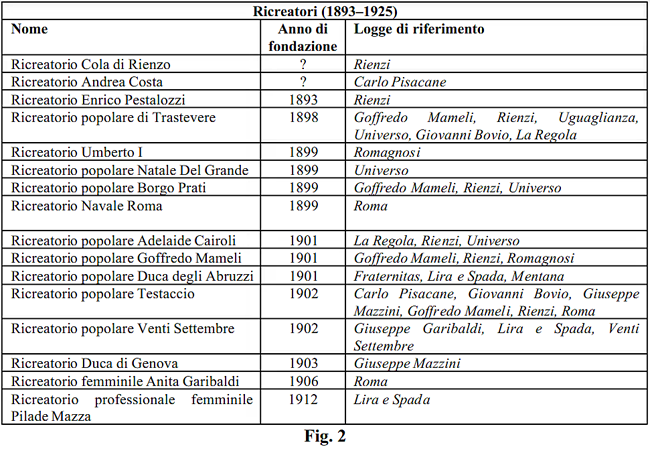
Il momento di svolta avvenne negli anni '90 dell'Ottocento: da questo momento l'azione sul versante educativo smise di essere frutto di iniziative di singoli esponenti e logge e si fece molto più articolata, con la creazione di numerosi educatori e ricreatori.
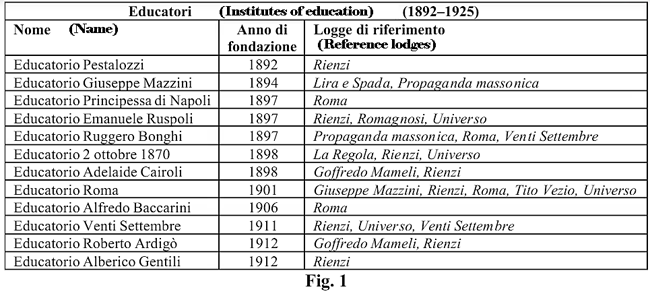
Se il primo educatorio nacque nel 1887, su input del Comune, nel corso di breve tempo la validità di questa offerta formativa fu riconosciuta e fatta propria dai massoni che ne istituirono e sostennero finanziariamente diversi. Incrociando i dati forniti dal saggio di Giancarlo Rocca con l'analisi dell'appartenenza massonica degli apparati dirigenti (grazie al registro matricolare del Grande Oriente d'Italia), è stato possibile individuare con certezza dodici strutture (vedi fig. 1). Si tratta di un numero molto significativo, corrispondente al 50% di tutte quelle istituite a Roma.
Questi educatori, sorti tra il 1892 e il 1912, videro la partecipazione attiva di pressoché tutte le logge presenti nella capitale (Giuseppe Mazzini, Goffredo Mameli, La Regola, Lira e Spada, Propaganda massonica, Rienzi, Roma, Romagnosi, Tito Vezio, Universo, Venti Settembre), con ruoli di primo piano affidati ai 'fratelli'. Esaminando più nel dettaglio i risultati della ricerca, emerge come le officine maggiormente impegnate nel sostenere queste iniziative furono la Rienzi, la Roma e l'Universo e che, nel corso del tempo, si venne a formare in una sorta di ragnatela, che copriva la capitale: pressoché tutti i quartieri della città avevano un educatorio a cui fare riferimento.
È importante, poi, sottolineare la presenza di diversi elementi di primissimo piano della dirigenza nazionale che si impegnarono personalmente nella gestione delle strutture, segno del comune sentire che univa gruppo dirigente e membri locali. Emblematico è il caso dell'Educatorio Roma. Fondato nel 1901, ebbe tra i promotori le più importanti personalità del Grande Oriente d'Italia: lo scultore Ettore Ferrari (futuro Gran Maestro), il deputato Salvatore Barzilai (personalità di spicco del partito repubblicano), il medico Achille Ballori (futuro Supremo Gran Commendatore del Rito Scozzese Antico ed Accettato) e il senatore Antonio Cefaly (vicepresidente del Rito Simbolico Italiano)52).
Gli educatori erano solitamente divisi in sezioni maschili e femminili (fa eccezione l'Alberico Gentili, dove le classi erano miste), che accoglievano bambini provenienti da famiglie povere nella fascia compresa tra i 6 e i 10 anni. I giovani vi si recavano dopo le 14:30, ottenendo un pasto gratis per poi restarvi fino alle 18:00. All'interno dei locali erano previsti corsi di canto, educazione civica, lavori manuali oltre ad esercizi ginnici e svaghi53).
52) Educatorio Roma, Statuto approvato nell'assemblea ordinaria del 2 marzo 1906 (Roma: Tip. latina, 1907).
53) Rocca, "Istruzione, educazione e istituzioni educative della massoneria a Roma dal 1870 all'avvento del fascismo," 54-55.
|
|
INTRODUCTION
The Italian unification and the constitution of the Kingdom of Italy having been achieved in 1861, Freemasonry found itself facing the enormous economic and social problems that afflicted the country. The young state, in fact, could not count on solid foundations, since it was born against the will of the Catholic Church and that the majority of the population had not participated in the Risorgimento movement.
In this difficult context matured the project to intervene in the educational field. If this was part of the philanthropic tradition pursued by Freemasonry, it acquired a further meaning, that of contributing to the formation of a national identity and cohesion. In short, it was necessary to 'shape' the citizens of the new state.
Consistent with this approach, the action of the Grand Orient of Italy, the most important and numerous Masonic obedience, intervened at 360 degrees in all areas of social life. Fighting poverty, building social housing, and training for young people and the unemployed were just some of the fields of action to which the lodges made their contribution. In the eyes of the Italian 'brothers', imbued with positivist thinking, education would have led to the moral and material emancipation of the working class.
Early attempts
Already in the constituent assembly of the Italian Grand Orient [G.O.I.], convened in Turin in December 1861, one of the participants, the Member of Parliament David Levi, had posed the problem of education: according to his opinion, one of the purposes of the G.O.I. should have been the promotion of kindergartens, evening and technical schools.1)
This first explicit declaration, however, did not have much success because the organization was committed to painstakingly gathering all the Masons of the Peninsula and therefore a few years had to pass for the topic to be addressed again.
The signal came from the top: the Grand Master Lodovico Frapolli, just took office, in August 1867 sent a circular in which he indicated a series of activities that every single lodge had to promote for the improvement of mankind, among which stood out the creation of schools for infants and workers.2)
Consistent with this statement, efforts were made to implement some initiatives. In 1868 the Italian National Association for Training and public Education was born. It was a project wanted and promoted by the Lodge Dante Alighieri of Turin which aimed, as referred to in its statute, to promote elementary education, putting pressure on the municipalities so that evening and holiday schools for adults as well as circulating public libraries would be established.3)
The association was aimed not only at Freemasons but at all those who had the problem at heart.
Starting from 1871, the Turin committee became the management center of this association, actively promoting the establishment of schools not only in the city but also in the countryside.4)
1) David Levi, Masonic program adopted by the reconstituted Italian Freemasonry presented by the Grand Secretary to the Grand Orient of Italy in the yearly session of the Worshipful Lodge No. 5861 (s.l.: s.e., 1861), 6.
2) "Circular," Bulletin of the Grand Orient of Freemasonry in Italy, vol. II (1867): 212.
3) Italian National Association for Education, Statute and Regulations (Turin: s.e., 1868)
4) Gildo Valeggia, History of the Florentine Masonic Lodge Concordia (1861-1911) (Milan: Bertieri and Vanzetti, 1911), CXIV-CXV.
Another contemporary initiative was the support for the newborn Italian section of the Teaching League. Founded in Belgium in 1864, on the initiative of some Freemasons of the Amis Philantrophe lodge, it had had a notable impulse and took root also in France.5)
The educational program it proclaimed had as its ultimate goal the emancipation of citizens and the end of clerical influence on civil society. To this end, it provided for the establishment of circulating public libraries, the presentation of scientific and political conferences, as well as the opening of evening, holidays, and professional schools.6)
Strengthened by the marked lay character that characterized it, the League turned to the Masonic community, launching an appeal in the magazine of the G.O.I. The subjects of the young kingdom had to receive a "wide, free, and universal" education, which would free them from prejudices: only in this way would they have undertaken the path of civilization that would have led them to become true citizens.7)
The call was answered, also in this case, by Lodge Dante Alighieri, who promoted, through Dr. Secondo Laura, the foundation of the local committee.
In 1868 the Florentine Lodge Nuova Campidoglio proposed the creation of an international Masonic high school. This school, although open to all, would have been entirely run by 'brothers' and would have been inspired by the most modern pedagogical theories. The students would have followed the normal path established by the Ministry, adding language courses to it.8)
The complexity of setting up and managing such an institution meant that the project was never realized, especially as the support of the leaders of the Grand Orient fell away.
Although the successes obtained had been limited, the constituent assembly of 1872, held in Rome, reaffirmed the importance of the Masonic commitment in the pedagogical field. The approved constitutions stated that the Obedience [G.O.I.] was to contribute to the betterment and perfection of mankind through education, training, and charity.9)
5) Roger Desmed, "Belgian Freemasonry and the secularization of education (1830-1914). An example: the lodge 'Amis Philanthropes' of Brussels," in Church and education. Proceedings of the colloquium for the 10th anniversary of the Institute of Christian History of the Free University of Brussels (22-23 April 1976), ed. Jean Préaux (Brussels: Editions de l'Université de Bruxelles, 1977), 197-222.
6) Fulvio Conti, "Freemasonry, School and Educational Issue in Liberal Italy," in Annals of the history of education and school institutions (Brescia: La Scuola, 2004), vol. XI, 19.
7) "The Italian League of Teaching in Italy," Journal of Italian Freemasonry 20 (1870): 1-4; P. Lazzarini [sic], "The League of Teaching," Journal of Italian Freemasonry 21 (1870): 4; no. 22: 3-4; no. 23: 2-4; no.2 (1871): 3-5.
8) Marco Novarino, "Freemasonry and education in Turin in the liberal era," in Annals of the history of education and scholastic institutions (Brescia: La Scuola, 2004), vol. XI, 82.
9) Constitutions of Italian Freemasonry discussed and approved by the Constituent Assembly of 1872 (Rome: Stabilimento Tip. Requestiedei, 1872), 4.
In 1874, the Grand Master Giuseppe Mazzoni resumed the appeal of his predecessor Frapolli. According to him, the Freemasons could not leave education in the hands of the Catholic monopoly, especially given the negative result obtained in parliament, where the proposal to make education compulsory was rejected. Once again, he reminded them how education was the weapon to defeat ignorance. The action of the lodges, therefore, had to be concrete, financially supporting teachers and pupils, providing books and ink, as well as opening rural and city libraries.10)
The commitment made personally by the Grand Master also had an impact on the official periodical of the Grand Orient, the Review of Italian Freemasonry. Here, in 1874, a special section was inaugurated in which were reported the pedagogical initiatives that the various lodges scattered throughout the Peninsula would have put in place.11) The implicit aim was to create a spirit of competition that pushed the lodges to increase their commitment in this sector.
The guidelines indicated by the leaders of the Italian Obedience were then continuously reconfirmed by subsequent councils. The fight against Catholic influence and the spread of knowledge were part of the process of secularization and modernization of which Freemasonry was the leading voice. The project followed a double trajectory: from above, through pressure on parliament and local administrations in favor of a policy that would make school free and compulsory; from below, with the promotion of educational and cultural structures that began the work and provided ideas and models to follow.
If the lobbying activity on the Chamber and Senate for the promotion of national educational policies has already been the subject of some analyzes (the reference work remains the monograph by Tina Tomasi),12) not as much attention has been given to the study of the initiatives implemented over the years in various Italian cities. Below we will focus on this last aspect, briefly taking into consideration three paradigmatic centers: Turin, Milan, and Rome.
10) Circular of 12 March 1874, envelope 58, f. 59, Carte Pianciani, Central State Archive of Rome (hereinafter ACSR).
11) "Education," Journal of Italian Freemasonry 10 (1874): 8.
12) Tina Tomasi, Freemasonry and school. From Unification to our days (Florence: Vallecchi, 1980.)
Turin
With the transfer of the capital to Florence (1864) and then to Rome, the city of Turin underwent a process of profound restructuring and transformation. The capital that had seen, in 1859, the resurgence of Freemasonry and therefore its structuring on a national basis, found itself having to manage the transition from the center of political life to an industrial center.
Thanks to the deep-rooted Masonic presence, the local exponents were able to make an important contribution to the birth of various pedagogical institutes.
The first, in chronological order, was the National Institute for the Daughters of Soldiers. Inaugurated in 1868, it represented the result of a compromise between the different currents that had fueled the Risorgimento: monarchists, moderates, and democrats. The idea was to build a boarding school that would welcome the soldiers' daughters and give them an education in step with the times.13)
The first 'Masonic' contribution was made by the former Deputy Grand Master Carlo Michele Buscalioni, who, although he had formally left the Order, continued to have very close relations with the lodges. Since he had been secretary of the Italian National Society, he was able to put pressure on the Women's Committee for Aid to the Wounded of the Homeland Wars by obtaining that it transferred to the school the entire capital still present in its coffers.14)
Although the operation was largely directed by the Member of Parliament, Tommaso Villa, member of lodge Cavour and future president of the institute (1898-1915), he could not prevent the clerical-moderate component from imposing a rigid division of girls according to the social class they belonged. The college, which welcomed girls from 8 to 18 years old, in 1876 was organized into three distinct structures that housed different school addresses: Villa della Regina (for the high-ranking young women), Casa Magistrale (for the daughters of the small and medium bourgeoisie) and Casa Professionale (for girls from peasant and worker families).15)
The first interesting aspect of this school was the significant interest in an excellent training of women to be employed in the nascent local industries, if coming from the humblest classes, or in strategic sectors such as schools, if belonging to more affluent families. The second element to underline was the debate that saw the different factions opposing the degree of secularism of the institute. Aware of the difficulty of imposing their own vision on the other members of the board of directors, the exponents of Freemasonry, Villa and Professor Ariodante Fabretti (vice president from 1887 to 1894 and an affiliated [member of] Lodge Dante Alighieri) were able to limit the religious staff to the chaplain and the teacher of religion, as well as to reduce the hours set aside for mass (only twice a week) and religious teaching (one hour a week).16)
13) See Demetrio Xoccato, "Monument to the events of the Risorgimento and laboratory of a female identity: the National Institute for the Daughters of the Military in Turin (1868-1914)," History of Women 12 (forthcoming).
14) Women's Committee of the Italian National Society for Aid to the Wounded in the Homeland Wars (s.l .: s.e., 1869).
15) National Institute for the Daughters of the Military, Organic Statute and General Regulations (Turin: Tip. Piazza, 1879), 25-27.
16) Minutes of 8 May, 14 May, 13 June and 13 October 1879, m. 51, Archives of the National Institute for the Daughters of Italian Soldiers, Turin State Archives. Court Section.
The National Institute for the Daughters of Soldiers was one of the most important experiments supported by Freemasonry in the field of female education. However, it did not substantially change the role of women in society. Although all Freemasons were in agreement in wanting the emancipation of women from the influence of the Catholic Church, it was much more difficult to determine what was, in practice, the educational path to follow and what its results. The woman, in fact, continued to be perceived as wife and mother: according to Cesare Prandi, author of an article in the magazine of the Grande Oriente, elementary and professional schools should have limited themselves to preparing young women in the management of the home.17)
In 1869 the entrepreneur Carlo Alfonso Bonafous died. A Freemason of French origin, he left an enormous sum (about 1,250,000 liras, equivalent to 5,700,000 euros) to the brothers of Lodge Dante Alighieri, with the task of building an agricultural school for abandoned and homeless minors.18)
After two years of tug-of-war between Villa and the prefect of Turin, who wanted to have weight in the future management of the structure, the Bonafous Institute was born. The school, located two and a half kilometers from the city, could count on vast cultivable lands and welcomed children between the ages of 10 and 18. Since many of them came from difficult [family] situations or from orphanages, it was organized according to a scheme that recalled the family organization: the pupils were divided into small groups, led by a staff member, and managed autonomously.19)
In addition to giving literacy lessons and elementary education, the board of directors sought to innovate the agricultural world, experimenting with new crops, and training the future farmers in the latest technological advances.20)
It is very difficult to assess the influence that the Masons had on the organization: the presence of "brothers" in the administration was extremely limited, except for Villa — first vice president (1871-1873) and then president (1874-1880), — while much more significant was the activity of economic support for the functioning of the school, with the presence of various entrepreneurial and bourgeois personalities.21)
It was probably a question of a calculation of opportunities: in the face of the difficulties of such an enterprise, to which was added the novelty of the experiment, it was considered better to offer purely financial support, leaving the management of the organization to others.
17) Cesare Prandi, "Women's education," Journal of Italian Freemasonry 9-10 (1877): 290-299.
18) "Alfonso Bonafous," Bulletin of the Grand Orient of Freemasonry in Italy, vol. II (1867): 614.
19) Tommaso Villa, Report of the commission appointed by the council to determine the foundations for the organization of the Bonafous Institute (s.l.: s.e., 1871), 19.
20) Demetrio Xoccato, "An education in the name of modernity: the Turin case (1868-1925)," The Commitment. Journal of Contemporary History 1 (2015): 24-25.
21) This is the list of the 'brothers' who supported the institute: the lawyer Alessandro Allis (Lodge Dante Alighieri); the chemist Giacomo Arnaudon (L. Cavour); Giuseppe Bracchi (L. Propaganda); the industrialist Giuseppe Melano (L. Italian Union of Buenos Aires); Senator Angelo Rossi (L. Dante Alighieri) and Commendatore Moise Treves (L. Cavour of the Symbolic Rite).
Still remaining in the field of professional education, in 1886 there was a first attempt to create a school for teaching mechanics. The initiative, which had seen the participation of Vittorio Mirano (president of the General Workers' Association and one of the protagonists of the rebirth of Freemasonry in Turin in 1859), received a good response, so much so that the Cavour lodge undertook to pay a financial contribution for the functioning of the institution.22)
In 1887, therefore, the Evening Workshops Schools were born, with the specific aim of transforming young apprentices into highly qualified workers, able to provide for themselves and their families.23)
The courses provided were various: working with wood, iron, clay, masonry construction and lithography. Over time, new lessons more related to industry were added, such as mechanical turning, repair of agricultural machinery and technical drawing.24)
A special mention should be made of the goldsmith course set up by the heirs of Carlo Borani, jeweler of the House of Savoy but also a member of lodge Ausonia.
The beginning of the twentieth century represented an important turning point because it saw a sudden surge in the Masonic presence in the top management of the institution. Up to that moment, in fact, the commitment of the 'brothers' had largely concentrated on the financial aspect (think of the financial support of the banker Carlo Bonis, a member of Lodge Cavour) and on the teachings, with the free contribution of several free masons as professors. With 1902, however, there was a change of strategy and Freemasonry assumed almost total control of the managerial positions: one of the two vice presidents (Giovanni Battista Diatto), the secretary (Annibale Cominetti) and the treasurer (Natale Caula) are affiliated to the Freemasonry, while the director of teaching staff, Francesco Bay, would become one in 1911.25)
22) Novarino, In the name of the great statesman. Le Logge Cavour in Turin from the Unification of Italy to the present day (Turin: Sottosopra, 2011), 144.
23) Evening Workshop Schools (Turin: Tip. Checchini, 1933), 8.
24) Workers' Evening and Holidays Workshop Schools Society, Evening Workshops Schools. Internal Regulations (Turin: Baravalle & Falconieri Press, 1905), 3.
25) Xoccato, "Ars et Labor. The Evening Workshops Schools of Turin (1887-1925)," Cahiers of social sciences 3 (2015): 240.
In the absence of sources that clarify the internal dynamics of this choice, we can still identify a basic fact: the lodges of the subalpine capital (Pietro Micca-Ausonia, Cavour and Dante Alighieri) were not the only ones to make a contribution to the school, but Members and lodges from the entire region also participated, such as [the lodges] Giordano Bruno of Pinerolo, Giuseppe Garibaldi of Novara and Andrea Vochieri of Alessandria.
This project was a sort of 'third way': faced with the choice whether to manage the institute together with other political and philosophical components or to limit oneself to providing economic support, it was decided to have complete control of the institution. It was a choice facilitated by the type of educational offer which, limiting itself to strictly professional training, made any anti-Masonic controversy unlikely.
The latest initiative took the form of the foundation of the first Popular University in Italy. It was an educational model that had already been present for some time in Europe, which had France and England as its reference countries. The purpose of these institutes was to spread a higher level culture among the most popular social strata — not able to attend actual universities — through conferences and lectures.26)
The main promoters of this project were the socialist Donato Bachi, the doctors Pio Foà and Amedeo Herltizka, as well as the astronomy professor Francesco Porro, all Freemasons. Thanks to their commitment, the University of Turin decided to allow the use of its classrooms, allowing the courses to officially start on November 12, 1900.27)
The first General Council elected Foà as president and Herltizka as secretary while, for the scientific committee, was appointed the famous mathematician Giuseppe Peano (member of [lodge] Dante Alighieri). The courses were paid for and open to all those who, in possession of an elementary school diploma, wanted to "cultivate the mind." Given the Masonic imprint, the statute explicitly excluded any political and religious interference.28)
The positivist training of most of the founders and teachers meant that most of the courses focused on practical and scientific topics. In fact, it was possible to follow lessons on hygiene, on the prevention of diseases, elementary notions of electricity, chemistry, and commercial law. Thanks to the success of the initiative, the school could enjoy a quiet and independent life, at least until 1930, the year in which fascism tried to incorporate it into its cultural activities.
26) See Vincenzo Borruso, Adult education and popular universities. A novelty with ancient roots (Palermo: Auser, 1997); Fabio Minazzi, editor, Knowledge for civil society: popular universities in the history of Italy (Varese: Popular University of Varese, 1994); Maria Grazia Rosada, Popular universities in Italy (1900-1918) (Rome: Editori Riuniti, 1975).
27) Enrico Miletto, " culture for the people." The Popular University of Turin (1900-1930) (Turin: Popular University of Turin, 2013), 21-25.
28) Popular University of Turin, Statute (Turin: Tip. Artigianelli, 1900).
Milan
As for Milan, it must be emphasized that the Masonic presence in this great center of the Po valley was not only deeply rooted but that here, more than in other places, secular and reformist forces met making the 'brothers' very active. Nevertheless, the topic of education was left aside until 1876, when the local lodges finally decided to commit themselves to the creation of educational institutions.29)
One of the first initiatives was the creation of a secular magazine that focused precisely on these issues. Thus was born "The Family and the School." Weekly instruction and education folio": directed by Ludovico Coiro, a member of lodge la Ragione, the newspaper did not have much success and was published only until 1878.30)
If this publishing project had little luck, much more significant was the effort to find alternatives to Catholic oratories [youth centers], in which young people grew up and found a meeting place.
As a first step, a commission was created with the aim of studying their functioning. Those in charge of drafting this analysis were Decio Nulli (member of the radical party) and the doctor Gaetano Pini, leading exponents of the local Freemasonry (without forgetting that the second was also president of the Italian Symbolic Rite, a rite that provided only the first three degrees). The reports of the two 'brothers,' which were later published, examined in detail the economic and administrative aspects of the male and female oratories.31)
On the basis of these reflections, the creation of a committee and a promoting society was decreed for the constitution of recreatories [places for children's recreation, after school or work hours], a sort of 'lay oratories' "to counter" to ecclesiastical structures. These were to provide young people with leisure and training courses in an equally comfortable, safe and economical environment.32) Leading the initiative was Senator Alfonso Sanseverino-Vimercati, a leading figure in local political and social life.33)
The organizational aspect followed exactly the Catholic model and it is no coincidence that they had the same opening hours. This decision showed the explicit desire to put itself in direct competition with these structures. The element that most exemplified the secular character of the institution was the obligation of the boys to participate in civil celebrations, instead of the usual religious holidays. To this was added another distinction: if in the [Catholic] oratories the prizes to the most deserving young people consisted of prayer books and sacred images, in the [secular] recreatories they were replaced by instructive books and portraits of illustrious men.34)
The first structure was inaugurated on July 16, 1879 within the premises of the Monastero Maggiore municipal school: the choice of making use of spaces already furnished and prepared made it possible to contain costs and focus on other necessities.
Despite the promising start, — 150 young people were registered,35) — the movement was not very successful and the recreatories did not spread within the city. The weakness of the initiative is also confirmed by a circular sent in 1892, in which, noting its poor success, it was asked to find a solution by actively participating in the congress of secular recreatories to be held in Pavia.36)
29) "Contemporary Chronicle," Civiltà Cattolica II (1877): 103-4.
30) Angelo Robbiati, "Festive Recreatories in Milan (1876-1906)," in Annals of the history of education and scholastic institutions (Brescia: La Scuola, 2004), vol. XI, 105.
31) Decio Nulli, The Catholic oratories in Milan. Relation to a philanthropic society (Milan: Civelli, 1877); Gaetano Pini, The oratories and Institutes for women's education in Milan. Relation to a philanthropic society (Milan: Civelli, 1877).
32) Nulli, The Catholic oratories in Milan. Relation to a philanthropic society.
33) Robbiati, "Festive Recreatories in Milan (1876-1906)," 108.
34) "The Recreatories," Journal of Italian Freemasonry 11-12 (1877): 337-342.
35) Robbiati, "Festive Recreatories in Milan (1876-1906)," 110.
36) Robbiati, "Festive Recreatories in Milan (1876-1906)," 111.
Despite the attempt to relaunch the project, the situation remained substantially unchanged and the few Recreatories added later (about four) were essentially the emanation of local associations and clubs not directly attributable to Freemasonry. The lack of Masonic support did not mean, however, the complete disinterest of the lodges in the educational field.
Indeed, it was in 1892 that the Italian Society for the Lay Education of Youth was born in Milan, to which the magazine of the Grand Orient dedicated an extensive article. This association had a twofold objective: on the one hand, to control textbooks and combat the Catholic presence in schools, and on the other to promote the foundation of colleges and school structures.37)
Since there are no traces of this association, it is to be assumed that it had a very short life and that the attention of the Masons was focused on other entities capable of responding better to concrete educational needs.
In 1893, in fact, the Humanitarian Society was founded, thanks to the ten million lire donated by the entrepreneur of Jewish origin Prospero Moisé Loria. The latter, in his will, had explicitly requested to start a philanthropic organization, with the aim of helping the poor by providing them "support, work and education."38) The Milanese Freemasonry did not immediately support the project, and the Freemasons present both in the promoting committee, set up to fulfill its last wishes, and in the first Governing Council (the aforementioned Nulli, of [lodge] La Ragione, Angelo Tondini, of the Carlo Cattaneo, and Osvaldo Gnocchi Viani), seem to have participated for personal convictions rather than for a directive decided by the Lombard 'brethren.'
The early years of the company were characterized by the presence of men linked to socialism and the labor movement (think of the president Guido Majno), an element that led the police to look suspiciously at the activities of the school, considered a place for the dissemination of subversive ideas. The Milanese riots of 1898 provided a good reason to oust the old leadership and place the institution under the control of the Municipal Charity Congregation.39)
37) "Italian Society for the Secular Education of Youth in Milan," Journal of Italian Freemasonry 4-6 (1892): 60-62.
38) The work of the Humanitarian Society from its foundation to today (Milan: Scuola del Libro, 1906), 16.
39) Fabio Pruneri, "The Humanitarian Society and Freemasonry," in Annals of the history of education and scholastic institutions (Brescia: La Scuola, 2004), vol. XI, 142.
After a long process brought by the old administrators, the Humanitarian Society was able, in 1901, to return to independence and resume its activities.
With the following year, all the various sections resumed their regular functioning focusing above all on assistance to all classes in difficulty, from the unemployed to the working poors. Therefore, were created employment offices, legal and medical assistance, secretariats in support of migrants, and a Casa del Lavoro [Work House]. The latter, established only in 1907, offered, for a limited number of days, a place to sleep for young people looking for a job.
The building activity promoted by the Humanitarian Society was also important: in 1905, in fact, it built a group of tenement houses, in which to welcome, at a reasonable price and in a hygienic environment, families with very low incomes.40)
Professional training represented the strong point. The workshops managed by the association were aimed at workers with at least three years of work experience and eager to improve their knowledge. The intent was to transform general workers into highly skilled executives.41) Among the expected teachings there were also more artisanal activities such as woodworking, ironwork, fabric decoration and goldsmithing.
The School of the Book deserves a separate discussion. Established in 1904, this printing workshop served a dual purpose: to train employees for the paper industry and to print books imbued with a moralizing spirit.
In 1910, the relations of the Humanitarian Society with the reformist socialist world became more and more stronger with the foundation of the Casa del Popolo, a collection and coordination center for all the initiatives created to help the workers of the Lombard city (National League of Cooperatives, Federation of Mutual Aid Societies and Camera del Lavoro [Labor Union).42)
The years following the First World War were marked by the [Humanitarian Society] presidency of Luigi Della Torre, a Freemason. However, this novelty did not represent a radical transformation of the association because the weight of the lodges remained quite limited within the board of directors. This seems to suggest that the Milanese lodges preferred to provide an economic and 'moral' contribution, rather than directly managing the structure. The 1924, however, did radically upset the internal equilibrium: the management was dissolved and replaced by the authority of men of confidence of the now in power fascism.43)
40) Pruneri, "The Humanitarian and Freemasonry," 144.
41) Augusto Osimo, "The Phenomenon of Unemployment and the Humanitarian Society," New CCIX Anthology (1906): 244-46.
42) Pruneri, "The Humanitarian and Freemasonry," 147.
43) Pruneri, "The Humanitarian and Freemasonry," 150.
Rome
The Eternal City, capital of the papal state until 1870, had a Masonic life that was difficult to quantify in the decade 1860-1870, because the 'brothers' had to escape the strict control of the [Papal] police. The Fabio Massimo lodge, for example, lived in hiding, so much so that the members were covered by secrecy and indicated with numbers.
Nonetheless, as soon as Rome was conquered and occupied by the Savoy forces, the Freemasons revealed themselves publicly and began to make their own contribution to the life of the city. The presence of the Pope and the widespread diffusion of ecclesiastical organizations and bodies constituted a significant obstacle: a success, however, would have had a strong symbolic meaning.
The first attempt dates back to 1871. A group of young people, among whom stood out the figure of the engineer Mario Moretti (of the Giordano Bruno lodge), gave birth to a public library.44) The following year was born the Italian Didactic Society, which set as its objectives the education of the people, the foundation of kindergartens, and the creation of another circulating library. To avoid controversy and disagreements that would undermined its action, the statute explicitly prohibited "political or religious discussions."45)
Thanks to the financial support of some workers' societies and of the lodges Universo, Tito Vezio and Uguaglianza, in 1875 was born the Roman League for the Education of the People.46) This association also proposed the clear separation between morality and religion, the establishment of cash prizes for pupils and families, in order to alleviate the economic difficulties of the weakest [family] nuclei. Another sector in which the league made its contribution was the creation of courses for adult workers, managed by university professors sensitive and willing to engage in the social sector (the intellectual Antonio Labriola for example).47)
To ensure full control of the institution, were installed in the steering committee the commissioner (and 'brother') Biagio Placidi, as president, the aforementioned Moretti and Luciano Morpurgo (who would soon enter Freemasonry and also become president of the League).48)
44) Daniela Fantozzi, "The movement for popular libraries in post-unification Italy," Historical Researches 3 (1995): 543-611.
45) Statute of the Italian Didactic Society of Rome approved in the general assembly of 17 October 1872 (Milan-Rome: Cooperative society between typographers and allied arts, 1872), 72; "The Roman League for the Education of the People," Journal of Italian Freemasonry 7-8 (1878): 235-236.
46) Biagio Placidi, Moral and economic report, made by the president of the Roman league for the education of the biagio placidi people, at the members' general assembly on March 26, 1876 in the Argentina theater (Rome: Tip. Della pace, 1876); Statute of the Roman League for People Education (Rome: Regia Tipografia, 1878).
47) "La League for Education," Journal of Italian Freemasonry 22-23 (1875): 3-4. On Labriola's interest in Freemasonry and its failed initiative, see Marco Novarino, Comrades and Freemasons. Socialism and Freemasonry from the Birth of the PSI to the Great War (Soveria Mannelli: Rubbettino, 2014), 333-39.
48) Placidi, Moral and economic report, made by the president of the Roman league for the education of the biagio placidi people, at the members' general assembly on March 26, 1876 in the Argentina theater, 9.
The next step was the establishment of Commissions within the districts of the capital which, however, did not have much luck. The limited financial capacity forced, therefore, to reduce the number of members of these committees to only one per neighborhood, appointed directly by the management.
Thanks to this restructuring, a first important result was achieved with the creation of a professional school for men in the Rione Ponte (1876). The institute welcomed young people aged seven and over and trained them in the profession of carpenter, cabinetmaker, and shoemaker. Despite the secular origin, the new president of the institution, Enrico Annibaldi, did not want to abandon customs, leaving the usual image of Christ on the cross to stand out in the classrooms.49)
This initiative represented the only concrete contribution on the educational level provided by the League, since the rest of the activity was limited to demonstrations in favor of compulsory schooling or financial support for students and their families.
Given the limited successes, Roman Freemasonry decided to direct its commitment to supporting the Umberto I Kindergarten, built in 1878 and, at least initially, of religious origin. In a short time, the 'brothers' began to infiltrate the institute, and then came to full control of the institution under the presidency of Achille Levi (in the early twentieth century). Also in this case, the leading role was held by lodge Universo, which contributed financially since 1882 followed, starting from 1907, also by the administrative council of the Grand Orient. Unlike what happened previously with the Rione Ponte school, they wanted to give the institute a more marked secular character, in the name of key words of Masonic rhetoric, such as homeland and mankind.50)
A similar model was followed by the Evening Folk School of Specialization. Aimed at young workers, in addition to providing elementary education and vocational training, it also had a kind of civic training course, entitled "Human and Citizen Duties."51)
49) Giancarlo Rocca, "Training, education and educational institutions of Freemasonry in Rome from 1870 to the advent of fascism," in Annals of the history of education and scholastic institutions (Brescia: La Scuola, 2004), vol. XI, 42.
50) Achille Levi, The pious educational work of a secular character (Rome: Bodoni, 1910).
51) Scientific, artistic and commercial guide of the city of Rome (Rome: Tip. Nazionale, 1886), 455.
The turning point came in the 1890s: from this moment the action on the educational front ceased to be the result of initiatives by individual exponents and lodges and became much more articulated, with the creation of numerous Educatories [Education Centers] and Recreatories.
If the first educatory was born in 1887, on input from the Municipality, in the course of a short time the validity of this educational offer was recognized and endorsed by the Masons who established and supported financially several ones. By cross-referencing the data provided by Giancarlo Rocca's essay with the analysis of the Masonic affiliation of the executive bodies (thanks to the matriculation register of the Grand Orient of Italy), it was possible to identify with certainty twelve structures (see fig. 1). This is a very significant number, corresponding to 50% of all those established in Rome.
These Education Centers, which arose between 1892 and 1912, saw the active participation of almost all the lodges present in the capital (Giuseppe Mazzini, Goffredo Mameli, La Regola, Lira e Spada, Propaganda massonica, Rienzi, Roma, Romagnosi, Tito Vezio, Universo, Venti Settembre), with leading roles entrusted to the 'brothers.' By examining the results of the research in more detail, it emerges that the lodges most committed to supporting these initiatives were the Rienzi, the Roma and the Universo and that, over time, it formed a sort of spider's web, which covered the capital: almost all the districts of the city had an education center to refer to.
It is also important to underline the presence of several leading elements of the national management who personally committed themselves to the management of the structures, a sign of the common feeling that united the management group and local members. The case of the Rome Education Center is emblematic. Founded in 1901, it had among the promoters the most important personalities of the Grand Orient of Italy: the sculptor Ettore Ferrari (future Grand Master), the member of Parliament, Salvatore Barzilai (leading figure of the Republican party), the doctor Achille Ballori ( future Supreme Grand Commander of the Ancient and Accepted Scottish Rite) and Senator Antonio Cefaly (vice president of the Italian Symbolic Rite).52)
The Education Centers were usually divided into male and female sections (with the exception of Alberico Gentili, where the classes were mixed), which welcomed children from poor families between the ages of 6 and 10. Young people went there after 2.30pm, getting a free meal and then staying there until 6pm. Inside the premises there were singing courses, civic education, manual work as well as gymnastic exercises and entertainment.53)
52) Educatorio Roma, Statute approved in the ordinary assembly of March 2, 1906 (Rome: Tip. Latina, 1907).
53) Rocca, "Education, education and educational institutions of Freemasonry in Rome from 1870 to the advent of fascism," 54-55.
|