
QSA Members Forum
For Masonic Research
The Golden Verses of Pythagoras
THE GOLDEN VERSES OF
PYTHAGORAS
Translated by Fabre d'Olivet

[EDITOR'S NOTE: PYTHAGORAS and his works play a dominant part in Masonic philosophy and symbolism, and these verses are reproduced here to show why. Pythagoras himself didn't write anything down, and most of the information about him and his work was written down centuries after he lived. What follows here is the Fabre d'Olivet Translation of the Verses published in 1813, later revised in a more modern version by Florence Firth in 1904, which has been followed here in the main, except for some changes in the wording and the addition of links leading to webpages where personages, places, occurrences, or theories are more fully described. This to give the reader the opportunity to gain a more comprehensive view of the material contained in this work.]
1. First worship the Immortal Gods, as they are established and ordained by the Law.
2. Revere the Oath, and next the Heroes, full of goodness and light.
3. Honour likewise the Terrestrial Dæmons by rendering them the worship lawfully due to them.
4. Honour likewise your parents, and those most nearly related to you.
5. Of all the rest of mankind, befriend him who distinguishes himself by his virtue.
6. Always give ear to his mild exhortations, and take example from his virtuous and useful actions.
7. Avoid as much as possible hating your friend for a slight fault.
8. Act according to your abilities, for what is possible is very near to what is necessary.
9. Know that all these things are as I have told you; and accustom yourself to overcome and vanquish these passions: —
10. First gluttony, sloth, sensuality, and anger.
11. Do nothing evil, neither in the presence of others, nor privately.
12. But above all, respect yourself.
13. Next, observe justice in your actions and in your words.
14. And do not get used to behaving yourself in anything without rule, and without reason.
15. But always keep in mind, that it is ordained by destiny that all men shall die.
16. And that the goods of fortune are uncertain; and that as they may be acquired, so may they likewise be lost.
17. Concerning all the calamities that men suffer by divine fortune,
18. Support your lot with patience, be it what it may, and never feel unhappy about it.
19. But do what thou can to make it better.
20. And consider that fate does not send the greatest portion of these misfortunes to good men.
21. There are among men many sorts of reasonings, good and bad.
22. Admire them not too easily, nor reject them outright.
23. But if falsehoods be advanced, hear them with mildness, and arm yourself with patience.
24. Try on every occasion to do what I am going to tell you: —
25. Let no man either by his words, or by his deeds, ever seduce you.
26. Nor entice you to say or to do what is not profitable for you.
27. Reflect and deliberate before you act, so that you may not commit foolish actions.
28. For it is typical of a miserable man to speak and to act without reflection.
29. But do that which will not afflict you afterwards, nor oblige you to repentance.
30. Never do anything which you do not understand.
31. But learn all you ought to know, and by that you will lead a very pleasant life.
32. In no wise neglect the health of your body;
33. But give it drink and meat in due measure, and also the exercise of which it has need.
34. Now by due measure I mean what will not bring you pain.
35. Accustom yourself to a way of living that is neat and decent without luxury.
36. Avoid all things that will occasion envy.
37. And be not unnecessarily prodigal, like one who knows not what is decent and honourable.
38. Neither be covetous nor stingy; a due measure is excellent in these things.
39. Do only the things that cannot hurt you, and deliberate before you do them.
40. Never let the pleasant sleep to close your eyelids, after you go to bed,
41. Until you have examined by your reason all your actions of the day.
42. Wherein have I done amiss? What have I done? What have I omitted that I ought to have done?
43. If in this examination you find that you have done something wrongly, reprimand yourself severely for it;
44. And if you have done anything good, rejoice.
45. Practise thoroughly all these things; meditate on them well; you ought to love them with all your heart.
46. These are the things that will put you on the way to divine virtue.
47. I swear it by him who has transmitted into our souls the Sacred Quaternion,*) the source of nature, whose cause it is.
48. But never begin to set your hand to any work, till you have first prayed the gods to accomplish what you are about to begin.
49. When you have made of this a habit,
50. You will know the bond uniting the Immortal Gods to the mortal men.
51. Even how far the different beings extend, and what contains and binds them together.
52. You shall likewise know that according to Law, the nature of this universe is in all things alike,
53. So that you shall not hope what you ought not to hope; and nothing in this world shall be hid from you. Thou wilt likewise know, that men draw upon themselves their own misfortunes voluntarily, and of their own free choice.
54. Thou wilt likewise know, that men draw upon themselves their own misfortunes voluntarily, and of their own free choice.
55. Unhappy that they are! They neither see nor understand that their good is near them.
56. Few know how to deliver themselves out of their misfortunes.
57. Such is the fate that blinds mankind, and takes away its senses.
58. Like huge cylinders they roll to and fro, and always oppressed with ills innumerable.
59. For fatal strife, innate, pursues them everywhere, tossing them up and down; nor do they perceive it.
60. Instead of provoking and stirring it up, they ought, by yielding, to avoid it.
61. Father Zeus! You could liberate men from innumerable evils,
62. By showing to each one of them the dæmon who guides him.
63. But take courage, man, be confident, for the race of mortals is of divine origin,
64. And their sacred nature reveals to them the most hidden mysteries.
65. Practicing what I command you, you will enjoy its benefits
66. And from the moment your soul will be healed, you will be freed from all evils.
67. But abstain from the foods, which we have forbidden in the purifications and in the deliverance of the soul;
68. Make a just distinction of them, and examine all things well.
69. May your soul be guided by right reason.
70. And when, after having divested yourself of your mortal body, will arrive to the purest Æther
71. Thou shall be a God, immortal, incorruptible, and Death shall have no more dominion over thee.
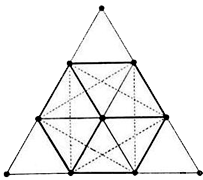 *) The Sacred Tetractys ("Sacred Quaternion") to the right, often called more simply the "Human Tetractys". This is only one of its representations, in a flat geometrical format, and a simplified one. The 10 points form a perfect triangle that includes the hexagon that is also the basic shape of the EthoPlasìn logo (at the top of the page) and some of its main buildings on the campus. The "Quaternion" refers to the "Quarter parts", or the 4 parts of the human being, each constituting a "Quarter" part of it. The first three components are the Body (with its instincts and related passions), the Soul (with its rational intellect and related passions), and the Spirit (with its judgment and pure intelligence). The fourth component has its location in the Spirit, but is only available after hard work of the human freewill for harmonizing and equilibrating the first three parts in a state of Godly Self Oneness. It is called philosophical Wisdom. Its attainment is the main purpose of life and the only hope of real human happiness but, unfortunately, because of ignorance, lack of will, or misuse of freewill, and thus missing work to harmonize the first three parts, it is too often out of reach. The four parts of the Quaternion are represented by both the 4 levels of the triangle and, in a more complete 3D version, by the Cube figure located in the middle of the Hexagon at the center of the Triangle. The six side angles of the central 2D Hexagon itself (or the six faces of the corresponding 3D Cube) are often used to represent the six forces at the base of all human holistic formation: the 4 Cardinal Virtues (Temperance, Fortitude, Prudence, and Justice), along with Beauty and Love. The overall 3D Tetractys symbol, with its central cube, should also be seen as integrated into a Sphere, that is the symbol of perfection once wisdom is reached.
Be it clear that each of the 4 cardinal virtues corresponds to each of the 4 levels of the Tetractys. Starting at the bottom: Temperance is the leading virtue of the body forces and its passions; Fortitude is the leading virtue of the soul and its passions; Prudence is the leading virtue of the Spirit and its passions; Justice is the leading virtue of the human Wisdom, but is fully attainable only in human beings who have reached that highest level of development in a state of Godly Self Oneness. For reasons of simplicity, Justice is usually considered the 4th virtue, at the 4th level of the Tetractys, but it is really a 5th virtue, over and above all the others, or, more than a 5th virtue, it is the effect of the harmonious amalgamation of the 3 lowest cardinal virtues controlling the human being in a state of "Godly Self Oneness". From this point of view, what we call "Godly Self Oneness," for lack of a better simple word for the translation of a beautiful and untranslatable word of Ancient-Greek, is really what is the 4th virtue. If we were not concerned to maybe unjustly look ludicrous, we could coin the new word "GodOneness" for that 4th virtue (from: GOdly Self ONENESS), but for the sake of simplification, we will agree that Justice is the 4th Cardinal Virtue at the top level of the Tetractys. The subject of philosophical virtues is in fact a very complex one, that includes 16 levels of virtues, but that is usually simplified in 4 main levels.
[EDITOR'S NOTES. 1) The note above has been "borrowed" from the EthoPlasìn Academy, PythAcademia — without permission. It is hoped the Academy will not be offended or aggrieved by it. On its site you will find a unique treasure trove of great classical philosophy. I wish you the time and the passion to jump with both feet into this site, and become the better and the wiser by each word you find there. 2) For a more comprehensive explanation of these Golden Verses, see also the NOTES ON THE GOLDEN VERSES OF PYTHAGORAS FROM THE COMMENTARIES OF HIEROCLES Here
