
QSA Members Forum
For Masonic Research
 Ramsay's Oration of 1737
Chevalier Andrew Michael Ramsay
and
Ramsay's Oration of 1737
Ref. Gould's History of Freemasonry — Vol. III, page 11
Compiled and Edited by R∴W∴ Bro. Gary L. Heinmiller,
Director, Onondaga & Oswego Masonic Districts Historical Societies [OMDHS]
April 2012

Webmaster's Note: With permission, we have reproduced here Bro. Gary L. Heinmiller's Paper published in the OMDHS website in 2012, followed below it by Le Discours (Oration) du Chevalier Andrew Michael Ramsay (1736) and by the its 1738 version, with commentaries, borrowed from other sources, rendering the exposition of this important figure of the 18th century nascent Freemasonry, Andrew Michael Ramsay, not well-known to English-speaking Masons, more complete. We owe to Bro. Francesco Angioni's researches our decision to publish what follows because, in his words: Chevalier Andrew Michael Ramsay "is historically very interesting and fundamental in regard to French and, more so, to German Masonic politics of the time. Templar Freemasonry was born in Germany from Ramsay's imaginative origin of Freemasonry in Palestine from the order of the Crusaders of St. John. Also interesting is Ramsay's attempt to bring Freemasonry closer to Catholicism and vice versa. He did not pronounce this publicly, but it transpires from the texts found many years later." Another Paper, by Henrik Bogdan, Faculty Member of the University of Gothenburg, published in academia.edu, gives a detailed account of the introduction of the High Degrees of Freemasonry. "Ramsey's oration, says Prof. Bogdan, proved to be a milestone in the development of Masonic rituals of initiation, and soon rituals began to appear that incorporated Ramsey's thesis. It was in the milieu of the Jacobite Parisian Lodges that the Masonic Templar Degrees first developed, perhaps as early as 1737."
Remarque: cette page est optimisée pour la voir avec Google Chrome (agrandi à 150%).
Please note: this page is best viewed with Google Chrome (zoomed at 150%)

Bro. Gary L. Heinmiller's Paper
The noble ardor which you, gentlemen, evince to enter the most noble and very illustrious Order of Freemasons, is a certain proof that you already possess all the qualities necessary to become members, that is, humanity, pure morals, inviolable secrecy and a taste for the fine arts.
Lycurgus, Solon, Numa and all the political legislators have failed to make their institutions lasting. However wise their laws may have been, they have not been able to spread through all countries and ages. As they only kept in view victories and conquests, military violence, and the elevation of one people at the expense of another, they have not had the power to become universal, nor to make themselves acceptable to the taste, spirit and interests of all nations. Philanthropy was not their basis. Patriotism badly understood and pushed to excess, often destroyed in these warrior republics love and humanity in general. Mankind is not essentially distinguished by the tongues spoken, the clothes worn, the lands occupied or the dignities with which it is invested. The world is nothing but a huge republic, of which every nation is a family, every individual a child. Our Society was at the outset established to revive and spread these essential maxims borrowed from the nature of man. We desire to reunite all men of enlightened minds, gentle manners and agreeable wit, not only by a love of the fine arts but, much more, by the grand principles of virtue, science and religion, where the interests of the Fraternity shall become those of the whole human race, whence all nations shall be enabled to draw knowledge and where subjects of all kingdoms shall learn to cherish one another without renouncing their own country. Our ancestors, the Crusaders, gathered together from all parts of Christendom in the Holy Land, desired thus to reunite into one sole Fraternity the individuals of all nations. What obligations do we not owe to these superior men who, without gross selfish interests, without even listening to the inborn tendency to dominate, imagined such an institution , the sole aim of which is to unite minds and hearts in order to make them better, to form in the course of ages a spiritual empire where, without derogating from the various duties which different states exact, a new people shall be created, which, composed of many nations, shall in some sort cement them all into one by the tie of virtue and science.
The second requisite of our Society is sound morals. The religious orders were established to make perfect Christians, military orders to inspire a love of true glory and the Order of Freemasons to make lovable men, good citizens, good subjects, inviolable in their promises, faithful adorers of the God of Love, lovers rather of virtue than of reward.
Polliciti servare fidem, sanctumque vereri
Numen amicitiae, mores, non munera amare.
To faithfully keep a promise, to honour the holiness of friendship
To love virtue, not its reward.
Nevertheless, we do not confine ourselves to purely civic virtues. We have amongst us three kinds of brothers: Novices or
Apprentices, Fellows or professed Brothers, Masters or Perfected brothers. To the first are explained the moral virtues, to the second the heroic virtues; to the last the Christian virtues; so that our Institution embraces the whole philosophy of sentiment and the complete theology of the heart. This is why one of our brothers [Comte de Tressan] has said:
Freemason, illustrious Grand Master
Receive my first transports,
In my heart the Order has given them birth,
Happy I, if noble efforts
Cause me to merit your esteem
By elevating me to the sublime,
The primeval Truth,
To the Essence pure and divine,
The celestial Origin of the soul
The Source of life and love.
Because a sad, savage and misanthropic philosophy disgusts virtuous men, our ancestors, the Crusaders, wished to render it lovable by the attractions of innocent pleasures, agreeable music, pure joy and moderate gaiety. Our festivals are not what the profane world and the ignorant vulgar imagine. All the vices of heart and soul are banished there, and irreligion, libertinage, incredulity and debauch are proscribed. Our banquets resemble those virtuous symposia of Horace, where the conversation only touched what could enlighten the soul, discipline the heart, and inspire a taste for the true, the good and the beautiful.
|
|
|
Thus, the obligations imposed upon you by the Order, are to protect your brothers by your authority, to enlighten them by your knowledge, to edify them by your virtues, to succor them in their necessities, to sacrifice all personal resentment, to strive after all that may contribute to the peace and unity of society.
We have secrets; they are figurative signs and sacred words, composing a language sometimes mute, sometimes very eloquent, in order to communicate with one another at the greatest distance, to recognize our Brothers of whatsoever tongue. These were words of war which the Crusaders gave each other in order to guarantee them from the surprises of the Saracens, who often crept in amongst them to kill them. These signs and words recall the remembrance either of some part of our science, of some moral virtue or some mystery of the faith. That has happened to us which never befell any former Society. Our Lodges have been established, are spread in all civilized nations and, nevertheless, amongst this numerous multitude of men never has a Brother betrayed our secrets. Those natures most trivial, most indiscreet, least schooled to silence, learn this great art on entering our Society. Such is the power over all natures of the idea of a fraternal bond! This inviolable secret contributes powerfully to unite the subjects of all nations, to render the communication of benefits easy and mutual between us. We have many examples in the annals of our Order. Our Brothers, traveling in diverse lands, have only needed to make themselves known in our Lodges in order to be there immediately overwhelmed by all kinds of succor, even in the time of the most bloody wars, while illustrious prisoners have found brothers where they only expected to meet enemies.
Should any fail in the solemn promises which bind us, you know, gentlemen, that the penalties which we impose upon him are remorse of conscience, shame at his perfidy and exclusion from our Society, according to those beautiful lines of Horace:
|
Est et fideli tuta silencio |
Loyal silence is surely rewarded |
Yes, sirs, the famous festivals of Ceres at Eleusis, of Isis in Egypt, of Minerva at Athens, or Urania amongst the Phoenicians, of Diana in Scythia were connected with ours. In those places mysteries were celebrated which concealed many vestiges of the ancient religion of Noah and the Patriarchs. They concluded with no banquets and libations when neither that intemperance nor excess were known into which the heathen gradually fell. The source of these infamies was the admission to the nocturnal assemblies of persons of both sexes in contravention of the primitive usages. It is in order to prevent similar abuses that women are excluded from our Order. We are not so unjust as to regard the fair sex as incapable of keeping a secret. But their presence might insensibly corrupt the purity of our maxims and manners.
The fourth quality required in our Order is a taste for useful sciences and the liberal arts. Thus, our Order exacts of each of you to contribute, by his protection, liberality or labor, to a vast work for which no academy can suffice, because all these societies being composed of a very small number of men, their work cannot embrace an object so extended. All the Grand Masters in Germany, England, Italy and elsewhere, exhort all the learned men and all the artisans of the Fraternity to unite to furnish the materials for a Universal Dictionary of the liberal arts and useful sciences, excepting only theology and politics.
This work has already been commenced in London and, by means of the union of our Brothers, it may be carried to a conclusion in a few years. Not only are technical words and their etymology explained, but the history of each art and science, its principle and operations, are described. By this means the lights of all nations will be united in one single work, which will be a universal library of all that is beautiful, great, luminous, solid and useful in all the sciences and in all noble arts. This work will augment in each century, according to the increase of knowledge, it will spread everywhere emulation and the taste for things of beauty and utility.
The word Freemason must therefore not be taken in a literal, gross and material sense, as if our founders had been simple workers in stone, or merely curious geniuses who wished to perfect the arts. They were not only skillful architects, desirous of consecrating their talents and good to the construction of material temples; but also religious and warrior princes who designed to enlighten, edify and protect the living temples of the Most High. This I will demonstrate by developing the history or rather the renewal of our Order.
Every family, every republic, every Empire, of which the origin is lost in obscure history, has its fable and its truth, its legend and its history. Some ascribe our institution to Solomon, some to Moses, some to Abraham, some to Noah, some to Enoch, who built the first city, or even to Adam. Without any pretense of denying these origins, I pass on to matters less ancient. This, then, is a part of what I have gathered in the annals of Great Britain, in the Acts of Parliament, which speak often of our privileges and in the living traditions of the English people, which has been the centre of our Society since the eleventh century.
At the time of the Crusades in Palestine many princes, lords and citizens associated themselves and vowed to restore the temple of the Christians in the Holy Land, to employ themselves in bringing back their architecture to its first institution. They agreed upon several ancient signs and symbolic words drawn from the well of religion in order to recognize themselves amongst the heathen and the Saracens. These signs and words were only communicated to those who promised solemnly, even sometimes at the foot of the altar, never to reveal them. This sacred promise was therefore not an execrable oath, as it has been called, but a respectable bond to unite Christians of all nationalities in one confraternity. Sometime after our Order formed an intimate union with the Knights of St. John of Jerusalem. From that time our Lodges took the name of Lodges of St. John. This union was made after the example set by the Israelites when they erected the second Temple who, whilst they handled the trowel and mortar with one hand, in the other held the sword and buckler.
Our Order, therefore, must not be considered a revival of the Bacchanals, but as an Order founded in remote antiquity, renewed in the Holy Land by our ancestors in order to recall the memory of the most sublime truths amidst the pleasures of society. The kings, princes and lords returned from Palestine to their own lands and there established divers Lodges. At the time of the last Crusades many Lodges were already erected in Germany, Italy, Spain, France and, from thence, in Scotland, because of the close alliance between the French and the Scotch. James, Lord Steward of Scotland, was master of a Lodge at Kilwinning, in the West of Scotland, MCCLXXXVI, shortly after the death of Alexander III, King of Scotland, and one year before John Balliol mounted the throne. This lord received Freemasons into his Lodge the Earls of Gloucester and Ulster, the one English, the other Irish.
Gradually our Lodges and our Rites were neglected in most places. This is why so many historians only those of Great Britain speak of our Order. Nevertheless it preserved its splendor amongst those Scotsmen of whom the Kings of France confided during many centuries the safeguard of their royal persons.
After the deplorable mishaps in the Crusades, the perishing of the Christian armies and the triumph of Bendocdar, Sultan of Egypt, during the eighth and last Crusade, that great Prince Edward, son of Henry III, King of England, seeing there was no longer any safety for his Brethren in the Holy Land, whence the Christian troops were retiring, brought them all back and this colony of Brothers was established in England. As this prince was endowed with all the heroic qualities, he loved the fine arts, declared himself protector of our Order, conceded to it new privileges and then the members of this Fraternity took the name of Freemasons after the example set by their ancestors.
Since that time Great Britain became the seat of our Order, the conservator of our laws and the depository of our secrets. The fatal religious discords which embarrassed and tore Europe in the sixteenth century caused or Order to degenerate from the nobility of its origin. Many of our Rites and usages which were contrary to the prejudices of the times were changed, disguised and suppressed. Thus it was that many of our Brothers forgot, like the ancient Jews, the spirit of our laws and retained only the letter and shell. The beginnings of the remedy have already been made. It is necessary only to continue and, at last, to bring everything back to its original institution. This work cannot be difficult in a State where religion and Government can only be favorable to our laws.
From the British Isles the Royal Art is now repassing into France, under the reign of the most amiable of Kings, whose humanity animates all his virtues and under the ministry of a Mentor, who has realized all that could be imagined most fabulous. In this happy age when love of peace has become the virtue of heroes, this nation, one of the most spiritual in Europe, will become the centre of the Order. She will clothe our work, our statutes, our customs with grace, delicacy and good taste, essential qualities of the Order, of which the basis is wisdom, strength and beauty of genius. It is in future in our Lodges, as it were in public schools, that Frenchmen shall learn, without traveling, the characters of all nations and that strangers shall experience that France is the home of all nations. Patria gentis humanae.
See also Encyclopedia of Freemasonry, Volume 2, By Albert Gallatin Mackey, H. L. Haywood, page 829.
Once thought of as the spiritual founder of the Scottish Rite, Chevalier Andrew Michael Ramsay (1696-1743) was admitted to a London lodge in 1730. As Grand Orator for the Grand Lodge of France, he gave a speech [Ramsay's Oration] before that Grand lodge on 24 Mar 1737 [now known to have been on 27 Dec 1736], in which he referred to legendary masonic origins in the Crusades. Author of Apology for the Free and Accepted Masons, in 1736, he died in 1743 at St. Germain-en-Laye. Biographies of him include A Chérel, Un aventurier religieux au xviii siècle, André-Michel Ramsay (Paris 1926) Chevallier, Les ducs, pp. 144-54 [pp. 35-37]
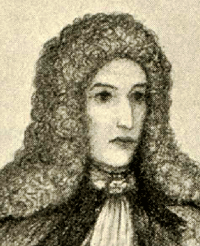 ANDREW MICHAEL RAMSAY - 9 January 1681- 6 May 1743. Raised a Calvinist, the Chevalier Andrew Michael Ramsay converted to Catholicism in 1709, although he was never entirely orthodox, as can be seen from his posthumously published The
Philosophical Principles of Natural and Revealed Religion unfolded in Geometrical Order. (Glasgow: 1749)
ANDREW MICHAEL RAMSAY - 9 January 1681- 6 May 1743. Raised a Calvinist, the Chevalier Andrew Michael Ramsay converted to Catholicism in 1709, although he was never entirely orthodox, as can be seen from his posthumously published The
Philosophical Principles of Natural and Revealed Religion unfolded in Geometrical Order. (Glasgow: 1749)
Leaving England for Holland in 1709, he soon moved to Cambrai where he lived with the eminent mystical theologian, Fénelon (1651-1715), Archbishop of Cambrai and later, in 1713 or 1714, to Blois where he was employed as secretary to the founder of Quietism, Madam Guyon. Relocating to Paris in 1716, he spent the rest of his life in or near that city.
It was here that he met the Duc d'Orleans who admitted Ramsay as a member of the Royal and Military Order of St. Lazarus of Jerusalem, giving him the title of Chevalier. James, the Old Pretender, was persuaded to grant him a certificate of nobility in 1723 and five years later he succeeded in having a diploma of nobility registered by the King of Arms in Edinburgh.
In 1724 he travelled to Rome as tutor to Charles Edward, Prince of Wales, where he was introduced to Philip, Duke of Wharton, He returned to Paris within twelve month. In 1729 he travelled to London where he was elected to fellowship of the Royal Society and initiated into Freemasonry the following year before returning to Paris.
Ramsay was once widely credited with introducing the Knights Templar lineage into what has been termed the masonic Orders of Chivalry, and for creating several such degrees. In fact Ramsey did nothing more than deliver an oration in Paris on 27 December 1736 [long thought to have been delivered on 21 March 1737] in which he expounded a Crusader transmission of masonic teachings. While he never promoted the creation of additional orders or degrees, he mentions the Templars once, in his posthumously published Philosophical Principles of Natural and Revealed Religion (1749), where he states that "every Mason is a Knight Templar."
It was Ramsey's request to Cardinal de Fleury to support Freemasonry which appears to have, in 1738, directly lead to Louis XV publishing an ineffectual edict prohibiting all loyal subjects from associating with Freemasonry, and Pope Clement XII to issue his Bull In Eminenti Apostulatus Specula on 17 April 1738 — a bull which was never promulgated in France.
Masonic historian Henry Coil notes: "For one who reached such notoriety, Ramsay's masonic career was unusually obscure."
Initiated: 16 March, 1730
Horn Lodge in the Palace Yard, Westminster
Founding member
Louis l'Argent Lodge
Grand Chancellor
Grand Orator
Grand Lodge of France
Andrew Michael Ramsay, (1686 - 1743), known in France as the Chevalier de Ramsay, was the son of a baker in Ayr, where he was born on 9 July 1686. He was educated at a school in Ayr and at the university of Edinburgh. After leaving the university he acted as tutor for some time to the two sons of the Earl of Wemyss, and about 1706 he went with the English auxiliaries to the Netherlands during the Spanish succession war. While on the continent he made the acquaintance of the theological mystic Poiret, and his religions views having, through Poiret's influence, undergone a change, he, after having left the army, went in 1710 to pay a visit to Fénelon, archbishop of Cambray. By the persuasion of Fénelon he entered the Catholic Church, and having gained Fénelon's special friendship, he remained with him till his death in January 1715. Fénelon left Ramsay all his papers. On Fénelon's death he went to Paris, became tutor to the Duc de Chateau-Thierry, and was made a knight of the order of St. Lazarus. While at Paris he also worked at his 'Vie de Fénelon,' which was published at the Hague in 1723, and was at once translated into English by N. Hooke. Its appearance brought him under the notice of the Pretender, James Francis Edward, who had been on terms of friendship with Fénelon. At the Pretender's request, Ramsay in 1724 went to Rome to be tutor to the Pretender's two sons, Prince Charles Edward and Henry, afterwards cardinal of York. He remained there for about a year and three months, the Pretender's alienation from his wife being probably the occasion of his resignation. After his return to Paris a proposal was made to him to become tutor to the Duke of Cumberland, third son of George II, but this he declined. In 1728, with the special permission of George II, he, however, undertook a journey to England, when he was chosen a member of the Royal Society, and received the degree of LL.D from the University of Oxford, being admitted of St. Mary's Hall. After his return to Paris he was appointed tutor to the Vicomte de Turenne, son of the Duc de Bouillon. He died at St. Germain-en-Laye on 6 May 1743.
Ramsay was also author of 'Discours de la Poësie Epique,' originally prefixed to an edition of 'Telemaque,' 2 vols. Paris, 1717;
'Essai philosophique sur le Gouvernement Civil,' London, 1721, reprinted as 'Essai de Politique,' and in English, London 1722 and
1769; 'Le Psychomètre ou Réflexions sur les differens Caractères de l'Esprit, par un Milord Anglais,' an essay on Lord Shaftesbury's
'Characteristics;' 'Les Voyages de Cyrus, avec un Discours sur la Mythologie des Payens,' Paris, 1727, London, 1728, and with
additions, 1730, 1733, in English by N. Hooke, London, 1730, 1739, and with additions, Glasgow 1755, and London, 1763, 1795, and 1816, written in imitation of Telemachus and the work on which his reputation chiefly rested; 'Poems,' Edinburgh, 1728; 'Plans of Education for a young Prince,' London, 1732; 'L'Histoire du Vicomte de Turenne,' Paris, 1735, The Hague 1736, and in English,
London, 1735; 'Philosophical Principles of Natural and Revealed Religion, explained and unfolded in a Geometrical Order,'
Glasgow, 1749; 'Two Letters in French to M. Racine, upon the fine Sentiments of Pope in his Essay on Man,' in 'Les œuvres de M.
Racine le Fils,' ii. 1747. His 'Apology for the Free and accepted Masons,' published in Dublin in 1738 and London in 1749, was burnt at Rome on 1 Feb. 1739. [Note there is a separate paper on this Apology' by the present compiler which may be read here. It is reasonably doubtful the Ramsay was the author of this 'Apology.' — g.l.h.]
[Chambers's Eminent Scotsmen; Swift's Works; Andreas Michael Ramsay by G. A. Schiffman, Leipzig, 1878; Brit. Mus. Cat.]
GOULD'S HISTORY OF FREEMASONRY THROUGHOUT THE WORLD
CHAPTER I
INTRODUCTION OF FREEMASONRY ABROAD — THE RISE OF ADDITIONAL RITES
THE CHEVALIER RAMSAY
It has been regarded as a matter of astonishment that, in the short space of from ten to twenty years after the establishment of the Grand Lodge of England, Freemasonry should have obtained a firm footing in the remotest parts of the continent of Europe. The circumstance, however, seems to be a natural result. England at that time was, without doubt, the centre of all eyes and any important movement in this country was bound to attract especial attention from the world at large. Marlborough's brilliant achievements abroad had made her weight felt on the Continent; the States of Europe were distracted and impoverished by constant wars, whilst England was at least undisturbed within her own frontiers and had become exceedingly wealthy. Her possession of Hanover brought her into close contact with Germany, but her alliance and, above all, her large subsidies, were desired by each of the contending States in turn and, as a consequence, her capital was the rendezvous of thousands of foreigners. In these circumstances the formation of the Grand Lodge could barely have escaped notice; but, when noblemen of high position and men celebrated for their learning began to frequent the assemblies, to accept office, to take part in public processions, proudly wearing the jewels and aprons, no foreigner resident in the City of London could fail to be struck with the phenomenon. For in those days London was not a province of vast extent. It was a city of ordinary dimensions and each citizen might fairly be expected to be acquainted with every part of it, as well as with the personal appearance of its chief notabilities. A duke or earl was not lost amongst the millions of people who now throng the thoroughfares. His person, equipages and liveries were familiar to the majority of residents, his words and actions the talk of every club and coffee-house. The Fraternity, so suddenly brought into prominence, must have attracted everyone's attention and many visitors to the metropolis must have been introduced into its circle. Returning to their own country, what more natural than a wish to enjoy there also those charming meetings where kindliness and charity prevailed, where the strife of parties was unknown, where the slightest allusion to political or religious controversy was forbidden. Whatis more natural than that those debarred from visiting its shores should desire to benefit by the new whim of "those eccentric islanders" and that, given a sufficient number of the initiated in any one town, Lodges should be formed? Even before regular Lodges were constituted, it cannot be doubted that informal receptions into the Fraternity took place whenever a few Freemasons met together. Wherever the earliest Lodges existed, there are found traces of previous meetings and, in no other way, can the presence in the first stated Lodges, of undoubted Freemasons initiated elsewhere, be accounted for. There seems little doubt that, within the five years from 1717, Freemasons were by no means scarce on the Continent. But little doubt can exist that no single Freemason ever lived on the Continent or elsewhere, whose Masonic pedigree did not begin in Great Britain. No former association, guild or otherwise, ever grew into a Fraternity of Freemasons outside these islands, nor was any connection with the building trades of the Continent ever claimed by the first Freemasons of Europe. The Craft there is a direct importation from England and, in its infancy and for many subsequent years, was confined entirely to the upper classes without the least admixture of the artisan. Even in Germany the language of the Fraternity was French, being that of the court and of diplomacy. All the earlier Minutes are recorded in that tongue and all the names of the first Lodges are French. For a few years the references are invariably to England and to English usages but, about 1740, a change took place. In contradistinction to English Masonry, a Scottish Masonry, supposed to hail from Scotland, but having no real connexion with the sister kingdom, arose, which was presumed to be superior to the hitherto known Craft and possessed of more recondite knowledge and extensive privileges.
Fertile imaginations soon invented fresh Degrees based upon and overlapping the English ritual. These Scottish Degrees were supplemented by additions of Chivalric Degrees, claiming connection with and descent from all the various extinct orders of knighthood, till finally we meet with systems of 7, 10, 25, 33, go and, eventually, 95 Degrees! The example was no doubt set in France and the fashion spread throughout Europe, till the Craft's stated origin in the societies of English builders was utterly lost sight of. It has been maintained that the impulse was given by the partisans of the Stuarts - refugees in France at the court of St. Germain - and that it was the result of intrigues to win the Craft to their political purposes. Color is lent to this view by the fact that the earliest names mentioned in connecton with French Freemasonry are those of well-known adherents of the Pretender. That Scotsmen and Englishmen residing in Paris should take the lead in an essentially English institution, does not appear sufficiently remarkable to warrant such a conclusion and, in the absence of anything like proof, cannot be entertained. In a solitary instance-the Strict Observance-it is possible that some such political design may have been cherished but, if so, it was dropped as useless almost before it was conceived and, certainly, the Stuarts themselves, on their own showing, never were Freemasons at all. Contemporary records are so scarce that little argument can be adduced on either side, whereas any amount of assertion has been freely indulged in. As the inducement to change possibly arose from the unlucky speech of a Scotsman - the Chevalier Ramsay - every arbitrary innovation was at first foisted on Scotland, as the most likely birthplace-in contradistinction to England, the land of the original Rite. How could a new Rite be fathered on France, Spain, Germany or Italy, where twenty years previously, as could at once be demonstrated, no Freemasonry had ever been heard of? There was absolutely no choice but Scotland, or peradventure Ireland, so Scotland obtained the credit of every new invention. The alleged connection with the Jacobites was clearly an afterthought. What is designated as Scots Masonry was unknown before the date of Ramsay's speech, but it appeared shortly afterwards. There is, therefore, a certain plausibility in representing the two as cause and effect; but the man and the discourse will now be considered and an endeavor made to present the facts in what seems to be their true light, for probably never was any character in Masonic annals with, perhaps, the single exception of the Baron von Hund, more unjustly held up to opprobrium and the scorn of posterity. Yet von Hund has always had a few upholders of his probity, whereas until quite recently no name has been too bad for Ramsay. Every petty author of the merest tract on Freemasonry has concurred in reviling a dead man on whose public or private life no slur can be cast, who was highly esteemed by great and good men of his own generation - whilst even writers of weight and authority have not disdained to heap obloquy upon him without one thought of his possible innocence. The general accusation against Ramsay is, that he was a devoted partisan of the exiled Royal Family of England; that he delivered or wrote a speech; that, in this speech, he willfully and knowingly fouled the pure stream of Masonic history; and that he so acted in the interests and to further the intrigues of a political faction. In view of acknowledged principles, no impeachment of a Freemason could be more serious, no action more reprehensible. Therefore, such a charge should only be brought on the clearest possible proof. Now the only particle of truth is that Ramsay certainly did write the speech. As for the other statements, if it can be shown that Ramsay was not a partisan of the Stuarts the whole libel loses the little consistency it ever possessed.
Rebold (Histoire des trois grander-loges, Paris, 1864, p. 44) says: "Ramsay was a partisan of the Stuarts and introduced a system of Masonry, created at Edinbro' by a chapter of Canongate-Kilwinning Lodge, in the political interests of the Stuarts and with the intention of enslaving Freemasonry to Roman Catholicism." The statement respecting the Edinbro' Chapter is too absurd to require refutation. Even the usually critical and judicious Kloss (Geschichte der Freimaurerei in Frankreich, Darmstadt, 18 52, vol. i, p. 46) declares "that it is clear that Ramsay purposely introduced higher Degrees in order to make a selection from the ranks of the brotherhood in the interests of the Stuarts and to collect funds for the Pretender"; whilst Findel does not scruple to call him "infamous." Only two writers have attempted to clear Ramsay's good name. Pinkerton (Notes and Queries, 4th series, December 18, 1869), the first of these, unfortunately takes up wrong ground. He argues that the speech is evidently a skit on Freemasonry and, therefore, not Ramsay's at all; further, that in view of Pope Clement's Bull-In Eminenti-Ramsay, who was a sincere convert to Romanism, could not by any possibility have been a Freemason.
But facts have since come to light which render it probable that the speech was delivered on March 21, 1737, whilst the Bull is dated 1738; while it is well known that, in spite of repeated Bulls, many conscientious members of the Roman Church have been at all times, are even now, members of the Craft. A few years ago, however, the Rev. G. A. Schiffmann, who, on other occasions, has shown that he possesses an unprejudiced mind and the courage of his convictions, published a pamphlet study of Ramsay (Andreas Michael Ramsay, Eine Studie, etc., Leipzig, 1878) and, although a few trifling details in his work may be subject to correction, his views in spite of Findel having done his best to prove their fallacy — are in the main those which merit the adoption of every critical reader. Had Masonic history always been studied in the same spirit of fearless, candid inquiry, there would be fewer fables and errors to correct. Although Schiffmann held an official appointment in Zinnendorff's Grand [National] Lodge, he, in 1870-6, gave expression to his opinion of the duplicity and deceit on which the whole Rite was based, supporting the Crown Prince's demand for inquiry and reform. He was consequently expelled in 1876, but received with high honor by all the more enlightened Lodges of Germany.
One of the most romantic figures in the history of Freemasonry is the Chevalier Andrew Michael Ramsay. He was born in Ayr on June 9, 1686, his father being a baker and, apparently, a strict Calvinist. The dates ascribed to his birth vary considerably. Rees' Cyclopaedia states he died in 1743, aged 57, which would place his birth in 1686, as stated. Chambers' Biographical Dictionary of Eminent Scotsmen gives the date as June 9, 1688. Findel also has 1686 and that date has been accepted by D. Murray Lyon. But, according to his own account (if correctly reported), he must have been born in 168o-i, because in 1741 he told Heir von Geusau that he was then sixty years old. This would make him sixty-two at the time of his death in 1743. Herr von Geusau was tutor to the son of the sovereign prince of Reuss, whom he accompanied in his travels through Germany, France and Italy. In Paris they met Ramsay, then tutor to the Prince of Turenne. Geusau kept a careful diary, anecdotal, personal, historical and geographical of the whole tour. This diary came into the possession of Dr. Anton Friedrich Buesching, who made extensive use of it for his Geography. He further gave copious extracts from it in Beitrdge Zu der Lebensgeschichte denkavurdiger Personen, Halle, 1783-9, 5 vols. In vol. iii some fifty pages are devoted to Ramsay's conversations with Geusau, respecting himself in general and his Masonic proceedings in particular, together with Geusau's reflections thereon. The Diary has unfortunately never been published in extenso, all allusions therefore by Masonic writers to Geusau's Diary are really to this collection of anecdotes of celebrated men. The value of the work consists in the fact that we have here a contemporary account of Ramsay, written with no ulterior object and, although at second-hand, Ramsay's own words concerning his Masonic career. Geusau was not a Freemason-a fact which enhances the value of his testimony.
After a brief period of tuition in a school at Ayr, Andrew entered Edinburgh University at the age of fourteen and, for three years, studied classics, mathematics and theology. He attained some fame in classical research and, throughout his life, the great Greek thinkers were his constant study and delight. Eventually he broke with Calvinism and was attracted to the mystical writings of Antoinette Bourignon, who was at that time enjoying a considerable following in Aberdeen. It was at one time believed that the famous Quietist travelled through Scotland in the dress of a hermit. She became famous at a time when both Scottish Episcopalianism and Scottish Catholicism had lost nearly all their spiritual vigor. As the outcome of her teachings, Ramsay got into touch with Poiret and the Quietist Movement in France, although he had become known as a Deist.
On leaving the University he took up the work of tutor and was engaged to teach the two sons of the Earl of Wemyss. * About 1706, however, he left Britain, only to return to it for short periods. He went first to Flanders, where he entered the army under the Duke of Marlborough, who was then engaged in the War of the Spanish Succession. In 171o he obtained an introduction to Fenelon, Archbishop of Cambrai and, as the outcome of an interview with him, Ramsay left the army and took up his abode with Fenelon, to study religion and to endeavor to gain peace of mind. He entered the Catholic Church in order to come directly under the Quietist Movement and he remained with Fenelon until the death of that dignitary in January 1715. Ramsay afterwards wrote the life of Fenelon, which was published at The Hague in 1723, in which there are vivid sketches of Madame Guyon and the violent Bishop Bossuet, the bitter opponent of Fenelon.
* Note the 4th Earl of Wemyss was David Wemyss (ca 1678-1720), who by his first marriage to Lady Anne Douglas sired James Wemyss (1699-1756) who was Grand Master of Scotland, 1743-44. By his second wife, Elizabeth Sinclair, David sired Margaret Wemyss (bef 1820-1799), who married James Stuart, 8th Earl of Moray and Grand Master of Scotland, 1744-46. By several other interesting marriages in this distinguished line there were several other Grand Masters. For a far more detailed look at the intermarriages and relationship of the Grand Masters of England, Scotland and Ireland, you are Fraternally invited to a series of Genealogical Charts showing a considerable of the these relationships here. If you click on the red links on the charts it will take to various other interesting, extensively connected charts — g.l.h.
There is no need to wonder that Ramsay was attracted by the beautiful life, words and actions of the celebrated Archbishop, whose all-embracing Christianity never shone more conspicuously than during the Flemish campaigns and by whom he was converted to the Roman faith. There is no proof or symptom of proof that Ramsay became such a fervid Ultramontanist as has been stated. The character of his master would almost forbid it. Fenelon was one of the pillars of the Gallican Church, which was by no means in servile submission to that of Rome, although in communion with it; and the liberal breadth of his views was so widely spread as to incur the enmity of the great Bossuet and the open hostility of the Jesuits. Ramsay's printed works breathe a spirit of toleration worthy of his master. To Geusau we are indebted for an anecdote which goes far to prove that he was no bigot. During his short residence at Rome an English lord lived at James's Court who was married to a Protestant lady. A little girl was born to the couple and, the parents being in doubt as to their proceedings, Ramsay advised that she should be christened by one of the two Protestant chaplains of the household and exerted himself to such good effect in the cause as to win the consent of the Cardinal Chief of the Inquisition. And Geusau, himself a Protestant, declares that Ramsay was a learned man, especially well informed in both ancient and modern history. He praises his upright and genial nature, his aversion to bigotry and sectarianism of all kinds and avers that he never once made the least attempt to shake his faith. Was this the kind of man to pervert Freemasonry in the interest and at the bidding of the Jesuits? After Fenelon's death Ramsay went to Paris and became tutor to the young Duc de Chateau-Thierry and gained the friendship of the Regent, Philippe d'Orleans. The Regent was the Grand Master of the Order of St. Lazarus, into which he admitted Ramsay, who thus became known as the Chevalier Ramsay. This Order was founded in the fourth century in Palestine and erected hospitals for lepers, which were known as Lazarettes. It was founded as a military and religious community, at the time of the Latin kingdom of Jerusalem. Popes, princes and nobles endowed it with estates and privileges, but the knights were driven from the Holy Land by the Saracens and, in i2gi, migrated to France and to Naples in 1311. It is now combined with the Order of St. Maurice and is conferred by the King of Italy, who is Grand Master, on persons distinguished in the public service, science, art, letters and charitable works, to which last-named its income is devoted.
Ramsay remained in Paris until 1724, when he accepted the post of tutor to Charles Edward and Henry (afterwards Cardinal of York), the two young Princes of the exiled House of Stuart, sons of the Pretender, James Francis Edward (James III), who had been on terms of friendship with Fenelon. He found the strange, though interesting, Court of St. James at Rome an uncomfortable abode and, after about a year, he resigned his position, in consequence of the constant intrigues and petty jealousies that surrounded the unfortunate James. Ramsay was an ardent Jacobite and he described the Pretender as " a very clever, fine, jovial, free-thinking man." In 1725, Ramsay was offered the post of tutor to the Duke of Cumberland, the second son of George II, but refused because of his adoption of the Roman Catholic faith and because he had no liking for that reigning monarch. He was, however, given a safe conduct to Britain and, towards the end of 1728, he arrived in London and immediately proceeded to Scotland, where he became the guest of the Duke of Argyll at Inverary. The Duke possessed one of the largest libraries in the United Kingdom, was a man of culture and a friend to higher education.
Ramsay made his way quickly into literary circles. He was in Oxford in 1728 as the guest of the Marquis d'Abais. On March 12, 1729, he was made a member of the Gentlemen's Society at Spalding, the membership of which was composed largely of Freemasons and, in the same year, he was elected F.R.S. , whilst, in the following year, Oxford conferred upon him the degree of D.C.L., he having previously been admitted a member of St. Mary's Hall. There was a strong minority opposed to him, which showed itself after the Earl of Arran, then Chancellor of the University, had proposed him for the honor. The opposition was on the grounds that he was a Roman Catholic, a -Jacobite and had been in the service of the Pretender. Dr. King, the principal of St. Mary's Hall, spoke in Ramsay's defence and concluded his speech by saying: Quod instar omnium est. Fenelonii magni archi prasulis Camara censis alumnum prasento vohis. Thefe were 85 votes in favor of his receiving the degree and 17 against. He was the first Roman Catholic to receive a degree at Oxford since the Reformation.
Hearne's Diary, under date of April 2o, 173o, has the following entry Last night Mr. Joyce and I (and nobody else) spending the evening together in Oxford, he told me that the Chevalier Ramsay (who is gone out of town) gave (before he went) in consideration of Dr. William King's Civilities to him in Oxford, the perpetual right of printing his Travels of Cyrus in French (which is) original, (the English being a translation and the Right given to another) provided the profits be turned to the benefit of St. Mary Hall. Inquiriing more about this, Mr. Joye was one of the witnesses to the deed of gift.
Chambers (Biographical Dictionary of Eminent Scotsmen, 1835, vol. iv, p. 137) is under a mistake in stating that the degree was conferred upon him by Dr. King, principal of St. Mary's Hall. Dr. King, not being Vice-Chancellor, could not have conferred the degree, though he might have been instrumental in procuring it for him. The only record of members of St. Mary's Hall is the buttery-book and Ramsay's name first appears there as charged for battels on the same date but, although his name is kept on the books for some years afterwards, he is never again charged, so that it is to be presumed he never went into residence. Curiously enough the usual entry of his admission to the Hall cannot be found, while another peculiarity is, that he is always described in the buttery-book as " Chevalier Ramsay, LL.D.," probably in error, this being the Cambridge degree, whereas the Oxford degree was D.C.L. Evidently this man, taking such a prominent position in London life, could not have been a notorious Jacobite intrigant.
Ramsay's work, the Travels of Cyrus, had been published in Paris in 1727 and immediately attained world-wide popularity, although the author was denounced by the critics as a "deistical, freethinking, socinian, latitudinarian, despiser of external ordinances." The work was widely translated and editions published at London, Glasgow, Breslau, Lisbon, Madrid, Naples and Leyden; the last British edition being published at London in 1816. It had, as an appendix, A Discourse upon the Theology and Mythology of the Pagans, the design of which was to show that "the most celebrated philosophers of all ages and of all countries have had the notion of a Supreme Deity, who produced the world by his power and governed it by his wisdom." That Ramsay was no Freethinker is proved by the opening lines of his poem on "Divine Friendship."
O sovereign beauty, boundless source of love,
From Thee I'm sprung, to Thee again I move
I Like some small gleam of light, some feeble ray
That lost itself by wandering from the day.
Or some eclips'd, some faint and struggling beam
That fain would wrestle back from whence it came.
So I, poor banished I, oft strive to flee
Through the dark maze of nothing up to Thee.
When Ramsay returned to France, he accepted the post of tutor to the Vicomte de Turenne, son of the Duc de Bouillon. He became actively associated with Freemasonry and it is claimed that he instituted new Degrees, the funds of which were devoted to the assistance of the exiled Stuarts. In 1737 he was Chancellor or Orator of the Grand Lodge of France, during the Grand Mastership of Lord Harnouster, when he delivered an oration, which has made his name famous in the annals of the Craft. This was published afterwards as the Relation Apologique de la Franc-Maçonnerie which, Kloss says, was the first thorough and circumstantial defense of the Craft. It was publicly burned at Rome by command of the Pope, on the ground that it was a work which tended to weaken the loyalty of the people. The incident is referred to in the Gentleman's Magazine for 173 8, in the following words There was lately burnt at Rome, with great solemnity, by order of the Inquisition, a piece in French, written by the Chevalier Ramsay, author of the Travels of Cyrus, entitled An Apologetical and Historical Relation of the Secrets of Freemasonry, printed at Dublin, by Patric Odonoko. This was published at Paris in answer to a pretended catechism, printed there by order of the Lieutenant of Police.
That Ramsay was a Freemason and Grand Chancellor of the Paris Grand Lodge is known from his conversations with Geusau, but he never stated when and where he was initiated. Inasmuch as he was in Flanders in 1709 and did not return to England till 172.5 at the earliest, he could scarcely at that time have been a member of the Craft, unless "entered" at Kilwinning previous to the era of Grand Lodges. Lyon (History of the Lodge of Edinburgh, p. 308), however, vouches for the fact that he was not a member of Kilwinning. It would appear probable that he was initiated in London circa 1728-c9. Among his fellow members of the Gentlemen's Society of Spalding, were no fewer than seven very prominent Freemasons and among his brother Fellows of the Royal Society, from '1730 to 1736 (the probable limit of his stay in England), were Martin Folkes, Rawlinson, Desaguliers, Lord Paisley, Stukeley, the Duke of Montagu, Richard Manningham, the Earl of Dalkeith, Lord Coleraine, the Duke of Lorraine (afterwards Emperor of Germany), the Earls Strathmore, Crawford and Aberdour, Martin Clare and Francis Drake. In such a company of distinguished Freemasons, it can scarcely be doubted that Ramsay soon became a prey to the fashion of the hour and solicited admission to the Fraternity, also that the Lodge to which he is most likely to have applied was that of the " Old Horn," of which Desaguliers and Richard Manningham were members. This supposition cannot be verified, because that Lodge (unlike some of the rest) has preserved no list of its members for 1730. If he left the Continent circa 1726, he could scarcely have been initiated there, except perhaps by individual Brethren, in an irregular manner, because the first Lodge heard of-out of Britain-was held at Paris in '1725. The facts, however, are by no means as clear as might be desired.
The Almanac des Cocus was published in Paris from 1741-3. Pinkerton states it was a vile and obscene publication. If so, it merely reflected the lascivious tendencies of the age and country and there is no reason on that account to declare that Ramsay could be the author of no part of its contents. It naturally treated the subjects of the day and might have published his Oration without previously consulting the writer. In the edition for 1741 appeared "Discourse pronounced the new articles of 1738, with various introductions by the author. He claims to at the reception of Freemasons by Monsieur de R---, Grand Orator of the Order." The next publication of the same Oration was in 1742 by De la Tierce (Histoire, Obligations et Statuts de la tr. Ven. Confraternities F.M., etc., 1742, 1745), who describes himself as a former member of the Duke of Lorraine's Lodge, London, whose book is in substance a translation of the Constitutions of 1741, supplemented by i have produced facts omitted by Anderson; indeed gives a very detailed account of the Grand Masters, from Noah onwards, reserving a distinguished place to Mistaim. The introduction preceding the "Obligations of a Freemason "consists of" the following discourse pronounced by the Grand Master of the Freemasons of France, in the Grand Lodge, assembled solemnly at Paris, in the year of Freemasonry, five thousand seven hundred and forty." It reappeared in other public publications, London, 1757 and 1795 (in French); the Hague, 1773 (also French); in the appendix to the second (1743) and third (1762) editions of the first translation into German of Anderson's Constitutions (Frankfort, 1741); and elsewhere. It will be observed that the Almanac, attributes, the speech to a Mr. R. and gives no date; Tierce, to the Grand Master in 1740; whilst, according to Kloss (Geschicbte, etc., op. cit., vol. i, p. 44), the German translations merely state that the Grand Orator delivered it. That the speech was Ramsay's is known from his confession to Geusau and the only remaining matter of doubt is the exact date of its delivery. Jouast (Histoire du Grand Orient de France, Paris, 1865, p. 63) maintains that it was delivered on June 24, 1738, on the occasion of the installation of the Duc D'Antin as Grand Master, referring to the Duke some expressions therein which probably applied to Cardinal Fleury; states that the speech was first printed at the Hague in 1738, bound up with some poems attributed to Voltaire and some licentious tales of Piron. If such a work really existed at that date, it was probably the original of the Lettre philosophique par M. de V---, avec plusieurs pieces galantes, London, 1757 and, again, in 1795; but Kloss, in his Bibliographie, knows nothing of it.
Thory dates the appearance of Ramsay as Orator, December 24, 1736 (Acta Latomorum, Paris, 1815, vol. i, p. 3z). But J. Emile Daruty would appear to have settled the matter almost beyond doubt, by the discovery, in a very rare work (P. E. Lemontey, Histoire de la Regence et de la Minorite de Louis XV, jusq'au Ministère du Cardinal de Fleury, Paris, vol. vii, pp. 292 et seq.) of the two following letters (Recherches sur le rite Ecossais, etc., Mauritius and Paris, 1879, pp. z87, 288), addressed by Ramsay to Cardinal Fleury, the all-powerful prime minister of France.
March 20, 1737.
Deign, Monseigneur, to support the Society of Freemasons [Ramsay used the English spelling] in the large views which they entertain and your Excellency will render your name more illustrious by this protection than Richelieu did his by founding the French Academy. The object of the one is much vaster than that of the other. To encourage a society which tends only to reunite all nations by a love of truth and of the fine arts, is an action worthy of a great minister, of a Father of the Church and of a holy Pontiff.
As I am to read my discourse to-morrow in a general assembly of the Order and to hand it on Monday to the examiners of the Chancellerie [the censors of the Press-prior to publication], I pray your Excellency to return it to me to-morrow before mid-day by express messenger. You will infinitely oblige a man whose heart is devoted to you.
March 22, 1737, I learn that the assemblies of Freemasons displease your Excellency. I have never frequented them except with a view of spreading maxims which would render by degrees incredulity ridiculous, vice odious and ignorance shameful. I am persuaded that if wise men of your Excellency's choice were introduced to head these assemblies, they would become very useful to religion, the state and literature. Of this I hope to convince your Excellency if you will accord me a short interview at Issy. Awaiting that happy moment, I pray you to inform me whether I should return to these assemblies and I will conform to your Excellency's wishes with a boundless docility.
Cardinal Fleury wrote on the margin of this letter in pencil, Le roi ne le vent pas. This probably explains Ramsay's meteor-like appearance in Masonic annals; for the only sign we have of his activity in Lodge is connected with this speech. Thory's assertions that he promulgated a new Rite was made sixty years afterwards without a shadow of proof. His speech may possibly have given rise to new Degrees, but what grounds are there for ascribing their invention and propagation to him? But precisely because Ramsay is only known by this one speech, does it appear probable, that in the above letters he is alluding to this one and no other ; if so, it was beyond doubt delivered on March 21, 1737.
The speech itself - in its entirety - is unknown in an English garb and, as the various versions differ slightly, the translation chosen is that of De la Tierce, which is generally accepted as the most correct.
[Here Gould transcribed Ramsay's Oration, as given above using Rev. Oliver's version.]
Now to what does this speech amount? a mere embellishment of Anderson! Builders and princes had united in Palestine for a humane purpose; the Society had been introduced into Europe, especially Scotland; had perished and been reintroduced into England by Prince Edward. From that time they had continued a privileged class of builders-Ramsay no longer claims for them knightly attributes -and had lost their moral tenets during the Reformation, becoming mere operative artisans; they had lately recovered or revived their old doctrines; and France was destined to be the center of the reformed Fraternity. The introduction of the legend of the Crusades may be taken to be a natural consequence of Ramsay's position in life, of the high nobility and gentry he was addressing, to whom the purely mechanical ancestry may have wanted toning down. But surely the Oration is not such a very heinous one? More dangerous and absurd speeches are still made in the Craft. That inventive minds, for their own purposes, may have seized upon and falsely interpreted certain passages, is no fault of Ramsay. It was looked upon with approbation by his contemporaries; it is simply impossible to find in it any indication of a desire to pervert Masonic ceremonies. One or two points may be further inquired into. The cause of the allusion to Kilwinning may simply be that Ramsay was from Ayr and, probably, as an antiquary acquainted with its very ancient history, brought in the Lodge merely as an ornament. His choice of the Order of St. John of Jerusalem may easily be accounted for. It was not the St. John of Malta, nor was he ever known to allude to the Templars. The fact is, he was himself a Knight of St. John of Jerusalem and thus paid a tribute to his own Order. In 1714-19 Helyot's great work on the spiritual and temporal orders was published in Paris (Hilt. des Ordres Monastiques, Religieux et Militaires). The third volume contains the history of the Order of St. Lazarus, of which Ramsay was a knight. Who can doubt that he read it? This states that in the fourth century an Order of St. Lazarus was established in Palestine and erected everywhere hospitals for lepers, which were called Lazarettes. Later on the Hospitallers of St. John of Jerusalem were established. The two associations united and worked under the same master, called the Master of the Hospital. When the Order of St. John added the vow of celibacy, these two separated. One retook the name of St. Lazarus, the other changed theirs to St. John the Baptist. At the time that the Hospitallers were in the service of the King of Jerusalem, they consisted of three Orders - knights to fight, servitors to nurse and clerics or chaplains. King Henry of England increased considerably their income, but France did most for the Order and it ultimately took refuge in that country. The Grand Master of that day was styled Grand Master of the Holy Order of Lazarus cis et translvare. In 1354 the Grand Master empowered John Halliday, a Scot, to rule over the temporal and spiritual affairs of the Order in Great Britain. In some sort, then, Ramsay was a descendant of the Order of St. John of Jerusalem, which, however, as such, was extinct and thus may be understood the very natural selection made of that Order on which to found his romance.
Following the Oration, we have a copy of Statutes in usage [at that time] in France. These are a paraphrase, more or less, of Anderson's Old Regulations. One in particular must be quoted, because they are all attributed to Ramsay — though without rhyme or reason — and because this especial one has been used to prove that he intended to employ Freemasonry for the propagation of the Roman Catholic religion.
Every incredulous brawler who shall have spoken or written against the holy dogmas of the ancient faith of the Crusaders shall be forever excluded from the Order; etc., etc.
But who would think that this was meant to exclude Protestants? The ancient faith of the Crusaders was Christianity. At a time when the Protestants were not thought of, no distinction could possibly be made between them and the then Universal Church. It would be absurd to call the Crusaders Roman Catholics in contradistinction to Protestants. The article simply means that Masons must be Christians; must be of the Catholic Church: whether Roman, Anglican, Greek or any other variety, was not even thought of. Therefore, even should these articles owe their inspiration to Ramsay — owing to want of evidence — they are quite powerless to strengthen the odious calumny under which he has so long lain.
One other matter must be referred to, although of no great importance. In 1736, the Lieutenant-General of Police in Paris, Herault, is said to have obtained, through an opera dancer, Madame Carton, a Masonic examination, mainly a translation of Pritchard's Masonry Dissected, which he caused to be published as an exposure of Freemasonry. In reply to this appeared Relation apologique et historique de la Société des F.M., par J. G. D. M. F. M., Dublin, Chez Patrice Odonoko, 1738, — 2nd edition, in London, 1749. It was burned in Rome, as mentioned already, by the Public Executioner on February 1. Many ingenious attempts have been made to prove the truth of this statement and to show the community of style and ideas between Ramsay's Oration and the Relation. As long as there was reason to suppose that the Oration was delivered in 1740, it was difficult to decide why Ramsay should have been selected to father this production and the very audacity of the assertion carried conviction with it. It could only be assumed that the correspondent of the Gentleman's Magazine was in possession of certain private information. But if the Oration was delivered in 1737, it is easy to conceive that the Relation might well have been attributed to the same hand in 1738. A mere guess at the hidden authorship. This fact tends to corroborate the Oration's date of 1737, for it may safely be affirmed that Ramsay did not write the Relation. Its style is far less pure than his, the orthography is totally distinct. Ramsay doubles all his consonants in such words as apprendre, combattre, diffcile; the author of the Relation writes aprendre, combatre, dificile, etc. The initials of the author, J. G. D. M. F. M., might perhaps be read as J. G., Dr. Med., Free Mason.
A word must, however, be said as to the case for the plaintiff.
Dr. George Oliver paid the Chevalier a high tribute for inventive genius, when he said if I had not found certain unmistakable inventions of a Master's part at an earlier date than the period when the Chevalier Ramsay flourished, I should have assigned the invention of this legend to him, as he was possibly the fabricator of the Degrees called Ineffable, which exemplify and complete the allegory of Hiram Abiff and, if judiciously managed, might, together, have formed a pleasing fiction.
Prince Charles Edward Stuart is said to have established the Rite de la Vielle Brethren at Toulouse, which he denominated Ecossais Fideles, in honor of the kind reception his aide-de-camp, Sir Samuel Lockhart, had received from the Free masons in Scotland. The Degrees of Ramsay were blended in this Rite. Ramsay issued a manifesto to the town of Arras, giving to the Lodge there the power to confer his Degree of the Eagle and Pelican. This thus formed the first authorized Chapter for the working of the higher grades.
There were nine Degrees in Ramsay's system, the first four of which comprehended Symbolical Masonry and formed the first Chapter. The second Chapter was composed of four further Degrees and comprehended what was called the Masonry of the Crusaders. The third Chapter was formed of those who had been admitted to the ninth or last Degree or into the secrets of Scientific Masonry. The three Chapters were united into a Consistory.
It would appear indisputable that Freemasonry was used as a tie to cement the adherents of James more closely to each other, notwithstanding the Papal denunciations of the Craft. Ladislas de Malezovich, in his Sketch of the Earlier History of Masonry in Austria and Hungary (A.Q.C., vol. v) claims that Ramsay must be regarded as the father of the Higher Degrees, for, in his famous oration, he first connected — without historical foundation — Masonry with the Crusades and the great historical orders of knighthood. He asserts that Ramsay established three Degrees, viz. Ecossais, Novice and Knight Templar and that out of this system sprang up, with a number of others, the so-called Rite de Clermont, which was founded at Paris, in 1754, by the Chevalier de Bonneville, although some claim that this was of Jesuit origin and that the Jesuits introduced several new Degrees, founded on Ramsay's system, which they used for the extension of their order. Ramsay, he says, added four other Degrees, making seven in all, viz. Maître Ecossais, Maître Elu or F. Iv-2 Chevalier de l'Aigle, Chevalier illustre de Templier, also called Knight of the Most Holy Sepulchre; and Chevalier Sublime or Knight of God.
Baron Hunde, then a Protestant (though he afterwards became a Roman Catholic at the importunity of his wife), contrived to obtain admission to the Order. The lessons he learned there formed the nucleus in his mind for a new system of the Degrees, seven in all, which he introduced into Germany, under the imposing title of Templeorden or Orden des Stricten Observantz.
Oliver, in his Historical Landmarks, asserts that Ramsay changed the names of the Degrees from Irlandais to Ecossais, as he was a Scot by birth and made use of the existing machinery for the purpose of excluding all Masons who were not prepared for partisanship. In inventing the new Degrees, Ramsay claimed that they dated their origin from the Crusades and that Godfrey de Bouillon was the Grand Master. He began, says Oliver, like all other innovators, by exacting the most inviolable secrecy from his novices. He told them that silence and secrecy are the very soul of the Order and you will carefully observe this silence, as well with those whom you may have reason to suppose are already initiated as with those whom you may hereafter know really belong to the Order. You will never reveal to any person, at present or hereafter, the slightest circumstances relative to your admission, the Degree you have received; nor the time when admitted. In a word, you will never speak of any object relating to the Order, even before Brethren, without the strongest necessity.
Oliver also asserts that, stimulated by the success which attended the promulgation of his manufactured Degrees in France, Ramsay brought his system of pretended Scottish Freemasonry into England, with the intention, it is supposed, of extending it indefinitely, if he found it acceptable to the English Fraternity, being commissioned by the Pretender, as an agent, to convert his interest with the Freemasons to the advantage of his employer. The attempt, however, failed and the overtures of Ramsay were unceremoniously rejected.
Ramsay, continues Oliver, returned to Paris, where he was received with enthusiasm and his system became the root and stem of so many additional Degrees of Scottish Masonry (so called) that their number cannot accurately be ascertained.
According to Burnes's History of the Knights Templar, Ramsay appeared in Germany under the sanction of a patent with the signed manual of Edward Stuart appointing him Grand Master of the seventh province; but, although he had invented a plausible tale in support of his title and authority-both of which he affirmed had been made over to him by the Earl Marischal on his death-bed - and of the antiquity of his Order, which he derived, of course, from Scotland, where the chief seat of the Templars was at Aberdeen, the imposture was soon detected; it was even discovered that he had himself enticed and initiated the ill-fated Pretender into his fabulous order of chivalry. The delusions on this subject, however, had taken such a hold in Germany that they were not altogether dispelled until a deputation had actually visited and found, among the worthy and astonished Brethren there, no trace, either of very ancient Templars or Freemasonry.
But if Ramsay stands acquitted of willfully perverting Freemasonry, can he be brought in guilty of unintentionally being the cause of the numerous inventions ,which so soon followed his discourse ? Given a nation such as we know the French to be, volatile, imaginative, decidedly not conservative in their instincts, suddenly introduced to mysterious ceremonies unconnected with their past history -given a ritual which appeals in no way to their peculiar love of glory and distinction - which fails to harmonize with their bent of mind-it was almost inevitable that some " improvements " should have been attempted. Add to this a certain number of more or less clever men, ambitious to rise at once to an elevated position in the Craft, perhaps to replenish their purses by the sale of their own inventions. All these elements existed, as events have proved and thus France was ready for the crop of high grades which so soon sprang up. Finding in Ramsay's speech indications which they could twist to their own purpose, they cleverly made use of them as a sort of guarantee of the genuineness of their goods. But they soon went far beyond any allusions contained in the Oration, for not a word can there be found pointing to the various degrees of vengeance, Elus, Kadosch, etc., or to the Templars. Although this speech did not suggest additional Degrees, it is probable that it aided intending inventors in their previously conceived designs. The distinction is a fine one and not worth arguing. It will suffice to have proved that Ramsay did write the speech, that his intentions were quite compatible with the most absolute innocence, that he was neither a Stuart intriguer nor a Jesuit missionary in disguise. As already remarked, he immediately disappeared from the Masonic stage, although he lived for seven years afterwards. His name had not previously been mentioned in connection with Freemasonry, therefore, if any persons assert that he was the concocter of a new rite of seven Degrees, the onus of proving anything so wildly improbable rests entirely upon themselves.
Ramsay's great and final secret was that "every Mason is a Knight Templar." His monumental work was published posthumously in Glasgow in 1749 and was entitled The Philosophical Principles of Natural and Revealed Religion. It created considerable stir in Roman Catholic circles, as the author enunciated views at variance with the doctrines of that Church. It was highly praised by Jonathan Edwards and Dr. A. V. G. Allen, in his Biography of that Calvinistic divine, describes the book as one of the most remarkable works of the eighteenth century.
Always a great linguist, Ramsay, towards the end of his life, studied Chinese and became able to read that difficult language. His intimate friends were few in number, his chief confidant in Edinburgh being Dr. John Stevenson. He was also acquainted with Dean Swift and on friendly terms with J. B. Rousseau and Racine. Ramsay passed away on May 6, 1743, at St. Germain-en-Laye, where he was buried and, at his own request, on his tomb was engraved Universitv Religionis vindex et Martyr. His heart was removed from his body and transferred to the nunnery of St. Sacrament at Paris. He was survived by his wife, who was a daughter of Sir David Nairn.
From La Melagrana — (The pomegranate)
The 1736 Version
(Translated by Bro. Vincent Lombardo)
|
ANDREW MICHAEL RAMSAY THE ORATION NOTICE This text is taken from: Founding texts of the Masonic tradition 1390-1760. Introduction to the thought of primitive Freemasonry, translated and presented by Patrick Négrier, Grasset, Paris, 1995, pp. 303-335. The Scottish knight Andrew Michael Ramsay was perhaps born in Ayr in 1686. Disciple of Fénelon and Madame Guyon, he was probably made a mason around 1727 in a Jacobite (Catholic) lodge still imbued with religiosity like the old operative lodges, before to be initiated again in 1730 in London in the Horn tavern lodge of Andersonian tradition. 1) On December 11, 1729 he had just been elected member of the Royal Academy of Sciences, 2) the prestigious Royal society of London which was inspired in particular by the work of Francis Bacon. Great orator of the Masonic Order in France, 3) Ramsay left two Masonic Speeches (1736 and 1737) which we will study below, but he also wrote other works which we must mention here: Interview of Fénelon with M. by Ramsay (1710), Essay on politics (1719), History of the life of Fénelon (1720), Cyrus Voyages (1727), History of the Vicomte de Turenne (1735), and finally The Philosophical principles of natural and revealed religion unfolded in geometrical order (1748). First a deist, then converted to Catholicism, he finally declared himself opposed to deism 4) but in favor of a certain religious indifferentism 5). Indeed, for this researcher anxious to "discover the original meaning of symbols, fables and the obscure tradition of antiquity, particularly the old canonical books of the Chinese," 6 the various spiritual traditions of humanity dated back to a common Noachian origin, 7) which enabled him to affirm that Christianity was as old as creation. 8) As his widow wrote, "he died on May 6, 1743 in Saint-Germain-en-Laye in the odor of holiness and in the arms of the Lord." 9) Ramsay's remains were buried anonymously in the crypt of that city's parish church. Ramsay's Oration of 1737 very quickly became a veritable charter for emerging French Freemasonry. Remember that the first French lodge was installed in Paris by the English around 1725. This lodge, apparently catholic in majority, was called Saint-Thomas by reference to Thomas Becket, the archbishop of Canterbury assassinated in 1170. But before studying Ramsay's Oration of 1737, let us examine in detail the first version of this Speech, dated 1736.
NOTES
|
ANDREW MICHAEL RAMSAY LE DISCOURS AVERTISSEMENT Ce texte est tiré de: Textes fondateurs de la tradition maçonnique 1390-1760. Introduction à la pensée de la franc-maçonnerie primitive, traduits et présentés par Patrick Négrier, Grasset, Paris, 1995, pp. 303-335. Le chevalier écossais Andrew Michaël Ramsay naquit peut-être à Ayr en 1686. Disciple de Fénelon et de madame Guyon, il fut vraisemblablement reçu maçon vers 1727 dans une loge jacobite (catholique) encore imprégnée de religiosité comme les anciennes loges opératives, avant d'être à nouveau initié en 1730 à Londres dans la loge Horn tavern de tradition andersonienne 1). Le 11 décembre 1729 il venait d'être élu membre de l'Académie royale des sciences 2), la prestigieuse Royal society de Londres qui s'inspira en particulier des travaux de Francis Bacon. Grand orateur de l'Ordre maçonnique en France 3), Ramsay a laissé deux Discours maçonniques (1736 et 1737) que nous étudierons ci-dessous, mais il écrivit également d'autres ouvrages que nous devons ici mentionner: Entretien de Fénelon avec M. de Ramsay (1710), Essai de politique (1719), Histoire de la vie de Fénelon (1720), Voyages de Cyrus (1727), Histoire du vicomte de Turenne (1735), et enfin The Philosophical principles of natural and revealed religion unfolded in geometrical order (1748). D'abord déiste puis converti au catholicisme, il se déclara finalement opposé au déisme 4) mais partisan d'un certain indifférentisme religieux 5). En effet, pour ce chercheur soucieux de «découvrir la signification originale des symboles, fables et de l'obscure tradition de l'antiquité, particulièrement des vieux livres canoniques des chinois» 6), les diverses traditions spirituelles de l'humanité remontaient à une commune origine noachique 7), ce qui lui permit d'affirmer que le christianisme était aussi ancien que la creation 8). Comme l'écrivit sa veuve, «il mourut le 6 mai 1743 à Saint-Germain-enLaye en odeur de sainteté et dans les bras du Seigneur» 9). La dépouille mortelle de Ramsay fut inhumée de manière anonyme dans la crypte de l'église paroissiale de cette ville. Le Discours de Ramsay de 1737 devint très rapidement une véritable charte pour la francmaçonnerie française naissante. Rappelons que la première loge française fut installée à Paris vers 1725 par des anglais. Cette loge, apparemment catholique en majorité, s'appelait Saint-Thomas par référence à Thomas Beckett, l'archevêque de Canterbury assassiné en 1170. Mais avant d'étudier le Discours de Ramsay de 1737, examinons dans le détail la première version de ce Discours, datée de 1736.
NOTES
|
|
1. THE 1736 VERSION This text, the manuscript of which is kept in the Epernay library under the number MS. 124, is dated December 26, 1736. It is a first version of Ramsay's Oration of 1737, of which we give in the [next] chapter of this anthology the final version. What is striking in this first version of 1736 is, on the one hand, its borrowings from the Anderson Constitutions of 1723 (we will mention the most significant of them in our annotations), and on the other hand its explicit and repeated reference to the existence of an esotericism. Ramsay evokes in fact "the eternal ideas" expressed by the proportions of Noah's ark, the "arcane science transmitted by oral tradition," the "secret science," the "hieroglyphic figures" of the "mysterious Book of Solomon," the Masonic "mysteries," and the "mysterious words of Solomon." For Ramsay, this esotericism is first of biblical origin: it refers in fact on the one hand to Noah's ark, and on the other hand both to the temple of Solomon and to the Book of Solomon. But what did this Book of Solomon mean by Ramsay's pen? Our Scottish knight seems to have borrowed the motif of this "Book of Solomon" from the following passage of the New Atlantis by Sir Francis Bacon (1561-1626): "Solomon … We have, moreover, some parts of his work, which you lost; namely his Natural History where he deals with all the plants from "the cedar which is in Lebanon to the moss which grows on the walls, and all that lives and which has motion." 1) However, the idea of a Natural History written by King Solomon was not a personal idea of Francis Bacon. The latter only reported in the extract we have just read about Solomon in I Kings 5, 13 which he quotes almost verbatim: "He spoke of trees, from the cedar of Lebanon to the hyssop coming out from the wall; he also spoke of quadrupeds, birds, reptiles and fish." On the other hand, the Bible contains another passage which shows King Solomon initiated into the esotericism of the natural sciences; it is the famous following passage from the book of Wisdom (written by Solomon as Sag. 9, 8. 12 indicates): "May God give me to speak of it as I wish and to conceive thoughts worthy of the gifts received, because he is himself the guide of wisdom and the director of wise men. We are indeed in his hand, and we and our words, and all intelligence and all practical knowledge. It is he who gave me an infallible knowledge of things to know the structure of the world and the activity of the elements, the beginning, the end and the middle of time, the alternations of the solstices and the changes of the seasons, the cycles of the year and the positions of the stars, the nature of animals and the instincts of wild beasts, the power of minds and thoughts of men, the varieties of plants and the virtues of roots. Everything that is hidden and visible, I have known because it is the worker of all things who instructed me, wisdom!" (Sag. 7, 15-21) When in his Oration of 1736 he mentioned the Book of Solomon, Ramsay was therefore inspired by the motif of the Natural History of Solomon which in his New Atlantis Francis Bacon had borrowed from 1 Kings 5, 13 and from Sag. 7. 15-21. However Ramsay did not only relate esotericism to the Book of Solomon involved in I Kings 5, 13 and Sag. 7. 15-21; following the authors of the Old Charges (including the Anderson Constitutions of 1723) which he probably knew, he also related this Solomonian esotericism to Noah's ark and the temple of Solomon, as well as to other links in the architectural tradition such as the labyrinths, pyramids and obelisks of the Egyptians; the sanctuary of the time of Moses; reconstructions of the temple in Jerusalem by Cyrus and by Zerubbabel; finally the temples of the Christians in Palestine. When he lists the names of the builders Noah, Moses, Solomon and Cyrus, while adding the names of Abraham and the patriarchs, Ramsay necessarily considers Abraham and the patriarchs as builders. It is a fact that Abraham built four altars (Gen. 12, 6-8; 13,18; 22, 9); and that Jacob erected the menhir (Gen. 28, 10-22) then built the altar of Beyt-'el (Gen. 35, 1-15). The biblical esotericism presented by Ramsay in his Oration of 1736, therefore, appears to be closely associated with a certain number of monuments described or simply mentioned in the Bible. Ramsay somewhat explains this esotericism of biblical architecture when in his Oration he affirms, based on Ex. 25, 8-9, that the sanctuary of the time of the exodus reproduced a celestial vision seen by Moses on the mountain: Now the celestial vision seen by Moses on the mountain could only be that of the structure of the starry sky. Ramsay therefore discreetly emphasizes that the sanctuary of the time of Moses reproduced the structure of the starry vault, a cosmic symbol of biblical architecture, moreover recognized by a certain number of classical authors. 2) On the other hand, taking up a statement from the Anderson Constitutions of 1723, which was based on the biblical typology of the temple, he rightly adds that this mosaic sanctuary was the model of the temple of Solomon: it was implicitly to recognize that the temple of Solomon reproduced, like his mosaic model, the structure of the starry sky. But if biblical architecture did have a cosmic symbolism, what did this cosmos represented by biblical architecture symbolize? But what was the status of this esotericism described by Ramsay in 1736? Perhaps remembering the words of the Old Charges according to which Masonry had been imported in France, then in England, after the building site of the temple of Solomon in Jerusalem, Ramsay tells us that a portion of the Book of Solomon (that is to say the esoteric knowledge described in I Kings 5, 13 and Sag. 7, 15-21) was found during the capture of Jerusalem, in 1099, when the princes, lords and Christian artists of this time sought to bring back the architecture to its primitive institution. However, in the Solomon context of the 1736Oration, where Ramsay refers to the Book of Solomon, this desire of 12th-century men to bring architecture back to its primitive institution can only refer to the Solomonic origins of the cathedral Gothic art, origin we saw from the operative freemasonry constituted in England around 1356. Ramsay did not need to go to look for in XIIth century Palestine the Solomonic origins of Gothic art which, as facts of culture, reappeared at the same time in the Île de France. However, Ramsay's Oration of 1736 clearly shows that, because architecture had been associated with the highest principles of knowledge from the Bible, 3) it had been easy for Anglo-Saxon Freemasons of the Middle Ages to consider the various monuments described in the Bible as many paths of the esotericism that they signified. That the monuments mentioned in the Bible were themselves bearers of the revelation, a Father of the Church, Quodvultdeus, bishop of Carthage († before 454) had explicitly stated it more than fifteen centuries ago: "If you are willing to edify yourself, you have the creation of the world, the measures of the ark, the enclosure of the tabernacle, the top of the temple of Solomon, and in the world the members of the Church that figured all that." 4) Ramsay delivered this first version of his Oration in the lodge named Saint Thomas No. 1, 5) the first lodge founded in Paris in 1725 or 1726 by Charles Radclyffe, count of Derwentwater, by Sir Hector Maclean, by Dominique O'Heguerty who was of Irish origin, as well as by dozens of other Anglo-Saxons and some Frenchmen. 6 The Anglo-Saxon origin of this lodge must be remembered here: it will explain further the change of light that in 1737 Ramsay will submit his Oration to with its second version. |
1. LA VERSION DE 1736 Ce texte, dont le manuscrit est conservé à la bibliothèque d'Epernay sous le numéro ms. 124, est daté du 26 décembre 1736. C'est une première version du Discours de Ramsay de 1737, dont nous donnons au chapitre [suivant] de cette anthologie la version définitive. Ce qui frappe dans cette première version de 1736, c'est d'une part ses emprunts aux Constitutions d'Anderson de 1723 (nous mentionnerons les plus significatifs d'entre eux dans nos annotations), et d'autre part sa référence explicite et répétée à l'existence d'un ésotérisme. Ramsay y évoque en effet «les idées éternelles» qu'exprimaient les proportions de l'arche de Noé, la «science arcane transmise par tradition orale», la «science secrète», les «figures hiéroglyphiques» du «mystérieux Livre de Salomon», les «mystères» maçonniques, et les «paroles mystérieuses de Salomon». Pour Ramsay, cet ésotérisme est d'abord d'origine biblique: il renvoie en effet d'une part à l'arche de Noé, et d'autre part tant au temple de Salomon qu'au Livre de Salomon. Mais que désignait donc, sous la plume de Ramsay, ce Livre de Salomon? Notre chevalier écossais semble avoir emprunté le motif de ce «Livre de Salomon» au passage suivant de la Nouvelle Atlantide de sir Francis Bacon (1561- 1626): «Salomon… Nous possédons d'ailleurs quelques parties, pour vous perdues, de son œuvre; à savoir son Histoire naturelle où il traite de toutes les plantes depuis "le cèdre qui est au Liban jusqu'à la mousse qui croît sur les murs, et de tout ce qui vit et qui possède le mouvement"1) .» Cependant l'idée d'une Histoire naturelle écrite par le roi Salomon n'était pas une idée personnelle de Francis Bacon. Celui-ci ne faisait que rapporter dans l'extrait qu'on vient de lire le propos sur Salomon en I Rois 5,13 qu'il cite presque textuellement: «il parla des arbres, depuis le cèdre du Liban jusqu'à l'hysope qui sort dans la muraille; il parla aussi des quadrupèdes, des oiseaux, des reptiles et des poissons.» D'autre part la Bible contient un autre passage qui montre le roi Salomon initié à l'ésotérisme des sciences naturelles ; c'est le célèbre passage suivant du livre de la Sagesse (rédigé par Salomon comme l'indique Sag. 9, 8. 12) : «Que Dieu me donne d'en parler à son gré et de concevoir des pensées dignes des dons reçus, parce qu'il est lui-même et le guide de la sagesse et le directeur des sages. Nous sommes en effet dans sa main, et nous et nos paroles, et toute intelligence et tout savoir pratique. C'est lui qui m'a donné une connaissance infaillible des choses pour connaître la structure du monde et l'activité des éléments, le commencement, la fin et le milieu des temps, les alternances des solstices et les changements des saisons, les cycles de l'année et les positions des astres, la nature des animaux et les instincts des bêtes sauvages, le pouvoir des esprits et les pensées des hommes, les variétés des plantes et les vertus des racines. Tout ce qui est caché et visible, je l'ai connu car c'est l'ouvrière de toutes choses qui m'a instruit, la sagesse!» (Sag. 7, 15- 21.) Lorsque dans son Discours de 1736, il évoquait le Livre de Salomon, Ramsay s'inspirait donc du motif de l'Histoire naturelle de Salomon que dans sa Nouvelle Atlantide Francis Bacon avait emprunté à 1 Rois 5, 13 et à Sag. 7, 15-21. Cependant Ramsay ne rattachait pas seulement l'ésotérisme au Livre de Salomon impliqué dans I Rois 5, 13 et Sag. 7, 15-21 ; à la suite des auteurs des Anciens Devoirs (y compris les Constitutions d'Anderson de 1723) qu'il devait probablement connaître, il rattachait également cet ésotérisme salomonien à l'arche de Noé et au temple de Salomon, ainsi qu'à d'autres maillons de la tradition architecturale comme les labyrinthes, pyramides et obélisques des égyptiens; le sanctuaire de l'époque de Moïse; les reconstructions du temple de Jérusalem par Cyrus et par Zorobabel; enfin les temples des chrétiens en Palestine. Or lorsqu'il énumère les noms des constructeurs que furent Noé, Moïse, Salomon et Cyrus tout en leur ajoutant les noms d'Abraham et des patriarches, Ramsay envisage nécessairement Abraham et les patriarches en tant que constructeurs. C'est un fait qu'Abraham bâtit quatre autels (Gen. 12,6-8; 13,18 ; 22,9) ; et que Jacob dressa le menhir (Gen. 28,10-22) puis bâtit l'autel de Beyt-'el (Gen. 35,1-15). L'ésotérisme biblique présenté par Ramsay dans son Discours de 1736 apparaît donc comme étroitement associé à un certain nombre de monuments décrits ou simplement mentionnés dans la Bible. Ramsay explicite quelque peu cet ésotérisme de l'architecture biblique lorsque dans son Discours il affirme en se basant sur Ex. 25, 8-9 que le sanctuaire de l'époque de l'exode reproduisait une vision céleste vue par Moïse sur la montagne: or la vision céleste vue par Moïse sur la montagne ne pouvait être que celle de la structure de la voûte étoilée. Ramsay souligne donc de manière discrète que le sanctuaire de l'époque de Moïse reproduisait la structure de la voûte étoilée, symbolique cosmique de l'architecture biblique d'ailleurs reconnue par un certain nombre d'auteurs classiques 2). D'autre part, reprenant un propos des Constitutions d'Anderson de 1723 qui se basait sur la typologie biblique du temple, il ajoute avec raison que ce sanctuaire mosaïque fut le modèle du temple de Salomon: c'était implicitement reconnaître que le temple de Salomon reproduisait, comme son modèle mosaïque, la structure de la voûte étoilée. Mais si l'architecture biblique possédait bien une symbolique cosmique, que symbolisait ce cosmos représenté par l'architecture biblique?
Mais quel était en 1736 le statut de cet ésotérisme décrit par Ramsay? Se souvenant peut-être du propos des Anciens Devoirs selon lequel la maçonnerie avait été importée en France puis en Angleterre depuis le chantier du temple de Salomon à Jérusalem, Ramsay nous dit qu'une partie du Livre de Salomon (c'est-à-dire des connaissances ésotériques décrites en I Rois 5, 13 et Sag. 7, 15-21) fut retrouvée lors de la prise de Jérusalem, soit en 1099, époque à laquelle les princes, seigneurs et artistes chrétiens de ce temps cherchèrent à ramener l'architecture à son institution primitive. Or dans le contexte salomonien du Discours de 1736 où Ramsay se réfère au Livre de Salomon, ce désir des hommes du XIIe siècle de ramener l'architecture à son institution primitive ne peut faire référence qu'aux origines salomoniennes de l'art gothique des cathédrales, origine nous l'avons vu de la francmaçonnerie opérative constituée en Angleterre vers 1356. Ramsay n'avait pas besoin d'aller chercher dans la Palestine du XIIe siècle les origines salomoniennes de l'art gothique qui, en tant que faits de culture, réapparurent à la même époque en Ile de France. Toutefois le Discours de Ramsay de 1736 montre clairement que, parce que l'architecture avait été dès la Bible associée aux principes les plus hauts de la connaissance 3), il avait été aisé pour les francs-maçons anglo-saxons du moyen âge de considérer les différents monuments décrits dans la Bible comme autant de voies d'accès à l'ésotérisme qu'ils signifiaient. Que les monuments évoqués dans la Bible étaient eux-mêmes porteurs de la révélation, un Père de l'Eglise, Quodvultdeus, évêque de Carthage († avant 454) l'avait explicitement affirmé il y a plus de quinze siècles: «Si tu es disposé à t'édifier, tu as la création du monde, les mesures de l'arche, l'enceinte du tabernacle, le faîte du temple de Salomon, et dans le monde les membres de l'Eglise que tous ceux-là figuraient» 4). Ramsay prononça cette première version de son Discours dans la loge intitulée Saint Thomas n° 1 5), la première loge fondée à Paris en 1725 ou 1726 par Charles Radclyffe comte de Derwentwater, par le chevalier James Hector Mac Lean, par Dominique O'Héguerty qui était d'origine irlandaise, ainsi que par une dizaines d'autres anglo-saxons et quelques français 6). L'origine anglo-saxonne de cette loge doit ici être retenue: elle expliquera plus loin le changement d'éclairage qu'en 1737 Ramsay fera subir à son Discours avec la deuxième version de ce dernier.
|
|
THE 1736 VERSION Oration of the chevalier Ramsay given in the St. John Lodge the 26th of Xmber 7) Omne trinum perfectum (equilateral triangle) Gentlemen,
The noble ardor that you show to enter the ancient and very illustrious Order of Freemasons is a sure proof that you already have all the qualities necessary to become its members. These qualities are philanthropy, inviolable secrecy and a taste for the fine arts. Lycurgus, Solon, Numa and all the other political legislators could not make their republics durable: however wise their laws were, they could not spread in all countries and in all centuries. As they were based on victories and conquests, on military violence and the rise of one people above another, they could not become universal or meet all tastes, genius, and interests of all the Nations. Philanthropy was not their basis; the false love of a patch of men who live in a small canton of the universe and who called it the fatherland, destroyed in all these warlike republics the love of humanity in general. Men are not essentially distinguished by the difference in the languages they speak, the clothes they wear, or the corners of this anthill they occupy. The whole world is but one great republic, of which each nation is a family, and each individual a child. It is, gentlemen, to revive and spread these ancient maxims taken from the nature of man that our society was established. We want to bring together all the men of a sublime taste and a pleasant humor by the love of the fine arts, where ambition becomes a virtue, where the interest of the brotherhood is that of the whole human race, where all nations can draw upon solid knowledge, and from which subjects of all different kingdoms can conspire without jealousy, live without discord, and cherish each other. Without renouncing their principles, we banish from our laws all disputes which can affect peace of mind, gentleness of manners, tender feelings, reasonable joy, and this perfect harmony which is found only in the excision of all indecent excesses and all discordant passions. We also have our mysteries: these are figurative signs of our science, very ancient hieroglyphs and words drawn from our art, 8) which compose a language sometimes silent and sometimes very eloquent to communicate at the greatest distance, and for recognizing our colleagues from whatever language or country they may be. We only disclose the literal meaning to those who we receive for the first time. It is only to followers that we reveal the sublime and symbolic meaning of our mysteries. This is how the Orientals, the Egyptians, the Greeks, and the sages of all nations hid their dogmas under figures, symbols, and hieroglyphs. The letter of our laws, our rituals, and our secrets often present to the mind only a confused heap of unintelligible words: but the initiates find there an exquisite dish which nourishes, which uplifts, and which reminds the spirit the most sublime truths. It happened among us that which hardly happened in any other society. Our lodges were established in the past and are spread today in all the policed nations, and yet in such a large multitude of men, no member has ever betrayed our secret. The lightest minds, the most indiscreet and the least educated learn to be silent as soon as they enter in the midst of this our great science: they then seem to transform themselves and become new men, both impenetrable and penetrating. If someone breached the oaths that bind us, we have no other criminal law than remorse for their conscience and exclusion from our society, according to these words of Horace: For faithful silence there is a sure reward Horace was formerly orator of a large lodge established in Rome by Auguste, while Maecenas and Agrippa were overseers there. 9) The best odes of this poet are hymns which he composed to be sung at our orgies. Yes, gentlemen, the famous festivals of Ceres at Eleusis, of which Horace speaks, as well as those of Minerva in Athens and Isis in Egypt were none other than lodges of our initiates, where we celebrated our mysteries with meals and libations but without the excesses, the debauchery and the intemperance into which the pagans fell, after having abandoned the wisdom of our principles and the cleanliness of our maxims. The taste for the liberal arts is the third quality required to enter our Order, the perfection of this taste is the essence, the end and the object of our union. Of all the mathematical sciences, that of architecture, whether civil, naval or military, is without doubt the most useful and the oldest. It is through it that we defend ourselves against the insults of the air, against the instability of the waves, and above all against the fury of other men. Our science is as old as the human race, but the general history of art should not be confused with the particular history of our society. There have been architects in all countries and in all centuries, but all these architects were not Freemasons initiated into our mysteries. Each family, each republic and each empire whose origin is lost in obscure antiquity has its fable and its truth, its legend and its history, its fiction, and its reality. The difference between our traditions and those of all other human societies is that ours are based on the records of the oldest people in the universe, 10) the only one that exists today under the same name as formerly, without being confused with the other nations although dispersed everywhere, and of the only one which has preserved its ancient books, while those of almost all other peoples are lost. 11). So here is what I have been able to gather from our origin in the very old archives of our Order, 12) in the acts of the Parliament of England which often speak of our privileges, and in the living jurisdiction of a nation which was the center of our arcane science since the tenth century. Deign, gentlemen, to redouble your attention; supervising brothers cover the lodge, get the common layman away from here. Keep away, oh keep away you Profanes, I hate the common masses and avoid them, keep silent. The supreme taste for order and symmetry and projection can only be inspired by the Great Surveyor 13) Architect of the Universe whose eternal ideas are the models of real beauty. 14) So we see in the sacred annals of the legislator of the Jews that it was God himself who taught the restorer of mankind the proportions of the floating building which was to shelter during the flood animals of all species to repopulate our globe when it came out of the waters. 15 Noah therefore must be regarded as the author and inventor of naval architecture as well as the first Grand Master of our Order. 16) The Arcane science 17) was transmitted by an oral tradition 18) from him to Abraham and to the patriarchs, the last of whom brought our sublime art to Egypt. 19) It was Joseph who gave the Egyptians the first ideas of labyrinths, pyramids and obelisks, which have been the admiration of all centuries, 20) It is by this patriarchal tradition that our laws and our maxims were spread in Asia, in Egypt, in Greece and in all the Gentility, but our mysteries were soon altered, degraded, corrupted and mixed with superstitions, the secret science 21) was kept pure only among the people of God. Moses, inspired by the Most High, built in the desert a mobile temple conforming to the model he had seen in a celestial vision 22) on the top of the holy mountain, obvious proof that the laws of our art 23) are observed in the invisible world where everything is harmony, order and proportion. 24) This traveling tabernacle, a copy of the invisible palace of the Most High which is the upper world, then became the model of the famous temple of Solomon 25) the wisest of kings and mortals. This superb edifice, supported by fifteen hundred columns of Paros marble, pierced with more than two thousand windows, capable of containing four hundred thousand people, was built in seven years by more than three thousand princes or master masons whose chief was Hiram-Abif, Grand Master of the Lodge of Tire, to whom Solomon entrusted all our mysteries. 26) He was the first martyr of our Order … his fidelity to keep … his illustrious sacrifice. 27) After his death, King Solomon wrote in hieroglyphic figures 28) our statutes, our maxims and our mysteries, and this ancient book is the original code of our Order. After the destruction of the first temple and the captivity of the favorite nation, the Lord's anointed the great Cyrus, who was initiated into all our mysteries, constituted Zerubbabel Grand Master of the lodge at Jerusalem, 29) and ordered him to lay the foundations for the second temple where the mysterious Book of Solomon 30) was deposited. This Book was kept for 12 centuries in the temple of the Israelites, but after the destruction of this second temple under Emperor Titus and the dispersion of this people, this ancient book was lost until the time of the crusades, that it was found partly after the capture of Jerusalem. 31) We deciphered this sacred code and without penetrating the sublime spirit of all the hieroglyphic figures which were there, we renewed our ancient Order 32) of which Noah, 33) Abraham, 34) the patriarchs, 35) Moses, 36) Solomon, 37) and Cyrus 38) were the first grandmasters. These, gentlemen, are our ancient traditions. 39) Now here is our real story. 40) At the time of the holy wars in Palestine, 41) several princes, lords and artists entered into a society, made a vow to restore the temples of the Christians in the Holy Land, undertook by oath to use their science and their goods to bring back the architecture to the primitive institution, 42) recalled all the ancient signs and the mysterious words of Solomon, 43) to distinguish themselves from the infidels and to recognize each other … (and decided to) unite intimately with …. 44) From then on and since, our lodges have been known as lodges of Saint John 45) in all countries. This union was made in imitation of the Israelites when they rebuilt the second temple. While some wielded the trowel and the compasses, the others defended them with the sword and the shield. 46) After the deplorable adventures of the holy wars, the withering away of the Christian armies, and the triumph of Bendocdor Sultan of Egypt during the eighth and last crusade, the son of Henry III of England, the great prince Edward, seeing that there would be no more safety for his fellow masons in the holy land when the Christian troops would withdraw, brought them all back and this colony of followers thus established itself also in England. As this prince was gifted with all the qualities of spirit and heart which form the heroes, he loved the fine arts and especially our great science. Having ascended the throne, he declared himself grand master of the Order, granted it several privileges and franchises, 47) and from then on the members of our brotherhood took the name of Freemasons. 48) Since that time Great Britain became the seat of arcane science, the custodian of our dogmas and the depositary of all our secrets. 49) From the British Isles the ancient science begins to pass into France. 50) The most spiritual nation in Europe 51) will become the center of the Order and will diffuse on our statutes graces, delicacy and good taste, essential qualities in an Order whose basis is wisdom, strength and beauty 52) of genius. 53) It is in our lodges in the future that the Frenchmen will see without traveling, as in a abridged table, the characters of all nations, 54) and it is here that foreigners will learn by experience that France is the true homeland of all peoples. 55)
NOTES
|
LA VERSION DE 1736 Discours de M. le chevalier de Ramsay prononcé à la loge de Saint-Jean le 26 Xbre 7) Omne trinum perfectum (triangle équilatéral) Messieurs, Lycurgue, Solon, Numa et tous les autres législateurs politiques n'ont pu rendre leurs républiques durables : quelque sages qu'aient été leurs lois, elles n'ont pu s'étendre dans tous les pays et dans tous les siècles. Comme elles étaient fondées sur les victoires et les conquêtes, sur la violence militaire et l'élévation d'un peuple au-dessus d'un autre, elles n'ont pu devenir universelles ni convenir au goût, au génie et aux intérêts de toutes les nations. La philanthropie n'était pas leur base; le faux amour d'une parcelle d'hommes qui habitent un petit canton de l'univers et qu'on nomme la patrie, détruisait dans toutes ces républiques guerrières l'amour de l'humanité en général. Les hommes ne sont pas distingués essentiellement par la différence des langues qu'ils parlent, des habits qu'ils portent, ni des coins de cette fourmilière qu'ils occupent. Le monde entier n'est qu'une grande république, dont chaque nation est une famille, et chaque particulier un enfant. C'est, messieurs, pour faire revivre et répandre ces anciennes maximes prises dans la nature de l'homme que notre société fut établie. Nous voulons réunir tous les hommes d'un goût sublime et d'une humeur agréable par l'amour des beaux-arts, où l'ambition devient une vertu, où l'intérêt de la confrérie est celui du genre humain entier, où toutes les nations peuvent puiser des connaissances solides, et où les sujets de tous les différents royaumes peuvent conspirer sans jalousie, vivre sans discorde, et se chérir mutuellement. Sans renoncer à leurs principes, nous bannissons de nos lois toutes disputes qui peuvent altérer la tranquillité de l'esprit, la douceur des mœurs, les sentiments tendres, la joie raisonnable, et cette harmonie parfaite qui ne se trouve que dans le retranchement de tous les excès indécents et de toutes les passions discordantes. Nous avons aussi nos mystères: ce sont des signes figuratifs de notre science, des hiéroglyphes très anciens et des paroles tirées de notre art 8), qui composent un langage tantôt muet et tantôt très éloquent pour se communiquer à la plus grande distance, et pour reconnaître nos confrères de quelque langue ou de quelque pays qu'ils soient. On ne découvre que le sens littéral à ceux qu'on reçoit d'abord. Ce n'est qu'aux adeptes qu'on dévoile le sens sublime et symbolique de nos mystères. C'est ainsi que les orientaux, les égyptiens, les grecs et les sages de toutes les nations cachaient leurs dogmes sous des figures, des symboles et des hiéroglyphes. La lettre de nos lois, de nos rits et de nos secrets ne présente souvent à l'esprit qu'un amas confus de paroles inintelligibles: mais les initiés y trouvent un mets exquis qui nourrit, qui élève, et qui rappelle à l'esprit les vérités les plus sublimes. Il est arrivé parmi nous ce qui n'est guère arrivé dans aucune autre société. Nos loges ont été établies autrefois et se répandent aujourd'hui dans toutes les nations policées, et cependant dans une si nombreuse multitude d'hommes, jamais aucun confrère n'a trahi notre secret. Les esprits les plus légers, les plus indiscrets et les moins instruits à se taire apprennent cette grande science aussitôt qu'ils entrent parmi nous: ils semblent alors se transformer et devenir des hommes nouveaux, également impénétrables et pénétrants. Si quelqu'un manquait aux serments qui nous lient, nous n'avons d'autres lois pénales que les remords de sa conscience et l'exclusion de notre société, selon ces paroles d'Horace: Est et fideli tuta silentio Horace fut autrefois orateur d'une grande loge établie à Rome par Auguste, pendant que Mécène et Agrippa y étaient surveillants 9). Les meilleures odes de ce poète sont des hymnes qu'il composa pour être chantées à nos orgies. Oui messieurs, les fameuses fêtes de Cérès à Eleusine, dont parle Horace, aussi bien que celles de Minerve à Athènes et d'Isis en Egypte n'étaient autres que des loges de nos initiés, où l'on célébrait nos mystères par les repas et les libations mais sans les excès, les débauches et l'intempérance où tombèrent les païens, après avoir abandonné la sagesse de nos principes et la propreté de nos maximes. Le goût des arts libéraux est la troisième qualité requise pour entrer dans notre Ordre, la perfection de ce goût fait l'essence, la fin et l'objet de notre union. De toutes les sciences mathématiques, celle de l'architecture, soit civile, soit navale, soit militaire est, sans doute, la plus utile et la plus ancienne. C'est par elle qu'on se défend contre les injures de l'air, contre l'instabilité des flots, et surtout contre la fureur des autres hommes. Notre science est aussi ancienne que le genre humain, mais il ne faut pas confondre l'histoire générale de l'art avec l'histoire particulière de notre société. Il y a eu dans tous les pays et dans tous les siècles des architectes, mais tous ces architectes n'étaient pas des francs-maçons initiés dans nos mystères. Chaque famille, chaque république et chaque empire dont l'origine est perdue dans une antiquité obscure a sa fable et sa vérité, sa légende et son histoire, sa fiction et sa réalité. La différence qu'il y a entre nos traditions et celles de toutes les autres sociétés humaines est que les nôtres sont fondées sur les annales du plus ancien peuple de l'univers 10), du seul qui existe aujourd'hui sous le même nom qu'autrefois, sans se confondre avec les autres nations quoique dispersé partout, et du seul enfin qui ait conservé ses livres antiques, tandis que ceux de presque tous les autres peuples sont perdus 11). Voici donc ce que j'ai pu recueillir de notre origine dans les très anciennes archives de notre Ordre 12), dans les actes du parlement d'Angleterre qui parlent souvent de nos privilèges, et dans la juridiction vivante d'une nation qui a été le centre de notre science arcane depuis le dixième siècle. Daignez, messieurs, redoubler votre attention; frères surveillants couvrez la loge, éloignez d'ici le vulgaire profane. Procul oh procul este profani, odi profanum vulgus et arceo, favete linguis. Le goût suprême de l'ordre et de la symétrie et de la projection ne peut être inspiré que par le Grand Géomètre 13) architecte de l'Univers dont les idées éternelles sont les modèles du vrai beau 14). Aussi voyons-nous dans les annales sacrées du législateur des juifs que ce fut Dieu même qui apprit au restaurateur du genre humain les proportions du bâtiment flottant qui devait conserver pendant le déluge les animaux de toutes les espèces pour repeupler notre globe quand il sortirait du sein des eaux 15). Noé par conséquent doit être regardé comme l'auteur et l'inventeur de l'architecture navale aussi bien que le premier grand-maître de notre Ordre 16). La science arcane 17) fut transmise par une tradition orale 18) depuis lui jusqu'à Abraham et aux patriarches dont le dernier porta en Egypte notre art sublime 19). Ce fut Joseph qui donna aux égyptiens la première idée des labyrinthes, des pyramides et des obélisques qui ont fait l'admiration de tous les siècles 20). C'est par cette tradition patriarcale que nos lois et nos maximes furent répandues dans l'Asie, dans l'Egypte, dans la Grèce et dans toute la Gentilité, mais nos mystères furent bientôt altérés, dégradés, corrompus et mêlés de superstitions, la science secrete 21) ne fut conservée pure que parmi le peuple de Dieu. Moïse inspiré du Très-Haut fit élever dans le désert un temple mobile conforme au modèle qu'il avait vu dans une vision celeste 22) sur le sommet de la montagne sainte, preuve évidente que les lois de notre art 23) s'observent dans le monde invisible où tout est harmonie, ordre et proportion 24). Ce tabernacle ambulant, copie du palais invisible du Très-Haut qui est le monde supérieur, devint ensuite le modèle du fameux temple de Salomon 25) le plus sage des rois et des mortels. Cet édifice superbe soutenu de quinze cents colonnes de marbre de Paros, percé de plus de deux mille fenêtres, capable de contenir quatre cent mille personnes, fut bâti en sept ans par plus de trois mille princes ou maîtres maçons qui avaient pour chef Hiram-Abif grand-maître de la loge de Tyr, à qui Salomon confia tous nos mystères 26). Ce fut le premier martyr de notre Ordre… sa fidélité à garder… son illustre sacrifice 27). Après sa mort, le roi Salomon écrivit en figures hiéroglyphiques 28) nos statuts, nos maximes et nos mystères, et ce livre antique est le code originel de notre Ordre. Après la destruction du premier temple et la captivité de la nation favorite, l'oint du Seigneur, le grand Cyrus qui était initié dans tous nos mystères constitua Zorobabel grand-maître de la loge de Jérusalem 29), et lui ordonna de jeter les fondements du second temple où le mystérieux Livre de Salomon 30) fut déposé. Ce Livre fut conservé pendant 12 siècles dans le temple des israélites, mais après la destruction de ce second temple sous l'empereur Tite et la dispersion de ce peuple, ce livre antique fut perdu jusqu'au temps des croisades, qu'il fut retrouvé en partie après la prise de Jérusalem 31). On déchiffra ce code sacré et sans pénétrer l'esprit sublime de toutes les figures hiéroglyphiques qui s'y trouvèrent, on renouvela notre ancien Ordre 32) dont Noé 33), Abraham 34), les patriarches 35), Moïse 36), Salomon 37) et Cyrus 38) avaient été les premiers grandsmaîtres. Voilà, messieurs, nos anciennes traditions 39). Voici maintenant notre véritable histoire 40). Du temps des guerres saintes dans la Palestine 41), plusieurs princes, seigneurs et artistes entrèrent en société, firent vœu de rétablir les temples des chrétiens dans la terre sainte, s'engagèrent par serment à employer leur science et leurs biens pour ramener l'architecture à la primitive institution 42), rappelèrent tous les signes anciens et les paroles mystérieuses de Salomon 43), pour se distinguer des infidèles et se reconnaître mutuellement… (et décidèrent de) s'unir intimement avec… 44). Dès lors et depuis, nos loges portèrent le nom de loges de saint Jean 45) dans tous les pays. Cette union se fit en imitation des israélites lorsqu'ils rebâtirent le second temple. Pendant que les uns maniaient la truelle et le compas, les autres les défendaient avec l'épée et le bouclier 46). Après les déplorables traverses des guerres sacrées, le dépérissement des armées chrétiennes, et le triomphe de Bendocdor soudan d'Egypte pendant la huitième et dernière croisade, le fils de Henry III d'Angleterre, le grand prince Edouard, voyant qu'il n'y aurait plus de sûreté pour ses confrères maçons dans la terre sainte quand les troupes chrétiennes se retireraient, les ramena tous et cette colonie d'adeptes s'établit ainsi en Angleterre. Comme ce prince était doué de toutes les qualités d'esprit et de cœur qui forment les héros, il aima les beaux-arts et surtout notre grande science. Etant monté sur le trône, il se déclara grand-maître de l'Ordre, lui accorda plusieurs privilèges et franchises 47), et dès lors les membres de notre confrérie prirent le nom de francs-maçons 48). Depuis ce temps la Grande-Bretagne devint le siège de la science arcane, la conservatrice de nos dogmes et le dépositaire de tous nos secrets 49). Des îles britanniques l'antique science commence à passer dans la France 50). La nation la plus spirituelle de l'Europe 51) va devenir le centre de l'Ordre et répandra sur nos statuts les grâces, la délicatesse et le bon goût, qualités essentielles dans un Ordre dont la base est la sagesse, la force et la beauté 52) du genie 53). C'est dans nos loges à l'avenir que les français verront sans voyager, comme dans un tableau raccourci, les caractères de toutes les nations 54), et c'est ici que les étrangers apprendront par expérience que la France est la vraie patrie de tous les peoples 55).
NOTES
|
|
Ramsay's Oration (1738) Ramsay: Initiated at the "Horn Lodge" in London in March 1730, the Chevalier de Ramsay was the official orator of the Lodge "The Louis d'Argent" in the Orient of Paris. The following text, known as "Ramsay's Oration" is a welcoming speech intended to welcome new initiates. This discourse had a considerable influence on French Freemasonry of the 18th century and was published several times. It was submitted by its author to Cardinal de Fleury, Minister of Louis XV, on March 20, 1737. Its historical value lies in the fact that it is very characteristic of Freemasonry of the Age of Enlightenment, and that it foreshadows, by its will to connect the history of Freemasonry to that of the crusades, the movement which will see the appearance of the "High Degrees." The most recent historical research shows, however, that this chivalrous "origin" must be considered in the same way as biblical origin. It is a "mythical" origin and not a historical fact.
Introduction to Ramsay's Oration The oldest "Masonic Speech" whose memory has come down to us is the one which was pronounced on Saint-John day in the summer of 1721, in front of the Grand Lodge of London by John Theophilus DESAGULIERS, after the election of the new Grand Master, the Duke of MONTAGU. The theme treated on this occasion, as for the ten other speeches delivered in lodge between 1721 and 1737, was: "Masons and Masonry." The RAMSAY Oration, therefore, follows on from an English tradition. But it is a milestone because it is the first speech written to welcome new initiates. It, therefore, endeavors to present a general view of the Masonic Order, its origin, the aims it proposes, as well as a precise idea of what it expects from its members. It takes a certain didactic character in an elegant and chastised form; it testifies by the abundance of quotations and historical references of the vast erudition and also of the lively imagination of its author. Lastly, by the vigor, the generosity and the clarity of the ideas expressed, it bears witness to RAMSAY's personality. At the time, in the lodges formed by the Grand Lodge of London, there was no official Orator. But it is certain that, from 1736, RAMSAY was already the official orator of the lodge of Louis d'Argent in the Orient of Paris. And it is the function of great orator that will attribute to him, in 1738, the first editor of his speech. Eight versions copied or printed during his lifetime were kept. Two of them seem to be faithful to two successive states of the original text. The first, pointed out by Albert LANTOINE, is in the library of Épernay, it appears in a collection of Masonic texts of 1737. It is titled: "Speech of Mr. the Knight of RAMSAY delivered at the Saint-John lodge on December 26, 1736." The second version, published in 1738 in The Hague, is entitled "Speech delivered at the reception of the Free Masons, by M. de Ramsay, Grand Orator of the Order." It appears to conform to the text submitted by Ramsay to Cardinal FLEURY, Minister of Louis XV, on March 20, 1737. It is this text, considered by the Very Illustrious Brother Étienne GOUT as the most faithful, which is reproduced below. The speech has two very distinct parts. The first deals with "the qualities required to become a Freemason and the aims of the Order," while the second tells "the origin and history of the Order." This Oration had a lasting influence on French Masonry in the 18th century, both spiritually and intellectually. It is, in particular, at the origin of the enrichment of the Order by many chivalrous ranks, most of which were integrated into the Ancient and Accepted Scottish Rite. These are the reasons why it appears in the "fundamental texts" of the Rite.
Speech delivered at the reception of Free-Masons by M. de Ramsay, Grand Orator of the Order FIRST PART QUALITIES REQUIRED TO BECOME A FREEMASON The noble ardor that you show, Gentlemen, to enter the very old and very illustrious order of Freemasons, is a sure proof that you already have all the qualities required to become its members. These qualities are wise Philanthropy, pure morality, inviolable secrecy and a taste for the fine arts. 1. PHILANTHROPY, OR LOVE OF HUMANITY Lycurgus, Solon, Numa, and all the other political legislators could not make their establishments durable; however wise their laws may have been, they could not spread in all countries or suit the taste, the genius, the interests of all Nations. Philanthropy was not their basis. The love of the fatherland, misunderstood and pushed to excess, often destroyed in these Warrior Republics the love of humanity in general. Men are not essentially distinguished by the difference in the languages they speak, the clothes they wear, the countries they occupy, or the dignities with which they are vested. THE WHOLE WORLD IS ONLY A GREAT REPUBLIC, OF WHICH EACH NATION IS A FAMILY, AND EACH PERSON A CHILD. It was to revive and spread these ancient maxims taken from human nature that our Society was established. We want to bring together men of an enlightened spirit and a pleasant temperament, not only by the love of the fine arts, but even more by the great principles of virtue, where the interest of the brotherhood becomes that of the whole human race, where all Nations can draw solid knowledge, and where all subjects of different Kingdoms can conspire without jealousy, live without discord, and cherish each other without giving up their Homeland. Our Ancestors, the Crusaders, gathered from all parts of Christianity in the Holy Land, wanted to bring together in a single fellowship the subjects of all Nations. What obligation do we not owe to these superior men who, without crass interest, without listening to the natural desire to dominate, have imagined an establishment whose sole purpose is the reunion of minds and hearts, to make them better, and to form in the continuation of times one spiritual nation where, without derogating from the duties which the difference of the states requires, one will create a new people which, by taking from several nations, will cement them all in a way by the bonds of virtue and science. 2. SOUND MORAL Sound morality is the second requirement required in our society. Religious orders were established to make Christian men perfect; military orders, to inspire love of beautiful glory; the Order of Free-Masons was instituted to train men and kind men, good citizens and good subjects, inviolable in their promises, faithful worshipers of the God of Friendship, more lovers of virtue than rewards. Polliciti servare fidem, sanctumque vereri It is not that we limit ourselves to purely civil virtues. We have among us three kinds of confreres, Novices or Apprentices, Fellows or Professors, Masters or Perfects. We explain to the former the moral and philanthropic virtues, to the others, the heroic virtues; to the latter the superhuman and divine virtues. So that our institute contains all the philosophy of feelings, and all the theology of the heart. This is why one of our venerable Confreres [2] says in an Ode full of enthusiasm: As a severe, wild, sad and misanthropic philosophy disgusts men of virtue, our Ancestors, the Crusaders, wanted to make it lovable by the attraction of innocent pleasures, pleasant music, pure joy, and reasonable gaiety. Our meals resemble these virtuous Horace suppers, where we talked about everything that could enlighten the mind, perfect the heart, and inspire the taste of the true, the good and the beautiful: Here the love of all desires is strengthened. We banish from our Lodges any dispute, which could alter the peace of mind, the gentleness of manners, the feelings of friendship, and this perfect harmony which is only found in the removal of all indecent excesses, and of all discordant passions. The obligations that order imposes on you are to protect your colleagues by your authority, to enlighten them with your lights, to build them up by your virtues, to help them in their needs, to sacrifice all personal resentment, and to seek all that can contribute to the peace, harmony and union of the Society. 3. THE SECRET We have secrets; they are figurative signs and sacred words, which compose a language sometimes silent and sometimes very eloquent, to communicate at the greatest distance, and to recognize our Confreres of whatever language or whatever country they are. It was, apparently, battle-cries that the crusaders gave to each other, to protect themselves from the surprises of the Saracens, who often slipped in disguised among them to betray and murder them. These signs and these words recall the memory of some part of our science or some moral virtue, or some mystery of faith. It happened with us that which hardly ever happened in any other society. Our lodges are established and are spreading today in all the civilized nations, and yet in such a numerous multitude of men, never a Brother has betrayed our secrets. The lightest minds, the most indiscreet and the least trained in keeping silent, learn this great science as soon as they enter our society. So much the concept of Fraternal Union has dominion over the spirits. This inviolable secret contributes powerfully to binding the subjects of all Nations, and to making the communication of benefits easy and mutual between them. We have several examples in the annals of our Order, our Confreres who were traveling in the different countries of Europe, having found themselves in need, made themselves known in our lodges, and immediately they were filled with all the help needed. Even in the bloodiest wars, illustrious prisoners found brothers where they thought they would only find enemies. If someone failed the solemn promises that bind us, you know, Gentlemen, that the greatest sorrows are the remorse of his conscience, the shame of his perfidy, and the exclusion from our Society, according to these beautiful words of Horace: Horace was once orator of a large lodge established in Rome by Augustus, while Maecenas and Agrippa were overseers. The best odes of this poet are hymns which he composed to be sung at our orgies [secret ceremonial rites]. Yes gentlemen, the famous feasts of Ceres in Eleusis, of which Horace speaks, as well as those of Minerva in Athens and Isis in Egypt, were none other than lodges of our initiates, where we celebrated our mysteries with meals and the libations but without the excesses, the debauchery and the intemperance into which the pagans fell, after having abandoned the wisdom of our principles and the cleanliness of our maxims and our manners: 4. THE TASTE FOR SCIENCE AND LIBERAL ARTS The fourth quality required to enter our Order is the taste for useful sciences, and the liberal arts of all kinds; thus the order requires each of you, to contribute by its protection, by its liberality, or by its work to a vast Work to which no Academy, and no University can suffice, because all the particular Societies being composed of a very small number of men, their work cannot embrace such an immense purpose. All the Grand Masters in Germany, in England, in Italy and throughout Europe, urge all the scholars and all the Artists of the Fraternity to unite in providing the materials for a Universal Dictionary of all the Liberal Arts and of all useful sciences, Theology and Politics only excepted. We have already started the work in London; but by the meeting of our colleagues we can bring it to perfection in a few years. With it, we will not only explain the technical word and its etymology, but we will also give the history of science and Art, its main principles and the way of working with it. In this way we will bring together the knowledge of all nations in a single work, which will be like a general store, and a Universal Library of all that is beautiful, great, luminous, solid and useful in all the natural sciences and in all the noble arts. This work will increase each century, according to the increase in knowledge; this is how a noble emulation with the taste for the fine letters and the fine arts will be spread throughout Europe. 5. CONCLUSION OF THE FIRST PART The term Free-Masons should not therefore be taken in a literal, coarse and material sense, as if the founders had been simple workers in stone and marble, or purely curious geniuses, who wanted to perfect the Arts. They were not only skillful Architects who wanted to devote their talents to the construction of exterior temples, but also religious and warrior Princes who wanted to light up and build the living temples of the Most High. This is what I will demonstrate by developing the origin and history of the Order. SECOND PART ORIGIN AND HISTORY OF THE ORDER 6. THE LEGEND AND HISTORY ACCORDING TO RAMSAY Each family, each Republic, and each Empire whose origin is lost in obscure antiquity, has its fable and its truth, its legend and its history, its fiction, and its reality. Some of them trace our institution back to the time of Solomon, of Moses, of the Patriarchs, of Noah himself. Some others claim that our founder was Enoch, the grandson of the Protoplast, who built the first city and named it after him. I quickly pass on this fabulous origin, to come to our true history. Here is what I was able to gather in the very old Annals of the History of Great Britain, in the acts of the Parliament of England, which often speak of our privileges, and in the living tradition of the British Nation, which has been the center and seat of our Brotherhood since the eleventh century. 7. INSTITUTION OF THE ORDER BY THE TEMPLARS At the time of the holy wars in Palestine, several Princes, Lords and Citizens got together and made a vow to restore the temples of the Christians in the Holy Land and undertook by oath to use their talents and their wealth to bring back the Architecture to [its] primitive institution. They agreed on several ancient signs, symbolic words taken from the background of religion, to distinguish themselves from the Infidels, and to recognize themselves from the Saracens. These signs and words were communicated only to those who solemnly promised, and often even at the feet of the altars, never to reveal them. This promise was, therefore, no longer an execrable oath, as it is said, but a respectable bond to unite the men of all Nations in the same brotherhood. Sometime later, our Order united intimately with the Knights of Saint John of Jerusalem. From then on and afterwards in all countries our Lodges carried the name of Lodges of Saint John. This union was made in imitation of the Israelites, when they rebuilt the second Temple, while they handled with one hand the trowel and the mortar, they carried with the other the Sword and the Shield (Ezra, Chap. IV , v. 16) [It is actually the book of Nehemiah (IV, 10-17)]. Our Order therefore, must not be regarded as a renewal of Bacchanalia, and a source of mad dissipation of frenzied libertinism, and scandalous intemperance, but as a moral order, instituted by our Ancestors in the Holy Land to recall the memory the most sublime truths, in the midst of the innocent pleasures of society. 8. THE ORDER PASSING FROM THE HOLY LAND Kings, Princes and Lords, returning from Palestine to their countries, established different Lodges there. At the time of the last Crusades we already see several Lodges erected in Germany, Italy, Spain, France and thence in Scotland, because of the intimate alliance that there was then between these two Nations. James Lord Steward of Scotland was Grand Master of a Lodge established at Kilwinning in the West of Scotland in the year 1286, shortly after the death of Alexander III, King of Scotland, and a year before John Baliol ascended the Throne. This Scottish Lord received as Free-Masons in his Lodge the Counts of Gloucester and Ulster, English and Irish Lords. Little by little our Lodges, our festivals and our solemnities were neglected in most of the countries where they had been established. Hence the silence of the Historians about our Order in almost all the Kingdoms, except those of Great Britain. They were nevertheless preserved in all their splendor among the Scots, to whom our Kings entrusted for several centuries the guardianship of their sacred personage. FROM THE CRUSADES TO THE REFORMATION. After the deplorable debacles of the Crusades, the withering away of the Christian Armies and the triumph of Bendocdor, Sultan of Egypt, during the eighth and last Crusade, the Son of Henry III King of England, the great Prince Edward seeing that he no longer had security for his Brethren in the Holy Land, when the Christian troops withdrew, brought them all back, and this Colony of brothers was thus established in England. As this Prince was endowed with all the qualities of the heart and the spirit which form the Heroes, he loved the Fine Arts, declared himself protector of our Order, granted it several privileges and franchises, and from then on, the members of this Brotherhood took the name of Freemasons. Since that time, Great Britain has become the seat of our science, custodian of our laws, and the depository of our secrets. The fatal discords of religion which ignited and tore Europe apart in the sixteenth century, caused our Order to degenerate in its greatness and nobility of its origin. We changed, we disguised, or we eliminated many of our rituals and customs that were contrary to the prejudices of time. CONCLUSION 10. RETURN, REGENERATION AND FUTURE OF This is how many of our Brethren forgot the spirit of our laws, and kept only the letter and the outward appearance. Our Grand Master, whose respectable qualities still surpass the distinguished birth, wants us to remember everything about its first institution, in a Country where religion and the State can only favor our Laws. From the British Isles, the ancient science begins to return to France under the reign of the loveliest of Kings, whose humaneness is the soul of all virtues, under the ministry of a Mentor who has achieved all that we had imagined of more fabulous. In these happy times when the love of Peace has become the virtue of Heroes, the most spiritual nation in Europe will become the center of the Order; it will spread on our Works, our Statutes and our mores, graces, delicacy and good taste, essential qualities in an Order, whose basis is the wisdom, the strength and the beauty of genius. It is in our Lodges in the future, as in Public Schools, that the Frenchman will see, without traveling, the characters of all Nations, and it is in these same Lodges that Foreigners will learn by experience that France is the true homeland of all peoples. Patriagentis humanae ["The Homeland of the Human Race"].
NOTES
|
Le Discours de Ramsay. (1738) Ramsay: Initié à la "Horn Lodge" de Londres en mars 1730, le Chevalier de Ramsay fut l'orateur attitré de la Loge "Le Louis d'Argent", à l'Orient de Paris. Le texte qui suit, connu sous le nom de "Discours de Ramsay" est un discours de bienvenue destiné à accueillir de nouveaux initiés. Ce discours eut une influence considérable sur la Franc-maçonnerie française du XVIIIe siècle et fut publié à plusieurs reprises. Il fut soumis par son auteur au cardinal de Fleury, ministre de Louis XV, le 20 mars 1737. Sa valeur historique réside dans le fait qu'il est très caractéristique de la Franc-maçonnerie du siècle des Lumières, et qu'il préfigure, par sa volonté de rattacher l'histoire de la Franc-maçonnerie à celle des croisades, le mouvement qui verra l'apparition des "Hauts Grades". Les recherches historiques les plus récentes montrent toutefois que cette "origine" chevaleresque doit être considérée de la même manière que l'origine biblique. Il s'agit d'une origine "mythique" et non pas d'un fait historique.
Introduction au Discours de Ramsay Le plus ancien «Discours maçonnique» dont le souvenir soit parvenu jusqu'à nous est celui qui fut prononcé à la Saint-Jean d'été de 1721, devant la Grande Loge de Londres par Jean-Théophile DÉSAGULIERS, après l'élection du nouveau Grand Maître, le duc de MONTAGU. Le thème traité à cette occasion, comme pour la dizaine d'autres discours prononcés en loge entre 1721 et 1737, était: «Les Maçons et la Maçonnerie». Le discours de RAMSAY prend donc la suite d'une tradition anglaise. Mais il fait date, car il est le premier discours rédigé en vue de souhaiter la bienvenue à de nouveaux initiés. Il s'attache donc à présenter une vue générale de l'Ordre maçonnique, de son origine, des buts qu'il se propose, ainsi qu'une idée précise de ce qu'il attend de ses membres. Il prend un certain caractère didactique en une forme élégante et châtiée, il témoigne par l'abondance des citations et des références historiques de la vaste érudition et aussi de la vive imagination de son auteur. Il porte enfin, par la vigueur, la générosité et la clarté des idées exprimées, témoignage de la personnalité de RAMSAY. À l'époque, dans les loges constituées par la Grande Loge de Londres, il n'y avait pas d'orateur en titre. Mais il est sûr que, dès 1736, RAMSAY était déjà l'orateur attitré de la loge du Louis d'Argent à l'Orient de Paris. Et c'est la fonction de grand orateur que lui attribuera, en 1738, le premier éditeur de son discours. Huit versions copiées ou imprimées de son vivant ont été conservées. Deux d'entre elles paraissent être fidèles à deux états successifs du texte original. La première, signalée par Albert LANTOINE, se trouve à la bibliothèque d'Épernay, elle figure dans un recueil de textes maçonniques de 1737. Elle est intitulée: «Discours de M. le Chevalier de RAMSAY prononcé à la loge de Saint-Jean le 26 décembre 1736». La seconde version, publiée en 1738 à La Haye, s'intitule «Discours prononcé à la réception des Free Maçons, par M. de Ramsay, Grand Orateur de l'Ordre». Elle apparaît conforme au texte soumis par Ramsay au cardinal FLEURY, ministre de Louis XV, le 20 mars 1737. C'est ce texte, considéré par le Très Illustre Frère Étienne GOUT comme le plus fidèle, qui est reproduit ci-après. Le discours comporte deux parties bien distinctes. La première traite «des qualités requises pour devenir Franc-Maçon et des buts que se propose l'Ordre», tandis que la seconde conte «l'origine et l'histoire de l'Ordre». Ce discours eut une influence durable sur la Maçonnerie française du XVIIIe siècle, tant sur le plan spirituel que dans l'ordre intellectuel. Il est à l'origine notamment de l'enrichissement de l'Ordre par de nombreux grades chevaleresques dont la plupart ont été intégrés au Rite Écossais Ancien et Accepté. Ce sont les raisons pour lesquelles il figure dans les «textes fondamentaux» du Rite.
Discours prononcé à la réception des Free-Maçons par M. de Ramsay, Grand Orateur de l'Ordre PREMIÈRE PARTIE DES QUALITÉS REQUISES POUR DEVENIR FRANC- La noble ardeur que vous montrez, Messieurs, pour entrer dans le très ancien et très illustre ordre des Francs-maçons, est une preuve certaine que vous possédez déjà toutes les qualités requises pour en devenir les membres. Ces qualités sont la Philanthropie sage, la morale pure, le secret inviolable et le goût des beaux arts. 1. LA PHILANTHROPIE, OU AMOUR DE L'HUMANITÉ Lycurge, Solon, Numa, et tous les autres Législateurs politiques n'ont pu rendre leurs établissements durables; quelques sages qu'aient été leurs lois, elles n'ont pu s'étendre dans tous les pays ni convenir au goût, au génie, aux intérêts de toutes les Nations. La Philanthropie n'étoit pas leur base. L'amour de la patrie mal entendu et poussé à l'excès, détruisait souvent dans ces Républiques guerrières l'amour de l'humanité en général. Les hommes ne sont pas distingués essentiellement par la différence des langues qu'ils parlent, des habits qu'ils portent, des pays qu'ils occupent, ni des dignités dont ils sont revêtus. LE MONDE ENTIER N'EST QU'UNE GRANDE REPUBLIQUE, DONT CHAQUE NATION EST UNE FAMILLE, ET CHAQUE PARTICULIER UN ENFANT. C'est pour faire revivre et répandre ces anciennes maximes prises dans la nature de l'homme, que notre Société fut établie. Nous voulons réunir des hommes d'un esprit éclairé et d'une humeur agréable, non seulement par l'amour des beaux-arts, mais encore plus par les grands principes de vertu, où l'intérêt de la confraternité devient celui du genre humain entier, où toutes les Nations peuvent puiser des connaissances solides, et où tous les sujets des différents Royaumes peuvent conspirer sans jalousie, vivre sans discorde, et se chérir mutuellement sans renoncer à leur Patrie. Nos Ancêtres, les Croisés, rassemblés de toutes les parties de la Chrétienté dans la Terre Sainte, voulurent réunir ainsi dans une seule confraternité les sujets de toutes les Nations. Quelle obligation n'a-t-on pas à ces Hommes supérieurs qui, sans intérêt grossier, sans écouter l'envie naturelle de dominer, ont imaginé un établissement dont le but unique est la réunion des esprits et des cœurs, pour les rendre meilleurs, et former dans la suite des temps une nation spirituelle où, sans déroger aux devoirs que la différence des états exige, on créera un peuple nouveau qui, en tenant de plusieurs nations, les cimentera toutes en quelque sorte par les liens de la vertu et de la science. 2. LA SAINE MORALE La saine Morale est la seconde disposition requise dans notre société. Les ordres Religieux furent établis pour rendre les hommes chrétiens parfaits; les ordres militaires, pour inspirer l'amour de la belle gloire; l'Ordre des Free-Maçons fut institué pour former des hommes et des hommes aimables, des bons citoyens et des bons sujets, inviolables dans leurs promesses, fidèles adorateurs du Dieu de l'Amitié, plus amateurs de la vertu que des récompenses. Polliciti servare fidem, sanctumque vereri Ce n'est pas que nous nous bornions aux vertus purement civiles. Nous avons parmi nous trois espèces de confrères, des Novices ou des Apprentis, des Compagnons ou des Profès, des Maîtres ou des Parfaits. Nous expliquons aux premiers les vertus morales et philanthropes, aux seconds, les vertus héroïques; aux derniers les vertus surhumaines et divines. De sorte que notre institut renferme toute la philosophie des sentiments, et toute la théologie du cœur. C'est pourquoi un de nos vénérables Confrères [2] dit dans une Ode pleine d'enthousiasme: Comme une philosophie sévère, sauvage, triste et misanthrope dégoûte les hommes de la vertu, nos Ancêtres, les Croisés, voulurent la rendre aimable par l'attrait des plaisirs innocents, d'une musique agréable, d'une joie pure, et d'une gaieté raisonnable.
Nos repas ressemblent à ces vertueux soupers d'Horace, où l'on s'entretenait de tout ce qui pouvait éclairer l'esprit, perfectionner le cœur, et inspirer le goût du vrai, du bon et du beau: Ici l'amour de tous les désirs se fortifie. Nous bannissons de nos Loges toute dispute, qui pourrait altérer la tranquillité de l'esprit, la douceur des mœurs, les sentiments de l'amitié, et cette harmonie parfaite qui ne se trouve que dans le retranchement de tous les excès indécents, et de toutes les passions discordantes. Les obligations que l'ordre vous impose, sont de protéger vos Confrères par votre autorité, de les éclairer par vos lumières, de les édifier par vos vertus, de les secourir dans leurs besoins, de sacrifier tout ressentiment personnel, et de rechercher tout ce qui peut contribuer à la paix, à la concorde et à l'union de la Société. 3. LE SECRET Nous avons des secrets; ce sont des signes figuratifs et des paroles sacrées, qui composent un langage tantôt muet et tantôt très éloquent, pour le communiquer à la plus grande distance, et pour reconnaître nos Confrères de quelque langue ou quelque pays qu'ils soient. C'étoit, selon les apparences, des mots de guerre que les croisés se donnaient les uns aux autres, pour se garantir des surprises des Sarrasins, qui se glissaient souvent déguisés parmi eux pour les trahir et les assassiner. Ces signes et ces paroles rappellent le souvenir ou de quelque partie de notre science ou de quelque vertu morale, ou de quelque mystère de la foi. Il est arrivé chez nous, ce qui n'est guère arrivé dans aucune autre société. Nos loges sont établies et se répandent aujourd'hui dans toutes les nations policées, et cependant dans une si nombreuse multitude d'hommes, jamais aucun Confrère n'a trahi nos secrets. Les esprits les plus légers, les plus indiscrets et les moins instruits à se taire, apprennent cette grande science dès qu'ils entrent dans notre société. Tant l'idée de l'Union fraternelle a d'empire sur les esprits. Ce secret inviolable contribue puissamment à lier les sujets de toutes les Nations, et à rendre la communication des bienfaits facile et mutuelle entre eux. Nous en avons plusieurs exemples dans les annales de notre Ordre, nos Confrères qui voyageaient dans les différents pays de l'Europe, s'étant trouvés dans le besoin, se sont fait connaître à nos loges, et aussitôt ils ont été comblés de tous les secours nécessaires. Dans le temps même des guerres les plus sanglantes, des illustres prisonniers ont trouvé des frères où ils ne croyaient
trouver que des ennemis. Si quelqu'un manquait aux promesses solennelles qui nous lient, vous savez, Messieurs, que les plus grandes peines sont les remords de
sa conscience, la honte de sa perfidie, et l'exclusion de notre Société, selon ces belles paroles d'Horace: Horace fut autrefois orateur d'une grande loge établie à Rome par Auguste, pendant que Mécène et Agrippa y étaient surveillants. Les meilleures odes de ce poète sont des hymnes qu'il composa pour être chantées à nos orgies. Oui messieurs, les fameuses fêtes de Cérès à Éleusine, dont parle Horace, aussi bien que celles de Minerve à Athènes et d'Isis en Égypte n'étaient autres que des loges de nos initiés, où l'on célébrait nos mystères par les repas et les libations mais sans les excès, les débauches et l'intempérance où tombèrent les païens, après avoir abandonné la sagesse de nos principes et la propreté de nos maxims et de nos mœurs: 4. LE GOUT DES SCIENCES ET DES ARTS LIBÉRAUX La quatrième qualité requise pour entrer dans notre Ordre est le goût des sciences utiles, et des arts libéraux de toutes les espèces; ainsi l'ordre exige de chaqun de vous, de contribuer par sa protection, par sa libéralité, ou par son travail à un vaste Ouvrage auquel nulle Académie, et nulle Université ne peuvent suffire, parce que toutes les Sociétés particulières étant composéesd'un très petit nombre d'hommes, leur travail ne peut embrasser un objet aussi immense. Tous les Grands Maîtres en Allemagne, en Angleterre, en Italie et par toute l'Europe, exhortent tous les savants et tous les Artistes de la Confraternité, de s'unir pour fournir les matériaux d'un Dictionnaire universel de tous les Arts Libéraux et de toutes les sciences utiles, la Théologie et la Politique seules exceptées. On a déjà commencé l'ouvrage à Londres; mais par la réunion de nos confrères on pourra le porter à sa perfection en peu d'années. On y expliquera non seulement le mot technique et son étimologie, mais on donnera encore l'histoire de la science et de l'Art, ses grands principes et la manière d'y travailler. De cette façon on réunira les lumières de toutes les nations dans un seul ouvrage, qui sera comme un magasin général, et une Bibliothèque universelle de tout ce qu'il y a de beau, de grand, de lumineux, de solide et d'utile dans toutes les sciences naturelles et dans tous les arts nobles. Cet ouvrage augmentera chaque siècle, selon l'augmentation des lumières; c'est ainsi qu'on répandra une noble émulation avec le goût des Belles-Lettres et des beaux Arts dans toute l'Europe. 5. CONCLUSION DE LA PREMIÈRE PARTIE Le nom de Free-Maçons ne doit donc pas être pris dans un sens littéral, grossier et matériel, comme si Instituteurs avoient été de simples ouvriers en pierre et en marbre, ou des génies purement curieux, qui vouloient perfectionner les Arts. Ils étoicnt non seulement d'habiles Architectes qui vouloient consacrer leurs talens leurs biens a la construction des temples extérieurs, mais aussi des Princes religieux et guerriers qui vouloient éclairer, édifier les temples vivans du Très-Haut. C'est ce que je vais démontrer en vous développant l'origine et l'histoire de l'Ordre. SECONDE PARTIE ORIGINE ET HISTOIRE DE L'ORDRE 6. LA LÉGENDE ET L'HISTOIRE SELON RAMSAY Chaque famille, chaque République, et chaque Empire dont l'origine est perdue dans une antiquité obscure, a sa fable et a sa vérité, sa légende et son histoire, sa fiction et sa réalité. Quelques-uns font remonter notre institution jusqu'au temps de Salomon, de Moîse, des Patriarches, de Noë même. Quelques autres prétendent que notre fondateur fut Énoch, le petit-fils du Protoplaste, qui bâtit la première ville et l'appela de son nom. Je passe rapidement sur cette origine fabuleuse, pour venir à notre véritable histoire. Voici donc ce que j'ai pu recueillir dans les très anciennes Annales de l'Histoire de la Grande-Bretagne, dans les actes du Parlement d'Angleterre, qui parlent souvent de nos privilèges, et dans la tradition vivante de la Nation Britannique, qui a été le centre et le siège de notre Confraternité depuis l'onzième siècle. 7. INSTITUTION DE L'ORDRE PAR LES CROISÉS Du temps des guerres saintes dans la Palestine, plusieurs Princes, Seigneurs et Citoyens entrèrent en Société, firent voeu de rétablir les temples des Chrétiens dans la Terre Sainte, et s'engagèrent par serment à employer leurs talens et leurs biens pour ramener l'Architecture à [sa] primitive institution. Ils convinrent de plusieurs signes anciens, de mots symboliques tirés du fond de la religion, pour se distinguer des Infidèles, et se reconnoître d'avec les Sarrasins. On ne communiquoit ces signes et ces paroles qu'à ceux qui promettoient solemnellement et souvent même aux pieds des Autels de ne jamais les révéler. Cette promesse n'étoit donc plus un serment exécrable, comme on le débite, mais un lien respectable pour unir les hommes de toutes les Nations dans une même confraternité. Quelques temps après, notre Ordre s'unit intimement avec les Chevaliers de Saint Jean de Jérusalem. Dès lors et depuis nos Loges portèrent le nom de Loges de Saint Jean dans tous les pays. Cette union se fit en imitation des Israélites, lorsqu'ils rebâtirent le second Temple, pendant qu'ils manioient d'une main la truelle et le mortier, ils portoient de l'autre l'Epée et le Bouclier (Esdras, Chap. IV, v. 16) [Il s'agit en réalité du livre de Néhémie (IV, 10-17)]. Notre Ordre par conséquent, ne doit pas être regardé comme un renouvellement de Bacchanales, et une source de folle dissipation de libertinage effréné, et d'intempérance scandaleuse, mais comme un ordre moral, institué par nos Ancêtres dans la Terre sainte pour rappeler le souvenir des vérités les plus sublimes, au milieu des innocens plaisirs de la Société. 8. PASSAGE DE L'ORDRE DE LA TERRE SAINTE Les Rois, les Princes et les Seigneurs, en revenant de la Palestine dans leurs pays, y établirent des Loges différentes. Du temps des dernières Croisades on voit déjà plusieurs Loges érigées en Allemagne, en Italie, en Espagne, en France et de là en Écosse, à cause de l'intime alliance qu'il y eut alors entre ces deux Nations. Jacques Lord Steward d'Écosse fut Grand Maître d'une Loge établie à Kilwinnen dans l'Ouest d'Écossé en l'an 1286, peu de temps après la mort d'Alexandre III, Roi d'Écosse, et un an avant que Jean Baliol montât sur le Trône. Ce Seigneur Écossois reçut Free-Maçons dans sa Loge les Comtes de Glocester et d'Ulster, Seigneurs Anglois et Irlandois. Peu à peu nos Loges, nos fêtes et nos solemnités furent négligées dans la plupart des pays où elles avoient été établies. De-là vient le silence des Historiens de presque tous les Royaumes sur notre Ordre, hors ceux de la Grande-Bretagne. Elles se conservèrent néanmoins dans toute leur splendeur parmi les Écossois, à qui nos Rois confièrent pendant plusieurs siècles la garde de leur sacrée personne. DES CROISADES A LA RÉFORME. DÉGÉNÉRESCENCE Après les déplorables traverses des Croisades, le dépérissement des Armées Chrétiennes et le triomphe de Bendocdar, Soudan d'Égypte, pendant la huitième et dernière Croisade, le Fils d'Henry III Roi d'Angleterre, le grand prince Edouard voyant qu'il n'avoit plus de sureté pour ses confrères dans la Terre sainte, quand les troupes Chrétiennes s'en retiroient, les ramena tous, et cette Colonie de frères s'établit ainsi en Angleterre. Comme ce Prince était doué de toutes les qualités du coeur et de l'esprit qui forment les Héros, il aima les Beaux-Arts, se déclara protecteur de notre Ordre, lui accorda plusieurs privilèges et franchises, et dès lors les membres de cette Confraternité prirent le nom de Francs-Maçons. Depuis ce temps, la Grande-Bretagne devint le siège de notre science, conservatrice de nos lois, et la dépositaire de nos secrets. Les fatales discordes de religion qui embrasèrent et déchirèrent l'Europe dans le seizième siècle, firent dégénérer notre ordre de la grandeur et de la noblesse de son origine. On changea, on déguisa, ou l'on retrancha plusieurs de nos rits et usages qui étoient contraires aux préjugés du temps. CONCLUSION 10. RETOUR, RÉGÉNÉRATION ET AVENIR DE C'est ainsi que plusieurs de nos confrères oublièrent l'esprit de nos lois, et n'en conservèrent que la lettre et l'écorce. Notre Grand Maître, dont les qualités respectables surpassent encore la naissance distinguée, veut que l'on rappelle tout à sa première institution, dans un Pays où la religion et l'État ne peuvent que favoriser nos Loix. Des Isles Britanniques, l'antique science commence à repasser dans la France sous le règne du plus aimable des Rois, dont l'humanité fait l'âme de toutes les vertus, sous le ministère d'un Mentor qui a réalisé tout ce qu'on avait imaginé de plus fabuleux. Dans ces temps heureux où l'amour de la Paix est devenu la vertu des Héros, la nation la plus spirituelle de l'Europe deviendra le centre de l'Ordre; elle répandra sur nos Ouvrages, nos Statuts et nos moeurs, les grâces, la délicatesse et le bon goût, qualités essentielles dans un Ordre, dont la base est la sagesse, la force et la beauté du génie. C'est dans nos Loges à l'avenir, comme dans des Écoles publiques, que les François verront, sans voyager, les caractères de toutes les Nations, et c'est dans ces mêmes Loges que les Étrangers apprendront par expériences, que la France est la vraie Patrie de tous les Peuples. Patriagentis humanae [«La Patrie du Genre humain»].
NOTES
|
