Serbian Translation

of

 The Sloane No. 3323 Manuscript

Translated by

Karlo Hameder V

From the Transcription of Thomas Martin


Divider

Imajte na umu: ova stranica je optimizovana za prikaz u Google Chrome (faktor zumiranja 150%).

Please note: this page is best viewed with Google Chrome (Zoomed at 150%)


The Sloane No. 3323 Manuscript

THIS is the second of the Manuscript Constitutions of the Freemasons preserved in the famous Sloane collection. It will he found at fo. 209 of vol. 3323; which volume is endorsed, in the writing of Sir Hans Sloane, " Loose papers of mine concerning curiosities."

In the case of this Manuscript, as in that of its fellow, we need not depend upon the judgment of experts as to its age, for it is signed hy Thomas Martin the transcriber, and dated 1659. It is written on 6 pages (3 leaves) of paper, each 6 inches by 7f inches. Bro. Hughan in his " Old Charges " has curiously fallen into a mistake in describing it as 5 inches by 4, possibly an undetected printer's error, which, however, has been copied by Bro. Gould in his " History of Freemasonry."

According to Dr. Begemann's classification, this Manuscript, like its fellow, belongs to the Sloane Branch of the Sloane Family. By Gould it is placed in class 5, ordinary MSS. on paper, presumably only made for antiquarian purposes, thus according it little weight from a strictly legal point of view.

The text has been once previously printed by W. J. Hughan in his " Masonic Sketches and Reprints," and no portion of it has hitherto been reproduced in facsimile.


Rukopis Sloane br. 3323

OVO je druga od rukopisnih zidarskih konstitucija sačuvanih u čuvenoj zbirci Sloane. Nalazi se u fondu 209 tom 3323; čiji je svezak odobrio Ser Hans Sloun (Sloane) u svom tekstu pod naslovom "Moji nepovezani listovi zanimljivosti".


U slučaju ovog rukopisa, kao i onog kod njegovog kolege, ne treba da zavisimo od ocene stručnjaka o njegovoj starosti, jer se potpisao prepisivač Tomas Martin i datiran je godinom 1659. Ispisan je na 6 stranica (3 lista) hartije, svaki od po 6x7 inča. Brat Hagan (Hughan) je u svojim "Starim dužnostima" na interesantan način pogrešio opisujući ga kao 5 sa 4 inča, što je verovatno neotkrivena greška štampara, a koju je, međutim, prepisao Br:. Guld (Gould) u svojoj "Istoriji masonstva".

Prema klasifikaciji doktora Begemana, ovaj rukopis, kao i njegov suvremenik, pripada ogranku Sloun porodice Sloun. Guld ga svrstava u razred 5, pod standardne rukopise na hartiji, verovatno zgotovljenog samo u antikvarske svrhe, pa prema tome, male je težine, sa strogo pravne tačke gledišta.

Tekst je svojevremeno štampao W. J. Hagan u svojim "Masonskim skicama i pretiscima", a nijedan njegov deo nije, do sada, objavljen u obliku faksimila.


picture

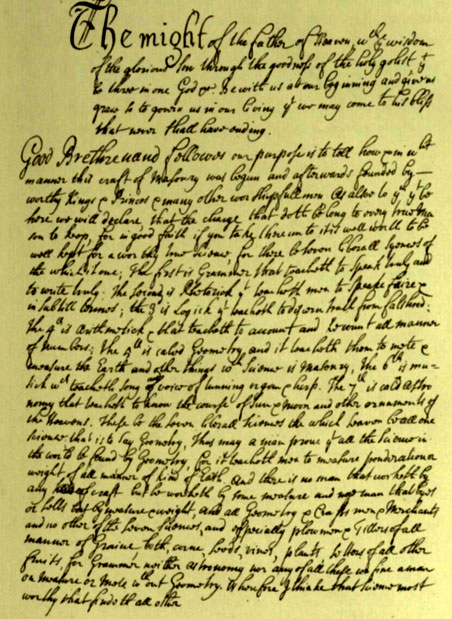
The 1st page of the Sloane No. 3323 Manuscript Facsimile Prva stranica faksimila rukopisa Sloane br. 3323

The Sloane No. 3323 Manuscript

[ A G.C vol. v. 65]


The might of the father of Heaven, with the wisdom of the glorious son through the goodness of the holy gohst, it be three in one God &c. Be with us at our beginning and give us grace so to govern us in our living that we may come to his bliss that never shall have ending.

Good Brethren and fellowes our purpose is to tell how & in what manner this craft of Masonry was begun and afterwards founded by worthy Kings & Princes & many other worshipfull men. As alsoe to those who be here we will declare, that the charge that doth belong to every true Mason to keep, for in good faith if you take thereunto it is well worth to be well kept for a worthy true science, for there be seven liberall syences of the which it one; The first is Grammer that teacheth to speak truly and to write truly; The second is Rhetorick it teacheth men to speake faire & in subtill termes; the 3rd is Logick it teacheth to discern truth from falshood; The 4th is Arithmetick & that teacheth to account and recount all manner of numbers; The 5th is caled Geometry and it teacheth them to mete & measure the Earth and other things which the Science is of Masonry; The 6th is musick which teacheth song and voice of tunning organ & harp. The 7th is cal'd Astronomy that teacheth to know the course of Sun & Moon and other ornaments of the Heavens. These be the seven liberall sciences the which seaven be all one science, that is to say Geometry, Thus may a man prone to all the science in the world be found by Geometry, for it teacheth men to measure ponderation or weight of all manner of kind of Earth. And there is no man that worketh by any craft but he worketh by some measure and noe man that byes or sells but by measure & weight, and all Geometry & Craftsmen & Merchants and no other of the seven sciences, and especially plowmen & Tillers of all manner of Graine, both, corne, seeds, vines, plants, setters of all other fruits, for Grammer neither Astronomy nor any of all these confine a man on Measure or Mete without Geometry. Wherefore I thinke that science most worthy that findeth all other.

Since long after the Children of Israeli were come into the land of Beehest it is nowamong us the Geometry of Jerusalem. King David begun the Temple of Jerusalem that is wth them, Templum Dei And the sd King David loved the Masons well and Cherished them well and gave them good payment and gave them charge that you shall heare afterwards' and after the discease of King David Solomon his son perform'd out the temple his father had begun, And he sent afterwards Masons of Divers Lands and gathered them together soe that fourscore thousand workers of stone and they named masons, And he had three thousand of them which were ordained masters and govemours of the work, And there was another King of another Region that Men cal'd Haram and loved well King Solomon and gave him timber for his work, And he had a son that was named Dynon and he was master of Geometry and he was cheife master of all his masons and master of all his Graving workes and of all other masons that belonged to the Temple and this witnesseth the Holy bible, in libr Regni quarto pris capt. To this son Solomon confirm'd both Charges and manners that his father had given to masons. And thus was the worthy craft of masons confirm'd in the Cuntry of Jerusalem and in many other Kingdoms glorious craftsmen waking abroad into divers Cuntrys, some because of learning more craft then others to teach their craft, And so it fell that a Curious mason nam'd Naymus Green had been at the making of Solomons Temple and came into ffrance and there taught the craft of masonry to the men of ffrane that was named Charles Mastill he loved well his Craft and drew unto him Naymus Greacus and learned of him the craft and took upon him the Charges and manners and afterwards by the grace of God he was Elected King of ffrance and when he was in Estate he tooke to him many masons and made masons there that were there and sett them in worke and gave them both Charges and manners and good payment which he learnd of other masons and confirm'd then a Charter from yeare to yeare to hold their assemblies and thus came the craft into ffrance.

England all that season was void both of any charge and Masonry untill the time of Saint Alban, And in his time the king of England was a Pagan, and he wal'd the town which is cal'd St. Albans, And so in St Alban's time A worthy knight was cheif steward to the King and had Government of the Realme and alsoe of making to town walls and loved the masons well and Cherished them and made their payment Right good standing wages as the Realme did require for he gave them every week sixpence to their duble wages, before that time throughout the whole land a mason took but a penny aday; And next to that time St. Albans mended it and gott them a Charter from the King and his Counsell and gave it to that name of assembly, and thereat he was himself and made masons and gave them Charges that you shall heare of.
After the Death of St. Albans there came great wars into England through divers nations so that good Rule of Masonry was destroyed untill the time of King Athelstone that was a worthy King in England and he brought that land into good rest and peace againe and builded many good workes of Castles & abbys and many other buildings and he loved masonry very well and he had a sonn that he named Heyme he loved masons much more then his father for he was of practice in Geometry wherefore he drew himselfe to commune with masons and to learn of them the craft and afterwards for the love he had for masons and to the craft that he was made mason of himself, and he gott of his father the King a Charter and Comission to hold every year an assembly where they would within the Realm and to correct within themselves statutes and trespasses if it was never done with in the craft and he held himself an assembly att Yorke and there he made masons and gave them Charges and taught them manners of the Masons and commanded that rule to be holden ever afterwards to themselves tooke the Charter and a Comission to keep, and ordain'd it shou'd be rul'd from King to King.
When this assembly was gathered together he caused a Cry to be made, that all masons both yong and old that had any writing or understanding of the Charges that were made in this land before or in any other land that they shou'd shew themselves forth and there was some in ffrench some in Greek some in English and some in other languages and the intent thereof was found and made and commanded that they shoud he read and tould when any Masons shou'd be made and give him his charge and from then to this time Masonry hath been kept in that forme and order as well as men might govern the same, And furthermore of Divers Assemblies hath been put to and added severall charges more by the best advice of the Master and fellowes —


Rukopis Sloane br. 3323

[ A G.C vol. v. 65]


Moći Oca Nebeskoga, s mudrošću Sina Slavnoga, kroz dobrotu Duha Svetoga troje u jednom Bogu, budi sa nama na početku našem i daj nam milost da upravlja nama u našem životu kako bismo dospeli do blaženstva njegovog koje se nikada neće ugasiti.

Draga Braćo i Pomoćnici, svrha nam je da vam kažemo kako su i na koji način ovaj nauk zidarski započeli i osnovali dostojni kraljevi i prinčevi i mnogi drugi časni ljudi. A takođe i onima koji su ovde rećićemo da dužnosti koje pripadaju svakom istinskom zidaru treba da se održavaju, jer ako ih u dobroj veri prihvatite vredi da ih čuvate za dostojnu, istinsku nauku, jer postoji sedam liberalnih nauka među kojima je ova jedna. Prva je Gramatika koja uči ispravnom govoru i pisanju. Druga je Retorika i ona uči ljude da govore lepo i suptilno. Treća je Logika i ona uči kako da se odvaja istina od laži. Četvrta je Aritmetika koja uči računanju i prebrojavanju svih načina brojeva. Peta se zove Geometrija i ona uči ljude merama i merenju Zemlje i drugih stvari koje čine nauku o zidarstvu. Šesta je Muzika koja uči pesmi i glasu i podešavanju orgulja i harfe. Sedmi se naziva Astronomija koja uči poznavanju kretanja sunca i meseca i drugih ukrasa neba. Ovo je sedam liberalnih nauka, a svih sedam su jedna nauka, to jest Geometrija. Stoga, neka Geometrija pronađe čoveka sklonog svim naukama na svetu, jer ona ljude uči da mere jačinu ili težinu svih vrsta stvari na zemlji. I ne postoji čovek koji se bavi bilo kojim zanatom a da ne radi po nekoj meri kao i svaki čovek koji kupuje ili prodaje, to radi po nekoj meri i težini te sva Geometrija, kao i zanatlije i trgovci, a nijedna druga od sedam nauka. Posebno to rade orači i odgajivači svih vrsta žita i kukuruza, semena, vinove loze, biljaka, i oni koji gaje sve ostale plodove, jer ni Gramatika ni Astronomija ni bilo koja druga nauka ne ograničava čoveka na meru i merenje bez geometrije, pa mislim da je to najdostojnija nauka koja je osnovala sve ostale.

Geometrija Jerusalima je sa nama od starih vremena, od vremena kada su deca Izraela došla u obećanu zemlju. Kralj David je započeo jerusalimski hram koji se među njima naziva Templum Dei, a spomenuti je kralj David voleo zidare i dobro ih je pazio i dobro ih plaćao i dao im dužnosti o kojima ćete kasnije čuti. Nakon bolesti kralja Davida, Solomon, sin njegov, završio je hram koji beše započeo njegov otac. A nakon toga, posla on po zidare iz raznih zemalja i okupio ih tako da je bilo osamdeset hiljada radnika koji su radili sa kamenom, a zvali se zidari. A imao ih je tri hiljade koji su bili prihvaćeni majstori i rukovodioci radova. A bio je tu kralj jednog drugog područja koga su ljudi zvali Haram i on je jako voleo kralja Solomona i davao mu drvnu građu za njegove radove i taj kralj je imao sina koji se zvao Dynon i bio je majstor geometrije i glavni gospodar svih njegovih zidara i majstora svih njegovih gravura i svih ostalih zidara koji su radili na Hramu, o čemu svedoči Sveta Biblija, u četvrtom poglavlju Knjige o kraljevima. Tom sinu Solomon je potvrdio i dužnosti i manire koje je njegov otac dao zidarima. i tako je taj vrli nauk zidarski potvrđen u zemlji jerusalimskoj te su zanatlije odlazile u mnoga druga kraljevstva slavna i različite zemlje, neki da bi usavršili nauk, a drugi da bi podučavali isti. Tako se desilo da je jedan znatiželjni zidar po imenu Nejmus Grin (Naymus Green), koji je radio na izgradnji Solomonovog hrama, otišao u Francusku i tamo podučavao zidarske radove francuskim muškarcima kao i čoveku koji se zvao Šarl Mastel (Charles Mastill), koji je voleo taj nauk i privukao se tom Nejmusu Grekusu (Naymus Greacus), naučio od njega nauk i preuzeo sve dužnosti i manire, a nakon toga je, milošću božjom, izabran za kralja Francuske, a kada je bio na svom imanju odveo je tamo mnogo zidara, a i proizveo zidare i dao im da rade, davajući im i dužnosti i manire i dobre nadnice o kojima je saznao od drugih zidara i potvrđivao im je Povelju iz godine u godinu nalažući im da održavaju skupštine, te je tako zanat ušao u Francusku.


Celo to vreme, Engleska je bila bez ikakvih dužnosti i Zidarstva sve do vremena Svetog Albana. A u njegovo vreme kralj Engleske bio je paganin, a Sv. Alban beše podigao zid oko grada koji se po njemu naziva Sv. Alban, pa je tako u njegovo vreme taj dostojni vitez bio glavni upravitelj kraljevog poseda i upravljao je Carstvom, a takođe je podigao gradske zidine, a voleo je zidare i pazio ih je i dobre im nadnice davao, kako dolikuje Carstvu, jer im je dodavao svake sedmice šest penija na njihove dvostruke nadnice. Pre tog vremena, u celoj zemlji je zidar uzimao samo peni dnevno, a nakon tog vremena, Sveti je Alban to popravio i pribavio im Povelju od kralja i njegovog veća i nazvao je skupštinom, a tu je i on sam bio i proizvodio zidare i dao im dužnosti o kojima ćete kasnije čuti.
Nakon smrti svetog Albana, Englesku su zahvatili veliki ratovi, preko različitih naroda, tako da je dobro Pravilo Zidarstva uništeno sve do vremena kralja Athelstona koji je bio dostojan kralj u Engleskoj. On je bio taj koji je ponovo smirio prilike u zemlji i uspostavio mir i sagradio mnoge lepe dvorce i opatije i mnoge druge zgrade i jako je voleo zidarstvo, a imao je sina po imenu Heyme koji je zidare voleo i više od svoga oca, jer je poznavao praksu geometrije pa se privukao komuni zidara da bi od njih izučio nauk. Nakon toga, zbog ljubavi koju je gajio prema zidarima i prema nauku, i sam je postao zidar, a od oca kralja dobio je Povelju i zaduženje da održi skupštinu na kojoj će, u okviru Carstva, ispraviti statute i rešiti prekršaje u vezi nauka, ako ih je bilo. Skup je održao u Jorku, gde je proizveo zidare, dao im dužnosti i podučavao ih manirima zidara i zapovedio da se to pravilo drži do daljnjeg i da se čuvaju Povelja i Zaduženja, te je odredio da se po njima vlada i da ih se prenosi od kralja do kralja.


Kada se ta skupština okupila, objavio je da svi zidari, i mladi i stari, koji su imali bilo kakvih pisanija ili razumevanja dužnosti datih u ovoj zemlji, ili u bilo kojoj drugoj, da bi trebali da ih pokažu, a bilo ih je i na francuskom, nekih na grčkom, nekih na engleskom, a nekih na drugim jezicima, a namera im je bila jasna, te je naređeno da se pročitaju i izreknu kadgod se prihvata neki zidar i daju mu se dužnosti, te od tada pa do vremena sadašnjeg, zidarstvo se održava u obliku i redu u kojem se istima može upravljati. Pored toga, postavljeni su različiti skupovi i dodato je još nekoliko dužnosti putem najboljih saveta Majstora i Pomoćnika.

Here followeth the worthy oath of Masonry

Every man that is a mason take heed Right well of this charge if you find yr self guilty of any of these that you may amend again and especially you that are to be charged take good heed you keep this Charge, for it is great perill for any man to forsweare himself on a book &c.

1. The charge is you shall be a true man to God and the holy Church and that you use no heresie by your understanding or by teaching discreet men.

2. Allsoe you shall be true leigh men to the King without Treason orfalshood and that you shall know no treason, that you amend it if you may or warne the King or his Counsell thereof.

3. Alsoe you shall be true one to another that is to say Every master and fellow of the trust of Masonry that be masons allowed & yt you as you wou'd they shou'd doe unto you.


4. Alsoe that Every mason keep true Counsell of lodge or Chamber and all other Counsell that ought to be kept by way of masonry.

5. Alsoe that no mason be cheife in Company soe far forth as shall be known.

6. Alsoe that you shall he true unto thy lord and Master that you serve and truly see for his profitt and advantage.


7. Alsoe yt you do no villany in that house whereby the craft may be slandred These be the Charge in Generali all which Every mason should hold both master and fellows.

Now I will rehearse the charge in singular for masters and fellowes.

1st. That noe master shall take upon him any Lords Worke nor other worke butt that he know himselfe able and cunning to performe the same soe that the craft have no disworshid but that the lord may be truly serv'd.

2ly. Allsoe that noe master take upon him any worke but that he take it reasonably soe that the Lord may be truly serv'd wth his own goods, and the master to live honestly and pay his fellows truly their pay as the manner of their craft doth require.


3ly. That no master or fellow shall supplant another of their work, viz. if they have taken a work or stand master of a lords work you shall not put him out if he he able of cunning to decide the worke.

4ly. That no master or fellow take any apprentice to be allowed this apprentice but for seven years and that yt apprentice be able of his birth & limbs as he ought.

5ly. That no master or fellow take allowance to be made masons wth out the assent of his fellows and that at least five or six, and that he that shall be made mason to be able over all sciences, that is to say that he be freeborn and of good kindred & no bondman and that he haue his right limbs as a man ought to have.

6ly. That no master put A Lord man to task that is used to go on a Journey.

7. That no master shall give no pay to his fellowes but as he may deserve so that he be not deceiv'd by false workmen.

8. That no fellow slander one another falsely behind his backe to make him loose his good name or his worldly goods.

9. That no fellows within the Lodge or without answer answer another ungodly without reasonable cause.

10. That Every mason shou'd prefer his Elder & put him to worship.

11. That no mason shall play att hazard or any other unlawfull game whereby they may be slandred.


12. That no mason be a common Ribbald in Lechery to make the craft slandred and no fellow goe into the town where is a Lodge of fellows wth out a fellow wth him that may bear him wittness that he was in honest company.


13. That Every fellow and master come to assembly if it be within fifty miles about him if he have warning and to stand to the award of masters and fellows.


14. That every master and fellow if they haue trespassed shall stand to the award of master and fellows to make the accord if they may but if they may not to go to the Common law.


15. That no mason work moulds square or Rule to any rough Lyers.

16. That no mason setts or layes within a lodge or wth out to haue mould stone wth mould of his own making.

17. That Every mason shall receive and cherish strange fellows when they come over the Cuntry to sett them on worke as the manner is, that is to say if they mould stones in place he shall sett him in a fortnight in work att the least and give him his hyre and if there be no stone for him then refresh himself wth some mony and bring him to the next lodge, and alsoe you shall and every Mason shall serve truly the works & truly make an end of your worke if it be task or Journey if you haue your pay as you ought to haue.

18. That no fellow shall take upon him to call a lodge to make any fellow or fellows wth out the consent of Master or Wardens; if they be wth in fifteen miles these things and all other matters that shall be discoursed to which belongeth the free masonry you shall faithfully keep soe help you God and by the contents of that book.

These were written by me.

Thomam Martin.


1659.

True copy.


Sledi vrla zakletva Zidarstva

Svi oni koji su zidari treba dobro da čuvaju ove dužnosti. Ako ste se ogrešili o bilo koju od njih tako biste ih mogli dopuniti, a posebno vi koji ćete biti optuženi, dobro pazite da se držite tih dužnosti, jer velika je opasnost da se čovek zakune na knjigu.

1. Prva dužnost je da budete istinski čovek prema Bogu i Svetoj Crkvi odupiranjem jeresu tako što ćete razumeti ili prihvatiti poduku razboritih ljudi.

2. Takođe, kralju ćete biti istinski podanik, bez izdaje i laži, i nećete znati ni za kakvu neveru; izmenite je ako možete ili upozorite kralja ili njegovo veće na to.

3. Takođe, treba da budete verni jedni drugima, to jest, svakom prihvaćenom Majstoru i Pomoćniku zidaru i treba prema njima da se odnosite onako kako biste želeli da se oni odnose prema vama.

4. Takođe, svaki zidar treba da se pridržava istinskog saveta svoje Lože ili Komore i svih ostalih saveta kojih bi se trebalo pridržavati po pravilima Zidarstva.

5. Takođe, nijedan zidar ne sme da bude šef Duštva u tolikoj meri da bi trebalo da se zna.

6. Takođe, treba da budete verni svome gospodaru i Majstoru kojem služite i uistinu imate pred očima njegovu dobit i prednost.

7. Takođe, u kući u kojoj boravite ne smete da činite zla, čime bi se nauk mogao diskreditovati. Ovo bi trebala da bude opšta dužnost koju treba da ima svaki zidar, i Majstor i Pomoćnik.

Sada ću, u jednini, nabrojati dužnosti Majstora i Pomoćnika:


1. Nijedan Majstor ne treba da preuzme na sebe bilo kakve gospodareve radove niti bilo koji drugi posao, osim onog za koji zna da je sposoban i vešt da obavi, tako da nauk ne izgubi čast i da gospodar može biti uslužen na pravi način.

2. Nijedan Majstor ne treba da prihvati nikakav posao, osim onog koji smatra razumnim, tako da se gospodaru može istinski služiti za njegovo dobro, a Majstor da živi pošteno i da svojim Pomoćnicima pošteno da isplati njihove nadnice kako to maniri nauka zahtevaju.

3. Nijedan Majstor ili Pomoćnik ne sme da zameni drugog u njegovom poslu, ako se ovaj već latio tog posla ili je Rukovodilac gospodarevih radova. Ne treba da ga lišite tog posla ako je sposoban i vešt da ga obavi.

4. Nijedan Majstor ili Pomoćnik ne treba da uzme šegrta na duže od sedam godina, a šegrt treba da bude dobroga roda i ima sve udove kao što bi trebao da ima.

5. Nijedan Majstor ili Pomoćnik ne može da se smatra zidarom ako ne dobije pristanak najmanje petoro ili šestoro svojih kolega. Prihvatiće se za zidara ako pokaže sposobnost u svim naukama tj. treba da bude slobodnorođen i dobroga roda, a ne kmet i treba da ima sve udove kao što bi čovek trebao da ima.

6. Nijedan Majstor ne treba da angažuje gospodarevog čoveka ako je ovaj navikao da putuje.

7. Nijedan Majstor ne treba da plati svojim Pomoćnicima više nego što zaslužuju, tako da ga lažni radnici ne bi prevarili.

8. Nijedan Pomoćnik ne treba da kleveće drugog iza njegovih leđa da bi ovaj izgubio dobar glas ili svoja svetovna dobra.

9. Nijedan Pomoćnik iz Lože, ili van nje, ne sme da govori sa drugim na bezbožnički način bez razumnog razloga.

10. Svaki bi zidar trebao da uvažava i poštuje starijeg po rangu.

11. Nijedan zidar ne sme da se bavi igrama na sreću niti bilo kojim drugim nezakonitim igrama putem kojih bi mogao da izgubi dobar glas.

12. Nijedan zidar ne sme da bude nepristojan i razvratnik, jer bi time nauk bio diskreditovan. Nijedan Pomoćnik ne sme da uđe u grad u kojem postoji Pomoćnička Loža, a da sa njim nije još jedan Pomoćnik, koji bi mogao da posvedoči da je ovaj bio u čestitom društvu.

13. Svi Pomoćnici i Majstori treba da prisustvuju skupštini ako se ona održava u krugu od pedeset milja od mesta stanovanja, ako je pozvan, i treba da bude na raspolaganju ostalim Majstorima i Pomoćnicima.

14. Svaki će Majstor i Pomoćnik, ako je počinio prekršaj, biti na raspolaganju ostalim Majstorima i Pomoćnicima kako bi se ovi složili, ako mogu, ali ako ne mogu, treba da se primenjuje običajno pravo.

15. Nijedan zidar ne sme da izrađuje modele, četvrtaste ili ravne za bilo koje grube polagače.

16. Nijedan zidar ne daje polagaču, iz Lože ili van nje, modele kamenova sa modelom njegove izrade.

17. Svaki zidar treba da primi i pazi stranog Pomoćnika kad ovaj dođe u Zemlju, da mu da da radi, kako je red, ako izrađuju kamenove na mestu, daće mu da radi najmanje dve sedmice i isplatiće mu nadnicu. Ako za njega nema kamenova, daće mu novaca i otpraviće ga u sledeću ložu. Takođe, svaki zidar treba istinski da služi radovima i zaista da završi posao, ako je to zadatak ili putovanje, ako dobije nadnicu onakvu kakva bi trebala da bude.


18. Da nijedan Pomoćnik ne treba da preuzme na sebe da ode u neku ložu da privuče nekog Pomoćnika, ili više njih, bez pristanka Majstora ili Nadzornika, ako se nalaze u krugu od petnaest milja. O svim ostalim stvarima će se raspravljat u okviru Slobodnog Zidarstva, čega ćeš se verno držati, tako ti Bog pomogao i sadržaj te knjige.

Haec scripta fuerunt p me

Thomam Martin.


1659.

Copia vera.


Divider