QSA Members Forum
For Masonic Research
The Sloane Manuscript No. 3848"
Serbian Translation
of
 The Sloane Manuscript No. 3848
Translated by
Karlo Hameder V
From the Translation of George William Speth

Imajte na umu: ova stranica je optimizovana za prikaz u Google Chrome (faktor zumiranja 150%).
Please note: this page is best viewed with Google Chrome (Zoomed at 150%)
|
|
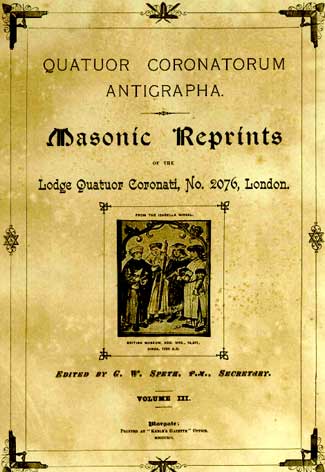
QUATUOR CORONATORUM ANTIGRAPHA.
Masonic Reprints of the Lodge Quatuor Coronati, No. 2076, London, BRITISH MUSEUM, ADD. MSS.,18,851, CIRCA, 1500 A.D.
EDITEH BY G. W. SPETH, P.M., SECRETARY VOLUME III. Margate: PRINTED AT "KEBLE'S GAZETTE" OFFICE MDCCCXCI. |
|
The Sloane No. 3848 Manuscript Sir Hans Sloane, physician, naturalist, and antiquary, conditionally bequeathed his immense collection of 50,000 volumes of printed books and manuscripts, and about 70,000 objects of art. By an act of Parliament, A.D. 1753, these were secured at the small cost of £20,000 for the use of the public. Among the manuscripts are two copies of the old Constitutions of the Freemasons, one at fo. 179, of vol. 3848, and the other at fo. 209, of vol. 3323. Both are reproduced in this present volume of Reprints. The Sloane Manuscript 3848, a facsimile of which precedes these remarks, consists of 13 pages, 6¼-inches by 8¼-inches. Irrespective of the text, it has a peculiar interest of its own, the conclusion reading "Finis p. me Eduardu Sankey, decimo sexto die Octobris Anno Domini, 1646." This is the very day when, according to his own diary, the celebrated antiquary, Elias Ashmole, was initiated into Freemasonry at Warrington. NAME Bro. W. H. Rylands has proved that Mr. Richard Sankey, (and his family for generations before him) was at that time a landowner in Warrington, and that in the Warrington registers is the entry "Edward, son to Richard Sankey, Gent., Bapt. 3rd February 1621-2." There can hardly be a doubt that this is the Edward Sankey who transcribed this manuscript, and although more than one of our "Old Constitutions" is signed, this is almost the only instance where it has been possible to identify the scribe. The Harleyian MS., written by Randle Holme III, also given in this volume of Reprints, is perhaps the only other. Further there is the possibility that this manuscript was in some way connected with Ashmole's initiation, being either prepared for that purpose or copied from the one then used on the same day. As a mere copy on paper, the document would naturally have been placed by Bro. Gould m his Class 5, consisting of copies probably prepared for antiquarian purposes only, but the coincidence of the date and name of the transcriber has enabled him to enroll it in Class 2, as having at some time apparently been in Lodge custody: thus considerably enhancing its value as legal evidence. Textually it is, however, one of the poorest we possess. The punctuation is very curious, and, if heeded, would utterly destroy any sense the language may have been intended to convey. It almost looks as if Edward Sankey had placed a semi-colon wherever he lifted his pen and eyes from the paper in order to read a few more words of his original. When the proofs of the first pages completed (not the first in order) were submitted to me, it at once became apparent that some of the numerous corrections and interlineations were not in Sankey s but m a neater, slightly more modern handwriting, with a peculiar tendency to slope backwards. As it happened, some of these particular corrections were not very judicious. Desirous of preserving Sankey's original handiwork, I ordered them to be omitted and the text restored; and the pages were printed before further consideration showed me how ill-advised I had been; and that probably the very corrections might prove of interest to the student. The handwriting might lead to the identification of a later owner,1) or the amendments might point out the MS. with which Sankey's production had been compared. But I repented me of the evil too late to repair all its consequences, certain sheets were pulled and the stones cleaned off. All the others, however, represent the manuscript in its present state. To remedy as far as possible the error in judgment, I have, in transcribing the document, given in the body of the text Sankey's unamended words only; and have annotated it, showing all the corrections, both those still left in the facsimile and those omitted therefrom. Some of the former, I think, are Sankey's own. In Bro. Begemann's classification this manuscript gives the name to the Sloane family, consisting of four sub-branches, and it is placed by him in the Sloane branch. Whether the fact, which will probably be new to him, that many passages are interlineations by another hand will affect his conclusions, he will possibly kindly let us know in the next number of Ars Quatuor Coronatorum. The Manuscript was printed in Bro. Hughan's " Old Charges," and in the Masonic Magazine, 1873; but no portion of it has been reproduced in facsimile previous to the present publication. > |
Rukopis Sloane br. 3848 Ser Hans Sloane, lekar, prirodnjak i antikvar, uslovno je zaveštao svoju ogromnu kolekciju od 50 000 svezaka štampanih knjiga i rukopisa i oko 70 000 umetničkih predmeta. Aktom Parlamenta iz 1753, taj materijal je, po ceni od 20 000 funti, postao dostupan javnosti. Medu rukopisima su dve kopije starih Konstitucija slobodnih zidara, jedna na fo. 179, sv. 3848, a druga na fo. 209, sv. 3323. Oba su objavljena u ovom sadašnjem svesku Reprints-a. Sloaneov rukopis 3848, faksimil na koji se odnose ove napomene, sastoji se od 13 stranica dimenyije 6¼ inča x 8¼ inča. Bez obzira na tekst, on ima svoju vlastitu vrednost, zaključak koji glasi "Finis str. ja Edvard Sanki (Eduard Sankey), decimo sexto die Octobris Anno Domini, 1646." To je upravo dan kada je, prema njegovom vlastitom dnevniku, proslavljeni antikvar, Ilajas Ašmol (Elias Ashmole), bio iniciran u masonstvo u Voringtonu (Warrington). Brat W.H. Rajlands (Rylands) dokazao je da je gospodin Ričard Sanki (Richard Sankey), (i njegova porodica generacijama pre njega) u to vreme bio zemljoposednik u Voringtonu, a da se u registrima Voringtoma nalazi yapis "Edward, sin Richarda Sankeyja, Gent., Bapt . 3. februara 1621-2." Teško da se može sumnjati u to da je ovo baš taj Edvard Sanki čijom je rukov ovaj rukopis pisan, i premda više od jedne naše "Stare konstitucije" nose potpise, ovo je gotovo jedini slučaj u kojem je bilo moguce identifikovati pisara. Rukopis Harvey, koji je napisao Randle Holme, takode naveden u ovom svesku Reprintsa, možda je jedini drugi rukopis. Dalje, postoji mogucnost da je ovaj rukopis na neki način povezan s Ašmoleovom inicijacijom, ili pripremljen za tu svrhu ili kopiran po onom koji je korišten istog dana. Kao puku kopiju na papiru, dokument bi, prirodno, sadržavao reč Br.:. Mogao bih izgraditi svoju klasu 5, koja se sastoji od kopija verovatno pripremljenih samo u antikvarske svrhe, ali podudarnost datuma i imena prepisivača omogucila mi je da je upišem u klasu 2, jer je rukopis, u jednom trenutku, očito bio pod zaštitom lože: povecavajuci tako njegove vrednosti kao pravnog dokaza. Tekstualno je, medutim, jedan od najsiromašnijih koje posedujemo. Interpunkcija je veoma neobična i, ako bi se na nju obratila pažnja, potpuno bi uništila bilo kakav smisao koji bi jezik verovatno trebao da prenese. Gotovo da se čini da je Edvard Sanki stavljao tačku sa zarezom svaki put kada je podigao pero i pogled sa hartije kako bi pročitao još nekoliko reči svog originala. Kad su mi dostavljeni dokazi o završenim prvim stranicama (ne prvima po redu), odjednom je postalojasno da neke od brojnih ispravki i interlineacija nisu u Sankijevom, vec nešto urednijem, malo modernijem rukopisu, s osobitom tendencijom da su slova nagnuta unazad. Kao što se i dogodilo, neke od ovih odredenih korekcija nisu bile previše razumne. U želji da sačuvam Sankijev originalni ručni rad, naredio sam da se izostave, a tekst da se obnovi; a stranice su odštampane pre nego što mi je daljnje razmatranje pokazalo koliko sam bio nesmotren; i da bi se same ispravke mogle pokazati zanimljivima za izučavaoce ovakvih tekstova. Rukopis bi mogao dovesti do identifikacije kasnijeg vlasnika1), ili bi dopune mogle ukazati na rukopis sa kojim je Sankijeva produkcija uporedivana. Ali, kajanje za zlo koje sam učinio došlo je prekasno da bih mogao da saniram sve njegove poslediceč nešto smo uspeli da eliminišemo, a drugo da očistimo. Sve ostalo, medutim, predstavlja rukopis u postojecem stanju. Da bih, što je više moguce, ispravio pogrešku u prosudbi, imam, prepisujuci dokument, u telu teksta, samo neizmenjene Sankijeve reči ; a zabiležio sam ih, pokazujuci sve ispravke, kako one koje su još uvek ostale u faksimilu, tako i one koje su iz njih izostavljene. Mislim da su neki od prvih Sankejeve. Po klasifikaciji Br.: Begemanna, ovaj rukopis daje ime porodice Sloane, koja ima četiri ogranka, a on ga postavlja u ogranak Sloane. Hoce li ga činjenica, koja ce za njega verovatno biti nova, da su mnoge interlineacije pisane rukom neke druge osobe, uticati na njegove zaključke, i navesti ga da nas o tome možda ljubazno obavesti u sledecem broju Ars Quatuor Coronatorum-a? Rukopis je štampan u "Starim dužnostima" Br.: Hagana (Hughan) te u Masonskom časopisu, 1873; ali nijedan njegov deo nije reprodukovan u obliku faksimila pre ove publikacije. > |

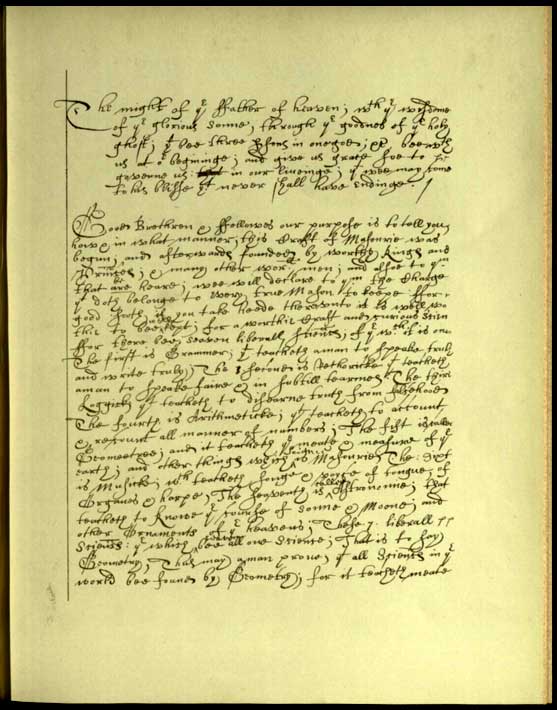
The 1st page of the Sloane No. 3848 Manuscript FacsimilePrva stranica faksimila rukopisa Sloane br. 3848
|
The Sloane No. 3848 Manuscript C A. Q.C. Vol. V, 65 THE might of the Father of Heaven; with the wisdom of his glorious Son, through the goodness of the Holy Ghost; who be three persons in one god & he be with us at our begining; and give us grace to govern us in our life; that we may come to his blisse that never shall have ending. Good Brethren & Fellows our purpose is to tell you, how & in what manner this Craft of Masonry was begun; and afterwards founded by worthy Kings and Princes & many other worthy men; and also to them that are heare; we will declare to them the Charge that belongs to every true Mason to keep for good sooth if you take heed thereunto it is well woth to be kept; for a worthy Craft and curious science for there be seven idieal sciencs; of which the first is Grammar; that teaches a man to speak truhfully and write truly; The second is Rethorick, which teaches a man to speak fairly & in subtle terms. The third is Logic, which teaches to discearn truth from falsehood. The fourth is Arithmetics, which teaches to account & recount all manners of numbers; The fifth is called Geometry, and it teaches the measure & measurement of the earth and other things which is Masonry; The sixth is Music, which teaches song & voice of tongue; of the organ & harp, The seventh is Astronomy, which teaches to know the course of the sun & the moon; and other ornaments of the heavens. These are the 7 liberal sciences, which be all one science, that is to say, Geometry, Thus may a man prove that all sciences in the world are found by Geometry; for it teaches measure and measurement, ponderation & weight of all the manners of the earth. And there is no man that works by any Craft but he workes by some measure & no man that buys and sells but by measure & weight; and all Geometricians & Craftsmen and Merchants find no other of the seven sciences and especially Plowmen and tillers of all manners of grain; both of corn seeds, vines and plants; sellers of all other fruits; for neither Grammar nor Astronomy nor any of all these can find a man to measure or record without Geometry, wherefore I think that it is a science most worthy that founded all the others; How this worthy science was first begun I shall tell yon. Before Noah's flood there was a man called Lameth as it is written in the 4th chapter of Genesis and this Lameth had 2 wives; one was called Adar; the other Sella: and by Adar he got 2 sons. One was called Jabell the other one Juball; And by the other wife he had a son & a daughter; and these four children founded the heginnings of all Crafts in the world. This Jabell was the eldest son and he founded the craft of Geometry and had flocks of sheep & lambs in the field, And he first wrought a house of stone & wood; and it is noted in the aforesaid chapter and his brother Juball founded Music of song, the harp & the organ. The 3rd brother Tuball found out the smith's crafts of iron & steel ; and their sister founded weaving ; and these children did know that god would take vengence for the sin either by fire or water; wherefore they wrote the sciences which were founded in 2 pillars of stone; so that they might be found after the flood. One of the stones was called Marble, which cannot burn in fire, the other was called Letera that cannot drowne [sink] in water; Our intent is to tell you truly how & in what manner these stones were found, where these crafts weare written in Greek. Hermenes, who was the son to Cus & Cus was the son to Shem who was the son of Noah. The same Hermenes was afterwards called Hermes, the father of wise men and he found the 2 pillars of stone where the Sciences were written, & taught them forth. And at the making of the Tower of Babylon the King of Babylon, who was called Hembroth or Membroth and he was a mason & loved well the craft, as it is said by the Master of the Stories; And when the City of Ninive & other cities of Eastasia should have been made. The King of Babylon sent thither six at the desire of the King of Ninive his cousin; and they went forth; and he gave them a Charge in this manner: that they should be true & live truly together; and that they should serve their lord truly for their payment; so that he might have worship for sending them; & other Charges he gave them; and this was the first time that any Mason had any charge of his Craft. Moreover, when Abraham & Sara, his wife, went to Egypt; they taught the seven sciences to the Egyptians. And he had a worthy scollar called Euclid and he learned right well and was a Master of all the 7 sciences; And it befell in his days that the Lords of the states of the Realm had so many sons that they had gotten, some by their wives; & some by Ladies of the Realm; for the Land is a holy Land with plenty of generations. And they had no competent living for their children; wherefore they had much sorrow. And the King of the Land made a great Council & applied to know how they might find their children the means [to to live]: & they could find no good ways. And that caused a cry to be made throughout the Realm; that if there were any man that could inform him, that he should come to him and be well rewarded and hold himself well paid; And after this Cry was made, came this worthy clerk Euclid and said to the King and all his great Lords: if you will have your children sent & taught like gentlemen should be, under the condition that you will grant them & me a Commission; which may have the power to rule them honestly as these sciences ought to be ruled; and the King with his Council granted them, & sealed the commission. And that worthy Doctor took the Lords' sons and taught them this Science of Geometry: in practice to perform Masonry and all manners of worthy works that belonged to building Castles, all mannes of Courts temples and Churches; with all other buildings; and he gave them charges in this manner; first that they should be true to the King and to the Lord they served; & that they should love each other and be true to one to another; & that they should call one another fellows; and not servants nor knaves nor other foul names; and that they should truly serve their lords for their payment. And that they should ordain the wisest among them to be made Master of the Lord's work; And neither for love, great living nor riches; to set another that has little cunning to be Master of the Lord's work, whereby he should be badly served or they be ashamed. And that they should call the governor of the works Master of the works whilst they work with him; & many other Charges which were too long to tell. And to all these Charges he made them swear the great oath: that men used to give in that time; and ordained for them reasonable payment; so that they might live by it honestly; & also that they should come to assembly with the others that they might have Counsel in their crafts, so they might work best to serve their lord for his profit and worship and to correct themselves if they had trespassed. And thus the craft of Geometry was governed there; and that worthy Master gave it the name of Geometry & it is called Masonry in this Land long afterward; It is now amongst us in the Country of Jerusalem where King David began the temple of Jerusalem that is [called] with them Templum Dei. And the same King David loved Masons well, and cherished them, and gave them good payment. And he gave them Charges that you shall hear afterwards. And after the decease of King David, Solomon, who was the son of David, carried out the Temple that his father had begun. And afterwards he was sent Masons from different Lands; and he gathered them together; so there he had fourscore thousand workers of stone. And they were named Masons; and he had 3 thousand of them; who were ordained Masters and Governors. And there was a King of another Region who men called Hyram and he loved well King Solomon; and gave him timber for his works; And he had a son that was named Aynon & he was a Master of Geometry; and he was the chief Master of all his Masons and Master of all his graved [sculptured] works; and of all other Masons that belonged to the Temple; & this can be witnessed in the Bible in Book 2 under chapter 5. And this son to Solomon confirmed both Charges & manners that his father had given to Masons; And thus was the worthy craft of Masonry confirmed in the Country of Jerusalem and in many other kingdoms. Glorious craftsmen walked abroad into different countries; some because of learninge more craft, and others to teach their craft. And so it befell that a curious workman who was named Nimus Greacus & had been at the making of Solomon's Temple, and came to France: & there taught the craft of Masonry to the man of France that was named Charles Martill. He loved well this craft and drew to him this Nimus Greacus; and learned from him the craft; and took upon him the Charges and Manners. And afterwards, by the grace of god he was elected King of France; And when he was in his estate [crowned King] he hired many Masons; and made Masons there where none; and set them to work; and gave them both charges & manners & good payment; which he had learned from other Masons; And confered them a Charter to hold their assembly every year; And thus came the craft into France, all this while England was void both of any charge or Masonry; until the time of St. Albans; and in his time the King of England was a Pagan; and he walled the Town which is now called St. Albans; and so in Albans' time that worthy Knight was the Chief Steward to the King & had governed the Realm; and also the making of the Town Walls. And he loved Masons well; & cherished them; & made there payment right good standing wages as the Realm did requier; for he gave them every week 3S 6d to there double wages: before that time, through all the Land, a Mason took but 1d a day; And after that time St. Albans amended it; he got them a Charter from the King and his Council, and gave it the name of assembly & thereat he was himself; and made Masons; and gave them Charges as you shall hear hereafter. After the decease of St. Albans there came grievous wars into England; through Nations, so that the good rule of Masonry was destroyed; until the time of King Athelstone, who was a worthy King in England; and he brought the Land into rest & peace again; and he builtd many great works & Castles & Abbeys; and many other buildings; and he loved Masons very well & he had a son who was named Hadrian: and he loved Masons much more than his father, for he was full of practice in Geometry, wherefore he drew himself in Communion with the Masons, to learn from them the Craft; and afterwards, for the love he had for the Masons & for the Craft, he was made a mason himself, and he got from his father, the King, a Charter and a commission to hold every year an assembly where they would within the Realm, and to correct among themselves the statutes and trespasses; if they weare done within the craft. And he himself held an assembly at York and there he made Masons, and gave them Charges and taught them the Manners of Masons, and commanded that rule to be kept ever after. And gave them the Charter & commission to keep. And he ordained that it should be ruled from King to King. When this assembly was gathered together; he caused a cry to be made, that all Masons, both young and old, who had any writing or understanding of the charges that were made before in this land, or in any other Land, that they should show them; and there were in French, some in Greek & some in English, and some in other Languages, and the intent thereof was found, & he commanded a book thereof to be made on how the craft was first found & made; and commanded that it should bee read and told whenever any Mason should be made; and to give him his Charge; and from time to time Masonry until that day had been kept in that form & order to govern the same; and furthermore at divers assemblies certain Charges were added by the best advice of Masters and Fellows. Here follows the worthy and godly oath of Masons: Every man that is a Masonn take heed right well to this Charge; if you find yourself guilty of any of these, you should amend yourself, especially you who is to be charged should take good heed that you may keep this Charge; for it is a great peril for a man to foreswear himself on a book. 1. The first Charge is that you shall be true to god; and the holy Church ; and that you use no heresy nor error by your understanding or by teaching of a discreet man, 2. Also you shall be a true liegeman to the King without treason or falsehood; and that you shall know no treason, but that you amend it if you may; or else warn the King or the Council thereof; 3. Also that you shall be true to one another, that is to say, to every man & fellow of you to trust of Masonry; if you are an accepted Mason & that you should do to them as you would like them to do to you. 4. Also that no Mason be a thief in Company as far as you shall know. 5. Also every Mason shall keep true to Counsel of lodge and Chamber; and all other Counsels that ought to be kept by the way of Masonry. 6. Also that you shall be true to the lord & Master that you serve and truly see for his profit & advantage. 7. Also that you do no villainy in that house, whereby the craft shall be slandered. These be the Charges in general which every Mason should hold both as a Master or a Fellow. Now I will rehearse other Charges in particular for Masters and Fellows: 1. First, that no Master shall take upon himself any Lord's work or other works; but that which he knows he himselfe is able & cunning [knowledgeable] to perform, so that the Craft has no disworship but that the lord may be served & that truly. 2. Also that no Master shall take any work but that which is reasonable so that the lord may be truly served for his own good & the Master to live honestly; and to pay his fellows truly as the 'man of the craft' does require. 3. Also that no Master nor Fellow shall supplant others of there work; (that is to say) if they have taken a job or stand Master of a Lord's work you shall not put him out of it; if he is able of cunning to perform the same. 4. Also that no Master nor Fellow shall take any apprentice for longer than for seven years, and that the apprentice shall also be of good birth and have all the limbs that he ought to have. 5. Also that no Master of the works nor a Fellow shall take allowance to make Masons without the assent of his fellows, at least five or six of them; and that he who shall be made Mason to be able on all criteria (that is to say) that he be free born; and of good kinred, and no bondman, and that he shall have his right Limbs as a man ought to have. 6. Also that no Master shall put a Lord's man to a task that requires going on a journey. 7. Also every Mason shall give no pay to his Fellowes but as they shall deserve, to avoid being deceived by false workemen. 8. Also that noe Fellow shall slander another falsely behind his back; to make him lose his good name or worldly goods. 9. Also that no Fellow within the Lodge shall answer another ungodlily without a reasonable cause. 10. Also every Mason shall prefer his elder and put him to worship. 11. Also that no Mason shall play at Hazards [gamble] or any other unlawfull game; whereby they may be slandered. 12. Also that no Mason shall be a common ribald in lechery; to make the craft slandered; and that no Fellow shall go into the Town where there is a Lodge of Fellows; without a Fellow with him; that may bear witness that he was in honest company. 13. Also that every Master and Fellow shall come to the assembly if it is within fifty miles from him if he has any warnings [summons], and to stand at the disposal of Masters and Fellows. 14. Also that every Master or Fellow, if he has trespassed, shall stand at the disposal of Masters & Fellows to make them accord if they may; (but if they may not, then to go to the Common Law). 15. Also that no Mason shall make moulds, square or rule, to any rough [brick]layer. 16. Also that no Mason shall set no layer within a Lodge, or without it, to have mould him stones; with no mould of his own working. 17. Also when someone comes to the country to set him to work as the manner [tradition] is (that is to say) if he has mould stones [work] in place; he shall set him to work for a fortnight & give him his hire; And if there are no stones work [available] for him, then to refresh him with some money and send him to the next Lodge. 18. Also you shall & every Mason shall serve truly the works; and truly carry them out to the end; be it a task or journey; if you may have your pay; as you ought to have; these Charges that we have rehearsed & all others that belong to Masonry you shall keep, to the uttermost of yor knowledge, so help you God & the Contents of this book.
|
Rukopis Sloane br. 3848 C A. Q.C. Tom. V, 65 MOĆ Oca nebeskog, s mudrošću Sina svog slavnog, kroz dobrotu Duha Svetoga, koji su tri lica u jednom bogu, sa nama na početku; daj nam milost da upravlja našim životima da bismo mu se beskrajno približavali. Dobra braćo i prijatelji, svrha nam je da vam kažemo kako i na koji način to Zidarstvo započeto je; a potom kako su ga zasnovali dostojni kraljevi i prinčevi i mnogi drugi dostojni ljudi; a i onima koji slušaju proglasićemo im dužnosti koje mora da ima svaki pravi zidar, da ih dobro čuva. Ako se pripazi na njih, dobro ih je čuvati za dostojni nauk i znatiželju nauke, jer postoji sedam liberalnih nauka, od kojih je prva Gramatika, koja uči čoveka da govori i piše istinito. Druga je Retorika, koja uči čoveka da govori pošteno i suptilno. Treća je Logika, koja uči odvajanju istine od laži. Cetvrta je Aritmetika, koja uči računanju i prebrojavanju svih načina brojeva. Peta se naziva Geometrija i uči meri i merenju zemlje i drugih stvari koje čine zidarstvo. Šesta je Muzika koja uči pesmi i glasu jezika i sviranju orgulja i harfe. Sedma je Astronomija, koja uči poznavanju kretanja sunca i meseca,i drugih ukrasa neba. To je 7 liberalnih nauka, koje su sve jedna te ista nauka, tj. Geometrija, tako da se može dokazati da Geometrija objedinjuje sve nauke na svetu, jer uči meri i merenju, ponderaciji i težini svih stvari na zemlji. I ne postoji čovek koji se bavi nekim zanatom a da ne radi po nekoj meri niti ijedan čovek koji kupuje i prodaje, osim po meri i težini, a svi geometri i zanatlije i trgovci ne nalaze nijednu drugu od sedam nauka, a posebno orači i uzgajivači svih vrsta žita, i semena, vinove loze i biljaka, te prodavci ostalog voća, jer ni Gramatika ni Astronomija, niti bilo koja od svih ovih nauka ne može da nade čoveka koji bi mogao meriti ili snimati bez Geometrije, pa zato smatram da je ta nauka najdostojnija i da je osnovala sve ostale. Reći ću vam kako je ova vredna nauka započela. Pre Nojeve poplave, beše čovek koji se zvao Lameth, kako je zapisano u 4. poglavlju Postanka, te ovaj Lameth imae dve žene; jedna se zvala Adar, a druga Sela. Adar dobi dva sina: jednog su zvali Džabel, a drugog Džubal. Od druge supruge Lameth dobi sina i kćer; i ovo četvoro dece osnovaše početke svih zanata na svetu. Ovaj Džabel beše najstariji sin i osnovaše zanat Geometrije i imao je stada ovaca i jagnjadi na polju, a prvo je sazidao kuću od kamena i drveta; a to je zabeleženo u spomenutom poglavlju, a njegov brat Džubal osnovaše Muziku, pevanje i sviranje orgulja i harfe. Treći brat Tubal otkrio je nauk kovanja gvožda i čelika, a njihova sestra je osnovala tkanje; i ta su deca znala da će se Bog osvetiti za greh, bilo vatrom ili vodom, pa su zaapisali nauke, prethodno utemeljene, na 2 kamena stuba kako bi ih mogli pronaći nakon potopa. Kamenje se zvalo Mermer, koje ne može da izgori u vatri, a drugo se zvalo Letera koje se nije moglo potopiti u vodi; Namera nam je da vam zaista kažemo kako i na koji su način pronadeni ti kamenovi na kojima ovi zanati behu zapisani na grčkom jeziku. Hermenes, koji je bio sin Kusa, a Kus je bio sin Šema, koji je bio Noin sin. Isti taj Hermenes kasnije je nazvan Hermes, otac mudraca, i pronašao je 2 kamena stuba na kojima beše zapisano 6 nauka, koje je podučavao. I prilikom gradnje Vavilonske kule, kralj Vavilona, koji se zvao Hembroth ili Membroth i bio zidar i mnogo je voleo taj nauk, kao što kaže Gospodar priča. A kad je trebao da se gradi grad Niniva, i drugi gradovi Istoka, kralj Vavilona posla tamo šest Majstora, po želji kralja Ninive, svog rodaka te oni odoše i na taj ih je način zadužio da budu istiniti i da se doista slože, te da trebaju istinski služiti svoga gospodara za svoju platu; tako da bi njihovo slanje bilo od neke vajde i dao im je i druge dužnosti, te je ovo bilo prvi put da je bilo koji zidar imao bilo kakvu dužnost u okviru svog nauka. Osim toga, kad su Avram i Sara, njegova supruga, otišli u Egipat; podučavali su tih sedam nauka Egipćanima. Avram je imao jednog dostojnog i veštog učenika zvanog Euklid, koji je sve dobro naučio i bio je magistar svih 7 nauka. Dogodilo se u njegovo doba da su gospodari država s područja Carstva imali mnogo sinova koje su dobili od svojih supruga, a neke od konkubina iz kraljevine jer je ta Zemlju bila sveta Zemlja s puno generacija. A nisu mogli da obezbede odgovarajući život za svoju decu. Zbog toga su bili jako tužni. A Kralj Zemlje te je sazvao Veliko Veće da bi pronašli način na koji bi ta njihova deca mogla da vode život koji im priliči, ali nisu mogli da nadu dobar način. I zbog toga su zavapili za pomoć po čitavom Carstvu: ako postoji čovek koji bi ih mogao posavetovati o tom pitanju, da dode do kralja i biće bogato nagraden i dobro plaćen; A nakon proglasa koji je poslat, došao je taj vrli službenik Euklid i rekao kralju i svim njegovim velikim gospodarima:"'ako ćete svoju decu dati meni da ih podučavam onako kako bi to trebala gospoda biti, pod uslovom da i njima i meni date obaveze koje bi mogle imati moć da njima pošteno vladam, jer bi tim naukama trebalo vladati. A kralj je, sa svojim Većem, odobrio molbu i zaključio obaveze. I taj je dostojni Doktor poveo sinove gospodara i naučio ih toj nauci Geometrije i praksi izvodenja zidarskih radova i svih načina dostojnih poslova koji su se odnosili na gradnju dvoraca, svih vrsta dvorova, hramova i crkava te svih ostalih zgrada i dao im je dužnosti u skladu sa tim; kao prvo da budu verni kralju i gospodaru kojeg služe, te da se vole i da budu verni jedni drugima i da se medusobno nazivaju drugovima, a ne slugama, nevaljalcima ili drugim ružnim imenima, i da trebaju uistinu da služe svojim gospodarima za nadnicu koju dobijaju od njega. I da odrede najmudrijeg medu sobom da ovaj postane Upraviteljem gospodarevih radova, a ni zbog ljubavi, ni sjajnog života niti bogatstva ne postaviti drugog koji nije dovoljno vešt da bude Upravitelj gospodarevih radova, čime bi on bio loše ili sramotno služen. A Upravitelja bi trebali da zovu Majstorom radova, dok bi oni koji rade sa njim imali mnoge druge dužnosti koje bi sada bilo predugo navoditi. I na sve ove dužnosti naterao ih je da polože veliku zakletvu koja se davala u to vreme i odredio im je razumne nadnice, tako da bi mogli pošteno da žive od toga, a takode i da bi dolazili na okupljanja sa ostalima, te bi tako mogli stvoriti savete u svojim zanatima, te bi možda najbolje radili kako bi služili svome gospodaru radi njegove dobiti i brige te kako bi se popravili ako su učinili kakav prekršaj. I tako se tamo upravljalo naukom Geometrije, a taj vrli Učitelj dao mu je naziv Geometrija, a inače se u toj zemlji drukčije naziva Zidarstvo. Sada je ono medu nama u zemlji Jerusalimu, gde je kralj David podizao jerusalimski hram, koji se zbog toga i zvao Templum Dei. A taj isti kralj David mnogo je voleo zidare i pazio ih je i dobro ih plaćao. I dao im je dužnosti o kojima ćete slušati kasnije. A nakon smrti kralja Davida, Solomon, koji beše sin Davidov, izveo je Hram koji je započeo otac njegov. A posle su mu poslali zidare iz različitih zemalja, a on ih okupi, pa je tamo imao osamdeset hiljada radnika koji su radili u kamenu. I zvali su se zidari; a imao ih je 3 hiljade od kojih su neki postavljeni za Majstore i rukovodioce. A bio je i kralj jedne druge regije kojeg su ljudi zvali Hiram i on je jako voleo kralja Salomona; i dade mu drvnu gradu za njegove radove, a imao je sina koji se zvao Aynon i bio je Majstor Geometrije i bio je glavni majstor svih njegovih zidara i Majstor svih njegovih rezbarskih radova i svih ostalih zidara koji su radili na Hramu, a o tome svedoči Biblija u 2. knjizi. I taj sin Soilomon potvrdi dužnosti i manire koje je njegov otac dao zidarima. I tako je taj vrli zidarski nauk potvrden u jerusalimskoj zemlji i u mnogim drugim kraljevstvima. Slavne zanatlije odlazile su u inostranstvo, u različite zemlje; neki da nauče više u nauku tom, a drugi da bi ga podučavali. I tako se desilo jedne godine da je jedan znatiželjni radnik, koji se zvao Nimus Greacus i koji je radio na gradnji Solomonovog hrama, dospeo u Francusku i tamo podučavao zidarskom zanatu Francuza koji se zvao Šarl Martil, koji je mnogo voleo taj nauk i privukao se Nimusu Greacusu i naučio od njega nauk i preuzeo od njega dužnosti i manire, a nakon toga, milošću božjom, izabran beše za kralja Francuske; a kad je bio na svom imanju, uzeo je mnogo zidara i proizveo i nove zidare tamo gde ih nije bilo i uključio ih u rad i dao im i dužnosti i manire i dobro ih je plaćao, kako je naučio od drugih zidara. Dodelio im je Povelju po kojoj svake godine treba da održe skupštinu.. I tako je ovaj nauk ušao u Francusku, sve to dok u Engleskoj nisu postojale nikakve dužnosti ili zidarstvo, sve do vremena Sv. Albonsa, kada je engleski kralj bio paganin. Tada je Sv. Albons obzidao Grad koji se i danas zove po njemu. I tako je u vreme Sv. Albonsa taj dostojni vitez bio glavni upravitelj kraljevog imanja a upravljao je i kraljevstvom, a takode i gradnjom gradskih zidina. I mnogo je voleo zidare i pazio ih je i odredio im dostojne nadnice, kako je kraljevstvo zahtevalo. Svake sedmice im je davao iij8 vjd, dvostruke nadnice: pre tog vremena, u celoj zemlji, zidar je dobijao samo 1 peni dnevno, a nakon tog vremena Sv. Albons je to popravio. A dobio je i Povelju od kralja i njegovog Veća i nazvao je skupštinom, na kojoj je i sam učestvovao i proizveo zidare i i dao im udžnosti, kako ćete čuti u nastavku. Nakon smrti Sv. Albonsa, Englesku su zahvatili teški ratovi, od raznih naroda, tako da je dobra vladavina zidarstva uništena, sve do vremena kralja Athelstonea, koji beše dostojan kralj u Engleskoj, koji je. ponovo obezbedio zemlji prosperitet i mir i sagradio mnoga sjajna dela i dvorce i opatije, kao i mnoge druge zgrade, i jako je voleo zidare, a imao je sina koji se zvao Hadrian: i taj je zidare voleo mnogo više od svoga oca, jer je posedovao praktična znanja Geometrije, pa se zidarima privukao u komunu da od njih uči nauk; a potom i za ljubav koju je imao prema zidarima i nauku i sam je postao zidar, a od oca, kralja, dobio je povelju i obavezu da se svake godine održava skupština na kojoj bi, u okviru kraljevstva, medu sobom, ispravljali statute i rešavali prestupe, ako su grešili prema nauku. Hadrian je i sam održao skup u Torku i tamo je proizveo zidare, dao im dužnosti i naučio ih manirima zidara i zapovedio da se tih pravila drže dogod su živi. I dao im je Povelju i obaveze da je čuvaju. I odredio je da treba da se prenose od kralja do kralja. Kada je taj skup okupljen, pozvao je sve zidare, i mlade i stare, koji su imali bilo kakvih pisanija ili razumevanja dužnosti koje su ranije iznesene u ovoj zemlji ili u bilo kojoj drugoj zemlji da ih pokažu na skupštini, bilo da su na francuskom, ili neki na Grčkom ili na engleskom ili su na drugim jezicima, a namera im je jasna, i naredio je da se sačini knjiga o tome kako je nauk prvi put pronaden i napravljen; i zapovedio je da je treba čitati i govoriti kad god se proizvodi neki Zidar i daju mu se njegove dužnosti. I s vremena na vreme, zidarstvo, sve do dana današnjeg, u tom obliku treba da se održava, kako bi se vladalo po istom, i nadalje na skupštinama treba da se odrede dužnosti i eventualno dodaju nove, po najboljim savetima Majstora i Pomoćnika. Tu sledi vrla i pobožna zakletva zidara. Svako ko je zidar treba dobro da pazi na ove dužnosti; ko se smatra krivim za bilo šta od toga, trebao bi da se promeni i dopuni a posebno onaj koji će biti optužen, i svi dobro treba da pazite da možete ispuniti tu dužnost, jer zakletva na knjigu velika je odgovornost za čoveka. 1 Prva dužnost je da budeš veran Bogu; i svetoj Crkvi; i da ne padneš u herezu niti činiš grešku razumevanjem ili prihvatanjem poduke od strane neke neupadljive osobe, 2. Takode treba da budeš pravi kraljev vazal bez izdaje ili laži; i ne treba da znaš ni za kakvu izdaju, ili je trebaš ispraviti ako možeš ili upozoriti kralja ili veće na nju; 3. Takode ćete biti verni jedni drugima, to jest svakom čoveku i kolegi od poverenja u okviru zidarstva, ako si prihvaćeni zidar, i to bi trebao biti njima ako bi želeo da oni budu tebi. 4. Takode, da se nijedan Zidar u Društvu, po tvom znanju, ne odmetne u lopova. 5. Takode će svaki zidar uistinu poštovati savete Lože i Komore; i sve ostale savete kojih bi se trebali držati zidari. 6. Takode ćeš biti veran gospodaru i Majstoru kojem služiš i istinski imaš na umu njegovu dobit i prosperitet. 7. Takode, ne smeš u kući u kojoj odsedaš da činiš ikakvo zlo, čime bi nauk bio oklevetan. To su opšte dužnosti kojih bi se svaki zidar trebao držati, bio to Majstor ili Pomoćnik. Sada ću pročitati i druge dužnosti, u jednini, za Majstore i Pomoćnike: 1. Prva je da nijedan Majstor ne sme da preuzme na sebe bilo koje gospodareve ili neke druge radove ako zna da nije sposoban i vešt da ih izvede, tako da se nauku ne naudi i da se gospodaru istinski služi. 2. Takode, da se nijedan Majstor ne bavi drugim poslom osim onim koji je razuman, tako da se gospodaru može istinski služiti za njegovo dobro, a Majstor da pošteno razrezuje i da pošteno plaća svoje radnike, onako kako to zahteva 'nauk'. 3. Takode, da nijedan Majstor ili Pomoćnik ne sme zameniti drugog u njegovom poslu, to će reći, ako se taj prihvatio posla ili postao Majstor gospodarevih radova, nećeš ga lišiti istih, ako je taj sposoban da ih veštinom svojom izvede. 4. Takode, da nijedan Majstor ni Pomožnik ne uzima učenika na duže od sedam godina i da učenik takode treba da bude dobrog roda i ima sve udove koje bi trebao da ima. 5. Takode, da nijedan Majstor radova, niti njegov saradnik, ne uzima dozvolu da radi kao zidar, bez pristanka svojih kolega, najmanje njih pet ili šest, te da onaj koji će postati zidar treba da bude sposoban po svim kriterijima, što će reći, da bude slobodan čovek, dobroga roda, a ne kmet, i da treba da ima sve udove koje bi čovek trebao da ima. 6. Takode, da nijedan Majstor ne daje zadatak radniku koji je navikao da putuje. 7. Takode, svaki će zidar platiti svojim drugovima onako kako se ovi budu trudili, da bi izbegao prevaru lažnih radnika. 8. Takode, nijedan drug ne sme lažno da kleveće drugog iza njegovih leda s namerom da ovaj izgubi svoj dobar glas ili svoja zemaljska dobra. 9. Takode, nijedan član Lože neće odgovoriti drugom na bezbožan način, bez razumnog razloga. 10. Takode, svaki zidar treba da voli svog pretpostavljenog i da ga poštuje. 11. Takode, da nijedan Zidar ne sme da igra igre na sreću ili bilo koju drugu nezakonitu igru, čime može da naudi nauku. 12. Takode, da nijedan zidar ne čini razvrata, čime bi nauk bio oklevetan, i da nijedan Pomoćnik ne sme sam da ide u grad u kojem postoji Pomoćnička Loža već da sa njim pode i drug njegov koji može da posvedoči da je ovaj bio u pristojnom društvu. 13. Takode, svaki Majstor i Pomoćnik mora da dode na skupštinu, ako se nalazi na udaljenosti kraćoj od pedeset milja ako je primio poziv, da bi bio na raspolaganju Majstorima i Pomoćnicima. 14. Takode, svaki Majstor i Pomoćnik, ako je načinio prekršaj, treba da stoji na raspolaganju Majstorima i Pomoćnicima, kako bi se ovi složili, ako mogu; ali ako ne mogu, onda da primene Običajno pravo. 15. Takode, nijedan zidar ne sme da izraduje modele, kvadratne ili druge bilo kojem polagaču. 16. Takode, da nijedan zidar ne daje model polagaču, bez obzira da li je ovaj u Loži ili je van nje; da bi ovaj samostalno radio. 17. Takode, kada neko dode u zemlju, Majstor treba da ga postavi da radi na uobičajen način, to će reći, ako ima gotove kamenove da ovaj radi petnaest dana i da mu isplati nadnicu, a ako za njega nema kamenja, daće mu novaca i otpremiti ga u sledeću Ložu. 18. Takode, svaki će zidar uistinu služiti svojim radom i svakako dovršiti ono što je započeo, bio to zadatak ili putovanje; kako bi dobioe svoju nadnicu, kao što je red. Ove dužnosti koje smo proćitali, i sve ostale koje pripadaju zidarstvu, održavaćete po najboljem svom znanju i saznanju, tako vam Bog i sadržaj ove knjige pomogao.
|