QSA Members Forum
For Masonic Research
"Oswald Wirth — Hermetic Symbolism — Le Symbolisme Hermétique"
 Le Symbolisme Hermétique — Hermetic Symbolism
By Oswald Wirth
(Translated by Bro. Vincent Lombardo)

Remarque: CETTE PAGE EST MIEUX VISUALISÉE avec Google Chrome (zoom à 150%).
Please note: THIS PAGE IS BEST VIEWED with Google Chrome (Zoomed at 150%)
Source: PRINCETON UNIVERSITY
|
|
|

|
Des 1894, nous avions conçu le projet de publier un ouvrage sur l'Alchimie et la Franc-Maçonnerie. Nous nous proposions d'entreprendre, a ce sujet, des recherches sur les origines maçonniques et sur le symbolisme usité au moyen age pour voiler les principes d'un rationalisme transcendant. Nos études ont été incessamment poursuivies depuis cette epoque; mais elles n'ont donne lieu qu'à des publications détachées, que nous nous sommes efforcé de réunir dans le present volume.
Qu'il nous soit permis de reproduire ici une page que nous a consacré notre très regretté ami, le T∴ Ill∴ F∴ Ch.-M. Limousin, dans le dernier article qu'il devait publier dans L'Acacia.
Nous ajouterons que nos connaissances en chimie sont rudimentaires et qu'il nous est impossible, par suite, d'apprecier les théories des anciens alchimistes au point de vue purement scientifique. D'autres se sont occupés de cet aspect de la question avec une compétence particulière, tels nos amis Jollivet Castelot et Abel Haatan. Pour notre part, nous ne nous sommes intéressé à l'Alchimie qu'en tant que son symbolisme traduisait, à nos yeux, des vérités d'ordre initiatique. Nous n'avons voulu l'envisager qu'à ce point de vue très spécial, sans prétendre le moins du monde que les symboles alchimiques ne font allusion qu'à ce qu'il nous a plu d'y chercher.
|
As early as 1894, we had conceived the project of publishing a work on Alchemy and Freemasonry. We proposed to undertake, on this subject, researches on Masonic origins and on the symbolism used in the Middle Ages to veil the principles of a transcendent rationalism. Our studies have been continuously pursued since that time; but they have only given rise to separate publications, which we have endeavored to bring together in this volume.
Allow us to reproduce here a page dedicated to us by our very missed friend, the very illustrious Bro. Ch.-M. Limousin, in the last article he was to publish in the Acacia [Publication].
We will add that our knowledge of chemistry is rudimentary and that it is therefore impossible for us to assess the theories of the ancient alchemists from a purely scientific point of view. Others have dealt with this aspect of the question with particular competence, such as our friends Jollivet Castelot and Abel Haatan. For our part, we were only interested in Alchemy insofar as its symbolism translated, in our eyes, truths of an initiatory order. We only wanted to consider it from this very special point of view, without claiming in the least that the alchemical symbols only allude to what we liked to look for there.
|
|
|
|

|
Nul n'entre ici, s'il nest géomètre! Tel fut l''avertissement que Platon avait tracé, dit-on, sur la porte de son école.
Les signes alchimiques les plus usuels semblent dérivés, en dernière analyse, du quaternaire suivant:
Il est probable que nous avons là les bases originelles de toute écriture, les quatre figures que l'homme a dû tracer avant toutes les autres. Au point de vue du symbolisme initiatique, le doute n''est pas possible: ce sont bien là les signes sacrés par excellence, auxquels se rattachent les notions pythagoriciennes de l'Unité ◯, du Binaire + du Ternaire △ et du Quaternaire ◻.
D'aprèes ce qui précède, nous savons que les figures fermées ◯ △ ◻ représentent des entités substantielles. Mais, à l'encontre du Triangle △ et du Carré ◻, le Cercle ⚪ est curviligne. Il est tracé par une ligne unique, sans commencement ni fin. Nous voici done en présence d'une substance qui, à en juger par son symbole graphique, doit présenter un double caractère d'unité et d'infinité. C'est la substance primordiale, universelle, éternelle et nécessairement une, de laquelle toutes choses sont tirées. Estimant qu'en la circonstance, comme en beaucoup d'autres, les mots sont impuissants à traduire l'idée qu'on voudrait leurfaire exprimer, les Grecs se sont efforcés de nous donner une notion de cette mystérieuse entité, en la symbolisant par un Serpent qui se mord la queue, dit «Ouroboros», et en accompagnant cet emblême de la devise: EN TO ΠAN. Un le Tout.
Ce Tout, précisément parce qu'il est Un, risque fort de passer pour Rien. Nous ne percevons les choses qu'en raison des contrastes. Or, ceux-ci ne sauraient exister dans ce qui est un, donc strictement uniforme et non différencié. A l'égard de nos perceptions, la plus inéluctable des réalités, la Réalité par excellence, disparaît ainsi comme si elle n'existait pas. Cela explique comment la Matière première des Sages n'est rien pour le vulgaire, alors qu elle est tout pour les philosophes. Les sots ne la voient nulle part, tandis qu'elle est partout pour les Sages. =6=
La substance ⚪ que nous avons envisagée jusqu'ici est, pour ainsi dire, abstraite. Diluée dans le vide infini de l'espace cosmique, partout identique à elle-même, elle resterait éternellement stérile, immobile, endormie, morte, donc pratiquement réduite au néant, s'il ne devait surgir en elle aucune cause de différentiation. =7= Il ne faut d'ailleurs jamais perdre de vue, que le centre dont il s'agit ici ne saurait être localisé nulle part. La Lumière infinite, l'Aôr Ensoph des Kabbalistes, est une radiation qui part simultanément de partout. Rien n'a pu précéder son apparition.
Lorsque l'on oppose l'un à l'autre les deux idéogrammes auxquels nous nous sommes arrêtes jusqu'ici, on peut leur assigner les interpretations suivantes:
Mais, par opposition au Soleil ☉, le Cercle ◯ fait aussi songer au disque lunaire. Or, ce qui distingue la Lune, quand on la compare au Soleil, c'est l'instabilité de son aspect. Alors que l'astre du jour se montre constamment identique à lui-même, qu'il sort de la lutte contre les nuages toujours aussi imperturbablement radieux, nous voyons la Lune augmenter ou diminuer sans cesse, selon l'ordre de ses phases. On a donc représenté la Lune, non par le Cercle plein, mais par le Croissant ☾. Ici encore des interprétations intéressantes découlent du rapprochement avec le signe solaire. =9=
Le Croissant peut d'ailleurs se présenter sous quatre aspects diflerents:
Les pointes tournées vers la gauche ☽, il correspond à la Lune entrant dans son premier quartier. L'astre augmente alors rapidement; aussi, le signe qui rappelle cette phase fait il allusion à une substance en voie de développement. C'est la jeunesse qui se hâte vers le plein épanouissement de l'âge adulte.
Nul signe graphique n'est aussi primitif, aussi spontané, que le Tau ou Thav archaïque des Phéniciens +. Son nom sémitique signifie marque, entaille, caractère d'écriture ou lettre par excellence, sans doute parce que la main trace, pour ainsi dire d'elle-même, ce graphisme élémentaire, adopté comme signature par ceux qui ne =11= savent pas écrire. Ce qui est certain, c'est que la Croix, dont les chrétiens ont fait leur emblème caractéristique, est, en réalité, un signe universel, fatalement commun à tous les peuples, si bien qu'on le retrouve sur les monuments préhistoriques, tant de l'ancien que du nouveau monde 1). Les Initiés y voient le symbole de l'union fécondante des deux principes antagonistes, générateurs de toutes choses: Agent et Patient, Esprit et Matière, Homme et Femme, etc. Pris isolément, ces deux principes ne représentent que de stériles abstractions, dénuées de realité. Leur séparation équivaut donc au néant, à la négation de toute existence. Toute manifestation de l'Etre, toute génération créatrice, procède de ce mariage dont la Croix + nous offre l'image des deux traits qui la composent, l'un, étendu, couché, horizontal comme la surface de l'eau, correspond, en effet, à la passivité réceptive et féminine, tandis que l'autre, dressé, debout, vertical, comme la flamme qui s'élève, dépeint l'action de l'énergie mâle dans son effort ascendant, de même aussi, inversement, dans cette pénétration qui transperce et féconde.
Inversement, le travail fortifiant et purificateur de la vie est représenté comme accompli ou achevé dans les entités désignées par les figures que surmonte la Croix:
Ce sont là des substances désormais spiritualisées, sublimées ou glorifiées, dont les vertus transcendantes opèrent les miracles du Grand Art.
Parmi les signes alchimiques, de beaucoup les plus nombreux dérivent du cercle O et de Croix +. A la placidité du Sel 🜔, dédoublé par l'action de la pesanteur, s'oppose l'effervescene du Nitre 🜕, partagé selon les polarités contraires, positive et négative, qui entretiennent un état de tension dynamique véhémente. Il y a menace perpétuelle d'explosion: c'est l'instabilité radicale, d'où résultent le mouvement, l'action, la stimulation incessante de toutes les énergies agissantes de la nature. Tel est le sens du diamètre vertical qui caractérise le Nitre 🜕, aussi appelé Sel Infernal, parce qu'on le rendait responsable de toutes les révoltes, des soulèvements révolutionnaires, sources de catastrophes, mais aussi de transformations indispensables.
Visite l'intèrieur de la Terre (Approfondis, pénètre en toi-même, apprends à te connaître à fond) et, en rectifiant (en subissant les épreuves purificatrices de l'Initiation, en parvenant à dompter les forces qui se combinent en toi) tu trouveras la Pierre cachée de la Vraie Medecine.
Après ce que nous avons déjà dit de la signification qui se rattache à la croix, selon qu'elle est tracée audessus ou au-dessous d'un élément idéographique, il devient en quelque sorte superflu de commenter le symbole de l'Antimoine ♁. Chacun y reconnaît désormais une entité subtile, une essence ultra-spiritualisée, parvenue au suprême degré d'évolution, de pureté et de puissance active. Les Hermétistes donnent ce nom à leur Eau permanente, à leur Eau céleste, autrement dit à leur Mercure, parce que celui-ci nettoye, purifie et lave l'Or philosophique, comme l'antimoine commun purifie l'or vulgaire 1). Dans son Char triomphal de l'Antimoine, Basile Valentin prétend que, préparée spagyriquement, cette substance est un antidote contre tous les venins. Il l'appelle le Grand Arcane, la Pierre de feu, =18= et lui attribue tant de vertus, qu'aucun homme n'est capable de les decouvrir toutes, la Pierre philosophale n'ayant guère de propriétés supérieures, tant pour la guérison des maladies du corps humain, que pour la transmutation métallique. Au point de vue de notre personnalité, il s'agit là de notre Ame intellectuelle, principe lumineux qui tend à nous élever, à nous spiritualiser, en nous dégageant de l'opacité de la matière. C'est aussi la Lumière vivante, ou plutôt le fluide mystérieux qui lui sert de vehicule, et grâce auquel s'opèrent les miracles du Grand Œuvre. Renversons l'idéogramme de ce principe d'ascension et d'émancipation dématérialisante, et nous obtiendrons le symbole de Venus ou du Cuivre ♁ ⊕ ↓ Ce qui précède permet de préciser le sens du symbole =19= qui représente communément le Monde ou, plus exactement, notre Globe planétaire
Selon qu'il est vert ou bleu, actif ou passif, masculin ou féminin, le Vitriol 🜖 est, en réalité, influencé par Mars ♂ ou par Vénus ♀.
♂♀
Aucun des signes alchimiques n'égale en importance celui du Mercure ☿. Toute la doctrine hermetique s'y synthétise en quelque sorte. Aussi, est-on bien près de posséder le secret du Grand Art, lorsque l'on est parvenu à discerner ce que les Philosophes ont voilé sous le symbole dont ils font le plus fréquent usage. Le Mercure ☿ nous apparaît ainsi comme l'essence fondamentale de la vie des choses, comme le principe grâce auquel elles se produisent, se développent et se transforment. C'est l'agent universel de la Nature, =22= le messager des dieux, c'est-à-dire l'intermédiaire partout indispensable aux manifestations de l'existence, ou l'éternel mediateur. |
Let none but geometers enter here! Such was the warning that Plato had written, it is said, above the door of his school.
The most common alchemical signs seem to be derived, in the final analysis, from the following quaternary:
It is probable that we have here the original bases of all writing, the four figures that man must have drawn before all the others. From the point of view of initiatory symbolism, doubt is not possible: these are indeed the sacred signs par excellence, to which are attached the Pythagorean notions of Unity ◯, of the Binary + of the Ternary △ and of the Quaternary ◻.
We know from the above, that the closed figures ◯ △ ◻ represent substantial entities. But, unlike the Triangle △ and the Square ◻, the Circle ◯ is curvilinear. It is drawn by a single line, without beginning or end. So here we are in the presence of a substance which, judging by its graphic symbol, must present a double character of unity and infinity. It is the primordial, universal, eternal, and necessarily one substance from which all things are derived. Believing that under the circumstances, as in many others, words are powerless to translate the idea that one would like them to express, the Greeks endeavored to give us a notion of this mysterious entity, by symbolizing it by a Snake that bites its tail, called "ouroboros", and accompanying this emblem of the motto: EN TO ΠAN. One the All.
This All, precisely because it is One, runs the risk of passing for Nothing. We only perceive things because of the contrasts. However, these cannot exist in what is one, and therefore strictly uniform and undifferentiated. With regard to our perceptions, the most inevitable of realities, the Reality par excellence, thus disappears as if it did not exist. This explains how the First Matter of the Sages is nothing for the commoner, while it is everything for the philosophers. Fools see it nowhere, while it is everywhere for the Sages. =6=
The substance ◯ which we have considered so far is, so to speak, abstract. Diluted in the infinite void of cosmic space, everywhere identical to itself, it would remain eternally sterile, motionless, dormant, dead, therefore practically reduced to nothingness, if no cause of differentiation should arise in it. =7= We must also never lose sight of the fact that the center in question here cannot be located anywhere. The Infinite Light, the Aôr Ein Sof of the Kabbalists, is a radiation which leaves simultaneously from everywhere. Nothing could have preceded its appearance.
When the two ideograms, to which we have stopped at so far, are opposed to each other, we can assign them the following interpretations:
But, in opposition to the Sun ☉, the Circle ◯ also brings to mind the lunar disk. However, what distinguishes the Moon, when we compare it to the Sun, is the instability of its aspect. While the star of the day is constantly showing itself identical to itself, as it emerges from the struggle against the clouds that are always so imperturbably radiant, we see the Moon constantly increasing or decreasing, according to the order of its phases. We have therefore represented the Moon, not by the full circle, but by the Crescent ☾. Here again interesting interpretations arise from the comparison with the solar sign. =9=
The Crescent can also be presented in four different aspects:
The points turned to the left ☽, it corresponds to the Moon entering its first quarter. The planet then increases rapidly; also, the sign that recalls this phase alludes to a developing substance. It is the youth that is rushing towards the full development of adulthood.
No graphic sign is so primitive, so spontaneous, as the archaic Tau or Thav of the Phoenicians +. Its Semitic name means mark, notch, writing character or letter par excellence, undoubtedly because the hand traces, so to speak of itself, this elementary graphic, adopted as a signature by those who do not know how to write. =11=
What is certain is that the Cross, of which Christians have made their characteristic emblem, is in reality a universal sign, inevitably common to all peoples, so much so that it is found on prehistoric monuments, in both the old and new world. 1) The Initiates see in it the symbol of the fecundating union of two antagonistic principles, generators of all things: Agent and Patient, Spirit and Matter, Man and Woman, etc. Taken in isolation, these two principles represent only sterile abstractions, devoid of reality. Their separation is therefore equivalent to nothingness, to the negation of all existence. Any manifestation of the Being, any creative generation, proceeds from this marriage of which the Cross + offers us the image of the two features that compose it, one, extended, lying down, horizontal as the surface of the water, corresponds, in fact, to the receptive and feminine passivity, while the other, erect, upright, vertical, like the rising flame, depicts the action of the male energy in its upward effort, so also, conversely, in this penetration which pierces and fecundates.
Conversely, the fortifying and purifying work of life is represented as accomplished or completed in the entities designated by the figures surmounted by the Cross:
These are substances henceforth spiritualized, sublimated or glorified, whose transcendent virtues operate the miracles of the Great Art.
Among the alchemical signs, many of the most numerous derive from the circle ◯ and from Croix +. To the placidity of Salt 🜔, doubled by the action of gravity, it is opposed the effervescence of the Saltpeter 🜕, shared according to the contrary polarities, positive and negative, which maintain a state of vehement dynamic tension. There is a perpetual threat of explosion: it is radical instability, from which result the movement, the action, the incessant stimulation of all the active energies of nature. This is the meaning of the vertical diameter that characterizes the Saltpeter 🜕, also called Infernal Salt, because it was made responsible for all revolts, revolutionary uprisings, sources of catastrophes, but also of essential transformations.
Visit the interior of the Earth (Deepen, penetrate yourself, get to know yourself thoroughly) and, by rectifying (by undergoing the purifying tests of the Initiation, by managing to tame the forces which gather inside yourself) thou will find the Hidden Stone of the True Medicine.
After what we have already said of the meaning attached to the cross, depending on whether it is traced above or below an ideographic element, it becomes somehow superfluous to comment on the symbol of the Antimony ♁. Everyone now recognizes in it a subtle entity, an ultra-spiritualized essence, having reached the supreme degree of evolution, purity and active power. The Hermetists give this name to their permanent Water, to their Celestial Water, in other words, to their Mercury, because it cleanses, purifies and washes the philosophical gold, like the common antimony purifies the common gold. 1) In his Char triomphal de l'Antimoine, Basile Valentin claims that, alchemically prepared, this substance is an antidote against all venoms. He calls it the Great Arcana, the Stone of Fire, =18= and attributes to it so many virtues that no man is able to discover them all, the Philosopher's Stone having hardly any superior properties, so much for the healing of diseases of the human body, as for metallic transmutation. From the point of view of our personality, this is our intellectual Soul, a luminous principle which tends to elevate us, to spiritualize us, by freeing us from the opacity of matter. It is also the living Light, or rather the mysterious fluid which serves as its vehicle, and thanks to which the miracles of the Great Work take place. Let us reverse the ideogram of this principle of ascension and dematerializing emancipation, and we will obtain the symbol of Venus or of Copper ♁ ⊕ ↓ The above makes it possible to specify the meaning of the symbol =19= which commonly represents the World or, more exactly, our planetary Globe
Depending on whether it is green or blue, active or passive, male or female, Vitriol 🜖 is, in reality, influenced by Mars ♂ or by Venus ♀. ♂♀
None of the alchemical signs equal in importance that of Mercury ☿. All the hermetic doctrine is in a way synthesized there. Also, we are very close to possessing the secret of the Great Art, when we have succeeded in discerning what the Philosophers have veiled under the symbol of which they make most frequent use. Mercury ☿ thus appears to us as the fundamental essence of the life of things, as the principle by which they occur, develop, and transform. It is the universal agent of Nature, =22= the messenger of the gods, that is to say the intermediary everywhere essential to the manifestations of existence, or the eternal mediator. |


 . Plus tard seulement, la Croix aux extrémités arrêtées

 , le Croissant triomphe: il domine et gouverne tout ce qui est au-dessous de lui.
  .
.  . Tous deux participent de la substance chaotique primitive, dite Matière première des Sages ou Alun

 , c'est-à-dire, de cette attraction en sens inverse, qui sollicite l'esprit à s'incarner et le détermine à descendre dans la matière pour s'y associer.
 . C'est le signe de la minéralité surmonté de la Croix. II s'agit donc du principe vital qui anime la Terre en tant que corps sidéral, et non de ce corps lui-même. C'est, en réalité, de l'Ame du Monde dont il est ici question, de cette Ame universelle des choses, grâce à laquelle elles se transforment et se trouvent entraînees dans le mouvement général du progrès, en dépit de leur passivité inhérente. Ce principe animique des corps sidéraux fut conçu par Paracelse comme un fluide subtil, condensateur de cette clarté diffuse, connue des occultistes sous le nom de Lumière astrale. Or, commander à celle-ci, pour la coaguler ou la dissoudre au gré d'une volonté maîtresse d'elle-même, c'est exercer effectivement le pouvoir suprême. En tant qu'insigne impérial, le globe du Monde
  , car il devient ainsi le symbole du Vitriol bleu, lequel est féminin-passif par rapport au Vitriol vert
  , représenté comme essentiellement actif et masculin. De part et d'autre, c'est la vitalité animale
|
Si maintenant nous nous reportons à ce qui a été dit du Sel Alkali 🜘 1), nous concevrons en quel sens le signe se trouve modifié par l'adjonction de la croix +, laquelle est ici l'indice d'une fécondation. La Matière première des sages 🜘, apte en puissance à subir toutes les métamorphoses, se trouve désormais animée, en vertu de ce déclanchement générateur de vie, qui lui fait réaliser en acte toutes ses potentialités latentes. Les Philosophes hermétiques se sont servis de nombreux termes pour désigner leur Mercure ☿, mais ils se sont attachés avec une prédilection particulière au mot Azoth, qui, selon Planiscampi, devrait s'écrire AZΩת, afin de se composer cabalistiquement de l'initiale commune à tous les alphabets A, suivie de la dernière lettre des Latins Z, des Grecs Ω et des Hébreux ת, l'Azoth =23= répresentant à la fois le principe et la fin de tout corps. Il est à remarquer, qu'en sa qualité de médiateur universel, le Mercure ☿ sert de lien entre les autres métaux ou planètes, sans manifester aucune affinité particulière, d'où son caractère neutre, ou plus exactement androgyne, indiqué par la position centrale qu'il occupe dans le septenaire suivant: |
If we now refer to what has been said about Alkali Salt 🜘, 1) we will see how the sign is modified by the addition of the cross +, which here is the indication of fertilization. The Prime Matter of the sages 🜘, potentially capable of undergoing all metamorphosis, is henceforth animated by virtue of this life-generating trigger, which makes it realize in act all its latent potentialities. The Hermetic Philosophers have used many terms to designate their Mercury ☿, but they got attached themselves with a particular predilection to the word Azoth, which, according to Planiscampi, should be written AZΩת, in order to cabalistically consist of the initial common to all alphabets A, followed by the last letter of Latins Z, of the Greeks Ω and Hebrews ת, the Azoth representing both the beginning and the end =23= of all bodies. It should be noted that in its capacity as universal mediator, Mercury ☿ serves as a link between other metals or planets, without showing any particular affinity, hence its neutral character, or more exactly androgynous, indicated by the central position which he occupies in the following septenary: |
 , il retrace le schéma de l'Arcane III du Tarot, qui représente l'
|
Cela signifie que le Mercure ☿ participe de toutes les qualités, ou qu'il est le principe dont elles s'engendrent dans leurs variétés et leurs oppositions. Il en est plus particulièrement ainsi de ce que les Hermétistes sont convenus d'appeler leur Azoth ☿, dont l'idéogramme est formé par le signe de Vénus ♀ (la Croix ansée des Egyptiens ☥ surmonté du croissant isiaque
Pour completer l'interprétation que nous avons donnée des différents signes planétaires, il nous reste à faire ressortir l'antithèse qui se traduit graphiquement dans les signes de Jupiter (Etain) ♃ et de Saturne (Plomb) + ☽.
Comme parmi les métaux connus des anciens l'Etain ♃ est le plus leger et le Plomb +☽ le plus lourd, on a fait correspondre le premier à l'Air et le second à la Terre. Jupiter ♃ personnifie d'ailleurs l'Air qui donne la vie, cet Esprit igné ou ce Souffle chaud dont les êtres semblent animés. Saturne +☽ par contre, a été identifié avec le Temps qui, en dissolvant les formes corporelles, rend sa liberté à l'esprit captif de la matière.
Dans l'ordre des figures fermées ○ △ ◻, le Triangle △ se trouve placé entre le Cercle ○ et le Carré ◻. On peut en induire qu'il représente une entité intermédiaire entre la substance quasi abstraite, qu'on peut dire spirituelle ○ et la matière qui tombe sous nos sens ◻. Dans la pratique, en effet, le Triangle devient le symbole des Eléments occultes, appelés: Feu △, Eau ▽, Air 🜁 et Terre 🜃. Ce ne sont point là des corps supposés simples; mais des modalités de la substance unique ○ qui déterminent au sein de celle-ci les particularisations corporisantes. Les Eléments hermétiques sont des abstractions intelligibles qui échappent entièrement à nos perceptions physiques. Il ne faut donc pas les confondre avec les choses élémentées, qui sont les effets dont nous les concevons comme la cause. Toute matérialité ne saurait être, d'ailleurs, que la résultante d'un équilibre réalisé △ entre les Eléments, qui s'opposent deux à deux, comme le montre le schema suivant:
Il faut entendre par là que l'Air 🜁, léger et subtil, allège, en contrebalançant l'action de la Terre 🜃 =28= épaisse et lourde, qui appesantit. Froide et humide, l'Eau ▽ contracte, d'autre part, ce que dilate le Feu △ sec et chaud. A la force ascensionnelle du Feu △ s'oppose, en effet, en premier lieu l'Eau ▽, qui s'ecoule vers le bas et remplit tout espace vide ou creux. Elle resserre ce que le Feu distend. Son action est donc centripète ou constrictive. Au lieu de s'élever verticalement comme le Feu, elle s'étale horizontalement. Elle tend ainsi au repos, au calme, ce qui permet d'établir un rapprochement entre sa passivité et la douceur féminine. |
This means that Mercury ☿ participates in all the qualities, or that it is the principle from which they are generated in their varieties and their oppositions. This is more particularly so with what the Hermetists have agreed to call their Azoth ☿, whose ideogram is formed by the sign of Venus ♀ (the ansate Cross of the Egyptians ☥ surmounted by the Isiac crescent
To complete the interpretation, we have given of the different planetary signs, it remains for us to bring out the antithesis which is expressed graphically in the signs of Jupiter (Tin) ♃ and of Saturn (Lead) + ☽.
As among the metals known to the ancients, Tin ♃ is the lightest and Lead +☽ the heaviest, the first has been made to correspond to Air and the second to Earth. Jupiter ♃ moreover, personifies the Air which gives life, this igneous Spirit or this warm Breath with which beings seem to be animated. Saturn +☽ on the other hand, has been identified with Time which, by dissolving bodily forms, gives freedom to the spirit captive of matter.
In the order of the closed figures ○ △ ◻, the Triangle △ is placed between the Circle ○ and the Square ◻. We can infer that it represents an intermediate entity between the quasi-abstract substance, which we can say spiritual ○ and the material that comes to our senses ◻. In practice, in fact, the Triangle becomes the symbol of the occult Elements, occult Elements, called: Fire △, Water ▽, Air 🜁 and Earth 🜃. These are not supposedly simple bodies; but some modalities of the unique substance ○ which determine within it the bodily particularizations. The Hermetic Elements are intelligible abstractions which entirely escape our physical perceptions. They should not therefore be confused with elementary things, which are the effects of which we conceive them as the cause. Any materiality can only be, moreover, the result of a balance achieved △ between the Elements, which are opposed in pairs, as shown in the following diagram:
We must understand by this that the Air 🜁, light and subtle, lightens, by counterbalancing the action of the Earth 🜃 =28= dense and heavy, which weighs down. Cold and humid, the Water ▽ on the other hand, contracts what the Fire △ dry and hot, expands. To the upward force of Fire △ is opposed, in fact, in the first place the Water ▽, which flows downwards and fills any empty or hollow space. It tightens what the Fire stretches. Its action is therefore centripetal or constrictive. Instead of rising vertically like Fire, it spreads out horizontally. She thus tends to rest, calm, which makes it possible to establish a connection between her passivity and feminine gentleness. |

|
A quelque règne qu'il appartienne, un individu procède toujours d'un centre interne d'initiative et d'action expansive. L'existence individuelle prend, en effet, sa source de cette révolte originelle, inspiree par l'égoïsme radical, qui oppose la partie au tout dont elle partage la vie d'ensemble.
Le cercle central figure une substance saline ◯ ou 🜔, passive ou neutre par conséquent, vers laquelle converge, dans le sens des flèches, un rayonnement de lumière et de chaleur vitales parti de l'ambiance.
Comme l'idéogramme 🜍 nous le révèle, ils entendaient par ce terme allégorique le Feu réalisateur emprisonné dans le noyau de chaque être. Cette ardeur vitale, se manifestant du dedans au dehors par les phénomènes de développement. et de croissance, est en réalité le principe constructeur de tout organisme. C'est l'Ouvrier auquel les Francs-Maçons rendent hommage par l'emblème du Delta lumineux.
Ils considèrent, en effet, que le Feu interne, auquel se rapporte la fixité individuelle, n'est qu'une particularisation de la Lumière créatrice ☉. Le Maçon est ainsi autorisé à se considerer comme une émanation directe =31= ou comrne line incarnation du Grand Architecte de l'Univers 1). Il ne doit pas oublier, d'ailleurs, qu'il n'occupe dans l'échelle des êtres aucun rang particulièrement privilégié, puisque toute individualité microcosmique, en qui se manifeste un foyer de vie autonome, découle, comme lui, de la seule et même essence lumineuse, dont la tri-unité se traduit par le ternaire alchimique: Soufre 🜍 Sel 🜔 et Mercure ☿. Pour l'Hermétisme, en effet, tout est lumière. Cela est aisement compréhensible en ce qui concerne le Soufre 🜍 et le Mercure ☿, puisque ces deux principes représented la lumière intérieure ou microcosmique 🜍, opposée à la lumière extérieure ou macrocosmique ☿. Or, le Sel 🜔 résulte de l'interference des deux radiations contraires, qui se neutralisent en une zône relativement stable de lumière condensée ou corporisée. Le Sel 🜔 devient ainsi le réceptacle substanciel, distendu par l'expansion sulfureuse interne 🜍 que contrebalance la compression mercurielle extérieure ☿. =32= Si le signe du Soufre 🜍 est le symbole d'un Feu constructeur, emprisonné dans le germe appelé à se développer, nous obtenons, en le renversant, l'idéogramme d'une Eau ayant subi la série complète des distillations épuratoires, grâce auxquelles se sont exaltées ses qualités propres. Au point de vue initiatique, il s'agit de l'Âme intégralement purifiée, fortifiée par les épreuves de l'existence et parvenue à cet état de sainteté qui permet de réaliser les miracles. On conçoit que, dans ces conditions, le signe qui nous occupe ait pu, en Hermétisme, se rapporter à l'Accomplissement du Grand Œuvre
La Matière concrète, autrement dit ce qui tombe sous les sens, a pour symbole le rectangle, dont les côtés correspondent au quaternaire des Eléments.
Comme nous l'avons déjà fait remarquer (1), le Carré ◻ semble engendré par deux équerres aux branches égales, qui se seraient réunies par leurs extrémités. Les mêmes éléments graphiques se distinguent également dans la Croix +, mais assemblés inversement, comme si les angles s'attiraient par leur sommet. Ces indications suffisent pour donner une idée du rôle constructif rempli par l'angle droit dans les combinaisons du symbolisme géométrique. Toute construction procède, en effet, de l'association de deux contraires, figurés par la verticale (énergie, action, force) et par l'horizontale (étendue, inertie, résistance). Le constructeur est appelé à mettre en mouvement ce qui, de sa nature, est immobile. Il rassemble ce qui est dispersé, et, c'est en vue de constituer un tout stable et solide, qu'il façonne et combine ses matériaux. Or, pour répondre =34= pleinement à leur destination, ceux-ci doivent satisfaire au contrôle de l'Equerre, qui détermine la configuration indispensable pour permettre aux pierres de s'ajuster exactement entre elles. Sans cet instrument, les Maçons estiment, avec raison, qu'il n'y aurait pas de Maçonnerie possible. Ils en ont fait l'insigne du Maître qui dirige leurs travaux, car celui-ci a pour mission essentielle de maintenir la bonne harmonie entre tous ses collaborateurs. Dans ce but, il doit se montrer habile à concilier les antagonismes, selon l'enseignement qui découle de l'Equerre, combinaison de l'horizontale et de la verticale. Il lui incombe, en outre, de faire observer la discipline, base de toute association. Ici encore, l'Equerre est un emblème parlant, puisque, en dehors d'elle, nulle coordination ne saurait subsister. Règle, loi, ordre, équité, justice, organisation, tout se rapporte, en effet,dans l'allégorie constructive, à la nécessité d'équarrir correctement les pierres destinées à se joindre sans solution de continuité, pour réaliser une construction parfaite.
Le symbolisme de l'Equerre projette une lumière inattendue sur les mystères du plus ancien signe sacré de la race indo-européenne. Il s'agit de la Croix gammée 卍, dite Swastika aux Indes et Fyrfos dans l'ancienne Scandinavie. Elle se compose de quatre équerres, quisemblent émaner d'un centre commun, pour former une Roue, celle de la Création ou du Devenir, car nous sommes en présence d'un emblème connu pour representer le Feu createur de toutes choses. Nos ancêtres préhistoriques identifiaient avec ce Feu, à. la fois animateur et constructeur, leur supreme Divinité, que les Francs-Maçons =35= devaient honorer sous le nom de Grand Architecte de l'Univers. Principe d'intelligence et d'activité féconde, il débrouille le Chaos originel, en tirant de puissance en acte le quaternaire des Eléments. Ceux-ci, qui sont les émanations immédiates de la Cause productrice, correspondent aux équerres du Swastika, dont la branche verticale
La théorie des Eléments, telle que nous venons de l'esquisser, pourrait être complétée à l'aide des rapprochements qu'il est facile d'établir entre la Croix +, le Swastika 卍 et le Carré ◻.
Le Carré parfait ◻ est l'image de l'individu réalisant la perfection de son espèce, par ce fait que l'harmonie règne en lui entre l'esprit et la matière, si bien que l'ouvrier spirituel est en pleine possession de son instrument physique. Nous résumerons d'ailleurs comme suit les principales correspondances des trois aspects de la Pierre.
La présente étude n'a pas la prétention de fournir la clef de toutes les interprétations dont le symbolisme hermétique est susceptible. Un symbole peut toujours être envisagé à une infinité de points de vue, et tout penseur est autorisé à lui découvrir un sens conforme à la logique de ses propres conceptions.
Ces considérations suffiront, sans doute, à mettre les choses au point. En interprétant de la manière qui nous a paru la plus rationnelle les symboles fondamentaux de l'Hermétisme, nous n'avons visé qu'à orienter les esprits, en montrant comment il est possible de faire parler une série de figures géométriques. Mais, bien loin de leur faire dire tout ce qu'elles sont susceptibles de révéler, nous ne leur avons demandé tout juste que les indications les plus indispensables pour donner une idée du langage graphique dont firent usage, entre eux, les disciples d'Hermès. Nous ne pouvons mieux clore cette étude qu'en reproduisant un pantacle bien connu, extrait du Traité de l'Azoth, =42= qui fait suite aux Douze clefs de Basile Valentin. On y retrouve, sous forme de globe ailé, le quaternaire |
Whatever reign he belongs to, an individual always proceeds from an internal center of initiative and expansive action. Individual existence takes, in fact, its source from this original rebellion, inspired by radical egoism, which opposes the part to the whole with which he shares the life of the whole.
The central circle represents a saline substance ◯ or 🜔 therefore passive or neutral, towards which converges, in the direction of the arrows, a radiation of light and vital heat from the environment.
As the ideogram 🜍 reveals to us, by this allegorical term they meant the realizing Fire imprisoned in the core of each being. This vital ardor, manifesting itself from the inside out by the phenomena of development and growth, is actually the building principle of every organism. It is the Worker to whom the Freemasons pay homage with the emblem of the luminous Delta.
They consider, in fact, that the internal Fire, to which individual fixity relates, is only a particularization of the creative Light ☉. The Mason is thus authorized to consider himself as a direct emanation =31= or as the incarnation of the Great Architect of the Universe. 1) He should not forget, moreover, that he occupies no particularly privileged rank in the scale of beings, since all microcosmic individuality, in which a focus of autonomous life manifests itself, stems, like him, from the sole and the same luminous essence, whose tri-unit is expressed by the alchemical ternary: Sulfur 🜍 Salt 🜔 and Mercury ☿. For Hermetism, indeed, everything is light. This is easily understandable with regard to Sulfur🜍 and Mercury ☿, since these two principles represent inner or microcosmic light 🜍, opposed to exterior or macrocosmic light ☿. However, Salt 🜔 results from the interaction of two opposing radiations, which neutralize each other in a relatively stable zone of condensed or embodied light. The Salt 🜔 thus becomes the substantial receptacle, stretched out by the internal sulfurous expansion 🜍 counterbalanced by the external mercurial compression ☿. =32= If the sign of Sulfur 🜍 is the symbol of a constructive Fire, imprisoned in the germ called to develop, we obtain, by reversing it, the ideogram of a Water having undergone the complete series of purifying distillations, thanks to which its own qualities are exalted. From the initiatory point of view, it is a question of the Soul fully purified, fortified by the trials of existence and reaching that state of holiness which allows miracles to be performed. It is understandable that, under these conditions, the sign which concerns us could, in Hermetism, relate to the Accomplishment of the Great Work
The concrete Matter, in other words, what is perceived by the senses, has for symbol the rectangle, whose sides correspond to the quaternary of the Elements.
As we have already pointed out, 1) the Equilateral Rectangle ◻seems generated by two squares with equal legs, which would have joined together at their ends. The same graphic elements are also distinguished in the Croix +, but assembled inversely, as if the angles attracted each other at their top. These indications are sufficient to give an idea of the constructive role fulfilled by the right angle in the combinations of geometric symbolism. Any construction proceeds, in fact, from the association of two opposites, represented by the vertical (energy, action, force) and by the horizontal (extent, inertia, resistance). The constructor is called upon to set in motion what, by its nature, is immobile. He brings together what is dispersed, and it is with a view to constituting a stable and solid whole that he shapes and combines his materials. However, to comply =34= fully to their destination, they must satisfy the control of the Square, which determines the configuration essential to allow the stones to fit exactly to each other. Without this instrument, the Masons believe, with good reason, that there would be no Masonry possible. They made it the badge of the Master who directs their work, because the latter's essential mission is to maintain good harmony between all his collaborators. To this end, he must show himself skillful in reconciling antagonisms, according to the teaching which derives from the Square, a combination of the horizontal and the vertical. It is his responsibility, moreover, to ensure that the discipline, which is the basis of any association, is observed. Here again, the Square is a speaking emblem, since, apart from it, no coordination can exist. Rule, law, order, equity, justice, organization, everything relates, in fact, in the constructive allegory, to the need to properly square the stones intended to join without any interruption of continuity, to achieve a perfect construction.
The symbolism of the Square sheds an unexpected light on the mysteries of the oldest sacred sign of the Indo-European race. It is the Croix gammée 卍, known as Swastika in India and Fyrfos in ancient Scandinavia. It is made up of four squares, which seem to emanate from a common center, to form a Wheel, that of Creation or of Becoming, because we are in the presence of an emblem known to represent the Creator Fire of all things. Our prehistoric ancestors identified with this Fire, both animator and builder, their supreme Divinity, that the Freemasons =35= were to honor under the name of Great Architect of the Universe. The principle of intelligence and fruitful activity, it unravels the original Chaos, by drawing the quaternary of the Elements from power into action. These, which are the immediate emanations of the producing Cause, correspond to the squares of the Swastika, whose vertical legs The theory of the Elements, as we have just sketched it, could be completed with the help of the connections which are easy to establish between the Cross +, the Swastika 卍 and the Square ◻.
The Perfect Square ◻is the symbol of the individual realizing the perfection of his species, by the fact that harmony reigns in him between spirit and matter, so that the spiritual worker is in full possession of his physical tool. We will also summarize the main correspondences of the three aspects of the Stone as follows.
The present study does not claim to provide the key to all the interpretations of which Hermetic symbolism is susceptible. A symbol can always be considered from an infinite number of points of view, and any thinker is allowed to discover a meaning in it that conforms to the logic of his own conceptions.
These considerations will undoubtedly suffice to put the matter into focus. By interpreting in the way that seemed to us the most rational the fundamental symbols of Hermeticism, we only aimed to orient the minds, by showing how it is possible to make a series of geometric figures speak. But, far from making them say everything they are likely to reveal, we only asked them for the most essential indications to give an idea of the graphic language used, among themselves, the disciples of Hermes. We cannot end this study better than by reproducing a well-known pantacle, taken from =42= the Treatise on Azoth, which follows the Twelve Keys of Basil Valentin. It is found there, in the form of a winged globe, the quaternary |


 engendre simultanément l'Air
  , se dégagent le Feu

|
Les notions d'idéographisme alchimique, dont l'exposé par trop sommaire fait l'objet de l'étude qui précède, ont trouvé leur application dans une expertise assez piquante, pour laquelle on voulut bien recourir à nos lumières.
Le Courrier de la Champagne menait le bon combat contre la Franc-Maçonnerie rémoise, lorsqu'il reçut la lettre suivante, qu'il s'empressa de publier le 26 janvier 1907: Le lendemain, 27 janvier, M. Henri Jadart, bibliothécaire et conservateur des musées de peinture et d'archéologie de la ville de Reims, crut devoir prendre la défense du tableau incriminé, auquel il s'intéresse particulièrement, en sa qualité d'ancien fabricien de l'Eglise Saint-Maurice.
Qu'il ne s'agisse point d'un vulgaire tableau de piété, c'est ce que nous accorderons immédiatement à M. de la Rive.=47= Nous sommes bien en présence d'une peinture ésotérique, et mème initiatique: mais la Franc-Maçonnerie n'y est pour rien. A la rigueur, elle suffit pour la propagation de vérités transcendantes. Ceux-là discernent, qui ont des yeux pour voir. Les autres contemplent, béatement, sans rien comprendre. Chacun en prend, en réalité, pour son grade initiatique. Voilà de la pure initiation, de l'initiation isiaque ou naturelle, indépendante de toute organisation concrète.
Examinons maintenant le fameux tableau, que M. de la Rive s'est un peu trop hâé de proclamer maçonnique, ce qui n'est pas le mot propre.
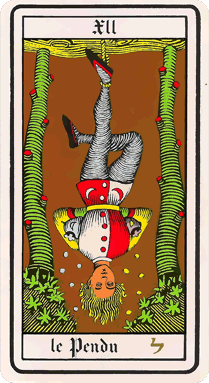
Comme le fait très justement remarquer M. de la Rive, le peintre a dû s'inspirer de la IVe églogue de Virgile, qui annonce le retour prochain de l'Age d'or, prédit par la Sibylle de Cumes. Le poète a l'intuition d'une race nouvelle qui descend du haut des cieux. Astrée, la Vierge, doit enfanter le Sauveur, qui ramènera dans le monde entier le règne béni de Saturne. Les pieces d'or, qui tombent aux pieds de la Sibylle, font-elles allusion aux oracles vendus à Tarquin-le-Superbe, ou sont-elles comme dans l'Arcane XII du =52= Tarot, un symbole de désintéressement? N'oublions pas que c'est surtout pour se livrer à la divination, qu'il est indispensable de savoir se dépouiller de ses métaux. |
The notions of alchemical ideography, whose overly summary account is the subject of the preceding study, have found their application in a rather piquant expertise, for which we were willing to resort to our knowledge.
The Courrier de la Champagne was fighting a good fight against Reims Freemasonry, when it received the following letter, which it hastened to publish on January 26, 1907: The next day, January 27, Mr. Henri Jadart, librarian and curator of the museums of painting and archeology of the city of Reims, thought it his duty to defend the offending painting, in which he is particularly interested, in his capacity as a former fabricator of the Church of Saint-Maurice.
That it is not a vulgar table of piety, it is what we will immediately grant to M. de la Rive. =47= We are indeed in the presence of an esoteric painting, and even initiatory: but Freemasonry has nothing to do with it. Strictly speaking, it suffices for the propagation of transcendent truths. Some [of these observers], who have eyes to see, discern. The others contemplate, blissfully, without understanding anything. In reality, each takes from it according to his degree of initiation. This is pure initiation, Isiac or natural initiation, independent of any concrete organization.
Let us now examine the famous painting, which Mr. de la Rive hastened to proclaim Masonic, which is not the proper word.
As Mr. de la Rive rightly points out, the painter must have been inspired by Virgil's Fourth Eclogue, which announces the imminent return of the Golden Age, predicted by the Cumaean Sibyl. The poet has the intuition of a new race which descends from the heavens. Astraea, the celestial Virgin, must give birth to the Savior, who will bring back the blessed reign of Saturn to the whole world. Do the gold pieces, which fall at the feet of the Sibyl, allude to the oracles sold in Tarquinius Superbus, or are they, as in Arcana XII of the Tarot, =52= a symbol of disinterestedness? Let us not forget that it is above all to indulge in divination that it is essential to know how to shed one's own metals. |
|
On est surpris de voir deux tritons, sonnant de la trompette, juchés sur le sommet du dôme hémisphérique formant le toit du temple sibyllin. Comment ces monstres aquatiques ont-ils recherché une position aussi aérienne? Il faut admettre que ce sont des habitants de cet Océan constitué par les eaux supérieures au firmament, représenté par le toit du temple. Ils ont pour mission d'insuffler aux âmes sensitives l'inspiration de ce qui se prépare à se réaliser. En somme, si l'image suspecte pèche par quelque chose au point de vue religieux, c'est précisément par son excès de catholicisme au sens propre du mot. On a voulu catholiciser ou universaliser au delà de ce que saurait admettre la foi peu éclairée d'un troupeau, qui ne fait qu'un médiocre honneur à son divin pasteur. |
We are surprised to see two tritons, sounding the trumpet, perched on the top of the hemispherical dome forming the roof of the sibylline temple. How did these aquatic monsters seek such an aerial position? It must be admitted that they are inhabitants of this Ocean formed by the waters above the firmament, represented by the roof of the temple. Their mission is to instill in sensitive souls the inspiration of what is preparing to happen. In short, if the suspicious image sins in anything from a religious point of view, it is precisely because of its excess of Catholicism in the proper sense of the word. We wanted to Catholicize or universalize beyond what the poorly enlightened faith of a flock could admit, which does only a mediocre honor to its divine shepherd. |

|
Elle porte le sceptre de la fécondité universelle, se rapprochant ainsi de Vénus-Uranie et de l'Istar babylonienne, envisagée com me la génératrice des formes idéales ou des idées-types selon lesquelles tout se crée. Son domaine est l'Océan lumineux ou se reflète la pensée créatrice, et dont les ondes correspondent aux Eaux supérieures de la Genèse, séparées des Eaux inférieures par le firmament. Elle a les ailes que lui attribue le =56= voyant de Pathmos; douze étoiles lui font une couronne resplendissante, alors que son pied repose sur le croissant de la lune. Il s'agit, en effet, d'un personnage éthéré, qui plane dans les régions sublimes de 'intellectualité pure, au-dessus du monde changeant ou sublunaire. |
She carries the scepter of universal fertility, thus approaching Venus-Urania and the Babylonian Ishtar, considered as the generator of ideal forms or of the typical ideas according to which everything is created. Its domain is the luminous Ocean where the creative thought is reflected, and whose waves correspond to the upper Waters of Genesis, separated from the lower Waters by the firmament. She has the wings attributed to her by Seer of Pathmos; =56= twelve stars make her a shining crown, while her foot rests on the crescent moon. She is, in fact, an ethereal character, who hovers in the sublime regions of pure intellectuality, above the changing or sublunar world. |

Vierge de la sacristie del'Eglise Saint-Thomas d'Aquin, à Paris.
C'est l'œuvre d'un sculpteur espagnol du XVIIe siècle, aussi habile comme artiste
que judicieux dans l'application du Symbolisme traditionnel.
|
Au point de vue hermétique, cela est beaucoup plus correct, car l'ensemble de l'Arcane III ramené à la sécheresse d'un idéogramme, se synthétise dans le signe du Mercure renversé ( De même que le croissant, la croix est placée tantôt au-dessus, tantôt au-dessous d'un élément de signe alchimique. Dans le premier cas, elle indique un travail accompli, une perfection définitivement acquise. Dans le second cas, il s'agit, au contraire, d'une action vitale qui demande à s'exercer, de virtualités latentes, concentrées comme en un germe, en attendant qu'elles puissent se déployer. Ce monstre est une sorte de sphinx, issu des quatre éléments. La partie antérieure de son corps est celle d'un lion qui vomit des flammes (Terre et Feu); mais il a des ailes (Air), et pour le reste, il devient un animal aquatique (Eau). Il représente la matière élémentaire, celle qu'il appartient à l'Intelligence de vaincre, de dompter et de domestiquer. |
From the hermetic point of view, this is much more correct, because the whole of Arcana III, reduced to the dryness of an ideogram, is synthesized in the sign of the reversed Mercury ( Like the crescent, the cross is placed sometimes above, sometimes below an element of alchemical sign. In the first case, it indicates an accomplished task, a definitively acquired perfection. In the second case, on the contrary, it is a question of a vital action which requires to be exercised, of latent potentialities, concentrated as in a germ, while waiting for them to be able to unfold. This monster is a kind of sphinx, resulting from the four elements. The front part of his body is that of a lion who vomits flames (Earth and Fire); but it has wings (Air), and for the rest it becomes an aquatic animal (Water). It represents the elementary matter, that which it is up to Intelligence to overcome, tame and domesticate. |

|
L'Arcane XI du Tarot nous montre, à ce sujet, la femme de l'Arcane III, qui maintient écartées, sans aucun effort, les mâchoires d'un lion furieux. C'est la Force, non pas l'énergie physique, mais la puissance irrésistible de la pensée, qui doit triompher de toute brutalité. |
The Arcana XI of the Tarot shows us, on this subject, the wife of Arcana III, who keeps apart, without any effort, the jaws of a furious lion. It is the Strength, not the physical energy, but the overwhelming power of thought, which must triumph over all bestiality. |

|
On peut se demander si cette Séphire ne devait pas être rappelée par les huit étoiles qui sur le tableau de Saint-Maurice, entourent la tête de la Vierge. L'ardeur impulsive se manifeste, en particulier, sous l'empire de Vénus, la femme qui, tenant un cœur enflammé à la main, s'échappe, pour ainsi dire, du globe ailé. C'est la passion qui s'extériorise, donnant naissance à l'Amour, c'est-à-dire à une force aveugle — Cupidon a les yeux bandés — soumise à des lois rigoureuses. Cette sentimentalité, d'ordre plutôt physiologique, est refoulée dans le domaine sublunaire, au-dessus duquel s'élève la pure spiritualité.
Restons, pour un instant, sur le terrain de la Gnose ou de l'Illumination spiritueile, dont le temple idéal nous est présenté par la Vierge. Celui qui devient à la fois fils et amant d'Isis, autrement dit disciple et confident de la Nature, joint au caducée la baguette divinatoire et l'anneau d'Hermès. La compagne de l'adepte tient enfin, de la main droite, un miroir, dans lequel se réflètent pour elle les images de la lumière astrale. Ces images sont vivantes; elles hantent les imaginations, provoquent les rêves, se nourrissent des pensées qu'elles suggèrent, des désirs qu'elles excitent et des aspirations qu'elles entretiennent. Se renouvelant sans cesse à travers les âges, ces fantômes mentaux servent de véhicule à cette Tradition impérissable, indépendante de la mémoire des hommes ou des documents matériels, qui n'est consignée, en caractères éthérés, que dans le livre mystérieux de la grande Révélatrice.
Les symboles qui nous restent à examiner sont plus spécialement alchimiques, tel en particulier le vase ovoïde, dont la Vierge tient le pied dans sa main droite. C'est l'Œuf des Philosophes, autrement dit, le vase de la Nature, en lequel s'accomplissent les opérations du Grand Œuvre, qui aboutissent à la naissance de l'enfant philosophique, destiné à «enrichir et perfectionner ses frères» 2). Hermétiquement luté, cet Œuf renferme le sujet de =66= l'Œuvre, qui n'y est introduit qu'après avoir été judicieusement choisi, puis débarrassé de tout corps étranger pouvant adhérer accidentellement à sa surface. Il s'agit, en d'autres termes, de la sélection du prof∴, qui est dépouillé de ses métaux, avant d'être emprisonné dans la Chambre des réflexions. |
One can wonder if this Sefira should not be recalled by the eight stars which on the Saint-Maurice painting surround the head of the Virgin. The Impulsive ardor manifests itself, in particular, under the domination of Venus, the woman who, holding a flaming heart in her hand, escapes, so to speak, from the winged globe [bottom-right detail]. It is the passion, which is exteriorized itself, giving birth to Love, that is to say to a blind force — Cupid with a blindfold — subject to rigorous laws. This sentimentality, of a rather physiological order, is repressed in the sublunar domain, above which rises pure spirituality.
Let us dwell, for a moment, on the field of Gnosis or spiritual Illumination, whose ideal temple is presented to us by the Virgin. The one who becomes at the same time son and lover of Isis, in other words disciple and confidant of Nature, joins to the caduceus the divinatory wand and the ring of Hermes. The Adept's companion, finally, holds in her right hand a mirror, in which the images of the astral light are reflected for her. These images are alive; they heighten the imaginations, provoke dreams, feed on the thoughts they suggest, they excite the desires, and they entertain the aspirations. Constantly renewing themselves through the ages, these mental ghosts serve as a vehicle for this imperishable Tradition, independent of the memory of men or of material documents, which is recorded, in ethereal characters, only in the mysterious book of the great Revelator.
The symbols which remain to be examined are more especially alchemical, such in particular the ovoid vase, of which the Virgin holds the pedestal in her right hand [bottom-left detail]. It is the Egg of the Philosophers, in other words, the vessel of Nature, in which the operations of the Great Work are accomplished, which culminate in the birth of the philosophical child, destined to "enrich and perfect his Brethren." 2) Hermetically closed, this Egg contains the subject of the Work, =66= which is only inserted there after having been judiciously chosen, then freed of any foreign body that may accidentally adhere to its surface. It is, in other words, the selection of the profane, who is stripped of his metals, before being imprisoned in the Chamber of Reflections. |

|
Ce dédoublement n'est pas définitif, car, en s'élevant, les parties évaporées se condensent, pour retomber sous forme de pluies successives, qui lavent progressivement la matière, la faisant passer du noir au blanc, en traversant les nuances intermédiaires du gris (épreuve de l'Eau). |
This splitting in two is not definitive, because, while rising, the evaporated parts condense, to fall back in the form of successive rains, which gradually wash the material, making it pass from black to white, crossing the intermediate shades of gray (trial by Water). |

|
L'Œuf a pour ambiance une sorte de sphère céleste, obliquement entourèe d'une bande zodiacale sur laquelle n'apparaissent que quatre signes, qui se suivent dans un ordre anormal. Au Cancer et au Lion succède, en effet, la Balance, immédiatement suivie des Poissons. Les opérations du Grand Œuvre qui correspondent à ces signes, sont la dissolution (♋), la digestion (♌), la sublimation (♎) et la projection (♓). Par cette =68= dernière se réalise la suprême transmutation, objectif de la Médecine de 3e Ordre (Maîtrise).
Notre tâche devient plus particulierement ardue, lorsqu'il nous faut élucider les mystओres du navire qui vogue à droite de la Vierge. C'est la barque d'Isis, qui rend possible la traversée de l'Océan vital. Ses voiles, gonflées par le souffle de l'Esprit universel, recueillent l'enthousiasme propulseur, qui a provoqué la chute du Cyclope, que nous voyons précipité dans les flots.
Cet impulsif peu rassurant doit être rejeté du vaisseau mystique, sa présence a bord étant de nature à
compromettre la navigation. Pour que celle-ci puisse s'accomplir avec securité, il faut que le rôle de vigie soit confié à un sensitif pleinement en possession de lui-même. C'est le cas de l'homme qui occupe la hune du second mât, auquel il est lié par une corde que Mercure dénoue, tout en suivant des yeux la chute du Cyclope, dont le voyant privilegié ne peut éviter le sort qu'à la faveur d'un parfait désintéressement. La tyrannie des appétits instinctifs s'oppose cependant, comme
un contrepoids nécessaire, au total oubli de soi-même. Il en résulte un conflit douloureux, auquel fait allusion =70= le corbeau qui déchire la poitrine de l'illuminé, pour le punir d'avoir imité Prométhée, en ravissant le feu du Ciel.
A la poupe du navire sacré, auprès du tronçon d'un troisième mât, destiné sans doute à représenter la barre du gouvernail, l'Enfant philosophique est assis sur un cœur rayonnant. Ce pilote n'est autre que la Raison (Verbe incarné, Fils de Dieu des Chrétiens, Buddhi des Théosophes), laquelle s'appuie sur le sentiment et la lumière qui s'en dégage, pour se manifester comme principe de la Conscience directrice des actions humaines. A bord du navire, la responsabilité du commandement incombe au Roi, qui représente la Volonté, dont les ordres sont exécutoires. Au-dessus de sa couronne se lit le chiffre 1266, et, entre son sceptre et son épaule droite, le chiffre 1137. Les deux mâts chargés de voiles se réunissent par leurs bases, derrière un guerrier cuirassé et casqué, dont la main droite est armée d'un simple bâton, tandis que, de la gauche, il présente une statue de Minerve au vieillard précédent. C'est Mars, l'ardeur agissante, mettant son énergie au service d'une volonté sagement pondérée. |
The Egg has for atmosphere a kind of celestial sphere, obliquely surrounded by a zodiacal band on which only four signs appear, which follow each other in an abnormal order. In fact, Cancer and Leo succeed Libra, immediately followed by Pisces. The operations of the Great Work which correspond to these signs are the dissolution (♋), digestion (♌), sublimation (♎) and projection (♓). =68= By this last is carried out the supreme transmutation, objective of the Science of the 3rd Order (Mastery).
Our task becomes more particularly difficult when we have to unravel the mysteries of the ship which sails to the right of the Virgin. It is the boat of Isis, which makes it possible to cross the vital Ocean. Its sails, inflated by the breath of the universal Spirit, collect the propelling enthusiasm, which caused the fall of the Cyclops, which we see plunged into the waves.
This little reassuring impulsive character must be rejected from the mystical vessel, its presence on board being likely to compromise navigation. In order for this to be accomplished safely, the role of watchman must be entrusted to a sensitive person fully in possession of himself. This is the case of the man who occupies the top of the second mast, to which he is tied by a rope that Mercury unties, while following with his eyes the fall of the Cyclops, whose fate the privileged seer can only avoid by means of perfect disinterestedness. The tyranny of instinctive appetites opposes itself, however, as a necessary counterweight, to the total forgetfulness of oneself. This results in a painful conflict, to which alludes =70= the crow which tears apart the chest of the illuminated, to punish him for having imitated Prometheus, by stealing the fire of Heaven.
At the stern of the sacred ship, near the section of a third mast, undoubtedly intended to represent the helm, the Philosophical Child is seated on a radiant heart. This pilot is none other than Reason (Incarnate Word, the Son of God of the Christians, the Buddhi of the Theosophists), which relies on feeling and the light that emerges from it, to manifest itself as the principle of the guiding Consciousness of human actions. On board the ship, the responsibility for command lies with the King, who represents the Will, whose orders are enforceable. Above his crown is the number 1266, and between his scepter and his right shoulder, the number 1137. The two masts loaded with sails meet at their bases, behind an armored and helmeted warrior, whose right hand is armed with a simple stick, while, from the left, he presents a statue of Minerva to the preceding old man. It is Mars, active ardor, putting its energy at the service of a wisely balanced will. |


|
Nous arrêtons ici ces commentaires, nécessairement arides et incomplets, pour qui ne s'est jamais occupé d'Hermétisme. Pour nous expliquer entièrement, plusieurs traités volumineux ne seraient pas de trop. Nous avons abordé déjà ce sujet dans la seconde partie d'un ouvrage paru en 1897, concernant l'Imposition des Mains et la Médecine philosophale. Depuis, nous avons voulu consacrer au Tarot une étude approfondie, intitulée l'Alphabet des Initiés, mais notre travail, souvent repris dans son ensemble, n'est pas encore prêt à voir le jour. Peut-être ferons-nous bien d'en extraire un chapitre, traitant de l'Idéographisme alchimique 1), pour en faire l'objet d'une publication séparée. Un ouvrage allemand sur la Philosophie hermétique et la Franc-Maçonnerie, dont l'auteur est le F∴ W. Hœhler, =74= vient d'ailleurs de paraître chez Weiss et Hameier, à Ludwigshafen (Palatinat). Nous nous proposons d'en rendre compte dans un prochain article, qui, à ce point de vue spécial, pourra faire suite à celui-ci, dont le but a été de montrer que le tableau de Reims, objet de la discussion engagée dans le camp de nos adversaires, ne relève pas plus de la mystique chrétienne ordinaire que du symbolisme maçonnique proprement dit, l'auteur ne s'étant inspiré que des allégories familières aux Initiés de l'Alchimie philosophique.
|
We stop here these comments, necessarily arid and incomplete, for those who have never been concerned with Hermetism. To explain it fully, several voluminous treaties would not be too many. We have already approached this subject in the second part of a work published in 1897, concerning the Laying of Hands and the Philosopher's Science. Since then, we have wanted to devote an in-depth study to the Tarot, entitled the Alphabet of the Initiates, but our work, often taken up as a whole, is not yet ready to see the light of day. Perhaps we will do well to extract a chapter from it, dealing with the Alchemical Ideography, 1) to be the subject of a separate publication. A German work on Hermetic Philosophy and Freemasonry, authored by Bro. W. Höhler, =74= has just been published by Weiss and Hameier, in Ludwigshafen (Palatinate). We propose to give an account of it in a future article, which, from this special point of view, could follow this one, the aim of which was to show that the painting of Reims, object of the discussion engaged in the camp of our adversaries, does not relate more to ordinary Christian mysticism than to Masonic symbolism properly so called, the author having been inspired only by allegories familiar to the Initiates of Philosophical Alchemy.
|

Rough sketch of the alchemical painting at Saint-Maurice Church in Reimswith enlargement of characteristic details for the study of symbolism.*
|
Sous ce titre, le Vrijmetselaar 1) de février 1908 a rendu compte, d'une manière très étendue, de notre étude intitulée: «Un Symbolisme inquiétant» (voir le chapitre précédent). Certaines de nos interprétations ont donné lieu, à ce sujet, à des commentaires dont nous croyons devoir donner une rapide analyse. Cette Eau, qui est l'habitat des tritons, correspond à la matière en quelque sorte abstraite, indépendante de toutes les formes et de tous les aspects qu'elle est susceptible de revêtir. Elle renferme en elle-même toutes les possibilités de formation et de transformation; mais aucun arbitraire ne détermine les formes ou leurs modifications. L'avenir est caché dans la matière, si bien qu'il suffit de connaître la loi qui la gouverne, pour posséder le don de divination et de prophétie.
La rédaction du Vrijmetselaar fait également quelques remarques intéressantes à propos du fil-à-plomb suspendu au bout de la poutrelle qui émerge de l'une des fenêtres du temple minuscule que la Vierge du tableau de Reims soulève de sa main gauche. Il constate que nous avous donné du fil à plomb une interprétation jusqu'ici inédite, en le rapportant à la nécessité de descendre en soi-même et de pénétrer jusqu'au centre, d'où jaillit la lumière intérieure, celle qui, selon l'Evangile de Saint-Jean éclaire tout homme venant en ce monde. Tous les auteurs qui traitent de symbolisme maçonnique n'ont, en effet, envisagé le fil à plomb qu'au point de vue de son emploi dans l'art de bâtir. Ils l'ont consideré, en conséquence, comme l'instrument de la construction en hauteur, sans remarquer qu'il s'applique tout aussi bien au travail en profondeur. Or, c'est au creusement d'un puits vertical, s'enfonçant jusqu'au centre de la terre que fait incontestablement allusion le fil à plomb de la peinture alchimique. Il est suspendu au-dessus de la tête de l'Adepte, qui doit savoir s'absorber en lui-même, pour parvenir jusqu'au noyau de son individualité, où il découvrira la mystérieuse Quintessence, c'est-à-dite l'essence de son moi réel, dégagé de toute contingence de forme. Connais-toi, toi-même, dit ainsi le fil à plomb, car celui qui, socratiquement, parvient à se connaître lui-même, apprend par ce fait à discerner l'unité fondamentale dans l'dentité du Tout; =80= à force d'approfondir, le penseur en arrive à saisir mentalement chaque chose, à se l'approprier et aussi à l'aimer, tant isolément, que dans sa liaison avec l'universalité des choses. |
Under this title, the Vrijmetselaar 1) of February 1908 gave a very extensive account of our study entitled: "A disturbing Symbolism" (see the previous chapter). Some of our interpretations have given rise to comments on this subject which we believe should be given a quick analysis. This Water, which is the habitat of the tritons, corresponds to the matter in a way abstract, independent of all the forms and all the aspects that it is likely to take. It contains within itself all the possibilities of formation and transformation; but no arbitrariness determines the forms or their modifications. The future is hidden in the matter, so that it suffices to know the law which governs it, to possess the gift of divination and prophecy.
The Vrijmetselaar editors also make some interesting remarks about the plumb line hanging from the end of the joist that emerges from one of the tiny temple windows that the Virgin in the Reims painting lifts with her left hand. He notes that we have given the plumb line a hitherto unprecedented interpretation, relating it to the need to descend into oneself and to penetrate to the center, from which springs the interior light, that which, according to the Gospel of Saint John, enlightens everyone who comes into this world. All the authors who deal with Masonic symbolism have in fact only considered the plumb line from the point of view of its use in the art of building. They considered it, therefore, as the instrument of construction of heights, without noticing that it applies just as well to work of depths. However, it is with the digging of a vertical well, sinking to the center of the earth that the plumb line of the alchemical painting undoubtedly alludes to. It is suspended above the head of the Adept, who must know how to absorb himself in himself, to reach the core of his individuality, where he will discover the mysterious Quintessence, that is to say, the essence of his real self, free from any contingency of form. Know thyself, says the plumb bob, for he who, Socratically, comes to know himself, thereby learns to discern the fundamental unity in the identity of the Whole; =80= by dint of deepening, the thinker comes to mentally grasp each thing, to appropriate it and also to love it, both in isolation and in its connection with the universality of things.
|
|
En terminant notre étude sup le tableau alchimique de l'église Saint-Maurice de Reims 2), nous avons promis de rendre compte d'un ouvrage allemand, dont l'auteur, le F∴ Wilhelm Höhler, s'est efforcé de démontrer que la Franc-Maçonnerie se rattache étroitement à l'Alchimie, ou, plus exactement à la Philosophie hermétique. Le travail dont il s'agit a été publié chez Weiss et Hameier, à Ludwigshafen (Palatinat), en 1905, sous le titre: Hermetische Philosophie und Freimaurerei. Ce n'est, en réalité, qu'un choix de textes judicieusement extraits des alchimistes les plus connus, tels que Basile Valentin, Michel Maier (Sendivogius), l'abbé Jean Trithéme, Raymond Lulle, Roger Bacon, Arnaud de Villeneuve, Jean d'Espagnet, Robert Fludd, et de quelques autres moins répandus: Benedictus Figulus, Egidius Gutmann, J. Stellatus, Alex, von Suchten, Mylius, Janus Lacinius, Tanck, Leonhard Thurneisser, etc. Ces citations fournissent la matière des chapitres suivants: L'Univers et l'Homme — Astrologie — Théosophie — Magie — Kabbale — Alchimie, ce dernier divisé en sous-chapitres: Signification du mot =84= Alchimie — Les asiprants — La tradition — Symboles — La matière — Les travaux — Couleurs, feu, instruments — Or potable — Christus lapis. Le F∴ Höhler n'a voulu s'adresser qu'aux Franc-Maçons. Il laisse donc à ses lecteurs le soin d'etablir les rapprochements entre les textes alchimiques qu'il reproduit et les enseignements maçonniques qui doivent leur être familiers. Cette méthode peut laisser perplexes les esprits paresseux, qui ne se sont jamais donné la peine de chercher le mot de toutes les énigmes que la Franc-Maçonnerie leur propose. Elle répondra, par contre,aux exigences des penseurs, qui, ne craignant pas le travail de la réflexion, préfèrent qu'on leur fournisse les éléments d'un problème, plutôt qu'une solution formulée plus ou moins dogmatiquement. Dans le domaine du symbolisme, il ne faut pas vouloir trop préciser, les symboles initiatiques correspondant à des conceptions peu saisissables de leur nature et nullement réductibles à des définitives scholastiques.
Afin de restreindre cette étude, nous ne la ferons porter que sur le ritualisme de la Maçonnerie classique, dite de Saint-Jean, laquelle ne comporte que trois grades. Cela nous permettra, au point de vue alchimique, de faire abstraction des svmboles considéré en eux-mêmes, pour ne nous attacher uniquement qu'aux =87= opérations successives qui aboutissent à la réalisation du Grand Œuvre.
Le Soufre 🜍 correspond, en effet, à l'énergie expansive qui part du centre de tout être (colonne J∴ rouge, initiative individuelle). Son action s'oppose à celle du Mercure ☿, qui pénètre toutes choses, par une influence venant de l'extérieur (colonne B∴ blanche, réceptivité, sensibilité). Ces deux forces antagonistes s'équilibrent dans le Sel 🜔, principe de cristallisation, qui représente la partie stable de l'être, celle dont la condensation s'effectue dans la zone où les émanations sulfureuses se heurtent à la compression mercurielle ambiante. |
By concluding our study on the alchemical painting of the Saint-Maurice church in Reims, 2) we promised to report on a German work, whose author, Bro. Wilhelm Höhler, endeavored to demonstrate that Freemasonry is closely linked to Alchemy, or, more exactly, to Hermetic Philosophy. The work in question was published by Weiss and Hameier, in Ludwigshafen (Palatinate), in 1905, under the title: Hermetische Philosophie und Freimaurerei. This is, in reality, only a choice of texts judiciously extracted from the most famous alchemists, such as Basile Valentin, Michel Maier (Sendivogius), the abbot Jean Trithéme, Raymond Lulle, Roger Bacon, Arnaud de Villeneuve, Jean d'Espagnet, Robert Fludd, and a few less common ones: Benedictus Figulus, Egidius Gutmann, J. Stellatus, Alex von Suchten, Mylius, Janus Lacinius, Tanck, Leonhard Thurneisser, etc. These quotes provide the material for the following chapters: The Universe and Man — Astrology — Theosophy — Magic — Kabbalah — Alchemy, the latter divided into sub-chapters: Meaning of the word Alchemy =84= — Asiprants — Tradition — Symbols — The material — The works — Colors, fire, instruments — Drinking gold — Christus lapis. Bro. Höhler wanted to address only Freemasons. He therefore leaves it to his readers to establish the connections between the alchemical texts, which he reproduces, and the Masonic teachings, which must be familiar to them. This method can leave lazy minds perplexed, who have never bothered to search for the word of all the riddles that Freemasonry offers them. It will respond, on the other hand, to the demands of thinkers, who, not fearing the work of reflection, prefer that they be provided with the elements of a problem, rather than a solution formulated more or less dogmatically. In the field of symbolism, we must not want to be too precise, the initiatic symbols corresponding to conceptions whose nature is difficult to grasp and in no way reducible to definitive scholastics.
In order to restrict this study, we will only focus on the ritualism of classical Masonry, known as Saint-John [Blue Lodges], which has only three degrees. This will allow us, from the alchemical point of view, to disregard the symbols considered in themselves, to focus only on =87= successive operations which lead to the realization of the Great Work.
Sulfur 🜍 corresponds, in fact, to the expansive energy which starts from the center of every being (red column J, individual initiative). Its action is opposed to that of Mercury ☿, which penetrates all things, by an influence coming from the outside (white column B, receptivity, sensitivity). These two antagonistic forces are balanced in the Salt 🜔, principle of crystallization, which represents the stable part of the being, that of which the condensation takes place in the zone where the sulfurous emanations collide with the ambient mercurial compression. |

=90=
|
Cette Pierre est un symbole essentiellement maçonnique, et il semble bien que les Alchimistes en aient primitivement emprunté l'emblème aux Initiés constructeurs. Une pierre, en effet, n'est pas normalement à sa place dans un symbolisme de métallurgistes; il est au contraire tout naturel qu'elle soit d'abord dégrossie, puis soigneusement taillée et polie par des Maçons. Ceux-ci sont d'ailleurs beaucoup moins mystérieux au sujet de leur Pierre que les Hermétistes. C'est ainsi qu'ils déclarent sans ambages que leur Pierre brute, c'est l'Initié lui-même dans son premier état. Il se degrossit lui-même en tant qu'Apprenti, afin de mériter de passer Compagnon, par le seul fait de sa transformation en Pierre cubique. Rigoureusement équarrie, cette Pierre possède, en puissance au moins, toutes les vertus de la fameuse Pierre philosophale. Il faut cependant posséder l'Art intégralement, être Ouvrier parfait ou Maître, pour opérer les transmutations.
Abandonné à lui-même, privé de tout réconfort, le sujet enfermé dans l'Œuf philosophique ne tarde pas à être accablé de tristesse. Il languit: ses forces lui échappent et la décomposition commence. Sous l'influence de celle-ci, le subtil se dégage de l'épais. C'est la première phase de l'épreuve de l'Air. Après être descendu jusqu'à ce centre du monde où se rencontrent les racines de toute individualité, l'esprit remonte; il s'élève, allégé du caput mortuum, qui noircit au fond du vase hermétique. Ce résidu est figuré par les vêtements dont le Récipiendaire a dû se défaire pour sortir =91= de son in pace. Il va maintenant se frayer péniblement une route au milieu de l'obscurité, sans se laisser rebuter par des obstacles sans cesse renaissants. Les hauteurs l'attirent: fuyant l'enfer, il veut gagner le ciel et s'acharne à gravir la pente abrupte de la montagne idéale, dont le sommet doit resplendir de lumière.
La Pierre philosophale est un Sel 🜔 parfaitement purifié, qui coagule le Mercure ☿, pour le fixer en un Soufre 🜍 éminemment actif.
Revenons maintenant aux opérations du Grand Œuvre.=95= Tout être porte en lui-même cet astre mystérieux, mais trop souvent à l'état de vague étincelle, à peine perceptible. C'est l'Enfant philosophique, le Logos immanent ou le Christ incarné, que la légende fait naître obscurément, au milieu des immondices d'une grotte servant d'étable. Ce Feu extériorisé ou cèleste est l'un des deux agents «actuels», ou effectivement agissants, du Grand Œuvre, l'autre étant le Feu central exalté au point de devenir attractif pour le premier, à la façon d'un aimant. Il s'établit alors une circulation, par l'effet de laquelle les deux agents sont réduits en un seul, qui est le Feu philosophique, =98= dont il est question dans la Table d'Emeraude, lorsque nous y lisons: «Il (l'Agent hermétique par excellence) monte de la Terre an Ciel et derechef il descend da Ciel en Terre, et il reçoit la force des choses d'en hant et d'en bas. Ainsi tu auras la gloire de l'Univers entier; par là toute obscurité s'enfuira de toi. Là réside la force forte de toute force qui vaincra toute chose subtile et pénétrera toute chose solide».
Le Feu philosophique est entretenu par le Soufre rouge des Sages, dont l'image est le Phénix renaissant continuellement de ses cendres. Si cet oiseau fabuleux, au plumage écarlate, était consacré au Soleil ☉, c'est qu'il représente le principe de la fixité individuelle.
Au point de vue initiatique, il symbolise en outre, d'une façon plus spéciale, l'immuabilité acquise à l'adepte, dont l'initiative individuelle s'exerce en parfait accord avec l'impulsion que tout constructeur reçoit de la puissance régulatrice de la construction universelle, autrement dit du Grand Architecte de l'Univers.
On est surpris de rencontrer ces emblèmes capitaux de l'Art Royal dans un opuscule qui prétend enseigner «le moyen de faire l'or caché des Philosophes» et dont l'auteur vivait à une époque de beaucoup antérieure à la renaissance de la Franc-Maçonnerie moderne. =101= |
This Stone is an essentially Masonic symbol, and it seems that the Alchemists originally borrowed the emblem from the Initiate builders. A stone, in fact, is not normally in its place in a symbolism of metallurgists; on the contrary, it is quite natural that it should first be roughened, then carefully cut and polished by Masons. These are also much less mysterious about their Stone than the Hermetists. This is how they clearly declare that their Rough Stone is the Initiate himself in his first state. He grows up himself as an Apprentice, in order to deserve to become a Fellowcraft, by the sole fact of his transformation into a Cubic Stone. Rigorously squared, this Stone possesses, potentially at least, all the virtues of the famous Philosopher's Stone. It is necessary, however, to possess the Art in its entirety, to be a perfect Worker or a Master, to carry out the transmutations.
Abandoned to himself, deprived of all comfort, the subject enclosed in the Philosophical Egg is shortly overwhelmed with sadness. He languishes: his strength escapes him, and decomposition begins. Under its influence, the subtle emerges from the unsubtle. This is the first phase of the trial by Air. After having descended to that center of the world where the roots of all individuality meet, the spirit ascends; it rises, lightened by the lost caput mortuum [residue], which darkens at the bottom of the hermetic vessel. This residue is represented by the clothes which the Candidate had to discard to get out of his in pace [comforts]. =91= He will now trudge his way through the darkness, not being put off by constantly re-emerging obstacles. He is attracted by the heights: fleeing hell, he wants to reach heaven and persists in climbing the steep slope of the ideal mountain, whose summit must shine with light.
The Philosopher's Stone is a perfectly purified Salt 🜔, which coagulates the Mercury ☿, to fix it in an eminently active Sulfur 🜍.
Let us now return to the proceedings of the Great Work. =95= Every being carries within itself this mysterious star, but too often in the state of vague spark, barely perceptible. It is the Philosophical Child, the Immanent Logos or the Incarnate Christ, that legend makes him born obscurely, in the midst of the filth of a cave serving as a stable. This exteriorized or celestial Fire is one of the two "actual" or actually acting agents of the Great Work, the other being the central Fire exalted to the point of becoming attractive to the first, like a magnet. A circulation is then established, by the effect of which the two agents are reduced into one, which is the philosophical Fire, =98= which is mentioned in the Emerald Table, when we read there: "He (the Hermetic Agent par excellence) rises from Earth to Heaven and once again he descends from Heaven to Earth, and he receives the strength of things from above and below. Thus, you will have the glory of the entire Universe; thereby all darkness will flee from you. There resides the strong force of all force which will overcome all subtle things and penetrate all solid things."
The philosophical Fire is maintained by the red Sulfur of the Sages, whose image is the Phoenix continually rising from its ashes. If this fabulous bird, with scarlet plumage, was consecrated to the Sun ☉, it is because it represents the principle of individual fixity.
From the initiatory point of view, it also symbolizes, in a more special way, the immutability acquired by the adept, whose individual initiative is exercised in perfect harmony with the impulse that every builder receives from the regulatory power of universal construction, in other words of the Great Architect of the Universe.
It is surprising to find these capital emblems of the Royal Art in a pamphlet which claims to teach "the means of making the hidden gold of the Philosophers" and whose author lived at a time much prior to the rebirth of Modern Freemasonry. =101= |
 , autrement dit, que l'Individu entre en communion avec la Collectivité dont il relève.
 . Cette substance dont l'idéogramme combine le Soufre

|
Les cinq pointes de cette figure, dite aussi Etoile du Microcosme, correspondent aux quatre membres et à la tête de l'homme. Et comme les membres exécutent ce que la tête commande, le Pentagramme est aussi le signe de la volonté souveraine, à laquelle rien ne saurait résister, pourvu qu'elle soit inébranlable, judicieuse et désintéressée.
Au point de vue initiatique, posséder son Compagnonnage signifie déjà être à même d'accomplir ce que le vulgaire appelle des miracles. — Armé de la Règle et du Levier, l'Initié soulève le monde — le monde moral, bien entendu, mais c'est le seul qu'il importe de soulever. La Fixation du Soufre philosophique, autrement dit la Maîtrise, est d'ailleurs figurée aussi bien par le supplice de Prométhée, enchaîné sur le Caucase pour avoir dérobé le Feu du Ciel, que par celui du Christ Rédempteur, suspendu par trois clous au quaternaire des branches de la croix.
Le Tarot n'est pas moins explicite à cet égard. Sa douzième clef nous offre, en effet, l'image d'un Pendu qui se balance tout souriant entre ciel et terre. Il est accroché par le pied gauche à une traverse que soutiennent deux arbres ébranchés, qui correspondent aux colonnes J∴ et B∴. La tête et les bras forment un triangle renversé, que surmonte une croix dessinée par la jambe droite repliée derrière la gauche, l'ensemble traçant ainsi le signe classique de l'accomplissement du Grand Œuvre Placé entre l'Abstrait et le Concret, entre l'Intelligence créatrice et la Création objective, l'Homme ainsi conçu apparaît comme le Médiateur par excellence ou le véritable Démiurge des écoles gnostiques.
Les dons les plus brillants de l'intelligence et du vouloir ne feraient jamais qu'un faux image de l'adepte qui n'aurait pas cultivé les qualités du cœur. Quant à la récompense de celui qui, par le sentiment, ne s'est pas élevé moins haut que par la science, elle réside dans le Sceau de Salomon.
Ces deux triangles entrelacés constituent l'Etoile du Macrocosme ou du Monde en Grand. Ils symbolisent l'union du Père et de la Mère, de Dieu et de la Nature, de l'Esprit unique et de l'Ame universelle, du Feu procréateur et de l'Eau génératrice. C'est le pantacle par excellence, le signe d'une puissance à laquelle rien ne résiste, et dont nous disposerions, si nous parvenions à posséder effectivement notre grade de Maître. |
The five points of this figure, also called the Star of the Microcosm, correspond to the four limbs and the head of man. And as the limbs do what the head commands, the Pentagram is also the sign of sovereign will, which nothing can resist, provided it is steadfast, judicious, and selfless.
From the initiatory point of view, having attained the rank of a Fellowcraft already means being able to accomplish what the commoners call miracles. — Armed with the Ruler and the Lever, the Initiate raises the world — the moral world, of course, but it is the only one that it is important to raise. The Fixation of the philosophical Sulfur, in other words the Mastery, is moreover represented as well by the torture of Prometheus, chained on the Caucasus for having stolen the Fire from Heaven, as by that of Christ the Redeemer, suspended by three nails in the quaternary of the sections of the cross.
The Tarot is no less explicit in this regard. His twelfth card offers us, in fact, the image of a Hanged Man who swings smilingly between heaven and earth. It is hung by the left foot to a transom supported by two lopped trees, which correspond to columns J and B. The head and the arms form an inverted triangle, surmounted by a cross drawn by the right leg folded behind the left, the whole thus tracing the classic sign of the accomplishment of the Great Work Placed between the Abstract and the Concrete, between Creative Intelligence and Objective Creation, the Man thus conceived appears as the Mediator par excellence or the true Demiurge of the Gnostic schools.
The most brilliant gifts of the intellect and of the will would never make more than a false image of the follower who would not have cultivated the qualities of the heart. As for the reward for one who, by feeling, has not risen less than by science, it is found in the Seal of Solomon.
These two interlaced triangles constitute the Star of the Macrocosm or of the World in Large. They symbolize the union of Father and Mother, of God and Nature, of the One Spirit and of the universal Soul, of the procreative Fire and of the generating Water. It is the pentacle par excellence, the sign of a power to which nothing can resist, and which we would have, if we managed to actually possess our rank of Master. |


|
Paru dans le Journal du Magnétisme, n° de janvier 1891. Traduit en italien par le Dr Hoffmann pour la revue Lux de Rome, n° de mars 1891.
La Médecine Occulte est basée sur la connaissance de l'homme dans ce qu'il y a en lui d'invisible et d'inexploré par la science officielle de nos jours. — Elle agit par des moyens paraissant irrationnels à quiconque n'est pas initié aux lois secrètes qui gouvernent la nature.
Les quelques pages qui précèdent doivent suffire pour faire entrevoir aux penseurs la haute valeur des traités d'Alchimie.
|
Published in the Journal of Magnétism, January 1891 Issue. Translated into Italian by Dr Hoffmann for the Lux magazine of Rome, March 1891 Issue.
The Occult Science is based on the knowledge of man in what is in him invisible and unexplored by official science today. — It acts by means which appear irrational to anyone who is not initiated into the secret laws which govern nature.
The few preceding pages must suffice to give the thinkers a glimpse of the high value of the treatises on Alchemy.
|
|
Dans son Dogme et Rituel de la Haute Magie, ouvrage devenu classique en Occultisme, Eliphas Levi 1) s'exprime comme suit: Cette appréciation du père de l'Occultisme contemporain nous engage à reproduire ici un texte dont il fait si grand cas. Jusqu'à la 61e question de son Catéchisme, le baron de Tschoudy s'est ainsi inspiré de la «Nouvelle Lumière Chymique», dont il s'est contenté d'extraire les points de doctrine les plus saillants, puis de les présenter fort habilement sous forme de demandes et de réponses. Il a ensuite appliqué le même procédé ingenieux à un ouvrage imprimé pour la premiere fois à Paris, chez Laurent d'Houry, en novembre 1686. Cette seconde source a pour titre: LA LUMIÈRE SORTANT PAR SOI-MESME DES TÉNÈBRES. ou véritable théorie de la Pierre des Philosophes, écrite en Vers Italiens, avec un Commentaire; le tout traduit en François par B. D. L. =119=
|
In his Dogma and Ritual of High Magic, a work that has become classic in Occultism, Eliphas Levi 1) expresses himself as follows: This appreciation of the father of contemporary Occultism prompts us to reproduce here a text for which he is so highly regarded. We cannot, however, dispense with formulating some reservations as to the exceptional source from which the author of the Blazing Star would have drawn his hermetic science. =116= Until the 61st question of his Catechism, Baron de Tschoudy was also inspired by the "New Chemical Light," from which he contented himself with extracting the most salient points of doctrine, then presenting them very skillfully in the form of Questions and Answers. He then applied the same ingenious process to a work printed for the first time in Paris, by Laurent d'Houry, in November 1686. This second source is entitled: THE LIGHT EMERGING BY ITSELF FROM DARKNESS, or true theory of the philosophers' stone, written in Italian Verses, with a Commentary; all translated in French by B. D. L. =119=
|
|
N. B. — Si tous les catéchismes de Maçonnerie étaient aussi instructifs que celui-là, — et ceux des autres grades de cette partie que j'espère communiquer un jour au public, s'il accueille cette ébauche, — il est à croire que l'on s'appliquerait davantage à se ressouvenir des questions de l'Ordre, mais leur sécheresse fatigue la mémoire, perd le temps et rebute l'esprit.
|
N. B. — If all the catechisms of Masonry were as instructive as this one, — and those of the other degrees of this institution, which I hope to communicate one day to the public, if they welcome this draft, — it is to be believed that one would apply himself more to remembering the questions of the Order, but their dryness tires the memory, wastes time, and puts off the mind.
|

 Après avoir fait ressortir aussi des correspondances, d'une part entre Mercure et Jupiter, puis de l'autre entre Mars et Vénus,le Cosmopolite ajoute: «La plupart des opérateurs savent bien comme on transmue le fer
 |
Dans le tome second de son Etoile Flamboyante, parue en 1766, le Baron de Tschoudy nous a donné un Catéchisme ou instruction pour le grade d'Adepte ou Apprentif Philosophe sublime et inconnu, au cours duquel il reproduit une ode alchimique italienne, résumé, selon lui, de toute la science des Philosophes. Il nous a paru bon de revoir avec soin la traduction =158= faite au XVIIe siècle, afin, sur divers points, de serrer de plus près le texte original 1). Nous nous sommes appliqué, en outre, à rester d'une extrême concision dans notre propre commentaire. De semblables écrits demandent à être médités et c'est à tort que l'on s'efforcerait de les dépouiller de leur caractère énigmatique. Nous sommes persuadé, d'ailleurs, que le lecteur attentif saura tirer profit de nos indications sommaires.
|
In the second volume of his Etoile Flamboyante [Blazing Star], published in 1766, Baron de Tschoudy gave us a Catechism or instruction for the rank of Adept or Apprentice Sublime and Unknown Philosopher, during which he reproduces an Italian alchemical ode, summarizing, according to him, all the science of the Philosophers. It has seemed good to us to carefully review the translation =158= made in the 17th century, in order, on various points, to get closer to the original text. 1) We have also endeavored to be extremely concise in our own commentary. Similar writings need to be meditated on and it is wrong to attempt to strip them of their enigmatic character. We are convinced, moreover, that the attentive reader will know how to profit from our summary indications.
|
|
Le Rien, dont le Tout est issu, ne saurait être qu'une abstraction de l'esprit; c'est le point mathématique sans dimensions renfermant en puissance tout ce qui doit se réaliser en acte. Tout microcosme procède d'une semence ou d'un germe, dont l'énergie expansive réside en un centre immatériel, d'où part l'action constructive de l'individu, absolument comme le pouvoir créateur s'exerce dans le macrocosme. Le chaos ténébreux correspond à la Matière première des Sages, dépositrice de toutes les potentialités, mais inerte tant que le travail coordinateur n'y a pas commencé.
La lumière qui débrouille le chaos n'est pas une radiation physique; elle est purement spirituelle et ne se manifeste que par ses effets. C'est l'Intelligence constructive, la Raison coordinatrice, qui s'identifie avec la Parole divine, dont il est dit: =161= In Principio erat Verbum. Ce principe, en lequel était le Verbe, figure ici le Centre unique, mais omniprésent, d'où émane perpétuellement l'action créatrice. A ce Centre sont rattachées toutes les créatures, qui en tirent leur vie et leur intelligence.
Les opérations du Grand Œuvre reproduisant les phases successives de la création, l'Artiste doit s'appliquer à singer Dieu. Avant tout, il lui faut obtenir son chaos (la Matière renfermant en elle-même tout ce qui est nécessaire à l'accomplissement de l'Œuvre), qu'il s'agit ensuite de coordonner progressivement, par une séparation préalable du subtil de l'épais (création du Ciel et de la Terre). Il est indispensable, en outre, d'établir un firmament séparant les eaux inférieures des eaux supérieures, afin d'isoler le sujet et de l'astreindre à travailler sur lui-même en déployant ses ressources propres. Il est non moins important de concentrer la lumière diffuse en un foyer fixe, qui correspond au Soleil (Soufre 🜍, centre d'initiative et d'action individuelle), puis d'en recueillir les reflets épars à l'aide d'un astre vagabond et changeant analogue à la Lune (Mercure
Par Illiaste il faut entendre Hyle ou la Matière chaotique. Celle-ci doit être décomposée en ses Eléments, afin que chacun d'eux soit purifié séparément, avant leur réunion en un nouveau chaos philosophique, figuré par «l'admirable composé» du poète.
Le Mercure
L'œuf philosophique doit être hermétiquement luté par la contraction des enveloppes les plus externes. Le travail intérieur peut ainsi s'accomplir à couvert, c'est-à-dire dans les conditions d'isolement indispensables à la maturation du sujet Il faut que celui-ci se développe par ses propres moyens, selon les lois de son devenir particulier. Lorsque cependant l'individualité a pris suffisamment consistance pour débuter dans la vie strictement autonome (naissance), elle ne saurait =165= être abandonnée à elle-même. Tout apprentissage s'effectue sous la direction d'un maître. Mais que de clairvoyance (yeux de lynx) et de discernement sagace réclame l'éducation d'un être qu'aucune influence étrangère ne doit déformer, afin qu'il reste scrupuleusement lui-même, tout en déployant progressivement toutes ses virtualités latentes!
Pour s'instruire de la théorie (Apprentissage, premier degré de l'Initiation), on ne saurait se contenter d'accumuler en sa mémoire les doctrines d'autrui, toutes plus ou moins entachées d'erreur. Le vrai disciple de la science doit parvenir à découvrir par lui-même les vérités qui se cachent au fonds du puits hermétique. Celui qui croit y avoir réussi peut se risquer à la pratique (Compagnonnage, deuxième degré d'Initiation), après y avoir été encouragé par les maîtres.
Canzone Seconda. — Chant Deuxième.
L'Alchimie est un vaste système d'allégories; celui qui n'en discerne pas la clef fera bien de s'abstenir de toute pratique. C'est en ce domaine surtout que la lettre tue et que l'esprit seul vivifie. L'Or philosophique est un trésor dont la valeur est absolue et non simplement conventionnelle, comme celle de ce que nous appelions les métaux précieux. L'adepte qui fera de l'Or sera riche spirituellement et n'aura que faire des biens qui excitent la convoitise du vulgaire. II
Les sages se gardent bien de travailler sur des corps privés de vie. Ils n'ont donc que faire des métaux ordinaires: ceux =168= qui les intéressent sont essentiellement vivants, ce ne sont même que des modalités de l'Agent vital universel. L'Or, l'Argent, le Mercure, le Cuivre, le Fer, l'Etain et le Plomb ne doivent être envisagés en Hermétisme que comme les symboles des entités subtiles sur lesquelles prétendent agir les adeptes. III Altro Mercurio, altro Oro Hermete addita: On ne saurait mieux se figurer le Mercure des Sages que sous l'image d'une humidité vaporeuse, distendue à l'extrême par une chaleur diffuse dans son ensemble. Il n'a rien de commun avec le vif-argent vulgaire; mais il lui ressemble par sa mobilité, car il est toujours en mouvement. Le Mercure ordinaire pénètre, en outre, les tissus avec lesquels il est mis en contact et cela rappelle la propriété essentielle du Mercure philosophique, qui est précisément de s'insinuer partout, jusqu'au centre même de toutes choses. Quant à l'Or hermétique, il se rapporte à la fixité du Feu vital. Il est plus précieux que tous les trésors chers aux avares. =169= IV
L'Or ☉ tiré de puissance en acte, c'est le Feu vital universel agissant, donc le Verbe, envisagé dans son rayonnement vivifiant. Il se combine avec l'Argent ☾, c'est-à-dire avec la substance fluide vitalisable, pour constituer le grand Agent de l'Oeuvre des Philosophes, leur Mercure V
Pour saisir toute la portée de cette strophe, le lecteur ne saurait se dispenser de revenir au schema reprodit ci-dessus et aux explications que nous en avons donné plus haut, pages 29 et 30.
S'il s'est bien pénétré de la théorie illustrée par notre figure, il n'éprouvera aucune difficulté à comprendre comment le Mercure VI
L'Art hermétique s'applique à rendre perméables les enveloppes qui isolent l'Agent interne (Soufre 🜍) de sa source extérieure d'action (Mercure VII
L'Adepte poursuit une œuvre de vie. Peu lui importent les substances mortes, dont le chimiste observe les réactions. L'action du Sage s'exerce sur le principe vital (Mercure VIII
L'Initiation s'efforce de libérer l'esprit emprisonné dans la matière. Elle ne saurait y parvenir, qu'en dissolvant les écorces qui interposent leur épaisseur opaque entre le foyer de l'initiative individuelle (Soufre 🜍) et sa source extérieure d'action (Mercure
Canzone Terza. — Chant Troisième. I
L'Alchimie des Initiés ne donne lieu à aucune opération de laboratoire. Chacun peut s'y livrer sans le moindre attirail métallurgique et sans s'astreindre à aucune dépense. Le plus pauvre des Philosophes, fût-il dépourvu de tout, n'en possède pas moins, en lui-même, tout ce qui est nécessaire à l'accomplissement du Grand Œuvre. II
La préparation de la Pierre des Sages ne donne lieu qu'à des travaux purement philosophiques. Le Philosophe hermétique est un ouvrier de la pensée et de la volonté; il reste étranger aux manipulations matérielles du souffleur vulgaire, dont l'intelligence ne s'est pas ouverte aux vérités initiatiques. Celles-ci correspondent à un ésotérisme traduit par des symboles empruntés à l'ancienne métallurgie. Mais l'Œuvre des Sages diffère autant du travail quotidien des ouvriers affineurs ou fondeurs, que la construction purement intellectuelle et morale des Francs-Maçons modernes se distingue du travail professionnel de leurs devanciers du moyen-âge, les Maçons constructeurs des cathédrales. III
Toute action initiatique se base sur le gouvernement du Feu vital qui anime tous les êtres. Connaître théoriquement ce Feu, c'est posséder l'initiation intellectuelle, celle du premier degré. L'Adepte va plus loin; il ne se contente pas de disserter froidement ou de contempler d'une manière passive. Il met en œuvre son propre Feu intérieur, qu'il sait exalter progressivement, tout en restant le maître de sa graduation. Ainsi l'individuel s'harmonise avec l'universel, le Soufre 🜍 se combine avec le Mercure IV
Le Feu vital universel agit dans la Nature d'une manière en quelque sorte mécanique et indifférente, selon des lois générales qui ne se plient pas aux applications particulières. Il appartient à l'Art de canaliser les forces naturelles, de les réunir et de les accumuler, afin de leur faire produire, dans des circonstances spéciales, leur maximum d'effet. L'Art permet alors à la Nature de se surpasser elle-même. V
Le Feu vital universel, caché en toutes choses, est l'Agent unique à l'aide duquel intervient l'Adepte, pour agir sur une Matière qui est également unique. Cette Matière, des plus communes, s'offre d'elle-même au Sage, qui trouve partout à exercer utilement son action. Il sait apprécier toutes les ressources et en tirer tout le parti que le sujet comporte. Son art consiste à mettre en valeur ce qui est injustement déprécié. VI
La Matière, que l'Adepte est appelé à mettre en œuvre, n'est autre que ce qu'on pourrait appeler l'Hominalité, la substance même du génie humain. Soleil ☉ (Raison) et Lune ☾ (Imagination) s'y associent. L'ardeur vitale volontaire et sentimentale (Feu) y réside, et l'on en tire l'eau ignée (le fluide vital chargé d'énergies actives) aussi bien que la terre fixe (la stabilité sur laquelle doit s'appuyer toute action). VII
Le vase unique correspond à la personnalité de l'Adepte. Les rayons solaires sont les vibrations du Verbe, autrement dit de la Lumière universelle. La vapeur qui s'épaissit représente la substance animique, d'abord diffuse, puis de plus en plus concentrée, ce qui la rend plus apte à réfracter la lumière. L'auteur se prononce ici en faveur d'une Alchimie purement initiatique et taxe de folie les entreprises des souffleurs. VIII
Cette énumération semble bien condamner en bloc tous les travaux de laboratoire. L'auteur est un Alchimiste purement spéculatif, pour qui le Grand Œuvre s'applique à une transmutation =180= autrement importante pour l'Humanité, que ne saurait l'être la fabrication de l'or aux dépens du plomb. Le symbolisme métallurgique n'est à ses yeux que la forme expressive, le contenant extérieur, d'un mystérieux ésotérisme, traduisant lui-même les données de haute mystique qui constituent le secret suprême de toutes les initiations. Se purifier intérieurement, afin de pouvoir s'élever assez haut pour ravir le feu du Ciel, consommer ensuite l'union intime de l'Homme avec Dieu, tel est l'éternel programme des Initiés de tous les âges. Ils visent, non à s'enrichir mesquinement, afin de jouir de la vie et poursuivre des ambitions vulgaires, mais à s'assimiler l'intelligence selon laquelle le monde se construit et à se faire les exécuteurs de la volonté qui régit le progrès. Nous voilà bien loin de toutes les substances qu'un chimiste peut combiner ou décomposer. IX
Pour rendre cette strophe intelligible, nous nous contenterons de rappeler les principes suivants:
X
Finalement, le trésor suprême de l'Art résulte de l'harmonisation parfaite de l'Esprit ☉et de l'Ame ☾. Toute la difficulté consiste à réaliser l'harmonie en soi-même, afin de participer ainsi à l'harmonie universelle; mais une fois cette harmonie individuelle réalisée, une cristallisation s'effectue autour du cube parfait initial et l'adepte accomplit dans son milieu la mission de transmutateur qui lui incombe. Il exerce une action de présence, et, par la vertu même de son harmonie personnelle, harmonise autour de lui en répandant sa lumière et en amenant autrui à s'adapter à sa norme. Tel est l'idéal du vrai Sage, dont l'œuvre est d'autant plus efficace qu'elle reste secrète. Il passe inaperçu au milieu de ses contemporains, qui ne se doutent pas de quoi ils lui sont redevables. La prudence d'ailleurs lui recommande d'agir en secret, car tout adepte qui se trahit soulève des haines dangereuses.
|
The Nothing, from which the Whole arises, can only be an abstraction of the mind; it is the dimensionless mathematical point containing potentially all that must be realized in act. Every microcosm proceeds from a seed or a germ, whose expansive energy resides in an immaterial center, from which the constructive action of the individual starts, just as the creative power is exercised in the macrocosm. The tenebrous chaos corresponds to the Primaeval Matter of the Sages, depository of all potentialities, but inert as long as the coordinating work has not started therein.
The light which unravels chaos is not physical radiation; it is purely spiritual and manifests itself only through its effects. It is the constructive Intelligence, the coordinating Reason, which is identified with the divine Word, of which it is said: =161= In Principio erat Verbum [In the beginning was the Word …]. This principle, in which the Word was, figures here the unique, but omnipresent Center, from which the creative action emanates perpetually. To this Center are attached all creatures, who derive their life and intelligence from it.
The operations of the Great Work reproducing the successive phases of creation, the Artist must apply himself to imitate God. Above all, it must obtain its chaos (Matter containing in itself all that is necessary for the accomplishment of the Work), which it is then a question of gradually coordinating, by a prior separation of the subtle from the thick (creation of Heaven and Earth). It is essential, moreover, to establish a firmament separating the lower waters from the upper waters, in order to isolate the subject and to compel him to work on himself by deploying his own resources. It is no less important to concentrate the diffused light in a fixed focus, which corresponds to the Sun (Sulfur 🜍, center of initiative and individual action), then to collect the scattered reflections with the help of a wandering and changing star, analogous to the Moon (Mercury
By Iliaster is meant Hyle or Chaotic Matter. This must be broken down into its Elements, so that each of them is purified separately, before their reunion in a new philosophical chaos, represented by the "admirable compound" of the poet.
Mercury
The philosophical egg must be hermetically sealed by the contraction of the outermost envelopes. The interior work can thus be accomplished under cover, that is to say, in the conditions of isolation essential to the maturation of the subject. It is necessary that this subject develops by its own means, according to the laws of its particular becoming. When, however, individuality has taken on sufficient consistency to begin in strictly autonomous life (birth), it cannot =165= be left to itself. All learning takes place under the guidance of a master. But what clairvoyance (lynx eyes) and sagacious discernment demand the education of a being that no foreign influence should distort, so that he remains scrupulously himself, while progressively deploying all his latent potentialities!
To learn about the theory (Apprenticeship, first degree of Initiation), one cannot be satisfied with accumulating in one's memory the doctrines of others, all more or less tainted with error. The true disciple of science must succeed in discovering for himself the truths which are hidden at the bottom of the hermetic well. He who thinks he has succeeded can take the risk of practicing (Fellow-craftmanship, second degree of Initiation), after having been encouraged to do so by the masters.
Canzone Seconda. — Second Canto.
Alchemy is a vast system of allegories; he who does not discern the key to it will do well to abstain completely from practicing it. It is in this domain above all that the letter kills and that the spirit alone vivifies. The Philosophical Gold is a treasure whose value is absolute and not simply conventional, like that of what we call precious metals. The adepts who will make Gold will be spiritually rich and will have nothing to do with goods which excite the lust of the commoner. II
The sages are careful not to work on bodies deprived of life. They, therefore, have nothing to do with ordinary metals: those =168= which interest them are essentially living, they are even only modalities of the universal vital Agent. Gold, Silver, Mercury, Copper, Iron, Tin, and Lead should be considered in Hermetism only as the symbols of the subtle entities on which adepts claim to act.
Another Mercury, another Gold Hermes points out: One could not better represent the Mercury of the Sages than under the image of a vaporous moisture, distended to the extreme by a diffused heat in its entirety. It has nothing in common with the common quicksilver; but it resembles it in its mobility, for it is always in motion. The common Mercury penetrates, moreover, the tissues with which it is put in contact, and this recalls the essential property of the philosophical Mercury, which is precisely to penetrate everywhere, to the very center of all things. As for the Hermetic Gold, it relates to the fixity of the vital Fire. It is more precious than all the treasures dear to the avaricious. =169=.
The Gold ☉ drawn from power in action, is the acting universal vital Fire, therefore the Word, considered in its vivifying radiance. It combines with Silver ☾, that is to say with the vitalizable fluid substance, to constitute the great Agent of the Work of the Philosophers, their Mercury
To grasp the full scope of this stanza, the reader cannot dispense with returning to the diagram reproduced below and to the explanations given above, pages 29 and 30.
If he has thoroughly penetrated the theory illustrated by our diagram, he will have no difficulty in understanding how Mercury VI
The Hermetic Art applies to making permeable the envelopes which isolate the Internal Agent (Sulfur 🜍) from its external source of action (Mercury VII
The Adept pursues a work of life. He does not care about dead substances, the reactions of which the chemist observes. The action of the Sage is exerted on the vital principle (Mercury VIII
The Initiation strives to free the spirit trapped in matter. It can only achieve this by dissolving the barks which interpose their opaque thickness between the focus of individual initiative (Sulfur 🜍) and its external source of action (Mercury
Canzone Terza. — Third Canto. I
The Alchemy of the Initiates does not give rise to any laboratory operation. Everyone can do it without the slightest metallurgical paraphernalia and without incurring any expense. The poorest of the Philosophers, even if he is deprived of everything, nevertheless possesses, in himself, all that is necessary for the accomplishment of the Great Work. II
The preparation of the Stone of the Sages only gives rise to purely philosophical work. The Hermetic Philosopher is a worker of thought and will; he remains a stranger to the material manipulations of the vulgar blower, whose intellect is not open to initiatory truths. These correspond to an esotericism translated by symbols borrowed from ancient metallurgy. But the Work of the Sages differs as much from the daily work of refiners or founders, as the purely intellectual and moral construction of modern Freemasons differs from the professional work of their predecessors of the Middle Ages, the Masons, builders of cathedrals. III
All initiatory action is based on the government of the vital Fire which animates all beings. To know this Fire theoretically is to have intellectual initiation, that of the first degree. The Adept goes further; he does not content himself with speaking coldly or contemplating in a passive manner. He uses his own inner Fire, which he knows how to gradually exalt, while remaining the master of his progression. Thus, the individual harmonizes with the universal, the Sulfur 🜍 combines with the Mercury IV
The universal vital Fire acts in Nature in a somewhat mechanical and indifferent manner, according to general laws which do not comply with particular applications. It is up to the Art to channel the natural forces, to unite them and to accumulate them, in order to make them produce, in special circumstances, their maximum effect. Art then allows Nature to surpass itself. V
The universal vital Fire, hidden in all things, is the unique Agent with the help of which the Adept intervenes, to act on a Matter which is also unique. This very common Matter is available to the Sage, who everywhere finds useful exercise of its action. He knows how to appreciate all the resources and make the most of them for what the subject entails. His art is to give value to what is unfairly depreciated. VI
The Matter, which the Adept is called to implement, is none other than what one might call Hominality, the very substance of human genius. Sun ☉ (Reason) and Moon ☾ (Imagination) are associated with it. The voluntary and sentimental vital ardor (Fire) resides there, and one draws from it igneous water (the vital fluid charged with active energies) as well as the fixed earth (the stability on which all action must be based.). VII
The unique vase corresponds to the personality of the Adept. The solar rays are the vibrations of the Word, in other words, of the universal Light. The thickening vapor represents the animal substance, first diffused, then more and more concentrated, which makes it more able to refract light. The author declares himself here in favor of a purely initiatory Alchemy and charges of madness the enterprises of the blowers. VIII
This enumeration seems to condemn all laboratory work as a whole. The author is a purely speculative Alchemist, for whom the Great Work applies to a transmutation =180= more important for Humanity than the manufacture of gold at the expense of lead could not be. Metallurgical symbolism is in his eyes only the expressive form, the external container, of a mysterious esotericism, itself translating the data of high mystique which constitutes the supreme secret of all initiations. To purify oneself internally, in order to be able to rise high enough to steal the fire from Heaven, then to consume the intimate union of Man with God, such is the eternal program of Initiates of all ages. They aim not to enrich themselves pettily, in order to enjoy life and pursue vulgar ambitions, but to assimilate the intelligence according to which the world is being built and to make themselves the executors of the will which governs progress. Here we are, a long way from all the substances that a chemist can combine or decompose. IX
To make this stanza intelligible, we will content ourselves with recalling the following principles:
X
Finally, the supreme treasure of the Art results from the perfect harmonization of Spirit☉ and Soul ☾. The whole difficulty consists in achieving the harmony within oneself, in order to participate in the universal harmony; but once this individual harmony has been achieved, a crystallization takes place around the initial perfect cube and the adept accomplishes in his environment the mission of transmuter which is incumbent upon him. He exerts an action of presence, and, by the very virtue of his personal harmony, harmonizes around him by spreading his light and bringing others to adapt to his norm. Such is the ideal of the true Sage, whose work is all the more effective as it remains secret. He goes unnoticed in the midst of his contemporaries, who have no idea what they owe him. Prudence, moreover, recommends that he act in secret, because any adept who unintentionally reveals himself raises dangerous hatreds.
|
 , c'est-à-dire activement animateur, grâce au stimulant qu'il reçoit d'un foyer d'individualisation, — peut se résoudre en Sel