
QSA Members Forum
For Masonic Research
FREEMASONRY Through the Funnel (English and Serbian)
KARLO HAMEDER
 FREMASONRY THROUGH THE FUNNEL
The Widow's Sons of Sombor
SOMBORSKI SINOVI UDOVICE
1897-2017

Webmaster's note: This colossal work by Karlo Hameder, originally two books in two languages (one Serbian, the other English), is a monument of Freemasonry, to be cherished by all thinking Masons not only in Serbia but around the world, where not much is generally known about the vicissitudes Freemasonry went through in the Austro-Hungarian Empire, particularly in Serbia, from its beginning in 1749, — describing its development as well as its many systems, its philosophy, symbolism, and constitutional structure, — to the present day.
Curious about the title of the English version of this book: Freemasonry Through the Funnel, I asked Karlo, receiving this explanation: "Through the funnel is allegorical. The book mainly targets the profane world, wishing to supply information on Freemasonry, which still is something like a taboo here [Serbia]. It starts from a wide approach to Freemasonry and gets down to a single, very local lodge, like a liquid would go through a funnel. The "story" flows pretty fast, too. Here [Serbia], schoolteachers very often tell their pupils when they don't learn enough: 'You would like me to take a funnel and pour all into your brain, wouldn't you?' This also refers to the profane world: they do not want to invest time into reading more extensively thus getting more information on Freemasonry but, like pupils, wish to get everything fast without much work."
So, lie back, put up your feet, and let Karlo pour all this valiant research into your brains!

Imajte na umu: ova stranica je optimizovana za prikaz u Google Chrome (faktor zumiranja 150%).
Please note: this page is best viewed with Google Chrome (Zoomed at 150%)
|
Somborski sinovi udovice Storija o masonstvu Slobodno zidarstvo u Somboru u periodu 1897-2017 1897-2017 autor: Karlo Hameder Sadržaj pregledao: László Vári Predgovor napisao: László Vári Ova e-knjiga je posvećena Katarini, Karlu i Violi |
Freemasonry Through the Funnel The Widow's Sons of Sombor 1897-2017 Researched and written by: Karlo Hameder Contents edited by László Vári Foreword by László Vári This book is dedicated to Katarina, Karlo and Viola |


|
PREDGOVOR Ovaj tekst je izuzetan iz više razloga. Njegov sadržaj, čitljivost i široki zahvat sa jedne strane, a posebna koncepcija sa druge. Mnogo je knjiga, članaka i rasprava do sada napisano o slobodnom zidarstvu, ali je ova knjiga drukčija od ostalih. Nekad se spominje da ako neko detaljno istraži određenu temu, a potom se iz toga izvlače relevantni zaključci, onda se kao "more u kapi" ogleda celokupnost teme. Dejstvo ove knjige je sasvim suprotno, ovde se u moru - istoriji slobodnog zidarstva - ogleda jedna kapljica - slobodno zidarstvo Sombora. Autor, na osnovu arhivske građe i stručne literature, priča o nastanku slobodnog zidarstva, njegovim pravcima - posvećujući posebnu pažnju na njegove regularne tokove - filozofiji, simbolici, konstitucionalnoj strukturi, dakle o svemu što karakteriše slobodno zidarstvo i njegovo delovanje, sve do današnjih dana. Kao što se somborsko slobodno zidarstvo usađuje u slobodno zidarstvo sveta, isto tako istorijat somborskog, odnosno većih slobodnozidarskih organizacija predstavlja deo svetske baštine. Autor ovo jasno vidi, a isto tako jasno i predstavlja čitaocu. Nemojmo se iznenaditi ako se isti događaj pominje više puta, jer se on posmatra iz različitih uglova; određeni periodi i procesi se, zapravo, ne mogu opisivati u obliku jedne linearne naracije. Južnoslovensko slobodno zidarstvo je mnogim nitima povezano, veoma često upetljano, sa mađarskim slobodnim zidarstvom. Uzmimo, na primer, Draškovićevu obedijenciju iz kojih je poteklo hrvatsko slobodno zidarstvo , ili beogradske lože koje su radile pod zaštitom mađarskih Velikih loža, ili na Đorđa Vajferta, guvernera Narodne banke Srbije, jednog od osnivača Drevnog i prihvaćenog škotskog reda Srbije, koga je u škotski red primio Vrhovni savet Mađarske. A somborska i vojvođanske lože svoje postojanje i podršku mogu, u znatnoj meri, da zahvale segedinskoj loži Árpád. Autor, sa ozbiljnom istorijskom perspektivom, na jedan izuzetno čitljiv način predstavlja sadržaj, ne padajući u zamku "visoko naučnog = dosadnog i nerazumljivog" stila. On navodi mnoge zanimljivosti, kuriozitete, na primer i to da je među njegovim precima bila i "gospođa operativni mason". Slični primeri se spominju kada se govori o postojanju ženskog slobodnog zidarstva. Nadam se da će čitalac sa istim uživanjem čitati ovu knjigu kao i ja i da će ga ova knjiga potaknuti na razmišljanje i proširiti mu vidike kroz niz podataka. Budapest, 2018. 04. 12. |
FOREWORD This text is extraordinary in many ways. On the one hand, it is its contents, its readability and its wide scope and its peculiar concept on the other. Many books, articles, and discourses have been written on Freemasonry but this one is different from the rest. It is generally thought that if a sub-area is uncovered in depth and then it serves as a source of further relevant conclusions, then the big total is reflected like "the sea in a drop" on the basis of the discovered interrelations. This book works oppositely; here, a drop - the Freemasonry of Sombor - plops into the sea - the world history of Freemasonry. The author describes the development of Freemasonry as well as its many systems - focusing mainly on its regular variant - its philosophy, symbolism, and constitutional structure i.e. all that Freemasonry is characterized by from its very beginnings to the present day. Just as the history of Sombor Freemasonry is embedded in the world history of Freemasonry, so is the story and operation of the Sombor Freemasonry, like the story of various major Masonic organizations, embedded in the world history. The author clearly sees and presents this to his readers. Do not be surprised if the same event occurs more than once throughout the book, described from different perspectives since the periods and processes discussed cannot be made into a linear narrative. South Slav Freemasonry is connected with many threads, very often being inextricably intertwined, to Hungarian Freemasonry. Think of the Draskovich obedience from which Croatian Freemasonry originated, or the Belgrade lodges labouring under the aegis of Hungarian Grand Lodges, or Georg Weifert, governor of the Serbian National Bank, one of the founders of the Ancient and Accepted Scottish Rite of Serbia, admitted into the Scottish Rite by the Hungarian Supreme Council. The existence of the Sombor and Voivodeship lodges was largely due to the Árpád Lodge of Szeged. The author presents the significant historical events in an exceptionally readable style avoiding "scientific loftiness = boring and incomprehensible." He mentions many interesting facts and curiosities, among which I would like to highlight the fact that there was an "operative masonry lady" among the author's ancestors; similar cases were referred to as the justification of women's Freemasonry. I hope that the reader will find this book enjoyable, thought-provoking, and educational as much as I found it. Budapest, 12 April 2018 |
|
NAMERA OVOG IZDANJA Iako je mahom istorijskog karaktera ovaj rad blago zadire i u druge oblasti, sa željom da se prezentuje jedan svet koji je oduvek postojao oko nas i bio deo svih društava, čak od osvita čovečanstva. Ovo je knjiga o slobodnom zidarstvu, o tome šta je ono u stvari, o njegovim osobinama i svetu, o teoriji njegovog nastanka i života, o njegovoj sveprisutnosti i međusobnoj protkanosti sa profanim svetom. S obzirom na svu obimnost, izvršili smo selekciju samo onih materijala i elemenata koje smo smatrali informativnim za one koji o ovoj temi nisu imali predznanja. I na ovom mestu, kao i na nekoliko sledećih, preporučujemo da se znanja koliko god je moguće prošire na one aspekte koji će prodreti dublje u ovu civilizacijsku pojavu zvanu slobodno zidarstvo. Slobodno zidarstvo je psihološko-društvena pojava, utkana u sva ljudska društva, koja egzistira od zore čovečanstva, od vremena rađanja potrebe da se ljudski rod, ujedinjavanjem u funkcionalne grupe izbori ne samo za svoj opstanak i položaj u biološkoj hijerarhiji već da, i svojom duhovnošću, oplemeni i sebe i svet u kome živi. U samom početku, za udruživanje takvog tipa nije postojao ni naziv, a kamoli da je imalo ikakve veze sa zidarstvom, ali su ga karakteristike nepogrešivo činile onim što je slobodno zidarstvo prigrlilo kao svoje osnovno obeležje. Slobodnozidarska zajednica je tajno društvo - bez tajni. Onaj ko se napinje da sazna "tajne", može slobodno do njih doći putem ogromnog opusa literature koja se stvarala i gomilala vekovima, a kvantitativno buknula pojavom Interneta, ali će time teško shvatiti suštinu. Misterija tajnosti je nestala, ali je ostala privatnost koju svi neupućeni brkaju sa tajnošću. Kao što svi imamo neke svoje "tajne" koje ne želimo da delimo sa drugima, recimo koga volimo, a koga ne, ili s kim provodimo najlepše trenutke, tako i slobodni zidar ima pravo na privatnost okupljanja sa ljudima sa kojima deli osećaj ravnopravnosti i nalazi duhovni interes takvog deljenja. Slobodni zidar, da bi zadržao i očuvao privatnost zajednice kojoj pripada, koristi jezik simbola, uputnica, postupaka, vizuelnih, zvukovnih i imaginativnih podsticaja, reči i tekstova i još mnogo toga koje crpi iz milenijskih tekovina nauke i civilizacije uopšte. Ono što čini svet slobodnog zidarstva je, zapravo, globalnost svetske baštine i kulture uzdignuta na duhovni stepen kojom slobodni zidar utiče na poboljšavanje svog sveta i okoline u kojoj živi. S obzirom da je primarni cilj slobodnog zidarstva duhovni napredak Zajednice, tokom istorije razvila se potreba za inicijacijom i ritualima sa ciljem da se neophodnim učenjima obezbedi upečatljivost u mentalnom svetu sledbenika. Ti su rituali u domenu privatnosti slobodnog zidarstva, ne zato da bi izgradili neki "tajni zid" prema profanom svetu već da bi upućivali one koji su se slobodnom zidarstvu posvetili. Dakle, smatra se da neupućeni, tj. oni koji se nisu posvetili duhovnim ciljevima slobodnog zidarstva, ne mogu razumeti šta se u njemu zapravo dešava, pa ga stoga ne mogu ni razumeti, te ga mistifikuju i, kako to skoro redovno biva sa onim što se ne razume ili ne razume dovoljno, preziru ga i vide kao sveopštu opasnost. Profani svet je svet mnogostruke isprepletenosti opštedruštvenih i ličnih interesa. Osnovni motiv koji pokreće aktivnosti živih bića, pa i čoveka, nastojanje je da se opstane. Da bismo bili u stanju da se uhvatimo u koštac sa svetom oko nas, moramo znati šta ili ko nam stoji na drugoj strani da bismo mogli da razvijemo osobine koje će nam pomoći da se izborimo za sebe, što uvek uključuje i druge u užoj ili široj zajednici u kojoj živimo. Profani svet u svoj svojoj celini i labavoj organizovanosti nije u stanju da se izbori za svoj opstanak, te organizovana društva, zajednice ili grupe instinktivno percipira kao opštu opasnost, ne ulazeći u njihove osobine i namere. Dakako su neke organizovane grupe okrenute protiv svih ostalih, kao i profanog sveta u celini. Znamo za kriminalne grupe, tehnokratske i druge interesne grupe pogubnih ciljeva i po ostatak čovečanstva i živog sveta i željom za dominacijom, ali je problem u tome što profani svet te grupe, kojima nedostaje duhovna vodilja za ostvarenje opšte-korisnog, poistovećuje sa onima čiji su se pripadnici posvetili baš onome što je njemu preko potrebno tj. humanizmu, sticanju znanja i radu na povećavanju mogućnosti da čovečanstvo prebrođuje greške koje milenijima čini i konačno se otisne van svoje mentalne kolevke. Ova knjiga je, baš iz gornjih razloga, namenjena profanom svetu, svima onima koji nemaju znanja i saznanja o svetu slobodnog zidarstva, ponajpre mladima, koji tek ulaze u svet informacija. Namera nam je da, kroz svoja razmišljanja predstavimo i demistifikujemo slobodno zidarstvo i damo mu, kroz niz činjenica, položaj koji bi trebao da se percipira nezavisno, bez predrasuda, ni negativno ni pozitivno, već činjenički. I ovim radom apelujemo na svest čitaoca da zaključke o pitanju slobodnog zidarstva, kao i o drugim oblastima ljudskog delanja, kulture i civilizacije, zauzima tek onda kada se već upoznao barem sa osnovama. Ova knjiga nema nameru, a i ne može, da pruži odgovore na većinu pitanja slobodnog zidarstva, pre svega zbog svog obima i geografske ograničenosti glavne teme tj. slobodnog zidarstva u Somboru pre 1940. godine, ali može da potstakne zanimanje i dalju potragu za informacijama. Dogod ne raspolažemo dovoljnim znanjem (tu mislimo na sve vrste znanja), ništa nije ni dobro ni loše. I slaganje i neslaganje sa onim što nam drugi kažu, pokazuju, prikazuju ili nameću jednako je dobro jer i jedno i drugo pokreće duh i daje priliku za delanje. Po pažljivo pročitanoj knjizi, čitaocu ostavljamo da sam odredi svoj stav prema slobodnom zidarstvu i da i sam nastavi sa sticanjem daljih informacija i znanja. Dakle, ovaj rad je informativnog karaktera bez ikakvih uobičajenih aspiracija naučnih ili istorijskih dela. U prvim poglavljima smo se služili bogatom raspoloživom literaturom o prazajednicama, istorijskom literaturom o prehrišćanskim društvima, istorijatu ljudskog znanja, pogotovo u oblastima sedam umetnosti, religijskim publikacijama, literaturom o cehovskom organizovanju, drevnom zidarstvu i slobodnom zidarstvu, operativnom zidarstvu, počecima modernog slobodnog zidarstva, delima o novijoj istoriji, kao i velikim brojem originalnih dokumenata iz Arhiva Jugoslavije, Državnog arhiva Mađarske, Arhiva grada Sombora, Arhiva Vojvodine, Državne biblioteke Sečenji - Budimpešta, Narodne bilioteke Srbije, biblioteke Šomođi - Segedin, biblioteke Ady Endre - Baja i biblioteke grada Sombora. |
THE INTENT OF THIS PUBLICATION This book is, to a great extent, historical by its nature, although it delves into other areas as well aiming to present a world that has always been a part of all societies, in one form or other ever since the dawn of mankind. This is a book about Freemasonry, what it actually is, about its character and its world, a theory of its origin and life, about its ubiquity and mutual interweaving with the secular world. To avoid inflating the size of this work, we selected only those materials and elements that we considered informative for those who have little or no prior knowledge of the subject. At this and many other points, we suggest further expansion of knowledge on those aspects that will penetrate deeper into this phenomenon within the human civilization called Freemasonry. Freemasonry, in a wider sense, is a psycho-social phenomenon, embedded in all human societies, which has existed since the first steps of mankind, from the time of the birth of Man's need to provide, through functional groups of individuals, not only for his own survival and position in the biological hierarchy but also to contribute to his own spiritual growth and enrichment of the environment. Initially, an association of this type did not even have a name let alone anything that might point to Freemasonry, although it seemed unmistakably characteristic of what Freemasonry embraced as its main property. The Masonic community is a secret society without secrets. Whoever is bent on learning the "secrets" may freely grasp them through the enormous opus of literature that has been piling up for centuries, even more so with the eruption of online materials. However, it will still be a laborious undertaking to snatch the essence. The mystery of secrecy has disappeared, but it remains a privacy that ignorant people confuse with secrecy. Just as we all have some of our "secrets" that we do not want to share with others, say who we love and whom we don't, or with whom we spend our most wonderful moments, so a Freemason also has the right to private gatherings with people who he shares a sense of equality with and finds the spiritual interest of such sharing. The Freemason, in order to preserve and maintain the privacy of the community, uses a language of symbols, references, procedures, visuals, allegories, audio and imaginative incentives, words and texts and even more, which draw on the achievements of the millennium-old science and civilization in general. What makes the world of Freemasonry is actually the globality of world heritage and culture elevated to a spiritual level, which the Freemason targets to improve the world and the environment in which he lives. The primary goal of Freemasonry is the spiritual progress of the Community. Therefore, initiation and rituals have been developed through history in order to provide a framework for the necessary teachings that are aimed at being impressed into the mental world of the followers. These Masonic rituals exist within the domain of privacy, not intended to erect a "secret wall" against the profane world but to instruct those who are dedicated to Freemasonry. Therefore, it is considered that the ignorant i.e., the one who has not committed himself to the spiritual goals of Freemasonry, may misunderstand what it is all about. That is why the majority tend to mystify it and, as it almost always happens with what is not fully grasped, they detest it and consider it as an all-out danger. The profane world is a complex fabric of social and personal interests. The main motive that drives the activities of living beings, humans included, is their attempt to survive. To be able to come to grips with the world around us, we need to know what or who we are facing so that we could develop such qualities that will help us secure safe existence, which also includes others in both the narrow and the wider community in which we live. The profane world, in its entirety and loose organization, is not able to secure their survival. Therefore, organized societies, communities or groups are instinctively perceived by them as overly threatening, without even intending to comprehend their benefits and intentions. Undoubtedly, there have always been organized groups that have turned against all other groups as well as the secular world as a whole. We know of some criminal groups', technocratic and other stakeholders' destructive goals against the human society and the living world and their desire to dominate, but the problem lies in the fact that the profane world identifies such groups, devoid of positive spiritual guidance, with those whose members devote their qualities to what the profane world needs most i.e. to humanism, acquisition of knowledge and labour on increasing Man's chance to overcome the errors that he has been making for millennia and finally help him fly out of his mental cradle. For the aforementioned reasons, this book is aimed at the profane world, at all those who have no knowledge or information about the world of Freemasonry, first and foremost the young, who are just entering the world of information. Stemming from our reflections, our intention is to present and demystify Freemasonry and, based on a substantial amount of factual material, offer it a position, which should be perceived without bias, neither negatively nor positively. With this book, we appeal to the awareness of the reader to draw conclusions on the issue of Freemasonry as well as other areas of human activity, culture, and civilization, only after they have already become familiar with the basics. This book has no intention, and may not provide answers to most questions of Freemasonry, due primarily to the rather limited geographical scope of its main topic and size i.e., Freemasonry in Sombor, a typical Central- and South East European town with a 120-year-old Masonic tradition stretching from 1897 to 2017, although it may arouse further interest and search for information. As long as we lack sufficient knowledge (here we mean all kinds of knowledge), nothing should be labelled as good or bad. Both agreeing and disagreeing with what others wish to present to us or impose on us may be equally good because both intentions do launch the spirit and offer an opportunity for action. After careful reading of this book, the reader is left to themselves to form their attitude to Freemasonry and continue acquiring further knowledge and information on the subject. Thus, this book serves for informational purposes only with no aspiration to be scientific or expertly historical. As source materials, we used the abundantly available literature on primeval communities, pre-Christian societies, history of human knowledge, especially in the area of the seven arts, religious publications, literature on the organization of guilds, on ancient masonry and Freemasonry, operative masonry, the beginnings of modern Freemasonry, works on recent history, as well as a large number of original documents from the National Archives of Hungary, the Archives of the City of Sombor (Serbia), the State library Széchényi of Hungary, the National Library of Serbia, Somogyi Library of Szeged (Hungary), Ady Endre Library of Baja (Hungary) as well the City Library of Sombor (Serbia). |
|
ŠTA JE SLOBODNO ZIDARSTVO? Po opšteprihvaćenoj definiciji, slobodno zidarstvo (masonstvo) je bratska organizacija koja postoji od pamtiveka u različitim oblicima širom sveta. Tzv. moderno slobodno zidarstvo postoji od 1717. godine kada su se 4 londonske lože ujedinile u Veliku Ložu Londona i Vestminstera, koja je kasnije preimenovana u Veliku Ložu Engleske. Velečasni Džejms Anderson (1680-1739), prezviterijanski sveštenik, koji je poznatiji kao jedan od najistaknutijih slobodnih zidara, Veliki Nadzornik Velike Lože Londona i Vestminstera (VLE), dobio je zadatak, 1721. godine, da napiše istoriju masonstva, iz koje se rodila Konstitucija slobodnih zidara 1723. godine. Andersonova Konstitucija je većim delom poslužila kao osnov organizovanja slobodnozidarskih saveza, pogotovo u vreme njegove ekspanzije u Evropi i svetu ali je do danas ozvaničen zavidan broj odstupanja u većini aspekata. Najviše promena se dogodilo u ritualima i oblicima slobodnog zidarstva. Iako se slobodno zidarstvo ili masonstvo smatra tajnom organizacijom, mnogi članovi bratstva javno su iznosili svoju pripadnost, dok su se ostali grozili obelodanjivanja bilo čega u vezi pripadnosti Savezu. U mnogim slučajevima pripadnost se ne može dokazati jer nema pisanih dokumenata (spiskova članova loža). Može se slobodno reći da, u određenim momentima istorije, kada se nije blagonaklono gledalo na slobodne zidare, iz raznoraznih razloga, pisani dokumenti su samo čudom preživeli, a mnoga dokumenta i predmeti nestali su zauvek. Naročito je to bio slučaj u novija vremena, u toku i nakon drugog svetskog rata, kada su razni režimi gajili paranoičan strah prema svemu što nisu mogli u potpunosti kontrolisati. Stav "ko nije sa nama, taj je protiv nas" je inače oduvek bila kočnica razvoja ljudske civilizacije jer je inicijalno isključivala mogućnost iskorišćavanja novih ideja, blagotvornih kako za ljudsku zajednicu, tako i za sve ostalo što je vrhovno biće stvorilo. Mnogi dokumenti izgubljeni su i prirodnim putem. Naime, često je dolazilo do tzv. uspavljivanja ili reorganizacije loža, pa se posebna dokumentacija utapala u neku već postojeću ili su se imena, registarski brojevi, geografski nazivi pogrešno pisali i/ili transkribovali, pa su podaci postali nerazumljivi. Na granici pouzdanosti i verodostojnosti podataka su usmena tradicija i pisane izjave suvremenika, članova porodica i potomaka. Bez obzira što, iz gorespomenutih razloga, nema direktnih materijalnih dokaza članstva, usmena predanja iz pouzdanih izvora mogu se smatrati prihvatljivim jer su toliko brojna ili dolaze od takvih autoriteta da se izjava može tretirati kao činjenica. Simbolika koju slobodno zidarstvo koristi i poznavanje iste, takođe može da doprinese razotkrivanju članstva neke ličnosti u slobodnozidarskoj zajednici. Zbog obima ove knjige, ne možemo da se bavimo svim oblicima slobodnog zidarstva, te ćemo izneti samo najosnovnije podatke o najrasprostranjenijem vidu, tzv. Jovanovskoj ili Plavoj loži, nazvanoj tako po svecima Jovanu Krstitelju i Jovanu Bogoslovu koji u slobodnom zidarstvu imaju simboličku ulogu. Naime, krštenje je za hrišćane simbolično umiranje i ponovno rađanje u jednom duhovno novom svetu "višeg ranga", a plava boja, pored nekolicine drugih boja korišćenim u raznim drugim masonskim sistemima ima posebno značenje, koje se zasniva na drevnim religijama i sistemima — ona je simbol savršenosti, istine, besmrtnosti i Božanstva. Jovan Bogoslov je na Tajnoj večeri sedeo sa Hristove desne strane kao "najomiljeniji učenik", te je on simbol učenja i znanja, sveprisutnih sadržaja masonskih radova. Kako postati slobodni zidar? Članstvo u svetu je bilo višemilionsko (1960-ih), ali u 21. veku ubrzano pada. 2010. je taj broj iznosio 2.655.000 (Hans Hermann Höhmann: Freimaurerei, Analysen, Überlengungen, Perspektiven, Temmen, 2010) Čovek postaje slobodni zidar kada njegov duhovni razvoj dostigne tačku kojom on sam nije zadovoljan i počinje da traga za filozofskim smislom postojanja u želji da prima saznanja i iskustvo drugih, te istraži sebe i svet oko sebe i to prenosi na one sa kojima svoja nova saznanja i osećanja može da deli na obostrano zadovoljstvo. Po pravilu, slobodni zidar bira se iz redova onih ljudi koji su se u profanom svetu dokazali svojim predanim radom i moralnim kvaliteta pod uslovom da ih želi dalje usavršavati. Takav čovek, bez obzira na mesto gde živi, posao kojim se bavi i položaj koji je stekao biva pozvan od strane članova Saveza da mu se pridruži. Ko može da postane slobodni zidar? Iako u svetu slobodnog zidarstva ima i žena, u veliku većinu obedijencija (od lat. reči oboedientia = poslušnost, pokornost), velikog slobodnozidarskog autoriteta u nekoj državi ili području, pristup imaju isključivo muškarci. Postoje, doduše, izvesna objašnjenja razloga zašto je ženama pristup onemogućen, ali su ona ipak stvar prihvatanja i filozofije. Po nekima, to je stvar tradicije i propisa. Velika Loža Engleske koja je, kako smo naveli, "praotac" modernog slobodnog zidarstva, prihvata tzv. "stare dužnosti" (Old Charges) koje propisuju isključivost članstva samo za muškarce. Takođe popularno objašnjenje jeste da slobodno zidarstvo vodi poreklo od operativnog zidarstva (što je u odnosu na moderno SZ uglavnom tačno), koje je bilo udruženo u esnafe gde pristup ženama takođe nije bio moguć. I takvo objašnjenje je diskutabilno jer, u kasnijim vremenima, ima primera da je čak na čelu zidarskog esnafa bila žena, koja je na tom položaju nasledila preminulog muža. To se desilo na pr. 1842. godine u Somboru. Sve u svemu, sam naziv bratstvo ne ostavlja prostor ženama. Uobičajeno je u današnje vreme da donja starosna granica za prijem bude 21 godina, ali izuzetno može da bude i niža, međutim, do 24. godine ne može se postati majstor tj. nosilac 3. stepena. U prošlosti, na ovom području, muškarci mlađi od 24 godine nisu se ni primali u Savez. Pored rečenih moralnih vrednosti, uslov je bio da kandidat bude zaposlen i da ima stabilne prihode kojima će finansirati svoje članstvo i učestvovati u filantropskom radu. Da li je slobodno zidarstvo tajna organizacija? Pošto će o tajnosti biti reči kasnije, odgovor je negativan jer su slobodnozidarske organizacije registrovane kod vlasti. Postojali su, međutim, primeri u toku istorije kada je u nekim zemljama i izvesnim periodima opšte paranoje protiv "tajnih" organizacija, koje nisu do tančina bile pod kontrolom vlasti, vladala zabrana, pa čak je legalizovan i progon slobodnih zidara od strane totalitarnih režima. Koji su ciljevi slobodnog zidarstva? Savez slobodnih zidara ima za cilj da deluje na tri načina: filantropski, filozofski i progresivno. To je savez koji okuplja ljude različitih veroispovesti, nacionalnosti, rasa, te političkih ubeđenja i pripadnosti različitim društvenim slojevima. Kroz ritualni rad i njegov simbolizam, koji slobodnog zidara usmerava u pravcu duhovnosti i moralne savršenosti, ostvaruju se osnovni zadaci: dobročinstvo, ljubav prema bližnjem, jednakost svih, nesmetan razvoj ličnosti, podizanje svesti i oplemenjivanje ljudskog društva. Koreni slobodnog zidarstva su veoma duboki i sežu u iskonska vremena, o čemu će biti reči kasnije. Ljudsko društvo već hiljadama godina pokušava da zakonima i propisima, uredi odnose među ljudima. Međutim, taj proces je mukotrpan jer zakoni služe ostvarenju ciljeva vladajuće klase, te su i u prošlosti i sada u nekim sredinama bili protivni osnovnim i prirodnim pravima ljudskih bića. Umesto obezbeđenja jednakosti i osnovnih ljudskih sloboda, režimi u raznim delovima sveta veoma često usađivali su netoleranciju, mržnju, nacionalnu, versku i rasnu isključivost, te razne neravnopravnosti među ljudima. Glavni zadatak slobodnog zidarstva je da se, stalno imajući pred sobom gornje, trostruko delovanje, neprestanim usavršavanjem svoje duhovne snage kao sredstva, bori za dostojanstvo i prirodna prava čoveka. Kako je slobodno zidarstvo organizovano? Kao prvo, ne postoji svetski centar slobodnog zidarstva. Ono što ujedinjuje bratstvo jesu ciljevi i njihovo spomenuto trostruko delanje. Svi slobodni zidari rukovode se osnovnom simbolikom i legendama poreklom iz drevnih civilizacija i običaja prvobitnog graditeljstva sa ciljem da se pripremi put ka ostvarenju ličnog i kolektivnog doprinosa za boljitak ljudskog društva. To se ostvaruje radom u loži, koja je u starim vremenima bila prostor u kom se bratstvo okupljalo na izvođenje radova. Prostor nije bio stalan jer su se graditelji selili sa jednog mesta gradnje na drugo. Pod pojmom lože danas se podrazumeva stalno mesto u kom se okupljaju članovi na radove. Iako broj članova jedne lože nije određen, smatra se da, u cilju efikasnijeg rada, ona ne treba da ima prevelik broj članova, pa se dešava da u jednom gradu bude više loža. Loža, kao osnovna jedinica, treba da bude "pod zaštitom" neke Velike Lože. Najčešće se Velike Lože organizuju na teritorijalnom principu, ali ima slučajeva da na istoj teritoriji (obično državi) postoji više velikih loža ili da jedna loža može da zatraži (i dobije) zaštitu Velike Lože čak sa neke geografski udaljene teritorije. Ko su članovi i šta se radi u loži? Članovi lože su sva braća koja su podnela molbu, odobren im je prijem od strane druge braće i to potvrđeno od strane Velike Lože, te su prošli inicijaciju u toj ili nekoj drugoj loži (a potom im je prihvaćena molba za prijem u tu ložu). Oni su inicijacijom stekli 1. stepen u plavoj ili Jovanovskoj loži. Nakon isteka vremena provedenog na stepenu učenika, u skladu sa zahtevima određene lože, slobodni zidar 1. stepena može da se uzdigne na 2. stepen pomoćnika, pod uslovom da prođe pomoćnički ritual. Po isteku propisanog vremena i ispunjenju određenih zahteva, pomoćnik može da bude uzdignut na najviši, 3. stepen "plave lože". Ogromna većina slobodnih zidara ostaje na tom stepenu. Postoji i niz viših stepenova u zavisnosti od sistema rituala, na pr: škotski sistem, Ritual Jorka, Memfis-Mizraim, a postoje i stepeni templarskog masonstva. Pod radom se podrazumeva skup slobodnih zidara jedne lože, uz eventualno prisustvo gostiju iz drugih sestrinskih loža, Velike Lože ili obedijencija koje sa Velikom Ložom imaju sporazum o međusobnom priznanju. Radovi mogu biti konferencijski ili ritualni. Na ritualnim radovima, koji se mogu neznanto razlikovati, ali su suštinski isti širom sveta, obavezno je nošenje slobodnozidarske odeće (crno odelo sa belom košuljom i crnom leptir mašnom ili kravatom, crne čarape i cipele, bele rukavice, kecelja sa oznakama stepena i funkcije među oficirima lože, lenta sa znakom lože i značka na reveru). Ritualni radovi izvode se u prostoru koji se simbolički označava kao hram. Radovi su različiti po sadržaju i stepenu učesnika. Tu se pored, simbolike rituala koji se izvodi, što sve prisutne treba da podseti na misiju svakog ponaosob, obavlja sve ono što je od važnosti za slobodnozidarsku aktivnost dotične lože: prijem novih članova, uzdizanje na 2. ili 3. stepen, čitanje izveštaja o radu (arhitektonskih tabli), planova (radova na neku slobodnozidarsku i profesionalnu temu), rasprava i donošenje odluka. Kroz radove braća - slobodni ljudi na dobrom glasu - u stalnom su traganju. Svaki put kada slobodni zidar uđe u ložu na ritualni rad, on polazi na put samospoznaje, samorazumevanja i usavršavanja. Nakon ritualnog rada običaj je da se vrši "malterisanje" ili "žbukanje" tj. organizuje se zakuska ili večera. Malterisanje se može vršiti i na nekom drugom mestu, kao što je restoran, privatan stan ili u prirodi. Na konferencijskim radovima ne nosi se slobodnozidarska odeća i rasprava se vrši o tekućim pitanjima od neposrednog značaja. Filantropski, filosofski i progresivni rad Jedan od principa slobodnog zidarstva je dobročinstvo i ljubav prema bližnjem. Filantropski i humanitarni rad je jedno od osnova masonstva. Može se reći da je skoro svaka loža zaštitnik nekog humanitarnog udruženja ili udruženja koje se bavi poboljšanjem života sredine u kojoj postoji. Spisak oblasti u kojoj slobodni zidari, preko navedenih udruženja deluju, je poduži. Najčešće se skupljaju sredstva, od samih slobodnih zidara i sponzora, za pomoć materijalno ugroženima, talentovanim učenicima i studentima, fondacijama koje se bave zaštitom životne sredine, prosvetnim institucijama, humanitarnim društvima za pomoć osobama, posebno deci, koje su zapale u probleme (kriminal, droga, prostitucija, hazardne igre i sl.). Pomaže se i porodicama preminule braće i obraća velika pažnja na duhovnu i stručnu pomoć svima koji je trebaju. Većina braće regrutuje se iz redova inteligencije. To su mahom vrhunski stručnjaci u svojim profanim strukama, te kao takvi, a stalno imajući pred očima principe i ciljeve slobodnog zidarstva, sarađuju u dnevnim listovima i časopisima, pišu knjige, bave se naučnim radom i publikuju elektronske tekstove na teme koje su od opšte i posebne koristi za Savez. |
WHAT IS FREEMASONRY? Following the generally accepted definition, Freemasonry is a fraternal organization that has existed in various forms around the world since times immemorial. The so-called "modern" Freemasonry has existed since 1717, when four London lodges united into the Grand Lodge of London and Westminster, later called the Grand Lodge of England (GLE). Reverend James Anderson (1680-1739), a Presbyterian clergyman, better known as one of the most prominent Freemasons, the Grand Warden of the Grand Lodge of London and Westminster, was given the task in 1721 to write the history of Freemasonry, from which the Constitution of the Free-Masons descended in 1723. Anderson's Constitution largely served as a basis for organizing the Masonic association, especially at the time of its expansion in Europe and the world although a remarkable number of authorized differences have existed until the present day. Most changes have taken place in the rituals and systems of Freemasonry. Although Freemasonry is considered to be a secret organization, many members of the Fraternity publicly stood their affiliation, while others shuddered at the thought of disclosing their affiliation in the Society of Freemasons which, in many cases, cannot be proven due to the lack of written documents (list of lodge members). It can be said that, at certain moments of history, when the prevailing attitude of the public to Freemasonry was far from benevolent, due to various reasons, written documents did miraculously survive, but the bulk of Masonic documents and regalia have disappeared without a trace. In particular, this happened to be the case in recent times, during and after WW2 when various regimes harboured a paranoid fear of everything that they were not able to fully control. The attitude of "who is not with us is against us" has always been an impediment to the development of human civilization since it initially excluded the possibility of exploitation of new ideas beneficial to the human community as well as to everything else that the Supreme Being created. Many documents were lost due to natural processes. Namely, it happened rather frequently that lodges went dormant or were reorganized, thus lodge documents were drowned in the process or the personal names, registration numbers, geographical names were incorrectly spelt and/or transcribed, so that the data rendered incomprehensible. Oral tradition and written statements of contemporaries, family members and descendants of Freemasons included in this book do dwell within the confines of reliability and veracity. However, due to the reasons mentioned above, there is no direct material evidence of membership and oral submissions from trusted sources can be considered acceptable since they are so numerous or originate from such authorities that they may be treated as near facts. The symbolism that Freemasonry exploits and the knowledge of it can also contribute to revealing the membership of a person in the Masonic community. Due to the scope of this book, we cannot deal with all the forms of Freemasonry. Therefore, we will provide the most basic information only about the most widespread Masonic system the so-called Blue Lodge dedicated to Holy Saints John, after St. John the Baptist and St. John the Evangelist, whose role is symbolic. Namely, for Christians, baptism is meant to be symbolic death and rebirth into a spiritually new world of a "higher rank," and colour blue (in addition to a few other colours) in Freemasonry caries a special meaning based on ancient religions and systems - it is a symbol of perfection, truth, immortality, and deity. On the Secret Evening, St. John the Evangelist was sitting to the right of Christ as "the most beloved disciple," the symbol of learning and knowledge. How does one become a Freemason? In the 1960s, there were ca. 6 million Freemasons in the world, but the numbers were rapidly decreasing, especially in the 21st century to reach 2.655 million in 2010 (Hans Hermann Höhmann: Freimaurerei, Analysen, Überlengungen, Perspektiven, Temmen). A man may become a Freemason when his spiritual development has reached a point of his own dissatisfaction and craving for search for the philosophical meaning of existence, who is willing to receive the knowledge and experience of others, thus exploring himself and the world around him and showing readiness to transmit the results acquired to those who his new knowledge and feelings can be shared with to mutual satisfaction. In all times, as well as currently, Freemasons have been considered to be "free men under the tongue of good report" i.e. those who have a good reputation in their respective community, which would primarily be understood as people of status, respect and integrity, those who do not intend to accept their current status as final but try, with the help of their Brethren, and the environment to enrich their spiritual being. They are people in constant search for what light symbolically represents in order to work on perfecting their personality and the world around them. A Freemason believes that the human society can become more humane and more just if the individuals that make it are such. As a rule, a Freemason is selected from the ranks of those people who, in the profane world, have proven their commitment to hard work and moral quality, provided he intends to continue improving his own self. Such a man, regardless of his origin, profession and position, is invited by the members of the Fraternity to submit his petition. Who can become a Freemason? Although the world of Freemasonry does not exclude the female sex, in the vast majority of Masonic obediences (from the Latin oboedientia = obedience, obeyance), a grand Masonic authority in a country or territory, grants access only to men. However, there are certain explanations of the reasons why women are denied access, although these still depend on the strategy of acceptance and philosophy. For some, it is a matter of tradition and regulations. The Grand Lodge of England who, as we noted, is the "father" of modern Freemasonry, accepts the so-called "Old Charges" stipulating exclusivity of membership for men only. An equally popular explanation is that Freemasonry is descended from operating masonry, which was organized into guilds where access to women was also not possible. This explanation is questionable since, in later times, there were cases where guilds of masons were headed by women, a position inherited after the deceased husband. One such case happened in Sombor in 1842, when Anna Gfeller, maiden name Hameder, inherited her deceased husband, Franz's position as Head of the local masons' guild. All in all, the mere name Brotherhood/Fraternity leaves no space for the female sex. It is common nowadays that the minimum age for admission is 21 years, but exceptionally it may be even lower. However, a Freemason may not be installed Master, holder of the Third Degree before the age of 24. In the past men below the age of 24 were not admitted to the Brotherhood in this part of the world. In addition to the said moral values, another condition stipulated that the candidate should be employed and have stable income which would fund his membership and participation in philanthropic activities. Is Freemasonry a secret organization? Since secrecy will be discussed later, the answer is negative because Masonic organizations have to be registered with the authorities. However, there have been cases in the course of history when, in certain countries, during periods of general paranoia against "secret" organizations that were not fully and thoroughly under the control of the respective government, that these organizations were banned. Thus, persecution of Freemasons was the course of action by such totalitarian regimes. What are the goals of Freemasonry? The Masonic alliance operates in three interwoven ways: philanthropic, philosophical and progressive as a unique operative model. It is an alliance that brings together people of different religions, nationalities, races, and political commitment and those belonging to different social strata. Basic tasks: charity, love of fellow humans and equality, unobstructed development of personality, raising awareness and ennobling the human society are achieved through ritual work and its symbolism, which a Freemason is directed by towards spirituality and moral perfection. The roots of Freemasonry are very deep, dating back to primordial times, as it will be discussed later. The human society has been trying to regulate its existence and relations between people for thousands of years. However, this process is utterly laborious because laws have predominantly served for the objectives of the ruling class, being opposed in some areas of life, to basic and natural rights of human beings. Instead of providing equality and basic human freedom regimes in various parts of the world have often implanted intolerance, hatred, national, religious and racial exclusivity, and various degrees of inequality among people. Bearing its aforementioned threefold operative model in mind, the main task of Freemasonry is to strive for the dignity and natural rights of Man by permanent bettering his spiritual power. How is Freemasonry organized? Firstly, there is no world centre of Freemasonry. What unites the Fraternity are its goals and operative model. All Freemasons are guided by basic symbols and legends originating from ancient civilizations and original building practices in order to lay the foundation for personal and collective contributions to the betterment of the human society. This is accomplished by lodge work which, in ancient times, was labour in a space where the Brotherhood gathered to plan its works. Space was not permanent since builders were moving from location to location searching for works and materialization of their plans. The term lodge today means a permanent place where members of the Brotherhood are brought together as well as the assembly of Brethren dully congregated for labour. Although the number of members of a lodge is not strictly determined, it is considered that works might not be efficient enough if the number of members is too big, so it happens that there might be more lodges in one city. The lodge, as the basic unit, is to be "under the aegis" of a Grand Lodge. Most often, Grand Lodges are organized on the territorial principle, but there are cases that on the same territory (usually the state) there are more Grand Lodges or that a lodge may request (and receive) the protection of a Grand Lodge of a geographically distant territory. Each Grand Lodge has under its protection a number of lodges. Some Grand Lodges are considered by other Grand Lodges as regular or irregular, and there are so-called illegal Grand Lodges. Regularity is more the subject of disagreement than agreement; it is determined by a number of requirements which one Grand Lodge sets against another in order to be accepted as regular. Since certain Grand Lodges have a better reputation than others, due to tradition or their role in Freemasonic history (the United Grand Lodge of England - UGLE, for example), they are widely accepted and recognized. However, in our opinion, it is the number of foreign Grand Lodges who have granted recognition to a particular Grand Lodge which is of utmost importance, thus facilitating wider dissemination of Freemasonry in the world. Regardless of specific requirements the basis for recognition is a set of rules referring to both lodge and member qualities, being as follows, according to the abridged and paraphrased rules of the Constitution of the Antient Fraternity of Free and Accepted Masons under the United Grand Lodge of England, 2016: Who are the members and what goes on in the Members of the lodge are all those Brethren who had submitted a petition, their admission was approved by the other Brethren and confirmed by the Grand Lodge, and subsequently were initiated in the same or any other lodge followed by acceptance of their application for admission to the lodge. By their initiation, they gained the first degree (Entered Apprentice) in the Blue Lodge. After the time spent at Entered Apprentice degree in accordance with the requirements of a particular Lodge, the Entered Apprentice may be conferred the Second Degree (Fellowcraft) provided he exhibits a certain level of proficiency in his current degree and undergoes the Fellowcraft ritual. After the prescribed time and fulfilment of certain requirements of the Fellowcraft Degree, a Brother may advance to the highest, Third Degree (Master Mason). A vast majority of Freemasons remain at that level. There is also a series of higher degrees, depending on the system of rituals, for example the Scottish Rite, York Ritual, Rite of Memphis-Misraim etc., and there are the degrees of Templar Freemasonry as well. 'Ritual Degree Labour' refers to the gathering of the members of a Masonic Lodge, with the possible presence of guests from other sister Lodges, the Grand Lodge and/or Obediences that have an agreement on mutual recognition with the Grand Lodge. There may also be Lodge meetings that are not ritual labour. At ritual works, which may slightly vary but are essentially the same throughout the world, Brethren have to wear Masonic clothing prescribed by a respective Grand Lodge e.g. black suit, white shirt and black bow tie, black socks and shoes, white gloves, apron corresponding to degree, lodge officer jewel, lodge pendant and lapel pin. Ritual work is performed in a space that is symbolically referred to as the lodge. The works are varied in content and depend on the degree of participants. This is the place where everything of importance for the Masonic activity of that particular Lodge takes place, in addition to the symbolism of the ritual that is performed, which should remind all those present to the mission of each and every i.e. admission of new members, promotion to the Second or Third Degree, reading of minutes, reports and papers, discussion and decision-making. Through the works, the Brethren - free men under the tongue of good report - are in constant quest. Every time a Freemason enters the Lodge for labour, he undertakes a journey of self-realization, self-understanding and development. Ritual work is followed by the "festive board" i.e. snack or dinner, which may take place at a different location: a restaurant, private home, cottage or in the open. At Lodge business meetings no formal clothing or regalia are worn and discussion is conducted on current issues of immediate importance for the Lodge. Philanthropic, philosophical and progressive work Among the principles of Freemasonry benevolence and charity are of paramount importance. Philanthropic and humanitarian work is one of the foundations of Freemasonry. It can be said that almost every Lodge is a patron of a humanitarian association or society that targets bettering of the living and social environment in which it exists. The list of areas in which Freemasons act, through the above associations, is very long. Most often, funds are collected from Freemasons themselves as well as from sponsors, to help the financially challenged, talented students, foundations dealing with environmental protection and conservation, educational institutions, humanitarian organizations that assist the socially challenged, especially children who have got into problems with crime, drugs, prostitution, gambling, etc. Families of deceased Brethren are also under special care by the Fraternity. Spiritual and professional support is also offered to all who need it. Most Brethren are recruited from the ranks of the intellectual elite. These are mostly top experts in their secular professions, and as such, through bearing in mind the principles and objectives of Freemasonry, collaborate in newspapers and magazines, write books, do scientific work and publish electronic texts on topics that are of general and special benefit for the Masonic Community. |
|
DVADESETČETIRI SATA OPSTANKA Merilo fizičkog života je dan. 24 perioda od po jednog sata, u svoj relativnosti njihovog odnosa, formiraju življenje sa jednim jedinim pra-ciljem: opstati! Bezbednost opstanka je ono čemu je živi svet, a tako i ljudsko biće, sa celokupnim svojim fizičkim ustrojstvom, itekako podređeno. Opstanak je zapravo obezbeđenje vremena koje je potrebno da živo biće obavi sve one radnje koje mu kupuju kontinuitet. Budući da dan kao merilo postavlja pred čoveka večni dualizam, on ga koristi da što bolje odredi svoj položaj da bi mu to omogućilo da prebrodi opasnosti življenja. Dualizam dana i noći, svetlo i tama daju okvir u kom čovek pronalazi i polaznu i završnu tačku. Mi smo deca svetlosti. Njenom pojavom određujemo polazište dana, a njenim nestajanjem kraj jednog, a nastupanje drugog perioda. Vremenska relativnost ovih perioda u toku 365/6 dana formira fizički i mentalni svet ljudskog bića, dajući mesta svim onim umnim i fizičkim procesima kojima čovek pokušava da obezbedi svoj kontinuitet. Iako radije ne bismo to priznali, ali bitni pokretač opstanka je strah. Pojavljivanjem svetla, procesom koji nam daje nešto vremena da započnemo pripreme za preživljavanje, nameće se nada, ali i strah i sumnja, da ćemo preživeti dan. Naravno, u civilizovanom svetu, koji je samo kulisa za ulogu koju treba da odigramo, sve izgleda delikatnije, ali je sirovost istine nepobitna: čovek treba da odradi sve na onakav način koji mu daje priliku da preživi dan i da se, na njegovom kraju, povuče na zaslužen odmor. Savremen život je umnogome promenio načine na koji uređujemo odnose sa svojom okolinom i sveukupnošću onoga što fizički postoji kako u nama i oko nas, tako i u svemirskim dimenzijama. Dan je konstanta, kao što je to i smena svetla i tame. U svojoj, možda bahatoj, samouverenosti i bezgraničnom poverenju u sposobnosti tehnološkog rešavanja problema opstanka, čovek današnjice pomera odnose svetla i tame ali, u osnovi, dan i tako ima dva perioda — vreme delanja i vreme nedalanja. Ovo prvo nam daje priliku da se izborimo za sebe, a ovo drugo da u tome uživamo, rezimiramo iskustva i pripremamo za sledeći početak. Da vidimo kako to funkcioniše u svakodnevnom životu. Iako se sve, kako smo ranije naveli, menja, odvajkada su se ljudi budili izlaskom sunca. U zavisnosti od svog materijalnog položaja, a to je u osnovi značilo imati ili nemati hranu, pristupalo se jutarnjem ritualu, tj. jutarnjem obroku. Jelo se da bi se osnažilo telo za izazove dana koji je pred nama. Odvajkada je prvi dnevni obrok bio ritualni obrok putem kojeg se ulazilo u svet neizvesnosti. Navike su se menjale vekovima, tempom koji je uvek bio u saglasju sa suvremenim životom, ali potreba izvođenja jutarnjeg rituala ostala je. U današnjem visoko individualizovanom, usamljeničkom svetu, rituali pripreme za hvatanje u koštac sa danom koji je pred nama umnogome variraju, ali je suština ostala ista. Rutinske radnje i pokreti, stereotipija poznatih situacija ima za cilj da nas, kroz poznato, prilagodi nepoznatom. Prevedeno u današnji svet, to bi bio prvi obrok dana. Zapitajmo se: od čega se on obično sastoji i koja je raznovrsnost namirnica koje se tom prilikom konzumiraju, u odnosu na dalje dnevne obroke? Jede se i pije uglavnom ono što i svaki drugi dan. Nema eksperimentisanja, raznovrsnosti, složenosti — jer je to obrok koji čoveka priprema za opasnosti dana, treba da mu da snage, da ga smiri, da mu da vremena da se "presliša". Nakon toga se upuštamo, neki samouvereno, a drugi sa izvesnom dozom bojazni, u vrtlog dnevnih dešavanja. U zavisnosti od mentalnih filtara koje smo stekli živeći u zajednici određenog tipa i usmerenja, naše lične angažovanosti i nasleđenih osobina, obavljamo razne radnje za zadovoljavanje svojih neposrednih ili budućih potreba. Bez obzira kako to radimo, prelazak iz tame noći u svetlo dana daje nam potku za složeno tkanje dana. Sam rezultat nije toliko bitan, već je to sama činjenica da smo preživeli i time dobili šansu da u sledećem danu ispravimo ono čime nismo zadovoljni ili usavršavamo ono čime jesmo. Koje je to doba kad čovek oseti da je opstao? Sretniji smo nego što smo bili na samom početku dana, kada smo se uputili u avanturu dnevnih izazova, čak i onda ako nije išlo onako kako bismo očekivali, tešeći se da nam je preostao barem još jedan novi dan. Skloniji smo da se hranimo u većem društvu, opušteniji smo, veseliji. Neko bi rekao: "Da, ali u čoveku je mnogo više od pukog opstanka". Jeste, ima mnogo, a sve i više, načina da se opstane u ljudskom društvu, a sve manje van njega. |
24 HOURS OF SURVIVAL A measure of physical life is the day - twenty-four, one-hour periods with all the relativity of their relations. It is the framework of life with a single primordial objective: to survive! The security of survival is what the living world, thus mankind as well, with all the complexity of its structure and organization, is very much dependent on. Survival is, actually, the provision of time for a living being to complete all those activities that buy continuity. Since the day as a benchmark lays the eternal dualism in front of Man, he uses it to fathom his position, thus enabling himself to overcome the dangers of living. The dualism of day and night, of light and darkness, provides a framework in which Man finds both his starting and ending point. We are the children of light. Its appearance determines the break of the day; with its fading, we are taken to its mere opposite. The relativity of the perception of time in these periods during the 365/7-day cycle forms the physical and mental world of human beings, giving place to all those physical and mental processes through which Man tries to secure his continuity. Although we prefer not to admit it, the essential driving force of survival is fear. The appearance of light, a process that grants us a certain amount of time to begin our preparations for survival, induces hope but also fear and doubt about surviving the day. Of course, in the civilized world, which is only a backdrop for the role that Man has to play, everything looks delicate and complicated, but the rawness of truth is undeniable: he should perform all his activities in such a way that will secure his survival and give him chance to acquire his well-deserved rest at the end of the conscious part of his day. Modern life has greatly changed the ways in which we manage relations with our environment and the totality of what physically exists within us and around us as well as in the Universe. The day is a constant, as is the continual change of light and darkness. In his, perhaps arrogant, self-confidence and boundless confidence in the power of technology to solve the problems of survival, modern Man has been trying to modify the optical relationship between light and darkness converting it into the time of action and time of inaction. The former gives us the opportunity to fight for ourselves and the latter to enjoy success, summarize experience and prepare for the following start. How does this work in everyday life? Although all that exists is in perpetual change, traditionally Man's day used to commence with the rising of the sun. It was his wealth (or poverty), which has always meant having or lacking food, which defined Man's approach to his morning ritual, i.e. his first daily meal. Food is to prepare the body for the challenges of the day ahead. From times immemorial, the first daily meal has always been a ritual meal through which Man entered the world of uncertainty. Formalities of habits have been changing for centuries at a pace that has always been in harmony with contemporary life but the need for performing the morning ritual has remained. In today's highly individualized, solitary world, the rituals of preparation for dealing with uncertainties of the day before us greatly vary, but their essence has not changed. Routine actions and movements, stereotypes of familiar situations, aim to gear us, from the well-known to the unknown. Translated into the habits of the modern world, it would be the first meal of the day. Let us ask ourselves: what that first meal of the day, that encounter with fear, that trial of gaining the upper hand against the projected challenges comprises i.e. what variety of foods are consumed on this occasion compared to further meals? Breakfast contains, more or less, the same foodstuffs day after day. There is no experimentation, diversity, complexity - because it is a meal that prepares Man for the dangers of the day ahead, which should give him power, calm him, allow him to "prepare". This is the main ritual that introduces him to the security of his daily Lodge. Collective food consumption, especially among people belonging to the same community or those who feel at ease in a given society is the culmination of intimacy. If we are deprived of the feeding and/or drinking ritual in the morning, does that not mean that we have been stripped off further rituals that would have the same goal - to relax and prepare for the challenges? What about morning coffee, reading the newspaper, friendly and intimate conversation, listening to favourite music? They are all small routines i.e. "rituals" of preparation. After this initial priming, we dive, some of us confidently others with a certain amount of fear, into the whirl of daily events. Depending on the mental filters that we have gained by living in a community of a certain type and our orientation, but also on our personal engagement and inherited traits, we perform various actions to meet both our immediate and future needs. No matter how we do it, the transition from the darkness of night into the light of day gives us the texture of the complex web of the day. The method itself is of little importance; it is the very fact that we have survived and thus have a chance to correct and even perfect what we were not satisfied during the following day. When does Man feel that he has survived? In the evening, at night, midnight! We are happier than we were at the beginning of the day, when we started the adventure of daily challenges, even if the perspective was not as bright as we expected, comforting ourselves that we were granted at least one new day. We are now more inclined to accept feeding in a larger company; we are relaxed, cheerful. Somebody would say, "Yes, but there is more in Man than mere survival." Right, there is a lot more choice to survival within the human society, although increasingly less outside it. |
|
Kako u osvit dana tako i na smiraju dana u čoveku je najizraženija sklonost ka socijalizaciji, doduše iz različitih razloga. Na početku dana ga pokreću strah i potreba za budnošću zbog efikasnijeg rešavanja konflikata kojima je izložen u toku svog puta ka uspešnom završetku, a na kraju dana je to zadovoljstvo preživljavanja i radost pripadnosti grupi, čijom pomoći je prebrodio sve izazove, naročito ako je to grupa "jakih", koja obezbeđuje i štiti one koji za to nisu sposobni sami. Mladi, nedovoljno zreli, stari i bolesni, u svetu živih, su rizične grupe, te razna stvorenja taj problem rešavaju na sebi svojstven način, ali najčešće žrtvujući ih u kritičnim ili kriznim situacijama. Ljudsko društvo višeg stepena duhovnosti nastoji da svesno razvija zaštitničke osobine koje onda projektuje na celo društvo i tako osnažuje i sebe. Dakle, u sagledavanju najosnovnijeg mehanizma funkcionisanja ljudske vrste ključne reči su udruživanje, tj. grupa, društvo, savez ili kolektiv, i briga za druge. Vrstu udruživanja i brigu o drugima određivalo je vreme i okruženje u kojem je ljudsko društvo živelo te su, shodno tome, pred članove postavljani i fizički i intelektualni zahtevi. U pradavna vremena, fizički element je, možda, bio presudniji zbog brojnih izazova materijalnog okruženja, ali je intelektualni određivao najbitnije elemente, strategiju i redosled postupaka. Verovatno kroz nizove grešaka, ljudsko društvo se kretalo od stihijske ad hoc organizovanosti do celishodnosti planiranja. Klimatski i drugi uslovi sredine su to nametali. Najsposobniji su prirodno stekli znanja i veštine korisne za opstanak i razvili svest o postojanju, u sebi samima i u svetu oko njih, nekih zajedničkih elemenata koji im pomažu da se pravilno pozicioniraju u stalnoj borbi za opstanak. Shvativši opštu povezanost i verujući da to mora da bude zasluga nekog vrhovnog bića koje je u svakom pogledu superiornije, uočavali su greške kroz koje su učili i razvijali se. Udruživanje je tako prerastalo u savez - sa ciljevima, neophodnim pravilima i ritualima koji su obezbeđivali odgovarajuću selekciju pripadnika, jednom rečju, društvo se, neprestano učeći, menjalo i duhovni element, prvobitno izražen u zaštiti slabijih članova zajednice, a kasnije i u pokušajima shvatanja (intelektualnog ali i osećajnog) postojanja vrhovnog bića koje je proželo sav perceptibilan svet. Od praiskonskog, "primitivnog" društva ka sadašnjosti, čovek je primoran da se udružuje radi ostvarenja svog glavnog cilja - opstanka, ali i dostizanja tačaka koje sam određuje na tom putu. Kako učenje, sazrevanje i ostvarenje krajnjeg cilja nije pravolinijski put već, po neuro-lingvističkom poimanju, mukotrpno napredovanje od nesvesne nekompetentnosti, kada vlada rajska i naivna nesvest do nesvesne kompetentnosti kada smo toliko usavršili strategiju i veštinu da se možemo posvetiti drugim intelektualnim zadacima. Sticanje znanja je Adamova muka i sudbina. Samo znanje, međutim, koliko je dobro toliko može da bude i loše. Koliko li se puta desilo da su pripadnici naše vrste zaobilazili duhovnu svest, hoteći da potčine sebi sve oko sebe, da bi, naivno verujući, obezbedili sebi opstanak! Takvim nerazumevanjem suštine koja nam je ugrađena u sposobnost saznavanja, nanosili su svakome i svačemu, a i sebi samom, teške povrede, kako fizičkog tako i mentalnog bića. Pravi savez je onaj koji svojim članovima, pored ostvarenja ciljeva koja proklamuje, obezbeđuje i neizmerno duhovno zadovoljstvo, reguliše ponašanje na dobrobit društva u kojem postoji i unosi duhovnost u procenjivanje strategije ostvarenja ciljeva. Odvajkada postoje savezi kojima su vodilja takvi principi. Slobodno zidarstvo je upravo takvo društvo. Nepisani, suštinski zakon slobodnog zidarstva proizvod je tradicije i običaja bratskog udruživanja koje egzistira od najranijih vremena, a to potvrđuje i način na koji braća prihvataju pravila svog društva i kojima se rukovode u svakodnevnom životu. Pisana pravila predstavljaju formalnu potvrdu takve tradicije. Definišući nepisane zakone ili "leges non scriptae" Ser Viljem Blakston (Sir William Blackstone, rodjen 10. jula 1723. umro 14 februara 1780.), vitez templar, konzervativni političar i najuticajniji pravnik Engleske 18. veka, u Komentarima engleskih zakona kaže: "njihova izvorna institucija i autoritet nije u pisanom obliku, kao što su to zakoni koje donosi parlament, već snagu obaveze, a time i silu zakona primaju od dugog i nepamćenog prihvatanja širom kraljevstva". To Albert Maki (Albert Mackey), možda najveći autoritet slobodnog zidarstva, naziva "drevnim korišćenjem" ili "ancient usage". Slobodnozidarski savez je prva i najveća bratska organizacija sveta. Zasniva se na verovanju da svaki pravi čovek treba da da svoj doprinos nastojanju da svet bude bolji. Razvijanjem naše kulture i filantropije stvaramo duboke promene u korist naše braće, porodice, naše zajednice i naše budućnosti. To ostvarujemo usavršavanjem svoje ličnosti i poboljšanjem života drugih, poštujući slobodnozidarske principe i tradiciju. Prvi i najosnovniji princip kojim se rukovodimo su: bratska ljubav, u kojoj ispoljavamo poštovanje, ljubaznost, toleranciju ličnih razlika u: religiji, naciji, kulturi, starosnoj pripadnosti i obrazovanju i borimo se za sveopštu harmoniju u svetu. Sem toga, zalažemo se za dobrobit svoje braće i bližnjih i vodimo brigu o zajednici kao celini. Borimo se za istinu, čast, ličnu odgovornost, ostvarenje integriteta ličnosti i neumorno i neprestano sticanje znanja. Neka nam Veliki Neimar Univerzuma pomogne da u tome i uspemo. |
THE MASONIC SOCIETY FROM TIMES Both at daybreak and sunset Man is driven by his craving for social acceptance for a whole host of reasons. At the beginning of the day, his activities are triggered by fear and the need for vigilance, believed to provide more effective resolution of conflicts, which he is exposed to in the course of his journey towards successful completion. At the end of the day, it is the pleasure of survival and the joy of belonging to a group that helped him overcome all the challenges, especially if the group is of a potent kind successfully providing for and protecting those who are not capable of this on their own. In the world of the living, the young, the immature, the old and the sick belong to risk groups, and various creatures solve the problem of their existence in their own way, most often than not, by sacrificing them in critical or emergency situations. A human community of a higher level of spirituality seeks to consciously develop protective properties, which are then projected onto the whole of the society with great self-empowering effect. Therefore, in describing the most fundamental mechanisms of functioning of the human species the keywords are as follows: association, group, society, community, collective and concern for others. The type of association and care about others has always been determined by time and environment. That is why members of a community have to cope with both physical and intellectual challenges and requirements set before them. In ancient times, the physical element was perhaps more crucial because of numerous challenges imposed by their material environment, but the intellectual element determined the essentials, the strategy and the sequence of procedures. Probably through a series of errors, the human society was progressing from rudimentary ad hoc organization to creation of plan-led systems; climatic and other environmental conditions demanded it. Naturally, the most capable acquired useful knowledge and survival skills and were well aware of their self-existence as well as the world around them, of common elements that helped adopt a beneficial position in the permanent struggle for survival. Having realized this, overall coherence and believing that this must be a Supreme Being's act, Man was able to spot his own errors and use them for learning and development. Thus, associations evolved into alliances focused on objectives, rules and rituals that were securing the appropriate selection of members. Through permanent learning, the society was constantly changing and the spiritual element initially manifested in the protection of the weaker members of the community, later focused on understanding the existence (intellectual but also sensational) of a Supreme Being who had permeated the whole of the perceptible world. From the primordial, "primitive" society to the present day, Man has been forced to enter into unions in order to achieve his primary objective - survival - but also to achieve the goals that he himself determined. Since learning, maturing, and reaching the ultimate goal does not follow a straight route but, as per the NLP (neuro-linguistic programming) view, it is a painstaking progression from unconscious incompetence, when paradisiacally naïve unconsciousness prevails, to unconscious competence, when we have already mastered the strategy and skills that will enable devotion to other intellectual tasks. The acquisition of knowledge is obviously Adam's torment and destiny. However, knowledge itself may be both good and bad. How many times has it happened that members of our species bypassed spiritual awareness in their attempt to subjugate all around them believing naively that this would secure their survival! By such lack of understanding of the essence of one's capability to learn, they seriously hurt everybody and everything, thus themselves as well, both physically and mentally. A real alliance is one that, in addition to achieving its proclaimed objectives, provides immense spiritual satisfaction for its members, regulates conduct for the benefit of the society in which it exists and brings spirituality into strategy-building, problem-solving and skill-building. From times immemorial, there have been associations guided by such principles. Freemasonry is exactly such an alliance. The all-permeating, unwritten core of Freemasonry is a product of tradition and customs of fraternal association which have existed since the earliest times and confirmed by the way Brethren accept the rules of their society, which govern their daily life. Written rules are the formal confirmation of such a tradition. Defining the unwritten laws or leges non scriptae Sir William Blackstone, (10th July 1723 - 14th February 1780), a Knight Templar, a conservative politician and an influential 18th century English jurist says in his Commentaries of the Laws of England, 1765-69: "I, therefore, style these paths of our law leges non- scriptae because their original institution and authority are not set down in writing, as acts of parliament are, but they receive their binding power, and the force of laws, by long and immemorial usage and by their universal reception throughout the kingdom." Albert Mackey, one of the greatest authorities of Freemasonry, calls this "the antient usage." ("Introduction", Sect. 3). The Masonic Alliance is the first and largest fraternal organization in the world. It is based on the belief that every real man should contribute to the collective effort to make the world a better place. By developing culture and philanthropy profound changes are made in favour of the Brethren, their families, communities and the future. This is achieved by improving the traits of personality and thus the lives of others, respecting the principles of the Freemasonic tradition. The first and most underlying principles that Freemasons are guided by are as follows: brotherly love, a manifestation of respect, courtesy, tolerance of personal differences in religion, nationality, culture, age and education and strife for universal harmony in the world. In addition to these objectives, a Freemason is committed to the welfare of his Brethren and loved ones and takes care of the community as a whole. He strives for truth, honour, for individual responsibility, achievement of personal integrity and tireless and continuous acquisition of knowledge. May the Great Architect of the Universe assist all the people of good intention in this and grant success. |
|
TAJNA I TAJNA DRUŠTVA Jedan od najistaknutijih slobodnih zidara, Bendžamin Franklin reče: "Troje može da čuva tajnu, ako je dvoje od njih mrtvo". Prava tajna ne iskazuje se rečima i ne prenosi jer je neizreciva i neprenosiva. Smatramo da je tajna u svojoj biti zajedničko doživljavanje i proživljavanje snopa čulnih stimulacija kojima se formira duhovno zajedništvo. Tajnu predstavlaju intimni momenti i verovanja kojima se stvara posebna veza između dve ili više osoba. U pradavna vremena, posebne veze među pripadnicima neke grupe bile su neophodne za obezbeđivanje opstanka, i grupe i drugih, koji su od te grupe zavisili. Lovcima pra-zajednice od vitalnog značaja bila je pripadnost i povezanost sa ostalima u grupi jer im je samom pripadnošću predodređeno da dele iste doživljaje i znanja da bi, u datoj situaciji, osetili potrebu, a i znali da pomognu i ostalim članovima grupe i drugima van grupe, a pripadnicima iste zajednice, da opstanu. Društveno biće, kako je čovek definisan, ovaploćuje se kroz doprinos koji individua ostvaruje u korist zajednice. Da bi grupa, kroz koju individua deluje, mogla efikasno da vrši svoju ulogu, potrebno je da deli doživljaje saznavanja sa drugim članovima. U lovačkoj pra-zajednici, bilo je to poznavanje tehnologije lova i njeno prilagođavanje datoj situaciji, poznavanje načina, mesta i vremena, a zbir svega znanja kao i deoba istog sa drugima u grupi, stvarao je osećaj pripadnosti i obezbeđivao zajednički doživljaj. Bila je to neizreciva tajna satkana od onih niti koje su povezivale pripadnike grupe. Neke od tih niti, grupa je ljubomorno čuvala jer su bile neprenosive i imale smisla samo za tu grupu, a drugi van grupe bi je samo zloupotrebili. Dakle, tajna nedvosmisleno postoji kao takva, ali pravu tajnu niko nikome ne može da iskaže ili prenese, već samo da oseti kroz zajednički doživljaj. Prava tajna je zapravo ne-tajna za jedne, ali je misterija za druge. Onaj ko misli da zna tajnu, zna vrlo malo. Izreka "Malo znanja (učenosti) je opasna stvar" su reči Aleksandra Poupa (Alexander Pope, 1688-1744) engleskog pesnika i esejiste. Polazeći od gornje definicije, tajna je sveprisutno i normalno vezivo svih grupa i društava, te oko nje nema misterije. Misterija tajne leži samo u glavama onih koji smatraju da je ona isto što i znanje, odnosno neznanje informacija koje isti ti smatraju činjenicama. Znanje je svakome dato, i svakome dostupno. V.N.U. (Veliki Neimar Univerzuma/Vrhovno biće/Bog/Tvorac), bilo kojim imenom da ga nazovemo, čoveku je dao moć saznanja a od njega zavisi da li će ga, i kako, upotrebiti. Tu nema nikakve tajne. Tzv. tajna društva su skupine ljudi raznorodnog znanja, iskustava i različitih tehnologija filtriranja stvarnosti koji se okupljaju u cilju ostvarivanja nekog zajedničkog cilja — društva kao i sva druga. Ona nisu tajna zbog "tajnosti" ciljeva već zbog ustrojstva i funkcionisanja društva kao i pomanjkanja želje da svoje doživljaje "otkriju" i međusobnu duhovnu povezanost obelodane profanom svetu iz uverenosti da ih taj svet ne može shvatiti na način koji bi bio konstruktivan za oba sveta. Svet slobodnih zidara je svet "tajnog društva". "Tajnost" se u njemu odnosi na intimne trenutke, bratski odnos, deobu duhovnosti i verovanja koji se ostvaruju povezivanjem u bratstvo, a jačaju putem duhovnog usavršavanja. "Tajnost" leži i u zakletvi na vernost prijateljstvu u okviru bratstva i nesebičnom deljenju duhovnih vrednosti, kao i o načinu na koji se sve to ostvaruje. Nijedan pravi slobodni zidar neće javno da iznese ono na šta se zavetovao da neće iznositi, a to je ono što se tiče samo njih i na šta svaki slobodni čovek ima pravo. Kao što ljubavnik ne želi da otkrije svoju ljubav ili je vrhunskom inženjeru zabranilo njegovo preduzeće da obelodanjuje poslovne podatke, tako se i član "tajnog društva" brani ćutanjem o stvarima na koje je prisegnuo. |
SECRECY AND SECRET SOCIETIES One of the most prominent Freemasons, Benjamin Franklin said: "Three can keep a secret if two of them are dead." The real secret is neither uttered nor spread because it is ineffable and non-transferable. We believe that a secret is, in its essence, a common experience of a cluster of sensory stimuli which form a spiritual communion. Secrets are intimate moments and beliefs that create a special bond between two or more persons. In ancient times, special bonds among the members of a group were essential for the survival of the group as well as others who were dependent on it. For the hunters of ancient communities, it was vitally important to be loyal and nurture connections with others in the group since by the affiliation itself they were destined to share the same experience and knowledge. In a given situation, they would feel the need (and know) to help the other members of the group as well as those outside it but still members of the same community, to survive. A member of a group or community is endorsed by others through his contribution to his overall achievement for the benefit of the community. In order a group could carry out its role effectively, it is necessary that members share the learning experience and its results with each other. In the hunting community of the primaeval society, it was the knowledge of hunting technology and its adaptation to a given situation - the knowledge of the way, place and time. This sum of all knowledge and sharing it with the others in the group created the sense of belonging and provided the feeling of common adventure. It was an unspeakable secret woven of threads that bound the members of the group together. Some of these threads were jealously guarded because they were non-transferable and made sense only for the group; due to the lack of understanding, outsiders would have abused them. A secret does exist, although a real secret may not be expressed or transferred but only felt through common experience. In fact, a real secret is no secret to those involved but a mystery to outsiders. Anyone who thinks he knows the secret knows very little. "A little knowledge is a dangerous thing," are the words of the English poet and essayist Alexander Pope (1688-1744). A secret is a ubiquitous and normal binder of all groups and societies and there is no mystery about this. The mystery of secret lies solely in the minds of those who think that it is identical to knowledge or, in their case, quasi-knowledge of information that they believe to be fact. The power of cognition has been given to everyone and is available to every one of us. The Great Creator of the Universe/Supreme Being/God/Creator, whatever name you use, granted Man the power of cognition but it depends on Man how he will use it. There is no secret about it. The so-called secret societies are groups of people of heterogeneous knowledge, experience and different technologies of filtering their own reality, who come together in order to achieve a common goal - to create and maintain a society, which is not a "secret" one because of the "confidentiality" of goals but for its organization and functioning as well as for the unwillingness to disclose their common experience and mutual spiritual connection to the profane world since they believe, this may not be understood in such a way that may be constructive for both worlds. In conclusion, we can say that the Masonic world is a "secret society" world. "Secrecy" refers to the intimate moments, fraternal relationship, sharing of spirituality and beliefs that are achieved by connecting and strengthening the bonds of the Brotherhood through spiritual development. "Secrecy" also lies in the pledge of allegiance to friendship within the Fraternity and altruistic sharing of spiritual values as well as in the manner how all this is accomplished. No true Freemason will disclose what he vowed he never would and/or what concerns only him, which is a free man's basic right. Like a lover who is silent about his "forbidden" love or an engineer prohibited by his company to disclose business information, a member of a "secret society" remains silent about what he swore he would not do. |
|
Saznanje je otkrovenje, prvi kontakt sa onim što nismo ni pretpostavili da postoji ili nas nije zanimalo, pa tako nismo ni primećivali. Primarno saznanje je svest o postojanju, buđenje moći koja nam je data da otkrivamo svet. Veoma je teško otkriti kako nastaje, šta ga izaziva i kako se budi. Nauka tvrdi da je podstrekač saznavanja potreba prilagođavanja svetu u kojem nastojimo da opstanemo i javlja se biološkim, a kasnije i mentalnim buđenjem i usavršavanjem adekvatnih osobina. Ne možemo reći da nije tako, ali je takav pogled jednostran jer objašnjava polazište, ali ne i onaj veći deo koji sledi. Čovek, da bi opstao, dakako mora, i svesno i nesvesno, da uloži ogroman napor i upotrebi svu oštrinu svojih čula, za saznavanje sveta oko sebe da bi u njemu pronašao svoje mesto. Vrhovno biće, kako god ga nazivali, je u čoveka usadilo i mnogo više od pukog fizičkog održanja. Danom kada je čovek otkrio, dakle saznao, da poseduje i veći potencijal nego drugi oblici života, počeo je da shvata sebe, svoje mesto u univerzumu i moć koju može da koristi za menjanje ne samo sveta u kojem živi već i svetova drugih. Vrhovno biće je omogućilo da čovek sagleda ne samo svet oko sebe već i introspektivno uroni u svoj sopstveni svet i otkriva kako zakonitosti funkcionisanja spoljne sredine, tako i svoj sopstveni unutrašnji mehanizam. Saznanje o moći vladanja fizičkim svetom ne znači i moć vladanja mentalnim svetom. Čovek je dobio sposobnost da otkriva i shvata, ali nije dobio uputstvo kako to da radi. Data mu je moć da bude svestan svoje odgovornosti za sebe i svoju okolinu. Međutim, u prekomernom oduševljenju svojim sposobnostima čovek je mnogo puta dovodio svoj svet pred fizičku propast nastojeći da sebi, uništavanjem ostalog sveta, obezbedi i više nego što mu je potrebno. Prirodni tok saznavanja je stvaranje iskustva, a da bi se ono moglo deliti sa drugima potreban je proces kojim se iskustvo usađuje u pripadnike jedne grupe, zajednice ili saveza. Učenje je niz postupaka kojima se odrađeno iskustvo, kao temelj te grupe ili zajednice, stiče. Iskustvo je niz filtara kroz koje jedna zajednica prosejava ona iskustva, saznanja, znanja i osobine koje smatra da su joj od najveće koristi za svoj opstanak. Svako učenje ima četiri faze. Prvu smo spomenuli kao otkrovenje, svest o nečemu što nismo znali ni da postoji, a smatramo korisnim za svoje ciljeve. Druga faza je usredsređeno i mukotrpno uvežbavanje i sticanje određenih osobina. Treća faza je primenjivanje osobina i daljeg uvežbavanja, a poslednja je aktivno, automatsko i skoro nesvesno rutinsko korišćenje naučenog. Danas bi se to zvalo profesionalnim stepenom. Nikad se ne može raći da je kraj nečega jer uvek nešto ostaje da se uradi. Nakon navedene "poslednje" faze učenja, sledi usavršavanje, "ekologizacija" naučenog kako bi se ono savršeno uklapalo u svet koji nameravamo da stvorimo, ne šteteći već pomažući svemu što nam je Vrhovno biće stavilo na raspolaganje. Stoga je nezaobilazno, ako se žele sačuvati fizički okviri i poznatog sveta i onog koji tek treba otkriti, da čovek spozna i sve svoje osobine i ograničenja, kao i svoju veliku odgovornost za sudbinu svoje kolevke. Duhovni razvoj, taj zbog svoje mukotrpnosti zanemaren element kompletne, stvaralačke ličnosti, neophodan je za opstanak čovečanstva. Ljudi nepokolebljivog moralnog integriteta i duhovnosti čuvari su svetlosti na stražari čovečanstva. Tokom istorije nije ih nikad bilo toliko koliko bi ih ovaj svet trebao, a bilo je bar isto toliko onih koji su svojim razornim mentalnim sklopom dovodili sam opstanak u opasnost, a o neodgovornosti u raznim situacijama koje nagrđuju živote svih, pa i njih, da i ne govorimo. Netrpeljivost, eksploatacija, razbijanje osnovnih jedinica ljudskog društva, ratovi, držanje eksploatisanih u neznanju i siromaštvu, ponajviše hranjene nezasitnom željom za slavom, sve su to gresi koji su se mogli izbeći, samo da su držaoci vlasti i oni koji teže da ih zamene, priduhovljeni na pravi način. Duhovnost ne proizilazi iz položaja ili zanimanja, već iz istinskog opredeljenja za altruizam i filantropiju. Nebrojeno je mnogo načina da se te osobine promovišu i aktivnije žive među ljudima. Porodica, obrazovni sistemi, udruženja (pa i "tajna") i pojedinci kojima je stalo do lepote sveta, znanja, kvaliteta života, opšteg prosperiteta ljudskog društva mogu da učine nezamislivo mnogo za ovaj svet. S obzirom na svoje ciljeve, slobodno zidarstvo je pokušaj veoma organizovanog uticaja na duhovnost sredina u kojima opstajemo. Još od pradavnih vremena postoji uverenje da bi svet bio bolji kada bi "svaki dvanaesti muškarac mogao da postane čovek na dobrom glasu." Znanje je moć. Rastom znanja raste i moć, ne moć kojom ćemo vladati već njom želju za vladanjem suzbijati i uravnotežavati svet u kojem opstajemo. Sticanje znanja je zadatak, svakom pojedincu je data sposobnost da pruži svoj doprinos, barem prihvatanjem osvedočenog pozitivnog iskustva drugih kojima se naš životni prostor, i društveni i prirodni, stvara pogodnim za zajednički, harmoničan život. Samo znanje nikad nije ni dobro ni loše, ali je loše ako je statično, ako ga je malo i ako se loše primenjuje. |
COGNITION, LEARNING, SPIRITUALITY Cognition is a revelation, a first contact with what we did not even assume to have existed or did not attract our interest, thus escaping our notice. Primary cognition is the awareness of existence, the awakening of the power that was given to us to discover the world. It is extremely difficult to find out how it is created, what it is caused by and how it is awakened. Science argues that it is the impetus to perceive the need to adapt to the world in which we endeavour to survive. It is the accompaniment to our biological and later mental awakening and perfecting of our competence. This is the undeniable truth, although such a view may be unilateral since it explains the starting point, but not the greater part that follows. Man, in order to survive must, both consciously and unconsciously, make an enormous effort and use all the sharpness of his senses to discover the world around him so that he could occupy a satisfactory position in it. The Supreme Being, whatever they are called, endued Man with substantially more than mere physical existence. On the day when Man discovered that he possessed a greater potential than other life forms, he began to understand himself, his place in the Universe and the power he might utilize for changing not only the world in which he himself lives but also the worlds of others. The Supreme Being has enabled Man to see not only the world that surrounds him but also submerge himself introspectively in his own world and perceive both the functioning laws of the external environment as well as his own internal mechanism. Perception of the power of domineering (not dominating!) the physical world does not mean understanding the power of managing the mental world. Man has been granted the ability to discover and understand, but left, like a helpless child, to find out how to do it. He does have the power of being aware of his responsibility for himself and his environment. However, in his excessive enthusiasm about his abilities and disregarding the rest of the living world many times has Man brought his own world to the brink of physical destruction, attempting to provide himself with more than he might "chew." The natural flow of cognition is the buildup of experience; to facilitate sharing it with others, a process is required for "implanting" experience into the members of a group, community or society. Learning is a series of procedures by which experience, as the foundation of that group or community, is acquired. Experience is a series of filters through which a community scrutinizes events, perceptions, knowledge and traits that it considers to be the most useful for their survival. All learning has four stages. The first one, as we have already mentioned, is a revelation, awareness of something whose existence we were not aware of. Then, at a certain moment, we reveal its potential benefit for our goals. The second stage is focused, painstaking practising and acquisition of certain qualities. The third stage is the application of these qualities and further training. The last is an active, automatic and almost unconscious, routine-like application of the acquired contents - likely to be called a "professional" degree. Learning may never be said to end because something always remains to be done. After the "last" phase of learning, it is refining, "ecologyzation," that may follow, through which the learned contents shall be fitted perfectly into the world that we intend to create without harming it but improving all that the Supreme Being has made available to us. Therefore, if the physicality of both the known world and the one that is yet to be discovered are to be preserved, it becomes inevitable for Man to understand all his qualities and limitations as well as his great responsibility for the fate of his cradle. Spiritual development, an element of a complete, creative personality, largely neglected because of its laboriousness, is indispensable for the survival of mankind. People of unshakable moral integrity and spirituality are the keepers of light on the guardhouse of humanity. Throughout history, there have never been as many of them as this world needs, although there have been at least as many of those who, by their destructive mindset, brought survival into danger, not to mention those whose irresponsibly devastated the lives of all, even their own. Intolerance, exploitation, breakdown of the family, the basic unit of human society, wars, keeping the exploited masses in ignorance and poverty, fed mostly by insatiable desire for glory - all these are mistakes and products of deviant minds that could have been and can be avoided if the authorities and those who are trying to replace them, had been and were on the right spiritual track. Spirituality does not stem from position or occupation but from a true commitment to altruism and philanthropy. There are many ways to promote these qualities and make them live more actively among people. The family, educational systems, associations (even the "secret" ones) and individuals who care about the beauty of the world, about knowledge, the quality of life and general prosperity of the human society are able to do an unbelievable amount of good for this world. Given its goals, Freemasonry is an attempt of a very organized influence on the spirituality of the communities in which it thrives. Since ancient times, there has been a conviction that the world would be better if every twelfth man could become a man under the tongue of good report. Learning is power. Growing in learning is also growing in power - not the power of domineering but the power of suppression of the desire to domineer and the power of harmonizing the world in which we exist. Acquisition of knowledge is a task; each individual has been given the ability to contribute, at least by accepting the positive experience of others, which makes our living space, both the social and the natural one, suitable for a common, harmonious life. |
|
GRADITELJSTVO I ARHITEKTURA
Iako su za njihovu gradnju bili potrebni iskustvo i zanatska veština, grube strukture prvobitnih društava koje su služile kao skloništa: zemunice, sojenice i slično, mnogi strunjaci ne smatraju delima arhitekture, što bi bilo pomalo diskutabilno. "Primitivnim" objektima podizanim pre više hiljada godina još se uvek divimo zbog njihove izuzetne lepote, izvanredne trajnosti i savršene korisnosti (tri glavne karakteristike koje, po Vitriviusu, arhitektura treba da sadrži). Graditeljstvo, umeće gradnje i arhitektura, njena velelepnost, funkcionalnost i trajnost ogledala su kultura. Za njih je bilo potrebno isto ono znanje koje je formiralo i civilizaciju u kojoj se određena kultura razvijala. Dakle, o arhitekturi možemo govoriti samo u okvirima civilizacije koja je takvom graditeljstvu dala duh, postupke i oblike. Pretvaranjem poslednjeg ledenog doba u pogodniji klimat, a time i proširivanjem životnog prostora kopnenih živih bića, ljudska rasa doživljava procvat. U isto vreme, međutim, čovek je suočen sa novim izazovima prilagođavanja novoj sredini gde mu je neophodna svest o sebi i prilično široka paleta znanja. To je period intenzivnog naseljavanja novih oblasti, stalnog kretanja i šireg saznavanja sveta. Možda je to, zapravo, izgnanstvo Adamovo i njegov usud. Možda je to onaj veliki izazov koji je uslovio nastanak civilizacija usled stalnog suočavanja sa promenama sredine. Čovek je morao ne samo da se priolagođava sredini, i to novoj, već i da je menja, prvobitno iz potrebe, a kasnije i zato što mu se "tako htelo" jer je bio izazvan da sve one svoje dobre osobine, koje je milenijima sticao, stavi u službu svoje kreativnosti i probuđene svesti o svojim sposobnostima. Kroz svoja lutanja novim svetom, morao je da gradi nova skloništa, obeležava svoje herojstvo, iskazuje poštovanje zagrobnog sveta i traži pomoć bogova. Gradio je strukture koje jesu bile grandiozne za svoje vreme, ulagao, veoma strpljivo, ogroman rad i razvijao organizaciju uklapajući prostije u složenije strukture i oblike, koristio raznovrsne materijale: od kože, kostiju, drveta do zemlje i kamena. Čak je i ukrašavao i ulepšavao predmete kojima se služio. I pored genijalnosti konstrukcije i predanog rada nedostaje planiranje, uklapanje delova i složeniji spoj različitih materijala koji su oblikovani sa afinitetom umetnika i sa kojima se rukuje znanjem naučnika. Tek kad je prestao da podražava svet oko sebe, čije je zakone i rešenja inače uspešno učio da primenjuje, i svesno stvara nove strukture, sa novim estetkim vrednostima i namerom da ih dalje razvija, rađala se nauka, umetnost i arhitektura, koja na neki način sve objedinjuje. Stari Sumerani i Egipćani su se, u nekom mističnom trenutku, otrgli od tih rudimentarnih začetaka i stekli i razvili arhitektonska znanja koja su korišćena u najstarijim graditeljskim poduhvatima. Mada skoro ništa nije preživelo od stvarnih metoda i tehnologije prastarih graditelja, svedočanstva njihovog rada su razasuta širom Evrope i Azije. Osnovna sličnost među njima upućuje na zajedničko nasleđe, od najdrevnije antike, koje ukazuje na prelaz sa varvarskog graditeljstva na civilizovanu arhitekturu. Arhitektura starog Egipta je stoga bila verovatno prvi sadržalac civilizacijske misli izražene u realnim formama, materijalizacija ljudske misli i stvaralaštva. Čovek je tada i tamo prvi put uspeo da u realnom svetu skoncentriše svoja kreativna znanja i iskaže svest o svojim duhovnim moćima. |
Although building construction required craftsmanship and experience, the rough structures of early societies that served mostly as shelters may not be called pieces of architecture by many experts, which is a "disputable matter." "Primitive" structures erected thousands of years ago are still marvelled as structures of exquisite beauty, superb durability and perfect utility (the three main features a piece of architecture has to incorporate, according to Vitruvius). Building construction, the craftsmanship of building and architecture, the grandeur, functionality and durability are mirrors of cultures. Therefore, we can speak about architecture largely within the framework of the civilization that furnished it with spirit, technology and form. After the last ice age turning into a more bearable climate and thus extending the living space of terrestrial living beings the human race experienced a boom. However, at the same time, Man was faced with new challenges in adaption to the new environment where he needed both to be aware of himself and a fairly wide scope of knowledge. It is a period of extensive settlement of new areas, intense movement and wider acquisition of knowledge about the world. This might be, in fact, the exile and doom of Adam. This might also be the great challenge that caused the emergence of civilizations due to a constant confrontation with environmental changes. Man was compelled not only to adapt to the ever-changing environment but also to labour on changing it, initially out of necessity, and later because he "so desired" since he was challenged to put all his good qualities, which he had been acquiring for millennia, into the service of creativity and the awakened awareness of his role. While roving the new world, Man had to build new shelters, construct structures to mark his heroism, express veneration of the afterworld and seek the help of gods. He built structures that were grandiose for their time, invested great work, very patiently, and developed organization through which he converted less complex structures into more complex ones and shapes using a variety of materials, from leather, bone, wood to earth and stone. He even decorated and beautified the objects he used. Despite the ingenuity of construction and dedicated work, there was rarely such planning, part fitting, and a more complex combination of different materials that were shaped with the affinity of an artist and worked with the knowledge of a scientist. Only when Man ceased to reflect the world around him, whose laws and solutions he successfully learned to apply, and consciously created new structures with new aesthetic values and intentions were science, art and architecture merged in a bond of Everything. On a mystical spur of the moment, the Ancient Egyptians (and the Sumerians before them) pulled away from the rudimentary beginnings gaining and developing the knowledge applied in the earliest architectural ventures. Although little has survived from the real methods and technology of ancient builders, the testimony of their work has spread across Europe and Asia. The existing similarities do indicate common heritage from the most ancient times and point to transition from barbarism to civilized architecture. Therefore, the architecture of Sumer and ancient Egypt was probably the first custodian of civilized thought expressed in real forms i.e. it was the materialization of human thought and creativity. There, for the first time, Man managed to concentrate his creative knowledge and potential in the real world and display his awareness of his own spiritual power. |
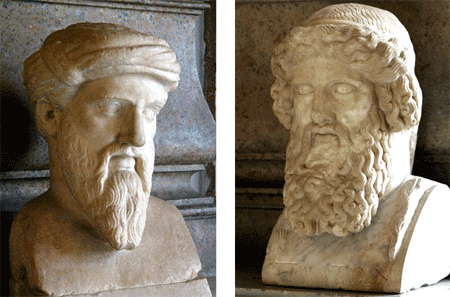
Pythagoras (ca. 570 - 495 BC) Plato (ca. 428 - 348 BC) (photo by the author)
|
PITAGORA, PLATON I GEOMETRIJA Pitagora Pitagora je rođen oko godine 580. p.n.e. Njegovo rođenje je roditeljima, ocu Menesarkusu i majci Parteniji najavljeno u Delfima. Proročica Pitija im je rekla da će im se roditi sin čija će mudrost i lepota biti veća no u svih drugih muškaraca, te da će dete učiniti mnogo dobra za čovečanstvo. Iz zahvalnosti prema Pitiji, roditelji su svom čedu, rođenom na Samosu, nadenuli ime Pitagora. Tu priču prati i priča o bezgrešnom začeću Pitagorine majke i njegovom rađanju kao božanskom biću i dobročinitelju čovečanstva, verovatno nastaloj nakon njegove smrti jer su ga smatrali i nazivali "božanskim učiteljem". O Pitagorinoj mladosti se zna veoma malo. Učio je kod bramina u Hindustanu, gde su ga ovi zvali javančarijom, jonskim učiteljem, a upoznavao se kako sa misterijima Izisa, Adonisa, tako i eleuzinskim, kaldejskim i vavilonskim. Kod bramina je, verovatno, prvi put čuo za selidbu duše, što zauzima značajno mesto u njegovim kasnijim učenjima. Egipat je, međutim, bio mesto gde je Pitagora stekao znanja o matematici i geometriji, naukama na kojima će kasnije zasnovati svoje tumačenje sveta. I pored ogromnog znanja kojim je u svom vremenu raspolagao, Albert G. Maki (Mackey), pisac Enciklopedije slobodnog zidarstva (1874) za njega kaže da je Pitagora sebe nazivao tražiocem znanja, a njemu se pripisuje i reč filozof odnosno zaljubljenik u mudrost. Pitagora otvara neku vrstu stecišta znanja, pre nego školu, u Krotoni u Italiji gde podučava "one koji su toga vredni" svojim pogledima na svet, tj. pitagorejanstvu, novoj "religiji". Smatrali su ga za više od filozofa i nazivali "vođom i ocem božanske filozofije", nadljudskim bićem, božjim čovekom, sinom boga. Svaka njegova reč se zapisivala i pamtila. Manli Hol (Manly Hall (1901-1990), kanadski pisac i mistik, najpoznatiji po svom delu Tajna učenja svih doba (1928) za Pitagoru kaže da je: U Pitagorinoj školi se strogo poštovala disciplina i hijerarhija. Tišina, tajnost i bezuslovna poslušnost činile su elemente reda, što nikako ne znači da se zanemarivala ljudska dimenzija. Negovalo se drugarstvo, toplina i iskrenost, težeći ka savršenim ljudskim odnosima. Po njegovom učenju, odnosi među ljudima su, u osnovi, mentalne, a ne fizičke prirode, a "stranac sličnog intelekta bliži je od roda". Pitagorejanci su, stoga, prerasli u bratstvo. Novi učenik je morao da prođe tri stepena pre no što je došao u kontakt sa majstorom Pitagorom. Na prvom stepenu (matematikus), morao je da savlada matematiku i geometriju, na drugom (teoretikus) primenu egzaktnih nauka, a na trećem (elektus) kandidatu je dato pravo da stupi u svetlost koju je bio u stanju da upije i lično stupi u kontakt sa Pitagorom. U "školi" su se izučavale muzika, geometrija i astronomija, a Pitagorina učenja su se mogla slušati tek nakon usvajanja znanja iz tih oblasti "Ovo se može smatrati jednim od fundamenata slobodnog zidarstva" , tvrdi Viljam Hačinson (William Hutchinson) u svom delu Duh slobodnog zidarstva (Spirit of Masonry), koga mnogi nazivaju "ocem simboličkog slobodnog zidarstva". Kaže se da naše moralne norme potiču od starogrčkih filozofa, a usavršene su hrišćanstvom. U modernom dobu, najviše se izučavaju Platon i Aristotel, a najveći uticaj na Platona imali su pitagorejanci. Platon Platon (Atina c. 427 — Atina c. 347 p.n.e.) rođen je u atinskoj aristokratskoj porodici. Bio je učenik Sokrata, a učitelj Aristotela. Bavio se istraživanjem i filozofijom lepote, pravde, jednakosti, estetike, teologije, kosmologije, teorijom znanja i jezika. Obrazovanje je sticao onako kao i svi dečaci iz bogatih atinskih porodica u to doba, na učenjima Kratila, Pitagore i Parmenida što je, verovatno, uticalo na njegovo izučavanje metafizike (prirode) i epistemologije (teorije znanja). Na njegovo formiranje kao filozofa uticao je Sokrat, njegov učitelj. Platon je bio oduševljen Sokratovom metodom dijaloga i debate, te ju je koristio u svojim raspravama o vrlini i formiranju plemenite ličnosti, čemu je, zapravo, posvetio sav svoj život. Rat između Atine i Sparte 409-404 p.n.e., u kojem je i sam učestvovao, doneo je pobedu Sparti, sirovoj, dobro organizovanoj, militarističkoj sili, a crne dane duhovnim vrednostima Atinjana. U godinama ludila stradao je njegov učitelj Sokrat, dobrovoljno napustivši ovaj svet ispijanjem napitka od otrovne deteline, na šta su ga osudili. Platona je to nagnalo da se okane svoje namere da se bavi politikom, te se posvetio učenju i filozofiji. Po Sokratovoj smrti, 12 godina je putovao po Sredozemlju učeći matematiku kod pitagorejanaca u Italiji, te geometriju, astronomiju i religiju u Egiptu. Tada je počeo i da piše. U prvim delima pokušava da prenese suštinu Sokratovih učenja. Kasnije se posvećuje pisanju tekstova o pravdi, hrabrosti, mudrosti i umerenosti i pojedinca i društva. Tada je napisao svoje napoznato delo Država u kom ispituje model pravedne države pod upravom kralja-filozofa, a u poznom periodu svog rada ispituje ulogu umetnosti, muzike, drame, plesa, arhitekture i etike. U svojim pisanjima o Teoriji formi, Platon smatra da je svet ideja jedina konstanta a da je svet koji primamo preko svojih čula varljiv i promenljiv. Oko 385. p.n.e., Platon osniva svoju Akademiju koja radi sve do 529. n.e., kada ga Justinijan I baca u tamnicu, na nagovor svojih savetnika, iz navodne bojazni prema hrišćanstvu. Za skoro 1000 godina svog postojanja i rada u Akademiji se izučavala astronomija, biologija, matematika, politika i filozofija. Platon se nadao da će Akademija biti rasadnik vođa starogrčkih polisa koji će istima rukovoditi sa puno znanja, pravde i duhovne snage. Zbog teško savladive želje velike većine ljudskih bića za vladanje drugima i nespremnosti da prihvate suživot sa ljudima drukčijih stavova, Platonu je prenošenje ideala u praksu teško išlo. Poznat je njegov pokušaj da, na nagovor svog učenika i prijatelja Diona, od Dionizija II, vladara Sirakuze na Siciliji, načini idealnog vladara, kralja-filozofa. Ne samo da mu to nije uspelo, već je i svoj život stavio na kocku kada ga je Dionizije II, verovatno iz slepe bojazni za svoj presto i nerazumevanja veličine Platonovog nauka, optužio za zaveru protiv njega i Platona stavio u "kućni pritvor". Na jedvite jade je Platon uspeo da se otisne natrag u Atinu gde mu se među tadašnjim učenicima ističe Aristotel, koji će nauk svog učitelja odvesti novim pravcima. Ovo je još jedan primer neophodnosti da se istraje u radu na duhovnom poboljšanju sveta u kojem se živi jer i jedno sićušno seme može da se pretvori u moćno drvo ako je zdravo i nađe se u pogodnom tlu, naročito ako to drvo u mladosti i neguju. Oduševljen Platonovom filozofijom, transformaciju u svesnu duhovnost spominje i Branko Mitrović, arhitekta, autoritet za italijanskuu renesasnu arhitekturu (Filozofija za arhitekte). Po Platonu, "stvari" našeg sveta refleksije su ili senke večnih formi ili ideja, koje ne postoje u prostoru ili vremenu, već van njih. Platon, koga slobodni zidari smatraju jednim od najznačajnijih ličnosti svetske civilizacije, to ilustruje pričom, poznatom kao "Alegorija pećine". Naime, jedna grupa ljudi je u okovima u jednoj pećini. Tamo su celog života i ne poznaju spoljnji svet. Vezani su tako da im svetlo vatre dolazi odostrag, te ne mogu da vide stvari direktno, već preko senki na zidu pećine. Vremenom nauče kada se senke preklapaju ili prate jedna drugu, a i to da sa senkama povežu određene zvuke, tako da realan svet zamenjuju svetom senki. Pošto sede u mraku svet koji smatraju realnim je ograničen, a moral im se zasniva na izvrnutim istinama, te se okovani čvrsto drže svojih predrasuda i samostvorenih ideja o realnosti. Platon kaže da ako bi se okovanima dopustilo da se okrenu i vide od čega im se sastoji svet koji su stvorili, zaslepilo bi ih svetlo vatre, pa bi želeli da se vrate u svoje nesretno stanje. Platon, međutim, veruje da, ako bi barem jednom od njih skinuli lance, taj bi mogao da vidi vatru, izlaz iz pećine i ostale okovane u stanju slepila. Alegorija se nastavlja tako što oslobođeni biva izveden na svetlo spoljnjeg sveta gde uviđa da su realnosti i moral sveta okovanih samo iluzije pravoga sveta. Besumnje, Platon veruje da povratak u pećinu ne bi bio moguć jer bi oslobođeni uvideo da je pre izlaska iz pećine bio rob, dakle svest o svom novom položaju ga odvodi dalje u slobodu saznanja. Platon je, kako smo rekli, imao ogromnog uticaja na slobodnozidarska shvatanja i filosofiju izraženu kroz simboliku stvaranja i simetriju i estetiku graditeljstva i arhitekture. U dijalogu Timaj on raspravlja o stvaranju sveta od strane demijurga, tvorca, majstora graditelja, neimara svega svemira i estetskoj lepoti i simetriji zasnovanoj na pet pravilnih poliedara: simbolu vatre - tetraedru, koji se sastoji od četiri trougle površi, simbolu zemlje - kocki ili heksaedru od 6 kvadratnih površi, simbolu vazduha - oktaedru sa 8 trouglova, simbolu vode - dodekaedru sa dvanaest petouglova i simbolu kosmosa - ikosaedru sa dvadeset trouglova. Uticaj Platona na slobodnozidarsku misao je ogroman. Raspon njegovih dela je velik, obuhvatajući matematiku, prirodne nauke, moral i teoriju politike, a njegova verovanja o važnosti matematike i obrazovanja otvorila su put boljem razumevanju celokupnog univerzuma. Njegovi stavovi o neophodnosti razuma u razvoju pravednog društva, u kojem postoji jednakost svih pojedinaca, čine osnov savremene demokratije i teoretske postavke nekih društava, kada ta društva pronađu izlaz iz okova ljudskih slabosti. Geometrija Platon je verovao da se svet može opisati brojevima. Jedno vreme je boravio u pitagorejskom društvu u Italiji, vegetarijanskom i komunističkom, koje je negovalo i egzaktan i ezoteričan pristup, pre svega matematici i geometriji, a i naukama koje iz ovih proizilaze, te ne treba zaobići ni verovatan uticaj Kabale. Geometriji je Platon pridavao poseban značaj. … postoji svet stvari o kojem saznajemo svojim čulima, i svet stvari kojeg otkrivamo umom. Ovaj drugi će i onda živeti kada materijalni svet bude nestao. Evo mosta: čulo vida nam govori da je to struktura od betona i gvožđa, a um da je to neustrašiv, složeni, i fino izrađen spoj u kom je ogromna masa materijala prilagođena zakonima mehanike, matematike i inženjerstva, zakonima koji se moraju primenjivati; da je matematičar takođe i pesnik, on bi video zakone koji drže most; ako ti zakoni ne bi bili poštovani, most bi se survao u reku. Zakoni predstavljaju Boga koji drži most na dlanu svoje ruke. Aristotel nam kaže da Platon pod idejama (idealističkim predstavljanjima stvari ili pojava onako kako ih vidimo) podrazumeva ono što i Pitagora podrazumeva pod "brojem" kada kaže da je ovo svet brojeva u verovatnom značenju da svetom upravljaju matematičke konstante i pravilnosti … Za Platona … matematika je, stoga, nezaobilazan preludij u filozofiju i njen najviši oblik. Iznad ulaza svoje Akademije, postavio je sledeći natpis: 'Neka niko ne ulazi ko nije naučen geometriji'. (str. 39) Geometrija je igrala ogromnu ulogu u operativnom zidarstvu, iz kojeg je, formalno, proizašlo savremeno slobodno zidarstvo. S druge strane, na moral i filozofiju slobodnog zidarstva mora da su uticala učenja Pitagore i Platona, kao i starogrčka filozofija, arhitektura i estetika. Nije slučajno da svaki slobodnozidarski hram krase stubovi: jonski, dorski i korintski, stubovi mudrosti, snage i lepote, stubovi Atine, Sparte i Korinta. … nije nam poznato da su Grci došli do nekog većeg znanja o geometriji pre Talesa iz Mileta, koji je umro za vreme vladavine vavilonskog cara Belšazara i doba vavilonskog ropstva Jevreja. Ispostavilo se, međutim, da je njegov slavniji učenik Pitagora taj koji se pokazao autorom 47. Euklidovog problema (Pitagorina teorema: "Površina kvadrata konstruisanog nad hipotenuzom pravouglog trougla jednaka je zbiru površina kvadrata konstruisanih nad katetama tog trougla.") koji je, ako se pravilno shvati, osnova sveg slobodnog zidarstva … . (str. 50) Bez obzira na Andersona, veoma je verovatno da su pitagorejska učenja direktno ili indirektno uticala na spekulativno, filosofsko slobodno zidarstvo jer zajedničko je objašnjenje sveta putem matematike i geometrije. Zbog obimnosti i mnogo boljih objašnjenja veza sa slobodnim zidarstvom od navedenih, savetovao bih čitaocu da potraži osnovna dela Pitagore, Sokrata, Platona i Aristotela da bi se osvedočio o izuzetnoj povezanosti njihovih učenja sa okvirima zapadne civilizacije. Matematika i geometrija pradavnih vremena, koja su do nas stigle uglavnom preko starogrčkih filozofa, igrale su značajnu ulogu u formiranju savremene slobodnozidarske misli. |
PYTHAGORAS, PLATO AND GEOMETRY Pythagoras Pythagoras was born around 580 BC. His birth was announced to his parents, father Mnesarchus and mother Parthenia, in Delphi. The prophet Pythia told them that they would be born a son whose wisdom and beauty would be greater than in all other men and that the child would do much good for humanity. From gratitude to Pythia, the parents called their son, born in Samos, Pythagoras. This story is followed by another story on the sinless conception of Pythagoras' mother and his birth as a divine being and benefactor of humanity, which might have appeared after his death because he was considered to be a "divine teacher." Very little is known about Pythagoras' youth. He studied with the Brahmins in Hindustan, where they called him jawan acharya (young, learned man), and Ionian teacher. There he met with the mysteries of Isis, Adonis, and those of the Eleusians, Chaldeans and Babylonians. It was probably there that he heard about soul transfer, which occupied a significant place in his later teachings. However, it was Egypt where Pythagoras gained the knowledge of mathematics and geometry, sciences that his interpretation of the world will be based on. Albert G. Mackey, the author of the Free Encyclopedia of Freemasonry (1874), said that Pythagoras had called himself a seeker of knowledge, and world philosopher i.e. lover of wisdom. In Crotona, Italy, Pythagoras opened a kind of knowledge acquisition site rather than a school, where he educated "those who are worth it" revealing and transferring his views on the world, later to be known as Pythagoreanism or the new "religion." They considered him to be more than a philosopher and called him "the leader and father of divine philosophy," a supernatural being, a divine man, a son of God. His words were noted down and remembered. Manly Hall (1901-1990), a Canadian writer and mystic, best known for his work The Secret Teachings of All Ages (1928) says for Pythagoras that: In Pythagoras's school, discipline and hierarchy were strictly respected. Silence, secrecy and unconditional obedience were the elements of order, which in no way meant neglecting the human dimension. Friendship, warmth and sincerity were cherished, aimed at perfecting human relations. According to his teaching, "relationships among people are basically mental not physical and a stranger of similar intellect may be closer to you than your next of kin." Therefore, the Pythagoreans grew into a brotherhood. A new student had to pass three degrees before he could contact Master Pythagoras. At the first degree (mathematics), he had to master mathematics and geometry, at the second (theoretical) application of exact sciences and the third degree (electus) "the candidate gained the right to enter the light he was able to absorb" and contact Pythagoras personally. Music, geometry and astronomy were studied at the "school," and Pythagoras' teachings could only be followed after acquiring knowledge in those areas. "This can be considered as one of the foundations of Freemasonry," says William Hutchinson, father of Freemasonry by many, in his Spirit of Masonry. It is said that our moral norms were set by ancient Greek philosophers and perfected by Christianity. In modern times, Plato and Aristotle are studied far more extensively than other philosophers but it was the Pythagoreans who exerted the greatest influence. Plato Plato (427 - 347 BC) was born to an Athenian aristocratic family. He was a disciple of Socrates and a teacher of Aristotle. He was engaged in the research and philosophy of beauty, justice, equality, aesthetics, theology, cosmology, the theory of knowledge and language. He was educated just like all the boys from wealthy Athenian families of the time, on the teachings of Cratylus, Pythagoras and Parmenides, who probably influenced his study of metaphysics (nature) and epistemology (theory of knowledge). His formation as a philosopher was influenced by Socrates, his teacher. Plato was delighted with Socrates' method of dialogue and debate using it in his debates on virtue and formation of a noble personality, which he actually devoted his whole life to. The war between Athens and Sparta of 409-404, which he himself participated in, brought victory to Sparta, a crude, well-organized, militaristic force causing the carefully cherished spiritual values of Athenians to suffer. In those years of insanity, his teacher Socrates perished; he was forced to drink a concoction of toxic clover. This made Plato abandon his intent to pursue a career in politics, and devoted himself to learning and philosophy. After Socrates' death, Plato travelled through the Mediterranean to study mathematics with the Pythagoreans in Italy as well as geometry, astronomy and religion in Egypt. Then he set about writing. In his first works, he tried to convey the essence of Socrates' teachings. Later, he devoted himself to writing texts on justice, courage, wisdom and moderation of both the individual and the society. Then he wrote probably his most famous work, a Socratic dialogue called The Republic in which he examined a model of a righteous state under the rule of a king-philosopher. In his later pieces, he examined the role of art, music, drama, dance, architecture and ethics. In his writings on The Theory of Form, Plato argues that the world of ideas is the only constant and that the world that we perceive through our senses is deceptive and changeable. Around 385 BC, Plato founded his Academy, which was active until 529 AD, when Justinian I had it closed, on the recommendation of his advisers, allegedly to protect Christianity. For almost 1,000 years of the existence of the Academy, astronomy, biology, mathematics, politics and philosophy were studied. Plato hoped that the Academy would be a nursery for the leaders of ancient Greek poleis who would manage their city-states with substantial know-how, justice and spiritual strength. Due to the hardly self-controllable desire of a vast majority of human beings to dominate others as well as their unwillingness to accept coexistence with people of different attitudes and orientation, Plato found it difficult to transfer his ideals into practice. It is well known that persuaded by his student and friend Dion, he attempted to convert Dionysus II, ruler of Syracuse in Sicily, into an ideal ruler of the king-philosopher kind. Not only did he fail, but he even diced with death when Dionysius II, probably from blind fear for his throne and lack of true understanding of Plato's science, accused Plato of conspiring against him and placed the philosopher under "house arrest." At a hair's breadth, Plato managed to avoid the situation and get back to Athens to teach. At the time, Aristotle stood out among his disciples, who took Plato's teachings to new directions. This is yet another example of the necessity to persevere in our efforts on the spiritual improvement of the world which we live in because even a tiny seed can grow into a powerful tree if it is healthy and finds itself in rich soil, especially if the tree is taken good care of when young. Enthusiastic about Plato's philosophy, he also mentions the transformation into conscious spirituality by Branko Mitrovic, an architect, an authority on Italian Renaissance architecture (Philosophy for Architects). According to Plato, the "things" of our world are reflections or rather shadows of eternal forms or ideas that do not exist in space or time, but outside them. This may be demonstrated with a story, known as the "Allegory of the Cave." Namely, a group of people are chained in a cave. They live there all their lives without knowing about the outside world. They are bound so that the light of fire comes from behind preventing them from seeing things directly, but through the shadows on the walls of the cave. Over time, they learn when shadows overlap or follow each other as well as how to connect certain sounds with shadows; thus, the real world is replaced with their world of shadows. Since they sit in the dark, the world they consider realistic is limited, thus their morality is based on truths that have been inverted; and the chains firmly keep their prejudices and prevent the formation of independent ideas about reality. Plato argues if the chained were allowed to turn and see what their world, which they themselves created, consists of they would be blinded by the light of the fire making them want to return to their unhappy state. However, he believes if at least one of them were removed the chains, he would be able to see the fire, the exit from the cave and the others in their state of blindness. The allegory continues with releasing the said one into the light of the outside world realizing that the realities and morality of the world of the chained ones are only illusions of the real world. Undoubtedly, Plato believes that return to the cave would not be possible since the liberated would realize that he had been a slave before he left the cave i.e. his awareness of his new position would take him further into the freedom of cognition. Plato had a huge impact on Freemasonry and philosophy expressed through the symbolism of creation as well as the symmetry and aesthetics of building construction and architecture. In Timaeus, one of Plato's dialogues, he discusses the creation of the world by the demiurge, an artisan-like figure responsible for the fashioning and maintenance of the physical universe. He is the master of builders, the creator of the whole of the universe, aesthetic beauty and symmetry based on the five correct polyhedra: the symbol of the fire - the tetrahedron, consisting of four triangular surfaces, the symbol of the earth - the cube or hexahedron, composed of 6 square surfaces, the symbol of air - the octahedron with 8 triangles, the symbol of water - the dodecahedron with twelve pentagons and the symbol of the cosmos and - the icosahedron with twenty triangles. The influence of Plato on Masonic thought is enormous. The scope of his work is great encompassing mathematics, natural sciences, morality and theory of politics. His beliefs on the importance of mathematics and education opened the road to a better understanding of the entire universe. His views on the necessity of reason in the development of a just society, in which equality of all individuals does exist, form the basis of contemporary democracy and the theoretical setting of some societies if or when these societies manage to find a way out of the fetters of human weaknesses. Geometry Plato believed that the world could be described by numbers. For a time, he was staying with the Pythagorean society in Italy, which was vegetarian and communal, where they nurtured both an exact and esoteric approach primarily to mathematics and geometry as well as to sciences that arose from them, although a very likely impact of the Kabbalah should not be overlooked as well. Plato attached special significance to geometry. … There is a world of things that we find out about our senses and the world of things that we discover with the mind. This other one will then live when the material world disappears. Here is a bridge: the sense perceives concrete and iron to a hundred million tons; but the mathematicians see, with the mind's eye, the daring and delicate adjustment of this mass of material to the laws of mechanics and mathematics and engineering, those laws according to which all good bridges that are made must be made; if the mathematician also be a poet, he would see these laws upholding the bridge; if the laws were violated the bridge would collapse into the stream beneath; the laws are God that holds up the bridge in the hollow of his hand." Aristotle hints something of this when he says that what Plato meant by "ideas," Pythagoras meant by "number" when he taught that it was a world of numbers (meaning presumably that the world is ruled by mathematical constancies and regularities) … for Plato … mathematics is, therefore, an indispensable prelude to philosophy, and its highest form; over the door to his Academy, Plato placed these words: "Let no man ignorant of geometry enter here." (p.39) Geometry played an enormously important role in Operative Masonry, from which modern Freemasonry formally emerged. On the other hand, the morality and philosophy of Freemasonry must have been under the influence of the teachings of Pythagoras and Plato, as well as ancient Greek philosophy, architecture and aesthetics. It is no coincidence that all Masonic temples are adorned with columns: Ionian, Doric and Corinthian, the pillars of wisdom, strength and beauty, the pillars of Athens, Sparta and Corinth. … Nor do we find the Grecians arrived at any considerable knowledge in Geometry, before the Great Thales Milesius, the philosopher, who died in the reign of Belshazzar, and the time of the Jewish captivity. But his scholar, the Greater Pythagoras, proved the author of the 47th problem of Euclid's first book, which, if duly observed, is the Foundation of all Masonry, sacred, civil and military. (p. 50) Regardless of Anderson, it is very likely that Pythagorean teachings, directly or indirectly, influenced speculative, philosophical Freemasonry since the common explanation of the world goes through mathematics and geometry. Due to the limited size of this publication and the wish to offer a much better explanation of the links to Freemasonry, I would advise the reader to look for the basic works of Pythagoras, Socrates, Plato and Aristotle to discover the remarkable connection of their teachings to Western civilization. The mathematics and geometry of the ancient times, which came down to us mostly through ancient Greek philosophers, played a significant role in the formation of contemporary Masonic thought. |
|
DALJI ŽIVOT ANTIČKE MISLI I GEOMETRIJE Mediteran sa Srednjim istokom kolevka je antičke misli. Sumer, Asirija, Egipat, Izrael, Kaldeja, Vavilonija, Grčka, Rim bile su radionice ljudske svesti i znanja koje su stanovnici tih zemalja i područja sticali na samom izvoru. Ono što je do nas doprlo, a na čemu je izgrađena zapadna, hriščanska civilizacija konglomerat je raznih uticaja koji je, zbog svog kvaliteta i pravovaljanosti za gradnju društava, preživeo do danas. Gorespomenutu Pitagorinu teoremu pripisujemo tom izuzetnom starogrčkom filosofu, koji je danas poznatiji kao matematičar, iako je Plutarh spominje kao jednu od osnovnih sastojaka egipatske religije, a crvena nit geometrije provlači se kroz čitav srednji vek do slobodnozidarskih rituala. Platon, veliki zagovornik geometrije kao koncentrata mnogih znanja, kaže da njegovo znanje geometrije potiče od Solona, koji je opet to znanje stekao u Egiptu. Ranohrišćanski ideolog Sv. Avgustin pokušao je da znanja starogrčke filozofije unese u hrišćanstvo, pridajući veliki značaj geometriji. Geometrija je, preko Avgustina, Žerbera Aurijaka (Gerber D'auriac), koji kasnije postaje papa Silvestar II (De Geometria), duboko prodrla u srednji vek. Geometrija je, smatralo se tada, znanje o strukturi neba i zemlje izraženo brojevima, merama i proporcijama. Srednjevekovni mislioci, kao i njihovi uzori iz antičkog sveta, posedovali su dublje opšte razumevanje "pozadine" mnogih nauka, što su, putem simbolizma, gde je geometrija bila od centralnog značaja, prenosili dalje, sa generacije na generaciju, što je prihvatilo i savremeno slobodno zidarstvo. |
FURTHER LIFE OF ANTIQUE THOUGHT AND GEOMETRY The Mediterranean with the Middle East is the cradle of antique thought. Sumer, Assyria, Egypt, Israel, Chaldea, Babylonia, Greece, Rome were workshops of the human mind and creativity for the inhabitants of these countries and territories, in various historical times. What has reached us, and what we have built our Christian civilization upon is a conglomerate of various influences that, due to their quality and legitimacy in the construction of societies, have survived to this day. The Pythagorean Theorem, mentioned by Plutarch as one of the essential ingredients of the Egyptian religion, is attributed to this remarkable ancient Greek philosopher, better known nowadays as a mathematician. The red thread of geometry, descending from unknown times, penetrates the entire Medieval Period and draws on all the way down to Masonic rituals. Plato, a great advocate of geometry said that his knowledge of geometry, as a concentrate of many sciences, had originated from Solon, who had gained the knowledge in Egypt. The Early Christian ideologist St. Augustine was bent on bringing the knowledge of ancient Greek philosophy into Christianity attaching great importance to geometry. Through St. Augustine and Gerber D'auriac, who later became Pope Sylvester II (De Geometria), Geometry penetrated deeply into the Middle Ages. At the time, it was believed to be the knowledge of the structure of the sky and the earth expressed in numbers, measures and proportions. Medieval thinkers, as well as their role models from the ancient world, possessed a deeper general understanding of the "background" of many sciences which, through symbolism where Geometry was of central importance, were passed from generation to generation and 18th-century Freemasonry embraced it as well. |
|
SEDAM UMETNOSTI Slobodnozidarski rituali, o kojima će biti reči kasnije, sadrže podosta Pitagorine i Platonove filosofije. Simbolika je nedvosmislena i zasnovana na Platonovoj ideji o četiri osnovne vrline: umerenosti, mudrosti, pravdi i hrabrosti kao i liberalnim umetnostima (artes liberales), tj. trivijumu (gramatika, logika, retorika, u dobu humanizma i renesanse preimenovane u studii humanitatis) i kvadrivijumu (aritmetika, geometrija, muzika, astronomija). Gramatika daje smisao onome što komuniciramo i omogućuje "fino podešavanje" poruke sa ciljem postizanja jasnoće i njenog prilagođavanja situaciji i mentalnoj šemi onoga ko poruku prima. Prema slobodnozidarskoj terminologiji, gramatika je alat za obradu neobrađenog kamena, sredstvo za eliminaciju sirovog, varvarskog izražavanja.
Retorika nam daje metodologiju izražavanja, tehniku koja nam pomaže da ostavimo utisak i ubedimo sagovornika, uz poštovanje njegovih stavova. Najvažnija umetnost trivijuma je logika, koja nam daruje sposobnost celishodnog zaključivanja, čvrstu pozadinu za primenu dve druge gornje umetnosti trivijuma. Pomaže nam takođe u razumevanju naših dužnosti prema Bogu i ljudima. Kvadrivijum obezbeđuje egzaktna znanja. Albert Maki u svojoj Enciklopediji slobodnog zidarstva (Encyclopedia of Freemasonry and Its Kindred Science, The Masonic History Company, London and New York, 1914) za aritmetiku kaže: "Za slobodnog zidara primena ove nauke znači da on konstantno dodaje svom znanju, da nikad ništa ne oduzima od karaktera svoje sabraće, da množi svoju dobrotu prema drugima i da deli svoja sredstva sa onima u nevolji." (str. 76) Geometrija je organski deo i osnova slobodnog zidarstva, dajući simbolički okvir za slobodnozidarsko delanje prema Bogu, jednih prema drugima i sredini u kojoj postojimo. Muzika je rođaka matematike i slobodnozidarska misterija. Tu korelaciju primetio je još Pitagora, a najverovatnije i neki pre njega. Slobodno zidarstvo je oduvek pridavalo veliki značaj astronomiji kao velikoj simetriji kojom je božanstvo uredilo svemir, te su mnogi simboli uzeti iz oblasti astronomije. Posedovanje navedenih osobina i sedam umeća smatralo se neophodnim za slobodnog građanina, koji treba da aktivno učestvuje u složenoj interakciji sa svojom sredinom, i prirodnom i humanom, da bi mogao da unapređuje ponajpre sebe, a i sredinu kojoj i on i njegovi potomci treba da žive. U antičkoj Grčkoj je to podrazumevalo učešće u javnim debatama, logičko objašnjavanje pojava, odbranu svojih stavova i postupaka na sudu i vojnu službu, koju je svaki slobodni muškarac bio obavezan da vrši, tj. sve ono što je slobodnog čoveka odvajalo od roba. Naglasak je bio na slobodi mišljenja i delovanja zasnovanog na visokom obrazovnom, moralnom i duhovnom nivou. Tokom vekova, a u zavisnosti od potreba određenog doba, tzv. liberalne umetnosti, odnosno slobodno sticana umeća, menjala su se. Na pr. logiku su zamenile etika i poezija, dodati su klasični jezici, istorija i filozofija, egzaktne nauke, psihologija itd. Do savremenog slobodnog zidarstva, liberalne umetnosti došle su preko srednjevekovnog sistema obrazovanja, gde se verovalo da su neophodne za sticanje savršenog obrazovanja. Pored Artes liberales, dostupnih slobodnom čoveku, postojali su i Artes illiberales, koji su se izučavali iz ekonomskih razloga i obezbeđivali tehnološka znanja određenih struka. Bili su namenjeni operativnim radnicima kjoji su se bavili mehaničkim izvođenjem radnih operacija, bez neophodnosti složenih znanja o poreklu, osnovi, sastavu, strukturi i učinku tih radnih operacija. |
THE SEVEN ARTS Masonic rituals, which will be discussed later, contain a number of elements of Pythagoras' and Plato's philosophies. Their symbolism is unequivocal and based on Plato's idea of four basic virtues: moderation, wisdom, justice and courage, as well as liberal arts (artes liberals), i.e. the trivia (grammar, logic and rhetoric), renamed to studio humanitati in the era of Renaissance and Humanism, and quadrivia (arithmetic, geometry, music and astronomy). Grammar gives meaning to what we communicate and enables "fine tuning" of messages in order to achieve clarity and adapt them to the situation and the cognitive structure of the receiver. According to Masonic terminology, grammar is a tool for chipping, shaping and smoothing the rough ashlar, a "tool" for eliminating raw, barbaric expression and perfecting the clarity and efficacy of messages. Rhetoric offers the methodology of expression, a technique that helps us leave an impression and persuade and/or entertain the listener while showing respect for their attitudes. The most important art of the trivia is logic, which gives us the ability to make a worthwhile conclusion, a solid background for the application of the two other aforementioned arts of the trivia. It also helps in understanding our duties toward God and people. The quadrivia provide exact knowledge. Albert Mackey in his Encyclopedia of Freemasonry and Its Kindred Science, The Masonic History Company, London and New York, 1914 says for arithmetic: "In the lecture, of the degrees of Grand Master Architect the application of this science to Freemasonry is made to consist in its reminding the Mason that he is continually to add to his knowledge, never to subtract anything from the character of his neighbor, to multiply his benevolence to his fellow-creatures, and divide his means with a suffering brother." (p. 76) Geometry is an integral part and the basis of Freemasonry, giving it a symbolic framework where the Fraternity works towards God, towards each other and the environment. Music is a cousin of mathematics and a Masonic mystery, a correlation noticed by Pythagoras but most probably by others even before him. Freemasonry has always attached great significance to astronomy as the great symmetry with which the Deity arranged the Universe; therefore, many symbols were taken from the field of astronomy. Possession of the said qualities and knowledge acquired in seven skills was considered indispensable for a free citizen who was supposed to participate actively in a complex interaction with his environment, both natural and human so that he could improve, primarily himself, but also the environment where he and his descendants were supposed to live. In ancient Greece, this involved participation in public debates, offering logical explanations of phenomena, defence of attitudes and actions at court and doing military service, which every free man was obliged to perform, i.e. everything that separated a free man from a slave. The emphasis was on the freedom of thought and action based on high educational, moral and spiritual principles. Over the centuries, depending on the requirements of a certain age, the so-called Liberal Arts i.e. freely acquired art, have changed. For example, logic was replaced by ethics and poetry; classical languages, history and philosophy, exact sciences, psychology, etc. were added. Liberal Arts came down to modern Freemasonry through the medieval system of education, where they were believed to be necessary for the acquisition of perfect education. In addition to the artes liberals, which were available to free men, there were also Artes illiberales, which were studied for economic reasons and provided the technological knowledge of certain professions. They were intended for operative workers who dealt with the mechanical execution of operations without the need for complex knowledge on the origin, basis, composition, structure and performance of these operations. |
|
MASONSKE LEGENDE Legende su priče u kojima su istorijski podaci isprepleteni sa izmišljenim i neobičnim događajima, a mogu da budu i predanja obogaćena maštom o nekim događajima ili osobi. Slobodnozidarske legende su od velike važnosti jer služe kao osnova mnogih rituala i njihovim delova, a imaju za cilj da slobodnom zidaru, na upečatljiv način, prenesu poruku i ukažu mu na smer i način delanja. Bez legendi, sistem slobodnozidarskog nauka bi izgubio podršku svojih ključnih simbola i instrukcija i prestao da postoji. Kaže se da je slobodno zidarstvo sistem moralnih zakona i uputstava obavijeno alegorijom i ilustrovano simbolima. Neofit, kroz inicijaciju, prima legende koje su se milenijima očuvale u slobodnozidarskom bratstvu, ukazujući na složeni karakter te institucije i operativne veštine kojima se duhovno graditeljstvo iskazuje. Kralj Solomon Solomon, Šlomo, Sulejman je lik iz Biblije, sin i naslednik kralja Davida, koga poštuju u judaizmu, hrišćanstvu i islamu kao nadasve mudrog kralja, graditelja prvog hrama i, po Talmudu, jednog od 48 proroka, a po Kuranu kao jednog od glavnih proroka. Smatra se da je rođen 848. p.n.e.,. Umro je u 52. godini života, a vladao je 40 godina, koje se smatraju najboljim godinama u istoriji Izraela, godinama mira i blagostanja. Bio je treći i poslednji vladar Ujedinjenog Kraljevstva. Solomon je imao 12 godina kada mu je njegov otac David, osećajući da mu se bliži kraj, predao kraljevstvo sledećim rečima: "Sada polazim na put sviju smrtnika. Ti budi hrabar i pokaži se čovekom! Slušaj naredbe Gospoda tvog Boga, idi njegovim stazama, drži se njegovih zakona, zapovedi, naredaba i njegovih pouka, kako je napisano u Zakonu Mojsijevu, da bi uspeo u svemu što poduzmeš i gdegod se okreneš." (Kraljevi I 2:2-3). Po jevrejskoj tradiciji, ovo su reči kojima otac blagosilja sina svog na Bar Micvu (dan religioznog punoletstva, kada dete puni 13 godina). Solomon je poznat i kao chacham mi'kol ha'adam (najmudriji među ljudima). Biblija kaže da su kraljevi iz svih krajeva sveta dolazili Solomonu da slušaju njegovu mudrost, ne samo onu religioznu, toransku, već i sekularnu mudrost i veliko naučno znanje. Vrhovno biće, Bog, nije stvorio ovaj svet da bi bio idealan po kriterijumu čoveka, već da bi čovek iz njega učio i trudio da isti svet učini boljim. Ništa nije potpuno dobro ili potpuno loše. I najgore stvari, pojave i dela mogu da pokrenu lavinu dobrog, a i ono što je u određenom trenutku i mestu najbolje može da se za tili čas izvrgne u nešto najgore. Solomon nije mogao da se odupre slavi, porivima i ponajpre uticaju svojih 700 žena i 300 konkubina, (doveo ih je iz političkih razloga, da bi učvrstio veze sa okolnim narodima) koje su njegov narod slađano navodile na idolatriju tj. poštovanje sijaset paganskih bogova. Njegovo ogromno rasipništvo i nameti na podanike, narod nije imao strpljenja da podnosi pa kad je, posle njegove smrti, zavladao njegov sin Revoboam, koji nije dorastao svom ocu, narod se pobunio, poglavito zbog arogantnog odbijanja Revoboama da snizi poreze, te je zemlja podeljena na severni deo, Kraljevinu Izrael i južni deo, Kraljevinu Judeju. Potomci Solomona po muškoj liniji vladali su samo Judejom. Iako Jevrejska Biblija (Biblia Hebraica) Solomonu pripisuje gradnju Prvog hrama u Jerusalimu i prikazuje ga kao mudrog, bogatog i moćnog kralja, smatra ga i krivcem za cepanje kraljevstva na dva dela. Bila je to kazna koju je Bog odmerio Solomonu i za idolatriju i okretanje leđa Jehovi. Solomonov hram Davidu, budući da je bio kralj-ratnik, koji je tako okrvavio ruke, Bog ne dopusti da sagradi hram, već to naredi njegovom sinu Solomonu. "Sada mi je Jahve, Bog moj, dao mir posvuda naokolo, nemam neprijatelja, ni zlih udesa." Prema rabinskim izvorima (celokupnost religioznih spisa), Prvi hram je trajao 410 godina, od 832. godine p.n.e. do 422. godine p.n.e. što je 165 godina kasnije nego što navode sekularni izvori. Kao što smo već rekli, drvnu građu je dopremio Kralj Hiram iz Libana (1 Kraljevi 5-6) 5:13, a Solomon je "digao" trideset hiljada kulučara (5:14), od kojih je svakog meseca, pod nadzorom Adonirama (tako zovu Hirama Abifa), radilo po deset hiljada u Libanu (5:15). Solomon je takođe imao 70.000 nosača i 80.000 kamnorezaca u brdima (5:16), pored 3.300 službenika koji su nadzirali radnike (5:17) koji su lomili i obrađivali gromade vrednog kamena i grubo ih klesali za temelje hrama (5:18). Solomonov hram se gradio sedam godina. Kako je na kraju izgledao? Pošto ne postoje pouzdani arheološki podaci, svi opisi su zapravo idealizovane rekonstrukcije, dobar razlog da slobodno zidarstvo iskoristi hram za simboličku osnovu slobodnozidarskih hramova i bogatu simboliku duhovnih instrukcija. Najdetaljniji opis dat je u Tanaku (hebrejski naziv za Bibliju; naziv se sastoji od početnih slova njenog sadržaja; Ta = Torah (Torat Moshe) + Na = Nevi'im (Proroci) + Ketuvim (Spisi). Iako su u Bibliji dati prilično tačni podaci i dimenzije, konstrukcije hrama variraju. Nije bio kopija niti jednog drugog hrama, ali je sadržavao karakteristične elemente arhitekture Mesopotamije (Sumer, Vavilon, Asirija) i Egipta. Svetinja nad svetinjama, Kodesh Hakodashim, ili "unutrašnja kuća", imala je uzdignut pod, a cela prostorija je bila obložena zlatom. Na zapadnom kraju nalazila su se dva keruvima raširenih krila, izrezbarena od maslinovog drveta. Dvokrilnim vratima je bila povezana sa većom prostorijom, "svetom prostorijom" (Heckal). U svetinji nad svetinjama nalazio se zavetni kovčeg, bila je obložena zlatom i finim tkanicama plave, purpurne i tamnocrvene boje i bila je bez prozora jer je tu prebivalo "ime" Boga. Veća prostorija, "sveta" ili Heckal (takođe znači palata, hram) bila je iste visine i širine kao i manja prostorija, ali dvostruko duža. Zidovi su bili obloženi kedrovinom koja je bila izrezbarena, pozlaćena i ukrašena kerubinima, palmama i cvetnim motivima. Od svetinje nad svetinjama prostorija je bila odvojena zlatnim lancem, a podovi obloženi pozlaćenom jelovinom. Ulazna vrata u veliku prostoriju, kao i ona koja su vodila u manju prostoriju, bila su dvokrilna, izrađena od maslinovog drveta, pozlaćena i ukrašena keruvimima, palmama i cvetnim motivima. Ulaz (Ulam) je bio iste širine kao i dve ostale prostorije. Sedam stepenika je vodilo do dva stuba od bakra (bronze), Boaz (levo, ako se posmatra spolja) i Jakin (desno), izuzetno značajnih u slobodnozidarskim ritualima. Oko glavnih prostorija, sa zapadne južne i severne strane, nalazile su se manje prostorije (kasnije su pridodata još dva sprata) koje su se koristile kao spremišta. Hram su okruživala dva dvora, unutrašnji ili Dvor sveštenika, koji je bio odvojen od spoljnjeg sveta zidom od grubo tesanog kamena na čijem su se vrhu nalazile grede od kedrovine. U dvoru je bio Oltar za žrtve paljenice i More od mesinga, koje se koristilo za ritualno kupanje (mikva). Veliki dvor je okruživao ceo hram i bio mesto okupljanja vernika. More od mesinga je bilo ogromnih dimenzija, prečnika 10 lakata i sadržavalo je 90 kubnih metara vode za ritualno očišćenje. Po Bibliji, izlio ga je, kao i ostale predmete, Hiram iz Tira, verovatno Hiram Abif, "sin udovice iz plemena Naftalijeva, ali mu otac bejaše iz Tira" (Kraljevi I 7:13-14). Hiram Abif U Drugoj knjizi Letopisa spominje se Huram iz Tira, sin udovice, rođen oko 1000 p.n.e., zapravo Hiram Abif, koga je kralj Tira Hiram poslao Solomonu, kao vrsnog i darovitog stručnjaka graditelja i livca, za potrebe gradnje njegovog Hrama. "… stoga ti šaljem čoveka mudra vešta i razumna, Hurama Abija, sina jedne Danovke i oca Tirca. Ume obrađivati zlato, srebro, tuč, železo, kamen, drvo, grimiz, ljubičasti baršun, bež i karmezin, ume rezbariti svakovrsne rezbarije i zamisliti svako delo koje mu se poveri …"(2 Hronike 2:13-16); U Prvoj knjizi Kraljeva (7), međutim, spominje se "sin udovice iz plemena Naftali". Kao i u mnogim drugim slučajevima tokom istorije, a u nedostatku autentičnih pisanih dokumenata, postoje mnogobrojna tumačenja, najčešće politički motivisana. I u ovom slučaju, pogotovo u tumačenjima i pogledima na delatnost i ulogu Hirama Abifa, kako stvarnu tako i onu alegorijsku, stvar je čitaoca kako će je razumeti. Sve dok neko tumačenje ne seje mržnju i čini nažao ljudima i sredini, privatna je stvar svakog pojedinca će ga "obraditi". Dakle, činjenica je da je Hiram bio toliko stručan u svom poslu da je zaslužio zaštitu svog kralja i bio vredan toga da zastupa svoju zemlju. Njegovo ime Abi znači "naš otac", pa se koristi u smislu "majstor", titula kojom se ukazuje poštovanje i označava posebnost. Inače postoji neviđena konfuzija oko njegovog imena, pa to neki autori bogato koriste da i njega i čitavo slobodno zidarstvo satanizuju. Opet je na zdravom razumu i daljoj informisanosti čitaoca da oceni verovatnoću i istinitost tih pristupa. Bez obzira na sve malverzacije sa njegovim imenom, Hiram ili Huram odlazi u Jerusalim i biva asociran sa izgradnjom Solomonovog hrama. Po Prvoj knjizi kraljeva za njegovo ime se vezuje izlivanje stubova Boaz i Jakin, Mora od mesinga sa dvanaest volova, kotlića, lonaca, lopata i umivaonika. U drugoj knizi Letopisa, međutim, on se smatra nadzornikom svih radova na Hramu. To bi bilo sve što se zna o Hiramu. Po slobodnozidarskoj mitologiji, tri pomoćnika-grubijana, urote se da iz Hirama izvuku tajnu reč, tj. znanja majstora graditelja. Kada u tome ne uspevaju, oni ga ubiju. Po jednoj verziji, sakriše ga u hramu, pa ga kasnije kolicima prebaciše na jedno mesto gde zakopaše telo, a grob označiše grančicom akacije. Kad kralj Solomon otkrije da Hirama nema, sazove sve koji su radili na građevini i tako ustanovi da nema one trojice. Naredi da se blokiraju svi putevi i luke i uputi poteru za ubicama. Tako ih i nađu i dovedu pred Solomona. Priznaše svoj zločin, a Solomon naredi da se muče i ubiju na najgrozniji način. Potom i Solomon i kralj Hiram od Tira odoše do majstorovog groba i otkopaše ga tražeći nedostajući slog tajne reči. Pošto ne nađoše ništa, odnesoše ga i sahraniše blizu Hrama, najbliže što se moglo Svetinji nad svetinjama. Za puno razumevanje priče o Hiramu treba se vratiti u vreme pre ubistva. I Solomon i Hiram su znali po jedan slog tajne reči, a Hiram Abif je znao treći slog. Plan je bio da se za osvećenje Hrama, po završetku gradnje svo troje okupe u Svetinji nad svetinjama na ritualu gde će zajedno izreći reč. Po jednoj verziji priče, Solomon je hteo da se domogne reči, pa je naredio trojici kalfa da izvuku slog iz Hirama. Hiram je posumnjao na Solomona jer niko drugi osim njih trojice nije znao da postoji tajna reč niti to ko poznaje njene slogove. Kad su kalfe uhvaćene nakon ubistva, Solomon je odmah dao da se ubiju da bi ih ućutkao. Sve u svemu, Hiram kralj od Tira i Solomon behu veoma tužni što se izgubila tajna reč. Nedostajući slog su zamenili novim, zavetujući se da će jednog dana ipak otkriti pravu reč. Prema drugoj verziji, na gradnji Solomonovog hrama radio je veliki broj majstora, uključujući i Hirama. Pomoćnici-grubijani su tražili tajnu reč da bi, pošto se gradnja bližila kraju, dobili veće nadnice. Ishod je isti: Hiram biva ubijen, ali telo nalaze ostali majstori. Reč nije izgubljena, ali Solomon naređuje da se telo sahrani ispod Hrama i da se na njemu ispiše tajna reč, sa istom zamenom kao u prethodnoj verziji, iz poštovanja prema Hiramu. "Izgubljeni" tajni deo se daje novim majstorima slobodnim zidarima u vidu jednog dela rituala. U ovoj verziji Hiram često nosi ime Adoniram. Po revidiranoj Andersonovoj Konstituciji iz 1738. godine mesto Zamenika Velikog Majstora, sa leve strane Velikog Majstora, naziva se "stolica Hirama Abifa". |
MASONIC LEGENDS Legends are stories in which historical data are interwoven with fictitious and unusual events; it may also be a tradition, an event or a tale with elements of imagination. Masonic legends are of great importance since they serve as thebasis of many rituals and parts of rituals, and aim to convey to the Freemason a message in a striking way and point to a right direction and proper action. Without legends, the system of Masonic science would lose the support of its key symbols and instructions and would cease to exist. It is said that "Freemasonry is a system of moral laws and instructions wrapped in allegory and illustrated by symbols." A neophyte, through his initiation, receives legends that have survived in the Masonic Fraternity for millennia pointing to the complex character of the Institution and operational skills that spiritual constructing expresses. Solomon and His Temple Solomon, (Shlomo, Suleyman) is a figure from the Bible, the son and successor to King David, who is respected in Judaism, Christianity and Islam as the supreme wise king, builder of the first temple and, according to Talmud, one of the 48 prophets and one of the chief prophets, by the Qur'an. He is thought to have been born in 848 BC. He died at the age of 52, and ruled for 40 years, considered to be the best years in Israel's history - years of peace and prosperity. He was the third and last ruler of the United Monarchy. Solomon was 12 years old when his father David, feeling that his end was near, proclaimed him king (despite Solomon being younger than his brothers) with the following words: "I am about to go the way of all the earth, so be strong, act like a man, 3 and observe what the Lord, your God requires: Walk in obedience to him, and keep his decrees and commands, his laws and regulations, as written in the Law of Moses. Do this so that you may prosper in all you do and wherever you go." (Kings, I 2: 2-3). According to the Jewish tradition, these are the words that a father uses to pronounce the blessing on his son at Bar Mitzvah (the day of religious adulthood, when the child turns 13 years old). Solomon is also known as the chacham mi'kol ha'adam (the wisest among people). The Bible says that kings from all over the world were visiting Solomon to listen to his wisdom, not just the religious kind, the Torah wisdom, but also his secular wisdom and great scientific knowledge. The Supreme Being, God, did not create this world to be ideal to the measure of man, but to teach man on it and make him toil for bettering it. Nothing is completely good or completely wrong. Even the worst things, phenomena and works can trigger an avalanche of good, and what seems to be the best possible place or time, may turn into its opposite in a moment. Solomon could not resist glory, compulsion and, first and foremost, the influence of his 700 women and 300 concubines, (he brought them for political reasons to strengthen ties with the surrounding nations), who pulled his people sweetly into idolatry i.e. worshipping a host of pagan gods. Due to his enormous wastefulness and growing imposts on his subjects, the people lost patience and when, after his death, his son Rehoboam succeeded him to the throne, the people rebelled, mainly because of the arrogant refusal of Rehoboam to lower taxes, so the land was divided into the kingdom of Israel in the north and the kingdom of Judah in the south. Solomon's descendants of the male line ruled only Judah. Although the Hebrew Bible (Biblia Hebraica) attributes construction of the First Temple in Jerusalem to Solomon and portrays him as a wise, wealthy and powerful king, it considers him to be the culprit for breaking the kingdom into two parts. It was the punishment God imposed on Solomon both for the idolatry and turning his back to Jehovah. Solomon's Temple David, being a king-warrior who had blood on his hands, was disqualified by God from building a temple. However, God ordered David's son Solomon to erect a magnificent temple. "But now the LORD my God hath given me rest on every side so that there is neither adversary nor evil occurrence." - said Solomon (King James Bible). By the end of the wreckage of wars and the advent of the time of building, Solomon sent a request to Hiram King of Tyre, his father David's friend, to send him timber, cedar and cypress, which he received and, according to the Bible, the construction of The Temple, the so-called First Temple on Temple Mount (Mount Zion) commenced. The exact year, even the century, is not uniquely accepted. According to some sources, the construction began as early as 967 BC and lasted for 7 years. It was allegedly destroyed by the Persian King Nebuchadnezzar II after the siege of Jerusalem in 587 BC. However, there is direct archaeological confirmation of the existence of the Temple outside Biblia Hebraica, which states only that the temple was built during the reign of Solomon. During the existence of the Kingdom of Judah, a sacred chest, the Ark of the Covenant, containing the stone tablets with the ten divine commandments, which Moses had brought from the Sinai (Gebel Musa), was kept in the Temple, according to the "Book of Exodus." According to rabbinic sources (the whole of the religious writings), the First Temple lasted for 410 years from 832 BC until 422 BC, which was 165 later than it is claimed by secular sources. As we noted above, the wooden material was delivered by King Hiram of Lebanon. (1 Kings 5-6) 5:13 King Solomon conscripted work crews from throughout Israel, 30,000 men in all. 5:14 He sent them to Lebanon in shifts of 10,000 men per month. They worked in Lebanon for one month and then spent two months at home. Adoniram was the supervisor of the work crews. 5:15 Solomon also had 70,000 common labourers and 80,000 stonecutters in the hills, 5:16 besides 3,300 officials who supervised the workers. 5:17 By royal order they supplied large valuable stones in order to build the Temple's foundation with chiselled stone. 5:18 Solomon's and Hiram's construction workers, along with men from Byblos, did the chiselling and prepared the wood and stones for the building of the Temple. Solomon's temple was being built for seven years. What did it look like when finished? Since no reliable archaeological data exist, all descriptions are actually idealized reconstructions, a good reason for Freemasonry to use the Temple for the symbolic basis of Masonic temples and the rich symbolism of spiritual instructions. The most detailed description is given in Tanaka (the Hebrew name for the Bible; the name consists of the initial letters of its contents; Ta = Torah (Torat Moshe) + Na = Nevi'im (Prophets) + Kaetuvim (Scriptures). Although the Bible contains quite accurate data and dimensions, the structure of the Temple varies. It was not a copy of any other existing temple, although it contained characteristic architectural elements from Mesopotamia (Sumer, Babylon, and Assyria) and Egypt. The sanctuary above the shrines, Kodesh HaKodashim or the "inner house" had a raised floor, and the entire room was plated with gold. At the west end, there were two cherubs with wings spread, cut out of olive wood. It was connected with a larger room, the "holy room" (Hekhál) with a double leaf door. In the sanctuary of the sanctuaries, there was the Ark of the Covenant. It was gold plated and clad in fine blue, purple and crimson fabrics and the room was without windows since it was the place where the "name" of God resided. The larger room, known also as the "holy" or Hekhál was of the same height and width as the smaller room, but twice as long. The walls were covered with cedar wood which was carved, gilded and decorated with cherubs, palm trees and floral motifs. From the shrine above the sanctuary, the rooms were separated by a gold chain, and the floor was covered with gold plated fir-wood. The entrance door to the large room, as well as the one that led to a smaller room, were two-winged, made of olive wood, gilded and decorated with cherubs, palm trees and flower motifs. The entrance (Ulam) was the same width as in the two other rooms. Seven steps led to two pillars made of copper, Boaz (on the left, if viewed from outside) and Jakin (on the right), both extremely important in Masonic rituals. Around the main rooms, on the western, southern and northern sides, there were smaller rooms (later two more floors were added) used as storerooms. The Temple was surrounded by courtyards; the inner courtyard or the Courtyard of the Priest, which was separated from the outer world by a wall of roughly carved stone, on top of which there were beams of cedar. In the court, there was the altar for burnt offerings and the Sea of Brass, which was used for ritual bathing. The Great Court surrounded the whole of the Temple and was the gathering place of the faithful. The Sea of Brass was huge in size, 10 cubits long containing 90 cubic meters of water for ritual cleansing. According to the Bible, it was Hiram of Tyre who cast it; most probably Hiram Abiff, "the son of a widow from the tribe of Naphtali, but his father was from Tyre" (1 Kings, 7: 13-14). Hiram Abiff Huram of Tyre, in fact, Hiram Abiff, the widow's son, born about 1000 BC, who was sent to Solomon by Hiram King of Tyre is mentioned in the Second Book of Chronicles as the best and gifted expert in the arts of building and casting in the context of building the Temple. (2 Chronicles 2:13); 13 Now I am sending Huram-abi, a skilled man, endowed with understanding 14 the son of a Danite woman and a Tyrian father, who knows how to work in gold, silver, bronze, iron, stone and wood, and in purple, violet, linen and crimson fabrics, and who knows how to make all kinds of engravings and to execute any design which may be assigned to him, to work with your skilled men and with those of my lord David your father… As in many other cases throughout history, due to the lack of authentic written documents, many interpretations spring up, most often politically motivated. In this case as well, concerning the interpretations of work and role of Hiram Abiff, both biblically supported and allegorical, it is the reader who is to take a stance. As long as an interpretation does not sow seeds of hatred and hurt individuals, communities and the environment, it is a private matter. So, it is a fact that Hiram was so skilled in his work that he deserved the protection of his king and was worthy of representing his country. His name Abi means "our father" as well as "master," a title that shows respect and determines distinction. Interestingly, there is enormous confusion over his name, and some authors misuse it so extensively, connecting it to paganism and Satanism, that they tend to refer to the entire Freemasonry as satanic. It is again on common sense and further information to assess the authenticity and plausibility of such approaches. Regardless of all the manipulations with his name, Hiram or Huram did go to Jerusalem and was indeed associated with the building of Solomon's Temple. According to the First Book of Kings, casting of the pillars Boaz and Jachin, the Sea of Brass with twelve oxen, kettles, shovel pots and washbasins were attributed to his name. In the "Second Book of Chronicles," however, he is considered to be the supervisor of all works at the Temple. That would be all that is known about Hiram. As per Masonic mythology, three apprentices, three ruffians conspired to extract the secret word from Hiram, i.e. the knowledge of the master builder. When they fail, they kill him. According to one version, first, they hide the corpse in the Temple and later transport it by carriage to a place where it is buried and mark the tomb with a branch of acacia. When King Solomon reveals that Hiram is dead, he calls upon all who work on the building, and so he finds out who the three ruffians are. He orders all the roads and ports to be blocked and sends a chase party after the murderers. So they are captured and brought before Solomon. They confess to their crime and Solomon orders them to be tormented most brutally and killed. Then Solomon and King Hiram of Tyre go up to the master's tomb and dig his corpse up, seeking the missing syllable of the secret word. They find nothing so they take the corpse and bury it near the Temple as close to the Holy of Holies as possible. For a full understanding of the story of Hiram, we should return in time to before the murder. Both Solomon and King Hiram acquired one syllable of the secret word; it was Hiram Abiff who was in possession of the third syllable. Upon completion of the Temple, all three of them were supposed to gather at the consecration of the Kodesh Hakodashim over the Holy of Holies where they were to utter the word. According to a different version of the story, Solomon wanted to get hold of the word and ordered the three apprentices to extract the syllable from Hiram. Hiram had suspected Solomon because no one else except the three of them knew that a secret word existed let alone the syllables that constituted it. When the apprentices were caught, Solomon had them executed immediately to silence them. All in all, Hiram King of Tyre and Solomon were devastated by the loss of the secret word. The missing syllable was replaced by a new one, vowing to find the right word one day. According to yet another version, a large number of masters, including Hiram, worked on the construction of Solomon's Temple. The apprentices/ruffians had been seeking the secret word ever since the commencement of the works. As the construction was approaching completion, they hoped for receiving higher wages. Here, the outcome is the same: Hiram is killed, but the corpse is found by other masters. The word is not lost, but Solomon orders the body to be buried beneath the Temple and that a secret word be printed on it, with the same substitution as in the previous version, out of respect for Hiram. The "lost" secret part is given to new master masons in the form of a part of the ritual. In this version, Hiram is often referred to as Adoniram. According to the revised Anderson Constitution of 1738, the place of the Grand Master's Deputy, on the left-hand side of the Grand Master, is called the Chair of Hiram Abiff. |
|
ZNAČAJ SOLOMONOVOG HRAMA ZA MASONSTVO Solomonov hram je više mit nego legenda. U određenim prošlim vremenima, kada je spekulativno slobodno zidarstvo žudilo za podrškom za nove, filozofsko-orijentisane rituale, priča o Solomonovom hramu, kao osnovi spekulativnog i filozofskog pristupa organizaciji slobodnozidarske doktrine, imala je graditeljsku ulogu. Smatralo se da se slobodno zidarstvo po prvi put u istoriji čovečanstva pojavljuje u organizovanom obliku baš u i oko Solomonovog hrama, a Solomon, Hiram Kralj Tira i graditelj Hiram Abif bili su Uvažene Starešine loža koje su sami osnovali, da su tamo uspostavljeni sistemi inicijacija, kao i simbolički stepeni i da je sve to, u neprekidnom nizu i nepromenjenom obliku, dospelo do naših dana. Ta teorija se danas ne može prihvatiti, ali je ona ipak učinila svoje. Struktura, osobine i događaji oko Solomonovog hrama ostavili su neizbrisiv trag na spekulativno slobodno zidarstvo tako da skoro celokupna simbolika današnje Kraljevske Umetnosti počiva na solomonskim temeljima. Oblik, oprema, usmerenje, oficiri lože, braća u loži, njihovo ponašanje i rituali personifikacije su solomonskih likova i simboli delova Solomonovog hrama. Savremeno slobodno zidarstvo, međutim, mitove i legende u vezi Hrama ne prima kao istorijske činjenice, već kao alegorije, ne kao stvarne događaje, već kao simbole. Sve te alegorije i simboli smatraju se onim za šta su i namenjeni: osnovom slobodnozidarskog moralnog kodeksa. Biblijski zapisi o Solomonovom hramu su legendarna svedočanstva o materijalnoj strani hrama, njegovoj izgradnji, veštini i organizaciji graditelja sa ciljem da se veliča odanost celokupnog naroda Jehovi, na čelu sa svima onima koji su u gradnji učestvovali. Hram je građen da bude Shekinah, mesto obitavanja Boga, vrhunsko religiozno obitavalište, odakle je on, svetlom i savršenošću/istinom (Urim i Tumim), ukazivao ljudima na principe uređenja ljudske zajednice na stubovima usvojene mudrosti, što je kasnije Platon izrazio u neophodnim osobinama vladara Dobrograda (Kallipolis). Pored ozbiljnih mana Solomona, koje su i dovele do raspada njegovog kraljevstva, legendarna je njegova mudrost koju je primio od Boga zbog svoje odanosti. Pošto ne bi priličilo da se tako značajno delo kao Solomonov hram, prekretnica ka stabilnosti vere i učvršćenje ideje jednog i jedinog Boga među narodom, ne gradi na superiorno mudar način, Solomon moli, a Bog mu daruje vrhunsku mudrost. "Podaj svome sluzi pronicavo srce da može suditi tvom narodu, razlikovati dobro od zla, jer ko bi mogao upravljati tvojim narodom koji je tako velik!" (Kraljevi I, 3:9). Dakle, dajte svome slugi razlucujuće srce da upravlja vašim narodom i da razlikujete izmedu ispravnog i pogrešnog, jer ko je u stanju da upravlja ovim velikim vašim narodom? "Gospod je bio zadovoljan što je Salomon to tražio. Pa mu Bog rece. "Jer si to tražio, a nisi iskao ni duga života, ni bogatstva, ni smrti svojih neprijatelja, nego pronicavost u prosuđivanju pravde, evo ću učiniti po rečima tvojim: dajem ti srce mudro i razumno, kakvo nije imao niko pre tebe niti će imati iko posle tebe, ali ti dajem i što nisi tražio: bogatstvo i slavu kakvu nema niko među kraljevima. I ako budeš stupao mojim putevima i budeš se držao mojih zakona i zapovedi, kao što je činio tvoj otac David, umnožiću tvoje dane." (Kraljevi I 3:10-14). Kontemplativno slobodno zidarstvo se ne bavi operativnom gradnjom zdanja, ali je simbolički prihvatilo gradnju duhovnog hrama u kom obitava On, Veliki Graditelj Univerzuma, Bog koji se štuje duhom i istinom i u kom zamiru zle misli i neprimerena strast. Paralela koja postoji između Solomonovog hrama i dešavanja u njemu su alegorijska, nematerijalna i podignuta na viši nivo duhovne svesti. Solomonov hram je veza između operativnog i spekulativnog slobodnog zidarstva. Čak i ako graditeljska dela propadnu, ostaju duhovne veze sa njima, veza sa legendama i duhom velikih dela. Odvajkada su hramovi, građeni ili improvizovani, imali za cilj da, kroz religijska osećanja, vode u pravcu duhovnog uzdizanja. Čim su primitivna društva počela da prelaze sa fetišizma na jednoboštvo, gradili su hramove. Jevreji su bili prvi koji su, u doba Izlaska iz Egipta prvi izradili tabernakl, ili šator sastanaka, prenosno obitavalište Boga i mesto za svete relikvije, model za Solomonov hram, koji su kasnije sledili i hrišćani i muslimani. Slobodnozidarska zajednica među svojim članovima ima pripadnike raznih veroispovesti i na taj način simbolički objedinjuje svoja duhovna stremljenja, što je omogućeno simboličkim načinom gradnje i prilikama koje su vladale pri izgradnji Solomonovog hrama. Sam projekat hrama daje osnovu za bogati simbolizam koji je prihvatilo spekulativno slobodno zidarstvo. Graditelji Solomonovog hrama su koristili arhitektonske planove koje su prostirali na tlu kao tepih, a po kojima se onda pripremao materijal, kameni blokovi koji su morali da se obrađuju, grubo ili fino, u zavisnosti gde su se ugrađivali. Po istim planovi su podizani zidovi, lukovi, potporni stubovi koji su morali da budu i čvrsti i elegentni. Centralno mesto slobodnozidarskog hrama zauzima tepih koji se postavlja pre početka radova, a sklanja po njihovom završetku. Za slobodne zidare Solomonov hram je simbolički primer božanske arhitekture čije savršenstvo, u duhovnom smislu, treba da bude težnja svakog člana Saveza. Klasična arhitektura (korintska, jonska i dorska), zastupljena u elementima Hrama, potiče od Pitagore, koji je, nakon potopa, pronašavši dva stuba na kojima su ispisane tajne geometrije, i uz pomoć geometra Hermesa Trismegistusa, preneo tajne Grcima. Te je stubove Solomon ugradio u svoj hram, postavivši ih na samom ulazu. Bili su od bronze, legure koju su pronašli Feničani, te su tako simbolički predstavljali primere velikog znanja i nauke. Stub sa leve strane zvao se Boaz, simbol snage, a desni Jakin, simbol ustanove i prava. U današnjim slobodnozidarskim ritualima stubovi igraju značajnu ulogu pri iniciranju kandidata i uzdizanja na stepen pomoćnika. Tako je geometrija, koren slobodnog zidarstva i tajna umetnost i nauka, dospela od božanstva do slobodnozidarskog Bratstva, slobodnih ljudi na dobrom glasu, posvećenih duhovnom napretku. U 18. veku su legende vezane za Solomonov hram imale jak uticaj na formiranje karakteristika slobodnozidarske mitologije koja je ugrađivana u rituale. |
THE IMPORTANCE OF SOLOMON'S TEMPLE FOR FREEMASONRY Solomon's Temple is more a myth than a legend. In certain periods in the past when speculative Masonry craved for support for new, philosophy-oriented rituals, the tale of Solomon's Temple, as the basis of a speculative and philosophical approach to the organization of the Masonic doctrine, had a constructive role. For the first time in the history of mankind Freemasonry appeared in an organized form within and around Solomon's Temple. Solomon, Hiram King of Tyre, and master builder Hiram Abiff were the Worshipful Masters of the Lodges they themselves founded; there were systems of initiation and symbolic degrees, and all this, in an uninterrupted series and unchanged form, has come down to our day. This theory may not be accepted nowadays, but it has done its job. The structure, properties and events surrounding Solomon's Temple left an indelible mark on speculative Freemasonry so that almost the entire symbolism of the modern Royal Art rests on Solomonic foundations. Form, equipment, orientation, lodge officers, Brethren in the lodge, their behaviour and rituals are personifications of Solomonic characters and symbols of the parts of Solomon's Temple. Modern Freemasonry does not accept the myths and legends of the Temple as historical facts, but as allegories; not as actual events, but symbols. All these allegories and symbols serve as the basis for the moral code of Freemasonry. The Biblical records of Solomon's Temple are legendary testimonies of the material aspect of the Temple, its construction, the skill and organization of the builders in order to glorify the loyalty of the entire nation to Jehovah led by all those who took part in the building. The Temple was built to be the Shekinah, the abode of God, the supreme religious habitat, from where He, by light and perfection/truth (Urim and Tumim), directed the human community to the principles of its organization, which shall rest on the pillars of the wisdom adopted, described by Plato as the necessary traits of the ruler of Goodcity (Kallipolis). Apart from Solomon's serious faults, which led to the disintegration of his kingdom, his wisdom received from God for his loyalty was legendary. Since it seemed suitable to erect such a significant structure and consider it as a turning point in the consolidation of the idea of one and only God, Solomon prayed in a superiorly wise way and God gave him supreme wisdom. Contemplative Freemasonry does not deal with the operative building of edifices, but it symbolically accepts the construction of the Spiritual Temple in which He, the Great Architect of the Universe is God, who is worshipped with spirit and truth where evil thoughts and undue passion recede. The parallel that exists between Solomon's Temple and the events within it are allegoric, non-material and elevated to a higher level of spiritual consciousness. Solomon's temple is a link between operative and speculative Freemasonry. Even if works of architecture disappear, spiritual connections with them remain; connection with the legends and spirit of great works. From ancient times, temples, no matter whether built or improvised, were intended, through religious sentiments, to lead in the direction of spiritual rising. As soon as primitive societies began to move from fetishism to monasticism, they built temples. In the time of Exodus, the Jews were the first to make a tabernacle, or the tabernacle of meetings, the mobile abode of God and the place for sacred relics, a model for Solomon's Temple later to be followed by both the Christians and Muslims. The Masonic community has, among its members, followers of various religions, thus symbolically uniting its spiritual aspirations, which is ensured by the symbolic way of construction and the circumstances that governed the construction of Solomon's Temple. The Temple project provides the basis for the rich symbolism that was accepted by speculative Freemasonry. The builders of Solomon's Temple used architectural plans that were spread on the ground like a carpet, and then they prepared the material: stone blocks that had to be chipped and smoothed depending on the positions they were to occupy within the building. Walls, arches, supporting columns were the architectural elements, which had to be firm and elegant and erected according to the same plans. The central place of the Masonic temple is occupied by the carpet that is spread before the beginning of the work, and it is removed upon its completion. For Freemasons, Solomon's Temple is a symbolic example of divine architecture whose perfection, in a spiritual sense, should be the aspiration of every member of the Fraternity. Classical architecture (Corinthian, Ionian and Doric), represented in the elements of the Temple, originates from Pythagoras who, after the deluge, found two pillars with secret geometry inscribed. With the help of geometrician Hermes Trismegistus, he conveyed the secrets to the Greeks. Solomon had these pillars built into his Temple setting them up at the entrance. They were made of bronze, the alloy invented by the Phoenicians thus symbolically representing great knowledge and science. The pillar on the left was called Boaz, a symbol of strength, and the right-hand one Jachin, the symbol of institution and law. In modern Masonic rituals, the pillars play an important role in the initiation of candidates and advancement of Entered Apprentices to Fellow Craft degree i.e. raising them to the level of the assistant. Thus, geometry is the root of Freemasonry and the secret of art and science, settling also in the Masonic Fraternity, whose members are free people under the tongue of good report dedicated to spiritual progress. In the 18th century, where the official roots of modern Freemasonry lie, legends related to Solomon's Temple had a crucial impact on the formation of the features of the existing Masonic mythology embedded in rituals. |
|
MOGUĆE VEZE U antičkom svetu postojale su mnoge organizacije koje su se bavile misterijama, kao što su bile mitraističke i eleuzijske u Grčkoj, druidske u Britaniji itd., međutim, one se teško mogu povezati sa slobodnim zidarstvom. Drukčije je, međutim, sa rimskim kolegijama (collegia), gildama ili društvenim klubovima koji su se redovno sastajali u zgradama, obično malo udaljenim od gradova, zvanim kurije. Iako su to bila udruženja raznorodnih aktivnosti, pa i kriminalnih, većina se bavila graditeljstvom. One su osnovane za vreme vladavine drugog rimskog kralja Nume Pompiliusa (753-673 p.n.e.), naslednika Romula, koji ih je priključivao rimskim legijama zarad izvođenja inženjerijskih radova, pa su se tako obrele i u udaljenim krajevima Rimskog carstva. Najbrojniji među njima bili su klesari i zidari kamenom i zadatak im je prvenstveno bio da grade utvrđenja. Bili su odlično organizovani. Alate su koristili kao simbole, klesali su oznake u kamene blokove koje su ukrašavali i vodili su brigu o udovicama i siročadi svojih kolega ako su ovi stradali na radu ili u ratovima. Hodeći po raznim zemljama i primajući nove uticaje, pripadnici kolegija su, po svoj prilici, prihvatali ili bili simpatizeri hrišćanske misli o jednakosti i verovanju u jednog boga stvoritelja. Mnogi su stradali zbog svojih uverenja. Postoje zapisi o tome da je Dioklecijan dao da se ubiju majstori Klaudijus, Kastorijus, Semporijanus, Nikostratus i šegrt Simplicijus (Claudius, Castorius, Semporianus, Nicostratus, Simplicius) jer su odbili da isklešu statuu paganskom bogu medicine Eskulapu. U vreme Isusa Hrista, u Palestini postoje tri verske sekte: Eseni, Farizeji i Sadukeji. Eseni su se rukovodili najvišim moralnim normama, upražnjavali su tajne rituale, kao i slobodni zidari današnjice. Neki smatraju da je Isus Hrist, do punoletstva, kada je zapošeo sa svojim propovedima, bio član Esena. Za razliku od Farizeja i Sadukeja, o Esenima nikad nije izrekao ništa loše. Po propasti Rima, mnoge kolegije su se sklonile na područje oko jezera Komo (Como), a i na samo ostvrvo u jezeru, pa su se odatle pojavili kao "komacinski graditelji, koje ćemo spomenuti kasnije, gradeći katedrale širom Evrope između godina 500. i 1390. |
POSSIBLE CONNECTIONS The ancient world was a rich soil for a number of cults and mysteries e.g. Mithraism, druidism as well as philosophical groups, societies and associations that dealt with the mythical and cosmological aspects of life and existence constituting also the active parts of everyday life. However, they can hardly be associated with Freemasonry. However, it is different in the case of the Roman collegia, gilds or social clubs that regularly met in buildings called curia, usually outside the confines of cities. Although they were associations pursuing diverse activities, even criminal ones, most were engaged in building construction. They were founded during the reign of the second Roman king Numa Pompilius (753-673 BC), the successor to Romulus, who joined them to Roman legions for the purpose of performing engineering. That is how they emerged in distant parts of the Roman Empire as well. The most numerous among them were stone masons and stone carvers whose primary task was to build fortifications. They were well organized, they used their tools as symbols, which they carved into building blocks. When a colleague was killed or died in an accident they took care of the widow and the orphans. Moving from place to place, from region to region, country to country, members of the collegia were, in all likelihood, exposed to different influences. They were most likely sympathizers of the Christian idea of equality and belief in one God creator. Many were killed because of their beliefs. Records say that Emperor Diocletian had masters Claudius, Castorus, Semporianus, Nicostratus and apprentice Simplicitus executed because they refused to cast a statue to the pagan demi-god of medicine Asclepius. At the time of Jesus Christ, three religious sects existed in Palestine: the Essenes, the Pharisees, and the Sadducees. The Essenes, like modern Freemasons, observed the highest moral norms and practised secret rituals. Some believe that Jesus Christ, until the age when he began his preaching, was a member of the Essenes. Unlike the Pharisees, and the Sadducees he never uttered a word of criticism about the Essenes. Upon the collapse of Rome, many collegia found retreat in the area around Lake Como and on Isola Comacina. It was there that "commissar builders" allegedly emerged later building cathedrals throughout Europe between the years of 500 and 1390. |
|
ISUS HRIST Pristup, stav i alegorijska uloga Isusa Hrista u slobodnom zidarstvu je možda najosetljivije pitanje oko kojeg se prepliću više emotivna no filosofska ili činjenična opredeljenja i profanog i slobodnozidarskog sveta. U slobodnom zidarstvu su u upotrebi mnoge alegorije i simboli koji postoje i u drugim filosofskim konstelacijama. Po drevnoj definiciji, slobodno zidarstvo je sistem moralnosti, uvijen u veo alegorije i prikazan simbolima. Slobodni zidar ima punu slobodu da, u razumnim okvirima, simbole tumači onako kako mu najviše odgovara sa jedinim ciljem: da dobrog čoveka učini boljim, verujući u očinstvo Boga, bratstvo ljudi i besmrtnost duše. Isus Hrist je izuzetno značajan lik u slobodnozidarskoj tradiciji, čega su najsvesniji slobodni zidari na višim stepenima. Isusov graditeljski rad prisutan je u instrukcijama i alegorijama slobodnog zidarstva. U ranom hrišćanstvu, crkva je bila podeljena na egzoteričku, koja je bila otvorena za mase i udovoljavala njihovim duhovnim potrebama i ezoteričku, (tzv. gnostičku) koja je negovala mistične aspekte religije. Gnostici su verovali da materijalni svet koji je demijurg (bog tvorac) stvorio treba da se odbaci zarad duhovnog sveta (sveta Boga). Grčka reč gnosis se tumači kao prosvećenje, spasenje, emancipacija ili jedinstvo sa Bogom, a do toga dolazi ako se praktikuje bezgranično čovekoljublje (čak do stepena totalnog osiromašenja), seksualna apstinencija i predana i stalna potraga za mudrošću. Za gnostike, svet demijurga je donji, materijalni svet, svet putenosti i vremena, tj. nesavršen i privremeni svet. Svet Boga, gornji svet, je taj koji se poistovećuje sa dušom i savršenošću. On je večan, nema dodirnih tačaka sa materijalnim i vremenski je neograničen. Da bi dopro do Boga gnostik mora da dođe do "znanja" koje u sebi sadrži filozofiju, metafiziku, znatiželju, kulturu, konkretna znanja i tajne istorije i svemira. Oni koji smatraju da slobodno zidarstvo postoji i na višim stepenima, veruju da prate gnostičko hrišćanstvo. Oni smatraju da oba Zaveta Biblije kriju kodirana ezoterička učenja koja se mogu otkriti gematrijom (pripisivanje brojčanih vrednosti rečima). Knjige Postanja i Otkrovenja smatraju kabalističkim (gematrijskim) biserima Biblije. O tome je napisano bezbroj knjiga i članaka, neki veoma dubiozne sadržine, a nad nekima se ipak moramo zamisliti. Među autoritete u istraživanju biblijskih asocijacija spadaju Vernon Dženkins (Vernon Jenkins), matematičar i David Fideler (Isus Hrist sin Božji), pisac i univerzitetski profesor. Ovde prepuštam čitaocu da, u skladu sa slobodnozidarskim principima sticanja znanja i tumačenja sam odredi svoj stav. Novi zavet je pun aluzija na zidarstvo i graditeljstvo. U jevanđelju po Marku 12:10, Isus kaže:" Kamen koji odbaciše graditelji postade ugaonim kamenom, To je delo Gospodnje i divno je u našim očima", a u Jevanđelju po Jovanu 1:42: U Jevanđelju po Jovanu (2:19-21) Isus se pojavljuje kao graditelj: "Razvalite ovaj hram, i u tri dana opet ću ga podići!" Odvratiše mu Jevreji:"Četrdeset i šest godina građen je ovaj hram. A ti ćeš ga podići u tri dana?" Zna se da su se sakralni objekti gradili od kamena. Isus tu aludira na vaskrsnuće i smatra ga duhovnom obnovom alegorijskog objekta. Potvrda za to, po slobodnozidarskom verovanju, dolazi od Sv. Jovana (20:16): "Marijo!", reče joj Isus. "Rabboni!", odgovori ona na hebrejskom i okrenu se k njemu. Neki smatraju da je reč aramejska (jezik kojim je govorio Isus), ali Albert Pajk (Albert Pike), veoma uticajan slobodni zidar, kontroverzna ličnost u očima protivnika slobodnog zidarstva, pisac Morala i dogme (skraćeni naslov) kaže da su to zapravo dve hebrejske reči: RB BNI i da znače "glavni majstor graditelj" ili "majstor graditelj", pa se time uspostavlja veza sa obnovom hrama u tri dana. Sv. Jovan je, smatra se, "šifrirao" svoje jevanđelje, te je ezoteričko slobodno zidarstvo dobilo priliku da potvrdi značaj reči Marije Magdalene. Ukupna gematrija grčkih reči "Gospode, ako si ga doveo ovamo, reci mi gde si ga položio i ja ću ga odneti" je 7261, a to ja tačna vrednost titule Αρχιτεκτων odnosno Majstor Graditelj. Stoga se Isus Hrist smatra Vrhovnim Arhitektom duhovnog hrama, sin Velikog Arhitekte Univerzuma. U slobodnozidarskom hramu, gde većinu čine hrišćani i Jevreji, Knjiga svetog zakona je nezaobilazni deo opreme lože. U drugim ložama se koriste druge svete knjige kao Talmud, Kuran, Vede, Đijan itd. Neki slobodni zidari, na čelu sa već spominjanim Albertom Pajkom smatraju da se Kraljevska umetnost ne zasniva na "Velikom svetlu", kako Bibliju nazivaju, već na Kabali, knjizi mistike i magije, ali takav stav nije opšte prihvaćen. Pa ipak, Albert Pajk, počasni član skoro svih Vrhovnih Saveta u svetu svog vremena, korene slobodnog zidarstva nalazi u hinduizmu, budizmu, zoroastrianizmu i drugim istočnjačkim religijama. Jedan drugi autoritet, Albert Maki, (Albert Gallatin Mackey) misli da masonstvo vodi poreklo od "drevnih rituala i misterija koje su se praktikovale u samom začetku paganske tame. Bez obzira na ova proizvoljna mišljenja, možemo reći da slobodno zidarstvo Bibliju koristi za objašnjenje svojih verovanja. Preovlađuje stav da je Biblija simbol božanske volje, zakon ili otkrovenje, ali da njen sadržaj nije Božja volja, te slobodni zidar nema obavezu da veruje u Bibliju, već u najsvetiju knjigu za koju zna (za hrišćane je to, svakako, Biblija). Da bi postao član neke lože. Slobodni zidar mora da veruje u Boga, ali ne mora da navede ime svoga Boga. Bog u koji slobodni zidar veruje naziva se, u SZ terminologiji Veliki Neimar Univerzuma (V.N.U.). Ima mnogo imena: Bog, Vrhovno biće, Tvorac, Veliki stvaralac, Veliki graditelj, Jehova, Alah, Buda, Brama, Višnu, Šiva ili Veliki Geometar. Slobodni zidari tvrde da je ime Boga izgubljeno, ali su osobine prenete na Isusa Hrista (Poslanica Filipljnanima 2:9-11): "Zato ga Bog uzdiže na najvišu visinu i dade mu jedincato ime koje je iznad svakog drugog imena, da se Isusovu imenu pokloni svako koleno nebeskih, zemaljskih i podzemaljskih bića i da svaki jezik pozna — na slavu Boga i Oca: gospodar je Isus Hrist." U slobodnozidarskoj literaturi, ime Isusa Hrista se retko spominje, s obzirom da slobodnozidarski Savez među svojim članovima ima i pripadnike drugih religija. Neki ideolozi slobodnog zidarstva čak smatraju da Mesija neće biti pojedinac već "savršenost ljudske rase", te je i to jedan od razloga zašto se o božanskoj biti Isusa ne razgovara. Niko u slobodnom zidarstvu ne mari koga pojedinačni član pominje u svojim molitvama: da li je to Muhamed ili Isus, Alah ili Buda, Bog ili Jahve, svi su oni jedno te isto — Veliki Neimar Univerzuma. Slobodno zidarstvo ne veruje de je Isus Hrist Bog, ali veruju da, preko svog Oca, poseduje božanske osobine i da je postigao savršeni stepen svesti koji možemo da nazovemo raznim imenima: kosmička svest, regeneracija duha, filosofska inicijacija, duhovno prosvetljenje ili hristovska svest (Lynn F. Perkins: Značenje slobodnog zidarstva, 1971.). Greh kao takav u slobodnom zidarstvu ne postoji. Smatraju ga "nedostatkom" koji mora da se prevaziđe većom prosvećenošću, a regulator "negrešenja" nikako ne treba da bude strah već svest o nepotrebnosti istog ako se teži čovekoljublju. U ritualu trećeg stepena, greh i zagađenje grehom umiru, a rađa se svest o pogrešnosti ranijih postupaka koji čine nažao ljudima i sredini. O jednom od najvažnijih elemenata hrišćanstva, spasenju i zagrobnom životu, slobodni zidari veruju da je spasenje zapravo prelazak iz materijalnog u duhovni svet, tj. kada čovek u svojoj svesti otkrije svoju sposobnost duhovnog uzdizanja. Viši stepeni slobodnog zidarstva su namenjeni starijim članovima i refleksije su na korisno proveden život i kontemplaciju o nadi u besmrtnost. Ona ne treba da se shvati u materijalnom smislu već kroz dela koja je čovek činio. Ako smo uspeli da, svojim znanjem, ljudskim kvalitetima i primerom i pregalaštvom delujemo na svoju sredinu i ljudsko društvo u celini tako da ono u potpunosti ili delimično prihvati našu "dobru nameru", obezbedili smo besmrtnost, jer će se naše ideje i pozitivne ljudske karakteristike prenositi sa generacije na generaciju čak i bezimeno. Na "nižim" stepenima slobodnog zidarstva, članu se otkrivaju mnoge tajne o besmrtnosti, ali ništa nije lepše i bolje od predanog filantropskog rada u granicama svojih moći koji će do "spasenja" svakako dovesti. Rad, a ne slepa vera, a suština nije u nalaženju već traženju svetlosti! Postoji dovoljno dokaza o tajnama zanata na zgradama širom Evrope, poznatim samo insajderima. U 16. veku, u Španiji, neki otac Benimeli otkrio je kamene tragove na 122 crkvene zgrade, a takvih je bilo mnogo u Firenci, Brešiji, Milanu, Parmi, Veneciji, Luki i mnogim drugim italijanskim gradovima. Marke su uklesane u kamene elemente, kao i uklesane u grede, stubove i ukrase sa verovatnim ciljem da se obeleži položaj odredenog elementa u celokupnoj konstrukciji i odredi majstor i njegov tim koji su trebali izvršiti posao. 7. Postoje pokušaji da se oznake povežu sa ezoterijom, ali to je malo verovatno; gradevinari su radili po narudžbi, a narucilac je definisao i / ili prihvatio, u skladu sa njihovim zahtevima i pogledima, konacni oblik, izgled i simboliku zgrade. Operativni slobodni zidari bili su samo oni koji su radili posao. To, naravno, ne iskljucuje inventivnost i posebne umetnicke aspekte graditeljskog dela. |
JESUS CHRIST The approach and attitude to the role of Jesus Christ in Freemasonry are likely to be the most sensitive issues intertwined with more emotional than philosophical or factual choices of both the profane and the Masonic world. There are very many allegories and symbols in Freemasonry that exist in other philosophical constellations as well. According to the accepted definition "Freemasonry is a system of morality, wrapped in a veil of allegory and depicted by symbols." A Freemason has full freedom to interpret each symbol to suit a sole purpose - to make him, the good man, even better by believing in "the fatherhood of God, Brotherhood of men and immortality of the soul." Jesus Christ is a very important figure in Masonic tradition, which Freemasons at higher degrees are especially aware of. Jesus's "building work" is well established in the instructions and allegories of Freemasonry. In Early Christianity, the church was divided into the exoteric, which was open to the masses and met their spiritual needs and the esoteric, (the so-called Gnostic), which nurtured the mystical aspects of religion. Gnostics believed that the material world which the demiurge (God the Creator) created should be rejected for the sake of the spiritual world (Holy God). The Greek word for gnosis is interpreted as enlightenment, salvation, emancipation or unity with God, and this becomes the case if one practices unlimited humanity (even to the degree of total impoverishment), sexual abstinence and undertakes a committed and constant quest for wisdom. For Gnostics, the world of demiurge represents the lower, material world, the world of passion, time, i.e. the imperfect and temporary existence. The world of God is the upper world, which is identified with the soul and perfection. It is eternal, there are no touch points with the material and it is not limited. In order to reach God, a Gnostic has to come to "knowledge," which involves philosophy, metaphysics, curiosity, culture, concrete knowledge and secrets of history and space. Those who believe that Freemasonry exists at higher levels as well believe that they follow Gnostic Christianity. They believe that encoded esoteric teachings are hidden in both Testaments of the Bible and may be discovered by gematria (attributing numerical values to words). The "Books of Creation and Revelation" are considered to be the Kabbalistic (gematric) pearls of the Bible. There are countless books and articles written about this, some of very dubious content, but some of them still have to be given some thought. Among the authorities in the research of biblical associations are mathematician Vernon Jenkins, and David Fideler (Jesus Christ Son of God), writer and university professor. Here, I leave it to the reader to form their attitude in accordance with the Masonic principles of acquiring knowledge. The New Testament is full of allusions to Freemasonry and architecture. In the "Gospel According to Mark" 12:10-11, Jesus says: "The stone which the builders rejected, the same was made the head of the corner. The Lord has done this, and it is marvellous in our eyes." (Gospel of John (2: 19-21) Jesus appears as a builder: "Destroy this temple, and I will raise it again in three days." They replied, "It has taken forty-six years to build this temple, and you are going to raise it in three days?" St. John is thought to have "encrypted" his gospel, thus esoteric Freemasonry had the opportunity to confirm the significance of the word uttered by Mary Magdalene. The total gematria of the Greek words "Sir, if you have carried Him off, tell me where you have put Him, and I will get Him." is 7261, which is the exact value of the title Αρχιτεκτων or Master Builder. Therefore, Jesus Christ is considered to be the Supreme Architect of the spiritual temple, the son of the Great Architect of the Universe. In those Masonic temples where the majority of members are Christians, the Book of the Holy Law is an indispensable part of the lodge regalia. Other sacred books and texts like Talmud, Koran, Vedas, Sutras, etc. are used by followers of other religions. Some Freemasons, headed by Albert Pike, believe that the Royal Art is not based on the "Great Light" (Isaiah 9:2), but on Kabbalah, a book of mysticism and magic, although such an attitude is not generally accepted. Nevertheless, Albert Pike, an honorary member of almost all the Masonic Supreme Councils in the world of his time, claims that Freemasonry had sprung up from Hinduism, Buddhism, Zoroastrianism, and other Eastern religions. Another authority, Albert Gallatin Mackey thinks that Freemasonry originated from "ancient rituals and mysteries that were practised at the very beginning of pagan darkness." Regardless of these arbitrary opinions, we can say that Freemasonry utilizes the Bible to explain its beliefs, claiming that the Bible is a symbol of divine will, law, or revelation, but that its content is not God's will, and a Freemason is not obliged to believe in the Bible, but in the most sacred book he is familiar with. For Christians it is, of course, the Bible, but not for the followers of Judaism, Islam, Buddhism, Hinduism, Jainism, Sikhism, Shintoism, Taoism etc. To become a member of a Lodge, a Freemason must believe in the Supreme Being, but he does not have to state the name of them. The Great Architect of the Universe is, in Masonic terminology, the name of the Supreme Being a Freemason believes in, having other names as well: God, Creator, Great Creator, Great Builder, Jehovah, Allah, Buddha, Brahma, Vishnu, Shiva or Great Geometer. G may refer to God but also to Geometry. Freemasons claim that the name of God had been lost, but the attributes were transferred to Jesus Christ (Philippians 2: 9-11): "Therefore God has highly exalted him and bestowed on him the name that is above every name, so that at the name of Jesus every knee should bow, in heaven and on earth and under the earth, and every tongue confess that Jesus Christ is Lord, to the glory of God the Father." In Masonic literature, the name of Jesus Christ is rarely mentioned since the Fraternity also has among its members, followers of other religions. Some ideologists of Freemasonry even believe that the Messiah will not be an individual but the "perfection of the human race"; that is one of the reasons why the divine essence of Jesus is not being discussed. No one in Freemasonry cares for the name of the deity an individual member mentions in his prayers: no matter whether it is Muhammad or Jesus, Allah, or Buddha, God or Yahweh, they are all one and the same — the Great Architect of the Universe. Freemasonry does not believe that Jesus Christ is God, but rather that, through his Father, he possesses divine qualities and has achieved the perfect degree of consciousness, which may be called different names: cosmic consciousness, regeneration of the spirit, philosophical initiation, spiritual enlightenment or the consciousness of Christ - Lynn F. Perkins: The Meaning of Masonry, 1971). In Freemasonry, sin does not exist. It is considered to be a "shortcoming" that must be overcome by greater enlightenment; the regulator of "non-sinning" should not be fear, but awareness of the needlessness of it if one seeks humanity. In the ritual of the third degree, sin and pollution by sin are dying and awareness is born of earlier wrong-doing and actions that harmed people and the environment. Concerning some of the most important elements of Christianity - salvation and afterlife - Freemasons believe that salvation is actually a transition from material to spiritual i.e. when a man in his consciousness reveals his ability of spiritual ascension. Higher degrees of Freemasonry are intended for older members, their reflections on useful life and contemplation on the hope of immortality. This should not be understood in the material sense, but in terms of the labour that a man has completed. If we have succeeded in working with our knowledge on our environment and human society as a whole in such a way that it fully or partially accepts our "good intent," our human qualities, personal example and zealousness, we have provided immortality for ourselves since our ideas, positive human characteristics and creations of our inner self will be transferred from generation to generation even if the origin may stay unknown. At the "lower" degrees of Freemasonry, the member is revealed many secrets of immortality, but nothing is more beautiful or better than devoted philanthropic work within the boundaries of the individual's power which will definitely bring about "salvation." Love, not blind faith should be pursued; the essence is not in finding but seeking the light. There is ample evidence of the secrets of the Craft on edifices throughout Europe, known only to insiders. In the 16th century, in Spain, a certain father Benimeli discovered stone marks on 122 church buildings, and there were many such in Florence, Brescia, Milan, Parma, Venice, Lucca and many other Italian cities. Marks were carved into stone elements as well as engraved into beams, columns and decorations with the likely aim of marking the position of a certain element within the overall structure and designate the master and his team who were to execute the work. There are attempts to link the labels to the esoteric, but this is quite unlikely; builders worked on order, and the contracting authority defined and/or accepted, according to their requirements and views, the final shape, appearance and symbolism of the building. Operating free masons were only those who did the work. This, of course, does not exclude inventiveness and special artistic aspects of the builder's work. |

Deatlj fasade crkve Orsanmichele, Firenca (fotografija autora)
Detail of the facade of Church Orsanmichele, Florence (photo by the author)
|
OPERATIVNO SLOBODNO ZIDARSTVO Operativno zidarstvo je zanatsko zidarstvo, koje je prethodilo spekulativnom, modernom slobodnom zidarstvu. Veza između jednog i drugog ostvarena je "prihvatanjem". Naime, u graditeljske gilde su prihvatani "stranci", oni koji nisu imali direktne veze sa operativnim zidarstvom, praksa čiji se počeci teško mogu utvrditi. Operativno zidarstvo u masonskom smislu, je zapravo zanatsko zidanje kamenom (engl. mason = onaj koji zida blokovima ili ciglom; stonemason = onaj koji kleše i zida kamenom). Pošto je zidanje složen proces, timski rad različitih struka, od arhitekata i planera do klesara kamenih blokova, stubova i finih elemenata zgrade do izvođača sijaset radnih operacija, neophodan je i usmeren ka istom cilju — da zadivi svojim rezultatom, zdanjem koje je i funkcionalno i grandiozno i estetski privlačno. Počev od neolita, kada je čovek počeo da podiže objekte, graditelji su uvek bili cenjeni i traženi, pa su se selili od gradilišta do gradilišta. Mahom zbog poslovične ljudske slabosti, podleganju slavi, a u velikoj meri i obezbeđenju sigurnosti, jer su naručioci često ubijali tvorce velikih arhitektonskih dela da ovi ne bi mogli drugima da podižu ista ili veća i lepša dela, bilo je neophodno držati stečena znanja u tajnosti. Time su graditelji stekli određenu slobodu, bili su traženi i mogli su da nađu posao gdegod su hteli. Čuvanje tajne zanata i organizovanje u neke vrste strukovnih udruženja oduvek je postojalo, kako smo ranije naveli, i u starom veku (Collegium fabrorum, radnička asocijacija koju neki smatraju začetkom operativnog slobodnog zidarstva), tako i u doba ranog hrišćanstva i srednjeg veka, ali nije ostalo ni dovoljno arhitektonskih dela, niti pisanih spomenika koji bi sa sigurnošću otkrili detalje takvih asocijacija. Od 7. i 8. veka graditeljstvo doživljava procvat. Tekstovi iz tog perioda pominju komacine (magistri comacini), majstore zidare, priznate za slobodne ljude (po Ediktu langobardskog kralja Rotarija, 643. godine), međutim, nema potvrde da su oni bili okupljeni u neku vrstu staleškog udruženja ili esnafa. U severnoj Italiji su gradili u romaničkom stilu sa izvesnim elementima vizantijske umetnosti između 7. i 9. veka. Njima se pripisuje tzv. "komacinski čvor" (poznat i kao Solomonov čvor)
©Solomon's Knot Credit: Araldiz_Manno_259.png Srednjevekovni graditelj je morao da bude arhitekta, zidar, zanatlija, crtač, projektant i inženjer. Uz pomoć jednostavnih alata: šestara, uglomera, ugaonika, viska i lenjira gradio je tako grandiozne gotske katedrale da se smatralo da graditelji poseduju neku magičnu tajnu, ali je to bilo samo poznavanje osnovnih proporcija i geometrije, znanja koja su se prenosila hiljadama godina. Majstori graditelji su tajne zanata delili među sobom. Velikom broju učenika i pomoćnika, koji su dugi niz godina usavršavali zanat, neka znanja nisu bila dostupna sve dok nisu savršeno izučili poznavanje i rukovanje materijalima i alatima. Iako ima pokušaja da se koreni operativnog slobodnog zidarstva izvedu preko Rimljana do Sv. Bonifacija (8. vek) i Sv. Avgustina i njegovih naslednika. Zaposlivši engleske zidare, koji su izučili zanat od Rimljana, na gradnji frizijskih, saksonskih i bavarskih crkava, pravi koreni slobodnog zidarstva leže u udruženjima koja su se, počev od 11. veka, a i ranije, organizovala oko gradnji velikih manastira. Pravi početak je, zapravo, tek u 13. veku kada samostalno slobodno zidarstvo biva vezano za svetovno sveštenstvo i urbanizaciju. Kapitoli (gradske zakonodavne vlasti) su ti koji preuzimaju raniju sveodređujuću ulogu manastira. Sa tim, pojavljuju se zanatska udruženja u kojima glavnu ulogu igraju svetovnjaci, zahvatajući čitavu teritoriju zapadne Evrope, sve do Praga i Budimpešte. Iz tih udruženja, rađa se, u Engleskoj i Škotskoj, spekulativno slobodno zidarstvo. Nekoliko događaja iz tog perioda aludira na izvesne osobine i moguće veze sa modernim slobodnim zidarstvom. Uz pomoć Uvaženog Brata Gordona Roua (Gordon Row) iz Velike Lože Teksasa, koji se tim pitanjem podrobno bavio, navešćemo samo neke: 926. godine, princ Edvin, sin Kralja Atelstana (Athelstan), saziva i predsedava skupom masona u Jorku. 1088. godine, postoji organizovano udruženje klesara i graditelja kamenom u Nemačkoj zvano "Steinmetzen". Tvrde da su preteče današnjeg slobodnog zidarstva. 1271. godine u Francuskoj postoje tzv. kompanjoni, koji tada deluju, navodno, već više stotina godina i svojataju početak slobodnog zidarstva. 1278. godine se po prvi put spominje reč "loža" u opatiji Vejl Rojal (Vale Royal Abbey), srednjevekovnoj engleskoj opatiji. Nazivi spomenutih udruženja graditelja nižu se od "bratstva", uglavnom verskog karaktera (11. vek), preko "korporacije" (13. vek) do "kompanjonskog udruženja". Dok ova zadnja u prvi plan stavlja tehnički napredak i zaštitu radnika, slično kao današnji sindikati, korporacija je organizovana, na osnovu podele rada, na: šegrte, kalfe i majstore (osnovne stepene jovanovskih loža današnjice). Operativno slobodno zidarstvo, dakle, odnosi se na slobodno kretanje graditeljskih stručnjaka, koji raspolažu određenim tajnama zanata što, okupljajući se na određenim mestima, na određen način, dele sa sebi ravnima, a vrše i instruisanje, bez simbolike i ezoterije, nižih rangova radnika sa ciljem njihovog priključenja društvu nakon godina usavršavanja struke. 1350. godine objavljen je Statut za radnike (Statute for Workers), koji je određivao plate radnika i sprečavao da dođe do eskalacije plata u slučaju da nema dovoljno stručne radne snage. Pominje se reč "mason", a u Palati Vindzor postoji "kuća za planove" (koja će prerasti kasnije u ložu u kojoj se, na radovima, rasprostire plan, preteča današnjeg "tepiha" sa simbolima. 1356. godine objavljuje se Londonski masonski pravilnik (.London Masonic Ordinance) koji sadrži najranije beleleške o šegrtima i kalfama. 1370. godine izdaje se Uredba o gradnji York Minstera (The Decree on the Construction of the York Minster), veličanstvene katedrale u Jorku, u kojoj se spominje reč "mason" ili "masoun" (na srednje-engleskom, preteči modernog englekog jezika). 1376. godine se prvi put spominje reč "slobodni zidar", u Londonskoj knjizi pisama H (Calendar of Letter-Books of the City of London): H, 1375-1399) od 09. avgusta te godine. Reč je kasnije precrtana i zamenjena rečju "mason". Operativno slobodno zidarstvo odnosi se na slobodno kretanje gradevinskih strucnjaka koji poseduju odredene tajne zanata, okupljajuci se na odredenim mestima, deleci i dajuci uputstva, na odredeni nacin, bez simbolizma i ezoterike, nižm redovima radnika kojima sa ciljem prihvatanja ovih radnika u kompaniju nakon njihovog višegodišnjeg profesionalnog razvoja. Svedočanstava o tajnama zanata koje poznaju samo upućeni ima napretek na građevinama širom Evrope. U 16. veku u Španiji je izvesni otac Benimeli otkrio oznake u kamenu na 122 crkvena zdanja, a bilo ih je u mnogim italijanskim gradovima gde se mnogo gradilo: Firenza, Brescia, Milano, Parma, Venezia, Lucca itd. Oznake su klesali u kamene elemente i urezivali u grede, stubove i druge elemente, kao i dekorativne elemente sa verovatnim ciljem da se označi mesto određenog elementa u sveukupnosti građevine i označe majstor i njegov tim koji to treba da izvede. Ima pokušaja da se oznake povežu sa ezoterijom, ali je to malo verovatno. Graditelji su radili po narudžbi, a naručilac je određivao i/ili prihvatao, po svojim zahtevima i nazorima, konačan oblik, izgled i simboliku građevine. Operativni slobodni zidari su bili samo izvođači. To, svakako, ne isključuje inventivnost i posebne umetničke vrednosti graditelja. |
OPERATIVE (MEDIEVAL) MASONRY Operative masonry is craft masonry, which preceded speculative, modern masonry. The connection between one and the other was achieved by "acceptance." Namely, "outsiders," those who did not have a direct connection with operational masonry were accepted into the guilds - a practice whose beginnings are hard to determine. Operative masonry is actually stone masonry (mason = one that builds with stone; stonemason = a person who cuts, prepares, and builds with stone.). Since building is a complex process, teamwork of various professions, from architects and planners to carvers of stone blocks, pillars and fine elements to the building contractor, it also brings together a host of work operations, all of which have the same goal — to impress with their result, with a building that is functional, grandiose, aesthetically attractive and durable. From the Neolithic, when Man began to raise structures, builders have always been in high demand, so they moved from site to site. Due to the need to provide them security, it was necessary for builders to keep their knowledge secret since employers very often had the creators of exceptional works of architecture executed so that they would not construct the same or greater and better works to others. Thus, builders had to be exceptionally secretive, but this also resulted in their higher status and gave them freedom of movement. They were in great demand throughout Europe and finding a building job was not difficult. In order to keep the Craft secret, unions of certain types have always existed even in ancient times. The collegium fabrorum, a workers' association, which existed in Early Christianity and the Middle Ages as well, is considered by some as the beginning of operative masonry. Unfortunately, there are not enough material documents that survived, which could shed more light on the functioning and methodology of the association. From the 7th and 8th centuries, building construction experienced a boom. Texts from that period refer to the comacine masters (magistri comacini), stonemason masters recognized as free people (by the "Edict" of the Lombardian King Rothari of 643). However, there is no confirmation that they were assembled in some sort of trade association or guild. In northern Italy, they were building in the Romanesque style with certain elements of 7th-9th-century Byzantine art. They are attributed the so-called Comacine knot (also known as Solomon's knot).
©Solomon's Knot Credit: Araldiz_Manno_259.png The medieval builder had to be an architect, a stonemason, a sculptor, a draftsman, a designer, and an engineer. With the help of simple tools: compasses, square, gauge, plumb rule, level, chisel, mallet and skirret, he erected such grandiose Gothic cathedrals that the builders were believed to possess some magical secret, although it was only the knowledge of basic proportions and geometry, the knowledge that had been taken from place to place and passed on from generation to generation for thousands of years. Master builders shared the secrets of the Craft among themselves. Despite receiving training for many years, a number of students and assistants were barred from certain secrets of the trade before they learned the science and skill of handling the materials and tools perfectly. There are also attempts to seek the roots of operative masonry, through the Romans, all the way to St. Boniface (8th century) as well as St. Augustine and his successors. Employing English masons, who learned from the craftsmanship of the Romans and practised the art of construction on Friesian, Saxon and Bavarian churches, the true roots of masonry lie in associations that, from their beginnings in the 11th century, were organized around the construction of large monasteries. The real beginning, in fact, may be dated to the 13th century when independent masonry became dependent on priesthood and ongoing urbanization in the world. Capitols (city legislature) were those who took over the former all-determining role of monasteries. It was then that craft associations, where laics played the main role, started spreading over the entire territory of Western Europe all the way to Prague and Budapest. It was in these associations in England and Scotland that speculative Freemasonry emerged. Several events from that period indicated certain traits and possible connections with modern Freemasonry. With the help of Honorable Brother Gordon Rowe of the Grand Lodge of Texas, who dealt with this matter in detail, we will only mention a few: 926 - Prince Edwin, the son of King Athelstan, convened and presided over an assembly of stonemasons gathering in York. 1088 - There was an organized association of stonemasons and stone builders in Germany called Steinmetzen. Some authors claim they were the forerunners of today's Freemasonry. 1271 - In France, there were so-called Comrades who, at that time, seemed to have already been active for hundreds of years before and arrogated to themselves the beginnings of Freemasonry. 1278 - The word "lodge" is mentioned for the first time at Vale Royal Abbey, a medieval English abbey. The names of the aforementioned associations of builders range from "fraternity" of mostly religious character (11th century), through "corporation" (13th century) to "companionship." While this latter emphasizes technical progress and protection of workers, something like today's trade unions, the corporation is organized on the basis of the division of roles into apprentices, fellows and masters (the degrees of the Blue Lodge today). Operative Freemasonry, therefore, refers to the free movement of construction professionals, who possess certain secrets of the craft, which, by gathering in certain places, in a certain way, share with their equals, and also instruct, without symbolism and esoteria, the lower ranks of workers with with the aim of their joining to the company after years of professional development. 1350 - The Statute for Workers was published, which determined the wages of workers and prevented escalation of wages in the event of a shortage of professional workforce. The word "mason" is mentioned, and there is a "house for plans" in Windsor Palace (which will later grow into a lodge where, during lodge work, a plan was spread on the ground, the forerunner of today's "trestle board" with symbols. 1356 - The London Masonic Ordinance was published. It contained the earliest notes on apprentices and fellows. 1370 - The Decree on the Construction of the York Minster (the magnificent cathedral in York) mentioned the word "mason" or "masoun" (in Middle English). 1376 - For the first time, the word "freemason" was mentioned in the Calendar of Letter-Books of the City of London: H, 1375-1399 of August 9, that year. The word was later crossed out and replaced with the word "mason." Operative free masonry refers to the free movement of architectural experts who possess certain secrets of the Craft which, through gathering in certain places, share between themselves and give instructions, in a certain way, without symbolism and esotericism, to the lower ranks of workers aiming at these workers' acceptance into the company after years of professional development. Testimonials about the secrets of the craft known only to those versed are rife on buildings across Europe. In the 16th century, in Spain, a certain father Benimeli discovered stone markings on 122 church buildings, and there were many in many Italian cities where many more in Italian cities where extensive building was going on, like: Florence, Brescia, Milan, Parma, Venezia, Lucca, etc. The markings were carved into stone elements and beams, columns and other elements, as well as decorations with the probable purpose of marking the position of a particular element within the overall structure and marking the master and his team who carried it out. There are attempts to link the labels to esotericism, but this is unlikely. The builders worked to order, and the client determined and / or accepted, according to his requirements and views, the final shape, appearance and symbolism of the building. Operative Freemasons were just contractors. This certainly does not exclude the inventiveness and special artistic values of the builder. |

|
NAJSTARIJI SLOBODNOZIDARSKI SPIS, RUKOPIS HALIVEL ILI REGIUS James Halliwell Phillipps (1820-1889) je prevodilac prvog poznatog slobodnozidarskog rukopisa sa srednjeengleskog na moderni engleski. Rukopis je poznat, po njegovom prezimenu, te kao Pesma Regius jer se na 64 strane, u 794 stiha, kako su se sve do 18. veka sva književna dela pisala, određuju moralne norme po kojima treba da se živi. Stihovi počinju Euklidovim principima i umetnošću geometrije, posle čega sledi petnaest tačaka kojih se majstor mora držati sa ciljem da uskladi svoje ponašanje sa datim moralnim normama: "ne pružati utočište lopovima, ne primati mito, redovno prisustvovati božjoj službi" i sl. Pesma zalazi i u domen gradnje tj. operativni rad na gradilištu savetujući sledeće: "na gradilištu ne radi noću, obučavaj šegrte i kalfe na najbolji način, ne laćaj se posla koji ne možeš da uradiš" i sl. Stručnjaci se slažu da je dokument pisan krajem 14. ili početkom 15. veka. Prelazio je iz ruke u ruku sve dok nije dospeo u londonsku Kraljevsku bibiloteku, a 1757. ga je Kralj Džordž II (George II) poklonio Britanskom muzeju. U tim vremenima, dokument je opisivan kao "pesma o moralnim dužnostima", nešto nalik na cehovske pravilnike o kojima će biti reči kasnije. Tada se još nije sagledao sav značaj teksta za slobodno zidarstvo. Pun značaj je dostigao tek onda kada je 1840. godine Džejms Halivel shvatio i u jednom članku otvoreno napisao da je tekst u potpunosti bio slobodnozidarski i, kao takav, prvi, što dokazuje da je slobodno zidarstvo u Englesku dospelo u toku vladavine kralja Atelstana (Athelstan) koji je vladao od 914. do 939. godine. |
THE OLDEST MASONIC MANUSCRIPT — THE HALLIWELL OR REGIUS MANUSCRIPT — James Halliwell Phillipps is the translator of the first known Masonic manuscript from Middle English to modern English. The manuscript is known as the Regius Poem. Its 794 lines of verse contain the moral norms contemporary stonemasons had to observe in their life and work. Regius Poem begins with the Euclidean principles and the art of geometry, followed by fifteen points that the master must observe in order to harmonize his behaviour with the existing moral norms: "do not provide shelter to thieves, do not receive bribes, attend regularly to God's service," etc. The Poem also penetrates the domain of building construction, operative work on the construction site advising the following: "Do not work at night on the construction site, train apprentices and fellows in the best way, do not fall for work you cannot do," etc. Experts agree that the document was written at the end of the 14th or the beginning of the 15th century, 1390 being the most probable year. It had been passing from hand to hand before it reached London's Royal Library; in 1757 King George II donated it to the British Museum, being described at the time as a "poem about moral duties," something like guild rules that will be discussed later. Then, its significance for Freemasonry still remained undiscovered. It was only when Regius Poem was really understood, first by James Halliwell in 1840. He wrote an article where he openly stated that the text was completely Masonic and as such it was the first to prove that Masonry came to England during the reign of King Athelstan, who ruled from 914 to 939. |

|
TRAGOVI SPEKULATIVNOG U OPERATIVNOM LOBODNOM ZIDARSTVU U Engleskoj i Škotskoj, a relativno kasno i u Nemačkoj i povremeno u Francuskoj, zahvaljujući gorespomenutom "prihvatanju" u zidarske esnafe i onih koji nisu imali ništa sa operativom, slobodno zidarstvo je počelo da se razvija u posebnom pravcu iz kojeg će proizaći tzv. spekulativno slobodno zidarstvo. Operativni slobodni zidari su se u 13. veku udruživali u veće grupacije koje su imale svoje statute. Sem izvesnih "slabih" dokaza, izuzetno je teško utvrditi njihove međusobne uticaje, kao i meru u kojoj su, sem engleskih i škotskih, formirale osnovu za pojavu spekulativnog slobodnog zidarstva kakvog ga poznajemo danas. Akademija del Disenjo (Academia del Disegno) u Firenci (1563.) bio je dom gde su se okupljali, pored profesionalnih građevinara, i "amateri". Najstarije nemačko "bratstvo" (vidi gore) potiče iz 1211. godine, a već 1275. se znalo za pet "velikih loža bratstva klesara kamena" (Haupthütten): Strasbourg Köln, Wien, Zürich i Magdeburg koje su imale svoj statut. Takođe postoje podaci o skupštinama održavanim između 1275 i 1564: Strasbourg, Regensburg, Speier, Köln, Basel. Daniel Ligou u svom Rečniku slobodnog zidarstva, (Paideia, Beograd, 2001.) navodi da: … Regensburški statut je mnogo puta objavljivan: lako je u njemu naći izvestan broj elemenata koji su se zadržali i u savremenom masonstvu, kao što su, recimo, tri stepena, isključivanje neupućenih, bratska jednakost i uzajamna pomoć, posebna sudska nadležnost, "znaci", obred inicijacije, otvaranje i zatvaranje skupština. Najzad, tekst govori, na žalost dosta neodređeno, o "pobožnim ljudima" koji bi hteli da prisustvuju božjoj službi, ali koji nemaju pravo glasa, što se može protumačiti kao začetak prihvatanja …" U različitim zemljama zapadne Evrope nailazimo na statute različite strogoće i isključivosti. U Francuskoj, u Provansi na primer, struka je bila slobodna, doduše uređena propisima, ali ne i obavezana zakletvom. (Danijel Ligu: Rečnik slobodnog zidarstva, Paideia, Beograd, 2001), (str. 883). … Zahvaljući londonskoj istraživačkoj loži Quatuor Coronati, sakupljena je pozamašna dokumentacija, poznata pod nazivom "Old Charges" (stare dužnosti). U Englesku je sistem "korporacija-bratstava" došao iz Francuske nakon normanskog osvajanja 1066. godine, ali autentični dokumenti o njima ne postoje pre 14. veka. Zna se, međutim, da su zidarske radionice zvane "lože" postojale još 1292. godine. Korporacija masona postoji u Česteru (Chester) 1327. i Jorku (York) 1350. Termin slobodni zidar (freemason) javlja se 1376. i označava masone londonskog bratstva. Prvi poznati statutarni tekstovi javljaju se 1349. (Statut radnika, Statute of Workers), preko Uredbe zidara iz Jorka (Decree of the Masonry of York 1332, 1370), Londonske odredbe (The London Provisions 1356) i Uredbe gilde tesara iz Noriča (Regulations of the Guild of Carpenters from Norwich, 1375). 1370-1400 nastaje slavni rukopis Regius, a 1430-1440 i rukopis Kuk (Cooke). (str. 882) Ligou dalje kaže: "Ako ostavimo po strani legendarnu istoriju Reda, uviđamo da nam celina ovih dokumenata pruža gotovo koherentnu sliku engleskog masonstva krajem srednjeg veka. Korporacija je ujedno i bratstvo i stavlja se pod zaštitu Boga ili Svetog trojstva, iskazuje vernost crkvi i zahteva da se slave tradicionalni praznici. Šegrt mora da položi zakletvu (verovatno nad Biblijom), a pre svega da se zakune da će čuvati tajnu; postoje stepeni, članovi ponekad nose posebnu odeću i nazivaju se braćom i sestrama... glavni oficir je "majstor", a postoje i nadzornici." (str. 883). U Škotskoj postoji veći tradicionalizam — Statut Šo (The Shaw Statute) iz 1598. godine poziva se na ranija pravila. |
TRACES OF OPERATIVE MASONRY IN MODERN FREEMASONRY In England and Scotland, and relatively late in both Germany and occasionally in France, Masonry began taking a distinctly different course towards "acceptance" into stonemason guilds of those who did not have anything to do with the operative masonry; this was what so-called Speculative Freemasonry later emerged from. In the 13th century, operative Masons merged into larger groups that had their own statutes. Apart from occasional "poor" evidence, it is extremely difficult to determine their mutual influence as well as the procedure of forming the basis for the appearance of speculative Freemasonry (England and Scotland excepted) as we know it today. Academy del Disenno (Academia del Disegno) in Florence (1563) was the home where both professional construction workers and "amateurs" gathered. The oldest German "Fraternity" dates back to 1211 and in 1275 five "big lodges of the stonemasons' Fraternity" were known to exist (Haupthütten) in Strasbourg, Cologne, Vienna, Zurich and Magdeburg and all of them had their written statutes. There are also data on assemblies held between 1275 and 1564 in Strasbourg, Regensburg, Speyer, Cologne and Basel. Daniel Ligou in Rečnik slobodnog zidarstva / Dictionary of Freemasonry, (Paidea, Beograd, 2001) says: … The Regensburg Statute has been published many times: it is easy to find in it a number of elements that have been retained in modern Freemasonry, such as, say, three degrees, the exclusion of outsiders (cowans), fraternal equality, philanthropy, special jurisdiction, "signs and marks," initiation ceremony, opening and closing of assemblies. Finally, the text, in a rather indefinite way, mentions "pious people" who would like to attend the divine service, but who have no right to vote, which can be interpreted as the beginning of acceptance. … In Western European countries statutes of different levels of strictness and exclusivity were in use. For example, in Provence, France the profession was free, although rather heavily regulated, but not obliged by oath. … Thanks to the London Quatuor Coronati Research Lodge, a large documentation known as "Old Charges" (old duties), had been collected. The "corporation-fraternity" system came to England from France after the Norman Conquest in 1066 although authentic documents about this did not exist before the 14th century. It is known, however, that Masonic workshops called "lodges" existed as early as 1292. A corporation of Masons existed in Chester, 1327 and York, 1350. The term "Freemason" occurred in 1376 and referred to the Masons of the London Brotherhood. The first known statutory texts appeared in 1349 (The Statute of Workers), through the Decree of the Masonry of York (1332, 1370), The London Provisions (1356) and the Regulations of the Guild of Carpenters from Norwich (1375). Between the years 1370-1400, the famous manuscript Regius was created, followed by Cooke Manuscript in 1430-1440. (p. 882) Ligou goes on to say: If we put aside the legendary history of the Order, we see that the total of these documents provides us with an almost coherent picture of English Masonry at the end of the Middle Ages. The corporation is also a fraternity placed under the protection of God or the Holy Trinity, loyal to the church and accepting to observe and celebrate traditional Christian holidays. The apprentice is obliged to take an oath (probably over The Bible), and thus be bound to keep the secret; there are degrees, members sometimes wear special clothing and call each other Brother (or Sister) … the chief officer is a "master," and there are supervisors." (p. 883) In Scotland, there is greater traditionalism since the Shaw Statute of 1598 mentions even earlier rules. |
|
KABALA Kabala je ezotericna riznica i zbir alata, sistem formiranja ljudskog mišljenja, disciplina ciji koreni sežu u judaizam. Njegova metodologija i postulati duboko su prisutni u ezoterijskim doktrinama brojnih tajnih društava, narocito Rozekrucijanizma. Dodirna tačka između Rozenkrojcerstva i ezoteričnog spekulativnog slobodnog zidarstva 17. veka nalazi se u Kabali. Njena doktrina, koja je prenošena usmenim putem, imala je uticaj i na slobodno zidarstvo. Zagovornici tog pristupa smatraju da je Bog sam uputio neke anđele u tajne Kabale, koji su to preneli čoveku sa namerom da ga, nakon njegovog pada, vrate u stanje blagostanja i saveza sa božanstvom. Doktrinu je Adam preneo Noi, ovaj Avramu, a Avram Mojsiju, koji je uputio 70 staraca — mudraca u rečene tajne, a ovi su ih prenosili Davidu, Solomonu i njegovim naslednicima sve do propasti Jerusalima. Smatra se da su Kabalu sastavili Jevreji iz grčkih, egipatskih i istočnjačkih izvora. Hrišćanski oci su je povremeno prihvatali smatrajući da je poreklom iz jednobožačke, a ne paganske religije. Kabala ima tri dela: tzv. Teoretski deo bavi se božanstvom i njegovim odnosom prema čoveku, tzv. enigmatski deo se bavi rasporedom reči i slova i preko njih izvlači ezoterički smisao Biblije. Treći deo je "praktični" baveći se osnovnim odnosima slova i reči i ukazuje na poremećaje tela i duše i mogućih tretmana istih. Čak i sada, autori masonskih dela, kao na pr. Džajls C H Nalens (Gilles C H Nullens), pokušavaju da odgovore na izvesna pitanja slobodnog zidarstva putem enigmatskih učenja Kabale. Vezu izmedu Kabale i masonerije stvorio je, u stvari, Albert Pike, najvažniji predstavnik škotskog masonstva, veliki autoritet, ali i kontroverzna licnost u ocima mnogih, posebno odredenih sveštenickih krugova. Iznad poprsja Alberta Pikea u Kući škotskog hrama u Vašingtonu, nalaze se sledeće reci: "Ono što smo ucinili za sebe umire sa nama: ono što smo ucinili za druge i za svet besmrtno je." Verujemo da je citalac taj koji bi trebao da ima poslednju reč. U svakom slucaju, sledece reci su Pajkove (Morals and Dogma): Slobodno zidarstvo je potraga za svetlošću. Ta potraga nas direktno vodi do Kabale … Sve slobodnozidarske asocijacije duguju svoje tajne i simbole Kabali … Čoveka obuzima divljenje kada prodire u svetilište Kabale, videći doktrinu tako logičnu, tako jednostavnu, a istovremeno tako sveobuhvatnu … Zohar … ključ svetih knjiga otvara sve dubine i svetlosti, rešava svu pometnju antičkih mitologija i nauka. … Sve religije su proizašle iz Kabale i njoj se vraćaju. (str. 744). O "pravom" poreklu religije Pajk kaže: "Sv. Pavle je učio religiju pod nogama rabina Gamalijela.… Tu je poreklo Trojstva Oca, Majke ili Svetog Duha i Sina. … Hrist je i sam priznao istinu da svi spisi Biblije imaju svoje unutarnje i spoljnje značenje …" O mističnom značenju ruže, Pajk kaže: "Mistična značenja ruže kao simbola treba tražiti u kabalističkim komentarima", o mistici Otkrovenja pak kaže sledeće: "Primarna tradicija jedinog otkrovenja sačuvana je pod imenom Kabala". O poreklu Pitagorine mudrosti: "Pitagora … posetio je sva svetilišta na svetu. Bio je u Judeji, gde se dao obrezati da bi mogao da pristupi tajnama Kabale, o kojima su ga obavestili proroci Ezekijel i Danijel." Chesed (milost) i Netzach (pobeda). Srednji stub se naziva Stubom ravnoteže, i sa svoje četiri sefire: Keter(kruna), Tipharet (lepota), Zesod (temelj) i Malkuth (kraljevina), drži muški i ženski stub u ravnoteži. Drvo života je rajsko drvo, koje je čuvala zmija. Kroz Raj je proticala reka koja se račvala u četiri pravca. U pravoslavlju, krst Hristov takođe predstavlja Drvo života, simbol života i savez neba i zemlje, duše i materije, centar u kome božansko ulazi u ljudsko srce, a udovi se pružaju u četiri različita pravca. |
KABBALAH Kabbalah is an esoteric treasure trove and toolbox, a system of formation of human thinking, a discipline whose roots are in Judaism. Its methodology and postulates are deeply present in esoteric doctrines of numerous secret societies, especially Rosicrucianism. The touching point between Rosicrucianism and esoteric speculative Freemasonry of the 17th century may also be found in Kabbalah. Its doctrine occasionally had an impact on Freemasonry. Advocates of kabbalistic approach believe that God himself instructed his angels in the secrets of Kabbalah, who handed it over to Man with the intention of returning him, after his fall, to a state of well-being and alliance with God. The doctrine was conveyed by Adam all the way down to Noah, who passed it on to Abraham and Abraham to Moses, who instructed 70 elderly wise men in the secrets, who were then transmitting them to David, Solomon, and his successors until the destruction of Jerusalem. It is believed that Kabbalah was compiled by Jews from Greek, Egyptian and Eastern sources. Church fathers occasionally accepted it believing that it was originally a homogeneous, not a pagan religion. Kabbalah is divided into three parts: the so-called theoretical part deals with the deity and its relation to Man; the so-called enigmatic part deals with the arrangement of words and letters thus extracting the esoteric meaning of the Bible; the third part is "practical" also dealing with the basic relations of letters and words and pointing to disturbances of the body and soul and possible treatments of these. Even now, the authors of Masonic works e.g. Gilles C H Nullens, are trying to resolve certain issues of Freemasonry through the enigmatic teachings of Kabbalah. The connection between Kabbalah and Freemasonry was, in fact, made by Albert Pike, the most important representative of the Scottish Order of Freemasonry, a great authority, but also a controversial personality in the eyes of many, especially certain clerical circles. Above the bust of Albert Pike in the House of the Scottish Temple in Washington DC, there are the following words: "What we did for ourselves dies with us: what we did for others and for the world is immortal." We believe that the reader is the one who should have the final word. Anyway, Pike's are the following words (Morals and Dogma): Freemasonry is a search for light. This quest leads us directly to Kabbalah … All Masonic associations owe their secrets and symbols to Kabbalah … man is overwhelmed with admiration when he penetrates the shrine of Kabbalah, seeing a doctrine so logical, so simple, and at the same time so comprehensive … Zohar … the key to sacred books opens all the depths and light, resolves all the confusion of antique mythologies and sciences … All religions have come from Kabbalah and return to it. (p. 744) On the "true" origin of religion Pike says: St. Paul learned religion under the feet of Rabbi Gamaliel… There lies the origin of the Trinity of the Father, the Mother and the Holy Spirit and the Son… Christ himself acknowledged the truth that all Scriptures of the Bible have their own inner and outer meaning. On the mystical meaning of the rose, Pike says: "The mystical meaning of the rose as a symbol should be sought in Kabbalistic comments." For the mystery of Revelation, he says: "The primary tradition of the only revelation has been preserved under the name of Kabbalah." On the origins of Pythagoras's wisdom: "Pythagoras ... visited all the sanctuaries in the world. He was in Judea, where he was circumcised in order to access the secrets of Kabbalah, which were told by the prophets, Ezekiel and Daniel." The goal of the Knights Templar, according to Pike, was the acquisition of wealth and power to establish the teachings of Kabbalah in the world. The Tree of Life and knowledge is at the centre of Kabbalistic symbolism. It may be considered a formula of existence, a stream of genesis from divine to earthly and backward. It consists of 10 Sephiroths and a 22-way emanation that connects them. The universality of the tree of life is a magical framework of mystical ideas of creation and survival. The left side (commonly called the left pillar) is the Pillar of Strictness, the female aspect of creation, with three of its spheres: Binah (understanding), Geburah (strength) and Hod (splendour). The right pillar is called the Pillar of Grace, the male aspect of creation, with three Sephiroths: Chokmah (wisdom), Chesed (mercy) and Netzach (victory). The middle pillar is called the Pillar of Equilibrium, and with its four Sephiroths: Keter (crown), Tipharet (beauty), Yesod (foundation) and Malkuth (kingdom), it holds the male and female pillar in balance. The Tree of Life is a heavenly tree, which was guarded by the snake in Paradise. A river flowed through The Paradise branching into four streams. In Orthodoxy, the cross of Christ also represents the Tree of Life, the symbol of life and the union of heaven and earth, soul and matter, a centre in which divine enters the human heart, and the limbs point in four different directions. |
|
KRATKA PRED-ISTORIJA SPEKULATIVNOG MASONSTVA Ovde nastavljamo sa taksativnim navođenjem datuma iz datoteke Uvaženog Brata Gordona Roua: 1600. godina je godina upisa u edinburšku ložu prvog ne-operativnog zidara, Džona Bosvela Lerda (John Boswell Laird) iz Aushinlecha i Škotskoj. Rukopis Jork br. 1, poznat kao Svitak iz Jorka (York Scroll), sada u posedu lože York br. 236, sadrži reč "slobodni zidar". 1617. godine rođen je Elajas Ašmol (Elias Ashmole) u Ličfildu (Litchfield) u Engleskoj. 1621. godine Uvažena Kompanija Slobodnih Zidara Londona navodi da postoje "prihvaćeni" i "operativni" članovi. 1634. godine u Ložu Edinburg primljena su tri pripadnika plemstva, dakle ne-zidara, Lord Aleksandar, Ser Antoni Aleksander i Lord Aleksandar Strakan (Lord Alexander, Sir Anthony Alexander, i Lord Alexander Strachan). 1641. godine izvršena je prva dokumentovana inicijacija. Ser Robert Morej (Sir Robert Moray) iniciran je u škotsku regimentu u Njukaslu (Newcastle) 20. maja. 1642. godina je godina iz koje potiče prva arhitektonska tabla (zapisnik po tadašnjoj terminologiji). Radi se o škotskoj loži Majka Kilvining (Mother Kilwinning) koja, navodno, potiče još iz 12. veka. 1646. godine i nadalje spekulativno ili misaono slobodno zidarstvo okuplja one ljude kojima je graditeljski zanat, sem časnih izuzetaka, stran. Iz ranijeg smo videli da takvi ljudi, iz raznih razloga, čini mi se ponajpre iz političkih i finansijskih, bivaju prihvaćeni u zatvorena društva operativnih graditelja jer u njima otkrivaju bogatu simboliku, alegoriju, a i znanja neophodna njihovim ciljevima. Broj spekulativnih slobodnih zidara toliko naglo raste da loži u Voringtonu (Worrington), posle 1646., većinu čine spekulativni masoni. Prvi znani ne-zidar u loži beše Elajas Ašmol (Elias Ashmole), političar, antikvar, kolekcionar, oficir, astrolog i alhemičar, koji je primljen 16. oktobra 1646., kako je u svom dnevniku zapisao. O istorijatu operativnog zidarstva se, zahvaljujući brojnosti sačuvanih originalnih dokumenata, zna dosta. Kako smo ranije naglasili, u operativnom slobodnom zidarstvu nema simbolike sem podudarnosti sa pravilima i organizacijom stepena simboličkog slobodnog zidarstva, tzv. "plavim" ložama. "Stare dužnosti" su spisi koji su doprli do nas, pisani sa namerom da se čitaju na sastancima "plave" lože i nemaju nikakve veze sa zidarskom strukom. Veza između Starih dužnosti i rituala prva tri stepena nije tako očigledna sem ako se pretpostavi da je u okviru zidarskog zanata postojalo neko kvazi-religiozno bratstvo koje je preživelo Reformaciju Henrika VIII. Da nastavimo sa hronikom Br. Gordona Rowa. 1655. godine "Kompanija slobodnih zidara grada Londona" menja ime u "Kompaniju masona". 1656. godine Džon Obri (John Aubrey) piše Prirodnu istoriju Wiltshire-a (Natural History of Wiltshire) u kojoj navodi da se "bratstvo slobodnih zidara međusobno raspoznaje po izvesnim znacima i lozinkama, kao i "značajnim rečima", a u svojoj Istoriji (History), koja je štampana tek 1647. godine, opisuje ih kao "prihvaćene masone". 1660. godine osnovano je Kraljevsko društvo sa velikim brojem masona među svojim članovima. 1668. godine izgrađena je zgrada za spekulativne masone u Londonu. 1670. godine Loža Aberdin (Aberdeen) vodi zapisnike (arhitektonske table), navodeći da su neki slobodni zidari bili spekulativni, a drugi operativni. 1680. godine rođen je u Aberdinu, Dr. Džejms Anderson. 1686. godine Dr. Robert Plot piše Prirodnu istoriju Staffordshira (Natural History of Staffordshire) u kojoj ismeva društvo slobodnih zidara, što je dokaz da je u to vreme postojala simbolička loža. 1688. godine se u Dablinu sastala loža prihvaćenih masona na Triniti Koledžu (Trinity College). Društvo slobodnih zidara se te godine spominje na Dablinskom univerzitetu u jednom satiričnom govoru. 1696. godine jedan edinburški rukopis navodi da masoni imaju "reč", "hvat", "znake, i "pet tačaka". 1698. godine pojavljuje se jedna anti-masonska brošura, izuzetno popularan oblik pisanog tužakanja i ogovaranja u Engleskoj toga doba, gde se smerni građani upozoravaju na "slobodne masone". 1709. godine Ser Ričard Stil (Sir Richard Steele) objavljuje jedan članak u Tatleru (posmatrač) u kom pominje neke ljude koji "koriste izvesne znake i simbole kao slobodni zidari". U 18. veku postojalo je zidarsko bratstvo, drukčije od operativnog, ali dokumenti ne daju potvrdu o članstvu slobodnih zidara u njima, sem ako su i sami živeli od graditeljstva. Poznato je da je Henri VIII, raskinuvši sa Vatikanom, ukinuo sve verski zasnovane gilde i bratstva, za razliku od čisto zanatskih. U to doba religiozne nesigurnosti i previranja, kao i znatnog sujeverja, koje su prihvatali ljudi svih klasa i stepena znanja, moguće je da su se organizovale neke ezoteričke grupe koje su delovale u tajnosti i prihvatale samo odabrane članove. Zbog svoje sigurnosti, morale su da budu maksimalno tajne, te zato nemamo nikakvih pouzdanih dokumenata o njima. Zahvaljujući špijunima, bile su poznate Kruni, koja ih nije uvek gasila, zbog činjenice da su im pripadali i članovi na visokim položajima, kao na pr. Francis Bacon, filozof, pravnik i državnik, rozekrojcer i mason, već su radije pustili da se one same vremenom ugase. 1710. godine Uvažena Elizabet Sen Leže (Elizabeth St. Leger), poznata kao "Gospođa mason", za koju se sumnjalo da je prisluškivala masonsku inicijaciju, dobila je dva stepena. Kasnije se udala za Ričarda Oldsvorta (Richarda Alsdsworth), pa je poznata i pod tim prezimenom. 1716. godine, kako ćemo u daljem tekstu spomenuti, održan je sastanak u Apple-tree Tavern (Taverni kod jabukovog drveta) u ulici Charles u Covent Gardenu na kojem se razgovaralo o kvartalnoj komunikaciji i godišnjoj skupštini. 1717. godine, 24. juna na dan (Sv. Jovana Krstitelja), u Londonu, četiri lože formirale su Veliku Ložu Engleske na sastanku u Westminsteru. Bio je to početak modernog slobodnog zidarstva. 1723. godine Dr. Džejms Anderson je objavio prvu Konstituciju slobodnih zidara (Constitution of the Free-Masons). 1730. godine Pričardova (Samuel Prichard) Disekcija slobodnog zidarstva (Masonry Dissected) je prvo izlaganje slobodnogzidarskog rituala i predstavlja veliku vrednost za izučavanje rezvoja rituala sve do današnjih dana. Martin Clarke objavljuje Odbranu slobodnog zidarstva (Defense of Masonry) kao odgovor na Pričardovu knjigu. Veliki Sekretar Velike Lože Irske, Džon Penel (John Pennell), objavljuje svoju verziju Konstitucije. 1732. godine Velika Loža Irske formira prvu putujuću ložu. 1733. godine slobodne zidare proganjaju u Firenci. 1738. godine pojavljuje se drugo izdanje Konstitucije slobodnih zidara Dr. Džejmsa Andersona. |
BRIEF PREHISTORY OF SPECULATIVE MASONRY MASONRY Here we continue with Honourable Bro. Gordon Rowe's listing of dates prominent for the history of Freemasonry: 1600 - It was the year of admittance of the first non-operative mason, John Boswell 9th Laird of Auchinleck in Scotland. Manuscript York No. 1, known as the York Scroll (now owned by York Lodge No. 236) contains the words "free mason." 1617 - The year Elias Ashmole was born in Litchfield, England. 1621 - The Worshipful Company of Masons of London stated that there were "accepted" and "operative" members. 1634 - Three members of the nobility were admitted into the Lodge of Edinburgh: Lord Alexander, Sir Anthony Alexander and Lord Alexander Strachan. 1641 - The first documented initiation took place. Sir Robert Moray was initiated into the Scottish regiment in Newcastle on May 20th. 1642 - It is the year of the first lodge report made at Mother Kilwinning Scottish Lodge. The Lodge allegedly dates back to the 12th century. 1646 - Speculative Masonry continued to attract those people who had no connection — rare exceptions only — with building construction. We saw earlier that such people, due primarily to political and financial reasons, as it seems to me, sought entrance and were admitted into the rather exclusive societies of operative masons not for symbolism, but for an opportunity for their wider education, which included the Royal Art as well, and acquisition of knowledge indispensable for their goals, which they might have found there. The number of speculative free masons was growing so rapidly that it was in Warrington, after 1646, that most of them were speculative masons. The first known non-mason in the Lodge was Elias Ashmole, a politician, antiquarian, collector, officer, astrologer and alchemist, who was initiated on 16 October 1646, as he noted in his diary. Due to a number of original documents preserved, there is extensive knowledge about the history of operative masonry. As we have pointed out above, there is little symbolism in operative masonry, apart from the rules and organization that may overlap with Blue-Lodge symbolism. Old Charges are documents that have reached as far as our time; they were written with the intention of being read at the Blue Lodge, thus their intentions have hardly anything to do with operative masonry. The connection between Old Charges and the rituals of the first three degrees is not so obvious unless it is assumed that there was a quasi-religious fraternity within the Masonic craft that survived the Reformation of Henry VIII. Let us continue with Br. Gordon Rowe's Chronicle: 1655 - The Company of Masons of London changes its name into the Company of Freemasons. 1656 - John Aubrey wrote Natural History of Wiltshire stating that "the Fraternity of Freemasons is distinguished by certain signs and passwords, as well as "significant words," and in his History, printed in 1647, he mentioned them as "accepted masons." 1660 - The Royal Society was established; a large number of members were Speculative Masons. 1668 - A building for the needs of Speculative Masons was erected in London. 1670 - The Aberdeen Lodge kept records (reports), stating that some Freemasons had been speculative and the others operative. 1680 - Dr. James Anderson was born in Aberdeen. 1686 - Dr. Robert Plot wrote the Natural History of Staffordshire in which he ridiculed the Freemasons' Society, which served as proof that a symbolic lodge existed at the time. 1688 - A Lodge of accepted masons was meeting at Trinity College, Dublin. That year, in a satirical speech, a Freemasons' Society was said to exist at Dublin University. 1696 — An Edinburgh manuscript stated that Masons had "word," "grip," "signs" and "five points" (of fellowship). 1698 - An anti-Masonic brochure appeared, being a very popular form of writing in the England of that time, in which sober-minded, religious citizens were warned of "Freemasons." 1709 — Sir Richard Steele published an article in the Tatler (Observer) in which he mentions some people who "use certain signs and symbols like Freemasons." In the 18th century, a Masonic Fraternity existed, different from the operative one, although documents do not provide confirmation of the membership of Freemasons in them unless they themselves earned their living from building construction. It is known that Henry VIII, breaking up with the Vatican, abolished all religiously tinted guilds and fraternities, being different from pure craft guilds. In that time of religious insecurity and turmoil, as well as widespread excessive credulity to which people of all classes and levels of knowledge fell victim to, it was possible that some secret esoteric groups accepted only selected members. Because of their safety, they had to maintain the highest level of secrecy, thus depriving the succeeding generations of reliable documents on their work. Thanks to spies, they were known to the Crown, although It did not always find it suitable to extinguish their flames due to the fact that they also had influential people in their ranks, one of these being Francis Bacon, philosopher, lawyer and statesman and a Rosicrucian and Freemason. 1710 - Honourable Elizabeth St. Leger, known as "the Lady Freemason," suspected of eavesdropping on a Masonic initiation, received two degrees. Later she married Richard Aldsworth, thus she was also known under that surname. 1716 - A meeting was held at Apple-Tree Tavern in Charles Street in Covent Garden, where quarterly communications and annual assemblies were discussed. 1717 - On 24thJune on the day of St. John the Baptist, in London, four lodges formed the Grand Lodge of England at a meeting in Westminster. It was the beginning of modern Freemasonry. 1723 - Dr James Anderson published the first Constitution of the Free-Masons. 1730 - Samuel Prichard's Masonry Dissected disclosed the secrets of the Masonic ritual in print. It was a valuable contribution to the study of Masonic ritual from its first days. Martin Clarke published The Defense of Masonry in response to Pritchard's book. The Grand Secretary of the Grand Lodge of Ireland, John Pennell, announced his version of the Constitution. 1732. The Grand Lodge of Ireland formed the first travelling lodge. 1733 - Freemasons were prosecuted in Florence. 1738 - The second edition of the Constitution of the Free-Masons by Dr James Anderson was published. |
|
DALJI PRILOG ISTORIJATU "MODERNOG" SLOBODNOG ZIDARSTVA Radi boljeg razumevanja previranja i čitavog snopa uticaja na formiranje "modernog" oblika slobodnog zidarstva, pozabavićemo se još nekim mogućim uticajima. Nema sumnje da su prvi spekulativni slobodni zidari bili Englezi, gde je moderno slobodno zidarstvo i rođeno 1717. godine. Francuzi i Nemci su, u toku 18. veka imali jak uticaj na formiranje Velikih loža širom Evrope i Amerike. Škotska je druga priča. Oni su imali veoma jake organizacije operativnih zidara čiji su se članovi raspoznavali na poseban način, a imali su i "masonsku reč". To su engleski ne-operativni masoni prihvatili, pa neki čak smatraju da englesko slobodno zidarstvo umnogome vodi poreklo od škotskog sistema, iako je teško verovati da je Škotska mogla da ima simbolički sistem koji bi bio prihvaćen početkom 18. veka. Bez obzira na dosta iscrpnu hronologizaciju Br. Gordona Roua (Rowe), smatra se da je moderno spekulativno slobodno zidarstvo počelo inicijacijom Elijasa Ašmola 1646. godine u Worringtonu (navodi se period 1640-1650), koji je jedini za koga znamo, sve do 1665. godine, da je bio spekularivni slobodni zidar. U njegovom slučaju se prvi put pominje izraz spekulativni slobodni zidar. Ašmol je postao član Kraljevskog društva i osnivač je poznatog Ašmoleanskog muzeja starina u Oksfordu 1677. Pedesetak godina kasnije, u Londonu, 4 lože su formirale Veliku Ložu, pa je logično da su i u 17. veku postojale spekulativne slobodnozidarske lože. O tome nemamo nikakvu dokumentarnu potvrdu. O ezoteričkom sadržaju određenih rituala možemo isto tako samo da nagađamo: da li dolaze iz 16. veka nakon Reformacije, da li su Ašmol i ostali razvili nekakav ceremonijalni ritual uzimajući iz antičkih misterija i rozenkrojcerstva ono što im je odgovaralo. Dakle, neposredni izvori rituala nisu nam poznati. Neki istraživači slobodnog zidarstva skloni su mišljenju da se osnova spekulativnog slobodnog zidarstva ne nalazi u njegovoj operativnoj varijanti, već da koreni sežu u Rozekrojcerstvo, alo ni o tome nema pisane potvrde. Osnivač rozenkrojcerskog pokreta (Ružinog krsta) je Nemac Kristijan Rozenkrojc (Christian Rosenkreuz), koji je stekao ezoteričku mudrost na putovanjima po Bliskom istoku, verovatno od sufi i zoroastrijanskih majstora te je, po povratku u domovinu u prvoj polovinu 16. veka, i osnovao "Bratstvo ružinog krsta", a on sam se proglasio vrhovnim starešinom. Najeminentnije delo rozekrojcera je Fama fraternitatis crucis iz 1614. godine u kojem se iznose ezoteričke mudrosti poreklom sa istoka. Kakve veze ima rozekrojcerstvo sa slobodnim zidarstvom? Prilike u Nemačkoj početkom 17. veka, kao i u većem delu Evrope, bile su užasne, te je postojala velika želja među inteligencijom da reformiše umove koji su do takve situacije doveli. Između ostalih, pojavila se knjiga Univerzalna reformacija celog sveta (A Universal Reformation of the Whole Wide World) u kojoj Apolon poziva sedam starogrčkih mudraca - Talesa iz Mileta ("Spoznaj sebe"; "Radije nek ti zavide nego da te sažaljevaju"), Solona iz Atine ("Ni u čemu ne preteruj"; "Ako si naučio slušati, znaćeš i zapovedati"), Hilona iz Sparte ("Pokoravaj se zakonima"; "Mrtvoga smatraj sretnim"), Kleobula iz Linda ("Najbolje je držati meru"; "Rado slušaj i ne govori mnogo"), Periandera iz Korinta ("Zanos može sve"; "Užici su prolazni, časno ime je besmrtno"), Pitaka iz Lezbosa ("Uoči pravi čas"; "Ni bogovi se ne bore protiv onoga što mora biti"), Bijasa iz Priene ("Većina ljudi je zla"; "Početak otkriva čoveka") (Filozofski rečnik, Matica Hrvatska, 1984.), zajedno sa Katulom i Senekom u Delfe da pronađu najbolji način za rešavanje ljudske mizerije. Posle predugog većanja, nisu se mogli složiti, ali je na kraju prevladao Senekim predlog "da bi iz svih oblasti društva trebalo sastaviti odbor koji bi za cilj postavio postizanje opšteg blagostanja čovečanstva, a taj bi se cilj ostvarivao u tajnosti." U jednoj drugoj knjizi pod naslovom Slavno bratstvo zaslužnog reda Ružinog krsta upućeno učenima i vladaocima Evrope (The Glorious Brotherhood of the Meritorious Order of the Rosy Cross) namera je bila da se isprave zla vremena onako kako je to predložio Seneka. Autor se nadao da će svojim delom privući umne ljude sa vizijom budućnosti koji će biti voljni da sarađuju na podizanju morala čovečanstva. U knjizi se spominje Kristijan Rozenkrojc, njegova putovanja po Arabiji i Kaldeji i mudrosti koje je, oko 200 godina pre pisanja te knjige, doneo sa sobom, podižući Dom Duha Svetoga, koji se nalazio na lokaciji tajnoj za sve sem za upućene. Kristijan Rozenkrojc je, navodno poživeo 106 godina. Grob su mu pronašli nakon dugo vremena, sedam spratova ispod zemlje, u tzv. zdencu inicijacije (zdenac = materica). Ima i onih istraživača slobodnog zidarstva koji začetke slobodnog zidarstva vide u 17. veku kao rezultat renesansnog duha koji je vladao Evropom toga vremena, ali ni to nije dokazano. Pod uticajem rozenkrojcerstva, mnogi naučnici tog doba, astrolozi i alhemičari, napeto su tragali za univerzalnim rastvaračem (alkahestom) i svelečećom supstancom (panaceom), te transmutacijom prostijih metala u zlato. Elajas Ašmol u toj priči figurira kao neka vrsta alegorijske ličnosti koja objedinjuje rosenkrojcerstvo sa spekulativnim zidarstvom. Opet naglašavamo da ta veza nije dokazana. Nema istorijskih dokaza, te je malo verovatno da je Ašhmol, sam ili sa drugima, tvorac masonskog rituala, jer nema nikakvih pisanih tragova. On sam dosta je pisao o alhemiji i astrologiji, i to sa podosta sujeverja. Možda je komotnije verovati da su rozenkrojcerstvo i spekulativno slobodno zidarstvo nekakav spoj, gde je slobodno zidarstvo prihvatilo moralne dogme, polu-hrišćanske ideje i nešto od misticizma rozenkrojcerstva. Šta je, međutim sa bratskom ljubavi, traganjem za istinom i filantropijom? Štaviše, rozenkrojceri se nisu bavili simbolizmom do još dugo nakon što je ono zaživelo u modernom slobodnom zidarstvu nakon 1717. godine. |
FURTHER CONTRIBUTION TO THE HISTORY OF "MODERN" FREEMASONRY In order to better understand the turmoil and the many influences on the formation of the "modern" form of Freemasonry, we will deal with some other possible effects. No doubt, the first Speculative Masons were Englishmen; that is why modern Masonry was born in their homeland in 1717. During the 18th century, the French and the Germans had a strong influence on the formation of Grand Lodges throughout Europe and America. However, the story of Scottish Freemasonry is quite different due to the fact that members of the existing operative masons' organizations of contemporary Scotland used a special way to recognize each other, in addition to the "Masonic word." This was accepted by English non-operative masonry, and it is even believed by some that English Freemasonry largely originates from the Scottish system, although it is difficult to believe that Scotland had had a symbolic system that would have been accepted at the beginning of the 18th century. Regardless of the rather exhaustive chronology of Bro. Gordon Rowe, modern speculative Freemasonry is thought to have begun with the initiation of Elias Ashmole at Worrington in 1646, the only one known to be a Freemason before 1665. In his case, the term "speculative freemason" was mentioned for the first time. Ashmole became a member of the Royal Society and he was the founder of the famous Ashmolean Museum of Antiquities in Oxford in 1677. About fifty years later, in London, 4 lodges formed the Grand Lodge, so it is logical that in the 17th century as well there were speculative Masonic Lodges although there is no documentary evidence to prove this. We can but speculate on the esoteric content of certain rituals: do they come from the 16th century after the Reformation, did Ashmole and the others develop some kind of ceremonial ritual, borrowing from ancient mysteries and Rosicrucianism, whatever suited their goals? So, direct sources of the rituals do not seem to be known. Some researchers into Freemasonry are prone to believe that the basis of speculative Freemasonry is not in its operative variant, but that the roots fall into Rosicrucianism, which has not been confirmed. The founder of the Rosicrucian Movement (the Rosy Cross) is a German, Christian Rosenkreuz, who gained his esoteric wisdom during his trips to the Middle East, probably from Sufi and Zoroastrian masters. Upon his return to his homeland, in the first half of the 16th century, he founded the Brotherhood of the Rosy Cross and declared himself Supreme Commander. The most eminent work of the Rosicrucians is Fama Fraternitatis Crucis published in 1614, which contains eastern esoteric wisdom. What does Rosicrucianism have to do with Freemasonry? Conditions in Germany at the beginning of the 17th century, like in much of Europe, were terrible. Therefore, the intelligentsia had a great desire to reform the prevailing mindset that was responsible for such a situation. Among other things, the pamphlet by an anonymous author titled A Universal Reformation of the Whole Wide World (Die Reformation der Ganzen Weiten Welt) was published in which Apollo calls to Delphi seven ancient Greek wise men, the Seven Sages — Thales of Miletus ("Know yourself," "Better to be envied than pitied"), Solon of Athens ("Do not overdo it," "He who has learned how to obey will know how to command"), Chilon of Sparta ("Obey the laws," "The dead consider me happy"), Cleobulus of Lindos ("It's best to keep up with me"; "Be fond of hearing rather than of talking"), Periander of Corinth ("The love of all," "Pleasures are transient, honors are immortal"), Pittacus of Mytilene ("Know the right moment." "Even the Gods cannot strive against necessity."), Bias of Priene ("The majority is wicked"; "The beginning reveals the man"), together with Catullus and Seneca, to find the best way for resolving human misery. They could not agree even after long discussions but in the end, Seneca's proposal prevailed: 'a committee should be drawn up from all areas of society, which would aim at achieving general well-being of humanity, which would be accomplished in secrecy.' In another book titled The Glorious Brotherhood of the Meritorious Order of the Rosy Cross, aimed at students and rulers of Europe, the intention was to correct the evils of time as suggested by Seneca. The author hoped to attract educated and wise people with a vision of the future who would be willing to cooperate on raising the level of morality of the entire mankind. The book mentions Christian Rosenkreuz, his travels across Arabia and Chaldea and the wisdom that he had brought with him, about 200 years before the book was written, building the House of the Holy Ghost, which was located at a site secret for all but the insiders. Christian Rosenkreuz allegedly lived to be 106. His grave was found a long time after his death, seven floors below the ground, in the so-called Well of Initiation (well = uterus). There are also Masonic historians who date the beginnings of Freemasonry in the 17th century being a result of the Renaissance spirit that dominated contemporary Europe, but this has not been proven. Under the influence of Rosicrucianism, many scientists of that time, mostly astrologers and alchemists, were searching extensively for a universal solvent (alkahest), cosmic substance (panacea), and the transmutation of simple metals into gold. In this story, Elias Ashmole figures as an allegorical personality who combines Rosicrucianism with Speculative Masonry. Again, we wish to point out that this connection has not been proven. There is no historical evidence, and it is unlikely that Ashmole, alone or with others, may have been the creator of the Masonic ritual because there are no written traces about this. However, he wrote quite a lot about alchemy and astrology, with a lot of superstition. Perhaps it is more comfortable to believe that Rosicrucianism and speculative Freemasonry are some kind of bondage, where Freemasonry has accepted the moral dogmas, semi-Christian ideas and something of the mysticism of Rosicrucianism. What about fraternal love, search for truth and philanthropy? Moreover, Rosicrucians did not deal with symbolism until much later, after it came to life in modern Freemasonry after the year 1717. |
|
FORMIRANJE PRVE "MODERNE" VELIKE LOŽE 24. juna 1717. Konstitucija prve Velike Lože Engleske, 24. juna 1717. Na osnovu Masonskih istorija (General History of Freemasonry) Emanuela Rebolda (Emmanuel ebold), izaslanika Velikog Orijenta Francuske, predsednika Akademije nauka i člana mnogih filosofskih i naučnih društava J. Flečer Brenan (J. Fletcher Brennan), urednik američkog masonskog časopisa, piše o previranjima i širenju slobodnozidarske misli u 17. i početkom 18. veka. Kako smo već ranije naglasili, ne-zidari su bili prihvatani u zidarska udruženja zbog njihove moći i uticaja u obezbeđenju i finansiranju graditeljskih poduhvata. Većina je pripadala plemstvu, pa čak bila i kraljevske krvi. Engleski kralj Čarls II (Chrales II, 1630-1685) postao je slobodni zidar u toku svog izgnanstva u Francuskoj, verovatno 1650-ih godina. Od njega i potiče drugi naziv za slobodno zidarstvo: Kraljevska umetnost. Naziv je dao zbog velikih beneficija koje su ga snašle na osnovu pripadnosti masoneriji. Verovatno zbog nestabilnih vremena i raznih kriza, prvenstveno ekonomskih, koje su zahvatale vodeće zemlje zapadne Evrope, te kriza morala, do 1703. godine, slobodno zidarstvo skoro zamire. Ostale su samo 4 lože u Londonu i neznatan broj slobodnih zidara, o kojima se ništa nije znalo u drugim gradovima Engleske. Drugi razlog je bio taj što je Katedrala Sv. Pavla u Londonu završena 1703. godine, iako se na kompletni završetak čekalo do 1711. godine. Sve u svemu, smatralo se da je do 1703. godine izgradnja Londona (posle Velikog požara 1666. godine, u kome je izgorelo 13.200 kuća i 87 crkava) završena, te su graditelji počeli da napuštaju grad. Spekulativni slobodni zidari nisu više marili za vezu sa operativnim, pa u tome leži klica razlaza. Spekulativni članovi okupljeni u operativnoj loži Sv. Pavle (Saint Paul) odlučiše da krenu u drugom pravcu, te da postanu zaštitnici religije i tradicije i očuvaju, divnim alegorijama, legendama i simbolima, humane osobine i u tom cilju doneli su sledeću rezoluciju: "Privilegije operativnog slobodnog zidarstva neće se više ograničavati samo na operativnu masoneriju, već će biti dostupne muškarcima svih zanimanja, pod uslovom da se njihov prijem odobri i da se iniciraju u bratstvo". Tom rezolucijom, slobodno zidarstvo je izmenjeno zauvek i stvoreno je ono što i danas postoji. Time se raskrstilo sa neefikasnim i besciljnim obedovalačkim okupljanjem članova visokog društva koje je svojom glupom nezainteresovanošću degenerisalo ovaj Savez uzvišenih ciljeva u družionice niskog ranga, gde se trivijalnim ćaskanjem prekraćivalo vreme. Tome je, nažalost, doprineo i veliki majstor i arhitekta Kristofer Ren (Christopher Wren), graditelj Katedrale Sv. Pavla, koji se sve do svoje smrti 1716. godine žestoko protivio bilo kakvim promenama. Tako su tada četiri postojeće lože, koje su egzistirale više po imenu nego delanju, okupile svoje članove i odlučile da se ujedine na novim principima. Prva Velika Loža Londona i Westminstera, kako se tada zvala, formirana je 24. juna 1717. godine, na Dan Jovana Krstitelja po julijanskom kalendaru, kada su se četiri postojeće lože okupile u pivnici Guska i roštilj (Goose and Gridiron), parodičnog naziva sazvežđa "Labud i lira". Naime u istoj pivnici sastajalo se i muzičko društvo imena "Labud i lira". Petrospratna pivnica sa ručaonom veličine oko 4,5 x 6,5 m na drugom spratu nalazila se u delu Londona koji je bio poznat kao Grobište Katedrale Svetog Pavla. To im nije bio prvi sastanak, jer su se predstavnici četiriju loža već 1716. godine bili sastali u krčmi Apple-Tree Tavern (Taverna Kod jabukovog drveta) gde su se konačno dogovorili o ujedinjenju i izabrali Velikog Majstora, ali tada još nisu imali nikakav pravilnik ili konstituciju. Na čelu Velike Lože našao se najstariji majstor, izvesni Antoni Sajer (Anthony Sayer) o kome se zna veoma malo. Zna se da je bio veoma cenjen, da ga je nasledio Džordž Pejn (George Payne) i da je u istoj Velikoj Loži kasnije bio Veliki Nadzornik. Jedna od četiri lože koje su formirale prvi Veliku Ložu sastajala se u navedenoj pivnici Guska i roštilj, pa se tako i zvala. Ostale lože koje su činile Veliku Ložu isto tako su nosile nazive pivnica i krčmi u kojima su se sastajale: kod Krune, kod Jabukovog drveta i kod Vrča i grožđa. S obzirom na 24. jun, Dan Jovana Krstitelja, kada je zaživela prva loža, odlučeno je da se svake godine slavi taj datum, kao i još tri dana (Miholjdan, Dan Sv. Jovana Bogoslova i Blagoveštenje). Velika Loža je, po izboru Antonija Sajera, izdala knjižicu Konstitucija i dužnosti slobodnog zidara (The Constitutions of the Free-Masons; containing the History, Charges, Regulations, &c. of that Most Ancient and Right Worshipful Fraternity, for the Use of the Lodges, London, in the year of Masonry 5723, Anno Domini 1723), koja je predstavljala prolog Konstituciji i dužnostima drevnog i poštovanog bratstva slobodnih zidara, koju je izdao Dr. Džejms Anderson 1723. godine. 1738. godine Konstitucija je, sa određenim izmenama, doživela i drugo izdanje. |
THE FIRST 150 YEARS OF "MODERN" FREEMASONRY Constitution of the first Grand Lodge, the Premier Grand Lodge of England, on 24th June 1717. Based on the General History of Freemasonry by Emmanuel Rebold, the emissary of the Grand Orient of France, J. Fletcher Brennan, president of the Academy of Sciences and a member of many philosophical and scientific societies and editor of The American Freemason, mentions the turmoil and spread of Masonic thought in the 17th and early 18th centuries. As we have pointed out earlier, non-masons were accepted into Masonic associations because of their power and influence in securing and financing construction enterprises. Most of them belonged to the nobility, being even of royal blood. The British King Charles II (1630-1685) became a Freemason during his exile in France, probably in the 1650s. The other name of Freemasonry, Royal Art, was given by him due to the great benefits that he had gained from his membership. Speculative members who gathered in the operative Lodge of St. Paul decided to take a different course and become protectors of religion and tradition and preserve human qualities through beautiful allegories, legends and symbols; to this end, they made the following resolution (Charles Harper: Freemasonry in Black and White, 2013): "The privileges of Masonry should no longer be restricted to operative masons, but extend to men of various professions, provided that they were regularly approved and initiated into the order." (p. 69). The first Grand Lodge of London and Westminster, as it was then called, was formed on John the Baptist Day on 24th June 1717, when four existing Lodges assembled at the Goose and Gridiron ale-house, a parody name for the Swan and Lyre constellations. Namely, the pub was also the meeting place of the music company called "Swan and Lyre." The five-storey ale-house with a dining area of about 4.5 x 6.5 m on the second floor was located in the part of London which was known as the Cemetery of St. Paul's Cathedral. It was not their first meeting, because the representatives of the Four Lodges had already met at the Apple Tree Tavern in 1716 where they finally agreed to unite and elect a Grand Master, but they did not have a rulebook or constitution at the time. The oldest master, Anthony Sayer, was elected Grand Master, about whom we do not know much. He is known to have been highly respected by the others and it was George Payne who followed him as Grand Master; Sayer later served as Senior Grand Warden. One of the four Lodges that formed the first Grand Lodge met regularly at the aforementioned Goose and Gridiron; therefore, they bore the same name as the ale-house. Other Lodges that made up the Grand Lodge had also been named after the ale-houses and taverns where they were meeting: At the Crown, At the Apple-Tree and At the Rummer and Grapes. Regarding 24th June, John the Baptist Day, when the first Lodge came into existence, it was decided to celebrate it every year, as well as three other days: St. Cyriacus Day (8th August), St. John the Evangelist Day (27th December) and Annunciation (25th March). The Grand Lodge, upon Antony Sayer's election, published a booklet of the Constitution and duties of Freemasons, which represented an introduction to The Constitutions of the Free-Masons; containing the History, Charges, Regulations, &c. of that Most Ancient and Right Worshipful Fraternity, for the Use of the Lodges, London, in the year of Masonry 5723, Anno Domini 1723. In 1738, the Constitution, with some changes, saw another edition. |
Anthony Sayer (c. 1672-1741)
|
ŠIRENJE SLOBODNOG ZIDARSTVA U SVETU Pogrešno je misliti da je, po formiranju prve Velike Lože 1717. godine, razvoj slobodnog zidarstva išao uzlaznom linijom. Poznata ljudska osobina, nekad pozitivna, a uglavnom negativna i nazadnjačka da se ne slažemo sa onim što nije naše, gde nam je uloga minorna i gde nam je teško da budemo primećeni, rađa individualizam po svaku cenu. Nastojimo, svim silama, da ostavimo nekakav trag o sebi i tako izborimo sebi veću šansu za opstanak (tako barem mislimo) i ostvarimo tu toliko priželjkivanu "besmrtnost". Sve u svemu, ta zaluđenost samim sobom i posledična neželja da se sarađuje na dobrobit svih, vladala je u svim istorijskim vremenima i ono što je izgledalo normalno i korisno za sve, razbijano je zarad nerazumljive želje za ličnim "sjajem". Skoro svako udruživanje pratile su sitne, ali "nepremostive" razlike između onih koji su trebali biti modeli slaganja. Tako je bilo i kod formiranja i udruživanja slobodnozidarskih loža od samog početka 1717. godine pa nadalje. Neke postojeće lože nisu imale nameru da se pridruže Velikoj Loži, a širenje slobodnog zidarstva po Evropi rađa i probleme zaštite (pokroviteljstva), pripadnosti jednoj ili drugoj obedijenciji i ponajviše bavljenje personalnim problemima i naplatom članarine. Dakle, nakon Velike Lože Engleske 24. juna 1717., sledile su sledeće Velike Lože:
|
EXPANSION OF FREEMASONRY IN THE WORLD It is a mistake to think that after the formation of the first Grand Lodge in 1717, the development of Freemasonry went on smoothly and progressively. A well-known human trait, sometimes positive, but mostly negative and backward, resting on disagreement with what is not part of one's existing world, where one's role is minor and where it is difficult to be noticed, gives birth to overemphasized individualism. We strive, by all means, to leave some sort of trace of ourselves and thus win ourselves a greater chance of survival (it is what we think!) and achieve this much desired "immortality." Since Freemasons, like all other people, are subjected to everyday challenges, circumstances in Masonic organizations may not be significantly different if compared with other profane associations. It is true that Freemasons are free people under the tongue of good report, that they vowed to the endeavor of getting better, being more tolerant and more God-honouring, this process is extremely demanding and too thorny; very few may be so resolute and have as much will and energy as to accomplish this task in their lifetime. Most importantly, A Freemason should, pure in heart, take the course towards the light, so everything that is believed to be good will be accomplished in this or another life (in case he believes in reincarnation), or in the lives of other beings. Self-indulgence and narcissistic madness, thriving in the profane world, consequently leading to a lack of desire to cooperate for the benefit of all, has ruled all through history, and what seemed normal and useful to all, has been ruined so many times out of an incomprehensible desire for personal "splendor." Almost every human association in history has been burdened by small, but "insurmountable" differences between those who were supposed to be the models of agreement and understanding. Unfortunately, this has been the case with the formation and association of Masonic Lodges from the very beginning in 1717 to the present day. Some of the existing Lodges did not intend to join a Grand Lodge, and the expansion of Freemasonry in Europe has created various problems, mainly those of protection (patronage). Belonging to one or the other obedience, dealing with personal problems i.e. problems of insatiable craving for fame and collecting membership fees are eaters of peace and understanding in Masonic communities. Bypassing a detailed psychological analysis of the said misunderstandings and problems, we are to mention briefly the expansion of Freemasonry through the "medium" of Grand Lodges limiting our list to the 18th century only. After the Grand Lodge of England, formed on 24th June 1717, other Grand Lodges followed:
|
|
SLOBODNO ZIDARSTVO OKO NAS I U NAS Ova knjiga se bavi slobodnim zidarstvom do prvih godina drugog svetskog rata, kada je ono u Srbiji, odlukom Velike Lože, uspavano. Slobodni zidari Jugoslavije i Srbije su se i nakon toga sastajali u dubokoj tajnosti, rizikujući živote i svoje i svoje porodice, ali je bratska ljubav i solidarnost bila na takvom stepenu da se ideja slobodnog zidarstva sačuvala u svoj svojoj biti, tako da je ono obnovljeno 1990. godine, kako kod nas, tako i u zemljama sa kvazi-komunističkim uređenjem, zapravo oligarhijama, druge polovine 20. veka. Najvažniji deo ove knjige biće posvećen pocecima i obnovi slobodnog zidarstva u ovom delu Evrope, sa posebnim fokusom na moj rodni grad Zombor (sada Sombor), sedište Bacbodroške županije, jedne od najvećih županija u Madarskoj, koji je posle prvog svetskog rata pretvoren u mali, prilicno zapušten jugoslovenski grad. Takode ćemo ispitati dogadaje koji su prethodili formiranju, kao i dogadaje koji su se dogodili tokom rada lokalne masonske lože. Nakon toga, pokušaćemo da povežemo dogadaje hronološki, kako bismo što je autenticnije moguce uspostavili organizaciju i rad lokalnih Slobodnih zidara. Daćemo potpun spisak clanova lokalne masonske lože, od njenih pocetaka do 1940. godine, ukljucujući I redovne clanove i podnosioce zahteva koji su već podneli svoje zahteve, ali je njihov prijem bio zaustavljen zbog izbijanja drugog svetskog rata i uspavljivanja Velike Lože Jugoslavije i pomenucemo poslednje tri godine svog postojanja pod novim okolnostima. Slobodno zidarstvo u Srbiji delovalo je u okviru jugoslovenske države između 9. juna 1919. godine kada je formirana Velika Loža Jugoslavija i 22. juna 1940. kada je Velika Loža bila primorana da se "uspava" zbog animoziteta koji su okupacione, nacističke vlasti gajile premo slobodnom zidarstvu. Pre Versajskog sporazuma 28. juna 1919. godine, oblasti koje su ušle u okvir Jugoslavije, bile su pod Austro-Ugarskom, Turskom i Italijom. Srbija, bez Vojvodine, bila je jedina nezavisna država koja je ušla u sastav Jugoslavije. Stoga je i slobodno zidarstvo u pred-jugoslovenskim zemljama bilo pod uticajem i zaštitom spomenutih velikih sila. Čak su i neke beogradske lože, naročito između 1890. i 1908. bile pod zaštitom Simboličke Velike Lože Mađarske. Pod zaštititom SVLM-a nalazile su se i sve vojvođanske lože do 1919. godine. Krenimo redom. Slobodno zidarstvo su u naše krajeve doneli oficiri koji su ratovali po Evropi i tako dolazili u kontakt sa slobodnozidarskom misli. Prva loža se pripisuje hrvatskim oficirima koji su, kao austrijski vojnici, pali u prusko zarobljeništvo u toku tzv. Sedmogodišnjeg rata (1754-1763), prvog velikog svetskog sukoba, u kojem je učestvovao veliki broj evropskih zemalja, kao i Severna i Centralna Amerika, Zapadna Afrika, Indija i Filipini. Na jednoj strani su se nalazile Engleska i Prusija, a na drugoj Austrija i Francuska, te njihovi brojni saveznici. 1775. izdvajaju se pristalice nemačkog jezika i osnivaju ložu Tri zmaja (Zu den Drei Drachen), dobivši patent od Berlinske Velike Lože Tri kugle, koja kasnije menja svoj naziv u Prijateljstvo (Zur Freundschaft). U Osijeku, Draškovićev prijatelj Stefan Nicki osniva ložu Budnost (Vigilantia) koja, sa značajnim prekidima, postoji i danas. Vigilantia 18. veka bila je loža u kojoj su Srbi i Hrvati tesno sarađivali. Neki od članova Lože bili su srpske nacionalnosti: mitropolit Stefan Stratimirović, episkop Josif Jovanović Šakabenda, izdavač Stefan Novaković. Grof Ivan Drašković, budući najuticajniji slobodni zidar u Hrvatskoj (tada deo Mađarske), zdušno je radio na osnivanju jedne Velike Lože, uvodeći strogi sistem dužnosti za svu braću u cilju prosvećenja i na dobrobit celoga naroda. Cilj je bio altruistički: "podići čovečanstvo na viši stepen", a celokupna aktivnost je poznata kao "Draškovićeva opservanca". 1775. je Velika Loža oformljena, a Grof Ivan Drašković je izabran za Velikog Majstora. Loža se zalagala za ukidanje kmetstva i jednak tretman svih ljudi. 1781. godine, ta je Velika Loža uspostavila saradničke odnose sa Bečom. Posle Draškovićeve smrti, 1787. godine, Velika Loža se raspala. 29. novembra 1780. umrla je i carica Marija Terezija, a za slobodno zidarstvo u Austriji nastupila su čudna i teška vremena. |
FREEMASONRY AROUND US AND WITH US This book mainly deals with Freemasonry until the first years of World War II, when it went dormant in Yugoslavia and Serbia, by the decision of the Grand Lodge. In the years after WW2, individual Freemasons, rather than Yugoslav and Serbian lodges, continued to meet in deep secrecy, risking their own life and the lives of their family members, but fraternal love and solidarity were at such a level that the idea of Freemasonry was preserved in its entirety, so that it was renewed in the year 1990, both in our country and other quasi-communist states around, actually oligarchies of the second half of the 20th century. The most important part of this book will be dedicated to the beginnings and restoration of Freemasonry in this part of Europe with special focus on my hometown Zombor (now Sombor), the seat of the Bacs-Bodrog County, one of the largest counties in Hungary that was turned into a small, rather neglected Yugoslav city after WW1. We will also examine the events that preceded the formation as well as those that happened during the work of the local Masonic Lodge. Further to this, we will try to connect the events chronologically and consequently, in order to establish, as authentically as possible, the organization and operation of the local Freemasons. We will give a complete list of members of the local Masonic Lodge as well, from its beginnings to the year 1940, including both regular members and petitioners who had already filed their applications but their admittance was pending due to the outbreak of WW2 and dormancy of the Grand Lodge of Yugoslavia, and mention the last three years of its existence under new circumstances. Serbian Freemasonry operated within the Kingdom of Serbs, Croats and Slovenes (Kingdom of Yugoslavia from 1929) between 9th June 1919, when the Grand Lodge of Yugoslavia was formed and 22nd June 1940, when the Grand Lodge was forced to go dormant to prevent persecution by the occupying Nazi authorities, a bitter enemy of Freemasonry. Before the Treaty of Versailles of 28th June 1919, the areas that were attached to Yugoslavia had been under Austro-Hungary, Turkey and Italy. Serbia, without Vojvodina, was the only independent state that entered Yugoslavia. Therefore, Freemasonry in the pre-Yugoslav countries was under the influence and protection of the aforementioned great powers. Even some of the Belgrade Lodges, especially between 1890 and 1908, were under the aegis of the Symbolic Grand Lodge of Hungary. All Lodges in Vojvodina were also under Hungarian protection until 1919. Let us follow the natural order of things. Freemasonry was brought to our region by officers who were taking part in wars throughout Europe and, thus came into contact with Freemasonry. The formation of the first Lodge is attributed to Croatian officers who, being Austrian military men, fell into Prussian captivity during the so-called Seven Years' War (1754-1763), the first major world conflict, engulfing a large number of European countries, as well as North and Central America, West Africa, India and the Philippines. England and Prussia were on one side, Austria and France on the other, both sides with numerous allies. Upon returning from captivity, Croatian officers formed a Lodge in 1759 called L'Amité de Guerre à Glina (War Friendship in Glina). From there, Freemasonry spread to other parts of Croatia and Slavonia. Count Drašković's family played the major role in the expansion of Masonry in Croatia. A member of this family, Kazimir, was one of the founding members of Lodge Zum Drei Kanonen (Three Canons) in 1742, and in 1773 Ivan Drašković formed Lodge Prudentia (Prudence), where the great mind, Bishop Maximillian Vrhovec was a member. A currently active Serbian lodge bears his name now. The two aforementioned lodges also operated a lodge called L'unité parfaite (Perfect Unity), later Libertas, in Varaždin. All the Lodges worked in the French language, which many members did not understand, given the fact that Croatia belonged to the German-speaking world. In 1775, adherents to the German language formed a new lodge called Zu den Drei Drachen (Three Dragons), receiving the patent from the Berlin Grand Lodge Zu den Drei Weltkugeln (Three Globes), which changed its name into Zur Freundschaft (Friendship). In Osijek, Drašković's friend Stefan Niczky formed Lodge Vigilantia which, with very significant interruptions, still exists. Lodge Vigilantia of the 18th century was a lodge where Serbs and Croats worked closely together since some of the members of the Lodge were of Serbian nationality: Metropolitan Stefan Stratimirović, Bishop Josif Jovanović Šakabenda, publisher Stefan Novaković. Count Ivan Drašković, being the most influential Freemason in Croatia (then a part of Hungary), was working with great enthusiasm on establishing a Grand Lodge and introducing a strict system of duty for all Brethren in order to enlighten and benefit all. His goal was altruistic: "to raise humanity to a higher level." The entire activity was known as the Drašković Observance. In 1775, the Grand Lodge was formed and Count Ivan Drašković was elected Grand Master. The Lodge advocated the abolition of serfdom and equal treatment of all people. In 1781 the Grand Lodge established cooperative relations with Vienna. After Drašković's death in 1787, the Grand Lodge broke up. On 29th November 1780, Empress Maria Theresa died and strange and difficult times for the Austrian Freemasonry followed. |
Maria Theresa and Franz I — Marija Terezija I Franc I (photos by the author)
|
FRANC I OD LOTARINGIJE I MARIJA TEREZIJA Marija Terezija Valburga Amalia Kristina Habsburška rođena je 13. maja 1717., godine formiranja modernog slobodnog zidarstva. Bila je jedina žena vladalac među dugom lozom habsburških vladara, carica Austrije, Mađarske, Hrvatske, Bohemije, Mantove, Milana, Lodomerije (područje u današnjoj Ukrajini, severoistočno od Galicije) i Galicije, Austrijske Holandije (tzv. Belgium Austriacum koju je Austrija dobila Mirovnim sporazumom u Raštatu 1714. godine) i Parme. Marija Terezija je došla na austrijski presto 1740. godine nakon što je njen otac Karlo VI preminuo, verovatno otrovan gljivama. Budući veoma rastrošan i zanemarujući savete mudrih, između ostalih i Eugena Savojskog, da više ulaže u vojsku i posvećuje veću pažnju punjenju državne kase, ostavio je zemlju u jadnom stanju, skoro potpuno osiromašenu. Marija Terezija je vladala punih 40 godina, sve do smrti 1780. godine i za to vreme dovela Austriju u red velesila. Posle 10 godina lutanja i loših uputstava koja je primala od desetak skromno sposobnih savetnika njenog oca a koje, po očevom amanetu, nije menjala, bila je primorana da "stvar uzme u svoje ruke" i, učeći se na greškama, razvije moć koja je i njoj i austrijskoj državi obezbedila opstanak i čvrstu budućnost. Znatnu podršku je dobila od Mađara koji su joj, prezirući u početku činjenicu da ponosnim vojničkim glavama vlada žena, ipak priznali erudiciju u rešavanju državnih pitanja i cenili njene teatralno-herojske nastupe u javnosti. Jedan od takvih je bio kada je pred mađarskom skupštinom u Pressburgu (današnja Bratislava, a tada glavni grad Mađarske) podigla svog sina i naslednika iznad glave, nagoveštavajući tako čvrstu budućnost Monarhije i pokazujući herojsko majčinstvo, te su nakon toga oduševljeni domaćini pristali na široku regrutaciju i priznali njenog muža Franca za suvladara. Marija Terezija je trebala da se uda za Leopolda Klementa od Lotaringije koji je naprasno umro od velikih boginja, te je umesto njega na austrijski dvor, kao 15-godišnjak, došao njegov mlađi brat Franc Stefan. Kako je to bilo uobičajeno u kraljevskim i carskikm porodicama, brak je bio sredstvo kojima su se dinastije koristile ili da sačuvaju svoje privilegije ili da ih prošire. Dobra strana takve trgovine bila je da se na taj način održavala i neka vrsta ravnoteže na evropskom kontinentu. Naravno, nije to sprečavalo ratne sukobe, koji su često izbijali ponajpre zbog nasledstva, a i zbog ličnih uvreda i drugih trivijalnosti, noseći u smrt mnoge nevine ljude, za razliku od dvoboja, takođe glupih sučeljavanja, gde je ginuo samo jedan, isto tako glup kao i njegov ubica. Zbog različite verske pripadnosti, kao u slučaju princa Frederika od Prusije, koji je bio kalvinista, kao i drugih, političkih razloga, Franc je ostao jedini kandidat, a i osoba najbliža srcu Marije Terezije. Venčali su se 12. februara 1736. godine. Rodilo im se 16-oro dece između 1737. i 1756. godine, 5 sinova i 11 kćeri. Drugi sin, Karlo Jozef umro je u 16. godini od velikih boginja. Prvi sin Jozef II je nasledio austrijski presto, a treći sin, Leopold II postao je car nakon svog brata. Četvrti sin Ferdinand je ženidbom postao Vojvoda od Brajsgaua (Breisgau), a najmlađi Maksimilijan Franc se domogao titule Arhiepiskopa od Kelna. Marija Terezija i Franc I od Lotaringije (1708-1765) začetnici su Habsburg-Lotarinške dinastije, jedne od najtrajnijih kraljevskih kuća u Evropi. Franc je bio jedini preživeli sin Vojvode od Lotaringije i Elizabete Šarlote od Orleana. Car Karlo VI od Austrije, otac Marije Terezije, izuzetno je cenio porodicu, kako zbog njihove odanosti prestolu tako i rođačkih veza, i nameravao je da je uda za člana te porodice, prvo Leopolda, koji je preminuo, pa Franca, što se i ostvarilo. Marija Terezija je gajila veliku ljubav prema Francu, pa ga je 1745. godine postavila za suvladara, ali je sebi zadržala pravo donošenja konačnih odluka. Priča se da ga je, kad je dolazilo do sukoba mišljenja među njima prosto udaljavala iz sale za sastanke. Franc I od Lotaringije je bio slobodni zidar, iniciran 1731. od strane Velike Lože Engleske. Posebno za tu priliku sazvana je jedna "privremena loža" u Hagu u kući britanskog ambasadora, Filipa Stanhopa (Philip Stanhope), 4. erla od Česterfilda (Chefield). U stepen majstora uzdignut je prilikom boravka u Engleskoj, takođe u jednoj "privremenoj, improvizovanoj loži", u Hoton Holu (Houghton Hall) u Norfolku, na imanju "prvog premijera Britanije", kako je sebe zvao, Robetrta Volpola (Robert Walpole). Za instituciju "privremene lože" (occasional lodge) Dr. Albert Maki (Albert Mackey) kaže: To je tehnički termin, koji može da se definiše kao poseban način iniciranja, uzdizanja na 2. stepen i uzdizanja kandidata na stepen majstora, od strane Velikog Majstora, u Loži emergencije, ili kako se u Konstituciji zove: "privremenoj loži" koju on posebno saziva, i koju sačinjavaju takvi majstori masoni koje može da sazove samo za tu priliku; loža prestaje da postoji po obavljanju inicijacije ili uzdizanja na drugi ili treći stepen, te se braća otpuštaju od strane Velikog Majstora (Udžbenik masonskog prava, Orijentir 8 - A Textbook of Masonic Jurisprudence, Landmark 8). |
FRANZ I STEPHAN OF LORRAINE AND MARIA THERESA Maria Theresa Walburga Amalia Christina Habsburg was born on 13th May 1717, the year of the formation of modern Freemasonry. She was the only woman ruler in the long line of Habsburg rulers, Empress of Austria, Hungary, Croatia, Bohemia, Mantua, Milan, Lodomeria (area in today's Ukraine, northeast of Galicia) and Galicia, Austrian Netherlands (the so-called Belgium Austriacum which Austria received by the Treaty of Rastatt in 1714) and Parma. Maria Theresa came to the Austrian throne in 1740 after her father Charles VI died, probably of mushroom poisoning. Since he was very thrifty and ignored the advice of the wise, Eugene of Savoy among others, to invest more in the army and pay more attention to the filling of the state treasury, he left the country in a state of despair and almost completely impoverished. Maria Theresa ruled for 40 years until her death in 1780. During that time she managed to turn Austria into a superpower. After 10 years of rather aimless policy-making and bad instructions she had been receiving from "left-over" counsellors with very modest capabilities, inherited from her father, she decided to take matter in her own hands and, by learning from mistakes, develop the power that provided both her and the Austrian state survival and a solid future. Significant support was received from the Hungarians who, initially despising the fact that a woman was to rule the military hotheads, finally recognized her erudition and resolving power in state issues; they appreciated her theatrically heroic "performances." One such was when, before the Hungarian Parliament in Pressburg (today's Bratislava, then the capital of Hungary), she raised her son above her head showing both her own heroic motherhood as well as him as heir to the throne. Of course, the enthusiastic parliamentary crowd was thus deprived of the will to turn down Maria Theresa's appeal for a wide-scale military conscription and recognition of her husband Franz as co-ruler. Maria Theresa was to marry Leopold Clement, Hereditary Prince of Lorraine (1707-1723) who died suddenly of smallpox, so it was his younger brother, Franz Stephan, who came to the Austrian court as a 15-year-old. As was customary in royal families, marriage was a means which dynasties used either to preserve their privileges or to extend them. The good side of such a trade was to maintain a certain balance on the European continent. Of course, this did not prevent wars and other conflicts, which often resulted primarily from inheritance issues or personal insult and other trivialities, bringing many innocent people to death, unlike duelling, also stupid confrontations, where only one was killed, who was as brainless as his killer. Due to the difference in the religious affiliations of possible candidates, as was the case of Prince Frederick of Prussia, who was Calvinist, as well as other political reasons, Franz remained the only candidate, and also the person closest to Maria Theresa's heart. They married on 12th February 1736. They had 16 children between 1737 and 1756, 5 sons and 11 daughters. The second son, Carl Joseph, died of smallpox at the age of 16. The first son Joseph II inherited the Austrian throne, and the third son, Leopold II accessed to the throne after his brother. The fourth son, Ferdinand, became Duke of Breisgau by marriage, and the youngest Maximilian Franz received the title of Archbishop of Cologne. Maria Theresa and Franz I of Lorraine (1708-1765) were the founders of the Habsburg-Lorraine dynasty, one of the longest living royal houses in Europe. Franz was the only surviving son of Duke of Lorraine and Elizabeth Charlotte of Orleans. Emperor Carl VI of Austria, the father of Maria Theresa, greatly appreciated the family both because of their loyalty to the throne and family ties and he intended to give her in marriage to a member of that family, first to Leopold, who had died, and then Franz. Maria Theresa had a great love for Franz, and she set him up as a co-ruler in 1745 although she retained the right to make final decisions. It is said that, when a conflict of opinion arose between them, she simply sent him away. Franz I of Lorraine was a Freemason, initiated in 1731 by the Grand Lodge of England. For that particular occasion, a "provisional lodge" was summoned in The Hague in the house of Phillip Stanhope, the 4th Earl of Chesterfield. During his stay in England, he was also conferred the Master Mason degree, at a "temporary, improvised lodge" at Hotpoint Hall (Houghton Hall) in Norfolk, on the property of Robert Walpole, "the first Prime Minister of Britain," as he used to call himself. About the institution of provisional lodge Albert Mackey says the following: This is a technical term, which can be defined as a special way of initiation, raising to the 2nd degree and raising the candidate to Master Mason degree by the Grand Master, in the Lodge of Emergency, or as it is called in the Constitution "Temporary Lodge," which he convenes in particular occasions, and is made up of such Masonic Masters who can only be convened for this occasion; the lodge ceases to exist after initiating or raising to the second or third degree, and the Brethren are dismissed by the Grand Master. (A Textbook of Masonic Jurisprudence, Landmark 8). |
St. Peter's Basilica, the Vatican (photo by the author)
Bazilika Sv. Petra u Vatikanu (fotografija autora)
|
VATIKAN I MASONSTVO OD DOBA MARIJE TEREZIJE Vatikan je oduvek bio ljuti neprijatelj slobodnog zidarstva, što umnogome vodi poreklo od animoziteta prema velikom delu antičke i jevrejske kulture sa uzuzetkom svetlog primera tolerancije iz 1233. godine kada je Papa Grgur IX izdao bulu pod nazivom Etsi Judaeorum (Čak i ako Jevreji) u kojoj traži da se sa Jevrejima u hrišćanskim zemljama postupa sa istom humanošću kojom bi hrišćani hteli da se sa njima postupa u nehrišćanskim zemljama. Ovo nismo naveli da bismo povukli paralelu između izraelitske kulture i slobodnog zidarstva, ali smo govorili o legendama i simbolizmu slobodnog zidarstva i njihovim dodirnim tačkama sa Biblijom Hebraicom i Kabalom (vidi gore). Bula koju je 28. aprila 1738. godine izdao Papa Klement XII, a potvrdio Benedikt XIV 1751., izričito zabranjuje katolicima da budu slobodni zidari. Papi je izuzetno smetalo što se slobodnozidarske lože "šire u svim pravcima i iz dana u dan im raste snaga". Svoj antagonizam objašnjava na sledeći način (In Eminenti, papska bula, 1738): U Buli se navodi da je usled toga nekoliko vlada, iz bojazni po svoju bezbednosnost, odlučilo da ovu pretnju "mudro eliminiše". Iako smo naglasili da ova knjiga zahvata slobodno zidarstvo od njegovih početaka do 1940., godine "samouspavljivanja", ipak ćemo morati da, s vremena na vreme, zađemo u neko naredno vreme. |
THE VATICAN AND FREEMASONRY IN THE TIME OF MARIA THERESA The Vatican has always considered Freemasonry to be their archenemy originating, most likely, from animosity toward a large part of ancient and Jewish culture, with the exception of a bright example of tolerance dating back to 1233 when Pope Gregory IX issued a Papal bull named "Etsi Judaeorum" ("Even if the Jews") in which he advocates treating Jews in Christian countries with the same humanity that Christians would expect to receive in non-Christian countries — a good lesson for the modern world as well. We did not suggest this should draw a parallel between Jewish culture and Freemasonry, but we have already mentioned the legends and symbolism of Freemasonry that have touch points with Biblia Hebraica and Kabbalah (see above). The Papal bull issued by Pope Clement XII on 28th April 1738 and confirmed by Benedict XIV in 1751, explicitly forbids Catholics from being Freemasons. Pope Clement XII was extremely disturbed by the fact that Masonic Lodges "are spreading in all directions and their strength is growing day by day." He explained his antagonism as follows: The Bull goes on to say that, due to this, several governments, from fear for their security, decided to "wisely eliminate" this threat. The "danger" referred to the rules that linked the members. Followers of different religions could be admitted into the same Lodge and be completely equal. The Bull says that the Fraternity "does not hold any civil or canonical sanctions ... As a result, all Catholic participation in Masonry is prohibited, and bishops are to proceed against it as well as inquisitors for heresy...calling upon the aid of the secular arm." The Bull considers Freemasonry a heresy, because of "its already notorious secrecy." Namely, the Papal Bulls of Clement XII and Benedict XIV from the 18th century, were supported and diligently refreshed in the past: 1821 (Pius VII), 1825 (Leo XII), 1829 and 1830 (Pius VIII), 1832 (Gregory XVI), 1846, 1849, 1864, 1865, 1869 and 1873 (Pius IX), 1881, 1882, 1884, 1887, 1890, 1892 (2x), 1894, and 1902 (Leo XIII), and in 1964 and 1965 (Paul VI). For the time being, the latest Vatican anti-Masonic document dates back to 1983. It was written by Cardinal Joseph Ratzinger, the penultimate and still living Pope, the only one who voluntarily renounced his position. He says in the Declaration of Masonic Associations on 26th November 1983: Therefore, the Church's negative judgment in regard to Masonic associations remains unchanged since their principles have always been considered irreconcilable with the doctrine of the Church and, therefore, membership in them remains prohibited for all Catholics. The faithful, who enrol in Masonic associations are in a state of grave sin and may not receive Holy Communion. It is not within the competence of local ecclesiastical authorities to give a judgment on the nature of Masonic associations which would imply the derogation from what has been decided above, and this is in line with the declaration of this sacred congregation issued 17th February 1981. The "Declaration" was signed by Prefect, Cardinal Joseph Ratzinger, and approved by Pope John Paul II, which gives it a pretty universal dimension. |
|
STAV PRAVOSLAVNE CRKVE PREMA MASONSTVU U prvim godinama života modernog slobodnog zidarstva, dakle prvoj polovini 18. veka, pravoslavna crkva u Srba morala je da se bori za svoj opstanak, kao i u prethodnim vekovima pod turskom vlašću. Mnoge crkve i manastiri bili su porušeni ili oštećeni, a lokalno stanovništvo osiromašeno i desetkovano stalnim ratovima i iseljavanjem. Prilike su počele neznatno da se poboljšavaju onda kada je Turska sila počela da gubi tlo pod nogama krajem 17. i početkom 18. veka. Tada su i neke od crkava i manastira počeli da se obnavljaju. Ravanica je na pr. obnovljena tek pošto je 1718. dospela pod habsburšku vlast. O tome poslednji preživeli monah iz bratstva manastira, koje je 1690. izbegao u Mađarsku, Stefan Daskal kaže: "Još nije bio utvrđen mir kada sam pošao i zatekao je sasvim pustu, porušenu i obraslu u šumu … na proleće dozvasmo majstore i uz Božju pomoć počesmo crkvu popravljati. … Što smo mogli, obnovili smo uz pomoć Boga i milostivih hrišćana koji su dali milostinju. Te godine kada smo počeli da obnavljamo manastir, bila je tolika glad da se u našem predelu nije moglo naći žita, osim proje, a i nje je bilo sasvim malo." (https://ravanica.rs/o-manastiru/istorijat). 1739. patrijarh Arsenije IV beži u Habsburšku monarhiju, a 1766. ukida se Pećka patrijaršija. U takvoj klimi dolaska u novu domovinu, teritorijalnog cepanja i nove borbe za opstanak, zauzimanje jedinstvenog stava prema društvenim pokretima, pogotovo tajnim, o kojima se jedva nešto znalo, nije bilo od primarnog značaja za pravoslavnu crkvu. Bilo je to doba rađanja egzaktnih nauka, revitalizacije klasičnog graditeljstva i prvih koraka prosvetiteljstva, koje je novoj pravoslavnoj inteligenciji bilo preko potrebno. Susrevši se sa prosvetiteljskim i filantropskim idejama slobodnog zidarstva, neki iz redova pravoslavnog sveštenstva su ga prihvatali, i usled veće vezanosti i brige za sudbinu svog naroda nego što je to bio slučaj u katoličanstvu. Pokretala ih je želja da svoj narod opismene i uvedu u tokove evropske civilizacije, nakon dugotrajne izloženosti sasvim drukčijoj, istočnjačkoj kulturi. Sinovac Arsenija IV Jovanovića Šakabende bio je slobodni zidar, kao što je to bio i mitropolit Stefan Stratimirović, pa i drugi crkveni velikodostojnici u drugoj polovini 18. i prvoj polovini 19. veka. Iz tih razloga, nameće nam se zaključak da pravoslavna crkva u 18. veku nije imala jasan, jedinstven stav prema slobodnom zidarstvu. Karlovačka mitropolija, pravoslavna organizacija Srba u Mađarskoj, tj. Habsburškoj monarhiji, zahvaljujući mnogim privilegijama, bila je najznačajniji predstavnik srpskog naroda. Gradilo se mnogo crkava u tadašnjem baroknom stilu, postojale su 4 eparhije (vršačka, temišvarska, budimska i bačka). I pored pojedinačnih i povremenih osuda, slobodno zidarstvo se, blago rečeno, tolerisalo, a i znalo se o njemu i njegovim karakteristikama mnogo više nego u krajevima pod turskom okupacijom. Od žestokih pravoslavnih protivnika slobodnog zidarstva u 18. veku bio je Petar I Petrović Njegoš (Sveti Petar Cetinjski). "Bezbožno jakobinsko framasonstvo", kako ga je nazivao, možda je i derivat činjenice da su u to vreme Francuzi zauzeli Boku. Njegov sinovac, Petar II Petrović Njegoš, je inače bio istaknuti slobodni zidar, što se očituje u Luči Mikrokozmi. U gradovima Vojvodine i Hrvatske postojale su brojne slobodnozidarske lože, a među članovima su bili i pravoslavni patrijarsi i episkopi. Opšte uzev, u pravoslavlju se pitanjem slobodnog zidarstva manje bavilo nego u katoličanstvu, pogotovo u prvih 150 godina moderne Kraljevske umetnosti. Ruska pravoslavna crkva je proklela masonstvo, a grčko više sveštenstvo je smatralo da je masonstvo nespojivo sa hrišćanstvom zbog tajnovitosti obreda. Marko Lopušina u svojoj knjizi Masoni u Srbiji navodi izjavu atinskog arhiepiskopa Hrisostoma: Slobodno zidarstvo nikako ne može biti u skladu sa hrišćanstvom, dok god je tajna organizacija i dok god deluje i podučava magijama, tajnama i bogoboračkom racionalizmu. Slobodno zidarstvo za svoje članove prihvata ne samo hrišćane, već i Jevreje i muslimane. Shodno tome, sveštenicima se ne može dozvoliti da učestvuju u ovom Savezu. Smatram da treba raščiniti sve sveštenike koji su u slobodno zidarstvo ušli bez dovoljno razmišljanja i bez provere — da prekinu svaku vezu sa njim, jer je jedino hrišćanstvo religija koja uči apsolutnoj istini i ispunjava sve religiozne i moralne potrebe čoveka …str. 15). a dalje kaže: "Ipak, masoni su uvek kod Srba bili identifikovani kao zaverenici protiv naroda". Starac Tadej (1914-2003), monah jednog manastira u istočnoj Srbiji (Vitovnica kod Petrovca na Mlavi) bio je poslednjih decenija života poštovan kao "najprosvetljeniji monah u Srbiji… (str. 16) Otac Tadej je smatrao masone vinovnicima najvećeg zla na svetu. Masoni su prisutni u svim hrišćanskim crkvama, naročito u katoličkim, ali i u pravoslavnim, većinski u grčkoj, a u manjoj meri i u našoj crkvi. Oni svuda zauzimaju ključna mesta i pripremaju dolazak antihrista, koji samo što nije zaseo, a od 1992. godine vlada pomoću pomagača. (str. 16) O svemu tome profesor Novak Jauković, mason iz Podgorice ima svoje viđenje (Masoni u Srbiji, 2010): Uvek je najlakše posegnuti za masonima kao dežurnim krivcima. Navodne zavere koje masoni tobož kuju objašnjavaju se i tvdnjama da je masonerija tajna i mistična organizacija. Međutim, ona je bila tajna do 1717. godine, a od tada je javna. Tačno je, međutim, da je masonerija ćutljivo bratstvo koje ne reaguje na mnoge napade i provokacije. Ćutljivost se ceni kao uzvišena muška vrlina. Pojam tajne u masoneriji vezuje se za doživljaj rituala koji se ne može opisati, on ostaje tajna kao i mnogi drugi doživljaji čoveka. Slobodno zidarstvo nije sekta. Član bratstva mora biti vernik, mora da veruje u Boga kao najuzvišenije biće. Tajne slobodnog zidrastva se tiču tradicionalnih načina prepoznavanja i prihvatanja. Konstitucija i pravila masonerije su dostupna javnosti, a ni njegovi ciljevi i principi nisu tajna. Veoma je bitno, na primer, međusobno priznanje loža, jer u suprotnom među članovima je zabranjen masonski kontakt. Masoni se sastaju u hramovima. Ovi sastanci se međusobno razlikuju, a shodno stepenu koji su masoni postigli mogu biti učenički, pomoćnički i majstorski. Masonerija koja se organizuje na stepenast način, zove se i jovanovska, po svetom Jovanu Krstitelju, na čiji dan je 7. jula po novom kalendaru stvorena u Londonu 1717. godine. Ovaj vid organizovanja slobodnih zidara danas je najzastupljeniji u svetu." (str. 16). U današnje vreme, u nekim pravoslavnim zemljama, pogotovo u Bugarskoj, masonstvo postaje gotovo moda među klerom. |
ATTITUDE OF THE ORTHODOX CHURCH TOWARDS FREEMASONRY In the first years of modern Freemasonry i.e. the first half of the 18th century, the Orthodox Church of Serbia had to fight for its survival like it had had to do under Turkish rule in the previous centuries. Many churches and monasteries were demolished or damaged, the local population was impoverished and decimated by constant wars and emigration. Conditions began to improve slightly when the Turkish power began to lose ground under their feet in the late 17th and early 18th centuries. At that time, some of the churches and monasteries were rebuilt or renovated. For example, monastery Ravanica was restored only after it had been brought under Habsburg rule in 1718. Stefan Daskal, the last surviving monk from the monastic Fraternity, who escaped to Hungary in 1690, says about this Monastery: The peace treaty was not yet signed when I went there and found the monastery completely empty, ruined and covered in vegetation … in the spring we called the masters and with God's help began to restore the church. … We rebuilt what we could with the help of God and gracious Christians. In the year when we began to renovate the monastery, there was such famine that it was not possible to find cereals in our region, except for some maize and even that was scarce. In 1739 Patriarch Arsenius IV, Archbishop of Peć and Serbian Patriarch between 1725 and 1737 and Head of the Serbian Orthodox Church in the Habsburg Monarchy from 1737 to his death in 1748 fled to the Habsburg Monarchy. In 1766, the Patriarchate of Peć was abolished. In such a climate — arrival in a new homeland, territorial split and new struggle for survival — adopting a common attitude towards secret societies, which were hardly known of, was not of primary importance to the Orthodox Church. It was the time of the birth of exact science, the revitalization of classical architecture and taking the first steps of Enlightenment, which was more than necessary for the new Orthodox intelligentsia. Having encountered the ideas of Enlightenment and the philanthropy of Freemasonry, some members of the Orthodox clergy embraced them for greater attachment and care for the fate of their congregation. They were driven by the desire to make their people literate and introduce them to contemporary European civilization, after long-term exposure to a completely different, eastern culture. The nephew of Arsenius IV Jovanović Šakabenda was a Freemason as it was Metropolitan Stefan Stratimirović and many other church dignitaries in the second half of the 18th and the first half of the 19th century. For these reasons, it is suggested that the Orthodox Church in the 18th century did not have a clear, common attitude towards Freemasonry. The Metropolitanate of Karlovci, the Orthodox organization of the Serbs in Hungary i.e. the Habsburg Monarchy, due to many privileges, was the most important representative of the Serbian people. Many churches were built in baroque style in the 4 dioceses (Vršac (Versecz), Temesvár (Timisoara), Buda and Bácska). Despite individual and occasional condemnations, Freemasonry was tolerated, and it was much better known than in territories occupied by Turkey. One of the fiercest Orthodox opponents of Freemasonry in the 18th century was Petar I Petrović Njegoš (St. Peter of Cetinje). His designation "ungodly, Jacobinic Freemasonry" may come from the fact that the French occupied Boka at that time. Anyway, his son, Petar II Petrović Njegoš, was a prominent Freemason, which is well reflected in his religious poem "The Ray of the Microcosm." In the cities of Vojvodina and Croatia, there were numerous Freemasonic Lodges, and among the members were Orthodox patriarchs and bishops. In general, in Serbian Orthodoxy Freemasonry did not seem to be an issue; there was less concern than in Catholicism, especially in the first 150 years of the modern Royal Art. On the other hand, the Russian Orthodox Church cursed Freemasonry, and the Greek-priesthood considered it incompatible with Christianity because of the mystery of the rite. In his book Masons in Serbia, (2010), Marko Lopušina quotes the statement of Chrisostom, the Archbishop of Athens: Freemasonry cannot be in any way consistent with Christianity as long as it is a secret organization and as long as it teaches magic, secrets, and ungodly rationalism. Freemasonry accepts not only Christians but also Jews and Muslims for its members. Accordingly, priests cannot be allowed to participate in this Alliance. I consider it necessary to deprive all the priests who went into Freemasonry without enough thought of their priesthood and cease every connection with them because the only Christianity is the religion that teaches absolute truth and meets all the religious and moral needs of man … (p. 15) Further, he says: "Nevertheless, Masons have always been identified among the Serbs as conspirators against the people." (p. 16) Old man Tadej (1914-2003), a monk in a monastery in Eastern Serbia (Vitovnica near Petrovac on the Mlava), honoured as "the most enlightened monk in Serbia" considered Freemasons to be the culprits of all the greatest evil in the world (Masons in Serbia, 2010): Masons are present in all Christian churches, especially in the Catholic Church, but also in the Orthodox, mostly in the Greek Church, and to a lesser extent in our church. They always occupy key positions and prepare for the arrival of an Antichrist, who is about to show up soon; since 1992, he has been ruling through his helpers. (p. 16) Professor Novak Jauković, a Freemason from Podgorica, has his vision (Masons in Serbia, 2010): It is always easiest to declare that the culprit is a Mason. The alleged conspiracies that the Masons plot may be explained with the claim that Freemasonry is a secret and mystical organization. However, it was a secret alliance until 1717, and since then its existence has been well-known to the public. However, it is true that Freemasonry is a silent Fraternity that does not respond to many attacks and provocations. Silentness is appreciated as a sublime male virtue. The notion of "secret" in Freemasonry relates to the experience gained in the rituals as well as many spiritual bonds adopted by lodge members, which are indescribable so they remain secret. Freemasonry is not a sect. A member of the Fraternity must be a believer, he must believe in God as the Supreme Being. The secrets of Freemasonry refer to traditional ways of recognition and acceptance. Constitutions and rules of Freemasonry are available to the public and neither its goals nor its principles are secret. Mutual recognition of lodges is very important, for example, because Masonic contacts between members of different lodges are prohibited in case their Lodges are not mutually recognized. Freemasons meet in temples. These meetings differ from each other, and according to the degree a Mason has attained he may be an Entered Apprentice, a Fellow Craft or a Master Mason. Masonry organized in a stepwise manner is called the Lodge of St. John the Baptist since the first Grand Lodge was formed in London on St. John Day in 1717. This form of organization of the Freemasonic alliance is the most prevalent in the world today. (p. 16) Nowadays, in some Orthodox countries, Freemasonry is becoming almost a fashion among the clergy. |
|
STAV PROTESTANTSKIH CRKAVA PREMA SLOBODNOM ZIDARSTVU Glavne protestantske crkve ne zabranjuju niti odvraćaju svoje članove od slobodnog zidarstva. Smatraju da je pravo svakog pojedinca da postane član bilo koje slobodnozidarske lože. Iste crkve nisu izdavale edikte protiv masonstva. Manje ptotestantske crkve, uglavnom one koje su se iz raznoraznih minornih razloga odvojile od glavnih, izražavaju neslaganje sa slobodnim zidarstvom zbog teološkog liberalizma i raznorodnosti. Međutim, zbog rastućeg konzervativizma (veoma objašnjivog naglim moralnim zaokretom današnjeg vremena), koji je evidentan u svim današnjim religijama, i protestantsko gledanje na slobodno zidarstvo se menja u pravcu niže tolerancije. Čini se da se borba kako za vernike, tako i za pripadnike društava, saveza i asocijacija, razbuktala. |
ATTITUDE OF THE PROTESTANT CHURCH TOWARDS FREEMASONRY The main Protestant churches do not bar or deter their members from Freemasonry. They consider that it the right of every individual to become a member of any Freemasonic Lodge and they have not issued any edicts against Freemasonry. Lesser Protestant churches, mainly those who have been separated from mainstream Protestant churches, due to various minor reasons, express their disagreement with Freemasonry for its theological liberalism and diversity. However, due to the growing conservatism (currently a very explicit, sharp, moral turn), which is evident in all modern religions, the Protestants' view of Freemasonry is changing towards lower tolerance. It seems that the struggle for believers, as well as for members of societies, associations and alliances, has rekindled. |
|
DALJA SUDBINA SLOBODNOG ZIDARSTVA U AUSTRO- UGARSKOJ Spomenute bule Klementa XII i Benedikta XIV, nastale verovatno pod jakim pritiskom katoličkog klera u želji da parira rastućoj verskoj toleranciji i prosvetiteljskim idejama slobodnog zidarstva, u Austriji nikad nisu objavljene, zahvaljujući uticaju Franca I i njegovim harmoničnim vezama sa svojom suprugom, caricom Marijom Terezijom, (koja je više nego telerisala njegove česte izlete iz bračnog gnezda). Neverovatno je da su lože, kako u samoj Austriji, tako i u zemljama pod austrijskom krunom, radile u relativnom miru, tek povremeno i neznatno uznemiravane, pred nosom same Carice koja je bila veoma pobožna, podložna uticaju klera i iskreno mrzela slobodno zidarstvo. Sam Franc I se radije bavio alhemijom, po uzoru na rozenkrojcere i iluminate, ali je aktivno podržavao, pa i podsticao organizovanje slobodnog zidarstva u Austriji. Verovatno je po njegovoj naredbi osnovana i prva bečka loža Tri kanona (Zum Drei Kanonen), sastavljena mahom od visokih oficira poreklom iz svih krajeva pod austrijskom krunom. 1743. godine je Marija Terezija, na nagovor jezuita, dala da se uhapsi većina članova lože Tri topa, ali su svi ubrzo pušteni. Događaj je, međutim, nagnao sve članove, a i one u drugim ložama koje su se u međuvremenu formirale, da svoje radove vrše u najvećoj tajnosti. Franc I je naprasno umro 18. avgusta 1765. godine na svadbi drugog sina Leopolda u Insbruku. Marija Terezija je izuzetno teško primila smrt svoga voljenog muža. Povukla se iz javnog života, prestala je da nosi nakit, dala je da se zidovi u njenim odajama oboje crno. 1767. godine je obolela od velikih boginja, koje su harale Evropom (i ne samo Evropom) toga doba. Začudo se oporavila, pa je u tome videla božji dar i želju Boga da vlada do smrti. Njen najstariji sin, Jozef po očevoj smrti zauzeo je mesto suvladara, ali je sa majkom stalno dolazio u sukob. Iako je bio intelektualno superiorniji, nije posedovao majčinu jaku ličnost. Činio je dosta promašaja, pa mu je i odgovaralo da Marija Terezija, kao vladar, preuzima odgovornost. Marija Terezija se od velikih boginja spasla, ali se nikad nije u potpunosti izlečila. Umrla je 24. novembra 1780. godine. Pored niza reformi koje je uvela i značajnih promena do kojih je došlo u toku i zbog njene vladavine, njeno doba je začetak korenitih promena i u krajevima koje sada zovemo našim, koje će se osetiti naročito u sledećem, 19. veku. Mnogi gradovi u Vojvodini i drugim, kasnije jugoslovenskim, zemljama otkupili su svoju slobodu, plaćajući suvim zlatom, ali je to bilo i doba kada su krenuli putem progresa, prosvećenja i buđenja svesti o sebi i svojim mogućnostima. Slobodnozidarskim rečnikom, bila je to inicijacija i unošenje svetla u jednu novu ložu, ložu jednakosti, nacionalnog preporoda, kulture i prilike za povezivanje sa drugim krajevima i narodima. |
FURTHER FATE OF FREEMASONRY IN AUSTRIA AND HUNGARY The aforementioned Papal bulls of Clement XII and Benedict XIV, were most likely created under strong pressure by the Catholic clergy desiring to contend with the growing religious tolerance and enlightening ideas of Freemasonry — never seen in Austria — thanks to the influence of Franz I and his harmonious ties with his wife, Empress Maria Theresa, (who tolerated his frequent trips from the marital nest). It is incredible that the Lodges in Austria, as well as in the countries under the Austrian crown, worked in relative peace, only occasionally disturbed, in front of the nose of the Empress herself, who was very pious and under the influence of the clergy — and she wholeheartedly hated Freemasonry. Franz I himself preferred to be engaged in alchemy, like the Rosicrucians and the Illuminati, although he actively supported and encouraged the organization of Freemasonry in Austria. Probably to his order, the first Vienna Lodge Zum Drei Kanonen (Three Canons) was formed, composed mainly of high ranking officers coming from all parts of the Austrian Empire. In 1743, Maria Theresa, persuaded by the Jesuits, ordered the arrest of most of the members of Lodge Zum Drei Kanonen. Luckily, they were all released in a short time. However, the event prompted all members, and those in other lodges, which were formed in the meantime, to carry out their works in the greatest secrecy. Franz I died suddenly at the wedding of his second son, Leopold, in Innsbruck on 18th August 1765. Maria Theresa found it extremely difficult to overcome the grief from her beloved husband's death. She withdrew from public life, stopped wearing jewellery, and had the walls in her apartments painted black. In 1767 she contracted smallpox, which was devastating the European population (and not only the European) of that time. She recovered miraculously, perceiving that as God's gift and his desire that she should rule until her death. Her eldest son Joseph became co-ruler after the death of his father but he was constantly getting into conflict with his mother. Although he was intellectually superior, he did not possess his mother's strong will and personality. He made a lot of mistakes; therefore, he found it more than convenient that Maria Theresa, as the ruler, took full responsibility. Maria Theresa had survived smallpox, but she never recovered completely; she died on 24th November 1780. In addition to a series of reforms that had introduced significant changes in the course of her rule, her time was the beginning of radical changes in the regions that we now call ours, which will be felt especially throughout the 19th century. Many cities in Vojvodina and other, later Yugoslav, regions bought their freedom with gold, but it was also the time when they started to tread the path of progress, enlightenment and awakening of the awareness of themselves and their abilities. Expressed in Freemasonic words, it was initiation and consecration of a new lodge - a lodge of equality, national revival, culture and opportunity to connect with other regions and peoples. |
Joseph Hickel (1736-1807): Joseph II, (photo by the author)
Joseph Hickel (1736-1807): Jozef II, (fotografija autora)
|
JOZEF II HABSBURŠKI Najstariji sin Marije Terezije i Franca I od Lotaringije, brat Marije Antoanete, živeo 1741-1790. Delio je krunu sa svojom majkom (nominalno) od 1764., a suvereni vladar Habsburško-Lotarinške kuće postaje 1780. nakon majčine smrti. Umro je naglo, bez naslednika. Vladao je u stilu prosvećenog apsolutizma, nazvanom po njemu jozefinizam, a smatraju ga jednim odtri najveća evropska vladara doba Prosvetiteljstva, pored Frederika II od Prusije i ruske carice Katarine II. Uveo je mnoge reforme u skoro sve oblasti života što je, kako kaže francuski istoričar Žan Berenže (Jean Bérenger: https://en.wikipedia.org…Joseph_II,_Holy_Roman_Emperor , "predstavljalo odlučnu fazu u modernizaciji Austrijske monarhije … ali je hteo da učini previše, prebrzo." Jozef II je skresao privilegije i feudalne slobode plemstva, kao i predrasude, i njihove i o njima, a udarao je po svemu što je smatrao zastarelim i neusklađenim sa trendom prosvetiteljstva. Tako je stekao nebrojene neprijatelje koji su jedva čekali njegov kraj. On je došao dosta brzo, zbog veoma narušenog zdravlja, u njegovoj 49. godini i 10. godini samostalne vladavine. Na njegovom epitafu piše: "Ovde leži Jozef II koji ni u čemu nije uspeo što je preduzeo". Jozef II verovatno nije bio slobodni zidar kao njegov otac ili brat Leopold, ali je bio dovoljno mudar da proklamovane ciljeve slobodnog zidarstva koristi kao svoje: društvenu, stalešku i versku toleranciju, razvoj ličnosti, humanost, čime je stekao podršku tadašnje masonerije. Međutim, odnosi su se pokvarili kada je, verovatno pod jakim uticajem protivnika slobodnog zidarstva, izdao dva dekreta uperenih protiv austrijskih masona. Prvim, 1781. godine, zabranio je da austrijske lože prihvataju zaštitu stranih loža, imajući time za cilj da austrijske slobodne zidare udalji od Velike Lože Britanije i tako omogući formiranje Velike Lože Austrije. Drugim dekretom 1785. godine centralizovao je slobodno zidarstvo u Veliku Ložu, da bi ga lakše nadzirao i ograničio autonomiju loža. Broj legalnih loža je takođe sveo (u Beču su ostale samo 3) kao i broj članova u njima na 180. Sve lože su policiji morale slati redovne izveštaje o sastancima i prisustvu istim. To je rađeno pod uticajem, a verovatno i ucenom, onih koji su se bojali gubitka svojih ničim sem rođenjem stečenih privilegija, naročito u tadašnjoj Mađarskoj u kojoj je od 5 miliona stanovnika bilo 40.000 plemića, neradnih, mahom samovoljnih i ne baš obrazovanih, sa privilegijama koje su iscrpljivale ionako siromašno stanovništvo i navodile na nezadovoljstvo, bune i revoluciju. Stanjem nakon ograničenja broja loža posle 1785. nisu bili zadovoljni ni slobodni zidari, pogotovo u Mađarskoj i delovima carevine van Beča, jer su im preostale samo lože u Pešti, Budimu, Zagrebu, Karlovcu i Petrovaradinu. Lokalne vlasti u navedenim gradovima dobile su instrukcije da se, ni na koji način, ne mešaju u radove tamošnjih Loža. Jozef II je za života izdao preko 6000 edikata i 11000 novih zakona nameravajući da iznova uredi skoro sve na radost i sreću svih stanovnika, ali na način koji je on sam smatrao najboljim, a od svojih sližbenika je tražio, sasvim idealistički, da sa istim entuzijazmom prionu na posao. Njih je birao po znanju, i sposobnosti, bez obzira na klasno poreklo ili nacionalnu pripadnost. Uveo je nemački jezik kao zvaničan jezik Imperije, što je toliko razbesnelo Mađare da se njihova skupština uopšte nije sastajala. U pravnom sistemu, ukinuo je brutalno telesno kažnjavanje i smrtnu kaznu za većinu prekršaja i uveo potpunu jednakost pred licem pravde. Cenzuru štampe i pozorišta je takođe stavio van snage, a 1781-82. je proširio prava kmetova, a porez razrezao na osnovu prihoda. Ova poslednja reforma nije u potpunosti zaživela u Mađarskoj i Transilvaniji (Erdelju) zbog otpora veleposednika. Ipak je nakon gušenja bune kmetova u Erdelju 1784-85 ukinuo kmetstvo, ali bez prava vlasništva nad zemljom ili ukidanja nameta koje je kmet plaćao vlastelinu. Feudalizam u Austriji i Mađarskoj će doživeti kraj tek 1848. Od pozitivnih reformi moramo spomenuti i uvođenje obaveznog osnovnog obrazovanja za oba pola. Država je davala školarine za siromašne a talentovane učenike. Jevrejima i drugim nacionalnim manjinama dopušteno je osnivanje škola. 1784. je iz škola isključen latinski jezik i kao nastavni jezik uveden nemački, što je naišlo na veliki otpor među narodnostima pod bečkom krunom. U 18. veku harale su mnoge epidemije. Gradovi nisu imali sredstava za osnivanje lokalnih bolnica. Jozef II je pokušao da centralizuje zdravstvo izgradnjom velike bolnice u Beču pod nazivom Algemeines Krankenhaus (Opšta bolnica) 1784. godine. Centralizacija je pogoršala higijenske uslove i smrtnost u bolnici porasla je na 20%, ali je to bio uvod u slavnija vremena austrijskog zdravstva u sledećem veku. Verske slobode su u zemlji Jozefa II bile najveće u Evropi, na šta su mnogi gledali podozrivo. Iako je sebe nazivao "čuvarem katolicizma", Jozef II se snažno obrušio na papski uticaj u zemlji. Zbog liberalnih i, u osnovi, antiklerikalnih inovacija Papa Pije VI mu je "došao na noge" 1782. godine, u Beč da bi tako pokazao kako te reforme Vatikan ozbiljno prima. Jozef II se u početku nije dao odvratiti od svojih reformističkih namera, ali je ipak 1789. izdao povelju u kojoj brojnoj zajednici galicijskih Jevreja, koji su govorili jidišom, ukida autonomiju njihove zajednice i uvodi strogu germanizaciju, zabranjujući im čak da se odevaju na tradicionalni jidiš način. Kao što se iz gornjeg vidi, slobodno zidarstvo, verovatno zbog uticaja njegovog oca i opšte klime prosvetiteljstva, naišlo je na povoljno tlo u Austriji u vreme Jozefa II, možda ne zbog njegove iskrene opredeljenosti već zbog progresivnih ideja kojima je ovaj mogao da eksperimentiše pa, u slučaju neuspeha, da eventualno ukaže na njihovo poreklo i tako skine odgovornost sa sebe. Nije sve išlo kako je planirao, zbog nestrpljenja i prevelike želje da se reformiše baš sve i to u deset kratkih godina koliko je imao na raspolaganju do svoje smrti. Mudri rekoše: "Čuvaj se žurbe, jer ona uvek dovodi do kajanja." |
JOSEPH II, HOLY ROMAN EMPEROR The eldest son of Maria Theresa and Franz I of Lorraine, brother of Marie Antoinette, lived from 1741 until 1790. He shared the crown with his mother (nominally) from 1764, becoming the sovereign ruler of the Habsburg-Lorraine House in 1780 after his mother's death. He died suddenly, without a successor. He ruled in the style of enlightened absolutism called Josephinism and considered himself one of the three greatest European rulers of the Age of Enlightenment, next to Frederick II of Prussia and Russian Empress Catherine II. He made many reforms in almost all areas of life which, according to French historian Jean Bérenger, Joseph II "represented a decisive phase in the modernization of the Austrian Monarchy … but he wanted to do too much, too soon." Joseph II trimmed the privileges and feudal freedom of the nobility; he was bent on eliminating prejudice, both by and against them, and struck on everything that he considered obsolete and incompatible with the trend of enlightenment. Thus he acquired countless enemies who were waiting patiently for his end. It came quickly, due to his very disturbed health, at the age of 49 and on the 10th anniversary of his independent rule. The epitaph on his tomb says: "Here lies Joseph II who has not succeeded in anything that he did." It is unlikely that Joseph II could have been a Freemason but he was wise enough to use the proclaimed goals of Freemasonry as his own: social, class and religious tolerance, development of personality traits, humanity — all this gave him the support of contemporary Freemasonry. However, relations deteriorated when, probably under a strong influence of the opponents of Freemasonry, he issued two decrees against the Austrian Masons. The first decree, of 1781, banned Austrian Lodges from accepting the protection of foreign Lodges, thus aiming to distance Austrian Freemasons from the Grand Lodge of England enabling thus the formation of the Grand Lodge of Austria. In another decree in 1785, he centralized Freemasonry in the Grand Lodge, to make it easier to control it and restrict the autonomy of the constituent Lodges. The number of legal lodges was also reduced (only 3 remained in Vienna) and so was the total number of lodge members to 180. All lodges had to send regular reports about their meetings and attendance to the police. This was carried out under the influence, and most likely by blackmail, of those who were afraid of losing their privileges acquired by birth only and not merit, especially in contemporary Hungary, where out of 5 million inhabitants, 40,000 belonged to the non-working, willful, poorly educated nobility whose privileges had exhausted the already wretched population and induced dissatisfaction, rebellions and revolution. Upon the restriction of the number of lodges after 1785, Freemasons were dissatisfied, especially in Hungary and parts of the Empire outside Vienna, because Lodges were allowed to exist only in Pest, Buda, Zagreb, Karlovac and Petrovaradin. Local authorities in the said cities were instructed in no way to interfere with the works of the Lodges. Although he was forced to abolish some reforms during his life, especially in Hungary, due to constant threats by the nobility, some changes introduced by Joseph II should be mentioned since they originated directly from the goals of Freemasonry. During his rule (1780-1790) Joseph II issued over 6206 decrees and 11000 new laws intending to reform almost everything for the joy and happiness of all the citizens, but in the way that he himself considered best, and he demanded, idealistically, his compatriots to act with the same enthusiasm. People were selected to functions by knowledge and ability regardless of class and nationality. He introduced the German language as the official language of the Empire, which angered the Hungarians so much that their Assembly did not meet at all. In the legal system, he abolished brutal corporal punishment and death penalty for most of the offences and introduced full equality in the face of justice. Censorship of the press and theatre was also abolished, and in 1781-82 he expanded the rights of the peasants and assessed tax as per income. This latest reform did not fully come to life in Hungary and Transylvania (Erdély) due to the resistance of the landowners. However, after the suppression of the riot of farmers in Erdély 1784-85, serfdom was abolished, although ownership of the land remained with the nobility as well as the levies the farmer had to pay to the landowner. Feudalism in Austria and Hungary will not end before 1848. Of the positive reforms, we must mention the introduction of compulsory primary education for both sexes. The state provided a scholarship for poor, talented students. Jewish and other national minorities were allowed to run their own schools. In 1784, the Latin language was excluded from schools, and the German language was introduced as the language of instruction, which caused great resistance among the peoples under the Imperial Crown. Many epidemics were raging through the 18th century. Cities did not have means to establish local hospitals. Joseph II tried to centralize health care by building a large hospital in Vienna called the Allgemeines Krankenhaus (General Hospital) in 1784. Centralization exacerbated hygiene conditions and mortality in the hospital rose to 20%. However, this must be seen as an introduction to more heroic times of Austrian health care in the following century. Religious freedom in the land of Joseph II was the most substantial in the whole of Europe, which many looked askance at. Although he called himself "the guardian of Catholicism," Joseph II strongly deplored the Papal influence in the country. Due to liberal and basically anti-clerical innovations, Pope Pius VI came to his feet to Vienna in 1782 in order to show how seriously the Vatican had received those reforms. In the beginning, Joseph II did let himself be dissuaded from his reformist intentions, but in 1789 he issued a charter in which a large community of Galician Jews, who spoke Yiddish, were stripped of their autonomy and forced into strict Germanisation, forbidding them even to wear traditional Yiddish attire. From the aforementioned, it becomes obvious that, due probably to the influence of his father and the general climate of enlightenment, Freemasonry found favorable ground in Austria during the reign of Joseph II, perhaps not because of his sincere devotion to the cause but because of the progressive ideas he could experiment with; in the event of failure, he would have been free to indicate their origin and thus transfer responsibility to the Freemasons. Not all turned out as he had planned, because of his impatience and overwhelming desire to reform everything in the ten short years that were available for the purpose before his death. Wise men say, "Take heed of haste because it leads to remorse." |
Leopold II, Holy Roman Emperor (photo by the author)
Leopold II, Car Svetog rimskog carstva (fotografija autora)
|
LEOPOLD II Sin Franca I i Marije Terezije, rođen 1747. kao treći sin od 16-oro dece, brat Marije Antoanete, nasledio brata Jozefa II (koji nije imao potomstva) na prestolu Austrijske carevine. Vladao je kratko, od 1790. do 1792. kada ga je nasledio najstariji sin Franc II. Sa Marijom Lodovikom od Španije imao je ukupno 16-oro dece, kao i njegovi roditelji. Vladao je, kao i njegov brat Jozef II, u stilu prosvećenog apsolutizma. Pre no što je krunisan za cara Svetog rimskog carstva, bio je Veliki vojvoda Toskane gde je uveo značajne reforme u duhu prosvećenog apsolutizma: vakcinaciju protiv malih boginja, humaniji tretman mentalno obolelih. Zakonskim propisima je zabranio okivanje i vezivanje obolelih (poučno štivo za kadrove u postojećim institucijama nekih zemalja). 1786. godine je doneo zakon kojim se ukida smrta kazna i uništenje svih oruđa za izvođenje najstrože kazne. Leopoldovi planovi za izradu liberalnog ustava Toskane nisu se ostvarili jer je 1790. preuzeo presto Svetog rimskog carstva. Čim je seo na presto, Leopold je, iz potpuno nerazumljivih razloga, s obzirom na njegovu veoma progresivnu vladavinu u Toskani, ukinuo mnoge reforme koje je uveo njegov brat Jozef II. Možemo samo da nagađamo, ali se čini da je glavni razlog takvog ponašanja bio izuzetno jak pritisak od strane Belgije, Mađarske i Bohemije. Leopold II je, kao i njegov otac Franc I, bio slobodni zidar uz to još i rozenkrojcer. Sem gorespomenutih delova Habsburškog carstva, većina je, a pogotovo slobodni zidari, očekivala dalje reforme u pravcu slobodne ideologije. Ukinuvši neke reforme svog brata, ne samo da ih nije nadomestio progresivnijim, već je, u svim pravcima, inaugurisao reakciju i vladavinu čvrste ruke. Slobodni zidari su, s pravom, očekivali unapređenje svog Saveza. Leopold je, međutim, došavši na presto godinu dana nakon izbijanja Francuske buržoaske revolucije, bio u paranoičnom strahu od širenja revolucije i na Austriju, te je organizovao tajnu špijunsku mrežu, podržavajući tako neke reakcionarne pisce kao što je bio zakleti protivnik slobodnog zidarstva A.L. Hofman (Hoffmann). Hofman je, uz pomoć tajne policije, poveo pravu hajku protiv slobodnih zidara, a Leopold II, na veliko iznenadjenje masonske zajednice, nije učinio ništa. Car Leopold II umro je neočekivano 1792. godine, što je potaklo mišljenje da je bio otrovan jer pre toga nije bolovao kao njegov brat Jozef II. Ostao je zabeležen kao vladar progresivnih ideja, koje je pretakao u praksu dok je bio Veliki Vojvoda Toskane. Nažalost, njegova vladavina prestolom Svetog rimskog carstva bila je samo bleda slika toskanskih dana. |
The son of Franz I and Maria Theresa, born in 1747 as the third son of 16 children, brother of Marie Antoinette, succeeded to the throne of the Austrian Empire after the death of his brother Joseph II, who had no offspring. He ruled briefly, from 1790 to 1792, when he was succeeded by his eldest son Franz II. With Maria Ludovika of Spain, he had 16 children, the same number as his parents. He ruled, like his brother Joseph II, in the style of enlightened absolutism. Before he was crowned Emperor of the Holy Roman Empire, he had been the Grand Duke of Tuscany where he introduced significant reforms in the spirit of enlightened absolutism: vaccination against smallpox, a more humane treatment of the mentally ill. By legislation, he prohibited shackling and binding of the sick (educational reading for cadres in the current institutions of some "modern" countries). In 1786, he passed a law abolishing the death penalty and eliminating all the instruments for the execution of the most severe punishment. Leopold's plans for the creation of a liberal constitution of Tuscany had not been fulfilled since he took over the throne of the Holy Roman Empire in 1790. As soon as he occupied the throne, Leopold, for totally incomprehensible reasons, in view of his very progressive rule in Tuscany, abolished many reforms previously introduced by his brother Joseph II. We can only speculate, but it seems that the main reason for such behavior was the extremely strong pressure exerted by Belgium, Hungary and Bohemia. Leopold II was a Freemason, like his father Franz I, and a Rosicrucian as well. Apart from the aforementioned parts of the Habsburg Empire, most of the population, especially the Freemasons, expected further reforms towards free ideology. Having abolished some of his brother's reforms, he did not replace them with more progressive ones. Furthermore, he inaugurated reactionism and firm-hand rule. Freemasons rightly expected the improvement of their alliance. However, when Leopold came to the throne a year after the outbreak of the French bourgeois revolution, he got terrified of the possibility for the revolution to spread to Austria, and organized a secret spy network, supporting some reactionary writers such as the paranoid opponent of Freemasonry, L. A. Hoffmann. Hoffmann, with the help of the secret police, started prosecuting Freemasons and Leopold II, to the great surprise of the Masonic community, did nothing. Emperor Leopold II died unexpectedly in 1792; this suggesting he was poisoned because he had not suffered from any ailment before unFranclike his brother Joseph II. He has been recorded as a ruler with progressive ideas, which he put into practice while he was the Grand Duke of Tuscany. Unfortunately, his reign as the Holy Roman Emperor was just a pale image of his Tuscan days. |
Friedrich von Amerling: Franz II (1832), (photo by the author)
Friedrich von Amerling: Franz II (1832), (fotografija autora)
|
FRANC II (FRANC I AUSTRIJSKI) Leopolda II je nasledio njegov sin Franc II, rođen 1768. godine, koji je nosio krunu Svetog rimskog carstva između 1792. i 1806., a zatim i krunu Prvog cara Austrije i kralja Češke i Mađarske, od 1806. do svoje smrti 1835. Već spominjani pisac, radije žurnalist, sumnjivog spisateljskog kvaliteta i još sumnjivijeg morala, beskrupulozna ličnost, potkazivač, protivnik slobodoumlja i masonomrzac Hofman nekako uspeva da sačuva, pa i toliko osnaži svoj uticaj na dvoru da se može reći da su ga se i Leopold II i njegov sin Franc II bojali. Hofman je držao u svojim rukama štampu i imao ogromnog uticaja na tajnu policiju. Mladi car Franc II je u početku svoje vladavine gajio simpatije prema slobodnom zidarstvu, ali se to pod Hofmanovim uticajem pretvorilo u pravu mržnju, te njegova vladavina doživljava zaokret ka reakcionarnom, većim delom i zbog neuspešnih ishoda ratova sa Francuskom. Slobodno zidarstvo u Svetom rimskom carstvu u ovom periodu doživljava svoje crne dane. Franc II prvo, po nagovoru Hofmana, pod izlikom da carevini preti velika opasnost od slobodnih zidara koji uvoze revolucionarne ideje iz Francuske, hapsi nekolicinu slobodoumnih ljudi, među kojima i slobodne zidare, i optužuje ih za urotu protiv monarhije. Troje biva pogubljeno, a ostali se osuđuju na duge zatvorske kazne (10, 20 ili 30 godina). 1794. zakonom se ograničava broj slobodnozidarskih publikacija, a 1795. masonstvo se potpuno zabranjuje. U takvoj klimi, slobodno i javno nastupanje i rad za dobrobit čovečanstva, bez obzira na nacionalnost i versku i političku pripadnost, zahtevao je veliku hrabrost. Odvažnih je uvek bilo, pa smo tako naišli i na podatak da je u bečku ložu Sveti Josip (St. Joseph), čiji je starešina tada bio Nikola Esterhazi (Eszterházy Miklós), primljen i izvesni major Danijel Miloradović. Paranoični strah od tajnih društava je toliki da ne veruje ni u efikasnost svoje tajne policije, pa 1794. predlaže Rajhstagu Regensburga da sva tajna društva (slobodne zidare, iluminate, rozenkrojcere) stavi van zakona na teritoriji cele Austrije. Predlog tada nije prihvaćen, ali slobodni zidari su se još strožije nadzirali i proganjali. 1801. je svima u javnim službama zabranjeno članstvo u tajnim organizacijama uz pretnju tužbom za veleizdaju. Između 1805. i 1809. vladalo je zatišje jer je Beč bio pod francuskom okupacijom i radile su francuske vojne lože. 1812. progoni su se nastavili uprkos pokušajima sa strane da u toku Bečkog kongresa ožive slobodno zidarstvo. Bečki kongres je bio od velikog značaja, kako za dalju sudbinu Evrope, tako i za slobodne zidare u okviru Austrije. Bio je to krojački salon u kom je nekolicina zemalja snažnih mišića, što javno, a uglavnom tajno, prekrajala sudbinu manjih naroda. Među njima je verovatno bilo i slobodnih zidara, ali ne onoliko i sa takvom moći da bi igrali glavnu ulogu u seckanju, prišivanju i zašivanju Evrope. Među Austrijancima ih svakako nije bilo. Domaćin skupa, koji je i vodio glavnu reč, bio je Klemens Vencel fon Meternih (Klemens Wenzel Lothar Graf/Fürst von Metternich-Winneburg zu Beilstein), zloglasni austrijski kancelar i toliko ljuti neprijatelj slobodnog zidarstva da je revnosno radio na tome da ono, sem revolucionarne 1848., kada je nakratko oživelo, praktično prognano iz Austrije sve do kraja prvog svetskog rata. Meternih (1773-1859), ministar inostranih poslova od 1809 do 1848. nosilac titule princa, koju je dobio 1813., organizator brojnih kongresa sa temom deljenja Evrope među velikim silama, bio je veoma uticajan uprkos padovima i nepovoljnostima koje su ga zadesile. Bio je savetnik Franca II (koji kao prvi car Austrije postaje Franc I), njegovog sina i naslednika, slaboumnog Fedinanda I od Austrije, te Ferdinandovog nećaka Franca Jozefa (još jednog ljutog neprijatelja slobodnog zidarstva). Iz gornjeg se vidi da je slobodno zidarstvo u Austriji bilo ne samo zabranjeno nego bavljenje njime toliko opasno, da se rizikovao i život. Javni nastupi, filantropija, objavljivanje slobodnozidarske literature nije se moglo ni zamisliti. Većina austrijskih loža se ugasila, a članovi su prešli u strane lože. Te su se nalazile u okolnim zemljama, pogotovo na teritoriji današnje Nemačke, Švajcarske, a pogotovo Mađarske. Požunj (Bratislava), glavni grad Mađarske države do 1784., a do 1848. sedište mađarskog Parlamenta, doživljava procvat u prvoj polovini 19. veka, zahvaljujući zabrani masonstva u Austriji. Svake druge nedelje, oko 500 slobodnih zidara sjatilo se u taj grad na radove svojih loža okupirajući sve hotelske kapacitete i trošeći velike novce. |
FRANCIS II (FRANZ I OF AUSTRIA) Leopold II was succeeded by his son, Francis II, born in 1768, who was wearing the crown of the Holy Roman Empire between 1792 and 1806, as well as the crown of the First King of Austria and Czechia and Hungary, from 1806 until his death in 1835. The already mentioned writer, rather a journalist of dubious literary quality and of even more dubious morale, an unscrupulous figure, an informer and opponent of the freedom of speech and furious enemy of Freemasonry, Hoffmann, managed to preserve, and even strengthen his influence at the court so much that both Leopold II and his son Franz II were afraid of him. Hoffman kept the press in his hands and had a huge impact on the secret police. In the beginning of his reign, the young Emperor Franz II favoured Freemasonry but, under Hoffmann's influence, this turned into real hatred, and his reign became reactionary, largely due to the unsuccessful outcome of the of wars with France. Freemasonry in the Holy Roman Empire in this period was experiencing its dark days. Persuaded by Hoffmann, Franz II, under the pretext that the Emperor was under threat by Freemasons who had been importing revolutionary ideas from France, a few free-minded people were arrested, including Freemasons. They were accused of conspiring against the monarchy. Three of them were executed, while the others were convicted to long prison sentences (10, 20 or 30 years). In 1794, the number of Masonic publications was limited and in 1795 Freemasonry was made completely illegal by law. In such a climate, free and public actions and work for the benefit of humanity, regardless of nationality and religious and political affiliation, demanded great courage. Brave people have always existed; we came across a note saying that a certain Major Danijel Miloradović was initiated into the Viennese Lodge St. Joseph, whose Worshipful Master at the time was Miklós Eszterházy. Paranoid fear of secret societies was so big that Franz II did not even believe in the effectiveness of his secret police. In 1794 he sent a letter to the Reichstag of Regensburg suggesting they outlaw all secret societies (Freemasons, Illuminati, and Rosicrucians) throughout the whole of Austria. The proposal was not accepted at the time, but Freemasons were even more closely supervised and persecuted. In 1801, members of public services were barred from membership in secret organizations, being threatened with a charge for high treason. Between 1805 and 1809 silence prevailed since Vienna was under French occupation and only French military Lodges were working. In 1812, persecutions continued despite attempts to revive Freemasonry during the Vienna Congress. The Vienna Congress was of great importance, both for the further fate of Europe and for the Freemasons within Austria. The Vienna Congress was a "tailor's salon" where some of the most muscular countries, which publicly but mostly secretly, tailored the fate of smaller nations. Among them, there may have been Freemasons, but not in such numbers that would give them the opportunity to play a major role in the splitting, scissoring and sewing of Europe. There were certainly no Austrian Freemasons among them. The host and leader of the gathering was the Klemens Wenzel Lothar von Metternich, the infamous Austrian Chancellor. He was such a colossal enemy of Freemasonry that he worked diligently on driving it out of the country. He managed to do this, with the exception of the Revolutionary 1848, when it was briefly revived. Freemasonry was practically expelled from Austria until the end of WW1. Metternich (1773-1859), the Austrian foreign minister from 1809 to 1848, the holder of the title of Prince, which he received in 1813, the organizer of numerous congresses with the purpose of dividing Europe between great powers, was very influential in spite of the falls and disadvantages that he had encountered. He was the adviser to Ferdinand I, the feeble son of Franz II (Franz I of Austria after 1806), who was the heir to the throne and later to Ferdinand's nephew, Franz Joseph, who was another angry enemy of Freemasonry. From the aforementioned facts, it can be seen that Freemasonry in Austria was not only prohibited but being a member of a Masonic lodge meant risking your life. Public appearances, philanthropy, publication of Masonic literature could not be even imagined. Most of the Austrian lodges went dormant and the members transferred to foreign lodges located in the surrounding countries, especially in the territories of today's Germany, Switzerland, and especially Hungary. Pozsony (Bratislava), the capital of the Hungarian state until 1784 and the seat of the Hungarian Parliament until 1848, was experiencing a boom in the first half of the 19th century due to the ban of Freemasonry in Austria. Every other week, some 500 Freemasons swarmed into the city for the works of their lodges occupying all the hotels and spending big money. |
|
PREGLED ISTORIJE SLOBODNOG ZIDARSTVA U MAĐARSKIM ZEMLJAMA OD XVIII VEKA DO 1918. GODINE Kako smo i do sada iznosili istorijske podatke za koje smo smatrali da su neophodni za pravilno razumevanje slobodnog zidarstva na određenom geografskom području, i ovde mislimo da je nezaobilazno da se, izvesno vreme, bavimo društveno-političkom i kulturnom istorijom, s obzirom na dugotrajnu povezanost slobodnog zidarstva u sadašnjim državama i pokrajinama sa slobodnim zidarstvom Mađarske u okviru njenih teritorijalnih granica. Poznavanje austrijske i habsburške pozadine i istorije, kao i kulture i slobodnog zidarstva uopšte, neodvojivo je od poznavanja mađarske slobdnozidarske tradicije. Prvi kontakti Mađara sa slobodnim zidarstvom sežu u Beč sredine, a naročito druge polovine 18. veka. Pripadnici visokog mađarskog plemstva. Grofovi Esterhazi, Aponji, Banfi (Eszterházy, Aponyi, Bánffy) bili su članovi bečkih loža. U krajevima Mađarske geografski bližim onim krajevima u kojima su lože već postojale, uticaj na začetak slobodnog zidarstva u Mađarskoj bio je velik. Na primer, Poljaci su uticali na osnivanje loža u Košicama (Kassa) i Miškolcu, a većinsko nemačko stanovništvo u gradovima Transilvanije (Kronštat, Hermanštat) je osnovalo prve lože na teritoriji Mađarske države koje su radile na nemačkom ili latinskom jeziku. Čak su i hrvatske lože, mahom vojne, i pre prisajedinjenja Mađarskoj imale znatnog uticaja na slobodno zidarstvo u zemlji, pogotovo u vreme neumornmog masonskog aktiviste Grofa Ivana Draškovića, na čiju inicijativu, sem formiranja nekoliko mađarskih loža, njih 12 je 1781. afilovano u Veliku Ložu Beča da bi formirale Veliku provincijsku ložu Mađarske, čiji je Veliki Majstor bio princ Karlo Palfi (Pálffy Károly, 1735-1816), kancelar Mađarske i Erdelja (Transilvanije) i guverner Požunja. Prva slobodnozidarska loža na teritoriji tadašnje Mađarske, osnovana je u Brašovu 1749. godine od strane brašovskog senatora i poreznika Martina Sojlera (Seuler), humaniste i prosvetitelja koji se sa slobodnim zidarstvom upoznao tokom svojih studija u Jeni i Berlinu gde je, postavši član lože Jedinstvo i tri globusa (De l'Union et des trois globes), a i zamenik Starešine iste. Loža je radila po škotskom ritualu. Po povratku u rodni grad, osnovao je simboličku ložu pod nazivom Tri stuba (Zur Drei Säulen) 30. jula 1749. kao i škotsku ložu Četiri meseca (Zu Vier Monden) iste godine. Obe lože su radile u tišini, ne zna se tačno koliko godina, ali se 1777. godine opet spominju. Ista je priča senatora i poreznika Sibinja koji je, postavši slobodni zidar u Drezdenu 1764. godine, osnovao ložu Sveti Andrej 1765. po povratku u rodni grad. Članovi su bili uglavnom oni koji su boravili ili studirali u nemačkim gradovima Jeni, Erlangenu i Tibingenu. Među njima je bilo najviše lekara, štampara i evangelističkih sveštenika, a sve transilvanisjske lože tog perioda radile su na nemačkom jeziku. Po nekima, prvu ložu na teritoriji Mađarske Čestiti putnik (Erényes utazó) osnivaju 1769. u Eperješu poljski emigranti, plemići koji su se, bežeći od represalija nakon poljsko-ruskog rata, koji su Poljaci izgubili, obreli u Mađarskoj. Dve zemlje su u 18. veku bile u tesnoj vezi preko poljskih kraljeva mađarskog porekla (Ljudevita I, Vladislava I i II i Ljudevita II). O članstvu lože, sem nekolicine ne zna se ništa, kao ni o delatnosti iste. Budući glavni grad Mađarske od 1541., greografska blizina Austrije i snažan uticaj nemačke kulture, Požunju su doneli posebnu ulogu u nastajanju tajnih društava, naročito rozekrojcerstva u 17. veku, a kasnije i slobodnog zidarstva. Krajem 16. i u 17. veka Požunj je bio mesto u kome su se štampala mnoga alhemijska dela. Alhemičari su opstali sve do sredine 18. veka. Rozenkrojceri su čak 1761. razvili živu aktivnost u Pragu, a 10-ak godina kasnije i u Beču. Među članovima je bilo dosta Mađara i pripadnika drugih nacionalnosti sa teritorije tadašnje Mađarske. Budući da slobodnozidarske lože nisu baš uživale veliku sigurnost u Beču, mnogi su svoje aktivnosti i sastajališta preselili u Požunj, gde su, počev od 1767. uživali zaštitu princa Alberta, koji je i sam najverovatnije bio član lože Ćutljivost (Schweigsamkeit), vice-regenta Požunja i velikog kolekcionara čija je umetničko-istorijska zbirka kasnije poslužila kao osnova slavnom bečkom muzeju Albertina. Jedna od prvih loža osnovana u to vreme bila je loža pod nazivom Ćutljivost (Ad Taciturnitatis). Nije poznata godina osnivanja niti vrsta rituala po kojem je loža radila (verovatno je to bio mešoviti ritual Draškovićeve opservance zasnovan na Škotskom), ali se 1774. pominje kao već čvrsto uspostavljena i značajna slobodnozidarska loža. 1768. je u Pešti radila jedna vojna loža, u koju je, između ostalih primljen i Ivan Nicki koji će zajedno sa Jovanom Draškovićem biti jedan od najagilnijih slobodnih zidara, osnivajući lože na teritoriji Slavonije, čiji će članovi biti i neki Vojvođani. 1770-ih godina, još uvek pod vladavinom Marije Terezije, u Austriji i Mađarskoj osnivaju se nove lože pod patentom Drezdena i Praga, koji je tada slovio za jednog od najnaprednijih gradova Evrope, zahvaljujući pre svega mineralogu Ignaciusu Bornu, osnivaču naučnog društva koje kasnije prerasta u Akademiju Češke. Tu treba spomenuti bečku ložu Tri orla (Drei Adler, 1770.), Sloga (La Concordia) u Trstu (1774.), Tri Zastave (Drei Flaggen) u Lembergu, današnji Lvov u Ukrajini (1777.). Pod patentom Regensburga, u Beču se osniva loža Nada (kasnije menja ime u Krunisanu nadu i Sveti Josip (1771.) koji 1775. dospeva pod zaštitu Berlina. 1760. u Banjskoj Štjavnjici u današnjoj Slovačkoj, počinje sa radom rudarska akademija, koja privlači ne samo stručnjake iz oblasti rudarstva nego i poznavaoce hemije, od kojih su neki bili rozekrojceri. Stoga se u tom rudarskom mestu, pod zaštitom lože Čestiti putnik iz Eperješa, osniva loža Čestiti čovekoljupci. Među članovima, znatan broj je rudarskih službenika, lekara, prosvetnih radnika, trgovaca, predstavnika lokalne uprave i evangelističkih sveštenika i učitelja evangelističkih škola, čineći tako jedan od prvih građanskih loža (za razliku od plemićkih i vojnih). Već smo ranije spominjali vojnu ložu Ratno drugarstvo u Glini, koja je osnovana po povratku hrvatskih oficira iz magdeburškog ropstva, kao I Draškovićevu ulogu u osnivanju loža Prudentia u Zagrebu i Savršeno jedinstvo u Varaždinu. Ruski kapetan Bresci, došavši iz Pariza, zajedno sa Ivanom Nickim i advokatom Kuglerom, u Varaždinu osniva, 1772. godine ložu slobodnih tesara. Tragajući za nečim sasvim posebnim, sa jednostavnijim ritualima, stvoreni su tzv. šumski stepeni (Grades forestiéres) čiji su rituali razrađeni na osnovu osobina šuma. Tako je stvoren red slobodnih tesara koji je zaživeo i u Varaždinu, ali je bio kratkog daha jer je uspeo da okupi samo pet članova, koji su kasnije prešli u slobodne zidare. Grof Drašković je te članove okupio, "preobratio" u slobodno zidarstvo i primio u svoju zagrebačku ložu. Isto je uradio i grof Nicki, te je u Varaždinu osnovana loža Savršeno jedinstvo (L'union parfaite) na čelu sa Nickim, koja 1774. godine menja ime u Slobodu. Loža je negovala tri simbolička stepena, za razliku od Draškovićeve Lože, koja se posvetila višim stepenima. Pošto većini članova ovo drugo nije odgovaralo, Nicki osniva nove lože u Križevcima (ime nepoznato) i Osijeku (Vigilantia tj. Budnost, 1773.) koje stupaju u tesnije odnose sa Draškovićevim ložama u Glini i Zagrebu, te se tako formira Velika Loža, koja koristi mešoviti sistem, zasnovan na ritualima i Draškovićevih i Nickijevih Loža. 1774. se pojavljuje nova loža u Varaždinu, Tri zmaja (Drei Drachen), sastavljena od nezadovoljnika radom prethodne varaždinske lože, pod zaštitom bečke lože Krunisana nada. Period između 1776. i 1780. (kraj doba Marije Terezije) od velikog je značaja u Austriji i Mađarskoj, jer se pojavom velikog broja sistema zapravo vršilo ispitivanje njihove efikasnosti i selekcija. Tu, pre svega treba da spomenemo templarski sistem koji je donekle pustio korenje u Pragu 1775. godine, ali nije naišao na bezrezervni prijem u drugim oblastima, pre svega u Mađarskoj. Iako se u literaturi templari često povezuju sa slobodnim zidarstvom, te su veze više proizvoljne nego stvarne jer ne postoje pouzdani dokumenti koji bi to potvrdili. U svojoj Konstituciji Anderson ih ne pominje a i drugi autori, kao Endru Majkl Remzi (Andrew Michael Ramsey, 1686-1743), jedan od najplodnijih, slobodnozidarskih pisaca, poznat ali i kritikovan od strane masona, po svojim Besedama (1736-37) i Kirovim putovanjima, navode samo blede aluzije na vezu templara sa masonima. Sve u svemu, iako je nekim slobodnim zidarima templarstvo privlačno zbog ceremonijalne, viteške titule i pradavnosti etičkih normi koje su, u svim dobima, bile od preke potrebe za ukazivanje na uzvišene moralne norme kojima bi, svi oni koji to mogu, trebalo da se rukovode, slobodno zidarstvo je drukčije po svom delanju i ciljevima (o tome će biti reči kasnije). Drašković biva premešten u Erdelj, gde se i dalje bavi osnivanjem loža, ali time njegove ranije lože stagniraju. Francusko-poljska loža u Eperješu, pak, toliko se udubljuje u alhemiju i rozenkrojcerstvo da slobodno zidarstvo smatraju sekundarnim. |
AN OVERVIEW OF THE HISTORY OF FREEMASONRYIN HUNGARY FROM THE XVIII CENTURY TO 1918 So far, we have presented historical data that we deem necessary for the proper understanding of Freemasonry in a certain geographical area. Here, we think that it would be of great importance to deal with the socio-political, cultural and historical background of Freemasonry in the currently existing countries and regions compared to Freemasonry in the Austro-Hungarian Empire. Knowledge of the Austrian and Habsburg background, history, culture and Freemasonry is inseparable from the knowledge of the Hungarian Masonic tradition. The first contacts of the Hungarians with Freemasonry go back to Vienna, to the Vienna of the second half of the 18th century. Members of the Hungarian high nobility (Counts Eszterházy, Aponyi and Bánffy) were members of Vienna Lodges. In the regions of Hungary geographically closer to the regions where Masonic Lodges had already existed, the impact on the beginning of Freemasonry in the country was great. For example, the Poles influenced the establishment of the lodges in Kassa (Košice) and Miskolc. The German majority in the cities of Transylvania (Kronstadt, Hermanstadt) established the first Lodges in the Hungarian state, which worked in German or Latin. The Croatian Lodges, mostly military, even before Croatia's union with Hungary, had a significant influence on Freemasonry in the country, especially in the time of the tireless Masonic activist, Count Ivan Drašković. At his initiative, several Hungarian Lodges, 12 of them in 1781, were affiliated into The Grand Lodge of Vienna to form the Grand Provincial Lodge of Hungary, whose Grand Master was Prince Károly Pálffy (1735-1816), Chancellor of Hungary and Transylvania and Governor of Pozsony (Bratislava). The first Masonic Lodge in contemporary Hungary was founded in Brassó (Brasov) in 1749 by Senator and Tax Officer Martin Seuler, humanist and educator, who was acquainted with Freemasonry during his studies in Jena and Berlin, where he became a member of L. De l'Union et des trois globes (Union and Three Globes), and deputy Worshipful Master of the same Lodge. The Lodge followed the Scottish Rite. Upon his return to his hometown, he established a symbolic Lodge called Zur Drei Säulen (Three Pillars) on 30th July 1749, as well as the Scottish Lodge Zu Vier Monden (Four Moons) in the same year. Both Lodges worked in silence although it is not known for how many years exactly; they were mentioned again in 1777. It is the same story of the Senator and Tax Collector of Nagyszeben (Sibiu) who, after becoming a Freemason in Dresden in 1764, founded Lodge St. Andrew in 1765 upon his return to his hometown. The members were mainly those who stayed or studied in the German cities of Jena, Erlangen and Tübingen. Most often, they were doctors, printers and evangelical priests. All Transylvanian lodges of that period worked in German. The first Masonic lodge in the Territory of Hungary is considered to have been Lodge Az erényes utazóhoz (Virtuous Traveller), founded in Eperjes (Prešov, in present-day Slovakia) in 1769 by Polish emigrants, noblemen who, fleeing from reprisal after the Polish-Russian War, which the Poles had lost, found themselves in Hungary. In the 18th century, the two countries were closely linked via the Polish kings of Hungarian descent (Lajos I, Vladislaus I and II and Lajos II). Nothing is known about the members of the Lodge, apart from just a few people, nor about the activity of the Lodge. Pozsony (Bratislava) played a special role in the emergence of secret societies, especially in the time of 17th-century Rosicrucianism due to the fact that it was the capital of Hungary from as early as 1541 and to its geographical proximity to Austria and strong influence of the German culture. At the end of the 16th and the 17th centuries, Pozsony was a place where many alchemical works were published. Alchemists survived in the city until the mid-18th century. As early as 1761, Rosicrucians developed a lively activity in Prague, and 10 years later in Vienna. Among the members, there were a lot of Hungarians and other nationalities from the territory of contemporary Hungary. Since the Masonic Lodges did not really enjoy high security in Vienna, many of their activities and meeting places were moved to Pozsony where, since 1767, they enjoyed the protection of Prince Albert, vice-regent of Pozsony and a prominent art collector whose artistic and historical collection later served as the basis for the famous Albertina Museum in Vienna, most likely a member of Lodge Schweigsamkeit (Silence). One of the first lodges established at that time was Lodge Ad Taciturnitates (Taciturnity). The year of formation or the type of ritual used is not known (it may have been the Mixed Rite of the Drašković Observance), but in 1774 it was mentioned as a well-established and prominent Masonic Lodge. In 1768, a military lodge was working in Pest, whose member was, among others, Ivan Niczky who was, together with Ivan Drašković, one of the most powerful Freemasons, setting up lodges in Slavonia, which also had citizens of Vojvodina among their members. In the 1770s, under the reign of Maria Theresa, new lodges were established in Austria and Hungary under the patents of Dresden and Prague, which was then recognized as one of Europe's most advanced cities, due primarily to mineralogist Ignatius Born, the founder of a scientific society that later grew into the Czech Academy of Sciences. Here we should mention the Vienna Lodge Drei Adler (Three Eagles) (1770), La Concordia (Harmony) in Trieste (1774), Drei Flaggen (Three Flags) in Lemberg, (present-day Lvov in Ukraine) (1777). Under the patent of Regensburg, Lodge Hoffnung (Hope) of Vienna was founded (later to change its name to Zur gekrönte Hoffnung i.e. Crowned Hope and St. Joseph (1771), which came under the protection of Berlin in 1775. In 1760, a mining academy was founded in Selmecbánya (Banská Štiavnica, Slovakia) attracting not only experts in the field of mining but also experts in chemistry and some of the Rosicrucians. Therefore, a lodge called Erényes emberbarátokhoz (Virtuous Philanthropists) was formed in this mining town, under the protection of Lodge Az erényes utazóhoz (Virtuous Traveller) of Eperjes. Among the members were a number of mining engineers, doctors, educators, traders, representatives of the local government and evangelical priests as well as teachers of evangelical schools, making it one of the first civilian Lodges (unlike noble and military Lodges). We have already mentioned Lodge L'amitié de guerre, Zur Kriegsfreundschaft (War Camaraderie) of Glina, which was founded after the return of Croatian officers from Magdeburg slavery, as well as Drašković's role in the establishment of Lodge Prudentia (Prudence) in Zagreb and L'unité parfaite (Perfect Unity) in Varaždin. Seeking something absolutely special, Russian captain Bresci, upon his arrival in Varaždin from Paris, established in 1772, together with Ivan Niczky and solicitor Kugler, Lodge Carpentiers gratuits (Free Carpenters) with simpler rituals and so-called forest degrees (Grades forestières), whose rituals were elaborated on the basis of the characteristics of forests. Thus, the Order of Free Carpenters, which began its life in Varaždin, was established, but it was short-lived since he managed to assemble only five members who later turned into Freemasons. Count Drašković was the one who gathered these members, turned them into Freemasons and admitted them into his Zagreb Lodge. The same was done by Count Niczky in the Varaždin Lodge Perfect Unity, which changed its name to Lodge Libertas (Freedom) in 1774. The Lodge nurtured the three symbolic degrees, while the Drašković Lodges followed the higher degrees. Since most of the members did not find the latter suitable, Niczky founded new lodges in Križevci (name unknown) and Osijek (Vigilantia) in 1773, which became more closely connected with Drašković's Lodges in Glina and Zagreb. A new Grand Lodge was constituted, based on a mixed system stemming from the rites followed by Drašković and Niczky Lodges. In 1774, a new Lodge was formed in Varaždin. Lodge Zu Drei Drachen (Three Dragons), constituted of members dissatisfied with the work of the previous Varaždin Lodge, which came under the aegis of the Vienna Lodge Crowned Hope. The period between 1776 and 1780 (the end of the Maria Theresa Era) was of great importance for Austria and Hungary since the appearance of a large number of systems actually tested their efficiency and methods of selection. First of all, we should mention the Templar system, which put down roots, to a certain extent, in Prague in 1775, but failed to attract unreserved reception in other areas, primarily in Hungary. Although Knights Templars are often associated with Freemasonry in literature, this relationship is more arbitrary than real because there are no reliable documents that would undeniably confirm this. In his Constitution, Anderson does not mention them while other authors, such as Andrew Michael Ramsay (1686-1743), one of the most prolific Masonry authors, well-known but also criticized by Freemasons, in his Orations (1736-37) and the Travels of Cyrus gives only faint allusions to the Masonic - Templar connection. All in all, Freemasonry is different in its actions and goals, although some Freemasons find Knights Templar attractive for their ceremonial, knightly titles and the antiquity of ethical norms which, in all times, have been indispensable for pointing to sublime moral norms that should be followed by all those who can. In that time, Drašković was reassigned to Transylvania, where he continued his engagement in lodge formation, although in that new situation his former Lodges were stagnating. However, the French-Polish Lodge in Eperjes was so much in alchemy and Rosicrucianism that Freemasonry was considered to be of secondary importance. |
|
TEMPLARSKI SISTEM U ovakvim prilikama, Prag preuzima značajnu ulogu osnivajući više loža, kao i Veliku Ložu škotskog tipa Kazimir, sedam zvezda, čijim zalaganjem se otvara poznato Praško sirotište, koje još postoji i danas i uživa podršku značajnih ličnosti današnjice. 1776. pod zaštitom Praške prefekture, osniva se loža Tri zastave (Zum Drei Flaggen) u Lvovu koja se sa tamošnjom, već postojećom ložom Tri orla (Drei Adler) ujedinjuje u ložu škotskog tipa 1778. godine. Pod Pražanima su bile i lože u Kelnu, Trstu i Luksemburgu kao i bečka loža Tri orla, čiji članovi osnivaju i ložu Palma u St. Pöltenu. Premeštanjem sedišta gubernije u Sibinj i naimenovanjem slobodnog zidara, barona Šamuela Brukentala (Samuel Bruckenthal) za gubernatora, sasko stanovništvo dobija podsticaj za osnivanje nove sibinjske lože Posvećena revnost (A szentelt buzgalomhoz) koja, naravno, radi na nemačkom jeziku, kao i isto tako poznata sibinjska loža Sveti Andrej (1777.) Ova loža je okupila znatan broj članova iz ranije uspavanih loža, a i veći broj novih članova iz redova "obične" inteligencije: prosvetnih radnika, tumača, trgovaca, vlasnika hotela i manufaktura, službenika, pravnika, procenitelja štete, finansijskih stručnjaka, arhivara, beležnika kao i veći broj nižih i viših oficira (jedan od njih je bio i poručnik Jovan Devčić). Mnogi članovi, naročito oficiri, inicirani su u nemačkim i austrijskim ložama. Loža je razvila značajan rad na obezbeđivanju materijalne i lekarske pomoći siromašnom stanovništvu i obespravljenima. Nedugo po osnivanju, Sveti Andrej, s obzirom na teritorijalnu udaljenost od Beča i svoju aktivnost, traži od lože Tri orla da je ova prizna za ložu templarskog sistema, da potvrdi stečene stepene njenih članova i dozvoli da radi od 1. do 4. stepena. Nakon nećkanja, Bečlije bivaju odobrovoljene sa 24 zlatnika i sklopiše ugovor sa Svetim Andrejem iste 1777. godine dajući im traženo. Mnogima, međutim, to nije bilo dovoljno jer su žudeli za višim stepenima, titulom viteza i zvučnim imenima koja tako dobijaju. U selu Grossau (danas Cristian), okupilo se desetak članova lože, bez znanja ostalih, i proizvelo nekolicinu u vitezove sa titulama bombastičnih naziva: Equis ab Equo rubro (vitez konja riđana), Eq. A Corva Coronato (vitez okićenog gavrana) ili Armiger a Tribus candelis (nosilac tri sveće) itd. Naravno, novopromovisanima se od njihovog "unapređenja" u Beču ništa nije priznalo. Svetoandrejci nisu, međutim, odustali već su zaštitu potražili kod Velikog Majstora, princa Ferdinanda od Braunšvajga koji ih je, doduše blago, odbio, ali je ostavio otvorena vrata za pozitivan odgovor koji je i usledio, te su viteški stepeni Sibinjanima priznati. Ovo loži Sveti Andrej daje krila, uvećavajući članstvo stručnjacima iz raznih oblasti života. Međutim, kako to obično nakon značajnih događaja biva (u ovom slučaju je to bila smrt Marije Terezije 1780. godine.), dolazi do razmimoilaženja, svađa i raspada postojećeg sistema, uglavnom zbog prevelike želje za promenama i biranja megalomanskih pravaca. Naime, loža Sveti Andrej je u to vreme bila kao matica nekog roja koja celog života donosi na svet nove radnike, jer je posvuda osnivala lože, o kojima je retko brinula, te o takvima skoro i nema podataka. U ovom periodu slobodnozidarska aktivnost, naročito u Erdelju, bila je veoma živa, ali su lože bile raznorodnog tipa i kratkog života. Budile su se i ranije osnovane pa uspavane lože, naročito u Brašovu, Tri stuba (Zur Drei Säulen), Četiri meseca (Zur Vier Monden). Kako smo rekli, bilo je to doba previranja i ispitivanja puteva. Ono što čini osnovnu osobinu je činjenica da su, sem plemstva i vojnih lica, sve više bila zastupljena lica iz lokalnih uprava, obrazovanja, nauke, medicine i prava. |
THE TEMPLAR SYSTEM Prague took on a significant role in the Templar system constituting more Lodges, as well as the Scottish Rite Grand Lodge named Casimir, Sieben Sterne (Casimir, Seven Stars) by whose devotion the famous Prague Orphanage was opened, which still exists today and enjoys the support of significant figures of the modern world. Lodge. Zum Drei Flaggen (Three Flags) of Lvov was established, in 1776 under the protection of the Prefecture of Prague where it united with the already existing Lodge Three Eagles forming a new Scottish Lodge in 1778. Lodges in Cologne, Trieste and Luxembourg were also under the aegis of Prague as was the Vienna Lodge Drei Adler (Three Eagles) as well, whose members established Lodge Palme (Palm Tree) in St. Pölten. By moving the seat of the province to Sibiu and nominating the Freemason Baron Samuel Bruckenthal governor, the Transylvanian Saxon population got an incentive to establish a new Lodge in Sibiu called A szentelt buzgalomhoz (Dedicated Devotion) which, of course, worked in German, as well as the well-known Sibiu Lodge St. Andreas (St. Andrew, 1777.) This Lodge had gathered a considerable number of members from the previously dormant Lodges as well as a large number of new members from the ranks of "ordinary" intelligentsia: educational workers, interpreters, traders, hotel and factory owners, clerks, solicitors, assessors of damage, financial experts, archivists, notaries, as well as a number of lower-ranking and senior officers (one of them was lieutenant Jovan Devčić). Many members, especially officers, were initiated in German and Austrian lodges. The Lodge performed significant work on providing material and medical assistance to the poor and disenfranchised. Shortly after its constitution Lodge St. Andrew, in view of the territorial distance from Vienna and its activity, asked Lodge Three Eagles to recognize them for a templar system lodge, to confirm the already conferred degrees of their members and allow the Lodge to operate from the 1st to the 4th degrees. Sensing their reluctance to act accordingly, the Viennese Brethren were cheered up with 24 ducats so they signed an agreement with Lodge St. Andrew in 1777, granting them what they had requested. However, many did not find this fully satisfactory since they craved for higher degrees, the title of knight and corresponding sonorous names. In the village of Grossau (now Cristian), about a dozen members of the Lodge gathered, not informing the others, and initiated a few into knighthood giving them titles like: Equis ab Equo rubro (knight of the bay horse) Equis a Corva Coronato (knight of the gilded raven) or Armiger and Tribus candelis (holder of three candles), etc. Naturally, the "newly promoted" were not recognized back in Vienna. However, Lodge St. Andrew members did not give up but sought protection from the Grand Master, Prince Ferdinand of Braunschweig, who mildly rejected them but left the door open for a positive response that did follow and the Sibiu lot was soon recognized their knighthood. It gave Lodge St. Andrew wings increasing their ranks with experts from various fields of life. However, as it usually happens after significant events (in this case it was the death of Maria Theresa in 1780), disagreement, quarrel and breakdown of the existing system follows, mainly because of the overwhelming desire for change but opting for megalomaniacal directions. Namely, Lodge St. Andrew was like the queen of a swarm of bees that was bringing new workers to the world for the rest of her life — it was establishing Lodges everywhere, although it failed to take care of them afterwards. That is why information about them is scarce or non-existing. Masonic activity in this period was quite lively, especially in Transylvania, but the Lodges were of a different type and short-lived. Formerly constituted but dormant Lodges at the time, especially in Brassó (Brasov) i.e. Zur Drei Säulen (Three Pillars), Zur Vier Monden (Four Moons), were becoming operational again. As we said, it was the time of turmoil and searching for directions. However, what makes the most outstanding feature of it is the fact that, apart from the nobility and the military personnel, the number of members from local government, education, science, medicine and law was growing. |
|
DVA IVANA — THE DRAŠKOVIĆ SISTEM STROGE OBSERVANCE Poseban savez loža zadnjeg kvartala 18. veka čine već spominjane lože u Glini, Zagrebu, Križevcima i Varaždinu. U ovom poslednjem gradu, preko lože Sloboda (Zur Freiheit), stvara se zaseban sistem pod vođstvom svojih osnivača i Starešina, grofova Ivana Draškovića i Ivana Nickog. Nicki je u svom kratkom, ali plodnom životu bio član nekoliko loža i verovatno uzdignut u izvestan broj Francuskih stepena. On je, kao Veliki Majstor Saveza, bio predstavnik slobodnog zidarstva pred licem građanskih vlasti, dok je Drašković to isto bio pred vojnim vlastima. Zasluga ove dvojice, sem predanosti ideji slobodnog zidarstva i ogromnog zalaganja, je ta što su pravilno zaključili da je svaka izolovana loža, koja ne održava uže kontakte sa drugim sličnim ložama, osuđena na stagnaciju i neminovno gašenje, a rezultati koje takve lože postižu u svojim filantropskim i progresivnim aktivnostima su minorne i veoma kratkog daha. Smatrali su da i teritorijalna blizina igra značajnu ulogu, što će se u sledeća dva veka pokazati posebno neophodnom. Ako je određena teritorija dobro pokrivena mrežom loža, širenje ideje slobodnog zidarstva je znatno olakšano. Pošto je u životu malo toga idealno, lože Nickog i Draškovića su se donekle razilazile u tretiranju slobodnozidarskih stepenova. Dok su se Draškovićeve pristalice zalagale za uvođenje viših stepenova, pristalice Nickog su ih smatrale "ispraznom pompom". 22. oktobra 1775. godine održana je skupština 4 lože u Brezovici na kojoj je revidirana ranije pripremljena Konstitucija od 9 članova. Za Velikog Majstora je izabran Drašković, a za njegovog zamenika Nicki. Tako je osnovana Mađarsko slobodno masonstvo (Latomia Libertatis sub corona Hungariae in Provinciam redactae). Nakon smrti Nickog, sistem je dalje živeo kao Draškovićev sistem ili Systema constitutionis Latomiae Libertatis sub corona Hungariae in Provinciam redactae, koji se strogo drži "drevne institucije". Drašković je premešten u Budim, gde je osnovao novu ložu. 24. februara 1777. Održava se nova skupština kojoj su prisutni i predstavnici ličkih i budimskih loža. Ističe se da je taj slobodnozidarski savez potpuno nezavisan od stranih loža, a sve pripadajuće lože imaju punu slobodu samostalnog delanja. Skupštine se održavaju svake godine, svaka loža treba da šalje po dva svoja predstavnika i tu se biraju Veliki Majstor, Pokrajinski Veliki Majstor i Starešine loža. Decembra iste godine, prihvata se i Statut koji sadrži opšte odredbe i ciljeve Saveza. Na skupštini 1778. godine, konačno se zaokružuje Savez na 7 loža. Da ne bi bilo sve lepo i harmonično, pobrinula se grupa braće koja je smatrala da je sistem izolovan, te su se zalagali za uže povezivanje sa stranim ložama, govoreći da ne osećaju "blagodeti centralnog vođstva". Drašković je bio suviše plemenita duša da bi se suprotstavio takvim zahtevima, pa je sazvao Skupštinu na svom imanju 1779. gde je nameravao da delegatima prepusti da se odluče da li će se pridružiti ložama iz Braunšvajga ili Berlina. Do Skupštine ili nije došlo ili nisu postignuti nikakvi rezultatri. Drašković je premešten u Erdelj, gde je uspeo da za svoju opservancu pridobije jednu sibinjsku ložu, a osnovao je i jednu novu ložu u gradu čiksereda (Csikszereda, danas Mierkureia Ciuk), ali daljih Skupština nije bilo. Drašković je tu obolio od teške bolesti i nakon dužeg bolovanja, 21. februara 1787. umro u 47. godini. Njegovom sistemu su pripadale sledeće lože: Sloboda (Varaždin), kao matična loža, Prudentia (Zagreb), Ratno drugarstvo (Glina), lička loža nepoznatog imena, Nepobedivi (Invictus), Usti nad Labom, češka), Vigilantia (Osijek), loža nepoznatog imena iz Križevaca, ćutljivost ( Ad Taciturnitatis, Požunj tj. Bratislava), Velikodušnost (Ad Magnamitatem, Budimpešta, budimska loža nepoznatog imena i Tri bela krina (Zur drei Weisse Lilien, Temišvar). |
THE TWO IVANS — THE DRAŠKOVIĆ STRICT OBSERVANCE A special alliance of lodges of the last quarter of the 18th century was constituted from the already mentioned Lodges of Glina, Zagreb, Križevci and Varaždin. In this latter city, through Lodge Freiheit, Sloboda (Freedom), a separate system was created through the said Lodge under the leadership of its founders and Worshipful Masters, Counts Ivan Drašković and Ivan Niczky. During his short but prolific life, Niczky had been a member of several lodges and probably elevated to a certain number of French degrees. He was, as the Grand Master of the Alliance, the representative of Freemasonry in front of the civilian authorities, while Drašković was in front of the military authorities. Except for their commitment to the idea of Freemasonry and their vigorous dedication, the merit of these two is that they had correctly concluded that every isolated lodge which does not maintain close contacts with other similar lodges, is condemned to stagnation and extinguishing of its lights; results of such lodges achieved in their philanthropic and progressive activities are minor and quite short-lived. They considered territorial proximity significant as well which will prove, during the following two centuries, particularly necessary. If a certain territory is well covered by a network of lodges, diffusion of the ideas of Freemasonry is considerably easier. Since there is little that can be called ideal, Niczky's and Drašković's Lodges somewhat differed in the treatment of Masonic degrees. While Drašković's supporters advocated the introduction of higher degrees, Nicky's supporters considered these "pomp without essence." On 22nd October 1775, an assembly of 4 lodges was held in Brezovica, where the formerly prepared 9-article Constitution was revised. Drašković was elected Grand Master, and Niczky his deputy. Thus, Hungarian Freemasonry was constituted (Latomia Libertatis sub corona Hungariae in Provinciam redactae). After Niczky's death, the system continued to live as the Drašković system or the Systema constitutionis Latomiae Libertatis sub corona Hungariae in Provinciam redactae, which strictly adhered to the "ancient institution." Drašković was reassigned to Buda where he founded a new Lodge. On 24th February 1777, a new Assembly was held, with the participation of representatives of lodges from Lika and Buda. It was emphasized that the Masonic Association was completely independent of foreign lodges and all the associated lodges had a full independence of action. Assemblies were held every year; each lodge was obliged to send two representatives. The Grand Master, the Provincial Grand Master and the Worshipful Masters of all the Lodges were elected there. In December that same year, the Statute containing the general provisions and goals of the Association was accepted. By the 1778-Assembly, the Alliance had grown to 7 Lodges. Nothing can ever be absolutely nice and harmonious, so a group of Brethren who thought the system was isolated were bent on establishing closer links with foreign Lodges, saying that they did not feel "the benefits of central leadership." Drašković was too noble a soul to contradict such requests, so he convened the Assembly on his estate in 1779, where he intended to leave to the delegates to decide between joining the Lodges from Braunschweig or the Berlin Lodges. It seems that either no decision was reached before the Assembly or the Assembly was not even held. Drašković was reassigned to Transylvania, where he managed to acquire one of the Sibiu Lodges for his Observance, and he also founded a new lodge in the town of Csíkszereda (Mierkureia Ciuk), but no further assemblies were held there. After a long, serious illness Drašković died on 21st February 1787, at the age of 47. The following Lodges belonged to the system of the Drašković Observance: Mother Lodge Libertas (Varaždin), Prudentia (Zagreb), War Camaraderie (Glina), a lodge of unknown name from Lika, Invictus (Invincible) (Aussig i.e. Usti nad Labom, Czechia), Vigilantia (Osijek), a lodge of unknown name from Križevci, Taciturnity (Pozsony i.e. Bratislava), Ad Magnamitatem (Generosity) (Pest-Buda), a Buda lodge of unknown name and Drei weiße Lilien (Three White Lillies) (Timisoara). |
|
BERLINSKI SISTEM U klimi u kojoj se templarski sistem širio po svim krajevima monarhije, a Draškovićev sistem polako zahvatao sve krajeve Mađarske, u Berlinu se rađao novi sistem, koji je i na teritoriji tadašnje Mađarske sticao pristalice. Otac berlinskog sistema je bio Johan Vilhelm Kelner fon Cinendorf (Willhelm Kellner von Zinnendorf, pruski vojni lekar i osnivač Velike Lože Nemačke 1770. godine. Nakon što se upoznao sa svim sistemima, a zahvaljujući svojim organizatorsko-diplomatskim sposobnostima, kojima je i dobio patent od Velike Lože Engleske za svoju VL Nemačke, uspeo je da pridobije i tada veoma cenjeni Švedski sistem, preko svog SZ brata Baumana, te je na osnovu njega izradio svoj novi 8-stepeni sistem. Cinendorf osniva ložu u Potsdamu i šest drugih u Berlinu i drugim gradovima, koje udružuje u Veliku Ložu 1773. godine, pod posebnim patronatom pruskog kralja Fridrika II. Novoosnovana Velika Loža stiče popularnost i u Austrougarskoj monarhiji, te već 1775. dve bečke lože i dve mađarske pod njihovom zaštitom traže od Berlina konstituciju i rituale. U Beč stiže Franc Zidhauzen (Franz Südhauzen), Cinendorfov prijatelj, i unosi svetlo u lože Krunisana nada i Sveti Josip, ističući da treba da se od navedene dve bečke lože i loža pod njihovom zaštitom osnuje i Austrijska pokrajinska loža, što ubrzo biva sprovedeno u delo. Saradnja između Berlina i austrougarskih loža je bila na visini, ali samo dotle dok nisu nastali, već tada ustaljeni, problemi sa plaćanjem članarine. Radilo se o sledećim ložama: Krunisana nada (Beč), Sveti Josip (Beč), Tri planine (Zur Drei Berge, Insbruk), St. Paolo Celecta (Kremona), Zlatni jelen (Zur Goldener Hirsch) i Zlatni točak (Zur Goldenes Rad, Monyorokerek, sada Eberau u Austriji) i Tri zmaja (Varaždin). U ovoj poslednjoj loži odnosi među braćom bili su izuzetno demokratski. Ravnopravno su bile zastupljene skoro sve nacionalnosti regije: Nemci, Mađari Hrvati, Srbi, Slovenci, Jevreji, kao i širok dijapazon zanimanja. Bilo je plemića: Pejačevića, Bedekovića, Marića i Jankovića kojima nije bilo mrsko da svoju braću "nižeg porekla" priznaju za svoje pretpostavljene u okviru slobodnozidarske hijerarhije. Krajem 70-ih godina 18. veka, kako smo već ranije naveli, u Požunju se vodio aktivan slobodnozidarski život pod patronatom princa Alberta u kom su, pored aristokrata i viših državnih službenika, učestvovala i braća iz nižih krugova. Istovremeno se, međutim pojavljivala i jedna grupa "običnih" građana, uglavnom onih koji su na neki način služili u plemićkim krugovima: muzičari, komornici, voditelji ergela, graditelji, sekretari i drugi službenici koji su i sami dobili želju da stupe u svet slobodnog zidarstva, ali su osećali da bi njihovo prisustvo među višim staležom, kao i višeg staleža među njima bilo samo tolerisano, ali ne i bratski prihvaćeno. Stoga Jozef Cistler (Joseph Zistler), dirigent primaša, odlučuje da sam osnuje ložu. Verovatno mu je pomogao brat Anton, sekretar lože Zlatni točak iz Eberaua. Ubrzo, međutim, u loži preovlađuje mišljenje da ne mogu da dobiju šire priznanje bez pomoći nekoga na visokom položaju ko bi bio voljan da se stavi na čelo lože. Uloge starešine prihvata se državni savetnik, baron Janoš Šilson (Silszon János) i loža se konstituiše pod nazivom Bezbednost (Zur Sicherheit) 1777. godine, tražeći zaštitu od bečke lože Sveti Josip. Ubrzo, međutim, dolazi do novih momenata u austro-ugarskom slobodnom zidarstvu. |
THE BERLIN SYSTEM The Templar system was still spreading throughout the Monarchy, and the Drašković's system had hardly touched all the regions of Hungary when a new system was in the making in Berlin, which was attracting followers from the territory of contemporary Hungary as well. The father of the Berlin system was Willhelm Kellner von Zinnendorf, a Prussian military doctor and the founder of the Grand Lodge of Germany in 1770. Having been acquainted with all the systems, and due to his organizational skills, which helped him receive the patent from the Grand Lodge of England for his German GL, he managed to gain the patent for the highly appreciated Swedish system as well, through his Masonic Brother Baumann. Based on these, Zinnendorf constituted his new 8-degree system, a Lodge in Potsdam and six other Lodges in Berlin and other cities, which he united into a Grand Lodge in 1773 under the special patronage of the Prussian King Friedrich II. The newly founded Grand Lodge was already gaining popularity in Austria and Hungary in 1775; two Vienna lodges and two Hungarian lodges under their protection were seeking a constitution and rituals from Berlin. Frank Südhauzen, a friend of Zinnendorf, arrived in Vienna and consecrated Lodge Crowned Hope and Lodge St. Joseph, pointing out that the Austrian Provincial Lodge should be constituted from the two Viennese lodges and a lodge under their protection, which would be realized soon. Cooperation between Berlin and the Austrian and Hungarian lodges was at its peak, but a problem arose in connection with the payment of membership fees. The following Lodges were involved: Crowned Hope (Vienna), St. Joseph (Vienna), Zu Drei Berge (Three Mountains) (Innsbruck), St. Paolo Celecta (Cremona), Zur Goldener Hirsch (Golden Deer) and Zur Goldenes Rad (Golden Wheel) (Monyorókerék, now Eberau in Austria) and Three Dragons (Varaždin). In this last Lodge, the relations among the Brethren were extremely democratic. Almost all nationalities of the region were equally represented: Germans, Hungarians Croats, Serbs, Slovenians, Jews, through a wide range of occupations. There were noblemen: Pejacević, Bedeković, Marić and Janković, who did not mind calling those of "lower descent" their Brethren and recognizing them for their superiors within the Freemasonic hierarchy. In the late 70s of the 18th century, as we have already mentioned, Masonic life in Pozsony was extremely active under the patronage of Prince Albert; besides aristocrats and senior civil servants, there were Brethren from "lower social circles" as well. However, at the same time, a group of "ordinary" citizens turned up in Masonic societies — mostly those who, in some way, were serving in the noble circles: musicians, chamberlains, barn managers, builders, secretaries and other servants who themselves had the desire to enter the world of Freemasonry; however, they felt that their presence among the higher class, as well as the higher stock among them, would only be tolerated, but not fraternally accepted. Therefore, conductor Joseph Zistler, decided to establish a Lodge — most likely, having been helped by his brother Anton, the Secretary of L. Golden Eagle of Eberau. Soon, however, the opinion that they could not receive wider recognition without someone at a high position who would be willing to occupy the position of Worshipful Master prevailed. The role of the Worshipful Master was accepted by State Councillor, Baron Janos Silszon and the new Lodge was constituted under the name Zur Sicherheit (Safety) in 1777, seeking protection from the Vienna Lodge St. Joseph. However, new moments arose in the Austrian and Hungarian Freemasonry. |
|
VELIKA LOŽA AUSTRIJE Nekako u ovom periodu, zadnjih godina vladavine Marije Terezije, dolazi do krize u odnosima između švedskih i berlinskih loža, što omogućuje ložama u Austriji i Mađarskoj, pripadnicama Austrijske pokrajinske lože, da jasnije sagledaju ingerencije Berlina, preko kontakata sa Engleskom i Švedskom. Ispostavilo se, naime, da je Berlinska Velika Loža samovoljno "stekla" svoj status. To je navelo austrijske i mađarske lože da počnu razmišljati o osnivanju jedne nezavisne Velike Lože koja bi imala isti autoritet kao bilo koja druga velika loža, uključujući i berlinsku. Dolaskom Jozefa II na vlast koji je, doduše kasnije, ograničio broj loža i članstva po ložama, slobodno zidarstvo se razmahalo. To je značilo da bi se u Berlin slalo podosta novca na ime članarine i drugih davanja. Dok je u sistemu bilo svega nekoliko loža, to nije predstavljalo neki problem. Austrijska pokrajinska loža je u takvoj situaciji tražila načina da se oslobodi iz berlinske stege. Pošto je postojao propis kojim se redovima zabranjuje iznošenje ili slanje novca u inostranstvo, ali se to odnosilo samo na svešteničke redove, slobodni zidari su zatražili od Jozefa II da i oni potpadnu pod zabranu, koji im je to i odobrio 26. marta 1784. Tako su uspeli da im Berlin, iako nevoljno, odobri osnivanje Velike Lože, što im je u nekoliko navrata već odbio. Pokrajinska loža je odmah krenula u okupljanje loža članica. Još 1781. je za ovu stvar dobila pozitivne signale od bečkih i praških templarskoh loža, a uspela je da pridobije i lože Draškovićevog sistema. Berlin je tada bio gluv za takvu ideju, pa je zvanično raspustio Pokrajinsku ložu, što ova prosto nije primila k znanju i nastavila svoj rad kao da se ništa nije desilo. O odluci i mogućnostima samostalnog rada o kojima se razgovaralo u Vilhelmsbadenu od 16. jula do 29. avgusta 1782. godine, bile su obaveštene sve lože februara 1783. godine. Formirana je jedna komisija sastavljena od predstavnika svih zainteresovanih loža čiji je zadatak bio da pripremi ujedinjenje. Ono se dogodilo 24. aprila 1784. godine. Tada je osnovana Velika Loža Austrije, koja je obuhvatala sledeće pokrajinske lože: 1. Austrijsku pokrajinsku ložu (Gornju i Donju Austriju, Goriciju, Trst i Tirol), 2. češku pokrajinsku ložu (češku, Moravsku i Šleziju), 3. Mađarsku pokrajinsku ložu (Mađarska, Hrvatska, Slovenija i Dalmacija) i 4. Transilvanijsku pokrajinsku ložu (Erdelj i Bukovina), a planirane su i 5. pokrajinske lože u Galiciji, Lombardiji i Nizozemskoj (današnji Beneluks). Veliki Majstor Velike Lože Austrije bio je grof Johan K. Ditrihštajn (Johann K. Dietrichstein), upravnik carske ergele, Veliki Majstor Pokrajinske Lože Mađarske grof Karolj Palfi, vice-kancelar Mađarske, a Veliki Majstor Pokrajinskje Lože Transilvanije Đerđ Banfi (Bánffy György), vice-kancelar Erdelja. Slobodni zidari naših krajeva, oficiri austrougarske vojske i inteligencija severno od Save i Dunava bili su rasuti po svim pokrajinskim ložama. Jozef II je, nezadovoljan podrškom slobodnih zidara svojim reformama, zatvarao neke lože, ali je pokrajinskim ložama zapravo činio uslugu jer su se zatvarale uglavnom ilegalne lože. Neke su tako došle do većeg prostora za delovanje, kao na primer mnogočlana loža Velikodušnost (Ad Magnamitatem) iz Pešte, boreći se protiv germanizacije, koju je sprovodio Jozef II, kao i lože na većoj geografskoj udaljenosti od upravnih centara u kojima je bilo članova iz naših krajeva (Petrovaradin, Osijek, Temišvar, Bátaszék…). Lože koje su pripadale gorenavedenim (3. i 4.) pokrajinskim ložama, nisu nikad razvile baš neku preteranu aktivnost, ali su u tim vremenima ipak opstajale. Ludvig Ajgner (Ludwig Eigner), poznatiji kao Lajoš Abafi (Abafi Lajos), potomak je kapetana Franca Adama Aignera (Franz Adam Eigner) koji je dugi niz godina sakupljao građu o slobodnom zidarstvu 18. veka, koju je od njega otkupio grof Feštetić (Festetics György) i pohranio u svojoj palati u Degu, Mađarska. Ludvig Aigner je postao slobodni zidar u budimpeštanskoj loži Matija Korvin (Corvin Mátyás) 1870. godine, gde je naredne dve godine bio bibliotekar. Budući čovek od pera, uređivao je SZ časopis Zora (Hajnal), a u svojoj loži je bio na svim položajima, a Starešina 1883-85. 1882. godine je sasvim slučajno došao do ogromne slobodnozidarske građe od oko 10.000 tabaka, koja se čuvala u Degu. Načinio je kopije i beleške važnijih dokumenata i u delovima ih objavljivao u slobodnozidarskim časopisima u narednih 10 godina. Između 1890. i 1900. objavio je pet tomova na nemačkom jeziku pod naslovom Geschichte der Freimaurerei in Oesterreich-Ungarn (Istorijat slobodnog zidarstva u Austro-Ugarskoj). Jednotomno izdanje na mađarskom jeziku objavljeno je 1900. godine. Sav originalni materijal iz palate u Degu nestao je u toku drugog svetskog rata. Smatra se da je uništen. Po Lajošu Abafiju, za vreme Jozefa II u 3. pokrajinskoj loži, najistaknutije su bile sledeće lože: Prva nevinost (Első ártatlansághoz, Budim), ćutljivost (Halgatagsághoz, Budim), Velikodušnost (Ad Magnamitatem, Pešta), Sveta Barbara (Pešta), Mudrost (Sapientia, Zagreb), Snaga (Potentia) i Viteštvo (Magnamitas, obe Karlovac), Lepa Zvezda (A Szép csillaghoz, Batasek), pečujska loža nepoznatog imena, Plamteći grm (Az égő bokorhoz, Košice), Spavajući lav (Az alvó oroszlányhoz, Eperješ), Budnost (Vigilantia, Osijek), Tri bela krina (Zur drei Weisse Lilien, Temišvar), Drugarstvo (Zur Freundschaft), Sloboda (Libertas) i Dobar savet (A jó tanácshoz, sve tri Varaždin). Kompletan spisak loža, po Abafiju, od važnosti za istorijat slobodnoig zidarstva u našim krajevima navešćemo kasnije. |
THE GRAND LODGE OF AUSTRIA In the last years of the reign of Maria Theresa, there was a crisis in the relations between the Swedish and Berlin lodges, which allowed Austrian and some Hungarian lodges, members of the Austrian Provincial Lodge, to view more clearly the jurisdiction of Berlin, through contacts with England and Sweden. It turned out, that the Grand Lodge of Berlin "acquired" its status arbitrarily. This prompted the Austrian and Hungarian lodges to start thinking about the establishment of an independent Grand Lodge that would have the same authority as any other Grand Lodge, including the Berlin Grand Lodge. By Joseph II's rise to power, the number of lodges as well as membership in them was limited, although this measure did not stop diffusion of Freemasonry. This meant that Berlin received a lot of money through membership fees and other benefits; when there were only a few lodges, it was not a problem. In such a situation, the Austrian Provincial Lodge was looking for a way to get rid of the Berlin shackles. There was a regulation that prohibited sending money abroad, but it referred only to priestly ranks; Freemasons were exempt from it. Therefore, they requested Joseph II to be included in the ban and the Emperor approved their request on 26th March 1784. Thus, they succeeded in persuading Berlin to grant them, although reluctantly, the right to constitute their own Grand Lodge, which had been rejected several times earlier. The Provincial Lodge immediately started gathering subordinate lodges. As soon as in 1781, she received positive signals from the Vienna and Prague Templar Lodges and managed to win over the Lodges of the Drašković system. Berlin was tone deaf to such an idea at that time, so it officially dissolved the Provincial Lodge; the Lodge simply did not take note of that and continued working as if nothing had happened. All the lodges were notified, in February 1783, about the decision and the possibilities of working independently, which was discussed in Wilhelmsbaden between 16th July and 29th August 1782. A committee was formed, composed of the representatives of all the interested lodges, whose task was to prepare the unification. It took place on 24th April 1784. At that time, the Grand Lodge of Austria was established, which included the following provincial lodges: 1. The Austrian Provincial Lodge (Upper and Lower Austria, Gorizia, Trieste and Tyrol), 2. The Czech Provincial Lodge (Czechia, Moravia and Silesia), 3. The Hungarian Provincial Lodge (Hungary, Croatia, Slovenia and Dalmatia), 4. The Transylvanian Provincial Lodge (Erdély and Bukovina), and 5. The Provincial Lodges of Galizia, Lombardy and the Netherlands (modern-day Benelux). The Grand Master of the Grand Lodge of Austria was Count Johan K. Dietrichstein, Royal Barn Manager, the Grand Master of the Provincial Lodge of Hungary was Count Károly Pálffyi, Vice-Chancellor of Hungary, and the Grand Master of the Transylvanian Lodge was György Bánffy, Vice-chancellor of Transylvania. The Freemasons of our region, officers of the Austro-Hungarian army and intelligentsia north of the Sava and Danube were scattered all over the Provincial Lodges. Joseph II, dissatisfied with the support of the Freemasons for his reforms, closed down some lodges, but he actually did good service to the Provincial Lodges because he mostly closed illegal lodges. Thus, some have gained a greater space for action, such as Lodge Generosity of Pest, which had a large membership and was fighting against Joseph II's Germanization as well as lodges at a greater geographical distance from the administrative centres, with members from our parts (Petrovaradin, Osijek, Timisoara, Bátaszék …). Lodges that belonged to the above mentioned (3rd and 4th) Provincial Lodges, had never really developed an excessive activity, but in those times they still managed to survive. Ludwig Aigner, better known as Lajos Abafi, was a descendant of Captain Franz Adam Aigner who, through many years, collected a large amount of material on 18th-century Freemasonry, which Count György Festetics bought from him and stored in his Dég palace in Hungary. Ludwig Aigner became a Freemason in the Budapest Lodge Corvin Mátyás in 1870, where he was a librarian for the following two years. Being a man of letters he was editing the Masonic magazine Hajnal (Dawn). In the course of the years, he occupied all the officers' positions in his Lodge; he was the Worshipful Master between 1883 and 1885. In 1882, quite by chance, he came across a huge Freemasonic archival material consisting of c. 10,000 sheets, which was kept in Dég. He made copies and notes of important documents and published them in Masonic magazines in the following 10 years. Between 1890 and 1900 he published five volumes in the German language under the title Geschichte der Freimaurerei in Oesterreich-Ungarn. The one-volume edition in the Hungarian language was published in 1900. The whole of the original material from the palace in Dég disappeared during the Second World War. It is believed to have been destroyed or taken to Moscow. According to Lajos Abafi, the most prominent lodges in the 3rd Provincial Lodge in the time of Joseph II were as follows: Első ártatlansághoz (First Innocence), Buda, Halgatagsághoz (Taciturnity), Buda, Ad Magnamitatem (Generosity), Pest-Buda, St. Barbara (Pest), Sapientia (Wisdom), Zagreb, Potentia (Power) and Magnamitas (Chivalry), both of Karlovac, A szép csillaghoz (The Beautiful Star), Bátaszék, a Pécs Lodge of unknown name, Égő bokor (The Burning Bush) (Košice), Az alvó oroszlányhoz (The Sleeping Lion) (Eperjes), Vigilantia (Osijek), Drei weiße Lilien (The Three White Lillies) (Timisoara), Zur Freundschaft, Libertas (Companionship, Freedom and Jó tanácshoz (The Good Counsel) (all three of Varaždin). A complete list of Lodges of relevance to the history of Freemasonry in the region, according to Abafi, will be given later. |
|
MASONSKA DELATNOST NA TERITORIJI MAĐARSKE POKRAJINSKE LOŽE U DOBA LEOPOLDA II Kako smo ranije naveli, slobodni zidari su se, nakon restrikcija Jozefa II, nadali da će im slobodoumni i inteligentni Leopold doneti boljitak, ali su prevideli strah od buržoaskih dešavanja u Francuskoj i formiranje izuzetno jake tajne policije na čelu sa progoniteljom masona Hofmanom, kojeg je kasnije "nasledio" i Franc II (Franc I Austrijski). Hofman je bio taj koji je Leopoldu toliko živopisno predstavio francusku opasnost da su slobode organizovanih grupa i brojnih ne-nemačkih naroda krajnje potkresane. Lože koje su radile u toku vladavine Jozefa II, nastavile su rad i za vreme Leopolda II, ali ne dugo. Nakon Leopoldove smrti 1792. lože na teritoriji Mađarske pokrajinske lože postepeno se uspavljuju, a oficiri loža daju ostavke na svoj položaj, verovatno u strahu od Hofmanovih represalija. Do 1792., međutim, vodi se živa kulturno-filosofska aktivnost. Dosta je obrazovanih ljudi, te se drže kvalitetna predavanja i pišu literarni radovi koji često za temu imaju futuristička viđenja o slobodi, te o ljubavi i bratstvu među ljudima. Rasprava o politici i religiji u loži nije dozvoljena, ali se opšti stavovi pojedinaca o religiji i politici prihvataju kao slobodno, demokratsko izražavanje mišljenja, koje može da prihvati čak i većina. Na primer, edukator Janoš Nađvati (Nagyváthy János), uticajni inicijator kulturnih i privrednih institucija, autor raznih radova, od poljoprivrede do religije, u svojim knjižicama govori o verskoj toleranciji i perspektivi razvoja ljudskog društva do kraja 19. veka. Iznosi ideje koje će se tek u 19. veku javiti kod Marksa i Engelsa, na pr. opšta ravnopravnost koja će formirati pravednije ljudsko društvo. Idući korak ispred prosvetiteljstva u kom je živeo, skicira budući saradnički, a ne eksploatatorski odnos zemljoposednika i seljaka, te katolički kler koji se odrekao celibata i, po ugledu na druge religije, vodi zdrav i normalan porodični život. Poreski sistem je reformisan tako da svi doprinose opštem blagostanju prema svojim mogućnostima, osnovno obrazovanje je u rukama države, a za one u teškom stanju otvaraju se humanitarne institucije, socijalni domovi i bolnice za bolesne i umobolne. Zbog zamaha nauke, usled širenja prosvetiteljskih ideja i ekonomskih promena koje su dovele do industrijske revolucije sredinom veka, u ovom periodu se u Mađarskoj rađa ideja o potrebi osnivanja učenog društva, te se u tom cilju, 3. oktobra 1790. drži sastanak progresivnog plemstva, slobodnih zidara, sve do jednog, u kući grofa Ferenca Sečenjija (Széchényi Ferenc), člana peštanske lože Velikodušnost. Parlament u Požunju već naredne godine donosi odluku o osnivanju Učenog društva, koje 1825. godine prerasta u Akademiju nauka. Ferenc Sečenji (1754-1820) oko sebe okuplja vodeće umove Mađarske i, u velikoj meri preko svojih slobodnozidarskih veza, ostvaruje progresivne ideje i za svoj narod i ostale narode koji su živeli u okvirima tadašnje mađarske države. Naime, 1802. godine poklanja nekoliko desetina hiljada knjiga, dokumenata i rukopisa za osnivanje Bibliotece Hungaricum, državne biblioteke, koja danas nosi njegovo ime. Od velikog značaja je izrada, u to vreme, kompletnog kataloga izdanja i stvaralaštva na većini jezika koji su u Mađarskoj bili zastupljeni. |
FREEMASONIC ACTIVITY IN THE TERRITORY OF THE HUNGARIAN PROVINCIAL LODGE IN THE TIME OF LEOPOLD II As we have stated before, after the restrictions of Joseph II, Freemasons hoped that the free-minded and intelligent Leopold would bring them a boost, but they overlooked the fear from the aftermath of the French bourgeois revolution and the formation of an extremely strong secret police headed by Hoffmann, the persecutor of Freemasons, who Franz II (Franz I Austria) "inherited." Hoffman presented the "French dangers" to Leopold so vividly that, consequently, the liberties of organized groups and many non-German nations were seriously trimmed. The lodges that operated during the reign of Joseph II continued to labour during Leopold II, but not for long. After Leopold's death in 1792, Lodges in the territory of the Hungarian Provincial Lodge were going dormant and lodge officers resigning steadily, probably in fear of Hoffmann's reprisals. However, until 1792, there had been intensive cultural and philosophical activity. There was no shortage of educated people, who gave quality lectures, wrote prominent literary works, often with futuristic views on civil liberties, brotherly love and fraternity among people. Debates on politics and religion in the Lodge is strictly forbidden, but general attitudes of individuals to religion and politics are accepted as a free, democratic expression of opinion, which may even be accepted by the majority. For example, educator János Nagyváthy, an influential initiator of cultural and economic institutions, author of various papers, ranging from agriculture to religion, spread the idea of religious tolerance and the perspective of the development of human society until the end of the 19th century. His idea of general equality that will form a just human society came to the attention of Marx and Engels well into the 19th century. Being a step ahead of the Age of Enlightenment, in which he lived, he sketched a future cooperative countering the exploitative relationship between landowners and peasants and the Catholic clerical community who, prompted by other religions, renounces celibacy and leads a healthy and normal family life. He suggests reforming the tax system so that everyone contributes, according to their financial standing, to the common well-being of the society; primary education is in the hands of the state; humanitarian institutions, social homes and hospitals are opened for those living in difficult conditions. Due to the progress of science and the diffusion of the idea of Enlightenment as well as the economic changes that led to the Industrial Revolution in mid 18th-century Hungary started recognizing the need for establishing and embracing a learned, educated society. To that end, on 3rd October 1790, a meeting was held with the participation of members of the progressive nobility and all the Freemasons, in the house of Count Ferenc Széchényi, a member of Lodge Generosity of Pest. As early as the following year, the Parliament of Pozsony brought about the Decision on Founding the Learned Society, which was transformed into the Academy of Sciences in 1825. Ferenc Széchenyi (1754-1820) brought together the leading minds of Hungary and, through his Masonic connections, managed to "instate" progressive ideas both for his people and the other nations who lived within the borders of the contemporary Hungarian state. In 1802 in fact, he donated tens of thousands of books, documents and manuscripts for the establishment of the Library Hungaricum, state library, which bears his name now. Of great importance is the production of a complete catalogue of editions and creations in most of the languages spoken in Hungary. |
|
TEMPLARSKI SISTEM U MAĐARSKOJ Mađarske, prvo u Požunj, glavni grad zemlje, pa potom i Peštu i Budim, početkom 80-ih godina. Kako se, skoro po pravilu, promene dešavaju zahvaljujući jednoj jedinoj ličnosti Krajem 18. veka, templarski sistem se iz Erdelja (Brašov) proširio u ostale delove, koja nalazi smisao, motivaciju i snagu da nešto započne i vodi, i ovde je bio potreban neko ko bi svojim kvalitetima garantovao uspeh poduhvata. Tu se u Pragu, preko grofova Kinigla (Kinigl) i Svirtsa (Sweerts), upoznaje sa templarskim sistemom i biva promovisan u red kao Eques a Pannonia. Toliko se oduševljava templarskim sistemom da odlučuje da ga proširi po Mađarskoj. Posle jednog sjajnog perioda, loža Velikodušnost nalazi se u nezavidnom položaju jer su mnogi članovi nezadovoljni odnosima koji su počeli da vladaju među članovima. Od tih članova Ajgner osniva novu peštansku ložu pod nazivom Sedam zvezda (A hét csillaghoz), u koju ulaze profesori univerziteta, lekari, trgovci i mnogi učeni ljudi. Među njima su i Đorđe Milivojin, peštanski prota, Pavle Davidović, baron i austrijski general i Stefan Vujanovski, prosvetitelj, prevodilac i pisac srpsko-rumunsko-nemačkog bukvara. Poslovi u Loži su uspeli da pođu normalnim tokom tek nakon uobičajenih teškoća, peripetija i nesporazuma oko izbora sistema kojem će se prikloniti, izbora Starešine, priznanja obeležja Lože i pitanja članarine, a pogotovo oko problema sa Antalom Kreilom, profesorom univerziteta koji je, budući da je bio iluminat, nastojao da ložu priključi redu iluminata ili nekom sličnom redu. Nekoliko dana po otvaranju lože, Ajgner osniva i privremenu škotsku ložu u Budimu pod nazivom Franc bdijući lav (Ferencz, az őrködő oroszlányhoz). Moli braću da je drže u potpunoj tajnosti do zvaničnog otvaranja, jer u međuvremenu treba da se obezbedi propisan broj škotskih majstora, tj. 21, od kojih zavisi snaga i vođenje plavih loža, te se mogu primati "i oni koji taj stepen nisu stekli na regularan način". Zadatak škotske lože je bio, kao i inače, da usmerava i kontroliše svoju jovanovsku ložu, kojoj je bila nadređena, kao i da inicira pitanja za diskusiju, ali nije uspela da razvije iole značajan rad ikoje druge vrste. Škotska loža se otvara 1793. godine. Leopold II naprasno umire 1. marta 1792., a Ajgner, brže-bolje koristi dolazak Franca II (kasnije Franca I Austrijskog) na vlast i period konsolidacije vlasti, kao i Francovo prisustvo državnoj skupštini 12. juna, da pred novog vladara javno iznese svoje stavove o slobodnom zidarstvu, ohrabren već isposlovanim carskim priznanjem lože Sedam zvezda od 19. marta. Biranim rečima utkanim u izuzetno složene rečenice, diplomatski kritikuje agresivnu zloupotrebu slobodnozidarskih simbola od strane iluminata u neobuzdanoj želji da Sedam Zvezda stave pod okrilje svoga reda. Lajoš Abafi u svojoj već spomenutoj knjizi citira svog pretka Ajgnera, koji je stavove o slobodnom zidarstvu predočio caru i u pisanom obliku (A szabadkőmuvesség története Magyarországon, 2012: … 1. Naš red nastoji da se, na sve dozvoljene načine, širi; 2. Nastojimo da delanjem na opštu korist svih pridobijemo poštovanje države; 3. Nastojimo da čistim moralom i opštom filantropijom steknemo naklonost siromašnih i nesrećnih, a pogotovo svojih članova. Ako svoju gradnju nastavimo na tim osnovama, držeći se poznatog republikanskog gesla Concordia res parvae crescunt (U slozi je snaga) i tako tragamo za pravom tajnom, brzo ćemo se opet uzdići u onu veličinu od koje je preostala samo bleda senka. Ne protivim se da se neki članovi bave tzv. tajnim naukama, ali samo u meri u kojoj to nije protivno osnovama vere i oprobanim iskustvima prosvećenog uma, jer čim se nastoje prekoračiti te granice, odlazi se na pogrešan put i, zajedno sa svojim sledbenicima, upada u opasnost ili izaziva najveća nesreća… (str. 376) Ajgner dalje kaže: " … cilj nam je filantropija u najširem značenju te reči. čemu onda udruživanje, jer bi to inače bio zadatak svih? … Pojedinac može malo toga da učini, ali ko poriče delotvornost rada pripadnika svih redova i rangova, ujedinjenih bratskom ljubavi i radeći rame uz rame?", (str. 377) a dopis caru Ajgner završava rečima: … u osnovnim pravilima slobodnog zidarstva u ložama nema nikakvog delanja protiv države, vere i dobrog morala. Iako je to jasno istaknuto, ipak se ponekad pogrešno tumači. Naime, nedelanje protiv države, vere i dobrog morala ne znači da ne može u tim pravcima da se dela pozitivno, što je inače obaveza svih građana. Obaveza slobodnih zidara je, zapravo udvostručena jer u delanje u pravcu dobra moraju da unesu i sebe same. Stoga, pod velom tajnosti može, u svako doba, da se radi efikasnije, kao što to čini vlast na otvoren način." (str. 378) Ajgner je pismo lično uručio caru 18. juna 1792. godine, a 25. juna već dobio odgovor u kojem se kaže da "slobodno zidarstvo samo tako može da bude od koristi i u stanju da čini dobro, te samo tako ga možemo trpeti". (str. 379) 15. marta 1793., nakon dugih pregovora dolazi do ujedinjenja loža Velikodušnost i Sedam Zvezda i te, kao i sledeće godine u redove se primaju dalji članovi, među kojima i nekolicina na verskim funkcijama, i katoličkih i pravoslavnih i pripadnika drugih vera. 1794. Ajgner osniva novu ložu u Budimu, sastavljenu od članova starijih budimskih loža pod nazivom Jedinstvo (Union). Među članovima se nalazio i Jovan Margalić, predak Somborca Ede Margalića, pisca, prevodioca, direktora Somborske gimnazije i profesora peštanskog univerziteta. Iste godine, skoro istovremeno sa škotskom ložom, Ajgner osniva i Kapitol visokih stepenova. Glavni cilj mu je bio da ujedini sve visoke stepene: viteške i one slobodnozidarske koji neguju templarski sistem. Izrađena je i struktura koja favorizuje ulogu vođe reda, koji treba da se bira na osnovu dubokog poznavanja unutrašnje organizacije i tradicije, a ne na osnovu ugleda koji bi uživao u profanom svetu. Međutim, ove ideje nisu naišle na jednodušno odobravanje od strane uticajnih ličnosti, koji su smatrali da je vreme templarskog reda odavno prošlo. 6. maja 1794. osniva se nova loža ujedinjenjem loža Sedam zvezda i Jedinstvo, pod nazivom ove poslednje. Sem uobičajenih aktivnosti (ritualnih radova, rasprava o manjim prekršajima i nesporazumima među članovima) u loži se malo toga dešavalo sve do 2. septembra iste godine kada je u Beču uhapšeno nekoliko tzv. jakobinaca, a ista sudbina je zadesila i nekolicinu članova nove lože u Budimpešti, kao i druge slobodne zidare na čelu sa Ignjatom Martinovićem, koji je javno pogubljen u Budimpešti 20. maja 1795. Ignjat Martinović je rođen u Pešti 1755. godine. Otac mu je bio kapetan Matija Martinović, poreklom iz porodice koja je u 17. veku živela u Albaniji, pa je pod Arsenijem čarnojevićem izbegla u Peštu. Ignjat nakon školovanja u Pešti odlazi u Baju gde postaje franjevački monah, ali ga nemirni duh ponovo vodi u Peštu na studije filosofije. Kasnije kao profesor fizike i hemije i poliglota radi u Lembergu (Lvov) i drugim gradovima Evrope. Iniciran je u loži Velikodušnost u Budimpešti. Iako su ga u Mađarskoj smatrali za heroja, koji je bio dovoljno hrabar da, prigrlivši ideje francuskoig prosvetiteljstva, istupa za nezavisnost Mađarske od Beča i to plati svojim životom, istraživanja u arhivama austrijskog glavnog grada otkriće da je bio informant Leopolda II, špijunirajući iluminate, jezuite i slobodne zidare, dakle kontroverzna ličnost o kojoj se još ne zna sve. U takvoj klimi "veleizdaje", u kojoj su učestvovali i mnogi slobodni zidari, odnos cara Franca II prema slobodnom zidarstvu se iz korena menja, te 11. juna 1795. godine stiže i zabrana svih aktivnosti. Ajgner, međutim, 22. jula iste godine, caru upućuje pismo, na momente čak i oštro, opravdavajući savez slobodnih zidara: … Nisu ništa do neprijatelji oni koji slobodnim zidarima prebacuju njihovi tajnovitost. To su oni koji ne znaju ili neće da znaju da je ovaj Savez, kojim rukovode iskusni i pošteni muževi, sa članstvom svih nacionalnosti i država i pripadnicima svih hrišćanskih crkava, prodirući u sve slojeve društva, svojim osnovnim propisima i zakletvom, a i svojom prirodom, u stanju da svakoj pojedinačnoj državi, čak i u odnosu na prekršaje protiv pozitivnih zakona, zbog svoje tajnovitosti i tajanstvenosti, pruže najveću, a nekad i jedinu, garanciju … (str. 409) U odgovoru, koji je stigao 6 dana kasnije, 28. jula, izražava se nepokolebljiv stav da se slobodno zidarstvo zabrani, ali se Loži dozvoljava da radi dok konačno ne uredi svoje finansije i imovinsko stanje. Potom je Loža u obavezi da preda sve svoje dokumente i zapisnike na čuvanje državnoj policiji. Nedugo posle ovog, sledilo je pismo cara kapetanu Ajgneru u kojem se ne vidi da bi monarh bio toliko protivan slobodnom zidarstvu, već je zabrana usledila kao primer drugim organizacijama. Svoj, u osnovi blagonaklon stav Franc II (Franc I Austrijski) sačuvao je do smrti. Može se očitati i u činjenici da je za odgojitelje i učitelje svoga sina Ferdinanda dovodio samo poznate slobodne zidare. I Ajgner i ostali članovi, međutim, oštro odbaciju sve optužbe da su bili špijuni u službi monarhije, što se objašnjava činjenicom da su to muževi na dobrom glasu, pošteni i nepotkupljivi, jer to dokazuje i njihovo materijalno stanje jer mnogi, uključujući i Ajgnera, žive u skromnim uslovima od veoma malih sredstava, a ni drugi ni on sam, za sve godine službe, nisu uspeli da isposluju više vojne rangove ili promociju u svojim delatnostima. Sam Ajgner je učinio veliku uslugu i slobodnom zidarstvu i istoriji sakupivši ogroman materijal o savezu i svime u vezi njega, zadirući u društvene odnose, nauku i druge oblasti života. Svi dokumernti i pokazatelji govore da je sin Franca I Austrijskog i njegov naslednik na prestolu, Ferdinand, bio isto tako blagonaklon prema slobodnom zidarstvu kao i njegov otac ali je, kao i on, tu blagonaklonost morao da podredi "interesima države", a te "interese" su formirali sposobni, reakcionarni i izuzetno agresivni i netrpeljivi savetnici i šefovi tajne policije koji su kulminirali u Meternihu. |
THE TEMPLAR SYSTEM IN HUNGARY By the end of the 18th century, the Templar system expanded from Transylvania (Brasov) to other parts of Hungary; first to Pozsony, the capital of the country, and then Pest and Buda, in the early 80's. In Timisoara, he was initiated into a Freemason, and raised to the degree of Master Mason soon because he acquired substantial knowledge of the Fraternity through extensive reading about it from as early as his youth; he had a profound knowledge of the Alliance and was a dedicated Freemason. Shortly thereafter, he became a Rosicrucian as well. At that time, he was reassigned to Osijek, and then to Petrovaradin, where he finally stopped being active in Rosicrucianism. In 1791, due to a serious illness, he found himself in the Prague military hospital. After a splendid period, Lodge Generosity found itself in an unenviable position because many members became dissatisfied with the relationship that existed among the members. Aigner and the said members created a new Pest Lodge called Seven Stars, which included university professors, doctors, traders and many learned people. Among them were Djordje Milivojin, the Orthodox Archpriest of Pest, Pavle Davidović, baron and Austrian general, and Stefan Vujanovski, educator, translator and writer of the Serbian-Romanian-German Spelling Book. The Lodge managed, after the usual difficulties, peripety and misunderstandings about the selection of the system to be adopted, installation of the Officers and the Worshipful Master, recognition of the Lodge insignia and membership fee issues and, above all, the problems with Antal Kreil, a university professor, member of the Illuminati who was trying to win the Lodge over to the Illuminati or a similar order, to take a normal course of events. A few days after the consecration of the Lodge, Aigner also established a temporary Scottish lodge in Buda called Ferencz, az őrködő oroszlányhoz (Franz the Guarding Lion). He urged the Brethren to keep it in full confidentiality until the official opening because, in the meantime, a sufficient number of Scottish Masters had to be gathered i.e. 21 of them, who the power and guidance of the Blue Lodge would depend on. Therefore, those who did not acquire their degree in a regular manner were also granted admittance. The task of the Scottish Lodge was, as usual, to direct and control its Blue Lodge, to which it was superior, as well as to suggest topics for discussion. The Scottish Lodge was consecrated in 1793 but it failed to develop any significant work of any other kind apart from the said guidance in the discussion. Leopold II died suddenly on 1st March 1792 and Aigner utilized quickly the arrival of Franz II (later Franz I of Austria) to power and the period of his consolidation of power, as well as Franz's presence at the Hungarian National Assembly on 12th June to publicly state his views on Freemasonry before the new ruler, encouraged by the Emperor's recognition of Lodge Zur Sieben Sterne (Seven Stars) on March 19th. In well-selected words, wrapped in extremely complex sentences, he diplomatically criticized the aggressive abuse of Freemasonic symbols by the Illuminati in their unrestrained desire to drive L. Seven Stars under the umbrella of their order. In his book, already mentioned above, Lajos Abafi quotes his ancestor Aigner, who also presented his views on Freemasonry to the Emperor in writing (A szabadkőművesség története Magyarországon, [History of Freemasonry in Hungary] 2012): … 1. Our order seeks to diffuse in all possible ways; 2. We strive to achieve respect by the state by working for the general benefit of all; 3. We try to gain the affection of the poor and unfortunate and, above all, of our members, by the purest morale and widespread philanthropy. If we continue our construction on these grounds, adhering to the republican motto Concordia parvae res crescent (Small things flourish by concord), and thus search for the right secret, we will quickly rise again to those ethical heights that are currently their own shadow only. I do not object to the fact that some members deal with the so-called secret teachings, but only to the extent that it does not contradict the basics of religion and the tried experiences of the enlightened mind; as soon as they try to cross those boundaries, they take a wrong path and, together with their followers, they are to find themselves in danger or cause the greatest misfortune … (p. 376) Aigner continues to say: … Our goal is philanthropy in the broadest sense of the word. Why then to seek membership in associations since that would otherwise be the task of all? … An individual can do a little, but who denies the effectiveness of a community of all ranks and orders united by brotherly love and working side by side each other? (p. 377) Aigner finishes his letter with the following words: … The basic rules of Masonic Lodges are void of any action against the state, religion and good morals. Although this is clearly emphasized, it is sometimes misinterpreted. Namely, non-acting against the state, religion and good morals does not mean that this may be completely void of any positive activity and effects; otherwise, it is the obligation of all citizens to act for the benefit of a better society and environment. The obligation of Freemasons is, in fact, doubled because they are obliged to direct themselves to good causes. Therefore, even under utmost secrecy, a Freemason may, at any time, work more efficiently, like the authorities do it in an open way. (p. 378) Aigner handed the letter to the Emperor in person on 18th June 1792; on 25 th June, he received an answer saying that "Freemasonry can only be useful and able to do well in that way and only thus may we put up with it." (p. 379) On 15th March 1793, after long negotiations, Lodge Generosity and Lodge Seven Stars united, and that year, as well as the following year, further members were admitted into the ranks, including a few at clerical positions, both Catholic and Orthodox, as well as members of other faiths. In 1794, Aigner established a new lodge in Buda, made up of members of the older Buda lodges, called Union. Among the members was Jovan Margalits, from Sombor by origin and ancestor to Ede Margalits, writer, translator, director of the Sombor Grammar School and professor of Pest University. In the same year, almost simultaneously with the Scottish Lodge, Aigner founded the Capitol of High Degrees. His main goal was to unite all the high degrees: knights and those Freemasons who nurtured the Templar System. A structure had been created, which favoured the role of the leader of the order, who was supposed to be elected on the basis of his expertise on internal organization and tradition, and not on the basis of reputation that he would enjoy in the profane world. However, these ideas were not endorsed unanimously by influential figures, believing that the time of the Templar Order had long since passed. On 6th May 1794, a new Lodge was established by unifying the former Lodge Seven Stars and the Lodge Union, under the name of the latter. Apart from the usual activities (rituals, discussion of minor violations and misunderstandings among members), little was happening in the Lodge until 2nd September of the same year when several so-called Jacobins were arrested in Vienna, and the same fate befell a certain number of members of the new Lodge in Budapest, as well as other Freemasons led by Ignácz Martinovics, who was publicly executed in Budapest on 20th May 1795. Ignácz Martinovics was born in Pest in 1755. His father was Captain Mátyás Martinovics, a descendant of a family who had lived in Albania in the 17th century and fled with Arsenije Carnojević to Pest. Ignácz moved to Baja after completing his education in Pest, where he became a Franciscan monk, but his restless spirit took him back to Pest to study philosophy. Later, as a professor of physics and chemistry and a polyglot he worked in Lemberg (Lvov) and other cities in Europe. He was initiated in Lodge Generosity in Budapest. Although Hungarians considered him to be a hero, who was brave enough to embrace the ideas of the French Enlightenment, advocating for Hungary's independence from Vienna and paying for it with his life, research in the archives of the Austrian capital revealed that he had been an informant of Leopold II, spying on the Illuminati, Jesuits and Freemasons, thus a controversial personality whose complete role is still a mystery. In such a climate of "high treason," which affected many Freemasons, the attitude of Emperor Franz II to Freemasonry changed radically, and on 11th June 1795, he banned all Masonic activities in the country. However, on 22nd July of the same year, Aigner sent a letter to the Emperor, justifying, occasionally in a harsh tone, the existence and activities of the Fraternity (A szabadkőművesség története Magyarországon, 2012): … Those who reproach Freemasons for their secrecy are nothing but enemies. They are those who do not know or do not want to know that this Alliance, led by experienced and honest men, with the membership of all nationalities and states and representatives of all Christian churches, penetrating all layers of society, with its basic regulations and oath-taking, as well as its nature, is capable of providing each individual state, due to its secrecy and mystery, the most substantial, and sometimes the only, guarantee, even in relation to offences against positive laws … (p. 409) The response, which arrived six days later, on 28th July, expressed the Emperor's unshakable attitude against Freemasonry, but the Lodge was allowed to work until it arranged its finances and the status of its property. Further to this, the Lodge was obliged to hand over all its documents and records to the state police. Shortly thereafter, a letter from Emperor to Aigner followed in which the Emperor's harsh opposition to Freemasonry was missing, but the ban had been imposed as an example to other organizations. Franz II (Franz I of Austria) maintained his essentially benevolent attitude to Freemasonry as long as he lived. This may also be understood from the fact that the teachers and educators of his son Ferdinand were exclusively Freemasons. However, both Aigner and the other members, vehemently rejected all accusations of being spies in the service of the Monarchy, which is explained by the fact that they were men under the tongue of good report, fair and incorruptible; many of them, including Aigner, lived in modest conditions on very small funds, and neither him nor the others, for all their years of service, had not managed to gain higher military ranks or promotions in their activities. Aigner himself had done a great service both to Freemasonry and history collecting a huge material about the Fraternity and all related issues, thus contributing to the social relations, science and other areas of life. All documents and indicators point at Franz I of Austria and his son and successor to the throne, Ferdinand, to have been tolerant of Freemasonry, although they were compelled to accord that benevolence with "the interests of the state," although those "interests" were designed by capable, ultraconservative and extremely aggressive and intolerant counselors and secret police chiefs — all culminating in Klemens von Metternich. |
|
AUSTROUGARSKA, SLOBODNOZIDARSKA TIŠINA (c. 1795-1848) Nakon 6. juna 1795. godine, u Monarhiji je zavladala tišina. Represalije su bile česte i okrutne, zatvori bili puni jakobinaca, lože rasformirane, a mnogobrojni narodi su živeli u strahu i nemaštini. Međutim, filantropija slobodnih zidara i dalje je bila živa. I dalje su pomagali koga god su mogli, od svoje braće do talentovanih učenika i studenata. Iako su lože bile zatvorene, članovi su se sastajali kao prijatelji, prostorije koje su ranije bile lože, pretvorili su u čitaonice i nadali se da će ubrzo doći bolja vremena. čak su i neka braća inicirana u Budimpešti, ali je sećanje na Martinovićevu egzekuciju još uvek bilo živo, te su se mnogi otisnuli tamo gde ih ruka Meternihovih policajaca nije mogla dostići. U drugim krajevima dolazi do nekakve tihe aktivnosti, pa se čak i otvaraju, oko 1809. godine, nove lože pod zaštitom Francuske Velike Lože: Rijeka, Dubrovnik, Udine, Milano, Kremona, Zagreb, Ljubljana, Prag. Neki su period duboke tišine iskoristili za produbljivanje znanja i dalju izgradnju filosofije slobodnog zidarstva. Radilo se dosta po arhivama, pa su i neki dokumenti, pisani tajnim pismom, ugledali svetlo dana. Sve u svemu, ono malo rada koji se odvijao postao je još tajniji i filosofski suštinskiji; dobra priprema za bolja vremena. 1835. godine na presto dolazi Ferdinand V. U pogledu slobodnog zidarstva, time se skoro ništa nije promenilo, ali su se braća nešto malo slobodnije mogla sastajati iako i dalje ilegalno, u podzemnim odajama, pećinama, skrovištima, tajnim prostorijama. Pošto se, međutim, članstvo nije obnavljalo, na tim sastancima ih je bilo sve manje i manje. Rituali i organizacija lože se počeli i zaboravljati, pored svetlih pokušaja da se, na osnovu starih, a novopronađenih, dokumenata čak formiranju i nove lože kao na pr. u Banskoj Štjavnici, Slovačka 1838-1840., koja je odmah po osnivanju prijavljena bečkoj policiji i zatvorena. |
THE AUSTRO-HUNGARIAN FREEMASONIC SILENCE (ca. 1795-1848) After 6th June 1795, a Freemasonic silence was ruling in the Monarchy. Repressions were frequent and cruel, prisons were full of Jacobites, Lodges were dissolved, and many nations lived in fear and insecurity. However, the philanthropy of the Freemasons was still living. They continued to help anyone who they could, from their Brethren to talented students and people in trouble. Although Lodges were closed, the members met as friends, in former Lodge rooms, now turned into reading rooms, hoping for the materialization of the silver linings of clouds. A few Brethren were even initiated in Budapest, but the memory of the Martinovics execution was still alive, and many members moved to where the Metternich police could not reach them. In other parts of the Empire, some quiet activity was going on — even new lodges came to existence around 1809, under the aegis of the French Grand Lodge in Rijeka, Dubrovnik, Udine, Milan, Cremona, Zagreb, Ljubljana, and Prague. This period of silence was used to deepen the well of knowledge and improve the philosophy of Freemasonry. There was a lot of work to do in the archives, so some of the documents, written in a secret alphabet, saw the light of day. All in all, the little work that was going on became even more secretive and philosophically more substantial; a good preparation for better times. In 1835 Ferdinand I accessed to the throne. Concerning Freemasonry, little had changed although Brethren were able to meet more freely — still illegally, in underground caves, hidden and secret places. However, since membership was not renewed, it crumbled steadily and meetings were increasingly less visited. Rituals and lodge organization began to be forgotten, with bright exceptions of attempts to refresh them on the basis of old, newly found documents; even new lodges were formed, one of these being at Banska Štijavnica, Slovakia (1838-1840), which was immediately reported to the Vienna police and dissolved. |
|
REVOLUCIJA 1848. Apsolutizam prve polovine 19. veka nije mogao doveka trajati. Obespravljeni narodi su ne samo digli glas protiv Meternihove strahovlade već su se latili oružja i svom silom krenuli na nepravdu pod geslom: Sloboda, Jednakost, Bratstvo. Različiti narodi su na različite načine videli svoje ugnjetače. U tom "proleću naroda" kako se revolucija 1848. zvala, Rusija i Srbi iz Vojvodine potpomognuti dobrovoljcima iz Srbije porazili su mađarsku vojsku u bici kod Vilagoša 13. avgusta 1849. Vođe su pobegle (Košut u Tursku, pa Ameriku), a ostalih (13) su kao taoci pogubljeni u Aradu, a među njima i Somborac Jožef Švajdel (Schweidel József), kome je podignut spomenik na prilazu Županiji krajem 19. veka. Proleće naroda je stvorilo tlo za osnivanje Vojvodstva Srbije i tamiškog Banata sa centrom u Temišvaru. Ubrzo su napuštene patriotska očekivanja Srba jer su u Vojvodstvu bili manjina, a javna administracija, kao i vojska, bila je u rukama Nemaca. Vojvodina je ukinuta 1860. godine, a jedini trajni rezultat bio je ponovno uspostavljanje titule Srpskog patrijarha. Na gornjoj teritoriji, u službenoj upotrebi su bili srpskohrvatski (ilirski) i nemački. Pored izvesnih funkcija koje su nosili Srbi, pravi nosioci vlasti bili su Nemci. 1919. je nekadašnje gornje područje podeljeno je između Srbije, Rumunije i Mađarske. |
THE 1848 REVOLUTION The absolutism of the first half of 19th century could not last forever. The disenfranchised nations not only raised their voice against Metternich's reign of terror, but they took up arms against injustice under the slogan: Freedom, Equality, Brotherhood! Different nations conceived their oppressors in different ways. In this Spring of Nations, as the revolution of 1848 was called, Russia and the Serbs of Vojvodina, supported by volunteers from the Principality of Serbia defeated the Hungarian army at the Battle of Világos on 13th August 1849. The leaders fled (Kossuth to Turkey, then to America) and the other 13 generals were executed in Arad, one of them, József Schweidel, being the native of Sombor - a monument to his memory was erected at the access to the Prefecture Building in Sombor at the end of the 19th century. In the upper territory, Serbian-Croatian (Illyrian) and German were in official use. With the exception of certain functions carried by the Serbs, the real holders of power were the Germans. Later, in 1919, the former Upper Territory was divided between Serbia, Romania and Hungary. |
|
SLOBODNO ZIDARSTVO NA OVIM PROSTORIMA NAKON 1848. Posle više neuspelih pokušaja počev od 1845., 1848. godina je donela prve rezultate. Naime, peštanski knjižarski trgovac Toma (August Michael Thoma) upućuje molbu frankfurtskoj Velikoj Loži, od koje i dobija patent 24. avgusta 1848. godine za osnivanje lože u Pešti pod nazivom Košut Lajoš, zora slavne svetlosti (Kossuth Lajos, a dicső fény hajnalához). Loža jer imala sjajne planove za proširenje. U toku Bahovog apsolutizma nije bilo slobodnozidarske aktivnosti sve do 1861. kada je planirano osnivanje lože Sveti Stefan u Pešti u koju bi ušlo najslavnije mađarsko plemstvo toga doba, ali su se planovi izjalovili jer su neki tražili patent of Hamburga, a ostali nisu hteli da prihvate da Loža radi na nemačkom, već samo na narodnom jeziku. Osnivanje nove peštanske lože, dve godine nakon toga, takođe ne uspeva, jer su se za dozvolu obratili Beču, gde ih je policija furiozno odbila. Nemajući drugog izlaza, braća iz Mađarske, 1863. godine, osnivaju ložu u Ženevi pod nazivom Ister (stari naziv za Dunav), koja se gasi 1866. jer su se odnosi između Mađarske i Austrije pomerili sa mrtve tačke i poznata Nagodba između dve zemlje već je bila skicirana. U Budimpešti, Ludwig Lewis osniva Ložu pod nazivom Jedinstvo u domovini (Egyesség a hazában) 27. oktobra 1868., koja je radila na nemačkom jeziku, a Starešina joj ubrzo postaje direktor muzeja Ferenc Pulski (Pulszky Ferencz). Potom se slobodni zidari iz emigracije vraćaju u Budimpeštu i 23. maja 1869. osnivaju prvu ložu koja je radila na mađarskom jeziku pod nazivom Matija Korvin istinoljubac (Korvin Mátyás az igazsághoz). Ove dve lože su zasejale seme slobodnog zidarstva u Mađarskoj, pa tako i u mnogim krajevima sadašnje naše države. Obe će, među svojim članovima imazi veliki broj muževa iz Vojvodine i Beograda i vršiti presudni uticaj na širenje slobodnog zidarstva u našim krajevima. Počev od svog osnivanja do kraja prvog svetskog rata te, i mnogobrojne druge lože, koje su nakon njih nastale, uživale su zaštitu i zakona i države tako da su nesmetano mogle da šire istinu, svetlost i ljubav prema bližnjem. |
NEW LIFE OF FREEMASONRY IN THESE TERRITORIES AFTER 1848 After several unsuccessful attempts between the years 1845 and 1848, the latter brought the first results. Namely, a Pest book dealer, August Michael Thoma, sent a petition to the Frankfurt Grand Lodge and managed to receive their patent on 24th August 1848 to establish a Lodge in Pest called Kossuth Lajos, a dicső fény hajnalához (Lajos Kossuth, the Dawn of Glorious Light). The Lodge originally had great plans for expansion. After they had succeeded in establishing three lodges, they also planned to form their Grand Lodge, counting on Ali Koç, a Belgrade-based Turkish Lodge, having had close working relations with them for a year. There are indications of a very likely participation of Ismail Beg, the Worshipful Master of Lodge Ali Koç, at the consecration ceremony of the Pest Lodge; documents have recorded his promise to support the occasion. Ali Koç Lodge was even prepared to admit Lajos Kossuth, who found refuge in Istanbul after the 1848 Hungarian revolution had failed. Unfortunately, due to unfavourable events in 1849, the Lodge went dormant. During Bach's Absolutism, there was no Freemasonic activity until 1861 when the establishment of Lodge St. Stephen in the Orient of Pest was planned; they intended to admit members from the ranks of the most famous Hungarian nobility of the time. The plans had failed because some of the members were in favour of the Hamburg patent while the others dismissed the idea of working in the German language since the national language was the only option. Establishment of a new Pest Lodge, two years later, failed as well since they applied to Vienna for permission, where the police furiously refused them. Having no other solution the Hungarian Brethren set up a Lodge in Geneva in 1863, under the name of Ister (the Danube), which went dormant in 1866 because the relations between Hungary and Austria finally moved from a dead point and the well-known settlement between the two countries was already sketched. Therefore, the German language Lodge called Egyesség a hazában (Unity in the Homeland) was established by Ludwig Lewis in Budapest on 27th October 1868. Museum director Ferenc Pulszky soon became its Worshipful Master. This made Freemasons from the region return to Budapest and on 23rd May 1869, they established the first Lodge in the Hungarian language called Corvin Mátyás az igazsághoz (Mátyás Korvin, the Truth). Those two Lodges sowed the seeds of Freemasonry in Hungary, and also in many parts of our present state. Both of these Lodges had among their members a large number of men from Vojvodina and Belgrade and exerted a decisive influence on the expansion of Freemasonry in our region. From the very beginning of its establishment until the end of WW1, those two, as well as many other Lodges that were created after them, enjoyed the protection of both the State and its laws, so that they could freely spread the truth, the light and love for fellow human beings. |
|
SLOBODNO ZIDARSTVO NA OVIM PROSTORIMA SIMBOLIČKA VELIKA LOŽA MAĐARSKE Kako smo ranije naveli, još u toku revolucije 1848. godine, po nastanku slobodnije klime, u Pešti se, posle višedecenijske zabrane, osniva loža Košut Lajoš zora slavne svetlosti koja se, ulaskom austrijskih snaga u Peštu, gasi. Tek 1868., nakon Nagodbe između Austrije i Mađarske, ministarstvo unutrašnjih poslova daje zeleno svetlo za osnivanje slobodnozidarskih loža, ali samo u Mađarskoj; u Austriji zabrana ostaje do kraja prvog svetskog rata. 1869. loža Jedinstvo u domovini dobija priznanje Velike Lože Engleske, te ubzo broj loža, i po engleskom i po francuskom sistemu, rapidno raste. 1870. godine osniva se Velika Jovanovska Loža, po engleskom patentu. Prvi veliki majstor je Ferenc Pulski (Pulszky Ferenc), starešina prve nove, priznate jovanovske lože Jedinstvo u domovini. Druga loža po ovom sistemu, Tri krina, osniva se u Temišvaru, tada nastanjenim većinskim srpskim življem, a nakon toga pojavljuju se još 23 lože od kojih je većina (12) radila na nemačkom jeziku, a 11 na mađarskom. Skoro istovremeno, osnivaju se lože koje prate škotski ritual po ugledu na francuski sistem. 1869. u Pešti se osniva Matija Korvin za istinu, a zatim Humbolt u Pešti, Napredak u Košicama, Hunjadi u Temišvaru, Fraternitas u Aradu, Egalitas u Vršcu, Kosmos u Oravici, Concordia u slovačkom mestu Nove Zamki, Zur Arbeit u Pešti. Dve godine kasnije, 12. juna 1871. lože po škotskom ritualu ujedinjuju se u Veliki Orijent Mađarske.
The seal of the Grand Orient of Hungary Karakteristika tog rituala je da se, nakon prva tri osnovna stepena koriste i 18., 30. i 33. stepen Veliki Majstor postaje Đorđe Joanović (Joannovics György, 1821-1909), naučnik, lingvista i član Akademije nauka, političar osuđen u Austriji na 12 godina zatvora 1854., pa amnestiran nakon 3 godine provedene u zatvoru, nosilac 33. stepena. 1865. Joanović postaje državni sekretar za obrazovanje Mađarske. Dve velike lože, nakon nekoliko propalih pokušaja, uspevaju da se ujedine 1886. godine u Simboličku Veliku Ložu Mađarske. Prvi Veliki majstor je bio Ferenc Pulski, a Đorđe Joanović je bio Veliki Počasni Majstor.
Pečat Simboličke Velike Lože Mađarske Sve vojvođanske i neke beogradske lože radile su pod zaštitom Simboličke Velike Lože Mađarske do 1908. godine. Većina je bila jovanovska, "plava loža" sa tri stepena. Iako je slobodno zidarstvo u užoj Srbiji i Beogradu postojalo i pre druge polovine 19. veka, bile su to turske lože, koje ćemo kasnije ukratko spomenuti, a u više detalja ćemo opisati osnivanje vojvođanskih i nekih beogradskih loža koje su nastajale mahom u četvrtoj dekadi 19. i početkom 20. veka, a posebno somborski venčić Filantropiju (Philanthropia) i ložu Jövendő (Budućnost). Usredsredićemo se na Slobodno zidarstvo u Somboru, posebno na venčić Filantropiju, pod pokroviteljstvom Lože Bratstvo Árpád, Or. Segedin i Lože Jövendő (Budućnost) koja je nakon Prvog svetskog rata preimenovana u Budućnost. Vojvođanska loža, verovatno ne jedina, za koju znamo da je radila po škotskom ritualu i bila pod zaštitom Velikog Orijenta Mađarske bila je loža Thales iz Velikog Bečkereka (Zrenjanin).Libertas, Novi Sad i Fels der Wahrheit, Bela Crkva. |
FREEMASONRY IN THE REGION SYMBOLIC Grand Lodge of Hungary As we have said above, even during the Revolution of 1848 but especially after it, the social climate became more open in Pest. Thus, after a decades-long ban on Freemasonry, Lodge Lajos Kossuth, the Dawn of Glorious Light was founded. Unfortunately, the light of the Lodge was extinguished when the Austrian forces entered Pest in 1849. It was not until 1868, after the Compromise between Austria and Hungary, that the Ministry of the Interior gave the green light to the formation of Masonic lodges, but only in Hungary; In Austria, the ban remained until the end of WW1. In 1869, L. Unity in Homeland received recognition from the Grand Lodge of England, which triggered lodge formation in the country and their number started rising rapidly, practising both the English and French Rites. In 1870, the Grand Lodge of St. John was founded after receiving the patent from England. The first Grand Master installed was Ferenc Pulszky, Worshipful Master of the first, newly recognized St. John Lodge Unity in Homeland. The second Lodge under this system, Three White Lillies, was based in Timisoara, inhabited by the majority Serbian population at the time; subsequently, 23 more Lodges were created; the majority (12) worked in German while the rest (11) in Hungarian. Almost simultaneously, Lodges which followed the Scottish Rite were being constituted, emulating the reputed French system. In, 1869 in Budapest, Lodge Máttyás Korvin, the Truth was constituted, then Humboldt in Pest, Progress in Košice, Hunyadi in Timisoara, Fraternitas in Arad, Egalitas (Equality) in Vršac, Cosmos in Oravica, Concordia in the Slovak town of Nove Zamki, Zur Arbeit in Budapest. Two years later, on 12th June 1871, Scottish Rite lodges were united into the Grand Orient of Hungary.
The seal of the Grand Orient of Hungary The characteristic of this ritual is that after the first three basic degrees the, 18th, 30th and 33rd (the highest) degrees are also used. The Grand Master of the Grand Orient of Hungary became György Joannovics (1821-1909), scholar, linguist and member of the Academy of Sciences, a 33rd-degree holder and politician convicted in Austria in1854 to 12 years in prison and amnestied after he had spent 3 years in jail. In 1865, Joanovics became the State Secretary for Education of Hungary. After several failed attempts, the two Grand Lodges managed to unite in 1886 into the Symbolic Grand Lodge of Hungary. The first Grand Master was Ferenc Pulszky, and George Joannovics was the Honourable Grand Master.
Seal of the Symbolic Grand Lodge of Hungary All Lodges of Vojvodina and some Belgrade lodges worked under the protection of the Symbolic Grand Lodge of Hungary until 1908. Most of them were so-called St. John- or Blue Lodges with three degrees only. Although Freemasonry in central Serbia and Belgrade existed even before the second half of the 19th century, those were Turkish lodges, which we will mention briefly later; there will be more details on the constitution of lodges in Vojvodina and some Belgrade ones that were created mainly in the last decade of the 19th century and at the beginning of the 20th century. We will focus on Freemasonry in Sombor, particularly Daughter-Lodge Philanthropia, sponsored by Lodge Árpád, the Brotherhood of Szeged and Lodge Jövendő (Future) renamed to Lodge Budućnost after WW1. The only Lodges in Vojvodina, as far as we know, that emulated the Scottish Rite and were under the protection of the Grand Orient of Hungary were Lodges Thales of Nagy Becskerek, Libertas of Újvidék and Fels der Wahrheit of Fehértemplom. |
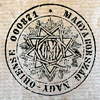
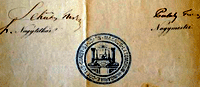
|
SLOBODNOZIDARSKE LOŽE I VENČIĆI U VOJVODINI 1870-1918 Ideja o formiranju Velike Simboličke Lože Mađarske, pod čijom zaštitom su radile sve vojvođanske lože do 1918. godine i neke beogradske do 1908. godine, začela se 1870. godine, nakon formiranja Velike Jovanovske Lože. Ideju o ujedinjenju pokrenula je loža Napredak u Orijentu Košice, koja je radila po škotskom ritualu, i njen Starešina Tivadar čaki (Csćky Tivadar). 21. juna naredne 1871. godine u Pešti je održan sastanak na kom su učestvovali predstavnici loža: Sečenji (Széchényi, Arad), Petefi (Petőfi, Novi Arad), Arpad (Árpád a testvériséghez, Segedin), Domoljublje (Honszeretet, Baja) i Glück auf (Oravica). Dogovoreno je da se međusobno priznaju dva rituala i izvrši ujedinjenje u Veliki Orijent, da se Veliki Majstori naizmenično smenjuju svake godine, da se promene u Konstituciji mogu vršiti samo uz 2/3 većinu glasova, te da se Konstitucijom garantuje autonomija svih loža. Do ujedinjenja, međutim, nije došlo zbog tzv. "vršačke afere". Naime, škotske lože su oformile izvršni komitet na čijem čelu je bio Đorđe Joanović, kasnije Veliki Majstor. On je u leto 1871. godine, u par rečenica, obavestio komisiju koja je radila na zajedničkoj Konstituciji da vršačke slobodne zidare, budući da je Vršac pogranično mesto, uznemiravaju vojne vlasti, te da je, njegovom ličnom zaslugom, stvar rešena. Međutim, u pismu od 11 strana koje su Starešina vršačke lože Egalitas Šandor Kuktai (Kuktay Sándor) i sekretar Mikloš Nađ (Nagy Miklós) napisali Joanoviću, a koje se danas nalazi u Državnom arhivu u Budimpešti, govori se i o razlikama u dva rituala, što je Joanović, budući dobar političar i želeći da izbegne neslaganja, prećutao. U pismu, međutim, postoje nagoveštaji da između proganjanja slobodnih zidara u Vršcu i rituala koji praktikuju postoji veza. S obzirom da je vlada dozvolila formiranje matične lože Matija Korvin, i Vrščani su od svojih građana na dobrom glasu formirtali ložu Egalitas, ali su, u svojoj preteranoj revnosti, primili i nekolicinu iz graničarskog mesta Bela Crkva (Banatska Krajina). Ispostavilo se da su, u toj srpsko-rumunsko-mađarsko-nemačkoj multinacionalnoj sredini belocrkvani bili oni koji su se u Revoluciji 1848 stavili na stranu Mađara, tj. sve je mirisalo na politiku kojom se jača uticaj mađarske države. Sa tim se nije pomirio kapetan Leopold Krajnc (Kreinz), gradonačelnik Bele Crkve i vojni sudija. Pozvao je petoricu belocrkvanskih slobodnih zidara, članova lože Egalitas, da se javno izjasne da li pripadaju slobodnozidarskom Savezu. Trojica su priznala, na šta je pročitana odredba iz Conversations Lexicona po kojoj "slobodno zidarstvo nije ništa drugo do propagiranje ideja socijaldemokratije" kao i odredba iz Austrijskog zakonika po kojem se svako takav kažnjava sa 3-5 godina zatvora. Tako je o tome Joanović bio detaljno obavešten i zamoljen da posreduje u Budimpešti, kako bi loža Egalitas mogla nesmetano da radi, a da i Bela Crkva ubrzo dobije svoju ložu. Iako je u to vreme ukinuta Banatska vojna krajina i celo područje dospelo pod Mađarsku, gde je slobodnozidarsko delanje bilo zakonom garantovano, oficiri, mahom Austrijanci, nisu tu činjenicu uzimali ozbiljno, pa se zato moglo desiti da su u Beloj Crkvi organizovali javni progon slobodnih zidara. Sve to pokazuje sa kakvim je problemima bilo suočeno slobodno zidarstvo u Austrougarskoj monarhiji 1870-ih godina i postaje jasno zašto je do ujedinjenja dve velike lože došlo tek u drugoj polovini 1880-ih godina. |
MASONIC LODGES IN HUNGARY 1870 - 1918 The idea of forming the Symbolic Grand Lodge of Hungary, under whose protection all the Lodges in Vojvodina worked until 1918, as well as some Belgrade Lodges until 1908, began in 1870, after the constitution of the Grand Lodge of St. John. The idea of unification was launched by Lodge Progress of Košice, which followed the Scottish Rite. Its Worshipful Master was Tivadar Csáky at the time. On 21st June 1871, a meeting was held in Pest with the participation of the representatives of the following Lodges: Széchényi (Arad), Petőfi (New Arad), Árpád (Szeged), Honszeretet (Patriotism), Baja and Glück (Luck) Oravica. It was agreed that the two rituals would be mutually recognized and the Lodges would unite into the Grand Orient, that the Grand Masters would alternate yearly, that changes to the Constitution could be made by 2/3 majority of votes, and the Constitution would guarantee autonomy to all the Lodges. However, unification did not occur due to the so-called "Versecz affair." Namely, the Scottish Lodges formed an executive committee headed by György Joannovics, later to be installed Grand Master. In the summer of 1871, he briefly informed the commission, which was working on the common Constitution that the Versecz Freemasons (Versecz was a border town at the time) were harassed by the military authorities but the problem was resolved thanks to his personal advocacy. However, in an 11-page letter written by Alexander Kuktay, Worshipful Master of Lodge Egalitas, to Joannovics, which is now in the State Archives in Budapest, differences in the two rituals were also discussed, which Joannovics, being a skilful politician and wanting to avoid possible disagreements, failed to mention. However, there are indications in the letter that there was a connection between the persecution of Freemasons in Versecz and the practising of the rituals. Given the fact that the government allowed the formation of the mother Lodge Mátyás Korvin, the Versecz Brethren formed Lodge Egalitas but, due to their extreme zealousness, they affiliated a few Brethren from the border town of Bela Crkva (Banat Military Frontier). It turned out that in that Serbian-Romanian-Hungarian-German multinational environment, the admitted Bela Crkva Brethren were supporters of the Hungarian side during the 1848 Revolution i.e. it all had a strong political note — aimed at strengthening the influence of the Hungarian State. Captain Leopold Kreinz, the mayor of Bela Crkva and military judge, could not agree with this. He summoned five members of Lodge Egalitas demanding that they publicly declare whether they belonged to the Freemasonic Alliance. Three of them admitted their membership. Reading out the corresponding provisions of the Conversation Lexicon (German edition) followed, (which said that Freemasonry was nothing but propagation of the idea of social democracy), as well as the provision of the Austrian Code of Law, which prescribed 3-5 years of imprisonment for similar crimes. Thus, Joannovics was informed about every detail and asked to intervene in Budapest, so that Lodge Egalitas could work smoothly, and that Bela Crkva could have its own Lodge soon. Although the Banat Military Frontier was abolished at the time and the whole area came to Hungary, where Masonic activity was guaranteed by law, officers, mostly Austrians, did not take this fact seriously, so it might have been the case that persecution of Freemasons did take place in Bela Crkva. The aforementioned problems may indicate the situation of Freemasonry in the Austro-Hungarian Monarchy of the 1870s and that is why the unification of the two big Grand Lodges took place much later i.e. in the second half of the 1880s. |
|
LOŽE POD ZAŠTITOM SVLM Između 1870. i 1918. Simbolička Velika Loža Mađarske bila je zaštitnik 123 lože i 24 venčića, od kojih su neki prerasli u neku od spomenute 123 lože. Ovde ćemo navesti samo one lože i venčiće o kojima postoje podaci u arhivima i koji su radili na teritoriji koja postaje Jugoslavija nakon prvog svetskog rata. Lože i venčići koji su radili između 1892. i 1908. Naziv lože, Orijent, Period rada Nächstenliebe, Sisak, 1881-1886 Stella Orientalis, Zemun, Pančevo, 1890-1914 Pobratim, Beograd, 1890-1908 Ljubav bližnjega, Zagreb, 1892-1919 Sirius, Rijeka, 1901-1919 Honszeretet/Domoljublje , Baja, Sombor, 1903-1919 Aurora, Vršac, 1903-1917 Jövendő/Budućnost, Sombor, 1908-1918 Alkotás/Stvaranje, Subotica, 1910-1918 Vigilantia/Budnost, Osijek, 1912-1919 Maximillian Vrhovec, Zagreb, 1914-1919 Thales (škotski ritual), Zrenjanin, 1875-1878 Egalitas (škotski ritual), Vršac, 1870-1879 Stena istine(škotski ritual), Zum Fels der Wahrheit, Bela Crkva, 1873-1879 Libertas (škotski ritual), Novi Sad, 1876-1883 Venčići koji su radili između 1892. i 1908 Naziv venč ića, Mesto, Period rada Élet/Život, Bela Crkva, 1912-??? Philanthropia, Sombor, 1897-1908 Rendületlenül/Nepokolebljivo , Novi Sad, 1914-??? Világ/Nepokolebljivo, Veliki Bečkerek, ???-1914 Őrtűz/Stražarska vatra), B. Palanka, 1913-??? Kossuth Lajos, Subotica, 1899-??? |
LODGES UNDER THE PROTECTION OF THE SYMBOLIC GRAND LODGE OF HUNGARY Between 1870 and 1918, the Symbolic Grand Lodge of Hungary was the patron of 123 subordinate lodges and 24 daughter-lodges, some of which grew into one of the aforementioned 123 lodges. Here we will only list those lodges and daughter-lodges whose existence is backed by archival documents and who worked on the territory that became Yugoslavia after WW1. Lodges and other bodies operating between 1892 and 1908. Lodge Name, Orient, Period of operation Nächstenliebe (Charity), Sisak, 1881-1886 Stella Orientalis, Zemun, Pančevo, 1890-1914 Pobratim (Blood Brother), Beograd, 1890-1908 Nächstenliebe (Charity, Zagreb, 1892-1919 Sirius, Rijeka, 1901-1919 Honszeretet (Patriotism), Baja, 1903-1919 Aurora, Vršac, 1903-1917 Jövendő (Future), Sombor, 1908-1918 Alkotás (Creation), Subotica, 1910-1918 Vigilantia (Alertness), Osijek, 1912-1919 Maximillian Vrhovec, Zagreb, 1914-1919 Thales (Scottish Rite), Zrenjanin, 1875-1878 Egalitas (Scottish Rite), Vršac, 1870-1879 Zum Fels der Wahrheit (Rock of Truth), Scottish Rite), Bela Crkva, 1873-1879 Libertas (Scottish Rite), Novi Sad, 1876-1883 Daughter-Lodges active between 1892 and 1908: Daughter Lodge Name, Place, Period of operation Élet (Life), Bela Crkva, 1912-? Philanthropia, Sombor, 1897-1908 Rendületlenül (Steadfastly), Novi Sad, 1914-? Világ (World), Zrenjanin, ?-1914 Őrtűz (Watchfire), B. Palanka, 1913-? Kossuth Lajos, Subotica, 1899-? |
|
SLOBODNO ZIDASTVO U SRBIJI, UKRATKO Podaci o ranom slobodnom zidarstvu u Srbiji preuzeti su iz Rečnika slobodnog zidarstva Danijela Ligua, Paidea, Beograd, 2001., te iz arhivske dokumentacije Državnog arhiva u Budimpešti. Prva loža koja se spominje u Srbiji, još dok je ona bila pod turskom vlašću, bila je loža nepoznatog imena, osnovana 1790. godine. O njoj se ne zna mnogo. Po svoj prilici, delovala je u Beogradu, na turskom jeziku, a članovi su bili, pored Turaka, i Srbi. Na čelu lože bio je Hadži Mustafa-paša, poznat u narodu kao "srpska majka". Po spisima suvremenika, tu su bili i mitropolit Metodije, Janko Katić, ustanički vođa, trgovac Petar Ičko i grčki rodoljub i pesnik Riga od Fere (Konstantin Rigas Valestinlis). Musrafa-pašu su ubili 1801. godine, a Petar Ičko je od Mitropolita Stratimirovića zatražio pomoć za rešavanje hrišćanskog pitanja u Beogradskom pašaluku. Takođe je stupio u vezu sa svojim slobodnim zidarima Jankom Katićem i Aleksom Nenadovićem, kao i Đorđem Petrovićem, viđenijim trgovcem, koji nije bio slobodni zidar. Otkrivši pripremani ustanak, Turci su žestoko odgovorili, pobivši mnoge, između ostalih i brata AleksE Nenadovića, što je samo ubrzalo ustanak 1804. godine u kojoj je Petar Ičko odigrao značajnu diplomatsku ulogu. Karađorđe ga je postavio za "prvog gradonačelnika slobodnog Beograda". Ministar prosvete je postao Dositej Obradović, takođe slobodni zidar, član više evropskih loža. Iako se nisu slagali po pitanju srpskog jezika i pisma, Mitropolit Stratimirović ga je, kao masonskog brata pozvao u Karlovce i primio ga sa svim počastima kao jednog od najobrazovanijih Srba u to vreme. Posle sloma prvog srpskog ustanka i represalija od strane Turaka, a i činjenice da su mnogi Srbi izbegli u okolne zemlje, slobodno zidarstvo je zamrlo u tim krajevima, sve do oko 1848. godine. Viđeniji Srbi su, u tom periodu, postajali članovi loža u Mađarskoj, pogotovo u Budimu, Pešti i Temišvaru, u nemačkim i švajcarskim ložama, ali o tome ima malo pouzdanih podataka. Oko 1848. u Beogradu je delovala turska loža Ali Koč, kojoj je pripadao i Sima Milutinović. Osnovana je barem nekoliko godina ranije jer smo naišli na podatak da je starešina lože Ismail-beg već te godine boravio u Budimpešti na svečanosti otvaranja lože Košut Lajoš zora slavne svetlost (Kossuth Lajos, a dicső fény hajnalához). Tvrdi se da je i Mihailo Obrenović bio slobodni zidar, ali se ne zna kojoj bi loži pripadao. Činjenica je da je održavao bliske veze sa Garibaldijem i slobodnim zidarom i iluminatom Macinijem (Mazzini). Verovatno pod njihovim uticajem, u Beogradu se 1876. godine osniva loža Svetlost Balkana (Luce dei Balkani) pod zaštitom Velikog orijenta Italije, prva srpska loža koja za članove ima srpske intelektualce, trgovce i ljude od imena, koji su svoje obrazovanje stekli po gradovima Evrope. 1878. na Berlinskom kongresu, Srbija dobija punu nezavisnost, čime se podstiče i širenje slobodnog zidarstva. 1881. počinje da radi loža Srbska zadruga. Ona se gasi 1883. godine, ali se iste godine osniva loža Sloga, rad i postojanstvo, takođe pod patronatom Velikog orijenta Italije. Članovi Lože, između ostalih su: Svetomir Nikolajević, Sreta Stojković i Đoka Milovanović Pravi zamah počinje 1889-90. godine kada se u Zemunu, uz pomoć segedinske lože Arpad, osniva loža Stella Orientalis, koja se kasnije seli u Pančevo, a u Beogradu Loža Pobratim. Obe lože osnovane su i radile pod zaštitom Simboličke Velike Lože Mađarske. |
A SHORT HISTORY OF FREEMASONRY IN THE PRINCIPALITY (LATER KINGDOM) OF SERBIA Data on early Freemasonry in Serbia were taken from the Serbian edition of the Dictionary of Freemasonry by Daniel Ligou, Paideia, Belgrade, 2001, pp. 488-493) and from the documents of the State Archives of Hungary. The first Masonic lodge in Serbia dates back to the time when the country was still under Turkish occupation; it was a lodge of an unknown name, founded in 1790. We do not know much about it. In all likelihood, it worked in Belgrade, in the Turkish language, and the members were Turks but also Serbs. The Worshipful Master was Hadji Mustafa Pasha, well-known among the people as the "Serbian mother." According to the writings of the contemporaries, the members of the Lodge were Metropolitan Metodije, Janko Katić, insurrection leader, merchant Petar Ičko and the Greek patriot and poet Rigas Feraios. After Mustafa Pasha had been assassinated by bandits in 1801, Petar Ičko began, through his Masonic connections, to seek help from Metropolitan Stratimirović in order to resolve the Christian issue in the Pashalic of Belgrade by starting an uprising. He also got in touch with his Masonic Brethren Janko Katić and Aleksa Nenadović, as well as Djordje Petrović, a respected merchant who was not a Freemason at the time. Having discovered the plans for the uprising, the Turks responded fiercely, killing many, including the brother of Aleksa Nenadović, which only accelerated the uprising in 1804 where Petar Ičko played a significant diplomatic role. The insurrection leader Karadjordje (Black George) appointed him the first mayor of free Belgrade. Dositej Obradović, also a Freemason initiated in Trieste and member of several European Lodges became the Minister of Education. Although he did not agree with Metropolitan Stratimirović on the reformed script of the Serbian language, Dositej was invited by his Masonic Brother to Karlovci, who received him with all honour as one of the most educated Serbs of the time. After the failure of the First Serbian Uprising and the reprisals by the Turks, a number of Serbs fled to the surrounding countries which rendered Freemasonry dead in those parts until about 1848. At that time, a number of Serbs became members of Hungarian lodges, especially in Buda, Pest and Timisoara, as well as of German and Swiss lodges, although little reliable information exists about this. Ali Koç Turkish Lodge was active in Belgrade Around 1848. It must have been constituted at least a few years earlier since we came across a note (Abafi Lajos: A szabadkőművesség története Magyarországon, 2012, pp. 424-425) claiming that the Worshipful Master of the Lodge, Ismail Bey, might have travelled to Budapest, the same year, for the consecration ceremony of Lodge Lajos Kossuth the Dawn of Glorious Light. It is claimed that Serbian Prince Mihailo Obrenović (1823-1868) might have been a Freemason, but it is not known which lodge he could have belonged to. It is a well-known fact, though, that he maintained close ties with Garibaldi and the Freemason and Illuminatus Mazzini. Probably under their influence, in 1876, the Luce dei Balkani, Svetlost Balkana (Light of the Balkans) Lodge was established under the protection of the Grand Orient of Italy, the first Serbian Lodge with members of the Serbian intellectual elite, traders and men of reputation who acquired their education in European cities. At the Berlin Congress of 1878, Serbia gained full independence, which encouraged the diffusion of Freemasonry in the country. In 1881, Lodge Srbska zadruga (Serbian Cooperative) began to work. It went dormant in 1883, but Lodge Sloga, rad i postojanstvo (Accord, work and perseverance), was founded in the same year, under the patronage of the Grand Orient of Italy as well. Members of the Lodge, among others, were: Svetomir Nikolajević (politician), Sreta Stojković (author and educator) and Đorđe Milovanović (painter). Real enthusiasm for Freemasonry began in 1889-90 when Lodge Stella Orientalis in the Orient of Semlin (Zemun), supported by Lodge Árpád of Szeged, and the Belgrade Lodge Pobratim (Blood Brother) were established and were working under the protection of the Symbolic Grand Lodge of Hungary. |
|
PRVI KORACI LOŽE STELLA ORIENTALIS ORIJENT ZEMUN (KASNIJE PANČEVO) Zahvaljujući obimnijoj dokumentaciji do koje smo uspeli da dođemo, navešćemo podatke o postupku osnivanja zemunske lože, čiji je član i prvi besednik, Julius Štili (Julius Stielly), preselivši se u Zagreb, kasnije odigrao ključnu ulogu u osnivanju zagrebačke lože Hrvatska vila 1892. godine, prve lože koja je radila na narodnom jeziku.
Pečat Lože Stella Orientalis 24. juna, godine 1887. Kalman Kesegvari (Kőszegváry Kálmán) šalje dopis Starešini segedinske Lože Árpád a Testvériséghez u kojem ga obaveštava da planira da osnuje ložu, zajedno sa nekolicinom svojih poznanika iz Beograda i Zemuna, koji su svi na visokim položajima i besprekornih moralnih kvaliteta, te moli Ložu Árpád a Testvériséghez za podršku u tom smislu. Iz Arpada mu odgovaraju da im je drago da se tako nešto planira i da će rado učiniti sve što je u njihovoj moći da do osnivanja Lože dođe. Nažalost, prvi pokušaj Kalmana Kesegvarija ne uspeva, ali ga to ne odvraća od ostvarenja plana, već nalazi nove potencijalne članove i u Segedin upućuje sledeće pismo. Uvaženi Starešino! Draga Braćo! Neumorni Kesegvari, 14. decembra šalje matrikule 3 Zemunca i tri Beograđanina, 4. januara 1889. jednu zemunsku i dve beogradske matrikule, a 8. oktobra dve zemunske i dve beogradske matrikule. Da bi Loža Arpad pokazala najveći oprez u izboru članova, u Beograd i Zemun upućuje dva svoja majstora u cilju prikupljanja podataka o kandidatima. 15. februara, na osnovu prispelih izveštaja Braće, dva kandidata bivaju odbijena, a dvanaest ih, čistim balotiranjem, preporuče za prijem. Prvog marta, još tri kandidata prolaze balotiranje. Nakon toga započinje inicijacija zemunskih i beogradskih kandidata. Od petnaestorice kandidata čiji je prijem odobren, pojavljuje se njih samo osmorica, a svetlost od Lože Arpad primaju ovim redosledom: Na radovima 24. maja, po prvi put, Loža Arpad se bavi molbom beogradske i zemunske Braće da se onima koji tamo žive pruži pomoć za osnivanje Lože u Orijentu Zemun. Braća odlučuju da se na unošenje svetla u novu Ložu upute u Zemun, da se odreknu povećanja nadnice u korist svoje sestrinske lože te da zaduže Br. dr. Aleksandra Polgara (Polgár Sándor) da ostvari dogovor sa beogradskom i zemunskom Braćom u vezi daljih poslova. 10. juna Besednik javlja da beogradska i zemunska Braća spremno prihvataju sva rešenja Lože Arpad. Međutim, zbog proteklih političkih događaja u Beogradu unošenje svetlosti u Ložu jedva da će biti ostvarivo. Da lep rezultat prvih koraka ovog pokreta ne bi bio uzaludan, Loža Arpad se rado prihvata zadatka da nove kandidate inicira u Beogradu, "pod vedrim nebom", znači u nekoj drugoj loži. Beogradska i zemunska Braća su, svojim zalaganjem, savladali sve prepreke i 30. novembra 1889. godine sledeća arhitektonska tabla obaveštava o osnivanju nove Lože: Orijent Beograd, 30. novembra 1889. Godine Vođeni željom da Kraljevsku umetnost širimo na Istoku i imajući u vidu značaj misije kojom se naše plemenite veze sa zemljama u polukultivisanim provincijama održavaju, potpisnici koji žive u Zemunu i Beogradu odlučili su da svoju Ložu stave pod zaštitu Najuvaženije Simboličke Velike Lože Mađarske. U tom cilju okupili smo se na ovoj Konferenciji na kojoj će se doneti definitivni zaključci, što je i zadatak arhitektonske table koja je pred nama. U prvom redu, treba zaključiti da će Loža u osnivanju raditi pod nazivom "Stella Orientalis", u Orijentu Zemun na nemačkom jeziku i treba je ustanoviti, što je pre moguće, te je u tom smislu sledeće i sastavljeno: Braća obeležena zvezdicom su se jednokratno primila navedenog zadatka prilikom osnivanja Lože. Iz priloga ovom izveštaju vidi se da je Loža Arpad pristala da, u cilju osnivanja, Braću Engela, Radulovića, Jankovića, Allina i Goldnera uzdigne na treći stepen. Ona Braća koja su svojim profanim poslovima sprečena da se u veoma bliskoj budućnosti pojave u Orijentu Segedin, mole Uvaženu Ložu da postavi nekog od Braće na dužnost Upravitelja, koji će u ime Lože, i u gornjem cilju, da preduzme uzdizanje navedene Braće pod vedrim nebom, te da ostane do konstituisanja Lože. Po osnivanju Lože, iz raznih razloga, a pre svega zbog znatnih neprijatnosti putovanja u Segedin, što postoji već duže vreme, molimo Uvaženu Ložu za razumevanje u donošenju odluke, te da nas istovremeno obavesti da li je potrebno da se označi poreklo Br aće koja su nam prešla, a koja su delegirana od strane Uvažene Lože, ili ne. Molimo Vas takodje da overite dokumente koje vam šaljemo, da bi ovi bili punovažni, tako da nam mogu služiti kao dokaz o osnivanju Lože. Po delegatu ćemo Vam poslati sredstva za gornju pomoć, kao i za takse koje dugujemo. S obzirom da su nam finansijska sredstva ograničena, te da treba da imamo pred očima sudbinu Lože, a koja započinje svoj život značajnim dugom, koji se može isplatiti samo uz velike napore i požrtvovnost braće, odlučili smo da uvedemo maksimalnu štednju za sve i svakoga dok ne budemo ojačali naše finansije i bili u mogućnosti da izdvajamo sredstva za više ciljeve Kraljevske umetnosti. Ovako stečena sredstva bi, u prvom redu, namenili za objekat Lože, te mislimo da — kada to bude moguće — izvršimo akviziciju takvog objekta, razmatrajući istovremeno kupovinu opreme jedne od 20-22 uspavljene lože, o kojoj nemamo nikakva saznanja, ni gde se nalazi, ni ko je vlasnik, ni koga treba kontaktirati, pa molimo Uvaženu Ložu za podršku u našoj stvari i da eventualno zamoli oficijelni Organ za posredovanje u kupovini preko Kancelarije Uvažene Velike Lože. S obzirom na to, da su mnoga naša Braća i danas članovi Lože "Arpad" u Orijentu Segedin, a nekolicina i drugih poznatih loža, te da je u cilju osnivanja Lože njihovo članstvo kod nas odobreno, zahvaljujemo se Velikoj Loži na podršci, i rečju i delom. Konačno, molimo Uvaženu Veliku Ložu da ponovo udovolji našoj molbi, uz najažurnije izvršenje, i da nas o tome istovremeno obavesti na našu profanu adresu Alfons Brun, šef biroa srpskih železnica, Beograd, Hotel Grand. Ostajemo s bratskim pozdravom. Engel, Štili, Vasa Radulović, Brun, Bek, Goldner, Volfner prisutni. Br. Alin, Janković i Kesegvari odsutni, koje predstavlja i vodi: Br. Brun. Loža Arpad će, s najvećom predusretljivošću, ispuniti sve želje osnivačke braće Stelle Orientalis: povećaće nadnice, izglasaće traženi povraćaj naknada, posredovaće u nabavci opreme Lože Zur Grossmuth i regulisaće razrešenje braće. Pošto je Br. Mošin Beck došao u Segedin sa pozivom na osnivačku svečanost, koji zemunska i beogradska braća upućuju majci-loži Árpád, Loža odlučuje da uputi tročlanu delegaciju, pozivajući istovremeno svu Braću da se pridruže delegaciji. U ime zemunske i beogradske Braće, Br. Aleksandar Engel šalje pismo Loži Árpád u kojem, toplim rečima, poziva Braću na osnivačke radove i kaže da će se datum svečanosti odrediti i javiti depešom onda kada bude primio obaveštenje o dolasku delegata Velike Lože. Međutim, ne malo iznenađenje među Braćom Lože Árpád izaziva pismo u kojem se traži hitno rešenje molbe Ferenca Štauda za prijem u bratstvo, a samo uzgred se spominje da je 19. januara 1890. Loža Stella Orientalis već održala osnivačke radove — zaobilazeći majku-ložu u potpunosti. Arhitektonska tabla Stelle Orientalis od 10. marta, potpisana od strane pet svetlosti radionice, pokušava da objasni gornji propust time da su osnivački radovi obavljeni bez ikakvih svečanih tonova i, rečima punim hvale za majku-ložu, mole se Braća i Starešina Lože da sami odrede neku od nedelja kada bi bili voljni da dođu, a Stella Orientalis bi tada održala svečane radove u čast Lože Árpád. Loža Árpád je s radošću primila srdačan poziv. Da bi dala doprinos jačanju bratskih odnosa, "Arpad" upućuje sedmočlanu delegaciju na svečane radove Stelle Orientalis 27. aprila. Tom prilikom, Dr. Ladislav Siveši (Szivessy László), Zamenik Uvaženog Starešine, oduševljeno pozdravlja Kalmana Kesegvarija, koga Loža Árpád bira za počasnog člana 14. marta, zbog zasluga oko osnivanja Lože Stella Orientalis. Delegacija, u kojoj su bile i dve sestre, iz Zemuna odlazi i u Beograd u posetu tamošnjoj Braći. Na oba mesta su Segedinci oduševljeno primljeni, te se sa tog prijatnog i edukativnog putovanja vraćaju puni lepih utisaka. Takođe 14. marta, Stella Orientalis bira Pavla Njilašija (Nyilassy Pál), Starešinu Lože Arpad za počasnog člana, koji se sledećim pismom zahvaljuje na časti: Draga Braćo! Daleko bilo da ovo nezasluženo priznanje pripišem sebi, koji još nisam imao priliku da učinim ništa za zemunsku Braću. Znam, međutim, da je ovo priznanje, preko mene, zapravo priznanje segedinskoj majci-loži. Stoga, ja u svoje ime, te u ime Lože "Arpad" uveravam dragu Braću da će se bratske veze i dalje razvijati. Želja mi je da V.N.U. da "Stelli Orientalis" vremena i sreće da, sa te svoje odabrane stražare, nadaleko širi prosvećenost i pravi humanizam, te da mladi plamen zvezde sja tako jako i visoko da je majka-loža i iz doma svog može ugledati. Preporučujem se zemunskoj Loži i ljubavi svih članova želeći da osećanja uzajamne bratske veze još dugo i stalno traju, te da naši kontakti u budućnosti budu što češći. Preseljenjem u Pančevo, loža Stella Orientalis ima 37 članova (4 inženjera, 6 državnih službenika, 10 trgovaca, 1 vlasnika mlina, 1 veterinara, 1 lekara (Dr. József Thüm iz Sombora), 1 preduzimača graditelja, 1 hotelijera, 1 carinika, dvoje zanatlija, 1 nastavnika, 2 bankara, 2 kapetana broda, 1 evangelističkog pastora, 2 štampara, 1 advokata). 1914. godine, kada se gasi, Loža ima 42 su člana, ali se po brojevima matrikula vidi da je kroz Stellu Orientalis prošlo 125 muževa. |
FIRST STEPS OF LODGE STELLA ORIENTALIS, ORIENT SEMLIN/PANČEVO Thanks to the documents that we managed to come across at the State Archives of Hungary and Somogyi Library of Szeged, we will present information on the process of establishing the Semlin Lodge, whose member and its first Orator, Julius Stielly, moved to Zagreb later and played the key role in the constitution of the Zagreb Lodge Hrvatska vila (Croatian Fairy) in 1892, being the first lodge that worked in the Croatian language. From the translation of authentic documents and letters the process of establishing a Masonic Lodge may clearly be seen. It was the beginning of a period of rapid expansion of Freemasonry in the regions north of the Sava and the Danube as well as Belgrade. Although L. Stella Orientalis worked under the protection of the Symbolic Grand Lodge of Hungary, the working language was German, due probably to the fact that the majority of the members were civil servants under the Austrian crown; that may be the reason why they were maintaining the prevailingly arrogant attitude of the Austrian crown regarding relations with the Balkan peoples.
Seal of Lodge Stella Orientalis On June 24, 1887, Kálmán Kőszegváry sent a letter to the Elders of the Szeged Lodge Árpád a Testvériséghez informing them that he was planning to establish a Lodge, along with a few of his acquaintances from Belgrade and Zemun (Semlin), all of whom were high-ranking and spotless quality, and asked the Lodge Árpád a Testvériséghez for support in this regard. He was told by Arpad that they were glad that something was planned and that they would gladly do everything in their power to facilitate the establishment of the Lodge. Unfortunately, Kálmán Kőszegváry's first attempt fails, but it did not deter him from realizing the plan and he found new potential members and sent the following letter to Szeged: Dear Worshipful Master, Dear Brethren, On 14th December tireless Brother Kőszegváry sent the petitions of three more candidates from Semlin as well as three from Belgrade on 4th January 1889, then one petition from Semlin and two from Belgrade and again two from Semlin and two from Belgrade on 8th October. In order to show that L. Árpád Lodge exercised the greatest caution in the choice of members, two of its Masters were sent to Belgrade and Semlin to collect information about the petitioners. On February 15, on the basis of the Brethren's reports received, two petitioners were turned down, but twelve of them were recommended for admission, via clean balloting. On 1st March, three other petitioners were accepted. After that, the initiation of the Semlin and Belgrade petitioners began. Of the fifteen petitioners whose admission had been accepted, only eight of them appeared, and were "brought to light" by Lodge Árpád in the following order: Lodge Árpád dealt with the request by the Belgrade and Semlin Brethren at the labour held on 24th May to provide help to those who lived there for establishing a lodge in the Orient Semlin. The Brethren decided to consecrate the new Lodge in Semlin, to exempt them from wage increase fees in favour of the Sister-Lodge and to put the Orator, Bro. Dr Sándor Polgár, in charge of drafting an agreement with the Belgrade and Semlin Brethren on further jobs. On 10th June, the Orator reported that the Belgrade and Semlin Brethren were ready to accept all the solutions drafted by L. Árpád. However, due to the past political events in Belgrade, the consecration of the Lodge would hardly be possible. In order to avoid all the efforts to turn out to be futile, L. Árpád was pleased to accept the task of initiating new candidates in Belgrade, "under the open sky" i.e. in an other lodge. Thanks to their commitment, the Belgrade and Semlin Brethren, overcame all the obstacles and, the following report 30th November 1889 tells about the establishment of the new Lodge: Orient Belgrade, 30th November 1889, Guided by the desire to diffuse the Royal Art further to the east and bearing in mind the importance of the mission by which our noble relations with countries in semi-cultivated provinces are maintained, the signatories who live in Semlin and Belgrade have decided to put their Lodge under the protection of the Most Worshipful Symbolic Grand Lodge of Hungary. With this aim in mind, we have convened at this Conference to make definitive conclusions, which have been entered into this report in front of us. Firstly, it has been concluded that the Lodge will be working under the name of Stella Orientalis in the Orient of Semlin, in the German language and should be consecrated as soon as possible. The Officers of the Lodge are as follows: The Brethren marked with an asterisk accepted their task solely for the consecration work. It may be seen, from the appendix to this report that Lodge. Arpad agreed to confer the third degree on Brethren Engel, Radulović, Janković, Allin and Goldner so that the Lodge could be established. Those Brethren whose profane jobs prevent them from appearing in the Orient of Szeged in the very near future asked the Worshipful Lodge to nominate one of the Brethren Representative of the Mother Lodge, who would, in the name of the Lodge and for the aforementioned task, undertake to raise the aforementioned Brethren "under the open sky" and remain there until the constitution of the Lodge. After the establishment of the Lodge, due to various reasons, above all to considerable inconvenience of travelling to Szeged, which has existed for quite a while, we are asking the Worshipful Lodge for understanding when they make decisions as well as to inform us whether it is necessary to indicate the origin of the Brethren who have been affiliated with us and who were delegated by the Worshipful Lodge, or not. We are asking you, too to verify the documents that we send to you so that they become valid, in order for them to serve as evidence for the establishment of the Lodge. By delegate, we will send you funds for the above assistance, as well as for the fees we owe. Given that our financial resources are limited and that we have to keep in mind the fate of the Lodge, which has begun its life with a significant debt that can only be paid through great effort and courage of our Brethren, we have decided to save on everything and everyone until we strengthen our finances and are able to allocate funds for the higher goals of the Royal Art. The funds thus obtained would be intended primarily for the Masonic Hall, and we think that - when it becomes possible - we shall undertake acquisition of such a structure, considering simultaneously the purchase of equipment of one of 20-22 dormant lodges, about which we have no knowledge, where it is located, who the owner is or who should be contacted. Therefore, we are asking the Honourable Lodge to support us in our matter and contact in this matter the official Procurement Mediation Authority through the Office of the Most Worshipful Grand Lodge. Considering that many of our Brethren are still members of Lodge Arpad in the Orient of Szeged, and several other well-known lodges, and that in order to establish our Lodge their membership with us has been approved, we are thanking the Grand Lodge for their support, in word and deed. Finally, we invite the Most Worshipful Grand Lodge again to meet our request, with the most urgent execution and send further information to our profane address: Alfons Brunn, head of the Serbian Railway Bureau, Belgrade, Hotel Grand. Yours faithfully. Present: Bros. Engel, Stielly, Vasa Radulović, Brunn, Beck, Goldner, Wolfner Absent: Bros. Allin, Janković and Kőszegváry Representing and leading: Bro. Brunn. Lodge Árpád fulfilled, with the greatest affability, all the wishes of the founding Brethren of Stella Orientalis: it raised the wages, announced the required refund of fees, mediated in the procurement of the equipment of Lodge Zur Grossmuth and regulated the demits of the Brethren. Since Bro. Mosin Beck arrived in Szeged with an invitation to the founding ceremony, which the Semlin and Belgrade Brethren were sending to Árpád Mother Lodge, the Lodge decided to nominate a three-member delegation, but also inviting all the Brethren to join the delegation for the consecration ceremony. On behalf of the Semlin and Belgrade Brethren, Bro. Alexander Engel sent a letter to Lodge Árpád in which, with the kindest words, he officially invited the Brethren to the founding work and said that the date of the ceremony would be determined and corresponding information sent by telegram as soon as he has received a notice on the arrival of the Grand Lodge delegates. However, the Brethren of Lodge Árpád were astounded when they received a letter that contained a request for an urgent solution to the petition of Ferenc Kajd and only incidentally mentioned that, Lodge Stella Orientalis had already held their foundation ceremony on 19th January 1890 — bypassing Mother-Lodge completely. The report of Stella Orientalis of 10th March, signed by the five lights of the Lodge, tried to explain the a/m "misunderstanding" by the fact that the founding work was not ceremonial and, with words full of praise for the Mother Lodge the Brethren and the Worshipful Master were asked to select a date on which they would be willing to come and then Stella Orientalis would hold the Ceremonial Labour in honour of Lodge Árpád. Lodge Árpád received the heartfelt invitation with joy. In order to contribute to strengthening fraternal relations, Lodge Árpád sent a seven-member delegation to the Ceremonial Work of Stella Orientalis on 27th April. On that occasion, Dr László Szivessy greeted Kálmán Kőszegváry, who was to be elected an honorary member of Lodge Árpád on 14th March for the merit of establishing Lodge Stella Orientalis. The delegation, which included two sisters as well, proceeded from Semlin to Belgrade to visit the Brethren there. In both places, the Szeged delegation was received enthusiastically. They returned from that pleasant and educational trip with exceptionally positive impressions. Also on 14th March Stella Orientalis elected Pál Nyilassy, Worshipful Master of Lodge Árpád, an honorary member, who sent the following letter of thanks: Dear Brethren! I would never attribute this undeserved affiliation to myself since I have had no opportunity so far to do anything for the Semlin Brethren. However, I know that this recognition, through me, is actually a recognition to the Mother Lodge. Therefore, on my own behalf and on behalf of Lodge Arpad, I assure you, dear Brethren, that our fraternal relations will continue to develop. I wish that the GAOTU grant L. Stella Orientalis time and luck to spread enlightenment and true humanism from their watchtower and let the young flame of their star glow so brightly and high that the Mother Lodge may see it from her home. Best regards to the Semlin Lodge and with love to all the members with the hope that the feelings of mutual brotherly relationship will last for a long time and that our contacts will be more frequent in the future. In the moment of their transfer to Pančevo, Lodge Stella Orientalis had 37 members (4 engineers, 6 civil servants, 10 traders, 1 mill owner, 1 veterinarian, 1 physician (Dr. József Thüm from Apatin), 1 contractor, 1 hotel owner, 1 customs officer, 2 craftsmen, 1 teacher, 2 bankers, 2 shipmasters, 1 evangelical pastor, 2 printers, 1 solicitor). In 1914, when it went dormant, the Lodge had 42 members. According to the total number of petitions filed, 125 men passed through L. Stella Orientalis. |

|
LOŽA POBRATIM, ORIJENT BEOGRAD Slobodno zidarstvo u Mađarskoj, zbog njegove zabrane u Austriji, bilo je u znatnoj ekspanziji pa je 1890. godine grupa srpskih intelektualaca i poslovnih ljudi, na čelu sa industrijalcem Đorđem Vajfertom (Georg Weifert), Androm Đorđevićem, profesorom Velike škole, Stevanom Mokranjcem, kompozitorom i Tihomirom Markovićem, advokatom, kao i Braćom Nikolajevićem, Stojkovićem i Milovanovićem, članovima Lože Sloga, rad i postojanstvo, zaključilo da bi bilo poželjno da se, i zbog geografske blizine i umnogome zajedničke istorije dva naroda, srpski slobodni zidari povežu sa mađarskim. Ovom opredeljenju je doprinelo i nezadovoljstvo beogradskih slobodnih zidara pomanjkanjem pažnje Velikog orijenta Italije dešavanjima na Balkanu, kao i time da će se preko Budimpešte lakše povezati sa ložama iz srednje i zapadne Evrope i odupreti ekspanziji Austrije na Balkanu. Cetvorica prvospomenutih su u jutro 5. oktobra 1890. inicirana u peštanskoj Loži Demokratia, i istog dana uzdignuta na drugi, pa treći stepen.
Pečat Lože Pobratim Svečanost otvaranja lože Pobratim održana je 02. februara 1891. godine uz prisustvo Velikog Sekretara Velike Simboličke Lože Mađarske Mora Gellerija (Gelléri Mór), Velikog Rizničara Eduarda Horna, Jovana Bošanjija (Bossányi János), kao i Starešine Lože Sloga, rad i postojanstvo Mihajla Valtrovića i Starešine Lože Stella Orientalis Juliusa Štilija, kao i delegata škotskih loža Matija Korvin (Korvin Mátyás), Humboldt i Kenjveš Kalman (Könyves Kálmán). Prvih devet godina, ložom Pobratim rukovodi Đorđe Vajfert, možda najznačajniji slobodni zidar Srbije do sada, pa ćemo navesti nešto više detalja o njemu samom i njegovom radu kao slobodnom zidaru. |
LODGE POBRATIM (BLOOD BROTHER), ORIENT BELGRADE Freemasonry in Hungary, due to its ban in Austria, was in considerable expansion, and in 1890 a group of Serbian intellectuals and businessmen, led by industrialist Georg Weifert, Andra Đorđević, professor of the Great School, Stevan Mokranjac, composer and Tihomir Marković, lawyer, as well as Brethren Nikolajević, Stojković and Milovanović, members of Lodge Accord, Work and Perseverance, concluded that it would be desirable for Serbian Freemasons to connect with Hungary due to the geographical proximity and the closely interrelated history of the two nations. The dissatisfaction of Belgrade Freemasons contributed to that decision. They complained about the lack of attention the Grand Orient of Italy paid to the events in the Balkans; through Budapest, it would also be easier to connect with lodges from Central and Western Europe and oppose the expansion of Austria in the Balkans. In the morning of 5th October 1890, four of the seven a/m gentlemen were initiated in the Pest Lodge Demokratia and raised to the second, and the third degrees on the same day.
Seal of Lodge Pobratim The consecration ceremony of Lodge Pobratim took place on 2nd February 1891 in the presence of the Grand Secretary of the Symbolic Grand Lodge of Hungary, Mór Gelléri, the Grand Treasurer Eduard Horn, János Bossányi, as well as the Worshipful Master of Lodge Accord, Work and Perseverance Mihailo Valtrović and Lodge Stella Orientalis' Worshipful Master Julius Stielly, as well as delegates from Scottish Lodges Corvin Mátyás, Humboldt and Könyves Kálmán. For the first nine years, Lodge Pobratim's Worshipful Master was Georg Weifert, perhaps the most prominent Serbian Freemason so far. We will give some more details about him and his work as a Freemason. |

|
GEORG (ĐORĐE) WEIFERT Kratka biografija Masonska godina 5937 je godina odlaska Brata Đure, kako su ga među Braćom oslovljavali, tj. Georga Vajferta na Večni Istok. NON OMNIS MORIAR (ne umire sve) reče Horacije u svojoj Karmini, što je za Brata Georga, nakon 47 godina slobodnozidarskog delovanja, višestruko tačno. Rođen je u Pančevu, 15. juna 1850. godine od oca Ignaciusa i majke Ane, a umro u Beogradu, 12. januara 1937. godine. Njegovi preci su se doselili u Vojvodinu iz severnog dela Austrije početkom 18.veka u potrazi za boljom srećom. Otac mu se bavio trgovinom i proizvodnjom piva, a sam Georg postao je jedan od najvećih srpskih industrijalaca svog vremena. Takođe je bio guverner Narodne banke Kraljevine Srbije, pa potom i Kraljevine SHS i jedan od najvećih imena, ako ne i najveće ime, srpskog slobodnog zidarstva. U vreme njegovog rođenja, Pančevo je bilo malo pogranično mesto na ušću Tamiša u Dunav, naseljeno pretežno Srbima, Nemcima i Mađarima, ali sa druge strane Dunava ležao je Beograd, komercijalni centar i glavni grad ponovo uspostavljene Kraljevine Srbije. Đorđe je u Pančevu pohađao nemačku osnovnu školu i mađarsku srednju školu, a Trgovačku akademiju završio je u Budimpešti. Dalje usavršavanje nastavlja u Velikoj pivarskoj školi u Minhenu, a 1872. godine dolazi u Beograd da pomogne ocu u izgradnji pivare na Topčiderskom brdu. 1873. ženi se Marijom Gisner, sa kojom započinje svoj veliki dobrotvorni rad, najpre otvaranjem velikog pančevačkog katoličkog groblja, gde se i danas nalaze posmrtni ostaci porodice Vajfert, pa potom i izgradnjom crkve Sv. Ane u Pančevu. 1876. godine, u vreme kada je Kneževina Srbija zaratila sa Turskom, Georg Vajfert daje novac za kupovinu topova za srpsku vojsku, a sam u operacijama srpske konjice učestvuje kao drobrovoljac. Tu prima i Orden za hrabrost, jedini orden koji je sa njim otišao u grob, pored 16 drugih koje je za života primio. U svom vremenu, Georg Vajfert bio je jedan od najistaknutijih i najbogatijih privrednika Srbije. Pored pivare "Weifert," koju je podigao i razvio sa svojim ocem, postao je vlasnik rudnika uglja Kostolac, rudnika bakra Bor, kamenog uglja Podvis i zlata Sveta Ana i smatra se ocem modernog rudarstva u Srbiji.
Georg Weifert (1850-1937) Pored obnove pančevačke crkve i groblja, te rada u dobrotvornim organizacijama, G. Weifert osniva Fond za gluvonemu decu Stefan Dečanski, postajući ne samo osnivač već i stalni finansijer istog i njegov počasni predsednik, kao i Invalidski fond Sv. Đorđa, uz podršku dobrotvora Nikole Spasića. 1912. godine, u toku balkanskog rata, najsiromašnijim porodicama Beograda poklanja 60.000 vekni hleba. U toku Velikog rata od 1915.-1918. boravi u Marseju odakle šalje svesrdnu pomoć narodu i vojsci. 1929. godine osniva Bolnicu za žene u Tiršovoj ulici u Beogradu, a Beogradskom ženskom društvu poklanja zemljište i podiže zgradu. U Pančevu podiže dve zgrade, a 1923. godine Beogradskom Univerzitetu ostavlja numizmatičku zbirku od 14.000 komada koju je, zajedno sa svojim ocem i bratom, sakupio u toku 40-ak godina. Iz zahvalnosti za veliku pomoć, bio je biran za počasnog predsednika Banatskog vatrogasnog udruženja i pančevačke Pučke banke. Pošto nije imao potomaka, celu njegovu imovinu je nasledio njegov sestrić ali je nakon 2. svetskog rata ona nacionalizovana. Današnja njena vrednost se procenjuje na 12 milijardi dolara! Slobodnozidarski rad Georg Vajfert je postao slobodni zidar u svojoj. 40. godini, 5. oktobra 1890. u Loži Demokratia u Pešti. Pošto su prethodno tri prve slobodnozidarske lože u Srbiji: Svetlost Balkana, Srpska Zadruga (radila veoma kratko) i Sloga, rad i postojanstvo bile pod pokroviteljstvom Velike Lože Italije, koja nije baš vodila veliku brigu o dešavanjima na Balkanu, javila se potreba da se osnuje nova loža koja će biti aktivnija i koja ce privući veći broj članova. Svetomir Nikolajević, profesor Velike škole i vojvoda Đorđe Milovanović, komandant Beogradskog grada, koji su tada već bili uzdignuti u majstore u Loži Demokratia u Pešti, inicirali su sastanak u prostorijama društva Sveti Sava, kuda su pozvani i Georg Vajfert i Stevan Mokranjac, kao i advokat Tihomir Marković i profesor Velike škole Andra Đorđević. Njih četvorica su u jutro 4. oktobra 1890. u loži Demokratia u Budimpešti primljeni za učenike. Istog dana u podne, uzdignuti su u pomoćnike, a u majstore kasno popodne. Nakon toga su imali belu trpezu u, danas nepostojećem klasicističkom zdanju, u blizini zgrade Akademije nauka, hotelu "Nadvojvoda Stefan u Budimpešti". Ubrzo nakon uzdizanja, 14. februara 1891. godine, osniva se nova Loža, Pobratim, kao simbol jedinstva mađarskog i srpskog masonstva, a Georg Vajfert postaje Starešina Lože, gde ostaje sve do 1899. godine. U toku njegovog starešinstva, ostvaruju se bliski odnosi izmedju srpske i hrvatske masonerije, uprkos zabrani slobodnog zidarstva u Austriji, pod kojom je Hrvatska tada bila. Prvi takvi kontakti ostvareni su 1892. godine. Tada se sklapa i lično prijateljstvo između Georga Vajferta i Adolfa Mihelića, Starešine Lože Hrvatska vila. Pored toga, Pobratim osniva i Ložu Nemanja u Nišu. Između 1899. i 1902. Simbolička Velika Loža Mađarske, pod čijom zaštitom se nalazila srpska masonerija, odlučuje da uzme aktivnijeg učešća u politici zemlje, osnivajući čak tri politčke partije. Politiziranje u ložama, nažalost, prati se i u Srbiji. Štaviše, po povratku Simboličke Velike Lože Mađarske u normalne okvire masonskog rada, to srpskim ložama ne uspeva, te se nalaze pod suspenzijom izmedju 1903. i 1905. godine. Pošto mađarska masonerija nije jednoglasno osudila aneksiju Bosne i Hercegovine od strane Austrije 1908. godine, srpske lože raskidaju odnose sa mađarskim. Nastaje problem legalizacije, koji Georg Vajfert rešava uspostavljanjem odnosa sa Velikom Ložom Hamburga, kao i mnogim drugim velikim ložama, uključujući i Vrhovni Savet Grčke. Naredne godine, u Beogradu, gradi se prvi masonski hram, na Vračaru, a Georg Vajfert obezbeđuje najveći deo sredstava za zemljište i izgradnju. Hram biva završen za nepune tri godine i u njega se unosi svetlo 1912. godine. 9. maja 1912. Vrhovni Savet Grčke dodeljuje Georgu Vajfertu, zajedno sa nekolicinom zaslužnih slobodnih zidara Srbije, počasni 33. stepen, a istog dana on postaje i Suvereni Veliki Komander Vrhovnog Saveta Drevnog i Prihvaćenog Škotskog Reda Srbije. Januara 1914. godine u Beogradu pokreće se Neimar, Organ Vrhovnog Saveta Srbije — manuskript za braću slobodne zidare, koji uređuje Jovan Aleksijević, a Prvu poslanicu Najmoćnijeg Suverena Vrhovnog Saveta Srbije o slobodnom zidarstvu i zadacima slobodnih zidara, u broju 1-3 (januar-mart) piše Georg Vajfert. Časopis je izlazio 1914. godine, te izmedju 1922 i 1926. Sve do 1915. godine ostaje u Beogradu, kada odlazi sa kraljem i vojskom, ali pre toga organizuje narodnu kuhinju, koja radi svo vreme rata. Po završetku rata, nastaje živa diplomatska aktivnost sa ciljem ujedinjenja slovenskih naroda Balkana u kojima, po prirodi svojih profanih funkcija, učestvuju i slobodni zidari. Nažalost, veoma često dolazi do zakulisnih radnji sa prikrivenim namerama, što je Georg Vajfert smatrao neprimerenim principima slobodnog zidarstva, pa nije hteo u njima da učestvuje. Kada je ujedinjenje slovenskih zemalja na Balkanu postala zbilja, u Zagrebu se formira Velika Loža Srba, Hrvata i Slovenaca, a Georg postaje Veliki Majstor. Loža je, 1929. godine, preimenovana u Veliku Ložu Jugoslavija. Kao slobodni zidar, Georg Vajfert se, u toku 47 godina svog slobodnozidarskog rada, aktivno zalagao za čiste namere i osnovne postulate slobodnog zidarstva. Za srpsko slobodno zidarstvo je učinio mnogo više nego iko pre i posle njega. Poštovao je i negovao osnovne principe slobodnog zidarstva zalažući se za nepromenljivost rituala, čak i u najtežim godinama rata i pokušajima rasturanja 1927. godine. Svim srcem je isticao potrebu bratske ljubavi i poštovanje nacionalne, religijske i političke pripadnosti. |
GEORG WEIFERT A short biography The Masonic year 6012 was the 75-year commemoration of the sad 5937 when Brother Djura, as he was called among the Brethren, i.e. Georg Weifert, left the Masonic scene and passed into the Eternal East. Non omnis moriar said Horatius in his Carmina, which is true for Bro. Georg Weifert, after 47 years of his Freemasonic work. He was born in Pančevo, on 15th June 1850, to father Ignatius and mother Ana, and died in Belgrade on 12th January 1937. His ancestors had moved to Vojvodina from Northern Austria in the early 18th century in search of better life. His father was a trader and brewery owner, and Georg himself became one of the greatest Serbian industrialists of his time. He was also the Governor of the National Bank of the Kingdom of Serbia and the Kingdom of SCS (Kingdom of Serbs, Croats and Slovenes) and the most prominent name of Serbian Freemasonry. At the time of his birth, Pančevo was a small border town at the confluence of the Tamiš and the Danube, inhabited mainly by Serbs, Germans and Hungarians, but on the other side of the Danube, there was Belgrade, a commercial centre and the capital of the re-established Kingdom of Serbia. In Pančevo, Georg attended a German elementary school and a Hungarian secondary school and graduated from the Academy of Commerce in Budapest. He did his further training at the World Brewing Academy in Munich, and in 1872 he came to Belgrade to help his father build a brewery at Topčidersko Brdo, Belgrade. In 1873 he married Maria Gisner, who was a faithful companion to his extensive charity work — first by reconstructing the Catholic cemetery of Pančevo, where the remains of the Weifert family still are, and then the construction of St. Ana Church in Pančevo. In 1876, at the time when the Principality of Serbia was waging a war against the Ottoman Empire, Georg Weifert donated funds for the purchase of cannons for the Serbian army; he even participated in the operations of the Serbian cavalry as a volunteer. He also received the Medal for Courage, the only decoration that went to the grave with him, in addition to 16 others he received in his lifetime. In his time, Georg Weifert was one of the most prominent and wealthiest businessmen in Serbia. In addition to the brewery "Weifert," which he built and developed together with his father, he became the owner of Kostolac coal mine, copper mine Bor, bituminous coal mine Podvis and gold mine Sveta Ana, and is considered to be the father of modern mining in Serbia. He was the Governor of the National Bank of the Kingdom of Serbia and SCS in a total of 26 years, 1890-1902 and then 1912-1926. He turned the National Bank into the currency issuer replacing the crown and introducing the dinar as the currency of the country. He is featured on the current Serbian RSD1000 banknote. The characters on all the other (but one?) current Serbian banknotes were Freemasons (even the only woman featured on the RSD200 banknote, artist Nadežda Petrović, had at least a connection to Freemasonry since her younger brother, Rastko Petrović was a Freemason).
1000 Serbian dinar banknote, 2006 issue, (reverse) In addition to the reconstruction of the Pančevo church and cemetery, and work in charity organizations, Mr Weifert initiated the Stefan Dečanski Children's Fund, becoming not only the founder but also the permanent financier of the institution and his honorary president. He was also the sponsor of the Disability Fund of St. George, together with benefactor Nikola Spasić. In 1912, during the Balkan war, he donated 60,000 loaves of bread to the poorest families of Belgrade. During the Great War, between 1915 and 1918 he was staying in Marseille, from where he supported the people and the army in Serbia. In 1929, he founded the Women's Hospital in Tiršova Street in Belgrade and donated the Belgrade Women's Society a plot where he had a building erected for the needs of the Society. In Pančevo he had two buildings constructed, and in 1923 he bequeathed to Belgrade University his 14.000-piece numismatic collection which he, his father and brother had been collecting for 40 years. In token of their gratitude for his great help, he was elected Honorary President of the Banat Firefighting Association as well as the Bank of Pančevo. Since he had no offspring, his property was inherited by his nephew, although after WW2, it was "nationalized" (a suitable name for looting). Its current value is estimated at $12 billion. Masonic Work Georg Weifert became a Freemason at the age of 40, on 5th October 1890 "receiving light" in Lodge Demokratia in Budapest since the previous three Masonic Lodges in Serbia: Lodge Light of the Balkans, Lodge Serbian Co-operative (existed for a very short time) and Accord, Work and Perseverance, which were under the protection of the Grand Lodge of Italy, did not really take great care of the events in the Balkans. There was a need for a new lodge that would be more active and attract more members. Svetomir Nikolajević, professor of the Grand School and voevoda Đorđe Milovanović, the commander of the City of Belgrade, who had already been raised to the degree of Master Mason at Lodge Demokratia in Pest, convened a meeting in the premises of the St. Sava Society; Georg Weifert and Stevan Mokranjac were invited as well solicitor Tihomir Marković and professor of the Grand School Andra Đorđević. In the morning of 4th October 1890, the four of them were initiated at Lodge Demokratia. The same day at noon, they were raised to Fellow Craft degree and to the Master Mason degree late in the afternoon. After that, they had a "white table" gathering at the Archduke Stephan Hotel, a classicist building in Budapest, which does not exist today, near the current Academy of Sciences. Shortly after the said event, on 14th February 1891, a new Lodge was established, named Pobratim, as a symbol of the unification of the Hungarian and Serbian Freemasonry; and Georg Weifert became the Worshipful Master of the Lodge remaining at the position until 1899. During his leadership, close relations between Serbian and Croatian Masonry were also established, despite the prohibition of Freemasonry in Austria where Croatia belonged to at the time. The first such contacts were made in 1892. It was in that period that personal friendship developed between George Weifert and Adolf Mihelić, the Worshipful Master of Lodge Croatian Fairy. In addition to this, Pobratim acted as Mother Lodge to Lodge Nemanja in the Orient of Niš. Between 1899 and 1902, the Symbolic Grand Lodge of Hungary, under whose protection Serbian Masonry was, decided to take more active part in the country's politics by establishing three political parties. Unfortunately, politicking in the Lodges, although strictly forbidden, was also going on in contemporary Serbia, like it did elsewhere in Central Europe. Moreover, after the return of the Symbolic Grand Lodge of Hungary to normal Masonic work, this was not possible in Serbian lodges, resulting in their suspension between 1903 and 1905. Since Hungarian Masonry did not unanimously condemn the annexation of Bosnia and Herzegovina by Austria in 1908, Serbian Lodges broke up relations with the Symbolic Grand Lodge of Hungary. That move raised the question of legalization of Freemasonry in Serbia, which Georg Weifert resolved by establishing relations with the Grand Lodge of Hamburg, as well as many other prominent lodges, including the Supreme Council of Greece. In the following year, in Belgrade, the first Masonic temple was built at Vračar (a municipality of Belgrade); Georg Weifert provided the largest part of the plot and construction assets. The Temple was completed in less than three years; it was consecrated in 1912. On 9th May 1912, the Supreme Council of Greece conferred on Georg Weifert, along with several meritorious Freemasons of Serbia, the 33rd degree and, on the same day, he became the Sovereign Grand Commander of the Supreme Council of the Ancient and Accepted Scottish Order of Serbia. In January 1914, the Supreme Council of Serbia started Neimar (Builder), a Masonic magazine, edited by Jovan Aleksijević. The first epistle of the Sovereign Grand Commander of the Supreme Council of Serbia on Freemasonry and the Mission of Freemasons, in issues 1-3 (January - March), was written by Georg Weifert. The magazine was run in 1914 and between 1922 and 1926. Until 1915, G. Weifert remained in Belgrade, However, that year he left Serbia, together with the king and the army; before that, he organized a national kitchen, which was active all through the war. After the end of the war, a vibrant diplomatic activity was created with the aim of unifying the Slavic peoples of the Balkans in which Freemasons also participated, as per the nature of their profane functions. Unfortunately, it happens very often that behind-the-scene activities with hidden, malicious intentions spoil the beauty of good deeds. He was accused of covertly redirecting charitable funds. Masonic wisdom says that such absurd gossip should be disregarded and left without response; Georg Weifert did exactly that, considering them to be inappropriate to principles of Freemasonry, so he did not want to participate in them. When the unification of the Slavic countries of the Balkans became reality, the Grand Lodge of Serbs, Croats and Slovenes was constituted in Zagreb, and Georg became the Grand Master. In 1929 the Grand Lodge was renamed to Grand Lodge Yugoslavia. During his 47 years as Freemason, Georg Weifert actively advocated for pure intentions and basic postulates of Freemasonry. He did much more for the Serbian Fraternity than anyone before and after him. He respected and nurtured the basic principles of Freemasonry, advocating against changes in the ritual, even in the most difficult years of the war and attempts of dividing the Serbian Masonic community in 1927. He wholeheartedly emphasized the need for brotherly love and respect for national, religious and political affiliations. |
|
SEGEDINSKA LOŽA BRATSTVO ARPAD I NJENA ULOGA U ŠIRENJU SLOBODNOG ZIDARSTVA U VOJVODINI Segedinska Loža Bratstvo Arpad (Árpád a Testvériséghez) počela je sa radom 29. maja 1870. godine, sa 14 članova i prvom arhitektonskom tablom na nemačkom jeziku.
Seal of Lodge Árpád a testvériséghez Naime pokretač slobodnog zidarstva u Segedinu i osnivač Arpada bio je glumac, intendant pozorišta iz Vircburga (Würzburg), slobodni zidar, nosilac viteškog krsta, Edvard Rajman (Edward Reimann, 1833-1898) koji je, boraveći sa svojom trupom u Temišvaru, postao počasni starešina lože Tri bela krina. Prilikom kasnijeg nastupa u Segedinu, iskoristio je priliku da u gradu na Tisi, mešovitog nacionalnog sastava, u kojoj je postojala znatna edukativna i poslovna tradicija, prione na okupljanje ljudi na dobrom glasu za praktikovanje Kraljevske umetnosti. To mu je lako uspelo, te je već 1870. godine Segedin (Szeged) imao slobodnozidarsku ložu jovanovskog tipa, sa tri stepena, čiji je prvi starešina bio Ivan Čermelenji (Csermelényi Iván), gradski službeni tužilac, a kasnije savetnik i direktor Zanatske banke. Već 1871. godine članstvo se toliko uvećalo da je Loža imala četiri komisije: za unutrašnju upravu, edukaciju za život u kolektivu, ritualnu, književnu i filantropsku. Sve do 1898. godine, Loža je radila u uznajmljenim prostorijama kada, iz svojih sredstava, ali ponajviše uz bogat prilog Austrijanke Marie Thielen, verovatno sestre, gradi svoj hram. Loža Arpad, koja je i dandanas aktivna, krajem 19. i početkom 20. veka bila je poznata po svojoj književnoj delatnosti i plodnom izdavaštvu. Jedan od članova lože bio je poznati pisac Mor Jokai (Jókai Mór), a sekretar Fridrih Arato (Arató Frigyes) i besednik Dr. Ljudevit Keheđi (Dr. Kőhegyi Lajos) napisali su veliki broj knjižica na temu slobodnog zidarstva, od istorijata do osnovnih principa Kraljevske umetnosti i Pravilnika i Kućnog reda. Loža Arpad, kao prva mnogočlana, regionalna loža i geografski najbliža današnjoj Vojvodini, imala je ogroman uticaj na formniranje i širenje slobodnog zidarstva u regionu. Pored hrvatskih loža u Sisku, Osijeku i Zagrebu loža Arpad je zaslužna za formiranje većine, rekao bih, skoro svih vojvođanskih loža i venčića, ponajpre u Somboru, odakle se slobodno zidarstvo širilo i na severoistok i na jug, te Zemunu, Pančevu, Subotici i Velikom Bečkereku (Zrenjaninu). Od samog osnivanja, segedinska Braća intenzivno rade na filantropskim zadacima, pogotovo nakon velike poplave 1879. koja je devastirala grad. Prikupljali su, iz međunarodnih izvora, sredstva za obnovu grada, svojim prilozima su pomogli osnivanje biblioteke Šomođi (Somogyi könyvtár), jedne od najvećih biblioteka u regionu, prikupljali su pomoć u novcu i odeći i obući za siromašnu decu, otvorili narodnu biblioteku i obrazovni centar, osnivali fondove za pomoć porodicama zatočenika, otvarali zabavišta, klubove za gluvoneme, dobrovoljne vatrogasne brigade, finansijski pomagali pozorišta i institucije kulture i osnovali Segedinsko društvo za zaštitu životinja. Možda najznačajniju instituciju koju su pokrenuli, a koja i danas postoji u obliku dečje bolnice, bio je dom za nezbrinutu decu. Na kraju 19. veka, loža Arpad imala je 188 članova od kojih je preko 80 bilo iz drugih gradova, od toga 40 iz Sombora. |
THE ROLE OF LODGE ÁRPÁD A TESTVÉRISÉGHEZ (BROTHERHOOD ARPAD), ORIENT SZEGED IN THE EXPANSION OF FREEMASONRY IN VOJVODINA Lodge Árpád (Árpád a Testvériséghez — Brotherhood Árpád) began to work on 29th May 1870 with 14 members who worked in the German language.
Seal of Lodge Árpád a testvériséghez Namely, the initiator of Freemasonry in Szeged, and founder of Lodge Árpád was an actor and the intendant of Würzburg Theater, a Freemason, a Knight's Cross holder, Edward Reimann (1833-1898) who became Honorary Worshipful Master of Lodge Three White Lillies while staying with his troupe in Timisoara. During his appearance in Szeged, "the city on the Tisza," boasting of mixed national composition with considerable educational and business tradition, he started gathering people "under the tongue of good report" who were willing to practise the Royal Art. It turned out to be quite easy for him to do the job, and in 1870, Szeged had already had a three-degree, St. John Masonic Lodge, whose first Worshipful Master was Iván Csermelényi, Official Prosecutor of the City, later to become the Consultant and Manager of Trade Bank. In 1871, membership increased so much that the Lodge formed five committees: for internal administration, education for life in the collective, for rituals as well as literary and philanthropic committees. Until 1898, the Lodge had worked in rented premises before a Masonic Hall was built, partially from their own funds, but mostly with support by the rich Austrian lady Marie Thielen, probably a sister. Lodge Árpád, still active today after 147 years, was known for its literary activity and fruitful publishing at the end of the 19th and early 20th centuries. Among the members of the Lodge, there were many excellent men of letters like the Secretary Frigyes Arató and the Orator Dr Lajos Kőhegyi, who wrote a large number of booklets on the topic of Freemasonry, from history to basic principles of the Royal Art as well as the Lodge Rulebook and House Rules. Lodge Árpád, as the most prominent regional Lodge and geographically the closest to present-day Vojvodina, had a huge impact on the formation and diffusion of Freemasonry in the region. In addition to Croatian Lodges in the Orients of Sisak, Osijek and Zagreb, Lodge Árpád was responsible for the constitution of the majority, I would say, all the Lodges and Daughter- Lodges of Vojvodina, first of all in Sombor, from where Freemasonry spread to the north-east and south, then Zemun (Semlin), Pančevo, Subotica and Zrenjanin (Nagybecskerek). From its very beginning, the Lodge was working intensively on philanthropic tasks, especially after the great flood of 1879 that devastated the city. They collected funds, from international sources, for the reconstruction of the city; with their contributions they helped the foundation of the Somogyi Library, one of the largest libraries in the region, collected funds, clothing and shoes for poor children, opened a national library and educational center, established funds for helping the families of detainees, opened amusement parks, clubs for deaf people, volunteer fire brigades, financially assisted theaters and cultural institutions and founded the Szeged Animal Protection Society. Perhaps the most important institution they launched, and which still exists under the name the Children's Hospital, was the Home for Abandoned Children. At the end of the 19th century, L. Árpád had 188 members: over 80 from other cities, 40 of them from Sombor. |
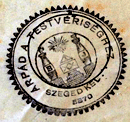
|
STATUT (OSNOVNA PRAVILA) LOŽE ÁRPÁD, ORIJENT SEGEDIN Prevod Statuta segedinske lože Arpad, koji porenosimo u celosti, ima za cilj da posluži kao model jednog slobodnozidarskog statuta sa kraja 19. veka. Svi venčići koji su radili pod patronatom lože Arpad, kao i druge vojvođanske lože kojima je Loža Arpad bila majka-loža, rukovodile su se principima iznetim u segedinskom Statutu. Loža Arpad je svoj prvi Statut izradila 1870. godine, u godini svog osnivanja, i nosi naslov Bratstvo Arpad, slobodnozidarska loža u Orijentu Segedin — Osnovna pravila 1870., Segedin. Sastoji se od dva uvodna dela: "Ciljevi" i "Obaveze", sa ukupno 17 članova, i "Statuta" koji čini zasebnu celinu i nosi naslov "Statut jovanovske lože Bratstvo Arpad u Orijentu Segedin, 1870". Podeljen je u dva dela, a ovi u manje celine. PRVI DEO sadrži članove o: prijemu, preporuci kandidata, proceduri pre prijema i razrešenju i isključenju (ukupno 26 članova) i DRUGI DEO sa članovima koji se odnose na: lože, oficire lože i njihov izbor, starešinu lože, ostale oficire, te pravila rada lože (ukupno 53 člana). Dve godine kasnije, ukazala se potreba da se neki članovi neznatno prerade, a izvestan broj i da se briše zbog ponavljanja izvesnih stavova. Ovaj Statut se smatra "konačnim". Po istim principima iznetim u ovom Statutu radile su lože u Vojvodini do kraja 1918. godine i formiranja Velike Lože Jugoslavija, kao i neke beogradske do 1908., godine razlaza sa Simboličkom Velikom Ložom Mađarske, zbog aneksije Bosne i Hercegovine. |
BASIC RULES OF LODGE ÁRPÁD, ORIENT SZEGED This is a translation of the complete Basic Rules of Lodge Arpad in the Orient of Szeged aiming to serve as a model Masonic Rule Book from the end of the 19th century. All the Daughter-Lodges that worked under the protection of L. Arpad, as well as the other Vojvodina lodges under the aegis of L. Arpad, were guided by the principles embodied in the Szeged Basic Rules. L. Arpad made its first Rule Book in 1870, the year of its establishment titled Brotherhood Arpad, a Masonic Lodge in the Orient of Szeged — "Basic Rules 1870." It consisted of two parts: "Objectives" and "Obligations," with a total of 17 Articles, and the "Statute" that formed a separate whole and bore the title Statute of St. John Lodge Brotherhood Árpád in the Orient of Szeged, 1870, Szeged, in the Orient of Szeged. It was divided into two parts, which contained subordinate parts. PART ONE contained articles on admittance, recommendation of candidates, pre-admitting and dismissal and demit procedures (a total of 26 Articles) and the articles of the SECOND PART were related to the Lodge, Lodge Officers and their election, the Worshipful Master, other Officers, and rules of lodge work (a total of 53 Articles). Two years later, there was a need for some Articles to be slightly modified and a certain number to be deleted due to the repetition of certain standpoints. These Basic Rules were considered "final." Lodges in Vojvodina worked as per the same principles outlined in the Basic Rules until the formation of the Grand Lodge Yugoslavia; some of the Belgrade Lodges followed these Rules until 1908, when they broke up with the Symbolic Grand Lodge of Hungary in protest of the annexation of Bosnia and Herzegovina by Austria-Hungary. |
|
OSNOVNA PRAVILA IZ 1872. GODINE OPŠTA PRAVILA "Iskrena odanost Vrhovnom biću, poštivanje vlasti i zakona, ljubav prema bližnjem, odanost i radinost u zanimanju koje obavljamo, razboritost i dobrotvornost, strpljenje i istrajnost i u patnji, pokornost u sreći — to su duhovni kvaliteti koji se od svih slobodnih zidara očekuju, koji su mera slobodnog zidarstva, te zato od slobodnog zidara tražimo da ima dovoljno snage da podnese teret i napor koji ga čeka, da bude spreman da se, plemenitog srca, odrekne svoje udobnosti i blagodeti, ako to služi na korist njegove ljudske braće." DEO PRVI Opšte odredbe o prijemu Posebne odredbe o prijemu Nakon toga poziva brata majstora predlagača da opovrgne obrazloženja gornje braće te, uz pomoć četiri brata majstora ispituje sva obrazloženja, ne pominjući imena onih koji su balotirali crnim kuglicama. Ako starešina i četiri brata majstora odbijanje prijema smatraju opravdanim, kandidat biva odbijen i starešina o tome obaveštava ložu. Odredbe o istupanju i isključenju iz lože DEO DRUGI O ložama O posebnim sastancima lože braća koja žive u mestu obaveštavaju se listićima, a onima koji su iz drugih mesta šalju se pozivna pisma. Prilikom prijema, sva braća svečano obećavaju da će redovno prisustvovati sastancima. Ako se, međutim, na osnovu knjige prisustva i odsustva, koju vodi nadzornik, ustanovi da određeni brat zanemaruje svoju dužnost u tom smislu, upućuje mu se pismena opomena. Sledeći korak, ako je brat učenik ili pomoćnik, produžava mu se vreme koje provodi na datom stepenu, a ako je majstor, upisuje mu se kazna u zapisnik, a njemu samom se uručuje izvod iz istog. U ozbiljnijim slučajevima, savet majstora može čak razmotriti i isključenje. Po isteku navedenog perioda od šest meseci svaki učenik i pomoćnik može da uputi molbu za uzdizanje. O usvajanju molbe odlučuje majstorski savet većinom glasova. Stručne komisije O svakoj inicijativi koja se javi u loži ili van nje, a nije takva da spada samo u domen rada pomoćničke ili majstorske lože, niti se smatra hitnom, prvo se raspravlja u dotičnoj stručnoj komisiji. Najkasnije za četiri sedmice, donosi se mišljenje sa kojim se izlazi pred učeničku ložu. Svaka stručna komisija bira sebi predsednika i sekretara, sačinjava pravilnik, određuje datume sastanaka, a o svom radu piše izveštaje koje svakih šest meseci iznosi pred učeničku ložu. Savet majstora Oficiri lože — biranje oficira Loža ima pravo da za svaku funkciju izabere i zamenika. Starešina Ostali oficiri Ako, zbog izuzetnih prilika, to izostane, vrši se čitanje i overavanje zapisnika na sastanku koji sledi neposredno nakon toga i ne može se dalje odlagati. Svaki brat ima pravo da da primedbu na sadržaj i formu zapisnika, ali o eventualnim izmenama odlučuje loža. Bez pravilno ispostavljene priznanice rizničara ne može da se obavi ni prijem novaka, ni uzdizanje na viši stepen. Do izuzetka od navedenog pravila dolazi samo onda ako loža potpuno oslobodi nekog od braće plaćanja njegovih obaveza ili mu dozvoli da ih plaća u ratama. U ovom drugom slučaju, rizničar ispostavlja odgovarajuće priznanice i pazi da se rate uplaćuju redovno. Rizničar je dužan da na prvom sastanku učeničke lože u mesecu obavesti ložu o stanju blagajne i fondaciji lože. Na kraju godine dužan je da pripremi završni račun koji će prekontrolisati komisija od tri člana. Pravila i postupci upravljanja ložom. |
BASIC RULES OF 1872 GENERAL RULES "Sincere loyalty to the Supreme Being, respect for the authorities and law, love for fellow human beings, loyalty and diligence in the occupation we do, prudence and charity, patience and perseverance in suffering as well, modesty in happiness - these are the spiritual qualities that all Freemasons are expected to practise. Therefore we ask the Freemason to have enough strength to bear the burden and effort that awaits him, to be ready to light-heartedly renounce his comfort and blessings, if this serves for the benefit of his human Brethren." PART ONE General provisions on admission Special requirements for acceptance After that, he invites the Brother proposer to confute the explanations of the "black balloters," and, with the help of four Master Brethren, he examines all the explanations, not mentioning the names of those who balloted with black balls. If the WM and the four Master Brethren consider the refusal of the acceptance to be justified, the candidate is rejected and the WM informs the Lodge about it. Provisions on resignation and exclusion from the PART TWO About the Lodges Resident Brethren are notified about special meetings of the Lodge by info slip, non-residents by letter of invitation. Upon reception, all Brethren shall promise to attend meetings regularly. However, if, on the basis of the Book of Presence and Absence, kept by the Warden, it can be seen that a particular Brother neglects his duty in this regard, a written warning shall be sent to him. As the next step, if the Brother is an Entered Apprentice or a Fellow Craft his time for being raised to the following degree is extended; if he is a Master, he is penalized, the penalty entered into the records and a copy sent to him. In more serious cases, the Masters' Council may consider exclusion. Upon the expiration of the said six-month period, each Entered Apprentice or Fellow Craft may apply for an upgrade. The acceptance of his request is decided by the Masters' Council by simple majority vote. Lodge Committees Any initiative that appears in or out of the Lodge, not being such as to belong solely to the domain of the Fellow Craft or Master Mason Lodge, nor is it considered urgent, is first discussed within a Lodge Committee. In four weeks the latest, the opinion of the Committee is communicated to the Entered Apprentice Lodge. Each expert Committee chooses itself a president and secretary, compiles their rules, sets dates for meetings, and submits a report to the Entered Apprentice Lodge every six months. Masters' Council Officers of the Lodge — Installation of Officers The Lodge has the right to elect deputies to all the positions. Worshipful Master Other Officers If, due to exceptional circumstances, this is not the case, reading and verifying of the minutes is carried out at the meeting that follows immediately afterwards; this cannot be further delayed. Each Brother has the right to comment on the content and form of the minutes, but it is the Lodge that decides on possible changes. Without a properly issued Treasurer's receipt, neither admission of novices nor raising to a higher degree may be actuated. An exception to this rule comes only if the Lodge completely exempts a Brother from payment of his obligations or consents to instalment payment. In this latter case, the Treasurer issues a corresponding receipt and ensures that the instalments are paid regularly. The Treasurer is obliged, at the first monthly meeting of the Lodge, to inform the Lodge about the situation of the treasury and the existing funds. At the end of the year, he is obliged to prepare an annual report, which will be checked by a three-member commission. Rules and procedures of lodge management |
|
KUĆNI RED LOŽE ARPAD IZ 1881. GODINE … Ovaj Kućni red navodimo iz istog razloga kao i Statut. Segedinska loža Bratstvo Arpad (skr. Arpad), u koju je uneto svetlo 1870. godine, radila je pod zaštitom Simboličke Velike Lože Mađarske. Sve do 21. marta 1910. godine, kada se izdvojilo 12 članova i formiralo Ložu Szeged, Arpad je bila najbrojnija loža, te je kao takva odigrala izuzetno značajnu ulogu na širenju slobodnog zidarstva u Vojvodini. Na osnovu raspoložive dokumentacije zasigurno znamo da su pod njenom zaštitom radili venčići Filantropija (Philanthropia) u Somboru, Košut (Kossuth) u Subotici (kasnije Loža Stvaranje - Alkotás), Nepokolebljivo (Rendületlenül) u Novom Sadu, lože Budućnost (Jövendő) u Somboru (raniji venčić Filantropija), i loža Stella Orientalis u Zemunu (kasnije preseljena u Pančevo), po jedan venčić u Kikindi i Bačkoj Topoli, a verovatno i loža Aurora u Vršcu i venčić u banatskoj Beloj Crkvi. Svi navedeni venčići i lože su svoje kućne redove uredili po ugledu na Kućni red lože Arpad iz 1881. godine, uz zanemarljive razlike, čime su u velikoj meri želeli da naglase zaštitničku ulogu majke-lože. Izvesnih problema bilo je u odnosima sa Stellom Orientalis i vršačkom Aurorom. Obe ove lože su radile na nemačkom jeziku, te je bilo izvesnih nedoumica kod prevođenja sa mađarskog. Pored toga, Stella Orientalis je osnovana u Zemunu, koji je tada bio pod jurisdikcijom austrijskog dela Austrougarske Carevine, pa je to bio razlog preseljenja lože u Pančevo, da bi tako slobodno mogla da radi pod zaštitom lože Arpad odnosno Simboličke Velike Lože Mađarske. U Austriji je slobodno zidarstvo bilo zabranjeno i proganjano sve do kraja prvog svetskog rada, a u mađarskom delu ono doživljava svoje zlatno doba krajem 19. i prvih godina 20. veka. Smatramo da je ovaj Kućni red zanimljiv istorijski dokument, te ga citiramo u celosti: DEO PRVI Članovi lože DEO DRUGI Prava i dužnosti redovnih članova Svaki redovni član ima pravo da nosi svoj amblem, kako u ovoj loži, tako i u drugim ložama. Ima pravo da traži da bude upoznat sa upravljanjem finansijskim sredstvima lože, kao i stanju istih. DEO TREĆI O naknadama DEO ČETVRTI Komisije lože DEO PETI Povećanje nadnice DEO ŠESTI Kućni red Obrazloženje S tim u vezi, komisija je, za svoj cilj, posebno istakla sledeća dva principa: U cilju jednoobraznosti, komisija je smatrala celishodnim da iz postojećih pravila izostavi sve ono što je inače sadržano u konstituciji, te je obratila pažnju samo na ono na šta Konstitucija i sama upućuje u vezi kućnih redova. Međutim, i u tome su se koristili kućni redovi drugih loža, posebno loža Sveti Stefan i Galilej, i odstupila od istih samo u onome što su lokalne prilike učinile neophodnim, što je bio slučaj kod naknada za prijem i uzdizanje, čija visina je, na različite načine, predstavljala problem za našu ložu, odbijajući mnoge valjane i perspektivne članove, koji nam se nisu pridružili samo iz tog razloga. Što se tiče slobode kretanja, komisija je smatrala nepotrebnim da uključi takve odredbe koje bi, u svetlu izmenjenih prilika, delovale samo kao faktor ograničenja. To se odnosi na dane i broj raznih radova, te na mesečnu članarinu, koje su zavisne ne samo od broja članova nego i planiranih aktivnosti lože, pa se utvrđuju za svaku godinu zasebno. U tu problematiku spada i finansijska osnovica lože, čije formiranje i uvećavanje loža želi da zadrži u domenu svog odlučivanja. Nakon svega ovoga, biće razumljivo zašto smo sav naš kućni red saželi u 19 tačaka, te se nadamo da će, uprkos tako malom broju članova, naša loža, kako do sada tako i od sada, sa istom revnošću i disciplinom vršiti slobodnozidarske dužnosti. U Orijentu Segedin, 25. maja 5880. G.I.S. |
THE 1881 HOUSE RULES OF LODGE ARPAD [The 1881 By-Laws of Lodge Arpad] We cite this By-Laws for the same reason as the Statute. The Szeged Lodge Brotherhood Arpad (abbr. Arpad), which illuminated in 1870, operated under the protection of the Symbolic Grand Lodge of Hungary. Until March 21, 1910, when 12 members were separated and formed the Lodge Szeged, Lodge Arpad was the most numerous Lodge in Hungary, and as such played an extremely important role in the expansion of Freemasonry in Vojvodina. Based on the available documentation, we know for sure that the Philanthropia daughter-lodge of Sombor, Kossuth daughter-lodge of Subotica (later the Lodge Creation - Alkotás), the Unwavering (Rendületlenül) daughter-lodge in Novi Sad, the Lodge Future (Jövendő) of Sombor (former daughter-lodge Philanthropia) worked under its protection as well as Stella Orientalis Lodge in Zemun (later moved to Pančevo), one daughter-lodge in Kikinda and one in Bačka Topola, and probably the Aurora Lodge in Vršac and a daughter-lodge in Banat's White Church (Bela Crkva). All the above-mentioned daughter-lodges and lodges arranged their by-laws in a manner similar to the By-Laws of the Arpad Lodge of 1881, with negligible differences, which made them much more eager to emphasize the protective role of the mother-lodge. There were some problems in the relations with Stella Orientalis and Aurora. Both of these lodges worked in German, and there were some doubts about the Hungarian translation. In addition, Stella Orientalis was founded in Zemun, which was then under the jurisdiction of the Austrian part of the Austro-Hungarian Empire, and this was the reason for moving the lodge to Pancevo, so that it could operate freely under the lodge Arpad or the Symbolic Grand Lodge of Hungary. Freemasonry was banned and persecuted in Austria until the end of the first world work, but in the Hungarian part it experienced its golden age in the late 19th and early 20th centuries. We find these By-Laws an interesting historical document and we cite them in their entirety: PART ONE Members of the Lodge PART TWO Rights and obligations of regular members Every regular member has the right to wear his jewel, both in this Lodge and in other lodges. He has the right to seek to be informed about the management of financial assets of the Lodge, as well as on the current financial situation. PART THREE Fees PART FOUR Lodge Committees PART FIVE Wage Increase PART SIX House Rules Explanation In this regard, the Commission particularly emphasized the following two principles: For the sake of uniformity, the Commission considered it desirable to exclude from the existing rules everything that is not contained in the Constitution, and pay attention only to what the Constitution itself refers to in relation to House Rules. However, the House Rules of other lodges, especially L. St. Stephan and Lodge Galilei, were also used, deviating from them only in what the local circumstances made necessary; this was the case with initiation and advancement fees since the corresponding amounts were, in different ways, problematic for our Lodge, rejecting many good and promising members who did not join us for that sole reason. Regarding the freedom of movement, the Commission considered it unnecessary to include such provisions which, in the light of the changed circumstances, would act only as a limiting factor. This refers to the dates and number of various works, and to the monthly membership fee, which depend not only on the number of members but also on the planned activities of the Lodge; therefore, they are determined for each year separately. This issue also includes the financial asset of the Lodge, whose formation and improvement the Lodge wishes to keep within the domain of its own decision-making. After all this, it will be understandable why we have reduced our House Rules to 19 points only, and we hope that, despite such a small number of Articles our Lodge will carry out our Freemasonic duties with the same zealousness and discipline, as it was in the beginning, is now and ever shall be. Made in the Orient Szeged, 25th May 5880 A.L. (Anno Lucis) |
|
GODINE KOJE SU PRETHODILE SOMBORSKOM SLOBODNOM ZIDARSTVU Sredinom 16. veka, za vladavine sultana Sulejmana Veličanstvenog, Sombor, kao sedište nahije, bio je pravi istočnjački grad sa pretežno turskim stanovništvom i pokojom slovenskom porodicom. Čak i 100 godina kasnije, 1665. godine, turski putopisac Evlija Čelebija opisuje Sombor kao tipično turski grad sa 2000 kuća pokrivenih ćeramidom i 14 džamija da bi ubrzo, 1687. godine, na glas o približavanju austrijske vojske, svo tursko stanovništvo napustilo Sombor. Na početku 18. veka, Sombor je gradić sa oko 3000 stanovnika, ali po dobijanju Povelje o statusu slobodnog i kraljevskog grada 17. februara 1749. grad dobija na važnosti i u privrednom i u kulturnom smislu, te 1785. već ima 13.360 stanovnika, mahom Slovena (Srba, Hrvata i Bunjevaca). Prva mađarska porodica doseljava se 1720. godine, a iz Austrije i Nemačke se vrši naseljavanje Nemaca, kao i Mađara i Slovaka krajem veka, a svoj dom u gradu nalazi prvi Jevrejin, Jakov Štajn tek 1789. godine. Do tada, grad nije dozvoljavao Jevrejima da se nasele. Živeli su u obližnjim selima i dozvoljavalo im se samo da preko dana dođu u grad da trguju. 9 godina kasnije u Somboru je 8 jevrejskih porodica. Postoji podatak da se Menahemu Šlezingeru 1794. rodio sin Josif, kasnije kapelnik garde kneza Miloša i kompozitor. Car Jozef II posećuje Sombor 1786. godine i određuje ga za administrativno sedište Bačke županije. Bačka i Bodroška županije su sjedinjene 1802. godine u Bač-bodrošku županiju. Bodroška županija je utemeljena još u 12. veku, a dobila je ime po Bodrogu, starom utvrđenom, sajamskom gradu kojeg su razorili Tatari 1224. godine. Nakon odlaska Turaka sedište Bodroške županije bilo je u Baji, ali se razmišljalo i o Novom Sadu kao sedištu. 1850. godine , u vreme Srpske Vojvodine i Temišvarskog Banata Sombor postaje sedište vrhovnog župana za Bački, Torontalski i Vršački okrug. Još u 18. veku u Somboru se otvaraju obrazovne institucije, osnova kasnije prosvetno-pedagoške slave grada: Srpska trivijalna osnovna škola (1717), Katolička osnovna škola (1722), Gramatikalna (latinska) škola (1759., od 1763. Gradska gramatikalna škola), Srpska osnovna škola "Norma" sa obrazovanjem učitelja (1778). Iste godine Sombor postaje sedište vrhovnog direktorata svih srpskih škola u Bačkoj, Baranjskoj i Tolnaškoj županiji. U 19. veku otvaraju se nove škole. 1812. godine u Sentandreji počinje da radi Preparandija (srpska učiteljska škola), koja se 1816. godine seli u Sombor, 1853. godine otvara se Niža nemačka realna gimnazija, a 1869. godine Niža realna gimnazija na srpskom i mađarskom jeziku, 1872. se otvara Viša mađarska gimnazija (preteča sadašnje gimnazije "Veljko Petrović"). 1875. godine počinje sa radom Srpska viša devojačka škola, a 1888. Trgovačka škola (sadašnja Ekonomska škola). |
THE YEARS THAT PRECEDED THE BIRTH OF FREEMASONRY IN SOMBOR In the mid-16th century, during the reign of Sultan Suleyman the Magnificent, Sombor, as the seat of a nachiye, was a true oriental city with predominantly Turkish population and quite a few Slavic families. Even 100 years later, in 1665, Turkish travel writer Evliya Çelebi described Sombor as a typical Turkish city with 2000 houses covered with Roman roof tiles and 14 mosques. However, quite soon, after 1687, when the Austrian army was approaching, the whole of the Turkish population left the city. At the beginning of the 18th century, Sombor was a town with about 3,000 inhabitants, but after receiving the Charter of Free and Royal city on 17th February 1749, the city gained importance both in economic and cultural terms, and in 1785 it already had 13,360 inhabitants, mostly of Slavic origin: Serbs, Croats and Bunjevci. The first Hungarian family settled in 1725, and from Austria and Germany, a large number of Germans, as well as Hungarians and Slovaks, settled in and around the city throughout the 18th century. By the end of the century, the first Jewish permanent resident of Sombor was Jacob Stein, who bought a house there in 1789. Until then, the city did not allow Jews to settle. They lived in the nearby villages, were allowed to pursue their businesses through the day and had to leave the city before dark. By the end of the 1790s, there were 8 more Jewish families in Sombor. Documents say that Menachem Schlesinger was born in Sombor in 1794 to father Joseph, becoming later a composer and Kapellmeister at the court of Prince Miloš of Serbia. Emperor Joseph II visited Sombor in 1786 and set it up for the administrative seat of the County of Bacs. Bacs and Bodrog Counties were united in 1802 in Bacs-Bodrog County. The Bodrog County was founded in the 12th century, and it was named after Bodrog, an old fortified town near present-day Sombor. It was destroyed by the Tatars in 1224. After the departure of the Turks, the seat of the Bodrog County was in Baja, although Novi Sad was also one of the candidates. In 1850, at the time of the Voivodeship of Serbia and Banat of Timisoara, Sombor became the seat of the Supreme Prefect of the Counties of Bacs-Bodrog, Torontal and Versecz. As early as in the 18th century prominent educational institutions were founded in Sombor thus creating the basis of the educational and pedagogical fame of the city: the Serbian trivial elementary school (1717), the Catholic elementary school (1722), the Latin grammar school (1759, i.e. the City Grammar School from 1763), The Serbian elementary school "Norma" with a teacher training department (1778). In the same year, Sombor became the headquarters of the Supreme Directorate of all Serbian schools in Bacska, Baranya and Tolna Counties. In the 19th century, new schools were opened. In the town of Szentendre, the "Preparandija" (the Serbian Teacher Training School) was opened in 1812; 4 years later, in 1816, it moved to Sombor. In 1853 The Lower German Real Gymnasium was opened, and in 1869, the Lower Real Gymnasium in the Serbian and Hungarian languages. In 1872 the Higher Hungarian Grammar School, the predecessor of the current Grammar School "Veljko Petrović" was founded. In 1875, the Serbian Higher Girls' School started working as well as the Trade School (current School of Economics) in 1888. |
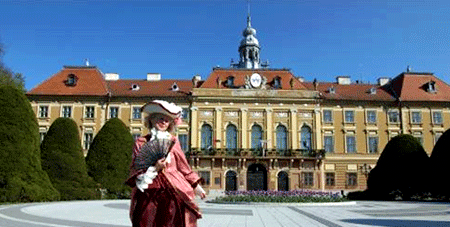
The Prefecture Building in Sombor (photo by the author)
Županijska zgrada u Somboru (fotografija autora)
|
Kao sedište Bač-bodroške županije, koja je bila jedna od najvećih u Mađarskoj, gde su pripadali i Novi Sad, Subotica, Baja i Senta, Sombor se naglo razvijao. Podizane su velelepne zgrade i crkve (Zgrada županije, 1808., Gradska kuća — sedište Magistrata, 1842., Zgrada Somborske štedionice (sada Gradska biblioteka), 1877., Narodno pozorište 1882., Srpska čitaonica, 1882., Preparandija, zadužbina Georgiija Brankovića 1895., Crkva Sv. Stjepana (Karmelićanska crkva sa dva tornja). Još od prethodnog, 18. veka grad krase pravoslavne crkve Sv. Đorđa (1761) i Sv. Jovana Preteče (1790), kao i katolička crkva Presvetog Trojstva (1762), Grašalkovićeva palata (1763), koja je u početku služila za karantin nemačkom doseljeničkom stanovništvu, Pašina kula (1541) i Krušperova kuća — Gradski arhiv (1771). |
Sombor was the seat of Bacs-Bodrog County, one of the largest Counties in Hungary, incorporating the cities of Novi Sad, Subotica, Baja and Senta. Magnificent buildings and churches were erected in the 18th and 19th centuries: the Prefecture Building in 1808, the Town Hall, which housed the Magistrate in 1842, the building of the Sombor Savings Bank (currently the City Library) in 1877, the National Theater in 1882, the Serbian Reading Room in 1882, the "Preparandija," endowment of Georgije Branković in 1895, the St. Stephen Church (Carmelite Twin-Towered Church). Since the 18th century, the city has been adorned with Orthodox churches of St. George (1761) and St. John the Forerunner (1790), as well as the Catholic Church of the Holy Trinity (1762) , Grassalkovics Palace (1763), which initially served as a quarantine building for the German immigrant population, Pasha's Tower (1541) and Krusper House - the City Archives (1771). |
|
CEHOVSKI PRAVILNICI IZ GODINA 1819 I 1828. Slobodno zidarstvo, iako suštinski drukčije po ciljevima i načinu delanja od operativnog, ima bezbroj dodirnih tačaka sa njim. Filozofija slobodnog zidarstva otelotvoruje se kroz bogatu simboliku poreklom od graditeljskog znanja i predanog sticanja manuelnih veština. Da bi operativni zanatlija, pogotovo zidar, koji radi timski, izuzetno otpornim i trajnim materijalom, stvarao dela koja će prkositi razornoj snazi vremena, postalo je neophodno da se udružuje i svoj rad reguliše strogim pravilima.
Pečat gradskog Urbara Zidari, graditelji i arhitekte velelepnih zdanja kojima se divimo i dičimo, bili su oni koji su, prirodom svog posla, i odredbama pravilnika svog ceha, donosili i pronosili i znanja i filozofiju ne samo materijalnog, već i duhovnog graditeljstva i davali duhovni dom onima koji sami nisu bili graditelji, ali su se zanosili simbolikom graditeljstva. Stoga smo smatrali neophodnim da kažemo nekoliko reči o prvom cehovskom organizovanju u Somboru jer, iako u nedostatku čvrstih materijalnih dokaza, oslanjajući se na predanja i porodična sećanja bledela tokom generacija, prva saznanja o slobodnom zidarstvu u Sombor behu donele zanatlije, kao i oficiri koji su se borili po evropskim ratištima. Detaljnije se bavimo zanatlijama jer su, povratkom u rodni grad sa šegrtovanja u dalekim krajevima ovde i ostajali, zasnivali porodice i širili znanja i ideje stečene u tuđini. Oni sami, prvenstveno zbog društvenog staleža kojem su pripadali, u to su vreme retko primani u kontemplativne lože, ali su moralna i duhovna pravila zapisana u cehovskim pravilnicima itekako imala uticaja, čak i neposrednog, na moralne norme slobodnih zidara. U 19. veku, naročito njegovim krajem, znatan broj slobodnih zidara odrastao je u zanatskim porodicama. Intenzivnim, planskim naseljavanjem Nemaca i Austrijanaca u toku vladavine Karla VI, njegove kćeri Marije Terezije i njenog sina Jozefa II, iz Baden-Virtemberga u županije Bač i Bodrog stiglo je 3500, mahom zanatskih, porodica. Za vreme Jozefa II u Sombor se naseljavaju 63 zanatlije, koje su radile u 34 različita zanata. Iako je bilo raznih cehova, 1819. postojao je ceh koji je okupljao graditelje, tesare i bačvare. Cehovska pravila su pisana na nemačkom jeziku, sa uvodom i zaključnim odredbama na latinskom. Cehovski pravilnik kjoji se primenjuivao u Bačbodroškoj županiji je, 27. septembra 1819., odobrio Franc I od Austrije, kao i "novi" od 49 tačaka, od 27. marta 1828. koji je u potpunosti napisan na nemačkom jeziku. Zbog obima ove knjige, nismo u mogućnosti da vršimo detaljno poređenje sa slobodnozidarskim pravilnicima, tako da ćemo istaći nekoliko sličnosti, a čitaocu prepuštamo da odredi koji pravilnik je uticao na onaj drugi. Članovi 1-9 Cehovskog pravilnika odnose se na izbor učenika koji može da bude bilo koje, zakonski priznate, vere, ali ako želi da nauči zanat, treba da bude neokaljane ličnosti, neko za njega mora da garantuje, mora o tome podneti pisani dokaz, mora da se povinuje strogim pravilima i svojim ponašanjem da služi na primer drugima i da na pravi način predstavlja struku kojom je odlučio da se bavi. Nije mu dopušteno da bez saglasnosti majstora išta poduzima. Za sve prekršaje sledi kazna, koja se izriče u novcu koji treba da uplati u cehovsku kasu. Članovi 10-20 regulišu detalje profesionalnog i ličnog života kalfe. Obaveza ovog stepena je da najmanje tri pune godine provede u putovanju po svetu učeći zahvate zanata i stičući "razna znanja za to vreme". Sa sobom mora da nosi pisane dokaze o svojim ljudskim i profesionalnim kvalitetima, a majstora kod koga se zaposli ne sme da napusti pre isteka 6 meseci, što znači da, pre no što i sam postane majstor, mora da uči od ukupno 7 majstora. Članovi 21-28 su opšte odredbe o majstorima. Da bi kalfa postao majstor, potrebno je da izradi svoje tzv. "remek-delo". Mesto nije određeno, dakle nije u obavezi da svoj rad izradi u mestu gde je učio zanat, a jednom stečeno majstorsko pismo priznaje mu se i u drugim mestima. Članovi 29-35 odnose se na obaveze majstora. Najvažnijom osobinom smatra se pobožnost, a najvažnije obaveze proizilaze iz vere. Majstor je dužan da svojim primerom i prilozima verskoj instituciji kojoj pripada daje primer svojoj okolini i doprinosi ostvarenju visokog morala društva u kojem živi. Članovi 36-49 uređuju posebne slučajeve. U slučaju smrti majstora, svi članovi ceha su obavezni da prisustvuju sahrani i pomognu porodici preminulog. Po smrti svog muža-majstora, supruga nasleđuje sva cehovska prava. 1833. godine, na čelu Ceha graditelja bio je Franc Gfeler (Franz Gfeller, cives selectus - ugledni građanin), graditelj Gradske kuće u Somboru, koji je za građanina Sombora primljen 1807. godine. Rečene 1833. godine, 19. marta je preminuo, a po njegovoj smrti na čelu Ceha nasleđuje ga njegova udovica Ana Gfeller-Hameder. Majstori su obavezni da se sastaju kvartalno, kada se raspravlja o unapred utvrđenim pitanjima. Majstori koji ne stanuju u Somboru, mogu da prisustvuju samo jednom sastanku godišnje, kada izmiruju svoje godišnje obaveze prema Cehu, a oni koji stanuju na većoj daljini od jednog sata putovanja, nisu obavezni da se lično pojavljuju. Glavni majstor ceha i njegov zamenik biraju se uvek istog datuma na period od godinu dana, a na istom sastanku podnosi se finansijski izveštaj. Korespondencija sa drugim cehovima, koja se tiče svih članova, vodi se na takav način da je sadržaj poznat svima. Skoro svaki član završava se ili spominje sankcije u slučaju neizvršavanja obaveza. |
THE GUILD RULES OF 1819 AND 1828 Freemasonry, although fundamentally different from operational masonry, both in its goals and operational model, has countless touch points with it. The philosophy of Freemasonry is embodied in rich symbolism originating from the science of construction and devotion to practising manual skills. In order for the operative craftsman, especially the stonemason, to work in a team with extremely resistant and durable material to create edifices that will defy the destructive power of time, it has become necessary to unite and regulate work with strict rules.
Seal of the City's Urbarium The stonemasons, builders and architects of the magnificent buildings we admire and boast of were those who, by nature of their work and the rules of their guild, brought and passed both the knowledge and the philosophy of not only the material but also the spirit of building construction, offering a spiritual home to those who were not builders themselves but became enthused over the symbolism of construction. Therefore, we considered it necessary to say a few words about the organization of the first guilds in Sombor because, in the absence of solid material evidence, relying on tradition and family memories faded through generations, the essential knowledge about Freemasonry in Sombor may be connected to the craftsmen and their guild rules, as well as officers who returned home from the many European battlegrounds. We are more focused on craftsmen and journeymen because, on returning to their hometown from practising their trade in faraway lands, they stayed, founded families, and spread knowledge and ideas acquired in foreign countries. They themselves, primarily due to the social class they belonged to, were rarely received into contemplative lodges at that time, but the morals and spiritual side of guild rules had indeed had an impact, even a direct one, on the moral standards of Freemasons. In the 19th century, especially by its end, a considerable number of Freemasons grew up in the families of craftsmen. The planned, intensive resettlement of Germans and Austrians during the reign of Charles VI Holy Roman Emperor, his daughter Maria Theresa and her son Joseph II, 3500 families, mostly of craftsmen, were resettled from Baden-Württemberg to the counties of Bacs and Bodrog. During the reign of Joseph II, 63 craftsmen settled in Sombor, who worked in 34 different crafts. Although there existed various guilds, one of these gathered builders, carpenters and coopers under the same roof. Guild rules were written in German, with the introductory and concluding provisions in Latin. The Guild Rules that were in use in Bacs-Bodrog County were approved by Franz I of Austria on 27th September 1819, and a subsequent, "new" one, comprising 49 Articles (all in German) came into force on 27th March 1828. Due to the purpose of this book to inform but avoid analyses, we shall not do a detailed comparison between guild rules and Freemasonic regulations, but point out a few similarities and let the reader decide on their relationship. Articles 1-9 of the Guild Rules refer to the choice of apprentice, who can be of any legally recognized religion. However, if he wishes to learn a craft, he shall be of an immaculate character, someone has to guarantee for him and a written proof must be submitted. He must comply with strict rules and his conduct must be exemplary to represent the profession which he has chosen to enter. He is not allowed to do anything without the consent of his master. For all offences, a penalty is imposed, which is pronounced in money and has to be paid for the benefit of the guild treasury. Articles 10-20 regulate the details of the professional and personal life of the journeyman. Anyone at this level is obliged to spend at least three full years on a journey around the world to study the craftsmanship and acquire "different types of knowledge and skills during the time." He must carry with him a written evidence of his human and professional qualities, and he must not leave his master before the expiration of 6 months, which means that he must learn from a total of 7 masters before he himself becomes a master. If a journeyman deserves it, via his devoted work and behaviour, the master as well as his guild, are obliged to issue to the journeyman, without charge, a Letter of Release describing all his virtues. Apart from his service with the masters of the craft he is practising, the journeyman may, upon presenting documents and references from his former master craftsmen, seek service with a noble person. How focused on work the life of the journeyman had to be and how socially acceptable his conduct was expected to be may be seen from the following sentence from Article 16: Articles 21-28 are general provisions on master craftsmen. In order for a journeyman to become a master craftsman, he is required to make his so-called "masterpiece." The place is not designated, i.e. he is not obliged to perform work in the place where he learned the craft; his master craftsman diploma is also recognized in other places. The supervision and evaluation of the work are performed by the guild that the journeyman reported his masterpiece to; the guild is also obliged, if the journeyman lacks his own resources, to provide him with all the material and conditions for the creation of his masterpiece. The new master craftsman has to pay a certain amount for the benefit of the guild treasury immediately upon gaining his title, although he is forbidden to give lunch or dinner for the members of the guild. Sons of craftsmen have no privileges in relation to other apprentices and have to pass the same path as others to gain the title of master craftsman. Articles 29-35 relate to the obligations of the master craftsman. The most important quality is devoutness, and the most important obligations come from faith. The Master is obliged, by his example and contributions to the religious institution that he belongs to, to be a role model of his community and contribute to the realization of high moral standards of the society in which he lives. The master craftsman is also obliged to take care of his family and apprentices and journeymen who learn and work with him. It is forbidden for him to lure journeymen from other masters, for personal gain. Both the master and the journeyman are forbidden to underestimate the work of other masters. All masters are the same as human beings and as members of the guild, and no one has the right to limit them in performing all the bits of their profession. Both domestic and foreign master craftsmen have the same rights and are equal in performing their profession and the sales of their products. In case of illness, the master craftsman's guild maintains his craft in such a way that all the other masters of his craft lease, for 8 days each, one of their apprentices until the sick master recovers. Articles 36-49 regulate special cases. In case of death of the master craftsman, all the members of the guild are obliged to attend the funeral and help the family of the deceased. After the death of her husband, the wife inherits all the guild rights. In 1833, the head of the Builders' Guild in Sombor was Franz Gfeller (cives selectus — a prominent citizen), the builder of the Town Hall of Sombor, who was accepted as a citizen of Sombor in 1807. In the said year of 1833, on 19th March, he died; following his death his widow Ana Gfeller neé Hameder inherited his position as the head of the Guild. Masters were obliged to meet quarterly when they discussed pre-determined issues. Masters who did not reside in Sombor were given the option to attend only one meeting a year when they settled their annual obligations towards the Guild; those who lived further away than one hour of travel were not obliged to appear personally. The head of the guild and his deputy were always elected on the same date for a period of one year, and a financial report was submitted at the same meeting. Correspondence with other guilds, which concerned all the members, was conducted in such a way that the content was familiar to all the members. Almost every Article ends with sanctions, or mentions them, in case of non-fulfilment of obligations. |
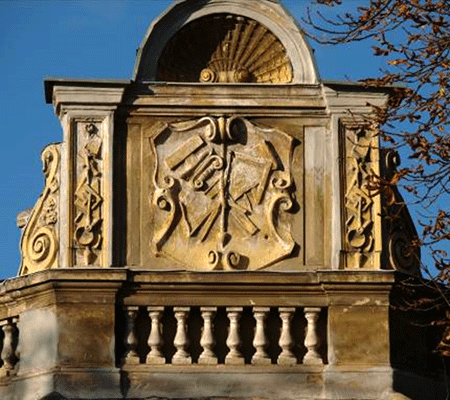
Decorative element of the house of Ullrich Wenzel in Sombor (photo by the author)
Dekorativni element na kuci Ulriha Vencela u Somboru (fotografija autora)
|
PRIČE I SAZNANJA Nezvanični počeci slobodnog zidarstva u Somboru, kao i u Vojvodini i Beogradu sežu u daleke godine 18. i 19. veka. Iako nema pouzdanih podataka, zna se, iz priča dalekih potomaka, oskudnih nagoveštaja u arhivskim dokumentima i materijalnim ostacima slobodnozidarskog simbolizma, da su Somborci, pogotovo graditelji znamenitih zgrada po kojima je Sombor prepoznatljiv (Franz i Karl Gfeller, Bauer i dr.), kao i ljudi od pera i nauke, bili članovi evropskih loža. O njima ima izuzetno malo podataka, pogotovo ako su živeli i radili u periodu nakon misteriozne smrti austrijskog cara i slobodnog zidara Leopolda Drugog, sina Marije Terezije, 1795. godine i revolucije 1848. godine kada je, podržan papskim ediktima, slobodno zidarstvo u Austriji, a i Mađarskoj, zemlji sa zasebnim parlamentom, ali zajedničkom krunisanom glavom, bilo zabranjeno. Oni, kojima je zapalo da svoje zrele i slobodnozidarske godine prožive u prvoj polovini 19. veka, morali su da kriju svoju pripadnost. Trag svojih opredeljenja su ostavljali diskretno, na zdanjima koja su podizali ili na svojim nadgrobnim spomenicima. Znanje o njima prenosilo se strogo u okviru porodice, sa kolena na koleno. U austrijskom delu zabrana će trajati sve do 1918. godine, ali slobodno zidarstvo u mađarskom delu carstva doživljava procvat nakon 1867. godine, te se unosi svetlo u mnoge lože širom Vojvodine pod pokroviteljstvom Simboličke Velike Lože Mađarske. Povelja Marije Terezije iz 1749., sjedinjenje dve županije u Bač-bodrošku i određivanje Sombora za sedište 1802. godine, kao i bogata obrazovna tradicija, činile su da se Sombor razvija i ekonomski i prednjači u mnogim privrednim i kulturnim aktivnostima, što je u grad privlačilo više stanovnika raznih profila u toku 19. veka, posebno sredinom veka. 1851. Sombor ima 22.886 stanovnika), prevazilazi po broju stanovnika takve gradove kao što su Beograd, Zagreb, Ljubljana, Novi Sad ili Osijek. Znatno više stanovnika imala je samo Subotica, koja tada ipak nije raspolagala takvom kulturnom moći kao Sombor. Još 1766. otvara se prva apoteka, pošumljava se, hrastom, preko 900 jutara gradskog zemljišta u okolini Sombora, 1789. počinje sa radom prva pošta, prokopava se Veliki Bački kanal, čime se dobija nova saobraćajnica i umnogome rešava pitanje podzemnih voda, osnivaju se biblioteke, 1817., 1859., i čitaonice 1844. i 1845., ulično osvetljenje od 1828. (uljano, pa gasno, a električno 1905.), prva tekstilna radionica u Vojvodini na parni pogon, 1840., prva štamparija 1850., štampaju se listovi na mađarskom i srpskom jeziku (Ipar - Privreda, Školski list, Prijatelj srbske mladeži, Bácska, Golub, Zdravlje, Zombor és vidéke — Sombor i okolina). Slobodno zidarstvo je u Sombor prispelo iz Segedina. Da bismo bolje razumeli kako je do toga došlo, spomenućemo u nekoliko reči zbivanja 1848-49 godine koja su počela u Beču 13. marta 1848. godine podizanjem barikada, te se ubrzo nezadovoljstvo naroda prenelo u Peštu. Vest o bečkim i peštanskim barikadama putovala je do Sombora 7 dana i stigla usred zasedanja Magistrata. Nakon ukidanja Srpske Vojvodine 1860. godine i Nagodbe između Austrije i Mađarske 1867, slobodno zidarstvo dobija zamah o kojem je već bilo reči. Izvestan broj Somboraca postaju članovi loža pod zaštitom Jovanovske Velike Lože Mađarske (od 1886. godine Simbolička Velika Loža Mađarske) i Velikog Orijenta Mađarske jer ih je posao naneo u druge krajeve. Bili su to uglavnom inženjeri, lekari ili nastavnici koji su svoje službovanje započeli van Sombora, uglavnom u Segedinu i Budimpešti, ali i u drugim gradovima. Bili su rasuti po gradovima Mađarske, pa sve do početka 1890-ih godina nije moglo da bude reči o organizovanom slobodnom zidarstvu u Somboru. |
STORIES AND FINDINGS The unofficial beginnings of Freemasonry in Sombor, as well as in Vojvodina and Belgrade, date back to the distant years of the 18th and 19th centuries. Although there are no reliable data, it is known from descendants' stories, scarce indications in archival documents and material remains of Freemasonic symbolism, that Somborians, especially the builders of the great edifices for which Sombor is so recognizable (Franz and Karl Gfeller, Bauer et al.) as well as men of letters and science, were members of European Masonic lodges. There is very little information about them, especially if they lived and worked in the period after the mysterious death of the Holy Roman Emperor and Freemason Leopold II, son of Maria Theresa, in 1792, and the Revolution of 1848 when, supported by papal edicts, Freemasonry in Austria and Hungary, a country with a separate parliament, but a joint crowned head, was banned. Those who happened to spend their mature and Freemasonic years in the first half of the 19th century had to keep their affiliation secret. They left the trail of their commitment discreetly, on buildings that they erected and on tombstones. Knowledge about them was passed on strictly within the family, from generation to generation. In the Austrian part, the ban lasted until 1918, but Freemasonry experienced a boom in the Hungarian part of the Empire after 1867, and the light was brought into many Lodges throughout Vojvodina under the aegis of the Symbolic Grand Lodge of Hungary. Maria Theresa's Charter of Free and Royal City that Sombor received in 1749, the unification of the two counties into Bacs-Bodrog County and the nomination of Sombor for the seat in 1802, as well as the rich educational tradition, made Sombor into a bustling city and a cultural leader in the region, thus attracting more residents of various profiles during the 19th century, especially in the middle of the century. In 1851 Sombor was a city of 22.886 inhabitants exceeding the number of inhabitants of such cities as Belgrade, Zagreb, Ljubljana, Novi Sad or Osijek. Subotica was the only city with significantly more inhabitants at the time, but it lacked the cultural power of Sombor. From as early as 1766, the first pharmacy was opened, more than 900 acres of urban land in the vicinity of Sombor was afforested, mainly with oak trees, in 1789 the first postal service started, the Great Bacska Canal was excavated (1793-1802), thus creating a new waterway and solving the issue of ground waters. Libraries were established in 1817 and 1859, as well as reading rooms in 1844 and 1845; street lighting arrived in 1828 (oil, gas, and electric in 1905), the first steam-driven textile workshop in Vojvodina started in 1840, the first printing press in 1850; newspapers in the Hungarian and Serbian languages were printed: Ipar (economy) Školski list (school leaflet), Prijatelji srpske omladine (friends of Serbian youth), Bácska, Golub (pigeon), Zdravlje (health), Zombor és vidéke (Sombor and its surroundings). In 1868, the first bank, the Sombor Savings Bank, started working, and in 1869 a railway track was laid to connect the Pannonian Plain with the Adriatic Sea passing through Sombor. In 1883, the Historical Society of Bacs-Bodrog County was founded, and in 1891 turning of Sombor into a leafy city began with planting thousands of hackberry trees; today the city is also known under the name Zelengrad (green city). In 1899, the Free Lyceum Society was founded by the Freemasons of Sombor, who also took a significant part in its work. It should be mentioned that in 1908, the first cinema began showing films. Freemasonry arrived in Sombor from Szeged. In order to better understand how this happened, we will mention, in a few words, the events of 1848-49, which began in Vienna on 13th March 1848, by raising barricades by the people dissatisfied with the absolutist rule. Soon the dissatisfaction of the people spilt over to Budapest. The news of the Viennese and Pest barricades travelled to Sombor for 7 days and arrived in the middle of the session of the Magistrate. The people there were living in peace and understanding and did not receive the news with too much concern, and so it was in the weeks that followed. After the abolition of the Voivodeship of Serbia and Banat of Temesvar in 1860 and the Austro-Hungarian Compromise of 1867, Freemasonry gained new momentum. A certain number of Somborians became members of the Lodges under the protection of the St. John Grand Lodge (Jánosrendi Nagypáholy), later Symbolic Grand Lodge of Hungary (upon its foundation) and the Grand Orient of Hungary due to the fact that they studied and worked in big European cities, mainly in Szeged, Budapest, Vienna or Zurich. Most of them were engineers, doctors, teachers or professors who did their service outside Sombor. They were scattered throughout the cities of Hungary, and until the beginning of the 1890s, there was no mention of Freemasonry in Sombor. |
|
PRILIKE U SOMBORU KRAJEM XIX VEKA Otvaranje novih škola, višeg stepena nego ranije, ekspanzija kulturnih institucija i društava, jačanje infrastrukture i povezivanje grada, železnicom i vodotokovima, sa ostalim delovima regiona i sveta, dolazak intelektualaca iz drugih sredina, oživljava ne samo svakodnevni život i kulturu grada, već utiče na brže uključivanje Sombora u sveopšti razvoj privrede i kapitalističkog načina privređivanja, a time i menjanja načina razmišljanja. Sombor se, naročito u zadnje dve dekade 19. veka, iz agrarno-urbane sredine pretvara u kulturno-urbanu. Za pojavu slobodnog zidarstva u Somboru izuzetno je značajna deonica železničke pruge Segedin-Sombor (Alföld-Adria) 1869-70. Time se Sombor, kao sedište županije, tešnje povezuje sa Budimpeštom i drugim gradskim centrima ka severu. Nažalost, nisu ovu privrednu ekspanziju i povezivanje sa glavnim gradom svi narodi u Somboru doživeli na isti način. Do 1876. zvanični jezik u Somboru, sudeći po zapisnicima sa sednica Magistrata, bio je srpski, ali su Mađari, kao manjinski, bili vladajući narod. Većinski srpski narod nije mogao ravnodušno da primi promenu, te u novoosnovanu Gimnaziju i kasnije Višu trgovačku školu (od 1888.) retko su upisivali svoju decu, što nije donelo mnogo dobra. Ono što je u Somboru ipak važilo kao pravilo, bila je izuzetna nacionalna i verska tolerancija u svim istorijskim vremenima. Somborci su oduvek bili mudriji i hladnije glave nego veliki upravljači teritorijom i regijom u kojoj se grad nalazi te, sem početnog gunđanja, "vođenja svakodnevnog života na svoj način", i relativno brzog prihvatanja novog statusa, nikad nije dolazilo do nacionalnih ili verskih sukoba. Po verskoj pripadnosti, međutim, katolici su bili u većini, jer je, pored slovenskog stanovništa (Bunjevaca, Hrvata, Slovaka) katoličke vere bilo i Mađara, kao i znatan broj Nemaca doseljenih još u 18. veku. Mađari su inače u svojoj državi činili manjinu (41,6%) i pred prvi svetski rat, pa im se to, pored zanemarivanja raznih potreba drugih naroda, strahovito osvetilo. Trijanonskim sporazumom 4. juna 1920. godine, na kojem su odluku donosile velike sile, kao što je to bivalo i pre i posle toga, lišeni su dve trećine svoje teritorije, uključujući i one delove gde jesu predstavljali većinu, kao i svoj bivši glavni grad i sedište državne skupštine i svoju evropsku prapostojbinu. |
SOMBOR BY THE END OF THE 19th CENTURY The opening of new, higher degree schools, the expansion of cultural institutions and societies, the improvement of infrastructure and the connection of the city, via railway and waterways, with the other parts of the region and the world, the arrival of intellectuals from other regions, revived not only the daily life and culture of the city, but also facilitated faster integration of Sombor into the overall development of the economy and the capitalist mode of production, thus changing the way of life and thinking. Sombor was transforming from an agrarian-urban environment into a cultural-urban one, especially in the last two decades of the 19th century. The Szeged-Sombor reach of the Alföld-Adria railway line, built in 1869-70, was of special importance for the emergence of Freemasonry in Sombor. Sombor, as a seat of Bacs-Bodrog County, was now connected with Budapest and other urban centres in the north. Unfortunately, different nationalities in Sombor had a different view of that economic expansion and connection with the capital city. As per the minutes of the meetings of the Magistrate, the official language in Sombor was Serbian until 1876. Now, the Hungarian minority became the ruling nation. Although Orthodox Serbs were the majority population, Catholics were more numerous since, besides the Catholic Slavic population (Bunjevci, Croats and Slovaks) there were Hungarians, as well as a considerable number of Germans who had settled in the 18th century. Surprisingly, Hungarians constituted a minority in their own country (41.6%) even before the First World War which, in addition to neglecting the needs of other nations, backfired after WW1 at the Trianon Treaty signed on 4th June 1920, in which decisions were made by the "great powers," like it has been happening ever since. Hungary was then deprived of two-thirds of its territory, including those parts where they did constitute the majority — they were stripped off even of Pozsony, their former capital city and seat of the National Assembly as well as their ancient European homeland. |
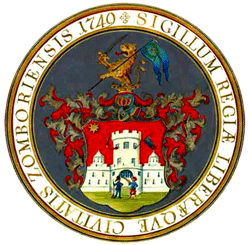
Coat of Arms of the City of Sombor (photo by the author)
Grb geada Sombora (fotografija autora)
|
ZAPISI O DOGAĐAJIMA U SOMBORU 1867-1897 O događajima u Somboru, najviše je pisao novinar i publicista Milenko Beljanski — Pipac (1923-1996). Objavio ih je u pet knjiga svojih Letopisa Sombora, zahvatajući ogroman period između 1360. i 1914. godine, sortiranih po godinama dešavanja. Delo jeste impozantno ali je i on, kao i mnogi koji su se okušali u prezentovanju istorijskih događaja, podlegao političkoj klimi svog vremena, pa su neki podaci proizvoljno tumačeni, verovatno usled nedostatka adekvatnih dokumenata. Godine 1867-1877. Do 1867. godine stanje u županiji bilo je očajno. Privreda praktično nije ni postojala jer se o infrastrukturi nije vodilo računa. Zemljani putevi su se u kišnom periodu toliko razlokali da su naselja praktično bila odsečena jedna od drugih. Nasipi, kako duž Dunava, tako i kanala, bili su u jadnom stanju. Županijska kasa je bila prazna jer skoro sve što se ubiralo prekop poreza odlazilo je u carsku kasu. Čak je i fond namenjen sirotištima preuzeo Beč. Trebalo je skoro 4 decenije da se finansijske prilike u županiji u potpunosti urede. 1868. Magistrat donosi nekoliko važnih odluka u cilju da se započne sređivanje zatečenog stanja, prvenstveno da se urede finansije u pravcu domaćinskog poslovanja i vođenja knjiga. Između ostalog, odlučeno je, a iste godine i sprovedeno, regulisanje toka rečice Mostonge koja je redovno plavila velika područja, kao i da se započne sa izgradnjom puteva. Kako to redovno biva, pojavila se najgora varijanta rešavanja problema — dilema, tj. određivanje prioriteta između samo dve date opcije — da li da se prvo gradi put Novi Sad-Segedin ili Apatin-Segedin. Pobedila je prva varijanta, ali su meseci nestali u svađi. Obrazovanje je takođe bilo u nezavidnom položaju usled nedostatka sredstava. 1870. Bač-bodrošku županiju je zadesila poplava. Najviše su stradala mesta duž Tise (Stari Bečej, Mol i Petrovo Selo), ali su štete morale da se saniraju iz županijske kase, koja se čak u dva navrata morala zadužiti. Do te godine, međutim, uspelo se u svođenju kriminala na najmanju meru. 1871. Županija, posle dve godine, dobija Velikog župana u liku Karla Martonfija (Mártonffy Károly). Uspostavlja se županijska vlast sastavljena od činovnika srpske, mađarske i bunjevačke nacionalnosti. 1872. U proleće, Dunav plavi 200.000 jutara oranice, pa se formiraju 4 komisije za rešavanje problema poplava. Videvši sizifovski posao koji županija obavlja u tom smislu, vlada konačno, sledeće godine, odlučuje da županiji uputi pomoć. 1873. Šajkaški reon vraća se u okrilje Bač-bodroške županije. Svečani govor na srpskom jeziku drži Petar Stojković. Krajem leta kolera devastira stanovništvo županije. Stanovništvo, "bežeći" od kolere iz jednog mesta u drugo, potpomognuto dezorganizacijom medicinske službe, samo je prenosilo bolest. 1874. godine započinje nagli razvoj obrazovanja. U već postojećim školama, broj prosvetnih radnika raste sa 132 na 156, a obaveznim obrazovanjem zahvaćeno je 18% stanovništva (u županiji Pešta-Piliš-Šolt je to bilo 16%). 1876. Dunav ponovo plavi probijajući nasip kod Bogojeva. U odbrani učestvuju svi muškarci od dožupana, preko inženjera do radnika i seljaka. Županija te i sledeće godine sanira štetu. Godine 1877-1881. Sveopšta karakteristika zadnje tridesettri godine 19. veka u Somboru je razvijanje zanatstva i proizvodnih snaga, a sa tim u vezi, postepeni prelazak na kapitalistički način proizvodnje i uređivanje društvenih odnosa, kao i pojava radničke klase. Grad se urbanizuje (kaldrmišu se ulice, zabranjuje se tov svinja na teritoriji gradskog jezgra), školski i obrazovni život je razvijeniji, kao i izdavačka delatnost (izdaju se knjige, časopisi, udžbenici na srpskom i mađarskom), stvaraju se udruženja zanatlija i trgovaca, grade se javne i privatne zgrade. S druge strane, postepeno se krči Bukovačka hrastova šuma usled komunalnih radova. Nacionalno pitanje je stalno na dnevnom redu usled neravnopravnog tretmana mađarskog i nemađarskog življa (Srba je skoro milion u tadašnjoj državi), sa čim nijedna strana nije zadovoljna. Buržoazija, međutim, nalazi načina da ostvari veoma dobru saradnju. Jevrejska zajednica igra značajnu ulogu u privredi, kulturi i školstvu. 1870-ih godina grad prosperira i od visokih poreza koji plaćaju izvoznici stoke. Oni gone ovce i rogatu stoku u Beč, pa je tamo prodaju sa velikim profitom i, po povratku, ulažu u razvoj grada. Milan Grgurov podnosi srpskoj pravoslavnoj crkvenoj opštini plan nove škole jer stara radi u kući gospođe Amalije Birvalski za šta joj se plaća 450 forinti godišnje. Grunt za novu školu kupljen je u reonu grada zvanom "Selenča" za 500 forinti. Srpskoj devojačkoj školi se pridodaje treći razred. Podiže se park kod željezničke stanice. U gradu se trguje žitom, a pojavljuje se i poznata žitarsko-trgovačka firma "Heim és Roheim". Opština u dva navrata traži dva čoveka koji bi skidali blato sa kaldrme i čistili smeće, ali se niko nije javio za taj posao. Konačno je pristao da to radi gradjevinski preduzimač Vencel Ulrih (Wenzel Ulrich) koji je sebi kasnije projektovao i izgradio kuću sa građevinsko-masonskim oznakama na fasadi. 1878. dolazi do okupacije Bosne i Hercegovine od strane Austrougarske, koja je to nerado učinila jer je tako dobila oko 1,5 miliona slovenskog stanovništva, ali nije htela da dopusti da se Srbija proširi nakon srpsko-turskih ratova 1876-78. Tom prilikom izbilo je žestoko nezadovoljstvo u gradu jer su mnogi građani regrutovani u Austrougarsku vojsku, narod je morao da plaća veći porez, a iz županije je rekvirirano 2000 kočija sa 4000 konja. Te godine, međutim, pod teškim okolnostima i suočeno sa otporom velikih zemljoposednika počelo je da radi prvo Županijsko privredno društvo, zahvaljujući, pre svega Velikom Županu Dezideru Gromonu (o kome u "istorijskim" spisima kolaju neistine) i podžupanu i kasnijem Velikom Županu Beli Šandoru (Sándor Béla). Iako Društvo, osnovano čak 15 godina ranije, gotovo da i nije radilo, buđenjem rada Društva dolazi do uvođenja velikih promena u poljoprivredu, napušta se ekstenzivna zemljoradnja i proizvodnja hrane raste iz godine u godinu. Po privrednoj delatnosti (uglavnom mala, zanatska privreda) Sombor je u županiji bio tek na četvrtom mestu, iza Baje, Novog Sada i Apatina. 1879. osniva se Srpska zanatska zadruga, koja u narednim godinama donekle popravlja zaostalo stanje somborske privrede. Ona je mogla da bude daleko prosperitetnija da je pruga Budimpešta-Zemun prošla kroz Sombor. Lobiranje Subotice i pogotovo Novog Sada po ovom pitanju donelo je dalekosežne blagodeti njima, naročito nakon prvog svetskog rata kada Sombor ustupa mesto Novom Sadu kao administrativnom središtu regije. Ovih nekoliko godina bilo je u znaku filantropskih i kulturno-obrazovnih aktivnosti, u kojima je Sombor prednjačio u odnosu na druge gradove županije. 1879-80 su pronađena sredstva za finansiranje izgradnje sirotišta i pomoć najsiromašnijim stanovnicima županije. Pored toga, čini se da su humanitarni fondovi bili "najzgodniji" za proneveru. U Kuli je otkriven manjak od preko 51.000 forinti u fondu za nezbrinutu decu, koji je zajedničkim sredstvima čitave Županije nadoknađen. U isto vreme, grad Sombor je izuzetnu pažnju posvećivao obaveznom osnovnom obrazovanju i kulturi. Pored štamparije Biterman, radi i knjižar i izdavač Milivoj Karakašević. Izdaje dela vodećih srpskih pisaca tog vremena, kao i dela Dositeja Obradovića i Njegoša. Izrađen je plan zgrade Somborske štedionice koja će se graditi na glavnoj ulici. 1879. Gimnaziju završava Vilmoš Donoslović (Donoszlovity Vilmos), rodom iz Nemeš Miletića, poreklom Bunjevac, lekar. Pored medicine, bavio se publicistikom i politikom. Kao član Mađarske nezavisne stranke, zalagao se za saradnju somborskih Mađara, Bunjevaca i Srba. 1907. je pokrenuo srpski nedeljnik Naše kolo, a jedno vreme je bio urednik društvenog, privrednog i književnog glasila Zombor és vidéke (Sombor i okolina). Hor Mađarske kasine priređuje koncert u korist postradalih u velikoj poplavi Segedina, a varoško baštovanstvo šalje 4500 sadnica. Članovi Srpske čitaonice priređuju zabavu, a prihod od oko 150 forinti poklanjaju bolnici za kupovinu bolničkog nameštaja. Za profesora Gimnazije dolazi Edo Margalić, slobodni zidar, kasnije profesor Peštanskog univerziteta i nadzornik svih srpskih škola u južnim krajevima Mađarske. Pokrenuo je akciju da se za Somborsku i Novosadsku gimnaziju podignu zgrade. Bio je jedan od osnivača Istorijskog društva i urednik Godišnjaka istog društva. U njegovom ogromnom opusu naučnih radova, značajno mesto zauzimaju radovi o kulturnom nasleđu Južnih Slovena. Kao profesor, predavao je mađarski, grčki i latinski jezik. Učeni Somborci govore više jezika. Katolički sveštenici su govorili mađarski i srpski jezik, a poznavali i latinski, nemački i italijanski. Pravoslavni sveštenici su pored srpskog govorili i nemački i mađarski, i u priličnoj meri i ruski. Pod nadleštvo somborskog protoprezviterijata potpadaju pravoslavne parohije u Somboru, Subotici, Baji, Riđici, Stanišiću, Pačiru, Bajši, Sivcu, Kuli, Laliću, Deronjama, Paragama, Parabuću, Bođanima, Srpskom Miletiću i Bačkom Brestovcu. 1879. u Somboru je 10.482 Srba i 17 škola sa 868 učenika. Arhitekta Đula Partoš (Patos Gyula), rodom iz Apatina, živeći u Budimpešti, podnosi plan o dogradnji županijske zgrade (dva bočna tornja i začelja) i s tim u vezi uvodi se prirez od 7% na poreska zaduženja građana. Plan se prihvata i zidanje poverava podnosiocu plana. Somborska štedionica uzima akcije u ukupnoj vrednosti od 5000 forinti da potpomogne izgradnju pozorišne zgrade. U Somboru se gaje svilene bube i postoji razvijeno svilarstvo. 1879. počela je da radi Trgovačka šegrtska škola. Zbog katastrofalne poplave u Segedinu, Sombor prima veliki broj dece iz tog grada, koja bivaju smeštena po somborskim porodicama i pohađaju ovdašnje škole. 1881. godine bečki list Welt- adresenbuch ovako vidi Sombor (izvor Milenko Beljanski: Letopis Sombora 1870-1906):
U Somboru posluju Somborska štedionica, Somborska trgovačka i zanatska banka, hotel "Lovački rog" ugošćuje putnike i poslovne ljude. Postoje prodavnice: gotovih odela, haljina, ženske i muške galanterije, krznarske radnje, trgovine kože, platna, mešovite robe, vina i rakije, žive stoke i vune. 14 je porodica koje se spominju u bečkom članku 1880. godine , a iz kojih potiču kasniji somborski slobodni zidari. Iste godine, u Somboru živi 12,107 katolika, 43 grčkokatolika, 10,896 pravoslavnih, 147 evangelika, 81 reformista i 604 izraelita. Od ukupnog broja od 1,619,692 učenika u državi 849.504 su katolici, 173.098 pravoslavci i 68.362 izraeliti. Završava se dogradnja Županijske zgrade, kao i pozorišne zgrade. Studenti koji se zanose panslovenskim idejama neće moći da se upisuju na fakultete i biće izgnani iz svih škola. Podignuta je nova zgrada Gimnazije, jednospratnica na mestu Latinske gramatikalne škole građene u 18. veku. Godine 1882-1887 Aprila 1882. godine nemačko stanovništvo održava demonstracije u Apatinu, Odžacima, Crvenki, Novom Vrbasu, Stanišiću, Futogu i Kovilju protiv neistinitih pisanja berlinskog lista Deutscher Schulverein u kome se navodi da nemačka manjina u Mađarskoj živi u skoro robovskom položaju. Tim demonstracijama su Nemci stekli značajne poene kod kako centralne tako i županijske vlasti. 1882-83. tuberkuloza i venerične bolesti su veoma česte bolesti u Somboru, a povremeno se još uvek javlja kolera. Da bi se zaštitili od veneričnih bolesti država izdaje zakon o prostituciji i javnim kućama kojih je, navodno, bilo 4 u Somboru. Mogle su da ih drže samo žene starije od 30 godina i nisu smele zapošljavati žene mlađe od 17 godina, a i te samo uz lekarsko uverenje. Magistrat donosi nekoliko pravilnika, između ostalih i pravilnik o merama predostrožnosti za izbegavanje telesnih povreda pri radu na poljoprivrednim mašinama, kao i o zabrani torbarenja, o čuvanju privatnih oglasa. U cilju povećanja nataliteta, iz zaklade Dimitrija Paphazija (Papházi Dömötör) dodeljuju se mirazi mladim srpskim udavačama. Završena je izgradnja katoličke osnovne škole, poznate kao "Centralna". 17. juna 1883. osvećen je prepravljeni toranj crkve Svetog Trojstva. U jabuku krsta na vrhu tornja stavljeno je pismo sa imenima svih tadašnjih nosilaca javnih funkcija u gradu i viđenijih Somboraca. U martu te godine, vlada naseljava 1000 porodica iz Bukovine. U većini banatskih mesta primljeni su sa oduševljenjem, ali u reagovanjima u sedištu županije nije bilo entuzijazma. 13. oktobra u Segedin stiže car Franja Josip da obiđe grad obnovljen nakon katastrofalne poplave 1878. Tom prilikom, car je primio i delegaciju županije i izjavio sledeće: "Ne sumnjam da će procvat ovog grada (Segedina) i njegovo jačanje i dalje voditi, ne samo želja za napretkom, već i svakdanja spremnost drugih da u tome nesebično pomažu." 1884. urađen je situacioni plan po kom se gradi i novi kompleks sa velikom žandarmerijskom kasarnom, bolnicom, magacinom i barutanom. Time se u Somboru stacionira još veći vojni kontigent. Sledeće godine počinju pripreme za zidanje još jedne kasarne i vojne bolnice. Te iste godine Somborci marljivo rade na osnivanju Privredne komore zajednički sa županijom Torontal sa sedištem u Velikom Bečkereku, sa kojom imaju tesne privredne veze ali, odlukom viših instanci, ipak potpadaju pod segedinsku Privrednu komoru. U Mađarskoj pučkoj kasini održava se drugarsko veče kojem prisustvuje i preko 30% Srba, a koje prerasta u tradicionalnu godišnju svečanost. Predsednik Kasine je Mihajlo Jakobčić. 12. marta Sombor je zadesio zemljotres. Nekoliko kuća se srušilo. 1885. rođen je Imre Fraj (Frey Imre), član jedne budimpeštanske lože, uvaženi numizmatičar i arheolog, koji je održavao veze sa najvećim svetskim muzejima. Zavičajnom muzeju svog rodnog grada darovao je svoju numizmatičku zbirku od 12.000 primeraka i arheološku zbirku od 1124 predmeta. Iste godine izlazi prvi broj časopisa Bács-Bodrog vármegye történelmi társulat évkönyve (Godišnjak Istorijskog društva Bač-bodroške županije) u kojem su često pisali somborski slobodni zidari Ede Margalić, Karlo Trenčenj (Trencsény Károly), Šoma Rac (Rácz Soma), Aleksandar Biterman (Bitterman Sándor) i dr. 1885., 27. juna, u Somboru se održava kongres srpske verske zajednice na kojem se utvrđuje da je došlo do pomirenja između srpskog i mađarskog naroda, ali Srbi traže veću autonomiju u okviru Mađarske. Te godine se spominje električno osvetljenje. 1886. se javljaju brojni problemi u obrazovanju. Srpski učitelji moraju polagati ispit iz mađarskog. Broj škola, zabavišta, dece i učenika je sve više, a novca je sve manje. Zabavilja Olga Pavlović žali se da devet meseci nije primila ni krajcaru za svoj rad sa decom. 1886. godine rođen je Simon Gutman, nadrabin, prevodilac i publicista, jedan od najobrazovanijih ljudi svoga doba u ovim krajevima, slobodni zidar, poliglota i veroučitelj u Gimnaziji. 1887. godine počinje bušenje prvog arteskog bunara, na trgu ispred Gradske kuće. Bušilo se do dubine od 334 m., a radovi su trajali dve i po godine. Bunar je davao 18,000 litara vode na dan, temperature od 24 stepena. Gradi se nova varoška klanica. Iste godine, Aladar Đerđ (György Aladár), mađarski pisac, novinar, publicista, marksista, kasnije pristalica građanskog radikalizma, istoričar kulture piše petotomno delo Narodi sveta, gde analizira i stanovništvo Bač-bodroške županije. Narod je opisao kao vredan i štedljiv, ali se okomio na građanski stalež koji je, po njemu, rasipan i sklon pijančenju, te zaostajanje gradova u privrednom i kulturnom smislu pripisuje sloju plavokrvnih i činovnicima na vlasti. Ocena je već tada bila paušalna "zahvaljujući" nekolicini zemljoposednika plave krvi iz pre-revolucionarnih vremena. Naime, Bač-bodroška županija je prošla kroz znatne promene i na društvenom planu i takve ocene naprosto nisu bile tačne. Godine 1888-1895 1890., 21. aprila bira se Georgije Branković, somborski prota, upravitelj Učiteljske škole u Somboru, kao i Kulpinac mitropolit Stefan Stratimirović 100 godina pre njega, za arhiepiskopa karlovačkog. Georgije Branković je slikaru Paji Jovanoviću poslužio kao model za lik Arsenija III Čarnojevića u njegovom monumentalnom delu "Seoba Srbalja". 1890. vrši se prebrojavanje stanovništva. Natalitet u Bač-bodroškoj županiji iznosi 12‰, dok je državni prosek 11‰. Stanovnika je, međutim, sve manje jer preveliki natalitet dovodi do rasparčavanja imanja i porodica sa mnogo sinova nije u stanju da obezbedi opstanak za sve, pa se neki od njih sele u druge krajeve i daleke zemlje. Drugi razlog je prelazak na intenzivnu poljoprivredu i veće korišćenje poljoprivrednih mašina, čime prestaje potreba za velikim brojem manuelnih radnika. Treći razlog je više nego dvostruko jeftinija zemlja u Slavoniji, pa se veliki broj seljaka seli u te krajeve. Veliki župan Bela Šandor postaje vitez Leopoldovog ordena, a dobija i krst Sv. Andreja od Pape Grgura. 1891. u Budimpešti umire Dimitrije Mita Petrović dugogodišnji profesor Učiteljske škole u Somboru, naučnik i kniževnik član Srpske akademije nauka, koji je, između ostalog, objavio Priručnik o gajenju svilenih buba (Svilarstvo) i delo o značaju arteskih bunara za zdravlje stanovništva (Arteski bunar u Somboru). 1892. stanovništvu u Somboru preti kolera. Istoriju Kasine piše Dr. Viktor Kolar, advokat, kasnije slobodni zidar. 1893. uspostavlja se prva gradska telefonska mreža. Među prvim korisnicima su porodice Vajdinger, Špicer i Mor (Weidinger, Spitzer, Mór). U gradu vlada difterija. 1895. Rođen je Đorđe Antić, apotekar, muzeolog, jedan od najpoznatijih Somboraca. 12. januara se uvodi električno ulično osvetljenje i počinje da radi prvi mlin na električni pogon. U godinama koje su sledile, do 1896., ubrzano se radilo na privrednom i kulturnom razvoju, idući u susret velikom datumu za tadašnju državu, 1000-godišnjici doseljavanja Mađara, što je većinski narod sa takvom revnošću vršio da je u potpunosti zaboravio da u državi žive i drugi narodi. Srećna okolnost je bila ta da je privredni i kulturni razvoj služio za dobrobit svih a, nakon zanosa velike proslave, treba se vratiti svakodnevnom životu, koji time postaje podnošljiviji i perspektivniji. Nezadovoljstvo je stalno tinjalo, ponekad se razbuktavajući u oštre verbalne sukobe, stvarajući tako pogodno tlo za razvoj različitih političkih ideja na nacionalnim i socijalnim osnovama. Godine 1896-1897 1896. godine proslavlja se 1000 godina od dolaska Mađara u Panonsku niziju. U Svečanoj sali Županije postavlja se slika "Bitka kod Sente" Ferenca Ajzenhuta (Eisenhut Ferencz), veličine 28m2, u kojoj su, 1697. snage Eugena Savojskog porazile Murata II. U bici su učestvovale stotine Somboraca raznih nacionalnosti. Takođe izlazi iz štampe Monografija Bač-bodroške županije u čijoj izradi učestvuje i somborski slobodni zidar dr. Josip Tim (dr. Thüm József), član pančevačke Lože Stella Orientalis. 1897. u advokatskom društvu Sombora, od 34 advokata, Laslo Kozma (Kozma László), Dr Šamu Griner (Grüner Samu), dr Lajoš Štraser (Strasser Lajos) i dr. Armin Bruk su slobodni zidari. Žetelački štrajkovi izbijaju u mnogim mestima Bač-bodroške županije. Traži se 12-časovni radni dan i jednaka cena rada za sve. Policija pažljivo prati kretanje građana koji bi mogli da budu nosioci socijaldemokratskih ideja. Slobodnozidarsko zalaganje za socijalnu i ekonomsku ravnopravnost čine da ih policija drži pod prismotrom. Predsednik lekarskog društva postaje Dr. Adolf Feles (Feles Adolf, rođen Flesch), slobodni zidar, član lože Arpad, Segedin i somborskog venčića Philanthropia, a kasnije prvi Sekretar prve somborske Lože pod nazivom Jövendő (Budućnost). Za predsednika suda u Sombor dolazi Elek Goždu (Gojdu), član budimpeštanske lože Könyves Kálmán, književnik, pravnik, javni radnik i erudita. Njegovim dolaskom i vezama oživljava se kulturni život u Somboru i jačaju kulturne veze među stanovništvom raznih nacionalnosti i veroispovesti. Lokalno izdavaštvo (u štamparijama Bitterman, Karakašević i Oblat) doživljava procvat. Prvo u novoizgrađenom parku oko Županijske zgrade, a potom, u narednih tridesetak godina, širom grada, sadi se više hiljada tzv. bođoša (Celtis australis), koji postaje skoro simbol Sombora u kasnijim vremenima. Počinje i organizovana trgovina somborskim sirom, još jednim "znamenjem" grada Sombora, koji se šalje u sve krajeve tadašnje države. Mnoge radničke dobrotvorne i sindikalne organizacije objedinjuju se u Centralno Veće na nivou države, a socijalndemokrati se okupljaju u jednospratnici Sreskog suda u Florijanovoj ulici 8 (danas Batinska 8) koja je 2016 ustupila mesto jednoj trospratnoj stambenoj zgradi, u skladu sa novim pravcem u somborskom arhitektonskom wunder-planiranju zvanom "novo za staro". |
EVENTS IN SOMBOR IN THE PERIOD 1867-1906 Most of the events in Sombor were compiled and recorded by journalist and publicist Milenko Beljanski - Pipac (1923-1996). He published them in five volumes of his Letopis of Sombor (Yearbook of Sombor), covering a vast period between 1360 and 1914. The work is impressive but he, like many others who tried to present historical events, succumbed to the political climate of his time, so some data were arbitrarily interpreted, probably due to the lack of adequate documents. In all likelihood, it was the case with us as well, in some parts of this book, sincerely trying to meet the objective of this work — to offer basic information on Freemasonry through focusing on the existence of this cultural and social phenomenon in a relatively small community. We have chosen events that, we believe, had both direct and indirect connection with the appearance and further course of Freemasonry in Sombor. In addition to the aforementioned Sombor Yearbooks, we also used other sources in Hungarian, English and German. 1867-1877 1867 - The situation in the County was desperate. The economy was practically non-existent due to a total neglect of infrastructure. In the rainy season, the dirt roads were so muddy that the settlements were practically cut off from each other. Dykes, both along the Danube and the canals, were in a poor state. The county treasury was empty since nearly all that came from inland revenues went to the imperial treasury. Even a fund dedicated to orphanages was taken over by Vienna. It took almost four decades for the financial situation in the County to be completely settled. 1868 - The Magistrate made a few important decisions in order to start settling the situation, primarily to improve financial practices and bookkeeping procedures. Among other things, it was decided and realized, in the same year, to regulate the flow of the Mostonga River in order to prevent flooding of large areas, which had taken place every spring. That year road construction began. However, as it often happens, the worst variant of problem-solving emerged — a dilemma — i.e. determining the priority between only two existing options — whether to build the Novi Sad-Szeged or the Apatin-Szeged road first. Finally, the first option won, but months of precious time were wasted in arguments. Education was also in an unenviable position due to the lack of funds. 1869-70 - Bacs-Bodrog County was hit by a flood. Cities along the Tisa (Stari Becej, Mol and Petrovo Selo) suffered most, but the damage had to be repaired with funds from the County treasury, which was heavily indebted on two occasions. 1871 - After two years, the County had a Grand Mayor again; Károly Martonffy was nominated for the position. The County authority was established, composed of Serbs, Hungarians and Bunjevci. 1872 - In spring, the Danube flooded 200,000 acres of land. That is why 4 committees for the resolution of the problem of flooding were constituted. Seeing the Sisyphean work that the County was doing in that regard, the government finally decided to send additional funds — the following year. 1873 - The region of Šajkaš was re-joined to the territory of Bacs-Bodrog County. Petar Stojkovic held a festive speech in the Serbian language. At the end of the year, cholera devastated the population of the County. The population was "fleeing" from one place to another to escape the disease. The medical service was disorganized, which worsened the situation and helped spread the disease. 1874 - A rapid development of education began. In the existing schools, the number of teachers had grown from 132 to 156, and 18% of the population was affected by compulsory education (for reasons of comparison, it was 16% in the most developed Pest-Pilis-Solt County, in the same period). 1876 - The Danube spilt its banks once again breaching the dykes at Bogojevo. All men, without exception, from the deputy prefect, through engineers to workers and peasants, were ordered to defend the city. The County managed to repair the damage in that same and the following year. 1877-1881 The general characteristic of the last thirty-three years of the 19th century in Sombor was the development of craftsmanship and "productive forces" and, with reference to this, a gradual transition to the capitalist mode of production and regulation of social relations, as well as the emergence of the working class. The town was urbanized (the streets were cobbled, raising of pigs was banned in the central area of the city), school- and educational life improved substantially as well as publishing (books, magazines, textbooks) in Serbian and Hungarian, craftsmen and traders' associations were created, beautiful public and private buildings were erected. On the other hand, the oak forest of Bukovac was gradually deforested due to communal works. The national issue was constantly on the agenda due to the unequal treatment of Hungarian and non-Hungarian peoples in the country (nearly a million Serbs at the time). However, the bourgeoisie always found ways to establish very good cooperation. The Jewish community played a significant role in the economy, culture and education. In the 1870s, the city prospered thanks to high taxes paid by livestock exporters. They drove sheep and horned cattle to Vienna and sold them at great profit and, upon return, invested the money into the development of the city. 1877 - Engineer and designer Milan Grgurov submitted to the Serbian Orthodox Church a new school plan because the old school was accommodated in Mrs Amalia Birvalski's house for a yearly rent of 450 forints. The plot for the new school was acquired for 500 forints in the part of the city called "Selenča." The Serbian Girls' School was added the third grade. A park was being planted near the railway station. The newly formed company "Heim és Roheim" soon became the leader in grain trading. The municipality put an advertisement in the local paper — twice — seeking two men to remove mud from the cobbled streets and collect garbage, but no one called for the job. Finally, building contractor Wenzel Ullrich (? - 1885) agreed to do the job. He later designed and built his own house featuring Masonic symbols. Was he a Freemason? 1878 - Bosnia and Herzegovina fell under the Austro-Hungarian rule but officially it still remained part of the Ottoman Empire. Austro-Hungary was initially reluctant to run the Bosnian affairs since they received thus 1.5 million more Slavs. However, they were compelled to abide by the decision of the Congress of Berlin in order to bar Serbia from expanding after the Serbian-Turkish wars of 1876-78. On that occasion there was fierce dissatisfaction in Sombor because many citizens were recruited to the Austro-Hungarian Army, the people had to pay a higher tax, and 2000 carriages with 4000 horses were taken from the County. However, in such difficult circumstances and under the resistance of large landowners, the first Economic Society of the County started working thanks, first of all, to the Grand Mayor Dezso Gromon (who was later falsely accused of cheating) and to Béla Sándor, Deputy Mayor and later Mayor of Sombor. The Society, founded 15 years earlier, had not worked; after waking it up, it introduced major changes in agriculture abandoning extensive farming and boosting food production, which grew steadily year after year. By economic activity (mostly small, craft industry), Sombor was only in the fourth place in the County, behind Baja, Novi Sad and Apatin. In 1879 the Serbian Trade Cooperative was founded, which somewhat sped up the slow Sombor economy in subsequent years. It could have been far more prosperous if the Budapest-Semlin railway line had touched Sombor. The lobbying of Subotica and, especially, of Novi Sad on this issue brought far-reaching benefits to them, especially after WW1 when Sombor gave in and Novi Sad became the administrative centre of the region. Those few years were the hallmark of philanthropic and cultural-educational activities in which Sombor predominated in relation to other cities of the County. In 1879-80 funds were procured to finance the construction of orphanages and help the poorest citizens in the County. Unfortunately, it seems that humanitarian funds were "at hand" for embezzlement. In Kula, a deficit of over 51,000 forints in the fund for abandoned children was discovered, to be compensated from the joint funds of the entire County. At the same time, the township of Sombor paid special attention to compulsory primary education and culture. Two publishers were active in the city: the Bittermann family, owners of a printing house and Milivoj Karakašević, bookshop owner and publisher, who published the works of leading Serbian writers of the time, as well as the works of Freemasons Dositej Obradović and Petar II Petrović Njegoš. The design of the Sombor Savings Bank building, which was to be erected in the main street, was being prepared. Mayor Julius Szemző, upon the approval of the Magistrate, built a park surrounded by stone wall and wrought iron installations; there are 3 single-storey houses in place of the park today. The area of the municipality of Sombor was resurveyed; thus, the city collected a substantial amount of money since the owners of the land had to pay 30-fillér surtax per acre. The Craft Cooperative employed a few dozen master craftsmen of different nationalities. The issue of erecting a theatre building as a common achievement of all the nationalities was raised and a joint stock company for the construction was established in 1879. Stevan Konjović wrote the Hungarian ABC Book and Reader and Nikola Vukičević was the author of the First Spatial Catechism used in teaching at the Higher Serbian Girls' School. Teacher Nika Grujic and eight others were arrested for recruiting people for the Serbian army in the Serbian-Ottoman war, but they were not brought to justice due to a wide support by the public; even Emperor Franz Joseph intervened to stop the proceedings. 1879/80 - Vilmos Donoslovity, a Bunjevac and native of Nemes Militics (Svetozar Miletić) finished the Grammar School, later to become a doctor; in addition to medicine, he studied journalism and went in for politics as well. As a member of Hungary's Independent Party, he advocated for the cooperation of Sombor Hungarians, Bunjevci and Serbs. In 1907 he started the Serbian weekly Naše kolo (our circle), and for some time he was the editor of the social, economic and literary magazine Zombor és vidéke (Sombor and its surroundings). At a large assembly of the opposition, attended by 8000 people, which was jointly organized by the Hungarian Independent Party and the Serbian People's Radical Party in Sombor in 1910, Dr Donoslovity was the first speaker. Among other things, the assembly demanded the introduction of secret balloting into state elections. Nika Maksimović (referred to as a Freemason) was elected deputy in the Parliament on behalf of the Serbian Liberal People's Party. The Parliament passed a law according to which all children had to study in the Hungarian language as well. The Choir of the Hungarian Kaszino held a concert to benefit the victims of the great flood of Szeged and the Municipality Gardening Company sent 4,500 seedlings to the troubled city. Members of the Serbian Reading Room organized an entertainment evening collecting around 150 forints and donating the amount to the hospital for the purchase of hospital furniture. Ede Margalits, a Freemason, became one of the teachers of the Grammar School and later a professor of the University of Pest and supervisor of Serbian schools in the southern regions of Hungary. He launched an action for the construction of buildings for the Sombor and Novi Sad grammar schools. He was one of the founders of the Historical Society and editor of the Yearbook of the same society. In his vast oeuvre of scientific papers, important place belongs to the works on the cultural heritage of the South Slavs. As a professor, he taught Hungarian, Greek and Latin. Learners from Sombor used to be polyglots speaking Hungarian, Serbian and German; many Orthodox priests also spoke Russian. Orthodox churches in Sombor, Subotica, Baja, Ridjica, Stanišić, Pačir, Bajša, Sivac, Kula, Lalić, Deronje, Parage, Ratkovo, Bodjani, Srpski Miletić and Bački Brestovac were under the jurisdiction of the Sombor proto-Presbytery. In 1879, there were 10,482 Serbs in Sombor and 17 schools with 868 students. Architect Gyula Pártos, a native of Apatin living in Budapest submitted a design for upgrading the Prefecture Building (two side towers and the rear of the building); in this regard, 7% surtax was imposed upon the citizens. The plan was accepted and the building was entrusted to the submitter of the design. The Sombor Savings Bank issued shares totalling 5000 forints to help erect the theatre building. Silkworms were reared in 1879 and sericulture was quite developed in Sombor. The Trade Training School started working. Due to a catastrophic flood in Szeged, Sombor received a large number of children who were accommodated with Sombor families and attended local schools. 1881 - The Vienna newspaper Weltadresenbuch wrote the following about Sombor (source Milenko Beljanski: Letopis Sombora 1870-1906): "Sombor is the seat and centre of Bacs-Bodrog County, the District and the court. It has a post office, a railway station, and telegraph service; it has 28,000 inhabitants (4,122 more than there actually were that year); it is also the centre of tax administration, tax inspectorate, financial management, management of crown assets and holdings, administration of the Franz Joseph Canal; there is the National Grammar School (Gymnasium), the Serbian Teacher Training School, the Higher Serbian Girls' School, the municipal library, the County and town archives, the County jail, a Turkish mosque, a brewery, a steam mill, vinegar, brandy and liqueur production, ropes production, hemp and jute processing, brick making, basket making, the Citizen's Kaszino, the Hungarian and Serbian reading rooms, workers' relief associations and hospital associations, a funeral society, the Jewish Women's Society and the Catholic Women's Society. Different trades are pursued in the city; there are: 33 solicitors, 8 doctors, 4 agencies, 1 decorator and painter, two chemists, two public baths, 5 bakers, 3 members of the Builders', Carpenters', Coopers' and Stonecutters' Guild, three producers of brandy and liqueurs, two sellers of beer, 5 brandy shops, 120 representatives of various crafts (bookbinding, brush manufacturing, glove making, goldsmith and jeweler, hatter, furrier, coffee roasting, coppersmith, house painter, skinner, licitar and candle maker, photographer, belt maker, saddler, umbrella maker, locksmith, tailor, shoemaker, soap boiler, rope maker, buckle maker, sieve maker, sock maker, upholsterer, carpenter, watchmaker, platter, weaver, gunsmith, brick maker, printer and lithographer, bookseller and seller of musical instruments, miller, turner, hardware store keeper, manufacturer of vinegar, seller of paint, butcher and sausage maker, hairdresser, tanner, tavernier, moulder and founder, grain trader, glass and glass vessel trader)." The following banks exist in the city: the Savings Bank, the Trade Bank of Sombor and the Sombor Crafts Bank. The Hunting Horn Hotel hosts travellers and business people alike. There are clothes and fashion shops: ready-made suits, dresses, women's and men's accessories, fur shops, leather goods, as well as canvas-, mixed goods-, wine- and brandy shops; there is also live cattle and wool trading. 14 families were mentioned in the 1881 Vienna article whose members or descendants were or later became Freemasons. In the same year, 12,107 Catholics, 43 Greek Catholics, 10,896 Orthodox Christians, 147 Evangelicals, 81 Reformists and 604 Israelites lived in Sombor. Of the total number of 1,619,692 students in the state, 849,504 were Catholics, 173,098 Orthodox and 68,362 Israelites. The Prefecture Building and the theatre building were completed. Pan Slavic spirited students were not allowed to enrol in universities and were expelled from all schools. A new one-storey building of the Gymnasium was erected in place of the former Latin Grammar School, built in the 18th century. 1882-1887 In April 1882, the German population held demonstrations in Apatin, Odžaci, Crvenka, Novi Vrbas, Stanišić, Futog and Kovilj against the untrue articles of the Berlin newspaper "Deutscher Schukverein," stating that the German minority in Hungary lived almost like slaves. With these demonstrations, the Germans gained significant points with both the central and county authorities. 1882-83 - Tuberculosis and venereal diseases were very common in Sombor, and there still were occasional outbreaks of cholera. In order to protect the population against sexually transmitted diseases, the state passed a law on prostitution and brothels; allegedly, there were four of them Sombor. They could only be run by women older than 30, who are allowed to employ only women over the age of 17 and in possession of a medical certificate. A day's wage for a man was one forint if he received food (one forint-twenty if he did not get a meal); for a woman, it was sixty kreutzers and thirty kreuzers for a child. The price of 100 kg of wheat was 10 forints and 20 kreutzers, the same amount of potatoes 4 forints, beans 8.5 forints. One hectolitre of excellent wine was 16 forints, a ton of sub bituminous coal 1.2 forints, 1 kg of beef or pork cost 54 kreuzers, mutton was 60 kreuzers, one kilo of onion 10 kreuzers, salt 12 kreuzers and sugar 58 kreuzers. The Magistrate brought forward several regulations among which: precautionary rules for avoiding bodily injuries at work on agricultural machinery, on banning peddling, on keeping private advertisements. In order to boost the birth rate, the foundation of Demeter Paphćzy donated dowries to young Serbian bachelorettes. Construction of the Catholic primary school, known as "Central," was completed. On 17th June 1883, the renovated tower of the Holy Trinity Church was consecrated. They placed a letter with the names of all the former holders of public functions and notable citizens into the sphere on which the church tower cross rested. In March of the same year, the government settled 1,000 families from Bukovina. In the majority of places in Banat they were gladly received, but there was no enthusiasm in the reactions with the county authorities. On 13th October, Emperor Franz Joseph came to visit the city of Szeged, restored after the catastrophic flood of 1878. On that occasion, the Emperor also received a delegation from the County. 1884 - A conceptual layout plan was prepared for building a new defence complex with a large gendarmerie barracks, a hospital, a warehouse and a powder mill. Thus, a greater military contingent could be stationed in Sombor. The following year, preparations were made for building another barracks and a military hospital. That same year, Somborians worked diligently together with Torontal County, who they had close economic ties with, on the establishment of the joint Chamber of Commerce headquartered in Nagybecskerek (Zrenjanin) but, by the decision of higher instances, Bacs-Bodrog County was driven under the Szeged Chamber of Commerce. In the Hungarian Kaszino, a party evening was held, attended by over 30% of Serbs, and turning it into a traditional annual gathering. The President of the Kaszino was Mihály Jakobcsics. On 12th March, Sombor was hit by an earthquake. Several houses collapsed. 1885 - Imre Frey was born; a member of a Budapest lodge, a respected numismatist and archaeologist, who maintained links with the world's largest museums. He endowed the native museum of his hometown his numismatic collection comprising 12,000 pieces and an archaeological collection of 1124 objects. In the same year, the first issue of the journal "Bács-Bodrog vármegye történelmi társulat évkönyve" (Yearbook of the Historical Society of Bacs-Brodrog County), was published. It was regularly contributed by Sombor Freemasons: Ede Margalits, Károly Trencsény, Soma Rácz, Sándor Bitterman and others. On 27th June 1885, a congress of the Serbian religious community was held in Sombor, where it was confirmed that reconciliation between the Serbian and Hungarian peoples did take place, although Serbs were demanding greater autonomy within Hungary. Electrification plans were mentioned in that same year. 1886 - Education was laden with numerous problems. Serbian teachers had to take an exam in Hungarian. In a lot of schools and kindergartens, the number of children and students was getting bigger and the amount of money available was dwindling. Kindergarten entertainer Olga Pavlović (kindergarten teachers were called "entertainers" at the time) complained about failing to receive even a kreuzer her work for nine consecutive months. At the Teacher Training School, 17 students were staging a strike due to "unmet requirements." Despite the opposition by the Minister of the Interior, Somborians accepted the newly completed theatre building as a city property. Under the patronage of the Subotica parish, the evangelical community was established. In 1886, Simon Guttmann, rabbi, translator and publicist, was born, one of the most educated people of his time in the region, a Freemason, polyglot and a Grammar School teacher. 1887 - Drilling of the first artesian well began on the Central Square in front of the City Hall. It was drilled to a depth of 334 meters, and the works lasted for two and a half years. The well provided 18,000 litres of water per day, at a temperature of 24oC. A new city slaughterhouse was being built. That same year, Aladár György, a Hungarian writer, journalist, publicist, cultural historian and Marxist — later a supporter of civil radicalism — wrote his five-volume Peoples of the World, where the population of Bćcs-Bodrog County was also analyzed. He described the citizens as hard-working and economical but accused the civic population of extravagance and drunkenness attributing the lagging of cities in economic and cultural terms to the "blue-blooded" and the ruling bureaucracy. Such assessment was simply not true, having been based on a few blue-blooded landowners from pre-revolutionary times since Bacs-Bodrog County had really passed through significant changes after 1867. 1888-1895 1890 - On 21st April, Georgije Branković, the Sombor archpriest, Director of the Teacher Training School, was elected Archbishop of Karlovac, like Metropolitan Stefan Stratimirovic a native of Kulpin 100 years before him. Georgije Branković served the famous painter Paja Jovanović as a model for the character of Arsenije III Čarnojević in his "Migration of the Serbs." A population census was made that year. The birthrate in Bacs-Bodog County was 12‰ while the national average was 11‰. However, the number of people dropped since excessive natality led to fragmentation of property and families with many sons were not able to provide survival for all, so some of them moved to other parts of the country as well as to distant lands. Another reason was the transition to intensive agriculture and application of agricultural machinery, which eliminated the need for a large number of manual workers. The third reason was the more than twice cheaper land in Slavonia, thus a large number of peasants moved there. Grand Mayor Béla Sándor received knighthood of the Order of Leopold II as well as the St. Andrew Cross and the Order of St. Gregory the Great. 1891 - Dimitrije Mita Petrović, allegedly a Freemason, died in Budapest. He was a longtime professor at the Teacher Training School in Sombor, scientist and author, member of the Serbian Academy of Sciences. He published, among other things, a manual on sericulture (silk) and a study on the importance of artesian wells for the health of the population (The Artesian Well in Sombor). 1892 - The population of Sombor was threatened by cholera once again. The History of the Hungarian Kaszino was written by solicitor and Freemason Dr Viktor Kollár. 1893 - The first city telephone network was established. Among the first beneficiaries were the Weidinger, Spitzer and Mór families. Diphtheria erupted in the city. 1895 - Djordje Antić, pharmacist, museologist, one of the most notable citizens of Sombor was born. Electric street lighting was introduced on January 12th and the first electric mill started working. In the years that followed, until 1896, the city was working intensely on boosting its economic and cultural development, in view of the big date for the state, the 1000th anniversary of the Hungarian Conquest, which the majority nation was exercising with such zealousness that they completely forgot about the other nationalities in the country. Fortunately, the economic and cultural development benefitted all since life was more bearable and promising for everyone after the big celebration. Unfortunately, dissatisfaction was constantly smouldering, sometimes flaring into sharp verbal conflicts thus creating a fertile ground for the development of different political ideas on national and social grounds. 1896-1897 1896 - That was the year of celebration of the 1000th anniversary of the arrival of Hungarians in the Pannonian Plain. The 28m2 painting "The Battle of Zenta" by Ferencz Eisenhut, depicting the forces of Eugen of Savoy defeating Murat II in the battle of Zenta in 1697, was hung in the Ceremonial Hall of the city's Prefecture Building. Hundreds of citizens of Sombor of different nationalities participated in the battle. A Monograph of the Bacs-Bodrog County was published; Freemason Dr József Thüm, a member of Lodge Stella Orientalis, was one of the authors. 1897 - Of the 34 solicitors in Sombor, László Kozma, Dr Samu Grüner, Dr Lajos Strasser and Dr Armin Bruk were Freemasons. Harvest time strikes were raging in many places in Bacs-Bodrog County. The strikers demanded: 12-hour working day and the equal pay rate for everyone. The police closely monitored the movement of those citizens who could have been the bearers of social-democratic ideas. Freemasonic advocacy for social and economic equality made the police put them under surveillance. Dr Adolf Feles (Flesch) became the President of the Medical Association. He was a Freemason, a member of L. Arpad of Szeged, Daughter Lodge Philanthropia, and later the first secretary of the first Sombor Lodge called Jővendő. Elek Gozsdu, a member of the Budapest Lodge Könyves Kálmán, a writer, lawyer, public worker and erudite, arrived in Sombor to become the President of the Court. With his arrival and connections, he revived the cultural life in Sombor and strengthened cultural ties among the people of various nationalities and religions. Local publishing (by Bitterman, Karakašević and Oblat printing houses) was flourishing. Thousands of European nettle trees (Celtis australis) were planted in the city, becoming the symbol of Sombor in later times, first in the newly constructed park around the Prefecture Building and then throughout the city. In the following thirty years production and trading in Sombor-cheese, an exquisite cheese brand, was in full swing, the product being sent to all corners of the state. Many workers' charities and trade unions were merging into state-level alliances and social democrats were gathering at the one-storey building at 8 Florian Street (today's Batinska street), which later housed the Court of Justice. It was replaced by a modern residential block in 2016, a new offspring of the local architectural wonder-planning. |
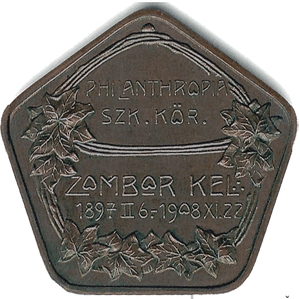
Medal of Daughter-Lodge Philanthropia (photo supplied by Josip Šosberger)
Medalja venčića Philanthropia (fotografiju ustupio Josip Šosberger)
|
OSNIVANJE SOMBORSKOG VENČIĆA PHILANTHROPIA GODINE 1897. "Zvanično" slobodno zidarstvo u Somboru započinje osnivanjem venčića Filantropija (Philanthropia) od strane segedinske lože Arpad, 14. aprila 1897. godine. Kao venčić, Filantropija je radila do 22. novembra 1908. kada prerasta u ložu Jövendő, tj. Budućnost nakon prvog svetskog rata. U godinama koje su prethodile ovom događaju, veći broj Somboraca iniciran je u loži Arpad, Orijent Segedin, tada najvećoj loži u Mađarskoj. Podaci o osnivanju somborskog venčića Filantropija, a time i "zvaničnom" početku slobodnog zidarstva u Somboru, potiču iz dokumentacije segedinske majka-lože i Državnog arhiva Mađarske. U somborskim institucijama koje su pozvane da se bave arhiviranjem i čuvanjem dokumenata prošlosti, podataka o slobodnom zidarstvu u Somboru gotovo da i nema, pre svega zbog prevelike bojazni nadležnih iz ranijih vremena da imaju ikakve veze sa takvom, anatemisanom temom. Jezik kojim su dokumenti pisani jezik je kraja 19. i početka 20. veka. Iako su to izveštaji, pozivnice, zaključci i zapisnici, jezik im se može nazvati formalno-pesničkim — zvaničan, ali kitnjast i opisan, sa puno atributa i idioma, naizgled složen, ali razumljiv obrazovanom članstvu slobodnozidarskih loža, kojima je i namenjen — za razliku od namerno presloženog i teško razumljivog jezika neknjiževnih tekstova kasnijih vremena. Izveštaj za godinu 1897. piše Fridrih Arato (Arató Frigyes), direktor Više državne ženske škole u Segedinu, sekretar lože i autor velikog broja dela o slobodnom zidarstvu, kao i svih godišnjih izveštaja lože Arpad od 1891. do kraja veka. Na samom početku dela izveštaja koji se odnosi na formiranje venčića Filantropija kaže: Sama majka-loža, svom je svojom snagom, u Filantropiji podsticala zametak harmoničnog slobodnozidarskog duha, pokazivala nesebičnu majčinsku ljubav i čuvala i štitila svoje čedo koje je sada toliko ojačalo da majku-ložu može da oslobodi njene ugodne dužnosti." Loža Arpad, u koje je uneto svetlo 1870. godine, već je podosta ranije, uvidela potrebu da, otvaranjem novih loža, širi slobodno zidarstvo u južnim krajevima tadašnje Mađarske, ali je u tome bila sprečena mnogim nepovoljnim događajima, kao na primer, katastrofalnom poplavom 12. marta 1879. godine u kojoj je stradao veći deo Segedina, a 60.000 ljudi ostalo bez krova nad glavom, kao i stalnom borbom za svoj opstanak. U izveštaju se ponosno ističe da je loža u teškim vremenima opstala, ali je morala da se nosi, bez finansijske podrške sa strane i adekvatnog duhovnog vođstva, sa takvom anarhijom u slobodnozidarskim odnosima da je došlo do uspavljivanja mnogih loža u ovim krajevima. Kao primer, iznose se Arad, Baja, Novi Sad, Temišvar, Vršac, Veliki Bečkerek (Zrenjanin), te Oravica, Lipovica i Karansebeš u današnjoj Rumuniji. Loža Arpad je, "kada god bi nastupili teški dani, uvek smogla snage da stane na noge i na ruševinama prethodnih gradi nove hramove". Prvi rezultati u tom smislu dolaze gradnjom Lože Stella Orientalis u Zemunu 30. novembra 1889. godine. Majka-loža je tada još uvek bila nedovoljno jaka, pa su je iscrpli "rastrojeni odnosi" koji su vladali u toku formiranja ćerka-lože. Uspevši da prevaziđe finansijske teškoće tog perioda i ojačavši se u duhovnom smislu, Loža Arpad uspeva da privuče zainteresovanost vojvođanskih gradova za aktivno slobodno zidarstvo. U samoj Loži se znatno povećava broj aktivnih članova, te se to blagotvorno odražava na slobodno zidarstvo, kako u regionu Segedina, tako i u južnom delu tadašnje Mađarske. Članstvo se, zapravo utrostručuje, a budući da velika većina novih članova potiče iz drugih mesta, sa tim se, prirodno, nameću novi centri slobodnozidarskih venčića i loža. Pitanje širenja slobodnog zidarstva u regionu Vojvodine postaje nezaobilazna tema konferencijskih sastanaka u zadnjoj dekadi 19. veka. Formiranje novih venčića i loža, međutim, nije išlo onom brzinom koja bi se, možda, očekivala u atmosferi ogromne oduševljenosti slobodnim zidarstvom. Razlog leži u izuzetno strogim zahtevima koje loža Arpad postavlja pred buduće molioce u smislu opreznog izbora članstva i bezuslovne spremnosti da se ide slobodnozidarskim putem u filozofskim i filantropskim aktivnostima. Sve to članovi koji planiraju venčić ili ložu u svojim mestima itekako dobro znaju, pa se koraci u tom pravcu preduzimaju sa puno opreza, pažljivog razmatranja i bez preterane žurbe. 1892. godine, venčić u Kikindi već je bio pred otvaranjem kada su se prilike iznenada promenile nagore. Iako nemamo podataka o tome šta se podrazumeva pod "nepovoljnim prilikama", činjenica je da je Kikinda na svoj venčić morala da sačeka nekoliko godina, a za to vreme somborski venčić uspeva da zaživi. U izveštaju se kaže da je ložu Arpadd i ranije, već krajem 1880-ih godina privlačilo sedište susedne županije Bač-bodroške, s obzirom na njenu veličinu, bogatstvo i inteligenciju. Već tada su se rodili prvi planovi za otvaranje lože u Somboru, ali tada još niko iz Sombora i okoline nije bio član Lože Arpad. Tadašnji somborski slobodni zidari bili su članovi drugih loža: zemunske Stele Orientalis, kao Br. Dr. J. T. ili budimpeštanske lože Kenjveš Kalman (Könyves Kálmán), kao Br. Dr. A. H., te se u Segedinu verovalo da će neke druge lože inicirati slobodno zidarstvo u Somboru, pa nisu u tom smislu preduzeli nikakve korake. 9. novembra 1895. godine, međutim, na svom jubilarnom radu, Arpad ponovo pokreće pitanje lože u Somboru. Naime, dva spomenuta Brata su iskoristila svoje prisustvo Arpadovom jubileju da upute molbu za pokroviteljstvo. Loža Arpad je, naravno, oberučke prihvatila molbu, ali je Bratu Dr. J. T. trebalo skoro godinu dana da ponovo da "znake života" i 24. septembra 1896. oglasi sledećim pismom upućenom Starešini lože Arpad: Dragi Brate, Loža Arpad ažurno odgovara da joj je drago i da je spremna da pruži i moralnu i materijalnu podršku za osnivanje ili pripreme za osnivanje lože u Somboru. Već 30. septembra, Br. Dr. A.H. traži prijem u segedinsku ložu i ujedno moli da se članarina Somborcima smanji na polovinu da bi tako oni drugom polovinom mogli da pokriju troškove osnivanja svog venčića. On i Br. Dr. J. T. došli bi u Segedin na dogovor o detaljima. 10. oktobra se somborska Braća J. T. i A. H. zaista pojavljuju u Segedinu na ritualnom radu 1. stepena. Nakon rada, održava se sastanak sa Oficirima Lože gde dva somborska Brata izlažu svoje smernice i planove. Oficiri Lože, i ovog puta pokazuju živo zanimanje za prve slobodnozidarske korake u Somboru i potvrđuju svoju podršku obećavajući da će na ritualnom radu 24. oktobra inicirati veći broj somborskih novaka i obezbediti time uslove za početak rada somborskog venčića. 30. novembra 1896. sledi pismo Br. J. T. sledećeg sadržaja: Dragi Brate Sekretare! 02. decembra 1896. godine, matrikule novaka I. S. (Imre Štajngaser — Steingasser Imre), M. K. (verovatno Mor Kele — Kelő Mór)) i V. K. (Viktor Kolár) ulaze u redovnu proceduru. Balotiranje se održava 09. januara 1897. Sva trojica dobijaju bele kuglice i postaju novaci, a čitaju se i matrikule dva nova kandidata: Š. R. (Šoma Rac — Rácz Soma) i F. K. (Ferencz Kende). Iako je segedinska loža bila spremna da prvu trojicu novaka inicira, članovi budućeg somborskog venčića traži da se sačeka rezultat balotiranja za novu dvojicu kandidata, pa da se sva petorica iniciraju istog dana. 24. januara. Kandidati Š.R. i F. K. prolaze balotiranje, te se zakazuje ritualni rad 1. stepena za 30. januar, kada sva petorica novaka iz Sombora bivaju inicirana. Bila je to veoma svečana prilika uz prisustvo 50 segedinske braće, te Br. M.T. iz budimpeštanske lože Napredak (Haladás), Br. J. T. iz zemunske Stele Orientalis i Br. P. NJ. iz lože Kralj Ladislav (László Király), Orijent Nađvarad (današnja Oradea u Rumuniji). Svečanom tonu rada uz tako veliki broj prisutnih doprinelo je i polaganje zakletve Starešine Br. V. P. i njegovog zamenika Br. J. R. Po položenoj zakletvi, Starešina lože Arpad vrši inicijaciju somborske Braće I. S., M. K., V. K., Š. R. i F. K. u slobodne zidare. Iako su somborska Braća gorela od želje da se venčić što pre oformi, majka-loža ih je uputila da strpljivo sačekaju da se izradi osnovni pravilnik, jer su znali kakvu odgovornost preuzimaju u smislu nesmetanog funkcionisanja ne samo somborskog venčića već i drugih koje otvaraju ili nameravaju da otvore. Pravilnik je, stoga, sem koncizno navedenih najosnovnijih obaveza, trebao da bude i univerzalan tj. da predvidi jednaka rešenja i za posebne situacije koje bi se mogle javiti u bilo kojoj datoj loži u budućnosti. Za izradu Pravilnika, u ime lože, zadužen je Sekretar. Rezultirajući Pravilnik ćemo kasnije navesti u celosti. 06. i 13. februara Loža Arpad raspravlja o predogu Pravilnika, a potom ga šalje somborskoj Braći na dalju raspravu. 06. marta, Br. Šoma Rac, u ime ostalih, obaveštava Arpad da Somborci prihvataju Pravilnik, kako u celini tako i po članovima, pa se zahvaljuju na svesrdnoj pomoći koju Loža stalno pruža i mole da se učini sve da se venčić ubrzo oformi. Arpadu je drago da se Pravilnik usvojio, te ga šalje Simboličkoj Velikoj Loži Mađarske u prilogu arhitektonske table kojom moli da ga ova potvrdi. Na osnovu gornjeg, Somborci odlučuju, 01. aprila 1897. da svečanim radom na Veliku Sredu, 14. aprila 1897. godine obeleže početak rada venčića i traže od Lože Arpad dalje instrukcije. Takođe ih obaveštavaju da će se svečano otvaranje Somborskog venčića, a potom i "žbukanje" održati u privatnoj kući jer su somborske prilike takve da neko javno mesto za to ne bi bilo pogodno. Loža odlučuje da, kao delegate, pod vođstvom Starešine Br. J. R., uputi sledeću braću: Zamenika Starešine Đ. N., Prvog Nadzornika A. B., Sekretara F. A., Besednika Dr. M. S., Rizničara V. M., te Braću E. Š., V. S. i M. L.
Pečat venčića Philanthropia Kako su svi pripremni radovi protekli u najboljem redu, Somborski venčić je, u stanu Br. Viktora Kolara svečano otvoren, kako se i planiralo, u 18 sati 14. arila 1897. godine na opštu radost svih prisutnih, kao i Braće u Segedinu i Simboličkoj Velikoj Loži Mađarske. Najverovatnije se "žbukanje" održalo u kući Br. Šome Raca, gde se nazdravljalo uspešnom radu do duboko u noć. |
THE FORMATION OF PHILANTHROPIA DAUGHTER-LODGE IN 1897 "Official" Freemasonry in Sombor began with the foundation of Philanthropia Daughter-Lodge by L. Arpad on 14th April 1897. As a Daughter Lodge, Philanthropia worked until 22nd November 1908, when it converted to L. Jövendő. After WW1 the same Lodge was renamed to L. Budućnost since the territory of Vojvodina was assigned to The Kingdom of Serbs, Croats and Slovenes by the Trianon Treaty on 04th June 1920. In the years that preceded the formation of Philanthropia, a number of Somborians were initiated in L. Arpad, in the Orient of Szeged, the largest lodge in Hungary at the time. Data on the establishment of Philanthropia, the first Masonic organization in Sombor and the "official" beginning of Freemasonry in Sombor, originate from the documentation of the Szeged Mother-Lodge and the State Archives of Hungary. At the institutions that deal with archiving and preserving documents of the past in Sombor, the City Archives, the City Museum and the City Library, there is next to nothing on Freemasonry, primarily due to excessive, paranoiac fear by the authorities of the former political system of anything that had any connection with Freemasonry. It was considered absolutely perilous for the system. The language in which the documents were written was the language of the end of the 19th and the beginning of the 20th century. Although they are reports, invitations, conclusions and minutes, their language is a mixture of formal, poetic and official, very elegant and descriptive, with a lot of attributes and idioms, seemingly complex but understandable to educated members of Masonic lodges, who the texts were intended to — compared to the deliberately complicated and hard-to-understand language of modern non-fiction in the country. Lodge Árpád's Report for the year 1897 was written by Frigyes Arató, director of the Higher State Women's School in Szeged and Secretary of the Lodge as well as the author of a large number of papers on Freemasonry and all the annual reports of L. Arpad from 1891 to the end of the century. At the very beginning of the part of the Report that refers to the formation of Daughter-Lodge Philanthropia, he says: In the 27th year of existence and work of L. Árpád in the Orient of Szeged, we celebrate the constitution of a Masonic Daughter Lodge in Sombor. This job is not the result of coincidence, a momentary enthusiasm that flashes up in a storm like straw, but of our focused will and calm consideration; therefore, it promises a long life to this youngest sprout of Hungarian Freemasonry. The Mother-Lodge itself, with all her power, encouraged the germ of the harmonious Masonic spirit in Philanthropia, demonstrating unselfish maternal love and guarding and protecting her offspring, who has strengthened so much that it may relieve her from her maternal duties. (p. 1) As early as its foundation in 1870 Lodge Árpád had already seen the need to spread Freemasonry to the southern parts of Hungary by starting new lodges, but many adverse events, for example, the catastrophic flood of 12th March 1879 in which the greatest part of Szeged was destroyed and 60,000 people were left homeless, prevented that and so did their constant struggle for survival. The Report emphasizes proudly that the Lodge survived in those difficult times although it had to bear, without external financial support and adequate spiritual leadership, such anarchy in Freemasonic relations that a lot of lodges in those parts had to go dormant, e.g. in the Orients of Arad, Baja, Újvidék (Novi Sad), Timisoara, Versecz, Greater Becskerek (Zrenjanin) as well as Oravica, Lipovica and Karansebes in present-day Romania. Whenever difficult days came Lodge Árpád always had the strength to find its feet and build new temples on the ruins of the previous ones. The first results in this sense came with the foundation Lodge Stella Orientalis in the Orient of Semlin on 30th November 1889. The Mother-Lodge was still insufficiently strong at that time and the "deranged relationships" that were ruling during the formation of the Daughter-Lodge were exhausting. Having succeeded in overcoming the financial difficulties of that period and strengthening in the spiritual sense, Lodge Árpád was able to attract the interest of those interested in bringing Freemasonry into the cities of Vojvodina. The number of active members grew significantly in the Lodge itself, and this reflected beneficially on Freemasonry, both in the Szeged region and in the southern part of Hungary. In fact, membership tripled and, naturally, new Masonic lodge centres emerged, since a vast majority of new members came from other places. The issue of expansion of Freemasonry in Vojvodina became an unavoidable topic at conference meetings in the last decade of the 19th century. However, the formation of new Daughter-Lodges and constituent lodges did not go at the same speed that might have been expected in the atmosphere of enormous enthusiasm about Freemasonry. The reason lies in the exceptionally strict requirements that Lodge Árpád imposed on prospective lodge applications in terms of careful choice of membership and unconditional readiness to follow the Masonic way in philosophical and philanthropic activities. All those members who planned to form a Daughter-Lodge or a constituent lodge in their places of living knew that very well, so steps in this direction were undertaken with a lot of caution, careful consideration and without excessive haste. In 1892, a Daughter-Lodge in the Orient of Kikinda was about to be constituted when, the situation suddenly changed for the worse, due to adverse circumstances. Although we do not have information or idea what was meant by "adverse circumstances," the fact is that Kikinda had to wait for a few years for their Daughter-Lodge and during that time the Daughter-Lodge in Sombor was able to begin its life. The report said that Lodge Árpád had already been attracted to the seat of the neighbouring Bacs-Bodrog County at the end of the 1880s, considering its size, wealth and intelligentsia. As early as then, the first plans for founding a Lodge in Sombor had already existed, although, at that time, no one from the city or the surrounding area was a member of Lodge Árpád. The existing Freemasons from Sombor were members of other lodges: Lodge Stella Orientalis of Semlin, like Bro. Dr Jozsef Thüm or the Budapest Lodge Könyves Kálmán, like Bro. D. A. H., and it was believed in Szeged that some other lodges would initiate petitioners from Sombor, so they did not take any steps in that regard. However, on 9th November 1895, at a tyled meeting, Lodge Arpad raised the issue of the constitution of a lodge in Sombor again. Namely, the two Brethren mentioned above were present at Lodge Árpád's anniversary and filed an application for Lodge Árpád's patronage. The Lodge, accepted the request, of course, but it took Bro. Dr Joseph Thüm (or Thiem) almost a year to show "signs of life" again, sending the following letter to Lodge Arpad on 24th September 1896: Dear Brethren, Lodge Árpád replied promptly saying that they were glad and ready to provide moral and material support for establishing or preparing for the establishment of a lodge in Sombor. On 10th October Brethren J. T. and A. H really appeared in Szeged at a 1st degree tyled meeting. After the work, a meeting with the Lodge Officers was held where the two Brethren from Sombor exposed their guidelines and plans. The Officers of the Lodge showed vigorous interest in the first Masonic steps in Sombor and confirmed their support, promising that they would initiate a number of petitioners in the ritual work on 24th October, and provide conditions for the commencement of work of the Sombor Daughter-Lodge. On 30th November 1896, a letter by Bro. J. T. followed, with the following content: Dear Brother Secretary! On 2nd December 1896, the matriculas of petitioners I. S. (Imre Steingasser), M. K. Mór Kelő and Gy. K. (Győző Kollár) entered the regular procedure. Balloting was held on 9th January 1897. All three received white balls only and became novices, and matriculas of two new petitioners, S. R. (Soma Rácz) and F. K. (Ferenc Kende), were also read out. Although the Szeged Lodge was ready to initiate the first three petitioners, the Daughter-Lodge in Sombor asked to wait for the result of the balloting for the two new petitioners so that all five could be initiated on the same day. On 24th January S.R. and F. K. were balloted and a 1st degree ritual work was scheduled for 30th January when all five petitioners from Sombor were initiated. It was a very ceremonial occasion in presence of 50 Brethren from Szeged as well as Bro. M.T. from the Budapest Lodge Haladás (Progress), Bro. J. T. from Lodge Stella Orientalis and Bro. P. NY., from Lodge László Király, Orient Nagyvárad (Oradea). The ceremonial tone of the work with such a large number of participants was enhanced by the oath-taking of the Worshipful Master Bro, V. P. and his deputy Bro. J. R. After the oath-taking, the Officers of L.Arpad commenced the initiation of the Sombor Brethren I. S., M. K., V. K., S. R. and F. K. conferring the first degree on them. Although the Sombor Brethren were burning with desire to form their Daughter-Lodge as soon as possible, the Mother-Lodge instructed them to wait patiently for the book of Basic Rules to be drafted, because they knew what responsibility they were taking in terms of unobstructed functioning of not only their own Daughter-Lodge but also other such lodges that were about to be constituted. Therefore, the Book of Regulations had to be drafted carefully stating concisely the most basic obligations; it also had to be universal i.e. provide for equal solutions for specific situations that could arise in any given lodge in the future. The task of the drafting of the Regulations, on behalf of the Lodge, was assigned to the Secretary. We will subsequently state the resulting Rules in full. On 6th and 13th February, Lodge Árpád discussed the draft of the Rulebook and sent it to the Sombor Brethren for further discussion. On March 6th, Bro. Soma Rácz, on behalf of others, informed Lodge Árpád that the Somborians had accepted the Rulebook, both as a whole and as per the articles, and thanked for the generous help that the Lodge was constantly providing and begged the Szeged Brethren to do everything towards the formation of the Daughter-Lodge soon. Lodge Árpád was pleased that the Rulebook had been adopted, and sent it to the Symbolic Grand Lodge attached to a report, requesting confirmation. The Lodge also sent representatives to the Grand Council meeting to facilitate the Grand Lodge's approval. The Most Worshipful Grand Master declared that the sending of the Regulations was considered only a formality since the Grand Lodge had already taken a principled stance and supported the document; subsequently, a written consent would be sent to facilitate foundation of the Daughter-Lodge as soon as possible. On the basis of the aforementioned, the Somborians decided, to mark the beginning of the labour of the Daughter-Lodge on Big Wednesday, and on 1st April 1897 asked Lodge Árpád, the Mother-Lodge, for further instructions so that their Daughter-Lodge could be consecrated on the said day, i.e. 14th April 1897. They also informed L. Arpad that the ceremony and the subsequent dinner would be held in a private home since circumstances in Sombor were such that a public place would not be suitable for the purpose. The Lodge decided to delegate, under the leadership of the Worshipful Master, Bro. J. R., the following Brethren: Deputy W.M., Bro. GY. N., Senior Warden, Bro. A. B., the Secretary, Bro. F. A., the Orator, Bro. Dr M. S., the Treasurer, Bro. VM and Brethren E. S., V. S. and M. L.
Seal of Daughter-Lodge Philanthropia As all the preparatory works had been completed in the best order, the Daughter-Lodge of Sombor was consecrated in Bro. Győző Kollár's home, as planned, at 6 pm on 14th April 1897, to the joy of all those present, as well as the Brethren in Szeged and the Symbolic Grand Lodge of Hungary. Most likely, "plastering" was held in the house of Bro. Soma Rácz, where toasting was going on deep into the night. |

|
ARHITEKTONSKA TABLA OD 14. APRILA 1897. GODINE Prisutni: Starešina Lože Arpad Br. J. R., Zamenik Starešine Lože Đ. N., 2. Nadzornik A. B., Sekretar F. A., Besednik Dr. M. S., Rizničar V. M., Braća E. Š., Dr. V. S., Dr. A. H., M. K., F. K., Dr. Đ. K. (Dr. Viktor Kolar), Š. M. (Šoma Rac), i I. Š., te E. G. (Elek Goždu) iz Lože Kenjveš Kalman, Dr. Š. G. iz Demokratie, i M. I. iz Lože Reform, kao gost. Ad 1. Br. J. R., kao Starešina lože Arpad, otvara svečani rad govoreći o značaju 14. aprila za čovečanstvo i mađarski narod. (Naime, tog je dana 1849. Mađarska proglasila nezavisnost od Austrije, ali je tog istog dana 1865. godine ubijen Abraham Linkoln. Kasniji događaji vezani za famozni 14. april, ili oko njega, za koje naši slobodnozidarski preci nisu mogli znati su, između ostalog, potonuće Titanika 1912. godine, stradanje Apola 13 i drugi dođaji, ali i brojni pozitivni događaji koji se biraju po nahođenju onih koji, iz raznoraznih razloga, nastoje da "dokažu" delovanje mistike brojeva). U svetlu uzvišenih dostignuća prošlosti Br. J. R. pozdravlja osnivanje Somborskog venčića i želi da V.N.U. blagoslovi njihove radove, a takođe poziva prisutnu Braću da potvrde spisak Braće osnivača Somborskog venčića, i to: E. G. Elek Goždu, (Demokratia ili Kenjveš Kalman), S. G. (Demokratia), te A. H., M. K., F. K., Đ. K. (Kollár Győző, tj. Viktor Kolar), Š. M. (Šoma Rac) i Š. J. Ad 2. Sekretar lože Arpad prikazuje Pravilnik koji je u ime Lože Arpad, a za potrebe Somborskog venčića izradio i koji su somborska braća već ranije prihvatila, kako u celini, tako i po članovima, te izražava svoje zadovoljstvo uspešnošću arhitektonske table br. 931. Ad 3. Rizničar V.M. podnosi izveštaj u kojem kaže da će Loža Arpad velikodušno prepustiti sav novac koji su somborska braća, članovi venčića, na ime članarine, uplatila segedinskoj loži, sem onog dela koji normalno pripada loži, a sa ciljem da se pomogne venčić, koji će na samom početku morati da ima podosta izdataka za pokretanje i uredno vođenje administrativnih poslova. U tom smislu rizničar, Br. V. M. prilaže 50 forinti, za šta se somborska Braća zahvaljuju. Ad 4. Starešina lože Arpad, Br. J. R., poziva Somborce da, u skladu sa Pravilnikom, izaberu oficire venčića. Rezultat izbora je sledeći: Starešina Br. E. G. (Elek Goždu), Besednik Br. Š. R. (Šoma Rac), Sekretar Br. F. K. (Ferenc Kende), Rizničar Br. Dr. V. K. (Viktor Kolar) — svi jednoglasno. Ad 5. Starešina lože Arpad, Br. J. R. poziva oficire Venčića da polože zakletvu, te izjavljuje da je Venčić zvanično osnovan. Ad 6. Zamenik Starešine Đ. N. pozdravlja Braću Venčića i u glavnim crtama predstavlja zadatke slobodnog zidarstva. Rečima oduševljenja podstiče somborsku Braću na slobodnozidarske radove, želi im puno sreće u daljem radu i da im uspesi služe kao nagrada za pregalaštvo. Ad 7. Na reči Starešine Lože Arpad reaguje Starešina Venčića Br. Elek Goždu: "Nemojte od mene tražiti velike reči jer reči ne predstavljaju suštinu slobodnozidarske misli. Ideje slobodnog zidarstva se ostvaruju delima, ne delima od globalnog značaja već sitnim delima svakodnevnice mesta u kom živimo. Tu se ostvaruju ideje slobodnog zidarstva. Ako svim našim koracima upravlja čovekoljublje, tek tada se možemo nazivati slobodnim zidarima. Te i takve kvalitete ne tražim samo u slobodnozidarskom bratstvu već mi je milo kad se o njima osvedočim i van njega, među onima koji svoje delanje vrše po idejama plemenitog humanizma. Dakle, tek tada ćemo naš poziv slobodnih zidara moći ostvariti kada u nama zaživi čisto čovekoljublje u najsitnijim detaljima našeg života i rada — jer život se itekako sastoji od sitnica." Ad 8. Br. Š. M., Besednik lože: "Uvaženi starešino, draga braćo! Ispunila nam se žarka želja. S radošću možemo da objavimo da je naš venčić osnovan. Kraljevska umetnost je ponovo odnela pobedu i našla još jedan svoj dom. U Orijentu Sombor smo razvili zastavu idealizma da pod njom u svako doba, nikad ne kloneći, kao ratnici, u žaru borbe, ostvarujemo ideje slobodnog zidarstva. Vi ste ti koji će predstavljati tu svečanu stražu čiji je zadatak da očuva čistotu stega, jača i njegovu svetlost i obezbeđuje mu čast! Kad Vam u budućnosti zatraže ovaj sveti znak, a vi ste uspeli da sačuvate njegovu čistotu, sami sebe ćete počastvovati, jer je to zadatak koji, sam po sebi, oplemenjuje. Ostavljamo Vam odabranu stražu, verujući u Starešinu, Oficire i muževnost i hrabrost svakog okca. Neka Vas u Vašoj borbi čeliči uzvišena svest o tome da služite plemenitoj stvari. Ako i vođa i oficir i vojnik sjedine svoju mudrost i snagu, do pobede mora doći. A nagrada? Nemojte je očekivati od spoljanjeg sveta. Biće ona tu u vama, biće tu kao slatko saznanje da ste, kao pravi čovek, ispunili svoj zadatak. Okupljajte pobornike ove ideje, s ljubavlju i prosvećenom edukativnošću i neka vas nije strah idealizma i galamdžijskih napada gomile koja nije prijemčiva za duhovne vrednosti. Vi ste nosioci takve misli čiji je uspeh osiguran — kao zlato iz praha zemlje, kao sunčevi zraci iza oblaka, koji su još uvek tamni, tako će se i ova plemenita misao pojaviti u svoj svojoj svetlosti, kao čisto, svetlucavo zlato, kao sjajno sunce, i pobediti mrak neznanja.Međutim, ako želite da ostvarujete prave rezultate, prednjačite, pružajući drugima sjajne primere i ne trošite uzalud velike reči — delo je hiljadu puta vrednije od reči! Tako će Kraljevska umetnost preko vašeg, još nejakog venčića, i ovde ubrzo imati svoj veličanstveni hram, do kojeg će vas mudrost i istrajna snaga vašeg Starešine i Oficira dovesti. Pismo Najuvaženijeg Zamenika Velikog Majstora Simboličke Velike Lože Mađarske Marcela Nojšlosa (Neuschloss Marczel) i Najuvaženijeg Velikog Sekretara Dr. Bakonjija (Bakonyi) 1897. godine: Tekuće godine, 24. aprila, preko poslate nam arhitektonske table br. 98, obavešteni smo o tome da je u Somboru, 14. aprila, osnovan slobodnozidarski venčić, što je Veliki Savet takođe primio k znanju na svom zasedanju 03. dana tekućeg meseca. Ovim Vam odajemo priznanje za pregalaštvo na polju proširivanja članstva. Molimo Vas da nam pošaljete po dva primerka zapisnika o osnivanju somborskog venčića i prihvaćenih osnovnih pravila. Takođe Vas molimo da nas obavestite o imenu venčića, kako slobodnozidarskom, tako i profanom. |
THE REPORT OF 14th APRIL 1897 The following Brethren were present at the consecration of Daughter-Lodge Philanthropia on 14th April 1897: Worshipful Master of Lodge Árpád, Bro. J. R., Deputy-Worshipful Master of the Lodge Gy. N., Junior Warden A. B., Secretary F. A., Orator Dr. M. S., Treasurer V.M., Brethren E. S., Dr V. S., Dr A. H., M. K., F. K., Dr GY. K, (Győző Kollár), S. R. (Soma Rácz), I. S. and E. G. (Elek Gozsdu) of Lodge Könyves Kálmán, Dr S. M., of Lodge Demokratia and M. I. of Lodge Reform, as guests. Item 2 - Lodge Árpád's Secretary presented the Rulebook that he prepared on behalf of his Lodge for the needs of the Daughter-Lodge, which the Sombor Brethren had already accepted both in its entirety and in terms of its articles. Item 3 - The Treasurer, Bro. V.M. submitted a report in which he said that Lodge Árpád would generously refund all the membership money that the Sombor Brethren, members of the Daughter-Lodge, had paid to the Szeged Lodge, except the part that normally belonged to the Lodge, with the aim of helping the Daughter-Lodge since they were to have considerable expenses for starting and proper management of their administrative affairs. In this sense, Treasurer, Bro. V.M. contributed 50 forints, for which the Sombor Brethren were very thankful. Item 4 - The Worshipful Master of Lodge Árpád, Bro. J. R. invited the Somborians, in accordance with the Rulebook, to elect and install the Officers of the Daughter-Lodge. The result of the election was as follows: Worshipful Master Bro. E.G. (Elek Gozsdu), Orator Bro. S. R. (Soma Rácz), Secretary Bro. F. K. (Ferenc Kende), Treasurer Bro. Dr V.K. (Győző Kollár) - all of them had been elected unanimously. Item 5 - The Worshipful Master of Lodge Árpád, Bro. J. R., called the Officers of the Daughter-Lodge to take the oath, and declared the Daughter-Lodge officially established. Item 6 - The deputy Worshipful Master, Gy. N. welcomed the Brethren of the Daughter-Lodge and presented briefly the tasks of Freemasonry. With words of enthusiasm, he encouraged the Sombor Brethren to do their best in Masonic works, and wished them a lot of happiness in further work, and that their successes serve them as a reward for their zealousness. Item 7 - The Worshipful Master of the Daughter-Lodge, Bro. Elek Gozsdu responded to the words of the W.M. of Lodge Árpád: Do not expect lofty words from me because words do not represent the essence of Masonic thought. The ideas of Freemasonry are realized via deeds, not deeds of global significance, but those realized through common activities in our everyday life within the environment we live in. This is where the ideas of Freemasonry are realized. If all our steps are guided by humanity, only then can we be called Freemasons. I do not look for such qualities within the Masonic Fraternity only, but I am so pleased to see them outside it as well, among those who do their work and live according to the ideas of noble humanism. Therefore, only then will we be able to call ourselves Freemasons, when pure humanity, in its tiniest details, materializes in our lives and work — because life is essentially composed of small things. Item 8 - Bro. S. R., Orator of the Daughter-Lodge: Dear Worshipful Master, dear Brethren! We were filled with burning desire and now our wishes have come true. With joy, we can announce that our Daughter-Lodge has been established. Royal Art is victorious once again and it has found another home. In the Orient of Sombor, we have spread the banner of idealism and under it, like warriors in the heat of battle do we realize the ideas of Freemasonry. You are those who will represent this solemn guard whose task is to preserve the purity of the banner, strengthen its light and provide it with honour! When this sacred sign is demanded from you in the future, and you have succeeded in preserving its purity, thus you will honour yourself since this task ennobles you by its very essence and existence. We leave you a chosen guard, believing in the Worshipful Master, the Officers and the virility and courage of every eye of the chain. In your struggle, let noble consciousness steel you for the accomplishment of elevated deeds. If the leader, officers, and soldiers combine their wisdom and strength, they must be victorious. What about a reward? Do not expect it from outside your world. It will be there in you; it will be there as sweet awareness that you, as a true man, have fulfilled your task. Gather up the supporters of this idea with love and enlightened education, and do not be afraid of idealism and the loudmouths, who are unreceptive to spiritual values. You are the bearers of thoughts whose success is secured - like gold from the dust of the earth, like the sun's rays behind the clouds which are still dark, so will this noble thought appear in all its light, like pure, glittering gold, like the bright sun and prevail over the darkness of ignorance. However, if you wish to achieve the right results, take the lead, provide others with great examples and do not waste big words in vain — labour is worth a thousand words! Thus, the Royal Art will have its magnificent temple soon, through your still feeble Daughter-Lodge where the wisdom and steady power of your W.M. and Officers will take you. We welcome you. Forward to victory at work!" Letter from Most Worshipful Grand Master of the Symbolic Grand Lodge of Hungary, Marczel Neuschloss, and Most Worshipful Secretary Dr Bakonyi in 1897: On 24th April of the current year, via report no. 98, we were informed that a Masonic Daughter-Lodge had been established in Sombor on 14th April, which the Grand Council had approved at their meeting on the 3rd day of the current month. Hereby we are sending you our recognition for your zealousness in the expansion of membership. Please send us two copies of the minutes on the establishment of the Daughter-Lodge in Sombor and the accepted Basic Rules. We are also asking you kindly to inform us about the name of the Daughter-Lodge, both its Masonic and profane one. |
|
ČLANOVI SLOBODNOZIDARSKOG VENČIĆA PHILANTHROPIA Venčić je osnovan 6. februara 1897. godine u Segedinu. Počeo je da radi u Somboru 14. aprila iste godine, nakon svečanog otvaranja u kući advokata Viktora Kolara. Nakon otvaranja, skup se preselio u kuću profesora Šome Raca ( obe adrese nepoznate), gde je izvršeno "žbukanje" (održana zakuska). Prezime i ime, Zanimanje/Škola, Loža, |
LIST OF THE MEMBERS OF LODGE PHILANTHROPIA The Daughter-Lodge was established on 6th February 1897 in Szeged. It started working in Sombor on 14th April of the same year upon consecration at the home of solicitor Győző (Victor) Kollár. After the consecration ceremony, the participants moved to the home of Grammar School Teacher Soma Rácz (both addresses unknown), where a dinner was held. Surname and name, Profession/city, Lodge |
|
OSNOVNA PRAVILA VENČIĆA POD ZAŠTITOM SZ LOŽE ARPAD
|
BASIC RULES OF DAUGHTER-LODGES UNDER THE PROTECTION OF LODGE ÁRPÁD
|
|
PRILIKE U SOMBORU 1899/1900 Godina 1899. Na predlog Dr. Janoša Duhona (Duchon János), slobodnog zidara i kasnije prvog Uvaženog starešine lože Jövendő, u koju će se uneti svetlo u Orijentu Sombor 22. novembra 1908. godine, osnovan je Slobodni licej, kulturna ustanova koja se bavila organizovanjem predavanja iz svih oblasti nauke, kulture i društvenog života. Predavanja su se održavala u Velikoj sali Gradske kuće kasno-jesenjih i zimskih dana i bila su otvorena za sve građane. Pečat radu Slobodnog liceja davali su somborski slobodni zidari, sve do 1914. godine, kada se institucija gasi zbog ratnih događanja. Trgovac Vitomir Bikar otvara radnju pomodne muške i ženske robe, a mladež se obučava u negovanju cveća i gajenju voća. U jevrejskoj osnovnoj školi je 50 devojčica od 102 učenika, a 8 učenika nije izraelitske, već drugih veroispovesti (5 katolika, 1 pravoslavac i dva reformista). Godina 1900. U poslednjih 10 godina 19. veka grad je napustilo 40.000 lica, mnogo više nego iz drugih gradskih sredina Bač-bodroške županije. Od toga broja 70% se iselilo u Ameriku, a 30% u Nemačku. |
THE SITUATION IN SOMBOR IN 1899/1900 The year 1899 Further to the proposal by Dr János Duchon, a Freemason and later the first Worshipful Master of Lodge Jövendő, which was consecrated on 22nd November 1908 in the Orient of Sombor, the Free Lyceum was founded, a cultural institution that organized lectures in all fields of science, culture and social life. The lectures were held in the Grand Hall of the City Hall in late autumn and winter and were open to all citizens. The tone of the Free Lyceum was set by the Sombor Freemasons until the year 1914 when the institution was closed due to the outbreak of WW1. Trader Vitomir Bikar opened a store of men's and women's fashion apparel. The youth was trained in growing and maintenance of decorative plants and fruit. In the Jewish elementary school, there were 50 girls out of 102 students, and 8 students were not Jewish (5 Catholics, 1 Orthodox and two reformists). In the last 10 years of the 19th century, 40,000 people left the city, many more than in other urban areas of Bacs-Bodrog County. Of this number, 70% moved to America and 30% to Germany. |
|
IZVEŠTAJ SLOBODNOZIDARSKOG VENČIĆA PHILANTHROPIA ZA GODINU 1900. Ovaj tekst je prevod sa mađarskog originala: Na samom početku, pada u oči pesnički stil kojim je zabeležena smrt jednog od Braće, a u drugom pasusu se autor (Br. Šoma Rac) veoma diplomatski, izdaleka, osvrće na problem koji je prethodne dve godine postojao u komunikaciji između lože Arpad i venčića Filantropija. Može, takođe, da se vidi intenzitet inicijacije nove Braće, kao i aktivnost venčića na duhovnom uzdizanju i Braće i profanog okruženja, ovo drugo preko Slobodnog liceja, obrazovne institucije koja je u Somboru zaživela, zaslugom Braće, nepune 4 godine nakon same njegove pojave na obrazovnoj sceni, po uzoru na oksfordski Juniverziti ikstenšen (University Extension), odnosno neku vrstu otvorenog univerziteta. Osnovne karakteristike delovanja slobodnog zidarstva su: filosofija, čovekoljublje i progresivnost. Ovo poslednje, loža Kralj Ladislav iz Oradeje (današnja Rumunija) shvatila je kao mogućnost bavljenja političkim i verskim pitanjima, kao šansom da predloži "osavremenjivanje" rituala, te je svojim dopisom tadašnjim ložama i venčićima pod pokroviteljstvom Simboličke Velike Lože Mađarske (tada ih je oko 85) izazvala radikalizaciju prilika u slobodnom zidarstvu, maltene raskol, na ovim prostorima. Zanimljiv je krajnje zamršen diplomatski jezik kojim je, u šestom pasusu, Filantropija iskazala svoj stav. I. Važnija dešavanja u životu venčića Godišnji izveštaj moramo da započnemo bolom u srcu zbog gubitka našeg čestitog i aktivnog radnika, Br. Antala Bajkaija protekle godine. Izgubili smo ga tako što mu ni telo nismo mogli povratiti iz zatalasalog Dunava, koji ga je u toku vršenja njegovih radnih dužnosti, odneo kao da, hraneći se krvlju njegovog srca, želi da umiri svoju žestinu… Život našeg venčića u protekloj godini, bio je toliko intenzivan da ga takvog još nikad nismo, do sada, videli. Odvijao se bez ishitrenosti i nepromišljene olakosti i u odnosima među Braćom, i u odnosima sa profanim svetom, što je znak zdrave borbe i verovanja u realne izglede ostvarivanja rezultata. Treba imati na umu da na uspeh imamo izgleda samo tako što ćemo se odreći svih agresivnih ispada i negovati međusobne odnose, praktikujući kraljevsku umetnost, koja uvek traži celovitog čoveka, a koja iz ovih prirodnih razloga treba, na samom početku, da se reši nepromišljenosti u svom radu. Verujemo da će rezultati duhovnog života i rada venčića Filantropija, onako kako ih pred Braću postavljamo, u krugu majstora Kraljevske umetnosti, naići na odobravanje. Bez želje da sebe hvalimo, navodimo samo detalje naše aktivnosti, sa ciljem da naši majstori vide koliko smo pažnje, u određenim periodima, posvećivali radu na čovekoljublju i duhovnom uzdizanju. Venčić nam se proširio za pet novih članova, i to: Žigmond Baranj (Bárány Zsigmond), Karolj Berec (Berecz Károly), Pal Hetenji (Hetényi Pál), Boldižar Silađi (Szilágyi Boldizsár) i Rudolf Skodnik (Scodnik Rezső), od kojih je troje iz Sombora, a dvoje iz drugih mesta, te je na kraju 1900. venčić brojao 29 članova. Kakvu pažnju smo posvećivali proširivanju članstva pokazuje i činjenica da smo se, kao i godinu dana ranije, 22. aprila, okupili samo sa jednim ciljem — da u Somboru i okolini označimo pojedince koji bi bili vredni prijema. Porast članstva, mada još mora pažljivo da se proceni, uputio nas je na zaključak da u Somboru, bilo iz svojih sredstava, ili pomoći Velike Lože, prenošenjem uspavane lože Domoljublje (Honszeretet), Orijent Baja, sagradimo hram Kraljevske umetnosti. Što se tiče rada na duhovnom uzdizanju, moramo da kažemo da su predavanja držala sledeća braća: Br. Lajoš Štraser (Strasser Lajos): "O slobodnozidarskoj velikodušnosti", u kojem je izneo mišljenje da velikodušnost proizilazi iz trojstva toleancije, opraštanja i altruizma; Br. Ivan Barci (Bárczi Iván): "Slobodnozidarski stavovi o današnjim nametima", u kojem je izneo stav da u poreskom sistemu nema morala, te da će javni moral biti izlagan propadanju sve dotle dok se prihodi budu utvrđivali na osnovu lične prijave prihoda i izjave o građansko-moralnoj odgovornosti. Venčić je navedeno pitanje držao do te mere značajnim da je smatrao potrebnim da se pokrene akcija u cilju rešavanja problema postojećeg poreskog morala, smatrajući ga srednjevekovnim načinom kategorizacije rada, bez ikakve veze sa duhom tadašnjeg vremena, ali je početak akcije odložio za bolja vremena. Br. Janoš Duhon obavestio nas je o problemu hraniteljskih porodica u gradu Somboru, što je privuklo izuzetnu pažnju Braće, naročito kad je otkrio da pravljenje anđelčića ("udomljavanje" dece rođene iz vanbraénih veza od strane njihovih majki, i postepena njihova eliminacija trovanjem) u gradu cveta, bez ikakvog nadzora. Izneo je tužnu statistiku o propadanju vanbračne dece, po kojoj je u godinu dana 52,4% novorođene dece bilo vanbračno; od toga, je preminulo 63%, a 76% pre svoje druge godine starosti, što je izazvalo preneraženje među Braćom. Dr. Duhon je predložio da se udomljavanje vrši samo u savršene hraniteljske porodice, da se odobravanje udomljavanja vrši na osnovu materijalnog stanja hraniteljske porodice, te da se u Somboru izgradi dom za nezbrinutu decu. Predmet ćemo staviti na dalju diskusiju, te ćemo kod lokalnih vlasti, poštujući odluke nadležnog ministarstva, preduzeti dalje neophodne korake. Br. Viktor Kolar obavestio nas je o sadržaju humanitarnog rada. Prema pokazateljima, humanizam je pojam koji u sebi sadrži i pojmove slobode, jednakosti i bratstva, znači sva ona prava koja čoveku kao članu ljudske zajednice pripadaju od momenta rođenja. Br. Karolj Berec je pred Braću izneo problem narodnih biblioteka u Bač-bodroškoj županiji. Njegov rad na tom polju ne samo da je doživeo priznanje od strane Braće, već je i preko članaka Br. Reze Sobotke (Szobotka Rezső) u štampi i šira javnost o tome obaveštena. Nažalost, do sada nema rezultata, ali se nadamo da će se ubrzo pronaći rešenje. Nakon uvodnog izlaganja Br. Viktora Kolara, Br. Iván Bárci je održao predavanje o društvenom programu koji je loža Kralj Ladislav iz Oradeje predočila našem venčiću* je pokazao da, iako se ne slaže sa krajnje radikalnim shvatanjima te Lože, ipak podržava snažnu progresivnost i slobodoumno iskazivanje mišljenja na nivou nacije. Venčić je zauzeo stav po tom pitanju, u onoj meri u kojoj su se iskazivala mišljenja, na osnovu kojih su se mogli izvući takvi principijelni stavovi po kojima se o verskim i političkim pitanjima, budući da se o njima ne razgovara na osnovu verske i političke pripadnosti, već uopšteno i na osnovu etičkih prilika pojedinca, itekako može voditi rasprava, te da bi propagiranje zaklljučaka koje moderna nauka i naučni metodi iznose o ustrojstvu budućeg društva, moglo da ima mesta, bez da se tekovine slobodnog zidarstva zanemare. Odgoj ženske populacije je takođe bio predmet razmene mišljenja, kao i izvlačenje problema zaštite novorođenčadi i male dece iz konteksta verske pripadnosti — problem koji u Somboru traži hitno rešavanje. Izradili smo jedan stalan, siguran i produktivan program koji ćemo ostvariti tako što ćemo pojedince zadužiti obradom prethodno utvrđenih pitanja, da bismo tako mogli da ih uključimo u buduće dnevne redove. To su sledeća pitanja: zaštita dece, poreski moral, sprečavanje alkoholizma, podržavljenje škola, problem županijskih biblioteka, edukativni radovi. U profanom svetu, Braća su se uvek trudila da udovolje zahtevima slobodnog zidarstva, a najlepšti primer toga je Slodobni Licej koji je, nakon prošlogodišnjeg uspeha, Braći dao krila. U ovogodišnjem radu Slobodnog Liceja učestvovala su naša Braća, održavši sledeća predavanja: Br. Elek Goždu o egoizmu i altruizmu; Br. Laslo Kozma o svetu** kurucza 293, Br. Šoma Rac o dobu Leopolda Drugog, Franca Prvog i Ferdinanda Petog; Br. Karolj Trenčenj o mađarskoj lirskoj poeziji; Br. Janoš Duhon o bakterijama; Br. Mor Kele (Kelő Mór) o Šubertovoj muzici; Br. Šoma Rac o antičkoj drami; Br. Mikloš Hegediš (Hegedus Miklós) o vodama Mađarske; Br. Ištvan Revicki (Reviczky István) o ledu; Br. Janoš Duhon o raskinizmu, te Br. Reza Sobotka o umetnosti u arhitekturi. Pored toga, venčić je pokrenuo akciju kojom se, zahvaljujući svesrdnom angažovanju Br. Rudolfa Sobotke, ostvarila želja da naučno-pozorišna trupa Uranija*** u Somboru, u narednom periodu, izvede nekoliko predstava. Sve te aktivnosti su na profani svet imale najpovoljnijeg uticaja, te propagiranje slobodnozidarskih ideja nije zaobiđeno ni u debatnim grupama.**** Venčić je za filantropske ciljeve izdvojio 90 kruna. Pored toga, naručili smo 1000 primeraka Narodnog kalendara, koji je uredio Ferenc Mora (Móra Ferencz) i podelili ga među narodom po nabavnoj ceni. Debatna grupa Društva tehničara, koji među svojim članovima ima i veći broj Braće, za 30 kruna nabavilo je i podelilo izdanje Herojske legende borbe Mađara za slobodu. Pored toga, isto društvo, ali u okviru jedne druge debatne grupe, protekle godine je obezbedilo odeću za 29 siromašne dece. Spomenuvši još, u užem okviru rezultata u protekloj godini, i da smo 08. aprila 1900. svečanim radovima obeležili godišnjicu formiranja našeg venčića, uz prisustsvo Starešine, njegovog Zamenika, Besednika i nekoliko članova lože Arpad, kao i članova subotičkog venčića Košut. Ne možemo a da ne spomenemo našu želju da, kako i ove tako i sledeće godine, sve članove našeg venčića prožme isti entuzijazam, da bismo tada mogli da se dičimo još sjajnijim rezultatima, te da bismo se mogli predstaviti kao nova slonodnozidarska institucija stvorena sopstevnim snagama. II. Broj sastanaka: BI. Podaci o biblioteci venčića: ** Anti-habsburški ustanci 1671. i 1711. *** Naziv Uranija potiče iz starogrčke mitologije. Ona je bila muza astronomije, kći Zevsa i Mnemosine, personifikacije memorije, a ded joj je bio Uranus, personifikacija neba. Urania Mađarsko Naučno Pozorište/Udruženje i Deoničko Društvo, osnovano 1897. godine u Budimpešti sa ciljem da … "bude mesto na kom će naučnik da edukuje, umetnik da prikazuje lepotu, a pisac da oplemenjuje, a da svo troje stvara osećaj jedinstva". Isto društvo, iste godine osnovano je i u Beču. Društvo je štampalo i svoj list i propagiralo duhovni i naučni razvoj. Ono postoji i danas u spomenuta dva grada i pokrovitelj je raznih naučnih i književnih institucija. **** Debatne grupe su delovale kao neformalne grupe intelektualaca istomišljenika koji su se sastajali i, uz ručak ili večeru, raspravljali o raznim temama od globalnog ili lokalnog značaja, te načinima rešavanja postojećih problema. |
DAUGHTER-LODGE PHILANTHROPIA YEAR 1900 REPORT. This text is a translation from the Hungarian original: At the very beginning, the poetic style that records the death of one of the Brethren catches the eye; in the second paragraph, the author (Bro. Soma Rácz), very diplomatically, looked into the problem that had existed between Lodge Árpád and Daughter-Lodge Philanthropia. The intensity of initiation of new petitioners can also be seen as well as the activity of the Daughter-Lodge on spiritual improvement of the Brethren as well as of the profane environment - the latter through the Free Lyceum, an educational institution that came to life in Sombor, thanks to the Brethren, nearly four years after its appearance on the educational scene, modelled after Oxford University Extension i.e. a kind of open university. The basic targets of Freemasonry are philosophy, humanity and progressivity. The latter was understood by Lodge King László of Nagyvárad (Oradea) as a possibility to deal with political and religious issues, as a chance to propose "modernization" of the existing ritual. They sent out a circular letter to all the lodges and daughter-lodges under the protection of the Symbolic Grand Lodge of Hungary (85 of them at the time) causing radicalization of the situation in Freemasonry, which nearly led to a split in the region. The extremely tangled diplomatic language of the sixth paragraph in which Philanthropia expressed its attitude, is also quite interesting. I. Events of importance in the life of We need to begin this annual report with pain in the heart because of the loss of our honest and active worker, Bro. Antal Bajkai last year. We lost him completely; even his body could not be recovered from the furious Danube which, while he was performing his duties (he was a hydrology engineer, TN), took him away, as if, by feeding with his heart, it wanted to calm down its rage. The life of our Daughter-Lodge was so intense in the past year that we had never seen anything like that before. It was bubbling gently without hastiness and imprudent easygoingness in relations between the Brethren and the profane world, which is a sign of healthy struggle and belief in the realistic outcome of the efforts made. It should be kept in mind that the prospect of success exists only in case we abandon all aggressive outbursts and nurture mutual relations, practising such Royal Art that always seeks a complete man who should, due to these natural reasons, get rid of all senselessness in his actions from the very beginning. We believe that the results of the spiritual life and work of Daughter-Lodge Philanthropia, as we put them before our Brethren in the circle of the Masters of the Royal Art, meet the approval of those present. Without the desire to praise ourselves, we only list the details of our activity, in order for our Masters to see how much attention, in certain periods, we dedicated to labour on humanity and spiritual improvement. The Daughter-Lodge admitted five new members: Zsigmond Bárány, Károly Berecz, Pál Hetényi, Boldizsár Szilágyi and Rezső Scodnik, three of them from Sombor, and two from other places, and at the end of 1900, the Daughter-Lodge could boast of having 29 members. How much attention we paid to the expansion of our membership is shown by the fact that, just like a year earlier, on 22nd April we gathered at a meeting only for one goal - to indicate those individuals from Sombor and its surroundings who would be worthy of admission. Although it has yet to be carefully evaluated, increase in membership led us to conclude that, either from our own funds or assistance and contributions from the Grand Lodge, as well as by transferring the dormant Lodge Honszeretet (Patriotism) of Baja to Sombor we may build a temple of the Royal Art. Regarding the work on spiritual growth, we must say that lectures were held by the following Brethren: Bro. Lajos Strasser: "On Masonic Generosity," in which he expressed an opinion that generosity stems from the trinity of tolerance, forgiveness and altruism; Bro. Iván Bárczi: "Masonic Attitude to Modern Investments," stating that there is no morality in the taxing system and that public morality will be exposed to decay as long as revenues are determined on the basis of the personal declaration of income and statement on civil and moral responsibility. The Daughter-Lodge held this issue so important that it considered it necessary to launch an action in order to solve the problem of the existing tax morality, considering it to be a medieval way of categorization of work, without any connection with the spirit of the current time; however, the beginning of the action was postponed until better times. After the introductory presentation of Bro. Győző Kollár, Bro. Iván Bárczi gave a lecture on the social program of Lodge King László of Oradea that was presented to our Daughter-Lodge.* Iván Bárczi showed that, although he disagreed with the extremely radical views of that Lodge, he still supported the strong progressivity and freedom of expression at the national level. The Daughter-Lodge took a stance on this issue at the level of expressing opinion; on the basis of this; we are of the opinion that principled conclusions could be drawn and that religious and political issues could be debated, since they are not discussed on the basis of religious and political affiliation but in general and on the basis of the moral standing of the individual member. Thus, the propagation of the conclusions of modern science and scientific methods on the organization of a future society may have its place, without neglecting the achievements of Freemasonry. The upbringing of the female population was also the subject of an exchange of views, as well as the drawing of the problem of protection of newborns and young children out of the context of religious affiliation — a problem that required an urgent solution. We have created a permanent, reliable and productive program that we intend to accomplish by assigning individual Brethren tasks on processing the previously identified issues so that we could include them in future agendas. These are the following issues: child protection, tax morality, prevention of alcoholism, nationalization of schools, the problem of county libraries, educational work. Within the profane world, the Brethren always endeavoured to meet the demands of Freemasonry and the most illustrious example of this is the Free Lyceum which, after last year's success, gave wings to the Brethren. In this year's work of the Free Lyceum our Brethren took part as well holding the following lectures: Bro. Elek Gozsdu about egotism and altruism; Bro. László Kozma about the world ** of the Kurutz (Hungarian anti-Habsburg rebels between 1671 and 1711), Bro. Soma Rácz on the age of Leopold II, Franz I and Ferdinand V; Bro. Károly Trencsény on Hungarian lyric poetry; Bro. János Duchon on bacteria; Bro. Mór Kelő on Shubert's music; Bro. Soma Rácz on ancient drama; Bro. Miklós Hegedus on the waters of Hungary; Bro. István Revizky on ice; Bro. János Duchon on Raskinism, and Bro. Rezső Szobotka on art in architecture. In addition to this, the Daughter-Lodge has launched an action within which, thanks to the full engagement of Bro. Rezső Szobotka, the scientific-theatre Urania*** is to give several performances in Sombor in the following period. The daughter-lodge has allocated 90 crowns for philanthropic goals. In addition to this, we have ordered 1000 copies of the National Calendar, edited by writer, journalist, museologist and freelancer Ferenc Móra and distributed it among the people at the purchase price. The debate group of the Society of Technicians, which has a certain number of Brethren among its members, has purchased and distributed the Heroic Legend of the Struggle of Hungarians for Freedom for 30 crowns. In addition to this, the same company, but within another debate group, provided clothing for 29 poor children last year. We have to mention as well, "in a narrower frame," that we celebrated, on 8th April 1900, the anniversary of the formation of our Daughter-Lodge, with the presence of the Worshipful Master, his Deputy, the Orator and several members of Lodge Árpád as well as members of Subotica's Kossuth Daughter-Lodge. We can but mention our desire that all our members, like it happened this year and hopefully will happen next year as well, be imbued with the same enthusiasm, so that we could then boast of even better results and present ourselves as a new Masonic community relying on our own forces. II. The number of the meetings: BI. Information about the library of the ** Rebellions against the Habsburgs in 1611 and 1711. *** The name Urania comes from ancient Greek mythology. She was the muse of astronomy, the daughter of Zeus and Mnemosine, a personification of memory, and her grandfather was Uranus, the personification of the sky. Urania Hungarian Scientific Theater / Association and Stock Company, founded in 1897 in Budapest with the aim to … "be the place where the scientist will educate, the artist show beauty, and the writer refresh, and all three create a sense of unity." The same company was founded in Vienna in the same year. The Society printed its own leaflet and propagated spiritual and scientific development. It exists in the two cities mentioned even today, sponsored by various scientific and literary institutions. **** Debating groups acted as informal groups of like-minded intellectuals who met at a dinner table and discussed various topics of global or local interest and methods of resolving existing problems. |
|
SITUACIJA SA DRUŠTVIMA I UDRUŽENJIMA U MAĐARSKOJ U PERIODU 1848-1919 Svo vreme navedenog perioda rad većine udruženja bio je snažno obojen nacionalnim emocijama, a socijalna i nacionalna pitanja, kojih je bilo napretek, imala su posebnu težinu. Građansko društvo je postepeno, razvojem ekonomskih prilika, pokazivalo sve veću vitalnost i snagu, naročito u urbanim sredinama. Tu nalazimo širok spektar humanitarnih, privrednih i kulturnih društava i udruženja, različita od onih u seoskim sredinama, gde se više pažnje posvećivalo zanatskim i vatrogasnim društvima, te štedionicama i gazdinskim kružocima. Gradska društva, udruženja, kružoci i kasine, posedovala su manje biblioteke, bila su pretplaćena na veći broj časopisa od nacionalnog značaja, imala su svoju pozorišnu, muzičku, umetničku i literarnu družinu. U ovom periodu, biblioteke, naučne i umetničke zbirke, te pozorišta imala su poseban značaj u širenju opšte kulture. Treba istaći i sportska udruženja koja su propagirala zdrav život i značaj fizičkog razvoja omladine. Formiraju se, pre svega streljački, klizački, biciklistički, kuglaški, atletski i nogometni klubovi. Škole više rade na vaspitnom i fizičko-kulturnom razvoju omladine, pa muzičke (pogotovo horske), izviđačke, šahovske, razne sportske i stenografske sekcije postaju sastavni deo vannastavnih aktivnosti u svim srednjim i nekim osnovnim školama. Tu su i verska udruženja koja pokrivaju sve vere zastupljene u državi i igraju značajnu ulogu u formiranju moralne svesti stanovništva, pa su tu i nedeljne verske škole, humanitarna društva, omladinska i ženska društva. Značajna su bila i vatrogasna društva, zbog očuvanja bezbednosti i javne imovine, kao i imovine građana. Povremeno su se osnivale i građanske i poljske straže. Određeni društveni slojevi su osnivali takva društva i udruženja čiji su ciljevi delovanja prevazilazili lokalne okvire, pa su potpadali pod državnu jurisdikciju. 1872. godine se ukidaju cehovi, što je podstaklo osnivanje strukovnih udruženja, koja su potom pratila društva za međusobnu pomoć, čiji je zadatak bio da ostvaruju beneficije za svoje članove u osiguranju i zdravstvenim uslugama, kao i u prevozu. 1891. godine, osnivani su socijalno-zdravstveni fondovi iz doprinosa poslodavaca i zaposlenih, kao i iz kamata i donacija. Tu spadaju razne komore (advokatska, lekarska, inženjerska …), kao i naučna i kulturna društva (istorijska, pravna, umetnička …). S obzirom da su društva i udruženja te vrste oduvek predstavljala mogućnost zajedničkog obavljanja određenih aktivnosti u društvu imajući legitimitet pravnog lica, u izvesnim istorijskim momentima ne samo da su "bola oči" apsolutističkim i nedemokratskim oblicima vlasti, već su bila predmet zabrana i proganjanja. Stoga su ih vlasti različito tretirale u različitim istorijskim periodima. Najčešće ne govorimo o regulativi, zakonima, već propisima i dekretima, a pojam "prava na udruživanje" javlja se relativno kasno u zakonodavstvu ovih područja. Nakon Nagodbe iz 1867. u Mađarskoj se primenjivao pravni običaj po kojoj je postojala sloboda udruživanja. Međutim, odobravanje rada bilo je u delokrugu Ministarstva unutrašnjih poslova, a uverenje se izdavalo tek po uvidu u Statut društva ili udruženja. Razlika u odnosu na vreme pre revolucije 1848. bilo je u tome što je konačno odobrenje ili zabrana ranije stizala iz Beča, a sada iz Budimpešte. Dekret Ministarstva unutrašnjih poslova iz 1873/1834 navodi da je sloboda udruživanja postojala i ranije, "s obzirom na buđenje i razvoj javnog života", ali da je kontrola društava i udruženja od strane vlasti neophodna "zbog očuvanja interesa države i sprečavanja zloupotreba", kao i vođenja evidencije o društvima i mogućnosti rešavanja eventualnih problema u vezi javnih pritužbi na rad navedenih organizacija. Dekretom br. 5008/1875. razrađeni su postupci prijave i odobravanja rada društva ili udruženja. Ovde se naglašava da udruženja i društva značajno različitih ciljeva ne mogu da imaju isti Statut, da nacionalna udruženja i društva mogu da deluju samo kao literarna i opšteobrazovna društva, te da se političkim i radničkim društvima i udruženjima ne dozvoljava formiranje filijala. Tek 1912. godine donosi se prvi zakon (XLIII) po kom Ministarstvo unutrašnjih dela ne samo odobrava i kontroliše rad udruženja i društava, već ima pravo da rad postojećih suspenduje ili zabrani. Dekretom 5479 od 27. jula 1914. zabranjuje se osnivanje društava i udruženja i njihovih podružnica na područjima u blizini ratnih dejstava, a dekretom br. 5735 od 01. avgusta zabrana se proširuje na čitavu teritoriju države. To je donekle ublaženo dekretom br. 1442 od 26. aprila 1916. godine po kom se izuzetno mogu formirati društva i udruženja ukoliko im je cilj u uskoj vezi sa vojnim operacijama ili ratnom dobročinstvom. |
SOCIETIES AND ASSOCIATIONS IN HUNGARY BETWEEN 1848 AND 1919 Throughout the abovementioned period, the work of most associations was strongly coloured with national sentiment and a multitude of social and national issues gave them special importance. With the change of the economic situation, the civil society was becoming increasingly more vital and stronger especially in urban areas. In urban areas, we find a wide range of humanitarian, economic and cultural societies and associations, different from those in rural areas, where more attention was paid to the formation of craft and firefighting societies, as well as savings banks and farmers' clubs. The societies, associations and circles in the city, owned small libraries that were subscribed to a number of journals of national importance and operated their drama, music, art and literary clubs. In this period, libraries, scientific and art collections, and theatres had a special significance for the expansion of general culture. Sports associations, which promoted a healthy life and supported physical development of the youth, should also be mentioned. Most popular sports were: shooting, skating, cycling, bowling, athletics and football. Schools started working more on the educational and physical-cultural development of the youth, so music (especially choral), scouts, chess, various sports and stenographic clubs became an integral part of extracurricular activities in all the secondary and some elementary schools. There were also religious associations that covered all the religions represented in the state and played a significant role in the formation of moral awareness among the population, so there were Sunday religious schools, humanitarian societies, youth and women's societies and associations. Firefighting companies also played a significant part in preserving security and protecting the public and private property. Occasionally, civil and field guards were established. Such societies and associations were founded by different social classes and their objectives and actions often transcended local frameworks and fell under state jurisdiction. In 1872, guilds were abolished prompting the establishment of professional associations, which were followed by mutual assistance companies, whose task was to create benefits for their members in insurance and health services, as well as in transport. In 1891, social-health funds were created from contributions by both employers and employees, as well as from interest and donations. They incorporated various chambers (lawyers', doctors', engineer's. … etc.), as well as scientific and cultural societies (historical, legal, artistic … etc.). Considering the fact that societies and associations, possessing the legitimacy of a legal person, had a chance to carry out certain activities jointly, not only did they "stick out like a sore thumb" in the eyes of absolutist and non-democratic governments but were subject to prohibition and persecution. Therefore, the authorities treated them differently in different historical periods. Most often, we do not talk about laws but regulations and decrees, and the term "freedom of association" appeared relatively late in the legislation of such regions. After the Settlement of 1867, the Hungarian legal practices did grant the freedom of association. However, the issue of approvals of work was within the scope of the Ministry of Internal Affairs, and a corresponding certificate of operation was issued only after insight was made into the Statute of the company or association. The difference, compared to the period before the Revolution of 1848, was that then the final approval or ban came from Vienna and now from Budapest. The "Decree of the Ministry of the Interior no. 1873/1834" stated that the freedom of association had existed even earlier, "with regard to the awakening and development of public life"; however, the "Decree" pointed out that the control of societies and associations by the authorities was necessary "in order to preserve the interests of the state and to prevent abuse." Keeping records of societies and association, it said, offered a chance to resolve possible problems related to public complaints about the work of these organizations. The procedures for applying and approving the operation of societies and associations were elaborated by "Decree no. 5008/1875." It was emphasized there that associations and societies with significantly different goals could not have the same Statute, that national associations and societies could act only as literary and general education societies, and that political and labour societies and associations were not allowed to form branches. As late as 1912, the first law (XLIII) was passed, according to which the Ministry of Internal Affairs not only approved and controlled the work of associations and societies but also had the right to suspend or ban the existing ones. Decree no. 5479 of 27th July 1914 prohibited the establishment of societies and associations as well as their branches in areas near military operations. By "Decree no. 5735" of 1st August, the ban was extended to the entire territory of the state. This was somewhat mitigated by "Decree no. 1442" dated 26th April 1916, by which societies and associations could be formed if their objectives were closely related to military operations or war charity. |
|
SOMBORSKA DRUŠTVA I UDRUŽENJA KRAJEM 19. I POČETKOM 20. VEKA U KOJIMA SU RADILI I SOMBORSKI SLOBODNI ZIDARI U vreme osnivanja venčića Filantropija, a kasnije i Lože Jövendő, u Somboru je postojalo, a većinom i aktivno radilo, preko 50 kulturnih, humanitarnih i edukativnih udruženja i društava, u kojima su, uprkos prilične nacionalne podeljenosti, radili pripadnici različitih konfesija i nacionalnosti. U raspoloživoj literaturi, nepravedno je zapostavljena uloga jevrejske zajednice koja je oduvek posvećivala znatnu pažnju humanističkom obrazovanju i jezičkoj kulturi. Izuzetne ličnosti kao što su bili rabin Dr. Mihajlo Fišer, a kasnije i nadrabin Dr. Simon Guttmann, Dr. Martin Kaboš (Kabos Márton), Mor Kele, Aron Vamošer (Wámoscher Áron), Dr. Adolf Feleš i mnogi drugi koji su bili ljudi izuzetno široke kulture i govorili više jezika, igrali su značajnu ulogu u povezivanju pravoslavne i katoličke inteligencije. U radu društava učestvovali su, a većinom bili i inicijatori i istaknuti članovi istih, i somborski slobodni zidari. Teško razumljiva politika zapostavljanja Sombora, uprkos njegovom odličnom položaju, perspektivi razvoja, uvek značajnoj inteligenciji, edukativnim institucijama i ljudskim resursima, svoje korene ima u davnijim vremenima, te navedeni period ne predstavlja izuzetak u tom smislu. Tada se mnogo više ulagalo u Segedin i Baju i donekle u Suboticu kao najveći grad u regionu, jer je Sombor, iako sedište Bač-bodroške, najveće županije u južnom delu tadašnje Mađarske, tretiran kao pogranična, vojna varoš u koju se ne isplati puno ulagati. Građani Sombora, međutim, u želji da svom mestu i sebi samima obezbede slavniji položaj na kulturnoj mapi ovog dela sveta, nastojali su, pogotovo u 19. veku, da pokrenu nova kulturna zbivanja, ali i da očuvaju stara. Učiteljska škola, Gimnazija i Ekonomska škola nosile su taj steg kulture i bila rasadnici izvanrednih ličnosti i progresivnoh ideja. Kako novac nije uvek presudan za obezbeđenje kvalitetnog života pokazuje i period na prekretnici vekova kada je, u velikoj meri, rad mnogih udruženja i društava počivao na privatnoj inicijativi, organizaciji i saradnji. Veliku ulogu, ako ne i presudnu, počev od ranih 1890-ih godina, imali su somborski slobodni zidari. Navešćemo koncizno sva društva i udruženja u kojima su delovali slobodni zidari članovi slobodnozidarskog venčića Filantropija (Philanthropia) i lože Jövendő, nakon prvog svetskog rata preimenovane u Budućnost. U radu više udruženja i društava učestvovale su i supruge somborskih slobodnih zidara, ali ih ovde nismo naveli. Kroz donji spisak prepuštamo čitaocu da oceni deo delatnosti i ciljeva somborskih slobodnih zidara. Više podataka o društvima i udruženjima građana u Somboru može da se pronađe u Gradskom arhivu. Literarno društvo Bač-Bodroške županije. Članovi slobodni zidari: Soma Rácz (potpredsednik u Somboru), Dr. Armin Lemberger, član Lože Honszeretet, Baja (potpredsednik u Baji) Dr. Martin Kaboš i Sanislo Latinović, član L. Arpad (članovi Upravnog odbora), Dr. Ferenc Radvanj (Radvány Ferenc), Dr. Rudolf Gal (Gál Rezső, član Upravnog odbora), Dr. Janoš Tim (Thüm János), Žigmond Baranj, Isidor Novaković (članovi revizorske komisije), Dr. Mihajlo Fischer (Fischer Mihály). Svoje radove su čitali Dr. Martin Kaboš i Sanislo Latinović. Komisija za postavljanje spomenika Ferencu Rakociju (Rákóczy Ferencz) i Jožefu Švajdlu (Schweidel József) Gradska biblioteka Crkveno Srpsko pevačko društvo Pevačko društvo i udruženje građana Kasina Južno-mađarsko društvo za javno obrazovanje Dnevni dom Advokatska komora Kružok nezavisnosti Stalna komisija za proslavu 15. Marta Istorijsko društvo bačbodroške županije b) Rođen u Baji 1827., umro u Somboru 1901. Jedan od najvećih i najpoštovanijih edukatora ovog područja, ko-osnivač Istorijskog društva i tvorac velike kulturološko-etnološke zbirke. c) Živeo između 1803. i 1876., političar, državnik, poslanik u Parlamentu, "mudrac nacije". Šoma Rac, profesor latinskog i grčkog jezika u somborskoj Gimnaziji 1898. piše prilog na 14 strana pod naslovom "Kraljevske potvrde o darovnicama porodici Janoša Terek-Mustafe" (u prvoj polovini 16. veka predak porodice je pao u zarobljeništvo, primio hrišćanstvo i za verno služenje darovana mu je plemićka titula), kao i prilog pod naslovom "Prvo predstavljanje naše županije iz 1790". godine na 16 stranica. Lekarsko društvo Lala Sportsko društvo Privredno društvo Bač-Bodroške županije Srpska čitaonica Viša ekonomska škola Trgovinski zbor Udruženje trgovinskih radnika Opšte udruženje zanatlija Bač-Bodroški odbor pisaca lokalne štampe Bač-Bodroško društvo trezvenih Društvo foto-amatera |
FREEMASON MEMBERS OF SOCIETIES AND ASSOCIATIONS IN SOMBOR AT THE TURN OF THE CENTURY At the time of establishment of Daughter-Lodge Philanthropia, and later L. Jövendő, there were over 50 cultural, humanitarian and educational associations and societies; the majority of them active. Despite considerable national divisions, members belonged to different religions and nationalities. In the available literature on the matter, the role of the Jewish community, who had always devoted considerable attention to humanistic education and linguistic culture, was unjustly neglected. Exceptional personalities such as Rabbi Dr Mihály Fischer, and Rabbi Dr Simon Guttmann, Dr Martin Kabos, Mór Kelő, Áron Wámoscher, Dr Adolf Feles and many others, being widely educated people who spoke several languages, played an important role in linking the Orthodox and Catholic intelligentsia. They were Freemasons, active participants in the work of societies and, most often, initiators of actions. It is difficult to understand the "policy" of neglecting Sombor and its surroundings in spite of its excellent location, good development perspectives, its permanently present intelligentsia, its excellent educational institutions and human resources. Unfortunately, such treatment of the city had its roots in the olden times, so the period we are referring to is no exception in this regard. At the time, a lot more was being invested in Szeged and Baja and to some extent in Subotica as the largest city in the region since Sombor, despite being the seat of Bacs-Bodrog County, one of the largest counties in the southern part of Hungary, was treated like a border city, a military town not worth investing in. However, the citizens of Sombor, in order to provide their city as well as themselves with a more glorious position on the cultural map of this part of the world, sought, especially in the 19th century, to launch new cultural projects, but also to preserve the best of the old. The Teacher Training School, the Grammar School and the School of Economics carried this culture banner being nurseries of extraordinary personalities and progressive ideas. As money is not always crucial for providing quality life, the period at the turn of the centuries showed this clearly when, to a large extent, the work of many associations and societies rested on private initiative, good organization and cooperation. Freemasons played a great role, probably even a crucial one, in the work of societies and associations since the early 1890s. We will give a brief overview of all the societies and associations in which Freemasons, members of Lodge Árpád, Daughter-Lodge Philanthropia and Lodge Jövendő, after WW1 renamed to Lodge Budućnost, as well as members of other lodges played important roles. Those society and association members who became Freemasons later i.e. between WW1 and WW2 are also listed. In the work of several associations and societies, spouses of Sombor Freemasons took an active part as well. Through the list below, we let the reader evaluate the part, activities and goals of Sombor Freemasons. More information on societies and citizens' associations in Sombor may be found in various documents in the City Archives. Literary Society of Bacs-Bodrog County Committee for the installation of the monument to City Library Serbian Orthodox Choral Society Choral Society and Citizens' Association Kaszinó founded in 1869 with the aim of improving the social circumstances, initiating and implementing humanitarian actions and actions of general social significance; pretty inactive in the first years of the 20th century. South-Hungarian Society for Public Education founded in 1906. Daycare Home Bar Association Independence Circle Permanent Committee for the Celebration of Historical Society of Bacs-Bodrog County b) Born in Baja in 1827, died in Sombor in 1901. One of the greatest and most respected educationist in the area, co-founder of the Historical Society and creator of a large cultural and ethnological collection. c) Lived between 1803 and 1876, a politician, statesman, Member of Parliament, "the sage of the nation." Soma Rácz, teacher of Latin and Greek at the Sombor Grammar School from 1898, wrote a 14-page contribution titled "The Certificates of Royal Grants to the Family of János Török-Mustafa" (in the first half of the 16th century, an ancestor of the family fell into captivity, received Christianity for his faithful service and was granted a title of nobility), as well as a 16-page article titled "First Presentation of Our County from 1790." Medical Society, founded in 1896 with the aim of representing the interests of Sombor doctors. Tulip Sports society, - founded in 1884, organizer of many athletic competitions. Participants were from the cities of Baja, Szeged and Subotica. Business Association of Bacs-Bodrog County Serbian Reading Room School of Economics Chamber of Trade Trade Workers' Association General Association of Craftsmen Bacs-Bodrog Journalists' Association Bacs-Bodrog Sober Society Amateur photographers' society |
|
PRILIKE U SOMBORU POČETKOM XX VEKA 1900. godine, Sombor, sa 29.607 stanovnika, treći je grad po veličini u Bač-bodroškoj županiji, posle Subotice sa 82.940 i Novog Sada sa 31.411 stanovnika. 14% Srba govori mađarski. Osniva se udruženje filharmonista, a grad izdvaja pomoć od 6000 kruna za održavanje koncerata. Takođe se izdvaja pomoć za školovanje 30 talentovanih učenika u visini od 4000 kruna. Kruna je nova Austrougarska valuta. 2 krune vrede 1 forintu. Nakon uvođenja električnog uličnog osvetljenja, upućuje se javni poziv građanstvu za uvođenje struje u domove. Trgovačka škola uvodi upisninu od 30 kruna za đake koji nisu iz Sombora. Sam početak 20. veka karakterišu nacionalna i politička previranja, a Slobodni licej i debatni klubovi igraju značajnu ulogu u opštoj edukaciji i formiranju mišljenja profane sredine. 1901. Pravoslavna crkva kupuje pustare oko Dalja i zapošljava nadničare iz Sombora koji se tamo nastanjuju. Gradski socijaldemokrati smatraju da je to problem, pošto se time tupi oštrica klasne borbe u gradu. 1902. godine se u somborskim štamparijama izdaju putopisna, istorijska i književna dela. U Gimnaziji srpski jezik postaje "izborni predmet", što izaziva ogromno nezadovoljstvo među srpskim narodom i somborskom inteligencijom. 1903. Izgleda da u obrazovanju vlada dezorganizovanost i opšti javašluk. Učitelj Miroslav Atanacković obaveštava nadležne da odlazi na odmor u Abaciju (današnja Optaija) i da će ga zamenjivati učenik Branko Jagerović. Istovremeno, učenica Jelena Tomić odlazi na odmor, navodno u Rijeku, nedaleko od Abacije. Iste godine, osniva se Opšti radnički sindikalni savez u koji se učlanjuje nekoliko stotina radnika i zanatlija, od kojih su mnogi Jevreji. Pravni zastupnik Saveza je Dr. Rea Gal, slobodni zidar. 1904. godine profesor Učiteljske škole Pavle Radosavljević osniva vaspitnu družinu "Spas" koja se bori protiv alkoholizma, pušenja, psovanja, kockanja i telesnih i duhovnih poroka. Družina se nije dugo održala i profesor Pavle-Paja Radosavljević, vrsni pedagog i psiholog, koji je pohađao somborsku Učiteljsku školu, a kasnije studirao u Beogradu, Cirihu i Jeni, gde je postao slobodni zidar, 1905. godine napušta Sombor i odlazi i SAD, gde postaje profesor Pedagoškog fakulteta u Njujorku i Teslin bliski prijatelj. Tamo je i umro 1958. godine. Dr Velimir Abramović, najveći današnji poznavalac Tesle, pominje Paju Radosavljevića kao velikog Teslinov prijatelja i ruskog masona. U prvim godinama 20. veka, razvija se izuzetna književna i štamparska aktivnost, somborske škole uživaju veliki renome, grad dobija električnu struju, ali se primećuju i prvi znaci stagnacije i grad zapada u sanjivo samozadovoljstvo, neku vrstu sitnorutinskog života, koje kod mnogih prerasta u duboko razočarenje, a sva ta mrtvaja će kulminirati neposredno po završetku prvog svetskog rata, kada se ukidaju županije i stvaraju banovine, te Sombor ulazi u sastav Dunavske banovine čije je sedište u Novom Sadu. Ako prihvatimo činjenicu da razvoj i pozitivna energija jednog grada, oblasti ili čak države, nepobitno zavisi od entuzijazma i erudicije onih koji su se prihvatili nezahvalnog zadatka da budu na čelu, teško je odrediti da li su se prvi znaci stagnacije javili zbog toga što je grad počeo da, iz raznoraznih razloga, gubi značajne ljudske resurse, one zamajce koji su ga pokretali i održavali, ili su isti odlazili jer je grad, kao mala, letargična sredina, koja je gubila utakmicu sa aktivnijim, i sve većim, sredinama, polako prestajao da obezbeđuje duhovnu hranu za njihove kulturne i obrazovne potrebe. Razlozi, međutim, mogu da se pripišu i nestabilnim političkim prilikama. Osećala se sve veća napetost usled socijalnih razlika koje su rasle geometrijskom progresijom. Iako je grad imao vrsne škole, iako je broj intelektualaca rastao, iako je pismenost bila veća nego u drugim tadašnjim sredinama, takođe se umnožavala i armija siromašnih i obespravljenih koji nisu imali pristup blagodetima dobrog obrazovanja, kako zbog nerazumljive isključivosti sveštenstva skoro svih glavnih konfesija, tako i zbog sve agresivnijeg nastupa aktuelne države u cilju pokazivanja mišića. To je rađalo antagonizam prema "tuđem" i otupljivalo organizovanje otpora takvom ponašanju na socijalnoj, a ne nacionalnoj osnovi. Nezadovoljstvo je vrilo, štrajkovi su bili učestali, ali nije bilo pravog rešenja. Takva psihološka atmosfera bogato se iskoristila onda kada je Nemačka, sa svojim saveznikom Austrougarskom, povela ekspanzionistički rat. Iako je bilo i tihog i javnog otpora regrutaciji, ipak su mnogi pojedinci osetili (sasvim pogrešno) da bi mogli da svoje nedoumice i obespravljenost kompenzuju na bojnom polju, gde su se osećali jednakiji nego u mirnodopskom životu. Prvih godina 20. veka sve su učestaliji članci o mladima u lokalnim listovima i sve se više razgovara u debatnim klubovima se vodi o "pogubnom ponašanju" mladih, koji se na misama "gađaju kukuruznim zrnima i sede, a stariji moraju da stoje" (Milenko Beljanski: Letopis Sombora 1907-1914). 1901. godine je počela da se gradi evangelistička crkva. Gradnja je završena 1904. godine, a iste godine je osvećena i nova katolička crkva sa dva tornja, jedno od znamenja Sombora, čija je izgradnja trajala punih 40 godina. Slobodni licej je veoma aktivan. Organizovao je niz predavanja. Tema "Realizam u Francuskoj u 19. veku" bio je predmet čitave serije predavanja, koja su toliko bila posećena da se nije moglo doći do mesta. Organizovana je izložba zbirke Istorijskog društva Bač-bodroške županije koja je u to vreme bila smeštena u zgradi Županije. Pokreću se listovi Sloga (Dr, Joca Lalošević) i Smotra (riđički učitelj Stevan Vlajković). Dr. Ede Margalić, slobodni zidar i profesor univerziteta u Budimpešti dolazi da, kao izaslanik ministra prosvete, pregleda Višu srpsku devojačku školu i piše izveštaj pun hvale za kvalitet nastave. Učiteljsku školu završava kompozitor Petar Konjović, rođen u Čurugu, ali potiče od somborskih Konjovića. 1921. je bio Inspektor muzike pri ministarstvu prosvete i tada postaje slobodni zidar u jednoj beogradskoj loži. U vreme samouspavljivanja Velike Lože Jugoslavija, 1940. godine, bio je profesor i rektor Muzičke akademije u Beogradu, član Češke akademije nauka i redovni član Srpske akademije nauka. U Bittermanovoj štampariji se štampa list Igazság (Istina) u kom sarađuje i Elek Goždu i druge značajne ličnosti iz mađarskog kulturnog života. Somborski pisci se okupljaju u kafani "Elefant" (Slon). Prevode se francuska dela, a pisac Dr. Đula Dudaš (Dudás Gyula) i Šoma Rac (profesor Gimnazije i jedan od najistaknutijih somborskih slobodnih zidara) izučavaju županijsku arhivu. |
SOMBOR AT THE TURN OF THE CENTURY 1900 - Sombor with its 29,607 inhabitants was the third largest city in Bacs-Bodrog County, after Subotica with 82,940 and Novi Sad with 31,411 inhabitants. Only 14% of the Serbs spoke Hungarian, which was the official language of the country. The Philharmonic Association was established, and the city allocated 6,000 crowns for the organization of concerts. 30 talented students received a total of 4000 crowns, allocated by the city. The crown became the new Austro-Hungarian currency; 2 crowns were worth 1 forint. After the introduction of electric street lighting, citizens were invited to have electricity installed in their homes. The Trade School introduced a 30-crown entrance fee for students who were not from Sombor. The very beginning of the 20th century was characterized by national and political turmoil, and the Free Lyceum and Debate Clubs played an important role in general education and formation of attitudes within the profane environment. 1901 - The Orthodox Church was buying uncultivated land around Dalj and employing wage-labourers from Sombor who were settling there. The city's Social Democrats considered that as a problem because of "diminished efficacy of the class struggle." 1902 - Travel books, history and literary works were published by the Sombor printing houses. In the Grammar School, the Serbian language became a "non-compulsory subject," causing enormous dissatisfaction both among the Serbian people and the local non-Serb intelligentsia. 1903 - Education seemed to be disorganized and uncontrolled, e.g. teacher Miroslav Atanacković informed the authorities that he would be going on holiday to Abbazia (present-day Opatija) and he would be replaced by student Branko Jagerović. At the same time, another student, Jelena Tomić, went on holiday at the same time, allegedly to Rijeka, which is not far from Abazzia. That same year, the General Labour Union was formed with a membership of several hundred workers and craftsmen, many of whom were Jews. The legal representative of the union was Dr Rezső Gál, a Freemason. 1904 - Pavle Radosavljević, a distinguished teacher and psychologist at the Teacher Training School, founded the association named Spas (salvation), which was struggling against alcoholism, smoking, cursing, gambling and physical and spiritual vices young people were exposed to. Pavle-Paja Radosavljević studied in Belgrade, Zurich and Jena, where he became a Freemason. He left Sombor for the US in 1905, where he became a professor at the College of Pedagogy in New York and a close friend of Nikola Tesla. He died there in 1958. Dr Velimir Abramović, the greatest modern expert on Tesla and his work, mentioned Paja Radosavljevic, in a radio interview, as a Russian!? Mason and a great friend of Tesla. In the first years of the 20th century, exceptional literary and printing activity was in progress in the city; in spite of the said disorganization in education, Sombor schools still enjoyed great reputation; the city had electric street lighting, but the first signs of stagnation could be observed and the city started falling into drowsy self-satisfaction, some kind of "small-routine" life which, grew into deep disappointment. All that "ditchwater" culminated immediately after the end of WW1, when counties were abolished i.e. converted into banovinas (the subdivision of first Yugoslavia) and Sombor became a part of the Danube Banovina, with its seat in Novi Sad. If we accept the fact that the development and positive energy of a city, region, or even a state, depends on the enthusiasm and erudition of those who have accepted the ungrateful task to be at the helm, it is not difficult to determine what happened in Sombor. Stagnation occurred because the city began to lose significant human resources, those flywheels and generators that maintained its life, who left because the city had turned into a small lethargic environment that lost the game against more active and increasingly larger environments and stopped providing spiritual food for their cultural and educational needs. However, the reasons may be attributed to unstable political circumstances as well. There was a growing tension due to social differences that were growing at a geometric rate. Although the city had excellent schools, although the number of intellectuals grew, although literacy was higher than in other regions, an army of the poor and disenfranchised did not have access to the benefits of good education, due to the incomprehensible exclusiveness of the priesthood of almost all the main confessions, and because of the increasingly aggressive performance of the state that wanted to flex its muscles. This gave rise to antagonism towards anything "alien" and stunned the organization of resistance to such behaviour on social rather than national basis. Dissatisfaction emerged, strikes were more frequent, but there was no real solution. Such a psychological atmosphere was used extensively when Germany, with its ally Austro-Hungary, decided to wage an expansionist war. Although there was both a quiet and public resistance to conscription, many individuals felt (quite wrongly) that they could compensate their confusion and disenchantment on the battlefield, where they felt "more equal" than in their peacetime life. Unfortunately, this "mind-modelling" is the companion of all wars — those stupid, completely unnecessary events of idiotic pride and destruction. In the first years of the 20th century, there were increasingly more articles in the local newspapers and more and more discussions were being held in debating clubs about the "disastrous behavior" of young people who, at church masses "were sitting and pelting corn seeds at the elderly and did not give up their seats to them" (Milenko Beljanski: Letopis Sombora (Yearbook of Sombor 1907-1914). In 1901, the Evangelical church began to be built. The building was completed in 1904, and the same year a new Catholic church with two towers was consecrated becoming one of the landmarks of Sombor, whose construction had lasted for 40 years. The Free Lyceum was very active organizing a number of lectures. The topic "Realism in France in the 19th Century" was the subject of a whole series of lectures, which were so well-visited that it was difficult to find a seat. An exhibition of the Historical Society's collection was located in the Prefecture Building. Newspapers Sloga (Accord) and Smotra (Muster) were started. Dr Ede Margalits, a Freemason and professor of Budapest University, arrived in Sombor on behalf of the Ministry of Education to inspect the Higher Serbian Girls' School. He wrote a report full of praise for the quality of teaching. Composer Petar Konjović, born in Čurug, finished the Teacher Training School. In 1921, he was the Music Inspector at the Ministry of Education and became a Freemason in a Belgrade Lodge. At the time of the dissolution i.e. dormancy of Grand Lodge Yugoslavia, in 1940, he was a professor and rector of the Academy of Music in Belgrade, a member of the Czech Academy of Sciences and a regular member of the Serbian Academy of Sciences. In Bitterman's printing press, the newspaper Igazság (Truth) was printed; Elek Gozsdu and other important figures of the Hungarian cultural life were frequent contributors. Sombor writers were gathering at the "Elephant" café. French works were being translated, and Dr Gyula Dudás and Soma Rácz researched the County archives. |
|
SOMBORSKI SLOBODNI ZIDARI U BAJI Iako je već šesta godina kako su Somborci dobili slobodnozidarski venčić pod zaštitom lože Arpad u Orijentu Segedin, svoje prilike nisu uspeli da srede. Na prekretnici vekova pokušavaju da dođu do svoje Lože i hrama. Iako postoji visok stepen kompaktnosti i saradnje među članovima, Sombor još uvek nije sredina koja bi slobodno zidarstvo prihvatila, ili barem tolerisala. Razlog tome je, kao i pre i posle, izolovanost i tajnost slobodnog zidarstva, što u glavama i srcima izaziva podozrivost i antagonizam. Kako je želja za suvišnim znanjem prognala čoveka iz rajskih vrtova i proklela ga zanavek, tako mu i malo ili ništa znanja oblikuje usud. Svi manje-više nosimo to breme predrasude prema onome što nije naše ili što ne razumemo, naivno verujući da će nas distanciranje od drugih ili nečeg drugog i stranog zaštiti od "pogubnih spoljnih uticaja" i dati nam veći prostor za preživljavanje. Naravno, istina je potpuno suprotna. Najčešće se sami odvajamo od onoga što bi nas, barem za korak, približilo onom rajskom vrtu iz kojeg smo izbačeni. S obzirom na članstvo venčića Filantropija, koje čine intelektualci najplemenitijeg kova, problem nerazumevanja sredine, sa kojim se slobodno zidarstvo suočavalo u svim vremenima, ne bi bio nerešiv, već i zbog znatnog doprinosa profanoj kulturi grada i županije kroz rad Slobodnog liceja i obrazovnih institucija, ali su tu bile i teškoće finansijske prirode. Dakle, istina je bila da somborski slobodni zidari nisu imali svoj hram. Morali su svih tih godina da rade "pod otvorenim nebom", seleći se iz jednog prostora u drugi, strahujući da će ih burna štrajkačka vremena baciti pred noge vlasti, a ova će im glave strpati u istu košaru sa opasnim elementima koji su drmusali stubove društva nadajući se da će sa njih da padne ono čime bi nahranili gladna usta svoje dece. Sve u svemu, slobodno zidarstvo u Somboru zapada u duboku stagnaciju između 1901. i 1903. godine, velikim delom i zbog previranja na političkoj sceni Mađarske države koja se, i ne hoteći, projektuje i na slobodno zidarstvo. Eto, početkom 1903. opasaše svoje kecelje i uputiše se na sever, u novi početak, u komšijsku i prijateljsku Baju da ne samo reše svoje probleme, već da i tamošnjima pripomognu u reosnivanju lože Domoljublje (Honszeretet), koja je u dva prethodna veka gradila svoj hram bez dovoljne i prave osnove, ne shvatajući da lepota hrama ne zavisi od kitnjastog izgleda već od čvrstine kamenih blokova koji su duboko u tlu i nepristupačni oku. Tri godine ranije, imali su nameru da Domoljublje reosnuju u Somboru, a time da dođu do neophodnih sredstava za svoj sopstveni hram, ali su Braća iz Baje radije sačekala 1903. godinu da svoju Ložu otvore u svom gradu. Za Somborce, Baja je u tim godinama stagnacije i nesigurnosti bila, zapravo, pribežište, ali i više od toga jer su između dva grada izgrađeni čvrsti temelji budućih bratskih odnosa. 29. marta 1903. godine konstituiše se SZ loža Domoljublje (Honszeretet) u Baji, na inicijativu već poznate nam lože Arpad, Orijent Segedin, a pod zaštitu Simboličke Velike Lože Mađarske zvanično dolazi 04 maja 1903. godine. Somborci su tu ne samo kao članovi već i Uvaženi Starešina iz Sombora prelazi u Baju da pomogne u radu svojim iskustvom, isto kako je činio Elek Goždu kad je prihvatio starešinstvo Filantropije. Marta 1903. godine Honszeretet od 14 članova ima samo jednog iz Sombora, Starešinu Rezu Sobotku. Već sledeće 1904. godine, 18. aprila, u Baju prelazi veći broj braće iz Sombora. Sve do 19. oktobra 1908. godine tj. osnivanja somborske lože Jövendő (Budućnost, kako se loža zvala nakon prvog svetskog rata), Somborci se iniciraju i dobijaju "povećanje nadnice" u Baji. Reza Sobotka, Uvaženi Starešina bajske lože, koristeći slobodnozidarsko iskustvo koje je stekao u Segedinu, te kao sekretar Filantropije preuzima na sebe veliki posao obezbeđenja unutrašnje opreme i formalnih zahteva koje Simbolička Velika Loža Mađarske postavlja. 16. aprila 1903. moli Veliku Ložu za logističku pomoć i potrebna odobrenja. Velika Loža obećava pomoć, a 04. maja iste godine i zvanično stavlja Honszeretet pod svoju zaštitu. Planira se unošenje svetla za 27. jun. Već 22. juna loža Honszeretet povećava nadnicu trojici braće uzdižući ih na 2. stepen, ali se svetlo konačno unosi u ložu 17. oktobra 1903. godine u novoizgrađenom hramu u Baji, u ulici Berényi Dániela br. 11. U štampanom programu od 9 tačaka se vidi da su Somborci imali značajnu ulogu u svim fazama svečanosti. Nakon osvećenja hrama, koje je obavio Veliki Majstor, nastupili su članovi Filantropije otpevavši svečanu pesmu sa mačem. Isto tako, somborska Braća su, pod tačkom 4. programa, otpevali himnu sa mačem, a pod tačkom 5. Karolj Trenčenj iz Sombora je odrecitovao svečanu pesmu koju je on sam napisao za tu priliku, te konačno pod zadnjom tačkom 9., u bratskom lancu, somborska Braća ponovo pevaju svečanu pesmu. Između 1904. i 1908. godine, u bajskoj loži predaju svoje molbe i biva iniciran izvestan broj Somboraca, koje ćemo navesti kasnije.
Pečat Lože Honszeretet (Patriotism) 20. maja 1904. sledeća Braća dobijaju častan otpust iz segedinske lože Arpad da bi bili primljeni u ložu Honszeretet: Šoma Rac (3. stepen), Dr. Janoš Duhon (3. stepen), Lajoš Rais, Ivan Barci, Ignac Kende i Vilmoš Krump (svi 1. stepen, a prva dvojica se odmah po prelasku u Baju uzdižu na 2. stepen, a sledeća dvojica 2 meseca posle njih). Sledeće, 1905. godine, sem uzdizanja Ignaca Kendea i Vilmoša Krumpa na 2. stepen 05. januara, Dezider Vajdinger, član Filantropije, postaje drugi nadzornik, a Reza Sobotka i te godine zadržava mesto Starešine lože, a oba oficira lože igraju značajnu ulogu u radu Odbora za privredu bajske lože. 29. januara 1905. Starešina Reza Sobotka, upućuje pismo SVLM, tražeći razjašnjenje situacije nastale u somborskom venčiću Filantropija, čiji je i on član. Naime, u Sombor, iz Orijenta Temišvar biva premešten Br. Novak. Čini se da je SVLM reagovala u korist Sombora i Baje, pa je već 18. februara iste godine Bela Tripolski (Tripolszky Béla) iz Bača svoju molbu predao bajskoj loži. Isto tako, te godine predaju molbu u Orijentu Baja: Dr. Bela Por (Poór Béla), advokat, Đula Lincinger (Lincinger Gyula), kraljevski podbeležnik i Janoš Žigmond (Zsigmond János), županijski podbeležnik, kao i Aron Vamošer (Wámoscher Áron), zemljoposednik, za čiji prijem Filantropija, u kratkom pismu upućenom Loži Honszeretet, kaže da bi bio preuranjen. Sredinom godine, vodi se prepiska o nesporazumu oko dozvole za osvećenje bajskog hrama. Iz pisma Sobotke SVLM-u od 14. decembra 1905. saznajemo da je somborski venčić Filantropija imala dugoročni nesporazum sa ložom Arpad i SVLM oko plaćanja članarine i drugih dažbina. Krajem 1905. i u 1906. godini u Loži Honszeretet biva uzdignut na 2. stepen Nandor Levay (Lévay Nándor), a Mikloš Jablonszky (Jablonszky Miklós), šef policije, Jene Feher (Fehér Jenő), inženjer, Dr. Ferenc Radvany (Radvány Ferenc), prosvetni inspektor, Aleksandar Šliser (Schlieser Sándor), trgovac, Dr. Dušan Knezi (Knézy Lehel), advokat iz Odžaka, Vilmoš Levi (Löwy Vilmos), veletrgovac, bivaju inicirani. Rudolf Sobotka (Szobotka Rezső), dobija premeštaj u Erdelj u Székelyudvarhely (danas Odorheiu Secuiesc u Rumuniji), te novi Starešina lože Honszeretet postaje Bela Drešer (Drescher Béla) iz Baje. Loža ima 42 člana od kojih je 14 iz Sombora. 1907. godine u Orijentu Baja iniciraju se Janoš Sabranszky (Sabranszky János), rođen u Požunju (Bratislava), a zaposlen kao vodoprivredni inženjer u Somboru. Za novog Starešinu bira se Aladar Rajk (Rajk Aladár), a Dr. Janoš Duhon (Duchon János) postaje Zamenik Starešine Lože. Rudolfa Sobotku članovi lože Honszeretet jednoglasno biraju za počasnog i večnog člana. Loža ima 48 članova od kojih je 17 iz Sombora. 19. oktobra 15 somborskih članova lože Honszeretet izdvaja se da bi u Somboru, 22. novembra 1908. godine formiralo ložu Jövendő (Budućnost), nakon što su uspeli, nakon dosta godina, da kupe kuću za hram u ulici Pašinoj br. 9. To je današnja Dositejeva ulica, ali je kuća srušena 2007. godine da bi na njenom mesti nikla zgrada jedne banke. Iz gornjeg se vidi da se između 1903. i 1908. Somborci dele na segedinske i bajske "pečalbare", te na one čiji nam je rad u gradu celtisa obavijen gustom maglom jer nema podataka o tome da li se išta slobodnozidarsko tamo i tada dešavalo. |
FREEMASONS OF SOMBOR IN BAJA Although it had been six years since the Daughter-Lodge Philanthropia was formed in Sombor under the protection of Mother-Lodge Árpád in the Orient of Szeged, the members still had not managed to settle their situation. At the turn of the century, they tried to build their lodge hall. Although there was a high degree of compactness and cooperation among the members, Sombor was still not a place where Freemasonry would be accepted, or at least tolerated. The reason for this was, like before and after, the isolation and secrecy of Freemasonry, which caused suspicion and antagonism in the minds and hearts. The desire for knowledge drove Man out of the Garden of Eden and cursed him for good, thus little or no knowledge does shape his destiny. We all, more or less, bear the burden of prejudice towards what is not ours or what we do not understand believing naively that distancing ourselves from the others or from anything different and alien will protect us from "devastating external influences" and give us a larger space for survival. Of course, the truth is completely opposite. Most often, we separate ourselves from what would take us at least a step closer to the Garden of Eden out of which we were expelled. Considering the membership of Daughter-Lodge Philanthropia, made of the noblest intellectuals, the problem of being misunderstood by the environment, which Freemasonry in Sombor was faced with at all times, would be resolvable, due to the significant contribution to the profane culture of the city and County through the work of the Free Lyceum and Educational Institutions, but there were also difficulties of a financial nature. As early as 1901, Sombor would have had a Lodge if Mother-lodge Árpád had shown a little more understanding for the needs and suggestions of the Sombor Brethren, who planned to buy a house for their Lodge Hall. The Brethren collected 9400 crowns partially from their own contributions and 3000 crowns was provided by the Brethren from Baja, whose Lodge Honszeretet had gone dormant fifteen years earlier. In the letter of 29th October 1901, the Orator of Philanthropia begged Lodge Árpád to grant the Daughter-Lodge an interest-free loan to the highest possible amount with the shortest repayment period in accordance with the financial potential of the Brethren so that they could procure a lodge hall in Sombor. The proposal was not accepted and Sombor had to wait for another 7 years before 17,000 crowns were collected and a house at no. 9 Pasha Street (today's Dositejeva Str.) was bought in 1908. Consequently, Sombor Freemasons did not have their own lodge hall. They had to work "under the open sky" all those years, moving from one place to another, fearing that the turbulent times laden with strikes and protests would throw them at the feet of the authorities and these would cram them into the same basket with "dangerous elements" that were shaking the pillars of society in the hope of procuring a few morsels to feed the hungry mouths of their children. All in all, Freemasonry in Sombor fell into deep stagnation between 1901 and 1903, largely due to the turmoil on the Hungarian political scene, which projected itself to Freemasonry as well. At the beginning of 1903, Sombor Freemasons tied their aprons and headed north, to a new beginning, to the neighbourly and friendly Baja not only to solve their problems, but also to help the local Freemasons re-establish Lodge Honszeretet which, in the previous two centuries was building its temple without sufficient devotion and proper basis, without realizing that the beauty of the temple does not depend on its gilded appearance but on the firmness of the building blocks that are deep in the ground, invisible to the eye. Three years earlier, they intended to re-establish L. Honszeretet in Sombor, and thus get the necessary funds for their own Masonic Hall, but the Brethren from Baja preferred to wait and reopen their Lodge in their hometown in 1903. For the Sombor Brethren, Baja was a refuge in those years of stagnation and uncertainty, probably even more than that since a very solid foundation for future fraternal relations was built between the two cities. On 29th March 1903, Lodge Honszeretet in the Orient of Baja was constituted, supported by Lodge Árpádin the Orient of Szeged and under the protection of the Symbolic Grand Lodge of Hungary. The Lodge was consecrated on 4th May 1903. Sombor Brethren were not only members there, but Bro. Rezső Szobotka of Philanthropia was elected Worshipful Master and moved over to Baja to help with his experience, just as Elek Gozsdu had done when he accepted to be the W.M. of Philanthropia. In March 1903, Lodge Honszeretet, with a total of 14 members, had only one from Sombor, the Worshipful Master. The following year of 1904, on 18th April, a large number of Brethren from Sombor transferred to the city of Baja. Until 19th October 1908, i.e. establishment of the Sombor Lodge Jövendő, Brethren from Sombor were initiated and conferred degrees in Baja. Rezső Szobotka, Worshipful Master of the Baja Lodge, using the Masonic experience he had gained in Szeged, and as the Secretary of Philanthropia took on a great job of procuring lodge regalia and meeting all formal requirements set forth by the Symbolic Grand Lodge of Hungary. On 16th April 1903, he asked the Grand Lodge for logistic support and necessary approvals. The Grand Lodge promised to help, and on 4th May of the same year, it officially put Lodge Honszeretet under its protection. It was planned to "bring light into the Lodge" on 27th June. Things rarely go smoothly and that was the case then as well. Namely, the Chief Notary of Baja, being the editor of the local Official Gazette and a bitter opponent to the ongoing lodge formation, published, anonymously, a text saying that the Baja Lodge put itself under the protection of the Commander of the Supreme Council György Joannovics, who was also the Most Worshipful Grand Master of the Symbolic Grand Lodge of Hungary at the time. It took some time for the matter to be smoothed between Lodge Honszeretet and the Symbolic Grand Lodge of Hungary. On 22th June, Lodge Honszeretet conferred the Second Degree on three Brethren, but ultimately "light entered the Lodge" in a newly built Masonic Hall in Baja, at No. 11 Berényi Dániel Str. on 17th October 1903. It can well be seen in the 9-point printed programme that Sombor Brethren played a significant role in the consecration ceremony. After the consecration of the Masonic Hall carried out by the Grand Master, the members of Philanthropia performed the national anthem with a sword. The following item in the programme, no. 5, was Károly Trencsényi's recital of a solemn poem that he had written for the occasion; and finally the last item, no. 9, in the chain of fraternity, the Sombor Brethren sang a solemn song again. Between 1904 and 1908, a certain number of petitioners from Sombor were initiated at the Baja Lodge.
Seal of Lodge Honszeretet (Patriotism) On 20th May 1904, the following Brethren received honourable discharge from Lodge Árpád to be admitted to Lodge Honszeretet: Soma Rácz (3°), Dr. János Duchon (3°) Lajos Raisz, Iván Bárczi, Ignác Kende and Vilmos Krump (all 1°; the 2° was conferred on the first two upon their transfer to Baja, the other two were raised to the 2° two months after them). In the following year of 1905, apart from raising Ignácz Kende and Vilmos Krump to the Fellow Craft degree on 5th January, Dezső Weidinger, a member of Philanthropia, became the Junior Warden, while Rezső Szobotka was re-elected Worshipful Master of the Lodge; both Officers of the Lodge played an important role in the work of the Economic Committee of the Lodge. On 29th January 1905, Worshipful Master, Rezső Szobotka, sent a letter to the Symbolic Grand Lodge of Hungary asking for clarification of the situation in Daughter-Lodge Philanthropia in Sombor, which he was also a member of. Namely, Bro. Novak of Timisoara was transferred to Sombor. He started persuading petitioners from Sombor to file their petitions to Budapest lodges instead of Baja, thus disregarding the territorial principle, which was about to be regulated by a new Constitution. That meant that the region of Sombor "would be deprived of considerable financial and intellectual power …" Worshipful Master Szobotka mentioned the case from the previous year when three petitioners from Bacs Palanka, who would normally hand over their petitions to Baja, did so in Budapest. In the same year, however, Lodge Honszeretet elected György Joanovics Grand Master of the Grand Orient of Hungary honorary member of Lodge Honszeretet. In 1905 Lodge Honszeretet had 36 members of which 11 were from Sombor. It seems that the Symbolic Grand Lodge of Hungary responded in favour of Sombor and Baja, and as soon as 18th February of the same year, Béla Tripolszky of Bács handed over his petition to the Baja Lodge. That year, Lodge Honszeretet received the petitions of Dr Béla Poór, lawyer, Gyula Linczinger, Royal Asst. Notary and János Zsigmond, County Asst. Notary as well as Áron Wámoscher landowner, whose reception was regarded too early by Philanthropia in a short letter sent to Lodge Honszeret. In the middle of the year, there was some correspondence about a misunderstanding that had occurred in connection with the approval of consecration of the Masonic Hall in Baja. Namely, the Brethren in Baja considered the approval of work that they received on 4th May 1903 to be identical to consecration of their Hall, disregarding the fact that for everything, literally all the moves related to the place and status of the Lodge within the geographical and working jurisdiction of the Symbolic Grand Lodge of Hungary, a formal approval should be sought. From Szobotka's letter to the Symbolic Grand Lodge of Hungary of December 14th 1905, we learn that Daughter-Lodge Philanthropia had a long-standing misunderstanding with L. Arpad and the Symbolic Grand Lodge of Hungary about the payment of membership fees and other charges. Namely, after the founding of Philanthropia, Lodge Árpád demanded that Somborians continue to send their payment to the Szeged Lodge, which they refused, especially in 1903 and after, when many of them became members of Lodge Honszeretet. In terms of the final decision, the Brethren who remained members of Philantropia did not have to pay membership fee either to L. Honszeretet or L. Árpád but directly to the Grand Lodge. Regardless of the seemingly well-regulated financial relations, payment problems on the route Sombor-Baja-Szeged-Budapest were probably never resolved to the satisfaction of all. By the end of 1905 and in 1906, the following Brethren were raised to the 2o level at Lodge Honszeretet: Nándor Lévay and Miklós Jablonszky, chief of police. The others: Jenő Fehér, engineer, Dr Ferenc Radvány, school inspector, Sándor Schlisser, trader, Dr Lehel Knézy, a solicitor from Hódzsák (Odžaci), and Vilmos Löwy, wholesaler had been initiated. Rezső Szobotka was transferred to Székelyudvarhely in Transylvania (now Odorheiu Secuiesc in Romania), and the new Worshipful Master of Lodge Honszeretet became Béla Drescher from Baja. The Lodge had 42 members out of whom 14 were from Sombor. In 1907, János Sabranszky (born in Pozsony (Bratislava) was initiated in the Orient of Baja and employed as a water management engineer in Sombor. Aladár Rajk was elected new Worshipful Master, and Dr János Duchon became Deputy W.M. Rezső Szobotka was unanimously elected honorary and permanent member. The Lodge had 48 members out of whom 17 were from Sombor. On 19th October 1908, 15 members from Sombor received an honourable discharge from Lodge Honszeretet in order to constitute their own Lodge Jövendő in Sombor on 22nd November 1908, after they had succeeded in buying their own Masonic Hall. It can be concluded that the Sombor Brethren were divided into Szeged and Baja "guest workers" and those whose work in the "city of hackberry trees" was covered with thick fog since there is no data on whether anything Freemasonic was happening there in that period. |
|
SOMBORSKI ČLANOVI LOŽE HONSZERETET (DOMOLJUBLJE) Prezime i ime, Godina prijema, Ime lože ili |
FREEMASONS OF SOMBOR, BÁCS PALANKA AND HODZSÁK AT LODGE HONSZERETET Surname & name, Profession, Admitted, Name |
|
PRILIKE U SOMBORU IZMEĐU 1904. i 1909. 1904. godine u listu Bácsország (Bački kraj) piše: "U celoj državi nema toliko političkih stranaka kao u Somboru (nabrojano je 9) koje su stalno u nekim razmiricama". Sombor potresaju štrajkovi zidarskih, mesarskih, lončarskih, ciglarskih, štamparskih, željezničkih, poljoprivrednih, mlinarskih i čizmarskih radnika. Oni traže da poslodavci poštuju ugovore, veće zarade i pravo proslavljanja prvog maja kao radničkog praznika. Policija zabranjuje sve demonstracije socijalista. Uprkos zabrani zidarski radnici osnivaju sindikalnu podružnicu i organizuju prvomajske i druge manifestacije, koje se ipak održavaju u obliku narodnog zbora pod prismotrom policije. Većina radnika su članovi Socijaldemokratske partije. U Sonti izbijaju nemiri prilikom štrajka oko 1700 bezzemljaša, te policija hapsi dvadesetdvojicu, a vođe bivaju osuđene na zatvorske kazne između 6 meseci i dve i po godine. Iste godine, Sonćani se povezuju sa organizovanim radništvom u Somboru koje predvode Mikša Vajl, Jožef Tigler i Ištvan Morber. Članovi socijaldemokratske partije ih uzimaju u zaštitu. Krajem godine donosi se odluka da se grade radnički stanovi, u današnjim ulicama Prizrenskoj i Matije Gupca, i prodaju pod veoma povoljnim uslovima, ali ta je ideja delimično zaživela tek 1913. godine. 1905. godine i učenice Učiteljske škole, po uzoru na svoje kolege, učestvuju u radu družine "Spas", pod rukovodstvom dr. Paje Radosavljevića. Protiv su kićenja, nošenja midera, svađe, alkohola i drugih mana ženske omladine, ali sav rad zamire iste godine odlaskom Paje Radosavljevića u Ameriku. Pedesetogodišnjica svešteničke dužnosti Georgija Brankovića obeležava se nizom bogosluženja. U štampariji Milivoja Karakaševića izdaju se značajna religiozna i edukativna dela. Otvara se internat đaka Učiteljske škole. List Sloga najčešće objavljuje članke o narodnosnim pitanjima, posebno položaju Srba u Mađarskoj. Podiže se spomenik Somborcu Jožefu Švajdlu, generalu pogubljenom u revoluciji 1848. godine, a u odboru za podizanje spomenika nalaze se, između ostalih, slobodni zidari prof. Šoma Rac, Karolj Trenčenj, Vilmoš Krump i Erne Žuljević. Spomenik se nalazio između županijske zgrade i glavne ulice, pri ulasku u županijski park. Iste godine u Bitermanovoj štampariji objavljuje se knjiga Karolja Trenčenja o Jožefu Švajdlu i otkrivanju njegovog spomenika. Profesor Šoma Rac postaje predsednik Slobodnog liceja koji od grada prima pomoć od 600 kruna. Gradi se električna centrala na desnoj strani Apatinskog puta, pored Francovog kanala (današnji Veliki bački kanal). Snabdeva grad električnom energijom u toku sedam sati svakog dana. Te godine traže se ponude za izgradnju vodovoda. Osniva se Agrarna štedionica, a među osnivačima su somborski i segedinski slobodni zidari Pavle Latinović (Latinovics Pál), Mor Lanji (Lányi Mór), Dezider Tarcai (Tarcay Dezső)i Lajoš Štraser (Strasser Lajos), koji je i bančin advokat. Banka raspolaže sa 500.000 kruna osnivačkog kapitala, a ostvaruje promet od 13 miliona kruna. Održava se prva izložba fotografija. Preuređuju se somborska sinagoga i jevrejska osnovna škola, (uvodi se električno osvetljenje), za šta se izdvaja 40.000 kruna. Jevrejska opština ima 200 lica koji plaćaju porez. Somborski atar iznosi oko 50.000 jutara. U vlasništvu veleposednika nalazi se deseti deo te površine. Najveći zemljoposednici u Bačkoj su Kaločka nadbiskupija sa 25.000 jutara i Srpska patrijaršija iz Sremskih Karlovaca sa skoro 16.000 jutara. Najveći deo je dat u arendu porodicama Semze, Lalošević i Vamošer, koji zakup plaćaju tako što krče patrijaršijske šume. Stoga su učestale kritike da je patrijaršija izdala srpske interese jer su zakupci katolici i Jevreji. U Slobodnom liceju se drže predavanja o feminizmu, položaju i problemima ženske populacije Sombora i okoline. Ponovo dolazi do štrajkova mlinarskih i štamparskih radnika. Nakon dvomesečnog štrajka, mlinarski radnici dobijaju povećanje plate. Dolazi do novog talasa iseljavanja u Ameriku. Sloga protestuje što je u Gimnaziji ukinut srpski jezik. Učitelji traže veće plate. Sekretar jurista je Bela Kežmarki (Kézsmárky Béla) , član lože Arpad, Segedin. Udruženje zanatlija kupuje nov dom, osniva se Srpsko gimnastičko društvo "Hrabrost", ali im pravilnik nije odobren jer se smatraju sportsko-političkim društvom. Osniva se Srpska nezavisna radikalna stranka na čijem čelu je bankar Ljubomir Bikar. Pred spomenikom Jožefa Švajdla osvećena je zastava Mađarske nezavisne stranke, a Socijaldemokrate slave prvi maj. U Sombor dolazi peštanski edukativno-pozorišni ansambl "Uranija" i održava seriju predstava. Trgovac Joca Jerasović poklanja Višoj srpskoj devojačkoj školi 200 knjiga i komplet Letopisa Matice srpske. Somborske ulice su izuzetno prljave, a narod je nezadovoljan i velikom skupoćom. Osniva se "potrošačko udruženje" za borbu protiv neopravdanog poskupljivanja najosnovnijih artikala. Otvara se Ženska trgovačka škola, a za upravitelja postavljen je Isidor Novaković, kasnije slobodni zidar. U gradu je sve više pisaćih mašina koje prodaje firma "Glogovski i drug", a koriste ih trgovci, advokati, crkvene opštine i pojedinci koji se bave drugim profesijama. Uspostavljene su žandarmerijske stanice u Žarkovcu, Šaponjama, Nenadiću, Biliću i Obziru jer je somborska policija prezauzeta. Na poziv bugarskih novinara od kojih su mnogi slobodni zidari, u Bugarsku odlazi Stevan Ilkić, tada učitelj i saradnik lista Sloga, a kasnije slobodni zidar, član lože Budućnost. Nastavlja se intenzivno iseljavanje za Ameriku, ne samo iz Sombora već iz čitave Bačke. U jednom periodu od dve nedelje iselilo se preko 2000 lica, mahom snažnih, mladih ljudi. Ima više igara na sreću, a prodaju se i srećke. Gradska uprava pravi razliku u novčanom pomaganju škola u korist rimokatolika, što izaziva nezadovoljstvo među pravoslavnima i izraelitima. Strogo verska, pravoslavna organizacija "Ratarska litija" sakuplja priloge. Iz Sombora odlazi Elek Goždu, predsednik suda, pisac i pokretač kulturnog života u gradu na početku 20. veka, a gradski fizik, lekar postaje Dr. Emilijan Grigorijević, kasnije član lože Budućnost. 1906. godine za profesora Učiteljske škole dolazi Vasa Stajić, prethodno učitelj u Pljevljima i Pakracu, ideolog jedinstva jugoslovenske omladine. 20. februara 1910. moli prijem u ložu Jövendő, ali balotiranje 9 meseci kasnije daje 3 crne kuglice i on biva odbijen sa obrazloženjem da je, po mišljenju jednog od istražitelja (koji tajno ispituju pogodnost molioca), "nemirne prirode, nepomirljivih stavova prema svojim pretpostavljenima i sklon ekstremima". Kasnije je ipak primljen, ali u novosadsku ložu Stratimirović. Vasa Stajić u Somboru pokreće list Novi Srbin, a u Pančevu Srpsku prosvetu. U oba lista se zalagao za saradnju Srba i Mađara i borio protiv ekspanzije germanskoig imperijalizma. Bio je član delegacije za pripremanje mirovnog ugovora u Parizu 1920. godine. Izabran je i za počasnog predsednika Matice srpske. 1906. privremeno jenjava talas štrajkova. Osniva se socijalistički orijentisana Radnička štedionica. Od 413 poslanika u Parlamentu zemlje 26 je predstavnika nemađarskih naroda. U Somboru je 1.368 zanatskih majstora i 1.103 pomoćnika koji rade u 93 zanata. 648 osoba su nadničari, a 1.245 radi kao kućna posluga. 1907. na Srpskom narodno-crkvenom saboru grupa od nekoliko desetina sveštenika i građana optužuje patrijarha Georgija Brankovića za nepoštenje i zlonamernost. Oko 5000 pravoslavnih vernika stavlja se u zaštitu patrijarha i potpisuje tzv. "Poverenicu patrijarhu". Za učenike Gimnazije i Trgovačke škole osnovan je internat, a prikuplja se novčana pomoć za učenike iz Bosne, Like i Dalmacije koji zanate izučavaju u Somboru. U Sombor dolazi nadbiskup Kaloče da krsti katoličku decu i daje Somboru 1000 kruna kao pomoć siromačnoj deci i veteranima revolucije 1848. Društvo književnika planira podizanje doma kulture. Po dve srpske i mađarske pevačke družine i Ujedinjena ciganska muzika održavaju tri koncerta, a prihod biva namenjen za porodice onih koji su pozvani na vojnu vežbu. Socijaldemokratska partija osniva 25 novih podružnica i postaje značajna politička snaga u regionu. Uspostavljaju se veze sa istomišljenicima, i Srbima i Mađarima, u oko 200 raznih mesta. Somborci koji studiraju u Budimpešti, Pragu i Beču, u svoj grad donose vaterpolo, te plivačka sekcija Sportskog udruženja, koje je formirano 1887. godine, proširuje se i na taj novi sport. U pozorištu radi "Elektrobijoskop", a za kinoprojektorom je Ernest Bošnjak, entuzijast sedme umetnosti, koji sanja da od Sombora napravi novi Holivud. Kasnije se projekcije drže i kafani "Korzo". U štampariji Bitterman, štampaju se putopisi iz Bosne, Hercegovine, Crne Gore, Dalmacije, Italije, Kopenhagena, Berlina i drugih mesta, a čitalačka publika pokazuje živo interesovanje. Za razrede srpskih škola u Bosni, Hercegovini i Crnoj Gori u Somboru se štampa udžbenik za učenje latiničnog pisma. Mnogo je štrajkova i demonstracija. Radnici raznih profila štrajkuju za bolje uslove rada i veće plate, a socijaldemokrati demonstriraju za uvođenje opšteg prava glasa. Policija zabranjuje da se na verske praznike puca iz vojničkih pušaka. Osniva se Okružni ured za socijalno osiguranje radnika i službenika i "Samopomoć" odakle radnici, nakon 4 godine članstva, mogu da dobiju pomoć za opravku ili podizanje kuća, kao i pomoć nezaposlenima. 1907. gradi se i velika vojnička kasarna. Bankrotira Zanatlijska banka zbog nesposobnosti rukovodstva kao i konkurencije novoosnovane Agrarne štedionice. 1. jula 1907. počinje da radi i Privredna štedionica oko koje je došlo do političkih problema jer se prvobitno u nazivu trebala javiti i reč "srpska". Aktuelna vlast je bila protiv, pa je reč izostavljena. Deoničari štedionice bili su bogati ljudi kako van Sombora, tako i iz Novog Sada i Srbobrana, a među njima i članovi porodice Dunđerski. Direktor je bio Isidor Novaković. Štedionica je radila do prvog svetskog rata, a obnovila se nakon rata. Srpska narodna knjižnica organizuje seriju predavanja, a među predavačima je i Dr. Emilijan Grigorijević. Osniva se Srpsko trgovačko kolo, a predsednik je Isidor Novaković, od naredne godine član Lože Jövendő. Isidor Novaković je i upravitelj Srpske ženske trgovačke škole. Radi i Srpsko omladinsko kolo "Napredak" na čijem čelu je Stevan Ilkić, učitelj, kasniji član Lože Budućnost. 1908. godine Socijaldemokratska partija je izuzetno aktivna. Održava zborove, demonstracije i traži sređivanje prilika u ekonomiji i pravo glasa za sve. Državna vlast poziva građane da joj dostavljaju podatke o radničkom pokretu. Miloš Crnjanski te godine objavljuje svoju prvu priču ("Dve jele") i prvu pesmu ("Svadba") u somborskom dečjem listu Golub. Karolj Trenčenji, slobodni zidar, staratelj je muzejske zbirke Istorijskog društva. Učitelj Stevan Ilkić, kasniji član Budućnosti napušta prosvetu i zamonašuje se u manastiru Svetog Đorđa u temišvarskoj eparhiji. U pozorištu je održana zabava članova antialkoholičarskog društva "Godtemplara", na čijem čelu je Šoma Rac, besednik SZ venčića Filantropija i bajske lože Honszeretet. Briše se srpski jezik kao nastavni u Gimnaziji iako Gimnaziju pohađa 42 učenika srpske nacionalnosti. U gradu i okolini veliki broj osoba pati od tuberkuloze, a difterija iz prethodnih godina konačno jenjava. |
SOMBOR IN THE PERIOD 1904-1909 1904 - The local paper Bácsország (Bacs Country) wrote: "There are not as many political parties in the whole of the country as in Sombor (9 registered), which are constantly in some disputes." In that period Sombor was being shaken by strikes of building-, butchery-, pottery-, brick making-, printing- railway-, farm-, wheat mill- and chimney-sweep workers. They were demanding higher wages, the right to celebrate May Day as the workers' holiday and employers to respect employment contracts. The police banned all demonstrations organized by the socialists. Despite the ban, building workers established a trade union branch and organized First of May celebration and other events, which were held in the form of a national gathering under the supervision of the police. Most of the workers were members of the Social Democratic Party. In Zonta (Sonta), riots broke out; 1700 landless labourers took to the streets; the police arrested twenty-two of them and the leaders were sentenced to prison terms between 6 months and 2 and a half years. That same year, the Zontans connected with the organized workers in Sombor, led by Miksa Weil, József Tigler and István Morber. Members of the Social Democratic Party took them under protection. At the end of the year, a decision was made to build council apartments in today's Prizrenska and Matija Gubec streets, and sell them under very favourable conditions, but this idea was only partially realized in 1913. 1905 - Girl students of the Teacher Training School, by way of example of their male colleagues, took part in the work of Nada (Hope) Society, under the leadership of Dr Paja Radosavljević. They were against adornment, wearing a corset, quarrelling, consumption of alcohol and other flaws of the young female population but all work was overshadowed by the departure of Paja Radosavljević to America. The fiftieth anniversary of the priestly duty of Georgije Branković was marked by a series of masses. In Milivoj Karakašević's printing press, significant religious and educational works were published. The boarding school of the Teacher Training School was opened. The newspaper Sloga (Accord) very often published articles on national issues, especially on the position of Serbs in the Hungarian state. A monument was erected to József Schweidel (b. Zombor 1796 — d. Arad 1849), a honvéd general in the Hungarian Army during the Hungarian Revolution of 1848, executed in Arad in 1849. The commemorative monument committee included Freemasons Soma Rácz, Károly Trencsény, Vilmos Krump and Ernő Zsulyevics. The monument was located between the Prefecture Building and the Main Street, at the entrance to the City Park. That same year a book by Károly Trencsény on József Schweidel and the unveiling of his statue was printed by Bitterman Press. Professor Soma Rácz became president of the Free Lyceum, which was allocated 600 crowns by the city. An electric power plant was built on the right-hand side of Apatin Road, next to the Franz canal (today's Big Bacska Canal). It supplied the city with electricity for seven hours every day. That year, tenders were called for constructing the water supply network. The Agrarian Savings Bank was founded, and among the founders were Freemasons from Sombor and Szeged: Pál Latinovics, Mór Lányi, Dezső Tarcai and Lajos Strasser, who was also the bank's solicitor. The bank owned 500,000 crowns equity capital and had a turnover of 13 million crowns. The first photo exhibition was held. The Sombor synagogue and the Jewish elementary school were rearranged, (electric lighting was installed), for which 40,000 crowns were allocated. The Jewish municipality had 200 taxpayers. The cadastral area of greater Sombor comprised about 50,000 acres. One-tenth of this area was owned by landowners. The largest landowners in Bacska were the archbishopric of Kalocsa with 25,000 acres and the Serbian Patriarchate of Sremski Karlovci with almost 16,000 acres. The largest part was leased to the Szemző, Lalošević and Wamoscher families, who paid the rent by felling the forests of the Patriarchate. Therefore, the Patriarchate was very often criticized for betraying Serbian interests since the renters were Catholics and Jews. In the Free Lyceum, lectures were held on feminism and the situation and problems of the female population of Sombor and its surroundings. Wheat mill and printing workers went on strike again. After a two-month strike, wheat mill workers got a salary increase. There was a new wave of emigration to America. Sloga was protesting against the abolishment of the Serbian language in the Grammar School. Teachers demanded higher salaries. The secretary of the jurists was Béla Kézsmárky, a member of Lodge Árpád. The Craftsmen's Association bought a new home, the Serbian gymnastics society Hrabrost (Courage) was established, but their rules were not approved because they were considered to be a sports and political association. The Serbian Independent Radical Party was founded, headed by banker Ljubomir Bikar. A flag of the Hungarian Independent Party was consecrated before the József Schweidel monument, and the Social Democrats celebrated the First of May. The educational theatre ensemble "Urania" from Budapest arrived in Sombor and gave a series of performances. Trader Joca Jerasović presented the Serbian High School with 200 books and a set of journals issued by "Matica srpska," the oldest Serbian literary and cultural institution. The streets of Sombor were extremely dirty. People were complaining about high prices. A "consumers' association" was formed to combat "unjustified expensiveness" of the most basic items. A Girls' Trade School was opened, and Isidor Novaković, a Freemason, was appointed Director. There were more and more typewriters in the city that were sold by the company "Glogovsky and Company", and were used by traders, solicitors, dioceses and other professionals. Gendarmerie stations were established in the settlements of Žarkovac, Šaponje, Nenadić, Bilić and Obzir because the police in Sombor were too busy. Intensive emigration to America continued, not only from Sombor but from the entire territory of Bácska. Over a period of two weeks, more than 2,000 people, mostly strong, young people, left. There were a number of games of chance, and lottery tickets were also sold. The city's administration was making difference in monetary aid to schools in favour of Roman Catholics, which caused dissatisfaction among the Orthodox and Jewish people. Strictly religious, the Orthodox organization "Ratarska litija" (Farmers' Prayer) collected contributions. Elek Gozsdu, a Freemason, president of the court, author and promoter of cultural life in the city at the beginning of the 20th century, left the city. Emilijan Grigorijević, later a member of Lodge Budućnost, became the City Physician. 1906 - Vasa Stajić, a former teacher in Pljevlja and Pakrac, and the ideologue of the unity of Yugoslav youth, came to Sombor to become a teacher at the Teacher Training School. On 20th February 1910, he petitioned at Lodge Jövendő, but his petition was turned down, after having received 3 black balls due to the report of one of the members of the Investigation Committee who found him to be "of restless nature, having irreconcilable attitudes toward his superiors and prone to extremes." He was later admitted to Lodge Stratimirović in the Orient of Novi Sad. Vasa Stajić launched the newspaper Novi Srbin (The New Serb) in Sombor and another one in Pančevo called Srpska prosveta (Serbian Education). In both papers, he advocated for more cooperation between Serbs and Hungarians and fought against the expansion of Germanic imperialism. He was a member of the delegation that was preparing the Paris Peace Conference in 1919-20. He was also elected honorary president of Matica srpska. 1906 - The wave of strikes was temporarily dying down. The socialist-oriented Labourers' Savings Bank was founded. Of the 413 deputies in the Parliament, 26 were representatives of non-Hungarian peoples. In Sombor, there were 1,386 master craftsmen and 1,103 apprentices working in 93 different crafts. 648 persons were day labourers and 1,245 worked as domestic servants. 1907 - At the Serbian National-Church Council, a group of several tens of priests and citizens accused patriarch Georgije Branković of dishonesty and malevolence. About 5000 Orthodox believers placed themselves under the protection of the Patriarch and signed the so-called Charter of Confidence. A boarding school had been established for Grammar School and Trade School students, and monetary contributions were collected for students from Bosnia, Lika and Dalmatia who were studying in Sombor. The Archbishop of Kalocsa arrived in Sombor to baptize Catholic children and gave Sombor 1,000 crowns to help poor children and veterans of the Revolution of 1848. The Writers' Society was planning to have a Home of Culture built. Two Serbian and the same number of Hungarian choral groups and the United Gypsy Music held three concerts, and the income was donated to families of those who had been summoned to military exercise. The Social Democratic Party established 25 new subsidiaries and became a significant political force in the region. Relations with like-minded people, Serbs and Hungarians, had been established in about 200 different places. Those young people from Sombor who were studying in Budapest, Prague and Vienna brought water polo to their home city, and the swimming section of the Sports Association, formed in 1887, included the new sport as well. "Elektrobijoskop" (electrical cinema) was working in the Theater and the projector operator was Ernest Bošnjak, enthusiast of the seventh art, who was dreaming of creating a new Hollywood in Sombor. Later, projections were also held at the "Korzo" pub. Bitterman Printing Press published travel books of Bosnia, Herzegovina, Montenegro, Dalmatia, Italy and Copenhagen, Berlin and other cities and countries attracting a vivid interest of the readers. A coursebook of the Latin script was printed for Serbian schools in Bosnia, Herzegovina and Montenegro. There were numerous strikes and demonstrations. Workers of various profiles were going on strike for better working conditions and higher salaries, and Social Democrats were demonstrating for the introduction of universal suffrage. The police banned shooting from service rifles on religious holidays. The District Social Insurance Office for Workers and Clerks and "self-help" was established, where workers were entitled, after 4 years of membership, to receive help for repairing, renovating or building houses, as well as assistance to the unemployed. In 1907 a large military barracks was built. The Craftsmen's Bank went bankrupt due to poor management as well as competition with the newly established Agrarian Savings Bank. On 1st July 1907, a political problem was about to start because of the newly formed Commercial Savings Bank, which was supposed to include the word "Serbian" into its name. The authorities were against this, thus the word was omitted. Apart from rich people from Sombor the shareholders of the savings banks were also citizens of Novi Sad and Szenttamás and among them were members of the Dundjerski family as well. The manager of the Commercial Savings Bank was Isidor Novaković, a Freemason. The Savings Bank worked until the beginning of WW1 but resumed its operations after the end of the Great War. The Serbian National Library organized a series of lectures, and Dr Emilijan Grigorijević was one of the lecturers. The Serbian Mercantile Circle was formed, and Isidor Novaković became the president. The following year, he became a member of L. Jövendő. Isidor Novaković was also the Director of the Serbian Girls' Trading School and he also worked at the Serbian youth circle "Napredak" (progress) headed by teacher Stevan Ilkić, later a member of Lodge Budućnost. Dr Nikola Maksimović, the Chief County Notary, a deputy at the Hungarian Parliament and a Freemason, died that year. The Maksimović family had large estates that were confiscated after WW2 and all the existing structures were demolished, which was the fate of many other estates in the region. That was a rather widespread "procedure" after WW2; all that was "old" and reminiscent of the "olden times" was torn down and broken to pieces. However, some pieces of value (art especially) found a new life in government offices or the homes of the new "elite." The area between Sombor and Csonoplya was exemplary in this respect. In Sremski Karlovci, patriarch Georgije Branković, the former Sombor archpriest, died, leaving Sombor somewhat distant from Sremski Karlovci. The funeral was attended by the prominent Somborians: Laza Kostić, archpriest Ljubomir Kupusarević, the Grand Church Notary Dr David Konjović, but also by priest Julius Fejér, who advocated with the state authorities for the election of Georgije Branković patriarch at the time. Future members of Lodge Jövendő organized an exhibition of paintings by the most famous Hungarian painters: Munkácsy, Lotz, Benczúr, Margitay, Palik, Színyei Merse and others. 1908 - The Social Democratic Party was extremely active. It was holding gatherings and demonstrations demanding universal suffrage and resolution of problems in the economy. State authorities invited citizens to provide information about the workers' movement. Teacher Stevan Ilkić, later a member of Lodge Budućnost, left education and became a monk at the monastery of St. George in the Timisoara Eparchy. The members of the Good Templars anti-alcohol society, led by Soma Rácz, the Orator of Daughter-Lodge Philanthropia and Lodge Honszeretet held a party in the Theater. The Serbian language was cancelled as the language of instruction in the Grammar School, although the Gymnasium was attended by 42 Serbian students. However, the Ministry of Education instructed the Teacher Training Schools in Baja and Szabadka to use the Serbian language as the language of instruction for four years since those were mixed nationality environments. The state ran a dubious, inconsistent national policy, causing misunderstandings and disturbances among nationalities. In 193 secondary schools in Hungary, over 54,000 students (together with over 15,000 Jewish children) were Hungarian nationals and around 13,500 were members of other nationalities. Only about 1,100 children came from Serbian families. In the city and its surroundings, a large number of people suffered from tuberculosis, but diphtheria was finally in retreat. |
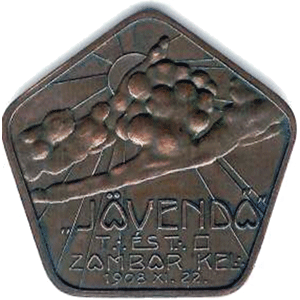
Medal of Daughter-Lodge Jövendő (photo supplied by Josip Šosberger)
Medalja venčića Lože Jövendő (fotografiju ustupio Josip Šosberger)
|
OSNIVANJE LOŽE JÖVENDŐ (kasnije Budućnost) Iako je somborsko slobodno zidarstvo oduvek bilo obavijeno nekom vrstom polutajne, po gradu se pričalo da postoje slobodni zidari i pominju se sledeća imena: Šimon Abelsberg (Abelsberg Simon) ml., žitarski trgovac, Dr. Janoš Duhon (Duchon János) lekar, Dr. Jožef Lajoša Cajzl (József Lajos Czeisel), advokat, Dezider Cetl (Cettl Dezső), službenik, Jožef Erlih (Ehrilch József) ml, limar, Dr. Isidor Gabor, advokat, Dr. Rudolf Gal (Gál Rezső), advokat, Bela Goldfan (Goldfahn Béla), slikar, Lajoš Guljaš (Gulyás Lajos), fabrički radnik, domaćin lože, Jene Feher (Fehér Jenő), inženjer, Dr. Martin Kaboš (Kabos Márton), lekar, Ignac Kende (Kende Ignácz), glavni inženjer, Đula Komaromi (Komáromy Gyula), finansijski savetnik, Vilim Levi (Löwy Vilmos), trgovac, Dr. Nikola Maksimović, veleposednik, Martin Matić, advokatski pripravnik, Isidor Novaković, profesor Više trgovačke škole, Dr. Bela Por (Poór Béla), advokat, Alajoš Ridler (Riedler Alajos), direktor mlina u Sivcu, Janoš Šabranski (Sabranszky János), inženjer, Aleksandar Špicer (Spitzer Sándor), trgovac, Aladar Tomčanji (Tomcsányi Aladár), Vilim Vago (Vágó Vilmos), direktor banke, Mikloš Jablonski (Jablonszky Miklós), šef policije, Dezider Vajdinger (Weidinger Dezső), veletrgovac, Janoš Žigmond (Zsigmond János), podbeležnik, Vilim Krump (Krump Vilmos) , Šoma Rac (Rácz Soma), profesori, Erne Žuljević (Zsulyevity Ernő), direktor Trgovačke škole i dr. Zaista osnivaju Ložu pod nazivom Jövendő u koji se unosi svetlo 22. novembra 1908. godine. Somborci, članovi Loža Arpad u Segedinu i Honszeretet u Baji, prelaze u somborsku Ložu, a tu su i oni članovi venčića Filantropija koji nisu, u kriznim godina po slobodno zidarstvo, napuštali Sombor. Nova Loža u Orijentu Sombor stavlja se pod zaštitu Simboličke Velike Lože Mađarske od koje traži pomoć u opremanju hrama. Na to su somborski slobodni zidari čekali punih 11 godina suočavajući se sa raznim problemima, počev od nesporazuma oko članarine sa matičnom ložom Arpad i Simboličkom Velikom Ložom Mađarske, do nemogućnosti da obezbede hram za svoje sastanke i rituale. Konačno, 1908. godine je kupljena kuća u Pašinoj ulici (sadašnja Dositejeva) br. 9 za 17.000 kruna koja se pokazala pogodnom i u kojoj se radilo sve do 1930. godine kada su uspeli da kupe novu kuću za hram, u ulici Nikole Vukičevića br. 16, današnjem "Magnetu". Gimnazija
Pečat Lože Jövendő |
FORMATION OF LODGE JÖVENDŐ Although the Freemasonry of Sombor was under a veil of secrecy, a few articles appeared in the local press by the end of 1908 saying that Freemasons did exist in the city; the following names were mentioned: Simon Abelsberg Jn., grain trader, Dr János Duchon, physician, Dr József Lajos Czeisel, solicitor, Dezső Cettl, clerk, József Ehrilch Jn., tinsmith, dr. Isidor Gábor, solicitor, Dr Rezső Gál, solicitor, Béla Goldfahn, painter, Lajos Gulyás, factory worker and lodger, Jenő Fehér, Márton Kabos, physician, Ignácz Kende, chief engineer, Gyula Komáromy, financial advisor, Vilmos Löwy, trader, Dr Nikola Maksimović, land owner and politician, Martin Matić, law student, Isidor Novaković, Trading School teacher and bank manager, Dr Béla Póor, solicitor, Alajos Riedler, director of the mill in Sivac, János Sabranszky, engineer, Sándor Spitzer, trader, Aladár Tomcsányi, Vilmos Vágó, bank manager, Miklós Jablonszky, chief of police, Dezső Weidinger, wholesaler, János Zsigmond, notary public, Vilmos Krump and Soma Rácz, teachers, Ernő Zsulyevity, director of the School of Economics and others. Indeed, the above-mentioned people set up a Lodge called Jövendő, which was consecrated on 22nd November 1908. Sombor Freemasons, members of Lodge. Árpád and Lodge Honszeretet, returned to the Sombor Lodge and joined those members of Daughter-Lodge Philanthropia who had not left Sombor in those years of crisis. The new Lodge in the Orient Sombor was placed under the protection of the Symbolic Grand Lodge of Hungary, from which it sought help in furnishing the Masonic Hall. The Freemasons of Sombor had been waiting for that for 11 years, having to deal with a variety of problems, from misunderstandings with Lodge Árpád and the Symbolic Grand Lodge of Hungary about membership fees to the inability to provide a masonic hall for their meetings and rituals. Finally, in 1908 a house was purchased for 17,000 crowns at No. 9 Pasha Str., which proved to be suitable for the purpose, serving as such until the year 1930 when a new house at today's no. 16 Nikola Vukičević Street was bought. The Grammar School (Gymnasium)
Seal of Lodge Jövendő |

|
ČLANOVI LOŽE JÖVENDŐ, ORIJENT SOMBOR OSNOVANE 22. NOVEMBRA 1908. GODINE Prezime i ime, profesija, grad, datum |
MEMBERS AND PETITIONERS TO LODGE JÖVENDŐ ESTABLISHED NOVEMBER 22, 1908 Surname and name, Profession, City, Date of |
|
STATUT LOŽE JÖVENDŐ Primedba: navedene ispravke dala je Velika Loža. DEO PRVI Član 1. Član 2. Član 3. Član 4. Član 5. Član 6. DEO DRUGI Član 7. Član 8. Član 9. DEO TREĆI Član 10. Član 11. Član 12. Član 13. Član 14. Član 15. Član 16. Član 17. Član 18. Član 19. Član 20. Član 21. Zadaci odbora su da: Član 22. Član 23. DEO ČETVRTI Član 24. Član 25. DEO PETI Član 26. Član 27. Član 28. Član 29. Član 30. 2. Članarine Član 31. Član 32. Član 33. 3. Naknade za uzdizanje Član 34. Član 35. 4. Udovička kesa Član 36. DEO ŠESTI Obaveze članova Lože Član 37. DEO SEDMI Član 38. Član 39. DEO OSMI 1. A Starešina Član 40. Član 41. Član 42. Član 43. 2. Ostale funkcije u Loži Član 44. Član 45. DEO DEVETI Član 46. Član 47. Član 48. Član 49. Član 50. Član 51. Član 52. Član 53. Član 54. Član 55. Član 56. Član 57. Član 58. Član 59. Član 60. DEO DESETI Član 61. Član 62. Član 63. DEO JEDANAESTI Član 64. DEO DVANAESTI Član 65. Član 66. Član 67. DEO TRINAESTI Član 68. Član 69. Član 70. Član 71. DEO ČETRNAESTI Član 72. Raspravljeno i prihvaćeno 26. juna 1909. godine na prvostepenom radu Lože pod nazivom Jövendő. Potpisano od strane sledećih:
Dr. Janoš Duhon, Starešina; Dr. Adolf Feleš, Sekretar; Šoma Rac, Besednik; Dr. Filip Griner, I Nadzornik; Dr. Šagi Šamuel, II Nadzornik; Overeno okruglim pečatom Lože: Na kraju 1909. godine somborska loža ima 37 članova od kojih je 26 iz Sombora, po 2 iz Palanke i Bogojeva, te po 1 iz Bezdana, Kule, Odžaka, Pančeva, Gedele-a (Gödöllő), Mitrovice i Sv. Lerinca (St. Lőrinc). Prvi Oficiri lože 22. 11 1908. su sledeća braća: |
RULEBOOK OF LODGE JÖVENDŐ Note: The corrections and additions were made by the Grand Lodge. PART ONE Article 1 Article 2 Article 3 Article 4 Article 5 Article 6 PART TWO Article 7 Article 8 Article 9 PART THREE Article 10 Article 11 Article 12 Article 13 Article 14 Article 15 Article 16 Article 17 Article 18 Article 19 Article 20 Article 21 The Committee's responsibilities are to: Article 22 Article 23 PART FOUR Article 24 Article 25 PART FIVE Article 26 Article 27 Article 28 Article 29 Article 30 2. Membership fees Article 31 Article 32 Article 33 3. Fees for raising Article 34 Article 35 4. Almoner's purse Article 36 PART SIX Obligations of Lodge members Article 37 PART SEVEN Article 38 Article 39 PART EIGHT 1. Worshipful Master Article 40 Article 41 Article 42 Article 43 2. Other functions in the Lodge Article 44 Article 45 PART NINE Article 46 Article 47 Article 48 Article 49 Article 50 Article 51 Article 52 Article 53 Article 54 Article 55 Article 56 Article 57 Article 58 Article 59 Article 60 PART TEN Article 61 Article 62 Article 63 PART ELEVEN Article 64 PART TWELVE Article 65 Article 66 Article 67 PART THIRTEEN Article 68 Article 69 Article 70 Article 71 PART FOURTEEN Article 72 Discussed and accepted on 26th June 1909, at the first-degree work of the Lodge called Jövendő. Signed by the following Freemasons: Certified by the round seal of the Lodge: At the end of 1909, the Sombor Lodge had 37 members, of whom 26 were from Sombor, 2 from Palanka and Gombos (Bogojevo) respectively and 1 from Bezdán, Kúla, Hódzsák (Odžaci), Pancsova (Pančevo), Gödöllö, Mitrovica and St. Lörinc respectively. The officers of the Lodge on the day of 22nd November 1908 were the following Brethren: |
|
MASONSKI DOKUMENTI I POSTUPAK PRIJEMA PRIKAZAN NA PRIMERU DR. ADOLFA FELEŠA Biografski podaci Dana 22. novembra 1908. godine, somborski venčić prerasta u SZ Ložu pod zaštitom Lože Arpad. Ima 9 članova, a privremeni Starešina je Dr. Janoš Duhon (Dr. Duchon János), katolik, somborski lekar. Privremeni Sekretar lože je Adolf Feleš, Jevrejin, lekar, rođen u mestu Bodrog — Monoštorseg u blizini Sombora (Bodrogh-Monostorszegh) 22. septembra 1865. godine, sin Ignaca Feleša (Feles Ignácz) i Neti Blau (Blau Netty). Kumovi su mu dr. Ignac Goldštajn (Goldstein Ignácz) i Lipot Baranj (Bárány Lipót). Izvor: Jevreji venčani u Somboru 1886-1942, autor: Milenko Beljanski. Strana 10, tačka 36.) Pohađao je Somborsku gimnaziju gde je i maturirao1884. godine. Profesor, a kasnije i kolega, bio mu je Šoma Rac (Rácz Soma), najznačajniji somborski mason do sada. U istoj gimnaziji je predavao predmet zdravstveno vaspitanje u svih osam tadašnjih razreda sa fondom od dva časa nedeljno. Pored rada u školi i redovne lekarske prakse, koju ubrzo napušta, osnovao je Institut za pripremanje vakcine protiv velikih boginja koja je krajem 19. i početkom 20. veka odnela mnoge živote. Dr. Adolf Feleš u Somboru, 01. marta 1897. pokreće i uređuje časopis Lekarska pitanja (Orvosügy) na mađarskom jeziku koji je bio više od državnog no lokalnog značaja. Časopis je bio izuzetno progresivan baveći se pitanjima osnivanja socijalnih institucija, penzionisanja lekara (što u to vreme nije postojalo), osnivanjem fonda za pomoć lekarima, njihovim udovicama i deci koja su ostala bez roditelja, radom lekara u otežanim uslovima. Časopis je pokrenuo ideju o osnivanju Lekarskog društva i stalno se borio protiv sujeverja i nadrilekarstva, a bavio se i istorijatom medicine i lekarske službe u tadašnjoj zemlji. U Lekarskim pitanjima su se objavljivali i oglasi za nove lekove, gorku vodu, banje, kao i Institut za spravljanje vakcine protiv velikih boginja. Jedan od istaknutijih saradnika u časopisu bio je i Dr. Janoš Duhon, prvi Starešina lože Jövendő. Skoro svi somborski slobodni zidari su početkom 20. veka, po osnivanju Slobodnog liceja, društva za unapredjivanje nauke i opšteg znanja, pa tako i dr. Feleš, redovno držali predavanja za građanstvo iz domena svojih struka i posebnih interesovanja. Dr. Feleš postaje slobodni zidar 1902. godine u segedinskoj lozi Arpad. 1911. godine, nakon 20-godišnjeg rada u somborskoj Gimnaziji i 9 godina aktivne SZ uloge u gradu, Dr. Adolf Feleš se seli u Budimpeštu. O njegovoj eventualnoj daljoj ulozi u somborskom slobodnom zidarstvu nema podataka. Umro je u Budimpešti 26. aprila 1918. godine, gde je i sahranjen. Tekst koji sledi prevod je molbe Adolfa Feleša za prijem u segedinsku ložu Arpad. Iz ovog dokumenta, kao i ostalih dokumenata u prilogu, može da se sagleda spektar dokumenata u tadašnjem postupku, način pisanja i sadržaj priloženih biografija, kao i postupak formiranja konačnog mišljenja o kandidatu. MOLBA ZA PRIJEM Datum rođenja: 22. septembar 1865. A) Dajući svoju časnu reč, da li izjavljujete, da se nikad niste ukaljali nikakvim nečasnim delom? Na svoju čast izjavljujem. B) Da li se ikad protiv vas vodio sudski postupak, ako da gde i sa kakvim ishodom? Nije se vodio postupak. C) Da li ste već upućivali molbu za prijem nekoj drugoj loži i kakav je bio ishod vaše molbe? Nisam. Za gornje izjave preuzimam odgovornost: Sombor, 16. aprila 1902. godine. Uvaženi Brat Dr. Janoš Duhon. PRIMEDBA: kratka biografija i portret molioca priključiv je ovom listu. KRATKA BIOGRAFIJA Srednju školu pohađao sam u somborskoj Velikoj Gimnaziji, gde sam maturirao 13. juna 1884. godine. Studije medicine sam zavšio na budimpeštanskom Naučnom fakultetu, odsek medicina, gde sam i stekao diplomu lekara 19. aprila 1890. godine. Vojni rok sam služio godinu dana, 1887.-88. godine, kao dobrovoljac u sanitetskoj službi . Po sticanju fakultetske diplome, postajem rezervni lekar asistent u zajedničkoj vojsci. 1894. godine, nakon oružane obuke, postavljen sam za vojnog lekara Mađarske kraljevske vojske, a od 1898. godine sam, kao takav, u rezervnom sastavu. 06. avgusta 1893. godine, stupio sam u brak sa Elom Šliser (Schlieszer Ella), ćerkom pokojnog Emanuela Šlisera i žene mu Berte Kaufman. U toku braka nam se rodilo dvoje muške dece. U radu Somborskog lekarskog društva, osnovanom 1896. godine, uzeo sam aktivnog učešća. Od osnivanja do protekle godine bio sam sekretar Društva. 1895. godine, uz dozvolu Mađarskog kraljevskog Ministarstva unutrašnjih poslova, osnovao sam Zavod za spravljanje vakcine protiv velikih boginja. Zbog zauzetosti radom u Zavodu prestao sam obavljati svoje dužnosti lekara opšte prakse, te se isključivo bavim spravljanjem vakcine protiv velikih boginja i zubarstvom. 1890. godine, napisao sam stručni rad na temu "Mortalitet od velikih boginja u Mađarskoj nakon uvodjenja Zakona o inokulaciji protiv velikih boginja 1887. godine, u odnosu na mortalitet od velikih boginja u drugim, razvijenim zemljama", o čemu sam obavestio i više stručnih casopisa". Svojeručno pisani biografski podaci su verovatno nepotpuni jer dokument na sledećoj strani nije kompletan. ISPITIVANJE KANDIDATA Za Brata Šomu Raca (Rácz Soma). Nakon što je molba primljena, Starešina Lože Árpád imenovao je Istražni odbor čiji su članovi bili Šoma Rac, Mor Kelo i Janoš Duhon. Komitetu je data dužnost da otkrije da li je Adolf Feleš dobro situiran i dostojan da postane član lože Arpad. Njihovi izveštaji su napisani na standardnom obrascu: U skladu sa čl. 175 Konstitucije, molim te da u vezi molioca Dr. Adolfa Felesa obaviš neophodnu inspekciju, te da me, u roku od tri sedmice, obavestiš da li ga njegovo materijalno stanje, reputacija i karakter čine pogodnim za prijem u zajednicu slobodnih zidara. Podaci o njegovoj biogafiji i drugi informativni podaci na raspolaganju su ti u Sekretarijatu. Sa bratskim pozdravom IZVEŠTAJ ŠOME RACA Uvaženi starešino, draga braćo, IZVESTAJ MORA KELEA Dr. Adolfa Feleša poznajem dugo vremena i mogu da vas izvestim da ga njegovo materijalno stanje, reputacija, te karakter čine pogodnim i dostojnim da se inicira u našoj zajednici, te ga ovim preporučujem. IZVESTAJ JANOŠA DUHONA Uvaženi starešino, draga braćo, Iz gornjih dokumenata se ne vidi samo postupak pripreme prijema kandidata, već se može shvatiti ljudska dimenzija odnosa koji može da potekne iz profanog sveta i prenese u svet slobodnog zidarstva, gde se još i dalje obrađuje na dobrobit sve Braće. Na osnovu drugih dokumenata, koje ovde nisam naveo, jasno je da su se akteri ove male slobodnozidarske priče poznavali i pre no što su postali to što su bili, te da su svoje odnose produbili na najbolji način. Adolf Feleš je bio pripadnik osme generacije maturanata somborske Gimnazije 1884. godine, Janoš Duhon je bio dve godine mlađi od njega položivši veliku maturu 1886. godine, a Šoma Rac je bio profesor iste škole 34 pune godine, izmedju 1886. i 1920. godine i njen direktor u dva navrata (1912-1913 i 1918.), a dr. Feleš i dr. Duhon su u somborskoj Gimnaziji bili školski lekari i nastavnici zdravstvenog vaspitanja, dr. Adolf Feleš od 1891. do 1911. godine, a dr. Janoš Duhon dva meseca u toku 1911. godine. Profesor Šoma Rac je, na osnovu činjenica i dokumenata, morao da bude veoma ugledan član segedinske lože Arpad, a kasnije i somborskog venčića Filantropija, jer je odigrao značajnu ulogu u pisanju izveštaja o pogodnosti i dostojnosti prijema novih članova širom Vojvodine. Bio je savestan, iskren i iskusan slobodni zidar, koji je, upkos određenih nedostataka u ličnosti kandidata koji su bili predmet njegove inspekcije, kao što je na pr. naveo u svom izveštaju o Dr. Felešu, imao "oko" za pravog kandidata koji će moći da da značajan doprinos svojoj Loži. Dr. Adolf Feleš je, 6 godina po prijemu, postao Sekretar Lože, a kasnije i Starešina. Neosporno je da su izveštaji presudni za prijem kandidata, ali na plećima sastavljača izveštaja veliki je teret. Primer na koji sam naišao u starim dokumentima sa kraja 19. i početka 20. veka odličan je primer kardinalne greške u izveštavanju o moralnim i ljudskim kvalitetima kandidata. Naime, kandidata Jakoba Fišera nisu primili u segedinsku Ložu sa obrazloženjem da je agresivan. Gosp. Fišer je uputio molbu loži Domoljublje(Honszeretet) u Orijentu Baja, gde su njegov slučaj istražili i ustanovili da je "proglašen" agresivnim samo zato što se bavio boksom. |
FREEMASONIC DOCUMENTS AND THE PROCEDURE OF ADMISSION — EXAMPLE OF DR. ADOLF FELES, THE FIRST SECRETARY OF LODGE JÖVENDŐ Biographical data On 22nd November 1908, the Sombor Daughter-Lodge grew into a Saint John constituent lodge under the protection of the Symbolic Grand Lodge of Hungary. There were 9 members, and the temporary Worshipful Master was Dr János Duchon, physician and Catholic. The temporary secretary of the lodge was Adolf Feles, a Jew, physician, born in Bodrog - Monostorszeg near Sombor on 22nd September 1865, son of Ignácz Feles and Netty Blau. (Source: Milenko Beljanski, Jews Married in Sombor 1886-1942, p. 10, item 36.) In addition to working at a school and his regular medical practice, which he abandoned, he founded the Institute for the Preparation of smallpox vaccine. The said disease killed a number people at the end of the 19th and early 20th centuries. On 1st March 1897, Dr Adolf Feles started and edited the journal Orvosügy (Medical Matters), published in Sombor in the Hungarian language, which was more of a national than local publication. The journal was extremely progressive, dealing with: the issues of formation of social institutions, providing retirement benefits for doctors (which did not exist at the time), and creation of a fund for helping deceased doctors' families as well as easing the difficult conditions doctors were working in. The magazine launched the idea of founding a Medical Association and was consistently striving against superstitions and quackery, and also dealt with the history of medicine and medical services in the country. Advertisements for new drugs, bitter water, spas, as well as the Institute for the Preparation of Small Pox Vaccine were also published. One of the prominent contributors to the magazine was D. János Duchon, the Worshipful Master of Lodge Jövendő. At the beginning of the 20th century, almost all Sombor Freemasons, including Dr Feles, held lectures for local citizens at the Free Lyceum, the Society for the Advancement of Science and General Knowledge. The text that follows is the translation of Dr Adolf Feles's petition for admission to Lodge Árpád (from the Hungarian National Archives, Section P). From this document, as well as other documents attached, one can see the spectrum of documents in the former admission process as well as the language and contents of the attached short C.V., and the procedure for forming a final opinion on a petitioner. Petition Date of birth: 22nd September 1865 A) By giving your word of honour, do you declare that you have never committed any discreditable deed? I declare so giving my word of honour. B) Have you ever been tried, if so where and with what outcome? I have never been tried. C) Have you already petitioned to another lodge and what was the outcome of your petition? I have not petitioned. For the above statements, I take full responsibility: Made at Sombor, 16th April 1902. Honourable Brother Dr János Duchon. NOTE: a short biography and a photo of the petitioner are attached to this sheet. (no photo attached, Short C.V. of Bro. Adolf Feles: I attended the Sombor Gymnasium completing it on 13th June 1884. I studied medicine at the Budapest Faculty of Science, Department of Medicine, where I was awarded the medical doctor's degree on 19th April 1890. I served my military term for a year, 1887-88, as a volunteer in the Military Sanitary Service. After gaining a university degree, I became a reserve medical assistant in the joint army. In 1894, after armed training, I was appointed military doctor of the Hungarian Royal Army; since 1898 I have been a member of the reserve corps. On 6th August 1893, I got married to Ella Schliesser, daughter of late Emanuel Schliesser and his wife, Bertha Kauffmann. During the marriage, we got two male children. I took an active part in the work of the Medical Society of Sombor, founded in 1896. From its foundation until last year I was the Secretary of the Society. I founded the Institute for the Preparation of Small Pox Vaccine, approved by the Hungarian Royal Ministry of the Interior in 1895. Due to my absorption in the work at the Institute, I abandoned my G.P. practice. Now, I am dealing exclusively with the vaccination against smallpox as well as dentistry. In 1890, I wrote a paper titled "Small Pox Mortality in Hungary after the Introduction of the Law on Inoculation against Small Pox in 1887 Compared to Small Pox Mortality in other, Developed Countries," which I sent to a number of professional journals. (The holograph is probably incomplete because the following page is incomplete TN). Investigation of the candidate (printed form) For Brother Soma Rácz. After the petition had been received, the Worshipful Master of Lodge Árpád appointed an Investigative Committee whose members were Soma Rácz, Mór Kelo and János Duchon. The Committee was assigned the duty to find out whether Adolf Feles was well-qualified and worthy of becoming a member of Lodge Árpád. Their reports were written on a standard form: In accordance with Article 175 of the Constitution, I am asking you to carry out a necessary investigation into the petitioner, Dr Adolf Feles, and to inform me, within three weeks, whether his material status, reputation and character make him suitable for admission into the community of Freemasons. His biodata and other information are available at the Secretariat. With Brotherly greetings Report by Bro. Soma Rácz Dear Worshipful Master, dear Brethren, Report by Bro. Mór Kelo I have known Dr Adolf Feles for a long time and I can tell you that his material status, reputation, and character make him suitable and worthy to be initiated into our community and I hereby recommend him. Report by Bro. János Duchon Dear Worshipful Master, dear Brethren,
The petitioner, Dr Adolf Feles, is not only my contemporary, but he is my dear friend as well. Our friendship reaches well into the past. During that time, I have had ample opportunity to get to know his character and way of thinking. We all have bigger or smaller weaknesses, and so does the petitioner Feles. However, these weaknesses are so neglibible in comparison with his good traits, among which I have to mention his good heart, humanistic attitude, very sincere collegiality, that his admission is well supported. I do not only know his extraordinary Freemasonic qualities on the basis of belonging to his circle of friends, but also on the basis of his excellent reputation. His financial situation is stable, like everything else you have asked me about, and my answer is that I warmly recommend him for admission. From the above documents, the reader may not only see the process of preparation for admission of a candidate but the human dimension of the relationship that can come from the profane world and be transferred to the world of Freemasonry, where it is subjected to further processing for the benefit of the Brotherhood. On the basis of these and other documents that I have not mentioned here, it is clear that the actors of this short Masonic story had known each other even before they became what they were, and they deepened their relations in the best way. Adolf Feles was a member of the eighth generation of graduates of the Sombor Grammar School 1884, János Duchon was two years younger than him, having passed the "Matura" in 1886, and Soma Rácz was a teacher at the same school for 34 years, between 1886 and 1920, and her director on two occasions (1912-1913 and 1918). D. Feles and Dr Duchon were school doctors and teachers in the same Gymnasium, Dr Feles from 1891 to 1911, and Dr János Duchon for two months in 1911. 6 years after his initiation, Dr Adolf Feles became the Secretary and later the Worshipful Master of Lodge Jövendő. Based on facts and documents we may conclude that Prof. Soma Rácz, must have been a very respectable member of Lodge Árpád, and later of Daughter-Lodge Philanthropia, since he contributed a number of investigative reports on the suitability of petitioners for admission covering a larger part of Vojvodina. He was a conscientious, honest and experienced Freemason who, despite certain shortcomings in the personality of the subjects of his investigations, had an eye for the right candidate who would very likely make a significant contribution to the Lodge they were admitted to. Indisputably, investigative reports are crucial for a petitioner's admission but are also a weight of the world on the investigator's shoulders. An example I encountered in the old documents from the late 19th and early 20th centuries is an excellent example of a cardinal error in reporting on the moral and human qualities of a petitioner. Namely, the petition to Lodge Honszeretet of candidate Jakob Fischer was turned down due to his "aggressiveness." On closer investigation of his case, it was found that he was declared aggressive just because he pursued boxing as a sport. |
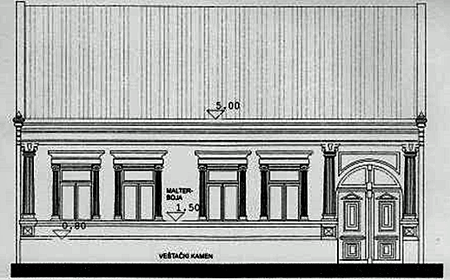
The house at No. 9 Pasa Str. - demolished in 2007 (photo by the author)
Kuća u Pašinoj ulici br. 9 - srušena 2007 (fotografija autora)
|
DOGAĐANJA, KORESPONDENCIJA I VAŽNIJI MOMENTI IZ ŽIVOTA LOŽE: 1909. godina 02. Januara, po običaju godišnje smene, birani su novi Oficiri lože. Starešina i Sekretar su ostali isti. Ivan Barci, Ignac Kende, Lajoš Rais i Jožef Volhajmer bivaju uzdignuti na 3°. 09. januara Vilmoš Levi, Janoš Šabranski i Aleksandar Šliser bivaju uzdignuti na 2o. Pismo SVLM u kojem se loža zahvaljuje na privremenoj dozvoli za rad. 18. Januara Aleksandar Biterman, Jožef Erlih ml., tokar (upisan kao limar), rođen u Salzburgu, Aleksandar Špicer i Aron Vamošer bivaju inicirani. 30. Januara, Sekretar Adolf Feleš upućuje pismo Otu Trautmanu u Simboličku Veliku Ložu Mađarske moleći ga da se časopis Istok (Kelet) ubuduće šalje na kućne adrese pretplatnika, a ne na adrese radnih mesta, gde imaju zbog toga razne neprijatnosti. 02. Februara održava se komemorativni rad - sećanje na preminulog Velikog Majstora Velikog Orijenta Mađarske, Đorđa Joanovića. 05. Februara od Simboličke Velike Lože Mađarske se traži 25 kom. blanko majstorskih diploma. 08. Februara sekretar Dr. Adolf Feleš upućuje ponovo istu molbu kao 30. januara, a takođe moli da Velika Loža potvrdi izbor oficira lože. 18. Februara Sekretar traži od Simboličke Velike Lože Mađarske da mu potvrdi prijem Izveštaja za 1908. godinu koji je poslao u januaru. 25. Februara ne odgov Simbolička Velika Loža Mađarske ara na molbu, ali traži da somborska loža plati 179 kruna duga i zaostali dug Filantropije od 68 kruna. 09. Marta Velika Loža ponovo traži isplatu duga, ali ovoga puta navodi da je to dug za lente koje je Velika Loža platila. 15. Marta Sekretar lože traži od Velike Lože da im otpiše dug od 413 kruna koji VL traži na ime nabavke opreme za Ložu pozivajući se na činjenicu da je Veloika Loža nekim ložama tu vrstu duga otpisala. Beleška na poleđini pisma: "S obzirom na tešku materijalnu situaciju, Velika Loža odbija molbu". Navodimo primer dnevnog reda ritualnog rada u subotu, 08. Maja 1909. godine u 18,00 sati: 08. Maja Br. Volhajmer drži predavanje. 29. Maja se održava zajednički rad na I stepenu sa budimpeštanskom Ložom Etveš (Eötvös). Žbukanje se održava u hramu lože. 12. Juna rad na prvom stepenu. Prijem novaka Dr. Rudolfa Gala (Gál Rezső) iz Sombora kao i Emila Kiršnera (Kirschner) i Dr. Jožefa Sekea (Szőke József) iz Palanke. Dr. Dušan Knezi (Knézy Lehel) drži predavanje o sekularizaciji. 24. Juna loža upućuje Velikoj Loži dokument o prijemu Dr. Rudolfa Gala, ali VL, tek 24 novembra iste godine odgovara da nema saznanja da je spomenuti brat ikad prijavljen kao molilac. Loža odgovara 03. decembra da je Dr. Reže Gal svoju molbu uputio loži Domoljublje, Orijent Baja još 12. juna 1908. godine. 26. Juna održava se ritualni rad III stepena u 18,00, a II stepena u 17,00. Br. Ivan Barci (Bárczi Iván) drži predavanje o inicijativi lože Unija (Union) . Na 3o uzdižu se: Karlo Berec (Berecz Károly), Vilmoš Krump (Krump Vilmos), Vilmoš Levi (Löwy Vilmos), Aleksandar Šliser (Schlieser Sándor) i Lajoš Gujaš (Gulyás Lajos), a na 2° Jene Feher (Fehér Jenő), Dr. Dušan Knezi (Knézy Lehel) i Rihard Vizinger (Wissinger Richárd). 23. Septembra Loža obaveštava Veliku Ložu da se radovi održavaju svake prve i treće subote u mesecu u novom hramu u Pašinoj ulici br. 9. u 19,00 sati. Istog datuma upućuje pismo Velikoj Loži u kom se kaže da se unošenje svetla planira za jednu od nedelja meseca novembra. U tom smislu, Loža će se potruditi da lokalni listovi budu obavešteni o događaju, te da se članci o slobodnom zidarstvu pojave na naslovnim stranicama. Takođe se planiraju predavanja u Slobodnom liceju, koji tradicionalno počinje sa radom u novembru, a predavanja se drže nedeljno sve do Uskrsa. Moli se Velika Loža da predavanje o ciljevima slobodnog zidarstva održi neko od budimpeštanske braće jer bi se tako privukla veća pažnja profanog sveta. 02. Oktobra održava se ritualni rad na I stepenu. Br. Reza Gal drži predavanje na temu "Socijalizam i socijalni pokret". 16. Oktobra ritualni rad I stepena. Ivan Barci drži predavanje o "Korespondenciji u vezi odluka lože Unija". 20. Oktobra razmotren je dopis Velikog Sekretara Bakonjija u vezi unošenja svetla u ložu Budućnost, koje se planira za 28. novembar. 01. Novembar. Pismo Velikom Majstoru. Ponovna molba da predavač u Slobodnom liceju bude osoba izuzetnog integriteta i opštepoznata široj javnosti. Takođe bi bilo dobro da o zvaničnom otvaranju Lože budu izveštavali i listovi glavnog grada. 03. Novembra dolazi pismo od Velike Lože u kom se traži da se odustane od javnog propagiranja slobodnog zidarstva, te da se otvaranje Lože obavi na uobičajen način pošto "vremena nisu pogodna za toliku javnu propagandu. Verujemo da se izlaskom pred javnost nanosi više štete nego koristi, a bilo bi inače teško naći takvog predavača koji bi u potpunosti odgovarao vašim zahtevima. Ako Braća obrate dužnu pažnju na moje strahove u vezi izlaska pred javnost i planirani rad obave isključivo u slobodnozidarskom krugu, o čemu očekujem vaš hitan odgovor, sa naše strane ćemo tada o događaju obavestiti sve lože koje rade pod našom zaštitom. Ako mi zdravlje dopusti, i sam ću prisustvovati svečanosti. Veliki Majstor". 06. Novembar. Ritualni rad na I stepenu. Dr. Rudolf Gal drži predavanje na temu "Pitanja socijalizma". 07. Novembra Velikoj Loži šalju se tri primerka Pravilnika na odobrenje. 09. Novembra Jövendő obaveštava Veliku Ložu o prihvatanju sugestija Velikog Majstora i konačnom datumu svečanog otvaranja Lože. U pismu sa istim datumom, Velika Loža obaveštava Ložu da je sa radošću primila vest da će se unošenje svetla obaviti u krugu slobodnih zidara. 13. Novembar. Simbolička Velika Loža Mađarske upućuje štampanu pozivnicu svim ložama pod njenom zaštitom na ritualni rad I stepena povodom unošenja svetla u Ložu Jövendő (Budućnost) Orijent Sombor, u nedelju 28. novembra sa početkom u 18,00 sati. Sličnu pozivnicu, sa dnevnim redom, upućuje i Loža Jövendő (Budućnost) . Pod tačkom 6. Sekretar Lože Br. Dr. Adolf Feleš će izneti istorijat lože, a Besednik Br. Šoma Rac će pod tačkom 7. upoznati prisutne sa radovima i programom Lože. 20. Novembra Loža šalje poduže pismo sa objašnjenjima i molbom da se Pravilnik u celosti prihvati. Ritualni rad I stepena. Predavanja drže Ivan Barci "O programu radova Lože" i Dr. Rudolf Gal "O socijalizmu". 21. Novembra Sekretar Feleš šalje telegram Dr. Jeneu Čukašiju (Csukásy Jenő) moleći ga da se založi na Savetu Velike Lože da se prihvati Pravilnik Lože koji je ranije poslat u Budimpeštu. 28. Novembra svečano otvaranje lože Jövendő i prijem molilaca Simona Abelsberga iz Palanke, te Dr. Martina Matića i Aladara Tomčanjija iz Sombora. Dr. Adolf Feleš upoznaje prisutne sa istorijatom slobodnog zidarstva u Somboru. Šoma Rac drži predavanje o ostvarenjima i programu lože Jövendő. Dr. Martin Kaboš drži govor o bratskom krugu. Svečano malterisanje. 4. decembar. Dopis Simboličkoj Velikoj Loži Mađarske u kom Jövendő obaveštava Veliku Ložu da daje podršku inicijativi Lože Etveš iz Budimpešte da se pokrene dnevni masonski list. Za to bi trebalo prikupiti 5.000 pretplatnika. Došlo se do broja 2400 pretplatnika koji su avansno uplatili pretplatu za 1 godinu. Ako se do 31. decembra 1910. list ne pokrene, uplaćena pretplata se vraća sa kamatom. 14. Decembar. Velika Loža u štampanom dopisu obaveštava sve lože pod svojom zaštitom da je na taj dan Loži Jovendő izdala saglasnost o radu. U pismu označenom istim datumom, Loža obaveštava Veliku Ložu da šalje 229 kruna (180 za članarinu, 24 za majstorske sertifikate i 25 za taksu za prijem 5-oro molilaca), te istovremeno moli Veliku Ložu da Loži oprosti dug od 301 krune 30 filera s obzirom da za opremanje hrama nije primila od Velike Lože nikakvu finansijsku pomoć. 16. Decembar. Loža sakuplja knjige od članova pa ih donira bolničkoj biblioteci. 18. Decembar. Sekretar Lože traži od Velike Lože da ubuduće šalje časopis Orijent na nemačkom jeziku na adresu Šimona Abelsberga ml., s obzirom da u Palanci živi i jedna druga osoba istog imena i prezimena. 1910. Godina 02. Januar, po običaju godišnje smene, birani su novi Oficiri Lože. Starešina i Sekretar su ostali isti. Ove godine su oformljeni iodbori: za privredu, pitanja od opšteg značaja i za saradnju sa sestrinskim ložama. 16. Januara iniciran je Lajoš Sabo (Szabó Lajos), glavni sekretar Štedionice, 28. februara Dr. Lajoš Jožef Cajzel (Ceisel József Lajos), advokat, 27. marta Đula Komaromi (Komáromz Gyula), finansijski savetnik, 10. aprila Karlo Polgar (Polgár Károly), pozorišni režiser, a 11. juna Isidor Novaković, direktor banke, kasnije profesor i direktor Ekonomske škole, jedan od najznačajnijih somborskih slobodnih zidara. 8. Marta Odbijaju se molbe molilaca Kalmana Čapoa (Csapó Kálmán) (8 crnih kuglica od ukupno 16) sa obrazloženjem da je dotični "uobražen, laktaš, tašt, da voli da ogovara i da prijem traži verovatno samo kao mogućnost uspostavljanja veza", Vase Stajića, profesora Učiteljske škole, jer "molilac je nemirnog duha, ne poštuje autoritet pretpostavljenih i ima ekstremne stavove" (2 crne kuglice, u izveštaju prepravljene na 3) i Bele Mohačija (Mohácsi Béla) sa sledećim obrazloženjem: "iako su ga ispitivači njegove ličnosti i finansijskog stanja jednoglasno preporučili za prijem, većem broju mlađih članova nije bio po volji". 02. Aprila Dr. Jožef Seke poziva svu Braću na druženje u Palanku. 12. Maja Br. Adolf Venecijaner (Venetianer Adolf) iz Subotice zatražio razrešnicu jer se u Subotici formira loža. - Juna meseca traži se od Velike Lože ukupno 150 formulara (po 50 razrešnica, matrikula i formulara za uzdizanje na viši stepen). Drže se sledeća predavanja 1911. Godina 31. Januara Filip Jakobi i Karlo Polgar uzdižu se na 2. stepen, a Aladar Tomčanji, Emil Kiršner, Dr. Jožef Seke, Jožef Žigmond i Karlo Polgar na 3. stepen. 11. Februara iniciraju se Vrbašani Robert Sajdl (Seidl Rübert), trgovac, Jožef Pehan (Pehán Jüzsef), slikar i Karlo Hegel, direktor Agrarne banke, te Palančani Dr. Jene Vermeš (Vermes Jenő), advokat, Kalman Tratner (Trattner Kálmán), veterinar, Janoš Tolnai (Tolnai János), nastavnik građanske škole i Imre Hondl, apotekar. Molba Velikoj loži da svu buduću prepisku šalje na profanu adresu Dr. Režea Gala. 16. Februara iniciran je Dezider Đenđeši (Gyöngyösi Dezső), direktor blagajne Društva za osiguranje radnika i Dr. Kalman Ribicei (Ribiczey Kálmán), sekretar nadžupana iz Novog Sada; a 6 oktobra Dr. Izidor Gabor, advokat iz Kule i Dezider Cetl (Cettl Dezső), službenik somborske Štedionice; 18. Novembra Bela Goldfan (Goldfahn Béla), somborski slikar. 18. Marta šalje se dopis Velikoj Loži u kojem se navodi da će na sednici Velike Skupštine interese lože Budućnost predstavljati Brr. Šoma Rac, Dr. Deže Gal i Dr. Martin Matić. 15. Maja novoizabrani sekretar lože Dr. Rudolf Gal šalje Velikoj Loži memorandum profesora somborske Gimnazije pod naslovom Memorandum akatoličkih nastavnika povodom delovanja Marijanske kongregacije te institucije (Marijanska kongregacija je takav katolički dušebrižnički pokret, zasnovan na učenjima Ignacija Lojole, koji propagira uticaj rimokatoličke crkve). Memorandum od šest punih kucanih strana napisao je profesor Šoma Rac u ime svih nekatoličkih profesora Gimnazije, a Dr. Rudolf Gal ga šalje Velikoj Loži "zbog eventualnog korišćenja u radovima". Profesor Šoma Rac počinje rečima: "Saznali smo da je deo naših učenika privučen u Marijansku kongregaciju. Iako ne želimo da ikoga sprečavamo u praktikovanju svoje vere, smatramo delovanje tog udruženja uvredljivim pozivajući se na slobodu savesti…" i nastavlja: "… Ovo je državna institucija u kojoj svako ostvaruje pravo na religiozna saznanja u skladu sa učenjima koja prenose sveštenici njegove i vere i koja se ostvaruje kroz predmet veronauka, u skladu sa tim… U ovoj višenacionalnoj sredini, gde mađarski narod ulaže velike napore da održi svoj nacionalni identitet, delovanje kongregacije samo produbljuje jaz u dušama mladih ljudi i zauvek razbija odnose, podižući zidove. Kod nas je pripadnost različitim veroispovestima ne samo pitanje savesti, već označava i rasno i nacionalno razjedinjenje, te mi koji nastojimo da odgojimo omladinu aktivnu, spremnu na prevazilaženje razlika, strpljivu i tolerantnu, koja će sve ljude, svoje bližnje, tretirati jednako, sa bolom u srcu otkrivano da se jedan deo naše omladine striktno i tajno odvaja od ostalih, tako da zajednički rad time biva onemogućen...". U daljem, bolnim rečima se pita: "…udruženje deluje tajno, zahtevajući od članova da polože zakletvu. Pitamo se da li se od deteta u razvoju (u gimnaziju se tada polazilo sa 11 godina) može tražiti ozbiljna i duboka moralna prisega? …" i dalje "… kako se od deteta može zahtevati verska isključivost i netolerantnost? … zato smo mi, profesori, protiv… dalji razlozi su pedagoški … udruženje, a samim svojim nazivom Marijansko društvo neosporno se radi o udruženju, nema nikakve veze sa slobodnom religioznom praksom … u religioznoj praksi moraju da učestvuju održavajući sastanke zakazane u određeno vreme gde moraju da budu prisutni… Po Statutu škole, u školi mogu da deluju samo ona društva i udruženja u kojima je članstvo otvoreno za sve, bez obzira na veroispovest i nacionalnost… Čudno je, međutim, da u nekim drugim državnim institucijama par excellence postoje katolička društva… ovo je osiromašenje duhovnog sveta mladih … cilj nas, profesora, je da stvaramo otvorene, iskrene ličnosti koje će slobodno iskazivati ono što je dobro i plemenito...Ovo je protivno i Državnom dekretu br. 751 iz 1887. godine u kom se kaže da … ovakva udruženja mogu da deluju samo u cilju samoobrazovanja, samopomoći, te kao telesno-vaspitna i zabavna društva… Protivno je i članu 26. po kojem se aktivnosti udruženja mogu vršiti samo u zgradi institucije, a ne u zgradi Karmelićanske crkve … Sveštenici svake veroispovesti neka odgajaju svoju omladinu tako da budu visokih moralnih vrednosti i pobožne patriote, a ne borci za interese samo te veroispovesti, bez tolerancije prema drugim veroispovestima, jer time sprečavaju naš rad na razvijanju međusobne ljubavi i zajedničkog rada". 21. Decembra Loža Jövendő izvodi zajedničke radove sa subotičkom Ložom Alkotaš. Starešina Dr. Janoš Duhon iznosi pitanje pokretanja dnevnog slobodnozidarskog lista, a braća Dr. Rudolf Gal i Žigmond Varadi (Várady Zsigmond) iz Alkotaša zajednički drže predavanje o pitanjima izbornog zakona. 1912. Godina 1913. Godina 09. Septembra, Savez prava opšteg, jednakog, tajnog glasanja upućuje pismo Simboličkoj Velikoj Loži Mađarske u kom se zahvaljuje Loži Jövendő na doprinosu i prilogu od 50 kruna. 15. Oktobra, Dr. Reže Gal Velikom Majstoru šalje pozivnicu na predavanja koja će održati Ištvan Apati (Apáthy István), Starešina Lože Unija iz Kluža u Loži Jövendő na temu "Zašto smo slobodni zidari", te u Slobodnom liceju na temu "Razvoj i revolucija". 1914. Godina Simbolička Velika Loža Mađarske traži spisak aktivnih članova, prosvetnih radnika, a Loža dostavlja sledeći spisak: Šoma Rac, profesor Gimnazije, Vilmoš Krump i Aleksandar Sauer, profesori Ekonomske škole, Janoš Tolnai i Lajoš Furman, nastavnici građanske škole. 1915. Godina 23. Maja predavanje profesora Šome Raca "O reformi srednjih škola". Daljih podataka o radu Lože u toj godini, ni u godinama prvog svetskog rata nema. Nije nam poznato da li je Loža uopšte i radila, a takođe ni sudbina članova. Posedujemo dokument od 20. maja 1916. godine, saglasnost da Dr. Šamu Šagi predstavlja Ložu na Velikoj Skupštini i isti dokument za 1917. godinu. 1918. Godina - U toku 1918., između 02. februara i 27. Aprila, molbe su podneli i inicirani su sledeći molioci: Dr. Lajoš Kemenj (Kemény Lajos), okružni lekar rođen u Čonoplji, Jožef Freund (Freund József), zempljoposednik i fabrikant testera iz Starog Bečeja, Emil Makai (Makay Emil), upravnik Agrarne štedionice iz Sombora, Nandor Mesner (Meszner Nándor) iz Bačkog Brestovca, trgovac konopljom i Alajoš Rindler (Rindler Alajos), direktor mlina iz Sombora. |
EVENTS, CORRESPONDENCE AND IMPORTANT MOMENTS IN THE LIFE OF LODGE JÖVENDŐ The year 1909 2nd January - As per the provisions of the Constitution on the annual reshuffling of functions in the Lodge, new Lodge Officers were elected. The Worshipful Master and the Secretary were re-elected. The 3rd degree was conferred on Iván Bárczi, Ignác Kende, Lajos Raisz and József Wollheimer. 9th January - Vilmos Löwy, János Sabranszky and Sándor Schlieszer were raised to the 2nd degree. The Lodge sent a letter to the Symbolic Grand Lodge of Hungary thanking them for the temporary work permit. 18th January - Sándor Bittermann, József Ehrilich Jn., a tinsmith and turner born in Salzburg, Sándor Spitzer and Áron Wamoscher were initiated. They had lodged their petitions to Lodge Honszeretet in the Orient of Baja between 2nd December 1907 and 7th May 1908. On the same day, the Secretary of the Lodge sent a letter to the Symbolic Grand Lodge of Hungary requesting the Grand Lodge to send an approval of the constitution of L. Jövendo. The first letter with the same content was sent to the GL on 18th November 1908. The Lodge submitted the report for 1908 to the Symbolic Grand Lodge of Hungary i.e. for the last two months of the same year, from the establishment of the Lodge on 22nd November. It was pointed out that Daughter-Lodge Philanthropia had been able to raise funds for the purchase of their Masonic Hall, as well as the fact that Freemasonry was diffusing to new, southwestern parts of the country. The report was written in a lavish style, with profuse compliments. In the original document, a greater part of the text was crossed out by the Symbolic Grand Lodge of Hungary. The income-related portion (2400 crowns) and the expenditure of the Lodge (e.g. 2000 crowns to assist poor children, as well as 400 crowns for the celebration of the children's day, which was planned to grow into a traditional children's event from the following year) was not crossed out. The sentence relating to the successful work of the Free Lyceum was not crossed out either. At the end of the report, there was a note saying that a house in Pasa Str. 9 was purchased for 17,000 crowns for the Masonic Hall, It is today's Dositejeva Street, but the house was demolished in 2007 to give place to a modern eyesore housing a bank and a few flats. At the time, out of 37 twenty-nine members came from Philanthropia and the following works would focus on problems of furnishing the temple. The Lodge library contained 183 volumes. 30th January - The Secretary, Adolf Feles, sent a letter to Otto Trautmann in the Symbolic Grand Lodge of Hungary asking him to send the magazine Kelet (east) to the home addresses of subscribers in the future, and not to company addresses, where the subscribers worked since they met various inconveniences. 2nd February - A Lodge of Sorrow was held to commemorate the deceased Grand Master of the Symbolic Grand Lodge of Hungary, György Joannovics, who had died on 10th January 1909. 5th February - The Symbolic Grand Lodge of Hungary was requested to send 25 pcs. of blank Master Mason Certificates. 8th February - The Secretary, Dr Adolf Feles sent the same request as of 30th January again. He also asked the Grand Lodge to confirm the election of the Lodge Officers. 18th February - The Secretary asked the Symbolic Grand Lodge of Hungary to confirm the receipt of the 1908 report he had sent earlier in January. 25th February - The Symbolic Grand Lodge of Hungary did not respond to the request, but asked the Sombor Lodge to cover a debt of 179 crowns as well as the outstanding debt of 68 crowns of Daughter-Lodge Philanthropia. 9th March - The Grand Lodge asked for payment of the debt again, but this time they said it was the debt for the medals that the Grand Lodge had paid for. 15th March - The Secretary of the Lodge asked the Grand Lodge to write off a debt of 413 crowns, which the Grand Lodge was asking for, for the purchase of equipment for the Lodge, referring to the fact that some of the lodges under the protection of the Grand Lodge were written off their debt. In the Note on the back of the letter it says: "Due to the difficult financial situation, the Grand Lodge has turned the request down." In the attachment to a separate letter, the Secretary of the Lodge sent the signed Solemn Oaths of the newly-initiated Brethren and requested the Grand Lodge to send 25 pcs. of blank forms of the Solemn Oath. In another letter, furnished with the same date, four Master Mason Certificates were asked for, for the four new Master Masons. The following is an example of the agenda, of the tyled meeting held on Saturday, May 8, 1909 at 6 pm: 8th May - Bro. Wollheimer read a paper. 29th May - A 1st-degree joint work was held with the Budapest Lodge Eötvös. Dinner was organized in the temple of the Lodge. 12th June - 1st-degree work. Initiation was held of petitioner Dr Rezső Gál from Sombor, as well as Emil Kirschner and Dr József Szőke from Palanka. Dr. Lehel Knézy held a lecture on secularization. 24th June - The Lodge sent the initiation documents of Dr Rezső Gál to the Grand Lodge. The Grand Lodge did not respond until 24th November saying they had no knowledge of the aforementioned Brother ever being registered as a petitioner. The Lodge said, on 3rd December that Dr Rezső Gál had submitted his petition to L. Honszeretet in the Orient of Baja, on 12th June 1908. 26th June - A 3rd-degree ritual work was held at 6 pm and a 2nd-degree work at 5 pm. Bro. Iván Bárczi held a lecture on the initiative of Lodge Union. The 3rd degree was conferred on Károly Berecz, Vilmos Krump, Vilmos Löwy, Sándor Schlieser, Lajos Gulyás, Jenő Fehér, Dr Lehel Knézy and Richárd Wissinger. 23rd September - The Lodge informed the Grand Lodge that works were held every first and third Saturday in the month in the new Masonic Hall at no 9 Pasha Street at 19.00. On that same day, the Lodge sent a letter to the Grand Lodge saying that the consecration of the Lodge was planned for one of the weeks of November. In that sense, the Lodge would try to inform the local papers about the event and articles on Freemasonry would appear on cover pages. Lectures were also planned in the Free Lyceum, which traditionally opened its door in November, and lectures were held weekly until Easter. The Grand Lodge was asked to send a Brother from a Budapest lodge to hold a lecture on the objectives of Freemasonry since it would attract the attention of the profane world. 2nd October - A 1st-degree ritual work was held where Bro. Rezső Gál read his paper on "Socialism and Social Movement." 16th October - A 1st-degree tyled meeting was held. Iván Bárczi lectured on the correspondence in connection with the decisions of Lodge Union. 20th October - The letter from the Grand Secretary Bakonyi was discussed regarding the consecration of Lodge Jövendő, which was planned for 28th November. The Lodge asked the Grand Lodge again and explained the importance of lecturing at the Free Lyceum about the objectives of Freemasonry by one of the Brethren who would be well-known to the general public. A tyled meeting would be held in the Masonic Hall of the Lodge, dinner as well; in case of a large number of guests the dinner would be held at one of the restaurants and the guests would be accommodated at the "Vadászkürt" (Hunter's Horn) Hotel. 1st November - A letter was sent to the Grand Master reiterating that the lecturer at the Free Lyceum had to be a person of exceptional integrity and publicly well-known. It would also be good if the newspapers in the capital would report about the official consecration of the Lodge. 3rd November - A letter from the Grand Lodge arrived asking the Sombor lodge to refrain from a public propagation of Freemasonry and conduct the "opening" of the Lodge in the traditional way, since "… times are not suitable for such public propaganda. We believe that there may be more damage than benefit, and it would, anyway, be difficult to find such a lecturer who would fully meet your requirements. If the Brethren pay due attention to my fears about going public and carry out the planned work only in the Masonic circle, about which I expect your urgent response, we will then inform all the lodges that work under our protection about the event. If my health permits, I will attend the ceremony. Grand Master." 6th November - A 1st-degree tyled meeting was held where Dr Rezső Gál presented his paper "The Issues of Socialism." 7th November - Three copies of the Rulebook were sent to the Grand Lodge for approval. 9th November - Lodge Jövendő informed the Grand Lodge about acceptance of the suggestions of the Grand Master and the final date for the consecration of the Lodge. In a letter of the same date, the Grand Lodge informed the Lodge that it was happy to hear that consecration would be conducted within the Freemasonic circle. 13th November - The Symbolic Grand Lodge of Hungary sent a printed invitation to all lodges under their protection for the 1st-degree tyled meeting held for the consecration of Lodge Jövendő in the Orient of Sombor on Sunday 28th November starting at 6 p.m. A similar invitation, with the agenda, was also sent by Lodge Jövendő. Under item 6, the Secretary of the Lodge, Adolf Feles, was to expose the history of the Lodge, and the Orator, Soma Rácz, would introduce the participants with the works and the program of the Lodge, under item 7. 20th November - The Lodge sent a letter of explanation asking the Grand Lodge to accept the Rulebook in its entirety. A 1st-degree tyled meeting was held. Papers were read by Iván Bárczi ("About the program of the Lodge") and Dr. Rezső Gál ("About Socialism"). 21st November - The Secretary, Dr. Feles, sent a telegram to Dr. Jenő Csukási, asking him "to intercede for us at the Grand Council to accept the Lodge Rulebook, which was sent to Budapest earlier." 28th November - Ceremonial consecration of Lodge Jövendő and initiation of petitioners Simon Abelsberg from Palanka, and Dr. Martin Matić and Aladár Tomcsányi from Sombor were held. Dr. Adolf Feles informed the Brethren about the history of Freemasonry in Sombor. Soma Rácz gave a lecture on the achievements and program of Lodge Jövendő. Dr. Márton Kabos made a speech on the "Chain of Fraternity." Ceremonial dinner followed. 4th December - Lodge Jövendő informed the Grand Lodge on their support to the initiative of Lodge Eötvös from Budapest to launch a daily Masonic newspaper. 5.000 subscribers were required for the purpose. The campaign that the Symbolic Grand Lodge of Hungary and its lodges launched had collected 2400 subscribers who were willing to pay the pre-subscription fee for 1 year. In case the newspaper was not started before 31st December 1910 the subscription amount paid was to be refunded with interest. 14th December - The Grand Lodge informed all the lodges under its protection, by letter, that on that day it had issued an approval for the work of Lodge Jövendő. In a letter furnished with the same date, the Lodge informed the Grand Lodge about sending 229 crowns (180 as membership fee, 24 for master certificates and 25 for the admission of 5 Brethren); at the same time the Lodge asked the Grand Lodge to write off the debt of 301 crowns and 30 filers, since she did not receive any financial help from the Grand Lodge for the equipment and regalia of the Masonic Hall. 16th December - The Lodge collected books from members and donated them to the hospital library. 18th December - The Secretary of the Lodge asked the Grand Lodge to send the German edition of the magazine Orient to the address of Simon Abelsberg Jn., since there was another person with the identical name in Palanka. The year 1910 2nd January - New Officers of the Lodge were elected. The Worshipful Master and the Secretary were re-elected. Committees were also formed: for Economy, Issues of General Importance and Cooperation with Sister Lodges. On January 16, Szabó Lajos, Secretary General of the Savings Bank, was initiated. Ceisel József Lajos, lawyer, March 27 Komáromy Gyula, financial advisor, April 10 Polgár Károly, theater director, and June 11, Isidor Novakovic, director of the bank, later professor and director of the School of Economics, one of Sombor's most significant Freemasons. 8th March - The petition of Kálmán Csapó (8 black balls out of 16) was rejected stating that the petitioner was "arrogant, careerist, vain, liked gossiping and sought admission for the possibility of establishing ties only," and so was Vasa Stajić, teacher at the Teacher Training School, because "the petitioner was a restless spirit, disregarding the authority of his superiors and had extreme attitudes" (2 black balls - corrected to 3 in the report). Béla Mohácsi's petition was treated in the same way, with the following reasoning: "although the investigators of his personality and financial status unanimously recommended him for admission, he was not to the liking of a greater number of younger members." 2nd April - József Szőke invited all the Brethren to socialize in Palanka. 12th May - Adolf Venetianer from Szabadka (Subotica) requested honourable discharge due to the formation of a lodge there. - In June, a total of 150 forms were requested from the Grand Lodge (50 forms each for honourable discharge, matriculation and raising).
The following papers were presented in the Lodge: The year 1911 31st January - Fülöp Jakobi and Károly Polgár were raised to the 2nd degree and Aladár Tomcsányi, Emil Kirschner, Dr József Szőke and János Zsigmond to the 3rd degree. 11th February - Robert Seidl, trader, József Pehán, painter and Károly Hegel, Director of the Agrarian Bank (all from Verbász - Vrbas) and Dr Jenő Vermes, lawyer, Kálmán Trattner, veterinarian, János Tolnai, civic school teacher and Imre Hondl, pharmacist (all from Palanka) were initiated. A request was sent to the Grand Lodge asking to forward all future correspondence to the profane address of Bro. Rezső Gál. 16th February - 18th November: Dezső Gyöngyösi, director of the Treasury of the Workers' Insurance Company and Dr Kálmán Ribiczey, Secretary of the Deputy Mayor of Novi Sad were initiated. Dr Izidor Gábor, lawyer from Kúla and Dezső Cettl, Sombor Savings Bank employee were initiated on 6th October. Béla Goldfahn, a painter from Sombor was initiated on 18th November. 18th March - a letter was sent to inform the Grand Lodge that the interests of Lodge Jövendő, at the session of the Grand Assembly would be represented by Bros. Soma Rácz, Dr Rezső Gál and Dr Martin Matić. 15th May - The newly-appointed Secretary of the Lodge, Rezső Gál, sent to the Grand Lodge a Memorandum of the Sombor Gymnasium entitled "The Memorandum of Acatholic Teachers on the Activities of the Marian Congregation of the Institution" (Marian Congregation is such a Catholic soul movement based on Ignatius Loyola's teachings that propagates the influence of the Roman Catholic Church, TN). The six-page memorandum was written by Professor Soma Rácz on behalf of all non-Catholic teachers of the Grammar School, and Dr Rezső Gál sent it to the Grand Lodge "for its possible use in works." Professor Soma Rácz began with the words: We learned that a certain number of our students were attracted to the Marian Congregation. Although we do not wish to prevent anyone from practising their religion, we consider the actions of this association to be offensive, referring to the freedom of conscience, and he continues: … This is a state institution in which everyone exercises the right to religious cognition in accordance with the teachings conveyed by the priests of his confession through the subject of Religious Education … In this multinational environment where the Hungarian people are making great efforts to maintain their national identity, the activity of the congregation only deepens the gap in the souls of young people and forever breaks relations by raising walls. In our country, belonging to different religions is not only a matter of conscience, but also of racial and national unity, and we who are trying to educate young people to be active, ready to overcome differences, to be patient and tolerant, who will treat all people and their loved ones equally, it was revealed, with pain in the heart, that one part of our youth is strictly and secretly separated from the others, so that our joint work is thus disabled. …. With pain in the heart he continued: … the association acts secretly, demanding from the members to take an oath. We wonder if a developing child (the age of eleven at the time) can be demanded to take a serious and profound moral oath…, and … how can a child be demanded religious exclusiveness and intolerance? … that is why we, teachers, are against … the other reasons are pedagogical … By its very name, the Marian Society is undoubtedly an association, so it has nothing to do with free religious practices … in their religious practice children have to take part in meetings scheduled at certain times and they have to be present … According to the Statute of the school, only those societies and associations where membership is open to all, regardless of religion and nationality, are allowed to function within the school … It is strange, however, that in some other state institutions par excellence Catholic societies do exist … this is the impoverishment of the spiritual world of young people … our goal is to create open, sincere personalities that will freely express what is good and noble … This is contrary to the State Decree no. 751 of 1887, in which it is clearly stated that … such associations can act only for the purpose of self-education, self-help, and as societies for physical and educational entertainment. … It is also contrary to Article 26, according to which the activities of an association can only be carried out at the premises of the institution, and not at the premises of the Carmelite Church … The priests of each religion will educate their youth so that they could gain high moral values and become pious patriots, and not fighters for the interests of one religion only, without tolerance towards other religions, because this prevents our work on developing mutual love and cooperation. 21st December - Lodge Jövendő held joint works with Lodge Alkotás in the Orient of Szabadka (Subotica). The Worshipful Master exposed the issue of launching a Masonic daily newspaper and Brethren Dr Rezső Gál and Zsigmond Váradi of Lodge Alkotás, held a joint lecture on the issues of the Electoral Law. The year 1912 Year 1913 9th September - The Association of the Right to General, Equal and Secret Voting sent a letter to the Symbolic Grand Lodge of Hungary thanking Lodge Jövendő for their support and a contribution of 50 crowns. 15th October - Dr Rezső Gál sent an invitation to the Grand Master for a lecture to be held by István Apáthy, the Worshipful Master of Lodge Union of Cluj, at the premises of Lodge Jövendő on the topics Why Are We Freemasons, as well as Development and Revolution to be held at the Free Lyceum. The year 1914 The Symbolic Grand Lodge of Hungary had asked for a list of active members who were educational workers and the Lodge delivered the following list: Soma Rácz, Gymnasium teacher, Vilmos Krump and Alexander Sauer, teachers of the School of Economics, János Tolnai and Lajos Furman, teachers of the civic school. Year 1915 There are no further data on the work of the Lodge, neither in that year nor in the years of the Great War. We have no information on the Lodge in the said period; we do not even know whether the Lodge was working regularly or not, nor do we know anything about the fate of the members. We possess a document dated 20th May 1916, the consent of Dr Samu Sági to represent the Lodge at the Grand Assembly and the same document for 1917. After the war, the Lodge showed a sign of life again. Based on the documents available we know that the Lodge had been working for some time, and many members reappeared in the new Lodge named Lodge Budućnost (the future), which worked under the protection of Grand Lodge Yugoslavia. Year 1918 - In the course of 1918, between 2nd February and 27th April the following petitioners were initiated: Dr. Lajos Kemény, district physician born in Csonoplya, József Freund, landowner and saw manufacturer from Ó-Becse (Bečaj), Emil Makay, manager of the Agrarian Savings Bank of Sombor, Nándor Meszner from Brestovác, hemp trader, and Alajos Riedler, Manager of the Sombor mill. |
|
PRVI ZNACI RATNIH PRIPREMA Iz "svakodnevnih" aktivnosti organa vlasti Austro-Ugarske i drugih država snažnog kapitalističkog podneblja dalo se naslutiti, znatno pre izbijanja prvog svetskog rata, da se "čuvari ustrojstva države" osećaju prilično nelagodno u svom poslu. U zadnjim dekadama 19. veka industrijalizacija se razmahala do tada neslućenih razmera. Kapitalistički način proizvodnje, nakon divlje eksploatacije krajnje osiromašenog i neukog ljudstva fabrika i rudnika sa početka veka, čime je iniciran ideološki komunizam, donekle je trebao da bude obuzdan ili barem prefarban. Bujanje industrijalizacije jeste omogućilo širim, eksploatisanim slojevima društva da svoj život donekle poboljšaju, ali je jaz između onih koji su raspolagali proizvodnim sredstvima i onih koji su ih na plećima nosili, ali ih nisu posedovali, postajao sve veći, preteći da jednom socijalnom olujom promeni svet. Komunizam i njegov blaži socijaldemokratski pandan dostigli su takvu popularnost da je kontra akcija morala da se preduzme. Umnožavanje i jačanje društava i udruženja raznog tipa donekle je vezivalo energiju kako inteligencije tako i ekonomski, politički, verski i nacionalno obespravljenog sloja najeksploatisanijih, ali je, u isti mah, rasla i opasnost po vlast zbog veće informisanosti, znanja i pupljenja potrebe i vere u obrazovanje. Nakon liberalističkog odnosa vlasti prema opštem udruživanju građana koje je vladalo do skoro pred kraj 19. veka u oblastima Austro-Ugarske, kojima se u ovoj knjizi bavimo, početak 20. veka je uneo rastuću strogost u dotičnom zakonodavstvu. Mudrost je nalagala da se u atmosferi socijalne, i svakakve druge, napetosti ne čine prenagljeni koraci, te su se zakoni postepeno "ustrožavali" uz istovremeno jačanje nacionalizma. Prema našem laičkom mišljenju, narodu se trebao "dati" rat kako bi se legitimitet nametnutom patriotizmu i privukle mase pod državnu zastavu, stvarajući takođe šansu da se reše "neželjenih elemenata" i tako opuste vladajuće društvene tenzije i reše domaćih političkih problema. To bi moglo biti i drugo u odnosu na kapitalističke i geo-strateške interese, koji su nastajali u prekomerno samouverenim vojnim umovima vremena. Međutim, planeri pokolja 16 miliona ljudskih bića (9 miliona vojnika i 6,5 miliona civila — od toga 450 + 650 hiljada u Srbiji) izgleda nisu računali na posledice, zaslepljeni svojom "svemoći". Ili ipak jesu? Prvi svetski rat je, kao i drugi, kao i svi ratovi modernog doba, bio prilika za eliminaciju, fizičku i psihološku, neželjenih i "opasnih" elemenata stanovništva i nadasve pogodan za testiranje novih čeda vojne nauke i industrije. Gde su tu slobodni zidari? Nesumnjivo je da se pokoji našao i među planerima jer bi se, svojim položajem i pripadnošću vladajućem sloju inače tu našao i da nije slobodni zidar, ali je većina delila sudbinu naroda. Videli smo ko su slobodni zidari u bačbodroškoj županiji bili i čime su se bavili. Oni koji su preživeli i ostali čitavi, pojaviće se u posleratnim ložama i nastaviti, pod novim okolnostima, svoj filantropski, filozofski i progresivni rad. Koje su to nove okolnosti? Velika većina slobodnih zidara delila je sudbinu ostatka stanovništva. Videli smo ko su masoni u bačbodroškoj županiji i koje su njihove aktivnosti. Oni koji su preživeli i ostali zdravi, pojavili su se u posleratnim ložama i nastavili, pod novim okolnostima, svoj filantropski, filozofski i progresivni rad. Koje su bile nove okolnosti? |
FIRST SIGNS OF PREPARATION FOR WAR From "day-to-day" activities of the authorities of the Austro-Hungarian Empire and other states of the strong capitalist constitution, it was possible to observe, well before the outbreak of the First World War, that the "guardians of the state system" felt quite uncomfortable in their work. In the last decades of the 19th century, industrialization expanded on an unprecedented scale. The capitalist model of production, after wild exploitation of the utterly impoverished and ignorant workforce in factories and mines all through the 19th century, thus initiating ideological communism, should have been somewhat curtailed or, at least whitewashed in the 20th century. The flourishing of industrialization enabled the wider, exploited layers of society to improve their situation to a smaller extent. However, the gap between those who possessed the means of production and those who shouldered the hardships was growing fast threatening to change the world in a social storm. Communism and its milder social-democratic counterpart had reached such popularity that urgent counter-action had to be taken. The multiplication and strengthening of societies and associations of various types tended to bind the energy of both the intelligentsia and the economically, politically, religiously and nationally disadvantaged class of the most exploited. At the same time, however, the authorities had been brought into danger from the same class due to their greater awareness, knowledge and faith in education. After the liberalist attitude of the government toward association of citizens that had ruled almost to the end of the 19th century in the areas of Austria-Hungary that we are focused on in this book, the beginning of the 20th century brought about growing rigour in the legislation. In the atmosphere of social, and all other tensions, wisdom demanded that hasty steps should not be taken. Therefore the laws were gradually becoming stricter, although nationalism was strengthening simultaneously. In our layman's opinion, the people were to be "given" a war in order to grant legitimacy to the imposed patriotism and draw the masses under the state banner creating also a chance to get rid of "unwanted elements" and thus relax the ruling social tension and solve domestic political problems. This may even come second to capitalist and geo-strategic interests, which were brewing in the over-confident military minds of the time. However, planners of the slaughter of 16 million human beings (9 million soldiers and 6.5 million civilians — (450 + 650 thousand in Serbia), blinded by their "omnipotence," did not count on the consequences, — or they did not? The Great War, like all the other wars in the "modern" age, was an opportunity, as we said above, for physical but also mental elimination, of unwanted and "dangerous" elements of the population and most suitable for testing new offsprings of military science and industry. Where were the Freemasons in that environment? Undoubtedly, some of them found themselves indirectly among the planners due to their position and affiliation (scientists whose inventions were abused, members of royal families or owners of means of production), but they would be in the same company, anyway, regardless of their Masonic inclination meaning that it was not a war waged by Freemasons but those who were supposed to benefit from it. The great majority of Freemasons shared the fate of the rest of the population. We saw who the Freemasons were in Bacs-Bodrog County and what their activities were. Those who survived and remained sane appeared in post-war lodges and continued, under new circumstances, their philanthropic, philosophical and progressive work. What were the new circumstances? |
|
OZLOGLAŠENA ZAVERA I VELIKI RAT Pre nego što odgovorimo na pitanje, pokušajmo da objasnimo još jednu zaveru, jednu od stotina koju je uticajni profani svet izmislio da bi okrivio slobodno zidarstvo, kako bi obezbedio legitimitet za svoje tajne operacije. Pokrenuti neuspešnim pokušajima da se nađu među članstvom ekskluzivnog kluba ljudi na dobrom glasu i zadojeni ljubomorom, a vođeni beskrupulozinim ekonomskim interesima nastojali su da proture neinventivnu priču o krivici masonerije za izbijanje tzv. Velikog rata. Vodeća hrišćanska crkva, poznata po svojim okorelim anti-masonskim stavovima, takođe nije želela da propusti pruženu šansu da pokaže svoje tradicionalno neprijateljstvo, pa je oberučke prihvatila servirano antimasonsko tumačenje sarajevskog atentata. Iako su planeri te nezapamćene klanice sigurno bili svesni da istorija ne oprašta, oni su ponovo napravili istu grešku kao i mnogi osvajači pre njih — zaslepljeni svojim projektovanim uspehom propustili su da prilagode svoje planove stvarnosti. Ovog puta, oni su prevideli moć bede. Očaj je rastao nezaustavivo, do tačke pucanja, stigla su nova vremena a gladna usta su vapila za socijalnom pravdom. Mišići industrijske elite tresli su vrata erodiranog kraljevskog favorizma tražeći apsolutnu slobodu da progutaju svet. Zbog toga je Veliki rat izazvao sukob društvenih klasa, stvarajući više zla nego dobra za sve u godinama koje su sledile. Planeri rata, koji su svi, bez razlike, pripadali moćnoj industrijskoj eliti, razvili su, poput ogromnog gavrana, svoja dva krila: gladnu, nemoćnu, bezobzirno iskorišćenu, ali budeću armiju radnika i seljaka i politički i finansijski oslabljene ostatke kraljevskih porodica i plemstva. Ciljevi tih novoformiranih moćnika bili su jasni, njihova strategija razrađena. Industrija, kojom su rukovodili, već je bila u punom zamahu, crni dim je već uveliko kuljao iz fabričkih dimnjaka. Ono što im je bilo potrebno bilo je "sredstvo za čišćenje" koje bi uklonilo prljavštinu sa njihovih pozajmljenih, gizdavih uniformi. Masoni su oduvek bili tu, zgodno pri ruci, a starinska austrijska kraljevska kuća, čiji je član Franz Fedinand bio neka vrsta crne ovce porodice, ponašajući se prilično agresivno i grubo oženivši za Habsburge neprikladnu groficu Sofi Hotek. Čak bi i nju tolerisali da Ferdinand nije pokazivao znatan liberalizam za prema slovenskim narodima u Austrougarskom carstvu. Bilo je to dovoljno da ga se žrtvuje u Sarajevu 28. juna 1914. godine. Srbija, kao nezavisna država sa najdužim stažom među južnoslovenskim zemljama, bila bi odgovorna za atentat jer je pukovnik Dragutin Dimitrijević, oficir Vojske Srbije i pripadnik tzv. "Crne ruke", obezbedio oružje za ubistvo sarajevskom atentatoru Gavrilu Principu. Međutim, Dragutin Dimitrijević i "Crna ruka!" učestvovali su u ubistvu srpskog kraljevskog para Aleksandra I Obrenovića i njegove supruge Drage, a pokušali su i ubistvo prestolonaslednika Aleksandra I Karađorđevića 1916. godine, koji je u vreme izbijanja prvog svetskog rata već bio mason. Ubijen je u Marseju 1934. Iako prava pozadina svih navedenih događaja možda nikad neće biti poznati javnosti, možemo se ipak zapitati ko je redovno okrivljavan. Masonstvo se oduvek odnosilo, posebno u 18. i 19. vijeku, na progresivnost i jednakost svih društvenih klasa. Oni koji su uvek bili usresređeni na održanje svog društvenog položaja i koristi koje je ono donosilo pokušavaju da diskredituju Masonstvo kadgod se pojavi prilika. Masoni takođe rade na ličnom duhovnom razvoju. Jedna od glavnih osobina im je i to da ne ulaze u sporove i sukobe i ne reaguju na optužbe i kritike. Veruju da dela govore bolje od reči. Zbog tišine koja vlada u pravim masonskim ložama, postalo je zgodno, tokom vekova, da ih se optužuje za sve probleme ovog sveta. Da li su svi ti sjajni umovi čovečanstva koji su stasavali pod masonskim nebom bili samo zaverenici, ubojice i protivnici 6. Božje zapovesti? — Ne ubij! To bi značilo da su svi loši momci koji su ometali razvoj ove planete bili masoni, zar ne? |
INFAMOUS CONSPIRACY AND THE GREAT WAR Before we attempt to reply to the question, let us try to unroll one more conspiracy, out of those hundreds that influential profanes and cowans fabricated and blamed on Freemasonry in order to provide legitimacy for their own covert operations tainted with jealousy and unsuccessful elbowing towards the exclusive club of people "under the tongue of good report." The leading Christian church, renowned for their Mason-hating attitude, did not want to miss the chance to show their traditional animosity as well, so she embraced the self-serving anti-Masonic interpretation of the Sarajevo assassination. Although planners of that unprecedented slaughter-house must have been aware that history does not forgive, they again made the same mistake as many conquerors before them: being blinded by their projected success they missed to adjust their plans to reality. This time, they denigrated the power of misery — or, did they? Desperation had been growing to the bursting point, new times had arrived and hungry mouths were crying for justice. Muscles of the industrial elite were shaking the gates of eroded royal favouritism demanding an absolute freedom to gulp the world. Consequently, the Great War brought about a conflict of social classes, which was just that, bringing more bad than good to all of them in the years after. The planners, belonging to the industrial powerhouse, like a huge raven, stretched both their wings: the hungry, disempowered and ruthlessly exploited but an awakening army of workers and the politically and financially weakened remnants of royalty and nobility. Serbia, as the longest independent South Slavic country was to be held responsible for the assassination since Colonel Dragutin Dimitrijević, an officer of the Serbian Army and a member of the so-called Black Hand, provided the murder weapon to the Sarajevo assassin Gavrilo Princip. However, Dragutin Dimitrijević and Black Hand had taken part in the assassination of the Serbian royal couple Alexander I Obrenović and his wife Draga in 1903 and also attempted the assassination of Crown Prince Alexander I Karadjordjević in 1916, who had already been a Freemason at the time. He was assassinated later in Marseille, in 1934 - you may wonder who was officially accused of the murder. Although the real background of all the said events may never be known to the public, we may wonder who was accused. Freemasonry has always been, especially in the 18th and 19th centuries, about progressivity and equality of all classes. Those who were bent on keeping their social position and the benefits it brought were trying to discredit Freemasonry whenever an opportunity arose. It is also about personal spiritual improvement. Freemasons do not enter into disputes and conflicts and do not respond to accusations and criticism. They believe that deeds speak better than words. Due to the silence that emanates from Masonic lodges, it has become, throughout the centuries, convenient to accuse them of all the problems of this world. However, have all those great minds of humanity under the Freemasonic sky been just murderous plot-makers and opponents of the 6th Commandment? — Thou shalt not kill! Then we should but conclude that all those bad guys who hindered the development of this planet were Freemasons. Insane reasoning! |
|
LONDONSKI UGOVOR Londonski Ugovor je bio pakt sklopljen u tajnosti 26. aprila 1915. godine između Trojne antante (Rusije, Francuske i Velike Britanije) na jednoj strani i Italije sa druge sa namerom da se privuče Italija u Trojnu antantu, napustivši Trojnu alijansu i okrene se protiv Nemačke i Austrougarske. U tom cilju, Italiji je obećan veliki teritorijalni ćar, ali je Versajskim ugovorom poništen, što je dalo povoda za događaje u Italiji između dva rata. Isti londonski sastanak vodio se, gle čuda, bez predstavnika Srbije, te nije bilo ni srpskih potpisnika Pakta. Međutim, pošto je do tada, Srbija podnosila ogroman teret austrougarskog vojevanja, te verovatno da bi joj se dao podstrek da svoje stanovništvo i dalje žrtvuje u ime dalekih država, obećane su i njoj i Crnoj Gori sledeće teritorije: 1. Dalmatinska obala između Krka i Stona, uključujući i Pelješac, Split i Brač. Crna Gora bi dobila jadransku obalu od Stona do Budve, uključujući Dubrovnik i bokokotorski zaliv i deo albanske obale do luke Sveti Jovan Medovski (Šenđin). 2. Srbija bi takođe dobila Bosnu i Hercegovinu, Bačku, Srem i Slavoniju, iako se ovom zadnjem opirala Italija. Londonskim ugovorom je takođe navedeno da primorje sa Rijekom i nekim ostrvima u tom području (Krk, Goli, Rab, Prvić i Sv. Grgur) treba da pripadnu "Hrvatskoj, Srbiji i Crnoj Gori". To znači da je italijanski deo (severna Dalmacija) razdvojio hrvatsko od crnogorskog primorja, čime je postalo očigledno da Antanta želi da stvori zasebnu hrvatsku državu, a Srbija i Crna Gora bi se proširile. |
THE TREATY OF LONDON The London Treaty was a secret pact made on 26th April 1915 between the Triple Entente countries (Russia, France and the United Kingdom) on one side and Italy on the other, with the intention of drawing Italy into the Triple Entente, after it had left the Triple Alliance and turned against Germany and Austro-Hungary. To this end, Italy was promised large territorial gains, but it was annulled by the Treaty of Versailles, which gave rise to the events in Italy between the two world wars. The Treaty of London talks were led, lo and behold, without the representatives of Serbia, and there were no Serbian signatories to the Pact. However, until then, Serbia had been bearing the burden of Austro-Hungarian warfare. In order to continue its sacrifice on behalf of far-off countries, both Serbia and Montenegro were promised the following territories: 1. The Dalmatian coast between Krka and Ston, including Pelješac, Split and Brač Montenegro would get the Adriatic coast from Ston to Budva, including Dubrovnik and the Bay of Kotor and part of the Albanian coast to the port of St. John the Medua (alb. Shëngjin). 2. Serbia would get Bosnia and Herzegovina, Bacska, Srem and Slavonia (although Italy showed resistance in case of Slavonia). The London Treaty also stated that Rijeka (Fiume) and some islands in the area (Krk, Goli, Rab, Prvić and Sv. Grgur) should belong to "Croatia, Serbia and Montenegro." This meant that the Italian part (northern Dalmatia) would separate the Croatian from the Montenegrin coast, which made it obvious that the Entente countries planned to create a separate Croatian state, while Serbia and Montenegro would expand. |
|
PARISKA MIROVNA KONFERENCIJA Pariska konferencija je trajala od 18. januara 1919. do 28. juna 1919., kada je potpisan Versajski sporazum. Londonski pakt je poništen. Osećajući se prevarenim, Italijani su nekoliko meseci odbijali da učestvuju u pregovorima. Sporazum je sadržavao 14 tačaka. Od posebnog značaja za kasnije formiranu Kraljevinu Srba, Hrvata i Slovenaca bile su sledeće tačke: Ne samo zbog toga što je Ugovor sastavljen po diktatu Amerikanaca koji su se, kao i u drugom svetskom ratu, u evropski deo sukoba umešali onda kada je već sve bilo jasno i "stari kontinent" obilno iskrvario, već i zbog kršenja od strane sila Antante (ko im je šta mogao!), Versajski sporazum je praktično uveo Evropu u pripremu novog sukoba koji će na površinu izbaciti takve likove kao Musolini, Franko i Hitler. |
THE PARIS PEACE CONFERENCE The Paris Peace Conference lasted from 18th January 1919 to 28th June 1919, when the Treaty of Versailles was signed. The London pact was cancelled. Feeling deceived the Italians refused to participate in the negotiations for several months. The agreement comprised 14 points. Of particular importance for the Kingdom of Serbs, Croats and Slovenes, to be formed later, were the following points: Due not only to the fact that the Treaty was dictated by the Americans who, like in the Second World War, intervened in the European conflict when everything was clear and the "old continent" had already bled out profusely, but also to the violation by the forces of the Entente (who were in a position to object to them?!), the Versailles Agreement practically brought Europe into the preparation for a new conflict that would bring to the surface such characters as Mussolini, Franco and Hitler. |
|
KAKO JE VOJVODINA POSTALA DEO SRBIJE Teritorijom koju danas nazivamo Vojvodina upravljale su mnoge države, a nastanjivali je nebrojeni narodi koji su dolazili, ostajali, ponekad i odlazili sa te vetrometine naroda. Prvi zabeleženi stanovnici Vojvodine, još u rimska vremena, bili su Kelti i Iliri. Kasnije dolaze Sloveni, Huni, Avari…, ali prve države koje su imale vlast nad ovim područjem bile su Rimsko carstvo, pa Država Gota, Hunsko carstvo, Kraljevstvo Gepida, te Ostrogota i Langobarda dok nije potpalo pod Vizantiju. Mađari su osvojili ovo područje u 10. veku. Nakon Mohačke bitke 1526. dolaze Turci, a nakon sklapanja Karlovačkog 1699. i Požarevačkog mira 1718., postaje deo Habsburške monarhije. Naziv Vojvodina, međutim, prvi put se koristi 1848. godine kada se formira Srpska Vojvodina i Tamiški Banat, koji je živeo između 1848. i 1860. kao nagrada od strane Beča za srpsko angažovanje u ugušivanju revolucije 1848. godine. 7 godina kasnije, 1867. poznatom Nagodbom između Austrije i Mađarske teritorija se vraća u okrilje Mađarske države. Period između 1867. i 1918. je bio vreme uspona i padova između pripadnika vladajućeg i ostalih naroda, te je možda i prirodno da je, nakon propasti Austrougarske 28. oktobra 1918. godine, Velika narodna skupština Srba, Bunjevaca i ostalih Slovena u Bačkoj, Banatu i Baranji u Novom Sadu 26. novembra iste godine izglasala prisajedinjenje Kraljevini Srbiji, što je 28. juna 1921. ozakonjeno prvim, Vidovdanskim ustavom Kraljevine SHS. S obzirom na nacionalni sastav Velike narodne skupštine (od 757 delegata bilo je 578 Srba, 84 Bunjevca, 62 Slovaka, 21 Rusin, 6 Nemaca, 3 Šokca, 2 Hrvata i 1 Mađar), po mišljenju Hrvata, date su mnogo veće ovlasti srpskom kralju, pa su, pored drugih razloga, služile kao osnov za izdvajanje iz zajedničkih organizacija i težnju ka secesionizmu. Predsednik Velike Skupštine i prvi predsednik pokrajinske vlade (narodne uprave) bio je Somborac Joca Lalošević. |
HOW VOJVODINA BECAME A PART OF SERBIA The territory that we call Vojvodina today has been governed by many countries so far, and inhabited by countless nations that came, stayed, but also left this weathered refuge of peoples. The first recorded inhabitants of Vojvodina, far into the Roman times, were the Celts and Illyrians. Later, the Slavs, the Huns, the Avars and many others came, but the first states that had authority over this area were the Roman Empire, the State of the Goths, the Hunnic "Empire," the Kingdom of the Gepids, the Ostrogoths and the Langobards until it came under the Byzantine Empire. The Hungarians conquered this area in the 10th century. After the Battle of Mohács in 1526, it fell under the Turks, and after the Peace Accord of Karlovac in 1699 and the Treaty of Passarowitz (Požarevac) in 1718, it became part of the Habsburg Monarchy. The name of Vojvodina, however, was first used in 1848 when the Voivodeship of Serbia and Banat of Temeschwar was formed, which existed between 1848 and 1860 as a reward by Vienna for the Serb engagement in suppressing the revolution of 1848. Seven years later, in 1867, the famous Austro-Hungarian Compromise brought the region back to Hungary. The period between 1867 and 1918 was the time of the rise and fall between members of the ruling and the other nations, and it is perhaps natural that after the collapse of the Austro-Hungarian Empire on 28th October 1918, the Great National Assembly of Serbs, Bunjevci and other Slavs of Bacska, Banat and Baranja, in Novi Sad on 26th November of the same year, voted to join the Kingdom of Serbia, which was legalized on 28th June 1921 by the first Vidovdan Constitution of the Kingdom of Serbs, Croats and Slovenes. Considering the national composition of the Grand National Assembly (out of 757 delegates 578 were Serbs, 84 Bunjevci, 62 Slovaks, 21 Ruthenians, 6 Germans, 3 Shokci, 2 Croats and only 1 was Hungarian). In the opinion of the Croats, much more power was granted to the Serbian king. Among other reasons, this served as the basis for their separation from joint organizations and a tendency towards secessionism. The first president of the provincial government (national administration) was a native of Sombor, Joca Lalošević, a non-Mason but very likely a Knight Templar. |
|
VOJVODINA U KRALJEVINI SHS I KRALJEVINI JUGOSLAVIJI Država pod nazivom Kraljevina Srba, Hrvata i Slovenaca postojala je od 1. decembra 1918. do 3. oktobra 1929. godine kada je promenila naziv u Kraljevina Jugoslavija. 1921. godine brojala je 11.984.911 stanovnika. Taj broj se do popisa iz 1931. uvećao za približno dva miliona. Na osnovu popisa stanovništva iz 1921. godine, Vojvodina je imala 1.528.238 stanovnika (34,9% Srba, 23,8% Mađara, 22% Nemaca, 8,5 % Hrvata, Bunjevaca i Šokaca, 4,4% Rumuna, 3,9 % Slovaka, 0,9 % Rusina i Ukrajinaca i 1,6 % ostalih). Po verskom sastavu, katolika je bilo 47,2 %, pravoslavnih 39,8 %, protestanata 10,4 %, a izraelita 1,3%. Država je, do 1922. godine, bila podeljena na pokrajine i okruge (županije), a između 1922. i 1929. se deli u 33 administrativne jedinice (oblasti), nakon čega se formira 9 većih administrativnih celina (banovina). Pre 1922. bila je pokrajina Banat, Bačka i Baranja. Nakon toga, teritorija današnje Vojvodine zahvata delove četiriju oblasti: Bačku, Beogradsku, Podunavsku i Sremsku. Od 1929. do 1941. godine Vojvodina je deo Dunavske banovine, sa sedištem u Novom Sadu, a sem današnje teritorije, zahvatala je i Baranju, veći deo Srema, Šumadiju, Požarevačku Moravu i Stig. |
VOJVODINA IN THE KINGDOM OF SERBS, CROATS AND SLOVENES AND THE KINGDOM OF YUGOSLAVIA The state called the Kingdom of Serbs, Croats and Slovenes existed from 1st December 1918 until 3rd October 1929, when it changed its name to the Kingdom of Yugoslavia. In 1921, the population of the country was 11,984,911. Until 1922, the state was divided into provinces and counties; between 1922 and 1929 it was divided into 33 administrative units (areas) after which 9 major administrative units (banovinas) were formed. Before 1922, the province of Vojvodina comprised Banat, Bacska and Baranja. Later, the territory of Vojvodina covered four areas: Bacska, Belgrade, Podunavlje and Srem. From 1929 to 1941, Vojvodina was part of the Danube Banovina, headquartered in Novi Sad, and besides its today's territory, it involved Baranja, much of Srem, Šumadija, Požarevac, Morava and Stig. |
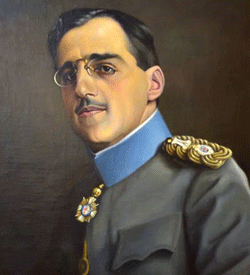
Aleksandar I Karadjordjević (1888-1934) (photo by the author)
Aleksandar I Karadjordjević (1888-1934) (fotografija autora)
|
POLITIČKE PRILIKE Odmah nakon proglašenja Države SHS, vođeni su pregovori oko formiranja vlade, koji su rezultirali izborom Nikole Pašića za premijera, što je regent Aleksandar Karađorđević, nosilac 33. stepena, odbio. Kriza koja je potom nastala rešena je izborom Stojana Protića, iz Pašićeve Narodne radikalne stranke, za predsedavajućeg Privremenog predstavništva. Vlada je konstituisana 20. decembra 1918. godine. Privremenim predstavništvom i vladom upravljala je nova Demokratska stranka, koju je osnovao Svetozar Pribićević, ministar unutrašnjih poslova i nosilac visokog masonskog stepena, koji će zastupati ideju jugoslovenstva. Stojan Protić je 16. avgusta 1919. godine podneo ostavku na mesto premijera. Njegovo mesto zauzeo je Ljubomir Davidović, ministar prosvete i slobodni zidar, koji je tada bio na čelu Demokratske stranke. Ubrzo je, zbog svoje centralističke politike, došao u ozbiljan sukob sa opozicijom. Da bi rešio problem, zatražio je od kralja da raspiše izbore za Ustavotvornu skupštinu. Kralj je to odbio, a Davidović je podneo ostavku. Stojan Protić se vraća kao premijer i za svoj glavni zadatak postavlja slabljenje centralizacije prethodne vlade. Protićevci su sada imali malu većinu, ali nedovoljnu za sprovođenje zakona, pa su vladali uredbama. 1920. godine zemlju potresaju radnički štrajkovi, izazvani teškim prilikama, ali i događajima u Rusiji i Mađarskoj koji su svetskom proletarijatu predočili mogućnost da dođe do vlasti revolucionarnim sredstvima. Pošto su klasne razlike bile te koje su određivale svakodnevni život i reakcije na događaje, najveće stranke su prevazišle svoje razlike, iz straha da im vlast ne izmakne iz ruku, pa se formirala koaliciona vlada u koju su ušli i socijaldemokrati i koja je imala većinu. Protić je podneo ostavku, a za predsedavajućeg je izabran "neutralni" Milenko Vesnić, ministar pravde, a kasnije ministar inostranih poslova. Koalicija je bila na staklenim nogama, te se održala samo kratko vreme, kao i svi kasniji dogovori kao i nebrojeni savezi i sporazumi između stranaka u to vreme (samo u to?). Izgleda da je to oduvek bila stvar mentaliteta na ovim prostorima gde varljivi osećaj trenutne moći emotivno rukovodi postupcima i udaljava ovaj svet od onog koji je planski, disciplinovano, predanim, kolektivnim radom i prevazilaženjem razlika sa ciljem da se usredsredi na ostvarenje zacrtanog rezultata, doneo sebi primat na ovoj planeti. Oduvek smo se više bavili individualnim koristoljubljem, medaljama, nekritičkim samoocenjivanjem svoga "rada" i deklarativnom, a ne stvarnom, dobrobiti za svoje bližnje i svoju okolinu. Nemudra, svađalačka, beskompromisna tehnologija rešavanja problema odredila je naš položaj u svetu i umanjila respekt koji bi, da smo samo malo drukčiji, itekako zaslužili. Slobodnozidarstvo je, između ostalog, tu osobinu zacrtalo da leči. Da li je uspelo u tome? Na to pitanje ova knjiga ima nameru da odgovori putem činjeničnog prikazivanja prilika. Sve u svemu, na političkoj sceni Kraljevine SHS, nakon izbora za ustavotvornu skupštinu 28. novembra 1920. godine, glavni igrači su bili Jugoslovenska demokratska stranka (Ljubomir Davidović), Narodna radikalna stranka (Nikola Pašić), Hrvatska republikanska seljačka stranka (Stjepan Radić) i Komunistička partija Jugoslavije, koja je dobila 12,4 % glasova i imala 58 poslanika u Skupštini. Do 1929. godine KPJ je toliko ojačala da je Ministar unutrašnjih poslova Milorad Drašković, 29/30. decembra 1920. izdao Obznanu kojom se zabranjuje KPJ — bilo je dozvoljeno komunističko angažovanje samo u okvirima Ustavotvorne skupštine. |
POLITICAL CONDITIONS IN THE KINGDOM OF SCS Immediately after the Declaration of the Kingdom of SCS, negotiations on the constitution of the government were conducted, resulting in the election of Nikola Pašić Prime Minister, which the regent, Aleksandar Karadjordjević a 33rd-degree holder, refused. The crisis that was created later was solved by the election of Stojan Protić, member of Pašić's People's Radical Party, to the position of the Chairman of the Provisional Representative Office. The government was constituted on 20th December 1918. The Provisional Representative Office and the government were managed by the new Democratic Party founded by Svetozar Pribićević, Minister of the Interior and bearer of a high Masonic degree, who represented the idea of Yugoslavism. On 16th August 1919, Stojan Protić resigned from the position of Prime Minister. His place was taken by Ljubomir Davidović, Minister of Education and Freemason, who was then the head of the Democratic Party. Due to his centralist politics, he soon came into a serious conflict with the opposition. In order to solve the problem, he asked the king to call snap elections for the Constituent Assembly. The king refused, and Davidović resigned. Stojan Protić returned as Prime Minister and targeted the centralization of the previous government. Supporters of Stojan Protić had a small majority now, but insufficient to enforce laws, so they ruled by decree. In 1920, the country was shaken by workers' strikes, triggered by difficult living conditions, but also by the events in Russia and Hungary, which the world proletariat saw as an opportunity to come to power by revolutionary means. Since class differences determined everyday life as well as reactions to events, the biggest parties overcame their differences, fearing that the power they possessed would slip out of hand, so a coalition government was formed with the Social Democrats who had the majority. Protić resigned, and a new president was elected, the "neutral" Milenko Vesnić, Minister of Justice, later the Minister of Foreign Affairs. Since the coalition was on a slippery ground it survived only for a short time and so did all subsequent agreements as well as countless alliances and agreements between the parties. Sounds familiar? It seems that this has always been a matter of mentality in this part of the world where the illusive sense of instant power manages one's behaviour most emotionally, thus moving this world further away from the one that has gained primacy by well-planned, disciplined, dedicated, collective work, overcoming differences so that it could focus its energy on achievements and intended results. The domestic mindset has always been more focused on self-interest, medals and decorations, glory in general, uncritical self-assessment of own "work" and declarative, not real, benefits for neighbours and the environment. The unwise, quarrelling, uncompromising way of dealing with problems determined the position of this region in the world and diminished the respect that would be, if only slightly different, greatly deserved. Freemasonry, among other things, has been designed to treat such personality traits. Has it succeeded here? This is one of the questions this book aims to answer via presentation of circumstances and situations. All in all, on the political scene of the Kingdom of SCS, after elections for the Constituent Assembly on 28th November 1920, the main players were the Yugoslav Democratic Party (Ljubomir Davidović), the National Radical Party (Nikola Pašić), the Republican Peasant Party (Stjepan Radić) and the Communist Party of Yugoslavia (with 12.4% of the votes and 58 MPs in the Assembly). By 1929, the Communist Party strengthened so much that on 29th/30th December 1920 the Interior Minister Milorad Drašković issued a Decree (Obznana) banning the Communist Party - communist engagement was permitted only within the framework of the Constituent Assembly. |
|
HRVATSKO PITANJE I TEŽNJE KA RAZBIJANJU KRALJEVINE JUGOSLAVIJE Odnosi u Kraljevini SHS/Kraljevini Jugoslaviji bili su daleko od blagougodnih zbog suštinskih, istorijskih razlika poglavito između težnama i Srba i Hrvata. Na moguće takvo stanje ukazivali su još 1915. godine tadašnji ruski ministar inostranih poslova Sergej Sazonov i ruski poslanik u Srbiji grof Grigorije Trubecki, kome je Fran Supilo, hrvatski političar, vođa Stranke prava 1895. godine, pristalica "omekšanog jugoslovenskog unitarizma", na pitanje, postavljeno u predahu Jugoslovenskog kongresa u Nišu 6. maja 1915. godine da li je hrvatski narod za državno jedinstvo sa Srbijom, odgovorio: Pošto Hrvati od samog početka nisu prihvatali kralja jer su smatrali da ih to čvršće vezuje za Srbiju i umanjuje mogućnost otcepljenja i formiranja zasebne države kad se za to ukaže prilika, Hrvatska republikanska seljačka stranka je odbila da se zakune kralju na vernost i time prisili demokrate i radikale da uđu u koaliciju sa Jugoslovenskom muslimanskom organizacijom, uz određene ustupke muslimanskim zemljoposednicima, da bi Ustav mogao da bude usvojen. Vidovdanskim ustavom 1921. godine država je postala unitarna monarhija što je komuniste toliko razbesnelo da su organizovali atentat (neuspešan) na Aleksandra I Karađorđevića. Hrvati su otvoreno iskazivali svoje nezadovoljstvo postojećom državom. Stjepan Radić je izjavljivao da je Hrvatska već spremna na otcepljenje. On je još 8. marta 1918 izjavio: Sukob sa Hrvatima se samo produbljivao. Novi vođa HSS, Vlatko Maček, takođe je uhapšen 1934. Kralj pokušava da "hrvatsko pitanje" reši sporazumom, ali su Hrvati nepopustljivi. Prilikom posete Marselju 9. oktobra 1934. godine, kralj Aleksandar I Karađorđević biva ubijen od strane makedonske terorističke organizacije VMRO (Vnatrešna makedonska revolcionarna organizacija) u saradnji sa hrvatskim ustaškim pokretom. Kralja Aleksandra nasleđuje njegov maloletni sin Petar II Karađorđević, pa je određeno namesništvo kojim je dominirao Aleksandrov brat Pavle. Unutrašnje tenzije bile su i veće nego ranije. Zemlja je počela da puca po šavovima, ali su svi tražili reviziju. Srbima je bilo na srcu pripajanje Vojvodine i ujedinjenje takve Srbije sa Crnom Gorom i Makedonijom, a Hrvati su tražili Dalmaciju i deo Vojvodine. Neslaganje je kulminiralo sa Bosnom i Hercegovinom, na koju su oba naroda (njihovi "predstavnici") polagali pravo. Nezadovoljstvo nesrpskih naroda je raslo i zbog toga što su ključne pozicije vlasti (premijer, ministri armije, mornarice, unutrašnjih poslova, vanjskih poslova, pravde) držale uglavnom osobe srpske nacionalinosti, od 1918., pa sve do 1941., iako su u ukupnom nacionalnom sastavu države bili zastupljeni sa oko 40%. Stoga možemo reći da je politici koja se vodila nedostajalo mudrosti i futurizma jer aktuelna vlast, verovatno baškareći se u svom samozadovoljstvu, nije našla za shodno da se ozbiljno pozabavi problemima otcepljenja, socijalne pravde i privrednog razvoja zemlje. U takvoj iredentističkoj klimi, nije čudo da je Jugoslavija prebrzo poklekla pred agresijom 1941. godine. |
THE CROATIAN ISSUE AND ASPIRATIONS FOR THE BREAKUP OF THE KINGDOM OF YUGOSLAVIA Relations in the State of SCS / Kingdom of Yugoslavia were far from acceptable due to essential, historical differences especially between the aspirations of both Serbs and Croats. As early as 1915, the Russian Foreign Minister Sergei Sazonov and the Russian ambassador in Serbia, Grigory Trubecki, indicated the situation. Trubecki asked the supreme leader of the Party of Rights, Frano Supilo, a supporter of the "softened Yugoslav unitarism" at the tea break of the Yugoslav Congress in Niš on 6th May 1915 about the Croatian nation's state unity with Serbia and received the following answer: Since the Croats had not accepted the king from the very beginning, since they thought this tied them harder to Serbia and diminished the possibility of secession and formation of a separate state when the opportunity arose, the CPP (Croatian Peasant Party) refused to swear loyalty to the king and thereby forced the Democrats and radicals to enter into a coalition with the Yugoslav Muslim Organization, granting certain concessions to Muslim landowners, so that the Constitution could be adopted. By the Vidovdan (St. Vitus) Constitution of 1921, the state became a unitary monarchy that made the Communists so angry that they organized the assassination (unsuccessful) of Aleksandar I Karadjordjeviý. The Croats openly expressed their dissatisfaction with the existing state. Stjepan Radiý declared that Croatia was already ready for secession. At a gathering in Prague he declared the following: "The Croatian people do not recognize the so-called Kingdom of the SCS under the Karadjordjeviý dynasty, because this Kingdom was not accepted by the Croatian Parliament, thus having no mandate of the Croatian people." (Alex N. Dragnich (1983). First Yugoslavia: Search for a Viable Political System, p. 18) The conflict with the Croats was deepening. The new leader of the CPP, Vlatko Maček, was also arrested in 1934. The King was trying to settle the "Croatian issue" by agreement, but the Croats were unrelenting. When visiting Marseille on 9th October 1934, King Aleksandar I Karadjordjeviý was assassinated by the Macedonian terrorist organization VMRO (Internal Macedonian Revolutionary Organization) in co-operation with the Croatian Ustasha Movement. King Aleksandar was succeeded by his minor son Peter II Karadjordjeviý. Regency was appointed, being dominated by Regent-Prince Pavle, Alexander's brother. Internal tensions were greater than ever before. The country started to come apart at the seams, but everyone was looking for a revision. Serbs were for the union of Serbia proper with Vojvodina, Montenegro and Macedonia; Croats sought Dalmatia and part of Vojvodina. The disagreement culminated with Bosnia and Herzegovina, which both nations (their "representatives") claimed right on. The dissatisfaction of the non-Serb peoples also grew because the key positions in the government (prime minister, ministers of defence, interior, foreign affairs, justice) were held by Serbs, from 1918 until 1941, although they were represented by around 40% in the total national count. Therefore, we can say that the policy conducted lacked wisdom and futurism, since the government, possibly enjoying its complacency, did not find it appropriate to seriously address the issues of secession, social justice and economic development of the country. In such an irredentist climate, it was not a miracle that Yugoslavia gave in to aggression in 1941. |
|
PRIJATELJI? KRALJEVINE JUGOSLAVIJE Kraljevina je negovala dobre odnose sa saveznicima iz prvog svetskog rata: Francuskom i Velikom Britanijom (zvaničan savez potpisan 1927. godine), ali je istovremeno ulazila u saveze sa Rumunijom i Čehoslovačkom (Mala Antanta 1920-21. godine) kao zid odbrane ako, kojim slučajem, Mađarska želi da povrati teritorije koje su pripale Kraljevini SHS i drugim dvema državama. Mađarska je inače najveći gubitnik prvog svetskog rata jer je diktiranim Trijanonskim sporazumom 4. juna 1920. svedena na svega oko 30% svoje teritorije od pre rata, što je izazvalo želju za revizionizmom i ustoličenje Hortijevske vlade. Drugi "zaštitni" savez u koji Kraljevina SHS ulazi nakon prvog svetskog rata je tzv. Balkanski blok sa Grčkom, Turskom i Rumunijom (1924.) koji zvanično prerasta u Balkansku Antantu 10 godina kasnije, ali se savez raspada nakon ubistva kralja Aleksandra. Posle parlamentarnih izbora 1935. godine došlo je do ozbiljnog rascepa na političkoj sceni države. Da bi smirio situaciju, namesnik, knez Pavle Karađorđević imenuje Milana Stojadinovića, slobodnog zidara, za premijera, što znači da se politika usmerava ka Velikoj Britaniji jer je novi sastavljač vlade bio direktor čak dva britanska koncerna u Jugoslaviji (Yarrows i Marconi). Bila su to "vremena uvoda u drugi svetski rat". Musolinijeva Italija i Hitlerova Nemačka su jačale mišiće i spremale na revizionizam i nove podele u Evropi. Mlada sovjetska država, bremenita problemima sve vrste, vremešni kolonijalni brižnici Francuska i Velika Britanija, svesne da se njihov kolonijalni ćar polako bliži kraju, neodlučna "izgubljena generacija" koja se po pariskim kafanama utapa u samoprezir i još nedovoljno zreli političari slabo konsolidovanih novih država nisu predstavljali ozbiljnog rivala brutalnoj fašističkoj snazi koja je nekrontrolisano rasla u Evropi. Razna su mišljenja o tome šta je Milan Stojadinović mogao i trebao da uradi u toj konstelaciji. Činjenica je da je, možda iz želje da svojoj ekonomski zaostaloj državi obezbedi što mirniji razvoj, sklapao sporazume sa svim i svakim moleći Boga da svoju nejaku i neorganizovanu vojsku ne mora da koristi u ime "prijateljstva" i potpisanih obaveza. Neki od tih sporazuma, sa Nemačkom i Italijom o nenapadanju na pr., kao i pokušaj da potpiše tzv. Konkordat sa Vatikanom, koji je, između ostalog, tražio da Jugoslavija raspusti sve masonske lože, a kome se žestoko protivila Srpska pravoslavna crkva i veći deo javnosti u Srbiji, smanjili su rejting Stojadinovićeve vlade. 11. decembra 1938. godine je, doduše, dobio vanredne izbore, ali sa neznatnom većinom. Bio je to kraj za Stojadinovića kao predsednika vlade. Nasledio ga je Dragiša Cvetković, koji je uspeo da u vladu uključi Hrvate putem sporazuma sa Vlatkom Mačekom i stvaranjem Banovine Hrvatske. Drugi svetski rat je već bio u punom jeku. Onaj ko je hteo video je kuda će fašistički antisemitizam i antikomunizam odvesti ovaj svet. Vlada Dragiše Cvetkovića je bila svesna, kao i prethodne jugoslovenske vlade, slabosti zemlje i njene nesposobnosti da se odupre sili. Stoga se, kao i druge vlade pre njega, samo da sačuva mir u zemlji, približila fašističkoj Nemačkoj, a 1940. je čak potpisala i dve antisemitske uredbe koje su objavljene u službenim novinama u Beogradu i Zagrebu 5., odnosno 9. oktobra kojima je žrtvovao jevrejsku manjinu zarad "viših" ciljeva. 1940. okupiran je i "mentalni saveznik" Francuska. U takvoj klimi, pre svega da zaštite i sebe i druge, jugoslovensko slobodno zidarstvo je odlučilo da se uspava, sa nadom da će, kad prođe ta oluja bezumlja, ponovo moći da obnovi svoj rad. Čekalo se međutim i duže nego što su se svi nadali — punih 50 godina, zbog paranoičnog straha i nepoverenja u Slobodno zidarstvo od strane vlasti, koje mora da su bile svesne svih nepravdi koje su nanele slobodoumnim, obrazovanim pojedincima. |
FRIENDS (?) OF THE KINGDOM OF YUGOSLAVIA The Kingdom nurtured good relations with allies from WW1: France and Great Britain (the official alliance signed in 1927), but at the same time it entered an alliance with Romania and Czechoslovakia (Little Entente 1920-21) as the defense wall in case Hungary wanted to regain its former territories that now belonged to the Kingdom of Serbs, Croats and Slovenes and the other two countries. In fact, Hungary is the greatest loser of WW1 since, dictated by the Treaty of Trianon, on 4th June 1920, the country was reduced to only about 30% of its former territory (even its ally Austria got a part), which prompted the desire for revisionism and establishment of the Horthy government. The second "protective" alliance which the Kingdom of SCS entered after WW1 was the so-called Balkan bloc, with Greece, Turkey and Romania (1924), which officially turned into the Balkan Entente 10 years later, but the alliance broke up after the assassination of King Alexander. After parliamentary elections in 1935, a serious split took place on the political scene of the state. In order to calm down the situation, Prince Pavle Karadjordjević named Freemason Milan Stojadinović Prime Minister, which meant that the country was directed to the UK because the new government's Prime Minister was the director of two UK corporate groups in Yugoslavia (Yarrows and Marconi). It was the time of the overture to WW2. Mussolini's Italy and Hitler's Germany were flexing their muscles and preparing for revisionism and a new division of Europe. The young Soviet state, burdened with all sorts of problems, the aging colonial caretakers, France and the UK, aware that their profitable colonial business was nearing its end, the indecisive "lost generation" that was drowning themselves in wine in Parisian taverns, and yet insufficiently mature politicians of poorly consolidated new states did not represent a serious rival to the brutal fascist power that was growing uncorked to its full extent. There are various opinions about what Milan Stojadinović could and should have done in such a constellation. The fact is that, perhaps out of a desire to provide his economically backward state with a more peaceful development, he concluded agreements with whoever wished so, praying to God not to have to use his weak and disorganized army in the name of "friendship" and the obligations accepted. The non-aggression pacts signed with Germany and Italy, as well as an attempt to sign the so-called Concordat with the Vatican strongly opposed by the Serbian Orthodox Church and the majority of the public, which among other things, demanded that Yugoslavia shall dissolve all the Masonic lodges, greatly reduced the rating of Stojadinović's government. However, on 11th December 1938, he won the spin elections, although with a slight majority only making the end to Stojadinović as Prime Minister. He was succeeded by Dragiša Cvetković, who managed to involve the Croats into the government through an agreement with Vlatko Maček and creation of the Banovina of Croatia. The Second World War was already in full swing. Those who had their eyes open could see clearly to what end fascist anti-Semitism and anti-communism would lead the world. The government of Dragiša Cvetković was aware, like the previous Yugoslav government as well, of the weakness of the country and its inability to resist brutal force. Therefore, like other governments before his, wishing to preserve peace in the country, he approached fascist Germany, and in 1940 he even signed two anti-Semitic decrees that were published in the official newspapers in Belgrade and Zagreb on 5th October and 9th October respectively sacrificing the Jewish minority for "higher" goals. In 1940, France, the "mental ally" was also occupied. In such a climate, in order to protect both themselves and others, Yugoslav Freemasonry decided to go dormant on 22nd June 1940, hoping to resume their activities once that madness was over. Unfortunately, they had to wait for 50 years, much longer than they had expected, due to the paranoiac fear and distrust in Freemasonry by the authorities, who must have been aware of all the injustice they inflicted on free-thinking, educated individuals. |
|
PRIVREDA KRALJEVINE S obzirom da su u Kraljevinu SHS ušle oblasti ekonomski razvijenije, koje su do tada bile u sastavu drugih država, a da su u Srbiji i Crnoj Gori postojeće proizvodne snage uništene usled ratnih dejstava, Kraljevina SHS je bila spoj ekonomski raznorodnih područja i sistema. Stanovništvo je takođe predstavljalo mešavinu zanatsko-industrijsko-urbanog i duboko tradicionalnog ruralnog. Da bi se jaz premostio, vlada je uvela visoke uvozne carine na industrijsku robu, a izvozne carine na poljoprivredne proizvode čime se dohodak prelivao iz poljoprivrede u industriju. Time su, u prvim godinama posle prvog svetskog rata, profitirala industrijska područja u severozapadnom delu zemlje. Jug je ostao poljoprivredni i industrijski nerazvijen. Najjača je bila prehrambena industrija, proizvodnja drvne građe i rudarstvo. Najviše su se izvozile sirovine, ali je taj sektor bio u rukama stranog kapitala. Sem Beograda, Pančeva i Zemuna, glavni industrijski centri nalazili su se u Sloveniji, Hrvatskoj i Slavoniji. U Kraljevini su između dva rata izgrađene 2193 fabrike, od toga u Vojvodini 390. Finansijski, država je bila veoma slaba, a inflacija u prvim godinama posle rata ogromna. Milan Stojadinović i guverner Narodne banke Đorđe Vajfert zamenili su austrougarsku krunu dinarima i uveli mere koje su smirile inflaciju. Između 1923. i 1931. dinar je bio veoma stabilna valuta. U zemlji su dominirale hrvatske banke i štedionice. Privreda je neodvojiva od politike, a kako je privreda svih država evropskog kontinenta u 20. veku krenula putem međuzavisnosti, najjače države su, kroz diplomatiju, pritiske i "tajna dejstva" određivale uloge privreda drugih zemalja. Nakon neuspele konferencije o razoružanju 1934. godine, Nemačka je počela intenzivno da se naoružava, otkrivši da ima najzdraviju i najproduktivniju privredu u Evropi, a ono što im nedostaje su sirovine. Njih poseduje jugoistočna Evropa, pogotovo zemlje Balkana, koje su nerazvijene. S obzirom da bi one bile dobar saveznik Nemačke u ratnom sukobu, saradnja između Jugoslavije i Nemačke se intenzivira. Jugoslavija je dobila preferencije za mnoge proizvode iz primarnog sektora jer su Nemci bili prevashodno zainteresovani za hranu, sirovine za eksploziv i konoplju od koje su se izrađivani delovi vojne odeće. Konoplja je u to vreme bila pri vrhu lestvice najtraženijih artikala u svetu. Tu je bio i lan od kog se pravilo ulje za podmazivanje. U mestima sa znatnim nemačkim stanovništvom u Vojvodini nicale su kudeljare. Zemlja je bila bogata rudom bakra, aluminijuma, cinka, molibdena, olova i drugih ređih metala koje su bile od značaja za ratnu industriju. Dakle, Jugoslavija je trebala da služi kao sirovinska baza u ratnim sukobima koji su bili na pomolu krajem 1930-ih godina. U Jugoslaviju se slivao strani, uglavnom nemački, kapital. Topionica olova u Zvečanu, fabrika aluminijuma u Šibeniku, valjaonica i livnica u Zenici, koju je gradio Krup, profitirale su od kompenzacionih ugovora sa Nemačkom. Međutim, roba koja se dobijala kompenzacijom teško se prodavala jer je tržište bilo malo i siromašno. Trgovinske veze sa Velikom Britanijom i Francuskom bile su slabe jer, sem sirovina, Jugoslavija nije imala šta da ponudi, a one su imale kolonije na svim kontinentima odakle su se snabdevale sirovinama. Kada je 1935. godine Društvo naroda Italiji uvelo sankcije zbog okupacije Etiopije, Jugoslavija se nesmotreno priključila većini. Posle Austrije i Nemačke, Italija je bila treći trgovinski partner Jugoslavije. Navedenim postupkom italijansko tržište je izgubljeno i zemlja je ekonomski postala još zavisnija od Nemačke, tako da je hitlerovska mašina bila najprirodniji saveznik sve do 1941. godine. |
THE ECONOMY OF THE KINGDOM The existing productive forces in Serbia and Montenegro were destroyed in the war, but economically more developed areas became parts of the Kingdom now, having previously been constituent parts of other countries and, so the Kingdom of SCS was a mosaic of economically diverse areas and systems. The population was also a mix of industrial-urban and deeply traditional rural. In order to overcome the gap, the government introduced high import duties on industrial goods and export duties on agricultural products whereby income flowed from agriculture to industry. Thus, in the first years after WW1, industrial areas in the northwestern part of the country profited. The South remained agricultural and industrially underdeveloped. The food processing and timber industries, as well as mining, were the strongest. Most of the raw materials were exported, but that sector was in the hands of foreign capitalists. With the exception of Belgrade, Pančevo and Zemun, the main industrial centres were located in Slovenia and Croatia. Between the two world wars, 2193 factories were built — 390 of them in Vojvodina. Financially, the state was very weak, and inflation was huge in the first years after the war. Milan Stojadinović and the Governor of the National Bank Georg Weifert replaced the Austro-Hungarian crown with the dinar and introduced measures that calmed inflation. Between 1923 and 1931, the dinar became a very stable currency. Croatian banks and savings banks dominated the country. Economy is inseparable from politics. As the economy of all countries of the European continent began to be interdependent in the 20th century, the strongest states determined the roles of the economies of other countries through diplomacy, pressure and "secret acts." Following the failed conference on disarmament in 1934, Germany began to arm itself intensively, presenting to the others that it had the healthiest and most productive economy in Europe, but what they lacked were raw materials. They were owned by the Southeast Europeans, especially the Balkan countries, which were underdeveloped. Given that they would be a good ally of Germany in a war, co-operation between Yugoslavia and Germany was intensifying. Yugoslavia was granted preferences for many products of the primary sector because the Germans were most interested in food, raw materials for explosives and hemp, serving as a basic material for military clothing and equipment. Hemp was at the top of the list of the most sought-after items at the time. There was also flex, a raw material for lubricating oil. In areas with significant German population in Vojvodina, hemp processing plants were mushrooming. The country was rich in copper, aluminium, zinc, molybdenum, lead and other rare metals that were of importance for the war industry. Therefore, Yugoslavia was to serve as a raw material base in conflicts that were becoming imminent by the end of the 1930s. Foreign, mostly German, the capital was flowing into the country. The lead smelter in Zvečan, the aluminium factory in Šibenik, the rolling mill and the foundry in Zenica, built by Krupp, benefited from countertrade agreements with Germany. However, the goods received by compensation were difficult to sell because the market was small and poor. Trade ties with Great Britain and France were weak because, Yugoslavia had nothing to offer, apart from raw materials, but they both had colonies on all continents where their raw materials originated from. When the League of Nations imposed sanctions on Italy because of the occupation of Ethiopia in 1935, Yugoslavia reluctantly joined the majority. After Austria and Germany, Italy was the third most important trading partner of Yugoslavia. Now, the Italian market was lost and the country became economically more dependent on Germany, so Hitler's developing war machine was the most natural ally until 1941. |
|
SLOBODNO ZIDARSTVO U KRALJEVINAMA SHS I JUGOSLAVIJA Videli smo da je teritorija Kraljevine SHS, osnovane 1. decembra 1918. godine, zahvatala Srbiju u današnjim granicama, Makedoniju, Crnu Goru, Bosnu i Hercegovinu, Hrvatsku (bez Istre, nekih kvarnerskih ostrva, Lastova i Rijeke) i Sloveniju (bez delova Istre i Zapadne Slovenije). Prve slobodnozidarske lože na navedenom području delovale su u Hrvatskoj i Slavoniji počev od 1759. godine kada je osnovana Loža Ratno drugarstvo (L'Amitié de Guerre) u Glini. Najveća zasluga za to, te za kasniji razvoj slobodnog zidarstva u Hrvatskoj pripada pukovniku Ivanu Draškoviću i njegovoj porodici (6 Draškovića je bilo po raznim masonskim ložama). Prve lože su radile na francuskom, a kasnije na nemačkom jeziku. Ivan Drašković je osnovao nekoliko loža, između ostalih i Ložu Mudrost (Prudentia) 1777, čiji je član bio i prosvećeni zagrebački biskup Maksimilajn Vrhovec. Loža je radila po principu Draškovićeve opservance koja se zalagala za ukidanje kmetstva jer su "svi ljudi rođeni jednaki". Od hrvatskih loža 18. veka treba spomenuti i varaždinsku Ložu Savršeno jedinstvo (L'Union parfaite), koja menja ime u Libertas. Članovi Libertasa osnivaju ložu Tri zmaja (Zu den drei Drachen). Jedan drugi poznati slobodni zidar tog doba, grof Stefan Nicki osniva Ložu Budnost (Vigilantia) u Osijeku, čiji su članovi bili i Srbi: Stefan Stratimirović, Josif Jovanović Šakabenda i Stevan Novaković. Od hrvatskih loža, pod vođstvom Ivana Draškovića, sastavljena je i Velika Loža u pokrajini slobode. Posle Draškovićeve smrti 1787. godine sve lože u Hrvatskoj su carskim dekretom zatvorene. Pod Napoleonovom vlašću 1809-1813, stvoreno je nekoliko loža koje su radile pod zaštitom Velikog Orijenta Francuske (Dubrovnik, Split, Zadar, Kotor, Ljubljana, Karlovac). Kotorska Loža Prijatelji pobede (Les Amis de Victoire) imala je u svom članstvu i pravoslavce i katolike. Odlaskom Francuza slobodno zidarstvo se od 1814. godine gasi. Zna se da je u 18. veku u Beogradu delovala turska loža pod imenom Bajram Beg koja je među svojim članovima imala i Srbe, ali se ništa konkretno o njoj ne zna, jer podaci potiču od suvremenika i ne mogu se proveriti. Zna se da je Hadži-Mustafa paša bio član, a to su bili i mitropolit Metodije , Janko Katić (srpski ustanički vođa), Petar Ičko (trgovac) i grčki pesnik Riga od Fere. Od značajnih Srba s početka 19. veka, slobodni zidari su bili Dositej Obradović, član više evropskih loža i Vuk Karadžić i Petar Petrović Njegoš. Oko 1848 u Beogradu je, na turskom jeziku radila Loža Ali Koč (član je bio pesnik Sima Milutinović Sarajlija). Slobodni zidar je, verovatno (neprovereno) bio i knez Mihailo Obrenović, održavajući kontakte u toku svog izgnanstva sa Macinijem (takođe i iluminat) i Garibaldijem. Oko 1870. godine slobodno zidarstvo u Evropi doživljava procvat, pa tako i u Srbiji. U Hrvatskoj, koja je tada bila pod Austrijom, slobodno zidarstvo i dalje, zbog zabrane sve do 1818. godine, uglavnom miruje iako se neke novoformirane lože, (Nächstenliebe u Sisku 1888-1893 na primer), zaobilazeći Austriju, stavljaju se pod zaštitu Simboličke Velike Lože Mađarske. Pod zaštitom Velikog Orijenta Mađarske 1875. godine otvara se loža Thales u Velikom Bečkereku (današnji Zrenjanin), a pod zaštitom Velikog Orijenta Italije u Beogradu se osniva Loža Svetlost Balkana (1876- ). Po dobijanju nezavisnosti 1878. u Srbiji se otvaraju Lože Srbska zadruga (1881-1883), Sloga, rad i postojanstvo (1883), Stella Orientalis u Zemunu/Pančevu (1890-1914) i Pobratim u Beogradu (1891-), kao i Nemanja u Nišu (1892-). Od kraja 19. veka, pa sve do pred prvi svetski rat, otvaraju se lože u Vojvodini, Beogradu, Zagrebu i Slavoniji pod zaštitom Simboličke Velike Lože Mađarske: Loža Ljubav bližnjega (Zagreb, 1892-1919), SZ venčić Philanthropia (Sombor 1897-1908), Loža Jövendő (Sombor, 1908-1919), Lože Sirius (Rijeka, 1901-1919), i Aurora (Vršac, 1903), venčići: Život (Élet, Bela Crkva, 189?-1908?), Nepokolebljivo (Rendületlenül, Novi Sad, 1914 - ????), i Svet (Világ, Veliki Bečkerek ????), Stražarska vatra (Őrtuz, Bačka Palanka, 1913 - ????), lože Budućnost (Jövendő, Sombor, 1908-1940), Stvaranje (Alkotás) (Subotica, 1910-), Budnost (Osijek, 1912-1919), Maksimilijan Vrhovec (1914-). Po završetku prvog svetskog rata, neke lože su prestale da postoje ili su preimenovane. Velika većina slobodnih zidara, koja je preživela rat i ostala u zemlji, nastavila je da radi u svojim matičnim ložama ili su postali članovi novoformiranih loža. Oktobra 1918. godine, hrvatske lože odvojile su se od Simboličke Velike Lože Mađarske, ali su svoje izveštaje za 1918. godinu poslale Velikoj Loži u januaru 1919. godine da bi 10. januara u Zagrebu obrazovale Veliku Maticu Ložu Ljubav bližnjega, a time je loža pod istim imenom prestala da postoji da bi bila preimenovana u Grof Ivan Drašković. Slobodnozidarska ujedinjavanja pratila su kretanja u Kraljevini. Kako je formirana Kraljevina Srba, Hrvata i Slovenaca, tako su se i slobodni zidari, nakon dobijanja razrešnica od svojih obedijencija (Velikog Saveta Srbije i Simboličke Velike Lože Mađarske) ujedinili u Zagrebu 9. juna 1919. godine u Veliku Ložu Srba, Hrvata i Slovenaca pod nazivom Velika Loža Jugoslavija. Prvi Veliki Majstor nove Velike Lože bio je Đorđe Vajfert, industrijalac, guverner Narodne banke, filantrop i možda najzaslužniji slobodni zidar na ovim prostorima od 1890. godine do sada. Zamenici su mu bili Hrvat Adolf Mihalić, pravnik i urednik slobodnozidarskog časopisa Šestar i Srbin Sreten Stojković, profesor i direktor više beogradskih gimnazija. Sva trojica su bila izuzetne ličnosti, nedostižno visokog morala i mudrosti. Jova Aleksijević, tadašnji Starešina lože Pobratim, slobodni zidar 33. stepena, u predgovoru knjige Sretena Stojkovića Slobodno zidarstvo, kaže: Neposredno posle rata, smatra se da se ukupan broj članova Velike Lože Jugoslavija kretao oko 300. Prisajedinjenjem Vojvodine lože koje su bile pod zaštitom Simboličke Velike Lože Mađarske nisu prestale sa radom. Od ukupno 31 Somborca članova predratne Lože više od 20 je nastavilo rad u Loži Budućnost, (nekolicina je preminula u periodu 1918-1920, pa se u spisima (sačuvani su dokumenti samo do 1921. godine) i drugim izvorima ne spominju. Slobodno zidarstvo je 1920-ih godina doživelo procvat u Srbiji. Broj loža se povećao na 24, a članstvo se više nego udvostručilo, regrutujući svoje istomišljenike iz krugova inteligencije koji su, videvši blagodeti industrijskog i opštedruštvenog razvoja u stranim sredinama u kojima su studirali, hteli iste implantirati u, svoju ratom napaćenu i opustošenu zemlju sa veoma skromnim industrijskim potencijalom. U vladi je bilo mnogo slobodnih zidara, kao i u drugim državnim institucijama. Čak i oni koji nisu bili masoni, recimo veliki političar Nikola Pašić, bili su pod uticajem slobodnozidarskih ideja. S druge strane, slobodni zidari se smatraju dežurnim krivcima za nedaće, ekonomske i socijalne, u mnogim zemljama, a posebno kod nas. Kraljevina SHS, potom Kraljevina Jugoslavija je zaista bila bremenita problemima svih vrsta, ali su oni proizilazili iz ranije navedenog antagonizma između konstitutivnih naroda i secesionističkih težnji Hrvata, što se prenelo i na slobodno zidarstvo. 12. septembra 1926. godine, Velika Loža Jugoslavija uspela je da okupi, pod pokroviteljstvom Međunarodne masonske asocijacije, 56 predstavnika 20 obedijencija iz 15 evropskih i dve neevropske države na Masonski međunarodni kongres pod motom "U znaku mira", kom je predsedavao Đorđe Vajfert. Donesena je Rezolucija u kojoj je izražena vera u slobodu i demokratiju kao jedini mogući put u socijalnu pravdu, zatraženo je od svetskih moćnika da se izvrši potpuno i bezuslovno razoružanje u svetu, te da se u svakoj državi osnuju slobodnozidarski odbori koji bi posredovali u rešavanju sukoba među državama i izradi ekonomskih programa. Nakon Šestojanuarske diktature 1929. godine, kada je Kraljevina SHS preimenovana u Kraljevinu Jugoslavija, radile su sledeće lože: Pobratim, Šumadija, Sloga, rad i postojanstvo, Istina, Preporod, Dositej Obradović, Maksim Kovalevski i Čovečnost (sve Beograd), Aurora (Vršac), Vojvodina (Petrovaradin), Banat (Pančevo), Mitropolit Stratimirović (Novi Sad), Budućnost (Sombor), Stvaranje i Stela polaris (Subotica), Maksimilijan Vrhovec, Grof Ivan Drašković, Pravdenost, Perun, Neptun, Ruđer Bošković i Bratstvo (sve Zagreb), Budnost (Osijek), Ivanjski krijes (Karlovac), Sloboda (Dubrovnik), Pravda (Split), Sima Milutinović Sarajlija (Sarajevo), Zora (Kotor), Valentin Vodnik (Ljubljana) i Kosovo (Skoplje). Članstvo je činila elita svih društvenih klasa. Sem tradicionalno zastupljenih struka: lekara, profesora, trgovaca, apotekara, štampara, privrednika, pada u oči velika zastupljenost slobodnih zidara u vladi Kraljevine, kao i drugih zemalja, što danas, barem kod nas, nije slučaj. 1934. se ponovo održavao Kongres masonstva u Beogradu, uz prisustvo 60 delegata iz 39 zemalja. U 6 od ovih država predsednici su bili slobodni zidari, 24 ministri prosvete, 22 ministri pravde, 27 ministri trgovine i industrije, 16 ministri unutrašnjih poslova i u 20 ministri finansija. U vladi generala Živkovića, bilo je 12 slobodnih zidara (S. Švrljuga, D. Kojić, Ž. Mažuranić, M. Srškić, V. Marinković. J. Demetrović, K. Kumanudi, O. Frangeš, M. Drinković, M. Kostrenčić, U. Krulj, A. Kramer i B. Maksimović), a bilo ih je i u svim političkim partijama, posebno u Demokratskoj stranci i Samostalnoj demokratskoj stranci (izvor: Zoran Nenezić: Masoni 1717-2010). Jugoslovensko slobodno zidarstvo je posebnu pažnju posvećivalo filantropskom radu, s obzirom na teško stanje u kojem je stanovništvo Kraljevine živelo. Spomenućemo samo Dom i obrazovni centar za siročad "Sveti Sava" u Beogradu, ustanovu za gluvonemu decu "Stefan Dečanski" i Fond za pomoć ratnim invalidima i deci "Sveti Đorđe". U svim mestima koje su imale slobodnozidarsku ložu, prikupljala se pomoć za siromašnu i talentovanu decu, biblioteke, borbu protiv alkoholizma i prostitucije, otvarani su centri za slepe, obrazovni centri za omladinu, a posebna se pažnja posvećivala borbi protiv tuberkuloze. Slobodno zidarstvo u Kraljevini Jugoslaviji nije bilo onoliko složno koliko bi se dalo pretpostaviti. Bez obzira što se Lože ne bave politikom, religijom i nacijom, neki slobodni zidari između dva rata nisu ostali imuni na stalna nacionalna trvenja između Srbije i severozapada zemlje. Kako su Hrvati stalno imali secesiju od Jugoslavije na umu, to se reflektovalo i u nekim Ložama. U Zagrebu je radila tajna Velika Loža pod nazivom Libertas koja je imala 24 radionice i dva kružoka. U regularnim ložama u ostalom delu zemlje delatnost je bila izuzetna. Velika pažnja posvećivala se filosofskom radu, ali je dosta učinjeno i na planu proučavanja istorije i društveno-ekonomskih problema. Kako smo gore naveli, u drugoj polovini 1930-ih godina ekonomske veze sa Nemačkom postale su tešnje. Nemačka i Austrija bile su najznačajniji ekonomski partneri zemlje koji su kupovali sirovine. Time je, međutim, zavisnost Kraljevine Jugoslavije od nemačke politike postajala sve veća. Hitler, žestoki protivnik slobodnog zidarstva, vršio je stalan pritisak na Jugoslaviju. Pred izbijanje rata na Balkanu, taj pritisak je bio tako snažan da je Velika Loža Jugoslavija odlučila, 22. juna 1940. godine da se uspava. San je trajao punih 50 godina, do 1990. |
BRIEF HISTORY OF FREEMASONRY IN THE TERRITORY OF THE KINGDOM OF SCS AND KINGDOM OF YUGOSLAVIA We saw that the territory of the Kingdom of SCS, established on 1st December 1918, involved Serbia, within its current borders, Macedonia, Montenegro, Bosnia and Herzegovina, Croatia (excluding Istria, a few Kvarner islands, Lastovo and Rijeka) and Slovenia (without parts of Istria and Western Slovenia). The first Freemasonic lodges in the above-mentioned territory were operating in Croatia and Slavonia from as early as 1759 when Lodge Amitié de Guerre was founded in Glina. The greatest merit for the development of Freemasonry in Croatia belonged to Colonel Ivan Drašković and his family (6 Draškovićes were in different Masonic lodges). The working language of the first lodges was French, and later German. Ivan Drašković founded several lodges, among others Lodge Prudentia (Wisdom) in 1777, whose member was the enlightened bishop of Zagreb Maximillian Vrhovec. The Lodge followed the principle of "Drašković's Observance," which advocated the abolition of serfdom since "all people were born equal." Among the Croatian lodges of the 18th century, we have to mention Lodge L'Unité parfait in the Orient of Varaždin, later to change its name to Lodge Libertas. Lodge Libertas members formed Lodge Zu den Drei Drachen (Three Dragons). Another famous Freemason of that time, Count Stefan Nicky founded Lodge Vigilantia in the Orient of Osijek, whose membership included Serbs: Stefan Stratimirović, Josif Jovanović Šakabenda and Stevan Novaković. Croatian lodges, led by Ivan Drašković, united to form their Grand Lodge "in the province of freedom." After Drašković's death in 1787, all lodges in Croatia were closed by imperial decree. Under the Napoleonic rule from 1809 to 1813, several lodges (in the Orients of Dubrovnik, Split, Zadar, Kotor, Ljubljana, and Karlovac) were formed under the protection of the Grand Orient of France. Lodge Les Amis de Victoire (Friends of Victory) in the Orient of Kotor had both Orthodox and Catholic members. There were no signs of Freemasonry after the French left in 1814. In the 18th century there was a Turkish lodge of an unknown name in Belgrade, which also had Serbs among its members, but nothing specific about it was known because the information came from our contemporaries and cannot be verified. It is well known that both Haji-Mustafa Pasha and Metropolitan Metodije were members, as well as Janko Katić (Serbian insurrection leader), Petar Ičko (trader) and Greek poet Rigas Feraios. Of the prominent Serbs who lived at the beginning of the 19th century, Dositej Obradović was a member of several European lodges as were Vuk Karadžić and Petar Petrović Njegoš. Around 1848, L. Ali Koç worked in Belgrade in the Turkish language (the poet Sima Milutinović Sarajlija was a member). Prince Mihailo Obrenović might have been a member as well, although this cannot be verified. He was maintaining contacts during his exile with Mazzini (a Freemason and Illuminatus) and Garibaldi. Around 1870, Freemasonry in Europe was flourishing, and so it was in Serbia. In Croatia, which was then under Austrian rule, Freemasonry was quiet due to the ban that lasted until 1818, although some newly formed lodges e.g. Lodge Nächstenliebe (Philanthropy) in the Orient of Sisak 1888-1893 were placed under the protection of the Symbolic Grand Lodge of Hungary bypassing Austria. Under the protection of the Grand Orient of Hungary, Lodge Thales was formed in the Orient of Nagy Becskerek (Zrenjanin) in 1875 and Lodge Light of the Balkans in Belgrade under the protection of the Grand Orient of Italy in 1876. After gaining independence in 1878, Lodge Serbian Cooperative (1881), Lodge Accord, Work and Perseverance (1883) and Lodge Blood Brother (1891) in Belgrade as well as Lodge Stella Orientalis in the Orient of Semlin/Pancsova (1890) and Lodge Nemanja in the Orient of Niš (1892) were formed. From the end of the 19th century, until WW1, lodges were formed in Vojvodina, Belgrade, Zagreb and Slavonia under the protection of the Symbolic Grand Lodge of Hungary: Lodge Nächstenliebe (Philanthropyy), Sisak, 1888-1893); Lodge Stella Orientalis, Semlin/Pancsova (1890-1914); Lodge Ljubav prema bližnjem (Philanthropy), Zagreb (1892-1919), Lodge Jövendő (Future), Zombor (1908-1918); Daughter-Lodge Philanthropia, Zombor (1897-1908); Lodge Sirius (Fiume/Rijeka, 1901-1919); Lodge Aurora (Versecz/Vršac, 1903-1917); Lodge Alkotás (Creation), Szabadka/Subotica (1910-1918); Lodge Vigilantia, Osijek (1912-1919); Lodge Maximillian Vrhovec, Zagreb (1914-1919); Daughter Lodges: Élet (Life) Fehér Templom/Bela Crkva (189?-1908); Rendületlenül (Unwaveringly), Novi Sad (1914); Világ (World) (Zrenjanin, -1914); Örtuz (Watchtower), Palanka (1913) After the end of WW1, some lodges ceased to exist or had to be renamed. The vast majority of Freemasons who survived the war and stayed in the country continued to work in their home lodges or became members of newly formed lodges. In October 1918, Croatian lodges left the Symbolic Grand Lodge of Hungary, but they still sent their 1918 reports to the GL in January 1919. On 10th January, in Zagreb, they elected Lodge Charity their Mother Lodge. It was renamed to Lodge Grof Ivan Drašković (Count I.D.). Masonic unifications followed the trends in the Kingdom. After the Kingdom of Serbs, Croats and Slovenes was formed, Freemasons, having received honourable discharges from their obedience (the Grand Council of Serbia and the Symbolic Grand Lodge of Hungary), united in Zagreb on 9th June 1919 into the Grand Lodge of Serbs, Croats and Slovenes called Grand Lodge Yugoslavia. The first Grand Master of the new Grand Lodge was Georg Weifert, industrialist, governor of the National Bank, philanthropist and perhaps the most prominent Freemason in this area from 1890 until this day. His deputies were Adolf Mihalić, lawyer and editor of the Masonic journal Šestar (compasses) and Sreten Stojković, professor and director of several Belgrade gymnasiums. All three were exceptional personalities of unattainably high morals and wisdom. Jovan Aleksijević, then the Worshipful Master of Lodge Blood Brother, holder of the 33rd degree, in the preface of Sreten Stojković's book Slobodno zidarstvo, njegov cilj i principi, njegova sadašnjost i prošlost / Freemasonry, Its Objective and Principles, Its Present and Past, 1926, says: Immediately after the war, the total number of members of the Grand Lodge of Yugoslavia is estimated to be around 300. The "accession" of Vojvodina did not deter the lodges under the protection of the Symbolic Grand Lodge of Hungary from joining the new Grand Lodge. Of the 31 members of pre-war Lodge Jövendő, more than 20 continued working in Lodge Budućnost (some moved to the Eternal East in the period 1918-1920, and are not mentioned in the files (documents were preserved until 1921 only). In the 1920s, Freemasonry was flourishing in Serbia. The number of lodges increased to 24; membership more than doubled by recruiting like-minded people from the ranks of the intelligentsia who, seeing the benefits of industrial and community development in foreign environments where most of them had studied, wished to implant the same boons in their war-ravaged and devastated country with very modest industrial capabilities. There were many Freemasons in the government as well, like in other state institutions. Even those who were not Freemasons, e.g. the great politician Nikola Pašić, were under the influence of Freemasonic ideas. In a number of countries, modern Serbia included, Freemasons have been considered, by the general public, to be perpetrators of all misfortunes, both economic and social. It was slightly different in the Kingdom of Yugoslavia although the country was burdened with all sorts of problems, stemming mostly from the previously mentioned antagonism between the constituent nations and secessionist aspirations of the Croats. That notoriously problematic situation did affect "old Yugoslav" Freemasonry though far less than it would be expected. On 12th September 1926, the Grand Lodge of Yugoslavia managed to host a Masonic International Congress, under the auspices of the International Masonic Association, with 56 representatives from 20 obediences (15 European and 2 non-European) organized under the motto "In the Name of Peace," chaired by Georg Weifert. The Congress passed a Resolution expressing faith in freedom and democracy as the only possible way to social justice; world powers were urged to work on full and unconditional disarmament throughout the globe. The Resolution also suggested establishing Freemasonic committees in each participant state to mediate in resolving emerging conflicts between countries and development of economic programs. After the 6th January Dictatorship in 1929, when the Kingdom of SCS was renamed to the Kingdom of Yugoslavia, the following lodges were active: Blood Brother; Šumadija; Accord, Work and Perseverance; Istina (Truth); Preporod (Renewal); Dositej Obradović; Maksim Kovalevski and Čovečanstvo (Humanity), all from Belgrade; Aurora, Vršac; Vojvodina, Petrovaradin; Banat (Pančevo); Mitropolit Stratimirović, Novi Sad; Future, Sombor; Creation and Stella Polaris, Subotica; Maksimilijan Vrhovec, Grof Ivan Drašković, Pravednost (Justice), Perun, Neptun, Rudjer Bošković and Bratstvo (Brotherhood), all from Zagreb; Vigilantia, Osijek; Ivanjski krijes (St. John's Eve), Karlovac, Sloboda (Freedom), Dubrovnik; Pravda (Justice), Split; Sima Milutinović Sarajlija, Sarajevo; Zora (Dawn), Kotor; Valentin Vodnik, Ljubljana and Kosovo, Skopje. Membership was made up of the most prominent individuals belonging to different social classes. Apart from traditionally represented professions: doctors, professors, traders, pharmacists, printers, and businessmen, there were a lot of Freemasons among the members of the government of the Kingdom, as well as from foreign countries. In 1934, another Congress of Freemasonry was held in Belgrade, hosting 60 delegates from 39 countries. In 6 of these countries, the presidents were Freemasons. In the participant countries, there were 24 ministers of education, 22 justice ministers, 27 trade and industry ministers, 16 ministers of the interior and 20 finance ministers who were Freemasons. In General Živković's government, 12 ministers were Freemasons (S. Švrljuga, D. Kojić, Ž. Mažuranić, M. Srškić, V. Marinković, J. Demetrović, K. Kumanudi, O. Frangeš, M. Drinković, M. Kostrenčić, U. Krulj, A. Kramer and B. Maksimovic). Freemasons were also present in all political parties, especially in the Democratic Party and the Independent Democratic Party (source: Zoran Nenezić: Masoni u Jugoslaviji 1764-1980, Zodne, 1988). Yugoslav Freemasonry paid special attention to philanthropic work, given the difficult situation in which the population of the Kingdom lived. We will only mention the Home and Education Center for Orphans "Saint Sava" in Belgrade, the Institution for Deaf Children "Stefan Dečanski" and the "St. George" Children Support Fund. In all the places where Freemasonic lodges existed, assistance was provided for poor and talented children, libraries, for a struggle against alcoholism, prostitution, centres for the blind, youth education centres were opened, and special attention was dedicated to fighting against tuberculosis. Freemasons in the Kingdom of Yugoslavia were not as united as it could be assumed. Regardless of the fact that the lodges do not deal with politics, religion and issues referring to national identity, some Freemasons between the two wars did not remain immune to the ongoing nationalistic frictions between Serbia and the northwest of the country. Since the Croats were constantly keeping secession from Yugoslavia in mind, it reflected in some lodges. In Zagreb there was a secret Grand Lodge called Libertas, which had operated 24 workshops and two circles. In regular lodges in the rest of the country, activity was exceptional. Great attention was paid to philosophical work, but much was done in the study of history and socio-economic problems as well. As we mentioned above, in the second half of the 1930s, economic relations with Germany became closer. Germany and Austria were the most important economic partners of the country buying large quantities of raw materials. However, the dependence of the Kingdom of Yugoslavia on German politics was growing as well. Hitler, a fierce adversary of Freemasonry, was exerting constant pressure on Yugoslavia. Before the outbreak of the war in the Balkans, this pressure was so powerful that the Grand Council of Grand Lodge Yugoslavia decided on 22nd June, 1940 to go dormant. A circular letter on the Decision was sent to all member lodges on 2nd August 1940. Freemasonry in the region stayed dormant until 1990. |
|
ŽIVOT SOMBORA IZMEĐU DVA RATA Nakon kapitulacije Austrougarske 3. novembra 1918. godine, u Sombor su ušle trupe Srpske vojske 13. novembra 1918. godine, te je grad prisajedinjen Kraljevini Srbiji, u okviru tadašnje Vojvodine, 25. novembra iste godine odlukom Velike narodne skupštine u Novom Sadu. Primopredaja grada između austrougarskih i predstavnika srpske kraljevske vlasti izvršena je u Svečanoj Sali Gradske kuće. 5 dana nakon toga, postao je deo novoosnovane Kraljevine Srba, Hrvata i Slovenaca. Od 1786. godine Sombor je bio središte Bač-bodroške županije, koja je sa svoja 10.362 km2 zahvatala i slobodne kraljevske gradove Baju, Novi Sad i Suboticu. 1910. godine županija je imala 812.400 stanovnika. Narodna skupština, koja se sastala u Novom Sadu, izabrala je taj grad, po proglašenju nove države 01. decembra, umesto Sombora, za glavni grad pokrajine Banata, Bačke i Baranje. Još je izvesno vreme Sombor bio centar županije, ali ukidanjem tih administrativnih celina i uvođenjem banovina Sombor se pretvorio u večni provincijski gradić. Uspon kvaliteta života u Somboru, pored povremenih kriza, potrajaće do otprilike pred prvi svetski rat. Pored, na mahove pozitivnog nasleđa, kao što je dosta rana elektrifikacija grada, što je mnogo bolje moglo da se iskoristi za razvoj modernih proizvodnih kapaciteta, somborska privreda između dva rata stagnira u odnosu na neke druge delove i pokrajine i državu u celini. Pozitivan primer je, međutim, osnivanje berze poljoprivrednih proizvoda 1925. godine, koja je imala manji promet i bila manje značajna od novosadske, ali je Somboru ipak obezbeđivala dovoljan priliv sredstava za ulaganja. Ulagalo se, međutim, u kulturu i obrazovanje, gde je Sombor postizao značajne rezultate, ali se tako nije obezbeđivala zdrava materijalna baza za dalji razvoj i ulaganja, te je i kultura ispaštala u kasnijim vremenima. Na osiromašanje resursa grada uticalo je i naseljavanje dobrovoljaca iz prvog svetskog rata u okolinu grada, kojima je podeljen značajan deo somborskog atara. Deoba zemljišta nije išla samo, često besktupuloznim, oduzimanjem od imanja krupnih zemljoposednika, već je 2000 jutara poklonjeno i iz gradskog zemljišnog fonda. Iako se stanovništvo Kraljevine uvećavalo za oko 2 miliona svakih 10 godina, što je bio slučaj i u Somboru, taj prirast stanovništva od oko 1,45% godišnje nije onakav kakav bi mogao da bude da je privreda mogla da obezbedi resurse za bolji život. Naime, davnašnji problem i grada i regije i čitave zemlje (a ni danas nije drukčije) je iseljavanje stanovništva. Ono je bilo naročito intenzivno u periodu 1919-1926 kada se iz Kraljevine iselilo oko 86.000 ljudi. Nedostatak kapitala za intenzivan razvoj prerađivačke industrije i stagnacija 20-ih godina, koja se prenela i na 30-te godine, uticali su da položaj Sombora u Kraljevini SHS i Jugoslaviji bude u stalnom padu, gubeći status koji je mukotrpno sticao tokom prethodna dva veka. Usled nebrojenih problema koje je Kraljevina Jugoslavija unela samim svojim osnivanjem, većina stanovništva je bila nezadovoljna iz razloga koje je teško i nabrojati. Suština je bila u nemogućnosti ili neželji da se reše ili barem počnu rešavati gorući ekonomski, nacionalni, politički i kulturni problemi. Kraljevina SHS/Jugoslavija bila je nepripremljen eksperiment koji je svim narodima doneo više zla nego dobra, a najveći "mirnodopski poraz" podneo je srpski narod jer je morao da žrtvuje dosta i od svog privrednog i kulturnog razvoja. To je izrazio vojvoda Živojin Mišić rekavši regentu Aleksandru sledeće: "Jugoslovenstvo nije narodnost, nego ideologija. Jugoslovenstvo ne može da posluži kao temelj za izgradnju jedne realne državne celine, nego je fiktivna ideja za koju valja pripremiti teren i naraštaje koji su daleko od shvatanja jedne celine." |
LIFE IN SOMBOR BETWEEN THE TWO WORLD WARS After the capitulation of the Austro-Hungarian Empire on 3rd November 1918, the troops of the Serbian Army entered Sombor on 13th November 1918. The city became a part of the Kingdom of Serbia within Vojvodina on 25th November of the same year by the Decision of the Grand National Assembly in Novi Sad. The handover of the city between the Austro-Hungarian representatives and the Serbian royal authorities was carried out in the Ceremonial Hall of the Prefecture Building. 5 days later, Sombor officially became a part of the newly founded Kingdom of Serbs, Croats and Slovenes. For more than a century, since 1786, Sombor had been the capital of Bacs-Bodrog County, which occupied an area of 10,362 km2 and included the free royal cities of Baja, Novi Sad and Subotica. In 1910, the County had a population of 812,400. Following the proclamation of the new state on 1st December the National Assembly, meeting in Novi Sad, selected that city, instead of Sombor, for the capital city of Banat, Bačka and Baranja. With the abolition of the former administrative units and the introduction of banovinas, Sombor lost its prominence and turned into a provincial town. Although Novi Sad and the nearby Sremski Karlovci were the cultural and political centres of the Serbs, Sombor had been being built, for almost a century, to be an administrative and educational centre, and even before the war Slavic population constituted the majority, which was not the case with Novi Sad, not even after the census of 1921. Such a loss of primacy in Vojvodina was due to the slowness and inability of the local authorities to turn the emerging chances to their own benefit even several decades before. Namely, when deciding on railway lines, road construction and infrastructure in general, local decision-makers were deeply dormant. That was the time when Sombor started being drowsy and neglected. Those who were in a position, during the following decades, to correct the mistakes neither had had interest nor the much-needed far-sightedness, courage or knowledge to meet the needs of their fellow citizens. In spite of the failures of the authorities, improvement in the quality of life in Sombor lasted until about WW1. In addition to occasional improvements in the infrastructure of the city, due mainly to private initiative, such as early electrification of the city, which could have been much better utilized for the development of modern production capacities, the economy of Sombor between the two wars stagnated in relation to some other parts and provinces as well as the state as a whole. However, a positive example was the establishment of the agricultural product exchange in 1925, which had lower turnover and was less significant than the Novi Sad exchange, but it still provided Sombor with sufficient inflow of investment funds. Substantial amounts were invested in culture and education, where Sombor achieved significant results, but this did not provide a sound material basis for further development and investment. That is why culture was suffering considerably in later times. The impoverishment of the city's resources was also due to the settlement of war volunteers in the farming areas surrounding the city. They were donated 2000 acres of farming land from the City Land Fund, in addition to many more acres confiscated unscrupulously from landowners (this became practice, to a much greater extent after WW2 as well — an easy way to provide support by prospective "defenders" of the ruling political system). Thus, the city remained without significant revenues, and agriculture, not industry, remained the main economic branch that could not provide the necessary funds for infrastructure. Due to their poor knowledge and farming skills, the newly settled population could hardly be involved in a more intensive agricultural production, yields were reduced, and settlement of the city's obligations against the state was extremely difficult. Roads were in desperate condition, funds were insufficient for the maintenance of health facilities, schools, melioration works and construction of sewage network. All this made it impossible to maintain a high level of culture and education, after which Sombor gained its fame. Although the population of the Kingdom was growing by about 2 million every 10 years, which was the case in Sombor as well, this population growth of about 1.45% per year was less than it could have been if the economy had provided resources for a better life. Namely, the long-standing problem of the city and the region, and of the whole country (the same even today), was emigration. It was particularly intense in the period 1919-1926 when c. 86,000 people left the Kingdom for good. Generally, emigration was not only a problem of numerical nature; it was also a problem of quality. The émigrés were those desperately dissatisfied with their position and the overall situation, those disappointed in the role of the state, which was supposed to take responsibility, by its very existence, to provide equal protection, welfare and social justice for all. Emigrants were also citizens of the Kingdom who felt that their abilities, motivation, knowledge and agility offered them a chance to change their material and spiritual position, i.e. those who would have, most certainly, contributed to the improvement of their environment if they had been given an opportunity to do so. All these émigrés could have stayed if the authorities had been able to do away with the wrong moves and the deeply rooted, nepotistic criteria in managing the citizens' future. The lack of capital for the intensive development of the manufacturing industry and the stagnation of the 1920s, which carried over into the 1930s, caused Sombor's position in the Kingdom of SHS and Yugoslavia to decline steadily, losing its hard-won status over the past two centuries. Due to countless problems that the Kingdom of Yugoslavia created by its very formation, the majority of the population was dissatisfied for such numerous reasons that they are difficult even to list. The essence lay in the impossibility or unwillingness to resolve, or at least begin to resolve the burning economic, national, political and cultural issues. The Kingdom of SCS/Yugoslavia was an unprepared experiment that brought more evil to all nations than good, and the biggest "peace-time defeat" was suffered by all the peoples, who sacrificed a lot from their economic and cultural development. This was expressed by the famous WW1 hero, General Živojin Mišić, in a conversation with Regent Alexander (Source: Srbin.info, 2015): "Yugoslavism is not a nationality, it is an ideology. Yugoslavism cannot serve as the basis for the construction of a real state entity, but it is a fictitious idea for which the ground, as well as the generations, must be prepared, but they are still far from even comprehending the entirety." |
|
SLOBODNO ZIDARSTVO U SOMBORU IZMEĐU DVA RATA I NJEGOV KRAJ Čovek je onakav kakvog ga prilike čine. Izdići se iznad neumoljive istine ove sentence znači uložiti suštinski napor u samoobrazovanje i usavršavanje duhovne snage da bi ona mogla da svojim zracima oplemeni okolinu u kojoj se živi i radi. Videli smo na samom početku ove knjige šta je slobodno zidarstvo; prolazeći kroz milenije i vekove kao što je ono prolazilo, došavši do Sombora, gde se isto tako pojavilo. Kroz ispitivanje prvih koraka slobodnog zidarstva u Somboru videli smo čime se ono bavilo, ko su somborski slobodni zidari bili, koje su ciljeve imali i šta su činili. U ovom delu nećemo da se bavimo onim što smo već ranije istakli. Somborsko slobodno zidarstvo nakon prvog svetskog rata je uglavnom isto kao što je bilo i ranije. Loža mađarskog naziva Jövendő, koja je radila na mađarskom jeziku, prevedena je u Ložu Budućnost i velika većina slobodnih zidara koja je u njoj radila pre rata, samo je nastavila radom u istojLoži, ali srpskog imena i na srpskom jeziku. Ono što se promenilo bila je kudikamo veća demokratičnost i pažnja koja se posvećivala izboru članstva u odnosu na nacionalni i verski sastav. Dok su predratni somborski slobodni zidari uglavnom bili Mađari i katolici, uz izvestan broj Jevreja i nekoliko pravoslavnih Srba, među posleratnim masoninima, koji su većinom bili pravoslavni Srbi, bio je donekle veći broj katolika Mađara, a broj izraelita i reformista ostao je približno isti. Pošto kod slobodnih zidara nacionalnost i veroispovest ne određuju i ne smeju da određuju članstvo, gornji podaci nisu ni od kakve važnosti. |
FREEMASONRY IN SOMBOR BETWEEN WW1 AND WW2 Man is what circumstances make of him. To rise above the inexorable truth of this sentence means he has to make the essential effort of self-educating and perfecting his spiritual strength so that it could both maintain and enrich the environment in which he lives and works. We saw at the very beginning of this book what Freemasonry is, advancing through the millennia, finally reaching Sombor, turning up silently. By examining the first steps of Freemasonry in Sombor we saw what it was like, who the Sombor Freemasons were, what goals they had and what they accomplished. They were intellectuals, members of the elite of this city, but they were also ordinary people like us, who were not bent on "ruling the world", although the Brotherhood had been labelled as such by the bitter opponents of Freemasonry. They were interested in enlightening their own lives and the lives of their loved ones, through education, culture, philosophy, awakening the sense of helping those who needed it as well as through struggle for equality and tolerance. They hoped that their good deeds and sincere craving for a better environment followed by others within the Masonic as well as the profane world. In this section, we will not deal with what we have already pointed out. Freemasonry in the Orient of Sombor, after WW1, was largely the same as it had been before. The Lodge of the Hungarian name Jövendő, which had worked in the Hungarian language, was translated into Lodge Budućnost and a vast majority of Freemasons who had worked there before the war, remained in the same Lodge, working now in the Serbian language. What had changed was the far and away democratic selection of membership in relation to their national and religious composition. While the pre-war Freemasons were mainly Catholic Hungarians and Germans as well as reformists and Jews and only a few Orthodox Serbs, among the post-war Masons, most of whom were Orthodox Serbs, there were a number of Catholic Hungarians and Germans and the number of Jews and reformists remained roughly the same. Since nationality and religion do not determine, and must not determine membership of a lodge, the above data belong to the domain of curiosity, being far less important than the rest of Freemasonic endeavours. |
|
ČLANOVI L. BUDUĆNOST (izvor: Zoran Nenezić: Masoni u Jugoslaviji 1764-1980) sa dopunama Jevrejske opštine Sombor i autora
|
MEMBERS OF LODGE BUDUČNOST (source: Zoran D. Nenezić: Masoni u Jugoslaviji 1764-1980) Amended by the Jewish Community of Sombor and the author
|
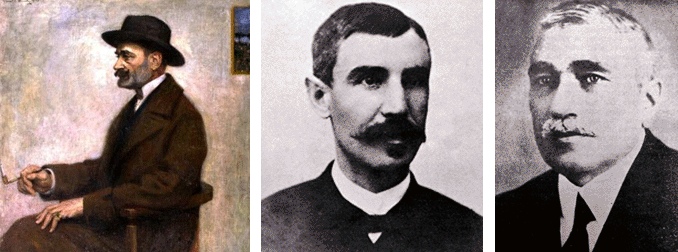
(From Left/S leva na desno) Elek Gozsdu, (1849 - 1919) - Ernő Zsulyevity (1857-1947) - Isidor Novaković (1974-1932)
|
POZNATI SOMBORSKI SLOBODNI ZIDARI (izbor) Elek Goždu, prvi Starešina somborskog venčića 1885. godine vraća se svom originalnom pozivu položivši pravosudni ispit, tj. istovremeno je položio i sudijski i advokatski ispit, za šta se u tadašnjoj Mađarskoj dobijala titula doktora. Tu titulu Goždu nikad nije koristio ispred svog imena, navodno zbog toga što je ispit polagao sa jednim kolegom, blago rečeno "skromne moći shvatanja zbilje", pa se zarekao ako taj "kolega" ikad položi ispit, da on svoju titulu nikad neće koristiti. Kako je to bivalo u svim vremenima, tako i tada. "Kolegi" su snažni vetrovi podrške razvili jedro, te je glatko položio doktorski ispit, a Elek, budući čovek prav i od reči, držao se obećanja koje je sebi dao sve do 26. maja 1919., dana kada se iz Temišvara uputio na Večni Istok. Te 1885. godine "prekomandovan" je u Belu Crkvu gde postaje zamenik tužioca, i gde se upoznaje sa slobodnim zidarstvom. Vraća se u Budimpeštu gde biva iniciran, navodno u Loži Könyves Kálmán, isti onaj u kojem su 1890. godine inicirani Georg Veifert, Andra Đorđević, Stevan Mokranjac i beogradski advokat Tihomir Marković. 1889. godine, u svojstvu kraljevskog tužioca odlazi u Erdelj, u Karansebeš, a 1892. vrši istu dužnost u Temišvaru. Te godine, štampa mu se zbirka od 9 pripovedaka Tantal. 1908. godine Elek Goždu piše svoju prvu dramu, Polubog, koja mu se premijerno izvodi u somborskom Narodnom pozorištu. Delo je bilo znatno ispred svog vremena, pa nije nailazilo na takav oduševljen prijem kao njegovi romani i pripovetke. Njegova druga drama, Karijera izlazi u obliku knjige i nije se nikad izvela na sceni. Krajem 19. i početkom 20. veka postojala je neka "tajna veza" između Temišvara i Sombora, pogotovo na polju prava i literature. U temišvarskim listovima često se pisalo o Somboru, a mnogi predstavnici zakonodavnih vlasti iz Temišvara premeštani su u Sombor. Tako i Goždu dospeva u Ravangrad, kako Sombor još nazivaju, kao kraljevski tužilac i predsednik suda 1897. godine. Imao je tu i neke korene. Iz Monografije grada Debrecina saznajemo da se njegov praded, Anton Goždu, vinarski trgovac, iz Miškolca doselio u Sombor 1725. godine. Podaci potiču iz "Miškolcske grčke kompanije. Elekov otac Đorđe bio je upravitelj dobara grofova Sinva i Vipfen, ali je na prilično nepoznat način, navodno usled dve elementarne nepogode, izgubio svoj imetak, pa se kao siromašak, ali čovek na dobrom glasu, odselio u Erči i oženio lepoticu Anastaziju Margo, devojku sa solidnim mirazom ali preštedljivu, poreklom iz bogate trgovačke porodice, i sa njom izrodio sina Eleka i tri kćeri. Dolazak Goždua u Sombor unosi veliku živost u kulturni život grada i pospešuje odnose između pripadnika raznih nacionalnosti i veroispovesti. Zahvaljujući svojim vezama, u somborsko pozorište dovodi poznate glumce i predstave, te organizuje izložbe vrsnih umetničkih dela iz budimpeštanskog Muzeja lepih umetnosti, izložbu dela srpskih slikara, kao i prezentaciju ikonostasa temišvarske Saborne crkve koji je izradio Konstantin Danil. Prijatelj je sa Lazom Kostićem, Veljkom Petrovićem, Dr. Radivojem Simonovićem, Đulom Revickijem i glavnim inženjerom županije Đurom Stankovićem, član je Istorijskog društva Bač-bodroške županije, koje 1897. broji više od hiljadu redovnih i počasnih članova, sa Dr. Janošem Duhonom, prvim Starešinom somborske Lože Budućnost, u koju se unosi svetlo 22. novembra 1908. godine, osniva Slobodni licej i drži mnogobrojna predavanja iz umetnosti i književnosti. U toku njegovog devetogodišnjeg boravka u Somboru, grad počinje da se budi iz letargije u koju je u zadnjoj dekadi 19. veka zapao. Koliko je Goždu uložio energije u uzdizanje i oživljavanje somborske kulturne scene, ne ostavljajući mu vremena za pisanje, svedoči i činjenica da je u Somboru, za sveg svog boravka, napisao samo 4 pripovetke. Elek Goždu je bio prvi Starešina venčića Filantropija, a kasnije i zamenik Starešine lože Domoljublje u Baji, kuda su se mnogi somborski slobodni zidari "preselili" 1903. godine. Po odlasku iz Sombora sarađuje u časopisu Simboličke Velike Lože Mađarske, Istok. Kao ličnost, bio je tih, usamljen, koračao je čvrstim, ali otsutnim koracima, udubljen u misli, čudeći se duboko u sebi tom nepreglednom mnoštvu koje juri glavom bez obzira u fatalnu površnost. Bio je tako hladnog srca, toliko rezervisan u tom dobu samozadovoljnih verbalno-junačkih hvalospeva da su se svi koji su i nameravali da osuju paljbu na njega po bilo kom osnovu, osetili razoružani i bez municije. Hteo je da postane pisac, a postao je i više od toga — prometejski plamen jedne perspektivne sredine kojoj je oduvek falilo samopouzdanje. Bio je čovek istine i činjenica, trezvenih pogleda na sebe, okolinu i budućnost. Iako je u poznim godinama kroz pesme otkrio pritajenu, neostvarenu svoju ljubav prema Ani Vajs, učinio je to elegantno, bez šerbetske romantike onako kako samo jedna nadasve iskrena i integrisana ličnost to ume. Šoma Rac, "majka" somborskog slobodnog Ako je Elek Goždu bio otac somborskog slobodnog zidarstva kao prvi Starešina, Šoma Rac je svakako bio "majka", počev od osnivanja venčića Filantropija do prve somborske lože Jövendő, čiji je put vodio preko Segedina i Baje. Iako je Elek Goždu, za 9 godina svog boravka u Somboru, pretočio svoje iskustvo slobodnog zidara i svoje veliko znanje i umeće, u kulturne i životne tokove ovog često usnulog grada, Šoma Rac je bio taj koji je 30 godina negovao i bdio nad humanošću, ne samo somborskih slobodnih zidara već i profanog društva, darujući im nesebično i sebe i ono čime se i sam oplemenjivao. Rođen je u mestašcetu Parasznya u Severnoj Mađarskoj 1861. godine. Gimnaziju je završio u Lošoncu (Losonc, današnji Lučenec u Slovačkoj), a diplomu profesora, kao i izuzetno široko obrazovanje stekao je na budimpeštanskom Pedagoškom fakultetu 1885. godine. Po završenom fakultetu Ministarstvo prosvete upućuje ga u Somborsku gimnaziju gde u početku, od 1886. predaje latinski i grčki jezik koji su tada u nastavnom planu bio zastupljeni sa ukupno 6 odnosno 4 časa nedeljno. Pored navedena dva jezika, predavao je i nemački jezik, a po potrebi i istoriju. Bavio se i pisanjem pesama, govora, članaka za istorijske i slobodnozidarske časopise. Autor je i udžbenika i knjiga lektire latinskog i grškog jezika za razrede gimnazije. Pored Somborske gimnazije, profesor Rac predaje i nemački jezik i stenografiju u somborskoj Ekonomskoj školi osnovanoj 1888. godine. U dva navrata (1912/13 i 1918) bio je i direktor Gimnazije. Slobodni zidar postaje 30. januara 1897. godine u loži Arpad u Segedinu, gde se od prvih dana angažuje na pisanju slobodnozidarskih članaka, predavanja i knjižica. Iste godine je već prvi Besednik venčića Filantropija, a 1901. godine je na spisku članova Filantropije upisan kao majstor, jedan od sedmorice članova Filantropije. Kao slobodni zidar i elokventan, veoma obrazovan i široko poštovan i voljen vaspitač i kolega, profesor Rac uživao je veliki ugled, kako u školama gde je predavao, tako i u profanom svetu. Nadahnuti njegovom ličnošću slobodni zidari postali su njegovi učenici i maturanti Gimnazije: Adolf Feleš (1884), Janoš Duhon (1886), Milenko Petrović (1902), Stojan Grgurov (1911), Kosta Grgurov (1913), Janoš Šabranski (1916), Fedor Konjović i Janoš Žigmond Veg (1919); učenici i maturanti Ekonomske škole: Dezider Cetl (1896), Martin Vamoši (1908), Aleksandar Kovjanić (1818) i Imre Kerenji. Neosporno je imao uticaja i na opredeljenje svojih kolega: Erne Žuljevića, Vilima Krumpa, Isidora Novakovića, Karla Trenčenja, te reformističkog veroučitelja Ištvana Sekija. Profesor Šoma Rac je aktivno učestvovao u osnivanju i radu mnogih somborskih društava i udruženja. Suosnivač je Slobodnog liceja koje je zvanično zaživelo u Somboru 18. februara 1901. godine, ali je sa radom počelo već 1899. Po odlasku prvog predsednika Eleka Goždua, na tom položaju ga nasleđuje Šoma Rac. On je bio taj koji je održavao i razvijao Slobodni licej još petnaestak godina. Za to vreme, spomenuto udruženje je Somboru davalo duhovnu ambroziju kroz predavanja koja su pokrivala skoro sve oblasti: od istorije i umetnosti, preko vodoprivrede i poljoprivrede, do medicine i socijalne politike. U početku je slušalaštvo dolazilo iz srednje klase, ali se krug širio, pa je Licej postao toliko popularan da jedva da je bilo mesta za stajanje u Svečanoj sali Gradske kuće, gde su se predavanja održavala. Pored Šome Raca i Eleka Goždua, česti predavči su bili i Ivan Barci, Joca Lalošević, eminentni profesor Gimnazije Dr. Dezider Kolman, Isidor Novaković, Janoš Duhon i drugi. Za vreme predsednikovanja Šome Raca, pored predavanja, Slobodni licej je organizovao i stručne tečajeve iz knjigovodstva i ekonomske matematike u cilju daljeg obrazovanja zanatlija i trgovaca. Tečajevi su bili besplatni jer je i grad imao sluha za ulaganje u budućnost, pa je odobrio potrebna sredstva za pokrivanje režijskih troškova Liceja. Izbijanje prvog svetskog rata stavilo je tačku na rad, a i na samo postojanje Slobodnog liceja. Kao što i sam naziv "slobodan" kaže, Licej se bavio svim oblastima, od naučnih do humanih i svim pristupima tim pitanjima. Povremeno su se čuli i nacionalistički i konzervativni tonovi, ali je osnovni zadatak, širenje opšte kulture, očuvan u većini slučajeva. Vaspitni uticaj Slobodnog liceja je bio neosporan: učinilo se mnogo na polju buđenja svesti o potrebi aktivnog pristupa gorućim problemima kao što je bila zaštita dece i žena, borba protiv alkoholizma, unapređivanje socijalne pravde, negovanje humanosti i eliminisanje međuverskih i međuetničkih tenzija. Šoma Rac je trideset godina, sve do svoje smrti u Somboru 1920. godine bio nezaobilazni, obrađeni kamen koji se ugrađivao u sve što je bilo dobro i progresivno u gradu Somboru. Posebnu vrednost predstavlja njegova briga za omladinu koju je vaspitavao za humanost, toleranciju i poštovanje, čuvajući je, kao što majka čuva, od izazova i opasnosti mračnih sila. Njegov "Memorandum akatoličkih nastavnika povodom pogubnog delovanja Marijanske kongregacije" je bio vapaj zvaničnim prosvetnim organima za očuvanje čistote, humanosti i plemenitosti edukacije omladine, jedan od mnogih njegovih slobodnozidarskih doprinosa za bolji svet. I posle nekoliko generacija, njegovo ime se u nekim somborskim porodicama i publikacijama spominje sa poštovanjem. Dr. Jožef Tim ml. (Thüm József) Izuzetno ga je privlačila istorija pa se, po povratku u Sombor posvetio istraživanju i pisanju istorijskih članaka sa tematikom iz Bač-bodroške županije, ali nije zanemario ni medicinu. Napisao je veći broj radova iz urologije i infektivnih bolesti, kao i brojne članke o opštim problemima zdravstvene zaštite. Za međunarodni lekarski kongres u Beču 1895. godine napisao je dva referata: "Zdravstveni zakon u Srbiji" i "Pojava malarije u međurečju Dunav-Tisa". Pisao je na tri jezika: nemačkom, mađarskom i srpskom i dela su mu često objavljivana u časopisima u zemlji i inostranstvu. Od istorijskih dela spominjemo Južnomađarski odbrambeni rat 1848-1849, Istorija Srba od najstarijih vremena do 1848. godine i Stav Obrenovića prema revoluciji 1848-49. Bio je član Mađarskog istorijskog društva, Zemaljskog arheološkog društva, član Mađarskog društva za heraldiku i genealogiju, Istorijskog društva Bač-bodroške županije. Kroz svoja dela i aktivnosti radio je na zbližavanju srpskog i mađarskog naroda. Aleksandar Obrenović ga je odlikovao Ordenom Sv. Save. Dr. Jožef Tim je postao slobodni zidar verovatno u zemunskoj, a kasnije pančevačkoj loži Stella Orientalis. U Izveštaju lože za 1895. godinu naveden je kao pomoćnik (2. stepen) a u Izveštaju za 1896. godinu kao majstor (br. 27 u spisku, matrikula pod br. 43, uzdignut 25. maja 1896.). Postoji zabeleška da je Dr. Jožef Tim 1895. godine ispred okupljneih članova lože Stella Orientalis, kao i predstavnika loža iz Budimpešte, Beograda, Halea, Frankfurta, Galaca, Zagreba i Novog Sada pročitao svoj rad na nemačkom jeziku pod naslovom "Slobodni zidari i kultura" ("Freimaurern und Cultur"). Erne Žuljević (Zsulyevity Ernő) Budući čovek od izuzetnog morala i integriteta, a nailazeći u svom poslu na probleme moralne prirode koje, bez pomoći vlasti, teško da je mogao da reši, smatrao je, da bi za sredinu u kojoj je živeo najcelishodnije bilo da se moralni i duhovni problemi počnu rešavati od malih nogu. Stoga je podneo molbu i bio postavljen za profesora somborske Gimnazije 1884. godine. U prosveti je ostao pune 34 godine, do 1918. godine. 1888. je postavljen za prvog direktora tada novoosnovane Srednje trgovačke škole koja je više puta menjala svoj naziv, istovremeno proširujući nastavni program. Bio i upravitelj zanatske i trgovačke šegrtske škole. Pored toga, radio je i kao profesor, predavajući matematiku, fiziku i trgovačko računovodstvo. Pored prosvetnog rada, Erne Žuljević je bio istaknuti ekonomista i učesnik mnogih kulturnih i privrednih aktivnosti u Somboru. 1889. godine bio je predsednik organizacionog odbora opšte zemaljske zanatske izložbe u Somboru, predsednik Zanatske zadruge za uzajamnu pomoć, član Segedinske okružne zanatsko-trgovačke komore, odbornik Zemaljskog profesorskog udruženja. Slobodni zidar postao je u Segedinu 30. januara 1897. godine u loži Arpad. Bio je član somborskog venčića Filantropija, i somborskih loža Jövendő (1908) i Budućnost (1919), ali je do svoje smrti 1947. godine ostao i član lože Arpad u Orijentu Segedin. Isidor Novaković Još pre prvog svetskog rata aktivno je učestvovao u privrednom i kulturnom životu grada, a zaslužan je za pokretanje akcije organizovanja Somborske trgovačke omladine. Za taj rad je primio orden Sv. Save IV i III reda. U Somboru je, inače, održan kongres udruženja Srpske trgovačke omladine, čiji je on bio organizator. Bio je i direktor Zemaljske kreditne banke u Somboru, a posle rata državni komesar vojvođanskih banaka, kao i predsednik Zanatske zadruge. Dvadesetih godina prošlog veka bavio se i politikom. Bio je poslanik u Skupštini Kraljevine u ime Demokratske stranke 1926. godine, ali je istovremeno radio i kao profesor Trgovačke akademije. Verovatno ga je politika i došla glave. Naime, 1932. su njegovi politički protivnici montirali sudski proces u kom je optužen da je imao aferu sa jednom učenicom, iako terminalno bolestan u to vreme. Toliko je duboko proživeo atak na njegov moral, koji je uvek bio neprikosnovenih visina, da je svega nekoliko nedelja nakon oslobođenja od optužbe, krajem iste godine i umro. Isidor Novaković je iniciran 04. juna 1910. godine u somborskoj loži Jövendő, na 2. stepen uzdignut je 20. maja 1911., a 1912. na 3. stepen. 1918. godine je Besednik Lože Jövendő. U Loži preimenovanoj u Budućnost, Isidor Novaković je istaknuti član sve do svoje smrti 1932. godine. Dr. Đorđe Protić Baveći se naučnim radom, izučavajući floru Bosne i Hercegovine, napustio je prosvetarski posao potpuno se posvetivši nauci. Prihvatio je posao u sarajevskom Zemaljskom muzeju gde je imao i prilike i vremena da piše naučne radove. Doktorsku disertaciju mu je štampala Austrijska akademija nauka 1891. godine. Pored naučnih radova, napisao je udžbenik Nauka o biljkama, koji je odobren za korišćenje u somborskoj Devojačkoj školi, ali tu nije mogao da nađe izdavača. Iako su mu somborska vrata, iz razloga o kojima možemo samo nagađati, uvek bila zatvorena, nije digao ruke od svog rodnog grada. Vratio se da bi postao član Lože. Budućnost. Umro je u Beču. Dr. Emilijan Grigorijević Sem lekarskog poziva, bio je aktivan u kulturnom, naročito muzičkom životu grada. Bio je dugi niz godina aktivan član hora Somborske pevačke družine, a takođe i drugi sekretar Srpske ženske dobrotvorne zadruge i član Upravnog odbora Srpske čitaonice. Nakon prvog svetskog rata, angažovao se u lokalnoj politici kao član Mesnog narodnog veća Srba i Bunjevaca. Svojim političkim radom doprineo je zbližavanju Srba i Hrvata na području grada. Nakon 2. svetskog rata, nova vlast tretirala je sve koji su na neki način bili angažovani u politici ili udruženjima u "Staroj Jugoslaviji" kao državne neprijatelje ili nepodobne za ikakve javne funkcije. Takvu grešku su činili i čine mnogi režimi lišavajući sebe stručnosti, iskustva i znanja ljudi kojima je jedina vodilja u životu pristojno, pošteno i moralno življenje i obavljanje svog posla. Dr. Emilijan Grigorijević je umro 1947. godine, iste godine kada se, osiromašen, obratio Narodnom odboru za pomoć da mu se vrati barem nešto od eksproprisanog poseda da bi mogao da se prehrani jer, teško bolestan i u 72. godini života, nije više mogao da obavlja lekarsku praksu. Molba mu je odbijena. Dr. Emilijan Grigorijević je bio član lože Budućnost od 1928. godine. Dr. Simon Guttmann Za rabina je postavljen 1925. godine i tu ostao do smrti. Bio je istaknuti somborski kulturni radnik, koji je dao značajan doprinos okupljanju somborskih Jevreja. Govorio je hebrejski, srpski, mađarski, nemački i ruski. Napisao je veći broj verskih članaka i rasprava na nemačkom, mađarskom i srpskom jeziku. Na 100-godišnjicu Chevre Kadishe (1928) napisao je, na mađarskom jeziku, Istoriju bačkih Jevreja, kao i 100 godina somborske jevrejske crkvene opštine, Udruženje bikur cholim (posete bolesnima), Somborska jevrejska omladina, Današnja somborska jevrejska crkvena opština i njene ustanove a sa ruskog je preveo Jevrejsku istoriju S.M. Dubnova. Srpsko izdanje je štampano na 148 stranica u Opštinskom glasniku grada Sombora., čime je zadužio Somborsko istorijsko društvo. Mnogi članci su mu objavljivani u Politici. 1927. je bio i član Upravnog odbora Somborske štedionice. Dr. Jovan Iskruljev Kao učitelj, vanredno je polagao Gimnaziju u Novom Sadu 1912. godine, da bi mogao da se upiše na filosofski fakultet u Budimpešti gde je apsolvirao. Rat ga je omeo u njegovim studijama, tako da ih je završio tek 1919. u Zagrebu, te položio doktorat folosofskih i pedagoških nauka. Sa titulom doktora i dalje radi u vežbaonici Učiteljske škole u Somboru, kao možda jedini takav sa doktoratom, u to vreme i posle njega. 1920. godine odlazi za Novi Sad gde postaje prosvetni inspektor, a odatle za Beograd gde je referent Ministarstva prosvete i docent na Višoj pedagoškoj školi. Iz Beograda odlazi u Vršac gde postaje direktor Okružnog ureda za osiguranje radnika, pa se opet vraća u Novi Sad. Jovan Iskruljev je bio i plodan pisac stručnih dela i članaka iz oblasti pedagoških nauka, posebno obrazovanja odraslih i koedukacije. Koedukacija u svetlosti eksperimentalne pedagogije je tema njegove doktorske disertacije. Njegov udžbenik Računica u slikama za prvi razred osnovne škole je bila zapažena i u inostranstvu. Napisao je i biografiju već spomenutog nam Paje Radosavljevića, sa kojim je održavao kontakt i nakon što je ovaj otišao za Ameriku. Jovan Iskruljev je umro u 86. godini u Novom Sadu. Đorđe Antić Iako se školovao za apotekara, mnogo je poznatiji kao lokalni polihistor, istoričar, kolekcionar i istraživač svega što zadire u život i istorijat grada. Tridesetih godina prošlog veka organizuje prikupljanje etnografskih predmeta, a on sam uređuje zbirke, piše i prevodi arhivsku građu, posebno fond Magistrata, sa mađarskog i nemačkog jezika. Gradskom muzeju je poklonio oko 350 predmeta velike etnografske vrednosti i značaja, ali većina nestaje "u vihoru rata", a i posle njega. 1938. godine kupuje Kronićevu palatu, a 1939. biva prijavljen u Loži Budućnost. Palata doživljava sudbinu drugih velelepnih zdanja u privatnom vlasništvu, tj. biva konfiskovana 1946. godine, a Đorđe Antić, pišući svoju "autobiografiju" na zahtev vlasti 21. novembra 1947. godine, treba da "opravda" ratne godine, koje je proveo u Somboru iako je celo vreme rata bio pod prismotrom. Đurica, Čika Đura, kako su ga zvali, neumorno radi na prikupljanju i obradi istorijske građe, provodeći još jedan život među zidovima Gradskog arhiva, kojem je zaveštao ogromnu zbirku, plod svog dugogodišnjeg rada. Spisak tema koje je obrađivao je zaista impozantan: od somborskog sira, pčelarstva i golubarstva preko sporta i turizma, do spiskova ratnih zarobljenika iz prvog svetskog rata, korespondencije sa znamenitim suvremenicima svojim u zemlji i inostranstvu - život bogat i primeran. |
PROMINENT FREEMASONS OF SOMBOR (Selection) Elek Gozsdu, the first Worshipful Master of After passing both the Bar Exam and the Solicitor's Qualifying Examination in 1885, thus gaining the title of Doctor, as per the Hungarian regulations, he returned to his original calling. However, he never used his title in front of his name, allegedly because he had taken the exam together with a colleague of somewhat "limited power of understanding reality," and he said that if the colleague would ever pass the exam, he would never use his title. As it has always happened, a strong wind rose to prop the colleague's vessel and he managed to pass the doctoral exam smoothly - Elek, being an honest man, kept his word until 26th May 1919, the day he passed from Timisoara into the Eternal East. In 1885, he was "transferred" to Fehértemplom (Bela Crkva), where he became Deputy Prosecutor and met with Freemasonry. He returned to Budapest where he was initiated, allegedly in Lodge Demokratia, (or more probably in Lodge Könyves Kálmán) the same one where Georg Weifert, Andra Djordjević, Stevan Mokranjac and Belgrade lawyer, Tihomir Marković were initiated in 1890. In 1889, as a royal prosecutor, he went to Transylvania's Karansebes, and in 1892 he performed the same duties in Timisoara. That year, a collection of 9 tales, Tantalus, was printed. In 1908, Elek Gozsdu wrote his first drama, The Demigod, which was premiered at the Sombor National Theater. The play was significantly ahead of his time, so he did not encounter such an enthusiastic reception as his novels and stories. His second drama, Career, was written in the form of a book and has never been performed on the stage.<.p> At the end of the 19th and early 20th centuries, there was a "secret connection" between Timisoara and Sombor, especially in the field of law and literature. Timisoara papers often wrote about Sombor, and many representatives of the legislative authorities from Timisoara were transferred to Sombor. Thus, Gozsdu came to Ravangrad, as Sombor is also called, to be the Royal Prosecutor and President of Court in 1897. He also had some roots here. In the Monograph of the city of Debrecen we learn that his great-grandfather Anton Gozsdu, a wine trader from Miskolc, moved to Sombor in 1725. The data came down from the Greek company "Miskolc." Elek's father, György, was the manager of the estates of Counts Szinva and Wipfen. In an unknown way, he allegedly lost all his property to two natural disasters and, as a poor man, he moved to Ercsi where he married the beauty, Anastasia Margo, a girl with a solid dowry but thrifty, coming from a wealthy trading family. They had son Elek and three daughters. The arrival of Gozsdu in Sombor brought a lot of vividness into the cultural life of the city and promoted relations between the members of various nationalities and religions. Thanks to his connections, he brought famous actors and performers to the Sombor Theater and organized exhibitions of outstanding artworks from the Budapest Museum of Fine Arts, an exhibition of works of Serbian painters, as well as a presentation of the iconostasis of the Timisoara Cathedral made by Konstantin Danil. He was a friend of Laza Kostić, Veljko Petrović, Dr Radivoje Simonović, Gyula Reviczky and County Chief Engineer Djuro Stanković, a member of the Historical Society of Bacs-Bodrog County, which counted more than a thousand regular and honorary members in 1897, with Dr János Duchon, the first Worshipful Master of L. Jövendő and he also co-founded the Free Lyceum and held numerous lectures in art and literature there. During his nine-year stay in Sombor, the city began to wake up from the lethargy that it had fallen into in the last decade of the 19th century. How much Gozsdu had invested in reviving the Sombor cultural scene, leaving him no time to write, was testified by the fact that during the whole of his stay in Sombor he wrote only four short stories. Elek Gozsdu was the first Worshipful Master of Daughter-Lodge Philanthropia, and later the deputy Worshipful Master of Lodge Honszeretet in the Orient of Baja, where many Freemasons from Sombor "moved" in 1903. Upon leaving Sombor, he contributed articles to Kelet (East), the magazine of the Symbolic Grand Lodge of Hungary. As a person, he was quiet, lonely, walking firmly but absentmindedly, absorbed in his thoughts, wondering, deeply in himself, why that vast crowd was constantly rushing into fatal superficiality. He was such a cool heart, so reserved in that time of complacent verbal and heroic praises that all who intended to blame him on any ground, felt disarmed and without ammunition. He wanted to become a writer, and he became more than that — a Promethean flame of a promising environment that lacked self-confidence. He was a man of truth and facts, of sober views of himself, the environment and the future. Although in his late years, his poems exposed his hidden, unfulfilled love for Ana Weiss, he made it elegant, without any sugary sentimentalism, just like a most sincere and integrated personality would do it. Soma Rácz, "Mother" of Freemasonry in Sombor Elek Gozsdu was the father of Sombor Freemasonry being the Worshipful Master of Daughter-Lodge Philanthropia, the first Freemasonic organization in Sombor. Soma Rácz was certainly the "Mother," from as early as the establishment of Philanthropia to the last days of Lodge Jövendő, whose path led through Szeged and Baja. Although Elek Gozsdu, for the 9 years of his stay in Sombor, transferred his Masonic experience and his great knowledge and skills into the culture and lifestream of this drowsy city, Soma Rácz was the one who was nurturing and watching over humanity for 30 years, not only of the Freemasons of Sombor, but also of the profane society, sharing selflessly what he himself cultivated. He was born in the village of Parasznya in Northern Hungary in 1861. He finished high school in Losonc (Lučenec in Slovakia) and studied at the Faculty of Pedagogy in Budapest. He graduated in 1885 and the Ministry of Education sent him to the Sombor Grammar School/Gymnasium, where he taught Latin and Greek, which were represented in the curriculum with a total of 6 and 4 hours per week respectively. In addition to the two languages, he also taught German and history, when needed. He also wrote poems, speeches, articles for historical and Masonic journals. He was also the author of coursebooks of Latin and Greek for grammar schools. In addition to the Sombor Grammar School, Professor Rácz also taught German and stenography at the Sombor School of Economics founded in 1888. On two occasions (1912/13 and 1918) he was also the Director of the Gymnasium. On 30th January 1897, Soma Rácz became a Freemason at L. Árpád in the Orient of Szeged, where he was engaged in writing Masonic articles, lectures, papers and booklets from the first days of his membership. In the same year, he was the first Orator of Daughter-Lodge Philanthropia, and in 1901 he became a Master Mason, one of the seven Masters of Daughter-Lodge Philanthropia. As a Freemason and an eloquent, highly educated and widely respected and beloved educator and colleague, Professor Rácz enjoyed a great reputation, both at the schools where he taught and in the profane world. His students and school-leavers of the Grammar School/Gymnasium, inspired by his personality, became Freemasons in their later life. This is a list of his Freemason-students with the years of completion of the Gymnasium and the School of Economics respectively: Adolf Feles (1884), János Duchon (1886), Milenko Petrović (1902), Stojan Grgurov (1911), Kosta Grgurov (1913), János Sabranszky (1916), Fedor Konjović and János Zsigmond Vég (1919) - Gymnasium; Dezső Cettl (1896), Márton Vámosi (1908), Aleksandar Kovjanić (1818) and Imre Kerényi (1919) - School of Economics. Undoubtedly, he had an influence on the commitments and orientation of his colleagues: Ernő Zsulyevics, Vilmos Krump, Isidor Novaković, Károly Trencsényi and reformist teacher of Religious Education, István Széki. Professor Soma Rácz actively participated in the founding and work of many Sombor societies and associations. He was a co-founder of the Free Lyceum, which officially came to life in Sombor on 18th February 1901, although it had started working two years before. After the departure of the first president, Elek Gozsdu, Soma Rácz took over. He was the one who maintained and developed the Free Lyceum for another fifteen years. During that time, the association gave Sombor the much needed spiritual ambrosia through lectures covering almost all areas: history and art, water management and agriculture, medicine and social politics. In the beginning, the audience came from the middle class, but the circle expanded, thus the Lyceum became so popular that there was hardly any place to stand in the City Hall's Ceremonial Hall, where the lectures were held. In addition to Soma Rácz and Elek Gozsdu, frequent lecturers were Iván Bárczi, Joca Lalošević, an eminent professor of the Gymnasium, Dezső Kolman, Isidor Novakovicć, János Duchon and others. During the presidency of Soma Rácz, in addition to lectures, the Free Lyceum organized professional courses in accounting and mathematical economics aiming to offer further education to craftsmen and traders. The courses were free because the city authorities did show proper understanding for the future by approving the necessary funds to cover the Lyceum's overheads. The outbreak of WW1 put a stop to work, as well as to the very existence of the Free Lyceum. As the name itself says, the Lyceum dealt with all areas, from scientific to human interest issues. Occasionally, nationalistic and conservative tones were heard also heard, but the basic task, the spread of general culture, was preserved in most cases. The educational impact of the Free Lyceum was unquestionable: a lot was achieved in raising awareness on the need for an active approach to burning issues such as the protection of children and women, fight against alcoholism, promotion of social justice, cultivation of humanity and relief of inter-religious and interethnic tensions. For thirty years, until he passed into the Eternal East in 1920, Soma Rácz was an unavoidable, perfect ashlar that was embedded in all that was good and progressive in the city of Sombor. Of particular value was his care for the youth, who he educated for humanity, tolerance and respect, protecting, as a mother may protect, from the challenges and dangers of dark forces. His "Memorandum of the acatholic teachers against the devastating action of the Marian Congregation" was a cry for official educational bodies to preserve the cleanliness, humanity and nobility of the education of young people — one of many of his Masonic contributions to a better world. Even after several generations, his name is still uttered with love and respect — unfortunately, among the members of a few Sombor families only. Dr József Thim Jn. He was attracted to history and, after returning to Sombor, he devoted himself to the research and writing of articles on Bacs-Bodrog County, although he did not neglect medicine. He wrote a number of papers on urology and infectious diseases, as well as numerous articles on general health care issues. For the International Medical Congress in Vienna in 1895, he wrote two papers: The Medical Law in Serbia and The Occurrence of Malaria in the Area between the Danube and the Tisa. He wrote in three languages: German, Hungarian and Serbian and his works were often published in magazines in the country and abroad. Of his writings on history let us mention the South-Hungarian Defense War of 1848-1849; History of the Serbs from the earliest times to 1848; and The Attitude of the Obrenovićes to the Revolution of 1848-49. He was a member of the Hungarian Historical Society, the National Archaeological Society, the Hungarian Society for Heraldry and Genealogy and the Historical Society of Bacs-Bodrog County. Through his works and activities, he was trying to bring the Serbian and Hungarian peoples closer together. He received the Order of St. Sava from Aleksandar Obrenović. Dr József Thüm became a Freemason probably at Lodge. Stella Orientalis in the Orient of Semlin (later Pancsova). According to the 1895 Lodge Report, he was at Fellow Craft degree; as per the Report for the following year, he was a Master Mason (No. 27 in the list, Matricule No. 43, raised on 25th May 1896). There is a note that Dr József Thüm read his 1895 paper, entitled "Freemasons and Culture in the German language" (Freimaurei und Kultur) in front of the members of Lodge Stella Orientalis, as well as representatives of the lodges from Budapest, Belgrade, Hale, Frankfurt, Galati, Zagreb and Novi Sad. Ernő Zsulyevity Being a man of exceptional moral and integrity, encountering problems of moral nature in his daily work that could hardly be solved without the help of the authorities, he thought that the root of moral and spiritual problems had to be dealt with as early as the individual's childhood and teenage years. So he filed an application and was appointed teacher at the Sombor Grammar School in 1884. He remained in education for 34 years, until 1918. In 1888, he was appointed Director of the newly established Secondary School of Economics, which changed its name several times, while extending the curriculum. At the same time, he was the Manager of the Craft and Trade School working also as a teacher of mathematics, physics and accounting. In addition to his educational work, Ernő Zsulyevity was a prominent economist and participant in many cultural and economic activities in Sombor. In 1889, he was the President of the Organizing Committee of the General Crafts Exhibition in Sombor, the president of the Craft Cooperative Society for Mutual Assistance, a member of the Szeged District Trades and Crafts Chamber, a member of the National Teachers' Association. Ernő Zsulyevity was initiated at Lodge Árpád in the Orient of Szeged on 30th January 1897. In spite of being a member of Daughter-Lodge Philanthropia (1897) and Lodges Jövendő (1908) and Budućnost (1919), he remained a member of Lodge Árpád in the Orient Szeged until his death in 1947. Isidor Novaković Even before WW1, he actively participated in the economic and cultural life of the city, being responsible for organizing the Commercial Youth of Sombor. For this work, he received the Order of St. Sava, grades IV and III. A Congress of Associations of Serbian Commercial Youth, organized by him, was held in Sombor. He was also the Director of the National Credit Bank in Sombor and the State Commissioner of the banks of Vojvodina as well as the President of the Crafts Cooperative after the war. In the 1920s, he was also involved in politics as a deputy at the Assembly of the Kingdom on behalf of the Democratic Party in 1926, although he worked as a professor at the Secondary School of Economics, at the same time. It was probably politics that cost him his life. Namely, in 1932, his political opponents mounted a court case in which he was charged with having an affair with a student, although he was terminally ill at the time. So emotionally did he receive the attack on his morale, which had always been exceptionally high, that he passed into the Eternal East only a few weeks after his release from the charge. Isidor Novaković was initiated in Lodge Jövendő on 4th June 1910 raised to the 2nd degree on 20 May 1911 and the 3rd degree in 1912. In 1918, he was the Orator of the Lodge. Isidor Novaković was a prominent member of Lodge Budućnost, the successor of Lodge Jövendő, until his death in 1932. Dr Djordje Protić Since he was pursuing scientific work, studying the flora of Bosnia and Herzegovina, he left educational work and devoted himself to science. He accepted a job at the Sarajevo National Museum where he had both time and opportunity to write scientific papers. His doctoral dissertation was published by the Austrian Academy of Sciences in 1891. In addition to scientific papers, he wrote a textbook on plants, which was approved for use in the Sombor Girls' School, although he could not find a publisher here. Although the gate of Sombor, for reasons we can only guess, was always closed for him, he had never given up on his hometown. He returned to become a member of Lodge Budućnost. However, Dr Djordje Protić died in Vienna, where he was buried. Dr Emilijan Grigorijević He was active in the cultural, especially the musical life of the city since he was an active member of the Sombor Choral Society for many years, as well as the Secretary of the Serbian Women's Charity Cooperative and a member of the Board of the Serbian Reading Room. After WW1, he was engaged in local politics as a member of the Local People's Council of Serbs and Bunjevci. With his political work, he contributed to the reconciliation between Serbs and Croats in the city. After WW2, the new government treated all those who had been, in any way, engaged in politics or associations in "Old Yugoslavia" as public enemies. It was the sort of mistake that is still made by many regimes: by excluding "the unsuitable" the community deprives itself of expertise, experience and knowledge of those people who are guided in their activities only by decent, honest and moral living and devotion to their profession. Such a person was Dr Emilijan Grigorijevic as well. He passed into the Eternal East in 1947, the same year when utterly impoverished, he turned to the National Committee for help to be returned at least some of his expropriated possessions so that he could feed himself since he was not able to perform his medical practice at the age of 72 due to serious illness. His request was turned down. Dr Emilijan Grigorijević was a member of Lodge Budućnost since 1928. Dr Simon Guttmann He was appointed rabbi in 1925 and remained at that position until his death. He was a prominent cultural worker, who made a significant contribution to the Jewish community of Sombor. He spoke Hebrew, Serbian, Hungarian, German, and Russian. He wrote a number of religious articles and discussions in German, Hungarian and Serbian. On the 100th anniversary of Chevra Kadisha (1928), he wrote, in the Hungarian language, The History of the Bačka Jews, as well as The 100th Anniversary of the Jewish Church Commune of Sombor and Its Institutions, The Association of Bikur Cholim (visiting the sick). He translated from Russian the History of Jews by S.M. Dubnov. The Serbian edition was printed on 148 pages in the Municipal Gazette of the city of Sombor. Many of his articles were published in the Serbian newspaper Politika. In 1927, he was also a member of the Managing Board of the Sombor Savings Bank. Dr Simon Guttmann was buried at the Jewish cemetery in Sombor. Dr Jovan Iskruljev Working as a teacher, he enrolled in the Novi Sad Gymnasium in 1912, so that he could study at the Faculty of Philosophy in Budapest where he eventually graduated. The war stalled him in his studies, so he finished them as late as in 1919 in Zagreb, where he later defended his graduate thesis and received his PhD degree in philosophy and pedagogical science. With PhD title in hand, he resumed his work at the Practice Room of the Teacher Training School in Sombor as perhaps the only one with a doctor's degree at the time. In 1920, he moved to Novi Sad, where he became a school inspector, and from there to Belgrade, where he was the Minister of Education and assistant professor at the Post-Secondary School of Pedagogy. From Belgrade, he went to Vršac, where he became the Director of the District Labor Inspectorate. Subsequently, he returned to Novi Sad. Jovan Iskruljev was a prolific writer of professional papers and articles in the field of pedagogical science, especially adult education and co-education. Co-education in the Light of Experimental Pedagogy was the subject of his doctoral dissertation. His textbook Prime Mathematics in Pictures for the first Grade of the Primary School was also noticed abroad. He also wrote the biography of Paja Radosavljević, mentioned above, who he had kept contact with before Paja left for America. Jovan Iskruljev passed into the Eternal East in Novi Sad at the age of 86. Although he was acquainted with Freemasonry in Sombor during his service in the city, mainly through contacts with teachers of Sombor schools who were members of Lodge Budućnost, he applied for admission 1930. The fact that he filed his petition in Sombor, and not in Novi Sad, testifies to his commitment to the city and the people who made Lodge Budućnost. Djordje Antić Although studying for a pharmacist, he was much better known as a local polyhistor, historian, collector and researcher of all that affected the life and history of the city. In the 1930s, he organized and arranged collections of ethnographic items, wrote and translated archival materials from Hungarian and German, especially the documents of the Magistrates' Fund. He donated to the city museum about 350 items of great ethnographic value and importance — most of them disappeared "in the whirlwind of the war" — and the years that followed. In 1938, he bought the Kronić Palace, and in 1939 he was initiated into Lodge Budućnost. The Palace, like other magnificent privately-owned buildings, was confiscated in 1946, and Djordje Antić, writing his "autobiography" at the command of the authorities, on 21st November 1947, had to "justify" the war years that he spent in Sombor, although the whole time of the war he was under surveillance by more than one entity. Đurica, Čika Đura, as he was called, works tirelessly to collect and process historical material, spending another life among the walls of the City Archive, to which he bequeathed a huge collection, the fruit of his many years of work. The list of topics he covered is truly impressive: from Sombor cheese, beekeeping and pigeon-fancying, through sports and tourism, to lists of prisoners of war from the First World War, to correspondence with famous contemporaries at home and abroad — a rich and exemplary life. |
|
RATNA I POSLERATNA SUDBINA MASONSTVA U JUGOSLAVIJI Situacija neposredno pre i neposredno posle Navedeni datum je doživelo 25 loža pod eagisom Vrhovnog saveta (koji je radio na višim stepenima) Velike Lože Jugoslavija, od kojih su neke radile i na višim stepenima: Ime, orijent, godina formiranja Pored navedenih loža radila je i Simbolička Velika loža Libertas sa tri svoje lože, pokrenuta oživljavanjem Lože. Ljubav bližnjega i odvajanjem iste od Velike Lože Jugoslavija:
U momentu uspavljivanja, u navedenih 28 loža radilo je oko 1200 članova pored neznanih, malobrojnih masona koji su u teškim godinama drugog svetskog rata, i nakon njega, negovali slobodno-zidarske tekovine bez ritualnih radova, o čemu će biti spomena kasnije. Ratne godine U toku 1941. i 1942. godine, uglavnom nakon aprilskog rata, nastao je veliki broj dosijea sa beleškama o pomnom praćenju članova navedenih jugoslovenskih masonskih loža, što ne znači da se masonstvo nije pratilo od strane državnih bezbednosnim organa i 1920-ih i 1930-ih godina. Ministri unutrašnjih poslova u vladi Milana Nedića, tj. Milan Aćimović (do novembra 1942.) i Tanasije Tasa Dinić (do novembra 1943.) revnosno su sprovodili planove nemačkih okupacionih snaga. Tanasije Dinić je, na osnovu paragrafa 6 Uredbe o uklanjanju nacionalno nepouzdanih elemenata iz javne službe, parafirao Naredbu sa 33 pitanja, koja je dostavljena pripadnicima masonskih loža, a po kojoj se tražio lični dolazak ili pisani odgovor u roku od tri dana, Na osnovu toga su sastavljani dosijei, koji su sadržavali i dodatne dokumente do kojih je Specijalna srpska policija (1941-1944) mogla da dođe. Pored "informativnih razgovora", izvestan broj masona je dospeo i u logor na Banjici (Beograd), osnovanom jula 1941. godine, kroz koji je prošlo 23,697 ljudi a od kojih je nestalo 3849. Pre dospeća u logor, većina uhapšenih je odvođena u zatvore Gestapoa i Specijalne policije i premlaćivana i mučena, te su mnogi tu i izdahnuli. Stradanje Jevreja-masona Jevreji su odvajkada bili izloženi progonima širom sveta i u svim vremenima, od starog veka do "modernih" vremena. Paranoja "pravovernih" i "pravo-moralnih" kojoj su bili izloženi, kulminirala je povremeno genocidnim ludilom koje nije svojstveno ni jednom živom organizmu. Setimo se uskršnjeg masakra Jevreja u Lisabonu 1506. godine, na primer. Holokaust koji su Hitler i njegovi ideolozi sproveli prema tom narodu, ostaće kao neizbrisiva opomena čovečanstvu. Kako u ostalim evropskim zemljama, tako i u Jugoslaviji, Jevreji, a posebno Jevreji-masoni bili su predmet progona i fizičke eliminacije. U predratno vreme, pored navedenih Loža, koje su imale članove Jevreje, radila je i jevrejska političko-humanitarna organizacija B'nai B'rit — Deca Zaveta), čiji je rad bio sličan masonskom: radilo se u ložama, postojao je Odbor oficira lože, maršal, dvernik, postojali su odbori za prosvetu i kulturu, socijalnu i karitativnu delatnost, obilazak bolesnika, ispitivanje kandidata, mirovni i sud časti i odbor sataratelja. Red B'nai B'rit osnovan je 1843. godine u Americi, brzo se širio po svetu i pred drugi svetski rat ima oko 1200 loža, od čega 6 loža u Jugoslaviji:
Članovi ovih Loža bili su posebno na udaru i okupacionih i kvislinških vlasti. Poznato je sa kakvom revnošću i organizacijom je Hitler sprovodio holokaust nad Jevrejima. To nije izostalo ni u okupiranoj Jugoslaviji. U Beogradu, na Sajmištu, koje se tada nalazilo na teritoriji NDH (Nezavisne Države Hrvatske) postojao je koncentracioni logor pod upravom Nemaca u koji su dovođeni i Jevreji-masoni između oktobra 1941. i jula 1944. Iako preciznih podataka nema, smatra se da je na Sajmištu stradalo oko 40,000 ljudi, a među njima i članovi, uglavnom beogradskih, masonskih loža. Tačan broj stradalih masona u Jugoslaviji nije utvrđen, ali postoje odvojeni podaci o ukupnom broju nestalih iz pojedinih oblasti i teritorija. Na primer, Pavle Šosberger, u svojoj knjizi Jevreji u Vojvodini (Prometej, Novi Sad, 1998) navodi 1895 imena vojvođanskih Jevreja stradalih u logorima smrti, ali je ukupan broj tog naroda nestalih u vihoru drugog svetkog rata verovatno i veći. Među stradalima je izvestan broj masona, a od somborskih slobodnih zidara iz Auswitza se nisu vratili: József Ehrlich Jn., Dr. Rezső Gál, József Haberfeldt, Ernő Kerényi, Sándor Kerényi, István Singer i Dr. János Végh. Masonstvo u Federativnoj Narodnoj Republici Jugoslaviji (1945-1963) i kasnije, sa posebnim osvrtom na aktivnosti Dušana Tomića) Iako sa velikom dozom nepoverenja, vlasti tzv. nove Jugoslavije koristile su veze koje su predratni masoni imali sa svetom. Na primer, postoji obimna prepiska Dušana Tomića, masona, koji je pre rata radio u jugoslovenskom Poslanstvu u Parizu i bio delegat Jugoslavije u Međunarodnom institutu za intelektualnu saradnju. Pariz je napustio 2 dana po borbardovanju Beograda. Za vreme okupacije je kraće vreme bio u zatvoru u Beogradu, potom je interniran u Nemačku, kao mnogi posle aprilskog rata 1941. godine, a oslobođenje ga zatiče u Beogradu. Dušan Tomić je bio predstavnik Velike Lože Jugoslavija u Francuskoj i glavna veza između francuske i jugoslovenske masonerije, kao i masonskih organizacija u drugim zemljama Zapadne Evrope i SAD. "… ove svoje veze koristi … da, preko ličnosti kojima se obraća, izdejstvuje obnovu masonske organizacije u Jugoslaviji." Korespondenciju vodi sa Mošom Pijade, svojim davnašnjim prijateljem navodeći da "kao prvo, obnovom Velike Lože i Vrhovnog saveta u zemlji onemogućiće se mnogi izvori odakle se vrši neprijateljska propaganda protiv Jugoslavije. Time bi, u isto vreme bila onemogućena nastojanja jugoslovenske emigracije da to sama učini … i drugo, dozvolom za obnovu masonske organizacije, inostrani krugovi, posebno oni u SAD, u znatnoj meri bi (i ne samo u materijalnom pogledu) pomogli novoj Jugoslaviji. Tomić je zato bio u stalnoj prepisci sa uticajnim masonom iz Vašingtona, Johnom Cowlesom …" (citat iz Biblioteke informativnih sredstava Arhiva Jugoslavije — inventari fondova i zbirki). Pošto je uvideo da njegovi dopisi ne proizvode željeni rezultat, na kraju insistira samo na tome da Velika Loža Jugoslavija dobije status persone civile, ali i to ostaje bez odjeka, te 1949. godine Tomić izražava spremnost da svoje masonske veze iskoristi ne samo u borbi protiv Stepinca i katoličke propagande već i "komunističke propagande u svetskoj javnosti protiv naše zemlje". U toku 1951. i 1952. godine vođeni su razgovori aktuelne vlasti sa masonima, a i sa nemasonima o masonskim pitanjima, posebno sa beogradskim, zagrebačkim i novosadskim članovima Loža i pripadnicima jevrejske B'nai B'rit. Informacije koje su se želele dobiti odnosile su se, uglavnom, na oblasti gde su masoni, smatralo se, imali ključnu ulogu u predratnoj Jugoslaviji i u toku rata, te poltički rad masona i ideološke veze sa Parizom i Londonom, preko Velikog Orijenta Francuske i Ujedinjene Velike Lože Engleske. Na taj način se nameravalo da se utvrdi prava rukovodeća struktura i označe ona lica koja su zapravo rukovodila politikom jugoslovenskog masonstva. U odnosu na slobodno zidarstvo, posleratne godine karakteriše nelagodnost, pa čak i bojazan vlasti od masona i masonstva uopšte koja, čini nam se, više proizilazi iz nepoznavanja suštine masonskog delanja kao i antagonizma prema "klasnom neprijatelju" tj, inteligenciji kojoj je ogromna većina masona pripadala, nego iz mržnje kakvu je gajila, recimo, katolička crkva. Pored toga, nije zanemarljiv ni element "rekvizicije" tj. robinhudovskog prisvajanja materijalnih dobara onih koji "imaju" da bi se delila onima koji "nemaju", uz raznorazna tragično-smešna opravdanja — dokazivanje svemoći neke aktuelne vlasti. Eklantantan primer toga je Rešenje Državnog sekretarijata unutrašnjih poslova FNRJ od 03. septembra 1958. godine kojim se imovina Vrhovnog saveta, čiji je rad onovljen u Rimu 1947. godine, u ulici Svetozara Markovića 8 u Beogradu proglašava narodnom imovinom i predaje na upravljanje Narodnom odboru opštine Savski Venac, pošto Udruženje "nije u zakonskom roku zatražilo obnovu svog rada". Masonstvu kao tajnom društvu koje bi moglo da deluje protiv postojeće "vlasti naroda" je tako onemogućavan rad. Vrhovni Savet, inače, prestaje sa radom 1967. godine. To nikako nije značilo da je masonstvo u doba FNRJ i SFRJ zamrlo. Lože, pa čak i novoformirane (Jugoslovenska Loža, na primer) opstajale su u toku 50-ih i 60-ih godina i radile neformalno, uglavnom u Beogradu i većim centrima u zemlji. Održavane su veze sa Velikim Komanderom Škotskog Reda Širerom, kao i Velikim Komanderom Škotskog Reda Južne jurisdikcije Luterom Smitom. Masonske aktivnosti su se dešavale pri Srpskoj akademiji nauka i umetnosti, gde je delovao jedan venčić, kao i pri Beogradskom univerzitetu. Tokom 60-ih i 70-ih godina mnogi kandidati su inicirani u stranim ložama u SAD, Nemačkoj, Engleskoj i Francuskoj, a posebno mesto u tom smislu pripada švajcarskoj Velikoj Loži Alpina, gde je iniciran najveći broj srpskih molilaca. U posleratnom periodu u Somboru nije postojala formalna masonska loža, a kuća u kojoj se nalazio hram dvadesetih i tridesetih godina, prodat je 1941. godine privatnoj osobi, a konfiskovan "u ime naroda" 1945. godine. Međutim, između 1958. i prvih godina 1970-ih predratni masoni, članovi predratnih loža povremeno su se sastajali na bratsko druženje i obradu masonske tematike po kućama i Braće i onih koje su nameravali da zainteresuju za masonstvo — takvima direktno prisustvo sastancima formalno nije bilo dozvoljeno, ali su iz neke susedne prostorije mogli da prate sastanak. Nažalost, sem usmenih informacija i očevidstva, drugih dokaza za tvrdnju nemamo. Buđenje masonstva u Srbiji Iako pod teškim uslovima, masonstvo se u Srbiji razvijalo, ali poglavito u Beogradu; u manjim gradovima, gde je ono ranije postojalo još je trajala usnulost, i ne samo masonska. Istina je da su masoni, a bilo ih je oko 200, dali izvestan doprinos smeni autoritarne vlasti i uvođenja nekog stepena demokratije 2000. godine. Nesloga, prenaglašena želja za vlašću i formalnom slavom je, kao neka kiselina, oduvek nagrizala i razjedala odnose među narodima, grupama i pojedincima na ovim prostorima. Teško je pronaći mesto ili period gde se i kada se to OVDE nije dešavalo. Još se nije našao agens da takvu kiselu sredinu pretvori u baznu. Izgleda da se radi o urođenoj mani koja čeka na neku buduću imunizaciju ili genetski inženjering. Naravno, masonstvo je ne samo podleglo, već i podleže navedenom stanju. 1997. godine, iz VL Jugoslavija istupa veliki broj članova i osniva Veliku Nacionalnu Ložu Jugoslavije (VNL) Srbije i Crne Gore i konačno Veliku Nacionalnu Ložu Srbije, a 2003. godine stotinjak članova napušta VNLS i odlazi u RVLS. 2006. godine, umesto najavljivanog velikog ujedinjenja masonstva u Srbiji dolazi do daljeg raskola. Detalji nisu vredni spomena jer potpadaju pod definiciju razloga navedenih na početku ovog pasusa. Proizvod raskola je nova VL tj. Ujedinjena Velika Loža Srbije, iz koje se, 2015. godine, izdvaja i Savez Ujedinjenih Velikih Loža. 2007. godine se pojavljuje Velika Masonska Loža Srbije, a iste godine i ženska masonska loža Vera Fides pod zaštitom Velike Ženske Lože Francuske (GLFdF) kao i Regularna Velika Loža Srbije, Beograd. Sledeće, 2008. godine osniva se Regularna Velika Loža Visokog Masonskog Saveta Srbije (koje više nema), a nekoliko loža izdvaja se iz VNLS i stavlja pod zaštitu Velikog Orijenta Francuske. Od juna 2009. godine deluje i Loža Misir, koja radi po Drevnom i Izvornom Obredu Memfisa i Mizraima kao i mešovita muško-ženska loža Singidunum Istok 1899 pod zaštitom Le Droit Humain (ljudska prava). To još nije kraj jer se 2011. godine osniva Velika Zemaljska Loža Srbije (VZLS) u Beogradu, a 2012. godine Tradicionalna Velika Masonska Loža Srbije (TVMLS). 2014. godine nastaje druga ženska Loža Danica, a 2015. godine Velika Loža Srbije. Pored navedenih velikih, ženskih i mešovitih loža, u Srbiji deluje, navodno, ukupno 36 velikih loža. Spomenućemo još i treću žensku ložu Venčić i mešovitu ložu Mitropolit Stratimirović u Beogradu (sa oko 200 članova). Ukupan broj članova srpskih Loža se teško može utvrditi, mahom zbog stalnih osnivanja novih loža i velikih loža, gašenja starih i prelazaka iz jedne u drugu kao i dvostrukog i višestrukog članstva u raznim ložama. Činjenica je da masona ima mnogo više nego što bi se očekivalo, što bi, polazeći od osnovnih načela masonstva: filantropije, filozofije i progresivnosti, trebalo da doprinese bržem i humanijem razvoju srpskog društva — pod uslovom da su sami masoni odani navedenom radu i da im društvo to i omogući. * Buđenje masonstva u Somboru S druge strane, ovaj posao je pao na Braću koji su bili pripadnici različite obedijencije. Ovako se to dogodilo: 16. marta 2010. godine, prvi Brat iz Sombora primljen je u Ložu Panonija, Orijent Novi Sad, koja je radila pod zaštitom Ujedinjene Velike Lože Srbije (UVLS). Godinu dana kasnije, 14. februara 2011., u istoj loži primljena su još četiri podnosioca molbe iz Sombora, a zatim još dva u 2012. Zbog iznenadnog povećanja članstva, Loža Panonija "rodila je" novu Ložu pod nazivom Dunav. Obe lože su radile u istoj Masonskoj loži. Tokom 2012. i 2013., još pet podnosilaca molbe iz Sombora primljeno je u Ložu Dunav. Prvih šest somborskih masona stiže do trećeg stepena 17. decembra 2013. godine. Godinu dana ranije, već se po masonskim kuloarima pominju planovi o osnivanju Lože u Somboru, a u junskom broju 2013. godine časopisa Ujedinjene Velike Lože Srbije, Neimar to je i potvrđeno. Somborska Braća sve više izražavaju nezadovoljstvo stanjem u Ložama Panonija i Dunav i traže da im se omogući stvaranje venčića. U prvoj polovini 2014. godine vrše se ubrzane pripreme, te se iste godine, umesto venčića, unosi svetlo u reosnovanu Ložu Budućnost, 27. septembra. Očekivanja da će otvaranjem Lože u Somboru sve krenuti masonskim putem predanog rada i razumevanja nisu se ispunila. Radilo se minimalno, sa nedovoljno energije i zanimanja za masonsko pregalaštvo. U Ložu je stupilo sve ono što je bilo pogubno i za profani svet: želja za vlašću i slavom, nedemokratičnost i širok dijapazon ljudskih slabosti rezultirajući pojedinačnim uspavljivanjem najmanje sedmorice članova. Loža je u međuvremenu narasla na 22 člana, ali su boljke ostale. Pokušaji postoje da se problemi reše i da somborska Loža Budućnost konačno krene filantropskim, filosofskim i progresivnim putevima opstanka, ali breme sektaštva, karijerizma, kao i prevelika želja da se do "kitnjaste slave" dođe najkraćim putem, bez dovoljno radnog napora, ne samo da ostaje već se bira kao "jedini" put kojim treba juriti. |
WAR- AND POSTWAR FATE OF FREEMASONRY IN YUGOSLAVIA AND SERBIA The situation before and after dormancy On the aforementioned date, there were 25 lodges under the aegis of the Supreme Council of Grand Lodge Yugoslavia. Some of these worked at higher degrees as well: Name, Orient, Year of formation In addition to the aforementioned lodges, the Symbolic Grand Lodge Libertas (Zagreb), with its three lodges, was also operating, constituted by the revival of Lodge Philanthropia and its separation from Grand Lodge Yugoslavia:
At the moment of going dormant, there were about 1,200 members in the aforementioned 28 lodges. The fate of Freemasonry in pre-war Yugoslavia was finally sealed by the Invasion of the country. Namely, most of the Freemasons in the Kingdom supported the coup of 27th April 1941, which will later intensify not only the antagonism towards everything that is Masonic, which was displayed at anti Masonic exhibitions in Belgrade and Osijek later that year, but also provoke the anger of the occupying authorities and place all Freemasons under the watchful eye of the secret police during the war as well as in post-war decades under the communist regime. The War Years During 1941 and 1942, mainly after the Invasion of 6th April, a large number of files were created on Freemasons and Freemasonry with notes on close monitoring of the members of the aforementioned Yugoslav Masonic lodges. This was happening, although to a lesser extent, in the 1920s and 1930s as well when some Freemasonic activity was also under the watchful eye of the state security. Ministers of the Interior in Milan Nedić's government, Milan Aćimović (until November 1942) as well as Tanasije Tasa Dinić (until November 1943) diligently carried out the plans of the German occupying forces. Based on paragraph 6 of the Decree on Removing National Unreliable Public Service Elements, Tanasije Dinić signed an Order containing 33 questions, which was submitted to all the members of Masonic lodges, demanding personal presence or written response within three days. Based on that, dossiers were compiled also containing additional documents, which the Special Serbian Police (1941-1944) procured. In addition to "informative interviews," a number of Freemasons were also sent to the Banjica camp (Belgrade), established in July 1941, through which 23,697 people passed, out of whom 3849 disappeared. Prior to their arrival at the camp, most of the detainees were taken to the Gestapo and Special police prison where they were beaten up and tortured and many even died there. The suffering of Freemason-Jews Jews have always been subjected to persecution all over the world and at all times, all through the ancient to the "modern" world. The paranoia of "right faith" and "right morals" that they were exposed to, culminated occasionally into genocidal madness, non-inherent in other living beings. We recall the Easter Massacre in Lisbon in 1506, for example. The Holocaust, which Hitler and his ideologues carried out against this nation, will remain an indelible admonition to humanity. Yugoslavian Jews, like Jews in other European countries, especially Freemason-Jews, were subjected to persecution and physical elimination. In the pre-war time, in addition to membership in the aforementioned lodges, Jews also worked in the Jewish political-humanitarian organization called B'nai B'rit — the Children of the Covenant — whose work was similar to the Masonic one: it was carried out in lodges, there were Lodge of Officers, the Marshal, the Tyler, there were committees for education and culture, social and charitable activity, visiting the sick, examination of candidates, the conciliation court and court of honour as well as the board of guardians. The order of B'nai B'rit was founded in 1843 in America spreading rapidly around the world. There were about 1200 lodges before the WW2, of which 6 lodges worked in Yugoslavia:
The members of these lodges were particularly targeted by the occupation and quisling authorities. It is well-known with what zeal and organization did Hitler carry out the Holocaust against the Jews; that was also very much present in occupied Yugoslavia. In Belgrade, at the Sajmište, which fell within the territory of the NDH (the Independent State of Croatia) there was a concentration camp under the administration of the Germans in which Freemason-Jews were taken between October 1941 and July 1944. Although the existing data are not precise enough, it is considered that c. 40,000 people, among them members of Masonic lodges, predominantly the Orients of Belgrade and Pančevo, were executed. The exact number of Yugoslavian Freemasons perished in WW2 has not been established, but separate data on the total number of missing persons from certain areas and territories do exist. For example, Pavle Šosberger in his book Jews in Vojvodina (Prometej, Novi Sad, 1998) lists 1895 names of Vojvodina Jews who died in death camps, but the total number of those people missing in the whirlwind of WW2 may even be bigger. Among the victims, there were a certain number of Freemasons. The following Freemasons of Sombor had not returned from Auswitz: József Ehrlich Jn., Dr Rezső Gál, József Haberfeldt, Ernő Kerényi, Sándor Kerényi, István Singer and Dr János Végh. Freemasonry in the Federal People's Republic of Yugoslavia (1945-1963) and later, with special emphasis on the activities of Dušan Tomić Although with a great deal of distrust, the authorities of the so-called new Yugoslavia used the connections with the rest of the world that the pre-war Freemasons had established and maintained. For example, there was an extensive correspondence between Freemason Dušan Tomić, who worked at the Yugoslav Mission in Paris before the war being the delegate of Yugoslavia at the International Institute for Intellectual Cooperation. Two days after the Bombing of Belgrade on 6th April 1941, he left Paris for the Yugoslav capital. During the occupation he spent a short time in a Belgrade prison, later to be interned to Germany, like many Yugoslavs after the Invasion in 1941, although he was again in Belgrade in the time of the liberation of the capital in October 1944. Dušan Tomić was a representative of Grand Lodge Yugoslavia in France and the main link between Yugoslav Freemasonry and French Freemasonry as well as Masonic organizations in other countries of Western Europe and the United States. … "He used those connections … through the persons he refers to, to obtain a reconstruction of the Masonic organization in Yugoslavia." He led correspondence with Moša Pijade, his long-time friend, stating that: "… firstly, by rebuilding the Grand Lodge and the Supreme Council many sources of enemy propaganda against Yugoslavia will be disabled. At the same time, it would be impossible for the Yugoslav emigration to try to do so … and secondly, with the renewal of the Masonic organization, foreign circles, especially those in the United States, would considerably (and not only materially) assist the new Yugoslavia" (The Library of Information Resources of the Archives of Yugoslavia - Inventories of Funds and Collections). (pp. XV-XVI) Therefore, Tomić was in constant correspondence with "influential Freemasons" from Washington, especially John Cowles. During 1951 and 1952, interrogations were held of Freemasons as well as non-masons on Masonic issues, especially of the members of Belgrade, Zagreb and Novi Sad lodges and the members of the Jewish B'nai B'rit. The information that the authorities were seeking fell within the area where the Masons were thought to have played the key role, the political work Freemasons were involved in during the existence of pre-war Yugoslavia and during the war, and ideological ties with Paris and London, through the Grand Orient of France and the United Grand Lodge of England. The authorities intended to discover the real managerial structure and designate the persons who actually were responsible for the policy of Yugoslav Masonry. In relation to Freemasonry, the post-war years were characterized by discomfort and even fear by the authorities of Masons and Masonry in general, which seems to have originated more from the ignorance of the essence of Masonic activities, as well as antagonism towards the "class enem," i.e. the intelligentsia to which the vast majority of Masons belonged to, than from the hatred it might have been cultivating, like the Catholic Church. In addition to this, but not to be neglected, was the so-called "requisition," "Robin Hood-like" appropriation of the material property of those who had and sharing it among those who did not have, with various ridiculous but tragic justifications — thus proving the omnipotence of the ruling authorities and the social system. An excellent example of this is the "Decision by the State Secretariat of the Interior of 3rd September 1958," by which the property of the Supreme Council at 8 Svetozar Marković Str. Belgrade, whose work was inaugurated in Rome in 1947, was declared national property and surrendered to the National Committee of the Municipality of Savski Venac (Belgrade) because the association "did not request the renewal of its work within the legal deadline." Thus, Freemasonry had to be disabled because "as a secret society, it could have acted against the existing power of the people." The Supreme Council ceased to exist in 1967. This did not mean that Freemasonry had died down in the days of the Federal People's Republic of Yugoslavia and the Socialist Federal Republic of Yugoslavia. Lodges, even newly formed ones (the Yugoslavian lodge, for example) survived during the 1950's and 1960's and worked informally, mostly in Belgrade and in larger centres in the country. Relations were maintained with the Grand Commander of the Scottish Order Bro. Shearer, as well as the Grand Commander of the Scottish Order of Southern Jurisdiction, Bro. Luther Smith. Masonic activities also took place at the Serbian Academy of Sciences and Arts, where a Daughter-Lodge was active, as well as another one at Belgrade University. During the 1960s and 1970s, many candidates were initiated in lodges in the United States, Germany, England, and France, and particularly in the Swiss Grand Lodge Alpina, where the largest number of Serbian petitioners was initiated. In the post-war period in Sombor, there was no formal Masonic lodge. The house where the Masonic Hall was located in the 1920s and 1930s was sold to a private person in 1941 and fell to "requisition" "in the name of the people" in 1945. However, between 1958 and the first years of the 1970s, the pre-war Freemasons, members of pre-war lodges organized, at irregular intervals, fraternal gatherings discussing Masonic topics and issues in the houses of Brethren and elsewhere. Unfortunately, there is no written evidence for this claim only first-hand oral information. The awakening of Freemasonry in Serbia Despite difficult conditions, Freemasonry in Serbia was developing, but mainly in Belgrade; in other cities, where it had existed before, dormancy was still in full swing — and not just the Masonic type. However, it is true that a few of the existing 200 Freemasons gave some contribution to the replacement of the authoritarian regime and introduction of a certain degree of democracy in 2000. Disaccord, overwhelming desire for power and gilded glory has always corroded relations among nations, groups and individuals in this region like acid. It is hard to find a place or a period where and when this did not happen here. No agent has been found yet to turn such acidic environment into a basic one. It seems to be a congenital defect that awaits some future immunization or genetic engineering. Of course, Freemasonry has succumbed to such a state. In 1997, a large number of members left the Grand Lodge Yugoslavia and founded the Grand National Lodge of Yugoslavia, Grand Nationa Lodge of Serbia and Montenegro and finally the Grand National Lodge of Serbia. In 2003, hundreds of members left the GNLS for the Regular Grand Lodge of Serbia. In 2006, instead of the announced great unification of Freemasonry in Serbia, there was a further break-up. Details are not worth mentioning because they fall under the definition of the cause given at the beginning of this paragraph. The breakthrough product was a new Grand Lodge i.e. the United Grand Lodge of Serbia, which broke up further into UGLS and Association of United Grand Lodges of Serbia (in 2015). In 2007, the Grand Masonic Lodge of Serbia appeared on the Masonic scene. In the same year, a women's Masonic lodge called Vera Fides was brought to light under the protection of the Grand Women's Lodge of France (GLFdF). The Regular Grand Lodge of Serbia, Belgrade followed. In 2008, the Regular Grand Lodge of the Supreme Masonic Council of Serbia was established (which no longer exists), and several lodges left the Grand National Lodge of Serbia and placed themselves under the protection of the Grand Orient of France. Since June 2009, it is Lodge Misir, practising the Ancient and Primitive Rite of Memphis Misraim, as well as the co-Masonic lodge Singidunum East 1899 under the protection of Le Droit Humain (human rights) that appeared on the Serbian Masonic scene. This is not the end yet because, in 2011, the Grand Country Lodge of Serbia (GCLS) was established in Belgrade, as well as the Traditional Grand Masonic Lodge of Serbia (TGMLS) in 2012. In 2014, another women's lodge called Danica (Morning Star) was created, as well as the Grand Lodge of Serbia in 2015. In addition to these grand-, women's- and co-Masonic lodges, there are, allegedly, c. 20 more grand lodges in Serbia. We will also mention both the third women's lodge called Venčić (Daughter-lodges) and the co-Masonic lodge Mitropolit Stratimirović in Belgrade (attracting about 200 members). The total number of members of Serbian lodges can hardly be determined, due to the permanent (so it seems) process of establishing new constituent lodges and grand lodges, the old ones going dormant, changes of lodge names, members moving from one lodge to the other and double and/or multiple memberships. The fact is that there are many more Freemasons than it would be expected which, based on the basic principles of Freemasonry: philanthropy, philosophy and progressivity, should contribute to faster and more humane development of the Serbian society — provided that the Freemasons themselves were wholeheartedly dedicated to the labour and the society accepted it or at least tolerated their existence. The awakening of Freemasonry in Sombor On the other hand, this job fell to Brethren who were members of a different Obedience. This is how it happened. On 16th March 2010, the first Brother from Sombor was brought to light at Lodge Panonija in the Orient of Novi Sad, which worked under the protection of the United Grand Lodge of Serbia (UGLS). A year later, on 14th February 2011, four more petitioners from Sombor were initiated at the same Lodge, then two more in 2012. Due to a sudden increase in membership, Lodge Panonija "gave birth" to a new lodge called Dunav. Both lodges worked in the same Masonic Hall. In the course of 2012 and 2013, five more petitioners from Sombor were brought to light at Lodge Dunav. The first six Sombor Freemasons were conferred the Third Degree on 17th December 2013. One year earlier, plans for the establishment of a lodge in Sombor were discussed in Masonic lobbies. That was mentioned (confirmed?) in the June 2013 issue of Neimar (Builder), the quarterly journal of the United Grand Lodge of Serbia. At the time, the Sombor Brethren were expressing their dissatisfaction with the situation in Lodge Panonija and Lodge Dunav; that is why they asked the Grand Lodge for chartering a lodge in Sombor, which was approved in the spring of 2014. After all the preparations had been completed, Lodge Budućnost was consecrated on 27th September 2014 thus reviving the old Lodge Budućnost. Great expectations about Lodge Budućnost have not been fulfilled yet due, most probably, to poor understanding of the essence of Freemasonry. Masonic labour was reduced to the minimum, as was work on further spiritual development and interest in Masonic literature was almost nonexistent. Everything that was troubling the profane world sneaked into the Lodge as well, from a frenetic desire for power and "gilded glory" to a wide range of human weaknesses, resulting in the decline in membership. Seven members left, some of them without even applying for demit. The Lodge did grow, though, reaching 22 members in the meantime, but the ailments have remained. Intention to finally solve all the problems that are blocking the road to progressivity, philanthropy and spiritual improvement do exist, but the burden of sectarianism and careerism as well as an overly pronounced wish for "gilded glory" is too big. It is a substantial job, which requires hard work and devotion. Taking shortcuts and considering them the "only option" to success is just a bad dream bringing more confusion and killing the essence of Freemasonry. |
|
EPILOG Možda nijedan vek nije započeo sa tako dubokim zahvatom u korenov sistem življenja običnog čoveka, koji nije ni imao vremena da postane svestan da je zakoračio u novi vek, a stari mu se već učinio predalekim za neku dublju kontemplaciju i poređenja. Stablo koje se relativno spokojno granalo stotinama godina odjednom se zaljuljalo u strahu da izgubi svoju vezu sa tlom. U takvoj nesigurnosti, čovek kreće na put jer mu se čini da hvatanje za grane drveta koje može da bude lako oboreno naletom čak i slabijeg vetra, ne daje osećaj spasa. U ranijim vremenima, u sličnim prilikama koje se, po svojoj brzini i snazi, ipak ne mogu porediti sa današnjim promenama, nudili su se razni oblici smirivanja uskomešanog mentalnog života, od tradicionalne religije do sverešavajućeg apsolutnog verovanja u moći suvremene nauke. Ono što je bilo i jeste zajedničko za sve te prekonoćne lekove za nelagodna civilizacijska drmusanja je očekivanje da na izlaz ukaže neka mistična sila, štagod ona bila. Prepuštajući se tako valovima sudbine, čovek se lišava onog osnovnog čime ga je Tvorac obdario — večitog, svesnog traganja za znanjem i verovanja u savršenstvo Tvorčevog dela i uspeh svog traganja. Da bi se bilo koji problem rešio, pogotovo ako se on usađuje u poimanje sveta oko sebe, treba da podstakne čoveka da krene na put. Da bi, međutim, i stigao na svoje odredište, neophodno je da ono postoji, bez obzira koliki put treba da se prevali i koliko će putovanje trajati. "Ako ne znaš kuda si krenuo, nikad nigde nećeš stići" je stara mudrost. Slobodno zidarstvo je sistem u kom se, uz pomoć istomišljenika marljivo radi na svom neprestanom duhovnom usavršavanju da bi čovek umeo da se uhvati u koštac sa izazovima svoje sredine. Slobodno zidarstvo nije jedini sistem koji daje priliku pojedincu da se duhovno razvija, ali antagonizma i isključivosti među njima nema. Slobodnom čoveku je dato da bira kojim će putem stići do cilja i rezultata blagotvornog i za njega i za njegovu sredinu. Ako znamo šta je taj cilj, kako se do njega putuje, a i to da je to stvar ličnog izbora, već smo načinili prvi korak na lestvici razumevanja, tolerancije i ljubavi za svoje bližnje. Iskreno se nadamo da smo uspeli da predstavimo sredinu u kojoj je u ovom delu sveta raslo slobodno zidarstvo i da smo pažljivom čitaocu mogli da označimo putanju kroz koju se masonstvo kretalo do ove, naizgled beznačajne, destinacije u vremenu sadašnjem. Takođe se nadamo da smo čitaocu približili ovu drevnu društveno-kulturnu pojavu koja je tankim, ali snažnim, nitima prisutna u tkanju svakodnevnog života. U srpskom jeziku, u upotrebi su dva sinonimna naziva za pojavu kojom smo se bavili u ovoj knjizi: slobodno zidarstvo i masonstvo, koje smo koristili naizmenično sa jedinim ciljem da izbegnemo ponavljanje iste reči ili izraza. Mora se priznati, međutim, da u svakodnevnoj profanoj upotrebi reči "mason" i "masonstvo" nose mnogo određeniju negativnu konotaciju u poređenju sa "slobodnim zidarima" i "slobodnim zidarstvom". Naime, masonstvo je, posebno u zadnja tri veka, zauzimalo centralno mesto u teorijama zavere. Danas je taj stav, uprkos mnogo većoj providnosti svih aktivnosti u svetu, dostigao ogromne razmere, naročito u onim delovima sveta i od strane onih koji spomenutu civilizacijsku pojavu ne poznaju. Pored masona, na tapetu su i iluminati, rozenkrojceri, alhemičari i ostala tajna društva i organizacije koje se profanom svetu tako čine. "Masoni", a u manjoj meri "slobodni zidari", optuživani su za kovanje zavera, ubistva, preuzimanje vlasti od vladajućih struktura, želju da vladaju svetom, za intrige, podmetanja i mnoge druge zlobne rabote. Iako se nikad ništa nije dokumentovalo, sama optužba je bila dovoljna da se u svesti velikog dela profanog sveta, posebno u nekim krajevima sveta, uvreži shvatanje o malicioznosti sveg masonstva. Tome su doprineli i sami masoni. Oni slede doktrinu nereagovanja na optužbe i neulaženja u rasprave, smatrajući da samo njihovo delanje, u kojem se rukovode najčistijim principima humanizma i duhovnosti, treba da dokaže benevolentnost masonstva. Masonerija je ne samo primala kritike već je, posebno u XVIII i XIX veku, bila izložena progonima. Crkva, ponajpre katolička, koristila je svoj položaj u narodu i društvu, da masonstvo stavi van zakona, posebno u onim vremenima kada je sama upadala u krizu i bila predmet preispitivanja kod društvene elite, kao što je to bilo u vreme prosvetiteljstva. U dvadesetom veku, masoni se optužuju za atentate na eminentne ličnosti, pa čak i izazivanje prvog svetskog sukoba. Neposredno pre i u toku drugog svetskog rata, nacistima je mržnja prema masonstvu bila dobrodošla alatka za učvršćivanje svog položaja i kao jedno od "opravdanja" za progon Jevreja. U ovoj knjizi, nismo se bavili teorijama zavere u kojima su, navodno, učestvovali masoni jer smo smatrali da bi, bez dokaza, to spadalo u domen fantazmagorije. Bilo bi, međutim, zanimljivo ispitati i navesti mnoštvo anti-masonskih teorija jer bismo tako prodrli dublje u metodologiju očuvanja vlasti i manipulaciju kojima se mnoge nemasonske društvene strukture služe da bi obezbedile povoljno mesto u umovima svojih sledbenika i pridobile nove "podanike", posebno u redovima mladih, neiskusnih i povodljivih. Kako smo na početku našeg epiloga nagovestili, ljudsko društvo na početku 21. veka je u previranju. Tek će naredne dekade, možda samo godine, pokazati u kom pravcu će se društvo kretati: da li će Eva i Adam konačno iskoristiti onaj mali "griz" znanja koje su poneli iz edenskih vrtova i pretvoriti ga u bar malo mudrosti ili će dopustiti silama mraka i bezumlja da se reše ove planete i krenu dalje u rušenje dela Velikog Neimara Univerzuma. Naš posao koji smo sami sebi postavili, bez ičije pomoći ili sugestija, ovim je završen, a na čitaocu je da ga nastavi, tragajući mudro i objektivno za suštinom masonstva ili slobodnog zidarstva, kako hoćete. |
EPILOGUE Perhaps no century has ever begun with such a profound grasp into the roots of the ordinary Man's system of living, depriving him even of that precious time he needed to become aware that he has ped into a new age and the old one had already become too remote for some deeper contemplation and comparison. The tree of relative stability that was serenely spreading its branches for hundreds of years suddenly started swaying and getting into the fear of losing its connection with the ground. In such uncertainty, Man set off to find consolation, since it seemed that grabbing the branches of the tree would provide him with the sense of salvation. In earlier times, in similar situations which, by their speed and strength, cannot be compared with today's changes, various forms of calming the confused mental life were offered, from traditional religion to belief in the absolute power of "omnipotent" science. What was, and still is, common to all these over-the-counter medications against such discomforting civilizations is the expectation of a mystical force — whatever it is — to help find a way out. By indulging in the waves of fate, Man deprives himself of those basics that the Creator bestowed upon him — the eternal, conscious search for knowledge and belief in the perfection of the Creator's work and the success of his quest. In order to solve a problem, especially if the result is intended to be implanted into the understanding of the world around him, Man should encourage himself to take that road. However, in order to arrive at his destination, the destination must exist, no matter what distance has to be covered and how long the travelling will take. "If you do not know where you are going, you will never get there" is old wisdom. Freemasonry is a system where, with the help of like-minded people, members diligently labour on their constant spiritual improvement so that they could handle the challenges of their environment. Freemasonry is not the only system that gives an opportunity to an individual to develop spiritually, but there is no antagonism and exclusivity among them. A free man has been given to choose how he will reach the goal and a result that is beneficial both for him and his environment. If we know what this goal is and how to travel towards it, that this is a matter of personal choice, we have already made the first step on the ladder of understanding, tolerance and love for our fellow humans. We sincerely hope that we managed to present the environment in which Freemasonry has been growing in this part of the world and signpost the careful reader's route through a myriad of paths to the intended destination — understanding Freemasonry as a thin but strong thread within the earthly fabric of day-to-day life. There are two rather synonymous names that we have used throughout this book: "Masonry" and "Freemasonry." Although they may bear even profound differences in meaning and usage, we have mostly used them alternately to indicate the same cultural phenomenon throughout history and avoid repetition. However, it must be said that in the everyday profane usage of the word "Masonic" and "Masonry" may carry a more negative connotation compared to "Freemasonry" and "Freemasonic." Namely, Masonry/Masonic/Mason(s), was very often used when talking or writing about conspiracy, especially in the last three centuries. Today, the negative connotation of the word has reached enormous proportions, despite much greater transparency of all activities in the world, especially in those parts, and by those who do not know or do not want to know the essence of the aforementioned civilizational phenomenon. This refers also to the Illuminati, Rosicrucians, Alchemists and members of other secret or semi-secret societies. "Masons," and to a lesser extent "Freemasons," are accused of making conspiracies to forge the future by committing murders and taking over power from ruling structures. They are accused of shaking the otherwise "normal" and "peaceful" world, instigating intrigues, embezzlement, havoc and doing a lot of malicious work. Although next to nothing has ever been documented, the accusation itself was enough to implant the idea of "evil intention" of all Masonry into the mind of a large part of the profane world, especially in some parts of the world. The Masons themselves also contributed to this. They have always followed the doctrine of no-commenting and no-objection to accusations believing that their actions only, in which they are guided by the purest principles of humanism and spirituality, should prove the benevolence of Masonry. Masonry did not only received criticism but was exposed to persecutions, especially in the 18th and 19th centuries. The church, primarily the Catholic Church, used its position in the society and among the people to outlaw Masonry, especially in those times when it had fallen into crisis and was subjected to re-examination by the social elite like it was in the time of the Enlightenment. In the twentieth century, the Masons were accused of assassinations of eminent personalities and even for the initiation of the first world conflict. Just before and during the Second World War, the hatred of Masons was a welcome tool for the Nazis to consolidate their position and as one of the "justifications" for the persecution of Jews. In this book, we did not deal with conspiracies in which the Masons allegedly participated, because we thought that, without proof, it would fall into the domain of phantasmagoria. However, it would, be interesting to examine the multitude of anti-Masonic theories in order to penetrate deeper into the methodology of the preservation of power and manipulation that many non-Masonic social structures provide in order to secure a place in the minds of their followers and attract new "subjects" from the ranks of the young, inexperienced and easily influenced. As we started at the beginning of our epilogue, the human society at the beginning of the 21st century is in technological and moral turmoil. The coming decades, or years perhaps, will show what direction the society will take: will Eve and Adam finally use that little "bite" of knowledge that they brought from God's Garden and transform it into a little wisdom or allow the forces of darkness and insanity to get rid of this planet and proceed to the demise of the Great Architect of the Universe. Our job, which we have set ourselves without any help or suggestion, is over. It is for the reader to continue it, searching wisely and objectively for the essence of Masonry or Freemasonry — as you wish. |
|
P R I L O Z I LOŽE KOJE SU DELOVALE ILI IMALE UTICAJA NA AUSTROUGARSKO MASONSTVO U PERIODU 1750- 1869 (po Ludvigu Ajgneru), (A Szabadkőművesség története Magyarországon) Ime Lože, Mesto |
A N N E X E S LODGES THAT AFFECTED AUSTRO-HUNGARIAN FREEMASONRY BETWEEN THE YEARS 1750 AND 1869 According to Abafi Lajos (Ludwig Aigner), (History of Freemasonry in Hungary) Name of Lodge translated into English, Place |
|
MASONI SOMBORSKE GIMNAZIJE (do 1940.) (do 1940.) Nastavnici (godina) i studenti koji su to postali |
FREEMASONS OF THE GRAMMAR SCHOOL (GYMNASIUM - until 1940) Teachers (year) and students who became |
|
MASONI SOMBORSKE EKONOMSKE ŠKOLE (do 1940.) Nastavnici (godina) i studenti koji su to postali |
FREEMASONS OF THE SECONDARY SCHOOL OF ECONOMICS - until 1940) Teachers (year) and students who became |
|
MASONI SOMBORSKE UĆITELJSKE ŠKOLE (do 1940.) Nastavnici (godina) i studenti koji su to postali |
FREEMASONS OF THE TEACHER TRAINING SCHOOL (until 1940) Teachers (year) and students who became |
|
MASONSKE VELIKE LOŽE U OVOJ KNJIZI
|
MASONIC GRAND LODGES IN THIS BOOK
|
|
MASONSKE LOŽE U OVOJ KNJIZI
|
MASONIC LODGES IN THIS BOOK
|
|
LIČNA IMENA U OVOJ KNJIZI (Osim imena koja su obuhvaćena gornjim
|
PERSONAL NAMES IN THIS BOOK (Except for the names already included in
|
|
NAZIVI MESTA U OVOJ KNJIZI
|
PLACE NAMES IN THIS BOOK
|
|
LITERATURA Prezime i ime autora, Naslov dela, izdanje |
BIBLIOGRAPHY AND FURTHER READING Author's surname and first name, Title of the work, edition (Serbian/Hungarian titles rendered in English) |
|
PODACI O AUTORU Rođen je 10. jula 1951. u Somboru, Vojvodina, Jugoslavija, Srbija; srećno oženjen već 45 years, otac 2 odrasle dece (43 i 42); završio Gimnaziju u Somboru (1970.) i Filosofski fakultet — grupa za engleski jezik i književnost Univerziteta Novi Sad (Profesor engleskog jezika i književnosti 1974.). Pohađao i položio specijalistički tečaj za Naučne stručne prevodioce u Beogradu (1979.). Karlo je većinu svog radnog veka proveo predavajući engleski jezik, poslovnu korespondenciju i prevođenje u gimnazijama, srednjoj tehničkoj školi i srednjoj učiteljskoj školi. Ranih 1980-ih godina, Karlo Hameder je bio zvanični prevodilac na Projektu Duđaila u Iraku. 1993. Je osnovao Školu stranih jezika i prevodilački servis Olympos u Sombor na čijem čelu je bio do svog penzionisanja 2015. godine. Napisao je brojne eseje i članke na različite teme, koje su se koristile u nastavnom procesu ili kao primeri u okviru tečajeva za pripremu ispita, mada nikada nisu imali za cilj da budu objavljeni. Međutim, Karlo je, u poslednjih devet godina, napisao brojne članke za elektronske časopise Mason (Scribd) and Neimar (Builder), na engleskom i srpskom jeziku. Njegova knjiga Freemasonry through the Funnel i njen srpski ekvivalenta Somborski sinovi udovice publikovani su na sajtu Smashwords.com zajedno sa još 7 svezaka prevoda sa engleskog na srpski jezik na temu masonstva:
Karlo Hameder je takođe strastveni fotograf amater, ekolog (uključujući i međuljudske odnose); poštuje naporan rad, mir, kulturni diverzitet i globalni patriotizam. Od 2011. godine bavi se raznim sistemima slobodnog zidarstva, a posebno istorijatom somborskih masonskih loža kao i ostalih loža u regionu. Ovo je dopunjeno i donekle izmenjeno izdanje njegove knjige Somborski sinovi udovice — kratak istorijat slobodnog zidarstva, koja je štampana februara 2014. godine (ISBN 978-86-917533-0-6). * * * |
ABOUT THE AUTHOR Born on July 10th 1951 in Sombor, Vojvodina, Serbia; happily married for 45 years, father to 2 adult children (43 & 42); graduated from the Grammar School in Sombor (1970) and the Faculty of Philosophy — English Language and Literature at Novi Sad University (B.A. 1974). He did a specialist course in Scientific and Professional Translation in Belgrade (1979). Karlo spent most of his working life teaching English, business correspondence and translation at grammar schools, secondary technical and teacher training school. In the early 1980s Karlo Hameder was the Official Translator at the Dujailah Project in Iraq. In 1993 he founded Olympos Language School and Technical Translation Service in Sombor, which he ran until his retirement in 2015. He has written a number of essays and articles on various topics, which were used in the teaching process or examples within the framework of exam preparation courses though they never aimed to be published. However, Karlo has written a number of articles for the electronic magazine Mason (Scribd) and Neimar (Builder), both in English and Serbian in the last nine years. His book Freemasonry through the Funnel and its Serbian equivalent Somborski sinovi udovice were published at Smashwords.com together with 7 Masonic booklets of translation from English into Serbian: Karlo Hameder is also a keen photographer an ecologist (including human relations); he respects hard work, peace, recognition of cultural diversity and global patriotism. Since 2011, he has been involved in the research of the various Freemasonry systems, especially the history of Sombor Masonic lodges and other lodges in the region. This is an amended and somewhat modified edition of his book The Sons of the Widow of Sombor - A Brief History of Freemasonry, published in February 2014 (ISBN 978-86-917533-0-6). * * * |
