Coat of ArmsThe Master's Book — Le livre du Maître


By Oswald Wirth

1974 Edition

(Translated by Bro. Vincent Lombardo)

Divider


Remarque: CETTE PAGE EST MIEUX VISUALISÉE avec Google Chrome (zoom à 150%).

Please note: THIS PAGE IS BEST VIEWED with Google Chrome (Zoomed at 150%)

Source: www.masoniclib.com

The numbers written in this fashion =9= refer to the page number in the original document.


«… La Franc-Maçonnerie est appelèe à refaire le monde.
La tâche n'est pas au-dessus de ses forces à la condition qu'elle
devienne ce qu'elle doit être.»
O. W.


Collection «Histoire et Tradition»       


Oswald Wirth


La franc-maçonnerie

rendue intelligible

à ses adeptes


sa philosophie, son objet,
sa methode, ses moyens


III
"LE MAÎTRE"


DERVY — LIVRES

6, Rue de Savoie - Paris-VIe

Voir aussi:
Le livre de l'Apprenti et Le Livre du Compagnon


"… Freemasonry is called to remake the world.
The task is not beyond its strength on condition that it
become what it should be. "
O. W.


Collection "History and Tradition"       


Oswald Wirth


Freemasonry

made intelligible

to its followers


its philosophy, its purpose,
its method, its means


III
"THE MASTER"


DERVY — LIVRES

6, Rue de Savoie - Paris-VIe

See also:
The Apprentice's Book and The Fellowcraft's Book


«… Ouand il y aura en Maçonnerie des Maîtres éclairés capables de lire et écrire la langue sacrée, alors notre institution passera du Symbole à la Réalité. Elle incarnera l'Initiation véritable et
construira effectivement le Temple de la
Suprême Sagesse humaine…»"
O. W.


Oswald Wirth


LE LIVRE DU MAÎTRE


MANUEL D'INSTRUCTIONS À L'USAGE
DES INITIÉS DU 3e DEGRÉ


"… When there will be in Freemasonry enlightened Masters able
to read and write the sacred language, then our institution will pass from the Symbol to the Reality. It will embody the true Initiation
and effectively build the Temple of the
Supreme Human Wisdom …"
O. W.


Oswald Wirth


THE MASTER BOOK


INSTRUCTION MANUAL FOR THE USE
OF THE INITIATED TO THE 3rd DEGREE

LE MAÎTRE MAÇON  — THE MASTER MASON

*      

TABLE DES CHAPITRES


Aux Initiés du 3e Degré.   page 11


PREMIÈRE PARTIE: NOTIONS HISTORIQUES RELATIVES AU GRADE DE MAÎTRE,   page 17.

Chapitre I - Les Sociétés Secrètes et les Initiés
page 19.
 Les Institutions Primitives (p. 19)
 L'Art Sacerdotal et l'Art Royal (p. 21)
 La Maîtrise Idéale (p. 26)
 La Mission des Initiés (p. 28)
 La Filiation Maçonnique. (p. 31)
 Sommes-nous des Sorciers? (p. 34)
 Nos cérémonies. (p. 37)
 Le Monachisme. (p. 42)

Chapitre II - Les Mystères   page 46.
 Les Initiations professionnelles (p. 48)
 La Bienfaisance (p. 52)
 Les Degrés de Capacités (p. 54)
 Les Maçons s'agitent, Hiram les mène (p. 58)

Chapitre III. - Le Maçonnisme   page 62.
 La Lumière Maçonnique (p. 64)
 L'intervention des Maîtres (p. 67)
 La Légende d'Hiram (p. 73)


DEUXIÈME PARTIE: LE RITUÉLISME DU GRADE
 DE MAÎTRE
,   page 77.

Chapitre I - Le rituélisme Initiatique   page 79.
 La Rétrogradation (p. 79)
 L'Apprentissage incessant (p. 82)
 La Chambre du Milieu (p. 84)
 La Légende Maçonnique (p. 87)
 Le Drame Symbolique (p. 88)
 L'Epreuve du futur Maître (p. 92)
 La Résurrection (p. 95)

Chapitre II - La Légende interprétée   page 100.
 La Régénération (p. 104)

Chapitre III - Les Mythes   page 107.
 L'Epopée de Gilgamès (p. 110)
 Le Déluge Chaldéen (p. 118)
 La Triade Phénicienne (p. 122)


TROISIÈME PARTIE:
CONCEPTIONS PHILOSOPHIQUES SE RATTACHANT AU GRADE DE MAÎTRE
,   page 125.

Chapitre I - L'Immortalité   page 127.
 Les Supérieurs Inconnus (p. 127)
 Le Mystère de L'Individualité (p. 130)
 La Divinité humaine (p. 132)
 La Mort (p. 134)
 L'Immortalité (p. 136)
 La Survivance (p. 140)
 Les Superstitions (p. 142)

Chapitre II - La Construction Individuelle   page 145.


QUATRIÈME PARTIE: LES DEVOIRS DU MAÎTRE,   page 149.

Chapitre I - La Réalisation   page 151.
 Être maître de soi (p. 127)
 Approfondir (p. 154)
 Écouter autri (p. 157)
 Perdre toute illusion (p. 159)
 Exercer la Maîtrise (p. 161)


CINQUIÈME PARTIE: CATÉCHISME INTERPRÉ
DU GRADE DE MAÎTRE
,   page 165.


SIXIÈME PARTIE: NOTIONS DE PHILOSOPHIE INITIATIQUE RELATIVES AU GRADE DE MAÎTRE,   page 177.

Chapitre I - Propriétés intrinsèques des
 Nombres au Grade de Maître
  page 179.
 Les Mystères du Nombre Sept (p. 179)
 La Tri-Unité Septénaire (p. 182)
 L'Equilibre (p. 185)
 L'Octoade Solaire (p. 189)
 L'Ennéade ou triple Ternaire (p. 191)
 La Tradition (p. 194)
 Les Muses (p. 196)
 Le Carré de Saturne (p. 198)
 Les Séphiroth (p. 200)
 La Puissance Magique (p. 204)
 Le Duodénaire (p. 206)
 Le Cercueil d'Osiris (p. 215)
 L'Adam Kadmon (p. 217)


SEPTIÈME PARTIE: LES PRÉROGATIVES DE LA MAÎTRISE,   page 221.

Chapitre I:
 Le Chapeau (p. 223)
 La Souveraineté des Maîtres (p. 224)
 L'Emancipation (p. 227)

Chapitre II - Les Hauts-Grades   page 231.
 La Loge de Perfection (p. 234)


HUITIÈME PARTIE:
INDICATIONS BIBLIOGRAPHIQUES À L'USAGE DES MAÎTRES
,   page 237.

 La Lecture (p. 239)
 Religion (p. 240)
 Symbolisme (p. 242)
 Archéologie (p. 242)
 Philosophie (p. 243)
 Hermétisme, Alchemie, Occultisme (p. 244)
 Franc-Maçonnerie (p. 245)


NEUVIÈME PARTIE: LES FIGURES DU LIVRE DU MAÎTRE,   page 247.


TABLE OF CONTENTS


To the Initiates of the 3rd Degree.  page 11


PART ONE: HISTORICAL NOTIONS RELATING THE THE MASTER DEGREE,   page 17.

Chapter I - The Secret Societies and the Initiates
page 19.
 The Primitive Institutions (p. 19)
 The Priestly Art and the Royal Art (p. 21)
 The Ideal Mastership (p. 26)
 The Mission of the Initiates (p. 28)
 The Masonic Filiation. (p. 31)
 Are we Sorcerers? (p. 34)
 Our ceremonies. (p. 37)
 Monasticism. (p. 42)

Chapter II - The Mysteries   page 46.
 The Professional initiations (p. 48)
 Charity (p. 52)
 The Degrees of Competence (p. 54)
 The Masons are agitated, Hiram leads them(p. 58)

Chapter III. - Freemasonry   page 62.
 The Masonic Light (p. 64)
 The intervention of the Masters (p. 67)
 The Legend of Hiram (p. 73)


PART TWO: THE RITUALISM OF THE MASTER DEGREE,   page 77.

Chapter I - Initiatory ritualism   page 79.
 Retrogradation (p. 79)
 The Never-ending Apprenticeship (p. 82)
 The Middle Chamber (p. 84)
 The Masonic Legend (p. 87)
 The Symbolic Drama (p. 88)
 The Trial of the Future Master (p. 92)
 The Resurrection (p. 95)

Chapter II - The Legend Interpreted   page 100.
 The Regeneration (p. 104)

Chapter III - The Myths   page 107.
 The Epic of Gilgamesh (p. 110)
 The Chaldean Flood (p. 118)
 The Phoenician Triad (p. 122)


PART THREE:
PHILOSOPHICAL CONCEPTS RELATED TO THE MASTER DEGREE
,   page 125.

Chapter I - Immortality   page 127.
 The Unknown Superiors (p. 127)
 The Mystery of Individuality (p. 130)
 The human Divinity (p. 132)
 Death (p. 134)
 Immortality (p. 136)
 Survival (p. 140)
 The Superstitions (p. 142)

Chapter II - Individual SELF-Development   page 145.


PART FOUR: THE MASTER'S DUTIES,   page 149.


Chapter I - The Achievement   page 151.
 Be self-controlled (p. 127)
 Study thoroughly (p. 154)
 Listen to others (p. 157)
 Lose all illusion (p. 159)
 Exercising Mastery (p. 161)


PART FIVE: INTERPRETATION OF THE CATECHISM OF THE MASTER DEGREE,   page 165.


PART SIX: NOTIONS OF INITIATORY PHILOSOPHY RELATING TO THE MASTER DEGREE,   page 177.


Chapter I - Intrinsic Properties of Numbers in the
 Master Degree
  page 179.
 The Mysteries of the Number Seven (p. 179)
 The Septenary Tri-Unity (p. 182)
 The balance (p. 185)
 The Solar Octoad (p. 189)
 The Ennead or triple Ternary (p. 191)
 The Tradition (p. 194)
 The Muses (p. 196)
 The Square of Saturn (p. 198)
 The Sephiroth (p. 200)
 The Magical Power (p. 204)
 The Duodenary (p. 206)
 The Coffin of Osiris (p. 215)
 The Adam Kadmon (p. 217)


PART SEVEN: THE PREROGATIVES OF MASTERY,   page 221.

Chapter I:
 The Hat (p. 223)
 The Sovereignty of Masters (p. 224)
 The Emancipation (p. 227)

Chapter II - THE HIGH DEGREES   page 231.
 The Lodge of Perfection (p. 234)


PART EIGHT:
BIBLIOGRAPHICAL REFERENCES FOR THE USE OF MASTERS
,   page 237.

 Reading (p. 239)
 Religion (p. 240)
 Symbolism (p. 242)
 Archeology (p. 242)
 Philosophy (p. 243)
 Hermeticism, Alchemy, Occultism (p. 244)
 Freemasonry (p. 245)


PART NINE: FIGURES OF THE MASTER'S BOOK,   page 247.

*      


(Préface à l'Edition de 1931)

Vénérables Maîtres,
 Vous avez été élevés au suprême degré de la hiérarchie maçonnique: votre diplôme en fait foi. Mais êtes-vous Maîtres véritablement? Répondre que certain rameau mystérieux vous est connu ne résout pas la question, car chacun peut retenir une formule rituélique et la répéter, sans en avoir saisi toute la portée.
 Il n'y a du reste rien d'humiliant à confesser notre impuissance en face du mystère. Admis en Chambre du Milieu il y a neuf lustres, je ne puis me targuer de connaître l'Acacia. Comme vous, je suis, en réalité, resté Compagnon. Mes voyages n'ont pas pris fin et je travaille sans relâche à conquérir la Maîtrise, que je suis très loin de posséder.
 Comment puis-je avoir alors la présomption de rédiger un Livre du Maître?
=12=
 Si je crois devoir donner satisfaction aux FF∴ qui attendent avec impatience la publication de ce manuel, c'est que, à force d'aspirer à la Maîtrise, je suis parvenu à m'en faire une conception très nette. C'est parce que je sais fort bien ce qu'il faudrait être pour se dire Maître que je me sens très inférieur au troisième degré. Conscient de tout ce qui me sépare de l'idéal, je mesure, par ce fait même, la distance à parcourir pour y atteindre. Me tenant au pied de la montagne, je discerne le sentier qui mène au sommet; les difficultés de l'ascension m'apparaissent et je puis renseigner les vaillants désireux de les affronter.
 C'est à eux que s'adresse le tome III de la Francmaçonnerie rendue intelligible à ses adeptes, ouvrage dont le plan fut arrêté dès 1888, au sein du Groupe Maçonnique d'Études Initiatiques. Immédiatement, le Livre de l'Apprenti fut mis en œuvre; mais il ne vit le jour que fin 1892, sous les auspices de la R∴ L∴ Travail et Vrais Amis Fidèles.
 Ce premier manuel s'inspirait d'idées mises en commun et longuement discutées; aussi ne portat-il aucune signature individuelle. Il n'en fut plus de même du Livre du Compagnon, paru en 1911, qui fut rédigé, dans une mesure beaucoup plus large, sous ma responsabilité personnelle.
 Quant au Livre du Maître, qui complète la série, il n'a pu être élaboré en Chambre du Milieu. On comprendra donc que je prenne à mon compte les vues que j'ai tenté de traduire dans ce traité particulièrement épineux
. =13=
 Sans doute, pour retrouver la Parole Perdue, ai-je eu recours aux lumières des FF∴ les plus instruits. Les uns comme Joseph Silbermann et le F∴ Hubert, directeur de la Chaîne d'Union, ont verbalement stimulé mes méditations, alors que Ragon, Eliphas Lévi, Albert Pike et surtout Goethe m'ont instruit par leurs écrits.
 Mais il ne suffit pas, en ces matières, de s'assimiler la pensée d'autrui. Pour renouer le fil rompu des traditions oubliées, il faut revivifier le passé par un effort personnel intense et persévérant. Il s'agit de revivre soi-même les temps anciens, en s'absorbant dans l'étude des monuments significatifs qu'ils nous ont laissés. Ruines, superstitions, doctrines philosophiques discréditées, religions étranges, tout mérite d'être exploré avec soin; mais rien ne saurait être plus révélateur que les poèmes et les mythes.
 Les poètes, dont l'imagination est éclairée, sont en Initiation plus instructifs que les froids raisonneurs. L'épopée chaldéenne du héros Gilgamès et la légende d'Ishtar descendue aux Enfers, compositions d'une haute portée initiatique, remontent à plus de cinq mille ans. Le récit de la mort d'Osiris et tant d'autres fables traduisent en images les enseignements de la plus profonde sagesse. La Bible elle-même est précieuse pour qui sait la comprendre. La séduction d'Ève par le serpent fait allusion aux principes fondamentaux de toute initiation, de même que quantité d'autres contes plus récents.
=14=
 Les générations se transmettent des fantasmagories frivoles en apparence, que le Penseur ne doit pas dédaigner. Ce sont elles qui animent le vitrail de cette fenêtre d'Occident, dont l'Initié, parti le matin de l'Orient, approche le soir, après avoir, à midi, examiné toutes choses à la pleine clarté du jour.

 Dès l'aube, sa raison éveillée avait guetté près de la fenêtre d'Orient les premiers rayons appelés à pénétrer dans son esprit. Cette illumination trop soudaine devait l'éblouir et le rendre présomptueux. Pleine d'ardeur, l'intelligence ainsi surprise se croit forte contre les erreurs. Elle ne voit partout que préjugés à combattre et fantômes à mettre en fuite. C'est l'âge des jugements précipités, qui ne tiennent compte d'aucune autorité reçue et portent condamnation sans réserve sur tout ce qui ne cadre pas avec l'opinion intransigeante trop brusquement acquise.
 Cette exubérance juvénile se calme vers le milieu de la vie. C'est alors qu'un jour implacable tombe presque verticalement par la fenêtre du Midi. Les objets ne projettent plus qu'un minimum d'ombre et se révèlent dans toute leur réalité. C'est l'heure où il convient de les observer rigoureusement, en les envisageant sous toutes leurs faces. Le jugement devient alors circonspect et reste volontiers en suspens. Une compréhension exacte se refuse à condamner, car elle explique avec indulgence, en faisant la part de tous les facteurs en cause.
 La pleine lumière conduit ainsi à la
Tolérance =15= qui caractérise la Sagesse des Initiés. Il faut être arrivé à tout juger avec sérénité, pour obtenir le droit d'ouvrir la fenêtre occidentale du Sanctuaire de la Pensée. Le Soleil s'est alors couché: l'agitation du jour se calme et la paix du soir s'étend graduellement sur la plaine. Les détails s'y estompent dans l'ombre grandissante, qui fait ressortir l'éclat de l'étoile vespérale devant laquelle pâlissent toutes les autres. Cet astre n'est plus l'arrogant Lucifer, inspirateur d'orgueil et de révolte; c'est un foyer de douce clarté, qui porte au rêve évocateur de l'idéalité. Désormais la nuit peut épaissir ses voiles: les ténèbres de l'extérieur ne prévaudront plus sur la lumière du dedans. Puis, quand les vivants se taisent, les morts se disposent à parler. L'heure est venue d'évoquer ceux qui détiennent les secrets qu'ils ont emportés dans la tombe. Ce sont eux les Véritables Maîtres, dont nous pouvons faire revivre la pensée en nous conformant aux rites prescrits.
 Mais ne prêtons pas aux cérémonies une valeur sacramentelle. Hiram ne ressuscite pas en nous parce que nous avons extérieurement joué son rôle. En Initiation, rien ne compte, hors ce qui s'accomplit intérieurement.
 Efforcez-vous donc, Vénérables Maîtres symboliques, de transformer le symbole en réalité. Titulaires de diplômes et porteurs d'insignes, métamorphosez-vous en Penseur participant à la Pensée impérissable!
=16=
 Puisse le Livre du Maître vous guider dans l'accomplissement de cette grande œuvre.

 Oswald Wirth∴
 Mai 1931.


(Preface to the 1931 Edition)

Venerable Masters,
 You have been raised to the highest degree of the Masonic hierarchy: your diploma attests to this. But are you really Masters? Answering that a certain mysterious branch is known to you does not resolve the question, because anyone can memorize a ritual formula and repeat it, without having grasped its full significance.
 There is nothing humiliating about confessing our powerlessness in the face of the mystery. Admitted to the Middle Chamber forty-five years ago, I cannot boast of knowing the Acacia. Like you, I have, actually, remained a Fellowcraft. My travels are not over, and I work tirelessly to conquer Mastery, which I am far from possessing.
 How then can I have the presumption to write a Book of the Master?
=12=
 If I think I must give satisfaction to the Brethren who impatiently await the publication of this manual, it is because, by dint of aspiring to the Mastery, I have come to form a very clear conception of it. It is because I know very well what it would take to be a Master, that I feel very inferior to the third degree. Aware of everything that separates me from the ideal, I measure, by this very fact, the distance to be covered to achieve it. Standing at the foot of the mountain, I can see the path that leads to the summit; the difficulties of the ascent appear to me, and I can inform the brave wishing to face them.
 It is to them that volume III of
"Freemasonry made intelligible to its followers" is addressed, a work whose plan was adopted, within the Masonic Group of Initiatic Studies, in 1888. The Book of the Apprentice was implemented immediately; but it did not see the light until the end of 1892, under the auspices of the W. Lodge Travail et Vrais Amis Fidèles.
 This first manual was inspired by ideas shared and discussed at length; for this it did not bear any individual signature. The same did not happen with the Fellowcraft Book, published in 1911, which was written, to a much larger extent, under my personal care.
 As for the
Master's Book, which completes the series, it could not have been prepared in the Middle Chamber. It will be understood, then, that the points of view I have tried to present in this particularly thorny treatise are my own. =13=
 No doubt, to find the Lost Word, I have had resort to the enlightenment of the most educated Brethren. Some like Joseph Silbermann and Bro. Hubert, director of the "Chain of Union," have verbally stimulated my meditations, while Ragon, Eliphas Lévi, Albert Pike and, especially, Goethe have instructed me through their writings.
 But it is not enough, in these matters, to assimilate the thoughts of others. To resume the broken thread of forgotten traditions, the past must be revived through intense and persevering personal effort. It is a question of personally reliving ancient times, absorbed in the study of the significant monuments that they left us. Ruins, superstitions, discredited philosophical doctrines, strange religions, all deserve to be carefully explored; but nothing could be more revealing than poems and myths.
 Poets, whose imagination is enlightened, are more instructive in Initiation than cold reasoners. The Chaldean epic of the hero Gilgamesh and the legend of the descent of Ishtar into hell, compositions of great initiatory significance, date back more than five thousand years. The account of the death of Osiris and so many other fables translate the teachings of the deepest wisdom into images. The Bible itself is precious to those who can understand it. The seduction of Eve by the serpent alludes to the fundamental principles of all initiation, as do many other more recent tales. =14=

 The generations pass on, apparently, frivolous phantasmagorias, which the Thinker should not disdain. They are the ones who animate the stained-glass window of this Western window, to which the Initiate, who left the East in the morning, approaches in the evening, after having examined all things at noon in the full light of day.
 From dawn, his awakened reason had watched near the eastern window the first rays of light that were to penetrate his mind. This too sudden illumination must have dazzled him and made him presumptuous. Full of ardor, the intellect thus surprised believes itself strong against all errors. It sees everywhere only prejudices to fight and ghosts to put to flight. This is the age of hasty judgments, which take no account of any received authority and condemn unreservedly anything that does not fit with the intransigent opinion too suddenly acquired.
 This youthful exuberance subsides by midlife. It is then that an implacable light falls almost vertically through the South window. The objects do not project but a minimum of shadow and stand out in all their reality. It is the hour when it is advisable to observe them rigorously, looking at them in all their phases. The judgment then becomes circumspect and willingly remains in abeyance. An exact understanding refuses to condemn, because it explains with indulgence, taking into account all the factors involved.

 The full light thus leads to
Tolerance =15= which characterizes the Wisdom of the Initiates. It is necessary to come to judge everything with serenity to obtain the right to open the western window of the Sanctuary of Thought. The Sun has then set: the agitation of the day subsides, and the peace of the evening gradually spreads over the plain. The details vanish in the growing shadow that makes the brightness of the evening star reappear, in front of which all the others pale. This star is no longer the arrogant Lucifer, inspirer of pride and rebellion; it is a focus of soft clarity, which evokes the dream of idealism. From now on the night can thicken its veils: the darkness of the outside will no longer prevail over the light of the inside. Then, when the living are silent, the dead prepare to speak. The time has come to evoke those who keep the secrets that were taken to the grave. They are the True Masters, whose thoughts we can revive by complying with the prescribed rites.
 But let us not give the ceremonies a sacramental value. Hiram is not resurrected in us because we have outwardly played his role. In the Initiation, nothing matters, except what is accomplished internally.
 Strive therefore, Venerable Symbolic Masters, to transform the symbol into reality. Holders of diplomas and bearers of insignia, transform yourself into a Thinker, partaker in the Imperishable Thought! =16=
 May the Book of the Master guide you in the accomplishment of this great work.


 Bro. Oswald Wirth
 May 1931.


*      


Première Partie


NOTIONS HISTORIQUES


RELATIVES AU GRADE DE MAÎTRE
=19=


LES SOCIÉTÉS SECRÈTES
ET
LES INITIÉS


Les Institutions Primitives


wirthI nous faisons abstraction de la famille, qui est antérieure à toute formation sociale proprement dite, quelle est l'association permanente la plus ancienne à laquelle nous puissions remonter? S'appuyant sur l'ethnographie, les sociologues répondent que c'est le groupement des hommes adultes en société secrète. Les individus qui ont charge des intérêts collectifs de la tribu sont tout naturellement amenés à se réunir pour délibérer et prendre des résolutions communes. Ils tiennent, à cet effet, à s'assembler strictement entre eux, en dehors des femmes, des enfants et des étrangers. L'accès de leur lieu de réunion est interdit, en conséquence, aux personnes non qualifiées pour participer à l'assemblée. Celle-ci prend très facilement un caractère sacré, de même que l'enceinte qui lui est réservée. Telle est l'origine du Temple dont les profanes (de pro fanum: devant le Temple) sont exclus. =20=
 Pour être admis en ce lieu redoutable, dont l'approche indiscrète porte malheur, les conditions varient. Parfois l'adolescent est accueilli, par le fait même qu'il atteint l'âge de sa majorité, mais il arrive aussi que des épreuves d'endurance physique soient imposées, ou qu'il faille donner des gages d'une suffisante maturité intellectuelle.
 Toujours est-il que, aux yeux des primitifs, nul acte ne saurait être plus important dans la vie que l'admission du jouvenceau dans l'assemblée des hommes faits. Des cérémonies, des fêtes et des réjouissances s'y rattachent donc, de nos jours encore, chez les sauvages restés à l'état de nature.
 Mais ce n'est point là, en général, la seule solennité qu'ils aiment à célébrer avec pompe. L'usage des fêtes annuelles, en l'honneur de la jeunesse atteignant l'âge de la puberté est presque universellement répandu. La première communion des Chrétiens remonte ainsi, dans son principe, à des rites d'une extrême antiquité. Il en est de même de l'immense majorité des pratiques religieuses des différents cultes, qui ont leurs racines dans les simagrées des féticheurs préhistoriques.
 Ceux-ci, d'ailleurs, ne doivent pas être méprisés. N'étaient-ils point choisis parmi les vieillards les plus expérimentés, ayant fait preuve de sagesse, de prudence et de subtilité au sein de l'assemblée des hommes faits? Trop affaiblis de corps pour participer aux expéditions guerrières, ces anciens, dont l'esprit restait vigoureux, surent prendre un ascendant parfois très étendu. Ce fut le cas =21= des Druides et d'autres prêtres similaires. Remarquons à ce sujet que «prêtre» vient de presbyter, dont la racine est un mot grec signifiant vieillard.


L'Art Sacerdotal et l'Art Royal

Qui se ressemble s'assemble. La similitude des caractères, des goûts, des intérêts, des occupations, des droits et des devoirs pousse au groupement. Les vieillards réputés les plus sages, mais physiquement débiles, furent donc amenés à se grouper séparément et à se réunir en dehors de l'assemblée des hommes restés vigoureux, au sein de laquelle prédominait l'élément guerrier. Peu nombreux, les vieux devaient aimer à tenir leurs conciliabules dans le silence de la nuit, retirés en quelque case isolée.
 Comme leur prestige et leur influence se basaient sur leur renom de sagesse, ils avaient intérêt à s'instruire réciproquement, en se communiquant le fruit de leur expérience et de leurs méditations. Ils devinrent ainsi les dépositaires des traditions de la tribu. Parmi eux se trouvèrent les conteurs, habiles à charmer leurs auditeurs par des récits de plus en plus imagés de hauts faits attribués aux dieux et aux héros. Il y eut des rapsodes, chanteurs inspirés, habiles à captiver les imaginations. Parfois même des devins annonçaient l'avenir et indiquaient des remèdes à tous les maux.
 La finesse d'esprit de vieillards musculairement affaiblis prévalut ainsi sur la fougue irréfléchie des forts. =22= Exploitant les croyances qu'ils avaient contribué à répandre, de frêles hommes de pensée se firent craindre et vénérer des foules. Devant eux s'inclinèrent des guerriers intrépides, allant jusqu'à se donner volontairement la mort sur l'ordre des représentants des cieux. Ce fut là le triomphe du pouvoir spirituel, qui n'abusa que trop de son absolutisme.
 Il faut cependant reconnaître en lui un facteur primordial du progrès humain. C'est lui qui le premier dompta la brutalité instinctive, en recourant aux seuls moyens dont il pouvait disposer. Il sut mettre en œuvre les fantômes de l'imagination, pour exercer son influence, grâce à eux, sur la masse des esprits grossiers. Ce fut là le point de départ de cet Art Sacerdotal, qui a toujours joué le rôle principal dans le gouvernement des hommes.
 Mais ne nous hâtons pas de condamner avant d'avoir bien compris. Dans les choses humaines, le bien et le mal aiment à s'enchevêtrer: il faut savoir les distinguer sans parti pris. Reconnaître l'un et l'autre en toutes choses est l'apanage de l'Initié qui a su cueillir le fameux fruit de l'arbre de la connaissance du Bien et du Mal. Toute la psychologie du prêtre-sorcier primitif ne se ramène pas aux subterfuges d'une ruse ambitieuse ou au désir égoïste d'exploiter la candeur d'autrui, car nous sommes tenus de voir en lui le précurseur de nos philosophes et de nos savants.
 Pour soutenir son renom de sagesse, il devait =23= trouver réponse à tout, et, en particulier, aux questions qui se posent en présence des phénomènes naturels. Il eut vite fait d'imaginer une cosmogonie, attribuant tout à l'action d'êtres invisibles, bons ou mauvais, conçus à l'image de l'homme. Les générations successives creusèrent ensuite ces notions rudimentaires, dont se dégagea peu à peu toute la science des premiers âges.
 Bien qu'issue de l'imagination, cette science n'est pas à mépriser. Elle s'est traduite en mythes, en symboles, en allégories, en une foule de pratiques superstitieuses. Gardons-nous de dédaigner celles-ci. Plus elles paraissent absurdes à première vue, plus elles doivent solliciter notre attention, si, transmises de siècles en siècles et sans cesse combattues par les orthodoxies et le rationalisme, elles ont survécu en dépit de tout. L'opiniâtreté de leur survivance ne peut s'expliquer que par un fond de vérité caché, dont elles sont le très impur véhicule, telle une perle qui se trouverait enfouie sous un amas de haillons sordides. Comme Maîtres, il nous appartient de découvrir cette perle sans nous laisser rebuter par ce qui la dérobe à l'indiscrétion profane.
 Mais, si l'intelligence humaine est respectable jusque dans ses premiers balbutiements, il ne faut pas perdre de vue que les esprits subtils sont portés à se gausser des naïfs. La candeur enfantine des peuplades primitives devait stimuler l'ingéniosité des sorciers. En présence de foules dociles à toutes les suggestions, ils s'attribuèrent de mystérieux pouvoirs. =24= Par des cérémonies étranges, des sacrifices et des incantations, ils prétendirent conjurer dieux et démons, déterminer le bon ou le mauvais sort et obtenir la réalisation de toutes leurs fantaisies. Ainsi se répandit la croyance à l'efficacité des rites magiques, dont la tradition s'est maintenue jusqu'à nos jours, puisque nous les voyons pratiqués, aussi bien par le sacerdoce des plus orgueilleuses religions, que par les humbles féticheurs africains.
 Ceux qui exploitent les superstitions en sont d'aillcurs dupes, eux-mêmes, pour une très large part. Ils se croient investis des pouvoirs surnaturels qui leur ont été magiquement transmis. C'est donc de bonne foi qu'ils exercent leur ministère et qu'ils se font payer leurs services, car la première mission de l'Art Sacerdotal a toujours été de nourrir ses adeptes.

 Jamais au surplus, les représentants du pouvoir spirituel ne méconnurent les avantages d'une étroite alliance avec les détenteurs de la puissance matérielle. Les concordats ne sont guère moins vieux que le monde, car ils remontent à la fondation des plus anciennes dynasties. N'est-il pas, en effet, dans la nature des choses, qu'une tribu, se sentant plus forte, mais moins bien partagée que la voisine, prenne la résolution de piller celle-ci? Pour diriger l'opération de brigandage, le choix d'un guerrier énergique s'impose. Tout ayant marché à souhait, il n'est pas vraisemblable que le chef militaire triomphant soit pressé de se dépouiller de =25= son autorité temporaire. La nécessité de défendre le bien mal acquis réclame un commandement permanent. Les premiers à le comprendre sont les sorciers. Après avoir préparé l'opinion publique, ces fidèles interprètes de la divinité, interviennent donc fort à propos pour administrer, sous une forme ou sous une autre, un sacrement équivalant à l'onction suprême. Du coup, la tribu victorieuse bénéfice d'un gouvernement stable, légitime et régulier.
 Le processus se généralisant, prêtres et rois règnent sur les peuples. Ce n'est pas fatalement pour le malheur des gouvernés, car l'intérêt des gouvernants est de bien remplir leur tâche, donc de gouverner aussi sagement que possible. Des rois justes et des prêtres honnêtes ont pu collaborer au bonheur des troupeaux humains dont ils avaient pris charge. Il est certain aussi que des soins particuliers furent donnés, en Egypte et en Chaldée, à l'éducation des hommes appelés à régner spirituellement ou matériellement. Des écoles enseignèrent un Art Sacerdotal raffiné, destiné à former des prêtres, et un Art Royal préparant à devenir roi.
 Cette instruction supérieure, visant au plus haut perfectionnement intellectuel et moral des individus, fut ensuite mise à la portée de tous les hommes dignes de la recevoir. Dans le cours de l'antiquité classique, il se constitua donc de nombreux centres d'initiation où les mystères furent révélés à une élite soigneusement sélectionée. =26=


La Maîtrise Idéale

De nos jours, l'Art Royal continue à être enseigné. Il est vrai que c'est sous le voile de symboles, dont le sens n'est pas toujours pénétré. Les Maçons du XVIIe siècle ont ainsi pu se proclamer adeptes de l'Art Royal, parce que les rois se sont jadis intéressés à l'œuvre des corporations constructives, privilégiées au Moyen-Age pour élever, dans toute la chrétienté, les édifices sacrés 1). Lorsque la Maçonnerie moderne se dégagea de toute préoccupation architecturale professionnelle, pour ne plus préconiser qu'une construction philosophique purement morale et intellectuelle, Art Royal devint synonyme de Grand Art ou d'Art par excellence. N'était-il pas, en effet, le roi des Arts cet Art Suprême selon lequel l'humanité dans son ensemble doit être construite, art qui s'applique, en outre, à chaque individu destiné à occuper sa place dans l'immense édifice?


1)   Voir l'Apprenti, éd. 1962, p. 38.

Mais il est temps de restituer à la vieille expression traditionnelle son sens primitif. Il ne faut pas que la Franc-Maçonnerie se dissimule qu'elle a pour mission de préparer ses adhérents à une véritable royauté: celle du Citoyen, souverain dans l'Etat moderne.
 Avant tout, ce Souverain doit avoir conscience de sa dignité. Il ne reconnaît au-dessus de lui aucun pouvoir devant lequel il s'humilie pour solliciter des faveurs. La Chose publiqueRes publica»: République) est sa chose à lui, sa propriété, dont il est responsable. Il n'y souffre aucun abus et veille =27= à ne jamais se faire complice d'un acte lésant l'intérét général.
 Ainsi compris, l'Art Royal doit être enseigné aux Républicains, car tant qu'ils n'auront pas réu une éducation de rois, ils ne sauront pas exercer leur souveraineté. Celle-ci restera fallacieuse, jusqu'au jour où les citoyens seront pénétrés du devoir de la royauté collective qui est leur apanage. Si, par leur moralité, ils ne s'élèvent pas au-dessus des esclaves, toutes les proclamations officielles ne changeront rien à leur sort. Sous l'étiquette la plus démocratique, ils continueront à subir le joug qu'ils n'auront pas eu l'énergie de secouer. Le renversement d'un trône ne confère pas, une fois pour toutes, la liberté. Celle-ci demande à être constamment conquise par ceux qui veulent la mériter. Gardons-nous donc de nous endormir sur les lauriers de nos pères qui ont pris la Bastille: nous ne serons jamais libres, si nous ne savons pas sacrifier continuellement nos ambitions mesquines au bien général. Sous quelque régime que ce soit, des prêtres et des rois nous domineront, tant que nous n'aurons pas appris à supplanter nous-mêmes prêtres et rois.
 Mais comment se soustraire à cette domination, sinon en s'inspirant de l'adage: on ne supprime que ce qu'on remplace. Cc n'est pas en vain que l'Initié est appelé à devenir son propre Roi et son propre Prêtre.
 Il sera Roi quand il régnera sur lui-même, quand ce qu'il y a de plus élevé en lui se fera obéir par =28= ce qui est inférieur. Cette Maîtrise de soi peut seule conférer la dignité royale, caractéristique du Citoyen jaloux de sa souveraineté nationale.
 Nul ne doit pouvoir, d'autre part, abuser de l'imagination du souverain. Celui-ci s'initiera donc aux mystères de l'Art Sacerdotal, afin de n'être dupe, ni du représentant de Dieu qui promet la félicité dans un autre monde, ni du charlatan politique, prétendu détenteur de la panacée universelle mettant fin à toutes les misères sociales.
 La vraie Maîtrise soustrait à toutes les duperies; mais elle ne s'acquiert qu'au prix d'efforts soutenus, dirigés contre toutes nos faiblesses intellectuelles et morales.


La Mission des Initiés

De tout temps et sous toutes les latitudes, il s'est trouvé des esprits loyaux aspirant à la vérité, au bien de leurs semblables et à la suppression des maux dont les hommes souffrent par leur propre faute. Ces sages ont parfois fait école en instruisant des disciples. Donnant l'exemple d'une vie austère, ceux-ci ne craignirent pas, en certaines circonstances, de s'attaquer publiquernent aux abus du jour. S'étant attiré des persécutions, les réformateurs furent contraints à la prudence; ils se firent discrets et s'enveloppèrent de mystère, sans rien abdiquer de leurs desseins généreux. Ainsi virent le jour de nombreuses associations plus ou moins secrètes et indépendantes les unes des autres, mais =29= animées d'un même esprit de justice et de philanthropie.
 A ce point de vue, la Franc-Maçonnerie actuelle est incontestablement l'héritière des plus nobles traditions. Ouvrière du progrès humain, elle a pleine conscience de son rôle émancipateur. Ne s'inféodant à aucune école et ne prenant parti pour aucun système, elle recherche en toute indépendance la Lumière qui affranchit de tout esclavage.
 Sachant que les peuples ne sont pas condamnés à une enfance éternelle, les Initiés suivent leur évolution qu'ils favorisent, en travaillant à élever partout le niveau intellectuel et moral. Malheureusement, il est des coalitions qui conspirent en sens contraire. Convaincus que les peuples ont intérêt à être maintenus en tutelle, elles s'efforcent de retarder la marche normale des choses et entravent le progrès.
 Une lutte s'engage ainsi fatalement entre les constructeurs de l'avenir et les conservateurs timorés d'un passé dont ils sont les bénéficiaires. Des éléments divers interviennent, de part et d'autre, dans cette lutte, chacun mettant en œuvre les ressources dont il dispose.
 Ce qui distingue à ce point de vue les Initiés, c'est leur horreur de la violence. Ce ne sont jamais eu qui trament les révolutions sanglantes ou soulèvent les foules en excitant leurs appétits. La méthode des Initiés découle de l'expérience des siècles: elle est patiente, mais sûre.
 Sans doute, une voix peut se faire entendre à =30= propos pour rappeler au sacerdoce ignorant et à la royauté dégénérée, les origines modestes des plus orgueilleux pouvoirs. Lorsque le descendant du primitif chef de brigands se targue d'être l'oint du Seigneur, des philosophes peuvent se permettre de rire ouvertement. Il n'est pas interdit non plus aux ironistes d'exercer leur verve aux dépens d'un pontife infaillible, dont la souveraineté spirituelle remonte à travers les âges à la très équivoque autorité d'un préhistorique doyen des sorciers.
 Ce sont là des incartades d'enfants terribles car, soucieux de ne rien renverser trop brusquement, les Initiés se contentent, en général, de sourire entre eux des vanités humaines. Craignant de propager intempestivement des vérités incendiaires, ils s'imposent une discrétion qui est une force redoutable. Tant qu'il n'est pas l'heure de parler 1) ils se taisent, accumulant les notions reconnues vraies, les mûrissant ainsi avant de leur donner l'essor.


1)   S'enquérir de l'heure avant d'ouvrir les trav∴ est une prescription rituélique.

Puis, ils ont l'immense avantage de ne pas être des utopistes. Ils savent que le bonheur des collectivités ne peut résulter que de la transfonnation des individus qui les composent. La santé du corps social dépend de l'état des cellules constituantes. N'attachons donc pas une importance exagérée à la modification des régimes politiques ou sociaux. Ce sont les pierres, taillées selon l'équerre, qui assurent la solidité de l'édifice. La pratique de l'art de bâtir en instruisit les Francs-Maçons, qui, s'ils ont renoncé à l'architecture matérielle, n'en taillent =31= pas moins leurs matériaux de construction. Ils dégrossissent sur eux-mêmes l'humaine pierre brute, qu'ils polissent ensuite avec soin, afin de l'adapter aux exigences du grand édifice. Il s'agit là de cette reformation intellectuelle et morale des individus qui est l'objectif de toute initiation véritable.
 Sous des symbolismes différents, le programme reste en effet le même lorsque les Hermétistes enseignent allégoriquement à transmuer le plomb en or, ou que les Rose-Croix des XVIe et XVIIe siècles assimilent au Christ, roi mystique, l'homme régénéré, mort à ses passions, afin de ressusciter dans la pure lumière.
 Sans doute, ce Christianisme initiatique n'est pas celui des vulgaires croyants; mais la Maçonnerie, elle aussi, s'élève ou s'abaisse dans la conception de chacun, selon le degré d'initiation conquis effectivement par ses adeptes; d'où nécessité pour ceux-ci de s'instruire aussi complètement que possible, bien décidés à se défaire de leurs préjugés, à perdre leurs illusions, tout en contribuant à l'émancipation particulière et générale par la culture simultanée, en soi et en autrui, de toutes les qualités de l'esprit et du cœur.


La Filiation Maçonnique

Les Institutions primitives, dont il est question plus haut, se sont transformées, selon les circonstances, en des associations politiques, religieuses ou =32= sociales d'une immense variété de formes. En ne tenant compte que de la mise en scène et du cérémonial encore en vogue parmi les sauvages actuels, on distingue six groupes d'institutions qui dérivent des usages les plus anciens.
 En tête viennent les sociétés secrètes politico-magiques, composées de sorciers, de devins et de guérisseurs plus ou moins convaincus. Parfois des cultes proscrits, considérés comme immoraux, se perpétuent secrètement et donnent lieu à des sabbats comme ceux du Moyen-Age. Il arrive aussi que ces corporations ne manquent pas de sérieux, au moins quant aux épreuves qu'elles imposent aux impétrants. Les Peaux-Rouges procèdent sous ce rapport à de véritables initiations 1).


1)   Voir Robert C. Wright, Indian Masonry.

Le second rang revient aux cérémonies de clan, se rattachant au culte du foyer familial et des ancêtres. De cette source dérivent souvent les pompes officielles et les religions d'Etat. Ces cérémonies eurent une telle importance dans l'antiquité, que Fabius, en pleine campagne contre Annibal, crut devoir quitter l'armée pour aller offrir, en temps et lieu, les sacrifices prescrits par les traditions de la gent fabienne, dont il était le chef.
 Dans la troisième catégorie entrent toutes les confriéries religieuses qui imposent un noviciat préparant à une vie spirituelle, inaccessible au commun des mortels. La perfection morale est le but que poursuivent ces institutions, qu'elles soient chrétiennes, bouddhistes ou musulmanes; mais elles =33= commettent l'erreur de se placer en dehors du grand courant de la vie normale; aussi leur œuvre est-elle stérile, ou pour le moins disproportionnée dans ses résultats avec l'effort déployé et les sacrifices consentis.
 En quatrième lieu se placent les mystères de l'antiquité, dont l'objectif essentiel était la recherche des vérités cachées. Les adeptes étaient instruits sous le sceau du secret de notions qu'il eût été dangereux de répandre publiquement.
 Sous la cinquième rubrique se rangent les confraternités formées par les hommes exerçant une même profession. L'architecture donna lieu, sous ce rapport, aux premiers groupements, comme le prouvent les collèges de constructeurs romains et les frères pontifes, spécialement chargés de la coustruction des ponts. Le Moyen Age généralisa l'organisation des métiers, basant toute la vie municipale sur le régime corporatif.
 Il reste à mentionner les associations philantropiques et les mutualités qui sont fort anciennes. C'est ainsi que les Romains se cotisaient pour s'assurer l'accomplissement, à leur décès, des rites funéraires conformes à leurs croyances 1).


1)   Cette classification est empruntée au F∴ Roscoe Pound, professeur de jurisprudence à l'Université d'Harvard, dont l'ouvrage irrtitulé: the Philosophy of Masonry, reproduit le texte de cinq conférences faites à Boston, en 1914, sous les auspices du Grand-Maître du Massachusetts.


La Franc-Maçonnerie moderne ne se rattache pas à une seule et unique de ces catégories, car il n'est plus possible de la faire entrer dans la cinquième, =34= puisqu'elle a cessé d'être une corporation d'artistes constructeurs. En elle, se synthétisent des tendances multiples, si bien que, par certains de ses côtés, notre institution se rattache à chacune des catégories envisagées par les sociologues.
 Il importe cependant d'établir les distinctions nécessaires, ne serait-ce que pour achever de caractériser la confraternité maçonnique.


Sommes-nous des Sorciers?

S'il fallait en croire nos adversaires, nous serions des magiciens noirs, adonnés aux plus épouvantables pratiques: sacrilèges, assassinats par envoûtement, invocations du diable, sabbats, orgies, etc.… Aucune accusation, née d'une fantaisie en délire, ne nous a été épargnée: toute une littérature spéciale en fait foi. Les premiers Chrétiens ont joui d'une tout aussi mauvaise réputation, parce que, tout comme nous, ils se réunissaient à «couvert» et que le dépit des profanes les porte toujours à interpréter en mal ce qui se passe à l'abri de leur indiscrétion.
 Si nous étions sorciers, même dans le sens le moins malveillant du mot, nous devrions chercher à développer certaines facultés dites «psychiques». Nos Loges seraient des écoles de magie pratique, avec classe de magnétisme humain, comme le rêvait Mesmer, ou de voyance, selon les procédés de Cagliostro, de Puységur ou des occultistes contemporains. =35=
 En réalité, les Francs-Maçons ne s'intéressent pas spécialement à l'occultisme, qu'ils n'étudient qu'en vue de porter en tous les domaines leur recherche incessante du vrai. Ils ne se sont jamais posés en thaumaturges et leurs secrets n'ont rien de commun avec ceux du Grand et du Petit Albert.

 Mais, ne ferions-nous pas de la magie inconsciente, sous l'influence mystérieuse d'une puissance surnaturelle soigneusement cachée? Ici nous entrons dans le domaine de la foi aveugle où la raison perd ses droits.
 Cependant, comme l'erreur n'est jamais absolue, il convient de rechercher le grain de vérité qui peut se dissimuler sous l'amas des pires extravagances. Tout n'est pas limpide dans nos usages et nous sommes fort capables de nous livrer avec candeur à des rites suspects. C'est ainsi que les anciens Maçons étaient loin de soupçonner qu'ils se livraient bel et bien à une opération magique en procédant à la transmutation instantanée de la plus banale des chambres en un temple réel, propre à l'accomplissement de leur culte.
 Après s'être mis à l'abri de toute indiscrétion profane, les adeptes de l'Art Royal, certains désormais d'être uniquement entre eux, chargeaient le F∴ Expert de tracer, à la craie ou au charbon, un rectangle au milieu du plancher. L'espace ainsi délimité devenait aussitôt sacré, nul ne devant plus y poser le pied. Pour accentuer la portée de ce quadrilatère réservé qui ne diffère que par sa forme rectangulaire des fameux cercles magiques, on y =36= dessinait des symboles significatifs. Un petit triangle équilatéral, flanqué des signes du Soleil et de la Lune, se traçait en tête du rectangle réservé, au centre duquel était figuré une étoile flamboyante, qui dominait deux colonnes marquées J∴ et B∴. Le tracé mystérieux achevé, les outils de la Maçonnerie étaient disposés à l'intérieur du carré long où équerre, compas, niveau, fil-à-plumb, ciseau, maillet, truelle, avaient une place prévue. Pendant ces préparatifs, le F∴ Maître des cérémonies avait upproché des bords du rectangle trois grands candélabres portant des cierges, qu'il était réservé au Maître et aux deux Surveillants d'allumer successivement. Lorsque brillait la lumière de l'Orient le Maître prononçait gravement: «Sagesse, dirige notre construction»; dès que l'Occident s'éclairait à son tour, le premier Surveillant s'écriait d'une voix ferme: «Force, exécute notre travail»; enfin, quand la troisième flamme illuminait le Midi, le deuxième Surveillant disait avec douceur: «Beauté, orne notre œuvre». Puis, chacun ayant regagné son poste, le Maître invoquait le Grand Architecte de l'Univers, avant de déclarer les travaux ouverts.
 Depuis le Christianisme, cette invocation n'a plus été qu'une simple prière, comme il s'en dit dans les églises; mais comme tout le cérémonial est franchement évocatoire, il est hors de doute que, primitivement, les Maçons ouvraient leurs travaux par une évocation magique ayant pour effet de conjurer le dieu des constructeurs, en vue de contraindre cet esprit à se condenser invisiblement =37= au milieu de ceux qui faisaient appel à son inspiration. Ils devaient alors se figurer le Grand Architecte de l'Univers comme présent au milieu d'eux.
 Supposons maintenant que de semblables rites soient accomplis avec conviction. Du coup, la Loge improvisée, ouverte n'importe où, prend une valeur initiatique, dont ne bénéficient plus nos locaux maçonniques luxueusement agencés, décorés selon les exigences du plus savant symbolisme, mais froids, morts, inanimés.
 Il est une magie que nous ne devrions pas négliger. Ce n'est pas celle des menus tours de passe-passe, même «psychiques», car le tablier maçonnique n'est pas destiné à se transformer en sac à malice. Nos mystères se rapportent à une magie supérieure, étrangère à tous les vains prestiges, et nous ne réaliserons notre Grand Œuvre qu'en retrouvant la Parole Perdue.
 Ajoutons que le Glaive, inutile aux constructeurs, est une arme magique, redoutable aux fantômes, comme le montre Homère dans l'Odissée, lorsqu'il chante son héros évoquant l'ombre du devin Tirésias.
 Sachons manier cet acier et nulle calomnie ne pourra nous atteindre.


Nos Cérémonies

Quand le public condescend à ne pas nous accuser des plus noirs maléfices, il se plait à nous représenter comme des grands enfants qui se déguisent =38= pour jouer des comédies ritueliques. «Les Francs-Maçons se moquent des prêtres, mais ils se livrent à des momeries encore plus ridicules»: telle est la sentence des esprits qui se disent éclairés.
 Toute critique formulée de bonne foi mérite considération. Ici, elle est d'autant plus sérieuse, que nombre de Francs-Maçons s'en sont émus. Honteux d'un cérémonial qui leur semblait creux, ces FF∴ n'ont pas hésité à rompre avec des traditions que leur seul archaïme ne rend plus suffisamment respectables à leurs yeux. De là tout un mouvement antisymboliste visant à moderniser rationnellement la Franc-Maçonnerie.
 Ces réformateurs apparurent aux traditionalistes sous l'aspect de mauvais Compagnons, portant par ignorance le premier coup au Maître Hiram. Il est certain que l'entreprise ne visait à rien moins qu'à la transformation de la Franc-Maçonnerie en une honnête société profane du type 6 de la classification des sociologues. Les symbolistes eurent beau jeu de démontrer que, sans symbolisme, il n'y a plus ni initiation, ni Franc-Maçonnerie.
 Mais n'abusons de rien et méfions-nous des choses, qui en se corrompant, tournent aux pires, Optimi corruptio pessima. Tout notre enseignement est symbolique; mais si les symboles ne nous enseignent rien, si en nous obligeant à en chercher la signification, ils ne nous mettent pas sur la voie des profonds mystères de la pensée humaine, alors il ne faut pas se le dissimuler, notre attitude devient grotesque. Quel pauvre homme que le Maçon qui =39= n'a jamais rien compris aux épreuves de sa réception et se complaît à revêtir ses insignes, très convaincu qu'une flamme de lycopode lui a réellement donné la lumière, et qu'il est un irréprochable initié, puisqu'il sait son catéchisme, et qu'il est en règle avec le trésor de son atelier!
 Il serait cruel d'insister, toute sincérité ayant droit au respect, et nulle plus que celle du Maçon animé de sentiments généreux. Qu'importe, après tout, qu'il n'ait pas su deviner nettement, si son cœur bien placé le fait agir maçonniquement?
 Au surplus, aucun rite n'est sans valeur. Même accompli machinalement, l'acte rituélique a son efficacité. Considérons un Maçon qui se prépare à entrer en Loge. Ayant mille préoccupations en tête, il ceint son tablier en pensant à autre chose; puis il prend automatiquement l'attitude prescrite, exécute le signe et la marche du grade, pour s'échouer finalement sur les colonnes. Bien que tout se soit fait distraitement, par habitude, le Maçon, sans qu'il s'en rende compte, a été occultement influencé; aussi ne se comportera-t-il jamais en Loge comme en réunion publique. Tout se passe comme si chacun des actes successifs avait eu sa répercussion dans le domaine mystérieux du sentiment. A défaut du conscient, le tablier avertit l'inconscient qu'il va falloir ne plus être le même homme. La main placée sous la gorge a eu la vertu de contenir réellement les passions dans la poitrine, afin que le signe de l'équerre puisse affirmer sans mensonge: «Mon cerveau est calme et je jugerai ici impartialement, avec la rigide équité que m'impose mon =40= caractère de Maçon». Il faudrait être bien médiocre psychologue, pour accabler de dédain des pratiques n'ayant de puéril que les apparences trompeuses.
 Soyons donc prudents à l'égard des formes traditionnelles. Tant que leur portée n'est pas discernée, mieux vaut les respecter, car le croyant qui leur fait crédit risque d'être plus sage que l'esprit fort, trop pressé de les décrier.
 Sans doute, l'impénétrable passé nous fait subir ainsi une domination irritante. Mais à quoi bon nous révolter, quand il s'agit d'une énigme à résoudre. Etudions, cherchons à comprendre et réservons notre jugement. l'impatience est excusable de la part d'un Apprenti; mais le Maître ne doit se prononcer qu'en pleine connaissance de cause.
 Comportant croyances et mystères, la Franc-Maçonnerie ne serait-elle pas, en fin de compte, une église comme une autre?   Comme une autre, non; comme aucune autre plutôt. La différence capitale réside dans le caractère purement humain de la Franc-Maçonnerie, qui ne se targue pas de détenir une vérité divinement révélée, mais convie ses adeptes à se dégager de l'erreur par leurs propre efforts, pour s'orienter d'eux-mêmes, en toute indépendance, vers cette lumière de l'esprit à laquelle aspirant les intelligences. Il y a pourtant des similitudes. Ecclesia, en grec, signifiant Assemblée, on ne saurait nier que l'essemble des Franc-Maçons forme «église», au sense étymologique du mot. =41= On peut même parler d'église au sens courant du terme, car nous n'avons pas échappé aux schismes, puisque, au sein de la Maçonnerie universelle, des organisations ecclésiastiques, dites «Grandes Loges» ont cessé de se reconnaître entre elles et s'excommunient le plus ecclésiastiquement du monde!
 Nous partageons, d'autre part, le sort des religions en ce sens que notre institution ne réalise que très imparfaitement son idéal. Il y a loin du corps maçonnique, tel qu'il fonctionne, au Maçonnisme pur. La distance est vraisemblablement équivalente à celle qui sépare les églises chrétiennes du Christianisme rêvé.
 Reste à savoir si la Franc-Maçonnerie est, oui ou non, une religion. Cesserait-elle d'en être une, parce que les autels de ses temples sont consacrés au culte de la Liberté, de l'Egalité et de la Fraternité? Ayons le courage de nous dire religieux et de nous affirmer apôtres d'une religion plus sainte que toutes les autres. Propageons la Religion de la République, qui formera le cœur des citoyens et cultivera les vertus républicaines. Mais ne songeons pas à un culte officiel, à une religion d'Etat; car, en nous assimilant tout l'enseignement de la Maçonnerie, ou plus exacternent du Maçonnisme, nous sommes appelés à exercer, chacun en notre sphère, une prêtrise indépendante ne visant qu'à l'émancipation des esprits.

 Il va de soi que la Maçonnerie ne se mettra jamais au service d'un gouvernement quel qu'il soit. =42= Une organisation maçonnique se faisant l'instrument du pouvoir n'a plus droit, en effet, au titre de Libre-Maçonnerie. Cela n'empêche pas les pseudo-Maçonneries les plus scandaleusement inféodées au trône et à l'autel de dénoncer comme «irrégulières» les Maçonneries démocratiques, coupables d'avoir contribué à l'émancipation des peuples, en se laissant entraîner transitoirement dans des conflits politiques!


Le Monachisme

Protéger une femme, la rendre mère et l'aider à élever ses enfants, telle a toujours été la plus noble mission du mâle. S'y soustraire volontairentent, sans excuse valable, est une lâcheté, pour ne pas dire un sacrilège envers la nature et l'humanité.

 Cependant, le célibat n'est pas blâmable quand les circonstances l'imposent et que, loin d'être recherché, il est subi comme une inéluctable calamité. Les associations de célibataires n'auraient donc, en principe, rien de répréhensible, si, dans leur outrecuidance, elles n'affichaient pas la prétention d'avoir choisi la meilleure part. A quelque religion qu'il appartienne, le mystique tombe dans une grossière erreur, lorsque, sous prétexte de se sanctifier, il fuit délibérément les charges et les responsabilités de la paternité. Pour se consacrer a Dieu, un âge canonnique devrait être fixé.
 Mais passons.   Restés sainement laiques, =43= les Enfants de la Veuve voient dans la Nature leur mère et lui obéissent docilement. Ce ne sont pas eux qui, redoutant la contamination d'un monde corrompu, s'en retirent dans l'intérêt de leur pureté morale. Ferments transformateurs, ils partagent toutes les misères de leurs concitoyens, qu'ils aspirent à moraliser par leur exemple. Pareille tâche ne saurait s'accomplir sans un puissant secours en énergie psychique. Les Francs-Maçons le sentent, et, si au milieu des combats qu'ils ont à soutenir, leur fermeté ne se dément jamais, c'est qu'ils savent où puiser la force morale dont ils ont besoin. Leur Loge est un asile de calme et de sérénité, où l'agitation du dehors n'a aucune répercussion. Les FF∴ y mettent en commun leurs aspirations généreuses et leur inébranlable volonté de réaliser le plus grand bien du plus grand nombre. Ainsi se constitue un foyer d'idéal et d'activité bénéfique: l'adepte s'y retrempe périodiquement, et c'est là le grand secret de sa puissance d'action régénératrice.
 Sans doute, rien ne devrait, sous ce rapport, présenter plus d'analogie avec une Loge qu'un monastère. En réalité, l'esprit qui anime les religieux tend à stériliser leurs entreprises. Avec des moyens incomparablement supérieurs à ceux des Francs-Maçons, à quoi ont-ils abouti?   Préoccupés de leur propre salut et de la prospérité de leur ordre, ils ne savent se vouer, en artistes désintéressés, au Grand Œuvre de l'achèvement du monde. De petites ambitions mystiques, le désir d'assurer leur éternité, les empêchent de travailler, sans arrière-pensée cupide, à réaliser le plan du Grand Architecte de l'Univers. =44= Il y a plus de vraie religion dans le cœur du Maçon prétendu athée, que dans le cerveau de l'ascète qui se macère en spéculant sur les délices de la vie future.

 Il n'en reste pas moins certain que les couvents ont rendu des services. Alors que le flambeau de la civilisation gréco-romaine menaçait de s'éteindre, des moines savants sauvèrent de la destruction les manuscrits anciens. Les Benédictins ont ainsi préparé la Renaissance. Grands bâtisseurs, ils ont dû largement contribuer, en outre, à l'instruction technique et symbolique des confréries architecturales dont dérive directenrent l'organisation des Francs-Maçons du Moyen-Age.

 Ceux-ci auraient pu tenir aussi quelques secrets des Templiers: mais rien dans le symbolisme maçonnique ancien et authentique ne trahit cette provenance. Il ne faut donc pas s'arrêter à la légende qui fait de Jacques Molay le fondateur de la Franc-Maçonnerie. Ce n'est là qu'un roman sans ombre de base historique, édité vers le milieu du XVIIIe siècle par des inventeurs de nouveaux grades prétendus maçonniques.
 Un dernier mot sur les moines dont la Grande Loge de France occupe l'immeuble, 8, rue Puteaux, à Paris. C'étaient des Franciscains, confits en la dévotion de saint Antoine de Padoue, qui a pour spécialité de faire retrouver les objcts perdus. Ces RR. PP. eurent l'idée ingénieuse d'appeler le public à bénéficier de leurs bons offices. Ils installèrent dans toutes les églises une boîte aux lettres et un tronc, =45= pour recevoir, l'une, les demandes écrites sollicitant une grâce, l'autre, les offrandes consacrées à l'œuvre particulière du pain de saint Antoine. Centralisées rue Puteaux, les demandes étaient lues en public chaque semaine, afin que les fidèles pussent leur accorder l'appui de leurs prières. Mais les moines escomptaierrt surtout leurs propres incantations: dans le silence de la nuit, ils se réunissaient en un oratoire spécial pour conjurer saint, Antoine de satisfaire leur clientèle.
 Leur ferveur aidant, il se produisit Dieu sait quelle télépathie. Toujours est-il que les objets perdus furent retrouvés, sinon en totalité, du moins en quantité suffisante pour motiver les ex-voto qui, peu à peu, tapissèrent de marbre tous les murs du sanctuaire de saint Antoine. En plein Paris sceptique de la fin du XIXe siècle, l'industrie religieuse des Franciscains battit son plein: ils gagnèrent de quoi payer l'immeuble qu'ils avaient fait bâtir, et, tout en subvenant aux frais de leur communauté, ils purent nourrir journellement de nombreux pauvres, bénéficiaires du pain de saint Antoine.
 Que faut-il conclure de ces faits?   D'abord que l'Art Sacerdotal, habile à tirer parti des croyances et de certaines influences psychiques encore mal définies, continue à être magistralement pratiqué. Ensuite, que tout est loin d'être élucidé, car le succès de l'entreprise des Franciscains pose un problème de métapsychologie qu'il appartient aux Initiés de prendre en très sérieuse considération. =46=


Part One


HISTORICAL NOTIONS


RELATING TO THE MASTER DEGREE
=19=


SECRET SOCIETIES
AND
THE INITIATES


The Primitives Institutions


wirthEAVING aside the family, which predates any social formation proper, what is the oldest permanent association to which we can go back? Based on ethnography, the sociologists respond that it is the grouping of adult men in a secret society. Individuals, entrusted with the collective interests of the tribe, are naturally induced to come together to deliberate and take joint resolutions. To this end, they tend to congregate strictly among themselves, apart from women, children, and strangers. Access to their meeting place is, therefore, prohibited to persons not qualified to participate in the assemblies. This very easily takes on a sacred character, as does the enclosure reserved for it. Such is the origin of the Temple from which the profane (from pro fanum: in front of the Temple) are excluded. =20=


 To be admitted to this fearsome place, whose indiscreet approach brings misfortune, the conditions vary. Sometimes, the adolescent is taken in for the mere fact of having reached his adult age; but it also happens that physical endurance tests are imposed, or that it is necessary to give pledges of sufficient intellectual maturity.
 Still, in the eyes of primitives, no act could be more important in life than the admission of the young man into the assembly of mature men. Ceremonies, festivals and celebrations are, therefore, attached to it, even nowadays, among savages who have remained in the natural state.
 But this is not, in general, the only solemnity which they like to celebrate with pomp. The use of annual feasts in honor of youth reaching puberty is almost universally widespread. The first communion of Christians thus dates back, in principle, to rites of extreme antiquity. The same is true of the vast majority of religious practices of different cults, which have their roots in the magic spells of prehistoric witch doctors.
 These fetishists, moreover, should not be despised. Were they not chosen from among the most experienced old men, who had shown wisdom, prudence and subtlety in the midst of the assembly of grown men? Too weak in body to take part in war expeditions, these elders, whose intellect remained vigorous, were able to gain a sometimes very extensive ascendancy. This was the case =21= with the Druids and other similar priests. Note in this regard that "prêtre" [priest] comes from presbyter, whose root is a Greek word meaning elder.


Priestly Art and Royal Art

Birds of a feather flock together. The similarity of characters, tastes, interests, occupations, rights, and duties leads to grouping. The old men [Elders], considered to be the wisest, but physically weak, were thus induced to band together separately and to gather apart from the assembly of men who remained vigorous, within which the warrior element predominated. Few in number, the old men must have liked to hold their meetings in the silence of the night, withdrawn in some isolated hut.
 As their prestige and influence were based on their reputation for wisdom, they had an interest in educating each other, sharing the fruits of their experience and their meditations. They thus became the custodians of the traditions of the tribe. Among them were the storytellers, adept at charming their listeners with increasingly colorful tales of great deeds attributed to gods and heroes. There were rhapsodists, inspired singers, skilled at captivating the imaginations. Sometimes even diviners announced the future and indicated remedies for all ills.

 The sharpness of mind of the muscularly weakened old men prevailed over the thoughtless fierceness of the strong. =22= Exploiting the beliefs that they had helped to spread, feeble-minded men as they were, they made themselves feared and revered by the multitudes. Intrepid warriors bowed before them, going so far as to kill themselves voluntarily at the behest of the representatives of heaven. That was the triumph of spiritual power, which then abused its absolutism.
 It must, however, be recognized as a primordial factor in human progress. It [this spiritual power] was the first to master instinctive brutality, resorting to the only means at its disposal. It knew how to use the phantoms of the imagination to exert its influence, thanks to them, on the mass of uncouth minds. This was the starting point of this Priestly Art, which has always played the main role in the government of men.

 But let us not hasten to condemn before having understood correctly. In human things, good and evil tend to get mixed up: it is necessary to know how to distinguish them without bias. Recognizing both in all things is the attribute of the Initiate who has known how to pick the famous fruit from the tree of the knowledge of Good and Evil. The whole psychology of the primitive priest-sorcerer does not boil down to the subterfuges of ambitious cunning or the selfish desire to exploit the candor of others, for we are bound to see him as the forerunner of our philosophers and scholars.
 To sustain his reputation for wisdom, he had to =23= find answers to everything, and, in particular, to the questions that arise in the presence of natural phenomena. He had quickly to imagine a cosmogony, attributing everything to the action of invisible beings, good or bad, conceived in the image of man. Successive generations then developed these rudimentary notions, from which all the science of the early ages gradually emerged.
 Although the result of the imagination, this science is not to be disregarded. It has been translated into myths, symbols, allegories, and a host of superstitious practices. Let us be careful not to disdain these. The more absurd they seem at first glance, the more they must demand our attention, if, handed down from centuries to centuries and ceaselessly fought by orthodoxies and rationalism, they have survived in spite of everything. The stubbornness of their survival can only be explained by a background of hidden truth, of which they are the very impure vehicle, like a pearl which would be buried under a heap of sordid rags. As Masters, it is up to us to discover this pearl, without being put off by what hides it from profane indiscretion.
 But, if human intelligence is respectable even in its first babbling, one must not lose sight of the fact that subtle minds are inclined to mock the naive. The childish candor of primitive peoples was to stimulate the ingenuity of sorcerers. In the presence of crowds obedient to all suggestions, they attributed mysterious powers to themselves. =24= By strange ceremonies, sacrifices and incantations, they pretended to conjure gods and demons, to determine the good or the bad fate and to obtain the realization of all their fantasies. Thus spread the belief in the efficacy of magical rites, whose tradition has been maintained to this day, since we see them practiced both by the priesthood of the proudest religions, and by humble African fetishists.

 Those who exploit superstitions are themselves fooled to a large extent by it. They believe they are invested with supernatural powers that have been magically transmitted to them. Thus, they exercise their ministry in good faith, and also make themselves pay for their services, because the first mission of the Priestly Art has always been to feed its followers.
 Moreover, the representatives of spiritual power never failed to recognize the advantages of a close alliance with the holders of material power. The Concordats are no less old than the world, for they date back to the founding of the oldest dynasties. Is it not, in fact, in the nature of things, that a tribe, feeling itself stronger, but less well shared than its neighbor, take the resolution to plunder the latter? To lead the banditry operation, the choice of an energetic warrior is essential. Everything having worked as desired, it is not likely that the triumphant military leader would be in a hurry to strip himself of =25= his temporary authority. The need to defend ill-gotten loot calls for a permanent command. The first to understand it are the sorcerers. After having prepared public opinion, these faithful interpreters of the divinity therefore intervene very appropriately to administer, in one form or another, a sacrament equivalent to the supreme anointing. Suddenly, the victorious tribe benefits from a stable, legitimate, and regular government.

 As the process becomes generalized, priests and kings reign over the peoples. This does not happen fatally to the misfortune of the governed, because the interest of the governors is to fulfill their task well, and therefore to rule as wisely as possible. Righteous kings and honest priests were able to collaborate in the happiness of the human herds in their care. It is also certain that particular care was given, in Egypt and in Chaldea, to the education of men called to reign spiritually or materially. Schools taught a refined Priestly Art, intended to train priests, and a Royal Art preparing to become a king.
 This higher education, aimed at the highest intellectual and moral improvement of individuals, was then made available to all men worthy of receiving it. In the courts of classical antiquity, there were therefore many initiation centers where the mysteries were revealed to a carefully selected elite. =26=


The Ideal Mastery

The Royal Art continues to be taught in our days. It is true that it is under the veil of symbols, whose meaning is not always penetrated. The Masons of the seventeenth century were thus able to proclaim themselves followers of the Royal Art, because the kings were once interested in the work of the construction corporations, privileged in the Middle Ages to erect, throughout Christendom, sacred buildings. 1) When modern Masonry freed itself from all professional architectural concern, to advocate nothing more than a purely moral and intellectual philosophical construction, the Art Royal became synonymous with Great Art or the Art par excellence. Was it not, in fact, the king of the Arts this Supreme Art according to which humanity as a whole must be built, an art which applies, moreover, to each individual destined to occupy his place in the immense edifice?


1)   See the Apprentice Book, ed. 1962, p. 38.

But it is time to restore the old traditional expression to its original meaning. Freemasonry should not conceal that its mission is to prepare its members for a true royalty: that of the Citizen, sovereign in the modern State.
 Above all, this Sovereign must be aware of his dignity. He will not recognize above himself any power before which he must humble himself to solicit favors. The Public Thing ("Res publica": Republic) is his own thing, his property, for which he is responsible. He will not suffer any abuse and will ensure =27= that he is never an accomplice in an act injurious to the general interest.
 Thus understood, the Royal Art must be taught to Republicans, because as long as they have not received a king's education, they will not know how to exercise their sovereignty. This will remain fallacious, until the day when citizens are imbued with the duty of collective royalty which is their appanage. If, in their morality, they do not rise above slaves, all official proclamations will not change their lot at all. Under the most democratic label, they will continue to bear the yoke that they did not have the energy to shake off. The overthrow of a throne does not confer freedom once and for all. It demands to be constantly conquered by those who want to deserve it. Let us, therefore, be careful not to fall asleep on the laurels of our fathers who took the Bastille: we will never be free if we do not know how to continually sacrifice our petty ambitions for the general good. Under any regime whatsoever, priests and kings will dominate us, as long as we have not learned to supplant priests and kings ourselves.

 But it is not possible to escape this domination except by taking inspiration from the adage: "we only remove what we replace." It is not in vain that the Initiate is called to become his own King and his own Priest.
 He will be King when he reigns over himself, when what is highest in him will be obeyed by =28= what is lower. Only this Mastery of himself can confer the royal dignity, characteristic of the citizen jealous of his national sovereignty.
 Nobody should be able, on the other hand, to abuse the sovereign's imagination. The latter will therefore be initiated into the mysteries of Priestly Art, so as not to be duped, neither by the representative of God who promises happiness in another world, nor by the political charlatan, alleged holder of the universal panacea putting an end to all social miseries.
 True Mastery shields all deceptions; but it can only be acquired at the cost of sustained efforts, directed against all our intellectual and moral weaknesses.


The Mission of the Initiates

At all times and in all latitudes, there have been loyal minds aspiring to the truth, to the good of their fellow men and to the suppression of the evils from which men suffer through their own fault. These sages have sometimes held school by teaching disciples. Setting the example of an austere life, they were not afraid, in certain circumstances, to publicly attack the abuses of the day. Having attracted persecutions, the reformers were forced to be cautious; they became discreet and wrapped themselves in mystery, without abdicating anything of their generous designs. Thus were born many associations more or less secret and independent of each other, =29= but animated by the same spirit of justice and philanthropy.
 From this point of view, current Freemasonry is unquestionably the heir to the noblest traditions. A worker of human progress, it is fully aware of its emancipatory role. Not subservient to any school and not taking sides with any system, in full independence it seeks the Light that frees from all slavery.
 Knowing that peoples are not condemned to an eternal childhood, the Initiates follow their evolution, which they promote, by working to raise the intellectual and moral level everywhere. Unfortunately, there are coalitions that conspire in the opposite direction. Convinced that the peoples have an interest in being kept in tutelage, they strive to delay the normal course of things and hinder progress.
 A struggle thus inevitably locks up between the builders of the future and the timid conservatives of a past of which they are the beneficiaries. Various elements intervene, on both sides, in this fight, each one using the resources at its disposal.

 What distinguishes the Initiates from this point of view is their horror of violence. They were never the ones who plotted bloody revolutions or stirred up crowds by exciting their appetites. The method of the Initiates derives from the experience of centuries: it is patient, but sure.
 Undoubtedly, a voice can purposely make itself heard =30= to remind the ignorant priesthood and degenerate royalty of the modest origins of the proudest powers. When the descendant of the primitive brigand leader boasts of being the Lord's anointed, philosophers can afford to laugh outright. Nor is it forbidden to ironists to exercise their verve at the expense of an infallible pontiff, whose spiritual sovereignty stretches back through the ages to the very equivocal authority of a prehistoric dean of sorcerers.
 These are the pranks of terrible children, because the Initiates, careful not to upset anything too abruptly, are content, in general, to smile among themselves at human vanities. Fearing to untimely propagate inflammatory truths, they impose upon themselves a discretion which is a formidable force. As long as it is not the time to speak 1) they keep silent, accumulating the notions recognized as true, thus maturing them before raising them up openly.


1)   Asking for the time [the hour] before opening the Works is a ritualistic prescription.

Then, they have the immense advantage of not being utopians. They know that the happiness of communities can only result from the transformation of the individuals who compose them. The health of the social body depends on the state of the constituent cells. Let us not, therefore, attach an exaggerated importance to the modification of political or social regimes. It is the square carved stones that ensure the solidity of the building. The practice of the art of building teaches the Freemasons that, even if they have renounced material architecture, =31= they must nonetheless carve their building materials. They rough up the raw human stone in themselves, which they then carefully polish in order to adapt it to the demands of the great edifice. It is about this intellectual and moral reformation of the individuals, which is the objective of all true initiation.
 Under different symbolisms, the program remains the same when the Hermetics allegorically teach to transmute lead into gold, or when the Rosicrucians of the sixteenth and seventeenth centuries assimilate to Christ, mystical king, the regenerated man, dead to his passions, in order to resuscitate in pure light.
 Undoubtedly, this initiatory Christianity is not that of ordinary believers; but Masonry, too, rises or falls in the conception of each one, according to the degree of initiation actually achieved by its adepts; hence the need for them to educate themselves as completely as possible, well determined to get rid of their prejudices, to lose their illusions, contributing in everything to the particular and general emancipation by simultaneous culture, in themselves and in others, with all the qualities of the mind and of the heart.


The Masonic Filiation

The primitive institutions, discussed above, have been transformed, depending on the circumstances, into political, religious, =32= or social associations in an immense variety of forms. Taking into account only the staging and the ceremonial still in vogue among today's savages, we can distinguish six groups of institutions which derive from the most ancient usages.
 At the head come the political-magical secret societies, made up of sorcerers, fortune-tellers, and more or less convinced healers. Sometimes proscribed cults, considered immoral, are perpetuated secretly, and give rise to sabbaths [covens] like those of the Middle Ages. It also happens that these corporations do not lack seriousness, at least as regards the hardships they impose on applicants. The Redskins proceed in this respect to true initiations. 1)


1)   See Robert C. Wright, Indian Masonry.

The second rank goes to clan ceremonies, relating to the cult of the family home and ancestors. From this source often derive official pomp and state religions. These ceremonies were so important in antiquity that Fabius, in the middle of the campaign against Hannibal, felt he had to leave the army to go and offer, in his time and place, the sacrifices prescribed by the traditions of the Fabian people, of which he was the leader in chief.
 The third category includes all religious brotherhoods that impose a preparatory novitiate for a spiritual life inaccessible to ordinary mortals. Moral perfection is the goal pursued by these institutions, be they Christian, Buddhist or Muslim; =33= but they make the mistake of placing themselves outside the mainstream of normal life; thus their work is sterile, or at least disproportionate in its results with the effort deployed and the sacrifices made.

 In the fourth place are the mysteries of antiquity, whose essential objective was the search for hidden truths. The adepts were instructed, under the seal of secrecy, in notions which it would have been dangerous to disseminate publicly.
 Under the fifth heading are the confraternities formed by men exercising the same profession. In this respect, architecture gave rise to the first groupings, as proved by the colleges of Roman builders and the pontiffs, especially responsible for the construction of bridges. The Middle Ages generalized the organization of trades, basing all municipal life on the corporate regime.

 It remains to mention the philanthropic associations and mutualities which are very old. This is how the Romans contributed [by subscriptions] to ensure, upon death, the fulfillment of funeral rites, in accordance with their beliefs. 1)


1)   This classification is borrowed from Bro. Roscoe Pound, professor of jurisprudence at Harvard University, whose book titled: The Philosophy of Masonry, reproduces the text of five lectures given in Boston, in 1914, under the auspices of the Grand -Master of Massachusetts.

Modern Freemasonry does not belong to single and unique of these categories, because it is no longer possible to include it in the fifth, =34= since it has ceased to be a corporation of building artist. In it, multiple tendencies are synthesized, although under certain aspects our institution is related to each of the categories addressed by sociologists.

 It is important, however, to establish the necessary distinctions, if only to complete the characterization of the Masonic brotherhood.


Are we Sorcerers?

If we were to believe our adversaries, we would be black magicians, addicted to the most hideous practices: sacrileges, assassinations by bewitchment, summoning the devil, sabbaths [covens], orgies, etc. … No accusation born of a delirious fantasy has been forgiven us: a whole special literature attest to this. The first Christians enjoyed an equally bad reputation, because, like us, they gathered "under cover" and the spite of the profane always leads them to misinterpret what goes on behind the cover from their indiscretion.

 If we were sorcerers, even in the least malevolent sense of the word, we would seek to develop certain so-called "psychic" abilities. Our Lodges would be schools of practical magic with classes in human magnetism, as Mesmer dreamed, or clairvoyance, according to the procedures of Cagliostro, Puységur or contemporary occultists. =35=

 In reality, the Freemasons are not particularly interested in the occult, which they study only with a view to carrying in all fields their incessant search for truth. They have never presented themselves as workers of miracles, and their secrets have nothing in common with those of the Grand Albert and the Petit Albert.
 But, wouldn't we be doing unconscious magic, under the mysterious influence of a carefully hidden supernatural power?   Here we enter the realm of blind faith where reason loses its rights.
 Yet, as the error is never absolute, it is advisable to seek the grain of truth which can be hidden under the heap of the worst extravagances. All is not clear in our usages, and we are quite capable of indulging ourselves with candor in suspicious rites. This is how the ancient Masons were far from suspecting that they were indeed engaging in a magical operation by proceeding to the instantaneous transmutation of the most banal of chambers into a royal temple, suitable for the accomplishment of their worship.
 After having sheltered themselves from all profane indiscretion, the followers of the Royal Art, certain now to be exclusively among fellows, instructed the Bro. Expert to draw, with chalk or charcoal, a rectangle in the middle of the floor. The space thus delimited immediately became sacred, no one having to set foot there again. To accentuate the scope of this self-contained quadrilateral, which differs only by its rectangular shape from the famous magic circles, =36= one drew in it significant symbols. A small equilateral triangle, flanked by the signs of the Sun and the Moon, was traced at the head of the self-contained rectangle, in the center of which was figured a blazing star, which dominated two columns marked J and B. Once the mysterious outline was completed, the tools of Masonry were placed inside the long square, where the square, compasses, level, plumb rule, chisel, gavel, and trowel, had a planned place. During these preparations, the Bro. Master of Ceremonies had brought to the edges of the rectangle three large candelabras carrying candles, which were reserved for the Master and the two Wardens to light successively. When the light of the East shone, the Master gravely pronounced: "May Wisdom, direct our construction"; as soon as the West was illuminated in its turn, the Senior Warden exclaimed in a firm voice: "May Strength, carry out our work"; finally, when the third flame illuminated the South, the Junior Warden said gently: "May Beauty, adorn our work." Then, once each had taken his place, the Master invoked the Great Architect of the Universe, before declaring the works open.
 Since Christianity, this invocation has been nothing than a simple prayer, as it is said in the churches; but as all the ceremonial is frankly evocative, there is no doubt that, originally, the Masons opened their work by a magical evocation having the effect of conjuring the god of the builders, in order to force this spirit to condense itself invisibly =37= in the midst of those who appealed to his inspiration. They must, then, imagine the Great Architect of the Universe as present in their midst.
 Let us suppose now that such rites are performed with conviction. Suddenly, the improvised Lodge, open anywhere, takes on an initiatory value, in which our luxuriously appointed Masonic premises no longer benefit, decorated according to the requirements of the most learned symbolism, but cold, dead, inanimate.
 There is a magic that we should not overlook. It is not that of petty sleight of hand, not even "psychic," because the Masonic apron is not intended to turn into a bag of tricks. Our mysteries relate to a superior magic, foreign to all vain prestige, and we will only achieve our Great Work by recovering the Lost Word.

 Let us add that the Sword, useless to the builders, it is a magic weapon, dreadful to the ghosts, as Homer shows it in the Odyssey, when he sings to his hero who evokes the shadow of the soothsayer Tiresias.
 Let us know how to handle this steel and no slander will be able to reach us.


Our Ceremonies

When the public condescends not to accuse us of the darkest evil spells, they like to represent us as grown-up children who dress up to play ritual comedies. =38= "The Freemasons laugh at priests, but they indulge in even more ridiculous mummeries." Such is the judgement of the minds who claim to be enlightened.
 Any criticism made in good faith deserves consideration. It is so serious that many Freemasons have been moved by it. Ashamed of a ceremonial that seemed hollow to them, these Brethren have not hesitated to break with traditions which their only archaism no longer makes sufficiently respectable in their eyes. Hence a whole anti-symbolist movement aimed at rationally modernizing Freemasonry.

 These reformers appeared to the traditionalists in the guise of evil Companions, who, out of ignorance, deal the first blow to Master Hiram. It is certain that the enterprise aimes at nothing less than the transformation of Freemasonry into an honest profane [secular] society of type 6 of the classification of sociologists. The Symbolists did a good job in showing that, without symbolism, there is no longer any initiation, or Freemasonry.
 But let's not abuse anything and beware of things, which by corrupting themselves, turn to be the worst, Optimi corruptio pessima [the corruption of the best is the worst of all]. The whole of our teaching is symbolic; if by forcing us to search for their meaning, they do not put us on the path of the profound mysteries of human thought, then, it is not necessary to hide it, our attitude becomes grotesque. What a poor man is the Mason who =39= has never understood anything about the trials of his initiation and takes pleasure in putting on his insignia, very convinced that a flame of club moss has really given him light, and that he is an irreproachable initiate, since he knows his catechism, and that he has fully paid his lodge dues!
 It would be cruel to insist, when all sincerity has the right to be respected, and none more than that of the Freemason animated with generous feelings. What does it matter, after all, that he did not know how to guess clearly, if his well-placed heart makes him act Masonic?
 Furthermore, no rite is worthless. Even when performed mechanically, the ritual act has its effectiveness. Consider a Mason who is preparing to enter the Lodge. With a thousand preoccupations in mind, he puts on his apron while thinking of something else; then he automatically takes the prescribed attitude, performs the step and sign of the degree, to finally stop between the columns. Although everything was done absent-mindedly, out of habit, the Mason, without realizing it, has been secretly influenced; thus, he will never conduct himself in the Lodge as in a public meeting. Everything happens as if each of the successive acts had had its repercussion in the mysterious domain of feeling. In the absence of the conscious, the apron warns the unconscious that it will be necessary to no longer be the same man. The hand placed under the throat had the virtue of really containing the passions within the chest, so that the sign of the square could affirm without lying: "My brain is calm, and I will judge here impartially, with the rigid fairness that my character as a Mason =40= imposes on me." One would have to be a very mediocre psychologist, to overwhelm with disdain practices which are childish only in deceptive appearances.
 So let's be cautious with traditional forms. As long as their scope is not discerned, it is better to respect them, because the believer who gives them credit risks being wiser than the strong spirit, too eager to decry them.
 Surely the impenetrable past thus makes us suffer an irritating domination. But why rebel when it comes to an enigma to solve? Let us study, try to understand, and reserve our judgment. Impatience is excusable in an Apprentice; but the Master should not pronounce himself except with full knowledge of the facts.
 Comprising beliefs and mysteries, wouldn't Freemasonry ultimately be a church like any other? Like any other, no; like no other rather. The capital difference lies in the purely human character of Freemasonry, which does not pride itself on holding a divinely revealed truth, but invites its followers to free themselves from error by their own efforts, to orient themselves, in complete independence, towards that light of the spirit to which the intellects aspire. There are, however, similarities. Ecclesia, in Greek, meaning Assembly, one cannot deny that the whole of the Freemasons forms a "church," in the etymological sense of the word. =41= It is also possible to speak of church in the current sense of the term, because we have not escaped schisms, since, within universal Freemasonry, ecclesiastical organizations, called "Grand Lodges" have ceased to recognize each other and excommunicate themselves most ecclesiastically in the world!
 We share, on the other hand, the fate of religions in the sense that our Institution only very imperfectly fulfills its ideal. There is a long way from the Masonic body, as it functions, to the pure Masonic ideal. The distance is probably equivalent to that which separates Christian churches from dreamed Christianity.

 Whether or not Freemasonry is a religion remains to be seen. Would it cease to be one, because the altars of its temples are consecrated to the cult of Liberty, Equality and Fraternity? Let us have the courage to call ourselves religious and to affirm ourselves as apostles of a religion more holy than all the others. Let us propagate the Religion of the Republic, which will form the hearts of the citizens and cultivate the republican virtues. But let's not think of an official worship, a state religion; for, by assimilating to ourselves all the teaching of Masonry, or more precisely of the Masonic idealism, we are called to exercise, each in our sphere, an independent priesthood aiming only at the emancipation of minds.

 It goes without saying that Masonry will never put itself at the service of any government whatsoever. =42= A Masonic organization making itself the instrument of power no longer has, in effect, the right to the title of Free-Masonry. This does not prevent the Pseudo-Masonries most scandalously attached to the throne and the altar, to denounce as "irregular" the democratic Masonries, guilty of having contributed to the emancipation of the peoples, allowing themselves to be temporarily dragged into political conflicts!


Monasticism

To protect a woman, to make her a mother and to help her bring up her children, such has always been the noblest mission of the male. To avoid it voluntarily, without a valid excuse, is cowardice, not to say a sacrilege against nature and humanity.
 However, celibacy is not reprehensible when circumstances dictate it and when, far from being sought, it is endured as an inescapable calamity. The associations of celibates would therefore have nothing reprehensible in principle if, in their insolence, they did not claim to have chosen what is best. To whatever religion the mystic belongs, he falls into a gross error when, under the pretext of sanctification, he deliberately shuns the burdens and responsibilities of fatherhood. To consecrate oneself to God, a canonical age should be fixed.
 But let's move on. Being healthy laymen, =43= the Sons of the Widow see in Nature their mother and docilely obey her. They are not the ones who, fearing the contamination of a corrupt world, withdraw from it in the interest of their moral purity. As transforming ferments, they share all the miseries of their fellow citizens, whom they aspire to moralize by their example. Such a task could not be accomplished without a powerful help in psychic energy. The Freemasons feel it, and if in the midst of the battles they have to sustain, their firmness never falters, it is because they know where to draw the moral strength they need. Their Lodge is an asylum of calm and serenity, where the hustle and bustle of the outside has no repercussions. The Brethren share their generous aspirations and their unwavering desire to achieve the greatest good for the greatest number. This is how a home of ideal and beneficial activity is constituted: the adept re-immerses himself in it periodically, and this is the great secret of his power of regenerative action.
 Undoubtedly, nothing should, in this respect, present more of an analogy with a Lodge than a monastery. In reality, the spirit which animates the religious [monk] tends to sterilize their enterprises. With resources incomparably superior to those of the Freemasons, what did they achieve? Concerned about their own salvation and the prosperity of their order, they do not know how to dedicate themselves, as disinterested artists, to the Great Work of the perfecting of the world. Small mystical ambitions, the desire to ensure their eternity, prevent them from working, without greedy ulterior motives, to carry out the plan of the Great Architect of the Universe. =44= There is more of true religion in the heart of the Mason, so-called atheist, than in the brain of the ascetic who macerates speculating on the delights of the afterlife.
 It is nonetheless certain that the convents have rendered services. As the torch of Greco-Roman civilization threatened to be extinguished, wise monks saved ancient manuscripts from destruction. The Benedictines thus prepared the Renaissance. Great builders, they must have extensively contributed, moreover, to the technical and symbolic instruction of the architectural brotherhoods from which the organization of the Freemasons of the Middle Ages derived directly.
 These could also have kept some secrets of the Templars: but nothing in the ancient and authentic Masonic symbolism betrays this provenance. We should, therefore, not take into account the legend which makes Jacques Molay the founder of Freemasonry. This is only a novel without a shadow of historical basis, edited around the middle of the eighteenth century by the inventors of the new so-called Masonic degrees.
 A final word on the monks, whose building the Grande Loge de France occupies at 8, rue Puteaux, in Paris. These were Franciscans of the devotion of Saint Anthony of Padua, whose specialty is to find lost objects. These Respectable Fathers had the ingenious idea of appealing to the public to benefit from their good offices. They installed in all the churches a letterbox and a trunk, =45= to receive, one, the written requests asking for a grace, the other, the offerings dedicated to the particular work of the bread of Saint Anthony. Centralized on rue Puteaux, the requests were read in public every week, so that the faithful could give them the support of their prayers. But the monks above all had their own incantations: in the silence of the night, they gathered in a special oratory to conjure Saint Anthony to satisfy their customers.
 Their fervor helping, God knows what telepathy occurred. In any case, the lost objects were found, if not in their entirety, at least in sufficient quantity to motivate the ex-votos which, little by little, lined all the walls of the sanctuary of Saint Anthony with marble. In the heart of skeptical Paris at the end of the 19th century, the Franciscans' religious industry was in full swing: they earned enough to pay for the building they had built, and, while providing for their community's expense, they were able to feed daily many poor, beneficiaries of the Saint Anthony's Bread.
 What to deduce from these facts?   First of all, that the Priestly Art, skilled in taking advantage of beliefs and certain psychic influences still poorly defined, continues to be masterfully practiced. Then, that everything is far from being elucidated, because the success of the Franciscan enterprise poses a problem of metapsychology which it is up to the Initiates to take into very serious consideration. =46=

*      


LES MYSTÈRES

L'esprit philosophique des initiations gréco-romaines s'est incontestablement réincarné dans la Franc-Maçonnerie moderne, du moins dans la branche latine de l'Institution. Peu nous importe le prestige extérieur, la respectabilité aux yeux des profanes, dont les Anglo-Saxons se montrent jaloux à l'excès. Nos Loges françaises, italiennes ou espagnoles ne sont pas des clubs où il est de bon ton d'être admis. Sur elles pèsent des excommunications qui ne sont pas uniquement cléricales, puisque la bigoterie maçonnique et même le sectarisme socialiste leur ont lancé l'anathème! Ce sont des conventicules suspects, où tous les rangs sociaux se coudoient en une promiscuité dont s'offusque le gentleman pointilleux. Dans ces antres règne bien une certaine discipline librement acceptée, mais on n'y respecte à peu près rien, en dehors des opinions que chacun a le droit d'exprimer en toute indépendance. Tout se discute donc en Loge. Les idées les plus contradictoires s'y heurtent pacifiquement, devant une assistance qui prend goût au sport intellectuel dont les champions fraternisent cordialement, après s'être combattus avec véhémence dans l'arène de la libre recherche du Vrai.
 Les choses n'ont pas dû se passer exactement ainsi à Eleusis, à Samothrace ou dans les sanctuaires initiatiques consacrés à Attis, à Isis ou à Mithra. Les Initiés modernes se refusent à limiter le champ de leurs investigations. Toujours en garde =47= contre l'erreur, qu'ils ne demandent qu'à discerner dès qu'elle se trahit, ils poussent leurs raisonnements à l'extrême, avec une hardiesse sans réserve. Beaucoup moins audacieux, leurs prédécesseurs de l'antiquité classique se contentaient d'interpréter philosophiquement les allégories mythologiques. Celles-ci les mettaient sur la voie d'une cosmogonie rationnelle, tout en leur permettant de se reconnaître au milieu de la diversité des panthéons. Comprenant à quoi correspondent les dieux, ils les fusionnaient d'une mythologie à l'autre, pour tendre à une doctrine philosophico-religieuse de plus en plus universelle. Ils avaient, en outre, des idées particulières sur la destinée humaine, sur la naissance, la vie et la mort qu'ils ne croyaient pas définitive.
 Une absolue discrétion leur était imposée, les profanes ne devant pas être troublés par des théories au dessus de leur compréhension. Mais, entre eux, les Initiés avaient toute latitude de s'éclairer mutuellement. Ils le firent au hasard des rencontres et des groupements amicaux spontanés, mais nos ateliers verbeux ne semblent pas avoir eu leur pendant à l'époque des initiations païennes.
 Celles-ci eurent très rapidement un sort facile à prévoir. La pompe, le cérémonial, prirent le dessus et l'esprit s'envola, pour hanter les philosophes dont les écoles se multiplièrent.
 Lorsque le Christianisme parut, il était d'usage de se faire initier, un peu comme on se fait recevoir Franc-Maçon, Templier ou Odd Fellow aux Etats-Unis. C'était de mode et n'engageait pas à =48= grand'chose. En recevant le baptême, les Initiés aux multiples mystères enrichirent le Christianisme naissant de nombreuses coutumes initiatiques, à commencer par le signe de croix permettant aux chrétiens dc se reconnaître entre eux.


Les Initiations professionnelles

Si, adaptée au génie moderne, l'intellectualité des anciens mystères revit dans la Franc-Maçonnerie, celle-ci doit ses traditions immédiates à une confraternité constructive du Moyen-Age. A cette époque, la taille des pierres fut poussée jusqu'au raffinement, grâce à une étude approfondie de la stéréométrie pratique. De savants calculs présidèrent, en outre, à l'assemblage des matériaux, dont la masse devait être systématiquement réduite au minimurn, sans préjudice pour la solidité de l'édifice. Mais, tout en gravitant autour de la géométrie, leur maîtresse-science, le savoir des maîtres d'œuvre fut des plus étendus. Il leur était même recommandé, s'il faut en croire au vieux manuscrit anglais 1), de s'instruire de omni re scibili et quibusdam aliis selon la formulc de Pic de la Mirandole. En tout cas, l'astronomie leur était indispensable, ne fût-ce que pour orienter exactement sur le terrain les axes de l'édifice à construire. Le rituel attache, en outre, une telle importance aux heures supposées d'ouverture et de clôture des travaux, =49= qu'il est inadmissible que la première pierre d'un édifice ait pu être posée à une heure non reconnue comme propice par l'astrologie. Les zodiaques et d'autres symboles des cathédrales témoignent d'ailleurs des préoccupations astrologiques des constructeurs, dont la science du symbolisme devait s'étendre, de plus, à l'hermétisme et à l'alchimie. Le texte déjà cité, dont le style et l'orthographe cadrent avec le XVe siècle, s'exprime comme suit à ce sujet:

«Les Maçons cachent l'art d'accomplir des merveilles et de prédire les choses futures, afin que les mal-intentionnés ne puissent en abuser. De même, ils se taisent sur l'art des transmutations et sur les méthodes aboutissant à la faculté de l'Abrac (Kabbale, Magie, Préparation de talismans), mais leur grand secret enseigne à devenir bon et parfait, sans rien craindre ni espérer. Ils possèdent enfin un langage universel qui leur est propre.»


1)   Il s'agit de l'interrogatoire supposé d'un Maçon par le roi Henri VI, texte dont le philosophe John Locke aurait annoté une copie.


On peut regretter, avec Locke, que l'ensemble de l'humanité ne bénéficie pas du grand secret des Maçons, qui réside dans une conception particulière de la vie. Celle-ci est envisagée comme une. Elle anime toute la Création, dont l'œuvre, loin de s'être arrêtée le sixième jour biblique, se poursuit indéfiniment. C'est l'objet de l'activité constante du Grand Architecte de l'Univers, dont les êtres sont les ouvriers conscients ou inconscients.
 Ce qui distingue les Maçons, c'est qu'ils collaborent au Grand Œuvre en pleine connaissance de cause, parce qu'ils ont été initiés au plan de l'intelligence =50= constructive du monde et qu'ils ont la volonté de bien travailler. Leur enthousiasme pour la grandeur et la beauté de l'œuvre les élève même au-dessus de tout souci de salaire, si bien qu'ils travaillent pour l'amour de l'art, inaccessibles à la crainte d'un châtiment, comme à l'espoir d'une récompense. N'étant plus salariés, ils s'élèvent au rang d'associés du Patron: ils sont à leur compte et parviennent ainsi à cette Maîtrise, équivalent d'une divinisation ou d'une apothéose.
 Le langage universel réservé aux Maçons découle de la clairvoyance acquise dans l'interprétation des allégories et des symboles. Apprentis et Compagnons s'exercent à épeler et à déchiffrer plus ou moins péniblement les mots sacrés, alors que les Maîtres, qui ont surmonté les difficultés du début, détiennent la clef de tous les symbolismes.
 Pour se rendre accessible au grand nombre, la pensée trop subtile se revêt d'images grossières, auxquelles s'arrête le commun des esprits, alors que l'Initié s'attache à discerner ce que parler veut dire. Se gardant bien de prendre à la lettre les fables, les mythes, le dogmatisme des religions ou la terminologie figurée des anciennes écoles philosophiques, le penseur véritable remonte jusqu'aux notions génératrices, mères du savoir humain 1).


1)   Gœthe, dans son second Faust, représente ces Mères comme des divinités redoutables, dont l'lnitié ne peut approcher ou'en s'enfonçant dans les extrêmes profondeurs, à moins que ce ne soit en s'élevant aux plus sublimes hauteurs car cela revient au même s'il faut en croire Méphistophélès.

Il s'initie ainsi au secret de la pensée rebelle à toute expression et pénètre la portée de toutes les =51= traditions mystérieuses, parvenus jusqu'à nous sous forme de légendes déconcertantes, de poèmes chantant des héros invraisemblables, d'œuvres d'art énigmatiques ou de synthèses philosophico-scientifiques extravagantes au premier abord. La véritable initiation ne s'émeut de rien, ne s'effarouche d'aucune apparence, et sonde avec sagacité les plus troublants mystères, persuadée qu'il importe de tout tirer au clair, car la poussière d'or de la vérité demande à être laborieusement isolée de la boue des âges et des décombres du passé.
 Il est à remarquer que les anciens Maçons honoraient Pythagore comme l'Initié ayant le plus contribué à faire répandre en Occident la lumière de l'Orient. Rien de plus caractéristique à cet égard, que le texte du manuscrit déjà cité, où le nom du philosophe se trouve naivement anglicisé.

«Peter Gower, un Grec, y est-il dit, voyagea pour s'instruire en Egypte, en Syrie et dans tous les pays où les Vénitiens (lisez Phéniciens) avaient implanté la Maçonnerie. Admis dans toutes les Loges de Maçons, il acquit un vaste savoir, puis revint en Grande-Grèce où il travailla en augmentant ses connaissances, si bien qu'il devint un sage puissant, d'une renommée fort étendue. Il fonda dans cette contrée une Loge considérable à Groton (Crotone) où il fit beaucoup de Maçons. Parmi eux, il en est qui vinrent en France, où ils firent à leur tour de nombreux Maçons, grâce auxquels, par la suite, l'Art passa en Angleterre.»

Ne voyons en ces lignes qu'un hommage rendu aux doctrines pythagoriciennes, tirées de spéculations =52= sur les propriétés intrinsèques des nombres et inspirées par les suggestions des figures géométriques. Cette philosophie numérale et symbolique guida les Maçons dans le tracé de leurs plans et dans le choix des proportions de chaque détail de leurs édifices.


La Bienfaisance

Comme les membres des autres corporations, les Maçons étaient tenus de se secourir réciproquement. Les Enfants de l'Art constituaient une grande famille et c'est à ce titre qu'ils se reconnaissaient comme frères.
 Mais leurs obligations strictes ne s'étendaient pas au delà du cercle de la profession dont les «mystères» devaient être tenus si jalousement secrets, afin qu'aucun profane ne pût faire indûment appel à la solidarité des adeptes.
 Lorsque d'operative, la Maçonnerie devint définitivernent speculative au début du XVIIIe siècle, les anciennes obligations professionnelles furent considérablement étendues, puisque la fraternité maçonnique devint alors universelle, le Franc-Maçon se proclamant frère de tous les hommes, initiés ou non. Désormais, les Maçons ne devaient plus se réunir sans contribuer au soulagement des misères humaines: la clôture de leurs travaux comporta circulation obligatoire du tronc de bienfaisance. Comme charité bien ordonnée commence par soi, la Maçonnerie assure avant tout le sort de ses vieillards, de ses veuves et de ses orphelins, grâce à =53= des institutions spéciales entretenues à ses frais. Mais à l'occasion de toutes les calamités publiques, l'Ordre se montre généreux. Sa bienfaisance matérielle, large et continue, excuse la puérilité des pompes rituéliques de certaines Maçonneries, trop oublieuses du côté intellectuel de l'institution.
 Mais il est moins important pour les Loges d'accumuler des ressources financières, que d'être riches à d'autres points de vue. La charité maçonnique sait que l'homme ne se nourrit pas exclusivement de pain: aussi se préoccupe-t-elle de ses besoins moraux et intellectuels.
 En tant que centre mobilisateur, tout atelier maçonnique exerce une action très efficace, pour le moins sur ses propres membres. Rien n'est, en effet, plus précieux pour le Franc-Maçon que l'estime de ses FF∴. Par sa conduite et son attitude, il doit s'appliquer en toutes choses à faire honneur à la collectivité qui a consenti à l'admettre dans son sein.
 Pour se montrer digne de la Franc-Maçonnerie, les Maçons n'hésitent pas, quand les circonstances les y invitent, à faire plus que leur devoir normal. Nombreux sont les adeptes convaincus, qui ont tout sacrifié pour donner l'exemple d'une moralité supérieure. Plus d'un s'est souvenu des enseignements de sa Loge, au moment de prendre une résolution suprême devant lui coûter la vie 1). =54=


1)   La Loge «Travail et Vrais Amis Fidèles» conserve précieusement une lettre de son ancient Vén∴, le F∴ Noël Salvadori, exposant les motifs qui l'ont porté à mettre ses chefs militaires en demeure de lui confier le poste périlleux où il se fit tuer à la tête de sa compagnie, le 12 octobre 1916.

Mais l'héroïsme ne rentre pas dans la règle courante de la vie, oú des actes plutôt insignifiants se succèdent dans un enchaînement d'allure automatique. L'homme ordinaire, qui ne demande qu'à se laisser vivre, prétend n'agir ni mieux ni plus mal que tout le monde; aussi ne se trouble-t-il d'aucun scrupule quand son avantage l'incite à commettre une de ces nombreuses petites vilenies excusées par les nécessités de la lutte pour l'existence. Le Maçon ne peut s'abandonner ainsi, car la Maçonnerie le retient. Elle lui rappelle qu'il n'a plus le droit de vivre en profane, c'est-à-dire aussi mal que le premier venu. Il s'est engagé à vivre mieux, en combattant partout les abus et la corruption, afin de contribuer, dans toute l'étendue de ses moyens, à réformer la société civile.
 Au sein de celle-ci, le Maçon fidèle à ses obligations se fait connaître, non par des gestes conventionnels, mais par la correction exemplaire de tous ses actes. Bienfaisance pour lui ne se confond pas avec ce qu'on est convenu d'appeler Charité. L'abandon de quelques bribes de superflu n'acquitte pas la dette sacrée que l'Initié contracte envers l'Humanité. Bien faire comporte tout un programme de vie. Vider sa bourse ne suffit pas, alors qu'il faut se donner soi-même, sans réserve, en entier et à jamais!


Les Degrés de Capacités

Le prestige du nombre trois réside vraisemblablement =55= dans le fait qu'il s'impose à toute organisation.
 Déjà l'ovule fécondé, qui se segmente en cellules, ne tarde pas à disposer celles-ci en trois pellicules, auxquelles se rattachera le développement ultérieur de tous les organes du corps. La sociologie constate, de son côté, une tendance naturelle des hommes à constituer trois groupements primitifs, comprenant les jouvenceaux, les hommes faits et les vieillards. Ce ternaire apparait ensuite dans toutes les institutions humaines qui impliquent une initiation sous quelque forme que ce soit. Partout l'initiable se distingue de l'initié comme celui-ci de l'initiateur; de là les hiérarchies d'Apprenti, Compagnon et Maître; de Bachelier, Licencié et Docteur; de Page, Ecuyer et Chevalier; etc.…
 Le premier degré se confère au candidat reconnu apte à s'instruire et à se développer pour se rendre digne du second degré. A celui-ci peut prétendre l'ouvrier dont l'apprentissage est achevé, si bien qu'il sait travailler et peut désormais exercer convenablement son métier ou sa profession. Le troisième degré enfin est réservé à l'artiste qui possède intégralement son art après s'en être assimilé tous les secrets, tant de la pratique que de la théorie.
 Si habile que soit l'ouvrier, il reste Compagnon tant qu'il n'a pas compris tout ce qui se rapporte à son art. Il ne passera Maître qu'en raisonnant la pratique, en parvenant à justifier rationnellement les règles auxquelles tout artiste est tenu de =56= se confornrer. Ainsi éclairé lui-même, l'Illuminé peut répandre la lumière, donc enseigner, professer et initier avec fruit.
 Mais la Maîtrise n'est jamais complète; nul ne saurait se targuer d'y être parvenu. Le plus expérimenté des Compagnons est choisi pour diriger les travaux et formuler l'instruction. Appelé ainsi à remplir les fonctions de Maître, il fait de son mieux, mais ne s'illusionne pas sur son caractère effectif, car aucune élection, aucune cérémonie initiatique, n'a le pouvoir de faire un Véritable Maître.
 L'être supérieur ayant droit à ce titre est d'une extrême rareté parmi les hommes, au point qu'on peut se demander s'il existe en chair et en os. Les Rose-Croix avaient imaginé des Sages morts à toutes les convoitises et soustraits, par ce fait, aux défaillances du corps, de l'âme et de l'esprit. Initiés à tous les secrets de la nature, ces philosophes passaient pour atteindre des âges prodigieux, pour avoir vécu il y a des siècles et pour posséder un savoil universel. Le comte de Saint-Germain, au XVIIIe siècle, se donnait pour l'un de ces adeptes: mais ses prétentions tombent devant le principe d'après lequel un vrai Maître ne cherche jamais à éblouir ses contemporains. De nos jours, certains Théosophes s'efforcent de nous faire croire aux Mahatmas (Grands Esprits) qu'ils font vivre dans des retraites inaccessibles de l'Himalaya. Ces mystiques posséderaient des pouvoirs extraordinaires, en particulier celui de se transporter instantanément n'importe où à travers l'espace. La matière =57= leur est soumise et se transforme au gré de leur volonté! …
 Peut-être les Maçons du XVIIIe siècle avaient-ils des idées plus saines, lorsqu'ils révélèrent au baron de Hund l'existence de Supérieurs inconnus. Malheureusement le fondateur du régime de la Stricte Observance ne sut pas pénétrer le mystère et devint le jouet de mystificateurs. Gœthe fut plus clairvoyant lorsque, après avoir participé, le 15 novembre 1814, à une tenue de Maîtrise particulièrement solennelle, il composa ces strophes intitulées «Symbolum».


Des Maurers Wandeln
Es gleicht dem Leben,
Und sein Bestreben
Es gleicht dem Handeln
Der Menschen auf Erden.

Die Zukunft decket
Schmerzen und Glücke
Schrittweis dem Blicke;
Doch ungeschrecket
Dringen wir vorwärts.

Und schwer und ferne
Hängt eine Hülle.
Mit Ehrfurcht, stille,
Ruhn oben die Sterne.
Und unten die Gräber.

Betrach't sie genauer
Und siehe, so melden
Im Busen der Helden
Sich wandelnde Schauen
Und ernste Gefühle.

Doch rufen von drüben
Die Stimmen der Geister,
Die Stimmen der Meister:
Versäumt nicht su üben
Die Krafte des Guten.

Hier winden sich Kronen
In ewiger Stille,
Die sollen mit Fülle
Die Thätigen lohnen!
Wir heißen euch hoffen.

Le poète reconnait, dans les voyages du Maçon, l'image de la vie humaine, avec ses aspirations et ses luttes. L'avenir nous cache les épreuves qui nous attendent, mais nous devons aller au devant d'elles avec hardiesse, sans hésitation ni terreur. Un rideau impressionnant intercepte cependant notre vue, alors que, dans un silence respectueux, scintillent en haut les étoiles et reposent en bas les tombes. Mais soyons attentifs, car, dans le cœur des vaillants =58= alterneront les frissons et les sentiments graves. De l'au-delà, la voix des esprits, celle des Maîtres, les exhorte à ne rien négliger dans l'application des forces du bien.


Les Maçons s'agitent, Hiram les mène

Efforçons-nous maintenant de surprendre à l'œuvre les Maîtres énigmatiques de la Franc-Maçonnerie.
 Au XVIIe siècle, les anciennes confraternités constructives avaient perdu leur raison d'être. En se développant, l'Etat moderne, de plus en plus centralisé, rend superflues les organisations nées du besoin de protection mutuelle des individus. La discipline des métiers s'étant relâchée, les corporations vieillies ne perpétuaient plus guère que les abus des jurandes et des maîtrises, dont la Révolution française était appelée à faire justice.
 Dans les Iles Britanniques, où les traditions sont tenaces, le passé ne put se résigner à disparaître. Les Freemasons continuaient à s'y réunir mystérieusement pour accomplir des rites inconnus du public. Leur association se disait fort ancienne et prétendait détenir des secrets remontant au sage roi Salomon. On savait qu'un serment terrible astreignait les affiliés à une discrétion absolue et qu'ils devaient se prêter une mutuelle assistance, fût-ce au péril de leur vie.
 Le silence de ces initiés piqua la curiosité de nombreux gentlemen, qui consentirent à devenir =59= membres honoraires de la confraternité, dans l'espoir de bénéficier d'extraordinaires révélations. Tel fut, du moins, le cas d'Elias Ashmole, le savant archéologue qui se fit recevoir Freemason à Warrington, le 16 octobre 1646.
 Mais il est à supposer que cet homme, distingué par ses connaissances étendues, se trouva déçu du peu que purent lui apprendre ses initiateurs, car il ne reparut en Loge que trente-cinq ans plus tard, à Londres, où on l'avait prié de prêter son concours à la réception de six gentlemen.
 Contrairement à la thèse soutenue par des auteurs mal informés, Ashmole ne doit donc pas être considéré comme le fondateur de la Franc-Maçonnerie moderne. Cet hermétiste estima que les Freemasons se livraient à des jeux enfantins et il ne se donna même pas la peine d'étudier leurs traditions et leurs cérémonies. Jugeant sans doute piteuses les légendes corporatives sur la transmission des secrets de l'art de bâtir, it dut sourir des «mystères» consistant en signes de reconnaissance et autres subtilités conventionnelles. Hâtons-nous de dire que le savant eut tort: croyant savoir, il ne sut pas prêter l'attention requise et deviner ainsi ce qui se cachait de rare et de fécond sous l'humilité des apparences.
 Les naifs artisans, qui, de très bonne foi, s'affirmaient dépositaires d'une tradition précieuse, ne trompaient pas leur clientèle de gens de qualité. Les «mystères» étaient réels, mais non à la portée =60= du premier venu, fût-il illuminé de toutes les lumières scientifiques de son temps.
 Hiram ne demandait alors à ses adeptes que d'accomplir fidèlement les rites traditionnels. Leur mission était modeste: gardiens d'un feu sacré destiné à ne point s'éteindre, il leur incombait d'entretenir une braise ardente sous la cendre de leur ignorance. Avec une piété touchante, ils observaient religieusement des usages dont ils étaient loin de soupçonner la portée. Les considérant comme immuables, ils s'appliquaient scrupuleusement à n'en négliger aucun détail, toute formalité prescrite ayant à leurs yeux une valeur sacramentelle. Ils attachaient ainsi une importance capitale à leurs cérémonies secrètcs et se persuadaient que l'omission du plus mince détail rituélique entachait de nullité une initiation. Si la faute venait à être constatée, force était de recommencer l'ensemble de la réception, en opérant cette fois selon toutes les règles.
 Ces minuties superstitieuses devaient offusquer les beaux esprits, avides de théories, de systèmes et de dissertations savantes. Intrigués par le secret de la Pierre philosophalc, ou par d'autres énigmes analogues, ces amateurs de sagesse dédaignaient de dégrossir modestement la Pierre brute; aussi traversèrent-ils l'ancienne Maçonnerie sans en tirer profit.
 Parmi les Maçons libres et acceptés, donc étrangers à la pratique de l'art de bâtir, il se rencontra pourtant des esprits perspicaces, pour qui les symboles =61= n'étaient pas entièrement lettre morte. Gagnés par la foi visiblement sincère des successeurs inhabiles des glorieux artistes du Moyen Age, ils s'attachèrent à la Maçonnerie, résolus à en sonder infatigablement les mystères.
 Désormais, Hiram eut des disciples intellectuels, dont il put cultiver les dispositions, tout en encourageant ses pieux serviteurs à persister dans leur salutaire conservatisme.
 Au nombre de ceux-ci comptent les candides Freemasons londoniens de 1717, qui n'étaient obsédés que d'une seule idée: ne pas laisser péricliter leur antique et vénérable confraternité. Hélas! les temps étaient durs. Il devenait difficile, même à Londres, de se réunir annuellement en nombre convenable pour célébrer avec apparat la fête obligatoire de l'Ordre. De plus en plus désertées, les Loges risquaient de n'être bientôt qu'un souvenir du passé. Dans cette extrémité, quatre loges expirantes groupèrent leurs effectifs, afin de résister coûte que coûte à la dissolution définitive.
 De la résolution énergique prise en commun naquit alors la Franc-Maçonnerie moderne, chétif enfant, comparable à celui que la légende fait naître à Bethléem, entre un bœuf et un âne. Transportés dans l'auberge qui remplace l'étable, ces animaux symbolisent l'entêtement de vivre et le manque d'instruction initiatique. Qu'importe, si le Verbe maçonnique non encore manifesté s'incarnait dans un organisme vigoureux, lui permettant de conquérir le monde et de le régénérer à son heure! =62=


THE MYSTERIES

The philosophical spirit of Greco-Roman initiations has unquestionably reincarnated in modern Freemasonry, at least in the Latin branch of the Institution. We do not care about external prestige, respectability in the eyes of profane, of which the Anglo-Saxons are excessively jealous. Our French, Italian or Spanish Lodges are not clubs where it is fashionable to be admitted. On them are weighed excommunications which are not solely clerical, since Masonic bigotry and even socialist sectarianism have anathematized them! These are suspicious conventicles, in which all social ranks rub shoulders in a promiscuity to which the punctilious gentleman takes offense. In these dens reigns a certain discipline which is freely accepted, but hardly anything is respected, apart from the opinions that everyone has the right to express in complete independence. Everything is, therefore, discussed in the Lodge. The most contradictory ideas clash there peacefully, in front of an audience which takes a liking to intellectual sport whose champions cordially fraternize, after having fought each other vehemently in the arena of the free search for the Truth.

 Things must not have happened exactly like this in Eleusis, Samothrace or in the initiatory sanctuaries dedicated to Attis, Isis or Mithras. Modern Initiates refuse to limit the scope of their investigations. Always on guard =47= against error, which they ask only to discern as soon as it is revealed, they push their reasoning to the extreme, with unreserved boldness. Much less daring, their predecessors of classical antiquity were content to interpret mythological allegories philosophically. These put them on the path to a rational cosmogony, while allowing them to recognize themselves amidst the diversity of pantheons. Understanding what the gods correspond to, they merged them from one mythology to another, to tend towards an increasingly universal philosophical-religious doctrine. They had, moreover, particular ideas about human destiny, about birth, life and death, which they did not believe to be final.
 An absolute discretion was imposed on them, for profanes were not to be confused with theories beyond their comprehension. But, among themselves, the Initiates had every latitude to enlighten each other. They did so at random through spontaneous friendly meetings and groupings, but our verbose lodges do not seem to have had their counterpart during the time of pagan initiations.
 These very quickly had a fate easy to predict. The pomp, the ceremonial, took upper hand and the spirit flew away, to haunt the philosophers whose schools multiplied.
 When Christianity appeared, it was customary to be initiated, a bit like a Freemason, Templar or Odd Fellow is initiated in the United States. It was fashionable and did not oblige much. =48= By receiving baptism, the Initiates into the multiple mysteries enriched the nascent Christianity of many initiatory customs, starting with the sign of the cross, allowing Christians to recognize one another.


The Professional Initiations

If, adapted to modern genius, the intellectuality of the ancient mysteries was revived in Freemasonry, this owes its immediate traditions to a Builders Fellowship of the Middle Ages. At that time, the size of stones was brought to refinement, thanks to a deep study of practical stereometry. Clever calculations also presided over the assembly of materials, whose mass had to be systematically reduced to a minimum, without prejudice to the solidity of the edifice. But, while revolving around geometry, their master science, the knowledge of the master builders was the most extensive. It was even recommended to them, if we are to believe the old English manuscript, 1) to instruct themselves on the de learn omni re scibili and quibusdam aliis ["concerning every knowable thing, and even certain other things"] Pico de la Mirandola. In any case, astronomy was essential to them, if only to orient exactly on the ground the axes of the edifice to be constructed. The ritual attaches, moreover, such importance to the supposed opening and closing hours of the works, =49= that it is inadmissible that the first stone of a building could have been laid at a time not recognized as auspicious by astrology. The zodiacs and other symbols of cathedrals bear witness to the astrological concerns of the builders, whose science of symbolism was to extend, also, to hermeticism and alchemy. The text already cited, whose style and spelling correspond to the fifteenth century, is expressed in this regard as follows:

"The Masons hide the art of performing wonders and predicting things to come, so that the ill-intentioned cannot abuse it. Likewise, they are silent about the art of transmutations and about the methods that lead to the faculty of Abrac (Kabbalah, Magic, Preparation of Talismans), but their great secret teaches them to become good and perfect, without fear or hope for anything. Finally, they have a universal language of their own."


1)   This is the supposed Interrogation of a Mason by King Henry VI, a text of which the philosopher John Locke would have annotated a copy.

It can be regretted, with Locke, that the whole of mankind does not benefit from the great secret of the Masons, which resides in a particular conception of life that is considered one. It animates all of Creation, whose work, far from having stopped on the sixth biblical day, continues indefinitely. It is the object of the constant activity of the Great Architect of the Universe, whose beings are the conscious or unconscious workers.
 What distinguishes the Masons is that they collaborate in the Great Work with full knowledge of the facts, because they have been initiated into the level of constructive intelligence =50= of the world and they have the will to do good to work. Their enthusiasm for the greatness and beauty of the work raises them even above all concern for wages, so much so that they work for the love of the art, inaccessible to the fear of punishment, as well as the hope of a reward. No longer being salaried, they rise to the rank of Associates of the Employer: they are self-employed and thus achieve this Mastery, equivalent to a deification or an apotheosis.
 The universal language reserved for Masons stems from the clairvoyance acquired in the interpretation of allegories and symbols. Apprentices and Fellowcrafts practice spelling and deciphering sacred words more or less painfully, while the Masters, who have overcome the difficulties at the beginning, hold the key to all the symbolisms.
 To make itself accessible to the common people, thought that is too subtle is clothed in crude images, before which the common mind stops, while the Initiate endeavors to discern what is spoken means. Avoiding taking at face value the fables, the myths, the dogmatism of the religions or the figurative terminology of the ancient philosophical schools, the true thinker goes back to the generating notions, mothers of human knowledge. 1)


1)   Goethe, in his second Faust, represents these Mothers as fearsome divinities, whom the initiate can only approach by plunging into the greatest depths, or by rising to the most sublime heights, which amounts to the same thing, if we have to believe Mephistopheles


He is thus initiated into the secret of thought rebellious to all expression and penetrates the scope of all =51= mysterious traditions, which have come down to us in the form of puzzling legends, of poems singing unlikely heroes, of works by enigmatic art, or philosophical-scientific syntheses extravagant at first glance. The true initiation is not moved by anything, is not frightened by any appearance, and sagaciously probes the most disturbing mysteries, persuaded that it is important to clarify everything, because the gold dust of truth demands that he be laboriously isolated from the mud of the ages and the rubble of the past. It should be noted that the ancient Masons honored Pythagoras as the Initiate who most contributed to spreading the light of the East in the West. Nothing more characteristic in this respect than the text of the manuscript already quoted, in which the name of the philosopher is naively anglicized.

"Peter Gower, a Greek, it is said there, traveled to be educated in Egypt, in Syria and in all the countries where the Venetians (read Phoenicians) had established Masonry. Admitted in all the Lodges of Masons, he acquired a vast knowledge, then returned to Magna Graecia where he worked by increasing his knowledge, so much so that he became a powerful sage, of a very widespread reputation. He founded in this region a considerable Lodge at Groton (Crotone) where he made many Masons. Among them, some came to France, where they in turn made many Masons, thanks to whom, subsequently, the Art passed to England."

Let us not see, in these lines, but a tribute paid to the Pythagorean doctrines, derived from speculations =52= on the intrinsic properties of numbers and inspired by the suggestions of geometric figures. This numeral and symbolic philosophy guided the Masons in drawing up their plans and in choosing the proportions of each detail of their buildings.


Charity

Like the members of other corporations, the Masons were required to help each other. The Children of the Art constituted a large family and it is in this capacity that they recognized themselves as brothers.
 But their strict obligations did not extend beyond the circle of the profession, whose "mysteries" were to be kept so jealously secret, so that no profane could unduly appeal to the solidarity of the adepts.
 When from operative, Masonry became definitively speculative at the beginning of the 18th century, the old professional obligations were considerably extended, since the Masonic brotherhood then became universal, the Freemason proclaiming himself the brother of all men, initiated or not. Henceforth, the Masons were no longer to meet without contributing to the alleviation of human miseries: the closure of their work entailed compulsory circulation of the charity Broken Column. As "charity well understood begins at home," Masonry ensures above all the fate of its elders, its widows, and its orphans, =53= thanks to special institutions maintained at its expense. But on occasions of public calamity, the Order is generous. Its wide and continuous material beneficence excuses the childishness of the ritual pomps of certain Masonry too forgetful on the intellectual side of the institution.
 But it is less important for Lodges to accumulate financial resources than to be rich from other points of view. Masonic charity knows that "man does not live on bread alone." Thus, it cares for his moral and intellectual needs.

 As a moralizing center, any Masonic lodge exerts a very effective action, at least on its own members. Nothing is, in fact, more precious for the Freemason than the esteem of his Brethren. By his conduct and his attitude, he must, therefore, strive in all things to honor the community that has consented to admit him to its bosom.
 To show themselves worthy of Freemasonry, Masons do not hesitate, when circumstances invite them, to do more than their normal duty. Many are the convinced followers, who have sacrificed everything to set an example of a higher morality. More than one has remembered the teachings of his Lodge when taking a supreme resolution that would cost him his life. 1) =54=


1)   The Lodge "Travail et Vrais Amis Fidèles" [Work and True Faithful Friends] preserves a letter from its former W. Master, Bro. Noël Salvadori, explaining the reasons which led him to put his military leaders on notice to entrust him with the perilous post where he was killed at the head of his company, on October 12, 1916.

But heroism does not fit into the ordinary rule of life, where rather insignificant acts follow one another in a sequence of automatic gait. The ordinary man who wants nothing but to be able to live, does not pretend to act better or worse than everyone else; so, he is not troubled by any scruples when his expediency prompts him to commit one of those numerous petty villainies excused by the necessities of the struggle for existence. The Mason cannot just surrender like that, as Masonry is holding him back. It reminds him that he no longer has the right to live as a profane, that is, as badly as anyone else. He is obliged to live better, fighting abuse and corruption everywhere, in order to contribute to the full extent of his means to reform civil society.
 Within it, the Mason, faithful to his obligations, makes himself known, not by conventional gestures, but by the exemplary correctness of all his acts. Beneficence for him is not to be confused with what is commonly called Charity. The abandonment of a few bits of the superfluous does not discharge the sacred debt that the Initiate contracts towards Mankind. Beneficence [bene facere], to do the good involves a whole life program. Emptying your purse is not enough, when you have to give yourself, without reservation, in full and forever!


The Degrees of Competency

The prestige of the number three probably lies =55= in the fact that it is imposed on any organization.
 Once the ovum is fertilized, dividing itself into cells, does not take long to arrange these into three layers, to which the subsequent development of all the organs of the body will be linked. Sociology notes, for its part, a natural tendency for men to constitute three primitive groups, comprising the young, the grown men and the elderly. This ternary then appears in all human institutions that involve an initiation in whatever form. Everywhere, the initiable is distinguished from the initiate, as the latter from the initiator; hence the hierarchies of Apprentice, Fellowcraft and Master; of Bachelor, Graduate and Doctor; of Page, Squire and Knight; etc.…
 The first rank is conferred on the candidate recognized as capable of instruction and development to become worthy of the second rank. To this can aspire the worker whose apprenticeship is so well completed that he knows how to work and can, henceforth, properly exercise his trade or profession. Finally, the third rank is reserved for the artist who fully possesses his art after having assimilated all the secrets of it, both in practice and in theory.
 However skillful the worker may be, he remains a Craftsman until he understands all that relates to his art. He will not become a Master until he knows how to reason in practice, coming to rationally justify the rules to which every artist is obliged to conform. =56= Thus, himself enlightened, the Enlightened One can spread the light, therefore teach, profess, and initiate fruitfully.
 But Mastery is never complete; no one could praise himself for having reached it. The most experienced of the Fellowcrafts is chosen to direct the work and formulate the instruction. Called thus to fulfill the functions of Master, he does his best, but does not delude himself as to its effectiveness, because no election, no initiation ceremony, has the power to make a True Master.
 The superior being entitled to this title is extremely rare among men, to such an extent that it is possible to doubt whether he exists in the flesh. The Rosicrucians had imagined Sages who were dead to all lusts and thus removed from the failings of the body, soul, and spirit. Initiated into all the secrets of nature, these philosophers were said to have reached prodigious ages, having lived for centuries, and possessing universal knowledge. The Count of Saint-Germain, in the eighteenth century, claimed to be one of these adepts: but his claims fall before the principle according to which a true Master never seeks to dazzle his contemporaries. Nowadays, some Theosophists try to make us believe in the Mahatmas (Great Spirits) who would live in inaccessible retreats in the Himalayas. These mystics are said to possess extraordinary powers, particularly that of instantly transporting themselves anywhere through space. =57= Matter is subject to them and is transformed according to their will! …

 Perhaps the 18th century Masons had more sound ideas when they revealed to Baron von Hund the existence of unknown Superiors. Unfortunately, the founder of the Rite of Strict Observance did not know how to penetrate the mystery and became the toy of mystifiers. Goethe was more insightful when, after having participated, on November 15, 1814, in a particularly solemn meeting of Masters, he composed these stanzas entitled "Symbolum."


The mason's wandering
resembles life,
And his endeavor
Is like the action
Of men on earth.

The future hides
Pain and happiness
Step by step to the gaze;
But undaunted
we press forward.

And heavy and distant
Hangs a shroud.
With awe, silent,
Rests above the stars.
And below the graves.

Take a closer look at them
And see, thus make themselves known
In the bosom of the heroes
Vacillating shivers
And solemn feelings.

Yet from yonder call out
The voices of the spirits
The voices of the masters:
Do not fail to practice
The powers of goodness.

Here crowns are wrought
In eternal silence,
They shall richly reward
Those who are active!
We bid you to hope.

The poet recognizes, in the Mason's travels, the image of human life, with its aspirations and its struggles. The future hides from us the trials that await us, but we must face them boldly, without hesitation or terror. An impressive curtain intercepts our view, however, while in respectful silence the stars shine high above, and the graves rest below. But let us be vigilant, because, in the hearts of the valiant =58= will alternate the shudders of fear and grave feelings. From the beyond, the voice of the spirits, that of the Masters, exhorts them not to neglect anything in the application of the forces of good.


The Masons are agitated, Hiram leads them

Let us now try to surprise the enigmatic Masters of Freemasonry at work.
 In the 17th century, the old builders' confraternities had lost their raison d'être. As the modern state developed more and more centralized, organizations born out of the need for mutual protection of individuals become superfluous. The discipline of the trades having been relaxed, the aging corporations perpetuated nothing but the abuses of the guilds and masters, upon which the French Revolution was called to do justice.
 In the British Isles, where traditions are tenacious, the past could not resign itself to disappearing. The Freemasons continued to gather there mysteriously to perform rites unknown to the public. Their association claimed to be very old and claimed to hold secrets dating back to the wise King Solomon. It was known that a terrible oath held the affiliates to absolute discretion and that they had to lend each other mutual assistance, even at the risk of their lives.
 The silence of these initiates piqued the curiosity of many gentlemen, who consented to become =59= honorary members of the brotherhood, in the hope of benefiting from extraordinary revelations. Such was, at least, the case of Elias Ashmole, the wise archaeologist who was made a Freemason in Warrington on October 16, 1646.
 But it is to be supposed that this man, distinguished by his extensive knowledge, found himself disappointed at the little that his initiators could teach him, for he did not reappear in the Lodge until thirty-five years later, in London, where he had been asked to assist in the initiation of six gentlemen.
 Contrary to the thesis supported by ill-informed authors, Ashmole should not, therefore, be considered the founder of modern Freemasonry. This Hermetist estimated that the Free Masons indulged in children's games and did not even take the trouble to study their traditions and ceremonies. Judging, no doubt, the corporate legends about the transmission of the secrets of the art of building pitiful, he must have smiled at the "mysteries" consisting of signs of recognition and other conventional subtleties. Let us hasten to say that the scientist was wrong: believing he knew, he did not know how to pay the necessary attention, and thus guess what was hidden of rare and fertile under the humility of appearances.
 The naive craftsmen, who, in very good faith, asserted themselves as custodians of a precious tradition, did not deceive their clientele of quality people. The "mysteries" were real, but not within the reach of everyone, =60= no matter how enlightened of all the scientific lights of their time.
 Hiram then only asked his followers to faithfully perform the traditional rites. Their mission was modest: guardians of a sacred fire destined not to be extinguished, it was incumbent upon them to maintain a burning ember under the ashes of their ignorance. With touching piety, they religiously observed uses whose scope they were far from suspect. Considering them as immutable, they scrupulously dedicated themselves not to neglect any detail of all the prescribed formalities that had a sacramental value before their eyes. They thus attached a capital importance to their secret ceremonies and persuaded themselves that the omission of the smallest ritualistic detail made an initiation null and void. If the fault was verified, it was necessary to start the whole initiation again, this time operating according to all the rules.

 These superstitious minutiae must have offended the fine minds, eager for scholarly theories, systems and dissertations. Intrigued by the secret of the Philosophical Stone, or by other analogous enigmas, these amateurs of wisdom disdained to modestly roughen the raw Stone; so, they crossed the old Masonry without profiting from it.
 Among the free and accepted Masons, strangers to the practice of the art of building, there were nonetheless some perceptive minds, for whom the symbols were not entirely dead letter. =61= Won by the visibly sincere faith of the incompetent successors of the glorious artists of the Middle Ages, they joined Masonry, determined to tirelessly probe its mysteries.
 Henceforth, Hiram had intellectual disciples, whose dispositions he could cultivate, while encouraging his pious servants to persist in their salutary conservatism.
 Among these are the ingenuous London Freemasons of 1717, who were obsessed with only one idea: not to let their ancient and venerable brotherhood perish. Alas! times were tough. It was becoming difficult, even in London, to meet annually in suitable numbers to celebrate with pomp the obligatory feast of the Order. More and more deserted, the Lodges risked soon becoming a memory of the past. In this extreme case, four dying Lodges grouped their troops together, in order to resist, at whatever cost, the final dissolution.
 From the energetic resolution taken together, modern Freemasonry was born, a puny child, comparable to that which legend gives birth in Bethlehem, between an ox and a donkey. Transported to the inn which replaces the stable, these animals symbolize the stubbornness of life and the lack of initiatory instruction. What does it matter, if the Masonic Word, not yet manifested, was incarnated in a vigorous organism, which allowed it to conquer the world and regenerate it in due time! =62=

*      


LE MAÇONNISME

La Maçonnerie moderne ne devait pas être une Minerve surgissant tout armée du cerveau d'un Jupiter idéologue. Son programme ne fut pas conçu d'avance par un fondateur, déterminé à tirer profit de l'ancienne Maçonnerie pour l'adapter à des destinées grandioses. En 1777, nul astrologue génial ne sut prévoir la hauteur à laquelle devait s'élever l'institution naissante. Celle-ci, tout d'abord, ne se préoccupa que d'assurer son existence. Elle voulait faire bonne figure et se mit à la recherche d'adhérents susceptibles de rehausser son prestige.
 Des hommes instruits, des penseurs vinrent ainsi à la Franc-Maçonnerie qui, dès 1723, put se présenter devant le monde avec des principes nouveaux, que nulle association humaine n'avait su formuler avec la même précision.
 Il s'agissait d'enseigner aux hommes à se placer au-dessus de tout ce qui les divise, pour les amener à pratiquer entre eux la véritable fraternité universelle. L'initiation des constructeurs devint le thème de cet enseignement, car il fut entendu que le Temple à édifier par les Franc-Maçons représente la société humaine idéale, rendue parfaite, grâce au perfectionnement intellectuel et moral des individus. La Franc-Maçonnerie ne prétendait pas réaliser surnaturellement l'Age d'Or ou le règne de Dieu sur terre; elle affirmait, au contraire, que les hommes ne doivent compter que sur eux-mêmes, puisqu'ils sont les Pierres, appelées à se tailler =63= elles-mêmes, pour s'adapter à l'édifice vivant qui se construit sous la direction du Grand Architecte de l'Univers.
 Le Maître constructeur suprême, en lequel les Maçons se plaisent à reconnaître le Dieu de leurs différentes religions, se distingue en réalité de toutes les entités théologiques. Ontologie et métaphysique ne sont pour rien dans la genèse d'un symbole, qui découle logiquement de la conception même du symbolisme maçonnique.
 Celui-ci représente le Maçon comme un ouvrier qui travaille à la réalisation d'un plan immense, beaucoup trop étendu pour que l'intelligence individuelle puisse se l'assimiler. Le Progrès s'acomplit, en effet, en dehors de notre compréhension et de notre volonté, comme s'il était conçu et voulu par une puissance supérieure à la nôtre. Cette puissance inconnue coordonne les efforts diffus et stimule les énwergies, afin de les faire concourir au Grand Œuvre de la Construction Universelle. Les Maçons se mettent consciemment à son service; ils s'initient en vue de mieux comprendre leur tâche et de se trouver ainsi en état de travailler plus utilement.
 Mais, s'ils n'avaient pas conscience d'être dans les ténèbres, pourquoi chercheraient-ils la lumière? Il faut qu'ils se sentent en infériorité devant les Maîtres, pour se mettre à leur école et faire appel à leur inspiration.
 Les Maîtres savent ce que nous ignorons; il ne faut pas les confondre avec les Contre-Maîtres choisis à leur défaut pour instruire les Apprentis =64= et diriger les Compagnons. Comme le rituel nous le donne à entendre, les Vrais Maîtres siègent invisibles dans une radieuse clarté, derrière l'épais rideau qui les sépare des ouvriers abandonnés à eux-mêmes dans la nuit et le deuil.
 L'abandon, cependant, est plus apparent que réel, car le désir de bien faire attire l'aide mystérieuse à laquelle nous avons droit. Soyons vaillants et la voix des Maîtres retentira en nous. Mais quels sont ces guides instructeurs, ces inconnus? La Maçonnerie pose le problème sans le résoudre, comme pour inciter ses adeptes à creuser le mystère où s'enveloppe l'ultime arcane de toute initiation.


La Lumière Maçonnique

Si nous voulons approcher du grand secret, rendons-nous compte qu'en dernière analyse tout n'est que vibration. Lumière, chaleur, son, électricité, magnétisme, tout se résoud en ondes de plus ou moins d'amplitude; il en est de même dans le domaine plus subtil de la pensée, de la volonté, de l'imagination et de la vie. Rien ne se perd, rien ne se détruit: tout se retrouve.
 Ces principes, confirmés par la science moderne dans toute l'étendue de ses constatations, ne nous intéressent ici qu'en tant qu'ils s'appliquent à la pensée humaine. Par elle-même, et sans être autrement exprimée, celle-ci se propage, au dire des Initiés, selon le mode vibratoire qui lui est propre.
 Une objectivité, indépendante du cerveau et de =65= son fonctionnement correspondrait donc à la Lumière intellectuelle, dont la conquête se poursuit à travers toute l'initiation maçonnique. Loin d'être le générateur de cette lumière, notre organe pensant n'est qu'une sorte de lampe à incandescence, qui s'illumine dès que passe le courant nécessaire. On peut le comparer aussi à un résonateur vibrant sous l'action d'ondes particulières. Toujours est-il que la pensée ne se laisse par rabaisser à une sécrétion élaborée purement et simplement par certaines de nos cellules nerveuses, dont le rôle est bien de révéler la pensée, de nous la rendre sensible, mais non de la créer. Comme partout, c'est la fonction qui est ici créatrice de l'organe. Nos lobes cérébraux ne se sont développés que sous l'influence d'un dynamisme-pensée préexistant, qui demandait à se manifester à nous.
 En d'autre termes, notre évolution, celle du monde et de tous les êtres, rentre dans le programme de la Grande Initiation progressive, dont l'Initiateur éternel prend le nom de Logos dans la doctrine platonicienne. Ce mot grec qui signifie Parole, Raison, Verbe, se rapporte, en réalité, à la Lumière intellectuelle incréée, antérieure à toutes choses. N'oublions pas, à ce sujet, que le serment maçonnique se prêtait jadis sur l'Evangile de Saint-Jean, qui débute comme suit:

«Au commencement était le Verbe, et le Verbe était avec Dieu; et le Verbe était Dieu.
Il était au commencement avec Dieu.
Toutes choses ont été faites par lui; et sans lui, rien de ce qui a été fait n'aurait été fait. =66=
En lui était la vie, et la vie était la lumière des hommes.

Et la lumière luit dans les ténèbres; mais les ténèbres ne l'ont point reçue…
»

Ce texte est de nature à faire réfléchir les Initiés. Il divinise l'Intelligence, qui, tout en débrouillant graduellement le chaos, se communique aux êtres, sous forme d'instinct d'abord, puis de conscience et de compréhension de plus en plus complète. La vie universelle a le sens d'un immense travail constructif, qui ne saurait s'exécuter aveuglément. S'il y a organisation progressive, donc coordination, c'est qu'un discernement intervient; mais tous les constructeurs ne sont pas également éclairés. Il en est qui obéissent docilement à des lois dont ils n'ont pas conscience, alors que d'autres sont parvenus à un plus ou moins haut degré d'initiation, dans la mesure où ils ont su discerner le plan du Grand-Œuvre. Sous ce rapport, il suffit à l'Apprenti d'être fermement décidé à s'instruire d'un art dont il ne possède encore qu'une vague notion théorique. Le Compagnon s'exerce à la pratique, mais avec hésitation, car il tâtonne et se livre à des essais qui ne sont pas tous heureux. Pour échapper à l'incertitude de l'empirisme, il faut qu'il s'élève à la Maîtrise, à moins qu'il ne bénéficie de la direction d'un Maître pleinement éclairé.
 Reste à pénétrer le mystère de l'Illumination. Si certains hommes se montrent plus clairvoyants que d'autres et peuvent utilement instruire et guider ainsi leurs semblables, d'où tirent-ils eux-mêmes =67= la compréhension supérieure et la lucidité surprenante dont ils font preuve? Nul ne doute que des études persévérantes, une longue expérience et de profondes méditations ne les préparent à ce rôle; mais, en fin de compte, leur supériorité se base sur l'affinement de leurs facultés pensantes. Ils se sont rendus plus accessibles aux vibrations de la lumière initiatique, d'où leur initiation à des mystères non encore révélés au commun des esprits.
 Faut-il maintenant faire remonter au Logos de Platon, à son Grand Architecte ou Démiurge, la Lumière qui éclaire progressivement l'Initié? Plus modestement nous pouvons nous arrêter à celui que les Maçons appellent leur Maître Hiram. Mais comment nous représentons-nous cette mystérieuse entité?
 Loin d'être un personnage, c'est une personniûcation. Mais de quoi? De la Pensée Initiatique, de cet ensemble d'idées qui survivent, alors même qu'aucun cerveau n'est plus capable de vibrer sous leur influence. Ce qui est précieux ne meurt pas et subsiste comme à l'état latent, jusqu'au jour où s'offrent des possibilités de manifestation. Alors Hiram ressuscite en la personne de chaque nouveau Maître.


L'Intervention des Maîtres

Les aspirations généreuses, les rêves sublimes d'hommes qui ont souffert de l'imperfection des =68= conditions humaines, se traduisent, dans l'ambiance psychique de la planète, par une tension persistante, dont les penseurs subissent l'influence. Au-dessus de nos têtes, dans l'azur de l'idéalité, plane, comme une nuée lumineuse, le patrimoine intellectuel et moral du genre humain. Toute pensée qui s'élève au-dessus de la mesquinerie des préoccupations égoïstes tend à se mettre en rapport avec cette source d'illumination. Aucune idée géniale ne saurait donc nous être étroitement personnelle. Quand nous pensons, nous procédons à des évocations et nous n'évoquons que ce qui préexiste.
 Dans ces conditions, les Maîtres de notre pensée, nos Initiateurs, sont bien d'ordre spirituel, mais nous leur ferions injure, en tombant à leur égard en quelque mysticisme grossier. Esprit vivant du Maçonnisme, Hiram n'est pas un vain fantôme: c'est une force illuminative et par ce fait dirigeante. Nous lui devons tout ce qui, en Maçonnerie, se cache sous le voile de l'anonyme, si bien qu'aucun auteur ne saurait être assigné aux œuvres les plus remarquables.
 Parmi celles-ci, rien n'est plus digne d'admiration que nos rituels des trois premiers degrés, tels qu'ils se présentent à nous à la fin du XVIIIe siècle ou au commencement du XIXe. Or, chose inconcevable, personne ne les a rédigés: ils se sont, pour ainsi dire, rédigés eux-mêmes, sous la main des innombrables copistes, qui les transcrivaient en les retouchant sur tel ou tel point, d'après leur sentiment et en tenant compte du goût régnant. =69=
 Comment un chef-d'œuvre a-t-il pu naître d'une aussi hasardeuse collaboration? Car, il ne faut pas se le dissimuler, le rituel anglais primitif est fort loin d'avoir la valeur initiatique de l'incomparable synthèse dont les Livres de l'Apprenti, du Compagnon et du Maître s'efforcent de faire apprécier la coordination réellement magistrale.
 Voyons, à ce sujet, comment d'«immuables» usages se sont insensiblement transformés.
 Comme l'établissent des documents authentiques du XVIe et du XVIIe siècles, une seule cérémonie initiatique se pratiquait alors, sinon partout, du moins en Ecosse, pays dont se réclament cependant les trente-trois grades du rite dit «Ecossais».
 On prétendait ainsi, par l'effet d'une réception unique, «faire des Maçons» initiés aux mystères corporatifs et jouissant de leurs droits d'ouvriers. Les formalités consistaient en la préparation du récipiendaire, dépouillé de ses métaux et d'une partie de ses vêtements, puis introduit en Loge les yeux bandés. Là, il circulait dans les ténèbres pour chercher la lumière qui lui était accordée après quelques demandes et réponses, sur quoi le néophyte prêtait serment en ployant le genou droit, qui, mis à nu, touchait le sol dans l'ouverture d'une équerre de fer. Il étendait en même temps la main droite sur une Bible ouverte, tandis que de la gauche, il appuyait la pointe d'un compas sur la région du cœur mise à découvert. Un fois relevé, le nouveau Frère était instruit sommairement de ce qu'il devait savoir. Avec les rites d'ouverture et =70= de fermeture des Travaux, c'est là tout ce que, en cette matière, la Maçonnerie moderne tient de la Maçonnerie ancienne.
 Ce cérémonial rudimentaire fut développé en Angleterre après 1717. On en tira d'abord le rituel du grade d'Apprenti, puis celui du grade de Compagnon; mais les Maçons anglais ne sureut amplifier qu'en ajoutant des fioritures dépourvues de portées initiatiques.
 Il n'en fut pas de même en France, où un remaniement approfondi du rituel devait s'imposer du seul fait qu'il était intraduisible. Le texte anglais fourmille, en effet, de tournures archaiques, qui sont une beauté dans l'original, mais tournent au grotesque une fois rendues littéralement en une autre langue. Ne fût-ce que pour cette raison, les Français durent s'efforcer d'adapter le rituel à leur propre génie. Ils le firent en s'inspirant de l'idée qu'ils se faisaient des initiations antiques.
 C'est ici qu'il y eut intervention des Maîtres, car le rituel français fut mis au point avec une compétence que ne possédait aucun des esprits les plus brillants de l'époque. Les réformateurs maçonniques du XVIIIe siècle dédaignaient, en effet, l'humilité des grades ouvriers; aussi ne rêvaient-ils que hiérarchies chevaleresques, superposant des dignités de plus en plus pompeuses. Nul auteur maçonnique n'a su apprécier, alors, le ternaire fondamental, par rapport auquel tous les grades prétendus supérieurs se révèlent d'une pitoyable infériorité. =71=
 En rèalitê, c'est bien l'esprit de la pure Initiation, qui, bribe par bribe, inspira la chaîne des obscurs Maçons, chargés de copier successivement les rituels pour les Loges nouvelles. Chacun croyait bien faire en retouchant quelque peu le texte, en y introduissant une petite variante jugée plus heureuse, ou en y apportant un amendement reconnu de bon effet. De très importantes modifications prévalurent ainsi à la longue.

 Tout d'abord, la réception corporative, dont le formalisme ne comportait ni épreuves proprement dites, ni purifications, fut transformée en une Initiation analogue à celle des Mystères gréco-romains.
 A cet effet, on crut devoir purifier le récipiendaire par les quatre Eléments. La chambre aux volets clos, où s'effectuait la préparation du postulant, devint par suite un caveau funéraire, tombeau du futur Initié, condamné à mourir au monde profane afin de renaître à une vie supérieure. On figurait ainsi la classique épreuve de la Terre, se traduisant par une descente symbolique aux Enfers et par la décomposition du grain de blé, confié pieusement au sillon pour obéir à Cérès. La rédaction d'un testament, usage ignoré des Anglo-Saxons, fut une heureuse innovation, de même que les inscriptions du Cabinet de réflexion et tout son agencement: pain, cruche d'eau, crâne, soufre et sel 1).


1)   Voir l'Apprenti, éd. 1962, page 126.

En Loge, le candidat accomplit, les yeux bandés, trois voyages, au cours desquels il est purifié successivement par l'Air, l'Eau et le Feu, comme =72= l'exigent les traditions initiatiques, absolument concordantes sur ce point, car on envisageait, à Eleusis, que le germe, après s'être développé sous terre, pousse jusqu'à l'air, où l'eau tombée du ciel fournit à la plante sa sève nourricière, tant que le feu solaire ne la dessèche pas en achevant de mûrir le grain nouveau. De son côté, l'Hermétisme soumet la matière du Grand-Œuvre d'abord à la putrefaction, qui tue le sujet, devenu noir comme la tête d'un corbeau, ensuite à la sublimation, ayant pour efret de libérer la partie volatile ou aérienne, puis à l'ablution, lavage d'où résulte la couleur blanche, et enfin à la calcination, pour laquelle le feu est activé jusqu'à l'obtention de la couleur rouge, signe d'achèvement heureux des premières opérations.

 Comme le second degré a surtout pour objet de faire comprendre le premier, le Compagnon devait être appelé à voyager pour son instruction. Le choix des outils qu'il s'exerce successivement à manier est fort ingénieux. L'instinct initiatique des auteurs de nos rituels ne s'y est pas démenti, pas plus que dans les développements sur l'Etoile flamboyante, sur la Lettre G et sur la glorification du Travail.
 Toutes ces «fantaisies» françaises, parmi lesquelles il ne faut pas oublier le calice d'amertume, sont marquées au coin d'un savoir très supérieur à celui qui régnait dans les Loges, même les plus éclairées. Alors, serait-ce le Diable qui les aurait dictées, ou bien quelque démon, parent de celui de Socrate? =73=


La Légende d'Hiram

S'il était réservé aux Maçons français d'imprimer un caractère vraiment initiatique au rituel des deux premiers degrés, c'est à l'Angleterre que revient le très grand honneur d'avoir conçu le merveilleux symbolisme de la Maîtrise. Mais le plus impénétrable mystère plane sur une genèse qui fait le désespoir des historiens les plus perspicaces et les mieux documentés 1).


1)   Voir GOBLET D'ALVIELLA, Des Origines du Grade de Maître dans la Franc-Maçonnerie, mémoire couronneé au concours du Grand-Orient de Belgique, Bruxelles, 1907.


Deux faits sont hors de conteste: aucun des anciens manuscrits maçonniques ne fait allusion à la mort tragique de l'architecte du Temple de Salomon; d'autre part, nulle mention relative au cérémonial de réception du troisième degré n'est antérieure à1725.
 Vers cette époque, et, selon toutes les apparences, postérieurement à 1723, date de publication du Livre des Constitutions, dont la première édition ignore le grade de Maître, un inconnu composa de toutes pièces le récit dramatique du meurtre d'Hiram par trois mauvais Compagnons, décidés à lui arracher frauduleusement les secrets de la Maîtrise.
 Si l'on songe, qu'au point de vue de la science des mythes et des symboles, cette dramatisation est un pur chef-d'œuvre, qui n'a pas son pareil en ce genre, on ne saurait rester dans le doute quant à la =74= source d'une aussi lumineuse inspiration. Les Maîtres, les vrais, ont voulu donner à la Maçonnerie moderne leur empreinte. Qui ont-ils choisi comme interprète? Peut-être quelque historien sans malice de la Philo-Musicae et Architecturae Societas Apolfini 1), dont ils auront pu faire leur médium inconscient!


1)   Cette Société de Maçons amateurs de musique a laissé des procès-verbaux, oui vont du 18 février 1725 au 23 mars 1727. Il en appert que trois degrés distincts d'Initiation furent conférés aux membres de l'association; mais la part du Maître a pu se réduire à la communication des menus mystères (mots de passe, etc.…), sans donner lieu à la mise en scène symbolique faisant ressusciter Hiram en la personne du nouveau Maître.
 C'est ce drame dont il serait intéressant de découvrir l'auteur, mais aucun document ne met sur sa trace.

Quoi qu'il en soit, ce n'est guère qu'à partir de 1733, que les Loges de Londres apprirent à gémir rituéliquement sur le tombeau de l'artiste qui vint de Tyr se mettre au service du roi Salomon. Passé jusque-là inaperçu, ce fondeur, que rien ne désigne comme l'architecte du Temple, devint subitement le héros primordial de la Franc-Maçonnerie.
 Cette apothéose inattendue scandalisa les lecteurs de la Bible, qui, texte en main, protestèrent contre une invention saugrenue, condamnée par les versets 13 et suivants du chapitre VII au premier livre des Rois, ou il est dit:
 Or, le roi Salomon avait fait venir de Tyr Hiram, fils d'une femme veuve de la tribu de Nephtali, le père duquel était Tyrien, travaillant en cuivre, fort expert, intelligent et savant pour faire toutes sortes d'ouvrages d'airain; il vint donc vers le roi Salomon, et fit tout son ouvrage.=75=
 Mais, comme le spécifie tout au long l'Ecriture Sainte, Hiram s'en tint à des travaux de métallurgie. Il fondit les deux colonnes du porche avec leurs chapiteaux, dressant l'une à main droite en la nommant Jakin et l'autre à main gauche en la nommant Boaz. Il fit aussi la mer de fonte, que supportaient douze bœufs de bronze. Il fit de plus dix soubassements d'airain, montés chacun sur quatre roues de même métal, lesquels portaient dix cuviers d'airain, etc.…
 Au deuxième Livre des Chroniques, chapitre II, 13 et 14, le roi Hiram de Tyr, écrivant à Salomon, s'exprime à son tour comme suit:
 Je t'envoie donc maintenant un homme expert et habile: Hhuram Abi (littéralement: Hiram-mon-père, titre marquant la vénération du roi pour l'artiste), fils d'une femme issue de la tribu de Dan, et duquel le père était Tyrien, sachant travailler en or, en argent, en airain, en fer, en pierres et en bois, en écarlate, en pourpre, en lin fin et en cramoisi; et sachant faire toute sorte de gravure et de dessin, de toutes les choses qu'on lui proposera, avec les hommes habiles que tu as, et ceux qu'a eus mon Seigneur David, ton père.

 Rien ne justifie donc, bibliquement, la légende de notre troisième degré, Hiram n'ayant jamais été appelé à diriger la construction du Temple et à commander l'immense armée d'ouvriers, partagée en apprentis, compagnons et maîtres. C'est au XVIIIe siècle, et pour les besoins d'un symbolisme initiatique d'une très haute portée, que le personage =76= biblique fut promu architecte et rival en sagesse pratique du roi Salomon, dont la sagacité brille surtout quand il s'agit de résoudre les énigmes proposées par la reine de Saba 1).


1)   Cette reine n'a aucune part dans la légende maçonnique, Elle joue par contre un rôlè important dans le récit romanèsque rapporté par Gérard de Nerval dans son Vogage en Orient. Hiram y devient le rival de Salomon et personnifie l'esprit démocratique appelé à triompher de la royâuté. C'est d'uh symbolisme ramené au niveau de la politique et compliqué de fioritures poétiques ne donnant lieu à aucune interprétation initiatique. La littérature fut d'ailleurs l'unique préoccupation de l'auteur, dont la phraséologie pompeuse a séduit les rédacteurs du rituel écossais.


MASONISM

Modern Masonry was not to be a Minerva springing up fully armed from the brain of an ideological Jupiter. Its program was not conceived in advance by a founder, determined to take advantage of ancient Masonry to adapt it to grandiose destinies. In 1777, no brilliant astrologer could foresee the height to which the nascent institution was to rise. This, of course, was only concerned with ensuring its existence. It wanted to look good and began to look for adherents who could enhance its prestige.

 Educated men and thinkers thus came to Freemasonry which, from 1723, was able to present itself to the world with new principles, which no human association had known how to formulate it with the same precision.
 It was a question of teaching men to place themselves above all that divides them, to lead them to practice true universal brotherhood among themselves. The initiation of the builders became the subject of this teaching, because it was understood that the Temple to be built by the Freemasons represents the ideal human Society, made perfect thanks to the intellectual and moral improvement of the Individuals. Freemasonry did not claim to supernaturally achieve the Golden Age or the reign of God on earth; it affirmed, on the contrary, that men must count only on themselves, since they are the Stones, called upon to carve themselves, =63= to adapt to the living edifice that is being built under the direction of the Great Architect of the Universe.
 The supreme Master builder, in whom the Masons like to recognize the God of their different religions, is actually distinguished from all theological entities. Ontology and metaphysics have nothing to do with the genesis of a symbol that logically derives from the very conception of Masonic symbolism.
 This symbolism represents the Mason as a worker working on the realization of an immense plan, much too extensive for the individual intelligence to be able to assimilate it. Progress takes place, in effect, outside our understanding and our will, as if it were conceived and desired by a power greater than our own. This unknown power coordinates the diffuse efforts and stimulates the energies, in order to make them contribute to the Great Work of Universal Construction. The Masons consciously put themselves at its service; they learn to better understand their task and thus find themselves in a position to work more usefully.
 But, if they were not aware of being in darkness, why would they seek the light? They must feel inferior before the Masters, to submit to their school and appeal to their inspiration.
 The Masters know what we do not know; they must not be confused with the Foremen chosen in their absence to instruct the Apprentices and direct the Craftsmen. =64= As the ritual implies, the True Masters sit invisible in a radiant clarity, behind the thick curtain that separates them from the workers left to themselves in the night and in mourning.

 The abandonment, however, is more apparent than real, because the desire to do good attracts the mysterious help to which we are entitled. Let us be brave, and the voice of the Masters will resound in us. But who are these instructor guides, these strangers? Masonry poses the problem without solving it, as if to incite its followers to penetrate the mystery in which the last arcanum of all initiation is enveloped.


The Masonic Light

If we want to get closer to the great secret, let us realize that in the last analysis everything is nothing but vibration. Light, heat, sound, electricity, magnetism, everything is resolved in waves of greater or lesser amplitude; the same is true in the subtlest realm of thought, will, imagination, and life. Nothing is lost, nothing is destroyed: everything is found again.
 These principles, confirmed by modern science in all the extent of its observations, interest us here only insofar as they apply to human thought. By itself, and without being otherwise expressed, it spreads, according to the Initiates, according to its own vibratory mode.
 An objectivity, independent of the brain and of =65= its functioning would, therefore, correspond to the intellectual Light, whose conquest is pursued through all Masonic initiation. Far from being the generator of this light, our thinking organ is nothing more than a kind of incandescent lamp, which lights up as soon as the necessary current is applied. It can also be compared to a resonator vibrating under the action of particular waves. Still, thought cannot be reduced to a secretion made purely and simply by some of our nerve cells whose role is, indeed, to reveal thought, to make it sensitive to us, but not to create it. As everywhere, it is the function which is here creative of the organ. Our cerebral lobes developed only under the influence of a pre-existing thought-dynamism, which demanded to manifest itself to us.

 In other words, our evolution, that of the world and of all beings, enters the program of the Great progressive Initiation, whose eternal Initiator takes the name of Logos in Platonic doctrine. This Greek word which means Word, Reason, Verb, actually relates to the uncreated intellectual Light, prior to all things. Let us not forget, on this subject, that the Masonic oath was once taken on the Gospel of Saint John, which begins as follows:

"In the beginning was the Word, and the Word was with God; and the Word was God.
It was in the beginning with God.
All things were made by Him; and without Him, nothing that has been done would have been done.
In him was life, and the life was the light of men.

And the light shone in the darkness; but the darkness did not receive it
…"

The nature of this text is likely to make the Initiates reflect. It deifies the Intellect, which, while gradually disentangling chaos, communicates itself to the beings, first in the form of instinct, then of awareness and understanding more and more completely. Universal life has the meaning of immense constructive work, which cannot be carried out blindly. If there is progressive organization, therefore coordination, it is because discernment takes place; but not all builders are equally enlightened. There are those who meekly obey laws of which they are not aware, while others have reached a more or less high degree of initiation, insofar as they have known how to discern the plan of the Great Work. In this respect, it is enough for the Apprentice to be firmly determined to learn an art of which he has as yet only a vague theoretical notion. The Fellowcraft exercises himself in practice, but with hesitation, for he gropes his way and indulges in trials which are not all happy. To escape the uncertainty of empiricism, he must rise to Mastery, unless he enjoys the guidance of a fully enlightened Master.
 It remains to penetrate the mystery of Enlightenment. If some men are more clairvoyant than others and can thus usefully instruct and guide their fellow men, whence do they themselves derive =67= the superior understanding and the astonishing lucidity which they display? No one doubts that persevering studies, long experience, and deep meditations prepare them for this role; but ultimately, their superiority is based on the refinement of their thinking faculties. They made themselves more accessible to the vibrations of the initiatory light, hence their initiation into the mysteries not yet revealed to the common mind.
 Must we now trace back to Plato's Logos, to his Great Architect or Demiurge, the Light which progressively enlightens the Initiate? More modestly we can stop at the one that the Masons call their Master Hiram. But how do we represent this mysterious entity?

 Far from being a character, he is a personification. But of what? Of Initiatic Thought, from this set of ideas that survive, even though no brain is already capable of vibrating under their influence. What is precious does not die and subsists as if in a latent state, until the day when possibilities of manifestation are offered. Then Hiram is then resurrected in the person of each new Master.


The Intervention of the Masters

The generous aspirations, the sublime dreams of men who have suffered from the imperfection =68= of human conditions, are expressed, in the psychic environment of the planet, by a persistent tension, whose influence is felt by thinkers. Above our heads, in the blue of ideality, hovers, like a luminous cloud, the intellectual and moral heritage of mankind. Every thought that rises above the pettiness of selfish preoccupations tends to relate to this source of enlightenment. No great idea can, therefore, be strictly personal to us. When we think, we proceed to make evocations and we evoke only what preexists.

 Under these conditions, the Masters of our thought, our Initiators, are indeed of a spiritual order, but we would be insulting them, falling in their regard in some coarse mysticism. Living spirit of Masonism, Hiram is not a vain phantom: he is an enlightening force and, therefore, a leading one. We owe him all that in Masonry is concealed under the veil of the anonymous, so that no author can be assigned to the most notable works.
 Among these, nothing is more worthy of admiration than our rituals of the first three degrees, as presented to us at the end of the eighteenth century or the beginning of the nineteenth. However, inconceivably, no one wrote them: they wrote themselves, so to speak, under the hand of innumerable copyists, who transcribed them by retouching them on this or that point, according to their feelings and taking into account the prevailing taste. =69=
 How could a masterpiece have been born from such a casual collaboration? Because, we must not hide it, the primitive English ritual is very far from having the initiatory value of the incomparable synthesis, whose really masterful coordination strive to make the Books of the Apprentice, of the Fellowcraft and of the Master appreciate.
 Let us see in this regard how "immutable" usages have been insensibly transformed.
 As established by authentic documents from the 16th and 17th centuries, a single initiation ceremony was then practiced, if not everywhere, at least in Scotland, a country to which, however, the thirty-three degrees of the so-called "Scottish" Rite are claimed.

 It was thus claimed, by the effect of a single reception, to "make Masons" initiated into the corporate mysteries and enjoying their rights as workers. The formalities consisted in the preparation of the candidate, stripped of his metals and part of his clothing, then introduced into the Lodge blindfolded. There, he was led around in the darkness to seek the light, which was granted to him after some questions and answers, after which the neophyte took the oath, on his bent right knee, naked and touching the ground in the opening of an iron square. At the same time, he extended his right hand over an open Bible, while with his left he rested the point of a compass on his exposed left breast. Once raised again, the new Brother was briefed on what he needed to know. With the ceremonies of opening and =70= of closing of the Works, this is all that, in this matter, modern Masonry maintains from ancient Masonry.
 This rudimentary ceremonial was developed in England after 1717. It was first drawn into the ritual of the Apprentice degree, then that of the Fellowcraft degree; but the English Masons could only amplify them by adding flowery phrases devoid of initiatory scope.
 The same did not happen in France where a profound recomposition of the ritual had to be imposed for the sole fact that it was untranslatable. The English text is indeed teeming with archaic phrases, which are a beauty in the original, but turn grotesque when translated literally into another language. If only for this reason, the French had to endeavor to adapt the ritual to their own character. They did so on the basis of the idea they had of ancient initiations.
 It is here that there was the intervention of the Masters, because the French ritual was developed with a competence not possessed by any of the most brilliant minds of the time. The Masonic reformers of the eighteenth century disdained, in fact, the humility of the workers' ranks; so they only dreamed of chivalrous hierarchies, superimposing more and more pompous dignities. No Masonic author has been able to appreciate, then, the fundamental ternary, in relation to which all the so-called higher degrees turn out to be pitifully inferior. =71=
 In reality, it is indeed the spirit of pure Initiation, which, bit by bit, inspired the chain of obscure Masons, responsible for successively copying the rituals for the new Lodges. Each one believed he was doing the right thing by modifying the text somewhat, by introducing a small variant considered to be more successful, or by making an amendment recognized as having good effect. Very important modifications thus prevailed, in the long run.
 First of all, the corporate reception, the formality of which did not include any actual trials or purifications, was transformed into an Initiation analogous to that of the Greco-Roman Mysteries.
 To this end, it was thought necessary to purify the candidate by the four Elements. The chamber with closed shutters, where the preparation of the postulant was carried out, was consequently transformed into a funerary vault, the tomb of the future Initiate, condemned to die in the profane world in order to be reborn to a higher life. Thus, was represented the classic trial of the Earth, resulting in a symbolic descent into Hell and by the decomposition of the grain of wheat, piously entrusted to the furrow to obey Ceres. The drafting of a will, a practice unknown to the Anglo-Saxons, was a felicitous innovation, as were the inscriptions of the Chamber of Reflection and all its arrangement: bread, jug of water, skull, sulfur, and salt. 1)


1)   See the Apprentice, ed. 1962, page 126.

In the Lodge, the candidate performs, blindfolded, three journeys, during which he is successively purified by Air, Water, and Fire, =72= as required by initiation traditions, absolutely consistent at this point, because it was considered, in Eleusis, that the germ, after being developed under the ground, rises up to the air, where the water fallen from the sky provides the plant with its nourishing sap, as long as the solar fire does not dry it out, achieving the ripening of the new grain. For its part, Hermeticism submits the material of the Great Work first to putrefaction, which kills the subject, turned black like the head of a crow, then to sublimation, having the effect of releasing the volatile or aerial part; then to ablution, washing from which results the color white, and finally to calcination, for which the fire is activated until the red color is obtained, sign of successful completion of the first operations.
 Since the object of the second degree is above all to make the first understood, the Fellowcraft should be called upon to travel for his instruction. The choice of tools that he exercises successively in handling is very ingenious. The initiatory instinct of the authors of our rituals is not denied there, nor in the developments on the Blazing Star, on the Letter G, and on the glorification of the Work.
 All these French "fantasies," among which we must not forget the chalice of bitterness, bear the mark of a knowledge far superior to that which reigned in the Lodges, even in the most enlightened ones. So, would it be the Devil who would have dictated them, or some demon, related to that of Socrates? =73=


The Legend of Hiram

If it was reserved for French Masons to impart a truly initiatory character to the ritual of the first two degrees, it is to England that belongs the great honor of having conceived the marvelous symbolism of the Master Degree. But the most impenetrable mystery hangs over a genesis that constitutes the despair of the most insightful and best-documented historians. 1)


1)   See Goblet d'Alviella, Des Origines du Grade de Maître dans la Franc-Maçonnerie [Origins of the Master Degree in Freemasonry], dissertation completed at the Grand-Orient de Belgique competition, Brussels, 1907.

Two facts are beyond dispute: none of the ancient Masonic manuscripts alludes to the tragic death of the architect of the Temple of Solomon; furthermore, no mention of the ceremonial raising to the third degree predates 1725.

 Around this time, according to all appearances, after 1723, the date of publication of the Book of Constitutions, the first edition of which ignores the Degree of Master, an unknown person composed from scratch the dramatic account of the murder of Hiram by three bad Fellowcrafts, determined to fraudulently extract the secrets of the Master from him.

 If we consider that, from the point of view of the science of myths and symbols, this dramatization is a pure masterpiece, which has no equal in this genre, there would be no doubt =74= as for the source of such a brilliant inspiration. The Masters, the true ones, wanted to give modern Masonry their mark. Who did they choose as interpreter?   Perhaps some historian without malice of the Philo-Musicae and Architecturae Societas Apolfini, 1) of which they could have made their unconscious medium!


1)   This Society of Music-loving Masons left minutes, indeed ranging from February 18, 1725 to March 23, 1727. It appears that three distinct degrees of Initiation were conferred on the members of the association; but the part of the Master could be reduced to the communication of the small mysteries (passwords, etc.…), without giving rise to the symbolic setting in scene making Hiram resuscitate in the person of the new Master.
 This is the drama whose author it would be interesting to discover, but no document traces it.

At any rate, it was hardly until 1733 that the Lodges of London learned moan ritually over the grave of the artist who came from Tyre to serve King Solomon. Hitherto unnoticed, this founder, whom nothing designates as the architect of the Temple, suddenly became the primordial hero of Freemasonry.
 This unexpected apotheosis scandalized the readers of the Bible, who, text in hand, protested against a preposterous invention, condemned by verses 13 and following of chapter VII of the first book of Kings, where it is said:
 Now, King Solomon had brought from Tyre Hiram, the son of a widowed woman from the tribe of Naphtali, whose father was Tyrian, who worked in copper, very expert, intelligent and learned to do all kinds of works of bronze; so he came to king Solomon, and did all his work. = 75 =; So he came to king Solomon, and did all his work. =75= But, as specified throughout the Sacred Scripture, Hiram stuck to metallurgical work. He cast the two columns of the porch with their capitals, erecting one on the right hand naming it Jachin, and the other on the left hand, naming it Boaz. He also made the molten sea, supported by twelve bronze oxen. He also made ten bronze pedestals, each mounted on four wheels of the same metal, which carried ten bronze vats, etc.…
 In the Second Book of Chronicles, chapter II, 13 and 14, King Hiram of Tire, writing to Solomon, in turn expresses himself as follows:
 "I am now sending you, therefore, an expert and skillful man: Hhuram Abi (literally: Hiram, my father, a title that shows the king's veneration for the artist), son of a woman from the tribe of Dan, and whose father was Tyrian, knowing how to work in gold, in silver, in brass, in iron, in stones and in wood, in scarlet, in purple, in fine linen and in crimson; and knowing how to make all kinds of engraving and drawing, and all the things that are proposed to him, with the skillful men that you have, and those that you have had from my lord David, your father."
 Nothing, therefore, biblically justifies the legend of our third degree, Hiram never having been called to direct the construction of the Temple and to command the immense army of workers, divided into apprentices, craftsmen, and masters. It was in the eighteenth century, and for the needs of an initiatory symbolism of very high scope, =76= that the biblical character was promoted architect and rival in practical wisdom to King Solomon, whose sagacity shines especially when it comes to solving enigmas proposed by the Queen of Sheba. 1)


1)   This queen has no role in the Masonic legend. On the other hand, she plays an important role in the romantic story told by Gérard de Nerval in his Vogage en Orient. Hiram becomes there Solomon's rival and personifies the democratic spirit called to triumph over royalty. It is a symbolism brought to the level of politics and complicated with poetic flourishes that do not give rise to any initiatory interpretation. Literature was, moreover, the sole preoccupation of the author, whose pompous phraseology seduced the editors of the Scottish ritual.

3Wirth     

*      


IIe Partie


LE RITUELISME


DU GRADE DE MAÎTRE
=79=


RITUÉLISME INITIATIQUE


La Rétrogradation


wirthORSQUE le Compagnon est jugé digne de la suprême Initiation, il est conduit à l'entrée d'un lieu ténébreux, oú il est invité à s'enfoncer graduellement, mais en tournant le dos à l'obscurité qui, devenant de plus en plus épaisse, enveloppe finalement d'un noir absolu le téméraire adepte, avide cependant de lumière intégrale.
 Comme tout ce qui se fait en Maçonnerie, cette marche à reculons est un symbole susceptible de multiples interprétations. Elle fait songer tout d'abord au Soleil qui, parvenu au méridien, région du Compagnonnage, descend peu à peu vers la nuit de l'Occident, puis rétrograde souterrainement vers l'Orient. Il faut y voir aussi une allusion au renoncement qui conduit à la Maîtrise, celle-ci exigeant le sacrifice de toute illusion, fût-elle le fruit de lumières acquises initiatiquement. Pour passer Maître, il est enfin nécessaire de posséder à fond tout l'enseignement des deux premiers grades, d'où l'obligation de repasser toute la carrière déjà parcourue. =80=
 Il s'agit donc pour le Compagnon de revenir sur ses pas, en partant de l'Etoile flamboyante — assimilée à la rosace qui, dans les cathédrales, s'illumine à la chute du jour, au-dessus du portail — entre les tours figuratives des colonnes J∴ et B
 Cet astre de la compréhension éclaire seul le Compagnon dans son recul qui s'accomplit sur le parcours du cinquième voyage, consacré à la contemplation. Mais cette fois, ce ne sont plus les impressions du dehors qu'il s'agit de recueillir. Rentrant en lui-même, l'Initié médite sur la valeur de ses propres conceptions. Il se rend compte de l'abîme qui sépare la réalité des images mentales par lesquelles nous essayons de nous la figurer. Par rapport à la Vérité qu'elles déguisent, nos idées ne sont que de grossières idoles: elles nous trompent, de même que les mots, si nous nous arrêtons à l'expression, sans discerner ce qui est exprimé. Dans tous les domaines, tout est symbole; ne soyons donc pas dupes du symbolisant et pénétrons jusqu'au symbolisé.
 Pleinement édifié en ce qui concerne l'impossibilité de posséder le Vrai, lequel ne se laisse contenir en aucune formule, le Compagnon doit pourtant agir avec certitude. C'est pourquoi il retrouve, en reculant, les outils de son quatrième voyage: Equerre et Règle. Quelle que soit sa perplexité au point de vue purement intellectuel, l'Initié n'hésite jamais, en eflet, quant à la conduite à tenir. Elle est infailliblement déterminée par les exigences constructives, qui réclament des pierres taillées à angle droit. Le constructeur humanitaire et social =81= sait donc toujours comment il doit se comporter par rapport à autrui, car il applique en toutes choses la mesure de l'équité (Equerre). D'autre part, il est fixé sur la direction immuable qu'il doit suivre, car il est animé du désir profond et constant de bien faire (Règle).


 Mais il ne suffit pas que le futur Maître soit exemplaire dans sa discipline personnelle. En réalisant la Pierre Cubique, il influence sans doute son ambiance, qu'il porte à une cristallisation analogue à la sienne; mais il faut qu'il agisse parfois avec vigueur, pour soulever les masses les plus lourdes et les ébranler pour le moins dans leur inertie. Il lui faut, dans ce but, le Levier qui se place dans sa main, dès que la rétrogradation le ramène sur les traces de son troisième voyage de Compagnon.
 Si rien ne résiste à l'énergie du vouloir (Levier), appliqué avec une rectitude absolue d'intention (Règle), il importe, en ces matières, qu'abstrait et concret ne soient pas confondus; c'est pourquoi le deuxième voyage est à refaire en s'inspirant de la Règle et du Compas, de la ligne droite et du cercle. La théorie la plus rigoureusement logique reste stérile si elle ne s'applique pas en tenant compte des contingences et des relativités. Le compas est par excellence l'instrument du Maître, parce que le sens de la réalité peut seul conduire à la Maîtrise.
 Il faut aussi que le futur Maître apprenne à commander en maniant le Maillet qui frappe le Ciseau. Il n'hésite donc pas à refaire son premier voyage de Compagnon, sachant fort bien qu'il ne devra jamais cesser de travailler à son propre perfectionnement. =82= Comment, du reste, commanderait-il à autrui, s'il n'était parvenu à se dominer lui-même? Toute Maîtrise commence par soi: être son propre Maître ouvre la voie à toutes les souverainetés 1).


1)   Relire dans le Compagnon, éd. 1962, pages 46 et suiv., ce qui se rapporte aux cinq voyages et au symbolisme des outils.


L'Apprentissage Incessant

Dans son recul sur la route de ses cinq voyages. le Compagnon sollicitant la Maîtrise ne perd pas de vue l'Etoile flamboyante, astre dont l'éclat augmente plutôt qu'il ne pâlit, au fur et à mesure que l'Initié s'enfonce dans une obscurité toujours plus épaisse. Mais soudain le scintillement encourageant s'éteint: le bandeau de l'Apprenti semble s'appliquer à nouveau sur les yeux du futur Maître; une coupe, en même temps, s'offre à ses lèvres, et il vide à longs traits le calice d'amertume, résolu à tout souffrir, afin de remplir fidèlement sa mission.
 Réconforté, sûr de lui-même en raison de la sincérité de son sacrifice, le postulant ne s'effare pas en se sentant subitement environné de flammes. Il reconnaît le brasier de sa première initiation et se laisse pénétrer par une chaleur qui le fera participer au pouvoir du Feu central, animateur de toutes choses.
 Rencontrant ensuite le Styx aux flots tumultueux, il se plonge dans l'Eau qui rend invincible, afin de =83= gagner à la nage la rive opposée, sans redouter l'impétuosité du courant, irrésistible pour les faibles. A peine a-t-il repris terre, qu'il s'engage au milieu de l'inextricable mêlée des êtres acharnés à se détruire. Il passe, en se désintéressant de cette lutte pour la vie, sur laquelle se base l'existence objective, car le Maître est au-dessus de toute ambition personnelle et ne songe qu'à remplir intégralement sa tâche en tant que collaborateur du Grand Œuvre.
 Au reste, le calme se fait; la route monte et nul bruit ne parvient plus aux hauteurs sereines vers lesquelles s'achemine l'Initié. Le voici dans la solitude des sommets, d'oú l'esprit humain prétend contempler l'ensemble des choses. Nul vertige n'y gagne le Penseur qui ne se fait aucune illusion sur les synthèses hâtives, échafaudées par des constructeurs impatients. Il connaît Babel et sa tour de confusion; aussi s'abandonne-t-il sans émoi au vent qui souffle en tempête. Transporté à travers l'Air, il est ramené sur le sol oú s'escriment les hommes.
 Ce n'est pas pour s'y arrêter, car la Terre s'ouvre devant l'intelligence avide de tout approfondir. Le candidat à la Maîtrise se précipite donc en un gouffre béant; il veut aller au fond des choses, pénétrer en leur intérieur, afin d'en juger du dedans au dehors, à l'inverse de ce qu'il a dû faire jusqu'ici.

 Mais oú tombe le Compagnon qui est revenu sur tous les détails de sa double initiation? Quel est ce =84= Cabinet de réflexion oú sa rétrogradation s'arrête? Quels sont ces squelettes phosphorescents qu'il aperçoit, ces larmes lumineuses qui courent sur les parois du vaste sépulcre oú d'étranges morts semblent avoir été réunis?


La Chambre du Milieu

Dans l'antiquité, les «Petits Mystères» préparaient à la grande Initiation, réservée aux seuls esprits d'élite. La Maçonnerie, elle aussi, initie en deux fois, car Apprentissage et Compagnonnage se font suite, pour réaliser en deux grades l'ensemble du programme préparatoire, complété par l'Initiation définitive que représente la Maîtrise. Celle-ci ne saurait se conférer d'emblée, car elle est la suite logique des progrès précédemment accomplis. Il faut posséder à fond les deux premiers grades pour aspirer au troisième, d'oú la nécessité de revenir en arrière, au point de départ primitif, pour s'engager de là dans une nouvelle direction.
 Le recul de l'aspirant à la Maîtrise n'aboutit cependant pas à l'étroit caveau de sa première mort initiatique. Cette fois, il s'est enfoncé beaucoup plus profondément dans le sein de la terre, puisqu'il est parvenu jusqu'au centre ténébreux oú s'élabore la pensée transformatrice, celle qui ranime la vérité morte et régénère les institutions compromises par la corruption.
 Cette caverne oú se trame l'éternelle conspiration =85= reconstructive, cet antre de Mithra oú la lumière disparue renaît afin de reparaître plus brillante, ce tombeau du passé oú l'avenir est en gestation, ce lieu intérieur et caché, inaccessible, sauf aux Initiés dignes des suprêmes révélations, ce sanctuaire connu des seuls Maîtres, c'est la Chambre du Milieu.

 Le Compagnon admis à y pénétrer doit offrir de sérieuses garanties. Ouvrier ponctuel, zélé, intelligent, ses Maîtres répondent de lui. En recherchant la Maîtrise, il ne cède à aucun mobile de vanité ou de basse ambition, car il ne demande à se perfectionner dans le Grand Art que dans le but de travailler plus utilement, de rendre de plus grands services et de faire bénélicier ses FF∴ moins instruits de la compétence qu'il désire acquérir.
 Interrogé par une voix grave, qui semble provenir d'une profondeur lointaine, le postulant répond en toute sincérité. Il est alors invité à se retourner, puis à confirmer ses déclarations par les signes et la marche des grades qu'il possède.
 L'obscurité serait complète sans un crâne lumineux qui permet de distinguer un catafalque dressé devant le récipiendaire. Celui-ci croit discerner en outre comme des ombres qui semblent plongées dans une inexprimable tristesse.

 Il apprend alors que l'œuvre de la Maçonnerie est compromise par suite de l'assassinat du Maître qui dirigeait ses travaux. Privés de ce guide éclairé, les ouvriers ont perdu toute confiance en eux-mêmes: ils n'osent poursuivre leur ouvrage et s'abandonnent au découragement. Les outils leur tombent =86= des mains; ils se désolent et gémissent, incapables d'achever une construction dont ils ne se sont pas assimilé le plan, sinon dans son ensemble rudimentaire. Mais l'harmonie générale leur en échappe, de même que les détails tels qu'il convient d'en prévoir l'exécution.
 Mais, ce qui achève de paralyser toutes les énergies, c'est la certitude acquise que les criminels doivent être cherchés parmi les Compagnons. Tous les ouvriers se sentent solidaires du forfait commis par leurs FF∴. Ils se reprochent de n'avoir rien su prévoir, de ne s'être occupés que d'eux-mêmes, sans veiller à la conduite d'autrui, sans se soucier des sentiments qui se développaient dans le cœur de quelques-uns.

 Maintenant le malheur est accompli. Hiram n'est plus là pour assigner sa tâche à chacun des constructeurs. Le travail est suspendu; avant de le reprendre, les ouvriers ont conscience qu'ils doivent épurer leurs rangs. Tout Compagnon aura donc à prouver qu'il est innocent du meurtre d'Hiram.
 Ses gants sont-ils restés blancs?   Son tablier est-il immaculé?  En cas d'affirmative, l'impétrant échappe à tout soupçon. Quand les assassins seront connus, il conviendra cependant de revenir sur cet examen par trop symbolique, car nul ne saurait se flatter de n'être complice en rien de la mort du Maître. Une fois pleinement instruit, chacun devra faire à ce sujet son examen de conscience et reconnaître dans quelle mesure, par ignorance, par fanatisme ou par ambition, il a participé au crime. =87=


La Légende Maçonnique

Dans sa sagesse exceptionnelle, Salomon a pu préciser l'idée du Temple, en arrêter le plan général, choisir l'emplacement de l'édifice, réunir les ouvriers, se procurer les matériaux et pourvoir à tous les approvisionnements; mais, habile à concevoir, à conclure des traités et à tout administrer pour le mieux, le roi se sentait incapable de diriger lui-même une construction et de maintenir l'ordre dans toute une armée de constructeurs. Il s'enquit donc d'un architecte et fit venir de Tyr un artiste d'une incontestable compétence.
 Le Maître était le fils d'une veuve en laquelle il nous est permis de reconnaître, mythiquement. Isis, la Nature. C'était donc un Initié formé par l'étude de tout ce qui frappe les sens, mais doué en plus de cette pénétration d'esprit indispensable pour découvrir les secrets à jamais dérobes à la grossièreté du vulgaire.
 Mais, dédaignant d'éblouir les hommes, le Tyrien restait silencieux. Plutôt que de se dépenser en paroles, il méditait des œuvres qui devaient parler pour lui à la postérité.
 Excellant à lire l'âme humaine, Salomon reconnut l'étranger digne de sa confiance et lui délégua les pouvoirs les plus étendus pour tout ce qui concernait la construction du Temple. Celui que, par déférence, le roi de Tyr avait appelé Hhuram Abi (Hiram, mon père) fut donc mis à la tête de tous les ouvriers. Ceux-ci ne tardèrent pas à subir =88= son ascendant, car le Maître ne s'imposait pas à eux en vertu d'une autorité d'emprunt. Possédant l'Art jusqu'en ses moindres détails, il prodiguait des avis précieux, aidant chacun à surmonter les difficultés rencontrées, encourageant les talents et secondant toutes les bonnes volontés. Nul, par suite, ne craignait Hiram Abi, comme chaque ouvrier l'appelait, en le vénérant comme son père. Chacun se félicitait de sa direction empreinte à la fois de justice et de bonté. On lui était reconnaissant d'avoir organisé le travail d'une manière équitable, en proportionnant les salaires aux capacités. A cet effet, Hiram avait réparti les ouvriers en trois classes distinctes: les Apprentis qui se rassemblaient devant la colonne J∴ pour recevoir leur instruction, leurs vivres et la juste récompense de leurs peines; les Compagnons, appelés à prendre rang dans le même but près de la colonne B∴, enfin les Maîtres, admis à se réunir dans l'intérieur du Temple.
 Chacune de ces catégories avait ses «mystères» spéciaux, si bien qu'un ouvrier pouvait se faire reconnaître à première vue comme Apprenti, comme Compagnon ou comme Maître. Certains mots prononcés dans l'attitude et avec les gestes voulus, jouaient à cet égard un rôle important.


Le Drame Symbolique

L'admirable organisation, instituée par le plus génial et dirigée par le plus bienveillant des chefs, =89= aurait dû fonctionner à jamais d'une manière parfaite. Mais la perfection n'est pas dans la nature des choses: c'est un idéal vers lequel tendent les êtres et les institutions, mais que nul ne saurait atteindre. Comme tout n'existe que pour se faire, le parfait (ou l'achevé) s'exclut de l'existence objective 1).


1)   Si nous nous en rapportons au récit orthodoxe actuel de la chute des Anges, la perfection ne se serait pas rencontrée, même au ciel, antérieurement à toute création matérielle, puisque la plus formidable des révoltes put y éclater contre l'ordre divin. Les Beni Ælohim, ces pures intelligences émanées directement de Dieu, leur père, furent-elles donc entachées d'imperfection, ou des abus criants motivaient-ils de leur part un soulèvement légitime?

Hiram hélas, devait éprouver en sa personne à quel point la perversité se glisse insidieusement dans le c œur humain, en dépit de tous les efforts d'instruction et quelle que soit la sagesse des mesures prises dans l'intérêt commun.
 Il est malheureusement dans la nature de l'homme d'être plus satisfait de lui-même que de son sort. Nombre d'ouvriers se crurent supérieurs à la situation qui leur était faite. Parmi eux, des Compagnons se persuadèrent que la Maîtrise leur était due, alors qu'on persistait à leur refuser ce suprême avancement dont ils se jugeaient dignes.

 La bonne opinion qu'ils avaient d'eux-mêmes les aveuglait sur leurs défauts. Victimes de leur médiocrité d'intelligence, ils s'illusionnaient dangereusement sur l'étendue de leur instruction, car celui qui sait le moins est toujours le plus disposé à ramener les bornes du savoir humain à l'étroitesse de son horizon mental. =90=
 Aigris, les mécontents s'en prirent peu à peu à tout ce dont ils ne comprenaient pas la raison d'être. S'érigeant en juges infaillibles, ils condamnaient les opinions et les méthodes de travail d'autrui. A les entendre, eux seuls auraient été dans le vrai et tout ne devrait se faire que selon leur avis.
 Il y eut enfin des misérables qui songèrent à se faire attribuer un salaire qu'ils avaient pleine conscience de ne pas mériter. Ce sont eux qui résolurent de parvenir à la Maîtrise par la violence, en impliquant dans un odieux complot d'autres Compagnons dont ils surent exploiter les dispositions fâcheuses.
 La légende, il est vrai, réduit à trois les ouvriers criminels; mais il ne faut pas oublier qu'ils personnifient chacun un état d'esprit largement répandu de nos jours comme aux temps les plus reculés.
 Les traîtres guettent l'heure où, le travail étant interrompu, le maître procède seul à sa tournée d'inspection journalière. La méridienne, consacrée au repos, fournit le moment propice 1). Sa visite terminée, Hiram, ne se méfiant de rien, se dirigeait, pour sortir, vers la porte d'Orient lorsqu'il vit l'un des conjurés venir à sa rencontre. Le Maître s'arrêta, surpris, pour demander à l'ouvrier le motif qui l'amenait dans le Temple à cette heure insolite. «Il y a longtemps, répondit le Compagnon, que je suis injustement retenu dans un rang inférieur; =91= j'ai droit à mon avancement, admettez-moi donc parmi les Maîtres!»


1)   La chute du jour est également admissible, bien que moins heureuse par rapport à la marche du soleil qui décline à partir de midi.

«Tu n'ignores pas, explique alors Hiram avec douceur, que je ne puis à moi seul t'accorder cette faveur. Si tu es digne d'être promu, présente-toi devant l'assemblée des Maîtres, qui te rendra justice. »
 «Je n'attendrai pas davantage et ne vous quitterai qu'après avoir reçu le mot des Maîtres!»
 «Insensé, ce n'est pas ainsi qu'il doit se demander; travaille et tu seras récompensé!»
 Le Compagnon insiste et menace Hiram en brandissant une Règle dont il frappe le Maître resté inffexible dans son refus. Destiné à la gorge, le coup dévie sur l'épaule et engourdit le bras droit.
 Se retirant en hâte devant le forcené, Hiram cherche à gagner la porte du Midi, mais, plus menaçant encore que le premier, un second scélérat lui barre la route et tente de lui extorquer des révélations sacrilèges. Exaspéré par la fermeté du Maître, le Compagnon déçu lui assène, dans la région du oœur, un furieux coup d'Equerre.

 Le blessé chancelle et se juge perdu. Il rassemble cependant ses forces pour s'acheminer vers la porte d'Occident. Mais quelques pas suffisent à le mettre en présence du plus pervers des trois conjurés. Celui-ci se précipite sur le Maître, dont il saisit le bras, résolu à lui arracher, ou son secret, ou la vie. Hiram bien qu'affaibli, regarde fixement l'infâme agresseur en s'écriant: «Plutôt mourir que de manquer au devoir!» Ce furent ses dernières =92= paroles, car, rémissant de rage, le traître l'abat aussitôt d'un formidable coup de Maillet porté en plein front.

 Le forfait accompli, les complices qui se sont rejoints, restent atterrés en reconnaissant l'inutilité e leur monstrueuse action, dont ils ne songent plus qu'à faire disparaître toute trace. En attendant que la nuit leur permette de transporter au loin le cadavre d'Hiram, ils l'enfouissent provisoirement sous un amas de décombres accumulés au Nord du Temple; puis, à minuit, ils gagnent la campagne avec leur funèbre fardeau.


L'Épreuve du futur Maître

Exactement informé du crime des mauvais Compagnons, le candidat à la Maîtrise constate le résultat d'un complot dans lequel il aurait pu être impliqué à son insu; les ouvriers fidèles se lamentent devant le cadavre du Maître, détenteur des secrets de l'Art.
 Le postulant est-il certain de n'avoir jamais pactisé avec les esprits superficiels, toujours prompts à condamner ce qu'ils ne comprennent pas et à vouloir supprimer ce qui ne cadre pas avec leur logique à courte vue?   S'est-il montré assez respectueux envers la tradition maçonnique personnifiée par Hiram, pour ne pas s'associer aux critiques inconsidérées, formulées à l'égard d'usages prétendus ridicules ou tout au moins démodés?   N'a-t-il en =93= rien participé à la mentalité qui fit abattre sur le Maître la lourde Règle du premier assassin?
 D'un autre côté, le Compagnon ne se reproche-t-il pas de s'être montré intolérant et d'avoir pris en haine ses contradicteurs, en suspectant leur bonne foi?   A-t-il admis que l'on puisse penser et même agir autrement que lui?   Aurait-il partagé l'étroitesse de sentiment du misérable qui s'en est pris au cœur d'Hiram, en le meurtrissant à l'aide d'unè Equerre de fer?
 Puis, jusqu'où le postulant pousse-t-il l'oubli de soi-même?   Ne veut-il être Maître qu'afin de rendre plus de services à autrui?   Est-il prêt à se désintéresser de sa propre personne, ou subit-il la fascination de quelque mirage de vanité?   Serait-il stimulé par l'orgueil de commander et de briller en un poste éminent?   N'a-t-il jamais allongé la main vers le Maillet fatal, qui consomma le meurtre d'Hiram?
 S'il se sent le cœur pur, le futur Maître doit enjamber sans frémir le cadavre étendu à ses pieds. Partant de la tête, qu'il contourne, il franchit la poitrine, en posant le pied droit contre le bras droit du mort. Le pied gauche exécute ensuite le même mouvement, mais sans se poser, le poursuit, en décrivant un arc au-dessus de l'abdomen, pour se poser contre la jambe gauche. Le pied droit rejoint aussitôt le gauche, mais ne se pose qu'en avant du pied droit du cadavre, où vient se placer immédiatement le pied gauche, en formant une équerre oblique. =94=
 Dès que cette marche est achevée, le Compagnon laisse retomber son bras gauche que, ployé à angle droit, il levait vers le ciel. De la région du cœur, il descend en même temps sa main droite vers l'aine gauche se déclarant prêt, par cette nouvelle attitude, à s'arracher les entrailles, plutôt que de manquer à ses obligations de Maître.
 Le voici digne, en effet, d'être élevé à la Maîtrise, car le cadavre est derrière lui. Il a mesuré l'inanité des choses corruptibles et périssables pour s'en détacher sans les ignorer, car le Maître n'est pas un ascète fuyant la matière, sous prétexte de se réfugier dans le spirituel. Sans doute, en se mettant à l'ordre, il affirme avoir renoncé à tout ce qui est inférieur. Rien de ce qui grouille sourdement en lui d'instincts brutaux mal étouffés, survivances d'un atavisme lointain, ne saurait l'influencer. Il n'est Maître que s'il domine tout ce qui menace de l'asservir.
 Déjà, comme Apprenti, il a su contenir ses passions afin de raisonner avec une stricte impartialité.
 Devenu Compagnon, il s'est attaché à dompter le lion rugissant qu'il porte en sa poitrine, imitant de son mieux le héros chaldéen Gigalmès qui, plus avisé qu'Hercule, se garde bien de tuer l'animal, symbole d'une force que l'Initié doit savoir soumettre à sa volonté. Pour conquérir la Maîtrise, il faut achever d'entrer en possession absolue de soi, au point de réfréner jusqu'aux appétits légitimes, en sacrifiant toutes les satisfactions personnelles au suprême idéal du bien général et du progrès universel.
 Mais nul ne s'élève, s'il ne consent à s'abaisser. =95= De même qu'une mort volontaire permet seule au profane de renaître à la vie supérieure de l'Initiation, il faut mourir une seconde fois pour conquérir les prérogatives des Maîtres immortels.
 Ses épreuves subies, le nouveau Maître est donc identifié avec Hiram, par le fait qu'il est frappé tour à tour avec la Règle, l'Equerre et le Maillet, dans les mêmes conditions que l'architecte du Temple. Comme celui-ci, il est renversé sur le sol et prend la place de son cadavre, son sort désormais se trouvant lié en toutes choses à celui du Maître disparu 1).


1)   Cette identification du futur Maître avec Hiram est strictement conforme à la doctrine des Mystères de l'antiquité selon laquelle le Myste jouait le rôle du dieu auquel il était consacré. Voir Alfred Loisy, Les Mystères païens et le Mystère chrétien, ainsi que les articles de Ch. Létan parus dans le Symbolisme de Septembre 1920 et de Janvier et Février 1921.


La Résurrection

Hiram avait toujours donné l'exemple de la plus rigoureuse ponctualité dans l'accomplissement de ses fonctions. Dès qu'ils ne le virent plus paraître au milieu d'eux à l'heure habituelle, les ouvriers s'inquiétèrent donc de ce qui avait pu lui arriver. Ils se souvinrent de certains propos auxquels aucun d'eux n'avait attaché d'importance, mais qui faisaient planer de tragiques soupçons sur la classe des Compagnons.
 Recueillant ces échos, les Maîtres résolurent de =96= se réunir. Nul d'entre eux n'osait prétendre à la succession de l'artiste tyrien, mais, l'un de ses confidents les plus expérimentés dut prendre sa place pour présider l'assemblée.
 Celle-ci ne se préoccupa que de retrouver Hiram, mort ou vivant, et, dans ce but, elle désigna neuf Maîtres, chargés d'explorer trois par trois le Midi, l'Occident et l'Orient, puis de se rejoindre, le neuvième jour des recherches, en un point déterminé de la région du Nord.
 Lorsque, exténués, les explorateurs parvinrent au rendez-vous, leurs mines découragées n'exprimèrent que trop l'inutilité de leurs efforts. L'un d'eux, cependant fit un rapport qui ranima tous les espoirs. Tombant littéralement de fatigue, ce Maître avait voulu se raccrocher à une branche d'acacia. Or, à sa grande surprise, cette branche lui était restée dans la main, car elle avait été enfoncée en une terre fraîchement remuée.
 A cette annonce, nul n'éprouve plus de lassitude: tous se lèvent et suivent le guide jusqu'à la hauteur désolée que couronne un tertre marqué du rameau de bon augure. Plus de doute, c'est bien là que repose la dépouille du Maître, car un Compas et une Equerre gisent près de la branche verte, emblème de l'espoir surgissant du tombeau.
 A l'aide de leurs truelles, les Maîtres creusent la terre et découvrent, à faible profondeur, le corps d'Hiram, dont le visage disparaît sous le tablier, insigne de sa dignité. D'un geste brusque, ce voile est retiré. Les traits augustes du mort apparaissent =97= alors, inaltérés, comme si la vie les animait encore. Une indicible horreur fige aussitôt les Maîtres en une attitude par laquelle ils exprimeront désormais qu'ils sont rentrés en possession du corps inerte de la tradition maçonnique.
 Or, lorsqu'une tradition a cessé d'être comprise, elle ne vit plus dans les esprits. En tant qu'observance servile, elle peut se maintenir transitoirement; mais ce qui manque de cohésion rationnelle ne tarde pas à se disloquer, car tout cadavre tend à se décomposer. C'est une décomposition naturelle qui dispersa les débris du corps d'Osiris, que l'inconsolable Isis rechercha péniblement en parcourant toute la terre. Les voyages de la Veuve correspondent aux pérégrinations des Maîtres, anxieux de retrouver le cadavre d'Hiram, c'est-à-dire les vestiges matériels et obscurcis de ce qui fut une lumineuse synthèse. Ces formes creuses dont l'esprit s'est retiré, ces écorces mortes, mais persistantes en raison même de leur desséchement, figurent ce qui se maintient à l'état cadavérique, en tant que superstition, au sens étymologique du mot.
 Il convient, en effet, d'appeler superstitieux tout ce qui tient debout sans justification logique, comme, par exemple, les rites perpétués par habitude ou par respect du passé, alors que nul ne sait plus à quoi ils correspondent. Hiram est l'intelligence qui anime la tradition maçonnique: il revit en nous dès que nous comprenons tout le mystère de la Maçonnerie, en nous rendant exactement compte de la raison d'être de ses usages symboliques.
 Lorsque le cadavre d'Hiram mis à jour apparaît =98= dans son intégrité comme prêt à reprendre vie, c'est que les Maîtres fidèles sont parvenus à reconstituer la tradition dans son ensemble matériel. Il ne leur reste plus qu'à ressusciter le mort en procédant selon les rites.
 C'est tout d'abord le Surveillant chargé des Apprentis qui expérimente la vertu du mot Ja-Kin, en pressant l'index de la main droite du cadavre. C'est un appel à l'énergie intérieure, au feu constructif inné, qui fait agir les êtres par eux-mêmes. Mais rien ne s'agite, et le Surveillant renonce à son entreprise en gémissant: «La chair quitte les os!»
 Son collègue, qui instruit les Compagnons, espère mieux réussir en serrant le médius, tandis qu'il articule: Bo-haz. Mais il n'est pas plus heureux, car la force extérieure, qui pénètre les individus pour stimuler leur ardeur vitale, est sans efficacité, si elle ne rencontre plus la moindre étincelle couvant sous les cendres d'un foyer définitivement éteint. Aussi, désespérant de ses moyens d'action, l'Initié lâche-t-il prise en gémissant: «Tout se désunit»!

 C'est alors que le chef intervient. «Isolément, dit-il, nous sommes impuissants. Unissons-nous donc avec ferveur, si nous voulons accomplir des merveilles. Formons une chaîne vivante autour de ce cadavre, et pour le ranimer, mettons en œuvre les suprêmes ressources de l'Art»!
 La chaîne rituéliquement formée, tous se recueillent; puis le chef, placé aux pieds du mort, =99= se détache et saisit la main droite du cadavre, en remontant jusqu'au poignet. Il tire ensuite à lui, tandis que les deux Surveillants poussent Hiram en avant par les épaules, puis le relèvent entièrement, si bien que le Maître ressuscité se trouve debout en face du chef qui le reçoit pied droit contre pied droit, genou contre genou, poitrine contre poitrine, les mains entrelacées et la main gauche passée pardessus l'épaule pour soutenir le défaillant, car la revivification n'est pas encore complète: seule la vie végétative circule à nouveau, mais l'esprit reste engourdi. Pour le réveiller, des paroles de vie sont prononcées tout bas à l'oreille du récipiendaire substitué au cadavre d'Hiram. On le nomme ainsi Mac Benahh, autrement dit Fils de la Putréfaction.
 Comme si ces mots achevaient de donner la clef de toute la Maîtrise, le nouveau Maître est maintenant honoré comme si Hiram s'était réincarné en lui. Du coup, la funèbre Chambre du Milieu se transforme brusquement en un sanctuaire resplendissant de lumière. L'épais rideau qui isolait les Maîtres siégeant invisibles à l'Orient, s'écarte et désormais chacun communique librement avec eux.


Part Two


THE RITUALISM


OF THE MASTER DEGREE
=79=


INITIATIC RITUAL


Retrospection


wirthWHEN the Craftsman is deemed worthy of the Supreme Initiation, he is led to the entrance of a dark place, where he is invited to enter gradually, but turning his back on the darkness which, becoming more and more thick, finally envelops in absolute blackness the audacious adept, nonetheless eager for intrinsic light.
 Like everything that is done in Masonry, this backward movement is a symbol susceptible of multiple interpretations. It brings to mind first of all the Sun which, having reached the meridian, the region of Fellowship, gradually descends towards the night of the West, then retrogrades underground towards the East. There must also be seen an allusion to the renunciation which leads to Mastery, this one requiring the sacrifice of all illusion, even if this were the fruit of acquired initiatory knowledge. To become Master, it is, in short, necessary to thoroughly possess all the teaching of the first two degrees, hence the obligation to review the entire course already covered. =80=
 It is therefore for the Fellowcraft to retrace his steps, starting from the Blazing Star — liken to the rose window which, in cathedrals, lights up at nightfall, above the portal — between the emblematic towers of columns J and B.
 This star of understanding alone enlightens the Companion in his retrospection that takes place on the fifth journey, devoted to contemplation. But this time, it is no longer the impressions from without that it is a question of collecting. Looking inward, the Initiate meditates on the value of his own conceptions. He realizes the abyss which separates reality from the mental images through which we try to imagine them. In relation to the Truth that they disguise, our ideas are only crass idols: they deceive us, just like the words, if we stop at the expression, without discerning what is being expressed. In all domains, everything is a symbol; let us not be fooled by the symbolizing what is symbolized.

 Fully edified with regard to the impossibility of possessing the Truth, which does not allow itself to be contained in any formula, the Fellowcraft must nevertheless act with certainty. This is why he finds, in retrospection, the tools of his fourth journey: the Square and [plumb] Rule. Whatever his perplexity may be from a purely intellectual point of view, the Initiate never hesitates, in fact, as to the conduct that he must observe. It is infallibly determined by building requirements, which call for the stones to be cut at right angles. The humanitarian and social constructor always knows, =81= therefore, how he should conduct himself in relation to others, because he applies the measure of equity in all things (Square). On the other hand, he is fixed on the unchanging direction that he must follow, because he is animated by the deep and constant desire to act righteously (Rule).
 But it is not enough for the future Master to be exemplary in his personal discipline. By accomplishing the Perfect Ashlar, he undoubtedly influences his environment, which he brings to a crystallization similar to his own; but it must sometimes act with vigor, to lift the heaviest masses and to shake them at least in their inertia. For this purpose, he needs the Lever, which is placed in his hand, the moment the retrospection brings him back on the traces of his third journey as a Fellowcraft.
 If nothing resists the vigor of the will (Lever), applied with an absolute rectitude of intention (Rule), it is important, in these matters, that the abstract and the concrete are not confused; this is why the second journey must be made again, inspired by the Rule and the Compasses, the straightedge and the circle. The most rigorously logical theory remains sterile, if it is not applied taking into account contingencies and relativities. The compass is the instrument of the Master par excellence, because only the sense of reality can lead to Mastery.
 The future Master must also learn to command, handling the Mallet [gavel] that strikes the Chisel. He, therefore, does not hesitate to make his first journey as a Fellowcraft again, knowing full well that he will never have to stop working on his own improvement. =82= How, after all, would he command others if he had not mastered himself? All Mastery begins with oneself: being one's own Master opens the way to all sovereignties. 1)


1)   Read again in the Fellowcraft Book, ed. 1962, pages 46 et seq., Which relates to the five Journeys and the symbolism of the tools.


The Never-ending Apprenticeship

In his retracing the path of his five journeys, the Fellowcraft seeking Mastery does not lose sight of the Blazing Star, a star whose brightness increases rather than fading as the Initiate sinks into an ever-deeper darkness. But suddenly the encouraging sparkle is extinguished: the Apprentice's blindfold seems to be applied again to the eyes of the future Master; a cup, at the same time, is offered to his lips, and he empties the chalice of bitterness with long drafts, determined to suffer it all, in order to faithfully fulfill his mission.

 Comforted, sure of himself, by reason of the sincerity of his sacrifice, the postulant is not afraid when he suddenly feels surrounded by flames. He recognizes the brazier of his first initiation and lets himself be penetrated by a heat that will make him participate in the power of the central Fire, animator of all things.
 Then, encountering the Styx with its tumultuous waves, it plunges into the Water that makes it invincible, =83= in order to swim to the opposite bank, without fearing the impetuous current irresistible to the weak. No sooner has he stepped onto the ground, than he becomes entangled in the midst of the inextricable melee of beings bent on destroying themselves. He passes by, disinterested in this struggle for life, on which objective existence is based, because the Master is above all personal ambition and only thinks of fulfilling his task as a collaborator of the Great Work in its entirety.
 As for the rest, there is calm; the path rises, and no noise reaches the serene heights towards which the Initiate is heading. Here he is in the solitude of the summits, where the human mind claims to contemplate all things. No dizziness wins over the Thinker who has no illusions about hasty syntheses, scaffolded by impatient builders. He knows Babel and its tower of confusion; so, he abandons himself without emotion to the stormy wind. Transported through the Air, it is brought back to the ground where the men fight each other.

 But it does not stop there, because the Earth opens before the mind, eager to deepen everything. The candidate for the Mastery rushes, therefore, into a cavernous abyss; he wants to get to the bottom of things, to penetrate them, in order to judge them from the inside out, unlike what he has had to do so far.
 But where does the Fellowcraft who reviewed in retrospection all the details of his double initiation end up? =84= What is this Chamber of Reflection where his retrospection stops? What are these phosphorescent skeletons that he perceives, these luminous tears that run down the walls of the vast sepulcher where strange dead seem to have gathered?


The Middle Chamber

In ancient times the "Little Mysteries" prepared for the Great Initiation, reserved only for selected minds. Masonry, too, initiates twice, because Apprenticeship and Fellowship follow each other, to carry out in two degrees the whole of the preparatory program, completed by the definitive Initiation represented by the Mastery. This cannot be granted straight away, because it is the logical continuation of the progress previously made It is necessary to fully possess the first two degrees to aspire to the third, hence the need to go back to the original point of departure, to start from there in a new direction.
 The retrospect of the aspirant to the Mastery does not end, however, into the narrow vault of his first initiatory death. This time he has sunk much deeper into the bosom of the earth, since he has reached the dark center where transforming thought is elaborated, that which revives dead truth and regenerates institutions compromised by corruption.
 This vault where the eternal reconstructive conspiracy is plotted, =85= this den of Mithra where the lost light is reborn in order to reappear brighter, this tomb of the past where the future is in gestation, this inner and hidden place, inaccessible, except to Initiates worthy of the supreme revelations, this sanctuary known only to Masters is the Middle Chamber.
 The Fellowcraft admitted to enter there must offer serious guarantees. A punctual, zealous, intelligent worker, his Masters answer for him. In seeking Mastery, he does not give in to any motive of vanity or ignoble ambition, because he does not strive to perfect himself in the Great Art but with the object of working more usefully, to render greater services, and to give his less educated Brethren the benefit of the skill he wishes to acquire.
 Questioned by a grave voice that seems to come from a distant depth, the candidate answers in all sincerity. He is then invited to turn around, then to confirm his declarations by the steps and signs of the ranks he possesses.
 The darkness would be complete without a luminous skull that makes it possible to distinguish a catafalque erected in front of the candidate. He believes also to discerns something like shadows which seem plunged in an inexpressible sadness.
 He then learns that the work of Masonry is compromised as a result of the assassination of the Master who directed its work. Deprived of this enlightened guide, the workers have lost all self-confidence: they do not dare to continue their work and abandon themselves to hopelessness. The work tools fall to them from the hands; =86= they grieve and moan, unable to complete a construction whose plan they have not fully learned, except in its rudimentary whole. But the general harmony escapes them, as do the details such as should be provided for their execution.
 But what completes to paralyze all energies, is the acquired certainty that the criminals must be sought among the Craftsmen. All the workers feel in solidarity against the crime committed by their Brethren. They reproach themselves for not having known how to foresee anything, for having taken care only of themselves, without watching over the conduct of others, without worrying about the feelings that developed in the hearts of a few.
 Now the misfortune is over. Hiram is no longer there to assign his task to each of the builders. The work is suspended; before resuming it, the workers are aware that they must purge their ranks. Every Craftsman will therefore have to prove that he is innocent of Hiram's murder.
 Did his gloves stay white? Is his apron immaculate? If so, the candidate escapes all suspicion. When the assassins are known, however, it will be necessary to return to this very symbolic examination, because no one can boast that he is not in any way complicit in the death of the Master. Once fully instructed, each one should make an examination of conscience in this regard and recognize to what extent, out of ignorance, fanaticism, or ambition, they have participated in the crime. =87=


The Masonic Legend

In his exceptional wisdom, Solomon was able to specify the idea of the Temple, to draw up the general plan, to choose the site of the building, to gather the workers, procure the materials and provide all the supplies; but skilled in conceiving, in finishing contracts, and in administering everything in the best way, the king felt incapable of directing the construction himself and of maintaining order in an entire army of builders. He therefore inquired about an architect and had an artist of undeniable competence come from Tyre.
 The Master was the son of a widow in whom we are allowed to mythically recognize Isis, Nature. He was therefore an Initiate formed by the study of everything that strikes the senses, but also gifted with that penetration of the mind essential to discover the secrets forever hidden from the coarseness of the commoner.
 But, disdaining to dazzle men, the Tyrian remained silent. Rather than wasting his time in words, he meditated on works which should speak for him to posterity.
 Excelling in reading the human soul, Solomon recognized the stranger worthy of his trust and delegated to him the most extensive powers for all that concerned the construction of the Temple. The one whom, in deference, the king of Tyre had called Hhuram Abi (Hiram, my father) was therefore placed at the head of all the workers. These were not long in feeling his ascendancy, =88= because the Master did not impose himself on them by virtue of a borrowed authority. Possessing the Art down to the smallest details, he lavished precious advice, helping everyone to overcome the difficulties encountered, encouraging talents, and supporting all goodwill. No one, therefore, feared Hiram Abi, as every worker called him, worshiping him, as his father. Everyone congratulated themselves on his leadership, which was characterized by both justice and kindness. He was grateful to him for having organized the work in an equitable way, in proportioning wages to skills. To this end, Hiram had divided the workers into three distinct classes: the Apprentices who gathered in front of the column J to receive their instruction, their food, and the just reward for their labors; the Fellowcrafts, called to stand for the same purpose near column B, and finally the Masters, allowed to meet inside the Temple.
 Each of these categories had its special "mysteries" so that a worker could be recognized at first sight as an Apprentice, a Fellowcraft, or a Master. Certain words, spoken in the required posture and gestures, played an important role in this regard.


The Symbolic Drama

The admirable organization, instituted by the most brilliant and directed by the most benevolent of Chiefs, =89= should have functioned perfectly forever. But perfection is not in the nature of things: it is an ideal towards which beings and institutions tend, but which no one would know how to achieve. As everything only exists to be made, the perfect (or the completed) is excluded from objective existence. 1)


1)   If we refer to the current orthodox account of the fall of the Angels, perfection would not have been found, even in heaven, prior to any material creation, since the most formidable of revolts could break out there against the divine Order. The Bene Elohim, these pure intelligences emanating directly from God, their father, were they therefore tainted with imperfection, or were they blatant abuses motivating a legitimate uprising on their part?

Hiram, alas! must have experienced in his person to what extent wickedness creeps insidiously into the human heart, despite all efforts, , instruction, and however wise the measures taken in the common interest.
 It is unfortunately in the nature of man to be more satisfied with himself than with his lot. Many workers believed themselves to be superior to the situation they were faced with. Among them, the Craftsmen convinced themselves that the Mastery was their due, while they were persistently denied this supreme advancement, of which they judged themselves worthy.
 The good opinion they had of themselves blinded them to their faults. Victims of their mediocrity of intellect, they deluded themselves dangerously about the extent of their education, for he who knows the least is always the most willing to reduce the limits of human knowledge to the narrowness of his mental horizon. =90=
 Embittered, the discontented gradually attacked everything for which they did not understand the reason for being. Setting themselves up as infallible judges, they condemned the opinions and working methods of others. To hear them, only they would have been in the truth, and everything should be done according to their opinion.
 There were, finally, wretched people who thought of being assigned a salary that they were fully aware of not deserving. It was they who resolved to achieve Mastery by violence, involving in an odious plot other Craftsmen, whose unfortunate dispositions they knew how to exploit.
 The legend, it is true, reduces the criminal workers to three; but we must not forget that they each personify a state of mind that is widely spread today, as in the most ancient times.
 The traitors watched for the hour when, at the end of the workday, the master proceeds alone on his daily round of daily inspection. The meridian, dedicated to rest, provides the right moment. 1) His inspection over, Hiram, not suspicious of anything, was heading out towards the Eastern Gate, when he saw one of the conspirators coming to meet him. The Master stopped, surprised, to ask the worker the reason which brought him to the Temple at this unusual hour. "It has been a long time," replied the Craftsman, "that I have been unjustly kept in a lower rank; =91= I have the right to my promotion, so admit me among the Masters!"


1)   The fall of the day is also admissible, although less fortunate compared to the march of the sun which declines after noon.

"You know well, then explains Hiram gently, that I cannot grant you this favor by myself alone. If you are worthy of promotion, present yourself before the assembly of Masters, who will do you justice."
 "I will not wait any longer and will not leave you until I have received the word of the Masters!"
 "Fool, that's not how it should be asked; work and you will be rewarded!"
 The Fellowcraft insists and threatens Hiram by brandishing a [Plumb] Rule with which he strikes the Master who remains unyielding in his refusal. Intended for the throat, the blow deflects over the shoulder and numbs the right arm.
 Retreating hastily from the madman, Hiram tries to reach the South Gate, but, even more threatening than the first, a second scoundrel blocks his way and tries to extort from him sacrilegious revelations. Exasperated by the firmness of the Master, the disappointed Fellowcraft strikes him with a Square, in the region of the heart, with a furious blow.
 The wounded man staggers and considers himself doomed. However, he mustered his strength to move towards the Western Gate. But a few steps are enough to put him in the presence of the most perverse of the three conspirators. The latter rushes on to the Master, seizing his arm, resolved to wrest from him, either his secret, or his life. Hiram, although weakened, stares fixedly at the infamous aggressor, exclaiming: " I'd rather die than fail in my duty!" These were his last words, =92= because, quivering with rage, the traitor immediately killed him with a formidable blow with a heavy setting maul to the forehead.
 The crime accomplished, the accomplices who have joined together, remain aghast, recognizing the futility of their monstrous action, of which they only think of making all traces disappear. While waiting for the night to allow them to transport Hiram's corpse far away, they temporarily bury it under a heap of accumulated rubble north of the Temple; then, at midnight, they reach the countryside with their funereal burden.


The Examination of the Future Master

accurately informed of the crime of the bad Craftsmen, the candidate for mastery notes the result of a plot in which he could have been involved without knowing it; the faithful workers lament before the corpse of the Master, holder of the secrets of the Art.
 Is the candidate, certain that he has never made a pact with superficial minds, always quick to condemn what they do not understand and want to suppress what does not fit with their short-sighted logic? Did he show himself respectful enough towards the Masonic tradition personified by Hiram, so as not to associate himself with the reckless criticisms, formulated with regard to usages supposedly ridiculous or at least out of date? Has he not participate =93= in the mentality which brought down on the Master the heavy [plumb] Rule of the first assassin?
 On the other hand, doesn't the Fellowcraft reproach himself for having shown intolerance and for having hated his opponents, by suspecting their good faith? Has he admitted that one can think and even act differently than him? Would he have shared the narrowness of feelings of the wretch who attacked Hiram's heart, bruising him with an Iron Square?

 In addition, how far does the applicant place self-forgetfulness? Does he want to be a Master except in order to better serve others? Is he ready to be disinterested in his own person or does he feel the fascination of some vain mirage? Would he be stimulated by the pride of commanding and to shine in an eminent position? Has he never reached out for the Fatal setting Maukl, which consummated Hiram's murder?
 If he feels his heart is pure, the future Master must step, without shuddering, over the corpse lying at his feet. Starting from the head, which he circumvents, he crosses the chest, placing his right foot against the right arm of the deceased. The left foot then performs the same movement, but, without landing, it continues in an arc over the abdomen to land against the left leg. The right foot immediately joins the left, but does not come to rest except in front of the corpse's right foot, where the left foot immediately comes to stand, forming an oblique square with it. =94=
 After this march has been executed, the Fellowcraft drops his left arm which, bent at a right angle, he raised towards the sky. From the region of the heart, he drops at the same time his right hand towards the left groin declaring himself ready, by this new attitude, to tear out his bowels, rather than to fail in his obligations as a Master.
 Here he is worthy, indeed, to be raised to Mastery, because the corpse is behind him. He measured the inanity of corruptible and perishable things, to get rid of them without ignoring them, because the Master is not an ascetic fleeing material possession, under the pretext of taking refuge in spiritual matters. No doubt, by putting himself to order [step and sign], he claims to have renounced all that is inferior. Nothing of brutal instincts badly stifled that dully seeps in him, survivals of a distant atavism, can influence him. He is not a Master if he does not master everything that threatens to enslave him. Already, as an Apprentice, he has been able to contain his passions in order to reason with strict impartiality. Having become a Fellowcraft, he endeavored to tame the roaring lion he carried in his chest, imitating as best he could the Chaldean hero Gilgamesh, who, wiser than Hercules, was careful not to kill the animal, symbol of a force that the Initiate must know how to submit to his will. To conquer Mastery, one must complete entering into the absolute possession of oneself, to the point of restraining even legitimate appetites, by sacrificing all personal satisfactions to the supreme ideal of general good and universal progress.
 But no one rises, if he does not consent to lower himself. =95= Just as only a voluntary death allows the profane to be reborn to the higher life of Initiation, it is necessary to die a second time to conquer the prerogatives of the immortal Masters.
 Having undergone his trials, the new Master is therefore identified with Hiram, by the fact that he is struck in turn with the [Plumb] Rule, the Square and the Mallet, under the same conditions as the architect of the Temple. Like him, he is knocked down to the ground and takes the place of his corpse, his fate now being linked in all things to that of the missing Master. 1)


1)   This identification of the future Master with Hiram is strictly in accordance with the doctrine of the Mysteries of Antiquity, according to which the Mystes [the Initiate] played the role of the god to whom he was consecrated. See Alfred Loisy, Les Mystères païens et le Mystère chretien [The Pagan Mysteries and the Christian Mystery], as well as the articles by Ch. Létan which appeared in the Symbolism in September 1920 and January and February 1921.


The Resurrection

Hiram had always set the example of the most rigorous punctuality in the performance of his duties. Since they no longer saw him appear in their midst at the usual time, the workers were therefore alarmed by what might have happened to him. They remembered certain talks to which none of them had attached any importance, but which raised tragic suspicions about the Fellowcraft class.

 Hearing these recollections, the Masters resolved to assemble. =96= None of them dared to claim the succession to the Tyrian artist, but one of their most experienced confidants had to take his place to preside over the assembly.
 The assembly was concerned only with finding Hiram, dead or alive, and, for this purpose, it appointed nine Masters, responsible for exploring, three by three, the South, the West, and the East, then to rejoin, the ninth day of search, at a specific point in the northern region.
 When the exhausted scouts arrived at the rendezvous, their discouraged faces expressed only too well the futility of their efforts. One of them, however, made an observation that rekindled all hopes. Literally falling from fatigue, this Master had wanted to hold onto to an acacia branch. Now, to his surprise, this branch had remained in his hand, for it had been driven into the freshly disturbed soil.
 At this announcement, no one feels fatigue anymore: everyone gets up and follows the guide to the desolate height that crowns a mound marked with the auspicious branch. There is no doubt, this is where the remains of the Master lie, for a Compass and a Square lie near the green branch, emblem of hope emerging from the grave.
 Using their trowels, the Masters dig the earth and discover, at a shallow depth, the body of Hiram, whose face disappears under the apron, the badge of his dignity. With a sudden gesture, this veil is removed. The august features of the dead then appear unaltered, =97= as if life still animated them. An unspeakable horror instantly freezes the Masters in an attitude by which they will henceforth express that they have come into possession of the inert body of the Masonic tradition.
 But, when a tradition is no longer understood, it no longer lives in people's minds. As a servile observance, it can be temporarily maintained; but what lacks rational cohesion does not take long to fall apart, because every corpse tends to decompose. It is a natural decomposition which dispersed the remains of the body of Osiris, which the inconsolable Isis painfully sought throughout all the earth. The Widow's journeys correspond to the pilgrimages of the Masters, anxious to find Hiram's corpse, that is, the material and obscured vestiges of what was a luminous synthesis. These hollow forms from which the mind has withdrawn, these dead barks, but persistent because of their very desiccation, represent what is maintained in the cadaveric state, as superstition, in the etymological sense of the word.
 It is convenient, in fact, to call superstitious everything that stands without logical justification, such as, for example, the rites perpetuated out of habit or out of respect for the past, while no one knows what they correspond to. Hiram is the intelligence that animates the Masonic tradition: he revives in us from the moment we understand the entire Mystery of Masonry, realizing exactly the reason for its symbolic uses.

 When Hiram's unearthed corpse appears in its entirety as ready to be brought back to life, =98= it is because the faithful Masters have succeeded in reconstituting the tradition in its material whole. They only have to resurrect the dead, proceeding according to the rites.
 It is first the Warden in charge of the Apprentices who experiences the virtue of the word Ja-Kin, by pressing the index finger of the corpse's right hand. It is a call to the inner energy, to the innate constructive fire, which makes beings act by themselves. But nothing moves, and the Warden gives up on his attempt, moaning: "The flesh comes off the bones!"
 His colleague, who instructs the Fellowcrafts, hopes to be more successful by pressing the middle finger while articulating: Bo-haz. But he is not happier, because the external force, which penetrates individuals to stimulate their vital ardor, is ineffective if it no longer meets the slightest spark smoldering under the ashes of a permanently extinguished hearth. Thus, despairing of his means of action, the Initiate lets goof his hand and expresses, moaning: "Everything is falling apart!"
 It is then that the Master intervenes. "In isolation," he said, "we are powerless. So let us fervently unite if we want to accomplish wonders. Let's form a living chain around this corpse, and to revive it, let's use the supreme resources of the Art!"
 All gather together ritually forming the chain [of Union]; then the Master, placed at the feet of the dead man, =99= stands out and takes the corpse's right hand, going up to the wrist. He then pulls the corpse towards himself, while the two Wardens push Hiram forward by the shoulders, then raise him completely, so that the risen Master is standing in front of the master who receives him right foot to right foot, knee to knee, chest to chest, the right hands intertwined and the left hand passed over the shoulder to support the failing, because the revival is not yet complete: only vegetative life circulates again, but the mind remains numb. To wake him up, words of life are whispered in the ear of the candidate substituted for Hiram's corpse. He is thus called Mac Benach, in other words Son of Putrefaction.

 As if these words ended giving the key to all Mastery, the new Master is now honored as if Hiram had been reincarnated in him. Suddenly, the funereal Middle Chamber is abruptly transformed into a sanctuary resplendent with light. The thick curtain which isolated the Masters who sat invisible in the East parted, and from now on everyone communicates freely with them.

3Wirth     

*      


LA LÈGENDE INTERPRÉTÉE

=100=

De toutes les institutions humaines, la Franc-Maçonnerie est la seule qui ait su prévoir sa propre décadence et la façon d'y remédier.
 Elle ne s'illusionne pas sur le péril intérieur qui menace les êtres vivants, en raison des germes de mort et de dissolution inhérents à tout organisme. Les ennemis extérieurs peuvent entraver et même paralyser notre activité; mais ils ne nous tuent que très exceptionnellement. Ce sont les maladies, résultant de troubles internes, qui, le plus souvent, nous conduisent au tombeau.
 Toute hygiène prévoyante tiendra donc compte des éléments dissolvants qui tendent à nous miner sourdement, tout en ayant leur rôle dans notre fonctionnement Vital. Pour résister à la mort, il faut connaître ses agents, afin de neutraliser constamment leur œuvre néfaste.
 En Maçonnerie, la solidité de l'édifice n'a rien à redouter de la pluie, du vent ou des clameurs furieuses du dehors; mais les ouvriers qui travaillent mal et dans un mauvais esprit compromettent la corporation, qu'ils peuvent même tuer, si celle-ci ne possède pas un pouvoir suflisant de résistance à la dissolution.
 Une institution indispensable au développemenr de l'Humanité ne saurait d'ailleurs disparaître, car elle bénéficie d'un esprit de Vie, qui, à l'instar du =101= Phénix, la fait perpétuellement renaître de ses cendres. A l'instrument usé ou corrompu qui se disloque, cet impérissable Archée 🜍 (feu constructif) substitue incessamment des organismes nouveaux, de mieux en mieux adaptés à leur mission.
 Chaque fois, le Fils de la Putréfaction, succède plus resplendissant à son père assassiné, comme Horus, le soleil matinal, reprend journellement la carrière d'Osiris, qui décline à partir de midi, pour s'enfoncer le soir dans les ténèbres de l'Occident.
 Mais, pour ressusciter plus forte et plus glorieuse, la Maçonnerie doit se prémunir contre le mal qui détermine sa perte. Il s'agit d'un triple fléau représenté par l'Ignorance, le Fanatisme et l'Ambition. Ce sont là les Compagnons indignes, qui s'attaquent au respectable Maître Hiram, c'est-à-dire à la Tradition Maçonnique personnifiée.
 Puisque les criminels de la légende sont des ouvriers qui coopèrent avec nous à la construction du Temple, ne cherchons pas en dehors de la Maçonnerie ses ennemis les plus redoutables.
 Assurément, les trois vices étendent leurs ravages à toute l'Humanité, qu'il importe de guérir graduellenrent de l'ignorance, du fanatisme et de la superstition. Mais avant de nous poser trop ambitieusement en guérisseurs d'autrui, soyons modestes et pourvoyons, avant toutes choses, à notre propre santé.
 La Maçonnerie commencera donc par elle-même, en s'efforçant d'extirper de son propre sein les vices dissolvants. Elle ne sera vraiment à la hauteur de sa tâche que du jour où son personnel saura se =102= montrer instruit, tolerant et désintéressé. Alors, mais alors seulement, son influence intellectuelle et morale s'affirmera irrésistible.
 Démasquons maintenant les meurtriers d'Hiram. Ils sont nombreux, hélas! mais le plus souvent, ils ne savent ce qu'ils font, étant plongés dans l'ignorance maçonnique la plus déplorable. C'est précisément parce qu'ils ignorent tout en Maçonnerie, qu'ils censurent avec intransigeance ce qui dépasse leur compréhension impuissante. Au nom d'un rationalisme borné, ils réclament la suppression des formes et des usages dont ils ne discernent pas la raison d'être. Leur vandalisme s'inspire d'une logique rigide et d'un dogmatisme étroit, dont l'image est la Règle qui s'abat sur l'épaule d'Hiram et lui paralyse le bras droit. Privé de ses signes matériels de manifestation, l'esprit maçonnique se trouve, en effet, réduit à l'impuissance, du fait des mutilations ou des bouleversements que le symbolisme traditionnel a subis. Aucun enseignement initiatique n'est possible, si les symboles sur lesquels il porte n'existent plus. Rationalisée selon le goût des anti-symbolistes, la Franc-Maçonnerie ne serait plus qu'une école, où les élèves qui ne savent pas lire auraient décrété la suppression de l'alphabet…
 Mais l'étroitesse du cœeur est pire encore que celle de l'intelligence. La Maçonnerie enseigne aux hommes à s'aimer, malgré tout ce qui les divise. Nous devons nous élever au dessus des divisions, pour communiquer entre nous, par l'effet de cette mutuelle tolerance, en dehors de laquelle il n'y a =103= pas de Franc-Maçonnerie. Que penser dès lors de ces prétendus Maçons qui, se croyant seuls en possession de la vérité maçonnique, prennent en haine quiconque ne pense pas comme eux?   Comme s'ils se proclamaient infaillibles dans leurs opinions, ces pontifes les érigent en dogmes et fulminent d'incessantes excommunications contre les hérétiques opposés à leur manière de voir. Ils tendent à désorganiser la Maçonnerie, à la rétrécir aux dimensions d'une église restreinte, alors que la Loge doit s'étendre de l'Orient à l'Occident et du Midi au Nord, pour exprimer à quel point l'universalité s'impose à notre institution essentiellement anti-sectaire. Aussi, en s'infiltrant parmi nous, sous quelque déguisement que ce soit, l'esprit de sectarisme réduit-il en poudre le ciment de notre fraternité universelle. Il dissocie les pierres de l'édifice, en prétendant les retailler plus exacternent. C'est donc bien avec l'Equerre de leur conception particulière du juste, que les intolérants, les sectaires et les fanatiques frappent au cœur le Maître Hiram.
 Comme tous les vices, le fanatisme résulte d'ailleurs de l'exagération d'une qualité, car il faut se faire une conviction pour agir. Eminemment actif, le Compagnon ne peut s'en tenir, à un scepticisme flottant, il lui faut de toute nécessité une base de certitude, au moins relative, pour bâtir. Il acceptera donc avec discernement certains principes et leur fera crédit en tant que guides de sa conduite. Mais, s'étant déterminé librement, il respectera la liberté d'autrui, en se rendant compte de divergences d'opinion résultant de la complexité de l'aspect des =104= choses, si bien que certains FF∴, et à plus forte raison des profanes, peuvent aboutir en toute sincérité à des conclusions contradictoires.
 Lorsque l'inintelligence et le sectarisme ont fait leur œuvre, Hiram n'a plus qu'à recevoir le coup de grâce. Assommé, il s'effondre sous le Maillet des ambitieux. Ceux-ci ne songent plus qu'à tirer parti à leur profit d'une institution faussée, en voie de dislocation. La détournant de son but élevé, mais lointain, ils lui assignent un objectif pratique immédiat pouvant servir leurs desseins. La Franc-Maçonnerie devient alors l'instrument d'une coterie politique accapareuse du pouvoir ou d'une conspiration dirigée contre l'intérêt général; c'est la mort du Maçonnisme, désormais indifférent au sort de son cadavre.


La Régénération

Les hommes et les institutions disparaissent, mais I'Humanité subsiste avec son besoin de progresser et d'accomplir ses destinées. Si donc l'organe qui assure sa marche en avant vient à lui manquer, elle ne peut s'empêcher de le remplacer, car l'immobilité serait contraire à sa nature. C'est pourquoi Hiram ne reste jamais mort longtemps.
 Dès qu'il cesse de remplir ses fonctions, ses vrais disciples se réunissent pour le pleurer. Se rendant compte de toute l'étendue du mal qu'ils déplorent, ils en cherchent les causes et découvrent le crime des mauvais Compagnons. =105=
 Les Initiés reconnaissent alors que tout est perdu… momentanément; car, quoi qu'il puisse arriver, ils ne se découragent jamais. «Hiram est mort sous la forme imparfaite qui avait fait son temps, qu'il renaisse donc mieux armé pour le rôle qui lui incombe!»
 Mais, pour le faire revivre, il faut retrouver son cadavre, c'est-à-dire reconstituer la tradition matérielle. Les symbolistes se mettent donc au travail, ils étudient l'Initiation sous tous ses aspects, comparent les rites, les emblèmes, les mythes, les religions et les philosophies, en vue de discerner ce qui est véritablement initiatique. Ils passent en revue ensuite les anciens usages de la Franc-Maçonnerie, écartent les superfétations parasitaires, les fantaisies injustifiées, et conçoivent ainsi l'ensemble à réédifier. C'est ce qui s'appelle voyager dans toutes les directions, pour découvrir finalement la dépouille mortelle du Maître assassiné.
 Mais le cadavre ne se relève pas de lui-même: il ne répond pas à l'appel fait à la vitalité qu'il aurait pu conserver (Ja-Kin) et c'est en vain qu'on tente de le galvaniser (Bo-haz). L'ancienne vie ne le fera point revivre: il importe de lui infuser un souffle nouveau, mis au service de l'idéal impérissable de l'Initiation.
 Tel est le sens de la chaîne de vie régénératrice. Ceux qui la forment ne se contentent pas de contempler la Tradition morte reconstituée. Mettant leurs âmes en commun, ils combinent en faisceau leurs aspirations les plus hautes et leurs désirs les plus fervents. Ils dégagent ainsi une force psychique =106= agissante, qui ranime le cadavre au fur et à mesure que le relèvent les vivants, en se liant à lui par les cinq points du Compagnonnage.
 Le rapprochement des pieds, des genoux, des poitrines, des mains droites et le geste simultané de la main gauche affirment en cela l'absolue communion des ouvriers fermement résolus à marcher vers un but unique (pieds), à professer le même culte du travail (genoux), à partager des sentiments identiques (poitrines), à unir étroitement leurs efforts (mains droites) et à se soutenir mutuellement (mains gauches).
 L'organisation renouvelée une fois debout, c'està-dire fonctionnant physiologiquement, il reste à lui faire prendre conscience d'elle-même. Il faut qu'elle se rende pleinement compte de sa raison d'être, de sa destination, de son vrai caractère et de ses moyens d'action. Ce complet rappel à soi est l'effet de la Parole perdue, retrouvée sous l'inspiration des circonstances.
 Le mot magique importe d'ailleurs peu en lui-même 1); mais il est bon que le Fils sache qu'il émane de la Putréfaction. Ne nous agitons-nous pas ici-bas sur le fumier du Devenir, où tout se dissocie sans cesse, où les formations éphémères s'écroulent pour fournir des matériaux à des constructions vitales perpétuellement renouvelées? Il faut avoir pénétré le secret de la Mort transformatrice, pour se faire une idée juste de la Naissance et de la Vie.


1)   Il signifie en hébreu: Il vit dans le Fils.


THE LEGEND INTERPRETED

=100=

Of all human institutions, Freemasonry is the only one that knew how to foresee its own decadence and how to remedy it.
 It has no illusions about the inner danger that threatens living beings, because of the germs of death and dissolution inherent in any organism. External enemies can hinder and even paralyze our activity; but they kill us only very exceptionally. It is the diseases, resulting from internal disturbances, which most often lead us to the grave.

 Any forward-looking hygiene will therefore take into account the dissolving elements which tend to undermine us silently, while having their role in our vital functioning. To resist death, one must know its agents, in order to constantly neutralize their nefarious work.
 In Masonry, the solidity of the building has nothing to fear from the rain, the wind, or the furious clamor of the outside; but the workers who work badly and in a bad spirit compromise the corporation, which they can even kill, it if it does not possess sufficient power of resistance against dissolution.
 An institution essential to the development of Humanity could not, moreover, disappear, because it benefits from a spirit of Life, which, =101= like the Phoenix, makes it perpetually reborn from its ashes. For the worn out or corrupted instrument that is falling apart, this imperishable Arche 🜍 (the constructive fire) constantly substitutes new organisms, better and better suited to its mission.
 Each time, the Son of Putrefaction succeeds his slain father more resplendently, like Horus, the morning sun, daily resumes the career of Osiris, which declines from noon, to sink in the evening in the darkness of the West.

 But, to resurrect stronger and more glorious, Masonry must guard against the evil which determines its loss. It is a triple plague represented by Ignorance, Fanaticism, and Ambition. These are the unworthy Fellowcrafts, who attack the respectable Master Hiram, that is to say, the Masonic Tradition personified.
 Since the criminals of the legend are workers who cooperate with us in the construction of the Temple, let us not look outside Masonry for its most formidable enemies.

 Undoubtedly, the three vices extend their ravages to all Humanity, which it is important to cure gradually from ignorance, fanaticism, and superstition. But before posing too ambitiously as healers of others, let us be modest and, above all, provide for our own health.

 Masonry will therefore begin with itself, striving to root out dissolving vices from its own bosom. It will only be truly up to its mission until the day its members will know how to show themselves =102= to be educated, tolerant, and disinterested. Then, but only then, will its intellectual and moral influence assert itself irresistibly.
 Let us now unmask Hiram's murderers. There are many, alas! but most often do not know what they are doing, being plunged into the most deplorable Masonic ignorance. It is precisely because they are ignorant of everything in Masonry that they intransigently censor what surpasses their powerless understanding. In the name of a limited rationalism, they demand the suppression of the forms and the usages of which they do not discern the reason for being. Their vandalism is inspired by a rigid logic and a narrow dogmatism, whose image is the [Plumb] Rule which falls on Hiram's shoulder and paralyzes his right arm. Deprived of its material signs of manifestation, the Masonic spirit is, in fact, reduced to impotence, due to the mutilations or upheavals that traditional symbolism has undergone. No initiatory teaching is possible if the symbols to which it relates no longer exist. Rationalized according to the taste of the anti-Symbolists, Freemasonry would be nothing more than a school where students who cannot read have decreed the abolition of the alphabet …
 But the narrowness of the heart is even worse than that of the intellect. Masonry teaches men to love each other, despite everything that divides them. We must rise above the divisions, to communicate among ourselves by the effect of this mutual tolerance, outside of which there is no Freemasonry. =103= What then to think of these so-called Masons who, believing themselves to be the only ones in possession of the Masonic truth, hate anyone who does not think like them? As if they proclaimed themselves infallible in their opinions, these pontiffs set them up as dogmas and fulminated incessant excommunications against heretics opposed to their way of seeing. They tend to disorganize Masonry, to narrow it down to the dimensions of a small church, while the Lodge must extend from the East to the West and from the South to the North, to express how universality is imposed on our essentially anti-sectarian institution. Thus, infiltrating among us, under whatever guise, the spirit of sectarianism reduces to dust the foundations of our universal brotherhood. It set apart the stones of the edifice, claiming to re-carve them more precisely. It is, therefore, with the Square of their particular conception of the just that the intolerant, the sectarians, and the fanatics strike Master Hiram in the heart.
 Moreover, like all vices, fanaticism results from the exaggeration of a quality, for it is necessary to form a conviction in order to act. Eminently active, the Fellowcraft cannot abide to a floating skepticism, he absolutely needs a base of certainty, at least relative, in order to build. He will, therefore, discerningly accept certain principles and give them credit as guides for his conduct. But, having determined freely, he will respect the freedom of others, realizing differences of opinion resulting from the complexity of the aspect of things, =104= so much so that certain Brethren, and all the more so the Profanes, can come to contradictory conclusions in all sincerity.
 When the unintelligence and bigotry have done their work, Hiram is left with nothing but the coup de grace. Stunned, he collapses under the Mallet of the ambitious. They only think of taking advantage for their own benefit of a distorted institution, in the process of disruption. By diverting it from its lofty but distant purpose, they assign it an immediate practical purpose that can serve their purposes. Freemasonry then becomes the instrument of a political coterie monopolizing power or of a conspiracy directed against the general interest; it is the death of Masonism, henceforth indifferent to the fate of its corpse.


Regeneration

Men and institutions disappear, but Humanity subsists with its need to progress and to accomplish its destinies. If, therefore, the organ which ensures its forward march should fail it, it cannot prevent itself from replacing it, because immobility would be contrary to its nature. That's why Hiram never stays dead for long.
 As soon as he ceases to perform his duties, his true disciples gather to mourn him. Realizing the full extent of the evil that they deplore, they seek the causes and discover the crime of the bad Craftsmen. =105=
 The Initiates then recognize that all is lost… momentarily; because whatever may happen, they never get discouraged. "Hiram has died in the imperfect form that his time had made, so let it be reborn better armed for the role that is incumbent upon him!"
 But, to bring it back to life, it is necessary to recover its corpse, that is to say, to reconstitute the material tradition. The Symbolists therefore set to work, they study the Initiation in all its aspects, compare the rites, emblems, myths, religions, and philosophies, in order to discern what is truly initiatory. They then review the ancient usages of Freemasonry, discardparasitic superfetations, unjustified fantasies, and thus conceive the whole to be rebuilt. This is what is called traveling in all directions, to finally discover the mortal remains of the slain Master.

 But the corpse does not rise on its own: it does not respond to the call to the vitality that could have preserved him (Ja-Kin) and it is in vain that an attempt is made to galvanize it (Bo-haz). The old life will not revive it: it is necessary to infuse it with a new breath, placed at the service of the imperishable ideal of Initiation.
 Such is the meaning of the chain of regenerative life. Those who form it are not content to contemplate the reconstituted dead Tradition. Pooling their souls, they combine their highest aspirations and their most fervent desires into a bundle. They thus release an active psychic force, =106= which revives the corpse as the living pick it up, by binding themselves to it through the five points of Fellowship.
 The coming together of the feet, knees, chests, right hands, and the simultaneous gesture of the left hand affirm in this the absolute communion of workers firmly resolved to walk towards a single goal (feet), to profess the same cult of work. (knees), to share the same feelings (breasts), to unite their efforts closely (right hands) and to support each other (left hands).
 Once on its feet, with the renewed organization, that is, functioning physiologically, it is necessary to make it aware of itself. It must be fully aware of its purpose, its destination, its true character, and its means of action. This complete recall to oneself is the effect of the lost Word, rediscovered under the inspiration of circumstances.

 The magic word, on the other hand, matters little in itself; 1) but it is good that the Son knows that he emanates from Putrefaction. Are we not agitating here below on the dung of Becoming, where everything is constantly dissolves, where ephemeral formations crumble to provide materials for the perpetually renewed vital constructions? It is necessary to have penetrated the secret of the transforming Death, to get a fair idea of Birth and Life.


1)   It means in Hebrew: He lives in the Son.

*      


LES MYTHES

=107=

Mourir à ce qui est inférieur, pour renaître à une vie supérieure, tel est le thème fondamental de toutes les initiations. Partout et de tous temps, le mort qui ressuscite joue le rôle principal dans les rites de réception des sorciers-prêtres. L'Eglise catholique elle-même est restée fidèle à la tradition, lorsqu'elle chante les prières des morts sur le diacre étendu sous un drap mortuaire, avant qu'il soit admis à se relever pour être investi de la plénitude des pouvoirs du sacerdoce.
 Des comparaisons s'imposent d'ailleurs entre la Passion d'Hiram et celle du Christ. De part et d'autre, le Maître succombe, victime des mêmes vices, puis revient à la vie pour ne pas abandonner ses disciples qui ont besoin d'être dirigés dans l'accomplissement de leur tâche. Celle-ci consiste, pour les Chrétiens, à réaliser sur terre le Royaume de Dieu, sorte de paradis reconquis, grâce à la généralisation des vertus chrétiennes. Les Maçons poursuivent le même idéal, lorsqu'ils se proposent d'achever la construction du Temple de la Fraternité universelle; mais leur méthode n'est pas celle des religions. Au lieu de faire appel indistinctement à tous les individus, pour les enrôler sous la bannière d'une foi, sinon totalement aveugle, du moins acceptée sans contrôle effectif, la Maçonnerie ne s'adresse qu'aux esprits émancipés, capables de se =108= déterminer par eux-mêmes, d'après ce qu'ils reconnaissent comme raisonnable et juste.
 Si le Christ symbolise donc, d'une manière très générale, la Lumière rédemptrice, qui éclaire tous les hommes, pour les amener à vivre de plus en plus fraternellement, il faut voir en Hiram une Lumière analogue, mais envisagée à un point de vue beaucoup plus restreint. Le Maître des Libres-Constructeurs qui recherchent la vérité en toute indépendance, à leurs risques et périls, sans s'incliner devant aucun dogme révélé, représente plus particulièrement le Génie de l'Initiation.
 Les Evangiles ont d'ailleurs transfiguré le fondateur du Christianisme en un personnage mythique par le fait qu'ils lui attribuent le sort d'autres héros divinisés.
 Parmi ceux-ci, nul ne jouissait, dans l'antiquité, d'un prestige comparable à celui d'Adonis, dont la résurrection annuelle se célébrait en grande pompe au printemps. Les Syriens et les Grecs tenaient des Chaldéens la légende de ce berger, amant de Vénus, qui renaissait avec la végétation.
 Un sens ésotérique plus profond se rattache au poème très ancien de la descente d'Ishtar aux Enfers. Lasse de frivolité, la déesse babylonienne se détourne des vivants et s'enfonce dans le séjour des morts. Elle s'y heurte à sept enceintes, qu'elle ne peut franchir qu'en se dépouillant graduellement de ses métaux et de ses vêtements. Elle se présente ainsi dans un état d'absolue nudité devant la Reine des Enfers, sa sœur, qui, après avoir provoqué =109= Ishtar à se révolter en lui reprochant ses fautes, la punit en la faisant accabler de tous les maux et en la retenant prisonnière.

 Les vivants ne connurent plus alors ni l'amour, ni ses rites. Les races étant menacées de s'éteindre, les dieux clairvoyants tremblent de manquer de dévots et d'offrandes. Or, faute d'adorateurs, leur divinité s'éteint! En cette extrémité, les dieux inférieurs ont recours aux supérieurs et implorent la libération immédiate d'Ishtar.

 Saisi par la voie hiérarchique, Ea, la Sagesse suprême, est perplexe, car il lui répugne de violer les lois qu'il a imposées à la Création, et cependant il ne peut stériliser celle-ci en laissant languir dans le noir Aralou la déesse de la fécondité. Mais l'Intelligence infinie est pleine d'ingéniosité: tourner la règle immuable n'est pour elle qu'un jeu. Contrairement à la légalité, l'Enfer, sera contraint de rendre sa proie, en dépit des protestations rageuses de la Dame du Pays sans retour.
 Ishtar est donc revivifiée, puis reconduite de porte en porte jusqu'à la sortie de la sombre demeure. En repassant par les enceintes fatales, la déesse rentre en possession de tout ce qui lui appartient. Elle retrouve l'étoffe qui protège sa pudeur, les anneaux de ses chevilles, ses bracelets, sa ceinture ornée des pierres d'enfantement, sa tunique diaprée, son collier ruisselant d'opales, ses pendants d'oreille et finalement sa grande couronne. Isthar ayant, avec celle-ci, retrouvé sa =110= royauté, la vie terrestre reprend son cours normal 1).


1)   Voir Le Poème d'Ishtar dans la Collection du Symbolisme.

Ce mythe, qui remonte pour le moins à cinq mille ans, fait allusion au renouvellement printanier de la végétation; mais on aurait tort de ne pas lui attribuer une portée plus subtile. Descente aux enfers, dépouillement, puis restitution des métaux, mort et résurrection, marquent autant de phases du programme constant de toutes les initiations. Envisageons donc le récit, dont la version assyrienne nous a été conservée presque intégralement, comme le premier anneau de cette longue chaîne de textes initiatiques, qui aboutit finalement à la légende d'Hiram.


L'Épopée de Gilgamès

Un autre chef-d'œuvre de la très ancienne littérature chaldéenne mérite de retenir notre attention. Il s'agit des douze chants composés à la gloire de Gilgamès ou Guilgamesh, roi et constructeur d'Ourouk, la cité initiatique aux sept enceintes.
 Non moins sage que devait l'être Salomon une vingtaine de siècles plus tard, le jeune souverain ne songe tout d'abord qu'à fortifier la ville sainte. Il tyrannise ses sujets en les astreignant à bâtir sans trêve. Cette jeunesse, uniquement constructive, semble identifier le roi avec le principe qui, en chaque être, stimule l'activité vitale pour hâter le développement de l'organisme.=111=
 L'adolescent ne tarde pas, en effet, à s'associer un satyre, personnifiant l'instinct génésique avec tout le déploiement de vigueur qui s'y rattache.
 Dès que Gilgamès dispose de l'énergie exubérante du compagnon qui a quitté pour lui la steppe où il vivait comme les animaux sauvages, le roi constructeur se préoccupe beaucoup moins d'Ourouk et se lance dans des entreprises lointaines (Fin de l'Apprentissage qui accumule et discipline les forces d'action, et commencement du Compagnonnage agissant).
 Les deux amis s'attaquent en premier lieu à Khoumbaba, la terreur de l'Orient, gardien d'une forêt de cèdres sacrés, où nul ne pénètre sans perdre aussitôt toute sa force. Mais tous les enchantements sont conjurés et les Initiés victorieux rapportent à Ourouk la tête de leur ennemi, ainsi que la statue de la déesse Irnina, enlevée du sanctuaire qui se dressait sur l'inaccessible montagne des dieux.
 Cette victoire libératrice semble remportée sur quelque tyrannie dogmatique, exploitant l'épouvante des masses crédules. Elle serait donc d'ordre intellectuel et psychique.
 Mais en contemplant Gilgamès dans tout l'éclat de son triomphe, Ishtar s'enflamme pour lui d'une irrésistible passion et lui demande de devenir son amant. Or, la déesse porte malheur à ceux qu'elle aime. Dominant sa sensualité, le héros repousse donc ses avances et offense ainsi mortellement la vindicative déesse. =112=
 Dans sa fureur, Ishtar obtient du Ciel la création d'un taureau gigantesque dont le souffle est empoisonné. Le monstre descend des hauteurs pour venger la déesse, mais, après des luttes exténuantes, il est vaincu et ses fameuses cornes d'ivoire, bordées de lapi-lazuli, sont rapportées en trophée à Ourouk.
 Du haut des remparts, Ishtar exaspérée maudit alors les vainqueurs. Indigné, le brutal compagnon de Gilgamès réplique en lançant à la déesse «le vrai morceau» du Taureau céleste, relique sur laquelle Ishtar pleure avec ses hiérodules 1). Gilgamès se lave ensuite dans l'Euphrate avec son ami, puis apparaît «resplendissant au-dessus de tous les hommes».


1)   Courtisanes sacrées, prêtresses respectées de la grande déesse asiatique.

Le fidèle associé de ses hauts faits n'a cependant pas respiré impunément les émanations méphitiques du taureau vengeur; une maladie de langueur l'envahit et il s'endort d'un sommeil qui ressemble de plus en plus à la mort. C'est ainsi que l'énergie génésique s'éteint insensiblement.
 Gilgamès est inconsolable de la perte de son ami, car il redoute pour lui-même un sort analogue. Désormais les entreprises glorieuses lui sont indifférentes; il recherche la solitude et s'enfonce dans le désert (de la méditation) afin de se rapprocher d'Outnapishtirn, son ancêtre, dont le nom signifie «il a trouvé la vie».
 Pour conquérir l'immortalité, le roi d'Ourouk =113= quitte son pays et se dirige vers l'Occident, en supportant la faim et la soif, exposé aux attaques des bêtes fauves. Il se heurte finalement à une chaîne de monts infranchissables, dans le flanc desquels s'ouvre un passage ténébreux, gardé par un couple de géants mi-humains mi-scorpions. Ces monstres pétrifient de terreur par leur seul aspect; mais, loin de reculer ou de mourir de peur, Gilgamès avance vers eux avec fermeté.
 Ce courage surhumain fait supposer à l'homme-scorpion qu'un être divinisé se dirige vers lui. Experte en la matière, la femme-scorpion discerne alors que l'Initié participe pour les deux-tiers à la nature divine et n'est plus homme que pour un tiers, ce qui est une manière de le reconnaître parvenu à l'intégrité du Compagnonnage et digne, par conséquent, d'aspirer à la Maîtrise.
 Cependant le scorpion mâle arrête Gilgamès et lui demande où il va. Apprenant que le voyageur veut se rendre auprès d'Outnapishtim, afin d'obtenir de lui le secret de la vie, les terribles gardiens déclarent ce projet irréalisable, car ils ne peuvent accorder l'accès de la gorge conduisant au delà des monts Mashou.
 Gilgamès insiste et invoque Shamash, le Soleil, témoin des tortures qu'il a endurées dans le désert. Ce dieu se laisse attendrir, mais, faisant appel à la raison de son protégé, il s'efforce de le détourner de la chasse anxieuse à laquelle il se livre sans espoir d'aboutir à trouver ce qu'il cherche.
 Mais le héros répond par un hymne à la Lumière, =114= incantation qui lui ouvre le noir couloir percé à travers la montagne. Pendant 11 heures doubles, il s'y enfonce sans percevoir la moindre lueur de clarté, puis l'obscurité s'atténue et c'est dans la pénombre que s'accomplit la dernière heure double de sa route.
 Celle-ci aboutit au jardin lumineux de la déesse Sidouri, verger qui s'étend jusqu'à la mer, et dont les arbres divins ont pour fruits des pierres précieuses. Gilgamès effarouche la jeune beauté qui règne sur le paradis stérile. Elle se barricade devant lui et ne se montre que pudiquement voilée pour lui prodiguer les plus raisonnables conseils. «Nul, sauf le Soleil, lui dit-elle, ne peut traverser la mer périlleuse, où s'agitent les eaux de la mort. Renonce donc, Gilgamès, à ton existence vagabonde, car la vie que tu cherches, tu ne la trouveras pas. Lorsque les dieux ont créé l'homme, ils ont fait de la mort sa destinée, retenant la vie en leurs mains». Puis la déesse vante fort judicieusement les joies de l'existence éphémère, qu'il faut savoir prendre telle qu'elle s'offre, pour en goûter toutes les satisfactions. Le sage se contente de revivre dans ses enfants et rend heureuse la femme qui s'attache à lui.

 Mais la volonté de Gilgamès est irrésistiblement tendue vers Outnapishtim; il veut tout affronter pour se rendre auprès de cet instructeur qui lui révélera les suprêmes mystères. Tant de persévérance et tant de détachement de ce qui est humain touchent la gracieuse Sidouri. Elle se décide donc à indiquer au héros le nautonier Amel-Ea, qui =115= consent à le prendre à bord de son navire. Celui-ci fend l'onde avec une merveilleuse rapidité, si bien qu'au bout de trois jours, il parvient dans les eaux de la mort, où la navigation, périlleuse à l'extrême, se poursuit cependant, puisque, en dépit des difficultés les plus inouïes, les limites du monde, où réside l'immortel Outnapishtim, sont finalement atteintes.
 Une fois débarqué, Gilgamès n'est admis en présence de son mystérieux ancêtre que par pitié pour les souffrunces endurées. Mais. hélas! il n'est renseigné que sur la manière dont les morts sont jugés par les Anounnaki qui fixent leurs destinées, car la mort est limitée aussi bien que la vie.
 L'entretien laisse au héros la conviction qu'il doit se résigner à mourir. Mais comment Outnapishtim a-t-il pu conquérir l'immortalité?
 Ici se place le récit du Déluge, mythe dont l'analyse fera l'objet d'un chapitre spécial.
 Avant de s'embarquer pour le retour, Gilgamès procède à des ablutions qui le purifient de toute souillure et le délpuillent de peaux qu'entraîne la mer. Au sortir de ce bain, l'Initié revêt un costume de voyage qui ne subira aucune détérioration avant la rentrée dans Ourouk.
 Cette ville représentant l'organisme matériel, les pérégrinations de Gilgamès sont extra-corporelles; c'est en âme et en esprit qu'il se transporte auprès du Maître, qu'il ne quitle qu'en se dépersonnalisant, c'est-à-dire en se débarrassant de son ambiance =116= mentale personnelle, constituée par toutes les préoccupations se rapportant à soi.
 Dès que Gilgamès s'est purifié, il est admis à plonger au fond d'une eau douce, afin d'y cueillir une herbe pointue, susceptible de rendre la jeunesse.
 Réconforté, le héros reprend la mer avec le précieux rameau et sept pains préparés à son intention par la femme d'Outnapishtim. Tout allant bien, Gilgamès aborde au bout de quelques jours de navigation, afin de se laver dans une flaque d'eau douce. Un serpent lui dérobe alors l'herbe rajeunissante. Dans l'espoir de retrouver celle-ci, Gilgamès décide de regagner Ourouk par voie de terre. Il abandonne donc le navire et se met en marche, suivi d'Amel-Ea. Après un long parcours, le roi pénètre finalement dans la ville dont il est le souverain. En conséquence de son attachement, le nautonier est commis à la surveillance des travaux de construction: du haut des remparts, il présidera désormais à la confection des briques et à la réparation des murailles.
 Quant à Gilgamès, préoccupé de la mort qui le guette, il ne songe plus qu'à évoquer l'ombre de son compagnon de jeunesse. Grâce à l'intervention d'Ea, l'ami des hommes, les puissances infernales ouvrent la terre et laissent remonter en tourbillon le souffle qui avait animé le puissant coopérateur du roi.
 Celui-ci interroge le revenant sur le sort des défunts, qui diffère selon le genre de mort et de =117= sépulture. Les guerriers tombés sur le champ de bataille bénéficient aux enfers d'un traitement de faveur; mais malheur à l'ombre dont nul ne se préoccupe sur terre, car elle n'a pour se sustenter que les restes de nourriture jetés à la rue …

 Ainsi se termine le plus ancien des poèmes épiques, auquel les Juifs ont emprunté l'hisloire du Déluge, qu'il nous reste à résumer d'après la version originale.


THE MYTHS

=107=

To die in what is inferior, in order to be reborn to a superior life, this is the fundamental theme of all initiations. Everywhere and at all times the dead man who rises plays the leading role in the reception rites of the sorcerer-priests. The Catholic Church itself has remained faithful to tradition, when it sings the prayers for the dead before the deacon stretched out under a burial cloth before he is allowed to rise to be invested with the fullness of the powers of the priesthood.
 Comparisons are also necessary between the Passion of Hiram and that of Christ. In both cases, the Master succumbs, victim of the same vices, then comes back to life so as not to abandon his disciples who need to be directed in the fulfillment of their task. This consists, for Christians, in realizing the Kingdom of God on earth, a sort of reconquered paradise, thanks to the generalization of Christian virtues. The Masons pursue the same ideal when they propose to complete the construction of the Temple of the Universal Brotherhood; but their method is not that of religions. Instead of appealing indiscriminately to all individuals, to enlist them under the banner of a faith, if not totally blind, at least accepted without effective examination, Masonry does not address itself but to emancipated minds, capable of =108= determining for themselves what to recognized as reasonable and fair.

 If Christ therefore symbolizes, in a very general way, the redemptive Light, which enlightens all men, to lead them to live more and more fraternally, we must see in Hiram a similar Light, but considered from a point of view much more restricted. The Master of the Free-Builders who seek the truth in complete independence, at their own risk and peril, without bowing to any revealed dogma, more particularly represents the Genius of Initiation.

 The Gospels have also transfigured the founder of Christianity into a mythical character by the fact that they attribute to him the fate of other deified heroes.
 Among these, no one enjoyed, in antiquity, a prestige comparable to that of Adonis, whose annual resurrection was celebrated with great pomp in the spring. The Syrians and the Greeks held from the Chaldeans the legend of this Venus-loving shepherd, who was reborn with the vegetation.
 A deeper esoteric meaning is attributed to the very ancient poem of Ishtar's Descent into Hell. Tired of frivolity, the Babylonian goddess turns away from the living and plunges into the abode of the dead. She comes up against seven enclosures, which she can only cross by gradually stripping off her metals and her clothes. She thus presents herself in a state of absolute nudity before the Queen of the Underworld, her sister, who, after having provoked =109= Ishtar to revolt by reproaching her for her faults, punishes her by making her overwhelmed with all evils and holding her prisoner.
 Since then, the living did not know love or its rites anymore. With the races threatened with extinction, the clairvoyant gods then tremble with the fear that they would lack the devotees and the offerings. However, for lack of worshipers, their divinity is extinguished! In the end, the inferior gods have recourse to the superiors and implore the immediate release of Ishtar.
 Respectful of hierarchy, Ea, the supreme Wisdom, is perplexed, because he is loath to violate the laws that she has imposed on Creation, and yet she cannot sterilize her, leaving the goddess of fertility to languish in the black Aralou. But her Infinite Intelligence is full of ingenuity: to turn the immutable rule is only a game for her. Contrary to legality, Hell, will be forced to return its prey, in spite of the angry protests of the Lady of the Country of no return.
 Ishtar is thus revived and then led from door to door to the exit of the gloomy abode. Crossing the fatal walls once again, the goddess regains possession of all that belongs to her. She recovers the cloth that protects her modesty, her ankle rings, her bracelets, her belt adorned with precious stones, her variegated tunic, her glittering necklace of opals, her earrings and, last, her great crown. Isthar, having with this, =110= regained her kingship, earthly life resumes its normal course. 1)


1)   See The Poem of Ishtar in the Symbolism Collection.

This myth, which dates back at least five thousand years, alludes to the spring renewal of vegetation; but it would be a mistake not to attribute a more subtle scope to it. Descent into hell, dispossession, then stripping of metals, death and resurrection, mark as many phases of the constant program of all initiations. Let us consider, then, the legend, whose Assyrian version has been preserved to us almost entirely, as the first link in the long chain of initiatory texts, which ultimately leads to the legend of Hiram.


The Epic of Gilgames

Another masterpiece of very ancient Chaldean literature deserves our attention. These are the twelve songs composed to the glory of Gilgames or Guilgamesh, king and builder of Uruk, the initiatory city with the seven enclosures.
 No less wise than Solomon must have been twenty centuries later, the young sovereign certainly thinks only of fortifying the holy city. He tyrannizes his subjects by forcing them to build relentlessly. This uniquely constructive youth seems to identify the king with the principle which, in each being, stimulates vital activity to hasten the development of the organism. =111=
 The adolescent does not take long, in fact, to associate himself with a satyr, personifying the reproductive instinct with all the display of vigor which is attached to it.
 Since Gilgamesh disposes of the exuberant energy of the Fellowcraft who left for him the steppe where he lived like the wild animals, the builder king worries much less about Uruk and embarks on distant undertakings. (End of the Learning which accumulates and disciplines the forces of action, and the beginning of the acting Fellowship).

 The two friends first attack Kumbaba, the terror of the East, guardian of a sacred forest, where no one penetrates without immediately losing all his strength. But all the incantations are cast and the victorious Initiates bring back to Uruk the head of their enemy, as well as the statue of the goddess Irnina, removed from the sanctuary which stood on the inaccessible mountain of the gods.
 This liberating victory seems to have been won over some dogmatic tyranny, exploiting the terror of the gullible masses. It would be, therefore, of the intellectual and psychic order.
 But while contemplating Gilgamesh in all the splendor of his triumph, Ishtar ignites for him an irresistible passion and asks him to become her lover. But the goddess brings bad luck to those she loves. Dominating his sensuality, the hero then rejects her advances and thus mortally offends the vindictive goddess. =112=
 In her fury, Ishtar obtains from Heaven the creation of a gigantic bull whose breath is poisoned. The monster descends from the heights to avenge the goddess, but, after grueling struggles, he is defeated and his famous ivory horns, lined with Lapis lazuli, are brought back as a trophy to Uruk.

 From the top of the ramparts, an exasperated Ishtar then cursed the victors. Outraged, Gilgamesh's brutal companion replies by throwing to the goddess "the real piece" of the celestial Bull, a relic over which Ishtar weeps with her hierodule. 1) Gilgamesh was immediately washed in the Euphrates with his friend and later appeared "shining above all men."


1)   Sacred courtesans, respected priestesses of the great Asian goddess.

The faithful associate of his great deeds, however, did not breathe with impunity the mephitic emanations of the avenging bull; a languor sickness invades him, and he falls asleep in a slumber that looks more and more like death. This is how the reproductive energy is unconsciously extinguished.
 Gilgamesh is inconsolable at the loss of his friend, for he fears a similar fate for himself. Henceforth glorious enterprises are indifferent to him; he seeks solitude and enters the desert (of meditation) in order to get closer to Utnapishtim, his ancestor, whose name means "he has found life."
 To conquer immortality, the king of Uruk =113= leaves his country and heads West, enduring hunger and thirst, exposed to the attacks of wild beasts. He finally comes up against a chain of impassable mountains, on the flank of which opens a dark passage, guarded by a pair of half-human and half-scorpion giants. These monsters petrify with terror by their very appearance; but, far from retreating or dying of fear, Gilgamesh advances firmly towards them.
 This superhuman courage makes the man-scorpion suppose that a deified being is heading towards him. Expert in the matter, the woman-scorpion discerns then that the Initiate participates for two-thirds in the divine nature and is no longer a man but for only a third, which is a way of recognizing that he has reached the integrity of the Fellowship and worthy, therefore, to aspire to Mastery.
 However, the male scorpion stops Gilgamesh and asks him where he is going. Learning that the traveler wants to go to Utnapishtim, in order to obtain from him the secret of life, the terrible guardians declare this project unfeasible, because they cannot grant access to the gorge leading beyond the Mashu mountains.
 Gilgamesh insists and invokes Shamash, the Sun, witness to the tortures he endured in the desert. This god allows himself to be moved, but, appealing to the reason of his protege, he tries to divert him from the anxious hunt to which he indulges himself without hope of finding what he seeks.
 But the hero responds with a hymn to the Light, =114= an incantation which opens to him the black corridor pierced through the mountain. For eleven double hours, he sinks into it without perceiving the slightest glimmer of light, then the darkness fades and it is in the twilight that the last double hour of his journey is accomplished.
 This leads to the luminous garden of the goddess Sidouri, an orchard which extends to the sea, and whose divine trees have precious stones for fruit. Gilgamesh frightens the young beauty who reigns over the sterile paradise. She barred her gate against him and does not allow herself to be seen except modestly veiled to lavish him the most reasonable advice. "No one, except the Sun," she said to him, "can cross the perilous sea, where the waters of death stir. Give up therefore, Gilgamesh, your wandering existence, for you will not find the life you seek. When the gods created man, they made death his destiny, holding life in their hands." Then the goddess very judiciously praises the joys of ephemeral existence, which one must know how to take as it offers itself, to enjoy all its satisfactions. The wise man is content to live again in his children and makes the woman who joins him happy.
 But Gilgamesh's will is irresistibly drawn to Utnapishtim; he wants to face everything to get to this instructor who will reveal the supreme mysteries to him. So much perseverance and so much detachment from what is human touch the gracious Siduri. She decides, then, to instruct the hero to see the ferryman Amel-Ea [Urshanabi], =115= who agrees to take him aboard his ship. This ship slices through the waves with marvelous speed, so much so that at the end of three days, it arrives in the waters of death, where the extremely dangerous navigation continues, however, since, despite the most unprecedented difficulties, they finally reach to the limits of the world where the immortal Utnapishtim resides.
 Once disembarked, Gilgamesh is admitted to the presence of his mysterious ancestor only out of pity for the sufferings endured. But alas! it is only informed about how the dead are judged by the Anunnaki who fix their destinies, for death is limited as well as life.
 The interview leaves the hero with the conviction that he must resign himself to dying. But how was Utnapishtim able to conquer immortality?
 Here is placed the story of the Flood, a myth whose analysis will be the subject of a special chapter.
 Before embarking for the return trip, Gilgamesh proceeds to perform ablutions which purify him of all sootiness and cleanse the skins that the sea carries away. On leaving this bath, the Initiate puts on a traveling suit that will not suffer any deterioration before returning to Uruk.
 This city representing the material organism, the wanderings of Gilgamesh are extra-corporeal; it is in soul and mind that he is transported to the Master, whom he does not abandon except by depersonalizing, that is, getting rid of his personal mental environment, =116= constituted by all concerns, constituted by all concerns relating to oneself.
 After Gilgamesh has been purified, he is allowed to dive to the bottom of a fresh water, in order to catch there a pointed herb that can restore youth.
 Comforted, the hero takes back to the sea with the precious bouquet and seven loaves of bread prepared for him by Utnapishtim's wife. All going well, Gilgamesh disembarks after a few days of navigation to wash himself in a pool of fresh water. A snake then steals the rejuvenating herb from him. In the hope of finding it, Gilgamesh resolves to return to Uruk by land. He therefore abandons the ship and sets off, followed by Amel-Ea. After a long journey, the king finally enters the city of which he is the sovereign. As a reward for his attachment, the ferryman is commissioned the supervision of the construction work: from the top of the ramparts, he will henceforth preside over the making of the bricks and the repair of the walls.
 As for Gilgamesh, preoccupied with the death that awaits him, he thinks only of evoking the shadow of his youthful companion. Thanks to the intervention of Ea, the friend of men, the infernal powers open the earth and let the breath that had animated the king's powerful cooperator rise in a whirlwind.
 The king interrogates the reappeared on the fate of the deceased, which varies according to the type of death and burial. =117= Warriors who have fallen on the battlefield enjoy special treatment in the underworld; but woe to the shadow that nobody cares about on earth, because it has nothing to sustain itself except the remains of food thrown into the street. …
 Thus ends the oldest of the epic poems, from which the Jews borrowed the story of the Flood, which it remains for us to summarize from the original version.

3Wirth         


Le Déluge Chaldéen

A l'instigation de Bel, le seigneur de la surface terrestre, les dieux ont décidé de provoquer un déluge dont les hommes ne doivent pas être avertis. Mais Ea, le dieu des eaux surcélestes, tient à sauver le plus fervent de ses adorateurs, qui habite Eridou. Tenu au secret à l'égard des humains, le dieu subtil, qu'aucune difficulté ne saurait arrêter, concentre sa pensée sur une paroi de roseaux de la demeure de son protégé. Celui-ci entend alors le mur lui parler, à l'instar d'un moderne phonographe: «Charpente une maison flottante!   Lâche la richesse, cherche la vie!   Dédaigne ce que tu possèdes et conserve la vie!   Fais entrer dans le bateau des êtres vivants de toutes sortes!»
 L'avis est compris. Mais comment le constructeur de l'arche expliquera-t-il son entreprise à ses concitoyens étonnés? «Tu diras, répond Ea, que Bel t'ayant pris en haine, tu veux fuir sa terre, en naviguant jusqu'au domaine d'Ea »
 Le bateau-maison se construit. Six toits le couvrent, sept bordages le protègent et neuf cloisons intérieures y établissent dix compartiments. Tout est goudronné avec soin; puis, les aménagements terminés, l'ami d'Ea transporte dans l'arche son or et son argent. Il y installe ensuite sa famille et ses bêtes, lesquelles ne comprennent que des herbivores et des oiseaux. Des maîtres, experts dans les différents arts, sont également embarqués, à commencer par tous ceux qui ont collaboré à la =119= construction du refuge sauveur. Un soir enfin le chef de l'entreprise se rend lui-même à bord et charge son nautonier de tout diriger désormais.
 Dès le lendemain, alors que le soleil s'élevait vers le milieu de la constellation des Gémeaux, un ouragan formidable éclate. Adad, le dieu des tempêtes, déchaîne tous les éléments, stimulé par Mardouk, le maître du feu céleste, et par Nabou, son infatigable messager. Le vent du sud soulève en même temps les eaux de la mer, qui envahissent toute la terre, où les hommes sont noyés, tandis que l'arche est poussée vers le nord.
 Les dieux ne tardent pas à être épouvantés de leur œuvre; ils se réfugient dans le ciel le plus élevé, oŝ ils pleurent la perte du genre humain. Au bout de six jours le calme renaît et le lendemain l'arche échoue sur le mont Nissir. Sept jours s'écoulent encore dans l'attente, puis une colombe, une hirondelle et un corbeau sont successivement lâchés. Comme ce dernier ne revient pas, l'arche va pouvoir être évacuée; mais ceux qu'elle a sauvés éprouvent le besoin de remercier les dieux en leur offrant un sacrifice et des libations. Tout le panthéon chaldéen se presse alors autour des offrandes dont il était privé depuis la catastrophe. La mère des dieux est d'avis que Bel, promoteur de tout le mal, ne doit point avoir part à ce qui est offert aux dieux. Mais Bel survient et entre en fureur, parce que l'humanité n'est pas entièrement détruite. Déjà il menace les survivants, lorsque Ninib, le dieu de la guerre, détourne sa colère sur Ea, soupçonné d'avoir suggéré le sauvetage. Mis en cause, =120= Ea reproche à Bel sa précipitation; puisque l'humanité avait seule encouru la colère des dieux, le châtiment aurait dû se borner aux humains. Or, pour atteindre ceux-ci, nul n'était besoin de noyer tout ce qui respire. Des fléaux comme le lion ailé, le chien sauvage, la famine et l'étrangleur Ira eussent largement suffi à la besogne. Ea se défend, en outre, d'avoir trahi le secret des dieux, puisque rien ne lui interdisait de gratifier son pieux serviteur d'un songe, dont celui-ci avait eu le mérite de deviner la portée.
 Satisfait, Bel monte alors dans l'arche, oŝ le protégé d'Ea s'était retiré par prudence. Le dieu le fait descendre à terre, ainsi que sa femme, et ordonne au couple de s'agenouiller. Puis Bel déclare: «Jusqu'ici vous étiez des mortels, désormais Outnapishtim et sa femme seront, comme nous, des dieux». En même temps, il touche le couple de son sceptre, le bénit et le transporte au loin, afin qu'il jouisse de son immortalité à l'embouchure des fleuves, c'est-à-dire à l'extrémité du monde, au delà de ce que l'on appela plus tard les Colonnes d'Hercule.
 Bérose raconte que le nautonier de l'Arche fut également immortalisé. Quant aux autres survivants du Déluge, ils revinrent en Babylonie, où, conformément aux ordres recus, ils déterrèrent les briques enfouies à Sippar, afin de répandre parmi les hommes les enseignements qui s'y trouvaient consignés.
 Outnapishtim est le titre initiatique de celui qui a trouvé la vie en conquérant l'immortalité. =121= Si Gilgamès avait compris la portée du récit de son ancêtre, il n'aurait plus tremblé devant la mort.
 Le Noé chaldéen fut d'abord désigné sous les noms d'Atrakhasis ou Khasisatra, dont Bérose fit Xisuthros, ce qui est un hommage rendu à la rare sagacité du protégé d'Ea, car, en lui attribuant des «oreilles démesurées» (c'est le sens du mot), ses contemporains faisaient allusion à une hyperesthésie auditive prise intellectuellement. Xisuthros entendait donc ce que chacun ne saurait percevoir. Comprenant mieux, il fut plus sage et plus prévoyant.
 Obéissant à Ea, il ne s'attacha pas à ce qui séduit les autres hommes; mais il chercha la vie en construisant l'arche et en y recueillant tout ce qui est digne de survivre. Si nous voulons nous immortaliser, faisons comme lui: identifions-nous avec l'impérissable! La vie individuelle procède d'une vie plus générale qu'il s'agit de faire prédominer en nous. A cet effet, le désintéressement s'impose: il faut devenir l'homme d'Ea, c'est-à-dire de l'intelligence créatrice, qui correspond au Grand Architecte de l'Univers. Le Maçon qui vit pour le Travail au lieu de travailler pour vivre, trouve la Vie en s'élevant à la vraie Maîtrise. =122=


La Triade Phénicienne

En tête des ouvrages exécutés par Hiram pour compléter le Temple de Jérusalem, la Bible cite les deux colonnes du porche, Iakin et Bohaz. Or, Hérodote nous apprend que, dans le plus ancien temple de Tyr, la divinité n'avait pour toute image que les deux stèles dressées par Ous'oos, le fondateur de la ville, en l'honneur du Feu et du Vent. Ces colonnes prirent ainsi un caractère sacré aux yeux des Phéniciens, qui érigèrent plus tard sur les deux rives du détroit de Gibraltar des monuments, connus dans l'antiquité sous le nom de Colonnes de Melquart ou d'Hercule (Héraklès).
 Ce binaire fondamental représente le double aspect du principe animateur de toutes choses. Le Feu s'allume en tous les êtres et assure leur fixité, leur croissance, leur développement, donc leur construction conforme au plan de l'espèce. Il a pour hiéroglyphe général le triangle équilatéral , qui se lit rou en accadien et a le sens de bâtir. Les Alchimistes en dérivent leur signe du Soufre 🜍, qui figure le Feu intérieur agissant, constructif, auquel correspond la colonne Iakin. Ce Feu reste inactif dans le germe, donc à l'état latent, tant qu'il n'est pas éveillé, excité et continuellement entretenu par le Vent, que personnifie Mercure aux yeux des Hermétistes. Le messager des dieux représente en cela un Air si subtil qu'il pénètre partout, même à travers les corps les plus denses. C'est le véhicule de la vie universelle, dont il est dit en lui la force, sens du mot Bohaz. =123=


 Le Feu cosmogonique et le Vent mystérieux qui l'attise ne suffirent pas à l'imagination populaire comme représentations divines. La religion proposa donc à l'adoration de la foule des divinités moins abstraites. Condensé dans le Soleil, le Feu universel devint Baal le bûlant, dieu terrible auquel, en temps de calamité, les parents sacrifièrent leurs enfants les plus chers. Ce maître impassible, fixe et hautain, trouve en la Nature une esclave soumise, bien que capricieuse et changeante, personnifiée par Astarté, divinité qui réunissait en elle Cybèle, Cérès, Diane et Vénus, en tant que personnification des éléments fécondables: Terre et Eau. Mais le Feu générateur (Baal) n'engendre la vie que pour la consumer: comme Saturne-Kronos il dévore ses enfants. Son activité incessante use les organes et tue les individus, de même que la chaleur continue dessèche la végétation. Le germe igné, déposé dans les êtres ne se développe d'ailleurs que sous l'influence de l'Air, c'est-à-dire du Vent mercuriel, primitivement adoré en liaison indissoluble avec le Feu. Or, cet agent vital, uniquement bienfaisant, devint, pour les peuples d'Asie Mineure, le dieu aimé, que chacun appela Adoni, mon seigneur. C'est grâce à cet amant d'Astarté (l'Ishtar chaldéenne) que les champs verdissent au printemps dans la beauté des fleurs qui éclosent. Mais Adonis (Tamouz, Doumouzi ou Eshmoun) est tué chaque année par la saison torride; il est alors publiquement pleuré, puis dévots et dévotes portent ostensiblement son deuil. Des processions gémissantes, parcourent finalement la campagne pour chercher =124= le tombeau du dieu; et quand sa statue est déterrée, puis rapportée en triomphe, une joie bruyante éclate pour fêter le Sauveur qui va répandre la prospérité.
 Byblos avait la spécialité de ce culte dont s'inspira la Pâque chrétienne. La résurrection du dieu attirait annuellement d'innombrables pèlerins, avides de profiter des bonnes grâces des Phéniciennes, qui, dans leur exaltation mystique, n'avaient rien à leur refuser.
 Le plus répandu des mythes asiatiques a-t-il suggéré certains détails de la légende d'Hiram, qui fut décriée, dès son apparition vers 1730, comme une invention saugrenue tirée d'Ovide et de Virgile? La réponse reste indécise, car, dans le domaine du symbolisme, les rencontres sont fatales. C'est ainsi que dans le conte profondément initiatique du Serpent Vert 1), Gœthe a pu mettre en scène une Sidouri 2), qu'il nomme la belle Lilia, sans connaître l'épopée de Gilgamès qui ne fut mise au jour que près d'un siècle plus tard. Toute imagination géniale puise ses images dans un domaine commun aux artistes et aux poètes de toutes les époques. La Maîtrise de la pensée nous élève jusqu'à cette région oœ les esprits dégagés de toute grossièreté communient dans la compréhension d'un langage qui s'exprime en formes et en figures de beauté. =125=


1)   Voir la traduction avec commentaire dans la Collection du «Symbolisme». Ce conte est en quelque sorte une splendide poétisation de la maîtrise.

2)   Voir plus haut, page 114.


The Chaldean Flood

At the instigation of Bel, the lord of the earth's surface, the gods have decided to bring about a flood of which men are not to be warned. But Ea, the god of super-heavenly waters, wants to save the most fervent of his worshipers, who inhabit Eridu. Held in secrecy with regard to humans, the subtle god, whom no difficulty can stop, concentrates his thoughts on a wall of reeds in the dwelling of his protege. He then hears the wall talking to him, as if he were a modern phonograph: " Build a floating house!" Let go of wealth, seek life! Despise what you have and keep life! Bring living beings of all species into the boat!"

 The advice is understood. But how will the ark builder explain his undertaking to his astonished fellow citizens? "You will say," replies Ea, "that Bel having hated you, you want to flee his land, by sailing to the domain of Ea."
 The floating house is built. Six roofs cover it, seven plankings protect it, and nine interior partitions establish ten compartments. Everything is carefully tarred; then, the facilities completed, Ea's friend carries his gold and silver into the ark. He then settles there his family and his animals, which include only herbivores and birds. Expert masters in the different arts are also embarked, starting with all those who collaborated =119= in the construction of the savior refuge. One evening, finally, the chief of the undertaking went on board himself and asked his boatmaster to manage everything from then on.
 The next day, as the sun rose towards the middle of the constellation Gemini, a formidable hurricane erupted. Hadad, the god of storms, unleashes all the elements, incited by Marduk, the master of heavenly fire, and by Nabu, his indefatigable messenger. The south wind simultaneously lifts the waters of the sea, which invade the whole earth, where men are drowned, while the ark is pushed north.

 The gods are quickly terrified of their work; they take refuge in the highest heaven, where they mourn the loss of mankind. At the end of six days calm is restored and the next day the ark ran aground on Mount Nissir. Seven days go by while waiting, then a dove, a swallow, and a raven are successively released. As the latter does not return, the ark will be able to be evacuated; but those that the ark has saved feel the need to give thanks to the gods, offering them a sacrifice and libations. The entire Chaldean pantheon then crowded around the offerings of which it had been deprived since the disaster. The mother of the gods is of the opinion that Bel, promoter of all evil, should not take part in what is offered to the gods. But Bel reappears and is furious that humanity is not entirely destroyed. He already threatens the survivors, when Ninib, the god of war, deflects his anger on Ea, suspected of having suggested the rescue. =120= Blamed, Ea reproaches Bel for his haste; since humanity alone had incurred the wrath of the gods, the punishment should have been confined to humans. However, to do so, there was no need to drown everything that breathes. Plagues like the winged lion, the wild dog, famine, and the strangler Ira would have sufficed for the job. Ea also defends himself from having betrayed the secret of the gods, since nothing prevented him from gratifying his pious servant with a dream, the scope of which he had had the merit of guessing.
 Satisfied, Bel then climbs onto the ark, where Ea's protege had had prudently retired. The god brings him down to earth, along with his wife, and orders the couple to kneel. Then Bel declares: "Until now you were mortals, henceforth Utnapishtim and his wife will be gods like us." At the same time, he touches the couple with his scepter, blesses them and carries them far away, so that they may enjoy their immortality at the mouths of the rivers, that is, at the end of the world, beyond what was later called the Pillars of Hercules.
 Berossus tells that the boatman of the Ark was also immortalized. As for the other survivors of the Flood, they returned to Babylon, where, in accordance with the orders received, they unearthed the bricks buried in Sippar, in order to spread among men, the teachings recorded therein.

 Utnapishtim is the initiatory title of the one who found life by conquering immortality. =121= If Gilgamesh had understood the significance of his ancestor's story, he would no longer have trembled in the face of death.
 The Chaldean Noah was first designated under the names of Atra-Hasis or Khasisatra, of which Berossus made Xisuthros, which is a tribute paid to the rare sagacity of Ea's protege, because, by attributing to him "oversized ears" (this is the meaning of the word), his contemporaries alluded to auditory hyperesthesia taken in an intellectual sense. Thus, Xisuthros heard what no one could perceive. Understanding better, he was wiser and more far-sighted.
 Obedient to Ea, he did not cling to what seduces other men; but he sought life by building the ark and gathering in it all that is worthy of survival. If we want to immortalize ourselves, let's act like him: let us identify ourselves with the imperishable! Individual life proceeds from a more general life that it is a question of making it predominate in us. For this purpose, disinterestedness is essential: it is necessary to become the man of Ea, that is, of the creative intelligence that corresponds to the Great Architect of the Universe. The Mason who lives for the Work instead of working for a living, finds Life by rising to true Mastery. =122=


The Phoenician Triad

Leading the works executed by Hiram to complete the Temple in Jerusalem, the Bible cites the two columns of the porch, Jakin and Bohaz. However, Herodotus teaches us that, in the oldest temple of Tyre, the divinity had for any image only the two stelae erected by Usoos, the founder of the city, in honor of Fire and Wind. The columns thus took on a sacred character in the eyes of the Phoenicians who later erected on the two banks of the Strait of Gibraltar the monuments known in antiquity as the Columns of Melqart or of Hercules (Heracles).
 This fundamental binary represents the double aspect of the animating principle of all things. The Fire is kindled in all beings and ensures their fixity, their growth, their development, therefore their construction in accordance with the plan of the species. it has as its general hieroglyph the equilateral triangle , which reads ru in Accadian and has the meaning of building. The Alchemists derive from it their sign of Sulfur 🜍, which symbolizes the active, constructive inner Fire, to which the column Jakin corresponds. This Fire remains inactive in the germ, therefore in the latent state, as long as it is not awakened, excited, and continuously maintained by the Wind, which personifies Mercury in the eyes of the Hermetists. The messenger of the gods represents in this an Air so subtle that it penetrates everywhere, even through the densest bodies. It is the vehicle of universal life, of which it is said, in him strength, meaning of the word Bohaz. =123=
 The cosmogonic Fire and the mysterious Wind which fuels it, were not enough for the popular imagination as divine representations. Religion therefore proposed less abstract divinities to the worship of the multitude. Condensed in the Sun, the Universal Fire became Baal, the burning, terrible god to whom, in times of calamity, parents sacrificed their dearest children. This impassive, fixed and haughty master, finds in Nature a submissive, yet capricious and fickle slave, personified by Astarte, a divinity that brought together Cybele, Ceres, Diana and Venus as the personification of the fertile elements: Earth and Water. But the Generating Fire (Baal) generates life only to consume it: like Saturn-Kronos it devours its children. Its incessant activity wears out organs and kills individuals, just as the continuous heat dries up vegetation. The igneous germ, deposited in the beings, only develops under the influence of the Air, that is to say, of the Mercurial Wind, originally adored in indissoluble connection with Fire. Now, this vital agent, only beneficial, became, for the peoples of Asia Minor, the beloved god, whom each one called Adoni, my lord. It is thanks to this lover of Astarte (the Chaldean Ishtar) that the fields green in spring in the beauty of the blooming flowers. But Adonis (Tammuz, Dumuzi or Eshmun) is killed every year by the torrid season; he is then publicly mourned, and after both male and female devotees wear ostensibly signs of his mourning. Moaning processions, lastly, cross the countryside to seek =124= the tomb of the god; and when his statue is unearthed, then brought back in triumph, a noisy joy bursts out to celebrate the Savior who is going to spread prosperity.
 Byblos had the specialty of this worship from which the Christian Passover was inspired. The resurrection of the god annually attracted innumerable pilgrims, eager to take advantage of the good graces of the Phoenician women, who, in their mystical exaltation, did not refuse them anything.
 Did the most widespread of Asian myths suggest certain details of the legend of Hiram, which was decried, from its appearance around 1730, as a preposterous invention taken from Ovid and Virgil? The answer remains undecided, because, in the domain of symbolism, encounters are fatal. This is how, in the deeply initiatory tale of the Green Serpent, 1) Goethe was able to stage a Siduri, 2) which he names the beautiful Lilia, without knowing the epic of Gilgamesh, which was only brought to light nearly a century later. Every brilliant imagination places his images in a domain common to artists and poets of all ages. The Mastery of Thought lifts us up to that region where minds, free from all coarseness, share in the understanding of a language which is expressed in forms and figures of beauty. =125=


1)   See the translation with commentary in the "Symbolism" Collection. This tale is in a way a splendid poetization of Mastery.


2)   See above, page 114.

*      


 IIIe Partie


CONCEPTIONS PHILOSOPHIQUES


SE RATTACHANT AU GRADE DE MAÎTRE
=127=


L'IMMORTALITÉ


Les Supérieurs Inconnus


wirthAISSANCE — VIE — MORT: ce ternaire correspond aux trois grades symboliques. L'Apprenti se dévoloppe pour naître à une vie nouvelle: il est en gestation et ne verra la lumière qu'au temre de ses épreuves intra-utérines, à la suite d'un accouchement, mis en scène dans certains mystères de l'antiquité. Le Compagnon est outillé pour vivre, autrement dit pour agir extérieurement, en vue d'accomplir un travail en association avec autrui. Quant au Maître, il a vécu en acquérant de l'expérience, mais il décline et doit se préparer à mourir.
 Soucieux de mener une vie supérieure, les mystiques s'attachent à suivre les trois voies successives. La première, dite purgative, vise à la purification morale (Apprentissage); la seconde, qui développe chez le croyant l'intelligence des mystères, est désignée comme illuminative (Compagnonnage); et la troisième, au cours de laquelle =128= le vouloir individuel se confond avec la volonté divine, devient de ce fait unitive (Maîtrise).
 Mais l'idéal unitif du religieux, qu'il soit chrétien, musulman ou bouddhiste, tend à une absorption plus ou moins annihilante en Dieu. Or, les Initiés visaient à l'apothéose par assimilation aux dieux, envisagés comme des intelligences immatérielles, gouvernant le monde au-dessus de l'humanité qui grouille à la surface du globe. C'est dans ce sens que Pythagore exhorte ses disciples à se diviniser: «Quand enfin, laissant ici-bas ton corps, tu auras pris vers le ciel ton libre essor, désormais impérissable, tu seras un dieu immortel, à l'abri des coups de la mort» 1).


1)   A. Siouville, Les Vers d'Or de Pythagore. Collection du «Symbolisme», Paris, 1913.

L'immortalité pythagoricienne exclut d'ailleurs tout repos éternel et toute béatitude paresseuse. Les dieux ont leur fonction dans la vie universelle: ils travaillent sur un plan supérieur; car, s'ils ne travaillaient pas, ils perdraient toute raison d'être et cesseraient d'exister. Il y a solidarité absolue dans ce qui est, ou la vie n'appartient qu'à ce qui agit pour le bien de l'ensemble. L'égoïsme est une erreur qui aboutit nécessairement à la mort, puisqu'il isole de la vie universelle, dont il coupe le courant. Quant à l'inaction, elle est synonyme d'anéantissement: le repos définitif équivaut au Néant. Dans ces conditions, il n'y a d'autre ressource, pour se rendre immortel, que de s'associer aux puissances qui régissent le monde.=129=
 A cet effet, il n'est pas indispensable de connaître les puissances que les hommes se représentent à leur image, en les appelant dieux, esprits ou démons. Les Maîtres — car ainsi les désignent les Initiés — s'enveloppent dans un mystère impénétrable; ils restent invisibles derrière l'épais rideau qui nous sépare de l'au-delà.
 Mais, si le voile ne se lève pas pour nous, il nous est loisible de nous en approcher et d'entrer en rapport avec la source de nos plus fécondes inspirations. Sachons écouter la voix des Maîtres, car ils ne demandent qu'à nous instruire dans le silence et dans le recueillement 1).


1)   Voir, page 121 la légende d'Atrakhasis, l'homme aux oreilles fines, le bon écouter, que protège Ea, la Sagesse suprême.

Il ne s'agit point là de nécromancie ou d'évocation des morts, selon les préceptes de l'antique magie ou les pratiques courantes du moderne spiritisme.
 Ce qui survit des morts, c'est leur pensée, c'est l'idéal auquel ils ont consacré leur vie. Nos Maîtres, ce sont tous les martyrs de l'idée, les artisans disparus du progrès humain. Entre eux et nous qui poursuivons leur œuvre s'établissent de mystérieuses communications. Toujours cachés, ils stimulent occultement notre pensée dans la recherche constante du Vrai et soutiennent notre volonté dans la lutte incessante qui nous est imposée.
 Lorsque l'Apprenti s'enfonce courageusement dans les ténèbres pour chercher la lumière, c'est un Maître invisible qui le guide d'épreuve en =130= épreuve, en le préservant du péril. Le Compagnon ne sera plus guidé de la même manière, car il doit savoir se diriger par lui-même, en profitant de l'expérience de ses aînés qui se font pour lui les interprètes de la Sagesse des Maîtres. Mais ceux-ci, les véritables Maîtres ne sont plus des ouvriers qui taillent des blocs et les ajustent à la place requise dans le grand édifice: ils ne travaillent plus que sur la planche à tracer, c'est-à-dire intellectuellement, en concevant ce qui doit se construire. Ce sont les Intelligences constructives du Monde, puissances effectives pour les Initiés qui entrent en rapport avec les Supérieurs Inconnus de la tradition.


Le Mystère de l'Individualité

Nous apparaissons transitoirement sur le théâtre du monde pour y jouer un rôle déterminé; mais nous ne pouvons entrer en scène qu'en nous affublant d'une personnalité (Persona, en latin, signifie masque; et, par extension, rôle, acteur) 1). Nous empruntons, à cet effet, un organisme à l'espèce animale la plus affinée de la planète, puis nous naissons avec les caractéristiques d'une race, pour subir ensuite les influences du milieu national et familial. Ainsi se constitue le personnage que nous représentons: il a son nom et croît se connaître, =131= grâce au miroir devant lequel il se maquille. C'est un singulier acteur, qui joue son rôle avec une conviction absolue, puisqu'il s'identifie pour de bon avec le personage représenté.


1)   Voir l'Apprenti, éd. 1962, page 152 et le Compagnon, éd. 1962, page 102.

La représentation cependant est limitée; quand le rideau tombe, l'acteur cesse de jouer et rentre dans la vie réelle. Peu importe alors le personnage qu'il incarnait pour les besoins de la pièce: roi ou mendiant, seigneur ou laquais, tout n'était que convention. Maintenant il ne reste plus qu'un artiste, plus ou moins satisfait de sa façon de jouer et d'interpréter la pensée de l'auteur.
 Fasciné par ce qui frappe les sens, l'individu ordinaire met dans son rôle toute son âme et il le vit, comme si sa véritable vie se déroulait sur les planches. Rares sont les acteurs de la comédie humaine qui se rendent compte qu'ils jouent et savent s'appliquer à bien jouer, sans être dupes de leur rôle.
 Ces sages ne s'illusionnent ni sur la richesse des décors, ni sur la somptuosité des costumes; ils ne s'émeuvent pas non plus outre raison des péripéties du drame qui se joue. Ce sont des Initiés qui ont su rompre le charme des apparences théâtrales; ils se savent déguisés selon les exigences de leur rôle et n'oublient pas ce qu'ils sont dans la réalité de la vie.

 Se connaître soi-même, à ce point de vue initiatique, fut le grand problème de Socrate. Si l'individu pouvait discerner qui il est, il détiendrait l'Arcane des Arcanes de toute philosophie transcendante. Un acteur mystérieux tient le rôle de =132= notre personnalité. Quel est cet artiste qui ne se montre qu'en scène, travesti et masqué?
 Si nous voulons le savoir, obéissons au rituel. Détournons-nous mentalement du monde objectif ou théâtral et rentrons en nous-mêmes, pour nous plonger dans la nuit du subjectif. Descendons aux enfers, dans cette noirceur indispensable à la réussite du Grand-Œuvre. Là, écoutons les révélations du silence et de l'obscurité; un dieu se manifestera, si réellement nous avons su mourir au monde extérieur, au phénoménalisme qui captive les profanes.
 Ce dieu n'a rien des idoles qu'enfante l'imagination; il n'est pas du domaine des formes, mais il est essentiellement vivant et agissant: c'est l'agent ou l'acteur dans toute la forme du terme, entité profondément réelle par rapport aux fantômes fallacieux des apparences phénoménales.


La Divinité humaine

Le Penseur, qui a su se discerner lui-même sous le masque de la personnalité, entre de ce fait dans la vie initiatique. Il ne se contente plus de l'existence factice du théâtre, et, sans négliger son rôle, il se préoccupe de la vie sérieuse de l'acteur descendu des planches.

 Cette vie est moins éphémère que l'autre. Nous n'en concevons ni le commencement ni la fin; elle est divine, et nous nous divinisons en y participant =133= d'une manière consciente. Il nous appartient de nous élever à la divinité en prenant conscience de notre nature véritable. L'initiation a toujours été le chemin du sanctuaire de l'Homme-Dieu. Elle enseigne à dépouiller la bête humaine, emprisonnée dans le champ étroit de la sensation matérielle, et prétend nous libérer, en nous appelant à une vie supérieure, d'une largeur illimitée…
 L'Initié possède la vie réelle et permanente, parce qu'il s'est détaché du transitoire apparent pour s'attacher à la réalité durable. Peu lui importe sa destinée théâtrale, qu'il subordonne à la tâche plus haute et plus vaste de son individualité. Il travaille, en tant qu'ouvrier du Grand-Œuvre, à la transformation éternelle des choses. Or, remplir une fonction d'éternité en y consacrant toute son énergie, c'est vivre de cette vie divine qui réalise l'idéal unitif des mystiques.

 Ceux-ci se trompent lorsqu'ils ne comprennent pas que vivre c'est agir. La vie n'a aucune existence par elle-même: nous ne vivons pas pour vivre, mais pour accomplir une fonction de l'organisme universel. L'initié s'en rend compte et veut remplir sa mission: il applique toute son intelligence à discerner ce qui lui est demandé, résolu d'avance à tout affronter et à ne ménager aucune peine pour bien travailler.
 Le Maçon qui travaille ainsi s'immortalise par son travail. Il sait que sa personnalité n'est rien et il se désintéresse de celle-ci. Mais il remonte jusqu'au principe intérieur d'initiative, qu'il devine, =134= sans pouvoir le connaître exactement, dieu inconnu dans sa mystérieuse réalité: c'est le moi transcendant, identique peut-être en tous les êtres qui pensent.
 Ce moi n'occupe aucun lieu dans l'espace et ne saurait être délimité dans le temps; il est donc d'essence divine. Aussi est-ce aux Initiés que s'adresse le psaume LXXXII, où se lit au verset 6: «J'ai dit: Vous êtes des Ælohim et vous êtes tous enfants du Souverain».


La Mort

Quand la représentation est terminée, l'acteur quitte le masque (persona) et redevient lui-même. En quoi ce retour à soi pourrait-il l'affecter?   La vie réelle serait-elle pour lui un désenchantement?   Il n'en sera jamais ainsi de l'artiste conscient de son art, qui n'est pas dupe de son propre jeu. Un rôle n'est pour lui qu'un incident de sa carrière, et son ambition sera de tenir honorablement de multiples emplois, en jouant toujours de mieux en mieux.
 Il en est de même de l'acteur affublé de notre personnalité. Celle-ci ne l'intéresse qu'en ce qu'elle lui fournit l'occasion d'éprouver son art et de s'y perfectionner. S'il est artiste, il vit pour l'art et non pour le rôle (persona): vita brevis, ars longa. Cela s'entend de la vie qui est courte si elle se limite à la personnalité, mais participe à la permanence de =135= l'art, dès qu'elle s'identifie avec lui. En d'autres termes: il n'y a pas de mort pour l'artiste.
 L'abandon d'un organisme usé ou détérioré, devenu impropre à remplir son office, ne représente pour l'ouvrier qu'un changement d'outil de bien mince importance, s'il sait travailler. Le bon ouvrier ne reste jamais sans occupation, même dans le domaine mesquin de notre agitation planétaire, à plus forte raison dans un ordre supérieur des choses, où rien ne se détruit, pas plus qu'en physique et en chimie. Soyons force créatrice et ne nous préoccupons pas de notre avenir.
 Quand notre personnalité d'état-civil s'éteint, les traces qu'elle laisse ne sont que d'un médiocre intérêt. Pour elle, il ne faut s'attendre à rien après la mort. Post mortem nihil! Mais l'instrument ne doit pas être confondu avec l'Ouvrier.

 Du reste, à quoi aspire l'Initié, sinon à se transformer?   Agent de transformation, comment redouterait-il sa propre métamorphose?   Pour progresser et monter, il faut se défaire des impedimenta. Sachons donc nous dépouiller de ce qui nous alourdit et gagnons en puissance ce que nous perdons en densité.
 Renonçons d'ailleurs à nous figurer la vie non personnalisée, car, en ce domaine, toutes les conjectures sont vaines. Il suffit que l'Acacia nous soit connu, autrement dit, que nous ayons conscience de la vie véritable. Mais la branche révélatrice est inséparable de l'Equerre et du Compas, instrurnents de mesure et de positivisme, déterminant la stricte =136= équité de nos actes et la méticuleuse rigueur de nos conceptions théoriques.
 Un Maçon ne se perdra donc jamais dans l'inconnu. Il fera sagement la part du mystère et refusera toujours de se poser en pontife capable de satisfaire toutes les curiosités. Ses convictions restent d'ordre pratique: il n'affirme que dans la mesure où il constate. Discernant le lien qui rattache toute la vie à une vie plus générale, il compare l'individu humain à une cellule organique du grand organisme de l'Humanité. Cet être collectif correspond au Grand Adam des Kabbalistes; il vit de cette vie supérieure, promise aux Initiés qui savent mourir à leur personnalité profane.


L'Immortalité

Sous la multiplicité des apparences extérieures infiniment variées, se cache une réalité intérieure, dont l'attribut essentiel est l'unité. C'est ce qui e fait dire aux anciens: ευ το παν, un-le-tout. Ils concevaient une substance unique, dissimulée sous les aspects constamment diversifiés de la matière. Comme ils croyaient en outre qu'une seule et même vie circule à travers tous les êtres vivants, ils admettaient, par analogie, qu'une seule lumière intellectuelle se manifeste dans toutes les intelligences.
 C'est dans la mesure où nous nous rattachons à l'Unité fondamentale des êtres et des choses que =137= nous sommes plus ou moins immortels. Si l'universalité se répercute en notre centre animateur, nous participons du permanent et de l'impérissable. Si, au contraire, le transitoire seul se réfracte en nous, il n'y a aucune raison pour que nous survivions à ce qui est, de sa nature même, éphémère et fugitif, ou temporel, comme disent les mystiques.
 A l'encontre des Initiés, ceux-ci se figurent une vie éternelle distincte de celle que nous menons en ce bas monde. Ils ne comprennent pas que la vie est nécessairement Une et que nous vivons dès maintenant dans l'éternité. Ce qui les trompe, c'est que, par rapport à notre personnalité, la vie unique se dédouble, selon que nous paraissons sur la scène de l'objectivité ou que nous nous en retirons momentanément.
 Ces phases de retraite sont marquées par le sommeil et par la mort, états similaires, dont l'un n'est pas plus alarmant que l'autre. Tandis que nous dormons, l'acteur qui, pour jouer son rôle, est entré littéralement dans notre peau, s'en dégage et redevient momentanément lui-même. Mais au bout de quelques heures, il revient en scène, jusqu'au jour ou il renonce au théâtre et ne reparaît plus: c'est alors que se produit ce qu'on est convenu d'appeler la mort, simple incident en regard du principe qui, en nous, pense et agit.
 Comme rien ne saurait se perdre ou se détruire, toute activité se poursuit sous un autre mode d'application. C'est ainsi que la tradition maçonnique envisage le Maçon comme appelé à travailler sur =138= un plan supérieur. Il y avait en lui une énergie consacrée au Grand-Œuvre, force indestructible au même titre que toute autre force. Cette énergie est indépendante de l'instrument grâce auquel elle se manifestait parmi nous. Elle se transforme sans s'éteindre; mais si l'on veut rester sur le terrain initiatique, il convient de ne pas pousser plus loin l'affirmation.
 Si nous nous en rapportons au symbolisme du 3e degré, nous sommes séparés de l'au-delà par un voile impénétrable. Nous sommes organisés pour travailler dans le domaine restreint que nous révèlent nos sens. Appliquons-nous donc à notre tâche, sans nous en laisser distraire par une curiosité indiscrète en l'état présent de notre condition. L'ouvrier, qui a revêtu le scaphandre en vue de la besogne dont il doit s'acquitter sous les flots, serait mal venu à regretter les vastes horizons de la surface des eaux. Il doit se contenter du peu qu'il perçoit dans les demi-ténèbres du fond vaseux où le retiennent ses semelles de plomb. L'appareil dont il est prisonnier lui permet d'agir dans un milieu qui n'est pas le sien ; tant qu'il y est enfermé, le plongeur, afin d'être entièrement à son labeur, fait abstraction de ses souvenirs d'air libre. C'est aussi notre cas tant que nous sommes matérialisés. Il faut alors tirer le meilleur parti possible des organes dont nous disposons et nous efforcer de faire consciencieusement notre métier de scaphandriers.
 Cependant, il n'est pas demandé au plongeur de se persuader que toute sa vie se passe au fond de l'eau. Il n'y est descendu que pour accomplir une =139= mission d'en haut. N'en serait-il pas de même du mystérieux acteur, qui, pour le besoin d'une cause élevée, s'est affublé de notre personnalité?

 Les anciens Sages n'ont jamais prétendu être plus éclairés en ces matières que le commun des mortels. Ils ne se targuaient d'aucune sensibilité anormale, révélatrice des secrets de l'autre monde ou de l'autre vie. La méditation les mettait sur la voie de suppositions raisonnables, sur lesquelles ils préféraient garder le silence, laissant aux devins et aux pythonisses les divagations sur ce qui est normalement inconnaissable.
 Ce qui subsiste après la mort, c'est d'ailleurs avant tout le souvenir. Laisser derrière soi une mémoire honorée doit être l'ambition de chacun. Si humble que soit le rôle, il importe de le bien jouer, l'art de bien vivre étant le suprême de tous les arts, le grand art ou art royal auquel se consacrent les Initiés.
 Qui a bien vécu s'immortalise, ne serait-ce que sous forme d'une influence atavique heureuse, courant destiné à se fortifier, surtout si la descendance est fidèle au culte des ancêtres.
 Ce culte prend ses racines dans un instinct très sûr. Il a donné lieu à des pratiques enfantines; mais il est profondément respectable dans la pureté de son principe. Nous devons vivre de manière à laisser derrière nous un dynamisme de bien, héritage plus précieux que celui sur lequel le fisc perçoit ses droits. Cette succession immatérielle s'ouvre d'ailleurs au bénéfice de tous ceux qui savent en =140= profiter, sans qu'aucun intéressé ne puisse être frustré.
 L'influence bénéfique ainsi exercée ne dépend pas du bruit qui a pu se faire autour d'une personnalité. Le silence ne tarde pas à se faire sur ceux qui ont le plus fait parler d'eux. La gloire n'est génératrice que d'une fort piteuse immortalité, image caricaturale de la vraie.
 Sachons bien vivre, et la mort ne serâ pour nous que le moyen de vivre mieux encore.


La Survivance

Celui qui laisse une œuvre a le sentiment qu'il ne meurt pas en entier.
 Dès que l'humanité a été capable de réflexion, l'homme qui ne possédait encore ni art ni industrie, fit consister le grand œuvre dans la reproduction de l'espèce. Tout ce qui se rapporte à la génération devint sacré. Dressé sous forme de menhir, l'image de l'organe mâle devint le premier symbole du pouvoir créateur; au sein de la famille, le père se sentit divinisé, d'où le patriarcat primitif. Mourir sans postérité passait alors pour la pire des infortunes, comme si celui-là mourait tout entier qui ne laissait personne derrière lui pour honorer sa mémoire.
 Plus tard, le nomade, devenu sédentaire, sembla participer à la vie de l'arbre qu'il avait planté. =141= Le fondateur d'un foyer en devint le dieu lare et la reconnaissance publique divinisa de même le constructeur d'un pont, d'un aqueduc ou l'individu qui avait creusé un puits. Les grands en arrivèrent alors à vouloir s'immortaliser par de formidables et indestructibles bâtisses devant leur servir de tombeaux. Les Pyramides témoignent de cette puérile ambition.
 Plus noble est la recherche du Beau, qui a obsédé les humains dès qu'ils se sont élevés au-dessus de l'animalité. Le besoin d'orner des objets, de leur donner une forme harmonieuse se manifeste dans les plus anciens vestiges du travail des primitifs. Il se forma des artistes amoureux de leur œuvre, digne d'être admirée d'une manière durable par les générations futures. Or, celui-là n'est pas mort qui a réalisé la beauté; il revit en tous ceux qui ont le même culte, en toutes les âmes que fait vibrer l'harmonie dont il s'est fait l'interprète.

 Aux arts plastiques, se superposent à ce point de vue la musique et la poésie. En un langage rythmé, que la mémoire retenait volontiers, les rapsodes chantèrent les légendes confiés à la tradition orale. L'écriture ensuite permit de fixer la parole, et l'art d'écrire apparut dès lors comme l'un des gages les plus sûrs de l'immortalité.
 Mais tout n'est que fort relatif dans le domaine de la survivance basée sur des œvres objectives et tangibles. Les chefs-d'œuvre périssent et nous oublions leurs auteurs. Ce qui, par contre, ne périt jamais, c'est l'action bonne et généreuse, accomplie =142= au bénéfice du grand nombre. Elle procède d'une force sans cesse croissante, qui anime les individus.
 Que ceux-ci disparaissent, peu importe, si l'énergie qui agissait en eux subsiste! Désintèressons-nous donc d'une immortalité que nous nous représenterions comme individuelle. Notre personnalité s'éteindra, et si plus tard des évocateurs imaginaient entrer en rapport avec nous, ils ne constitueraient un fantôme qu'en rassemblant les notions qu'ils pourraient se faire de nous. En s'exaltant, ils finiront peut-être par objectiver ce qu'ils ont dans l'esprit, car toute nécromancie n'est qu'une fantasmagorie dont l'opérateur fait les frais.
 Un Initié n'évoquera donc jamais un personage, quel qu'il soit. Le contenant, le masque (persona) n'est rien à ses yeux: il ne s'intéresse qu'au contenu, à l'énergie animatrice qui seule est impérissable.
 Cette énergie est attirée par le désir de bien faire et de se consacrer corps et âme au Grand-Œuvre. Qui donc agit en nous, si ce n'est la force qui anima nos prédécesseurs?   Hiram qui ressuscite est une réalité. Sachons méditer et comprendre.


Les Superstitions

En secouant le joug des préjugés, la raison se révolte contre tout ce qui ne résiste pas à l'épreuve de la critique. Rien de mieux; mais le juge qui condamne est-il certain d'être entièrement éclairé? =143=
 Rien n'existe sans raison d'être. Approfondissons donc avant de rejeter. Cette méthode n'est pas révolutionnaire, mais elle est initiatique. La jeunesse impatiente ne s'en accommode guère, mais l'âge doit l'adopter comme règle. Le Maître ne juge qu'en parfaite connaissance de cause.
 S'il a saisi ce que symbolise le cadavre d'Hiram, il ne méprisera rien de ce qui est humain. Il se gardera, en particulier, d'accabler d'un dédain irréfléchi tout ce qu'un rationalisme étroit se hâte par trop de rejeter comme absurde.
 Notre raisonnement n'a rien d'infaillible, et sa clarté ne porte que dans un rayon limité. Tout est en outre très loin d'être expliqué, si bien qu'une prudente réserve s'impose surtout à l'égard des croyances tenaces, qui se maintiennent de siècles en siècles, en dépit des religions régnantes et de toutes les philosophies des beaux esprits. Ce sont des superstitions. Or, pris dans son acception la plus large, ce terme s'applique à tout ce qui survit (superstes). Toute superstition est donc une survivance: la survivance d'un usage ou d'une pratique à la notion qui primitivement lui a donné naissance. Nous ne savons plus pourquoi nous accomplissons les actes sociaux de la vie courante, qui, cependant ont été logiquement déterminés à leur origine. Actuellement, nous nous en acquittons mécaniquement, pour obéir à la coutume et sans nous préoccuper de leur justification rationnelle. Notre vie est ainsi un tissu de superstitions, très innocentes pour la plupart.
 D'autres le sont moins, puisque, loin de passer =144= inaperçues, elles choquent les amis de la raison. C'est ici que le Maître-penseur se distingue de l'Apprenti qui s'exerce à raisonner. Une superstition fixera d'autant plus l'attention des esprits, réfléchis qu'elle apparaîtra comme plus répandue, plus ancienne et plus grossière. Il est permis, en effet, de se dire a priori, que, si la vérité abolue nous échappe, nous ne saurions d'autre part nous trouver en présence d'une erreur totale largement et durablement accréditée parmi les hommes. Ceux-ci n'adhèrent avec entêtement, en dépit de tous les beaux raisonnements, qu'à des notions qui ne sont pas entièrement fausses, mais dont la vérité initiale a été défigurée. De même que d'imperceptibles paillettes d'or sont charriées par le limon des fleuves, il y a du vrai dans le fatras grotesque des superstitions. Sachons donc laver la boue des âges pour en dégager le métal précieux.
 N'oublions pas que nos rites et nos symboles nous sont parvenus sous forme de superstitions, c'est-à-dire de survivances conservées avec piété, alors que nul ne pouvait en fournir une interprétation logique. Or, le passé ne nous a pas encore livré tous ses secrets. Il mérite d'être étudié dans celles de ses survivances qui nous déconcertent le plus. Déjà, à la lumière d'une connaissance plus approfondie des facultés humaines, nous ne haussons plus les épaules au récit des exploits attribués aux sorciers. Sagement, nous cherchons à faire la part des imaginations frappées, tout en nous efforçant de dégager le vraisemblable de la fiction. Les croyances populaires, recueillies jusque chez les sauvages, =145= fournissent d'inestimables indications sur ce qu'on pourrait appeler la révélation naturelle. Il y a là un immense domaine de recherches que l'Initié ne doit pas négliger, s'il veut réellement retrouver la Parole perdue. Le cadavre d'Hiram est devant nous: penchons-nous sur lui, redressons-le et rendons la vie, en lui infusant la nôtre, à ce qui ne demande qu'à parler pour nous instruire!


 Part Three


PHILOSOPHICAL CONCEPTS


RELATED TO THE MASTER'S DEGREE
=127=


IMMORTALITY


The Unknown Superiors


wirthBIRTH — LIFE — DEATH: this ternary corresponds to the three symbolic degrees. The Apprentice develops to be born into a new life: he is in gestation and will not see the light until the end of his intrauterine ordeals, following childbirth, staged in certain mysteries of antiquity. The Fellowcraft is provided with tools to live, in other words to act externally, in the process of carrying out a work in association with others. As for the Master, he has lived gaining experience, but he is in decline and must prepare to die.
 Anxious to lead a higher life, the mystics endeavor to follow the three successive paths. The first, called purgative, aims at moral purification (Apprenticeship); the second, which develops in the believer an understanding of the mysteries, is designated as illuminative (Fellow-craftsmanship); and the third, during which =128= individual will merges with divine will, thereby becomes unitive (Mastership).

 But the unitive ideal of the religious, whether Christian, Muslim or Buddhist, tends to a more or less annihilating absorption in God. However, the Initiates aimed at the apotheosis by assimilation to the gods, considered as intangible intelligences, ruling the world above the humanity which swarms on the surface of the globe. It is in this sense that Pythagoras exhorts his disciples to deify themselves: "When at last, leaving your body here below, you will have taken your free flight towards heaven, henceforth imperishable, you will be an immortal god, sheltered from the blows of death." 1)


1)   A. Siouville, Les Vers d'Or de Pythagore. "Symbolism" Collection, Paris, 1913.

Pythagorean immortality excludes, moreover, all eternal rest and all lazy beatitude. The gods have their function in the universal life: they work on a higher plane; for, if they did not work, they would lose all raison for being and would cease to exist. There is absolute solidarity in what is, where life only belongs to what acts for the good of the whole. Egoism is a fault that necessarily leads to death, since it isolates from universal life, whose flow it cuts off. As for inaction, it is synonymous with annihilation: final rest is equivalent to Nothingness. In these conditions, there is no other resource to make oneself immortal than to associate with the powers which govern the world. =129=

 For this purpose, it is not essential to know the powers that men represent in their image, by calling them gods, spirits, or demons. The Masters — because that is how the Initiates designate them — envelop themselves in an impenetrable mystery; they remain invisible behind the thick curtain that separates us from the hereafter.
 But, if the veil does not lift for us, we are free to approach it and enter into relationships with the source of our most fruitful inspirations. Let us know how to listen to the voice of the Masters, because they only wish to instruct us in silence and recollection. 1)


1)   See, page 121, the legend of Atra-Hasis, the man with fine ears, the good listener, protected by Ea, the Supreme Wisdom.

This is not about necromancy or evocation of the dead, according to the precepts of ancient magic or the current practices of modern spiritualism.
 What survives of the dead is their thought, it is the ideal to which they have devoted their lives. Our Masters are all the martyrs of the idea, the disappeared artisans of human progress. Mysterious communications are established between them and us who continue their work. Always hidden, they secretly stimulate our thought in the constant search for the Truth and support our will in the incessant struggle imposed on us.
 When the Apprentice courageously plunges into the darkness to seek the light, it is an invisible Master who guides him through the ordeal, =130= preserving him from peril. The Fellowcraft will no longer be guided in the same way, because he must know how to direct himself, taking advantage of the experience of his elders, who become for him the interpreters of the Wisdom of the Masters. But these, the true Masters, are no longer workers who carve blocks and adjust them to the required place in the great edifice: they no longer work except on the tracing board, that is, intellectually, in conceiving what must be built. These are the constructive Intelligences of the World, effective powers for the Initiates who come into contact with the Unknown Superiors of the tradition.


The Mystery of Individuality

We appear temporarily on the theater of the world to play a determined role in it; but we can only enter the scene by putting on a personality (Persona, in Latin, means mask; and, by extension, role, actor). 1) We borrow, for this purpose, an organism from the most refined animal species on the planet, then we are born with the characteristics of a race, to then undergo the influences of the national and family environment. This is how the character we represent is constituted: he has his name and believes he knows himself, =131= thanks to the mirror in front of which he puts on makeup. He is a unique actor, who plays his role with absolute conviction, since he completely identifies himself with the character represented.


1)   See the Apprentice, ed. 1962, page 152, and the Fellowcraft, ed. 1962, page 102.

Performance, however, is limited; when the curtain falls, the actor stops acting and returns to real life. It does not matter then the character he played for the needs of the play: king or beggar, lord or lackey, everything was only convention. Now there is only left one artist more or less satisfied with his way of playing and interpreting the author's thoughts.

 Fascinated by what strikes the senses, the ordinary person puts all his soul into his role and he lives it, as if his true life were unfolding on stage. Rare are the actors in human comedy who realize they are acting and know how to apply themselves to playing well, without being fooled by their role.
 These wise men are not deluded either by the richness of the decorations, nor by the sumptuousness of the costumes; nor are they moved unreasonably by the ups and downs of the drama that is being played out. They are Initiates who have managed to break the spell of theatrical appearances; they know they are disguised according to the demands of their role and do not forget what they are in the reality of life.
 Knowing oneself, from this initiatory point of view, was Socrates' great problem. If the individual could discern who he is, he would hold the Arcane of the Arcana of all transcendent philosophy. A mysterious actor plays the role of our personality. =132= Who is this artist who only shows himself on stage, disguised and masked?
 If we want to find out, let's obey the ritual. Let us mentally turn away from the objective or theatrical world and return to ourselves, to immerse ourselves in the night of the subjective. Let us descend into hell, in this darkness essential to the success of the Great Work. There, let us listen to the revelations of silence and darkness; a god will manifest himself, if we have really known how to die to the outside world, to the phenomenalism which captivates the profane.
 This god has nothing of the idols that the imagination gives birth to; it is not in the domain of forms, but it is essentially living and acting: it is the agent or the actor in all the form of the term, a profoundly real entity in relation to the fallacious phantoms of phenomenal appearances.


The Human Divinity

The Thinker, who has known how to discern himself under the mask of personality, by this fact, he enters the initiatory life. He is no longer satisfied with the fictional existence of the theater, and, without neglecting his role, he is concerned with the serious life of the actor who has come down from the stage.
 This life is less ephemeral than the other. We do not conceive of it either the beginning or the end; it is divine, and we deify ourselves by participating in it in a conscious way. =133= It is up to us to rise to divinity by realizing our true nature. The Initiation has always been the path to the sanctuary of the Man-God. It teaches to strip the human beast, imprisoned in the narrow field of material sensation, and claims to free us, calling us to a higher life, of unlimited amplitude …

 The Initiate possesses real and permanent life because he has detached himself from the transitory appearance in order to attach himself to the lasting reality. It matters little to him his theatrical destiny, which he subordinates to the higher and vaster task of his individuality. He works, as a worker of the Great Work, for the eternal transformation of things. Now, to fulfill a function of eternity, by devoting all one's energy to it, is to live by that divine life which realizes the unitive ideal of the mystics.
 They are mistaken when they do not understand that to live is to act. Life has no existence by itself: we do not live to live, but to perform a function of the universal organism. The initiate realizes this and wants to fulfill his mission: he applies all his intelligence to discern what is required of him, resolved in advance to face everything and to spare no effort to work well.
 The Mason who works in this way is immortalized by his work. He knows his personality is nothing and is disinterested in it. But he rises to an inner principle of initiative, which he guesses, =134= without being able to know it exactly, an unknown god in his mysterious reality: it is the transcendent self, perhaps identical in all thinking beings.
 This ego does not occupy any place in space and cannot be delimited in time; it is therefore of divine essence. Thus, it is to the Initiates that Psalm LXXXII is addressed, where it is read in verse 6: "I have said: You are Elohim, and you are all children of the Sovereign."


Death

When the performance is over, the actor takes off his mask (persona) and returns to being himself. How could this return to oneself affect him? Would real life be a disenchantment for him? That would never be the case with the artist conscious of his art, who is not fooled by his own play. For him a role is only an incident in his career, and his ambition will be to hold multiple jobs honorably, always playing better and better.
 It is the same with the actor disguised with our personality. This only interests him in that it provides him with the opportunity to test his art and to perfect it. If he is an artist, he lives for art and not for the role (persona): vita brevis, ars longa. This means that life is short if it is limited to the personality, but participates in the permanence of the art, =135= since it is identified with it. In other words: there is no death for the artist.
 The abandonment of a worn or deteriorated organism, which has become unfit to perform its function, represents for the worker only a change of tool of very little importance, if he knows how to work. The good worker never remains without occupation, even in the petty domain of our planetary agitation, all the more so in a higher order of things, where nothing is destroyed, any more than in physics and chemistry. Let us be a creative force and do not worry about our future.
 When our civil status personality dies out, the traces it leaves are of little interest. For her, you shouldn't expect anything after death. Post mortem nihil! [there is nothing after death] But the instrument should not be confused with the Worker.
 Besides, what does the Initiate aspire to, if not to transform himself? Being an agent of transformation, how would he fear his own metamorphosis? To progress and climb it is necessary to get rid of impediments. So let us know how to strip ourselves of what weighs us down and gain in power what we lose in density.
 Moreover, let us give up imagining life non-personalized, because, in this area, all conjectures are in vain. It is enough that the Acacia is known to us, in other words, that we are aware of the true life. But the revealing branch is inseparable from the Square and the Compasses, instruments of measure and positivism, determining the strict =136= fairness of our actions and the meticulous rigor of our theoretical conceptions.
 A Mason will therefore never get lost in the unknown. He will wisely share the mystery and will always refuse to pose as a pontiff capable of satisfying all curiosities. His convictions remain practical: he only asserts to the extent that he confirms. Discerning the tie that binds all life to a more general life, he compares the human individual to an organic cell of the great organism of Humanity. This collective being corresponds to the Great Adam of the Kabbalists; he lives that superior life promised to the Initiates who know how to die in their profane personality.


Immortality

Beneath the multiplicity of infinitely varied exterior appearances lies an interior reality, whose essential attribute is unity. This is what made the ancients say: ευ το παν, one-the-all. They conceived a single substance, hidden under the constantly diversified aspects of matter. As they further believed that one and the same life circulates through all living beings, they admitted, by analogy, that one intellectual light manifests in all intelligence minds.

 It is to the extent that we relate to the fundamental Unity of beings and things =137= that we are more or less immortal. If universality reverberates in our animating center, we participate in the permanent and the imperishable. If, on the contrary, the transitory alone is refracted in us, there is no reason for us to survive what is, by its very nature, ephemeral and fugitive, or temporal, as the mystics say.

 Unlike the Initiates, they imagine an eternal life distinct from that which we lead in this lower world. They do not understand that life is necessarily One and that we are living right now in eternity. What deceives them is that, in relation to our personality, the unique life is duplicated, depending on whether we appear on the stage of objectivity, or whether we momentarily withdraw from it.
 These phases of withdrawal are marked by sleep and death, similar states, of which one is no more alarming than the other. While we sleep, the actor, to play his part, came literally in our skin, emerges from it, and momentarily becomes himself again. But at the end of a few hours, he returns on stage, until the day when he gives up the theater and does not reappear again: it is then that occurs what we have agreed to call death, a simple incident with regard to the principle which, in us, thinks and acts.
 Since nothing can be lost or destroyed, all activity continues under another mode of application. This is how the Masonic tradition sees the Mason as called to work on a higher plane. =138= There was in him an energy devoted to the Great Work, an indestructible force just like any other force. This energy is independent of the instrument by which it manifested itself among us. It is transformed without being extinguished; but if one wants to remain on the initiatory ground, it is advisable not to push the affirmation any further.

 If we refer to the symbolism of the 3rd degree, we are separated from the hereafter by an impenetrable veil. We are organized to work in the narrow domain revealed to us by our senses. Let us, therefore, apply ourselves to our task, without letting ourselves be distracted by an indiscreet curiosity in the present state of our condition. The worker, who has put on a diving suit for the job he has to do under the waves, would be wrong to regret not seeing the vast horizons of the surface of the water. He must be content with the little he perceives in the semi-darkness of the muddy bottom where his lead soles hold him. The apparatus of which he is a prisoner allows him to act in an environment which is not his own; while he is confined there, the diver, to dedicate himself entirely to his work, disregards his memories of free air. This is also our case while we are materialized. We must, therefore, make the best possible use of the organs at our disposal and strive to conscientiously do our job as divers.

 However, the diver is not required to convince himself that his whole life is spent at the bottom of the water. He only descended there to accomplish a =139= mission from above. Would it not be the same with the mysterious actor, who, for the need of a high cause, has become cloaked in our personality?
 The ancient Sages never claimed to be more enlightened in these matters than the ordinary mortals. They did not boast of possessing any abnormal sensitivity revealing the secrets of the other world or the afterlife. Meditation put them on the path of reasonable assumptions, about which they preferred to remain silent, leaving to soothsayers and clairvoyants to ramble on what is normally unknowable.

 What remains after death is, above all, memory. Leaving behind an honored memory should be everyone's ambition. However humble the role may be, it is important to play it well, the art of living well is the supreme of all the arts, the great art or Royal Art to which Initiates devote themselves.
 He who has lived well immortalizes himself, if only in the form of a happy atavistic influence, a current destined to strengthen itself, especially if the descendants are faithful to the cult of the ancestors.
 This cult is rooted in a very sure instinct. It has given rise to childish practices; but it is deeply respectable in the purity of its principle. We must live in such a way as to leave behind a dynamism of good, a more precious heritage than that on which the tax authorities collect their rights. This immaterial inheritance is opened, on the other hand, for the benefit of all those who know how to profit from it, =140= without any interested party being frustrated.
 The beneficial influence thus exerted does not depend on the noise that may have been made around a personality. Silence does not take long to fall on those who made people talk about them the most. Glory only generates a very pitiful immortality, a caricatural image of the true one.
 Let us know how to live well, and death will not be for us but the means of living even better.


Survival

He who leaves a work has the feeling that he does not die entirely.
 Since mankind has been capable of reflection, the man who did not yet possess either art or industry, made the great work consist in the reproduction of the species. Everything relating to generation was made sacred. Erected in the form of a menhir, the image of the male organ became the first symbol of creative power; within the family, the father felt deified, hence the primitive patriarchy. To die without posterity then passed for the worst of misfortunes, as if someone who left no one behind to honor his memory died completely.
 Later, the nomad, who had become sedentary, seemed to participate in the life of the tree he had planted. =141= The founder of a home became its Lar god, and public recognition likewise deified the builder of a bridge, an aqueduct, or the individual who had dug a well. The great men then came to want to immortalize themselves by formidable and indestructible buildings to serve as their tombs. The Pyramids bear witness to this childish ambition.
 Nobler is the search for Beauty, which has obsessed humans since they have risen above animality. The need to decorate objects, to give them a harmonious form, is manifested in the oldest vestiges of the work of the primitive peoples. This need formed artists in love with their work worthy of being admired in a lasting way by future generations. Now, he who has realized beauty is not dead: he lives on in all those who have the same cult, in all the souls that vibrate by the harmony of which he has made himself the interpreter.
 From this point of view, music and poetry are superimposed on the plastic arts. In a rhythmic language, which memory readily retains, the rhapsodies sang the legends entrusted to oral tradition. The writing then made it possible to fix the word, and from then on, the art of writing appeared as one of the surest pledges of immortality.
 But everything is only very relative in the domain of survival based on objective and tangible works. Masterpieces perish and we forget their authors. What, on the contrary, never perishes is good and generous action, =142= carried out for the benefit of the great number. It proceeds from an ever-increasing force, which animates individuals.
 That these disappear does not matter, if the energy that worked in them remains! Let us, therefore, lose interest in an immortality that we would imagine as individuals. Our personality will be extinguished, and if evocators later imagined entering into contact with us they would only constitute a ghost by gathering the notions they could make of us. By exalting themselves, they would end up, perhaps, by objectifying what they have in the mind, because all necromancy is nothing but a phantasmagoria in which the operator pays for the expenses.
 An Initiate will, therefore, never evoke a character, whatever it may be. The container, the mask (persona) is nothing in his eyes: he will only be interested in the content, in the animating energy which alone is imperishable.
 This energy is drawn by the desire to do well and to devote oneself body and soul to the Great Work. Who then acts in us, if not the force which animated our predecessors? Hiram resurrecting is a reality. Let us know how to meditate and understand.


Superstitions

By shaking off the yoke of prejudice, reason revolts against anything that does not stand the test of criticism. Perfect; but is the judge who condemns certain to be entirely enlightened? =143=
 Nothing exists without a reason for being. So, let's dig deeper before rejecting. This method is not revolutionary, but it is initiatory. Impatient youth hardly get used to it, but age must adopt it as a rule. The Master judges only with the full knowledge of the facts.
 If he has grasped what Hiram's corpse symbolizes, he will not despise anything that is human. In particular, he will be careful not to overwhelm with thoughtless disdain everything that a narrow rationalism is too hasty to dismiss as absurd.
 Our reasoning is by no means infallible, and its clarity extends only to a limited radius. Everything is also very far from being explained, so much so that a prudent reserve is essential, especially with regard to tenacious beliefs which are maintained from century to century, in spite of the reigning religions and all the philosophies of great minds. These are the superstitions. However, taken in its broadest sense, this term applies to everything that survives (superstes). Every superstition is, therefore, a survival: the survival of a usage or a practice has the notion of what originally gave to birth it. We no longer know why we perform the social acts of everyday life, which, however, were logically determined at their origin. Currently, we comply with them mechanically, by obeying custom and without worrying about their rational justification. Our life is thus a fabric of superstitions, very innocent for the most part.
 Others are less so, since, far from passing unnoticed, =144= they shock the friends of reason. This is where the Master-Thinker differs from the Reasoning Apprentice. A superstition will fix the attention of thoughtful minds all the more as it appears to be more widespread, older, and grosser. It is, indeed, permissible to say to ourselves a priori that, if the abolished truth eludes us, we would not know, on the other hand, that we find ourselves in the presence of a total error widely and durably accredited among men. These do not stubbornly adhere, despite all good reasoning, but to notions that are not entirely false, but whose initial truth has been disfigured. Like imperceptible nuggets of gold that are carried by the mud of the rivers, there is truth in the grotesque mud of superstitions. So let us know how to wash the mud of the ages to release the precious metal from it.

 Let us not forget that our rituals and symbols have come down to us in the form of superstitions, that is to say, of survivals preserved with piety, while no one could give them a logical interpretation. On the other hand, the past has not yet given us all its secrets. It deserves to be studied in those of its survivals that most baffle us. Already in the light of a more in-depth knowledge of human faculties, we do not shrug off the list of feats attributed to sorcerers. Wisely, let us try to do the part of the exalted imaginations, striving to detach the plausible from the fictitious. Popular beliefs, collected even among savages, =145= provide invaluable indications of what might be called natural revelation. There is here an immense field of research which the Initiate must not neglect if he really wants to find the lost Word. Hiram's corpse is before us: let us lean over him, lift him up, and bring him back to life, by infusing him with our own in what he wishes to do nothing but speak to instruct us!

*      


LA CONSTRUCTION INDIVIDUELLE

Il est communément admis que l'Initiation antique portait plus particulièrement sur deux grands secrets, se rapportant, le premier à l'existence d'un Dieu unique, synthèse de toutes les divinités adorées par le vulgaire, et le second à l'immortalité de l'âme humaine!
 Comme la méthode initiatique se refuse à inculquer quoi que ce soit, il n'est guère admissible qu'une doctrine positive ait été enseignée au sein des Mystères. L'adepte a pour mission de découvrir par lui-même ce qu'il lui convient d'admettre comme vrai. Ses maîtres se gardent de formuler des dogmes ayant la prétention de résoudre les problèmes qui se posent devant l'intelligence humaine. L'Initié se consacre à la poursuite incessante d'une vérité qu'il sait n'atteindre jamais. Il laisse donc aux religions et aux systèmes de philosophie le soin de satisfaire les curieux, qui, incapables de toute recherche personnelle, réclament des solutions =146= autorisées, garanties par une église respectable ou par une école jouissant du prestige voulu!
 Loin d'épargner la peine de penser, l'Initiation astreint à réfléchir. Poser avec lucidité les problèmes lui importe beaucoup plus que de les résoudre. Sans doute, en interrogeant les nombres, conformément aux préceptes pythagoriciens, nous arrivons à concevoir l'unité d'un principe universel actif et intelligent. Il nous est loisible d'édifier sur cette base la métaphysique de notre choix; mais nous n'aurons pas le droit d'ériger nos vues personnelles en doctrines de l'Initiation.
 En ce qui concerne le Grand Architecte de l'Univers, il faut bien se rendre compte que cette expression ne vise aucunement à imposer une croyance. Les constructeurs devaient être tout naturellement amenés à se représenter le monde comme un immense chantier de construction. Concluant du petit au grand, ils n'hésitèrent pas à se persuader que tout se construit, l'ensemble du travail de la nature ne visant qu'à construire des êtres de plus en plus parfaits. Cette conception envisage tout organisme comme une construction, l'homme lui-même, par conséquent, comme un édifice animé.
 Le symbolisme maçonnique pousse plus loin encore l'analogie en suggérant que le microcosme, ou monde en petit, se construit lui-même, tout comme le macrocosme, ou monde en grand. Nous aurions donc en nous un architecte, agissant dans sa sphère à l'instar du Grand Constructeur universel.
 Les Hermétistes, dont les allégories s'inspirent de =147= la chimie, font résider l'énergie constructive de tout individu dans ce qu'ils appellent leur Soufre, ardeur interne expansive, déterminant le développement du germe, la croissance et le complet épanouissement de l'être. Ce principe mystérieux est tiré de puissance en acte par l'effet de la fécondation. Celle-ci déclanche une multiplication rapide de la cellule fécondée, dont la descendance se différencie de plus en plus, en s'adaptant aux fonctions complexes de la collectivité qui se constitue. Chacun de nous est une Humanité en petit, issue d'un ovule originairement mâle et femelle. Il est même permis de retrouver dans la vie intra-utérine la phase correspondante à l'état édénal de la légende biblique.
 Quoi qu'il en soit, l'organisme s'édifie, non au hasard, mais selon certaines règles de l'art, qui visent à former un individu normal, robuste et bien adapté au rôle qu'il doit remplir. Il y a en cela des règles générales d'architecture imposées par la tradition de l'espèce. Tout se passe comme si le germe individuel obéissait à une suggestion constructive, appelant chaque cellule à remplir une fonction déterminée par l'intérêt de l'ensemble. Il y a intention et prévision autrement dit exécution d'un plan préconçu. Cela est vrai de toute construction vitale, si infime soit-elle. Le moindre végétal procède d'une idée-type selon laquelle il se construit. Plus complexe, la construction humaine s'inspire, elle aussi, d'un type général et durable de race, particularisé d'une manière plus éphémère dans les =148= familles. L'individu est le produit transitoire et répété d'une cause permanente constructive.
 Gardons-nous donc de céder à cette paresse d'esprit qui confond le Grand Architecte des Initiés avec le Dieu des Croyants. La construction universelle est une réalité. Les êtres grands et petits se construisent chacun selon le plan idéal de leur espèce, modifié dans ses détails, afin de correspondre à la destination particulière (destinée) des individus. Il ne s'agit pas d'éluder les problèmes, mais d'en chercher la solution en toute liberté d'esprit. Pour approfondir le mystère, il faut le fixer et non s'en détourner. Tout est, pour le Penseur, matière à réflexion: il ne craint ni de s'aventurer dans la nuit pour y saisir des ombres, ni de plonger dans les ténèbres de l'insondable, s'il doit en ramener des éléments de lumière. Hiram ne ressuscite qu'en surgissant du tombeau.


INDIVIDUAL FORMATION

It is commonly admitted that the ancient Initiation focused more particularly on two great secrets, relating, the first to the existence of a unique God, a synthesis of all the divinities worshiped by the common people, and the second to the immortality of the human soul!
 As the initiatory method refuses to inculcate anything, it is hardly admissible that a positive doctrine has been taught within the Mysteries. The mission of the adept is to discover for himself what it is convenient for him to admit as truth. Its masters refrain from formulating dogmas claiming to solve the problems facing human intellect. The Initiate devotes himself to the incessant pursuit of a truth which he knows he will never reach. He leaves, then, to the religions and the systems of philosophy the care to satisfy the curious man, who, incapable of any personal investigation, demand authorized solutions, =146= guaranteed by a respectable church or by a school enjoying the desired prestige!

 Far from sparing the trouble of thinking, the Initiation compels to reflect. Posing problems lucidly matters much more to him than solving them. Undoubtedly, by questioning the numbers according to the Pythagorean precepts, we come to conceive the unity of an active and intelligent universal principle. We are free to build on this basis the metaphysics of our choice; but we will not have the right to set up our personal views as doctrines of Initiation.
 As far as the "Great Architect of the Universe" is concerned, it must be realized that this expression is in no way intended to impose a belief. The builders had to be naturally brought to imagine the world as one huge construction site. Concluding from the small to the large, they did not hesitate to persuade themselves that everything is built, the whole of nature's work aiming only to build ever more perfect beings. This conception considers every organism as a construction, man himself, consequently, as an animated edifice.

 Masonic symbolism takes the analogy even further, by suggesting that the microcosm, or world on a small scale, builds itself, just like the macrocosm, or world on a large scale. We would therefore have within us an architect, acting in his sphere according to the will of the Great Universal Builder.
 The Hermetists, whose allegories are inspired by chemistry, =147= make the constructive energy of every individual reside in what they call their Sulfur, expansive internal ardor, determining the development of the germ, the growth, and the complete flourishing of the being. This mysterious principle passes from potential into action by the effect of fertilization. This triggers a rapid multiplication of the fertilized cell, whose offsprings are increasingly differentiated, by adapting to the complex functions of the collectivity which is formed. Each of us is a small Humanity, resulting from an originally male and female ovum. It is even permissible to find in intrauterine life the phase corresponding to the Edenic state of the biblical legend.
 Be that as it may, the organism is built, not at random, but according to certain rules of the art, which aim to form a normal, robust individual well suited to the role he must fulfill. There are in this certain general rules of architecture imposed by the tradition of the species. Everything happens as if the individual germ were obeying a constructive suggestion, calling each cell to fulfill a function determined by the interest of the whole. There is in that intention and foresight, or in other words, execution of a preconceived plan. This is true of every vital construction; however small it may be. The smallest plant proceeds from an idea-type according to which it is built. More complex human construction is also inspired by a general and lasting type of race, particularized in a more ephemeral way in families. =148= The individual is the transitory and repeated product of a constructive permanent cause.
 Let us beware, then, of giving in to that laziness of spirit that confuses the Great Architect of the Initiates with the God of the believers. Universal construction is a reality. Large and small beings are each built according to the ideal plan of their species, modified in its details in order to correspond to the particular destination (destiny) of the individuals. It is not a question of evading the problems, but of seeking the solution with complete freedom of mind. To deepen the mystery, it is necessary to fix it and not to turn away from it. Everything is, for the Thinker, food for thought: he is not afraid either of venturing into the darkness to take what he seeks from the shadows, or of plunging into the darkness of the unfathomable if he must draw from them elements of light. Hiram is only resurrected by emerging from the grave.


    3Wirth
The Fleur-de-Lys reduced to its ideographic elements. The conventional sign of the end of the Great Work 🜞 is crowned by a rhombus representing the achievements of spiritual order, as opposed to the objective and material square . From the psychic Ternary (water, Soul) comes thus an ideal and dominating Quaternary, which remains in equilibrium by the foliage of the Binary (B and J).
The whole explains the heraldry that once manifested the emancipatory mission of France, a nation called
to dominate by the idea that it has felt and later brought to light with the help of
a rigorous reasoning (B) and an ardent and generous faith (J).

*      


IVe Partie


LES DEVOIRS DU MAÎTRE


LA RÉALISATION
=151=


L'IMMORTALITÉ


Etre maître de soi


wirthPPELES à nous associer au Grand-Œuvre de la Construction universelle, nous devons avant toute chose entrer en possession de l'outil nécessaire. Cet instrument de travail est notre organisme, construit en vue de la tâche qui nous incombe. C'est un édifice, dont les pierres constitutives sont des cellules vivantes; mais cet ensemble possède son autonomie physiologique, et l'intelligence souveraine ne gouverne jamais l'animal d'une manière absolue. Etouffée par l'instinct au début de la vie, elle ne s'affirme que peu à peu avec l'âge de raison; puis elle entre en lutte avec les passions, pour ne prédominer que tardivement, quand celles-ci se sont calmées.
 Se rendre maître de soi correspond donc, pour une très large part, au programme de la vie. Nous prenons possession peu à peu de nos organes et de nos facultés, sans parvenir, le plus souvent, à réaliser toutes les possibilités. Or, l'Initiation nous convie, sous ce rapport, à surpasser la commune =152= mesure: ce qui distingue l'Initié, c'est qu'il se possède mieux et plus complètement que le vulgaire des humains. Mais la tâche est ardue; aussi les exigences sont-elles proportionnées au degre initiatique atteint.
 En se mettant à l'ordre, l'Apprenti donne à entendre symboliquement qu'il se domine en matière cérébrale. Placée en équerre sous le menton, sa main préserve la tête de toute agitation montant de la poitrine, où bouillonnent les passions. Le jeune Initié juge avec calme, impartialement, en chercheur sincère et désintéressé du vrai.
 Mais il ne suffit pas de s'assurer une louable sérénité spéculative. Si nous nous appliquons à nous faire des idées aussi justes que possible, ce n'est pas par dilettantisme, pour le plaisir de l'argumentation, ou pour nous complaire stérilement dans une mentalité supérieure. Si nous voulons voir clair, c'est afin d'agir avec discernement, l'action étant notre fin et non la spéculation. Or, ce n'est pas le cerveau qui stimule notre activité, car celle-ci découle du sentiment, dont l'organe symbolique est le cœeur. Il appartient donc au Compagnon, qui est le réalisateur par excellence, de surpasser l'Apprenti dans la domination de soi-même. A la discipline cerébrale, il ajoute celle de la sentimentalité: il soumet à l'intelligence les forces qui font agir; il les coordonne sans les affaiblir et les applique avec discernement. Ses passions le servent, parce qu'il a su les dompter.
 Le Maître achève de soumettre ce qui doit obéir. =153= Sa maîtrise s'étend jusqu'aux instincts qui mènent la bête humaine. Il ne les supprime pas, car ils sont nécessaires; mais il les subjugue, comme le donne à entendre l'attitude caractéristique du troisième degré. De la gorge, la main s'est portée sur le cœur et finalement sur le ventre, siège des Appétits que l'Initié réduit au silence.
 Sous prétexte de souveraineté absolue de l'intelligence, certaines écoles prétendent soumettre l'organisme à un régime de tyrannie étranger au programme de l'Initiation véritable. Sagement pondérée en toutes choses, celle-ci ne tombe en aucune exagération. Elle dédaigne, en particulier, l'acrobatie psycho-physiologique des fakirs, derviches et autres ascètes, qui se traduit par des effets insolites, bons à connaître, mais non à rechercher. Le réel Initié ne songe à émerveiller personne, il ne se préoccupe que de la tâche qui lui income, et c'est uniquement en vue de pouvoir pleinement accomplir celle-ci qu'il s'assure la maîtrise de son instrument d'action.
 En lui-même, cet instrument ne présente qu'un intérêt secondaire. Le maintenir en parfait état n'est pas l'objectif capital de l'adepte qui se consacre au Grand-Œuvre. L'art d'éviter la décrépitude et de vieillir en pleine vigueur d'esprit n'est donc pas le dernier mot de l'Initiation, bien que l'élixir de longue vie ne soit pas une chimère. Une sage hygiène physique et mentale prolonge la vie individuelle: il est des vieillards qui possèdent le secret de se rajeunir très naturellement, sans recourir à aucune diablerie. Les légendes, comme celle=154= de Faust, sont fort instructives pour l'Initié, habile à dégager l'esprit emprisonné dans la lettre morte. L'entretien de la santé physique favorise d'ailleurs le perfectionnement moral. Il ne lui est cependant pas subordonné, car il peut se faire, dans des cas exceptionnels, que le corps doive être sacrifié à une cause supérieure. Le bon cavalier soigne sa monture et mesure l'effort qu'il en exige; mais, devant une nécessité d'ordre supérieur, il cesse de ménager la bête.


Approfondir

Nul n'est Maître s'il ne possède l'Art à fond. Seul, l'Apprenti peut se contenter d'aperçus rapides, généraux et superficiels: à lui les théories hâtives et les juvéniles certitudes. Instruit par la pratique, le Compagnon observe avec soin et contrôle l'enseignement théorique, acquérant ainsi peu à peu l'expérience qui conduit à la Maîtrise. Celle-ci, cependant, ne récompense l'ouvrier que s'il a su s'élever jusqu'au génie de l'Art, qu'il doit comprendre et sentir.

 Fidèle aux principes reconnus, le Compagnon travaille correctement, selon les règles admises; mais il ne se permet pas d'innover, de modifier l'application des principes fondamentaux et d'inaugurer de nouvelles méthodes de travail.
 Or, comme toutes choses, l'Art évolue et s'adapte aux nécessités, puisque destiné à progresser sans cesse. Le progrès, en cela, est l'œuvre des Maîtres =155= qui rénovent les traditions en les affranchissant de la routine. Loin de toute servilité, ils sont animés du pur esprit de l'Art et ne craignent pas de réformer ce qui le fige en un style vieilli ou le pétrifie dans le culte aveugle du passé.
 L'artiste vibre sous l'influence de l'Art qu'il sent intérieurement, si bien qu'il en devient le libre interprète identifié avec l'œuvre à laquelle il s'est voué. Mais l'Initié se consacre au Grand Art qui est celui de la vie; il aspire donc à la maîtrise vitale: c'est la Vie, la vraie Vie, qu'il doit comprendre et sentir.
 Une judicieuse compréhension de la Vie est, en effet, à la base de toute sagesse initiatique. Le Penseur parvient à se soustraire à l'imposture des apparences extérieures qui dupent les esprits superficiels. Sa supériorité réside donc dans son pouvoir d'approfondir.
 Ce pouvoir, l'Initié doit le développer; mais il n'y réussira pleinement qu'à la fin de sa carrière, alors qu'il approchera de la Maîtrise. Il aura toujours à lutter contre l'illusion qui nous guette en tout ce qu'il nous est donné d'imaginer ou de percevoir sensiblement.
 Aller au fond des choses, tel est l'éternel objet de la philosophie, la tâche essentielle du Maître-Penseur. C'est dans l'intérieur de la Terre que les Hermétistes devaient chercher la Pierre cachée des Sages 1). Ces mêmes profondeurs révéleront au =156= Maçon la Parole Perdue. C'est à force de descendre que l'on pénètre dans la Chambre du Milieu, où resplendit la Lumière centrale explicative de toutes les énigmes. Seule, la clarté rapportée des profondeurs permet au Maître d'éclairer ses FF∴ et de prévenir ainsi le meurtre d'Hiram.


1)   Voir dans l'Apprenti, éd. 1962, page 127, l'interprétation du mot Vitriol.

Si l'instructeur a manqué de pénétration, s'il n'est pas descendu jusqu'au foyer de la compréhension lucide, les lueurs qu'il a recueillies ne suffisent pas à détourner les mauvais Compagnons de leur criminel projet. Le complot se trame avec la cornplicité inconsciente des faux-Maîtres, qui sont des aveugles dirigeant d'autres aveugles. Une lourde responsabilité pèse donc sur le Maçon qui se décore des insignes du 3e degré, s'il ne travaille pas à s'assimiler la pleine intelligence de l'Art. Il est coupable des fautes qui se commettent parce qu'il n'a pas su les faire éviter. Celui qui passe Maître contracte l'engagement de travailler, non plus simplement pour soi, mais surtout pour autrui. Il a charge d'intelligences, car il doit aux Apprentis et aux Compagnons la lumière indispensable à l'accomplissement de leur tâche.

 Ce n'est donc pas pour nous reposer que nous atteignons le sommet de la hiérarchie maçonnique. Nous y devons redoubler d'efforts constants, afin que rien de ce qui concerne l'Art ne reste obscur pour nous. Tandis que les ouvriers se reposent des fatigues du jour, il appartient au Maître de veiller dans le silence de la nuit, afin de mieux s'absorber en de profondes méditations qui éclairent le présent =157= et font prévoir l'avenir à la lumière du passé perspicacement évoqué.


Ecouter autrui

En Initiation, tout s'accomplit par alternances, comme le rappellent les colonnes fondamentales J∴ et B∴ qui correspondent aux deux plateaux de la balance ramenant sans cesse à l'équilibre nécessaire. Or, il y aurait rupture de cet équilibre, si le Maître se bornait à méditer en ne faisant appel qu'à l'illumination intérieure. La méditation silencieuse a son complément et, au besoin, son correctif, dans la libre discussion qui est d'autant plus féconde, que les idées échangées sont plus opposées.
 Loin de fuir la contradiction, le Penseur saura donc la rechercher. Il ne craindra pas d'aller s'instruire auprès d'adversaires qu'il supposera de bonne foi. En se plaçant à leur point de vue, il discernera la faiblesse de leur argumentation, tout en se trouvant amené, le plus souvent, à élargir ses propres opinions.
 C'est ainsi que le Maître s'élèvera de plus en plus dans le domaine de la compréhension; il saisira la pensée d'autrui, pour en retenir ce qui s'accorde avec la sienne. L'incessante préoccupation de s'assimiler le Vrai, quelle que soit sa source, développera d'ailleurs en lui le sentiment de la Tolérance, vertu essentielle du véritable Franc-Maçon.
 Une minuscule truelle d'argent, portée sur le =158= cœur, désignait jadis l'initié devant qui chacun pouvait s'expliquer sans réserve, certain de s'adresser à une intelligence sachant comprendre et à un cœur ouvert à tous les nobles sentiments. Il faut que le Maître justifie son insigne, s'il ne veut pas faire figure d'imposteur devant ceux qui s'adresseront à lui sur la foi des symboles.
 Gardons-nous de dénigrer systématiquement ce que nous ignorons. Si nous condamnions l'adversaire sans avoir pesé ses arguments, persuadés qu'il ne saurait être que dans le faux, c'est nous qui tomberions dans l'erreur. Toute opinion largement répandue renferme du vrai, car c'est la vérité qui captive l'esprit humain, alors même qu'elle se déguise sous des dehors grossiers. Aucune croyance n'est méprisable, car aucune n'est fausse d'une manière absolue.
 L'Initié se plaît donc à écouter avec bienveillance tous ceux qui croient avoir raison. Il fréquentera les croyants avides de le convertir à leur religion ou les philosophes soucieux de propager leur système. S'inspirant des sages de l'antiquité, il ira frapper à la porte de tous les sanctuaires et ne dédaignera aucune école. La controverse l'instruira, car il discutera, non pour convaincre, mais pour dégager partout de sa gangue le pur métal dont il recueillera les paillettes éparses.

 Les plus humbles milieux peuvent contribuer ainsi à enrichir l'Initié, pourvu qu'il sache s'intéresser à la spécialité de chacun, en discernant partout la matière première du Grand-Œuvre. =159= Sous ce rapport le sage découvre en tous lieux et en abondance ce que le sot ne parvient à trouver nulle part 1).


1)   Les Philosophes hermétiques se sont plu à multiplier les énigmes relatives à leur matière première, qui est à la fois partout et nulle part. «Les pauvres, dissent-ils, la possèdent aussi bien que les riches. Connue de tous, elle est de tous méconnue. Le vulgaire la rejette avec mépris, alors qu'elle est précieusement recueillie par le philosophe». (Voir Oswald Wirth, Le Symbolisme hermétique dans ses rapports avec l'Alchimie et la Franc-Maçonnerie, p. 177).


Perdre toute illusion

Se payer de mots sonores et de vaines apparences n'est que trop souvent le propre d'esprits qui se prétendent sérieux et positifs. En se renseignant partout, sans cesser d'approfondir, le Penseur effectif échappe à cette duperie. Comme rien ne l'abuse, il en arrive à concevoir la réalité dépouillée des dehors séduisants qui l'agrémentent aux yeux du vulgaire. La vision pénétrante du sage perçoit le squelette des choses. Tel est le sens des ossements qui tapissent la Chambre du Milieu. Le Maître fait abstraction du décor sensible qui masque une vérité intérieure attristante: il ne s'illusionne sur rien et porte un jugement implacable même sur ce qu'il aime le plus.
 Sous ce rapport, il se jugera tout d'abord lui-même sans complaisance. Reconnaissant ses défauts et ses faiblesses, il se gardera bien de s'attribuer une supériorité sur ses compagnons de misère. L'individu ne possède en propre que le désir plus ou moins intense et constant de réaliser son idéal =160= par ses actes. Ce sentiment intime fait seul notre grandeur effective. Entretenons-le avec soin, persuadés que, sous les dehors les plus humbles, nous rencontrons à chaque pas notre supérieur.
 Jugeons aussi les institutions auxquelles nous sommes attachés. N'ayons pas la superstition de croire que nous sommes libres parce que nos ancêtres sont morts pour la liberté. L'indépendance n'est pas transmissible par héritage: il faut s'affranchir chaque jour pour devenir et rester libre. Sous une infinité de formes perfides, l'esclavage nous guette sans cesse; il s'impose à notre esprit si la paresse intellectuelle nous mpêche de chercher par nous-mêmes la vérité; il nous paralyse moralement si notre volonté s'endort dans les préoccupations égoïstes; il s'impose enfin à nous politiquement, dès que nous négligeons nos devoirs et oublions notre dignité de citoyens.
 On a souvent reproché à la Franc-Maçonnerie de s'occuper trop de politique. En réalité, elle n'a pas su intervenir comme elle aurait dû. Les Loges ne sont pas destinées à faire office de comités électoraux et encore moins d'agences procurant des faveurs du gouvernement; mais elles doivent être des foyers d'éducation démocratique. C'est dans leur sein que doit se former le sacerdoce de la religion républicaine, car la Patrie, la Chose publique (Res publica) est digne d'un culte, qu'il appartient aux Francs-Maçons d'instituer.
 Leur mission, en cela, est de prêcher d'exemple par la pratique des vertus républicaines. Celles-ci découlent du courage civique appliqué à la défense =161= de l'intérêt général. Jaloux de sa souveraineté, le citoyen se sent atteint par tous les abus. Loin de s'en rendre complice par son silence ou en pactisant avec ceux qui en profitent, il n'hésite pas à sacrifier ses avantages personnels en combattant avec fermeté tout ce qui tend à corrompre les mœurs publiques. Les peuples n'ont que le gouvernement qu'ils méritent. S'ils sont corrompus eux-mêmes, ils ne peuvent s'attendre à être gouvernés avec intégrité.
 Astreignons-nous donc à être purs individuellement. Ne sollicitons pas de faveurs de nos mandataires, afin de conserver le droit de les contrôler avec sévérité, sans leur passer la moindre défaillance. Dans une démocratie, chaque citoyen est responsable du bien commun. Ne l'oubliez pas, vous qui, en qualité de Maîtres, devez être des éducateurs. Pour être républicain, il ne suffit pas de voter le jour venu et de pérorer dans des réunions publiques; la tâche est plus ardue et plus austère. La République ne se contente pas d'être proclamée, puis affichée en tant qu'étiquette; il faut qu'elle pénètre jusqu'à la moelle citoyens et institutions.
 Sachons voir clair à cet égard et accomplissons notre devoir, nous qui, désabusés sur les apparences, aspirons à leur substituer la réalité.


Exercer la Maîtrise

Pour rendre à la Nation tous les services qu'elle attend de nous en tant que citoyens pleinement =162= éclairés, il nous est indispensable d'être à la hauteur de notre rôle de Maçons par rapport à la Maçonnerie.
 En, ce domaine, comme en tout autre, nulle illusion ne doit troubler la limpidité de notre jugement. L'organisme maçonnique a ses imperfections, ses tares et ses maladies guérissables, auxquelles le Maître-Maçon s'attache à porter remède.
 En tant que médecin, il s'appliquera tout d'abord à discerner le mal, en notant les symptômes alarmants. Remontant ensuite à la cause des troubles constatés, il se fera une idée du désordre et appliquera les remèdes. Il se pourra que la maladie soit grave et qu'elle semble même incurable. Les choses en sont parfois au point qu'on est tenté de ne plus reconnaître la Franc-Maçonnerie dans ce qui porte son nom. On se trouve alors en présence d'associations, qui, insensiblement, se sont écartées de l'idéal maçonnique, les unes en un sens et les autres eu poursuivant une évolution diamétralement opposée.
 Le Maçon instruit et animé du pur sentiment maçonnique en arrive ainsi à chercher la véritable Maçonnerie sans la trouver réalisée en aucun des groupements existants. En présence des déviations qui l'offusquent, il se demande si la vraie Maçonnerie n'est pas une utopie, un rêve du domaine spirituel, irréalisable dans la pratique, tant que les hommes n'auront pas cessé d'être ce qu'ils sont.
 L'Initiation exige que nous mourrions à la vie profane, pour renaître à une vie supérieure. =163= Or, les Maçons se contentent de mourir beaucoup trop symboliquement: le cérémonial initiatique leur suffit et ils oublient de se conformer au programme dont il est la mise en scène allégorique. Résultat: la Maçonnerie n'est que symbolique et le Maçon n'est que le symbole de ce qu'il devrait être.
 Il faut qu'il n'en soit plus ainsi. La Maçonnerie trop uniquement cérémonielle a fait son temps. Notre institution n'en est plus à sa période d'enfance, où, d'instinct, elle accomplissait pieusement des rites dont elle ignorait la signification. Désormais Hiram veut revivre en articulant la Parole Perdue. La Tradition morte, qui le perpétuait en tant que cadavre momifié, doit reprendre vie dans notre compréhension et notre volonté.
 Ranimons en réalité Hiram. Concevons à cet effet le pur idéal maçonnique, en lui érigeant un autel dans le sanctuaire de notre intelligence. C'est en évoquant l'esprit qui donne un sens vivant aux formes incomprises que nous ressusciterons la sagesse des âges.
 La Franc-Maçonnerie moderne n'est pas destinée à rester ce qu'elle a été. Elle n'a pu réaliser son idéal ni dans le passé, ni dans le présent; mais l'avenir qui s'ouvre devant elle est plein de promesses. A la phase d'inconscience enfantine et de développement instinctif, que marquent les deux siècles qui ont pris fin le 24 juin 1917, doit succéder un âge de raison et de discernement. L'idée maçonnique ne s'est traduite jusqu'ici qu'en gestes rituéliques accomplis sans conviction suffisante, puisque les «mystères» restaient mystérieux. =164=

 Hâtons-nous de leur faire perdre ce caractère. La nuit du mystère prend fin devant les clartés de l'aube des temps nouveaux. Mais le jour spirituel ne se lève pas sans notre participation active: c'est la conjuration des Maîtres qui oblige le soleil intellectuel à percer les brumes de l'horizon.

 Sachons donc évoquer la lumière, afin, qu'illuminant notre compréhension, elle nous permette d'enseigner et de faire comprendre ce que nous aurons approfondi.
 Quand il y aura en Maçonnerie des Maîtres éclairés, capables de lire et d'écrire la langue sacrée, alors notre institution passera du Symbole à la Réalité. Elle incarnera l'Initiation véritable et construira effectivement le Temple de la suprême sagesse humaine. Faisant apprécier toute chose à sa juste valeur, le Maçon pleinement instruit ne s'en tiendra plus alors à la lettre morte de la plus vénérable des traditions, car il en saisira l'esprit vivifiant, qui lui permettra d'exercer véritablement la Maîtrise et d'accomplir la grande transmutation de l'ignorance en savoir et du mal en bien.


 Part Four


THE MASTER'S DUTIES


THE IMPLEMENTATION
=151=


IMMORTALITY


To be One self's Master


wirthPPEALED [called] to associate ourselves with the Great Work of Universal Construction, we must first of all come into possession of the necessary tool. This working tool is our organism, built for the task incumbent upon us. This is an edifice whose constituent stones are living cells; but this whole has its physiological autonomy, and sovereign intelligence never governs the animal in an absolute manner. Stifled by instinct at the beginning of life, it does not assert itself but little by little with the age of reason; then it enters into a struggle with the passions, so as not to predominate until later, when they have calmed down.

 Becoming master of oneself corresponds, therefore to a very large extent, to the program of life. Little by little, we take possession of our organs and our faculties, most often without succeeding in realizing all the possibilities. However, in this respect the Initiation invites us to go beyond the common measure: =152= what distinguishes the Initiate is that he masters himself better and more completely than the common human being. But the task is arduous; and the demands are also proportionate to the degree of initiation reached.
 By putting himself in order, the Apprentice symbolically implies that he is dominating himself in cerebral matters. Placed squarely under the chin, his hand protects the head from any agitation rising from the chest, where passions boil. The young Initiate judges calmly, impartially, as a sincere and disinterested seeker of truth.
 But it is not enough to ensure a commendable speculative serenity. If we endeavor to form our ideas as justly as possible, it is not out of dilettantism, for the sake of argument, or to fruitlessly indulge ourselves in a superior mentality. If we want to see clearly, it is in order to act with discernment, the action being our end and not the speculation. However, it is not the brain that stimulates our activity, because it comes from the feeling, whose symbolic organ is the heart. It is, therefore, up to the Fellowcraft, who is the realizer par excellence, to surpass the Apprentice in the domination of himself. To the cerebral discipline, he adds that of sentimentality: he submits the forces that make us work to the intellect; he coordinates them without weakening them and applies them with discernment. His passions serve him because he has mastered them.
 The Master completes the submission of what must obey. =153= His mastery extends to the instincts that drive the human beast. He does not suppress them, because they are necessary; but he subjugates them, as the characteristic attitude of the third degree implies. From his throat, his hand is brought down to the heart and finally on the belly, seat of the appetites that the Initiate reduced to silence.
 Under the pretext of absolute sovereignty of the intellect, certain schools claim to submit the organism to a regime of tyranny alien to the program of true Initiation. Wisely balanced in all things, it does not fall into any exaggeration. He disdains, in particular, the psycho-physiological acrobatics of the fakirs, dervishes, and other ascetics, which results in unusual effects, good to know, but not to seek. The real Initiate does not dream of astonishing anyone, he is only concerned with the task that is incumbent upon him, and it is only with a view to being able to fully accomplish this task that he ensures the mastery of his instrument of action.
 In itself, this instrument is only of secondary interest. Keeping it in perfect condition is not the primary objective of the adept who devotes himself to the Great Work. The art of avoiding decrepitude and aging with full vigor of spirit is therefore not the last word of the Initiation, although the elixir of long life is not a chimera. Wise physical and mental hygiene prolongs individual life: there are old people who have the secret of rejuvenating themselves very naturally, without resorting to any devilry. The legends, like that of Faust, =154= are very instructive for the Initiate, skilled in extracting the spirit imprisoned in the dead letter. The maintenance of physical health also promotes moral improvement. It is not, however, subordinate to it, for it may happen, in exceptional cases, that the body must be sacrificed to a higher cause. The good rider takes care of his mount and measures the effort required of it; but, faced with a necessity of a higher order, he ceases to spare the animal.


Going deeper

No one is a Master if he does not possess the Art thoroughly. Only the Apprentice can be satisfied with quick, general, and superficial knowledge: hasty theories and juvenile certainties are his. Instructed by practice, the Fellowcraft carefully observes and controls the theoretical teaching, thus gradually acquiring the experience which leads to Mastery. This, however, only rewards the worker if he has known how to rise to the genius of the Art, which he must understand and feel.
 Faithful to recognized principles, the Fellowcraft works correctly, according to accepted rules; but it does not allow himself to innovate, to modify the application of fundamental principles, or to inaugurate new working methods.
 However, like all things, Art evolves and adapts to necessities, since it is constantly destined to progress. Progress, in this, is the work of the Masters =155= who renew traditions by freeing them from routine. Far from all servility, they are animated by the pure spirit of the Art and are not afraid to reform what freezes it in an old style or petrifies it in the blind cult of the past.
 The artist vibrates under the influence of the Art that he feels internally, so much so that he becomes its free interpreter identified with the work to which he has dedicated himself. But the Initiate devotes himself to the Great Art, which is that of life; he therefore aspires to vital mastery: it is Life, true Life, which he must understand and feel.
 A judicious understanding of Life is, in fact, the basis of all initiatory wisdom. The Thinker manages to escape the imposture of external appearances which deceive superficial minds. Its superiority therefore lies in his power to look deeper.
 The Initiate must develop this power; but he will not be fully successful at it until the end of his career, when he will approach Mastery. He will always have to fight against the illusion that haunts us in everything that we are given to imagine or perceive sensibly.
 Getting to the bottom of things is the eternal object of philosophy, the essential task of the Master-Thinker. It is in the interior of the Earth that the Hermetists had to search for the Hidden Philosopher's stone. 1) These same depths will reveal to Mason the Lost Word. =156= It is by dint of descending that one enters the Middle Chamber, where the central Light explaining all the enigmas shines. Only the clarity drawn from the depths allows the Master to enlighten his Brethren, and thus prevent the murder of Hiram.


1)   See in The Apprentice, ed. 1962, page 127, the interpretation of the word Vitriol.

If the instructor has lacked penetration, if he has not descended to the focus of lucid understanding, the glimmers of light he has gathered are not enough to make the evil Craftsman desist from his criminal project. The plot is hatched with the unconscious complicity of the false Masters, who are the blind leading other blind. A heavy responsibility thus rests on the Mason who adorns himself with the insignia of the 3rd degree, if he does not work to assimilate the full understanding of the Art. He is guilty of the faults that are committed because he has not known how to avoid them. Whoever becomes a Master contracts the obligation to work, no longer simply for himself, but above all for others. He is responsible for intelligences, because he owes the Apprentices and the Craftsmen the light essential to the accomplishment of their task.
 It is, therefore, not to rest that we reach the top of the Masonic hierarchy. We must redouble our constant efforts there, so that nothing concerning the Art remains obscure to us. While the workers rest from the fatigue of the day, it is up to the Master to keep watch in the silence of the night, in order to better absorb himself in deep meditations which shed light on the present =157= and make the future foreseen in the light of the past insightfully evoked.


Listening to others

In the Initiation, everything is accomplished by alternations, as we are reminded by the fundamental columns J and B, which correspond to the two plates of the weight scales constantly maintaining the necessary balance. However, there would be a break in this balance, if the Master confined himself to meditating, by appealing only to inner enlightenment. Silent meditation has its complement and, if necessary, its corrections, in the free discussion which is all the more fruitful, as the ideas exchanged are more opposite.
 Far from avoiding contradiction, the Thinker will know how to look for it. He will not be afraid to go and learn from adversaries that he will assume in good faith. By taking their point of view, he will discern the weakness of their argument, while being led, more often than not, to broaden his own opinions.
 This is how the Master will rise more and more in the realm of understanding; he will grasp the thoughts of others, to retain what agrees with his own. The incessant concern to assimilate the Truth, whatever its source, will also develop in him the feeling of Tolerance, an essential virtue of the true Freemason.
 A tiny silver trowel, worn over the heart, =158= once designated the Initiate before whom each one could explain himself without reservation, certain to address an intellect knowing how to understand and a heart open to all noble sentiments. The Master must justify his badge, if he does not want to appear as an impostor in front of those who will address him on the credence of symbols.
 Let us beware of systematically denigrating what we do not know. If we condemn the adversary without having weighed his arguments, convinced that he can only be wrong, it is we who would fall into error. Every widely held opinion contains some truth, for it is the truth that captivates the human mind, even when it is disguised under a crass exterior. No belief is contemptible, for none is absolutely false.

 The Initiate enjoys, therefore, listening with kindness to all those who believe they are right. He will frequent believers eager to convert him to their religion, or philosophers anxious to propagate their system. Inspired by the sages of antiquity, he will knock on the doors of all sanctuaries and will not disdain any school. Controversy will educate him, because he will discuss, not to convince, but to free everywhere from its matrix the pure metal of which it will collect the scattered spangles.
 The humblest ambient can also contribute to enriching the Initiate, provided he knows how to take an interest in each person's specialty, by discerning everywhere the raw material for the Great Work. =159= In this respect, the wise man discovers in all places and in abundance what the fool cannot find anywhere. 1)


1)   The Hermetic Philosophers took pleasure in multiplying the enigmas relating to their raw material, which is both everywhere and nowhere. "The poor," they say, "own it as well as the rich. Known to all, it is unknown to all. The commoner rejects it with contempt, whereas it is preciously received by the philosopher." (See Oswald Wirth, Hermetic Symbolism in its relations with Alchemy and Freemasonry, p. 177).


Losing all Illusion

To indulge in pompous words and empty appearances is all too often the peculiarity of minds who claim to be serious and positive. By learning everywhere, unceasingly deepening, the effective Thinker escapes this deception. As nothing mystifies him, he comes to conceive the reality stripped of the seductive exteriorities that, in the eyes of the commoner, adorn it. The wise man's insight perceives the skeleton of things. This is the meaning of the bones that line the Middle Chamber. The Master disregards the sensory decoration that disguises a saddening inner truth: he is not deluded by anything and make a relentless judgment even on what he loves the most.
 In this respect, he will first of all judge himself without complacency. Recognizing his flaws and his weaknesses, he will be careful not to claim superiority over his fellows in misery. The individual possesses only the more or less intense and constant desire to realize his ideal through his actions. =160= This intimate feeling alone makes our effective greatness. Let us nurture it with care, convinced that, under the most humble exteriorities, we find our higher at every step.
 Let us also judge the institutions to which we belong. Let us not have the superstition of believing that we are free because our ancestors died for freedom. Independence cannot be transmitted by inheritance: it is necessary to shake off the yoke every day to become and remain free. Under an infinity of perfidious forms, slavery is constantly lying in wait for us; it imposes itself on our mind if intellectual laziness prevents us from seeking the truth for ourselves; it paralyzes us morally if our will becomes lull in selfish concerns; In short, it is imposed on us politically, as soon as we neglect our duties and forget our dignity as citizens.
 Freemasonry has often been criticized for being too involved in politics. In fact, it did not know how to intervene as it should have. Lodges are not intended to serve as electoral committees, and even less as agencies seeking government favors; but they must be centers of democratic education. It is in their midst that the priesthood of the republican religion must be formed, because the Homeland, the Public Thing (Res-publica), is worthy of a cult, which it is up to the Freemasons to establish.
 Their mission, in this, is to preach by example by practicing the republican virtues. These derive from the civic value applied to the defense =161= of the general interest. Jealous of his sovereignty, the citizen feels hurt by all abuses. Far from being an accomplice by his silence or by making a pact with those who profit from it, he does not hesitate to sacrifice his personal advantages by firmly fighting anything that tends to corrupt public mores. The people have only the government they deserve. If they are themselves corrupt, they cannot expect to be ruled with integrity.

 So let us subject ourselves to being individually pure. Let us not solicit favors from our representative, in order to preserve the right to control them with severity, without forgiving them the slightest failure. In a democracy, each citizen is responsible for the common good. Do not forget that, as Masters, you must be educators. To be a Republican, it is not enough to vote when the day comes and to speak at public meetings; the task is more difficult and more austere. The Republic is not content with being proclaimed, then put on posters as a commercial label; it must penetrate to the core of citizens and institutions.
 Let us know how to see clearly in this regard and fulfill our duty, we who, disillusioned with appearances, aspire to replace them with reality.


Practice Mastery

To provide the Nation with all the services it expects from us as fully enlightened citizens, =162= it is essential for us to live up to our role as Masons in relation to Masonry.

 In this area, as in any other, no illusion should disturb the clarity of our judgment. The Masonic organism has its imperfections, its defects, and its curable diseases, to which the Master-Mason endeavors to provide remedy.

 As a doctor, he will first endeavor to discern the evil, taking note of the alarming symptoms. Then going back to the cause of the disorders observed, he will get an idea of the disorder and apply the remedies. It may happen that the disease is serious and even seems incurable. Things are often at a point where one is tempted to no longer recognize Freemasonry in what bears its name. We then find ourselves in the presence of associations which, imperceptibly, have deviated from the Masonic ideal, some in a sense and others having pursued a diametrically opposite evolution.

 The Mason, educated and animated by pure Masonic sentiment, thus comes to seek true Masonry, without finding it carried out in any of the existing groups. In the presence of deviations that shock him, he wonders if true Masonry is not a utopia, a dream of the spiritual realm, unrealizable in practice, as long as men have not ceased to be what they are.

 The Initiation requires that we die to profane life, in order to be reborn to a higher life. =163= However, the Masons are content to die much too symbolically: the initiatory ceremonial is enough for them, and they forget to conform to the program expressed in the allegorical stage presentation. Result: Masonry is only symbolic, and the Mason is only the symbol of what it should be.
 It must no longer be so. The far too purely ceremonial Masonry has had its day. Our institution is no longer in its infancy period, when instinctively performed pious rites whose meaning it did not know. From now on Hiram wants to come back to life by articulating the Lost Word. The Dead Tradition, which perpetuated him as a mummified corpse, must come to life in our understanding and our will.

 Let's actually revive Hiram. Let us conceive the pure Masonic ideal for this purpose, by erecting an altar to it in the sanctuary of our intellect. It is by evoking the spirit which gives a living meaning to misunderstood forms that we will resuscitate the wisdom of the ages.
 Modern Freemasonry is not meant to remain what it has been. It has not been able to realize its ideal either in the past or in the present; but the future that opens before her is full of promises. The phase of infantile unconsciousness and instinctive development that mark the two centuries that ended on June 24, 1917, must be followed by an age of reason and discernment. The Masonic idea has so far only been translated into ritualistic gestures accomplished without sufficient conviction, since the "mysteries" have remained mysterious. =164=
 Let us hasten to make them lose this character. The night of mystery comes to an end before the light of the dawn of the new times. But the spiritual day does not rise without our active participation: it is the conspiracy of the Masters that obliges the intellectual sun to break through the mists of the horizon.
 So let us know how to evoke the light, so that, by illuminating our understanding, it allows us to teach and to make understand what we will have deepened.
 When there will be enlightened Masters in Masonry, able to read and write the sacred language, then our institution will pass from Symbol to Reality. It will embody the true Initiation and effectively build the Temple of the Supreme Human Wisdom. Making all things appreciate at its true value, the fully instructed Mason will no longer stick to the dead letter of the most venerable of traditions, for he will seize the vivifying spirit, which will allow him to truly exercise Mastery and to accomplish the great transmutation of ignorance into knowledge and evil into good.

*      


Ve Partie


CATÉCHISME INTERPRÉTATIF


DU GRADE DE MAÎTRE
=167=


D. — Etes-vous Maître?
R. — Eprouvez-moi: l'acacia m'est connu.

D. — Pourquoi répondez-vous ainsi?
R. — Parce que l'acacia est le symbole d'une vie indestructible, dont les mystères m'ont été dévoilés.

D. — Où avez-vous été reçu Maître?
R. — Dans la Chambre du Milieu.

D. — Quel est ce lieu?
R. — Le centre où se rencontrent ceux qui ont su approfondir.


D. — Qu'avez-vous vu en entrant?
R. — Deuil et consternation.

D. — Quel en était le motif?
R. — La commémoration d'un lugubre événement.

D. — Quel est cet événement?
R. — L'assassinat du Maître Hiram.

D. — Par qui fut-il assassiné?
R. — Par trois Compagnons parjures.

D. — Cet assassinat est-il un fait réel? =168=
R. — C'est une fiction symbolique, profondément vraie par l'enseignement qui s'en dégage.

D. — Quel est cet enseignement?
R. — La pure tradition maçonnique, personnifiée par l'architecte du Temple de Salomon et constamment mise en péril par l'ignorance, le fanatisme et l'ambition des Maçons qui n'ont pas su comprendre la Maçonnerie, ni se dévouer à son œuvre sublime.

D. — Que vîtes-vous dans le lieu où vous fûtes admis?
R. — Le tombeau d'Hiram, qu'une faible lueur éclairait.

D. — Quelles sont les dimensions de ce tombeau?
R. — Trois pieds de large, cinq de profondeur et sept de longueur.

D. — A quoi font allusion ces chiffres?
R. — Aux nombres sacrés proposés à la méditation des Apprentis, des Compagnons et des Maîtres.

D. — Quel rapport ces nombres ont-ils avec le tombeau d'Hiram?
R. — Ce tombeau renferme le grand secret de l'Initiation, qui ne se découvre qu'aux penseurs capables de concilier les antagonismes par le ternaire, de concevoir la quintessence intelligible, dissimulée sous les dehors sensibles, et d'appliquer la loi du septenaire dans le domaine de la réalisation. =169=


D. — Quel indice fit reconnaître le tombeau d'Hiram?
R. — Une branche d'acacia plantée dans la terre fraîchement remuée.

D. — Que signifie ce rameau verdoyant?
R. — Il représente la survivance des énergies que la mort ne saurait détruire.

D. — Lorsque vous fûtes conduit auprès du tombeau d'Hiram, que fîtes-vous de la branche d'acacia?
R. — Je m'en emparai, sur l'ordre de mes conducteurs.

D. — Quel est le sens de cette action?
R. — En saisissant l'acacia, je me rattache à tout ce qui survit de la tradition maçonnique. Je promets ainsi d'étudier avec ferveur la Maçonnerie dans tout ce qui subsiste de son passé, dans ses rites, ses usages et ses pratiques, sans me laisser détourner par un archaïsme contraire au goût du jour.

D. — A quelle épreuve fûtes-vous soumis devant le tombeau d'Hiram?
R. — J'eus à me justifier du soupçon d'avoir participé au complot des meurtriers du Maître.

D. — Comment avez-vous prouvé votre innocence?
R. — En approchant du cadavre, que j'ai enjambé sans crainte, fort de ma conscience. =170=

D. — A quoi se rapporte la marche que vous avez exécutée?
R. — A la révolution annuelle du Soleil à travers les signes du zodiaque.

D. — Pourquoi ne comporte-t-elle aucun arrêt?
R. — Parce qu'elle est aussi l'image de la vie terrestre, qui se précipite d'un seul élan de la naissance à la mort.

D. — Comment avez-vous été reçu Maître?
R. — En passant de l'équerre au compass.

D. — Le compas est-il donc plus spécialement réservé aux Maîtres?
R. — Oui, car seuls, ils savent manier cet instrument avec profit.

D. — Quel usage font-ils du Compas?
R. — Ils mesurent toutes choses en tenant compte des relativités. Leur raison, fixe comme la tête du compas, se reporte sur les objets en modifiant l'écartement des branches qui les relient. Le jugement de l'Initié s'inspire, non des rigides graduations de la Règle, mais d'un discernement basé sur l'adaptation rigoureuse de la logique à la réalité.

D. — Quel est l'insigne des Maîtres?
R. — L'équerre unie au compass.

D. — Que signifie la réunion de ces instruments?
R. — L'Equerre contrôle le travail du Maçon, qui =171= doit agir en tout avec rectitude et en s'inspirant de la plus scrupuleuse équité. Le Compas dirige cette activité en l'éclairant, afin qu'elle trouve son application la plus judicieuse et la plus féconde.

D. — Si un Maître était perdu, où le trouveriez-vous?
R. — Entre l'Equerre et le Compas.

D. — Comment interprétez-vous cette réponse?
R. — Le Maître cherché se distinguera par la moralité de ses actes et par la justesse pratique de son raisonnement. C'est à ce point de vue qu'il se tient entre l'Equerre et le Compas.


D. — Que cherchent les Maîtres?
R. — La Parole Perdue.

D. — Quelle est cette parole?
R. — La clef du secret maçonnique, autrement dit, la compréhension de ce qui reste inintelligible aux profanes et aux initiés imparfaits.

D. — Comment cette parole s'est-elle perdue?
R. — Par les trois grands coups que portèrent à la tradition vivante de la Maçonnerie des Compagnons indignes et pervers.

D. — Comment fut-elle retrouvée?
R. — Hiram ayant été assassiné, ses disciples les plus fervents résolurent de découvrir sa sépulture, qui leur fut révélée par une branche d'acacia. Ils convinrent alors de déterrer le mort, en observant le mot qui leur échapperait à la vue du cadavre =172= et le geste dont ils ne sauraient se défendre, afin d'adopter l'un et l'autre en tant que mystères conventionnels du grade.

D. — Quel est le nouveau mot sacré ainsi substitué à l'ancien?
R. — M.C.B.N.C.


D. — Que signifie-t-il?
R. — Fils de la Putréfaction ou Fils du Maître mort (exactement: Il vit dans le Fils). — On dit aussi: La chair quitte les os, ce qui correspond à M.H.B.N., autre forme du mot du Maître.

D. — N'a-t-on aucun soupçon du mot primitif, que les conjurés tentèrent vainement d'arracher à Hiram?
R. — On croit qu'il correspondait au tétragramme י ה ו ה, dont la prononciation n'était connue que du grand prêtre de Jérusalem.

D. — Comment se communique le mot sacré des Maîtres?
R. — Par les cinq points parfaits de la Maîtrise.

D. — Quels sont-ils?
R. — Pied contre pied, genou contre genou, poitrine contre poitrine, les mains droites unies en griffe, la main gauche réciproquement entre les épaules.

D. — A quoi font-ils allusion?
R. — A la résurrection d'Hiram. Le rapprochement des pieds indique en outre que les Maçons marcheront sans hésiter au secours l'un de l'autre; =173= les genoux qui se touchent promettent d'intercéder en cas de besoin; les poitrines sont rapprochées en signe de compassion et d'identité dans la façon de sentir; les mains droites jointes renversées trois fois garantissent l'accord en vue du travail au milieu de toutes les vicissitudes; enfin les mains gauches préservent mutuellement d'une chute possible.

D. — Quel est le signe adopté par les Maîtres pour se reconnaître?
R. — C'est le geste d'horreur qu'ils ne purent réprimer en découvrant le cadavre d'Hiram.

D. — Ont-ils un autre signe, dont ils ne doivent pas abuser?
R. — Oui, le signe de détresse, réservé pour les cas d'extrême danger. Il s'exécute les doigts entrelacés et les mains renversées sur le sommet de la tête, au cri de «A moi les E∴ de la V∴».

D. — Ce signe n'a-t-il pas une variante?
R. — Il peut s'exécuter d'une seule main, placée, fermée sur la tête, puis ouverte doigt par doigt en prononçant: Sem, Cham, Japhet! 1).


1)   Les flls de Noé sont les ancêtres des difrérentes races humaines auxquelles s'étend la Franc-Maçonnerie dans son universalité.


D. — Quelle est la veuve dont les Maçons se disent les fils?
R. — C'est Isis, personnification de la Nature, la mère universelle, veuve d'Osiris, le dieu invisible qui éclaire les intelligences. =174=


D. — Quel est le mot de passe du troisième degré?
R. — G.B.L.M. La Bible désigne ainsi les tailleurs de pierre qui collaborèrent, avec les maçons de Salomon et ceux d'Hiram, roi de Tyr, à la construction du Temple de Jérusalem (1er livre des Rois, ch. 5, v. 18).

D. — Comment frappent les Maîtres?
R. — Par trois coups, dont le dernier est renforcé pour rappeler la mort d'Hiram; mais lorsque cette batterie fut attribuée aux Apprentis, les Maîtres, pour se distinguer, la répétèrent par trois fois 1).


1)   La batterie devrait toujours être de trois coups: App∴. o-o-O, — Comp∴ o-o-o, — M∴ O-o-o.


D. — Quel âge avez-vous?
R. — Sept ans et plus.

D. — Pourquoi ce chiffre?
R. — L'Apprenti débute dans ses méditations par l'Unité et le Binaire, pour s'appesantir sur le Ternaire, avant de s'attaquer au Quaternaire, dont l'étude est réservée au Compagnon. Celui-ci part de quatre pour s'arrêter longtemps à cinq, avant d'aborder six et de se préparer à l'étude de sept. Il appartient au Maître d'élucider les mystères du Septénaire et d'appliquer la méthode pythagoricienne aux nombres plus élevés. De là son âge initiatique comportant sept ans et plus.
 D. — Comment voyagent les Maîtres? =175=
R. — De l'Orient à l'Occident et du Midi au Nord, sur toute la surface de la terre.

D. — Pourquoi?
R. — Pour répandre la lumière et assembler ce qui est épars. En d'autres termes, pour enseigner ce qu'ils savent et apprendre ce qu'ils ignorent, en contribuant partout à faire régner l'harmonie et la fraternité parmi les hommes.

D. — Sur quoi travaillent les Maîtres?
R. — Sur la planche à tracer.

D. — Se bornent-ils donc à dresser des plans que d'autres exécuteront?
R. — Les Maîtres préparent l'avenir, qu'ils savent prévoir en se basant sur l'expérience du passé.

D. — Quel usage les Maîtres font-ils de la truelle?
R. — Elle leur sert à masquer les imperfections du travail des Apprentis et des Compagnons.

D. — De quoi est-elle l'emblême?
R. — Des sentiments d'indulgence qui animent l'homme éclairé à l'égard de toutes les faiblesses dont il discerne les causes.


D. — Où les Maîtres reçoivent-ils leur salaire?
R. — Dans la Chambre du Milieu, c'est-à-dire dans le centre où l'intelligence s'illumine.

D. — Quel est le nom d'un Maître Maçon?
R. — Gabaon. =176=

D. — Que signifie ce nom commun à tous les Maitres?
R. — Il les incite à se demander qui ils sont réellement, car le nom fortuit que porte notre personnalité n'est pas celui du Maître de notre organisme.

D. — Quel est dès lors l'objet de la Maitrise?
R. — Chercher le Maître qui est en nous à l'état de cadavre inanimé, faire revivre le mort, afin qu'il agisse en nous.


 Part Five


INTERPRETATIVE CATECHISM


OF THE MASTER DEGREE
=167=


Q. — Are you a Master [Mason]?
A. — Try me: the acacia is known to me.

Q. — Why do you answer like this?
A. — Because the acacia is the symbol of an indestructible life, the mysteries of which have been revealed to me.

Q. — Where were you made a Master?
A. — In the Middle Chamber.

Q. — What place is that?
A. — The center where those who have known to go deeper meet.

Q. — What did you see when you entered it?
A. — Mourning and consternation.

Q. — What was the reason?
A. — The commemoration of a dismal event.

Q. — What is this event?
A. — The assassination of [our Grand] Master Hiram.

Q. — By whom was he assassinated?
A. — By three perjured Craftsmen.

Q. — Is this murder a real fact? =168=
A. — It is a symbolic fiction, profoundly true by the teaching that emerges from it.

Q. — What is this teaching?
A. — The pure Masonic tradition, personified by the architect of the Temple of Solomon and constantly endangered by the ignorance, fanaticism, and ambition of the Masons who did not know how to understand Masonry, nor devote themselves to its sublime work.

Q. — What did you see in the place where you were admitted?
A. — Hiram's tomb, illuminated by a faint glow.

Q. — What are the dimensions of this tomb?
A. — Three feet wide, five deep and seven long.


Q. — To what do these numbers allude?
A. — To the sacred numbers offered for meditation to the Apprentices, Fellowcrafts and Masters.

Q. — What relation do these numbers have with the tomb of Hiram?
A. — This tomb contains the great secret of Initiation, which is only discovered by thinkers capable of reconciling antagonisms through the ternary, of conceiving the intelligible quintessence hidden under the sensorial externalities, and of applying the law of the septenary in the field of achievement. =169=

Q. — What clue led to the recognition of Hiram's tomb?
A. — A branch of acacia planted in freshly disturbed soil.


Q. — What does this green branch signify?
A. — It represents the survival of energies that death cannot destroy.

Q. — When you were brought to Hiram's tomb, what did you do with the branch of acacia?
A. — I took it, on the order of my conductors.

Q. — What is the meaning of this action?
A. — By taking the acacia, I attached myself to all that survives of the Masonic tradition. I thus promise to study Masonry with fervor in all that remains of its past, in its rites, its usages and its practices, without letting myself be discouraged by an archaism contrary to the taste of the day.

Q. — To what trial were you subjected in front of the tomb of Hiram?
A. — I had to justify myself for the suspicion of having participated in the plot of the Master's assassins.

Q. — How did you prove your innocence?
A. — By approaching the corpse, which I stepped over without fear, sure of my conscience. =170=

Q. — What does the walk you have performed relate to?
A. — To the annual revolution of the Sun through the signs of the zodiac.

Q. — Why does it have no stops?
A. — Because it is also the image of terrestrial life, which rushes from birth to death with a single impetus.

Q. — How were you made a Master?
A. — Passing from the square to the compasses.

Q. — Is the compasses therefore more especially reserved for Masters?
A. — Yes, because only they know how to use this instrument profitably.

Q. — What use do they make of the Compasses?
A. — They measure everything taking into account relativities. Their ratio, fixed like the head of the compass, is transferred to the objects by modifying the spacing of the legs that join them. The judgment of the Initiate is inspired not by the rigid graduations of the Ruler, but by a discernment based on the rigorous adaptation of logic to reality.

Q. — What is the insignia of the Masters?
A. — The square joined to the compasses.

Q. — What does the union of these instruments mean?
A. — The Square controls the work of the Mason, =171= who must act in everything with rectitude and being inspired by the most scrupulous equity. The Compass directs this activity by enlightening it, so that it finds its most judicious and fruitful application.

Q. — If a Master was lost, where would you find him?
A. — Between the Square and the Compasses.

Q. — How do you interpret this answer?
A. — The sought-after Master will be distinguished by the morality of his actions and by the practical correctness of his reasoning. It is from this point of view that he stands between the Square and the Compasses.

Q. — What are the Masters looking for?
A. — The Lost Word.

Q. — What is this word?
A. — The key to Masonic secrecy, in other words, the understanding of what remains unintelligible to Profanes and to imperfect initiates.

Q. — How did this word get lost?
A. — By the three great blows that the unworthy and perverse Craftsmen dealt to the living tradition of Masonry.

Q. — How was it found?
A. — Hiram having been assassinated, his most fervent disciples resolved to find his grave, which was revealed to them by a branch of acacia. They then agreed to dig up the dead man, taking note of the word that escaped from them at seeing the corpse =172= and the gesture that they irresistibly made, in order to adopt both as conventional mysteries of the degree.

Q. — What is the new sacred word thus substituted for the old one?
A. — M.C.B.N.C.

Q. — What does it mean?
A. — Son of Putrefaction or Son of the dead Master (exactly: He lives in the Son). - We also say: The flesh leaves the bones, which corresponds to M.H.B.N., another form of the Master's word.

Q. — Do we have any inkling of the primitive word, which the conspirators tried in vain to wrest from Hiram?
A. — It is believed to correspond to the tetragrammaton
י ה ו ה, the pronunciation of which was known only to the high priest of Jerusalem.

Q. — How is the sacred word of the Masters communicated?
A. — By the five perfect points of Mastery [Fellowship].

Q. — What are they?
A. — Foot to foot, knee to knee, breast to breast, the right hands joined in a claw, the left hand reciprocally between the shoulders [hand over back].

Q. — To what do they allude?
A. — To the resurrection of Hiram. The coming together of the feet further indicates that the Masons will walk without hesitation to help each other; =173= the knees touching is a promise to intercede in case of need; the breasts are brought together as a sign of compassion and identity in the way of feeling; the right hands joined, turned three times, guarantee the agreement with a view to work in the midst of all the vicissitudes; and finally, the left hands protect each other from a possible fall.

Q. — What is the sign adopted by the Masters to recognize each other?
A. — It is the sign of horror that they could not repress when they discovered Hiram's corpse.

Q. — Do they have another sign, which they are not to abuse?
A. — Yes, the sign of distress, reserved for cases of extreme danger. It is executed with the fingers intertwined and the hands thrown back on the top of his head, to the cry of "Help me, you Widow's sons."

Q. — Doesn't this sign have a variant?
A. — It can be performed with one hand, placed, closed on the head, then opened finger by finger while pronouncing: Shem, Cham, Japhet! 1)


1)   The sons of Noah are the ancestors of the various human races to which Freemasonry extends in its universality.


Q. — Who is the widow whose sons the Masons call themselves?
A. — It is Isis, personification of Nature, the universal mother, widow of Osiris, the invisible god who enlightens the intellects. =174=

Q. — What is the password of the third degree?
A. — G.B.L.M. The Bible thus designates the stonemasons who collaborated with the masons of Solomon and those of Hiram, king of Tyre, in the construction of the Temple of Jerusalem (1st book of Kings, ch. 5, v. 18).

Q. — How do the Masters knock?
A. — By three blows, the last of which is reinforced to recall the death of Hiram; but when this knocking was attributed to the Apprentices, the Masters, to distinguish themselves, repeated it three times. 1).


1)   The knocking should always be by three blows: Apprentice. o-o-o, - Fellowcraft o-o-O, - Master O-o-o


Q. — How old are you?
A. — Seven years and over.

Q. — Why this number?
A. — The Apprentice begins in his meditations with the Unit and the Binary, to dwell on the Ternary, before tackling the Quaternary, whose study is reserved for the Fellowcraft. This one starts from four to stop for a long time at five, before approaching six and preparing for the study of the seven. Appertain to the Master to elucidate the mysteries of the Septenary and to apply the Pythagorean method to higher numbers. Hence his initiatory age comprising seven years and more.

Q. — How do the Masters travel? =175=
A. — From East to West and from South to North, over the entire surface of the earth.

Q. — Why?
A. — To spread the light and assemble what is scattered. In other words, to teach what they know and learn what they do not know, contributing everywhere to making harmony and brotherhood reign among men.

Q. — What are the Masters working on?
A. — On the tracing board.

Q. — So do they limit themselves to drawing up plans that others will carry out?
A. — The Masters prepare for the future, which they know how to foresee based on the experience of the past.

Q. — What use do the Masters make of the trowel?
A. — It serves them to hide the imperfections of the work of Apprentices and Craftsmen.

Q. — What is it the emblem of?
A. — Of the feelings of indulgence which animate the enlightened man with regard to all the weaknesses of which he discerns the causes.

Q. — Where do the Masters receive their salary?
A. — In the Middle Chamber, that is to say in the center where the intellect is enlightened.

Q. — What is the name of a Master Mason?
A. — Gabaon. =176=

Q. — What does this common name mean to all Masters?
A. — He encourages them to ask themselves who they really are, because the fortuitous name that our personality bears is not that of the Master of our organism.

Q. — What then is the purpose of Mastery?
A. — To seek the Master who is in us in the state of inanimate corpse, to revive the dead, so that he acts in us.


3Wirth
The Hermit of the Tarot. He is solitary, he is sheltered from all passions, because his cloak, like Apollonius's, intercepts extraneous influences. Master of himself, he probes the terrain on which he advances cautiously, since any precipitation compromises the march of progress. Partly
covered, his lantern concentrates its light on the path he travels and does not scatter its rays into space uselessly. This is how the true sage
devotes himself to enlighten human evolution in a practical way, without becoming a revealer of mysteries that excite the curiosity
of the intellects. In this regard, discretion prevails.

*      


VIe Partie


NOTIONS   DE   PHILOSOPHIE
INITIATIQUE


RELATIVES AU GRADE DE MAÎTRE
=179=


PROPRIÉTÉES   INTRINSÈQUES
DES NOMBRES


AU GRADE DE MAÎTRE


Les Mystères du Nombre Sept


wirthOUR justifier son âge initiatique, le Maître ne doit rien ignorer des spéculations que les anciens basaient sur les propriétés intrinsèques des nombres. Le Compagnonnage a dû le conduire jusqu'au septénaire en lui faisant franchir les sept marches du Temple 1). Il s'agit maintenant de partir de sept pour s'élever à toute la série des nombres supérieurs.
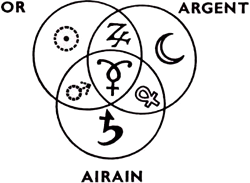

1)   Voir le Compagnon, éd. 1962, page 168.

Constatons tout d'abord le prestige exceptionnel dont jouit le nombre sept. Déjà, les Chaldéens le considéraient comme plus sacré que les autres. En superposant sept cubes de maçonnerie, ils érigeaient des tours destinées à relier la terre au ciel, car la divinité s'exerçait, à leurs yeux par l'entremise =180= d'une administration universelle comportant sept ministères. Ces départements correspondaient aux astres qui parcourent la voûte céleste, comme s'ils étaient plus actifs que les étoiles fixes. Soleil , Lune , Mars , Mercure , Jupiter , Vénus , et Saturne , se partagèrent ainsi le gouvernement du monde.
 Personnifié par les poètes pour les besoins de la dramatisation mythologique, ce septénaire devait, par la suite, se subtiliser dans l'esprit des métaphysiciens.
 La tour aux sept cubes du Temple de Bel apparut alors comme le symbole de la Cause première immanente, chacune de ses sept plates-formes étant consacrée à l'une des Causes seconds, organisatrices de l'Univers.
 C'est à ces causes septénaires qu'il faut attribuer l'œuvre de la Création, telle qu'elle nous apparaît dans les cosmogonies, dont la Genèse hébraïque n'est qu'un spécimen particulier.
 Celle-ci nous a d'ailleurs transmis les notions mystérieuses qui, sous forme d'enseignements secrets, se sont conservées au sein des écoles d'initiation d'Occident, où il a toujours été entendu que la Lumière nous vient d'Orient.
 C'est ainsi que les philosophes hermétiques ont discerné sept influences distinctes, qui se répercutent en tout être organisé, qu'il s'agisse du Macrocosme (monde en grand) ou du Microcosme (monde en petit), représenté par l'individu humain, animal, végétal ou minéral. Il est à remarquer, à ce propos, =181= qu'ils ne considéraient le règne minéral comme individualisé que dans les atomes, les molécules chimiques et les corps sidéraux.
 Du reste, une distinction s'imposait entre la nature élémentaire, soumise au quaternaire des éléments 1), et une nature plus affinée par suite de son accord vibratoire avec les sept notes qui forment la gamme de l'harmonie universelle.


1)   Voir l'Apprenti, éd. 1962, page 208.

Connaître ces notes est d'importance capitale pour qui aspire à s'initier à la musique des spheres que prétendait entendre Pythagore. Elles correspondent aux jours de la semaine qui, en dépit des révolutions religieuses, restent consacrés au septénaire divin, conçu il y a plus de sept mille ans par les sages auxquels remonte l'ère de la Vraie Lumière.
 Si ce septénaire ne procédait que des sept planètes et des sept métaux connus des anciens, il n'y aurait plus, actuellement, à en faire grand cas. Mais il se justifie beaucoup plus par l'étude de l'homme que par les observations astronomiques primitives ou par une métallurgie encore dans l'enfance. Parmi les hommes d'une même race, on distingue en effet sept types, caractérisés très nettement au physique comme au moral. Les chiromanciens et les astrologues nous ont conservé à ce sujet des traditions qui ne sont pas à dédaigner, car elles font application d'une loi générale du septénaire, dont les Initiés doivent saisir toute la portée. Ils ne parviendront à la Maîtrise que s'ils se rendent =182= compte que tout est à la fois un, triple et septuple. Essayons de stimuler par quelques schémas la sagacité du lecteur.


La Tri-Unité Septénaire

Piquées en triangle, trois rosettes de soie bleue décorent le tablier des Maîtres. Symboliquement, ce sont des anneaux que l'on se plaît à rapprocher et à entrelacer pour former une tri-unité qui se trouve être septénaire.


 Part Six


CONCEPTS OF INITIATORY
PHILOSOPHY


RELATING TO THE MASTER DEGREE
=179=


INTRINSIC PROPERTIES
OF NUMBERS


IN THE MASTER DEGREE


The Mysteries of the Number Seven


wirthS TO JUSTIFY his initiatory age, the Master must not ignore the speculations that the ancients based on the intrinsic properties of numbers. The Fellowcraftship had to lead him to the septenary by making him climb the seven steps of the Temple. 1) It is now a question of starting from the number seven to rise to the whole series of higher numbers.


1)   See The Fellowcraft, ed. 1962, page 168.

Let us note first of all the exceptional prestige enjoyed by the number seven. The Chaldeans considered it already more sacred than the others. By superimposing seven masonry cubes, they erected a tower intended to connect the earth to the heaven, because the divinity was exercised, in their eyes, =180= through a universal administration comprising seven ministries. These departments corresponded to the stars which travel through the celestial vault, as if they were more active than the fixed stars. Sun , Moon , Mars , Mercury , Jupiter , Venus , and Saturn , thus shared the government of the world.
 Personified by the poets for the purposes of mythological dramatization, this septenary had therefore to be refined in the minds of the metaphysicians.
 The tower with the seven cubes of the Temple of Babel then appeared as the symbol of the immanent First Cause, each of its seven platforms being dedicated to one of the Secondary Causes, organizers of the Universe.
 It is to these septenary causes that we must attribute the work of Creation, as it appears to us in the cosmogonies, of which the Hebrew Genesis is only a particular specimen.

 This has also transmitted to us the mysterious notions which, in the form of secret teachings, have been preserved in the initiation schools of the West, where it has always been understood that the Light comes to us from the East.
 This is how the Hermetic philosophers discerned seven distinct influences that reverberate in every organized being, whether it is the Macrocosm (world in large) or the Microcosm (world in small), represented by the human, animal, vegetable, or mineral individual. It should be noted, in this regard, =181= that they considered the mineral kingdom as individualized only in atoms, chemical molecules, and sidereal bodies.
 Moreover, a distinction was required between elementary nature, subjected to the quaternary of the elements 1) and a nature more refined as a result of its vibratory concord with the seven notes which form the scale of universal harmony.


1)   See The Apprentice book, ed. 1962, page 208.

Knowing these notes is of capital importance for anyone who aspires to learn the music of the spheres that Pythagoras claimed to hear. They correspond to the days of the week that, despite religious revolutions, remain consecrated to the divine septenary, conceived more than five thousand years ago by the sages to whom the era of True Light dates back.
 If this septenary only proceeded from the seven planets and the seven metals known to the ancients, there would be little need to pay much attention to it today. But it is justified much more by the study of man than by primitive astronomical observations or by a metallurgy still in its infancy. Among the men of the same race, one distinguishes in fact seven types, characterized very clearly with the physical as with the moral characteristics. Palmists and astrologers have preserved for us traditions that are not to be disdained, because they apply a general law of the septenary, of which the Initiates must grasp the full scope. They will only achieve Mastery if they realize =182= that everything is at the same time one, threefold and sevenfold. Let us try to stimulate the reader's sagacity with a few diagrams.


The Septenary Tri-Unity

Laid in the shape of a triangle, three rosettes of blue or red silk decorate the apron of the Masters. Symbolically, they are rings that we like to bring together and intertwine to form a trinity that turns out to be septenary.

3Wirth

Rien de de plus simple que ce tracé muet, évocateur de concepts philosophiques dont l'exposé fournirait le texte d'une série de copieux volumes. Contentons-nous ici d'indications concises, destinées à guider les aspirants à la vraie Maîtrise intellectuelle.
 1° Cercle d'or. — Soleil , centre immuable et =183= fixe d'où râyonne toute activité. Esprit qui anime la matière. Le Soufre des alchimistes 🜍. Feu intérieur individuel. Générateur de couleur rouge: sang, action, chaleur et lumière.
 2° Cercle d'argent. — Lune , astre changeant, miroir réceptif des influences; moule déterminant toute formation. La substance passive, épouse de l'esprit, Le Mercure des Hermétistes , véhicule de l'activité spirituelle qui pénètre toute chose. L'espace, couleur bleue: air, sentiment, sensibilité.
 3° Cercle d'airain ou de plomb. — Saturne , le dieu précipité du ciel, qui règne sur tout ce qui est pesant. Matérialité, positivisme, lourdeur réalisante. Couleur jaune, qui tend à s'obscurcir, en tournant au brun, puis au noir: la charpente osseuse, la base solide de toute construction, le roc qui fournit la pierre brute, point de départ du Grand-Œuvre.
 4° Surface d'interférence de 1 e 2. — Le Fils, né du mariage du Père et de la Mère. Jupiter , à qui est consacré l'étain, le plus léger des métaux. Opposé à Saturne qu'il détrône, ce dieu correspond à la spiritualité. C'est lui qui décide et ordonne, en projetant la foudre du courant volontaire. Couleur pourpre ou violette (complémentaire du jaune): idéalité, conscience, responsabilité, gouvernement de soi.
 5° Espace central, où les trois couleurs primitives se synthétisent en lumière blanche. — Etoile flamboyante, Mercure des Sages , quintessence. Le lien subtil de la personnalité. Ether vivant sur qui tout =184= retentit. Le fluide des magnétiseurs, le grand agent magique.
 6° Domaine d'interférence de 2 et de 3. — Vénus , le cuivre, la vitalité, l'humidité génératrice des êtres. Couleur verte: douceur, tendresse, sensibilité physique.
 7° Interférence de 1 et de 3. — L'activité matérielle, Mars , le fer, le besoin d'action, la motricité qui dépense et qui consume l'énergie vitale. Le feu dévorant, couleur de flamme, jaune rouge écarlate: instinct de conservation, égoïsme, férocité, mais aussi puissance inlassable de réalisation.
 Le septénaire ainsi esquissé se retrouve jusque dans les sept péchés capitaux, dont la distinction repose sur des données initiatiques:
 1° L'orgueil, nuisible lorsqu'il procède d'une vanité frivole, se rattache au Soleil, qui éblouit les faibles.
 2° La paresse, provient de la passivité lunaire, alanguie en inertie abusive.
 3° L'avarice est le vice des saturniens 1), prévoyants et prudents à l'excès.
 4° La gourmandise se reproche par contre aux jupitériens, gens hospitaliers et généreux qui ne s'oublient pas eux-mêmes.

 5° L'envie tourmente les mercuriens agités qui ne sont jamais satisfaits et ne peuvent s'empêcher =185= d'ambitionner avec véhémence ce qu'ils ne possèdent pas.
 6° La luxure naît de l'exagération des qualités de Vénus.

 7° La colère, enfin, est le défaut de Mars, dont elle exalte la violence et les emportements.


1)   Type humain particulier, de même qu'il existe des jupitériens, des mercuriens, des martiens, des solariens, des lunariens et des vénusiens.

On remarquera que 1 s'oppose à 6, 2 à 7 et 3 à 4, alors que 5 n'est en opposition avec personne en particulier, tout en assurant l'équilibre général.
 Il est à noter aussi que, si l'on supprimait l'un des sept péchés capitaux, le monde cesserait d'exister. Rien ne démontre mieux l'importance du septénaire, tel que le conçoivent les Initiés.


L'Équilibre

De la compréhension de sept, il est aisé de passer à l'intelligence de huit, si l'on a saisi exactement la signification des colonnes J∴ et B∴. — Sept est, en effet, à huit ce que J∴ est à B∴.
 Sept établit, fonde, crée, organise, coordonne, harmonise, produit.
 Huit consolide, maintient, préserve, distribue l'ordre et conserve l'harmonie. C'est le nombre de la stabilité, ramenant à l'état statique ce qui émane de sept à l'état dynamique. Sept débrouille le chaos et construit le monde (Macroscome et Microcosme) dont huit règle la vie et le fonctionnement. Le progrès résulte de l'action septénaire qui dirige les =186= mouvements combinés, mais les dynamismes s'opposent entre eux pour réaliser l'équilibre, comme l'indique l'idéograme choisi par les Accadiens pour désigner les noms divins:

3Wirth         

Nous ne sommes plus ici dans le domaine de l'initiative génératrice (J∴), dans l'instabilité motrice et agissante, car tout se contrebalance dans ce tracé, comme si toute action devait être neutralisée, en vue de stabiliser, autour d'un point fixe, un ensemble d'énergies mutuellement tenues en échec (B∴). Sept correspond à Mars , l'ardeur agissante, et Huit à Vénus , l'humidité qui entretient la Vie. Sept se rapporte au principe mâle fécondateur, au Feu universel invisible, qui anime et construit mystérieusement toutes choses, alors que Huit évoque la substance féminine fécondée, Isis, l'épouse d'Osiris, autrement dit la Nature, personnifiée par Ishtar, Astarté ou l'Arthémis d'Ephèse.
 Or, la Grande Déesse, nourricière des vivants, était servie, selon les Phéniciens, par huit dieux =187= secondaires, dits Kabirim (Forts, Puissants). Ce nombre est significatif, car il ne saurait s'appliquer aux agents coordinateurs du chaos, aux Causes secondes, constructives de la Tri-unité nécessairement septenaire. Conjuguées symétriquement, les oppositions agissantes se contrarient dans l'octoade et visent à l'immobilité relative et à la fixité par rapport au centre. Les énergies en jeu sont donc essentiellement conservatrices, si bien qu'il est permis de voir dans les Kabirim les Puissances qui assurent le bon fonctionnement du monde qu'elles ont contribué à construire. On les appelait au secours contre le déchaînement des éléments et les marins comptaient sur leur protection dans le péril de la tempête. Ils croyaient les voir se manifester au sommet des mâts sous forme de lueur, connue depuis sous le nom de feu Saint-Elme.
 Le culte de ces divinités se transmit aux Grecs, qui instituèrent en leur honneur les mystères de Samothrace; puis la dévotion aux Cabires se répandit dans le monde romain.

 Mais, en se vulgarisant, la doctrine initiatique primitive devait fatalement s'obscurcir. Les dieux trop énigmatiques des Syriens furent hellénisés en tant que fils ou petit-fils d'Héphaistos, plus connu sous le nom de Vulcain, le dieu du travail souterrain et du feu intérieur. On leur attribua comme mère une fille de Protée, l'émanation marine qui prend toutes les formes vivantes, puisqu'elle n'est autre que l'humidité vitale. Ces enfants du Feu et de l'Eau terrestres prennent dans l'imagination l'aspect de gnômes forgerons, maniant marteau et =188= tenaille. Ce sont eux qui provoquent l'ascension de la sève végétale, d'où leur affinité avec Déméter (Cérès) et Dionysos (Bacchus); ils deviennent, à ce point de vue, les génies de la fertilité.
 Quel rôle ont-ils joué, en outre, dans les Mystères révélateurs des destinées de l'âme humaine?   Certaines gravures de miroirs étrusques nous apprennent que l'un des Cabires fut mis à mort par ses frères aînés, puis rappelé à la vie par Hermès avec le concours des meurtriers. Cette résurrection a été rapprochée de celle d'Hiram.


Nothing could be simpler than this silent outline, evocative of philosophical concepts, whose exposition would fill a series of copious volumes. Let us be content here with concise indications intended to guide the aspirants to the true intellectual Mastery.
 1° Golden Circle. — Sun , immutable and fixed center from which all activity radiates. =183= Spirit that animates matter. The Sulfur of the Alchemists 🜍. Individual inner fire. Generator of the red color: blood, action, heat, and light.
 2° Silver Circle. — Moon , changing star, receptive mirror of influences; that determines all formation. The passive substance, spouse of the spirit, The Mercury of the Hermetists , vehicle of the spiritual activity which penetrates all things. The blue space: air, feeling, sensitivity.
 3° Bronze or Lead Circle. — Saturn , the god cast down from the sky, who reigns over all that is heavy. Materiality, positivism, realizing heaviness. Yellow color that tends to darken, turning to brown, then to black: the bone structure, the solid base of all construction, the rock that provides the raw stone, the starting point of the Great Work.
 4° Interference surface of 1 e 2. — The Son, born of the marriage of Father and Mother. Jupiter , to whom tin, the lightest of metals, is consecrated. Opposite to Saturn whom he dethrones, this god corresponds to spirituality. It is he who decides and orders, projecting the lightning of the voluntary current. Purple or violet color (complementary to yellow): ideality, conscience, responsibility, self-control.
 5° Central space, where the three primitive colors are synthesized in white light. — Flaming star, Mercury of the Wise , quintessence. The subtle bond of the personality. Living ether upon which everything resonates. =184= The fluid of magnetizers, the great magical agent.
 6° Interference domain of 2 and 3. — Venus , copper, vitality, the generating moisture of beings. Green color: sweetness, tenderness, physical sensitivity.
 7° Interference of 1 and 3. — Material activity, Mars , iron, the need for action, dynamism that expends and consumes vital energy. Devouring fire, color of flame, yellow, scarlet, red: instinct of self-preservation, selfishness, ferocity, but also tireless power of achievement.
 The septenary thus sketched can be found even in the seven deadly sins, whose distinction rests on initiatory data:

 1° Pride, harmful when it proceeds from frivolous vanity, is linked to the Sun, which dazzles the weak.
 2° Laziness comes from lunar passivity, languid in abusive inertia.
 3° Greed is the vice of the Saturnians, 1) far-sighted and prudent to excess.
 4° Gluttony, on the other hand, is reproached to the Jupiterians, hospitable and generous people who are unselfish.
 5° Envy torments restless Mercurians, who are never satisfied and cannot prevent themselves =185= from vehemently covet what they do not possess.
 6° Lust arises from the exaggeration of the qualities of Venus.
 7° Anger, lastly, is the fault of Mars, whose violence and outbursts it exalts.


1)   Particular human type, just as there are Jupiterians, Mercurians, Martians, Solarians, Lunarians and Venusians.

It will be noted that 1 is opposed to 6, 2 to 7, and 3 to 4, while 5 is not in opposition to anyone in particular, thus ensuring the general balance.
 It should also be noted that if one of the seven deadly sins were removed, the world would cease to exist. Nothing better demonstrates the importance of the septenary, as the Initiates conceive it.


The balance

From the understanding of the seven, it is easy to move on to the comprehension of the eight, if the meaning of the columns J and B has been grasped exactly. — Seven is, in fact, to eight what J is to B.
 Seven establishes, founds, creates, organizes, coordinates, harmonizes, produces.
 Eight consolidates, maintains, preserves, distributes order, and preserves harmony. It is the number of stability, bringing back to the static state what emanates from seven in the dynamic state. Seven unravel the chaos and build the world (Macrocosm and Microcosm) of which eight regulates the life and the functioning. Progress results from the septenary action which directs the combined movements, =186= but the dynamisms oppose each other to achieve the balance, as indicated by the ideogram chosen by the Accadians to designate the divine names:

3Wirth         

We are no longer here in the domain of generative initiative (J), in motor and acting instability, because in this layout everything is counterbalanced, as if all action had to be neutralized, in order to stabilize, around a fixed point, a set of mutually held in check energies (B). Seven corresponds to Mars , the active ardor, and Eight to Venus , the moisture that sustains Life. Seven corresponds to the fertilizing male principle, to the invisible universal Fire that mysteriously animates and builds all things, while Eight evokes the fertilized feminine substance, Isis, the wife of Osiris, in other words Nature, personified by Ishtar, Astarte or Artemis of Ephesus.
 Now, according to the Phoenicians, the Great Goddess, nurturer of the living, was served by eight secondary gods, =187= called Cabeiri (Strong, Powerful). This number is significant, because it cannot be applied to the coordinating agents of chaos, to the secondary Causes, constructive of the necessarily septenary Tri-unity. Conjugated symmetrically, the active oppositions contradict each other in the octad and tend towards relative immobility and fixity in relation to the center. The energies in play are therefore essentially conservative, so much so that it is possible to see in the Cabeiri the Powers which ensure the proper functioning of the world they have helped to build. They were called for help against the outburst of the elements, and the sailors counted on their protection in the danger of the storm. They believed they saw them manifest themselves at the top of the masts in the form of a glow, later known as the fire of St. Telmo.
 The worship of these divinities was transmitted to the Greeks, who instituted in their honor the mysteries of Samothrace; then devotion to the Cabeiri spread throughout the Roman world.
 But, by becoming popular, the primitive initiatory doctrine was inevitably to be obscured. The too enigmatic gods of the Syrians were Hellenized as the sons or grandsons of Hephaestus, better known as Vulcan, the god of underground work and inner fire. They were assigned as mother a daughter of Proteus, the marine emanation which takes all living forms, since it is none other than the vital moisture. These terrestrial children of Fire and Water take in the imagination the appearance of blacksmiths gnomes, wielding hammers and tongs. =188=. They are the ones which cause the rise of the vegetable sap, hence their affinity with Demeter (Ceres) and Dionysus (Bacchus); they become, from this point of view, the geniuses of fertility.
 What role did they play, moreover, in the Mysteries revealing the destinies of the human soul? Certain Etruscan mirror engravings tell us that one of the Cabeiri was put to death by his elder brothers, then brought back to life by Hermes with the help of the murderers. This resurrection was compared to that of Hiram.


     3Wirth
Standing between two Cabeiris, Mercury resurrects a third, whose companions have murdered.
Reproduction of an engraving that decorates an Etruscan mirror.


L'Octade solaire

Le nombre huit, qui est celui des Kabirim sémitiques, se retrouve dans l'emblême babylonien du Soleil, dont les rayons se répartissent en double croix. Verticaux et horizontaux, les uns sont rigides et se rapportent au quaternaire des éléments, de même qu'aux effets physiques de la lumière et de la chaleur. Les rayons obliques indiquent, au contraire, par leur ondulation qu'ils sont vivants; et comme de plus chacun d'eux est triple, ils font allusion au duodénaire des divisions de l'écliptique, dont il sera question plus loin.

3Wirth     

Le Soleil était envisagé comme l'un des sept grands agents coordinateurs du monde, mais on lui attribuait, en outre, une influence permanente essentiellement régulatrice. C'est lui qui assure l'ordre des saisons, la succession régulière du jour et de la nuit, si bien que tout fonctionnement normal fut, par extension, considérée comme son œuvre. Le dieu-lumière a horreur du désordre, =190= qu'il réprime partout. C'est ainsi qu'il favorise le raisonnement lucide, qui coordonne les idées selon les lois d'une saine logique. Il modère de même les passions, afin qu'elles ne puissent troubler la sérénité dont il est le dispensateur. Il intervient enfin jusque dans l'organisme qui offusque Apollon lorsque tout n'y fonctionne pas à souhait. La médecine a donc été placée sous le patronage du dieu régulateur, dont le fils, Asclepios ou Esculape, a pouvoir de guérir en rétablissant l'harmonie du rythme vital, rendu discordant par la maladie.
 La vertu solaire tend à dissiper tous les maux; elle fait pénétrer la clarté dans les esprits, la paix dans les âmes et restitue la santé aux corps. Son action est réparatrice, si bien que le Soleil a été considéré comme le grand ami des vivants, comme leur Sauveur ou Rédempteur. En cette qualité, il convient de grouper son rayonnement en croix, ou mieux encore, en double croix. Le christianisme naissant s'est largement imprégné de ces notions fort anciennes.

3Wirth     

Un soleil, dont les rayons forment huit faisceaux, décorait l'Orateur des Loges au XVIIIe siècle. =191=
 Cet emblème désigne très justement l'officier qui veille à l'application de la loi et doit faire la lumière dans l'esprit des néophytes sur les mystèree de leur initiation.
 Remarquons encore que notre chiffre 8 dérive de deux carrés superposér 3Wirthou 3Wirth. Cette dernière forme nous est donnée par le Hhet phénicien 3Wirth huitième lettre de l'alphabet primitif qui, simplifiée, est devenue notre H et, d'autre part, le chiffre 8. Cela nous ramène au Carré long qui représente la Loge, ou, plus exactement, le sanctuaire inviolable du suprême idéal maçonnique.


3WirthLe nombre 8 est d'ailleurs le cube de 2, ce que représente graphiquement la figure ci-contre, qui montre qu'un cube ne redevient cubique par multiplication qu'en réalisant l'Octoade, unité supérieure dans le domaine des trois dimensions. Huit devient ainsi le nombre de la cohésion constructive, source de solidité du Grand-Œuvre Maçonnique.


L'Ennéade ou triple Ternaire

Si, dans une Loge, 8 est le nombre de l'Orateur, 7 convient au Maître qui dirige les travaux et 9 au F∴ Secrétaire, =192= chargé du tracé assurant la coutinuité de l'œuvre.

 Symboliquement, ce tracé s'exécute sur une planche divisée en 9 carrés dont l'ordre numérique détermine la signification.
 Les trois rangées de chiffres correspondent aux grades d'Apprenti, de Compagnon et de Maître. Elles se rapportent aussi à l'Idée, à la Volonté et à, l'Acte. Les colonnes verticales expriment, par contre, la triplicité inhérente à toute manifestation unitaire, en laquelle se distinguent nécessairement trois termes:


3Wirth1° Le Sujet, agissant, principe d'action, cause active, centre émanant, agent.
2° Le Verbe, l'activité, le travail, l'émanation radiante, la vertu agissante.
3° L'Objet, le résultat, l'œuvre accomplie, l'acte effectué.
 En appliquant ces notions générales à chacuu des termes du triple ternaire, on est conduit à des interprétations comme les suivantes:

1. Le principe pensant, centre d'émission de la pensée.

2. La pensée, l'action de penser.

3. L'idée, la pensée formulée ou émise.

4. Le principe voulant, centre d'émission de la volonté.

5. L'énergie volitive, l'action de vouloir. =193=

6. La volition voulue, le vœu, le désir.

7. Le principe agissant, disposant du pouvoir exécutif, dirigeant et réalisant.

8. L'activité opérante.

9. L'acte accompli et sa répercussion permanente; l'expérience du passé, semence de l'avenir.

 Les mots se prêtent fort mal à rendre tout ce que suggère aux Initiés le groupement des chiffres. Nous sommes dans le domaine des secrets incommunicables: Il faut découvrir par soi-même ce qui ne saurait s'inculquer ou faire l'objet d'une leçon s'adressant à la mémoire.
 Il s'agit en somme de s'exercer au classement méthodique de nos conceptions, en évitant de confondre les domaines ou les catégories. C'est, pour une bonne part, ce qui s'appelle travailler sur la planche à tracer.
 L'important est d'ailleurs de saisir la leçon qui se dégage des faits. Mais ceux-ci s'enchaînent dans leur accomplissement avec l'idée dont ils procèdent. Tout progrès tire son origine d'un rêve ou d'une utopie, qui, peu à peu, a pris consistance dans les esprits. L'idée devient alors l'Impératrice (arcane III du Tarot) 1) et se fait génératrice de la volonté (IV. L'Empereur du Tarot) 2). Rencontrant l'approbation générale, le consensus moral (V. Le Pape), l'aspiration se répand et gagne en tension =194= (VI. L'Amoureur) 3). Désormais l'exécution s'impose et VII (Le Chariot) se met en mouvement d'accord avec VIII (La Justice) 4), pour aboutir à IX (L'Ermite), le Sage, le Philosophe expérimenté, le Maître.


1)   Voir l'Apprenti, éd. 1962, page 204.

2)   Voir le Compagnon, éd. 1962, page 115.

3)   Voir le Compagnon, éd. 1962, page 41.

4)   Voir l'Apprenti, éd. 1962, page 168.
Pour les âutres arcanes, se reporter au Tarot des Imagiers du Mogen-Age (Collection du Symbolisme).

Rien de sérieux, de durable, ne s'improvise. Il faut labourer, semer, laisser germer et croître la récolte, avant de pouvoir, très tardivement, rentrer une moisson mûrie à point. Poursuivre une réalisation immédiate est une erreur. Se précipiter sur l'appât du moment équivaut, le plus souvent, à lâcher la proie pour l'ombre. Avis aux politiciens prétendus réalistes! Le Maçon doit être résigné à ne pas profiter lui-même de son travail initiatique. S'il laisse sur sa planche un tracé judicieux, l'exécution s'en produira en temps voulu. Le Maître de la Loge s'informe de l'heure pour ouvrir et fermer les travaux: c'est là une leçon dont il importe de saisir la portée.


La Tradition

Comment les Maîtres travaillent-ils sur la planche à tracer?   Cette question, que le catéchisme se garde bien de résoudre, est d'une extrême importance. La planche, sur laquelle se dessine ce qui deviendra exécutoire, est fort mystérieuse, comme toutes les autres particularités de la Maîtrise, grade =195= suprême de l'Initiation. Le bois, sur lequel les Maîtres tracent leurs plans à la Règle et au Compas, n'est pas le marbre ou l'airain où se grave l'histoire, ni même la brique aux inscriptions cunéiformes qui nous a conservé la science des Babyloniens. Chacun de nous possède son humble planche qui n'a rien d'impérissable. Nous y traçons notre testament constructif, l'ensemble de volontés qui seront exécutoires après nous, pour nos successeurs dans l'accomplissement du Grand-Œuvre.
 Le tracé s'effectue sous forme d'actes: c'est notre pensée vécue, notre volonté traduite en action, qui se dessine sur la planche dont s'inspireront les ouvriers de demain. Nous sommes influencés par nos prédécesseurs et nous influençons nos héritiers. Ils bénéficieront de notre pensée, qui se développera dans leur mentalité comme une graine que nous aurons semée. Ils puiseront dans notre volonté l'énergie nécessaire pour réaliser notre rêve.
 Chacun de nous recueille un patrimoine intellectuel et moral qu'il a mission de faire fructifier, afin de le transmettre enrichi à la génération suivante. Telle est la tradition vénérable, la Sainte Kabbale des Initiés. Le Maître est comptable de ce trésor accumulé par les siècles. S'il comprend ce qu'ont voulu les plus nobles esprits et s'il veut à son tour, du fond de tout son être, la réalisation du même idéal, il devient par ce fait le digne émule des Sages discrets, qui, dès l'origine des sociétés humaines, n'ont cessé de conspirer en faveur du Mieux.

 Le progrès ne s'accomplit que parce qu'il est voulu. Sachons donc nous associer corps et âme à =196= la chaîne des volontés transmutatrices du Mal en Bien. Vivons pour l'Œuvre, en Maçons qui n'attendent leur salaire qu'en Chambre du Milieu.


Les Muses

Neuf sœurs, filles de l'Intelligence suprême (Zeus ou Jupiter) et de la Mémoire (Mnémosyne), personnifiaient aux yeux des Grecs les mystérieuses puissances inspiratrices des artistes et des poètes. Ces vierges, qui rendent l'homme sensible aux accords d'une harmonie délicate, sont dirigées par Apollon, le dieu des arts réalisateurs du Beau.
 Or, nul n'est Maître s'il reste livré à lui-même et n'entre pas en communion avec ce qui, autour de lui, vibre harmoniquement. Tant que nous ne percevons pas certaine musique hyperphysique, nous ne pouvons être appelés aux grandes réalisations. Même habile et instruite à sa manière, la brute ne saurait collaborer utilement au Grand-Œuvre, car son activité se traduit en un travail par trop inharmonique.
 Le Compagnon a dû s'instruire des arts libéraux 1) pour s'élever à la Maîtrise; comme adepte du troisième degré, il s'assimile l'Art dans ce qui constitue son essence: il devient Artiste d'une manière générale, en puissance psychique, sinon matériellement en acte.


1)   Voir le Compagnon, éd. 1962, page 168.

Pourvu que le Maître ou l'Artiste intérieur, sente, vibre, et soit en harmonie avec le Beau, =197= peu importe ce qu'il extériorise par le geste, car il émet une radiation bénéfique, certaine de trouver son utilisation. Il trace sur sa planche des figures qui ont la valeur de pentacles.
 Familier aux Hermétistes, ce terme désigne un tracé symbolique, plus ou moins complexe, en lequel se concentre toute une philosophie. L'ancienne magie en faisait un copieux usage: elle prétendait conjurer démons et maladies par la vertu de figures appropriées, gravées sur des amulettes. De nos jours, l'Eglise a fait du crucifix un pentacle qui met le diable en fuite, pour ne point parler d'innombrables médailles, toutes miraculeusement efficaces en leur domaine. En réalité, la vertu pentaculaire réside dans l'idée, les sentiments générateurs d'énergie ou l'état d'âme que l'image évoque. Par elle-même, celle-ci n'est pas agissante, puisqu'il est entendu chrétiennement qu'en ce domaine la foi est seule opérante.
 Mais que dire d'un pentacle invisible, tracé par toute une vie d'efforts mis au service d'un idéal supérieur?   Il ne s'agit plus ici d'enfantillages de grimoire, mais du renforcement de la puissance secrète des Initiés. Celle-ci n'a jamais résidé dans leur nombre, ni dans l'organisation judicieuse de leurs groupements, mais uniquement dans la valeur de ce qu'ils ont su tracer sur leur planche énigmatique.
 Les Muses sont les institutrices qui nous enseignent à déchiffrer les hiéroglyphes initiatiques et à lire ainsi dans le livre éternel de la Tradition sacrée. Elles inspirent l'artiste, le musicien, =198= le chantre, le poète, mais aussi et surtout le penseur, car la pensée correspond au plus subtil des Arts, auquel nul ne s'élève, s'il ne s'est mis à l'école d'Apollon et des neuf sœurs, sereines dispensatrices de rythmes justes et de mesures harmonieuses. C'est ainsi que la lyre d'Amphion rendait des accords si parfaits, que leur action rassembla les pierres des murs de Thèbes, qui s'ajustèrent d'elles-mêmes pour entourer la ville sainte d'un inébranlable rempart.

 Il faut savoir comprendre la vérité qui s'adresse à nous en un langage de fable.


Le Carré de Saturne

Les nombres peuvent être disposés en carrés, de telle manière qu'en les additionnant horizontalement, verticalement ou en diagonale, on obtienne invariablement la même somme. On forme ainsi des carrés magiques, dont le plus simple se limite aux neuf premiers nombres et correspond à Saturne selon les occultistes. Il groupe en croix les nombres impairs et relègue aux angles les nombres pairs.
 Si puérile qu'elle paraisse, toute combinaison de chiffres est instructive; mais il est parfois difficile d'en dégager un enseignement initiatique.

3WirthEn ce qui concerne le classique Carré de Saturne, notre attention doit se porter tout d'abord sur la colonne centrale, qui nous donne le commencement, le =199= milieu et la fin de la série des nombres à un seul chiffre. Cela nous autorise à rapporter [1], [5] et [9] à l'Apprenti, au Compagnon et au Maître, qui seraient placés entre les colonnes J∴ [8, 3, 4] et B∴ [6, 7, 2]. L'Apprenti aurait ainsi à distinguer [8] de [6]; puis à concilier l'antagonisme des deux chiffres. Or, 8 et 6 signiffient Raison et Sentiment, Rigueur, Justice, Sévérité, en opposition avec Douceur, Bonté, Indulgence.
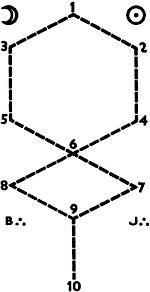
 Au Compagnon se recommande une distinction analogue entre [3] et [7], entre la conception théorique et abstraite, s'inspirant de l'idéalité pure: [3] et l'exécution pratique, concrète, tenant compte de toutes les contingences: [7].

 Le Maître enfin, tracera ses plans en conciliant le positivisme mathématique, froidement observateur et calculateur: [4] avec des dons subtils d'intuition et de prévision divinatoire de l'avenir: [2].
 Le mystère, l'inconnu encore inexploré: [2] s'oppose d'ailleurs diagonalement à: [8], chiffre impliquant logique, ordre, loi, domaine intelligible tombant sous le rayonnement du Soleil. — Même opposition entre [4] et [6]: le vouloir positif qui ordonne [4] et l'aspiration sentimentale se traduisant par la passivité du désir [6].
 Si l'initiation part du raisonnement de l'Apprenti, exercé dans les limites étroites du cercle que décrit le Compas: [8], c'est pour aboutir à la voyance du Maître: [2], qui sonde les profondeurs de l'infini et fait jaillir la lumière du sein des ténèbres. =200=


Les Séphiroth

Tradition se dit Qabbalah en hébreu: aussi la Kabbale est-elle une philosophie qui se transmettait initiatiquement de génération en génération. Elle se base sur des spéculations numérales, que résume la théorie des Séphiroth (Nombres), dont l'ambition est de relier le Relatif à l'Absolu, le Particulier à l'Universel, le Fini à l'Infini, ou la Terre au Ciel. Cette jonction s'opère par l'entremise de la décade, dont chaque terme a reçu des dénominations caractéristiques.


1. Kether, Couronne ou Diadème. — Unité, Centre, Principe dont tout émane et qui renferme tout en puissance, en germe ou en semence. Le Père, source, point de départ de toute activité. Agent pensant et conscient qui dit: Ehyeh: Je suis!

2. C'hocmah, Sagesse. — Pensée créatrice, émanation immédiate du Père: son premier né, Fils, Parole, Verbe, Logos ou Suprême Raison.
3. Binach, Intelligence, Compréhension. — Conception et génération de l'Idée, Isis, Vierge-Mère, qui enfante les images originelles de toutes choses.
4. C'hesed, Grâce, Miséricorde, Merci; ou GEDULAH, Grandeur, Magnificence. — Bonté créatrice appelant les êtres à l'existence. Pouvoir qui donne et répand la vie.
5. Geburah, Rigueur, Sévérité; PEC'HAD, Punition, =201= Crainte; ou DIN, Jugement. — Gouvernement, administration de la vie donnée. Devoir, domination de soi-même. Morale qui retient. Discrétion, réserve obligeant à se limiter.
6. Tiphereth, Beauté. — Idéal selon lequel les choses tendent à se construire. Sentiment, Désir, Aspirations, Volitions à l'état statique.
7. Netsah, Victoire, Triomphe, Fermeté. — Le Discernement qui débrouille le chaos, coordonne les forces constructives du monde, dirige leur application et assure le progrès. Le Grand Architecte de l'Univers.
8. Hod, Splendeur, Gloire. — La Coordination, la Loi, la Justice immanente, la Logique des choses. Enchaînement nécessaire de causes et d'effets.
9. Jesod, Base, Fondement. — Plan immatériel selon lequel tout se construit. Potentialités latentes. Planche à tracer. Fantôme pré-existant à ce qui doit devenir.
10. Malcut, Royaume. — La Création. La Roue du perpétuel Devenir. L'Apparence, la Phénoménalité. La Matière, source d'illusion et d'imposture.
 La dixième Séphire ramène à l'unité les neuf précédentes. Elle figure le sol, sur lequel se dresse le porteur de la Couronne, c'est-à-dire l'Homme universel, le Grand Adam spirituel, dont le corps se distribue comme suit entre les autres Séphires: Sagesse, cerveau, Intelligence, gorge, organes de la =202= parole, Grâce, bras droit, Rigueur, bras gauche, Beauté, poitrine, cœur, Victoire, jambe droite, Splendeur, jambe gauche, Base, organes de la génération.
 La décade séphirotique était aussi comparée à un arbre, rappelant l'arbre de vie des anciennes cosmogonies. Le schéma ci-dessous correspond à cette conception.

3Wirth

Les trois premières Séphires constituent une triade intellectuelle qui se reflète dans une seconde triade morale ou psychique, laquelle est soutenue par une dernière triade dynamique ou physique. =203= La colonne centrale, 1, 6, 9, 10 est neutre ou androgyne, conciliatrice des oppositions de droite et de gauche, 2, 4, 7, figurant la colonne J∴ masculine-active, et 3, 5, 8, la colonne B∴ féminine-passive.
 Le symbolisme maçonnique concorde avec la Kabbale en ce qu'il a d'essentiel. Il est intéressant à ce point de vue d'établir un rapprochement entre l'arbre des Séphiroth et la hiérarchie des officiers d'une Loge.
 1. La Couronne occupe la place du V∴. M∴ dirigeant les Travaux, que les branches de l'Equerre relient à 2, Sagesse, Raison, Orat.∴, et à 3, Intelligence, Compréhension qui enregistre, Secrét∴.
 4. Grâce, et 5, Rigueur, correspondent à l'Hosp∴ et au Trés∴; mais ces officiers devraient intervertir leurs places pour rester dans la logique du système séphirotique.
 6. Beauté, convient au M∴ des Cér∴, ordonnateur de tout ce qui tient aux formes.
 7. Victoire, Fermeté, et 8, Splendeur, Ordre, s'associent au 1er et au 2e Surv∴, alors que 9, Base ou Fondement se rapportent au F∴ Exp∴, gardien des traditions.
 Enfin 10, Royaume ou monde prof∴, est le domaine du F∴ Couv∴, qui veille extérieurement à la sécurité des travaux.
 Sagesse, Force, Beauté, les trois piliers qui soutiennent symboliquement le Temple, résument, en outre, la théorie des Séphiroth, en la dégageant des subtilités métaphysiques, auxquelles les anciens Maçons constructeurs tenaient à échapper. =204= Leur formule simplifiée se contente d'attribuer à la Sagesse (2e Séphire), la conception du travail maçonnique, dont l'exécution est confiée à la Force (7e' Séphire), alors que la Beauté (6e" Séphire) a mission d'orner, d'agrémenter et de mettre ainsi toute chose définitivement au point.


La Puissance Magique

Le nombre Onze a été considéré comme tout particulièrement mystérieux, sans doute parce qu'il réunit en lui 5 et 6, chiffres du Microscome et du Macrocosme 1), dont le schéma suivant précise la portée:
 L'étoile centrale est celle du génie humain, de l'intelligence 3Wirth appliquée, servie par des organes de perception et d'action. Placé au cœur du monde en grand (Macrocosme), cet astre devient ce qu'on pourrait appeler la Grande Etoile Flamboyante. Il s'agit, en d'autres termes, de l'Homme en possession du maximum de ses moyens de réalisation, disposant de la Force exécutive qui se rattache à la 7e Séphire, et que l'Arcane XI du Tarot représente sous les traits d'une femme victorieuse d'un lion 2). =205=

 Mais l'esprit individuel humain ne triomphe (7e Séphire) qu'en tant que centre agissant de l'âme universelle, donc en renonçant à tout égoïsme pour se mettre sans réserve au service du Grand Tout. L'Initié véritable tend à concentrer sur lui les énergies diffuses d'une vaste ambiance; il dispose ainsi d'une manière très réelle, d'une puissance illimitée, provenant des dieux 3)), au sens initiatique du mot. Le Maçon, qui s'est voué de toute son intelligence et de tout son cœur à l'exécution du plan de l'Architecte Suprême, peut accomplir un travail de beaucoup supérieur à ses moyens personnels: il n'est pas seul, car avec lui se solidarisent toutes les énergies que stimule la même bonne volonté. La Chaîne d'Union est effective pour tout adepte sincère, qui, ayant réalisé l'équilibre: 8, reçoit dans la mesure où il donne, en bénéficiant du courant qu'il a su établir en le transmettant.


1)   Voir le Compagnon, éd. 1962, page 151.

2)   Voir l'Apprenti, éd. 1962, page 205.

3)   Tout ce qui agit invisiblement a Jadis été divinisé.

Pour compléter l'étude du nombre Onze il est bon, après l'avoir envisagé comme la somme de 5 et 6, de le décomposer en 4 et 7; 3 et 8; 2 et 9; 1 et 10, en attribuant à ces chiffres la valeur initiatique qu'ils tirent du triple ternaire et de l'Arbre des Séphiroth.
 4 et 7 font résulter la puissance de 11 d'un vouloir énergique, inébranlablement fixe et positif: 4, associé au discernement qui, mettant chacun à sa place, sait diriger avec tact et commander en établissant l'harmonie: 7.
 3 et 8 visent la judicieuse application du pouvoir =206= agissant de 11, grâce à laquelle il se développe se maintient. C'est l'Intelligence: 3, assurant bonne administration: 8.
 2 et 9 font remonter la force initiatique: 11 au rayonnement de la Sagesse: 2, accumulé sur la Planche à tracer: 9. L'Initié conspire en concentrant les irradiations diffuses: il influence occultement ce qui doit devenir: c'est là le secret de son irrésistible pouvoir.
 1 et 10 nous montrent enfin en 11 la synthèse de la décade. Ramené à l'unité, le Tout se prête à l'accomplissement des merveilles de la «chose unique» dont traite la Table d'Emeraude d'Hermès Trismégiste. Pénétrons jusqu'au centre et tout nous obéira.


Le Duodénaire

Douze correspond à la division la plus ancienne et la plus naturelle du cercle, donnée par les deux diamètres qui se coupent à angle droit et par quatre arcs, de même rayon que la circonférence, 3Wirth tracés en prenant comme centre les extrémités de la croix.
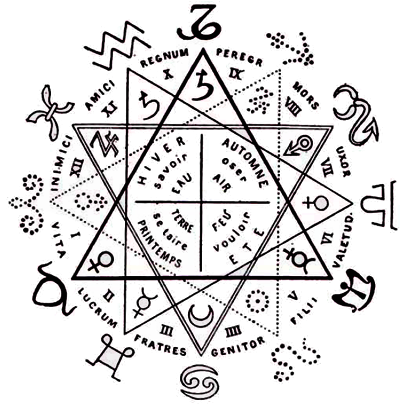
 Cette division a été appliquée au ciel où elle détermine douze espaces égaux que le soleil parcourt avec régularité dans sa course annuelle apparente autour de la terre. Les constellations qui coïncidaient =207= jadis avec ces espaces leur ont donné leur nom, tirés d'animaux ou d'êtres animés. Ainsi se forme le duodénaire zodiacal, dont la symbolisme est d'une extrême importante, car l'année devient le prototype de tous les cycles, allégorisant aussi bien les phases de la vie humaine, que celles de l'Initiation.
 Dans les mystères de Cérès, l'Initié partageait, en effet, les destinées de la graine confiée au sol. Comme elle, il devait subir l'influence solaire pour se développer et fructifier, puis repasser par cet enchaînement de métamorphoses dont résulte =208= la révolution circulaire de la vie. Chaque signe du Zodiaque prend à ce point de vue, une signification particulière, que nous nous efforcerons de fixer, après avoir fourni quelques indications générales sur le symbolisme des douze signes.


The Solar Octad

The number eight, which is that of the Semitic Cabeiri, is found in the Babylonian emblem of the Sun, whose rays are distributed in a double cross. Vertical and horizontal, some are rigid and relate to the quaternary of the elements, as well as to the physical effects of light and heat. The oblique rays indicate, on the contrary, by their undulation that they are alive; and since each one is threefold, they allude to the duodecinary of the divisions of the ecliptic, which will be discussed later.

3Wirth     

The Sun was regarded as one of the seven great coordinating agents of the world, but he was also attributed a permanent, essentially regulatory influence. It is the one who ensures the order of the seasons, the regular succession of day and night, so well that all normal functioning was, by extension, considered as his work. The light-god abhors disorder, =190= which he represses everywhere. This is how he promotes lucid reasoning, which coordinates ideas according to the laws of sound logic. He also tempers the passions, so that they cannot disturb the serenity of which he is the dispenser. In short, it intervenes even in the organism which obfuscates Apollo when everything is not working as it should. Medicine was therefore placed under the patronage of the regulating god, whose son, Asclepius or Aesculapius, has the power to heal by restoring the harmony of the vital rhythm, made discordant by the disease.

 The Solar virtue tends to dispel all evils; it brings clarity into minds, peace into souls and restores health to bodies. Its action is restorative, so much so that the Sun has been considered as the great friend of the living, as their Savior or Redeemer. In this capacity, it is convenient to group its radiance in a cross, or better still, in double cross. The nascent Christianity was largely imbued with these very ancient notions.

3Wirth     

A sun, whose rays form eight beams, decorated the Orator of the 18th century Lodges. =191=
 This emblem rightly designates the officer who oversees the application of the law and must shed light in the minds of the neophytes on the mysteries of their initiation.
 Note also that our number 8 derives from two superimposed squares 3Wirth or 3Wirth. This last form is given to us by the Phoenician Hhet 3Wirth eighth letter of the primitive alphabet which, simplified, became our H and, on the other hand, the number 8. This brings us back to the oblong square which represents the Lodge, or, more exactly, the inviolable sanctuary of the supreme Masonic ideal.


3WirthThe number 8 is also the cube of 2, which is graphically represented by the figure opposite, which shows that a cube becomes cubic again only by the multiplication realizing the octad, a higher unit in the field of three dimensions. Eight thus becomes the number of constructive cohesion, source of the solidity of the Masonic Great Work.


The Ennead or triple Ternary

If, in a Lodge, 8 is the number of the Speaker, 7 is appropriate for the Master who directs the work, and 9 for the Bro. Secretary, =192= responsible for the layout that ensures the continuity of the work.
 Symbolically, this layout is carried out on a board divided into 9 squares whose numerical order determines the meaning.
 The three rows of numbers correspond to the degrees of Apprentice, Fellowcraft, and Master. They also relate to the Idea, the Will, and the Act. The vertical columns express, on the other hand, the triplicity inherent in every unitary manifestation, in which three terms are necessarily distinguished:


3Wirth1° The Subject, acting, principle of action, active cause, emanating center, agent.
2° The Word, activity, work, radiant emanation, active virtue.
3° The Object, the result, the work done, the act done.
 By applying these general notions to each of the terms of the triple ternary, we are led to interpretations such as the following:

1. The thinking principle, the center of thought.

2. Thinking, the act of thinking.

3. The idea, the thought formulated or expressed.

4. The willing principle, the center of emission of the will.

5. The energy of volition, the act of wanting.=193=

6. Willed volition, wish, desire.

7. The acting principle, having executive power, directing and carrying out.

8. Operative activity.

9. The act performed and its permanent repercussions; the experience of the past, the seed of the future.

 The words do not lend themselves to expressing all that the grouping of numbers suggests to Initiates. We are in the domain of incommunicable secrets: one must discover for himself what could not be instilled or made the object of a lesson that is addressed to the memory.
 In short, it is about practicing the methodical classification of our concepts, avoiding confusing the domains or categories. Much of this is called working on the Tracing Board.
 The important thing is, however, to grasp the lesson that emerges from the facts. But these are linked in their accomplishment with the idea from which they proceed. All progress has its origin in a dream or a utopia, which, little by little, has taken consistency in people's minds. The idea then becomes the Empress (Arcanum III of the Tarot) 1) and becomes a generator the will (Arcanum IV of the Tarot, the Emperor) 2). Meeting general approval, the moral consensus (Arcanum V, the Pope), the aspiration spreads and gains in tension (Arcanum VI, the Lover). 3)=194= Henceforth the execution is imposed and VII (the Chariot) is set in motion together with VIII (the Justice), 4) to end with IX (The Hermit), the Sage, the experienced Philosopher, the Master.


1)   See The Apprentice, 1962 ed., page 204.

2)   See The Fellowcraft, 1962 ed., page 115.

3)   Voir The Fellowcraft, 1962 ed., page 41.

4)   Voir The Apprentice, 1962 ed., page 168.
For the other arcana, see Tarot des Imagiers du Mogen-Age (Collection du Symbolisme).

Nothing serious, lasting, can be improvised. It is necessary to plow, sow, let germinate and grow the crop, before being able, much later, to bring in a perfectly ripened harvest. Pursuing immediate realization is a mistake. Rushing on the attraction of the moment, is very often equivalent to letting the prey escape into hiding. Warning to the so-called realist politicians!   The Mason must be resigned not to profit from his initiatory work himself. If he leaves a judicious plan on his [tracing] board, the execution will take place in due time. The Master of the Lodge is informed of the time to open and close the works: this is a lesson whose significance is important to understand.


The Tradition

How do the Masters work on the tracing board? This question, which the catechism takes care not to resolve, is of extreme importance. The board, on which is drawn what will become executable, is very mysterious, like all the other particularities of the Master rank, =195= the highest degree of Initiation. The plank, on which the Masters trace their plans with the Ruler and the Compasses, is not the marble or the bronze on which history is engraved, nor even the brick with cuneiform inscriptions that the science of the Babylonians has preserved for us. Each of us has his own humble board which is not imperishable at all. We draw in it our constructive testament, the set of wills which will be executed after us by our successors in the accomplishment of the Great Work.

 The plan is carried out in the form of acts: it is our lived thought, our will translated into action, which takes shape on the [tracing] board from which the workers of tomorrow will be inspired. We are influenced by our predecessors, and we influence our heirs. They will benefit from our thinking, which will develop in their minds like a seed that we have sown. They will draw from our will the energy necessary to realize our dream.
 Each of us collects an intellectual and moral heritage that has the mission of making it bear fruit, in order to transmit it enriched to the next generation. Such is the venerable tradition, the Holy Kabbalah of the Initiates. The Master is responsible for this treasure accumulated over the centuries. If he understands what the noblest minds have wanted and if he, in turn, wants from the depths of his whole being, the realization of the same ideal, he becomes by this fact the worthy emulator of the discreet Sages, who, from the origin of human societies, have not ceased to conspire in favor of the Better.
 Progress is accomplished only because it is wanted. So let us know how to associate ourselves body and soul with the chain of wills transmuting Evil into Good. =196= Let us live for the Work, as Masons who only expect their wages in the Middle Chamber.


The Muses

Nine sisters, daughters of the Supreme Intelligence (Zeus or Jupiter) and of Memory (Mnemosyne), personified in the eyes of the Greeks the mysterious inspiring powers of artists and poets. These virgins, who make man sensitive to the chords of a delicate harmony, are led by Apollo, the god of the arts, producers of Beauty.
 However, no one is a Master if he remains devoted to himself and does not enter into communion with what vibrates harmoniously around him. Until we perceive certain hyperphysical music, we cannot be called to great achievements. Even skillful and educated in his own way, the brute cannot usefully collaborate in the Great Work, for his activity translates into a too inharmonic work.
 The Fellowcraft had to learn the liberal arts 1) in order to rise to Master; as an adept of the third degree, he assimilates the Art in what constitutes its essence: he becomes an Artist in general way, in psychic potency, if not materially in act.


1)   See the Fellowcraft, ed. 1962, page 168.

Provided that the Master or the inner Artist, feels, vibrates, and is in harmony with the Beautiful, =197= it does not matter what he exteriorizes by the gesture, because it emits a beneficial radiation, certain to find its use. He draws on his [tracing] board figures that have the value of pentacles.
 This term, familiar to the Hermetists, designates a more or less complex symbolic layout, in which a whole philosophy is concentrated. Ancient magic made copious use of it: it claimed to ward off demons and diseases by virtue of appropriate figures, engraved on amulets. Nowadays, the Church has made of the crucifix a pentacle that puts the devil to flight, not to mention countless medals, all miraculously effective in their domain. In reality, the pentacular virtue resides in the idea, the feelings that generate energy or the state of mind that the image evokes. By itself, this is not effective, since it is understood Christianly, that in this area faith alone is effective.
 But, what about an invisible pentacle traced by a lifetime of effort put at the service of a higher ideal?   This is no longer a question here of childish Book of Magic, but rather a reinforcement of the secret power of the Initiates. This has never resided in their number, nor in the judicious organization of their groups, but only in the value of what they have been able to trace on their enigmatic [tracing] board.
 The Muses are the teachers who teach us to decipher the initiatory hieroglyphics and thus to read in the eternal book of the Sacred Tradition. They inspire the artist, the musician, =198= the singer, the poet, but also and above all the thinker, because thought corresponds to the most subtle of the Arts, to which no one rises, if he has not put himself at the school of Apollo and the nine sisters, serene dispensers of correct rhythms and harmonious measures. This is how the lyre of Amphion made such perfect chords, that their action gathered the stones of the walls of Thebes, which adjusted themselves to surround the holy city with an unshakeable rampart.
 We must know how to understand the truth which is addressed to us in the language of a fable.


The Square of Saturn

The numbers can be arranged in squares, in such a way that adding them horizontally, vertically or diagonally, the same sum is invariably obtained. Magic squares are thus formed, the simplest of which is limited to the first nine numbers and corresponds to Saturn, according to the Occultists. It groups odd numbers in a cross and relegates even numbers to the corners.
 Childish as it may seem, any combination of numbers is instructive; but it is sometimes difficult to extract an initiatory teaching from it.

3Wirth As far as the classic Saturn Square is concerned, our attention must of first be fixed on the central column which gives us the beginning, =199= the middle, and the end of the series of single-digit numbers. This allows us to relate [1], [5] and [9] to the Apprentice, the Fellowcraft, and the Master, which would be placed between columns J [8, 3, 4] and B [6, 7, 2]. The Apprentice would thus have to distinguish [8] from [6]; then to reconcile the antagonism of the two numbers. However, 8 and 6 mean Reason and Feeling, Rigor, Justice, Severity, in opposition to Sweetness, Kindness, Indulgence.
 An analogous distinction between [3] and [7] is recommended for the Fellowcraft, between the theoretical and abstract conception, inspired by pure ideality [3] and the practical, concrete execution, taking into account all contingencies: [7].
 Lastly, the Master will draw up his plans by reconciling mathematical positivism, coldly observing and calculating: [4] with the help of subtle gifts of intuition and divinatory forecasting of the future: [2].
 The mystery, the still unexplored unknown: [2] is also diagonally opposed to: [8], a number implying logic, order, law, an intelligible domain falling under the radiation of the Sun. — The same opposition between [4] and [6]: the positive will which orders [4] and the sentimental aspiration resulting in the passivity of the desire [6].
 If the initiation starts from the reasoning of the Apprentice, exercised within the narrow limits of the circle described by the Compasses: [8], it is to lead to the clairvoyance of the Master: [2], who probes the depths of infinity and makes light emerge from the bosom of darkness. =200=


The Sefirot

Tradition is called Kabbalah in Hebrew: Kabbalah is also a philosophy that was transmitted initiatically from generation to generation. It is based on numerical speculations, summarized by the theory of the Sefirot (Numbers), whose goal is to reconnect the Relative to the Absolute, the Particular to the Universal, the Finite to the Infinite, or the Earth to the Heaven. This junction takes place through the decade, in which each term has received characteristic names.

1. Kether, Crown or Diadem. — Unity, Center, Principle from which everything emanates, and which contains everything in power, in germ or in seed. The Father, source, starting point of all activity. Thinking and conscious agent who says: Ehyeh: I am!
2. Chokhmah, Wisdom. — Creative thought, immediate emanation of the Father: his first-born, Son, Verb, Word, Logos or Supreme Reason.
3. Binah, Intelligence, Comprehension. — Conception and generation of the Idea, Isis, Virgin-Mother, who gives birth to the original images of all things.
4. Chesed, Grace, clemency, Mercy; or Gedulah, Greatness, Magnificence. — Creative goodness calling beings into existence. Power that gives and spreads life.
5. Gevurah, Rigor, Severity; Pec'had, Punishment, =201= Fear; or Din, Jugement. — Government, administration of the given life. Duty, domination of oneself. Moral that holds back. Discretion, reservation obliging to limit oneself.
6. Tiferet, Beauty. — Ideal according to which things tend to build. Feeling, Desire, Aspirations, Volitions in a static state.

7. Netzach, Victory, Triumph, Firmness. — Discernment which unravels chaos, coordinates the constructive forces of the world, directs their application and ensures progress. The Great Architect of the Universe.
8. Hod, Splendor, Glory. — Coordination, Law, Immanent Justice, the Logic of things. Necessary sequence of causes and effects.
9. Yesod, Basis, Foundation. — Intangible Plan according to which everything is built. Latent potentials. Tracing Board. Phantom pre-existing to what must become.
10. Malkuth, Kingdom. — Creation. The Wheel of Perpetual Becoming. The Appearance, the Phenomenality. Matter, source of illusion and imposture.
 The tenth Sefirah brings the previous nine back to unity. It represents the ground, on which the carrier of the Crown stands, that is, the universal Man, the Great spiritual Adam, whose body is distributed among the other Sefirots as follows: Wisdom, Brain, Intellect, throat, organs of speech, =202= Grace, right arm, Rigor, left arm, Beauty, chest, heart, Victory, right leg, Splendor, left leg, Base, organs of generation.
 The Sefirotic decade was also compared to a tree, reminiscent of the tree of life of ancient cosmogonies. The diagram below corresponds to this concept.

3Wirth

The first three Sefirot [Numbers] constitute an intellectual triad which is reflected in a second moral or psychic triad, which is supported by a last dynamic or physical triad. =203= The central column, 1, 6, 9, 10 is neutral or androgynous, conciliating the oppositions of right and left, 2, 4, 7, appearing the column J masculine-active, and 3, 5, 8, the feminine-passive column B.
 The Masonic symbolism agrees with Kabbalah in what is essential. It is interesting from this point of view to establish a connection between the tree of Sefirot and the hierarchy of the officers of a Lodge.
 1. The Crown represents the W. Master directing the Works, which the branches of the Square connect to 2, Wisdom, Reason, Orator, and to 3, Intellect, Understanding which registers, Secretary.
 4. Grace, et 5, Rigo, correspond to Bros. Hospitaller [in charge of charities] and Treasurer; but these officers should switch their places to stay in the logic of the sefirotic system.
 6. Beauty, suited to the Master of Ceremonies, organizer of all that pertains to forms.
 7. Victory, Firmness, and 8, Splendor, Order, are associated with the Sr. and the Jr. Wardens, while 9, Base or Foundation relates to the Experienced Brother [who guides the Candidate], guardian of traditions.
 Lastly 10, Kingdom or profane world, is the domain of Bro. Tyler, who externally oversees the security of the works
 Wisdom, Strength, and Beauty, the three pillars which symbolically support the Temple, further summarize the theory of the Sefirot, by detaching it from the metaphysical subtleties to which the ancient Masons builders were keen to escape. =204= Their simplified formula is content to attribute to Wisdom (2nd Sefirah), the conception of Masonic work, the execution of which is entrusted to Strength (7th Sefirah), while Beauty (6th Sefirah) has the mission to adorn, to make pleasant, and to put all things into focus.


The Magical Power

The number Eleven was considered to be particularly mysterious, no doubt because it unites in it 5 and 6, figures of the Microscom and Macrocosm, 1) whose scope is specified in the following diagram:
 The central star is that of the human genius, of the applied intellect, 3Wirth served by the organs of perception and action. Placed in the heart of the world on a large scale (Macrocosm), this star becomes what we could call the Great Blazing Star. It is, in other words, of the Man in possession of the maximum of his means of realization, having the executive Strength which is attached to the 7th Sefirah, and which the Arcanum XI of the Tarot represents under the features of a woman victorious over a lion. 2) =205=
 But the individual human spirit triumphs (7th Sefirah) only as an active center of the universal soul, that is, by renouncing all selfishness to place itself wholeheartedly at the service of the Great Whole. The true Initiate tends to concentrate within himself the diffuse energies of a vast environment; he thus has in a very real way an unlimited power coming from the gods, 3) in the initiatory sense of the word. The Mason, who devoted himself with all his intelligence and all his heart to the execution of the plan of the Supreme Architect, can carry out a work much greater than his personal means: he is not alone, because with him are united all the energies that stimulate the same goodwill. The Chain of Union is effective for every sincere adept, who, having achieved the balance: 8, receives to the extent that he gives, benefiting from the flow that he has been able to establish by transmitting it.


1)   See the Fellowcraft, ed. 1962, page 151.

2)   See the Apprentice, ed. 1962, page 205.

3)   Everything that acts invisibly was once deified.

To complete the study of the number Eleven it is good, after having considered it as the sum of 5 and 6, to break it down into 4 and 7; 3 and 8; 2 and 9; 1 and 10, by attributing to these numbers the initiatory value that they derive from the triple ternary and from the Sefirot Tree.
 4 and 7 give rise to the power of 11 from an energetic will, unswervingly fixed and positive: 4, associated with discernment which, putting each in his place, knows how to lead with tact and command by establishing harmony: 7.
 3 and 8 aim at the judicious application of the acting power =206= of 11, thanks to which it develops and maintains itself. It is Intellect: 3, ensuring good administration: 8.
 2 and 9 bring up the initiatory force: 11 to the radiance of Wisdom: 2, accumulated on the Tracing Board: 9. The Initiate conspires by concentrating the diffuse irradiations: he occultly influences what must become: this is the secret of his irresistible power.
 1 and 10 finally show us in 11 the synthesis of the decade. Reduced to unity, the Whole lends itself to the accomplishment of the wonders of the "unique thing" dealt with in the Emerald Table of Hermes Trismegistus. Let us penetrate to the center and everything will obey us.


The Duodenary

Twelve corresponds to the oldest and most natural division of the circle, given by the two diameters which intersect at right angles and by four arcs, with the same radius as the circumference, 3Wirth traced taking the ends of the cross as the center.
 This division has been applied to the sky where it determines twelve equal spaces which the sun traverses with regularity in its apparent annual course around the earth. The constellations which long ago coincided =207= with these spaces gave them their name, taken from animals or animated beings. Thus is formed the zodiacal duodenary, whose symbolism is extremely important, because the year becomes the prototype of all the cycles, allegorizing the phases of human life as well as those of the Initiation.
 In the mysteries of Ceres, the Initiate shared, in fact, the destinies of the seed entrusted to the ground. Like it, he had to undergo the solar influence in order to develop and bear fruit, then go through this chain of metamorphoses which results in the circular revolution of life. =208= Each sign of the Zodiac takes, from this point of view, a particular meaning, which we will endeavor to fix, after having provided some general indications on the symbolism of the twelve signs.

3Wirth     

La figure de la page 207 résume les traditions relatives au zodiaque, dont les signes se relient au septénaire des planètes, en ce sens que le Soleil a son domicile dans le Lion et que la Lune est chez elle dans le Cancer . Les autres domaines ou sphères d'influence se répartissent comme suit:

Mercure       Gémeaux     et   Vierge       

Vénus         Taureaux     et   Balance     

Mars           Bélier             et   Scorpion     

Jupiter       Poissons         et   Sagittaire  

Saturne      Verseau         et   Capricorne

Chaque signe participe, d'autre part, de la nature de l'un des quatre Eléments, d'où la classification suivante:


The figure on page 207 summarizes the traditions relating to the zodiac, whose signs relate to the septenary of the planets, in the sense that the Sun has its domicile in Leo and the Moon is in Cancer . The other domains or spheres of influence are distributed as follows::

Mercury     Gemini        and   Virgo       

Venus         Taurus       and   Libra        

Mars          Aries             and   Scorpio     

Jupiter       Pisces           and Sagittarius

Saturn         Aquarius     and  Capricorn

Each sign participates, on the other hand, in the nature of one of the four Elements, hence the following classification:

3Wirth     

=209=

Chaque signe est ainsi caractérisé par une Planète et par un Elément. Voyons ce qui se dégage de ces données par rapport à l'initiation.
 Douze pentacles unissant l'Elément et la Planète au signe correspondant nous aideront à élucider la question.

 Bélier. Feu, Mars. — Il s'agit du Soufre des 3Wirth Alchimistes 🜍, feu constructif intérieur, stimulant toute croissance et tout développement. Engourdi durant l'hiver, il se réveille au printemps, fait germer la graine et provoque l'éclosion des bourgeons. Il représente l'initiative individuelle, qui se déclanche sous l'impulsion d'une influence extérieure générale, comme l'énergie emprisonnée dans le germe entre en œuvre au signal du Soleil. — L'ardeur initiatique conduisant à rechercher l'Initiation.

Taureau. Terre, Vénus. Le Sel 🜔 réceptive en laquelle la 3Wirth fécondation s'est effectuée. =210= L'élaboration intérieure.
Judicieusement préparé, le récipiendaire a été admis aux épreuves.


Gémeaux. Air, Mercure. — Les enfants de la Terre fécondée par le Feu. 3Wirth Le double Mercure des Alchimistes symbolisé par deux Serpents ou par un serpent à deux têtes. La vitalité constructive et organisante. La sublimation de la matière dans la fleur qui s'épanouit. — Le néophyte reçoit la lumière.
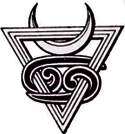

Cancer. Eau, Lune. — La sève gonfle les formes 3Wirth qui atteignent leur plénitude. La végétation est luxuriante. C'est la saison des feuilles, des herbes et des légumes, mais les grains et les fruits restent verts. Les jours sont longs: la lumière abonde. =211=L'Initié s'instruit en s'assimilant l'enseignement initiatique.

Lion. Feu, Soleil, — L'ardeur sulfureuse et intérieure du Bélier 3Wirth s'étant acquittée de sa tâche constructive, le Feu extérieur intervient pour dessécher et tuer ce qui n'est que construction aqueuse, pour cuire et mûrir l'enveloppe des germes ignés. La Raison implacable exerce sa critique rigoureuse sur toutes les notions reçues. — L'Initié contrôle par lui-même avec sévérité les idées qui ont pu le séduire.

Vierge. Terre, Mercure. — La substance fécondée, =212= épouse virginale 3Wirth du Feu fécondateur, accouche et retrouve sa virginité. La moisson est mûre, la chaleur moins torride. — Ayant fait son choix parmi les matériaux de construction, l'Initié les assemble pour les dégrossir et les tailler en vue de leur destination.


Balance. Air, Vénus. — Equilibre des forces constructives 3Wirth et destructives. Maturité: le fruit dans toute sa saveur. — Le Compagnon en état de déployer son maximum d'activité utilement appliquée.


Scorpion. Eau, Mars. — La masse aqueuse fermente. 3Wirth Les éléments de la construction vitale se dissocient, attirés vers de nouvelles combinaisons. =213= Désorganisation révolutionnaire. Le Soleil précipite sa chute vers l'hémisphère austral. — Complot des mauvais Compagnons. Hiram est frappé à mort.

Sagittaire. Feu, Jupiter. — L'esprit animateur s'est dégagé 3Wirth du cadavre et plane dans les hauteurs. La nature prend un aspect désolé. — Les ouvriers abandonnés sans direction se lamentent. Ils se dispersent pour chercher le corps du Maître assassiné.



Capricorne. Terre, Saturne. — Rien ne vit plus: 3Wirth la substance terrestre est inerte, passive, mais fécondable à nouveau. — Le tombeau d'Hiram =214= est découvert, grâce à la branche d'Acacia, seul vestige de la vie disparue.



Verseau. Air, Saturne. — Les éléments constructifs 3Wirth se reconstituent dans la terre reposée qui se prépare à de nouveaux efforts générateurs. Elle se sature de dynamisme vitalisant. — Le cadavre de l'Architecte est mis à jour et la chaîne se forme pour le ressusciter.

Poissons. Eau, Jupiter. — La glace se rompt; =215= 3Wirth les neiges fondent, abreuvant le sol de liquides propres à être vitalisés. Les jours allongent rapidement, le règne de la lumière s'affirme. — Hiram est relevé; il reprend conscience: la Parole perdue est retrouvée.



Le Cercueil d'Osiris

Une loi unique régissant l'Univers, tout s'y construit d'après les mêmes principes d'architecture. 3Wirth On doit donc retrouver en petit ce qui existe en grand. Partant de cette donnée, les anciens ont établi un rapport d'analogie entre les signes du zodiaque du Macrocosme et les parties du corps du Microcosme. Il en résulte les correspondances suivantes:

Bélier, Tête, crâne, cerveau.

Taureau, Cou, maxillaires, vertèbres cervicales, bouche, gorge, organes de la parole.

Gémeaux, bras, omoplates, clavicules et muscles moteurs. Organes d'action extérieure, de travail et de réalisation.
 Ce premier ternaire se ramène donc =216= à la formule: Pensée-Parole-Action.
 Il se rapporte à l'esprit ou à l'Intelligence et à ses manifestations.

Cancer, poitrine, cage thoracique, poumons, organes de la respiration, qui entretiennent la vie en la renouvelant continuellement.

Lion, cœur, épigastre, plexus solaire, vertèbres dorsales. La circulation du sang, qui répand l'ardeur vitale dans tout le corps.

Vierge, abdomen, vertèbres lombaires, intestins, nutrition, source de régénération continuelle des tissus.
 Ce second ternaire, qui n'a plus rien d'intellectuel, est entièrement d'ordre vital. Il s'applique à la production et à la répartition de la vie, de même qu'à la réparation de l'usure résultant du fonctionnement vital.

Balance, hanches, os du bassin, reins, organes de sécrétion et d'élimination. Maintien de l'équilibre vital, grâce au rejet des éléments usés.

Scorpion, anus, pubis, organes sexuels, reproduction, perturbations résultant du rut.

Sagittaire, cuisse, fémur (assiette, base du tronc). La fibre musculaire, son élasticité et ses réserves dynamiques. Magnétisme animal.
 Ce troisième ternaire correspond plus particulièrement à l'instinct qui assure la police de l'organisme, perpétue l'espèce et provoque entre individus les attractions et répulsions irraisonnées, effet des polarisations sexuelles. =217=


Capricorne, les genoux et, par extension, les articulations en général. Ligaments. Ce qui relie les os entre eux et leur permet d'obéir aux muscles. Le ciment du symbolisme constructif.

Verseau, les jambes, leurs deux os et, par extension, le tissu osseux. Les organes de locomotion permettant aux hommes de se rapprocher et de collaborer.

Poissons, les pieds qui permettent de se tenir debout. La station verticale, marque de supériorité sur les animaux.
 Ce dernier ternaire semble faire allusion à la vie sociale. Respect de la hiérarchie (genou qui plie), Conservatisme, Religion, Liberté, Progrès (jambes qui marchent). Dignité de l'individu, respect de soi-même, culte de l'Hominalité.


L'Adam Kadmon

Douze clôt le cycle des nombres sur lesquels s'exerçaient de préférence les spéculations philosophales. Aux douze travaux d'Hercule et aux douze signes du Zodiaque, on faisait correspondre autant de phases de l'accomplissement du Grand-Œvre. Mais comme douze ferme le cercle, treize s'en trouve exclu, d'où le caractère néfaste attribué à ce chiffre, auquel le Tarot associe l'image de la Mort fauchant tout ce qui ne possède qu'une existence éphémère.
 En réalité, si l'on tient à pousser l'étude des =218= nombres au delà du duodénaire, il faut se baser sur le triple ternaire de la planche à tracer et envisager à sa suite un nouveau groupement par 9.

3Wirth       3Wirth

Ces triples ternaires ou ennéades peuvent se superposer, si bien que 10, 11, 12, prennent la valeur symbolique de 1, 2, 3, et ainsi de suite des autres chiffres. Mais correspondance et analogie ne sont pas identité: il s'agit donc de procéder à une transposition des significations, en considérant les neuf premiers nombres comme se rapportant, dans leur ensemble, à l'Homme-type métaphysique ou abstrait, à l'Adam Kadmon des Kabbalistes, Adam supérieur ou céleste, qu'ils opposent à l'Adam inférieur ou terrestre, Homme collectif, concret, auquel se rapporte l'ensemble du second triple ternaire.
 L'unité de l'Adam céleste résulte d'une triple tri-unité, qui se déduit de la proposition: Je pense. Ces deux mots impliquent, en effet, un sujet pensant: 1, cause qui n'est tel que parce qu'il pense: or, on ne saurait penser: 2, acte, qu'en pensant quelque chose: 3, effet. Mais si nous distinguons logiquement la cause de l'acte et de l'effet, il y a là dans la réalité une trinité unitaire, qui se trouve nécessairement à la base de tout. Du domaine de la pure idéation, elle se transporte en celui de la =219= volition, car, si je pense, j'en ai conscience et je suis consentant: je veux penser 4, cause voulante. Mais, ici encore, je ne veux qu'en faisant acte volontaire: 5 et en voulant quelque chose: 6. Ce n'est pas tout: la volonté ne s'exerce pas dans le vide: son commandement s'applique à des forces dont elle est génératrice: 7, qu'elle fait agir: 8 et qu'elle accumule: 9.

 Tout cet ensemble se synthétise en 10, monade spirituelle dont procède l'Adam terrestre. L'action propre de cette monade sera 11 et le résultat immédiat de cette action, 12.

 Quant au nombre 13, nous en pénétrons la signification en nous reportant à la 4e Séphire. Or, celle-ci, correspond à la Bonté qui répand la Vie, alors qu'à 13 se rattache une idée de mort, donc de destruction de la vie. L'opposition semble irréductible et cependant la vitalité collective du Grand Adam terrestre (Règne hominal) s'alimente du contenu libéré par la dissolution du contenant. La Mort ne détruit pas l'énergie vitale, qu'elle se borne à faire rentrer dans la circulation Générale: 14. L'Arcane XIV du Tarot représente, en effet, la Tempérance sous les traits d'un ange qui transvase incessamment le fluide vital universel d'une amphore dans l'autre. Ce fluide détermine d'ailleurs les polarisations sexuelles qui gouvernent la vie animale et correspondent au dieu Pan: 15, baptisé Diable au Moyen-Age (Arcane XV du Tarot).
 Le discernement harmonisateur: 7 fait place dans l'Adam terrestre à l'aveuglement de l'égoïsme: 16 =220= qui déchaine la lutte pour la vie. La Justice: 8 ne règne ainsi que dans le ciel, sans que cependant la terre soit vouée à une complète anarchie, car l'intérêt collectif influence les individus et leur inspire une esthétique: 17 représentée par les Etoiles de l'Arcane XVII du Tarot. L'expérience théorique: 9 n'obtiendrait cependant jamais la sanction du fait, si la douleur ne venait l'imposer. A demi-éclairée, l'Humanité progresse, mais c'est sous l'aiguillon d'une dure nécessité. Le travail s'accomplit, mais non de plein gré: il s'impose, il est forcé. Cet état de déchéance correspond à 18 et au sentier de la vie, sur lequel tombe l'incertaine clarté de la Lune dans l'arcane XVIII du Tarot.
 Mais notre esclavage doit prendre fin, car un Rédempteur: 19 nous est promis. L'Arcane XIX l'identifie avec le Soleil qui éclaire définitivement les hommes en les convertissant à la saine raison. Ce sera l'avènement de la Vraie Lumière, dont le rayonnement sera régénérateur, comme le montre l'Arcane XX (Le Jugement), si bien qu'il en résultera l'harmonie universelle du Monde régénéré (Arc. XXI). Le Temple idéal, que construisent les Maçons est ainsi représenté par le nombre 21, synthèse d'un triple septénaire ou d'un septuple ternaire.
 Ces indications trouvent leur commentaire graphique dans le Tarot, dont l'étude fournit la matière d'un ouvrage intitulé: Le Tarot des Imagiers du Moyen Age.


=209=

Each sign is thus characterized by a Planet and by an Element. Let's see what emerges from these data in relation to the initiation.
 Twelve pentacles uniting the Element and the Planet to the corresponding sign will help us to elucidate the question.

 Ram. Fire, Mars. — It is the Sulfur of the Alchemists 🜍, interior constructive fire, stimulating all growth and all development. Benumbed during the winter, it awakes in the spring, germinates the seed, and causes the buds to hatch. It represents the individual initiative, which is triggered under the impulse of a general external influence, as the energy trapped in the germ comes into play at the signal of the Sun. — The initiatory ardor leading to seek Initiation.
 Taurus. Earth, Venus. The receptive Salt 🜔 in which the fertilization took place =210= Inner elaboration.
Judiciously prepared, the Candidate was admitted to the trials.

 Gemini. Air, Mercury. — The children of the Earth fertilized by Fire. The double Mercury of the Alchemists symbolized by two Serpents or by a serpent with two heads. The constructive and organizing Vitality. The sublimation of matter into the blooming flower. — The neophyte receives the light.
 Cancer. Water, Moon. — The sap swells the forms which reach their fullness. The vegetation is lush. It is the season for leaves, herbs, and vegetables, but the grains and fruits remain green. The days are long: the light abounds. =211=The initiate learns by assimilating the initiatory teaching.

 Lion. Fire, Sun, — The sulphureous and interior ardor of Aries having acquitted itself of its constructive task, the exterior Fire intervenes to dry up and kill what is only watery construction, to bake and ripen the envelope of igneous germs. The relentless Reason exercises its rigorous criticism on all the notions received. — The Initiate controls by himself with severity the ideas which could seduce him.
 Virgin. Earth, Mercury. — The fertilized substance, =212= virgin wife of the fertilizing Fire, gives birth and regains her virginity. The harvest is ripe, the heat less scorching. — Having made his choice of the construction materials, the Initiate assembles them to rough them and cut them for their destination.
 Libra. Air, Venus. — Balance of constructive and destructive forces. Maturity: the fruit in all its flavor. — The Fellowcraft is able to deploy his maximum usefully applied activity.

Scorpio. Water, Mars. — The aqueous mass ferments. The elements of the vital construction dissociate, attracted to new combinations. =213= Revolutionary disorganization. The Sun precipitates its fall towards the southern hemisphere. — Conspiracy of the wicked Craftsmen. Hiram is struck to death.

Sagittarius. Fire, Jupiter. — The animating spirit has emerged from the corpse and hovers in the heights. Nature takes on a desolate aspect. — The forsaken Workers without management are lamenting. They disperse to search for the body of the murdered Master.

Capricorn. Earth, Saturn. — Nothing lives any more: the terrestrial substance is inert, passive, but fecundable again. — Hiram's grave =214= is discovered, thanks to the branch of Acacia, the only vestige of the disappeared life.

Aquarius. Air, Saturn. — The constructive elements are reconstituted in the resting earth which prepares itself for new generative efforts. It is saturated with vitalizing dynamism. — The Architect's corpse is uncovered and the chain is formed to resurrect it.

Pisces. Water, Jupiter. — The frost breaks; =215= the snows melt, watering the ground with liquids suitable for vitalization. The days are growing rapidly, the reign of light is asserting itself. — Hiram is raised; he regains consciousness: the lost Word is found.


The Coffin of Osiris

As single law governs the Universe, everything is built in it according to the same architectural principles. We must therefore find in small what exists in large. On the basis of this data, the ancients established an analogy between the signs of the zodiac of the Macrocosm and the parts of the body of the Microcosm. This results in the following correspondences:

Aries, Head, skull, brain.

Taurus, Neck, jawbones, cervical vertebrae, mouth, throat, speech organs.


Gemini, arms, shoulder blades, collarbones, and motor muscles. Bodies of external action, work and realization.
 This first ternary is therefore reduced =216= à to the formula: Thought-Word-Action.
 It relates to the mind or Intellect and its manifestations.


Cancer, Cancer, chest, rib cage, lungs, organs of respiration, which sustain life by continually renewing it.


Leo, heart, epigastrium, solar plexus, dorsal vertebrae. The circulation of the blood, which spreads the vital ardor throughout the body.

Virgo, abdomen, lumbar vertebrae, intestines, nutrition, source of continual tissue regeneration.
 This second ternary, which no longer has anything intellectual, is entirely of a vital order. It applies to the production and distribution of life, as well as to the repair of wear and tear resulting from vital functioning.

Libra, hips, pelvic bones, kidneys, organs of secretion and elimination. Maintenance of the vital balance, thanks to the rejection of worn elements.

Scorpio, anus, pubis, sexual organs, reproduction, disturbances resulting from rutting.

Sagittarius, thigh, femur (plate, base of the trunk). Muscle fiber, its elasticity and its dynamic reserves. Animal magnetism.
 This third ternary corresponds more particularly to the instinct which ensures the policing of the organism, perpetuates the species and provokes between individuals irrational attractions and repulsions, the effect of sexual polarizations.=217=

Capricorn, the knees and, by extension, the joints in general. Ligaments. What binds the bones together and allows them to obey the muscles. The cement of constructive symbolism.

Aquarius, the legs, their two bones and, by extension, bone tissue. The organs of locomotion allowing men to come closer and collaborate.

Pisces, the feet which allow to stand upright. The vertical posture, a mark of superiority over animals.
 This last ternary seems to allude to social life. Respect for hierarchy (bending knee), Conservatism, Religion, Freedom, Progress (legs walking). Dignity of the individual, self-respect, cult of Hominality.


The Adam Kadmon

Twelve closes the cycle of numbers on which philosophical speculations were preferably exercised. To the twelve labors of Hercules and the twelve Signs of the Zodiac, as many other phases of the execution of the Great Work were made to correspond. But since twelve closes the circle, thirteen is excluded from it, hence the nefarious character attributed to this number, to which the Tarot associates the image of Death mowing down everything that has nothing but an ephemeral existence.
 In fact, if the study of numbers is to be carried beyond the duodenary, =218= it is necessary to rely on the triple ternary of the of the Tracing Board, and then consider a new grouping by 9 following it.

These triples ternaries or enneads can be superimposed, so that 10, 11, 12, take the symbolic value of 1, 2, 3, and so on of the other digits. But, correspondence and analogy are not identity: it is, therefore, a question of proceeding to a transposition of the meanings, by considering the first nine numbers as relating, as a whole, to the metaphysical or abstract Man-type, to the Adam Kadmon of the Kabbalists, the superior or celestial Adam, whom they oppose to the inferior or terrestrial Adam, the collective, concrete Man, to whom the whole of the second triple ternary relates.
 The unity of the celestial Adam results from a triple tri-unity, which is deduced from the proposition: I think. These two words imply, in fact, a thinking subject: (1, cause) which is such only because he thinks: now, he can only think: (2, act), by thinking something: (3, effect). But if we logically distinguish cause from act and effect, there is actually a unitary trinity there, which is necessarily at the base of everything. From the domain of pure ideation, it moves into that of volition, =219= because, if I think, I am aware of it and I am consenting: I want to think (4, willing cause). But, here again, I only want by making a voluntary act: (5) and by wanting something: (6). That is not all: the will is not exercised in a vacuum: its command applies to forces which it generates: (7), which it causes to act: (8) and which it accumulates: (9).
 All this ensemble is synthesized in (10), spiritual monad from which the terrestrial Adam proceeds. The proper action of this monad will be (11) and the immediate result of this action, (12).
 As for the number (13), we will penetrate its meaning by referring to the 4th Sefirah. Now, this one corresponds to the Goodness which spreads Life, while to 13 is attached an idea of death, therefore of the destruction of life. The opposition seems irreducible, and yet the collective vitality of the great earthly Adam (Human Kingdom) is nourished by the content released by the dissolution of the container. Death does not destroy the vital energy, which it limits itself to making it re-enter the General circulation: (14). The Arcanum XIV of the Tarot represents, in fact, Temperance in the guise of an angel who incessantly transfers the universal vital fluid from one amphora to the other. This fluid also determines the sexual polarizations which govern animal life and correspond to the god Pan: (15), the baptized Devil in the Middle Ages (Arcane XV of the Tarot).
 The harmonizing discernment: (7) gives way in the terrestrial Adam to the blindness of selfishness: (16) =220= which unleashes the struggle for life. Justice: (8) thus only reigns in heaven, without, however, the earth being doomed to a complete anarchy, because the collective interest influences individuals and inspires them with an aesthetic: (17) represented by the Stars of the Arcanum XVII of the Tarot. Theoretical experience: (9) however, would never obtain the sanction of the fact if the pain did not come to impose it. Half-enlightened, Humanity is progressing, but it is under the sting of a hard necessity. Work is carried out, but not willingly: it is imposed, it is forced. This state of degradation corresponds to (18) and to the path of life, on which the uncertain clarity of the Moon falls in Arcana XVIII of the Tarot.
 But our slavery must end because a Redeemer: (19) is promised to us. Arcanum XIX identifies it with the Sun that definitively illuminates men by converting them to sound reason. This will be the advent of the True Light, whose radiance will be regenerative, as shown by Arcana XX (The Judgment), so that the universal harmony of the regenerated World will result (Arcana XXI). The ideal Temple, which the Masons build, is thus represented by the number (21), the synthesis of a triple septenary or a sevenfold ternary.

 These indications find their graphic commentary in the Tarot, the study of which provides the material for a work entitled: Le Tarot des Imagiers du Mogen Age.

*      


VIIe Partie


LES   PRÉROGATIVES
DE LA MAÎTRISE


=223=

Le Chapeau


wirthE Maître qui, au XVIIIe siècle, dirigeait les travaux de sa Loge, restait couvert en signe d'autorité. Les FF∴ élevés au 3e degré se couvraient de même en Chambre du Milieu, s'affirmant ainsi les égaux de leur Président. Les loges anglo-saxonnes ignorent actuellement cette coutume, qui s'est maintenue en Allemagne en se généralisant, si bien que tous les FF∴, même les Apprentis, arborent en Loge le chapeau de cérémonie. Mais ce n'est plus une manifestation d'égalité, le rituel prescrivant de se découvrir dès qu'il est fait mention du Grand Architecte de l'Univers.
 Symboliquement, tout l'intérêt du chapeau se limite au fait qu'il remplace la Couronne (Kether, 1re Séphire des Kabbalistes). Emblème de la souveraineté, il a la mission de faire comprendre à celui qui le porte, qu'il n'est pas un chef ayant pouvoir de commander arbitrairement selon ses appréciations personnelles. Un souverain doit régner et non =224= exercer un commandement. Or, on ne règne qu'en traduisant la volonté générale. Le Maître ne dirigera donc pas sa Loge à son idée, mais il s'inspirera des aspirations les plus élevées de la collectivité. C'est l'idéalité collective qui forme le diadème lumineux, couronnement de l'arbre des Séphiroth, que devait rappeler jadis le tricorne du Maître de la Loge.
 De nos jours, dans nos Loges latines, les Maîtres ne se couvrent plus que pour travailler au troisième degré. Tous affirment ainsi qu'ils sont capables de tenir le premier Maillet et de se comporter, le cas échéant, en dignes souverains initiatiques.
 Sachant faire abstraction de soi, le Maître devient, en effet, apte à régner, non en despote ou en potentat vulgaire, mais en adepte de l'Art Royal, digne d'occuper le trône de Salomon, le plus sage des rois. L'individu qui se domine lui-même et ne subit aucun entraînement s'élève à la royauté des Initiés. Comme rien ne lui commande, il est libre et ne se détermine que sous l'influence de la raison la plus éclairée.
 Tout Maître doit s'efforcer de réaliser cet idéal, qui lui confère des prérogatives importantes, dont le port du chapeau n'est qu'un symbole subtil dans son apparence assez grossière.


La Souveraineté des Maîtres

En Maçonnerie, nulle autorité n'est supérieure à celle du Maître. Au-dessus du Maître il n'y a rien. =225= Celui qui dirige les Travaux de la Loge n'est rien de plus que les autres Maîtres et leur doit compte de l'accomplissement de sa fonction. Un Grand-Maitre n'est lui-même qu'un délégué des Maîtres et c'est en leur nom et sous leur contrôle qu'il gouverne une fédération de Loges.
 Un gouvernement maçonnique ne possède d'ailleurs aucun pouvoir par lui-même. Il est l'exécuteur pur et simple de la volonté de ses commettants et son rôle se borne à la gestion des intérêts collectifs. Mais les Loges n'ont aucune impulsion à recevoir d'une administration commune. Si elles éprouvaient le besoin d'être dirigées, c'est qu'elles ne seraient encore que des embryons de Loges, des ateliers ne sachant pas travailler par eux-mêmes, d'où nécessité de les diriger et de les tenir en tutelle.
 Il n'en sera jamais ainsi d'une Loge véritable que gouvernent les Maîtres animés de l'esprit d'Hiram, car le travail n'y chômera jamais et il portera tous les fruits qu'on est en droit d'espérer, en dehors de toute stimulation extérieure.
 La Loge autonome est le seul organisme fondamental de la vie maçonnique. Ce sont les Loges travaillant maçonniquement qui constituent entre elles la Maçonnerie Universelle, dont les Grandes Loges et les autres juridictions ou puissances maçonniques ne sont parvenues, depuis 1717, qu'à compromettre l'existence, en multipliant les dissensions et les schismes. Or, la vraie Maçonnerie ne comporte pas de division, car il est de son essence d'être unie. Mais l'unité maçonnique n'est réalisable =226= qu'entre Loges libres, non assujetties aux législations arbitraires des groupements locaux. S'il convient aux Loges de former entre elles des confédérations, il leur est loisible de se soumettre à une commune obédience; mais un groupe de Loges ne peut légiférer que pour son propre compte et n'a pas le droit de juger d'autres groupes analogues. Qui condamne autrui se condamne soi-même, en s'excluant de l'universalité: c'est là une loi nécessaire, bien que trop souvent méconnue, de la pure et authentique Franc-Maçonnerie.
 Il importe donc que les Maîtres préposés à la direction et au gouvernement des Loges aient conscience de leur souveraineté, dont ils doivent se montrer jaloux. Ils n'ont à obéir qu'aux décisions prises dans l'intérêt commun et doivent formellement refuser de subir des fantaisies législatives contraires à l'esprit maçonnique.
 Sous ce rapport, le véritable Maître sait juger, ou sa réception au troisième degré n'a été qu'une grotesque simagrée. Celui en qui Hiram a trouvé un corps devient réellement Maître en Maçonnerie et ne s'incline devant aucun commandement; l'esprit recteur de l'institution est en lui, et l'inspire dans tous ses actes de souveraineté.
 Mais il est difficile d'être Maître; aussi les Loges qui se sentent dirigées à tâtons cherchent-elles au dehors la direction absente à l'intérieur. Elles se subordonnent alors à une «Obédience», ce qui est la négation même de la Franc-Maçonnerie, suprême école de liberté.=227=
 L'idéal vers lequel nous devons tendre étant ainsi formulé sans réticence, il importe de rappeler, qu'en pratique, l'acceptation d'une discipline rend seule possible la collaboration. Il est donc plus sage de se soumettre à une règle critiquable, que de prétendre n'agir qu'à sa tête. Le véritable Maître saura discerner et n'agira qu'en s'inspirant du bien réel de l'Ordre. Il n'oubliera d'ailleurs jamais le respect que tout initié doit à la loi, si imparfaite soit-elle 1).


1)   Voir l'Apprenti, éd. 1962, page 166.


L'Émancipation

L'indépendance des Loges et la souveraineté des Maîtres s'affirment dès la fondation de l'atelier. Celui-ci se constitue de par la volonté des Maîtres qui se sont unis en vue de la création d'un nouveau foyer de vie maçonnique. Ces Maîtres exercent en cela un droit imprescriptible de la Maîtrise et ce sont eux qui légitiment la Loge qu'ils fondent, sans qu'ils aient d'autorisation à solliciter de personne. Ils ne sont nullement tenus de rattacher leur Loge à un groupement préexistant, et, s'il leur convient de proclamer l'atelier indépendant de toute puissance maçonnique, ils agiront dans la plénitude de leurs droits, que nul ne contestait avant 1717.
 A cette date, il a plu à quatre Loges périclitantes de Londres de se réunir en Grande Loge, innovation qui fut grosse de conséquence, puisque la Maçonnerie =228= moderne en est née. Ce qui fait la grandeur de cette Maçonnerie, ce sont les principes qui furent formulés en son nom en 1723 2); sa faiblesse, par contre, réside dans l'institution des gouvernements maçonniques. Ceux-ci se sont révélés usurpateurs dès le début. Ils se sont arrogés le droit de légiférer en matière maçonnique et ont exigé des Loges une subordination humiliante. Dans une Obédience, les Loges sont traitées en petites filles, qui ne doivent rien entreprendre sans avoir obtenu au préalable la permission d'une autorité centrale contrôlant tous leurs actes. Du reste, ces Loges sont dites Loges-filles de la Loge-mère à qui elles doivent l'existence. Le pire, c'est que les Grandes-Loges s'érigent en juges de la «régularité» d'autrui et qu'elles «reconnaissent» ou excommunient selon leur bon plaisir, en évoquant des prétextes qui renient tout esprit maçonnique.


2)   Voir l'Apprenti, éd. 1962, page 55.

Il est temps que ce scandale prenne fin; mais à cet effet, les Maîtres doivent ressusciter Hiram et restituer aux Loges les droits qu'elles n'ont laissé usurper que parce qu'elles manquaient de Maîtres.
 Or, s'il y a, au sein des Loges, pénurie d'Initiés réels, c'est que la Maîtrise n'est pas à la portée du premier venu. Pour assurer leur prospérité matérielle, trop d'ateliers font du recrutement intensif, oubliant, qu'au dire des Anciens, tout bois n'est pas bon pour faire un Mercure et qu'un profane, si bien intentionné soit-il, n'a pas toujours en lui l'étoffe d'un Maître. En fait, les Loges de tous les Rites et =229= de toutes les Obédiences sont encombrées d'éléments pour qui la Maîtrise n'est restée que purement conventionnelle.

 Ces Loges, par suite, ne sont pas des foyers de véritable vie maçonnique; ce sont des groupements où prédominent des préoccupations à peine teintées de Maçonnisme. On se contente d'y accomplir des rites, tout en fraternisant d'une manière fort louable, sans jamais oublier les misères humaines, que l'on s'efforce de soulager. C'est un bon commencement; mais il ne faut pas s'en contenter. Si nous n'avions à notre actif que nos œuvres de bienfaisance, nous serions inférieurs à quantité d'associations profanes spécialement organisées pour venir en aide aux malheureux.
 En réalité, notre façon de bien faire n'est destinée à se traduire que dans une très faible proportion par des secours matériels. Notre travail doit bénéficier, moins aux individus qu'à l'Humanité dans son ensemble; il ne saurait être fécond, que s'il est bien dirigé, d'où la nécessité de former des Maîtres, si la Maçonnerie doit devenir une réalité.
 Mais la Franc-Maçonnerie ne sortira de sa phase par trop exclusivement cérémonielle et trop peu agissante, qu'en s'affranchissant de l'excès de matérialité qui l'alourdit. Depuis deux cents ans, elle s'est donnée une forme qui n'est pas nécessairement définitive. L'office du F∴ Trésorier a pris beaucoup trop d'importance par suite de l'ambition des Loges d'avoir un local aménagé à leur usage exclusif. Or, pour qui doit agir spirituellement =230= finances et propriétés sont des poids lourds, dont la tradition nous enseigne à nous affranchir.

 Les Maçons convaincus, qui veulent travailler, n'ont que faire d'un temple pompeusement décoré, puisqu'ils possèdent l'art de transformer en sanctuaire le premier local venu. Ils peuvent donc se constituer en Loge de la plus absolue régularité où et quand bon leur semble. Ils n'ont pas de diplômes à conférer, ni de mots de semestre à communiquer. En initiation vraie, les parchemins ne sont que de la peau d'âne et un mot soufflé à l'oreille ne suffit pas pour se faire reconnaître.
 La Maçonnerie ne sera majeure, libre et pleinement agissante que du jour où les Maîtres s'affirmeront.
 Puisse le présent manuel contribuer à éclairer les disciples d'Hiram et les aider à trouver la Parole de la Vie, qui remet debout pour l'action la victime des mauvais ouvriers.
 Relevons-nous et soyons Maîtres!


 Part Seven


THE PREROGATIVES
OF MASTERY


=223=

The Hat


wirthTHE Master who, in the 18th century, directed the work of his Lodge, remained covered as a sign of authority. The Brethren raised to the 3rd degree covered themselves in the same way in the Middle Chamber, thus asserting themselves the equals of their President. The Anglo-Saxon lodges are currently ignoring this custom, which has been maintained in Germany, becoming so widespread that all the Brethren, even the Apprentices, wear the ceremonial hat in the Lodge. But it is no longer a manifestation of equality, the ritual prescribing that they must be uncovered every time the Grand Architect of the Universe is mentioned.
 All the interest about the hat is limited, symbolically, to the fact that it replaces the Crown (Kether, the 1st Sefirah of the Kabbalists). As an emblem of sovereignty, it has the purpose of making the wearer understand that he is not a leader having the power to arbitrarily command according to his personal opinions. A sovereign must reign and not exert command. =224= However, one reigns only by interpreting the general will. The Master will, therefore, not run his Lodge as he sees fit, but he will be inspired by the highest aspirations of the community. It is collective ideality which forms the luminous diadem, crowning of the tree of the Sefirot, which the tricorn of the Master of the Lodge was to recall in the past.
 Nowadays, in our Latin Lodges, the Masters only cover themselves to work in the third degree. All affirm, thus, that they are capable of holding the gavel and behaving, if necessary, as worthy initiatory sovereigns.
 Knowing how to abstract from himself, the Master becomes, in fact, fit to reign, not as a despot or a vulgar potentate, but as an adept of the Royal Art, worthy of occupying the throne of Solomon, the wisest of kings. The individual who masters himself and does not suffer any deviation rises to the royalty of the Initiates. As nothing commands him, he is free and does not determine himself except under the influence of the most enlightened reason.
 Every Master must strive to achieve this ideal, which gives him important prerogatives, of which the wearing of the hat is only a subtle symbol in its rather crude appearance.


Sovereignty of the Masters

In Masonry, no authority is superior to that of the Master. Above the Master there is nothing. =225= The one who directs the Works is in no way superior to the other Masters, and owes them an account of the performance of his function. A Grand Master is himself only a delegate of the Masters, and it is in their name and under their control that he governs a federation of Lodges.
 A Masonic government does not possess any power of its own. He is the pure and simple executor of the will of his constituents and his role is limited to the management of collective interests. But the Lodges do not have to receive any impulse from a common administration. If they felt the need to be directed, it was because they would still only be embryos of Lodges, workshops that did not know how to work by themselves, hence the need to direct them and keep them under tutelage.
 This will never be the case with a true Lodge governed by the Masters animated by the spirit of Hiram, because the work will never stand still and it will bear all the fruits that one has a right to hope for, apart from any external stimulation.
 The Autonomous Lodge is the only fundamental organism of Masonic life. It is the Lodges that work Masonically that constitute the Universal Masonry among themselves, whose Grand Lodges and the other Masonic jurisdictions or powers have only managed, since 1717, to compromise their existence, by multiplying dissensions and schisms. Now, true Masonry does not involve division, for it is its essence to be united. But, Masonic unity is achievable =226= only between free Lodges, not subject to the arbitrary legislation of local groups. If it is appropriate for the Lodges to form confederations among themselves, they are free to submit to a common obedience; but a group of Lodges can only make laws for its own account, and it does not have the right to judge other analogous groupings. Whoever condemns others condemns himself, by excluding himself from universality: this is a necessary law, although too often unrecognized, of pure and authentic Freemasonry.

 It is, therefore, important that the Masters in charge of the management and government of the Lodges are aware of their sovereignty, of which they must be jealous. They must obey only decisions taken in the common interest and must formally refuse to submit to legislative fantasies contrary to the Masonic spirit.
 In this respect, the true Master knows how to judge, otherwise his reception to the third degree has been only a grotesque show off. He in whom Hiram has found a body, actually becomes a Master of Masonry and does not bow down to any command; the guiding spirit of the institution is in him and inspires him in all his acts of sovereignty.
 But it is difficult to be a Master; so, the Lodges which feel themselves to be led in a hesitant way (groping), seek outside the absent leadership within. They are then subordinated to an "Obedience," which is the very negation of Freemasonry, the supreme school of freedom. =227=
 The ideal towards which we must strive being thus formulated without reticence, it is important to remember that, in practice, only the acceptance of a discipline makes collaboration possible. It is therefore wiser to submit to a questionable rule, than to pretend to have one's way. The true Master will know how to discern and will act only by being inspired by the real good of the Order. He will never forget the respect that every initiate owes to the law, however imperfect it may be. 1)


1)   See the Apprentice, ed. 1962, page 166.


Emancipation

The independence of the Lodges and the sovereignty of the Masters have been affirmed since the founding of the lodge. This is constituted by the will of the Masters who have united for the creation of a new center of Masonic life. These Masters exercise thereby an inalienable right of the Masters and it is they who legitimize the Lodge they founded, without having to solicit authorization from anyone. They are under no obligation to attach their Lodge to a pre-existing group, and, if it is appropriate for them to proclaim the workshop independent of any Masonic power, they will act in the fullness of their rights, which no one contested before 1717.
 On this date, it pleased four London Lodges, in danger of disappearing, to unite into a Grand Lodge, an innovation that was of great consequences, since modern Masonry was born from it. =228= What makes the greatness of this Masonry are the principles that were formulated in its name in 1723; 2) its weakness, on the other hand, lies in the institution of Masonic governments. They proved to be usurpers from the start. They arrogated to themselves the right to legislate in Masonic matters and demanded humiliating subordination from the Lodges. In an Obedience, the Lodges are treated as minor daughters, who should not undertake anything without having first obtaining the permission from a central authority controlling all their actions. Moreover, these Lodges are called Daughter Lodges of the Mother Lodge to whom they owe their existence. The worst thing is that the Grand Lodges set themselves up as judges of the "regularity" of others and that they "recognize" or excommunicate at their pleasure, evoking pretexts which deny any Masonic spirit.


2)   See the Apprentice, ed. 1962, page 55.

It is time for this scandal to end; but for this purpose, the Masters must resurrect Hiram and restore to the Lodges the rights which they let usurp only because they lacked Masters.
 However, if there is, within the Lodges, a shortage of real Initiates, it is because Mastery is not within the reach of the first comer. To ensure their material prosperity, too many lodges engage in intensive recruitment, forgetting that, according to the Ancients, not all wood is good for making a Mercury [On ne fait de tout bois l'image de Mercure] and that a Profane, however well-intentioned, not always have in him the makings of a Master. In fact, Lodges of all the Rites =229= and of all the Obediences are encumbered with elements for which the Mastery has remained only purely conventional.
 These Lodges, therefore, are not homes of true Masonic life; these are groups where preoccupations barely tinted with Masonicism predominate. They are content to carry out rites, fraternizing in a very laudable way, never forgetting the human miseries that they strive to alleviate. It's a good start; but we must not be satisfied with it. If we had only our charities to our credit, we would be inferior to many secular associations specially organized to help the unfortunate.


 In reality, our way of doing good is not destined to be translated but in a very weak proportion by material aid. Our work should benefit less the individuals than Mankind as a whole; it can only be fruitful if it is well directed, hence the need to train Masters, if Masonry is to become a reality.

 But Freemasonry will come out of its phase that is too exclusively ceremonial and not very operative, only by freeing itself from the excess of materiality which weighs it down. For two hundred years, it has given itself a form which is not necessarily final. The office of Bro. Treasurer has taken on too much importance because of the ambition of the Lodges to have furnished premises for their exclusive use. Now, for those who must act spiritually, =230= finances and property are heavy burdens, from which tradition teaches us to free ourselves.
 Convinced Masons have no need for a pompously decorated temple, since they possess the art of transforming any premises into a sanctuary. They can, therefore, constitute themselves in a Lodge of the most absolute regularity where and when they see fit. They have no diplomas to confer, nor semester words to communicate. In true initiation, the scrolls are nothing but an ass's skin, and a word blown into the ear is not enough to be recognized.

 Masonry will not be of age, free and fully effective until the day the Masters assert themselves as such.
 May this manual help enlighten Hiram's disciples, and help them find the Word of Life, which raises the victim of evil workers to action.
 Let us rise up and be Masters!

*      


LES HAUTS GRADES

=231=

La Maîtrise est un sommet, terme fatal de toute ascension: Celui qui se sent Maître n'a plus rien à ambitionner. Mais tous ceux qui ont joué le rôle d'Hiram ne se sont pas pénétrés de l'esprit du rite. Ils ont subi passivement un cérémonial auquel ne se rattache aucune grâce sanctifiante, si bien que, n'ayant su y mettre du leur, ils sont restés après ce qu'ils étaient avant. Sur plus de quatre millions de Maçons qui arborent les insignes du troisième degré, combien se trouve-t-il d'adeptes possédant, ne fût-ce qu'un très humble commencement de Maîtrise? Combien de Loges sont-elles en droit de se dire «justes et parfaits», en se basant sur le fait que les trois qui les dirigent sont des Maîtres effectifs?
 Toute la Maçonnerie dite symbolique n'est hélas, que le symbole de ce qu'elle devrait être réellement. On s'en est aperçu au XVIIIe siècle, dès que la Maçonnerie actuelle eut pris quelque extension. Constatant que ceux qui se disaient Maîtres ne l'étaient pas, ceux qui croyaient l'être dans une certaine mesure éprouvèrent le besoin de développer la Maîtrise dans des ateliers spécialement fondés à cet effet.
 C'est ainsi qu'une meilleure sélection devait être réalisée par les Maîtres Ecossais, qui surgirent vers 1740 avec l'ambition de former en un 4e degré les =232= Maîtres effectifs faisant défaut aux Loges bleues 1), le rouge devenant désormais la couleur des ateliers supérieurs.


1)   Voir l'Apprenti, éd. 1962, page 71.

Mais comme le 4e grade ne fut guère plus heureux pratiquement que le 3e, il y eut bientôt surenchère dans la multiplication des grades.
 Pourquoi se serait-on arrêté à 4, alors que 7 est un nombre beaucoup plus prestigieux? Dans l'excellente intention de perfectionner la Maçonnerie et de réaliser la vraie Maîtrise, de nombreux ritualistes se mirent à l'œuvre et combinèrent des hiérarchies de grades pour ainsi dire à l'infini.
 Tous les auteurs qui ont approfondi le ternaire fondamental de la Franc-Maçonnerie ont coudamné avec sévérité l' «ivraie des hauts-grades», élucubrations fantaisistes, ne contribuant qu'à égarer l'esprit et à faire méconnaître le pur Maçonnisme.
 Cette critique est justifiée dans une très large mesure, car, si le rituel des trois grades dits «symboliques» porte visiblement la marque des Maîtres, rien, en revanche, n'est moins magistral que le symbolisme des degrés dits «philosophiques». Tout y sent la contrefaçon pénible, et l'idée initiatique ne se traduit nulle part en synthèse lumineuse.

 S'ils n'ont pas été plus heureusement inspirés, il ne faut cependant pas jeter la pierre aux inventeurs des hauts grades. Ils poursuivaient l'idéal de la vraie Maîtrise, et, s'ils ont fait fausse route en =233= cherchant le grand Arcane, leurs tentatives infructueuses restent méritoires et leurs erreurs sont instructives.
 Tous les systèmes supra-maçonniques du XVIIIe siècle se sont finalement fondus dans les 30 grades que le Rite Ecossais superpose au ternaire primitif. Historiquement, cette hiérarchie présente un incontestable intérêt; elle a pris, en outre, une importance particulière au point de vue international, puisque les Suprêmes Conseils confédérés réalisent dans leur domaine propre l'universalité maçonnique qui est la pierre d'achoppement de la Maçonnerie bleue.
 Il s'est trouvé, de plus, parmi les FF∴ hauts-gradés, des Maçons d'une vaste érudition qui se sont efforcés de tirer le meilleur parti possible des grades qu'ils n'avaient pas inventés. Il n'est que juste de rendre hommage sous ce rapport à la mémoire du F∴ Albert Pike, qui fut Souverain Grand Commandeur du Suprême Conseil pour la Juridiction Sud des Etats-Unis de 1859 à 1891. Ecrivain de grand talent, ce F∴ voulut spiritualiser l'Ecossisme, en rattachant à chaque grade un profond enseignement initiatique, développé dans un savant ouvrage intitule: Morals and Dogma. On ne peut lui reprocher que de s'être laissé éblouir par les trente degrés considérés comme supérieurs, et d'avoir ainsi dédaigné d'approfondir les fondements mêmes de la Franc-Maçonnerie. Les hauts grades ont eu, en effet, le très grave inconvénient de détourner quantité de Maçons de l'étude persévérante de la synthèse ternaire primordiale. En cela ils ont été nuisibles =234= et tombent sous le coup du réquisitoire d'historiens tels que Findel.
 Mais, grâce à l'initiative de FF∴ éclairés, une évolution s'est accomplie au sein de l'Ecossisme, qui, renonçant à des prétentions injustifiées, ne s'efforce plus, en France, en Belgique et en Suisse pour le moins, qu'à reprendre le programme initiatique des trois premiers grades.


La Loge de Perfection

Les degrés immédiatement superposés à la Maîtrise, et qui se confèrent en Loge de Perfection, sont caractéristiques à cet égard. Le Maître Secret (4e grade) repasse, en quelque sorte, par les épreuves de l'apprentissage, dont il est appelé, cette fois, à saisir l'ésotérisme. Ainsi préparé, l'apprenti haut-gradé s'efforcera de devenir Maître Parfait (5e grade) en participant aux funérailles d'Hiram, pompeusement célébrées par le roi Salomon. Ce grade malheureusement est fort creux, comme beaucoup d'autres, qui font souvent double emploi entre eux. Il en est aussi dont la donnée se présente comme fausse et inconciliable avec la pure conception maçonnique. Ces grades mal venus font nombre dans la hiérarchie, mais c'est tout, car ils ne se confèrent pas in extenso: on les saute en se bornant à déclarer au récipiendaire qu'il en est investi. Les échelons écossais ne sont donc pas gravis un à un; les plus instructifs donnent seuls lieu =235= à une réception rituélique; mais le but poursuivi, surtout en Loge de Perfection, est exclusivemeut de faire l'éducation maçonnique de véritables Maîtres.
 Les hauts grades se recommandent donc aux Maçons qui aspirent à la Maîtrise et ne savent pas s'y élever d'eux-mêmes en Chambre du Milieu. Pour leur venir en aide, l'Ecossisme leur ofrre des cours de répétition qui ont leur valeur, sans être indispensables.
 Certains grades, prétendus supérieurs, sont, en réalité, lamentablement inférieurs dans leur thème, qui n'a rien d'initiatique.
 Rien n'est à ce point de vue plus faux que de mettre en scène la punition des meurtriers d'Hiram. dont la mort n'a pas à être vengée.
 Les Initiés ne punissent jamais et ils se vengent encore moins. A l'égard du mal, ils sont les médecins qui guérissent. En tant que Maçons, ils reconstruisent ce qui a été détruit; ils ne combattent l'ignorance haineuse qu'en répandant généreusement la lumière, et n'opposent au fanatisme aveugle que leur tolérance pleinement éclairée. Et lorsque la perversité ambitieuse compromet le salut commun, les Sages font surgir de la corruption un ordre meilleur par la coalition des volontés saines. Ils raniment l'idéal dont les sociétés humaines ont besoin pour se montrer dignes d'elles-mêmes.
 En résumé, le besoin des hauts grades ne se serait jamais fait sentir, si, pratiquement, les trois degrés fondamentaux n'étaient restés lettre morte. =236= Les degrés supérieurs perdront toute raison d'être, dès que les Loges se montreront capables de former des Maîtres effectifs.
 D'ici là, ne démolissons rien. Efforçons-nous plutôt de faire nos classes initiatiques en profitant des enseignements qui s'offrent. Le Maître s'instruit partout, même aux écoles équivoques, qui se basent sur des traditions mal comprises. S'il ne sait constamment rectifier et mettre au point, en devinant la vérité sous l'expression malheureuse qui la défigure, c'est qu'il n'a pas trouvé la lumière du troisième degré.

 Puissent les lecteurs de ce manuel la posséder et pénétrer le vrai sens de ce qui s'y rencontre d'énigmatique ou d'involontairement mystérieux!


THE HIGH DEGREES

=231=

Mastery is a summit, the fatal end of any ascent: He who feels himself Master has nothing more to aspire to. But not all who have played the role of Hiram have penetrated the spirit of the rite. They passively underwent a ceremonial to which no sanctifying grace is attached, so much so that, not knowing how to put their own effort into it, they have remained afterwards the same as they were before. Of the more than four million Masons who display the insignia of the third degree, how many adepts are there found possessing, even if it is only a very humble beginning of, Mastery? How many Lodges are entitled to call themselves "just and perfect," based on the fact that the three who run them are effective Masters?
 All so-called symbolic Masonry is unfortunately only the symbol of what it should really be. This has been noticed, in the eighteenth century since the present Masonry had taken some extension. Noting that those who claimed to be Masters were not, those who believed to be to a certain extent felt the need to develop the Mastery in lodges specially founded for this purpose.
 This is how a better selection had to be made by the Scottish Masters who emerged around 1740 with the ambition to train in a 4thdegree =232= the Effective Masters lacking in the Blue Lodges, 1) the red now becoming the color of the upper lodges [Chapters].


1)   See the Apprentice, ed. 1962, page 71.

But as the 4th degree was hardly happier in practice than the 3rd, there was soon a surge in the proliferation of degrees.

 Why should it stop at 4 when 7 is a much more prestigious number?   With the excellent intention of perfecting Masonry and achieving true Mastery, many ritualists set to work and combined hierarchy of degrees, so to speak, to infinity.
 All the authors who have deepened the fundamental ternary of Freemasonry have severely criticized the "intoxication of the high degrees," fanciful rantings, contributing only to mislead the mind and to disregard pure Masonry.
 This criticism is justified to a very large extent, because, if the ritual of the three so-called "symbolic" grades visibly bears the mark of the Masters, nothing, on the other hand, is less masterful than the symbolism of the so-called "philosophical" degrees. Everything there smacks of painful counterfeiting, and the initiatory idea is nowhere translated into luminous synthesis.
 If they were not more happily inspired, we should not however throw stones at the inventors of the higher degrees. They pursued the ideal of true Mastery, and, if they have taken a false path, =233= in seeking the great Arcanum, their unsuccessful attempts remain meritorious, and their errors are instructive.
 All the supra-Masonic systems of the 18th century finally merged into the 30 degrees that the Scottish Rite superimposes on the primitive ternary. Historically, this hierarchy is of undeniable interest; it has, moreover, taken on a particular importance from the international point of view, since the Confederate Supreme Councils realize in their own domain the Masonic universality which is the stumbling block of Blue Masonry.
 In addition, among the high-ranking Brethren, there were Masons of vast erudition who endeavored to make the best possible use of the degrees which they had not invented. It is only fair to pay homage in this respect to the memory of Bro. Albert Pike, who was Sovereign Grand Commander of the Supreme Council for the South Jurisdiction of the United States from 1859 to 1891. A very talented writer, this Brother wanted to spiritualize Scotticism, by attaching to each degree a profound initiatory teaching, developed in a learned work entitled: Morals and Dogma. We can only reproach him for having allowed himself to be dazzled by the thirty degrees considered as superior, and for having thus disdained to deepen the very foundations of Freemasonry. The higher degrees had, in fact, the very serious disadvantage of diverting a number of Masons from the persevering study of the primordial ternary synthesis. In this they have been harmful =234= and fall under the indictment of historians such as Findel.
 But, thanks to the initiative of enlightened Brethren, an evolution has taken place within the Scottish Rite, which, renouncing unjustified claims, no longer strives, in France, Belgium and Switzerland at least, but to return to take the initiatory program of the first three degrees.


The Lodge of Perfection

The degrees immediately superimposed on the Master's degree, and which are conferred in the Lodge of Perfection, are characteristic in this respect. The Secret Master (4th degree) goes back, in a way, through the trials of the Apprentice, whose esotericism is enjoined, this time, to grasp. Thus prepared, the high-ranking apprentice will strive to become a Perfect Master (5th) by participating in Hiram's funeral, pompously celebrated by King Solomon. This degree is unfortunately very hollow, like many others, which often overlap between them. There are also some whose data is presented as false and irreconcilable with the pure Masonic concept. These foolish degrees are numerous in the hierarchy, but that is all, because they are not conferred in full: they are skipped by simply declaring to the recipient that he is invested in them. The Scottish rungs are, therefore, not climbed one by one; only the most instructive give rise to a ritual reception; =235= but the goal pursued, especially in the Lodge of Perfection, is exclusively to make the Masonic education of true Masters.
 The high degrees are therefore recommended to Masons who aspire to Mastery and do not know how to rise by themselves to it in the Middle Chamber. To help them, the Scottish Rite offers them rehearsal lessons that have their value but are not essential.
 Certain degrees, supposedly superior, are, in reality woefully inferior in their theme, which is not at all initiatory.

 Nothing is, from this point of view, more false than staging the punishment of Hiram's killers, whose death does not have to be avenged.
 The Initiates never punish, and they take revenge even less. With regard to evil, they are the doctors who heal. As Masons, they rebuild what has been destroyed; they fight hateful ignorance only by generously shedding light, and only oppose blind fanaticism with their fully enlightened tolerance. And when ambitious perversity compromises common salvation, the Sages bring forth a better order out of corruption by the coalition of sound wills. They rekindle the ideal that human societies need to prove themselves worthy of themselves.
 In short, the need for higher grades would never have arisen if, in practice, the three fundamental degrees had not remained a dead letter. =236= The higher degrees will lose all raisons d'etre, as soon as the Lodges show themselves capable of forming effective Masters.
 Until then, let's not demolish anything. Instead, let us strive to do our initiatory classes by taking advantage of the teachings that are available. The Master learns everywhere, even in equivocal schools, which are based on poorly understood traditions. If he does not know how to constantly rectify and focus, by guessing the truth under the unfortunate expression which disfigures it, it is because he has not found the light of the third degree.
 May the readers of this manual possess it and penetrate the true meaning of what is found in it that is enigmatic or unintentionally mysterious!

3Wirth           


The Eight Trigrams — The Feng Shui & The I Ching
For an Explanation of these diagrams, see The Kua or Trigrams of Fohi.

*      


VIIIe Partie


INDICATIONS BIBLIOGRAPHIQUES
A L'USAGE DES MAÎTRES


=239=

La Lecture

N. de E. — Cette édition 1963 reproduit fidèlement celle de 1931.
 Certains ouvrages mentionnés par l'auteur sont aujourd'hui  rarissimes.


wirthA tradition initiatique remonte à une époque où les livres étaient inconnus. Qui voulait s'instruire devait alors observer, méditer, deviner et se taire. Le silence s'imposait, car aucun langage philosophique ne s'était encore formé, si bien que pour exprimer des conceptions d'ordre élevé, les mots faisaient défaut. La pensée n'avait pas non plus la précision que devaient lui donner les Grecs: elle restait nuageuse et flottante, propre à être évoquée par des symboles, plutôt que de se laisser figer en formules verbales fournissant matière à discussion.
 De nos jours tout est changé. Les mots dominent notre intellectualité, si bien que nous ne savons plus penser en dehors d'eux. Les choses ne nous parlent plus et nous avons cessé d'entendre les oracles du Grand Pan.
 Force nous est donc de nous rabattre sur la parole morte qui s'étale dans les livres. Les mystères =240= de l'écriture alphabétique nous ayant été révélés, toute la science humaine se trouve à notre disposition. Sachons puiser dans cette accumulation de mots, mais ne nous contentons pas de nous assimiler l'expression de la pensée d'autrui. Ne lisons qu'en vue de stimuler notre propre pouvoir de réflexion. Lire peu et penser beaucoup par soi-même, telle doit être la règle du Maître. Architecte de sa construction intellectuelle, il recueille des matériaux qu'il met en œuvre selon son propre plan, en les taillant à sa convenance. Il ne se laisse endoctriner par personne et ne retient que ce qu'il a fait sien, par cette pénétration d'esprit qui prend possession du fond de l'idée, sans se contenter d'en enregistrer la forme.

 Les Maîtres qui voudront ainsi travailler trouveront de précieux éléments dans des ouvrages tels que les suivants:


Religion


La Sainte Bible. Traduction des textes originaux. (Les Bibles protestantes donnent généralement satisfaction à cet égard). Etudiées par un Initié, les traditions qui sont parvenues jusqu'à nous par l'intermédiaire des Juifs se montrent révélatrices des plus intéressantes doctrines ésotériques. La lecture très attentive de la Bible se recommande donc aux Francs-Maçons, qui peuvent se dispenser d'illuminer symboliquement leur Loge en exhibant sur l'autel le livre sacré des seuls Judéo-Chrétiens si, en dehors de tout apparat formaliste, ils savent en tirer de précieuses notions initiatiques. =241=

E. Ledrain. La Bible. Traduction nouvelle. Paris. Lemerre, 10 vol.

E. Ledrain. Histoire d'Israël. Avec un appendice par J. Oppert. Paris, Lemerre, 1879-82.
Fabre d'Olivet. La Langue hébraïque restituée et le véritable sens des mots hébrâïques rétablis, etc.… Paris, 1815-16, 2 vol. in-4°. (Réimpression fac-similée: Dorbon-Aîné, 1931, 2 vol.).
Cet ouvrage n'est pas è suivre à la lettre au point de vue linguistique. Son mérite réside dans la Cosmogonie de Moîse, qui est génialement construite et projette des clartés inattendues sur la métaphysique religieuse. — La réédition qu'en a donnée l'éditeur Dorbon-Aîné offre un intérêt tout spécial, car elle est suivie de la reproduction, en fac-similé, d'un manuscrit inédit, malheureusement non terminé, où, en 1823, Fabre d'Olivet retrace l'historique de sa «Langue hébraïque restituée», donne les raisons qui la lui firent composer, en développe certains points et discute les critiques qu'elle souleva.

Salomon Reinach. Orpheus: Histoire générale des Religions. Paris, 1909, 1 vol. in-16.
Imbu d'esprit scientifique, l'auteur fait trop abstraction du côté proprement religieux des religions. Il les juge superficiellement, en profane, mais n'en fournit pas moins de très précieux renseignements.

Joseph Huby. Christus: manuel d'histoire des Religions. Paris, 1916, 1 vol. in-16.
Réplique catholique à l'ouvrage précédent. Les auteurs des différents chapitres traitent leur sujet avec compétence; mais, persuadés que le Christianisme possède seul la vérité, ils nè parviennent pas à saisir l'esprit des autres religions. Une équitable revue des croyances de l'humanité ne saurait être passée que par un esprit religieux =242= impartial, capable de sentir la Religion à travers les religions.

Auguste Dide. La Fin des Religions. Paris, 1 vol. in-16.


Symbolisme


Lanoê-Villène. Principes générauz de la Symbolique des Religions. Paris, 1915, 1 vol. in-16.

Les abbsés Banier et Mascrier. Histoire générale des cérémonies, mœurs et coutumes religieuses de tous les peuples du monde. Paris, Rollin fils, 1741, 7 vol. in-folio.

Porphire. L'Antre des Nymphes. Suivi d'un essai sur les Grottes dans les cultes magico-religieux et dans la Symbolique primitive, par P. Saintyves. Paris, 1918.

F. Warrain. Le Mythe du Sphinx. Paris, 1910.

Oswald Wirth. Le Symbolisme hermétique dans ses rapports avec l'Alchimie et la Franc-Maçonnerie. Paris, Collection du Symbolisme.

Oswald Wirth. L'Idéal Initiatique, tel qu'il se dégage des rites et des symboles. Paris, Collection du Symbolisme, 1926.

Le Symbolisme, revue mensuelle consacrée à l'étude des Symboles initiatiques et à leur interprétation. Directeur Oswald Wirth 1).


1)   Aujourd'hui trimestrielle. Directeur: M. Lepage, 23, rue André-de-Lohéac, Laval, (Mayenne), France. (N.d.E).


Archéologie


Dictionnaire des Antiquités greques et romaines d'après les textes et les monuments, ouvrage =243= rédigé par une société d'écrivains spéciaux, d'archéologues et de professeurs sous la direction de Ch. Daremberg et Edm. Saglio. Paris, Hachette, 9 vol. in-4°.

J. de Morgan. Les Premières Civilisations. Paris, E. Leroux, 1909, 1 vol. gr. in-8°.

G. Maspero. Histoire ancienne des peuples de l'Orient Classique. Paris, 1908, 3 vol. in.4°.

Goblet d'Alviella. Croyances, Rites, Institutions. Paris, 1911,3 vol. in-8°.

F. Lajard. Recherches sur le culte public et les mystères de Mithra en Orient et en Occident. Paris, Imprimerie Impériale, 1867, 1 vol. in-4°.

Paul Dhorme. Choix de textes religieux Assyro-Babyloniens. Transcription, Traduction, Commentaire. Paris, 1907.

Revue d'Assyriologie et d'Archéologie Orientale publiée sous la direction de V. Scheil et F. Thureau-Dangin. Paris, Ernest Leroux.

J.-L. Courcelle-Seneuil. La Recherche de l'Utile dans les temps préhistoriques (Atsina - Kasisatra - Krusaor). Paris, Livre Mensuel, 1919 et 1920, 3 vol.

Fustel de Coulanges. La Cité antique. Paris, Hachette, 1 vol. in-16.

A.-C. Eugène Caillot. Mythes, légendes et traditions des Polynésiens. Paris, E. Leroux, 1914, 1 vol. in-8°


Philosophie


Henri Bergson. L'Evolution créatrice, 3e éd. Paris, 1907, 1 vol. in-8°.

P. Commelin. Pensées de Marc-Aurèle Antonin, précédées de la vie de cet empereur, suivies du =244= Manuel d'Epictète et du Tableau de Cébès. Paris, 1 vol. in-18.

Léon Daudet. L'Hérédo: essai sur le drame intérieur.
Le Monde des Images.
Le Rêve éveillé.
Paris, 3 vol. in-18.

M. Matter. St-Martin, le Philosophe inconnu, sa vie et ses écrits, son maître Martinez et leurs groups. Paris, 1861, 1 vol. in-12.

Ad. Franck. Dictionnaire des Sciences Philosophiques. Paris, Hachette, 1885, 1 vol. pet. in-4°.

F. Warrain. La Synthèse concrete: étude métaphysique de la Vie. Paris, 1906.


Hermétisme, Alchimie et Occultisme


Louis Ménard. Hermès Trismégiste, traduction complète, précédée d'une étude sur les livres hermétiques. Paris, Perrin, 1910, 1 vol. in-18.

M. Berthelot. Origines de l'Alchimie, Paris, Steinheil, 1885, 1 vol. in-8°.

M. Berthelot. Introduction à l'Etude de la Chimie des anciens et du Moyen-Age. Paris, Steinheil, 1889, 1 vol. in-4°.

Antoine-Joseph Pernety. Dictionnaire Mytho-Hermétique. Paris, Bauche, 1758, 1 vol. in-16°.

Antoine-Joseph Pernety. Les Fables égyptiennes et grecques dévoilées et réduites au même principe, avec une explication des hiéroglyphes et de la Guerre de Troye. Paris, Bauche, 1758, 1 vol. in-16.

Abel Haatan. Contribution à l'étude de l'Alchimie. Théorie et pratique du Grand Œuvre. Paris,1905, 1 vol. in-8°. =245=


Henri-Corneille Agrippa. La Philosophie Occulte. La Haye, 1727, 2 vol. in-8°.
Recueil très érudit des traditions superstitieuses de l'antiquité.


Henri-Corneille Agrippa. Paradoxe sur l'Incertitude, Vanité et Abus des Sciences. S.L., 1603, 1 vol. in-12.

Edmond Doutté. Magie et Religion dans l'Afrique du Nord. Alger, 1909, 1 vol. in-8°.

P. Saintyves. La Force Magique. Du Mana des primitifs au Dynamisme scientifique. Paris, 1914.

P. Saintyves. Les origines de la Médecine. Empirisme ou Magie? Paris, 1920.

Eliphas Lévi. Le Grand Arcane ou l'Occultisme dévoilé. 2e édition. Paris, 1921, 1 vol. in-8°.

Ad. Franck. La Kabbale ou la Philosophie religieuse des Hébreux. Paris, Hachette, 1843, 1 vol. in-8°.

Edouard Schuré. Les Grands Initiés. Esquisse de l'histoire secrète des religions (Rama, Krishna, Moïse, Orphée, Pythagore, Platon, Jésus). Paris, 1889, 1 vol. in-8°.

Edouard Schuré. Sanctuaires d'Orient: Egypte, Grèce, Palestine. Paris, 1898, 1 vol. in-8°.

Papus. A B C illustré d'Occultisme. Paris, Dorbon-Aîné, 1925, 1 vol. gr. in-8°.

Papus. Traité méthodique de Science Occulte, suivi d'un Glossaire d'Occultisme. Paris, Dorbon-Aîné, 1929,2 vol. gr. in-8°.


Franc-Maçonnerie


Goblet d'Alviella. Des origines du Grade de Maître dans la Franc-Maçonnerie. Bruxelles, 1907.
Mémoire couronné au concours du Grand Orient de Belgique. =246=

Louis Amiable. Une Loge Maçonnique d'avant 1789: La R∴ L∴ Les Neuf Sœurs. Paris, F. Alcan, 1897.

A. Micha. Le Temple de la Vérité ou la Franc-Maçonnerie dans sa véritable doctrine. Science et Religion, Théosophie et Initiation. Paris, Libr. de l'Art Indépendant, 1916.

Endres (F.-C), Le Secret du Franc-Maçon. Paris, Dorbon-Aîné, 1930, 1 vol. in-12.

Le Forestier. La Franc-Maçonnerie occultiste au XVIIIe siècle et l'Ordre des Elus Coens. Paris, Dorbon-Aîné, 1929, 1 vol. gr. in-8°.

Deux Siècles de Franc-Maçonnerie: 1719-1919. Numéro spécial du Bulletin du Bureau International des relations maçonniques publié à l'occasion du deuxième Centenaire de la Maçonnerie moderne. Berne, 7917, I vol. in-8°.


 Part Eight


BIBLIOGRAPHICAL INDICATIONS
FOR THE USE OF MASTERS


=239=

Reading

Editor's note. - This 1963 edition faithfully reproduces that
of 1931. Some works mentioned by the author are extremely rare
 today.


wirthTHE initiatory tradition dates back to a time when books were unknown. Whoever wanted to be educated had then to observe, meditate, guess, and be silent. Silence was required, because no philosophical language had yet formed, so that to express high-order concepts, words were lacking. Neither did the thought have the precision that the Greeks had to give it: it remained cloudy and floating, suitable for being evoked by symbols, rather than allowing itself to be frozen in verbal formulas providing material for discussion.

 Nowadays everything is changed. Words dominate our intellectuality, so much so that we no longer know how to think outside of them. Things no longer speak to us and we have stopped hearing the oracles of the Great Pan.
 We are, therefore, forced to fall back on the dead word that is displayed in books. =240= The mysteries of alphabetical writing having been revealed to us, all human science is at our disposal. Let us know how to tap into this accumulation of words, but do not content ourselves with assimilating the expression of the thoughts of others. Let us only read in order to stimulate our own thinking power. Reading a little and thinking a lot for oneself must be the rule of the Master. The Architect of his intellectual construction, he collects materials that he uses according to his own plan, sorting them to his liking. He does not allow himself to be indoctrinated by anyone, and only retains what he has made his own, by this penetration of the mind which takes possession of the substance of the idea, without contenting himself with recording its form.
 The Masters who want to work in this way will find valuable elements in works such as the following:


Religion


The Holy Bible. Translation of the original texts. (Protestant Bibles are generally satisfactory in this regard). Studied by an Initiate, the traditions which have come down to us through the intermediary of the Jews prove to be revealing of the most interesting esoteric doctrines. Very careful reading of the Bible is, therefore, recommended to Freemasons, who can dispense with symbolically illuminating their Lodge by exhibiting on the altar the sacred book of the Judeo-Christians only if, apart from any formalist pageantry, they know how to draw valuable initiatory notions from it. =241=

E. Ledrain. The Bible.New translation. Paris, Lemerre, 10 vol.

E. Ledrain. History of Israel. With an appendix by J. Oppert. Paris, Lemerre, 1879-82.

Fabre d'Olivet. The Hebrew Language restored and the true meaning of Hebrew words restored, etc.… Paris, 1815-16, 2 vol. in 4° (Facsimile reprint: Dorbon-Aîné, 1931, 2 vols.). This work is not to be followed to the letter from a linguistic point of view. Its merit lies in the Cosmogony of Moses, which is brilliantly constructed and casts unexpected light on religious metaphysics. — The reissue given by the publisher Dorbon-Aîné is of very special interest, because it is followed by the reproduction, in facsimile, of an unpublished manuscript, unfortunately not completed, in which, in 1823, Fabre d'Olivet retraces the history of her "Restored Hebrew Language," and gives the reasons which made him compose it, develops certain points, and discusses the criticisms that it raised.


Salomon Reinach. Orpheus: General History of Religions. Paris, 1909, 1 vol. in-16.
Imbued with a scientific spirit, the author ignores the strictly religious side of religions. He judges them superficially, as a layman, but nonetheless provides very valuable information.


Joseph Huby. Christus: Manual of the history of Religions. Paris, 1916, 1 vol. in-16.
Catholic reply to the previous work. The authors of the various works treat their subject with competence; but, convinced that Christianity alone possesses the truth, they fail to grasp the spirit of other religions. A fair review of the beliefs of humanity can only be passed through an impartial religious mind, =242= capable of feeling Religion through religions.


Auguste Dide. The End of Religions. Paris, 1 vol. in-16.


Symbolism


Lanoê-Villène. General principles of the Symbolism of Religions. Paris, 1915, 1 vol. in-16.

Abbots Banier and Mascrier. General history of the ceremonies, mores and religious customs of all the peoples of the world. Paris, Rollin fils, 1741, 7 vol. in-folio.

Porphire. The Lair of the Nymphs. Followed by an essay on Caves in magico-religious cults and in primitive Symbolism, by P. Saintyves. Paris, 1918.

F. Warrain. The Myth of the Sphinx. Paris, 1910.

Oswald Wirth. Hermetic Symbolism in its relationship with Alchemy and Freemasonry. Paris, Symbolism Collection.


Oswald Wirth. The Initiatic Ideal, as it emerges from rites and symbols. Paris, Symbolism Collection, 1926.

Symbolisme, a monthly magazine devoted to the study of Initiatic Symbols and their interpretation. Director Oswald Wirth. 1)


1)   Now quarterly. Director: M. Lepage, 23, rue André-de-Lohéac, Laval, (Mayenne), France. (N.d.E).


Archeology


Dictionary of Greek and Roman Antiquities according to texts and monuments, =243= work written by a society of special writers, archaeologists and professors under the direction of Ch. Daremberg and Edm. Saglio. Paris, Hachette, 9 vol. in-4°.

J. de Morgan. The First Civilizations. Paris, E. Leroux, 1909, 1 vol. gr. in-8°.

G. Maspero. Ancient history of the peoples of the Classical Orient. Paris, 1908, 3 vols. in-4°.

Goblet d'Alviella. Beliefs, Rites, Institutions. Paris, 1911. 3 vol. in-8°.

F. Lajard. Research on public worship and the mysteries of Mithras in the East and the West. Paris, Imperial Printing, 1867, 1 vol. in-4°.

Paul Dhorme. Selection of Assyro-Babylonian religious texts. Transcription, Translation, Commentary. Paris, 1907.

Journal of Assyriology and Oriental Archeology published under the direction of V. Scheil and F. Thureau-Dangin. Paris, Ernest Leroux.

J.-L. Courcelle-Seneuil. The Search for Usefulness in prehistoric times (Atsina - Kasisatra - Krusaor). Paris, Livre Mensuel, 1919 and 1920, 3 vol.

Fustel de Coulanges. The ancient city. Paris, Hachette, 1 vol. in-16.

A.-C. Eugene Caillot. Myths, legends and traditions of the Polynesians. Paris, E. Leroux, 1914, 1 vol. in-8°.


Philosophy

Henri Bergson. Creative Evolution, 3rd ed. Paris, 1907, 1 vol. in-8°.

P. Commelin. Meditations of Marcus Aurelius Antoninus, preceded by the life of this emperor, =244= followed by the Manual of Epictetus and the Table of Cebes. Paris, 1 vol. in-18.

Léon Daudet. L'Hérédo: essay on the inner drama.
The World of Images.
The Awakened Dream.
Paris, 3 vol. in-18.

M. Matter. St-Martin, the Unknown Philosopher, his life and his writings, his teacher Martinez and their groups. Paris, 1861, 1 vol. in-12.

Ad. Franck. Dictionary of Philosophical Sciences. Paris, Hachette, 1885, 1 vol. small. in-4°.

F. Warrain. Concrete Synthesis: a metaphysical study of Life. Paris, 1906.


Hermetism, Alchemy and Occultism


Louis Ménard. Hermes Trismegistus, complete translation, preceded by a study of the Hermetic books. Paris, Perrin, 1910, 1 vol. in-18.

M. Berthelot. Origins of Alchemy, Paris, Steinheil, 1885, 1 vol. in-8°.

M. Berthelot. Introduction to the Study of Ancient and Middle Ages Chemistry. Paris, Steinheil, 1889, 1 vol. in-4°.

Antoine-Joseph Pernety. Mytho-Hermetic Dictionary. Paris, Bauche, 1758, 1 vol. in-16°.

Antoine-Joseph Pernety. The Egyptian and Greek Fables unveiled and reduced to the same principle, with an explanation of hieroglyphics and the Trojan War. Paris, Bauche, 1758, 1 vol. in-16.

Abel Haatan. Contribution to the study of Alchemy. Theory and practice of the Great Work. Paris, 1905, 1 vol. in-8°. =245=

Heinrich-Corneille Agrippa. Occult Philosophy. The Hague, 1727, 2 vols. in-8°.
A very erudite collection of the superstitious traditions of antiquity.

Heinrich-Corneille Agrippa. Paradox on Uncertainty, Vanity and Abuse of Sciences. S.L., 1603, 1 vol. in-12.

Edmond Doutté. Magic and Religion in North Africa. Algiers, 1909, 1 vol. in-8°.

P. Saintyves. The Magic Force. From the Mana of primitives to Scientific Dynamism. Paris, 1914.

P. Saintyves. The origins of Medicine. Empiricism or Magic? Paris, 1920.

Eliphas Levi. The Grand Arcane or Occultism unveiled. 2nd edition. Paris, 1921, 1 vol. in-8°.

Ad. Franck. Kabbalah or the Religious Philosophy of the Hebrews. Paris, Hachette, 1843, 1 vol. in-8°.

Edouard Schuré. The Great Initiates. Sketch of the secret history of religions (Rama, Krishna, Moses, Orpheus, Pythagoras, Plato, Jesus). Paris, 1889, 1 vol. in-8°.

Edouard Schuré. Eastern Sanctuaries: Egypt, Greece, Palestine. Paris, 1898, 1 vol. in-8°.

Papus. A B C illustrated with Occultism. Paris, Dorbon-Aîné, 1925, 1 vol. gr. in-8°.

Papus. Methodical treatise on Occult Science, followed by a Glossary of Occultism. Paris, Dorbon-Aîné, 1929, 2 vol. gr. in-8°.


Freemasonry


Goblet d'Alviella. Origins of the Master Degree in Freemasonry. Bruxelles, 1907.
Thesis crowned at the Grand Orient de Belgique competition. =246=

Louis Amiable. A Masonic Lodge from before 1789: The Worshipful Lodge The Nine Sisters. Paris, F. Alcan, 1897.

A. Micha. The Temple of Truth or Freemasonry in its true doctrine. Science and Religion, Theosophy and Initiation. Paris, Libr. de l'Art Indépendant, 1916.

Endres (F.-C), The Secret of the Freemason. Paris, Dorbon-Aîné, 1930, 1 vol. in-12.

Le Forestier. The occultist Freemasonry in the 18th century and the Order of Elected Coens. Paris, Dorbon-Aîné, 1929, 1 vol. gr. in-8°.

Deux Siècles de Franc-Maçonnerie: 1719-1919. Special issue of the Bulletin of the International Bureau of Masonic Relations published on the occasion of the second Centenary of Modern Masonry. Berne, 7917, I vol. in-8°.

3Wirth 

Oannes, the Fish-God of the Babylonians. Emerging from the sea at daybreak, he would talk with men until sunset, to teach them letters, sciences and arts, as well as rules for the founding of cities and construction of temples, legal principles and even geometry, without forgetting the precepts relating to the cultivation of the land, the sowing, the crops, etc. (Tradition told by Beros, Babylonian priest of the Alexandrian era).

*      


FIGURES DU LIVRE
DU MAÎTRE


=249=


Indications sommaires
sur leur origine et leur portée symbolique


Hors-texte. — Frontispice de «La Maçonnerie Occulte», de J.-M. Ragon, dessiné par Oswald Wirth pour la réédition Nourry, 1926.
 Rien ne manque à cette synthèse de l'enseignement initiatique franc-maçonnique. Ce dessin, vraisemblablement inspiré, est puissamment évocateur et porteur de Lumière. Pour le penseur introspectif il peut être la clé de sa Chambre du Milieu, demeure de la Parole Mystérieuse qu'il faut «entendre» et «voir» pour posséder la Vraie Maîtrise.
 Dans «Le Symbolisme Occulte de la Franc-Maçonnerie», le Maît∴ O. W. donne une interprétation de ce remarquable «Morceau d'Architecture» (Editions du Symbolisme).
 P. 9. — Le Maître en méditation devant la planche à tracer disposée sur le tombeau d'Hiram. Un bas-relief rappelle la mort de l'architecte Tyrien martyr du devoir professionnel. — Dessin d'Henri Bonis, professeur à l'école des Beaux-Arts de Toulouse, ancien Vén∴ de la L∴ Travail et Vrais Amis Fidèles. =250=
 P. 16. — Un Maître d'Œuvre du XVe siècle, d'après un lavis conservé à la Bib. Nat. Cab. des Estampes reproduit par G. Hanotaux dans Jeanne d'Arc (Paris, Hachette 1911). Cet architecte représente de Berneval, à qui est due la rosace de Saint-Ouen, de Rouen.
 P. 76. — Les outils du meurtre d'Hiram. Les trois caractères phéniciens correspondent aux lettres hébraiques
ח ד ם qui se lisent Hourom ou Hiram.
 P. 99. — Equerre et compas encadrant une tête de mort qui se détache sur un pentagone noir figurant la matérialité sensible (Cercueil d'Hiram). Le tout est traversé par la branche d'Acacia révélatrice, symbole de ce qui est impérissable.
 P. 117. — Gilgamès, le héros chaldéen, d'après une statue assyrienne du Louvre. Se gardant bien de tuer le lion des emportements passionels, l'Hercule babylonien s'est contenté de l'étourdir à l'aide d'une massue élastique. Il presse sur son cœeur l'animal dompté, afin de bénéficier des énergies impétueuses qu'il importe de mettre au service d'une sereine sagesse.
 P. 148. — La Fleur de lys ramenée à des éléments idéographiques. Le signe conventionnel de l'accomplissement du Grand Œuvre 🜞 est surmonté par un losange 🝔 qui figure les réalisations d'ordre spirituel, par opposition au carré objectif et matériel. Du triangle animique 🜄 (Eau, Ame) se dégage ainsi un Quaternaire idéal et dominateur, maintenu en équilibre par les rinceaux du Binaire (J∴ et B∴). Le tout donne raison aux héraldistes qui ont deviné jadis la mission émancipatrice de la France, nation appelée à dominer par l'idée, qu'elle a sentie, puis rendue lumineuse en la soutenant autant par le raisonnement rigoureux (J∴) que par une foi ardente et généreuse (B∴). =251=
 P. 176. — L'Ermite du Tarot. Ce solitaire est à l'abri de tous les entraînements, car son manteau, comme celui d'Apollonius, intercepte les influences extérieures. Entièrement maître de lui-même, il sonde le terrain sur lequel il avance avec circonspection, toute précipitation risquant de compromettre l'œuvre du progrès. En partie voilée, sa lanterne concentre sa clarté sur la route à suivre et ne disperse pas en pure perte son rayonnement dans l'espace. C'est ainsi que le vrai sage s'applique à éclairer pratiquement l'évolution humaine, sans se poser en révélateur des mystères qui sollicitent la curiosité des intelligences. A cet égard, la discrétion s'impose.
 P. 182. — Schéma du Septénaire engendré par le Ternaire.
 P. 186. — Le signe déterminatif des noms divins assyro-babyloniens. Dans les textes en caractères cunéiformes, cet idéogramme annonce que le mot qui suit est le nom d'un dieu ou d'une déesse.
 P. 188. — Debout entre deux Cabires, Mercure en ressuscite un troisième, que ses compagnons ont tué. Reproduction d'une gravure décorant un miroir étrusque.

 P. 189. — Le symbole du Soleil, tel qu'il se rencontre sur les monuments chaldéens.
 P. 190. — L'insigne de l'Orateur d'une Loge au XVIIIe siècle.
 P. 191. — L'Octoade cubique.
 P. 192. — Le carré du triple Ternaire.
 P. 198. — Le carré magique de Saturne.
 P. 202. — L'Arbre des Séphiroth Kabbalistiques.
 P. 204. — L'Astre du Microcosme (Pentagramme) au centre de l'Etoile du Macrocosme (Sceau de Salomon). =252=
 P. 206. — Division naturelle du cercle en douze parties égales.
 P. 207. — L'ensemble des signes du Zodiaque, avec les Maisons astrologiques correspondantes, désignées par leur chiffre et leur nom latin. Les planètes occupent les angles du trigone de leur Elément. Au centre, la croix du quaternaire des saisons, des âges, etc.
 PP. 209 à 274. — Pentacles de chacun des signes du Zodiaque, combinés avec leur planète et leur Elément.
 P. 215. — Momie décorée des signes du Zodiaque, rappelant la correspondance de ceux-ci avec les parties du corps humain.
 P. 236. — Les Koua ou Trigrammes de Fô-hi. Le symbolisme chinois procède d'une distinction fondamentale représentée comme suit:

 Ce qui est un, uniforme, indivisible. L'Absolu, le spirituel, la cause agissante, l'imperceptible.
 Ce qui est composé, varié, divisible. Le Relatif, la matière, les effets produits, la nature visible (les deux yeux).
 En se combinant, ce Binaire engendre le Quaternaire suivant:


 Subtilité, Intelligence, Soleil, Feu.
 Calme, Sensibilité, Lune, Eau.
 Eveil, Discernement, Etoiles fixes, Air.
 Repos, Sommeil, Planètes, Terre.
 Les Trigrammes poussent plus loin la particularisation, en évoquant des idées complexes, rappelées par leurs noms conventionnels: =253=
 Ciel. Principe de toute action dans les trois mondes, spirituel, animique et matériel.
 Vapeurs, Matière sublimée. Eaux supérieures.
 Feu. Chaleur. Dilatation. Expansion.
 Foudre. Ardeur intérieure comprimée.
 Vent. Spiritualité mouvante, animatrice.
 Eaux inférieures. Circulation vitale.
 Montagne. Matérialité support de la spiritualité.
 Matière. Passivité soumise à tous les agents.
 Au centre de l'octoade des Koua figure le Taï-Khi, image des oppositions génératrices dans l'Unité double et de ce fait Tri-Une.

P. 246. — Oannès, le dieu-poisson des Babyloniens. Surgissant de la mer au lever du jour, il conversait avec les hommes jusqu'au coucher du soleil, pour leur enseigner lettres, sciences et arts, ainsi que les règles pour la fondation des villes et la construction des temples, enfin les principes des lois et jusqu'à la géométrie, sans oublier les préceptes relatifs à la culture de la terre, aux semailles, aux moissons, etc. (Tradition rapportée par Bérose, prêtre babylonien de l'époque alexandrine).
 P. 254. — La Roue de Fortune (Arcane X du Tarot). Elle tourne en maintenant fixe, au-dessus du tourbillon vital, le principe énigmatique de la persistance individuelle (Sphinx). La stabilité résulte de l'équilibre réalisé entre constructions (Anubis ascendant) et destructions (Typhon descendant).

 P. 271. — L'oiseau de Minerve voit clair au milieu des ténèbres, parce qu'il s'appuie sur la Règle (Rectitude de jugement) et s'abrite sous le Compas (Limitation raisonnable du champ d'exploration du mystère).


ILLUSTRATIONS OF
THE MASTER'S BOOK


=249=


Summary indications
on their origin and their symbolic significance


Inset. - Frontispiece to "La Maçonnerie Occulte," by J.-M. Ragon, drawn by Oswald Wirth for the Nourry reissue, 1926.
 Nothing is lacking in this synthesis of the initiatory teaching of Freemasonry. This drawing, probably inspired, is powerfully evocative and bearer of Light. For the introspective thinker it can be the key to his Middle Chamber, home of the Mysterious Word that must be "heard" and "seen" in order to possess True Mastery.
 In "The Occult Symbolism of Freemasonry," Master O. W. gives an interpretation of this remarkable "Piece of Architecture" (Editions du Symbolisme).
 P. 9. — The Master in meditation in front of the tracing board placed on the tomb of Hiram. A bas-relief recalls the death of the Tyrian architect, martyr of professional duty. — Drawing by Henri Bonis, professor at the Toulouse School of Fine Arts, former W. Master Lodge Travail and Vrais Amis Fidèles. =250=
 P. 16. — A 15th century Master of Work, from a watercolor preserved in the Bib. Nat. Cab. of Prints reproduced by G. Hanotaux in Joan of Arc (Paris, Hachette 1911). This architect represents de Berneval, to whom is due the rose window of Saint-Ouen, of Rouen.
 P. 76. — The tools of Hiram's murder. The three Phoenician characters correspond to the Hebrew letters
ח ד ם which read Hourom or Hiram.
 P. 99. — Square and compasses framing a skull that stands out against a black pentagon depicting sensitive materiality (Hiram's Coffin). The whole is crossed by the revealing branch of Acacia, symbol of immortality.
 P. 117. — Gilgamesh, the Chaldean hero, an Assyrian statue in the Louvre. Being careful not to kill the lion with passionate outbursts, the Babylonian Hercules was content to stun him with an flexible club. He presses the tamed animal to his heart, in order to benefit from the impetuous energies that it is important to put at the service of a serene wisdom.

 P. 148. — The Fleur de Lys reduced to ideographic elements. The conventional sign of the accomplishment of the Great Work 🜞 is surmounted by a diamond 🝔 which represents the achievements of a spiritual order, as opposed to the objective and material square . From the animists triangle 🜄 (Water, Soul) emerges an ideal and dominating Quaternary, kept in balance by the foliage of the Binary (J∴ and B∴). All of this proves the heraldists who have guessed in the past the emancipatory mission of France, a nation called to dominate by the idea, which it felt, then made luminous by supporting it as much by rigorous reasoning (J∴) as by a ardent and generous faith (B∴). =251=
 P. 176. — The Hermit of the Tarot. This loner is sheltered from all impulses because his coat, like that of Apollonius, intercepts outside influences. Entirely master of himself, he probes the ground on which he advances with circumspection, any haste running the risk of compromising the work of progress. Partly veiled, its lantern focuses its light on the route to be followed and does not scatter its radiance into space. This is how the true sage practically applies himself to shedding light on human evolution, without posing as a revealer of the mysteries that urge the curiosity of intellects. In this regard, discretion is essential.

 P. 182. — Diagram of the Septenary generated by the Ternary.
 P. 186. — The determinative sign of the Assyro-Babylonian divine names. In texts in cuneiform characters, this ideogram announces that the following word is the name of a god or a goddess.
 P. 188. — Standing between two Cabeiris, Mercury resurrects a third, whose companions have murdered. Reproduction of an engraving that decorates an Etruscan mirror.
 P. 189. — The symbol of the Sun, as it is found on Chaldean monuments.
 P. 190. — The insignia of the Orator of a Lodge in the eighteenth century.
 P. 191. — The cubic octad.
 P. 192. — The square of the triple Ternary.
 P. 198. — The magic square of Saturn.
 P. 202. — The Tree of the Kabbalistic Sefirot.
 P. 204. — The Star of the Microcosm (Pentagram) in the center of the Star of the Macrocosm (Seal of Solomon). =252=
 P. 206. — Natural division of the circle into twelve equal parts.
 P. 207. — The set of signs of the Zodiac, with the corresponding astrological Houses, designated by their number and their Latin name. The planets occupy the angles of the trine of their Element. In the center, the quaternary cross of seasons, ages, etc.
 PP. 209 to 274. — Pentacles of each of the signs of the Zodiac, combined with their planet and their Element.
 P. 215. — Mummy decorated with the signs of the Zodiac, recalling the correspondence of these with the parts of the human body.
 P. 236. — The Koua or Trigrams of Fo-hi. The Chinese symbolism proceeds from a fundamental distinction represented as follows:

 That which is one, uniform, indivisible. The Absolute, the spiritual, the active cause, the imperceptible.
 That which is compound, varied, divisible. The Relative, the material, the effects produced, the visible nature (the two eyes).
 By combining, this Binary generates the following Quaternary:

 Subtlety, Intellect, Sun, Fire.
 Calm, Sensitivity, Moon, Water.
 Awakening, Discernment, Fixed stars, Air.
 Rest, Sleep, Planets, Earth.
 The Trigrams push the particularization further, by evoking complex ideas, recalled by their conventional names: =253=
 Sky. Principle of all action in the three worlds, spiritual, animate and material.
 Vapors, sublimated material. Higher waters.
 Fire. Heat. Dilation. Expansion.
 Lightning. Compressed inner ardor.
 Wind. Moving animating spirituality.
 Lower waters. Vital circulation.
 Mountain. Materiality supporting spirituality.
 Matter. Passivity subject to all agents.
 In the center of the octad of the Koua is the Tai-Khi, image of the generative oppositions in the double Unity and, therefore, Tri-Unity.

P. 246. — Oannes, the Fish-God of the Babylonians. Emerging from the sea at daybreak, he would talk with men until sunset, to teach them letters, sciences and arts, as well as rules for the founding of cities and construction of temples, legal principles and even geometry, without forgetting the precepts relating to the cultivation of the land, the sowing, the crops, etc. (Tradition told by Beros, Babylonian priest of the Alexandrian era).

 P. 254. — The Wheel of Fortune (Arcane X of the Tarot). It turns while maintaining fixed, above the vital vortex, the enigmatic principle of individual persistence (Sphinx). Stability results from the balance achieved between constructions (ascending Anubis) and destruction (descending Typhoon).
 P. 271. — The bird of Minerva sees clearly in the midst of darkness, because it leans on the Ruler (Straightness of judgment) and shelters itself under the Compasses (Reasonable limitation of the field of exploration of the mystery).

3Wirth 


Avis: les pp. 257 à 267 (INDEX ALPHABETIQUE DES MATIERES) ont été omises.
Please note: pp. 257 to 267 (ALPHABETICAL INDEX OF CONTENTS) have been omitted.

3Wirth 


Divider