
QSA Members Forum
For Masonic Research
Overview of the History of Masonry.
English Translation
of the
 Overview of the History of Masonry
transcribed from
The Eleusinians of the Nineteenth Century
Volume I, Berlin, 1802
(Translated by Bro. Vincent Lombardo)

Bitte beachten Sie: diese Seite ist optimiert für die Darstellung in Google Chrome (Zoomfaktor 150%).
Please note: this page is best viewed with Google Chrome (Zoomed at 150%)
|
Overview of the History of Masonry. I Ancient history. 287. St. Alban introduces the first architects and masons in Great Britain, and unites them into a society. "Upon the arrival of Emperor Carausius (Caracalla [!]) in Britain (287), the Masons received the freedom, through an public letter, to convene a General Concilium, to which St Alban personally presided as Grand Master, and attended several admissions [initiations]." 600. Augustin, archbishop of Canterbury, (who had come to England to baptize Æthelbert, king of Kent) at the head of the masons, when the ground was laid to the old cathedral church at Canterbury, and in 602 to that of Rochester. 680. Several experienced masons and architects come from France to England, and scattered themselves into lodges under the leadership of Bennet, Abbot of Wirral, whom Cœnred, king of Mercia, appointed to supervise the works. 856. Architecture (after declining under the heptarchy,) flourished again under the favor of Saint Swithun, whom the Saxon King Æthelwulf ordered to renovate several sacred buildings. 872. The Art [architecture] got in King Alfred (reigned from 872 - 900) a zealous promoter and protector. He also founded the University of Oxford. 900. Edward, Alfred's successor, left the care of the art to the husband of his sister Ethred and his learned brother Æthelweard , who founded the University of Cambridge. 924. Æthelstan, son and successor of Edwards, appoints his brother Edwin as patron of the freed masons, to whom he also grant a patent of freedom, by virtue of which they may hold a general assembly at Yorck annually. 925. [Athelstan, grandson of Alfred, and Edward I have Masons and architects come to England from France, put his brother Edwin at their head, and give them liberties and their own jurisdiction.] 926. Prince Edwin, as Grand Master of York, holds the first Grand Lodge of Free-masons, and has a constitution and laws drafted. Here (according to the mentioned Free-Masons-Calendar) many ancient writings in Greek, Latin and other languages were brought together, from which the constitution of the English lodges should be a digest. 960. The Art of the Freemasons flourishes under Edgar's patronage and Dunstan's grand mastership. After Edgar's death (975), it floundered for almost 50 years. 1041. The Art flourished under Edward, nicknamed the Confessor. He rebuilt the Westminster Abbey, and made the [beloved ruler] Leofric, Earl of Coventry, the superintendent of the works. Under this splendid architect came into existence the Abbey of Coventry and various other buildings. 1066. William the Conqueror attains the English crown. He appointed the Bishop of Rochester, Gundulph, and Roger de Montgomery to be joint patrons of the masons, who at that time were great masters in both civil and military architecture. Under their supervision, the Brotherhood was needed to build the Tower of London, which came about under the following government. l. c. 1087. William Rufus rebuilds the London Bridge, as well as the Palace and the Great Hall at Westminster. 1135. King Stephen had a chapel built by the Brotherhood at Westminster, in which the House of Commons now assembles, under the direction of Gilberts de Clare, Marquis of Pembrocke, who then led the supervision of the lodges. 1155. The Grand Master of the Knights Templar, who had then the supervision of the Freemasons, uses them to build the Temple Church in Fleet Street. 1199. Until this year, the brotherhood was under the patronage of the Order of the Temple; Peter de Colechurch has now been appointed Grand Master of the Masons. He began to build the London Bridge of Stones, which was completed in 1209. by William Alkmain. Under Peter de Rupibus and his deputy Geoffrey Fitz-Peter, architecture flourishes at the time of Henry II and his successors. 1220. During the minority of Henry III the start was made with the building of Westminster Abbey. 1272. At the accession to the throne by Eduard I stood at the head of the brotherhood: Walter Giffard, Archbishop of York, Gilbert de Clare, Earl of Gloucester, and Ralph Lord of Monthermer, who also directed the construction of Westminster Abbey. 1307. Walter de Stapledon, Bishop of Exeter, was named Patron of the Brotherhood, under whose direction the Exeter and Oriel Colleges at Oxford, Clare-Hall at Cambridge, and others similar Buildings were carried out. 1314. Some of the Templar Order's fugitive brothers have to hide in the British Isles and work as common masons for a while to save their lives. 1357. William of Wykeham, future Bishop of Winchester, at the head of 400 free masons built the castle at Windsor. 1358. Edward III studies and improves the institution and the old laws of the society and adds various wise ordinances to the old original code. The lodges had become too numerous. Eduard, as Grand Master, therefore assembled the Grand Lodge, with the lords of the realm (almost all masons) present, and drafted regulations and laws for the lodges and the brethren. 1375. Robert of Barham with 250 masons builds St. Georges Hall, among other [buildings]. 1377. Richard II (who succeeded his grandfather Edward III.) confirms William of Wyckeham in the Grandmastership, who then built Westminster Hall in its present form and two new colleges at Oxford (these at his own expense). 1413. Dies Henry IV, who appointed Thomas Fitzalan, Earl of Surrey as Grand Master. Under his successor, Henry V, Henry Chicheley, Archbishop of Canterbury had the direction of the lodges. 1425. The Parliament during the civil disturbances (during the infancy of Henry VI) forbids all meetings of the free Masons in lodges and chapters, under pain of imprisonment. But the Act is not put into effect, and the persecutions stop with the admission [initiation] of Henry VI. He appointed William Waynflete, Bishop of Winchester, Grand Master and had many Colleges built. 1441. William Sinclair, Earl of Orkney and Caithness, Baron of Roslin, is appointed by the King James II of Scotland as the Grand Master of the Free Masons in this kingdom, and shortly afterwards this Office was conferred hereditary even to his family. The first, or Mother Lodge, was then at Kilwinning in West Scotland, which graces the grand lodge of this kingdom still now with the name of its mother lodge. 1442. Henry VI of England is initiated into the Fraternity; he improves its regulations and protects it. A multitude of the most distinguished Englishmen follow his example. 1471. After having been very much shattered during the previous civil unrest, the Fraternity now returns to public acceptance under the leadership of Grand Master Richard Beauchamp, Bishop of Salisbury. 1473. On August 16, by an Act of parliament, women are excluded from the lodges. 1485. Henry VII comes to the throne. The Fraternity, under the patronage of the army commander and of the Holy Order of Knights of St. John of Rhodes (Malta) comes back in esteem. 1502. On January 24, a Grand Lodge is constituted in the Royal Palace, the King directs the work as Grand Master, and in solemn procession lays the foundation stone for the famous Chapel on the east side of Westminster Abbey, which is named after him. 1509. Henry VIII appoints Cardinal Wolsey as Grand Master; he builds Hamptoncourt, Whitehall, the Christchurch Collegium at Oxford, which, along with other buildings, fell prey to the crown when he fell out of [the king's] favour in 1530. 1530. Thomas Cromwell, Earl of Essex becomes Grand Master and employs the Fraternity for the building of St. James's Palace, Christ's Hospital, and Greenwich Castle. 1540. Under the direction of John Tuchet, Lord Audley, who had taken over the Grand Master dignity after Cromwell's beheading, Free Masonry kept thriving, and the Brotherhood had work to construct Magdalene College at Cambridge and other works. 1552. After Eduard Seymour, Duke of Sommerset, who was beheaded, John Ponet, Bishop of Winchester, became patron or Grand Master of the Fraternity until 1553 (the last until [Queen] Elisabeth). 1561. Queen Elizabeth I persecuted the Freed-Masons and sent armed men to York on St. John's Day (December 27) to break up the Grand Lodge meeting. The Grand Master Thomas Sackville invites some of the most distinguished officers into the Lodge, who then, by their report, win the Queen's clemency for the Masons. He personally submits to the Queen that the masons are nothing but a society of skilled architects and artists who live in perfect harmony and fraternal friendship, without interfering in state and church matters. in the same year. Change in the rituals, in order to take away from the Queen the suspicion that the Free Masonry ceremonies had a kinship with papistical practices. 1567. Sir Thomas Sackville resigns and Francis Russel, Earl of Bedford is elected Grand Master in the north, and Sir Thomas Gresham (the builder of the Royal Exchange) Grand Master in the south. 1603. James I, Protector of the Order in Scotland and Grand Master of the Lodges of the Empire. To represent him, the Scottish Grand Lodge elects a Deputy Grand Master, and each master gives him four livres (royalty fee). 1607. Inigo Jones, General Director of the Royal Buildings, institutes as Grand Master several lodges according to a new scheme, restores the society's annual feasts and introduces the quarterly grand convocations. 1614 and 1616. Publication of: "Universal and General Reform of the Whole Wide World, together with the Fama fraternitatis of the laudable Order of the Rose-Croix" and: "Chymical Wedding of Christian Rose-Croix." (by Valentin Andreae.) 1617. Valentin Andreae issues his Invitatio fraternitatis Christi and institutes a society of Worshipers of Goodness to bring about his good intentions. (Fraternitatem Christi) at the same time he declares himself against the Rosicrucians in his Turris Babel, Christian Mythology, etc., and renounces the nonsense of his sympathetic followers. in the same year. Appearance of the book: The whole art and science of from God Highly Enlighten Christian Fraternity of the Rose-Croix etc. By Theophilum Schweighardt. 1618. Until this time, Inigo Jones had been re-elected Grand Master every year, followed by William Earl of Pembrocke, who remained in office until 1630. in the same year. Appearance of the book: The College and the Axioms of the enlightened brotherhood of Christian Rosicrucianism uncovered. 1620. Rosicrucian Sisters. The information on them are to be found in the book: Ladies of the Sisterhood of the rose-colored Cross, that is, brief discovery of the nature of this woman's society, what religion, science of divine and natural things, what crafts and arts, medicines, etc. are concerned with. Parthenopolis 1620. 8vo. 1622. Secret society of alchemists in The Hague under the name Rosicrucian whose founder is called, Christian Rose, and pretend that they held meetings in Amsterdam, Nuremberg, Hamburg, Danzig, Mantua, Venice and Erfurt. 1630. The College Rosianum, founded by a certain Rosius, on the borders of the Dauphiné, and made famous by D. Peter Mormius, under the title: the most hidden and yet undiscovered secrets of the whole nature of the College Rosianum. Leiden 1630. in the same year. Henry Danwers, Earl of Danby, Grand Master. 1633. Thomas Howard, Earl of Arundel , Grand Master. 1635. Francis Russell, Earl of Bedford , Grand Master. 1636. Inigo Jones, for his great service to the Brotherhood, is re-elected [Grand Master] and remains so until his death in 1646. 1640. Probably, according to the assumption of many, the year of the first appearance of the word Freemasonry. — From now on are said to be frequent traces of it; none before. 1646. Association of several scholars to pursue, according to Bacon's opinion, the philosophical and physical sciences exoterically; from which, 14 years later, the Royal Society of Sciences comes into being in London. in the same year. The famous antiquary and Rosicrucian Elias Ashmole is admitted [initiated] into the newly created Order [of Free and Accepted Masons]. Was he still (as he tells in his 1717 printed diary) in the one [assembled] in the Mason's Hall in London on March 11, 1682? 1649. The Royalist-minded under Cromwell choose the cover of the Masonic Society for their gatherings and establish a secret committee. circa 1660. The secret society of the king's friends [Loyalists], at the time of the Scottish war, makes an even restricted committee for the Scottish affairs and chooses new symbols, signs, and words. circa 1663. Christopher Wren becomes grand-superintendent of Free-Masons. He is not sympathetic to the esoteric teaching style. in the same year. The Free Masons receive permission to build St. Paul's Church in London. The building is made according to Sir Christopher Wren's layout, laid the foundation stone in 1675 and completed the whole building in 1710. in the same year. The Free Masons' Society, after having regained royal dignity (a few years earlier — Charles II himself, on his ascent to the throne, had been admitted [initiated] in the Brotherhood), takes measures in a general assembly to support them. — An Earl of St. Alban is named as the originator of the new institution. 1674. George Villiers Duke of Buckingham, is now Grandmaster; but Wren actually led the brothers' works. 1677. The Free-Mason Society, as a secret society, was still so unknown that it was considered merely a part of the Guild Masonry, to which it also belonged publicly. A guild Mason was then called a Free-Mason, and is literally translated in Coles English-lat. Lexicon (London 1677) as Caementarius [mason, stonemason, stonecutter]. circa 1680. The society is now in poor state of affairs; its dissolution is impending. 1685. Wren is elected Grand Master. in the same year. The Free-Masons destroy many old minutes and records to prevent discoveries [become publicly known]. in the same year. Remarkable change in the former institution, and in the symbols. The Solomonic House is postulated instead of the Solomonic Temple; which the then construction of the St. Paul's Church in London perhaps gives reason to the symbolic interpretation and to the many persecutions and vexations that its architect Chistopher Wren had to suffer. 1690. Christopher Wren establishes, according to the Free-Masons Calendar for 1775, the Freemasons Society. 1691. The oldest constituted lodge, according to Samuel Prichard: Masonry dissected, being a universal and authentic description of all its branches from the original to this present time. London 1731, where he says: nothing was heard before 1691 of constituted lodges and quarterly communication. As such, he calls one at King's Arms at St. Paul's Church Yard. (now called The Mitre.) 1693. William III King of England is made a Freemason. He confirms Christopher Wren as Grand Master and promotes the lodges, especially one at Hampton Court, which was held there during the construction of the new part of the palace. Wren built Kensington's palace, and others. 1696. On May 6, the famous John Locke finds a very valuable Masonic manuscript in the Bodleian Library, which prompted him to be immediately admitted into Free-Masonry in London. This manuscript is, according to Locke's calculation, of the year 1436 and has all the characteristics of antiquity and authenticity. 1697. The Free-Masons hold a general assembly and celebrate a grand festival, where many esteemed and noble brothers are present.
|
Übersicht der Geschichte der Maurerei. I Alte Geschichte. 287. St. Alban führt die ersten Baumeister und Maurer in Groß-Brittannien ein, und vereinigt sie zu einer Gesellschaft. "Bei der Ankunft des Kaisers Carausius (Caracalla) in Britannien (287.), erhielten die Maurer durch einen offenen Brief die Freiheit, ein General-Concilium zu versammeln, welchem St. Alban persönlich als Groß-Meister vorsaß, und mehreren Aufnahmen beiwohnte." 600. Stand Augustin, Erzbischof von Canterbury, (der nach England gekommen war, um Ethelbert, König von Kent zu taufen) an der Spitze der =45= Maurer, als der Grund zu der alten Kathedralenkirche zu Canterbury und 602 zu der zu Rochester gelegt wurde. 680. Verschiedene erfahrene Maurer und Baumeister kommen aus Frankreich nach England, welche sich unter sich selbst in Logen verteilen, unter Anführung Bennets, Abts zu Wirral, den Kenred, König von Mercia ernannte, die Aufsicht über die Arbeiten zu führen. 856. Kam die Maurerei, unter Begünstigung des heiligen Swithin, welchem der sächsische König Ethelwolph auftrug, einige heilige Gebäude zu renovieren, wieder in Flor. (nachdem sie unter der Heptarchie gelegen hatte.) 872. Die Kunst erhält an König Alfred (reg. von 872 — 900) einen eifrigen Beförderer und Beschützer. Er stiftete auch die Universität zu Oxford. 900. Edward, Alfreds Nachfolger, überließ die Sorge für die Kunst dem Gemahl seiner Schwester Ethred und seinem gelehrten Bruder Ethelward, welche die Universität Cambridge stifteten. 924. Athelstane, Sohn und Nachfolger Edwards, ernennt seinen Bruder Edwin zum Patron der befreiten Maurer, welchem er auch einen Freiheitsbrief für sie erteilt, vermöge dessen sie jährlich zu Yorck eine allgemeine Versammlung halten durften. 925. [Athelstan, Enkel Alfreds und Eduard I. läßt aus Frankreich Maurer und Baumeister nach England kommen, stellt seinen Bruder Edwin an ihre Spitze, und gibt ihnen Freiheiten und eigene Jurisdiktion.] 926. Prinz Edwin hält als Großmeister zu York die erste große Loge der befreiten Maurer, und läßt Konstitution und Gesetze entwerfen. Hier wurden (nach dem erwähnten Frei-Maurer-Calender) viele alte Schriften in griechischer, lateinischer und anderen Sprachen zusammen gebracht, aus denen die Konstitution der englischen Logen ein Auszug sein soll. 960. Die Kunst der freien Maurer blüht unter dem Schutze Edgars, und dem Groß-Meistertum Dunstan's. Nach dem Tode Edgars (975) sank sie auf beinahe 50 Jahre zurück. 1041. Die Kunst blühte auf unter Edward, mit dem Beinamen Confessor. Er baute die Westminster-Abtei von neuem, und machte den Leofrik, Earl of Coventry zum Oberaufseher der Arbeiten. Unter diesem trefflichen Architekten kam auch die Abtei zu Coventry und verschiedene andere Gebäude zu Stande. 1066. Wilhelm der Eroberer gelangt zur englischen Krone. Er ernannte den Bischof von Rochester, Gundulph und Roger de Montgomery zu gemeinschaftlichen Schutzherrn der Maurer, welche um diese Zeit sowohl in der Civil- als Kriegsbaukunst große Meister waren. Unter ihrer Aufsicht wurde die Brüderschaft gebraucht, den Tower zu London zu bauen, welcher unter der folgenden Regierung zu Stande kam. 1087. William Rufus erbaut die Londoner Brücke von neuem, so wie den Palast und die große Halle zu Westminster. 1135. König Stephanus ließ durch die Brüderschaft eine Kapelle zu Westminster erbauen, worin sich jetzt das Haus der Gemeinen versammelt; unter Direktion Gilberts de Clara, =48= Marquis von Pembrocke, der damals die Aufsicht über die Logen führte. 1155. Der Groß-Meister der Tempel-Ritter, der damals die Aufsicht über die freien Maurer hatte, bedient sich derselben, um den Tempelhof in Fleet-Street zu errichten. 1199. Bis zu diesem Jahre stand die Brüderschaft unter dem Patronat des Tempelherrnordens; Peter de Colechurch wurde nun zum Groß-Meister der Maurer ernannt. Er fing an die Londoner Brücke von Steinen aufzuführen, welche 1209. von William Alkmain vollendet wurde. 1220. Während der Minderjährigkeit Heinrichs III. wurde der Anfang mit Erbauung der Westminster-Abtei gemacht. 1272. Bei der Thronbesteigung Eduard's I. standen an der Spitze der Brüderschaft: Walther Giffard, Erzbischof v. York, Gilbert de Clare, =49= Earl of Gloucester, und Ralph Lord of Monthermer, welche auch den Bau der WestMünster-Abtei dirigierten. 1307. Wurde Walther Stapelton, Bischof von Exeter zum Patron der Brüderschaft ernannt, unter dessen Direktion die Kollegien Exeter und Oriel zu Oxford, Clare-Hall zu Cambridge u. a. Gebäude aufgeführt wurden. 1314. Einige flüchtige Brüder des Tempelherrn Orden müssen sich in den Britischen Inseln verbergen und eine Zeitlang als gemeine Maurer arbeiten um ihr Leben zu erhalten. 1357. William a Wickham, nachmaliger Bischof von Winchester erbaut an der Spitze von 400 freien Maurern das Schloß zu Windsor. 1358. Eduard III. studiert und verbessert die Einrichtung und die alten Gesetze der Gesellschaft, und fügt dem alten Originalgesetzbuche verschiedene weise Verordnungen bei. Die Logen waren zu zahlreich geworden. Eduard, als Groß-Meister versammelte daher die große Loge, wobei die Lords des Reichs (beinahe alle Maurer) gegenwertig =50= waren, und ließ Verordnungen, Gesetze für die Logen und die Brüder entwerfen. 1375. Robert a Barham erbaut mit 250 Maurern St. Georges Hall u. a. 1377. Richard II. (der seinem Großvater Edward III. folgt) bestätigt William a Wickham in der Groß-Meisterschaft, der darauf Westminster-Hall in der heutigen Gestalt und zu Oxford zwei neue Kollegien (diese auf eigene Kosten) erbaute. 1413. Starb Heinrich IV., welcher Thomas Fitz-Allen, Earl of Surrey zum Groß-Meister ernannt hatte. Unter seinem Nachfolger Heinrich V., hatte Heinrich Chicheley, Erzbischof von Canterbury die Direktion der Logen. 1425. Das Parlament in den bürgerlichen Unruhen (während der Minderjährigkeit Heinrichs VI.) verbietet alle Versammlungen der freien Maurer in Logen und Kapiteln, bei Gefängnisstrafe. Aber die Akte wird nicht in Kraft gesetzt, und die Verfolgungen hören mit der Aufnahme Heinrichs VI. auf. Er ernannte William Wannefleet, Bischof von Winchester zum Groß-Meister, und ließ viele Colledges erbauen. =51= 1441. William St. Clair, Earl of Orkney and Cathneß, Baron of Roslin, wird von Jacob II. K. von Schottland zum Landes-Groß-Meister der Frei-Maurer in diesem Königreiche ernannt, und kurz hernach diese Stelle sogar seiner Familie erblich gegeben. Die erste, oder Mutterloge, war dazumal zu Kilwinning in Westschottland, welche die große Loge dieses Königreichs noch jetzt mit dem Namen ihrer Mutterloge beehrt. 1442. Heinrich VI. von England wird in die Brüderschaft aufgenommen; er verbessert ihre Verordnungen und beschützt sie. Eine Menge der vornehmsten Engländer folgt seinem Beispiele. 1471. Kam durch den Groß-Meister Richard Beauchamp, Bischof von Sarum, die Brüderschaft wieder in Aufnahme, da sie in den vorherigen bürgerlichen Unruhen sehr zerrüttet gewesen war. 1473. Den 16. August. werden durch eine Akte die Frauenzimmer aus den Logen ausgeschlossen. =52= 1485. Kommt Heinrich VII. auf den Thron. Die Brüderschaft kommt unter dem Patronat des Heermeisters und der Ritter vom heil. Johannes zu Rhodos (Malta) wieder in Achtung. 1502. Den 24. Januar. wird im königl. Palaste eine große Loge errichtet, der König dirigiert als Groß-Meister die Arbeit, und legt in feierlicher Prozession den Grundstein zu der berühmten Kapelle an der Ostseite der Westminster-Abtei, die von ihm den Namen hat. 1509. Heinrich VIII. bestellt den Kardinal Wolsey zum Groß-Meister; er baut Hamptoncourt, Whitehall, das Christchurch-Collegium zu Oxford, welche, nebst anderen Gebäuden bei seinem Fall 1530 der Krone anheim fielen. 1530. Thomas Cromwell, Earl of Essex wird Groß-Meister und beschäftigt die Brüderschaft bei Aufführung des St. James Palasts, Christs-Hospital und des Kastels zu Greenwich. =53= 1540. Unter Direktion des John Tauchet, Lord Audley, welcher nach Cromwells Enthauptung die Groß-Meister-Würde übernommen hatte, blieb die Frei-Maurerei im Flor, und die Brüderschaft hatte Arbeit bei der Erbauung des Magdalenen-Collegii zu Cambridge und anderer Werke. 1552. Nach Eduard Seymour, Herzog von Sommerset, welcher enthauptet wurde, wurde John Poynet, Bischof von Winchester Patron oder Groß-Meister der Brüderschaft, bis 1553. (der letzte bis auf Elisabeth.) 1561. Die Königin Elisabeth verfolgt die befreiten Maurer, und sendet Bewaffnete am Johannistage (den 27. Dezember) nach York, um die Loge zu zerstören. Der Groß-Meister Thomas Sackville ladet einige der vornehmsten Offiziere zur Loge ein, welche sodann durch ihren Bericht, die Königin für die Maurer gewinnen. Er selbst stellt der Königin vor, daß die Maurer nichts anders, als eine Gesellschaft geschickter Architekten und Künstler wären, die in vollkommener Eintracht und brüderlicher Freundschaft lebten, ohne sich in Staats- und Kirchenangelegenheiten zu mischen. =54= eod. Veränderung in den Ritualen, um der Königin den Argwohn zu benehmen, als ob die Frei-Maurer-Zeremonien eine Verwandtschaft mit papistischen Gebräuchen hätten. 1567. Sir Thomas Sackville resigniert und Francis Rüssel, Earl of Bedford wird zum Groß-Meister in Norden, und Sir Thomas Gresham (der Erbauer der königlichen Börse) zum Groß-Meister in Süden erwählt. 1603. Jakob I., Protektor des Ordens in Schottland und Groß-Meister der Logen des Reichs. Ihn zu repräsentieren wählt die Schottische große Loge einen Deputierten Groß-Meister und jeder Meister gibt ihm vier Livres (de redevance.) 1607. Inigo Jones, General-Intendant der Königlichen Gebäude, errichtet als Groß-Meister verschiedene Logen nach einem neuen Plane, erneuert die jährlichen Festtage der Gesellschaft und führt die vierteljährigen großen Zusammenkünfte ein. 1614 und 1616. Ausgabe der: "Allgemeinen und Generalreform der ganzen weiten Welt, benebenst der Fama fraternitatis des löblichen Ordens des Rosenkreuzes" und: "Chemische Hochzeit Christiani Rosenkreuz." (von Valentin Andreä.) 1617. Valentin Andreä gibt seine Invitatio fraternitatis Christi heraus und stiftet eine Gesellschaft der Verehrer des Guten zu Bewirkung seiner guten Absichten. (Fraternitatem Christi) Zugleich erklärt er sich gegen die Rosenkreuzer in seinem Turris Babel, Mythologia Christiana etc. und sagt sich von dem Unsinn seiner seinwollenden Anhänger los. eod. Erscheinung des Buchs: Die ganze Kunst und Wissenschaft der von Gott Hocherleuchten Fraternität Christiani Rosenkreuz etc. Durch Theophilum Schweighart. 1618. Bis hierher war Inigo Jones jährlich wieder =56= zum Groß-Meister erwählt worden, worauf ihm William Earl of Pembrocke folgte, der bis 1630 im Amte blieb. eod. Erscheinung des Buchs: Entdeckung des Collegii und der Axiomen der erleuchteten Brüderschaft Christian Rosenkreuz. 1620. Rosenkreuzer-Schwestern. Die Nachricht von ihnen in dem Buche: Frauenzimmer der Schwestern des rosenfarbenen Kreuzes, d. i. kurze Entdeckung von der Beschaffenheit dieses Frauenzimmers, was für Religion, Wissenschaft göttlicher und natürlicher Dinge, was für Handwerken und Künste, Arznei etc. darinnen zu finden sind etc. Parthenopolis 1620. 8vo. =57= 1622. Geheime Gesellschaft von Alchimisten im Haag unter dem Namen Rosenkreuzer, deren Stifter Christian Rose genannt wird, und welche vorgeben, daß sie in Amsterdam, Nürnberg, Hamburg, Danzig, Mantua, Venedig und Erfurt Zusammenkünfte hielten. 1630. Kollegium Rosianum, gestiftet von einem gewissen Rosius, an den Grenzen der Dauphine, und bekannt gemacht durch D. Peter Mormius, unter dem Titel: die Verborgensten und bisher unentdeckten Geheimnisse der ganzen Natur von dem Kollegium Rosianum. Leiden 1630. eod. Heinrich Danwers, Earl of Danby, Groß-Meister. 1633. Thomas Howard, Earl of Arundel, Groß-Meister. 1635. Francis Rüssel, Earl of Bedford, Groß-Meister. =58= 1636. Inigo Jones wird wegen seiner großen Verdienste um die Brüderschaft aufs neue gewählt und bleibt es bis an seinen Tod 1646. 1640. Wahrscheinlich das Jahr der Entstehung der Frei-Maurerei, nach der Vermutung mehrerer. — Von jetzt an, wie man sagt, häufige Spuren derselben; vorher keine. 1646. Vereinigung mehrerer Gelehrten, nach Baco's Meinung, die philosophischen und physikalischen Wissenschaften exoterisch zu betreiben; woraus nach 14 Jahren die königl. Gesellschaft der Wissenschaften in London entsteht. eod. Der berühmte Altertumskenner und Rosenkreuzer Elias Ashmole wird in den neuentstandnen =59= Orden aufgenommen. Er war noch, (wie er in seinem 1717 gedruckten Tagebuche erzählt) 1682 d. 11. März in einer ? in Mason's Hall zu London. 1649. Die Königlich Gesinnten unter Cromwell wählen die Decke der Freimaurer-Gesellschaft für ihre Versammlungen und errichten einen geheimen Ausschuß. 1660 circa. Die geheime Gesellschaft der Freunde des Königs macht zur Zeit des schottischen Kriegs einen noch engeren Ausschuß für die schottischen Geschäfte, und wählt sich neue Sinnbilder, Zeichen und Worte. 1663 circa. Christoph Wren wird Groß-Oberaufseher der Frei-Maurer. Er ist der esoterischen Lehrart nicht geneigt. eod. Die Freien-Maurer erhalten die Erlaubnis, =60= die St. Paulskirche zu London zu erbauen. Der Bau wird nach Sir Christoph Wrens Grundriß unternommen, der Grundstein 1675 gelegt und das ganze Gebäude 1710 vollendet. eod. Die Gesellschaft der Frei-Maurer nimmt nach der (einige Jahre vorher) wieder hergestellten königlichen Würde (Carl II. war selbst auf seinen Reisen in die Brüderschaft aufgenommen worden) in einer allgemeinen Versammlung Maßregeln zu ihrer Aufrechthaltung. — Ein Graf v. St. Alban wird als der Urheber der neuen Einrichtung genannt. 1674. George Villiers Duke of Buckingham, Großmeister; aber Wren leitete eigentlich die Arbeiter der Brüder. 1677. War die Frei-Maurer-Gesellschaft, als geheime Gesellschaft, noch so unbekannt, daß man sie bloß als einen Teil der Maurer-Zunft betrachtete, zu welcher sie auch öffentlich gehörte. Free-Mason hieß damals auch ein zünftiger Maurer, und wird in Coles englisch-lat. Lexikon (London 1677) geradezu durch Cämentarius übersetzt. =61= 1680 circa. Mißlicher Zustand der Gesellschaft; sie droht, sich aufzulösen. 1685. Wren wird zum Groß-Meister erwählt. eod. Die Frei-Maurer vernichten viele alte Protokolle und Akten, um Entdeckungen zu verhüten. eod. Merkwürdige Veränderung in der bisherigen Einrichtung, und in den Sinnbildern. Statt des Salomonischen Hauses, setzt man den salomonischen Tempel; zu welcher symbolischen Auslegung vielleicht der damalige Bau der St. Paulskirche zu London und die vielen Verfolgungen und Verdrießlichkeiten, die ihr Baumeister Cph. Wren erleiden mußte, die Veranlassung gegeben. 1690. Christoph Wren errichtet, nach dem Free-Masons Calendar, for 1775, die Freimaurer-Gesellschaft. 1691. Die älteste konstituierte Loge, nach Samuel =62= Prichard: Masonry dissected, being a universal and genuine description of all its branches from the original to this present time. London 1731. wo er sagt: vor 1691 habe man von constitued Lodges und quaterly Kommunikation nichts gehört. Als eine solche nennt er die zu King's Amrs in St. Paul's Church-Yard. (jetzt The Mitre genannt.) 1693. Wilhelm III. König von England wird zum Freimaurer aufgenommen. Er bestätigt Christoph Wren als Groß-Meister und begünstigt die Logen, besonders eine zu Hampton Court, welche während des Baus des neuen Teils des Palastes daselbst gehalten wurde. Wren baute Kensingtons Palast u. a. 1696. Den 6. Mai fand der berühmte John Locke, eine alte sehr schätzbare Freimaurer-Handschrift in der Bodlejanischen Bibliothek, welche ihn selbst bewog, sich sogleich in London zum Frei-Maurer aufnehmen zu lassen. Diese Handschrift ist nach Locke's Berechnung vom Jahr 1436 und hat alle Kennzeichen des Altertums und der Echtheit. 1697. Die Frei-Maurer halten eine Generalversammlung und feiern ein großes Fest, wobei sich viele hohe und edle Brüder einfinden.
|

|
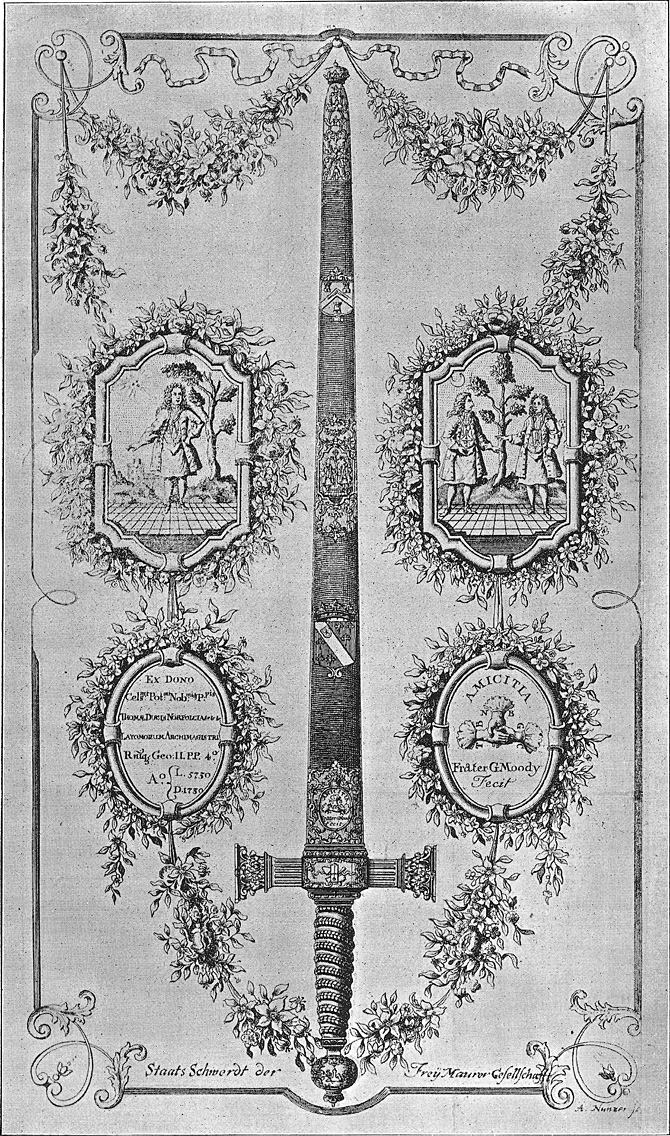
II. Factual information on a History of Freemasonry in the 18th century, especially in Germany. 1702. After this year, Freemasonry went into decline; the number of lodges decreased and the celebration of the feast of St. John was completely omitted. Only the old lodge St. Paul and a few others still gathered, but consisted of only a few members. Hence the decision was made to no longer restrict the privileges of the Free-Masons to architects and operative masons, but that men of all classes and professions should be allowed to promise and promote the dignity of the Order, as an old, venerable society. 1716. The so-called Restoration of the Grand Lodge in London. — After Wren's death, the four London Lodges, namely: those meeting at the Goose and Gridiron Ale-house in St. Paul's Church-yard, at the Apple-Tree Tavern, at the Crown Ale-house, and at the Rummer and Grapes Tavern, united under the new Grand Master Anthony Sayer. 1717. On June 24 the Grand Lodge of London is restored, and Anthony Sayer Esq. chosen as Grand Master. — It is decided to unite, to restore the yearly Grand Convocations and Festivals, to put the old customs and practices of the brotherhood into a firm order, and to establish only such rituals as fit for those members who now make up the lodges. 1719. The first Grand Master (named by some George Payne, John Theophilus Desaguliers by others) after the Reform collects many ancient writings concerning masonry. 1720. On December 27 The office of Deputy Grand Master is restored in England and to each of them, every Grand Master is gives the power to appoint his Deputy Grand Master and even the two Grand Wardens. in the same year. On Wednesday, May 4, the Grand Lodge of the new (Modern) English Free-Masonry celebrates its annual Festival. in the same year. in June or July 24, various important ancient manuscripts are burned by anxious brothers. — Internal transformation. 1721. The year Free-Masonry actually becomes [publicly] known in its present form. 1722. On March 25, in the plenary assembly of the Grand Lodge, after the favorable report of the committee, it was resolved that Anderson's work be printed under the authority of the Grand Lodge. in the same year. First sure trace of constituted lodges. 1723. Appearance [public release] of the first Book of Constitutions of the Freemasons, (in 4to. 131/2 sheet) whereby they are first publicly known as a society. "On the 17th of January, Anderson presents the printed work to the Principals of the Grand Lodge (consisting of the Grand Officials and the Deputies of 26 Lodges), which, with the addition to the appended ancient form of setting up a Lodge, is again approved." — The famous physicist Desaguiliers is described as Deputy Grandmaster. in the same year. On June 24, institution of the offices of a Master Grand Treasure and of Grand Secretary in London. The Grand Stewards are proposed and established; the Toasts are introduced. in the same year. On November 16, Twelve Grand Stewards are appointed annually. (According to others, in 1728.) On February 24, at the convocation of the Grand Lodge under the Grand Master Lord Crawford, [! Crawford was G.M. in 1734] Anderson proposes a new edition of the Book of Constitutions and receives orders to submit his materials to the Grand Officials. 1725. The three Englishmen: Lord Derwentwater, Sir Maskeleyne Esq., and Master Heguerty, set up with the English grocer Heure the first lodge in France, in Paris, thereby causing the unmeasured spread, as well as the many changes in the institutions. in the same year, the English free masons set up a special alms' deputation. There is a provision for the distribution of the benevolent contributions. 1726, the office of Provincial Grand Master is established. (In the province assigned to him, he is the immediate representative of the Grand Master, with the power to constitute lodges.) 1727. The authority of the English Grand Lodge abroad is widely recognized under the Grandmastership of Lord Coleraine. A deputation is sent to Madrid to establish a lodge there. 1728. Installation of (twelve) Grand Stewards. in the same year, Grand Master Lord Kingston sends the first Charter of Constitution to the East Indies. 1730. Lord Kingston, who had been Grand Master in London, establishes a Grand Lodge in Dublin and is himself elected Grand Master of Ireland. The Grand Lodge of London, which plans to be a Universal-Grandmastership, declares the Irish one as unconstitutional, but cannot [produce] anything to object to their [kind] of Masonry. in the same year, Peculiar journey of the Scotchman Ramsay to England. He was, after his conversion to the Catholic religion, the tutor of the two princes of the Pretender in Rome; was Chancellor of the Grand Lodge in France, and made the suggestion in England: that every member of the society (which he estimated to be 3000 throughout Europe) should give annually ten Louis d'or to the promotion of their chief purpose [the restoration of the Stuarts to the English Throne]. See Nicolai, l. c. pp. 232 - 236. in the same year, The first lodges in the East Indies and America are founded under the Grand Mastership of Lord Kingston. 1731. On January 29, The Duke of Norfolk sends from Venice to the Grand Lodge in London, along with 20 lbs. sterling Alms contribution, a large lodge book in Fol. beautifully embroidered in blue and gold, and the old Leib-sword [?] of Gustav Adolph, which afterwards also the Duke Bernhard of Weimar had carried, with both heroes name on the blade and the Norfolk coat of arms on the scabbard, inlaid with silver. This sword is currently the English Grand Master's Sword of State. in the same year, New Constitutions in the English Lodges; a consequence of Ramsay's journey — and most reasonable to think it will be expended towards the forming another System of Masonry, the old Fabrik being so ruinous, that, unless repair'd by some occult Mystery. in the same year, Emperor Franz I, as a traveling prince, was promoted to Master [Mason} under Grand Master Lovel, in an extraordinary lodge, on Robert Walpole's country house in Norfolk with the Duke of Newcastle. (He had already received the other two degrees at The Hague.) 1733. Lord Sackwille, Duke of Middlesex, establishes a lodge in Florence. 1735. At the Grand Lodge [Convocation] held on March 31, Anderson gets the order to list in the new edition of the Book of Constitutions also the patrons of the ancient Masonry, since the beginning of time, as well as the Grand Masters and Grand Officials, since Grand Master Montagu. in the same year, Free-Masonry is suspended in the United Netherlands and even the name: Free-Mason is banned. circa the same year, First German Lodge (St. George, later called Absalom, in Hamburg) is founded by the Scottish Lords Keith and Marshall. The next oldest is the one To the Three Roses in Sachsenfeld. 1736. Ancients and Moderns English System. — Under the Grand Mastership of Earl of Loudoun disputes arise in the elections of the Grand Officials; a number brothers in turmoil; citing the ancient York constitution, new lodges repudiate the restoration of 1716 (or 1717) and withdraw from the Grand Lodge of London. in the same year, The Anderson's Book of Constitutions appears in The Hague, translated into French by Johannes Kühnen, Deputy Grand Master of the Lodges in Holland. in the same year, The first lodge in Africa is established under Grand Master Lord Loudon. in the same year, On October 15, The last hereditary Grand Master of Scotland of the St. Clair [or Sinclair] family, who was the last of his [genealogical] line, resigns, leaving the election of a new Grand Master to freedom to the brethren. All and thirty-four working lodges send delegates who, in sign of gratitude, on the 30th of November, elect the same William St. Clair of Roslin as their Grandmaster on November 30, to whom then followed in 1737 Georg Earl of Cromarthy. 1737. On the 25th of January the Grand Lodge again approves the new edition of the Book of Constitutions. in the same year, Louis XV, King of France, abolishes Free-Masonry in his lands and declares punishable even the dealings with Free-Masons. in the same year, On November 5, Frederick, Prince of Wales, father of King George III, is initiated into Free-Masonry in a specially constituted lodge at Kew. 1738. On January 25, Publication of the new edition of the Book of Constitutions. in the same year, Bull of Pope Clement XII and Excommunication of the Free-Masons. in the same year, In Sweden, Free-Mason assemblies are banned under the penalty of life imprisonment. in the same year, Emperor Charles VI abolishes Free-Masonry in Flanders, and expels the Free-Masons. in the same year, Frederick II is initiated with all the festivities of the Order in the night between the 14th and 15th of August in the Cornish Hotel in Braunschweig, by a deputation from Hamburg, in the presence of Baron von Bielefeld, Baron O. u. v. L., the ruling Count von der Lippe-Bückeburg, Count v. K. and Bar. V. A. in the same year, Immigration of Free-Masonry into the Prussian states; but in secret because Emperor Friedrich Wilhelm I was against it. 1739. August II, King of Poland, [! died 1733] persecuted the Free-Masons at the instigation of the papal bull and had the excommunication posted on all churches. in the same year, The dissatisfied Brethren, who in 1736 had left the London Grand Lodge, as independent Free Masons choose their own Grand Master, make a new law book, grant patents for the establishment of new lodges, etc. 1740. Philip V, King of Spain, has the Free-Masons, as such, thrown to jail. in the same year, Stronger introduction of masonry into Germany through the war of that time. — Foundation of Lodge Absalom. in the same year, Bro. Luttmann brings a patent from London for the establishment of a mother lodge in the three degrees to Hamburg and for himself the patent as Grand Master of Hamburg and Lower Saxony. in the same year, On September 13, Foundation of the ▭ Aux Trois Globes in Berlin, chaired by Bro. Baron von Bielefeld and the co-foundation of Geh. R. Jordan. As the first Masonic temple in the Prussian Lands, it receives a royal protectorate and will establish two daughter lodges in this year. in the same year, Free-Masonry is persecuted by the Dutch clergy, but the government steers the matter to the moral constraint of conscience and ban to the [church] confessors [to ask] all questions about Free-Masonry. In a few years, many new lodges are being built in the United Netherlands, some of them [sponsored] from England and some from Scotland. in the same year, Under the Grand Master Earl of Kintore provincial Grand Masters are constituted in Barbados, Hamburg and Russia. 1741. In Florentine, Parmesan regions, in Malta and other parts of Italy, the Inquisition is brought to bear against the Free-Masons. in the same year, [Publication of] the first German edition of Anderson's Book of Constitutions at Frankfurt a. M. (the second two were also published there in 1743, the third in 1762, and a second part by Kleinschmidt. 1784. 8.) in the same year, On June 24, declaration, that the Grand Treasurer, Grand Secretary, and Grand Swordman or Master of Ceremonies are proper member of Grand Lodge and are to be elected annually. in the same year, The Scottish A. Degree [Scottish Rite], is introduced in Hamburg by Count von Schmettau as the first originator of the Scots Master [Maître Écossais] degree, and 6 months later the ⊠ Judica is established. 1742. On January 31, Founding of the Lodge in Altenburg as the 7th Lodge in Germany (after Hamburg, Dresden, Berlin, Bayreuth, Wroclaw and Leipzig, today "Minerva to the Three Palms") by three brothers of the Leipzig Lodge "Aux trois Compas": Albrecht Anton von Rüxleben (1705 - 1750), Johann August Bachoff von Echt (1717 - 1794) and his brother Ludwig Heinrich Bachoff von Echt (1725 - 1792). The Leipzig Loge belonged to the Dresden Grand Lodge "Aux trois aigles blancs" ("To the Three White Eagles," today "Swords Lodge"), which assented to its establishment. The Altenburg Loge is named "Aux trois planches à tracer" ("To the Three Drawing-Boards", later also "To the Three Drawingboards"). in the same year, On March 20, Baron von Hund is initiated into the Order at Frankfurt am Main. 1743. John [João] King of Portugal, persecutes the Free-Masons and has them imprisoned. in the same year, Baron von Hund is Worshipful Master of a new lodge in Paris. — First Origin of the Templar System of Strict Observance. in the same year, New edition of Anderson's Book of Constitutions. in the same year, Foundation of the Lodge St. George in Hamburg. 1744. The ▭ Aux Trois Globes receives from its royal Grand Master the title of a Grand Royal Motherlodge to the Three World Globes. in the same year, The Brethren in Antigua build a magnificent temple and receive from London the name of the Grand St. John Lodge of Antigua. 1746. The Grand Lodge for the Three World Globes in Berlin already has fourteen subsidiary lodges in Berlin, Meiningen, Frankfurt a. d. O., Wroclaw, Dresden, Neuschatel, Halle etc. in the same year, Ludwig Friedrich Lenz publishes the first German-language Masonic song book "Freymäurer-Lieder." His title page shows Archimedes with the inscription "NOLI TURBARE CIRCULOS." 1747 On April 3, The public processions of Free-Masons at festivals are abolished in England. 1747 On August 11, The Duke of Holstein (Initiated into the Order in the year 1740 by Emperor Friedrich II) becomes Deputy Grand Master of the Grand ▭ aux Trois Globes; He revises and rectifies its statutes, which are published March 16, 1748. 1748 On June 10, Reinstallation of the Stewards Lodge by the Grand Motherlodge "zu den drei Weltkugeln." |
II. Data zu einer Geschichte der Freimaurerei im 18ten Jahrhunderte, besonders in Deutschland. 1702. Nach diesem Jahr geriet die Freimaurerei in Verfall; die Zahl der Logen verminderte sich und die Feier des Johannisfestes wurde gänzlich unterlassen. Nur die alte Loge St. Paul und einige andere, versammelten sich noch, bestanden aber nur aus wenig Mitgliedern. Daher faßte man den Beschluß, daß das Privilegium der freien Maurer sich nicht länger bloß auf Architekten und arbeitende Maurer einschränken, sondern, daß man Männer von allerlei Ständen zulassen wolle, welche geloben würden, die Würde des Ordens, als einer alten, ehrwürdigen Gesellschaft zu unterstützen. 1716. Sogenannte Restauration der großen Loge in London. — Die dort befindlichen Logen, nämlich: die in der Taverne zur Gans, bei der Paulskirche; in der zur Krone, zum Apfel und zum Kömer, vereinigen sich, nach dem Abgang Wren's, unter dem neuen Groß-Meister Anton Sayer. 1717. Den 24. Juni. wird die große Loge zu London wieder hergestellt und Anthony Sayer Esq. zum Groß-Meister erwählt. — Man beschließt, sich zusammen zu halten, die jährlichen großen Versammlungen und Feste wieder zu erneuern, die alten Gewohnheiten und Gebräuche der Brüderschaft in eine feste Ordnung zu bringen und nur solche Ritualia fest zu setzen, als sich für diejenigen Mitglieder paßten, aus denen jetzt die Logen beständen. 1719. Der erste Groß-Meister nach der Reform (von einigen George Payne, von anderen Joh. Theoph. Desaguiliers genannt) sammelt viele alte Schriften, die Maurerei betreffend. 1720. Den 27. Dezember. Das Amt eines Deputierten Groß-Meisters in England wird erneuert und dem jedesn: aligen Groß-Meister die Macht erteilt, seinen Deputierten Groß-Meister und die beiden Großaufseher selbst zu ernennen. eod. Mittwochs den 4. Mai feiert die große Loge der neuen (modern) englischen Frei-Maurerei ihr jährliches Fest. eod. Den 24. Juni oder Juli werden von ängstlichen Brüdern verschiedene wichtige alte Handschriften verbrannt. — Veränderung im Inneren. 1721. Das Jahr der eigentlichen Bekanntwerdung der Frei-Maurerei in ihrer jetzigen Gestalt. 1722. Den 25. März in der vollen Versammlung der großen Loge wurde nach dem günstigen Bericht der Komitee, das Andersonsche Werk unter Autorität der großen Loge dem Druck übergeben. eod. Erste sichre Spur von konstituierten Logen. Es wird festgesetzt, daß jede Loge ein Konstitutions-Patent von der großen Loge zu London haben müsse, wenn sie für echt anerkannt werden wolle. Doch waren außer London mehrere Logen, die an dem neuen Groß-Meistertum keinen Teil nahmen, der alten Yorker Konstitution treu blieben, und keine anderen Oberen, als ihre Logenbeamten über sich erkannten. 1723. Erscheinung des ersten Konstitutions-Buches der Freimaurer, (gr. 4. 131/2 Bogen) wodurch sie zuerst öffentlich als Gesellschaft bekannt werden. "Am 17. Jan. legt der Großvorsteher Anderson das gedruckte Werk der großen Loge (bestehend aus den Großbeamten und den Deputirten =67= von 26 Logen) vor, welches, nebst der Zugabe, von der alten Manier, eine Loge zu errichten, nochmals gebilligt wird." — Der berühmte Physiker Desaguiliers wird dabei als Deputierter Großmeister genannt. eod. Den 24. Juni. Einsetzung der Ämter, eines Groß-Schatz-Meisters und Groß-Sekretärs in London. Groß-Stewards werden vorgeschlagen und festgesetzte Gesundheiten eingeführt. eod. Den 16. November. Zwölf Groß-Stewards werden jährlich ernannt. (nach anderen 1728.) Den 24. Februar in der Versammlung der großen Loge unter dem Groß-Meister Lord Krawfurd, trägt Anderson auf eine neue Ausgabe des Konst. Buchs an, und erhält Befehl, seine Materialien dazu den Großbeamten vorzulegen. =68= 1725. Die drei Engländer: Lord Derwentwater, Sir Maskeleyne Esq., und Master Heguerty errichten bei dem englischen Speisewirt Heure in Paris die erste Loge in Frankreich und veranlassen dadurch die ungemessene Ausbreitung, so wie die vielen Abänderungen in den Ordenseinrichtungen. eod. errichten die englischen Frei-Maurer eine besondere Almosen-Deputation. Es wird eine Vorschrift zu Austheilung der milden Beiträge gegeben. 1726 wird das Amt eines Provinzial-Groß-Meisters errichtet. (Dieser ist in der ihm angewiesenen Provinz der unmittelbare Repräsentant des Groß-Meisters mit der Macht, Logen zu konstituieren.) 1727. Die Autorität der großen Englischen Landes-Loge, unter dem Groß-Meistertum des Lord Coleraine allgemein anerkannt. Es wird eine Deputation nach Madrid gesandt, um daselbst eine Loge zu stiften. 1728. Einsetzung von (zwölf) Groß-Stewards. =69= eod. Der Groß-Meister Lord Kingstone sendet das erste Konstitutions-Patent nach Ostindien. 1730. Lord Kingston, der in London Groß-Meister gewesen war, errichtet eine große Loge zu Dublin und wird selbst zum Groß-Meister von Irland gewählt. Die große Loge zu London, welche ein Universal-Groß-Meisterthum projektiert, erklärt das Irrländische für konstitutionswidrig, kann aber gegen ihre Maurerei nichts einwenden. eod. Merkwürdige Reise des Schottländers Ramsay nach England. — Er war, nach seinem Übertritt zur katholischen Religion, Hofmeister der zwei Prinzen des Prätendenten zu Rom; war Kanzler der großen Loge in Frankreich, und machte in England den Vorschlag: daß jedes Mitglied der Gesellschaft (die er durch ganz Europa auf 3000 schätzte) jährlich zehn Louisd'or zur Beförderung ihres Hauptzwecks geben sollte. v. Nic. l. c. S. 232 — 236. eod. Unter dem Groß-Meistertum des Lord Kingston's werden die ersten Logen in Ostindien und Amerika gestiftet. 1731. Den 29. Januar. Der Herzog von Norfolk schickt von Venedig, nebst 20 Pfd. Sterl. Almosenbeitrag, an die Gr. L. zu London ein großes in Blau und Gold prächtig eingebundenes Logenbuch in Fol., und das alte Leibschwert Gustav Adolphs, welches nachher auch der Herzog Bernhard von Weimar geführt hatte, mit beider Helden Namen auf der Klinge und dem Norfolkischen Wappen auf der Scheide, mit Silber eingelegt. Dieses Schwert ist gegenwärtig des englischen Groß-Meisters Staatsschwert. eod. Neue Konstitutionen in den englischen Logen; eine Folge der Ramsayschen Reise — and most reasonable to think it will be expended towards the forming another System of Masonry, the old Fabrik being so ruinous, that, unless repair'd by some occult Mystery. eod. Kaiser Franz I, als reisender Prinz, wird unter dem Groß-Meister Lovel, in einer außerordentlichen Loge, auf Robert Walpole's Landhause in Norfolk mit dem Herzog von Newcastle =71= zum Meister befördert. (Die zwei anderen Grade hatte er schon im Haag erhalten.) 1733. Lord Sackwille, Duke of Middlesex, stiftet zu Florenz eine Loge. 1735 in der, am 31. März gehaltheten großen Loge, bekommt Anderson den Befehl, in der neuen Ausgabe des Konst. B. auch die Patrone der alten Maurerei, seit dem Anfange der Zeit, so wie die Groß-Meister und Groß-Beamte, seit dem Groß-Meister Montagu aufzuführen. eod. Die Frei-Maurerei wird in den vereinigten Niederlanden aufgehoben und selbst der Name: Frei-Maurer verboten. eod. circa. Erste deutsche Loge (St. Georg. Nachher Absalom genannt, zu Hamburg) durch die schottischen Lords Keith und Marshall gestiftet. Die nächstälteste ist die zu den drei Rosen zu Sachsenfeld. 1736 Altes und neues englisches System. — unter dem Groß-Meistertum des Grafen v. Loudon, entstehen Streitigkeiten bei den Wahlen der Groß-Beamten; eine Anzahl Brüder stiften; mit Berufung auf die alte Yorker Konstitution, neue Logen, verwerfen die Restauration von 1716 (oder 1717) und entziehen sich der großen Loge von London. =73= eod. Das Andersonsche Konstitut-Buch erscheint zu Haag, von Joh. Kühnen, deput. Groß-Meister der Logen in Holland, ins französische übersetzt. eod. Unter dem Groß-Meister Lord Loudonwird die erste Loge in Afrika errichtet. eod. Den 15. Oktober resigniert der letzte erbliche Groß-Meister von Schottland aus der Familie St. Clair, welcher der letzte seines Stammes war, und überläßt die neue Wahl eines Groß-Meisters der Freiheit der B B. Sämtliche vier und dreißig arbeitende Logen senden dazu Abgeordnete, welche aus Erkenntlichkeit am 30. November eben denselben William St. Clair of Roslin zu ihrem Landes-Großmeister wählen, welchem alsdann 1737 Georg Earl of Cromarthy folgt. 1737 Den 25. Jan. billigt die große Loge abermals die neue Ausgabe des Konstitutions-Buchs. eod. Ludwig XV. König von Frankreich, hebt in =74= seinen Landen die Frei-Maurerei auf und erklärt selbst den Umgang mit Frei-Maurern für strafbar. eod. Den 5. November Friedrich, Prinz von Wallis, Vater K. Georg III., wird in einer dazu besonders errichteten Loge zu Kew zum Frei-Maurer aufgenommen. 1738 Den 25. Januar. Erscheinung der neuen Ausgabe des Konst. B. eod. Bannbulle und Exkommunikation der Frei-Maurer von Papst Clemens dem XII. eod. In Schweden werden die Frei-Maurer-Versammlungen bei Lebensstrafe verboten. eod. Kaiser Carl VI. hebt die Frei-Maurerei in Flandern auf, und verjagt die Frei-Maurer. eod. Friedrich II. wird in der Nacht zwischen dem 14. und 15. August zu Braunschweig, im Kornischen Hotel, durch eine Deputation von =75= Hamburg, wobei der Baron v. Bielefeld, Bar. v. O. u. v. L., der regierende Graf von der Lippe-Bückeburg, Graf v. K. und Bar. v. A. gegenwärtig waren, mit allen Feierlichkeiten in den Orden aufgenommen. eod. Einwanderung der Frei-Maurerei in die Preußischen Staaten; jedoch ins geheim weil K. Friedrich Wilhelm I. dagegen eingenommen war. 1739. August II., König v. Polen, verfolgt die Frei-Maurer auf Veranlassung der päpstlichen Bulle und läßt die Exkommunikation an allen Kirchen anschlagen. eod. Die BB., die sich als unzufrieden 1736 aus der Londoner Gr. L. entfernt hatten, erwählen sich, als selbstständige Frei-Maurer, einen eigenen Groß-Meister, machen ein neues Gesetzbuch, erteilen Patente zu Errichtung neuer Logen etc. 1740. Philipp V., König von Spanien, läßt Frei-Maurer, als solche, ins Gefängnis werfen. eod. Stärkere Einführung der Maurerei in Deutschland =76= durch den damaligen Krieg. — Stiftung der L. Absalom. eod. Der Br. Luttmann bringt aus London ein Patent zu Errichtung einer Mutter-Loge in den drei Graden nach Hamburg und für sich das Patent als Groß-Meister von Hamburg und Niedersachsen. eod. Den 13. September. Gründung der ▭ aux Trois Globes in Berlin, unter dem Vorsitz des Br. Baron v. Bielefeld und der Mitstiftung des Geh. R. Jordan. Sie erhält, als der erste Maurer-Tempel in den Preuß. Landen ein königl. Protektorium und stiftet noch in diesem Jahre zwei Tochterlogen. eod. Die Frei-Maurerei wird von der holländischen Geistlichkeit verfolgt, die Regierung aber steuert dem Gewissenszwange und verbietet alle Fragen an Beichtkinder über Frei-Maurerei. Es entstehen in wenig Jahren viel neue Logen in den vereinigten Niederlanden, die ihre Konstitutionen teils aus England teils aus Schottland bekommen. eod. Unter dem Groß-Meister Earl of Kintore =77= werden Provinzial Groß-Meister in Barbados, Hamburg und Rußland konstituiert. 1741. Im Florentinischen, Parmesanischen, auf Malta und in anderen Gegenden von Italien wird die Inquisition gegen die Frei-Maurer ercitiert. eod. Die erste deutsche Ausg. des And. Const. B. Frankfurt a. M. (die zweyte ebendaselbst 1743. die dritte 1762. und ein zweiter Theil von Kleinschmidt. 1784. 8.) eod. Den 24. Juni festgesetzt, daß der Groß-Schatz-Meister, Groß-Sekretär und Groß-Schwertträger oder Ceremonien-Meister ordentliche Mitglieder der Gr. L. sein und jährlich erwählt werden sollen. eod. In Hamburg der Schottl. A. Grad durch den Grafen v. Schmettau, als erstem Urheber des Sch.-Meisters eingeführt und 6 Monate später die ⊠ Judica errichtet. 1742. Den 31. Januar. Gründung der Altenburger Loge als 7. Loge in Deutschland (nach Hamburg, Dresden, Berlin, Bayreuth, Breslau und Leipzig) durch drei Brüder der Leipziger Loge "Aux trois Compas" (heute "Minerva zu den drei Palmen"): Albrecht Anton von Rüxleben (1705 - 1750), Johann August Bachoff von Echt (1717 - 1794) und sein leiblicher Bruder Ludwig Heinrich Bachoff von Echt (1725 - 1792). Die Leipziger Loge gehörte zur Dresdner Großloge "Aux trois aigles blancs" ("Zu den drei Weißen Adlern", heute "Schwerterloge"), die der Neugründung zustimmte. Die Altenburger Loge erhielt den Namen "Aux trois planches à tracer" ("Zum drey Reiss-Brettern", später auch "Zu den drey Reissbretern"). eod. Den 20. März. Freiherr von Hund wird zu Frankfurt am Main in den Orden aufgenommen. =78= 1743. Johann König von Portugal, verfolgt die Frei-Maurer und läßt sie ins Gefängnis setzen. eod. Freiherr v. Hund ist Meister vom St. Einer neuen Loge zu Paris. — Erster Ursprung des Tempelherren-Systems der str. Obs. eod. Neue Ausgabe des Andersonschen Konstitutions-Buchs. eod. Stiftung der L. St. George in Hamburg. 1744. Die ▭ aux Trois Globes erhält von ihrem königlichen Groß-Meister das Prädikat einer großen königlichen Mutterloge zu den drei Weltkugeln. eod. Die BB. zu Antigua bauen ein prächtiges Logenhaus und erhalten von London aus den Namen der Großen Joh. L. zu Antigua. 1746. Die Gr. L. zu den drei Weltk. zu Berlin hat schon vierzehn Tochterlogen zu Berlin, Meiningen, Frankf. a. d. O., Breslau, Dresden, Neuschatel, Halle etc. =79= eod. Ludwig Friedrich Lenz gibt das erste deutschsprachige freimaurerische Liederbuch "Freymäurer-Lieder" heraus. Sein Titelblatt zeigt den Archimedes mit der Umschrift "NOLI TURBARE CIRCULOS". 1747. Den 3. April. Die öffentlichen Prozessionen der Frei-Maurer in England an den Festen, werden aufgehoben. 1747. Den 11. August. Der Herzog von Holstein (im J. 1740 von K. Friedrich II. in den O. aufgenommen) wird Vice-Groß-Meister der gr. ▭ aux Trois Globes; er revidiert und rektifiziert ihre Statuten, welche den 16. März 1748 publiziert werden. 1748. Den 10 Juni. Reinstallierung der Stewards-Loge bei der gr. Mutterloge zu den drei Weltkugeln. |
|
1749 — 1756 Gradual introduction of the Rite of Strict Observance in Germany by Lord v. Marshal (in Altenburg and Naumburg) and the Baron von Hund. 1751 June Benedict XIV, invoking the secular arm, confirms the ban-Bull of Clemens VII. in the same year, On July 2, At the request of Joseph Torrubia, Auditor of the Holy Office, etc. with the Inquisition, Free-Masonry is banned in Spain by a royal decree. 1752 Lodge de l'Amitie in Berlin, previously established by the French scholars and artists appointed by Frederick II, begins to work publicly in the French language. 1753 In this year there were already in the Strict Observance system Priors, Subpriors, Prefects, Commanders; the system already existed in full, only on a small scale; earlier already existed a temple. Chapter of Unworthy in the Order of Lausitz. 1754 Foundation of the ▭ Concordia or zur Eintracht. in the same year, On June 27, The new edition of the Constitution book is written by John Entick. 1755 Loge de l'Amitie, maintaining its own constitution, affiliates with the [Grand] Lodge of the three World Globes. in the same year, On March 13, Baron von Hund has a preliminary regulation for the establishment of a Pension Fund to be enacted provisorily in his province. in the same year, On March 20, The English Grand Lodge declares various meetings of Brethren, who had been posing for ancient Free-Masons, and were found in the investigation to be incorrect, to be bogus. in the same year, An old Dresdner Lodge adopts the Strict Observance System and reforms its customs. 1755 On July 24, Formal introduction of the Grand Certificate in England. 1756 Epoch of spread of the French Higher Degrees in Germany, during the Seven Years War. in the same year, On June 19, Separation of Lodge Concordia from its mother-Lodge of the Three World Globes. in the same year, All working lodges in the United Holland unite into a National Grand Lodge in the Hague. in the same year, On December 27, von Hund publishes an exposition of the aforementioned preliminary Pension Bank regulation [Prospectus] with amendments and enhancements. 1757 On May 2, Baron von Printzen is elected Master of the ▭ to the Three World Globes, on June 17 in a Steward ▭ examines its active and passive conditions and brings everything in order again. 1758 New French and half English Masonry of Higher Degrees in Berlin [brought] by the Marquis of Lernay (according to others: Chevalier Ville de Lermet) and von Printzen; suggesting the Occult Philosophy and the philosopher's stone. "The supposed Order of the Temple, which was first introduced in 1758 by one French Marquis de Bernez (named in the Order Eques a Turri aurea), to a perceived Jesuit friend, on the orders of the unknown superiors, had to adopt the signum solis or ⊙ as a sign under which the Order of the Jesuits is also envisaged." in the same year, Entick's edition of the Book of Constitutions [is published]. It is sold for the benefit of the poor. 1759 on June 26 Schröpfer arrives at the Hotel de Saxe in Leipzig as port inspector. 1760 Total propagation of French Masonry into Germany with the army of the Duke de Broglie. 1761 Schröpfer establishes himself as a vintner in Leipzig. in the same year, On April 12, Lodge de l'Amitie aux Trois Colombes is founded as the daughter lodge of the Grand Lodge of the Three Globes. in the same year, On May 20, Foundation of a Masonic Tribunal, as a supreme Order Authority for the Prussian states, through a solemn Act of Reunion, [under] Grand Master Baron von Printzen. 1762 The Marquis de Lernay establishes a Grand Chapter of Knights of Jerusalem in Berlin, in the manner that was customary at that time in Amiens and other French cities. 1762 and 1763 Disputes among the Berlin lodges. The ▭ de l'Amitie separates from the Three Globes and the ▭ Concordia, and works at this time [is held] less often because a large part of their members had gone away [in the army]. in the same year, In London, 14 Brethren are expelled because of their association with clandestine lodges. 1763 The Masonic Apostle Rosa spreads his System [Strict Observance] from Berlin, transforms many lodges, and builds chapters in Brunswick, Hamburg, Copenhagen, etc. He claims that the Order secrecy consists of alchemy, theosophy, cosmosophy, mechanics, etc., but with the confession of not knowing it himself. in the same year, At a convention in Saxony Baron von Hund is acknowledged as Provincial Grand Master of the German Free-Masons. in the same year, After three years of work, the members of the Masonic Tribunal at the Grand Lodge of the Three World Globes in Berlin resigned their offices, and there is a six-year anarchy. 1764 On March 16, some Brethren of the old Loge de l'Amitié [of Friendship] of Berlin, institute a new lodge under a patent from the [Scottish] Lodge Puritas of Braunschweig, which soon after spreads. Are affiliated with it the lodges in Bordeaux, Aix in Provence, lodge Eduard of Dresden and others, and appoint representatives to it. in the same year, The royal Empress Maria Theresa abolishes Free-Masonry in her states because the lodges [grand] Master refuses to inform the government of its inner institution. in the same year, Johnson de Fünen, who claims to be an Englishman and claims to be sent by the superiors in Scotland to reform all the German lodges, had propagated above all the idea that Masonry was the continuation of the Templar Holy Order; the Chevaliers Prêtres [Knight Priest of the Holy Order of Wisdom] had fled to the Scottish Islands; but if the militia of the temple were only to return public, then the Clerics would no longer hide, but lay down their salvaged treasures and high sciences (ghost-seeing, gold making, etc.) in their laps [in the open]. At the same time he gave a list of uninterrupted Grand Masters from James de Molay's up to his times, naming various sages in Italy and the Orient, as members of the Order. He made proselytes, especially in Jena, wrote to all lodges, lamented that they let themselves be led astray by the Berliners, claimed that he alone, as a Master of the Templars, had the power to make knights, and invited deputies to Jena. in the same year, at this time the French and Dutch [lodges] continue to play with a tremendous number of degrees, without seeking any further seriousness by it. — Other German lodges, especially in Frankfurt, work undisturbed by the English system. in the same year, Johannes Christian Schubart von Kleefeld, in the quality of a long-lasting Deputy Grand Master, publicly declares this Johnson to the mother-lodge to the Three World Globes in Berlin, a swindler. 1765 On July 27, the Duke of York becomes a Free-Mason in the ▭ de l'Amitié. The lodge gives itself the name: The Royal York of Friendship in his honor. 1765 The lodges in Hamburg and Brunswick leave the English system and enter the Strict Observance. 1766 The lodge Royal York of Friendship receives a formal Charter from the Grand Lodge of London, as No. 330 of the London Register, and is dated June 24, 1767. in the same year, Dr. Ellermann, M.D., called von Zinnendorf through adoption by his mother brother, is staff physician and then General Staff physician in Berlin in the seven-year war, in the Strict Observance called Eques a Lapide Nigro [Knight of the black stone], and also old Scot. Grand Master of the ▭ to the Three World Globes, declares the Strict Observance a fraud, and himself the founder of a new system, for which he secretly received the rituals (documents) by the secretary of the Swedish Lodge, Eckleff. He gives himself an English privilege and declares all other [systems] of Masonry spurious. Several lodges from the Strict Observance join his faction. in the same year, Introduction of intolerance into Masonry. in the same year, On August 9, The Grand Lodge of the Three Word Globes, together with its daughter Lodge Concordia, join the Strict Observance. in the same year, A plan is presented to the superiors of the Strict Observance, according to which, through money contributions of the Brethren, life annuity to support especially poorer Brethren could accrue within five years. — The plan was rejected by most lodges. 1767 Appearance of Clericorum Ordinis Templar and Offers to confide to the System of Strict Observance the secrets of the fathers in Auvergne. in the same year, Fourth Edition of the Constitution Book. The Appendix thereto in 1776. in the same year, First foundation of the Illuminati Order through Weishaupt. 1768 Schröpfer establishes his notorious coffee house. in the same year, von Schubart withdraws completely from Masonry. in the same year, On October 29, The plans for a new home are presented in the English Grand Lodge and its construction enacted; the building site for it, however, is bought only in 1774. 1769 The French National Grand Lodge concludes a Coalition Treaty with the English one. 1770 On April 25, The Grand Lodge in The Hague concludes a Coalition Treaty with the supreme Grand Lodge of England, which gives them the power to constitute and establish new lodges throughout the Netherlands and its dependent colonies. in the same year, On December 27, Baron von Zinnendorf forms a Grand Lodge in Berlin from twelve lodges, makes of the Bro. King the Grand Master, and becomes the Deputy Grand Master of his system. 1771 Baron von Zinnendorf persistently seeks, between March 29 and October 29, a Constitution from London. 1772 Convention at Kohlo (a knightly estate belonging to the Lieutenant-General Count von Brühl in the Lower Lusatia, not far from Pforta), after which the H.F. B. of the general superiors of all lodges of Strict Observance and the Eques ab ense of the special superiors of the Upper and Lower Saxon, Danish and Latvian lodges of the Strict Observance are named. in the same year, Construction of a lodge house in Barbados. in the same year, Schröpfer begins to hold a lodge. in the same year, On January 8, von Zinnendorf holds, on the basis of a Swedish constitution written in ciphers, a German Lodge in the locale of the French Lodge Royal York of Friendship, in order to induce, by the testimony of this lodge, the Masonic recognition denied in London; to which end he secretly removes the original minutes of the Loge Royal York and sends it to London. in the same year, Elaboration of the Zinnendor's Acts (rituals, ordinances) through the efforts of some Brethren in Berlin. in the same year, On July 5, Duke Friedrich becomes Grand Master of the Prussian States at the Grand Lodge of the Three World Globes; the old Scottish Directorate of the Strict Observance takes its headquarters in Braunschweig and Bro. Wöllner becomes its Master. 1773 On November 30, Zinnendorf's Grand Lodge receives through its current Grand Master Prince Ludwig Georg Carl of Hesse Darmstadt, the sought recognition from London and takes the legal name of National Grand Lodge of Germany. in the same year, Leuchte dies suddenly at the Wartburg [prison]. 1774 On May 19, Union of the ▭ Royal York with Zinnendorf's Grand Lodge at the recommendation of the Grand lodge of London; soon after (October 6th), the more violent insults ensue from one of them. in the same year, On July 16, Following the London Constitution, the National Grand Lodge receives a most venerable royal Protectorate. in the same year, On October 8, Schröpfer shoots himself in Rosenthal, in his 35th year. circa in the same year, Persecution of the Free-Masons in Gdansk [Danzig]. 1775 Convention in Brunswick. — Legitimization of the Knight of the Sword [Baron von Hund]. in the same year, On May 1, After a solemn procession in Great Queen Street, Lincoln's Innfields, the English Grand Master Lord Petre laid the foundation stone of the Grand Lodge's Freemasons' Hall, collecting a collection and making speeches. in the same year, On June 30, The reigning Duke Ernst of Saxony-Gotha and Altenburg is elected Grand Master of Zinnendorf's Grand Lodge. in the same year, The office of Grand Chaplain is restored and manned at the English Grand Lodge. in the same year, The Clerics separate from the Strict Observance. in the same year, enter the stage Baron von Gugomos in Upper Germany. He calls himself an envoy of the unknown superior, or of the Holy See, in Cyprus, namely in Nicosia, High Priest, Knight, Dux, etc., convene a convention, promising ghost apparitions, making gold, discovering the Templar treasures, miracles of all kinds. His Fraud is discovered, he escapes, and subsequent retraction. in the same year, Baron von Wächter, (Knight of Ceraso) is sent from the ancient Scottish Lodge of Franconia to Italy to look for the Order's secret or, according to others, to join the Brethren of the Stict Observance in Italy more closely to those in Franconia. (Earlier, Count C. - - - had already gone there with a similar intent.) He set up a few chapters in Italy, lived at the court of the Pretender, and discovered all accounts of him groundless, of Kilmanrock, of the [the Pretender's] Secretary Approsi, etc., and of all the other pillars of the German Templar Higher system. He, however, returned with great wealth, about which he declared that his important knowledge was not a secret Free-Masonry and his own free property. in the same year, The Rosicrucians form a large Mason-Party. — Martinists in Lyon and Paris. — Publication of the two books: The Erreurs et de la Verite of St. Martin and Tableau Naturel. in the same year, The Prince-Bishop of Hildesheim Fr. Wilh. von Westphal forbids his clergy and his officials from visiting the lodges because of the papal bulls. 1776 In the presence of the Grand Master and "territorial Sovereigns," Bro. Ernst II, Duke of Saxony-Gotha-Altenburg, becomes a member of the National Grand Lodge, Berlin. in the same year, The union of the ▭ Royal York of Friendship with the National Grand Lodge is repealed by the findings of the Grand Lodge of London from June 15, 1776, and April 11, 1778 and the ▭ Royale York, is affirmed in its old legal name. in the same year, The new magnificent assembly hall of the Grand Lodge of England is solemnly inaugurated by the Grand Master Lord Petre Baron of Writtle and the other Grand Officials, in the presence of 150 ladies and 400 brothers, with the customary ceremonies. 1776 Enter the stage the Knight of the Triumphant Swan, who assigns Rome and Florence as places for keeping divine secrets. in the same year, On June 30, The Duke Ernst of Gotha and Altenburg is again elected Grand Master of the National Gran Lodge. in the same year, New edition of the English Book of Constitutions. in the same year, In England is introduced the office of a Grand Architect. in the same year, On November 8, von Hund dies in Meiningen in the 55th year of his age, and is buried three hours from Meiningen at Melrichsstadt, a town in the diocese of Würzburg. in the same year, Beginning of the Neapolitan persecutions [of Masonry]. 1777 The Grand Lodge of Sweden, through emissaries sent to Berlin, (by means of an official document dated 29 July,) declares for bogus the patents which Baron von Zinnendorf claimed to have received from it, and upon which he arrogated the power to establish a new system in Germany. 1778 Since this year approximately, the secret machinations of the unknown superiors of Order of the Gold and Rosicrucians. in the same year, The French Masons leave more and more the old English constitution and rave about their own invention [System]. A large number of French lodges, especially in Alsace and Lorraine, have joined forces with the United Strict Observance and commit themselves under the protection of the Duke of Chartres. But at the convent of Lion they create the Templar Holy System, for fear of calling themselves Chevaliers bienfaisants de la Sainte Cité, remain in connection with the Strict Observance as a special Jurisdiction, but have their own mysterious degrees of Archives Mytho-hermetiques . in the same year, The Loge Royale York, after revoking its old rights, begins (14 Jan.) to work also in German. 1779 Doctor Starck makes an effort to unite the Brethren of the Strict Observance located in Mitau with the Clerics, but in vain. 1780 The Illuminati in Bavaria in the same year, Beginning of the union of the so-called Asiatic Brothers into a social body (closed in 1784); devoted to the propagation of the true explanation of all Masonic symbols, signs and words. in the same year, First public attack on the T. H. System through the book: the stumbling block and rock of vexation, by St. Nic. in the same year, On September 9, First Circular of the Duke Ferdinand v. B. as an invitation to a Convention. 1781 Ferdinand IV, King of Naples persecutes the Free-Masons. 1781 Appearance of the fanatical book: the purpose of the Freemason Order, in which reference is made to unknown fathers, who hold secret sciences. (By St. Nic.) 1782 The same author publishes the book: On old and new mysteries, which is full of incomprehensible and secretive hints. in the same year, The Eques a ceraso [Baron von Wächter] declare himself ready to return some of his knowledge into the fold of free-masonry, which knows nothing at present, but only wants to open himself up to a small circle of self-proclaimed Brethren, and with these to give the Order a new feature. — For fear of Jesuits he is not be accepted. in the same year, Joh. Wilhelm v. Zinnendorf dies in Berlin. in the same year, Joh. Peter Geogel of Frankfurt a. M., Provincial Grand Master of the Franconian, Upper and Lower Rhenish District, dies. As a result, the Provincial Grand Mastership set up from London expires, which becomes a secondary reason for the emergence of the Eclectic Freemasonry. 1783 The Congress of Wilhelmsbad near Hanau, where the Strict Observance, a faction of the German Rosicrucians and (through Baron von Knigge) the Illuminati took part; — held to determine the true purpose of Free-Masonry and examine whether to seek a continuation of the Order of the Temple and the true mystery of the unknown superiors of today's Templar Order. After 30 sessions, those questions are answered in the negative and the Knights Templar System abolished. in the same year, Circular of the Eclectics, from the Provincial Loge of Frankfurt am Main (March 18) and the Provincial Lodge of the Imperial Eagle in Wetzlar. (March 21st.) circa in the same year, Congress in Paris, advertised by the 'Lodge of the Amis Reunis' there, with an invitation to all enlightened Brethren to unite their mystical treasures with their own. in the same year, On January 28, Neapolitan edict, in which all previous statements, punishments and decrees related to masonic affairs are abolished, but it is left up to the junta to further monitor things that can be suspicious to religion and to the state. 1784 On June 22, Edict of the Elector Charles Theodore IV of Bavaria, against all unsanctioned and inadmissible communities. in the same year, Noorthouck's edition of Anderson's Book of Constitutions. in the same year, From this year on, the attacks of the Berlin Monthly on secret Catholicism [See Jesuits in Masonry]. 1785 On March 2, New edict in Bavaria against the Free-Masons and Illuminati; Prohibition of all meetings and collections of money. (In the edict, the [Masonic] society is said to have degenerated too far from its first institution.) in the same year, On August 16, The Edict is reiterated, with the injunction to the presidents and members of the associations, to come forward within eight days as Illuminati and to abjure the society. 1785 Free-Masonry is banned in Venice, and the lodge Master banished with his wife and children. in the same year, On December 12, Cabinet Order of Emperor Joseph II in relation to masonic affairs, in which it is decreed: That in capital cities be only a maximum of three lodges, the lists of the members and indication of the meeting days be submitted, and the lodges Masters be reported annually to the government; but all the government agencies should give the Freemasons complete acceptance, protection and freedom. in the same year, Appearance of the Saint-Nicaise and the following year of the Anti Saint-Nicaise. in the same year, Appearance of the book: The theoretical Brothers, or second stage of the Rosicrucians and their instruction. Athens. in the same year, Separation of the Altenburg Lodge "Zu den Drey Reissbretern" from the "National Grand Lodge" (together with the lodges "Schwarzer Bär" of Hanover, and the lodges in Gotha and Riga). Unlike most lodges of the time, the Lodge was kept free from the influences of the Strict Observance. 1786 The highest degree of English Masonry (the Royal Arch) begins to become known in Germany; not long before in England (circa 1777). in the same year, The Altenburg Lodge now carries the name "Archimedes of the Three Drafting Boards." 1786 From 6 November 1786 to 16 August 87, the trial of the suspected secret Catholicism between D. and the senior court chaplain Starck and the editors of the Berlin Monthly Journal. 1788 Le Bauld de Nans becomes Grand Official of the Lodge Royale York, and earns great merits within it. in the same year, After the failed attempt to join the National Mother Lodge "of the Three World Globes" in Berlin, the affiliation takes place with the "Eclectic Society" of Frankfurt a. M. 1789 Publication of the Masonic Code or Statutes and Regulations for the use of the French ▭ Royal York of Friendship; written by le Bauld de Nans. in the same year, On October 25, The so-called Eclectic Society is terminated by Bro. August von Chraf and the Provincial Lodge of Unity of Frankfurt a. M. unites with the London Grand Lodge. 1792 Lodge Clarence in London states that it would not tolerate incendiary speech at its meetings. Since it is already a fundamental law of the Order to ban all political matters, the other English lodges are so outraged by that statement that they declare: that the Lodge Clarence is not genuine, but rather belongs to a new system known only in England, whose followers are not recognized by the Grand Lodges in Scotland and Ireland. 1793 On December 13, Johannes Joachim Christoph Bode, dies in Weimar. 1794 Issue of the: System of the Free-Masons Lodge Truth and Unity to the Three Crowned Columns in Prague. 1796 The Doctor and Prof. Fessler receives from the Conseil sublime of the Lodge Royal York of Berlin the order to revise its constitution and rituals, for which task a commission of seven brothers is assigned to him. in the same year, On February 9, The Grand National Motherlodge of the Three World Globes receives a royal Protectorate. 1797 On June 3, Election of the esteemed Bro. Fessler to Deputy Grand Master of this Lodge. [his Resignation in 1802.] in the same year, On August 3, The first important step to make the Free Masons' society into a society in the most perfect sense by the Basic Treaty or Fundamental Constitution of the Grand Motherloge Royal York of Friendship and all the lodges associated with it . in the same year, The esteemed lodge duly submit to His Majesty the King its constitution and on the 29th of December of this year, and January 4, 1798, receive for itself and its daughter lodges, all the rights formerly granted to the other Berlin mother-lodges by Royal Protectorate. 1798 On June 11, The Loge Royal York gives itself the legal title of the Grand Lodge. 1798 On October 28, Solemn installation of G. R. von Sellentin as Grand Master of this Grand Lodge. in the same year, On October 20, Royal edict on Secret Societies, as a regulation for the Free-Masons in the Prussian States; wherein are recognized and protected only those lodges which commit themselves to the system of one of the three Grand and Motherlodges: the Three Globes, the Zinnendorf National Lodge and the Royale York, and making these Grand Lodges responsible for their daughter lodges. 1799 New attempts at Occultism by the Zinnendorf lodge and the Rosicrucians. The Grand Lodge of the Free-Masons in Berlin, called the Royal York of Friendship, is referred in the Hamburg Correspondent No. 167 to the pastoral letter to the true and genuine Free-Maurer of Old System 5785, a book in which whiffs the spirit of Chrysophirons [Joseph Friedrich Göhrung]. 1800 On June 13, Completion of the legal constitution of Free Masonry by the: Thoroughly revised (second) edition of the Basic Treaty of the Grand Free Masons Lodge Royal York of Friendship and its laws. 1800 On December 31, The Grand Freemasons Lodge Royal York of Friendship introduces the oldest true English ritual of the three St. John-degrees in all lodges under its Jurisdiction.
|
1749 — 1756. Allmähliche Einführung des Tempelherren-Systems in Deutschland durch Hr. v. Marschall (zu Altenburg und Naumburg) und den Baron v. Hund. 1751. Junis. Benedict XIV. bestätigt die Bann-Bulle Clemens VII., mit Aufrufung des weltlichen Arms. eod. Den 2. Jul. wird die Frei-Maurerei in Spanien, auf Antrag des Joseph Torrubia, Revisors des heil. Offiziums etc. bei der Inquisition, durch ein königliches Dekret verbannt. 1752. Die Loge de l'Amitie zu Berlin, vorher gestiftet durch die von Friedrich II. berufenen französischen Gelehrten und Künstler, fängt an, in französischer Sprache, öffentlich zu arbeiten. 1753. In diesem Jahre gab es schon in der str. O. Priores, Subpriors, Praefecte, Komthurs; das System existierte also schon vollkommen, nur im Kleinen; auch war schon früher ein temple. Kapitel zu Unwürde in der O. Lausitz. 1754. Stiftung der ▭ Concorde oder zur Eintracht. =81= eod. Den 27. Jun. Die neue Ausgabe des Konstitutionsbuch wird John Entick aufgetragen. 1755. Die Loge de l'Amitie affiliiert sich, mit Beibehaltung ihrer eigenen Verfassung, mit der Loge zu den drei Weltkugeln. eod. Den 13. März. Hr. v. Hund läßt ein Präliminar-Regulativ zu Errichtung einer Pensionenkasse in seine Provinz Provisorie ergehen. eod. Den 20. März. Die Engl. gr. Loge erklärt verschiedene Versammlungen von B B., die sich für alte Frei-Maurer ausgegeben hatten und bei der Untersuchung nicht richtig befunden wurden, für unecht. eod. Eine alte Dresdner Loge nimmt das Tempelherrn-System an, und reformiert ihre Sitten. 1755. Den 24. Jul. Einführung der großen, förmlichen Certificate in England. 1756. Epoche der Verbreitung französischer höherer Grade in Deutschland, durch den siebenjährigen Krieg. eod. Den 19. Juni. Trennung der L. Concorde von ihrer Mutter-L. zu den drei Weltk. eod. Alle arbeitende Logen in den vereinigten Niederl. treten im Haag zu einer gr. Landes-Loge zusammen. eod. Den 27. Dezember. v. Hund publiziert eine Erläuterung des erwähnten Präliminar-Kassenregulativs mit Abänderungen und Erweiterungen. 1757. Den 2. Mai. B. v. Prinzen wird zum vorsitzenden Meister der ▭ zu d. drei W. gewählt, untersucht d. 17. Jun. in einer Stew. ▭ ihren aktiv.-u. Passiv-Zustand und bringt alles wieder in Ordnung. 1758. Neu französische und halb englische Maurerei höherer Grade in Berlin durch den Marquis von Lernay (nach anderen Chev. Ville de Lermet) und v. Prinzen; mit Hindeutung auf die Philosophia arcani und den Stein der Weisen. "Der vermeinte Tempelherrn-O., welcher 1758 durch einen französischen Marquis de Bernez, (im O. Eques a Turri aurea genannt) einen ausgemachten Jesuitenfreund zuerst eingeführt wurde, mußte auf Befehl der unbekannten Oberen das Signum solis oder ⊙ zum Zeichen annehmen, unter welchem Bilde auch der O. Der Jesuiten vorgestellt wird." eod. Entick's Ausgabe des Konstitutionsbuchs. Sie wird zum Vorteil der Armen verkauft. =84= 1759. Den 26. Juni. kommt Schröpfer, als Küper im Hotel de Saxe, nach Leipzig. 1760. Vollkommenere Einwanderung der französischen Maurerei nach Deutschland mit der Armee des Herzogs v. Broglio. 1761. Schröpfer etabliert sich als Weinschenk zu Leipzig. eod. Den 12. April. Die L. de l'Amitie aux Trois Colombes als Tochter L. der Gr. L. zu den drei Weltk. gestiftet. eod. Den 20. Mai. Stiftung eines maurerischen Tribunals, als einer obersten Ordensbehörde für die Preußischen Staaten, durch eine feierliche Reunions-Akte. B. v. Prinzen Groß-Meister. 1762. Errichtet der Marquis de Lernais zu Berlin =85= ein Großes Kapitel der Ritter von Jerusalem, auf den Fuß, wie es damals zu Amiens und anderen Franz. Städten üblich war. 1762 und 1763. Streitigkeiten unter den Berliner Logen. Die ▭ de l'Amitie trennt sich von den drei Weltkugeln und der ▭ Concorde, und arbeitet in dieser Zeit seltener, weil ein großer Teil ihrer Brüder abgegangen war. eod. Zu London werden 14 BB. Wegen Gemeinschaft mit Winkellogen ausgestoßen. 1763. Der maurerische Apostel Rosa verbreitet sein System von Berlin aus, formt viele Logen um, und errichtet Kapitel zu Braunschweig, Hamburg, Kopenhagen etc. Er behauptet, das Ordensgeheimnis bestehe in Alchemie, Theosophie, Kosmosofi, Mechanik etc., jedoch mit dem Geständnis, es selbst nicht zu wissen. eod. Auf einem sächsischen Convente wird B. v. Hund als Provinzial-Groß-Meister der deutschen Frei-Maurer anerkannt. eod. Die Mitglieder des Maurerischen Tribunals bei der Gr. L. zu den drei Weltk. in Berlin, legen nach dreijährigen Arbeiten ihre Ämter nieder, und es tritt eine sechsjährige Anarchie ein. 1764. Den 16. März errichten einige Brüder der alten Loge de l'amitié zu Berlin, nach einem Patent von der Loge Purita zu Braunschweig, eine neue Loge, die sich bald vermehrt. Mit ihr affiliieren sich die Logen zu Bordeaux, Aix in Provence, Eduard zu Dresden und andere, und ernennen Repräsentanten bei derselben. eod. Die K. K. Maria Theresia hebt in ihren Staaten die Frei-Maurerei auf, weil der Logen-Meister sich weigert, der Regierung von ihrer inneren Einrichtung Kenntnis zu geben. eod. Johnson a Fünen, der sich für einen Engländer ausgab und behauptete, von den Oberen in Schottland abgeschickt zu sein, um alle deutschen Logen zu reformieren, hatte vorzüglich die Idee verbreitet: die Maurerei sei Fortsetzung des T. H. O; die Chevaliers Pretres seien auf die Schottischen Inseln geflohen; die Miliz des Tempels aber solle nur wieder öffentlich auftreten, =87= dann würden die Clerici sich nicht länger verbergen, sondern ihre geretteten Schätze und hohen Wissenschaften (Geistersehen, Goldmachen etc.) in ihren Schoos niederlegen. Zugleich gab er eine Liste der ununterbrochenen Groß-Meister von Jacob Molai bis auf seine Zeiten und nannte verschiedene Weise in Italien und im Orient, als Mitglieder des Ordens. Er machte, besonders in Jena, Proselyten, schrieb an alle Logen, klagte, daß sie sich von den Berlinern irre führen ließen, behauptete, er habe, als Heer-Meister allein die Befugnis, Ritter zu schlagen, und forderte Deputierte nach Jena. eod. Um diese Zeit spielen die Franzosen und Holländer mit einer ungeheuren Menge von Graden fort, ohne weiter etwas Ernsthaftes dabei zu suchen. — Andere deutsche Logen, besonders die Frankfurter, arbeiten ungestört nach dem englischen System. eod. Joh. Christian Schubart v. Kleefeld, erklärt, in der Qualität eines beständig abgeordneten Groß-Meisters, der Mutter-Loge zu den drei Weltkugeln in Berlin diesen Johnson öffentlich für einen Betrüger. 1765. Den 27. Juli wird der Herzog von York in der ▭ de l'amitie zum Frei-Maurer aufgenommen. Die Loge nimmt ihm zu Ehren den Namen: La Royale York de l'amitie an. 1765. Die Hamburger und Braunschweiger L. L. verlassen das englische System und treten zur strikten Observanz. 1766. Die Loge R. Y. de l'a erhält von der großen Loge =89= zu London eine feierliche Konstitution, und wird unter dem 24. Junis 1767, als Nro. 330 des Londoner Verzeichnisses eingetragen. eod. Der D. Medicinä Ellermann, durch Adoption seiner Mutter Bruder von Zinnendorf genannt, im siebenjährigen Kriege Stabsmedikus und hernach General-Stabs-Medicus in Berlin, bei der strikten Observanz Eques a Lapide Nigro genannt, auch Altschott. Ober-Meister der ▭ zu den drei Weltkugeln, erklärt die str. Obs. für Betrug, und sich für den Stifter eines neuen Systems, wozu er die Rituale (Akten) durch den Sekretär der schwedischen Loge, Eklef, heimlich erhalten. Er läßt sich ein englisches Privilegium geben, und erklärt alle übrige Maurerei für unecht. Mehrere Logen von der str. Obs. treten zu seiner Partei. eod. Einführung der Intoleranz in die Maurerei. eod. Den 9. August. Die gr. L. zu den drei W. nebst ihrer Tochter L. Concorde treten der strikten Observanz bei. eod. Den Oberen der str. O. wird ein Plan vorgelegt, =90= nach welchem durch Geldbeiträge der B B. binnen fünf Jahren Leibrenten entstehen könnten, um, besonders ärmere B B. zu unterstützen. — Er wurde von den meisten Logen verworfen. 1767. Erscheinung der Clericorum Ordinis Templar und Erbieten, die Geheimnisse von den Vätern in Auvergne dem System der strikten Observanz mitzuteilen. eod. Vierte Ausgabe des Konstitutions-Buchs. Der Anhang dazu 1776. eod. Erste Gründung des Illum. O. durch Weishaupt. 1768. Schröpfer etabliert sein berüchtigtes Kaffeehaus. eod. v. Schubart zieht sich ganz von der Maurerei zurück. eod. Den 29. Oktober. Der Riß zu einem neuen Hause wird in der =91= Engel, großen Loge vorgelegt und der Bau desselben beschlossen; jedoch erst 1774 der Bauplatz dazu erkauft. 1769. Die große französische Landesloge schließt mit der englischen einen Vereinigungs-Vertrag. 1770. Den 25. April. Die große Loge im Haag schließt einen Vereinigungstraktat mit der obersten großen Loge von England, wodurch jene die Macht erhält, in ganz Holland und den davon abhängigen Kolonien neue Logen zu stiften und zu konstituieren. eod. Den 27. Dezember. Herr v. Zinnendorf errichtet aus zwölf Logen eine große Loge zu Berlin, macht den Br. K. zum Groß-Meister und sich zum Deputierten Groß-Meister seines Systems. 1771. Herr von Zinnendorf begehrt, unterm 29. März und 29. Oktober anhaltend, eine Konstitution von London. 1772. Konvent zu Kohlo (einem dem Generalfeldzeugmeister Gr. v. Brühl gehörigen Ritter-Guthe =92= in der Nieder-Lausitz, unweit Pforten), auf welchem der H. F. v. B. zum generellen Oberen aller Logen der strikten Obs. und der Eques ab ense zum speziellen Oberen der Ober- und Niedersächsischen, dänischen und kurländischen Logen der str. Obs. ernannt wird. eod. Erbauung eines Logenhauses zu Barbados. eod. Schröpfer fängt an Loge zu halten. eod. Den 8. Januar. v. Zinnendorf hält unter Berufung auf eine schwedische, in Chiffren geschriebene Konstitution, eine deutsche Loge im Locale der franz. Loge Royale York de l'amitie, um die in London versagte maurerische Anerkennung durch das Zeugnis dieser Loge zu bewirken; zu welchem Ende er das Original-Protokoll der Loge R. Y. heimlich wegnimmt und nach London sendet. eod. Ausarbeitung der Zinnendorffischen Akten (Rituale, Verordnungen) durch die Bemühung einiger Brüder zu Berlin. =93= eod. Den 5. Juli. Herzog Friedrich wird Groß-Meister der Preußischen Staaten bei der gr. L. zu d. 3 W.; das Altschott. Direktorium der str. Obs. Nimmt seinen Sitz in Braunschweig und Br. Wöllner wird Ober-Meister desselben. 1773. Den 30. November. Die Zinnendorfische große Loge erhält durch ihren gegenwärtigen Groß-Meister Prinzen Ludwig Georg Carl von Hessen Darmstadt, die gesuchte Anerkennung von London und nimmt die Firma einer großen Landesloge von Deutschland an. eod. Leuchte stirbt plötzlich auf der Wartburg. 1774. Den 19. Mai. Vereinigung der ▭ Royale York mit der Zinnend. großen Loge, auf Vorschlag der großen Loge zu London; worauf bald (d. 6. Oktober) desto heftigere Insulten von der einen Seite erfolgen. eod. Den 16. Juli. In Erfolg der Londoner Konstitution erhält die =94= große Landes-Loge ein Allerh. Königl. Protectorium. eod. Den 8. Oktober. Schröpfer erschießt sich im Rosenthal, in seinem 35. Jahre. eod. circa. Verfolgung der Frei-Maurer in Danzig. 1775. Konvent zu Braunschweig. — Legitimation des Eq. ab Ense. eod. Den 1. Mai. Legte der engl. Groß-Meister Lord Petre, nach einer feierlichen Prozession in Great-Queen Street, Lincoln's Innfields, den Grundstein zu dem Hause der gr. Loge, wobei eine Kollekte gesammelt und Reden gehalten wurden. eod. Den 30. Juni. Der regierende Herzog Ernst zu Sachsen-Gotha und Altenburg wird zum Groß-Meister der Zinnendörfischen gr. Loge erwählt. eod. Das Amt eines Groß-Kapellans wird bei der engl. gr. L. wieder erneuert und besetzt. =95= eod. Die Kleriker trennen sich von der strikten Observanz. eod. B. v. Gugomos tritt in Oberdeutschland auf. Er nennt sich einen Gesandten der unbekannten Oberen, oder des heiligen Stuhls, in Zypern, namentlich zu Nicosia, Hohepriester, Ritter, Dux etc. beruft einen Konvent, verspricht Geister-Erscheinungen, Goldmachen, Entdeckung der Tempelherren-Schätze, Wunder aller Art. Sein Betrug wird entdeckt, er flüchtet, und tut nachher Widerruf. eod. Bar. v. Wächter, (Eq. a ceraso) wird von der altschott. Loge von Franken aus nach Italien geschickt, um das Ordens-Geheimnis aufzusuchen, oder, nach anderen, die B B. der str. Obs. in Italien genauer mit denen in Franken zu verbinden. (Vorher war schon ein Graf C. — in ähnlichen Absichten dorthin gegangen.) Er errichtete einige Kapitel in Italien, lebte am Hofe des Prätendenten und entdeckte den Ungrund aller Erzählungen über jenen, den Kilmanrock, den Sekretär Approsi etc. und alle übrigen Stützen des deutschen T. H.-Systems. Er selbst aber kam mit großem Reichtum zurück, worüber er erklärte: daß seine wichtigen Kenntnisse kein Frei-Maurer-Geheimnis =96= und sein freies Eigentum seien. eod. Rosenkreuzer bilden eine große Maurer-Partei. — Martiniesten zu Lion und Paris. — Die beiden Bücher: Des Erreurs et de la Verite von St. Martin und Tableau naturel. eod. Der Fürst-Bischof von Hildesheim Fr. Wilh. v. Westphal verbietet seinem Klerus und feinen Beamten den Besuch der Logen, wegen der päbstl. Bullen. eod. Unter dem Großmeister und "Landesherren", Br. Ernst II., Herzog von Sachsen-Gotha-Altenburg, Zugehörigkeit zur Großen Landesloge, Berlin. 1776. Die Vereinigung der ▭ la Royale York de l'amitie mit der gr. Landes-Loge wird durch die Erkenntnisse der gr. L. zu London vom 15. Jun. 1776 und 11. Apr. 1778 wieder aufgehoben und die ▭ Royale York, in ihren alten Gerechtsamen bestätigt. eod. Der neue prächtige Versammlungssaal der gr. Loge von England wird vom Groß-Meister Lord Petre Baron von Writte und den übrigen Groß-Offizianten, in Gegenwart von 150 Damen und 400 Brüdern feierlich, mit den gewöhnlichen Zeremonien eingeweiht. =97= 1776. Trat der Ritter a Cygno triumphante auf, welcher Rom und Florenz, als Orte der Aufbewahrung göttlicher Geheimnisse anwies. eod. Den 30. Juni. Der Herz. Ernst von Gotha und Altenburg wird aufs neue zum Groß-Meister der großen L. Loge erwählt. eod. Neue Ausgabe des englischen Konstitutions-Buchs. eod. In England wird das Amt eines Groß-Architekten eingesetzt. eod. Den 8. November. v. Hund stirbt zu Meiningen im 55. Jahre seines Alters, und wird zu Melrichsstadt, einem Städtchen im Bistum Würzburg, drei Stunden von Meiningen begraben. eod. Anfang der Neapolitanischen Verfolgungen. =98= 1777. Die große Loge von Schweden erklärt durch Abgesandte in Berlin (vermittels einer Akte vom 29. Julius) die Patente, welche Hr. von Zinnendorf von ihr erhalten haben wollte, und worauf er die Befugnis, ein neues System in Deutschland zu gründen, baute, für unecht. 1778. Seit diesem Jahre ungefähr, die heimlichen Machinationen der unbekannten Oberen des O. der Gold- und Rosenkreuzer. eod. Die Französischen Maurer verlassen immer mehr die alte englische Konstitution und schwärmen nach eigener Erfindung. Eine große Anzahl französischer Logen, besonders in Elsaß und Lothringen, haben sich mit der str. Obs. Vereinigt und sich unter den Schutz des Duc de Chartres begeben. Aber auf dem Konvent zu Lion schaffen sie das T. H. System, aus Furcht ab, nennen sich Chevaliers bienfaisants de la Sainte Cité, bleiben mit der str. Obs. als besondere Provinz in Verbindung, haben aber eigene mysteriöse Grade. v. Archives Mytho — hermetiques. eod. Die Loge Royale York, nach Zurücknahme ihrer =99= alten Rechte, fängt (d. 14. Jan.) an, auch deutsch zu arbeiten. 1779. Der D. St. gibt sich Mühe, die zu Mitau befindlichen B B. der str. O. mit den Klerikern zu vereinigen, aber vergeblich. 1780. Illuminaten in Bayern. eod. Anfang der Vereinigung der sogenannten Asiatischen Brüder zu einem gesellschaftlichen Körper (geschlossen im J. 1784); verbunden, zu Fortpflanzung der echten Erklärung aller maurerischen Symbole, Zeichen und Wörter. eod. Erster öffentlicher Angriff auf das T. H. System durch das Buch: der Stein des Anstoßes und Fels der Ärgernis, von St. eod. Den 9. September. Erstes Circulare des Herz. Ferdinand v. B. als Einladung zu einem Convente. 1781. Ferdinand IV. König von Neapel verfolgt die Frei-Maurer. =100= 1781. Erscheinung des fanatischen Buchs: Vom Zwecke des Fr. M. O., in welchem auf unbekannte Väter hingewiesen wird, welche geheime Wissenschaften inne haben. (Von St.) 1782. Derselbe Verf. gibt das Werk: Über alte und neue Mysterien heraus, welches voll unverständlicher und heimlicher Winke ist. eod. Der Eques a ceraso erklärt sich bereit, in den Schoß der Frei-Maurerei, welche jetzt gar nichts wisse, einen Teil seiner Kenntnisse niederzulegen, will sich aber nur einem kleinen Zirkel selbstgewählter B B. eröffnen, und mit diesen dem Orden eine neue Einrichtung geben. — Wird aus Furcht vor Jesuiten nicht angenommen. eod. Joh. Wilhelm v. Zinnendorf stirbt zu Berlin. eod. Joh. Peter Geogel zu Frankfurt a. M., Provinzial-Groß-Meister des Fränkischen, Ober- und Nieder-Rheinischen Kreises, stirbt. Dadurch erlischt das von London aus eingesetzte =101= Provinzial-Groß-Meisterthum, welches eine Nebenveranlassung zur Entstehung der eklektischen Maurerei wird. 1783. Konvent zu Wilhelmsbad bei Hanau, woran die str. Obs., eine Partei deutscher Rosenkreuzer und (durch Freih. v. Knigge) die Illuminaten Teil nahmen; -- um den wahren Zweck der Frei-Maurerei zu bestimmen und zu untersuchen, ob sie eine Fortsetzung des Tempelherrnordens und das wahre Geheimnis bei den unbekannten Oberen der heutigen Tempelherrn zu suchen sei. Nach 30 Sitzungen werden jene Fragen verneint, und das Temp.-Hrn.-System abgeschafft. eod. Circulare der Eklektiker, von der Prov.-Loge zu Frankfurt am Main (unterm 18. März) und der Prov.-L. zum Reichs-Adler in Wetzlar. (Unterm 21. März.) eod. circa. Konvent in Paris, ausgeschrieben von der Loge des amis reunis daselbst, mit Einladung an alle erleuchteten Brüder, ihre mystischen Schätze mit den ihren zu vereinigen. eod. Den 28. Januar. Neapolitanisches Edikt, worin alle bisherigen =102= Angaben, Strafen und Dekrete, in maurerischen Angelegenheiten, aufgehoben, der Junta aber aufgegeben wird, darauf ferner zu invigileren, als auf eine Sache, die der Religion und dem Staate verdächtig werden kann. 1784. Den 22. Juni. Edikt des Kurfürsten Carl Theodor IV. von Bayern, gegen alle unbestätigte und unzulässige Kommunitäten. eod. Noorthoucks Ausgabe des Andersonschen Konst.-Buchs. eod. Von diesem Jahre an, die Angriffe der Berl. Monatsschrift auf den heimlichen Katholizismus. 1785. Den 2. März. Neues Edikt in Bayern gegen Frei-Maurer und Illuminaten; Verbot aller Zusammenkünfte und Geldsammlungen. (In dem Edikte wird die Gesellschaft eine, von ihrem ersten Institut allzuweit abgeartete, genannt.) eod. Den 16. August. Wiederholtes Edikt ebendaselbst, mit der =103= Aufforderung an die Präsidenten und Mitglieder der Kollegien, sich in acht Tagen als Illuminaten zu melden und der Gesellschaft zu entsagen. 1785. In Venedig wird die Frei-Maurerei verboten, und der Logen-Meister mit Gattin und Kindern verbannt. eod. Den 12. Dezember. Cabinets-Ordre Kaiser Josephs II. in maurerischen Angelegenheiten, worin verordnet wird: Daß in Hauptstädten nur höchstens drei Logen sein, die Listen der Mitglieder und Anzeige der Versammlungstage eingereicht, und die Logen-Meister jährlich der Regierung angezeigt werden; alle Regierungsstellen aber den Freimaurern vollkommene Aufnahme, Schutz und Freiheit angedeihen lassen sollen. eod. Erscheinung des Saint-Nicaise und im folgenden Jahre des Anti Saint-Nicaise. eod. Erscheinung des Buchs: Die theoretischen Brüder, oder zweite Stufe der Rosenkreuzer und ihre Instruktion. Athen. eod. Trennung von der "Großen Landesloge" (gemeinsam mit den Logen "Schwarzer Bär", Hannover, und den Logen in Gotha und Riga) der Altenburger Loge "Zu den drey Reissbretern". Im Gegensatz zu den meisten Logen der damaligen Zeit wurde die Loge von Einflüssen der Strikten Observanz freigehalten. 1786. Der höchste Grad der englischen Maurerei =104= (Royal Arche) fängt an in Deutschland bekannt zu werden; nicht lange vorher (circa 1777) in England. eod. Die Altenburger Loge führt nun den Namen "Archimedes zu den drey Reissbretern". 1786. Vom 6. November 1786 bis zum 16. August 87. der Prozeß über den Verdacht des heimlichen Katholizismus zwischen D. und Ober-Hof-Prediger Stark und den Herausgebern der Berl. Monatsschrift. 1788. Le Bauld de Nans wird Groß-Beamter der Loge Royale York, und erwirbt sich um dieselbe große Verdienste. eod. Nach dem gescheiterten Versuch, sich der Nationalmutterloge "Zu den drei Weltkugeln" in Berlin anzuschließen, erfolgt der Anschluss an den "Eklektischen Bund" in Frankfurt a. M. 1789. Erscheinung des Code Maçon ou Statuts et Reglements pour l'usage de la etc. ▭ Franc. Royale York de l'Amitie; redige par le Bauld de Nans. eod. Den 25. Oktober. Wird der sogenannte eklektische Bund durch den Br. August v. Grafe beendigt und die Prov.-L. zur Einigkeit in Frankfurt a. M. mit der großen L. in London vereinigt. 1792. Die Loge Clarence in London erklärt: daß sie bei ihren Zusammenkünften keine aufrührerischen Gespräche dulden würde. Da es ohnehin =105= ein Grundgesetz des Ordens ist, alle politischen Materien zu verbannen, so werden die anderen engl. Logen über jene Erklärung so empört, daß sie erklären: Die Loge Clarence sei nicht echt, sondern gehöre zu einem neuen, allein in England bekannten Systeme, dessen Anhänger von den großen Logen in Schottland und Irland nicht anerkannt würden. 1793. Den 13. Dezember. Joh. Joachim Christoph Bode, stirbt zu Weimar. 1794. Ausgabe des: Systems der Frei-Maurer-Loge Wahrheit und Einigkeit zu den drei gekrönten Säulen in Prag. 1796. Der D. und Prof. Fessler erhält von dem Conseil sublime der Loge R. Y. zu Berlin den Auftrag, ihre Verfassung und Rituale zu revidieren, bei welchem Geschäft ihm eine Kommission von sieben Brüdern zugegeben wird. eod. Den 9. Februar. Die gr. National-Mutter-Loge zu den drei Weltk. erhält ein königl. Protektorium. =106= 1797. Den 3. Junis. Wahl des gedachten Br. Fesslers zum Deputierten Groß-Meister dieser Loge. eod. Den 3. August. Erster bedeutender Schritt, die Gesellschaft der Frei-Maurer zu einer, im vollkommensten Verstande rechtlichen Gesellschaft zu erheben, durch den: Grundvertrag oder Fundamental-Konstitution der großen Mutter-Loge R. Y. zur Freundschaft und aller mit ihr vereinigten Logen. eod. Die gedachte Loge legt S. Majestät dem Könige ihre Konstitution pflichtmäßig vor und erhält unter dem 29. Dezember ds. J. und dem 4. Januar 1798 für sich und ihre Tochter-Logen, alle die Rechte, welche die anderen Berlinischen Mutter-Logen durch Königliche Protektorja vormals erhalten haben. 1798. Den 11. Juni. Die Loge Royale York gibt sich die rechtliche Verfassung einer großen Loge. =107= 1798. Den 28. Oktober. Feierliche Installation des G. R. v. Sellentin als Groß-Meister dieses Logenvereins. eod. Den 20. Oktober. Königliches Edikt über die geheimen Gesellschaften, als Regulativ für die Frei-Maurer in den Preußischen Staaten; worin nur diejenigen Logen anerkannt und geschützt werden, welche sich zu dem System einer der drei großen und Mutter-Logen: zu den drei Weltkugeln, der Zinnendörfischen Landes-Loge und Royale York bekennen, und diese großen Logen für ihre Tochter-Logen responsabel gemacht werden. 1799. Neue Verfinsterungsversuche durch die Z. Und Rosenkreuzer. Die große L. der Frei-Maurer zu Berlin, R. Y. zur F. genannt, wird im Hamburger Korrespondenten Nro. 167 auf den Hirtenbrief an die wahren und echten Frei-Maurer alten Systems 5785., ein Buch worin der Geist Chrysophirons bläst, verwiesen. 1800. Den 13. Junis. Vollendung der rechtlichen Verfassung der Frei-Maurerei =108= durch die: Durchaus revidierte (zweite) Ausgabe des Grundvertrags der großen Frei-Maurer-Loge R. Y. zur Freundschaft und deren Gesetze. 1800. Den 31. Dezember. Die große Freymaurer-Loge R. Y. Zur Fr. führt bey allen Logen ihres Vereins das älteste echte englische Ritual der drey Sct. Johannis-Grade ein.
|
|
Further for "Lodge Archimedes" of Altenburg. (By Bro. Vincent Lombardo) 1801. The Grand Freemasons Lodge Royal York of Friendship introduces the oldest true English ritual of the three St. John-degrees to all lodges under its Jurisdiction. 1802. Development of a new ritual by Bro. Johann Friedrich Pierer. 1803. Establishment of the Deputation [daughter] Lodge "Archimedes of the Eternal Union" in Gera (1803 - 1935). 1804. Inauguration of the Altenburg Logenhaus (cost: 22,000 Thaler). eod. Publication in Altenburg of the "Journal for Freemasonry." 1809. Establishment of the Deputation [daughter] Lodge "Archimedes of the Saxon Confederation" in Schneeberg (1809 - 1933) 1811. Publication of the "Correspondence Circle" by Bro. Johann Friedrich Pierer. 1813. The Bros. von Blücher, von Scharnhorst and von Ribbentrop take part in a temple work [lodge meeting] and a few days later at a Table Lodge. 1814. Re-entry into the Lodge House after intercession by Bro. Rosenberg, Adjutant of the Russian commander of Altenburg. From 1816. The lodge provides the necessary rooms for the meetings of the newly established "Naturalist Society of Easterland," the "Art and Craft club" and the "Pomological Society". Founders and members of these associations were for the most part lodge members. 1820. Foundation of the Fraternal Society in Eisenberg. 1821. Foundation of a Masons club in Rochlitz. 1823. Publication of the "Magazine for Masons " for 5 years. 1824. At the initiative of Bro. Carl Friedrich Waitz 32 "Archimedes" Brethren establish the "Savings Bank Union," the first Saving Bank in Altenburg, based in the Logenhaus. 1836. A new Lodge Constitution comes into force. 1837. Publication of the magazine "Der Ziegeldecker" [The Tyler]. 1842. Centenary of the lodge; by then lodge "Archimedes" has 642 members. The magazine "Maurerhalle" [Mason Hall] is published for 3 years. 1846. The "Masonic Journal" is renamed "Masonic Gazette." 1848. Continuation of the magazine "Der Ziegeldecker" as "Bruderblätter". 1863. A new Lodge Constitution comes into force. 1870/71. The Lodge House becomes hospital for the sick and wounded of the German-French war. 1875 The five independent lodges now call themselves the "Free Association of the Five Independent Lodges in Germany." Members are: 1892 Construction of the valuable and famous Masonic Medal Collection (about 3,000 specimens), which — like the "Altenburg Logen-Bibliothek," as Germany's largest Masonic library, (about 7,500 titles, including almost 130 own publications) — were lost in the turmoil of the Second World War. 1895 Electric lighting is set up for the great hall. 1900 There are 31 endowments with a total capital of about 190,000 marks. The lodge capital amounts to approx. 90,000 marks (with 291 members and the annual contribution [dues] of 24 marks). 1906 Reconstruction and extension of the Lodge House. 1914 The Lodge House becomes a hospital again. 1924 The Grand Lodge "Deutsche Bruderkette" is set to work by the Lodges of the "Free Association of the Five Independent Lodges of Germany" (see 1875) at the anniversary celebrations of lodge "Archimedes." Until 1933 belong to it 10 lodges. 1933 After trying to preserve the lodge life during the National Socialism, the brothers meet on April 20, 1933 for a last [tyled] lodge work. After that, there are only public meetings. 1934 The entire lodge property is confiscated. The lodge becomes "Youth House" for the Hitler Youth (renaming the street "Johannisgraben" to "Ludendorffstraße"! Today is again "Johannisgraben"). 1935 November 4: winding-up order of the members' gathering of the " erstwhile Lodge Archimedes zu den drei Reißbretern" in the presence of two Gestapo officials. 1945 Attempts are made to hold a lodge work during the three-month American occupation — the attempt is continued. 1960 The Logenhaus now houses conference rooms and the cafeteria of the Institute for Teacher Education. 1992 Founding of the lodge association "Archimedes to the three Reißbretern" in Dortmund, in order to secure the restitution claims of the Lodge. 1997 The Logenhaus and the property is given back to the Grand Lodge of the Ancient Free and Accepted Mason of Germany (A.F.u.A.M.v.D. e.V.) (until 2000) 1999 Beginning of the reactivation of the Lodge by the District of Baden-Württemberg of the Grand Lodge of the Ancient Free and Accepted Masons of Germany (A.F.u.A.M.v.D. e.V.) 2000 October: Initiation of 10 Altenburg men by the Ulmer Lodge "C.D. Hassler" and the Stuttgart Lodge "Sarastro." 2002 January: 260th Foundation Day Celebration. 2005 May: Grand Lodge Meeting of Grand Lodge A.F.u.A.M.v.D. e.V. in the Altenburger Logenhaus. 2014 May 9: Change from the district of Hesse-Thuringia to the Saxony district. 2015 September 9. Fraternal visit by W. Bro. Vincent Lombardo to Lodge Archimedes, bringing gifts on behalf of Quinte St. Albans Lodge No. 620 of the Grand Lodge of Canada in the Province of Ontario.
Daughter Lodges: Additional club foundations by members of the Loge: |
Weiter zur "Lodge Archimedes" in Altenburg. (Von Br. Vincent Lombardo) 1801. Unter Br. Johann Friedrich Pierer erklärt die Altenburger Loge "Archimedes zu den drey Reissbretern" feierlich ihre Selbstständigkeit. 1802. Erarbeitung eines neuen Rituals durch Br. Johann Friedrich Pierer 1803. Errichtung der Deputationsloge "Archimedes zum ewigen Bunde" in Gera (1803 - 1935) 1804. Einweihung des Altenburger Logenhauses (Kosten: 22.000 Taler). eod. Herausgabe in Altenburg des "Journals für Freimaurerei". 1809. Errichtung der Deputationsloge "Archimedes zum sächsischen Bunde" in Schneeberg (1809 - 1933). 1811. Herausgabe der "Zirkelkorrespondenz" durch Br. Johann Friedrich Pierer. 1813. Die Brr. von Blücher, von Scharnhorst und von Ribbentrop nehmen an einer Tempelarbeit und einige Tage später an einer Tafelloge teil. 1814. Wiedereinzug in das Logenhaus nach Fürsprache durch Br. Rosenberg, Adjutant des russischen Kommandanten von Altenburg. Ab 1816. Die Loge stellt die erforderlichen Räume für die Versammlungen der neu gestifteten "Naturforschenden Gesellschaft des Osterlandes", des "Kunst- und Handwerksverein" und der "Pomologischen Gesellschaft" zur Verfügung. Stifter und Mitglieder dieser Vereinigungen waren zum großen Teil Logenmitglieder. 1820. Gründung des Brudervereins in Eisenberg. 1821. Gründung eines Maurerclubs in Rochlitz. 1823. Es erscheint für 5 Jahre die "Zeitschrift für Freimaurer". 1824. Auf Initiative von Br. Carl Friedrich Waitz gründen 32 "Archimedes"-Brüder den "Spar-Kassen-Verein", die erste Altenburger Sparkasse mit Sitz im Logenhaus. 1836. Eine neue Logenverfassung tritt in Kraft. 1837. Herausgabe der Zeitschrift "Der Ziegeldecker". 1842. Jahrhundertfeier der Loge; inzwischen hat die Loge "Archimedes" 642 Mitglieder. 1846. Das "Journal für Freimaurer" wird in "Freimaurer-Zeitung" umbenannt. 1848. Fortsetzung der Zeitschrift "Der Ziegeldecker" als "Bruderblätter". 1863. Eine neue Logenverfassung tritt in Kraft. 1870/71. Das Logenhaus wird Lazarett für Kranke und Verwundete des Deutsch-Französischen Krieges. 1875 Die fünf unabhängigen Logen nennen sich nunmehr "Freie Vereinigung der fünf unabhängigen Logen in Deutschland". Mitglieder sind: 1892 Aufbau der wertvollen und berühmten freimaurerischen Medaillensammlung (ca. 3.000 Exemplare), die — ebenso wie Deutschlands größte freimaurerische Bücherei, die "Altenburger Logen-Bibliothek" (ca. 7.500 Titel, darunter fast 130 Eigenveröffentlichungen) — in den Wirren des Zweiten Weltkriegs verloren geht. 1895 Für den großen Saal wird eine elektrische Beleuchtung eingerichtet. 1900 Es bestehen 31 Stiftungen mit einem Gesamtkapital von ca. 190.000 Mark. Das Logenvermögen beträgt ca. 90.000 Mark (bei 291 Mitgliedern und einem Jahresbeitrag von 24 Mark). 1906 Umbau und Erweiterung des Logenhauses. 1914 Das Logenhaus wird wieder Lazarett. 1924 Die Großloge "Deutsche Bruderkette" wird von den Logen der "Freien Vereinigung der fünf unabhängigen Logen in Deutschland" (vgl. 1875) beim "Archimedes"-Stiftungsfest in Arbeit gesetzt. Ihr gehören bis 1933 10 Logen an. 1933 Nach Versuchen, das Logenleben im Nationalsozialismus zu erhalten, treffen sich die Brüder am 20. April 1933 zu einer letzten Logenarbeit. Danach gibt es nur noch allgemeine Treffen. 1934 Das gesamte Logenvermögen wird beschlagnahmt. Das Logenhaus wird "Haus der Jugend" für die Hitlerjugend (Umbenennung der Straße "Johannisgraben" in "Ludendorffstraße"! Heute wieder "Johannisgraben"). 1935 4. November: Auflösungsbeschluss der Mitgliederversammlung der "ehemaligen Loge Archimedes zu den drei Reißbretern" in Gegenwart von zwei Gestapobeamten. 1945 Versuch, eine Logenarbeit während der dreimonatigen amerikanischen Besetzung abzuhalten — es bleibt bei dem Versuch. 1960 Im Logenhaus sind inzwischen Seminarräume und die Mensa des Instituts für Lehrerbildung untergebracht. 1992 Gründung des Logenvereins "Archimedes zu den drei Reißbretern" in Dortmund, um die Restitutionsansprüche der Loge zu sichern. 1997 Rückübertragung des Logenhauses und des Grundstücks an die Großloge der Alten Freien und Angenommenen Maurer von Deutschland (A.F.u.A.M.v.D. e.V.) (bis 2000) 1999 Beginn der Reaktivierung der Loge durch den Distrikt Baden-Württemberg der Großloge der Alten Freien und Angenommenen Maurer von Deutschland (A.F.u.A.M.v.D. e.V.) 2000 Oktober: Aufnahme von 10 Altenburgern durch die Ulmer Loge "C. D. Hassler" und die Stuttgarter Loge "Sarastro". 2002 Januar: 260. Stiftungsfest. 2005 Mai: Großlogentreffen der Großloge A.F.u.A.M.v.D. e.V. im Altenburger Logenhaus. 2014 9. Mai: Wechsel vom Distrikt Hessen-Thüringen zum Distrikt Sachsen. 2015 9. September. Brüderlicher Besuch von Bro. Vincent Lombardo zur Lodge Archimedes, mitbringend Geschenke im Namen von Quinte St. Albans Lodge No. 620 der Großloge von Kanada in der Provinz Ontario.
Tochterlogen: Weitere Vereinsgründungen durch Mitglieder der Loge: |
